June 22, 2010
On staged readings
Max Sparber has a great post with advice for playwrights when having staged readings of their work.
Last year, I had two readings of the script I've written, one relatively informal, and one formal, and his words really ring true. I have been involved in more staged readings than I can count as an actress, and I have also participated in the Playwright/Directing Unit at the Actors Studio (a tedious task at times, but unbelievably useful for the playwright) and all of this prepared me, to some degree, to how it would feel being on the other side of the process. My concerns were different. As an actress in a staged reading, my only responsibility is to the playwright, to speak the words clearly (staged readings are usually about having the script be heard, it's a work in progress), and to commit to what is going on in the script to the best of my ability while holding script in hand. I am off the hook in a staged reading, as an actress. That's part of why they can be so fun. But when it was MY work being read, I paced in the back of the small performance space like a tiger, listening carefully to audience reaction, trying to FEEL what was happening between the molecules in the room: did that joke land? If it didn't get a laugh, why? There are many reasons why, and you have to take them all into account. Maybe the actor, who is reading, after all, bumbled the line a bit. Or maybe the line isn't funny. All bets are off at that point. You have to consider everything. You have to be at the very same moment: detached and attached.
It was exhilarating, and nervewracking, and I was so happy when it was over. It was illuminating, too: we had a QA afterwards, pretty informal, but what ended up happening was so helpful for me in moving forwards with my writing. I got the same comment from multiple people about the female character. There were questions. People were intrigued, don't get me wrong, but there was a sense that there might be a lack of clarity there somewhere. I also have a dreaded fear of being too obvious, which can keep me from saying what I mean, and this is something I need to work on. I have been reading Streetcar Named Desire and Long Day's Journey Into Night over and over these days, basically to remind myself how it is done, and although there are still mysteries in the characters, and I could talk about Blanche and Mitch and Stanley and Mary Tyrone all day long, there is never any doubt that the playwright knows what story he is telling. Tennessee Williams is not afraid to be clear. The last scene of Streetcar is a masterpiece. If you had held out any hope at all that Blanche could be saved, Williams disabuses you of those fantasies in a scene that is, what, 2 pages long? That's economy, that's clarity. It helps me to read those scenes again, those climactic scenes that work, to remind myself to not be afraid to put it all out there, to say, in no uncertain terms, what I mean. So when I got numerous comments about the female character, all along the same lines, I do remember thinking, "Okay, gotta look at that section ... something's not working there." An example of being both detached and attached. I am still amazed at myself that I was able to be in that space, because all I felt, inside, was ATTACHED.
As Max writes:
Ignore individual answers, as there are audience members out there who manage to get bewildered by The Family Circus, but pay attention to the answers as an aggregate. If there are areas of the play that confuses a number of people, it's probably actually confusing.
Yup. You have to know what to take in and what not to take in, but at the moment of the staged reading, it is best to keep your mouth shut and listen to everything. Do not defend. Do not defend. State what you were going for, and then shut up and hear people respond whether they got it or not.
One great thing that came out of it was that I had written into the script the Pauses I wanted the actors to take. I guess I think I'm Harold Pinter or something. David (the actor) asked me if I wanted them to follow the Pauses to the letter, and I said, "For this purpose, yes. Let's see how it plays. And don't add more pauses. Just do the ones I wrote." WELL. Within about 15 minutes of the reading, I thought, "I can lose about 50% of these pauses." I had over-paused, basically. It was immediately apparent that I could lose most of them. Too many. It made the script sag. Pinter can do it, but that's because he's a genius. I went nutso with the pauses, and now need to pull back, and let the dialogue just play. That was a great thing that came out of the reading, something that nobody even commented on, but it was just a Note to Self. ENOUGH with the pregnant pauses! That's what a reading is for. You have to put it out there, without second-guessing, and be willing to take a good hard look at what doesn't work. In front of people. Not for the faint-hearted.
Over the weeks following the second reading, I had email conversations and actual conversations with people who had been there, who fleshed out for me some of their thoughts about the script, and again, that was so helpful, because first of all it helped me see that in some cases I was actually onto something, and then, in other cases, it helped me see where I was 100% NOT clear about what I was trying to say. And, in some cases, it helped me actually see that I didn't know what the hell I WAS trying to say, and I needed to get clear MYSELF.
If you find yourself talking too much, if you find yourself going on and on about what is "going on" in a certain scene, that that is a pretty sure sign that you have no idea what actually is going on. You should be able to boil it down and sum it up in a sentence. You can boil down Act III, scene 1 in Hamlet into a sentence and that scene is one of the greatest achievements in Western literature. The theme, the objective, is clear, in almost every line. It's not muddy or complex. You don't need to talk and talk about it. "Do I want to live or do I want to die?" Hamlet wonders. That's it. I'm talking as an actress and a member of the show-trash community here, NOT academia, an important distinction. People can write theme papers on it to their heart's delight, but in terms of drama, the action of the scene is as simple as can be. So any time I found myself babbling on and on about this or that moment, I knew that I didn't know what the hell was going on.
Most of my friends are actors, so they speak in actor-terms, and I found their comments to be the most intuitive, the most clicked-in. They weren't jargony or academic (as mentioned by Sparber), but emotionally based. If something doesn't make sense emotionally, then an actor will be the one to tell you why. Because that is their business. They truck in emotions. This is not about being obvious or literal. Usually it is the more academic types who want something more literal. After all, there are moments in Women Under the Influence where Gena Rowlands doesn't behave in a way that makes sense, perhaps, dramaturgically, it might look weird on the page, but on a deeper level, a soul-level, it makes more sense than any performance before or since. That is part of what I was going for with some of my transitions, and so I really needed to listen, and listen closely, to those who said they didn't get it, or those who said they got it completely. Again, you have to be able to listen. And then decide what to do.
Max writes:
Once you have had a few responses that are really useful, though, you'll start to recognize them. They tend to produce a sort of "Aha!" moment. They make instant, intuitive sense, and may actually cause you to see your own writing in an utterly new way. They tend to take the form of a very specific comment about the script you wrote, such as, "It seems like the main character of your play is actually ..." or "For me, the moment of the greatest dramatic interest was ..." You hear these comments, and think, My God, that at actually is the main character, and that actually is the dramatic climax of the play!
I had mentioned in the QA that the scene I had been most concerned about, the one I had worked on the most, was the climax to the first "act" (although it's really more of a big SCENE, made up of little fragmentary other scenes), which I called "the Baby on Board Scene". I was tormented by that scene. I had a clear idea in my head of how it had to PLAY, but then that means that it must, it must, exist like that on the page. I worked it to death. But it wasn't until I heard the two wonderful actors read it that I could really get a sense if I had succeeded or not. One of the people there said to me afterwards, "It was in the Baby on Board scene that I suddenly started not liking her. I started feeling worried for HIM, and like he should cut his losses and get out. I was with her up until that point, and then I turned on her."
I thought to myself: "YES!"
And this was a woman making that comment, which had been another concern of mine. One of my explicit (unstated) goals in that scene was to have women, who might have been "rooting" for the female character, abandon her to her own demons, and switch sides. I hadn't said that out loud in the QA session, I hadn't told anyone, but when I got that comment, about one of the most re-written and edited scenes in the piece thus far, I knew I had done what I had wanted to do, and knew I didn't need to edit at least THAT scene anymore.
I haven't touched it since.
I won't be shy and tell you that the scene played like a bat out of hell. It killed. It was the most successful scene of the entire second reading, the one that that generated the most organic response. I don't know what it was like for the actors, but it felt, to me, watching, that all they had to do was say the lines, and the thing landed. Standing in the back, I was gauging the energy of the room the entire time like a crazy barometer. I had been so worried about the scene that there was a hunkering-down feeling in me, like: "Okay. Don't just listen to the words. Be totally present, 100% right now, so you can see how this damn thing plays." I had a specific idea in my mind of the arc of the scene, which comes out of the scene before. The scene before ends on a hopeful note, a moment of conciliation, where the female concedes ground, and the two have a loving moment. The next scene (the scene in question) opens mid-argument. The argument goes, without let-up, until the very end of the scene, when he (I hoped) demolishes her with a monologue about what is wrong with her. My hope for it was: the audience would already be invested in the couple, rooting for them, and the scene before leaves them hopeful, hopeful that this nice man will make it work with this weird prickly OCD woman. I wanted to start mid-argument to dash the audience's hopes INSTANTLY. The two argue for a bit, and then it becomes clear what they are arguing about. The Baby on Board signs. (It all makes sense in the context of my female character, who lives life like it is an ideological war on all fronts). I wanted that to be funny, hilariously funny. I wanted to set it up that the audience thinks they are arguing, at first, about something that might be reasonable for a young new couple to be arguing about: she flirted with someone else, or he didn't call when he said he would ... but then, when it becomes apparent, that they are in a rageful argument about the Baby on Board signs - I wanted that to be funny. Get a huge laugh, basically. (This was my main #1 fear: that it wouldn't get a laugh.) I wanted the argument to rollick along, and I wanted the audience to find it all funny - almost like they are relieved. "Oh, they're just arguing about that ... that's kind of silly ... I can relax ..." But then, at a specific point, I wanted the audience to go: "Uh-oh." By that point, there are only 2 pages left in the scene. I didn't want to dwell on it, or hammer it home 10 times. I wanted there to be a feeling of dread, and of incomprehension, that she would be so unreasonable, that she would be willing to throw away this romance because of a disagreement about the Baby on Board sign, of all things ... and then, boom, it's over. He's had it. He's done. She has revealed herself to be an unworthy mate over the course of the scene, and he's out of there.
So. That's a lot to get into one scene, and that's some pretty subtle maneuvering that has to take place. I only write about this at length because it is a moment I am quite proud of, and it is important, in times of difficult work and struggle, to remember the moments that worked. It helps me (to quote Lorna in Golden Boy), "stiffen the space between my shoulder blades". You need that when you are trying to work. As you can see, I had a specific experience I wanted to create, and if it was great on the page but didn't play that way for the audience, I'd have to re-work. And literally, every transition I just mentioned above is what I could feel happening in that audience. They rode the wave. The actors were more like conductors. They played the shit out of the scene. They played it real, they played it heartbreaking, and the result, out in the dark seats, was tense silence at first, dismayed, then HOWLS of laughter that continued on for a couple of pages, just waves and waves of guffaws, every time my female character said the words "Baby on Board sign", the laughter would get more intense. And then, at the moment I had planned (and this is credit to the actors, too, who just went there, talented geniuses that they are), I could feel the energy shift. People stopped laughing. People pulled back. They realized that a disaster was unfolding. It was funny and then .... it was not.
We weren't out of the woods yet. We still had the whole second act to go through, but that "Baby on Board" scene had been my main concern. If you don't get THAT, then you don't get any of it. The rest will NOT follow. Because then it will seem like he has over-reacted and fled into the night over a stupid trivial argument. But that was not the story I was telling. You need to finish that scene thinking, "Well, that sucks, but I think he did need to escape that. He clearly couldn't have dealt with that." If you end that scene thinking, "Boy, did he over-react", then I have failed.
There is nothing like the thrill, quiet and sure, when you know ... you KNOW ... you have succeeded.
The comments I got at the QA confirmed my feelings about that scene, and also deepened my understanding of what I hadn't done in some of the other scenes. There were issues I needed to take seriously. "Why does he call her and ask her out to dinner?" That was a big one. I am still not sure I have handled that one appropriately, and I am still working on it. What does he want from her? If my answer requires me to talk for 15 minutes, then it's not a good answer. Objectives need to be short and to the point.
To quote my acting mentor Sam Schacht:
Every scene is either Fight or Fuck. If you're ever stuck and you don't know how to play something, then just make a choice, either way, and see how it goes. Fight or Fuck. See if it gets you anywhere.
It might be possible to count just how many times I think of his words in my life when I'm trying to create something, but I doubt it. It comes up for me constantly. There are, naturally, subtleties ... but when you're stuck? Trying something subtle is never the way to go. William James wrote:
To change your life: start immediately; do it flamboyantly; no exceptions.
The same is true with acting, with writing. If I'm stuck, the last thing I need to do is try to make a subtle measured change. Fight or Fuck, man. Fight or Fuck. Choose.
Try something unexpected, something sudden, as sometimes happens in real life. People are surprising. See how your characters would react to a surprise. Don't assume you know. Those people on the page might surprise you if you just let them.
I am talking to myself right now. It helps. Don't assume you know, Sheila. Let them surprise you. See what happens.
Oh. And don't be afraid to say what you mean. Ever.
May 27, 2010
Balm in Gilead
Someone keeps searching for the term "balms and gilead" in my Search box. I don't know what they are finding, but it seems they are coming up empty, since the searching for that term continues - and I figure I should correct this person, so hopefully he/she can find what he/she is looking for. Now it could be that this person is searching for a Bible verse, ie: "Is there no balm in Gilead? is there no physician there?" but I imagine that this person is looking for Lanford Wilson's play Balm in Gilead (not "balms and gilead"), and here is a post I wrote about that groundbreaking play, more influential than I think it is given credit for, for helping to create that overlapping montage effect of dialogue so prevalent now.
Strangely enough, I just had a conversation a couple weeks ago about Balm in Gilead with friend Alex (who has directed the play), and Jeff Perry, who appeared in the Steppenwolf production of said groundbreaking play in 1980, directed by John Malkovich (which was eventually moved to New York). Perry played Franny. We were talking about how to create a sense of conversation, realistically and convincingly onstage. Especially when there are many cast members, and there has to be the illusion of a crowd scene, where we dip in and out of many different conversations (one of the biggest challenges of Balm in Gilead, not just for the audience, but for the actors. How to pick up your cues, how to listen while you are pretending to silently talk to someone else - how the entire cast in such a play has to become one big organic entity. Not easy.)
So I hope that helps you, in whatever you are searching for.
May 2, 2010
Scott Caan's Two Wrongs: a "delightful production"
A really nice review of Scott Caan's Two Wrongs :
And this one is a lollapalooza, a hearty laugh-out-loud, feel-good comedy that will engage you throughout, just as it does the audience full of attractive 20 and 30-somethings that packs the house each weekend.
Well. Since I was in the audience twice over the past week, I consider that a compliment. Cause yeah, it's all about me.
Congrats, Two Wrongs team!
Los Angelenos, still time to see it! Call (323) 960-1057 for tix!
April 27, 2010
Two Wrongs, a new play by Scott Caan
Is there such a thing as too much self-knowledge? Is the pursuit of love helped by therapy, or hurt by it? There is a crazy and chaotic element to falling in love that perhaps does not fit into the "rules" of what mental health means in our self-help-focused society, but is that necessarily a trap? Scott Caan's new play, Two Wrongs, which opened last weekend at the Mineral Theatre Company's Lounge Theatre, produced by Mike O'Malley and directed by Missy Yager, examines the confluence of love and therapy, neurosis and happiness, and the play is a ride and a half. Well-written, observant, hilarious, and touching, Two Wrongs has, at its heart, a deep yearning for connection, for love, for finding that one, your mate.
Larry Clarke plays the therapist, and Bre Blair and Val Lauren play two of his clients. One day, due to an apparent scheduling mix-up, Blair and Lauren run into each other in the therapist's waiting room. She freaks out that someone else is there. Normally the room is empty because it is HER time. She doesn't want to be seen. Therapy should be confidential and anonymous. Security has been breached. All is lost! Lauren (a really funny and relaxed actor) tries to talk to her, tries to joke with her about the mix-up, but she is having NONE of it. Blair is hysterical, as she staunchly turns her back on the man sitting less than a foot away, insisting that this is HER time, not HIS time, and to please go away and come back when she is no longer there.
The dialogue zips and sparks. It's really fun stuff, especially because both of these people are DEEP into therapy, and so they try to be aware, sensitive, and yet they cannot hide their own neuroses. These never tip off into parody, or mockery, meaning: neither of them seem stereotypically "cray cray". They are people who are trying to work on themselves. They have problems. They are trying to do better for themselves.
Despite this inauspicious meeting, the man goes into his therapy session and he can't stop talking about that girl he met in the waiting room. There was something about her he liked. She was "pretty and smart", and that was what he liked about her. The therapist keeps trying to talk about deeper underlying issues, but the man is determined. He wants a date with that girl, and he wants the therapist to help him set it up.
The therapist reluctantly embarks on a journey of deception, using his therapy sessions with the two people to basically say, "He really likes you - do you like him? Check yes or no."
Bre Blair has to create a character here who is deeply unhappy, and yet really prefers being alone. There is always something wrong with every guy she dates, and she can't deal with it anymore. She has a hilarious monologue about one date she went on with a man she (and her therapist) now refer to as "the burping guy". He burped at the table, apparently, and then blew the burped-out air off to the side with his mouth, and it was such a gross moment that she can't get it out of her head. He may be her Prince Charming but the burp is something from which she will not recover. Scott Caan shows one of his many gifts as a writer here. This is an acute observation of a certain kind of perfectionist woman, and yet he never makes the mistake of labeling her as "high-maintenance", or judging her. Because this is a play about therapy, it's all about what is REALLY going on with these people. Maybe it is that she fears intimacy, and so therefore she focuses on the tiny foibles and flaws of her dates, so that she won't have to commit, and therefore risk getting hurt. It is totally clear that that is what is going on with her, and yet there she is, lying in the therapist's couch, ranting about the way this guy burped and how disgusting it was. The script is fantastic in that way: it operates on multiple levels simultaneously.
The man and the woman do begin to date. It's not like a normal date, where perhaps you want to put on your best face, and present a totally awesome persona to your prospective mate. Here, because they both know the other is in therapy, they can get to the truth much quicker. I loved that aspect of the script. Therapy is an easy target for mockery, but sometimes that mockery is TOO easy. Sure, therapy can be over-used or abused, but at the same time, there is nothing worse than a person who THINKS they are awesome, and yet project nothing but weirdness and hostility and unexamined issues. Two Wrongs doesn't point the finger at therapy as the problem. It actually is seen as a healthy pursuit, and helps these two lost somewhat damaged souls to connect. "So what's wrong with you?" she asks him, with the understanding that something must be, since he is in therapy. She gets it. Something is "wrong" with her as well.
Bre Blair has to start the show as a chatty neurotic, constantly second-guessing herself with her therapist, and struggling to find her own truth. Through the course of this show (which is not long), she has to blossom completely, bursting forth into full flower - the true goal of therapy, if you think about it - and Blair is superb in showing that transformation. She is funny, sweet, sometimes difficult, and it's exhilarating to watch her find her own power. She creates a character that is believable, relateable, and also flawed and perhaps dangerous. There's a twist in the script that requires us to believe that she could behave in an unpredictable and impulsive manner. Blair nails that dynamic. I buy it completely. Yup, I could totally see her blossoming a bit, and then realizing, "Holy shit, this is scary and new", and suddenly clamping back down into her old ways. Blair doesn't miss a beat throughout. She's wonderful.
Val Lauren, as the man, is terrific. I loved his energy on stage. He seemed like a practical character, a guy who had some issues and so was going to therapy to try to figure it out, but he wasn't passive in that process. He challenges the therapist from time to time - ("No, no, no, don't do that, don't get all professional on me, just talk to me ...") and he also challenges her. He is interested in her. He is interested in her in a way he has never been interested in a woman before. What is that about? It's all new territory for him, and Lauren manages to suggest this in subtle and really eloquent ways. He has a short monologue where he talks about her, and what she is to him - and he has one line where he says, "To me, you're perfect in every way." A simple line, right? But handled wrong, it could be deadly. Too sentimental, perhaps, or cliched. However: Love itself is a cliche. We're all different, but there are certain rituals everyone goes through in the terrifying process of falling in love, and in that moment, where he tells her she is perfect in every way, Lauren plays it as though he is discovering it for the first time. He clicks into the underbelly of the thing, the truth, the realization aspect of falling in love. It's not easy for some of us. Some of us have problems even just being with other human beings. Lauren, at the beginning of the play, wearing a T-shirt, jeans, slouched in his chair, twitchy, pesters her in the waiting room to look at him, joking with her about her paranoia. He reminded me (just go with it, please) of Rocky Balboa, in the early scenes of Rocky, where we see a man who, just by his physical gifts and presence, should (should) be completely at home in the world, and yet - there's something about Rocky that is just yearning for connection. He is isolated. And yet, tragically for him, he is a true extrovert. That extroverted side of him has been squashed down, put into sinister use by the loan shark and others ... but if you watch how he chats up Adrian in the fish store early on ... he keeps it light and jokey and friendly and non-threatening, and all I can sense in those early scenes is the loneliness of this man, his desire for friendship, to be listened to, to be taken into consideration. Val Lauren has all of that going on for him in the early scenes of Two Wrongs, and so when he confesses, "To me, you are perfect in every way," it comes out in a simple and true way that works. It just WORKS. I found myself invested in these two people, hoping they could work it out.
Larry Clarke, as the poor therapist caught in the middle, is hilarious. But look out for that sucker-punch, because it's coming. He has this way of listening, sitting back and staring at his clients, which make you wonder what the hell that guy is really thinking. He has no business meddling with the love lives of two of his clients, but that makes him funny and human as well. There are a lot of things to talk about in therapy: childhood, dreams, job issues, family problems ... but this therapist? All he talks about with his clients (at least all that we see in the play) is love and relationships. I don't think that's an accident. Scott Caan knows exactly what he is doing here.
There's loneliness keening on the edges of the play, and while so much of it is funny, I found myself really moved time and time again - not so much by the events in the play, but by the search itself. Everyone is searching. Everyone wants to find "that one". An intermediary is sometimes necessary. Sign up with an online dating service. Ask your friends to introduce you to new interesting people. Have a friend set you up on a blind date. In Two Wrongs, the matchmaker is a therapist. His actions border on the unethical, but the best part of the play is that the therapist is given his reasons as well. He has motivations. An objective. A life outside the world of the play. So many playwrights forget this. Or, if they don't forget it, they do not have the skill to make it live and breathe on stage. The characters remain wooden, or schticky. It is hard to imagine any of them, oh, going to a movie, or just having breakfast, doing things normal people do. The world of the play feels artificial. But Scott Caan gives everyone room here. Room to be human, flawed, genuine, cunning, baffled, lonely. And although the entire play takes place in the therapists' office (except for one brief scene on a bench placed downstage), I could feel the world, their lives, their concerns and interests, pressing in onto that isolated office. These were not people acting in isolation. They were struggling. The office is supposedly a safe place where you can come, drop the cares of the day, drop the persona, and say whatever you want to say.
This is a good thing.
Sometimes.
Here, however, everything goes haywire.
Director Missy Yager has done a superb job in creating the world in which these three characters must operate: The script is handled with sensitivity, finding the humor as well as the pathos. The set, with its Oriental rug, wall of books, and leather therapists' couch is simple and yet immediately tells us where we are. Clarity is key in a play like this one. I loved the music chosen to play between each scene (beautiful and appropriate - not too on-the-nose, emotional), I loved how each song served to guide me deeper and deeper into the play, without telling me specifically how I should be feeling about it.
It's been a couple of days now, and I am still thinking about all three of those characters, and that is a great tribute to Scott Caan's script, and the entire team.
It's a short run, and it's selling out quickly, so if you live in Los Angeles, call to buy your tickets now: (323) 960-1057.
Two Wrongs plays at the Lounge Theatre, at 6201 Santa Monica Blvd in Los Angeles.
April 26, 2010
Sick, by Erik Patterson: The Los Angeles Theatre Center
What a joy it was to attend the world premiere of Sick, award-winning playwright Erik Patterson's latest, playing at The Los Angeles Theatre Centre through May 16. It is funny, personal, brutal at times, and deeply profound. From the first scene, where we witness a married couple, Pamela and David (played by Vonessa Martin and Ramon de Ocampo) discuss her health issues, we know we are in the hands of an ensemble we can trust. The tone of the piece, set immediately by Patterson and the director, Diane Rodriguez, is confident, absurd, and unafraid of sentiment when the time comes. Not sentimentality, which is deadly, but true and honest sentiment. Sick is a terrific piece of work.
Pamela, in a panic, opens the play by breathlessly describing to her husband that "something is wrong" with her. The humor here is that her "symptoms" immediately take on a sketchy quality, as in: she does not appear to be a reliable narrator of her own body. She informs her husband, "My poop is weird." He tries to be patient and interested, but you can tell that this is a conversation they have had countless times over the years. She is convinced that the restaurant where she works is "giving her cancer". She needs to get a new job. Her "poop is weird". In her neurotic mind, everything is connected. As indeed it is. It's a small cast, and Sick lets us get to know them in pieces, the actors rotating through scenes with one another, and through this we get to know their relationships. Pamela and David have a young son Michael, played with beautiful sweetness and clarity and intelligence by 11 year old Quinton Lopez. Johnny Giacalone, in a fantastic performance, plays Gary, Pamela's out-of-control brother, who has been thrown out of the house by his newly-sober wife Carla (the night I saw the show, Carla was played by the understudy, Regan Metoyér - she was wonderful). Carla is now attending AA meetings, and has become a Christian, and cannot deal with her husband Gary, who is still drinking, smoking pot, and thinks if he promises to her that he will cut out "vodka and jello shots", that that will be enough. Carla is new to AA, and she finds help and inspiration from an old-timer, Jeannie, played by Anita Dashiell, in a really subtle and effective performance. She has all the steps down, she has been clean for 12 years, but she is not without her flaws (she is obviously addicted to coffee, and watch how she INHALES the half of that Krispy Kreme donut, terrifiied that the Overeaters Anonymous people will judge her), and shows that health (mental or otherwise) is a process. You are never DONE. Drunk Gary has moved in with his sister Pamela. Meanwhile, Pamela continues to think she is dying. She is perpetually sick. Something is wrong. In desperation, she goes to see her son's pediatrician, played by Brendan O'Malley, in a wonderfully sociopathic performance, and even though he insists that he is a PEDIATRICIAN, he does listen to her problems. She just knows that something is WRONG.
Well, yes. Something IS wrong. But not with Pamela. She's got it all wrong. In more ways than one.
Patterson has created a really personal piece of work here. There isn't one didactic moment. It's not politicized, even in this climate where healthcare reform is on everyone's lips. This is te story of one wacky family (but no wacky than any other family), and how they deal with sickness, imagined and real. Nobody is exempt. Perhaps hypochondriacs know this on a deeper level than other people, which causes them to obsess, and fixate, and spin their wheels. Everyone has an "end". It's out there, waiting for each of us. Hopefully, we can spend our time on this planet not worrying about it too much, and trying to have a good and meaningful life while we are here. But sickness can throw that balance out of wack. Everyone reacts differently to sickness, the specter of it, and Patterson examines all of the diverse ways that people respond. Some deny it entirely, some accept it, some become totally selfish, others can't help but empathize. I loved how much variety he was able to find in his script - the humor leavened by the seriousness, with the entire cast on the stage the whole time, with those not in whatever scene was happening, sitting in the background, reading magazines, and I really got that feeling of being in a hospital waiting room. The masses of people. Sitting, waiting, watching the clock ... maybe one person is waiting for a benign routine test, maybe one person is waiting to hear whether they have two months to live or not. Regardless, everyone sits together at the hospital, and there's a FEELING in those places ... unmistakable to anyone who has spent any time at all in a hospital. Sick nails it.
The acting is fantastic. I hesitate to say too much about each character, since each specific journey unfolds in a way that is individual and full of surprises (I did not know how it would go, the ending was not "telegraphed" to me in any way, which was very effective), but each actor was marvelous. Sick is about one specific family. And yes, the family has a lot of problems, and are in the midst of fighting with one another (Pamela and David fighting over her hypochondria and how to raise their son Michael, Gary and Carla about to split up over his drinking and her rigid sobriety) - but one of the things Sick so understands, and I found it deeply moving, was how families can come together. How they operate, when under duress. How things become clear, horribly so, when something bad happens. The people in the World Trade Center on 9/11 were like everyone else: maybe someone had left home having a fight with his wife, maybe someone else hadn't said "I'm sorry" to their kid for whatever reason, things left unsaid, unresolved - but what were the calls about coming from those towers on that day? "I love you." "I love you." "Just calling to say I love you." "I love you." I felt that the cast of Sick, every one of them, helped create a family. Sometimes, in plays, where "families" are supposed to be represented, you just never buy it. "No way are those two siblings." "Those two are cousins? Not a chance." Everyone seems like separate individuals. This happens in films, too. But here, I really felt this FAMILY operating as a FAMILY. This is a great compliment to Patterson's writing, and also to every actor on that stage.
Information and tickets for Sick here.
April 23, 2010
Two Wrongs, by Scott Caan - world premiere
A play with some good friends and family involved: The world premiere of Two Wrongs opens tonight here in Los Angeles at the Mineral Theatre Company. Information here (tickets, directions).
Directed by Missy Yager, recently seen off-Broadway in The Starry Messenger. and long-time O'Malley friend (additionally, she was the one who read the female part in an early draft of my script last year when we had a reading of it out here, which was a true highwater mark for me - she's a wonderful actress, I was so honored!), and produced by cousin Mike O'Malley, it also stars Larry Clarke, another honorary O'Malley, a fantastic actor from TV, movies (recently seen in The Informant) as well as theatre.
Written by Scott Caan, Two Wrongs opens tonight and runs through Sunday, May 9. It's a short run, so theatre-lovers in Los Angeles, and I know you're out there - make sure to check it out!
Very much looking forward to seeing it tomorrow night.
Ticket information here.
"family drama with a side of hypochondria and alcoholism": Sick, by Erik Patterson

Great review of Sick, the new play by Erik Patterson, which opened at the Los Angeles Theatre Center last weekend. It also got Critics' Pick from Back Stage West. My brother Brendan O'Malley is in the cast, and I am really looking forward to seeing it tonight.
Los Angelenos: Ticket information here.
April 17, 2010
Today in history: April 17, 1897
American playwright Thornton Wilder was born.

A snarky funny anecdote about Wilder from Tennessee Williams's Memoirs
Streetcar opened in New Haven in early November of 1947, and nobody seemed to know what the notices were or to be greatly concerned. After the New Haven opening night we were invited to the quarters of Mr. Thornton Wilder, who was in residence there. It was like having a papal audience. We all sat about this academic gentleman while he put the play down as if delivering a papal bull. He said that it was based upon a fatally mistaken premise. No female who had ever been a lady (he was referring to Stella) could possibly marry a vulgarian such as Stanley.We sat there and listened to him politely. I thought, privately, This character has never had a good lay.
This one below is one of my favorite anecdotes of all time. It comes from the book The Actor's Chekhov
Interview with PETER HUNT:
When you hit your head on a wall, back up and go another direction. Don't be afraid to say you're wrong.My favorite example of that is the Our Town story. Nikos [Psacharapolus] was directing, and Thornton Wilder himself was playing the Stage Manager. For some reason he and I struck up a friendship, and one day we were standing and talking, and Nikos burst out of the rehearsal room and came up to Thornton and said, "The scene isn't working." And Thornton Wilder said, "What? The scene isn't working?" Nikos said, "Yeah, George and Emily, they're on the ladder, doing the homework scene." And Thornton said, "What's wrong with it?" And Nikos said, "It doesn't work." And Thornton said, "What are you talking about, it's a Pulitzer-Prize winning play, it works!" And Nikos said, "It's not working. They're up there, I'm playing all the values, they're in love, he's in love with her, they want to get married – but it's not working." Thornton's jaw drops to the floor and he says, "My lord, what are you doing? It's very simple! He's stupid and she's smart, and if he doesn't get the algebra questions for tomorrow's homework, he's going to flunk. THAT'S IT." And Nikos said, "But Thornton, it's a love scene!" And Thornton said, "That's for the audience to decide." And Nikos said, "Got it!" And he rips open the door to the rehearsal room and yells, "Everything we worked on is off! You're dumb, you're smart! Play it!"
If you have ever seen Our Town
My tribute piece to Paul Newman includes an analysis of one of his moments as The Stage Manager in Our Town, and how he said a certain line in a way I had never heard it before. A way that made beautiful horrible sense, and made me see that moment in a new light. A true tribute to the power of that American classic.
And finally. This:

What is that, you may ask? A page from Thornton Wilder's copy of Finnegans Wake
Thornton Wilder said:
"I am not interested in ... such subjects as the adulteries of dentists. I am interested in those things that repeat and repeat and repeat in the lives of the millions."
Happy birthday, sir.
April 4, 2010
One of the reasons I love John Lahr
... son of Bert Lahr, as well as long-time theatre critic for The New Yorker (his profiles have been compiled into a wonderful book: Show and Tell: New Yorker Profiles
Direct address suggests that the audience is being let in on a secret. In Edelstein’s production, we are, instead, let in on a documentary. In the opening four minutes of the play, a long time in the theatre, Tom (Patch Darragh) enters, puts on a record, loosens his tie, and readies himself to write—a preparation that includes swigging from a bottle of Bourbon (though drinking as an aid to writing was a habit that Williams didn’t acquire until nearly a decade later)—and, after much flimflammery, starts to type. When Tom finally gets around to speaking the play’s first words, he talks to himself, as if sounding out lines hot off his typewriter. We don’t enter into memory; we’re outside it, watching it take place. This is a huge shift in narrative tone, dramatically speaking—like switching from first to third person. To members of the audience who don’t know the masterpiece, it may come as a surprise to learn that none of what they’re seeing was written by Williams. To those who are familiar with the play, it’s an outrageous piece of intellectual impertinence from a director who is trying to claim co-authorship of a play that he imperfectly understands. At a stroke, Williams’s purpose and his meaning are skewed and screwed.
I have always felt that a theatre critic's job is not just to say, "This was good", or "This was bad", but to understand the context and try to make it relevant and clear to the reader (and potential audience member). Not only does he describe accurately this imposed "device" in the new production but he is able to analyze why, exactly, it doesn't work. He does this because he knows Williams's work so well, and knows what has been lost in the transfer.
I love John Lahr's work.
April 2, 2010
Plot
"Aristotle says that plot is the most important factor of a play but I'd rather have a bad plot with interesting characters than a good one with a bunch of stooges."
-- Tennessee Williams, college paper
April 1, 2010
"Why I do theatre"
An extraordinary clip posted by Alex, of part of a lecture on theatre given by Patsy Rodenburg. Not to be missed. See the whole thing.
March 24, 2010
Today in history: March 24, 1955

Tennessee Williams's Cat on a Hot Tin Roof opened on Broadway. It was directed by Elia Kazan and starred Ben Gazzara and Barbara bel Geddes. Williams was tormented by the writing of this play. He found it "messy", and wrote in his journal that "the intrusion of the homosexual theme may be fucking it up again". But he kept at it. He always kept at it.
On April 3, 1954, Williams wrote to his agent Audrey Wood:
Here's a sort of rough draft of the play that threw me into such a terrible state of depression last summer in Europe, I couldn't seem to get a grip on it. I haven't done much with it since then, but I would like to have this draft typed up, so that I will at least be able to read it with less confusion. Although it is very wordy it is still too short and would need a curtain-raiser to make a full evening. But I do think it has a terrible sort of truthfulness about it, and the tightest structure of anything I have done. And a terrifyingly strong final curtain.
In June of that year, he wrote to Cheryl Crawford (director, producer):
I let Audrey read "Cat on a Hot Tin Roof" while she was here and to my surprise she seemed to take a great liking to it, said the material excited her more than anything I've done since "Streetcar". But she doesn't find it complete in its present form and wants me to add another act to it. So far I don't agree with her. I think it tells a full story, though it is under conventional length, and that as soon, or if I get back my creative breath, i can fill out these two acts (or 3 long scenes as they actually are) to a full evening without extending the story as I see it.
Williams's back-and-forth with his agent are always really good reading, dealing as they do with the creative process. Here is part of a letter Williams wrote to Wood in September, 1954:
I agree in principle with what you say in your letter ... but I feel there are circumstances to consider carefully in this instance. For one thing, I gathered that your enthusiasm for the "Cat" play is more or less contingent on my adding another act to it. To me the story is complete in its present form, it says all that I had to say about these characters and their situation, it was conceived as a short full-length play: there are three acts in it. First, Brick and his wife. Second, Brick and Big Daddy. Third, The family conference. They are short acts but complete, and I thought at least structurally the play was just right, I liked there being no time lapse between the acts, one flowing directly into the others, and it all taking place in the exact time that it occupies in the theatre. I would hate to lose that tightness, that simplicity, by somehow forcing it into a more extended form simply to satisfy a convention of theatre, would much rather risk the prejudice that might be incurred by bringing down a curtain at 10:30 or 10:45 and possibly raising it a little later to compensate. Or even using a good one-act play as a curtain-raiser.
This was a disagreement that would go on and on (even carrying over into Kazan's feelings about the play, which culminated in there being TWO versions published - Williams's preferred version, and then Kazan's staged version. It's fascinating to read those two back to back).
Williams only wanted Kazan to direct, naturally. Kazan was "his" director. Williams sent the play to Kazan, and then began a back and forth between them. They were very close intimate friends and colleagues - they were able to speak truthfully to one another (sometimes forcefully), expressing emotions of dismay or conviction - without sugar-coating things. This is the collaborative process. I would so love to have Kazan's side of these letters published - or to have a volume of the Williams-Kazan correspondence - showing BOTH sides, because while Williams gave birth to these plays (and Kazan has said that all of Williams's plays came to him complete - there were no major revisions that needed to be done - Cat is the exception) - Kazan was the "midwife". It was his input and sensibility that helped ground Williams's lyrical and sometimes sentimental art. Kazan has obviously written to Williams giving him some strongly-worded reactions to Cat on a Hot Tin Roof. It had to do with its structure - the highpoint of the play comes in the second act. It should come in the third, according to Kazan (and to Wood). Williams disagreed. In October, 1954, Williams responds:
There is certainly no use in my trying to disguise or dissimulate the fact that I passionately long for you to do this play. But I can understand why you are afraid of its failure although I am not. I don't mean I think it couldn't fail. I think it not only could fail but has a fifty-fifty chance of failure, and know how much I have to lose from such a failure, but still I do passionately long for its production and for you to stage it because I think it does that thing which is the pure aim of art, which is to catch and illuminate truly and passionately the true, true quality of human existence. It so happens that the second act has the highest degree of dramatic tension. That has happened before in very fine plays and they have survived it. It has to be compensated, not by a trick or distortion but by charging the final scene with something plus, underlining and dramatizing as powerfully as possible the sheer truth of the material, it's very lack of shrewd showmanship, because I think critics and theatre lovers will respect it all the more for not making some facile, easy, obvious concession to the things which a lot of people have complained about in us, both, a too professional, showy, sock-finish to theatre. Am I rationalizing again? Maybe, but on the other hand, I may be simply trying to articulate to you my side of the case ... Even if "Cat" is not a good play, it's a goddam fiercely true play, and what other play this season is going to be that? I resumed work this morning, at 8 a.m. after not much sleep, on Act Three, determined to get what you want without losing what I want. (Assuming they are essentially the same thing, just conceived of in different fashions) I dare to believe that I can work this out, but it would help me immeasurably if you and some producer would give me a vote of confidence by committing yourselves to a date of production with the work still on the bench. I don't think that I would fail you. Of course I will be disappointed if you refuse, perhaps even angry at you - I was angry with you last night, too angry to sleep! - but I will not hate you for it, and we would still do something together again. I know that you are my friend.
Kazan wrote about this Third-Act disagreement (among other things) in his autobiography. So let's get his side of things:
I believed Big Daddy could not be left out of the third act. I felt that his final disposition in the story had to be conveyed to an audience. I also thought that the third act was by far the weakest of the three - one and two were brilliant and as good as anything Tennessee ever wrote. I suggested that Big Daddy be brought back into Act Three, a suggestion that had nothing to do with making the play more commercial. Tennessee said he'd think about my suggestion, and a few days later he brought me a short scene where Big Daddy did appear and told a dirty joke. It wasn't this author's best work, but perhaps it was better than nothing.
This is a big disagreement. What Kazan describes (the Big Daddy short scene) happened once rehearsals got underway, but the issue was there from the start.
Kazan agreed to direct. A date was set. Work continued on the script. Williams wrote to Kazan on Nov. 3, 1954:
I am glad that in "Cat" we are getting off the chest some of the terrible things that we have to say about human fate. I want to keep the core of the play very hard, because I detest plays that are built around something mushy such as I feel under the surface of many sentimental successes in the theatre. I want the core of the play to be as hard and fierce as Big Daddy. I think he strikes the keynote of the play. A terrible black anger and ferocity, a rock-bottom honest. Only against this background can his moments of tenderness, of longing, move us deeply. This is a play about good bastards and good bitches. I mean it exposes the startling co-existence of good and evil, the shocking duality of the single heart. I am as happy as you are that our discussions have led to a way of high-lighting the good in Maggie, the indestructible spirit of Big Daddy, so that the final effect of the play is not negative, this is a forward step, a step toward a larger truth which will add immeasurably to the play's power of communication or scope of communication.
Work on the script continued. Kazan sent a 5 page letter to Williams (why can't I read that letter??), telling Williams his problems with the script - it mainly had to do with the conception of the character Brick.
Which reminds me of a funny story. Allow me a digression:
Tommy Lee Jones came and spoke at my school. He hung out with us students, and answered questions. He could be frightening at times, and wasn't afraid to let people know that some of the questions were a little bit stupid. One of my classmates, a playwright - really nice guy - asked (and it was the WAY he asked it that was so funny - I could see Tommy Lee Jones break down his veneer a bit, he enjoyed the manner of the question, it seemed to come from an intelligent place): So my classmate asked, "I know that you played Brick in Cat on a Hot Tin Roof. Having suffered through many a terrible Brick in almost every acting class I have ever taken, I just had to ask you: what's up with Brick? What's the roadblock?" Tommy Lee Jones' whole body language changed. He responded to the question physically, perking up, sort of changing his position. He loved it. Anyway, his feeling was that Brick came from Williams's long fascination with Nietzsche - that Williams was working out something in that character that had to do with Nietzsche's views - and that was Jones's approach to it. This is interesting because I haven't heard many people make that connection, but that was Jones's "way in" (which just goes to show you what a brainiac that guy is. I will be playing Brick. I will learn my lines, I will walk with a limp, I will be a convincing drunk and closeted gay man .... and I will also immerse myself in the works of Nietzsche, looking for clues). Because Brick IS a problem, a conundrum. Not a problem to be solved, mind you, but one of those characters who stay in the mind long long after you leave them. Jones also felt that Cat on a Hot Tin Roof was certainly Williams's most well-made play, and, ultimately, Williams's "only truly great play". A very interesting perspective. No wonder everyone who worked on the original production felt like they were wrestling with a giant anaconda. Williams was working on something different than he had ever worked on before: the themes in Cat are not the themes of Streetcar or Menagerie - and that play really does stand out (in my opinion) in his body of work as quite singular.
The "homosexual" level of the story was difficult to handle (although crucial), and Williams stuck to his guns about all of it, with an increasing sense that he was not being understood at all. He was more than willing to collaborate, to take in suggestions - but when the suggestions seemed to threaten the core of the play, he pushed back.
Williams wrote in his journal, about Kazan's Brick comments:
I do get his point but I am afraid he doesn't quite get mine. Things are not always explained. Situations are not always resolved. Characters don't always 'progress'. But I shall, of course, try to arrive at another compromise with him.
In one of his notes on the play, Williams wrote:
The poetic mystery of BRICK is the poem of the play, not its story but the poem of the story, and must not be dispelled by any dishonestly oracular conclusions about him: I don't know him any better than I know my closest relative or dearest friend which isn't well at all: the only people we think we know well are those who mean little to us.
In another letter to Kazan, Williams talks specifically about the character of Brick, one of the many bones of contention (and seriously: every actor attempting to get by the "roadblock" of this character should not only heed Tommy Lee Jones's advice, but also read this letter:
Why does a man drink: in quotes "drink". There are two reasons, separte or together. 1. He's scared shitless of something. 2. He can't face the truth about something. - Then of course there's the natural degenerates that just fall into any weak, indulgent habit that comes along but we are not dealing with that sad but unimportant category in Brick. - Here's the conclusion I've come to. Brick did love Skipper, "the one great good thing in his life which was true". He identified Skipper with sports, the romantic world of adolescence which he couldn't go past. Further: to reverse my original (somewhat tentative) premise, I now believe that, in the deeper sense, not th eliteral sense, Brick is homosexual with a heterosexual adjustment: a thing I've suspected of several others, such as Brando, for instance. (He hasn't cracked up but I think he bears watching. He strikes me as being a compulsive eccentric.) I think these people are often undersexed, prefer pet raccoons or sports or something to sex with either gender. They have deep attachments, idealistic, romantic: sublimated loves! They are terrible Puritans. (Marlon dislikes me. Why? I'm "corrupt") These people may have a glandular set-up which will keep them "banked", at low-pressure, enough to get by without the eventual crack-up. Take Brando again: he's smoldering with something and I don't think it's Josanne! Sorry to make him my guinea pig in this analysis (Please give this letter back to me!) but he's the nearest thing to Brick that we both know. Their innocense, their blindness, makes them very, very touching, very beautiful and sad. Often they make fine artists, having to sublimate so much of their love, and believe me, homosexual love is something that also requires more than a physical expression. But if a mask is ripped off, suddenly, roughly, that's quite enough to blast the whole Mechanism, the whole adjustment, knock the world out from under their feet, and leave them no alternative but - owning up to the truth or retreat into something like liquor ....
Wow. I mean, just: WOW.
Williams is making the case that Brick does, in a way, "progress" (one of Kazan's criticisms) - that he eventually faces the truth about who he is. Williams goes on in the same letter:
He's faced the truth, I think, under Big Daddy's pressure, and maybe the block is broken. I just said maybe. I don't really think so. I think that Brick is doomed by the falsities and cruel prejudices of the world he comes out of, belongs to, the world of Big Daddy and Big Mama. Sucking a dick or two or fucking a reasonable facsimile of Skipper some day won't solve it for him, if he ever does such "dirty things"! He's the living sacrifice, the victim of the play, and I don't want to part with that "Tragic elegance" about him. You know, paralysis in a character can be just as significant and just as dramatic as progress, and is also less shop-worn. How about Chekhov?
It was time to find the cast. Again, there were disagreements between Kazan and Williams. Kazan writes in his autobiography (and this, to me, is a brilliant analysis of a certain TYPE of woman that perhaps I recognize because, duh, he's talking about me):
[Barbara Bel Geddes] was not the kind of actress [Williams] liked; she was the kind of actress I liked. I'd known her when she was a plump young girl, and I had a theory - which you are free to ignore - that when a girl is fat in her early and middle teens and slims down later, she is left with an uncertainty about her appeal to boys, and what often results is a strong sexual appetite, intensified by the continuing anxiety of believing herself undesirable. Laugh at that if you will, but it is my impression and it did apply to Miss Bel Geddes. I knew how much a working sexual relationship meant to this young woman and that in every basic way she resembled Maggie the Cat. I trusted my knowledge of her own nature and life and therefore cast her.
I believe it is a mistake to ONLY cast a sexpot in that part. It is a misunderstanding of what Williams is going for. Elizabeth Taylor was fine in the part, but put her side by side with Barbara Bel Geddes, and you not only get a different interpretation of the role, due to the different sensibilities of the two actresses, but you get an entirely new interpretation of the play. Maggie the Cat is not some nympho. I've seen her play that way and I find it misogynistic (on the part of the director, and also the actress, frankly) and incorrect. Misogynistic because it compartmentalizes women into two different groups: the sexy and the unsexy. And the "unsexy" can't possibly have sexual feelings, right? At least it's not anything that an audience (male audience, it is assumed) would want to SEE. Everyone on the planet has sexual feelings. I find it far more interesting to see Maggie cast as a normal woman, who expected a normal (ie: sexual) relationship with her husband, and is driven to the brink by his refusal to participate. How much more agonizing would that situation be for a woman who already has some anxiety about her attractiveness to men (as pointed out by Kazan)? Anyway, you could take many different tactics with this - and it's not that a beautiful woman can't also have insecurities and anxieties - but often the actress playing the role doesn't include those elements at all (which are in the script). All she does is beg her husband to fuck her, writhing around in a negligee. Well, that's one (unimaginative) way to go with it. Kazan sensed something in Barbara Bel Geddes that he thought would be powerful and potent in the part.
Young actor Ben Gazzara was cast as Brick. He was well-known at the Actors Studio, but this would be the role that would make him a star. He writes in his autobiography:
When I was cast to play Brick in Cat on a Hot Tin Roof it was a dream come true. Every actor wished to be in a Tennessee Williams play directed by Elia Kazan. Kazan had not been abandoned. He lost friends but he worked in film and in the theater whenever he wanted to. And despite the controversy surrounding him, most actors would have killed to work with him, too. He was the "actor's director" and he had chosen me to work with. I couldn't believe my good fortune.. I'd seen how Williams's plays gave actors the material they could delve deeply into - the glorious Laurette Taylor in The Glass Menagerie and the electrifying Marlon Brando in A Streetcar Named Desire. How would I pull it off?
Gazzara describes the first rehearsal:
When I arrived at the New Amsterdam Roof, near Times Square, where we were to rehearse, everybody was already seated around a huge wooden table. Elia Kazan, Tennessee Williams, Barbara Bel Geddes, Burl Ives, Mildred Dunnock, Pat Hingle, and Madeleine Sherwood. Seated nearby facing them were Audrey Wood and the producer Roger Stevens of the Playwrights' Company.Nobody got up or even said hello. They looked at me in silence. I was embarrassed because I'd arrived late ...
But once the reading began, all else was forgotten. To hear Tennessee's vivid dialogue being spoken by these fine actors was a revelation. The play became much more than I imagined when I'd read it on my own.
Gazzara talks about the part of Brick:
He's married to a beautiful woman, and I had to make it clear to viewers that rejecting Maggie doesn't come from his dislike or disgust, but instead from the death of Skipper, the friend he'd loved with a love he never admitted, even to himself. The loss of Skipper leads Brick to more and more booze and even greater disgust with people's mendacity, especially his own... I worked on reaching into myself to find the broken part of Brick.
What a beautiful way to put it.
Gazzara describes some tense moments at reherasals, when it became clear that Williams was not happy with the casting of Barbara Bel Geddes.
She was much too wholesome for [Williams's] taste. He was looking for something more neurotic, but I'm sure that Kazan had cast Barbara precisely for that wholesome quality. Theatergoers loved Barbara and therefore she would be able to make audiences embrace this complicated and not always likable character. Gadg [Kazan] was absolutely right about that.But Tennessee felt there were problems during the scene where Barbara is on her knees embracing my legs and making a plea for me to take her to bed. Tennessee said something like, "Gadge, she's fuckin' with my cadence." He may have thought he was whispering but Tennessee had a deep, mellifluous voice which at that moment was too loud. And he'd been drinking. Well, I looked over and Barbara was gone. She'd run off the stage in tears, so I went after her to console her. When I came back, Gadge looked at me for a long time and said, "You're a nice guy." I didn't understand. Wasn't it normal to help a lady in distress?
Kazan finally spoke to Williams and told him to lay off Bel Geddes, which he did. Eventually, Williams went up to Bel Geddes and told her she had much improved and he was happy with what she was doing.
The opening approached. After a run-through in early March, Tennessee Williams sent his notes to Kazan, some of which I will excerpt here - just a fascinating glimpse of the artistic process:
The bare stage background in New York may have been partly responsible but it seemed to me that the last act of the play, the first part of Act III, suffers from an undue portentousness as if we were trying to cover up some lack of significant content by giving it a "tricky" or inflated style of performance.In manuscript, in style of writing, this is almost the most realistic scene that I have ever written. I gave
enormouscare to restricting all the speeches to just precisely what I thought the person would say in precisely such a situation, I tried to give it the quality of an exact transcription of such a scene except for the removal of any worthless irrelevancies. I assumed, and still believe, that the emotional essence of the situation was strong enough to hold interest, and that the exact quality of experience, if captured truly, would give it theatrical distinction...There is a "poetry of the macabre" which I was creating in all the silly, trivial speeches that precede and surround the announcement to Big Mama, the fuss over what he ate at dinner, the observations about Keeley cure, anti-buse, vitamin B12, the southern gush and playfulness, these all contribute to a shocking comment upon the false, heartless, grotesquely undignified way that such events are treated in our society with its resolute concentration on the trivia of life. Practically all these values disappeared, for me at least, in a distractingly formalistic treatment of the situation...
I'm not happy over the interpretation of Doc Baugh whom I had conceived as a sort of gently ironical figure who had seen so much life and death and participated actively in so much of it that he had a sort of sad, sometimes slightly saturnine, detachment from the scene, a calm and kindly detachment, but he plays like a member of the family, in the same over-charged manner, like a fellow conspirator, especially at the moment when he starts abruptly forward as if about to deliver a speech and says the Keely cure bit at stage-center with such startling emphases. It is off-beat off-key little details like this which give the beginning of Act Three its curiously unreal look-for-the-rabbit-out-of-the-silk-hat air ...
I love the noise of the storm fading into the lovely negro lullabye: that's a true and beautiful bit of non-realistic staging which comes at the right moment and isn't the least bit exaggerated, in fact I would like to hear the singing better ...
After all of this, he closes the letter with:
I am being utterly sincere when I say that, on the whole, you have done one of your greatest jobs. I just want all of it to measure up to the truest and best of it, and to make it plain to everybody that this play is maybe not a great play, maybe not even a very good play, but a terribly, terribly, terribly true play about truth, human truth.
Cat on a Hot Tin Roof opened on this day, in 1955, in New York. It got incredible reviews. Brooks Atkinson, one of Williams's staunchest critic supporters, wrote: "[The play seemed] not to have been written. It is the quintessence of life." The performances were praised to the rooftops, Ben Gazzara became THE new guy in town, and Cat ended up running for almost 700 performances. It was a smash hit, playing to standing-room only houses. The play went on to win the Pulitzer Prize and the Drama Critics' Award.
When Williams heard that he had won both of the plum prizes for a playwright, he sent a telegram to the cast of Cat on a Hot Tin Roof, on May 2, 1955:
DEAR PLAYERS: I WANT YOU TO KNOW THAT I KNOW THAT YOU ALL GAVE ME THE PRIZES. ALL MY LOVE=
TENNESSEE

March 8, 2010
"a fatally mistaken premise"
Now I like Thornton Wilder a lot (not only because of Our Town and all the others, but because of this and also this anecdote - which should be memorized by every actor/director planning on doing Our Town, because THAT is the key to the scene), but I love this put-down here from Tennessee Williams in his Memoirs. Wilder's opinion sounds similar to Louis B. Mayer's opinion about Streetcar, as related by Elia Kazan in his autobiography:
Louis B. Mayer sought me out to congratulate me and assure me that we'd all make a fortune ... He urged me to make the author do one critically important bit of rewriting to make sure that once that "awful woman" who'd come to break up that "fine young couple's happy home" was packed off to an institution, the audience would believe that the young couple would live happily ever after. It never occurred to him that Tennessee's primary sympathy was with Blanche.
You know, the dark mystery and power of sex is threatening, even to very intelligent people. Maybe even more so to intelligent people. Willful blindness to it, and also refusal to side with the "sensitives", as Williams called them. Because if you let yourself identify with Blanche ... when before you would have judged her ... it seriously could change your entire outlook on life forEVER, and who wants that? It's confronting, a character like that. However, that is neither here nor there, although quite interesting. What I want to share is the excerpt from Williams's memoir, which pretty much nails my own response to Wilder's comment:
Streetcar opened in New Haven in early November of 1947, and nobody seemed to know what the notices were or to be greatly concerned. After the New Haven opening night we were invited to the quarters of Mr. Thornton Wilder, who was in residence there. It was like having a papal audience. We all sat about this academic gentleman while he put the play down as if delivering a papal bull. He said that it was based upon a fatally mistaken premise. No female who had ever been a lady (he was referring to Stella) could possibly marry a vulgarian such as Stanley.We sat there and listened to him politely. I thought, privately, This character has never had a good lay.
February 17, 2010
Interpreting Lady M: Sarah Siddons/Ellen Terry

Ellen Terry, 16 years old
I am finally reading Michael Holroyd's A Strange Eventful History: The Dramatic Lives of Ellen Terry, Henry Irving, and Their Remarkable Families
I never felt so strongly as now that language was given to me to conceal rather than to reveal - I have no words at all to say what is in my heart.
When Terry's memoir came out, Virginia Woolf, a big fan, wrote in her diary about it:
... a bundle of loose leaves upon each of which she has dashed off a sketch ... Some very important features are left out. There was a self she did not know.
But the strength of her memoir, why it is so fantastic, is her memories of rehearsal processes, for all of her plays, and how she created this or that role, and why Irving's Hamlet was so good, what it was he DID as an actor that was so amazing. She has a great eye. But the more shocking elements of her life (her failed marriage as a teenager to the painter GF Watts, who made her famous, her living in sin with Edward Godwin which put her beyond the pale of respectable society - but frankly she had had enough of marriage with that Watts fellow, the two children she had with Godwin - one of whom grew up to be the famous Gordon Craig - and etc.) are left out of her memoir, or she hints at them, but does not reveal. That is her prerogative, but it sure is interesting to get a fuller picture of this famous woman, not only as an artist but as a human being. Michael Holroyd wrote a giant (three-volume, I believe) biography of George Bernard Shaw, which took up most of his life. Shaw was friends with Terry and they had a voluminous fascinating correspondence. A Strange Eventful History is that interesting and rare thing: a group biography.

Henry Irving, as Shylock
Henry Irving, dedicated somewhat gloomy actor (or "actor-manager" as was the term back then, because that was really the way to make your mark - you had to have your own theatre), is someone I knew nothing about, besides what Terry said about him, and besides what all of the people (people like Oscar Wilde, Henry James, Shaw, many others) who saw him act thought of his performances. There is a tragedy to his personality. He had nothing but theatre. It probably saved his life, but there is a lot of wreckage there because of it: a failed marriage, a contentious relationship with his two sons (who despised him and yet who also needed him desperately), and who knows what was going on in his relationship with Terry.
Holroyd makes the leap that they were lovers, and while there was certainly speculation at the time that that was true (they traveled together, he would visit her house and "sleep over", all those things) - the evidence is pretty slim. The fact that Ellen Terry, in letters and her memoir, rhapsodizes over his beauty does not necessarily mean that she was in love with him. There is such a thing as artistic appreciation. I could write a paragraph about my dear friend David, and how much I love him, his face, his eyes, the way he smiles, that may make you think I am in love with him, but we are dear friends, and to me his personality is one of the best I know, and I have no problem appreciating him aesthetically. The fact that people were suspicious that Terry and Irving were having an affair is not necessarily proof. Gossip happens. You can't give too much credence to it. I am not saying I DON'T believe they had an affair (although it wouldn't really be an affair - she, by that point, was a widow, and he was separated from his wife) - but I don't think Holroyd proves his case as much as HE seems to think he does.
Additionally, please, biographers: an actor is separate from his work, that is part of the appeal of acting. The fact that Irving wanted to play "Mephistopheles" in Goethe's Faust may have had NOTHING to do with any biographical element of his life - purging a demon, or trying to deal with the loss of his sons, whatever. Irving knew good theatre, and knew a good part for him when he saw one. Much of acting is about ESCAPING, and I see this kind of thing in theatrical biographies time and time again, and I just don't think it's appropriate to speculate like that. It makes you look like the outsider that you are. ACTORS understand how it works. You should take them at their word. If you look at the scope of someone's work, and see certain themes, well, that certainly is interesting ... but it doesn't necessarily follow that the themes are in place because the actor's mother didn't love him enough. This sort of analysis seems to diminish the actor's talent. I can certainly look at some of Montgomery Clift's roles, for example, and see there the SPLIT that I believe was in Clift's personality - the abyss between one side of himself and the other. He was gay at a time when you really couldn't be gay. He didn't want to be gay. He was truly tortured by it (unlike Tennessee Williams or Truman Capote, his contemporaries, who lived "out" lives and yes, paid prices for it, but they lived "out" anyway). Clift couldn't. His sex life was tormented and anonymous and he hated himself afterwards. All of these things are certainly present in his work, because he's an actor - he uses EVERYTHING - you can see that split in A Place in the Sun, in The Misfits, in The Heiress, From Here to Eternity. But to say that this was all just a biographical PURGING, as opposed to an organic outgrowth of his natural tendencies and talent ... is a misunderstanding of how acting itself works. Much of it is on an unconscious level. You don't say, "I'd like to work out my feelings about my mother in this particular role." That may be a byproduct, you may be surprised at the things you discover in the process, but it just doesn't work like that.
Holroyd makes that mistake quite a bit, it's one of my pet peeves, but his research more than makes up for it. He gets, as much as possible, first-person accounts of the performances, people who were THERE, so that THEY can tell us how Irving affected them, or Terry. One of the things I really liked to learn was Terry's growth as an actress. She was a star, remember. She was seen as emblematic of their particular age. This was a good and bad thing. It could limit her. She realized her own limits when she played Lady Macbeth, a totally different part for her. Terry was known for her grace and charm, which apparently came naturally to her, flowing out of her in undulating waves that captivated her audiences.
Bram Stoker (friend and assistant to Henry Irving at the time) said that Terry "moved through the world of the theatre, like embodied sunshine." She was not a great tragedienne, like Mrs. Sarah Siddons, star of Drury Lane Theatre in the 18th century, whose Lady Macbeth was apparently off-the-charts, and still being talked about in Terry's time, even though no one alive at that time could have seen it. It was one of THOSE performances, and Siddons haunted Terry. Here is Sarah Siddons as Lady Macbeth:

Interesting to compare and contrast that with Terry as Lady Macbeth:

If I could play interpreter for a second, although one is a painting and one is a posed still photograph, what I see as the differences here are: Siddons's Lady Macbeth is an iconic vision of tragedy and doom. It is horrifying, in its own way. Terry's Lady Macbeth adds a level of femininity and grace to it, which is horrifying in ITS own way, considering Lady Macbeth's actions. It's perverse.
There are contemporary reports from Siddons's production of Macbeth that audience members literally fainted at Sarah Siddons' show of intensity. There is a great anecdote, one I treasure, of how Sarah Siddons, to get into the mood for the sleepwalking scene (because, remember, Lady Macbeth is barely onstage in that whole play - you have a LOT of downtime with Lady M!) she would go out into the alley behind the theatre, in costume, and chop wood. It got her into the proper frenzy so that she could go on and say "out damn'd spot" and have it be believable. Isn't that marvelous? You do what you have to do.
But Terry was not known for her tragic roles. She was known for her warmth and loving quality, something far more appropriate to comedies. I loved this comment from Terry. It came from her after her triumphant performance as Beatrice in Much Ado About Nothing (which pre-dates her Lady M):
It is only in comedy that people seem to know what I am driving at!
God, I love that. She really did understand her own gifts. She was not universally beloved - Henry James had a problem with her acting (but then, that may have been envy speaking, since he was dying to write plays himself, and felt left out of that world). But still, his cranky comments on her still give a really nice glimpse of what exactly it was that she was about. He wrote:
[Terry] is greatly the fashion at present, and she belongs to a period which takes a strong interest in aesthetic furniture, archaeological attire, and blue china.
Ouch. Henry James' assessment, which is a criticism, is actually the very thing that Oscar Wilde found so enchanting (remember the comment that made him notorious at Oxford, before he was famous for his writing: "I am finding it harder and harder to live up to my blue china.") I am sure Henry James was digging at both Terry and Wilde in his comment.
Elizabeth Robins, an American actress at the time, said that Ellen Terry had "the proportions of a goddess and the airy lightness of a child."
Now perhaps you can see why Terry playing Lady Macbeth might have been a challenge for her. Lady M having the "airy lightness of a child"? Really? Terry herself saying that it is "only in comedy" that people seemed to know what she was "driving at"? How will that type of talent handle the demands of Lady Macbeth's voracious ambition and eventual madness?
Holroyd's book (and why it is so good) does not short-change the artistic journey of these people, which, for me, is the real interest in it. Lady Macbeth was going to be a new thing for Terry. Holroyd doesn't pontificate on his own about why - he goes into Terry's process, how she worked on it, etc., and it is really interesting stuff. Her Lady Macbeth ended up being one of her greatest triumphs. Not beloved by all - because Terry seemed to take a different "spin" on it than what was expected. I love all of this information because it seems to show the flexibility of Shakespeare's work, first of all, purists be damned, and also it shows Ellen Terry's self-knowledge. Her understanding of her own strengths as an actress. She could not out-Siddons Siddons, and she knew it. So what would be her "way in"? Fascinating questions.
Terry, in her memoir, writes of Irving as Macbeth:
When I think of his "Macbeth", I remember him most distinctly in the last act after the battle when he looked like a great famished wolf, weak with the weakness of a giant exhausted, spent as one whose exertions have been ten times as great as those of commoner men of rougher fiber and coarser strength."Of all men else I have avoided thee."Once more he suggested, as only he could suggest, the power of Fate. Destiny seemed to hang over him, and he knew that there was no hope, no mercy.
As they began rehearsals for Macbeth, Henry Irving wrote Terry an extraordinary note, which really illuminates their special artistic relationship and symbiosis:
To-night, if possible, the last act. I want to get these great multitudinous scenes over and then we can attack our scenes ... Your sensitiveness is so acute that you must suffer sometimes. You are not like anybody else - see things with such lightning quickness and unerring instinct that dull fools like myself grow irritable and impatient sometimes. I feel confused when I'm thinking of one thing, and disturbed by another. That's all. But I do feel very sorry afterwards when I don't seem to heed what I so much value ... I think things are going well, considering the time we've been at it, but I see so much that is wanting that it seems almost impossible to get through properly. 'To-night commence, Mattias. If you sleep, you are lost!'
After the play opened, Terry wrote in her diary:
It ('Macbeth') is a most tremendous success, and the last three days' advance booking has been greater than ever was known, even at the Lyceum. Yes, it is a success, and I am a success, which amazes me, for never did I think I should be let down so easily. Some people hate me in it; some, Henry among them, think it my best part, and the critics differ, and discuss it hotlly, which in itself is my best success of all! Those who don't like me in it are those who don't want, and don't like to read it fresh from Shakespeare, and who hold by the 'fiend' reading of the character ... One of the best things ever written on the subject, I think, is the essay of J. Comyns Carr. That is as hotly discussed as the new 'Lady Mac' - all the best people agreeing with it. Oh, dear! It is an exciting time!
A "new 'Lady Mac', huh? Intriguing. It takes courage to "re-interpret" such a well-known character. It doesn't always succeed. There have been a couple of instances recently where a performance has made an indelible impression, something that helps people to re-think, in general, the WAY a certain part should be played. There was the Doll's House a couple years back, with Janet McTeer's Nora, a performance people are still talking about. I don't want to say it was a re-thinking, which implies that other interpretations are wrong. It went at it from a different angle, let's say - it went deeper as well. Scholars can opine and theorize but very often it is the ACTOR (or the director) who can break new ground with such well-known plays.
All of this talk about Macbeth reminds me of the second season of Slings & Arrows, the Canadian TV show I have raved about before. Each season shows the New Burbage Theatre Festival rehearsing a different Shakespeare play, and season 2 is Macbeth. They have hired an actor who has played the part three times before, a big stage star, who is cocky and assured that he knows more about Macbeth than anyone, and he becomes, very quickly, un-direct-able. He will not stray from his own interpretation, which worked so well for him in the past. The director wants him to go another way, and the clashes they have in rehearsal are fascinating - a great lesson in script analysis, first of all - and secondly, a great lesson in the importance of interpretation. The thing about Shakespeare's work that is so exceptional, I would say, is how adaptable it is. How flexible it is. Change the focus of your lens, and hierarchies of new meaning come into focus. Change the focus again, and you still get clarity, brilliant clarity, but you have new hierarchies. It is not "relative", it won't take ANYTHING (as I've said before, productions that try to turn Taming of the Shew into a feminist manifesto and Merchant of Venice into a play about ANTI-Semitism always have a rough time - you have to muck with the text too much. You have to basically de-nature Shylock. You can't get away from the Shylock-ness of Shylock. Good luck trying - many a brilliant theatre director has tried - but I haven't seen it done successfully yet.) So it isn't that there are no limits to the interpretations, it is that it shifts, subtly, depending on the lens through which you look. Do you want your "version" of the play to be about forgivness and mercy? Or do you want it to be about the ravages of war? The dissolution of personality that comes along with power? It's all there. Focus in on any one of those things and the play will play along, so to speak.
In the 2nd season of Slings & Arrows, Geoffrey (the director) wants to focus on the fallibility of Macbeth, the humanity of him. They key to much of this is in the scenes with his wife, Macbeth's private relationship, where we can see what is going on behind closed doors. The text supports that interpretation. The scenes between them pulse with sexual feeling and anxiety. Talk of nipples and sucking and sex and all of that. It is not an out-of-left-field interpretation. So Geoffrey wants his Macbeth to be a man, driven to heights of murder and carnage, through an anxiety about his sexual potency with his wife. Again, this is supportable in the text. Much of their scenes together is Lady Macbeth pushing him to go further, go further. It is SHE who is the engine. She builds him up, with one hand (so to speak), telling him how much he deserves because he is great and powerful, etc. etc. - and emasculates him with the other, basically saying to him, "Are you a man or what??" A potent combination, lethal in this case. Geoffrey's actor playing Macbeth has always been in productions where Macbeth basically is a psychopath, a criminal personality, whose bloodlust and ambition knows no bounds. There IS no moral compass. This is also supportable in the text (I think Macbeth, along with Crime and Punishment is one of the great descriptions in the canon of what it actually feels like to have no moral compass. You get INSIDE it, rather than stay outside of it - which then implicates you, the reader/audience member. Raskolnikov is not without sympathetic qualities. Neither is Macbeth. Admitting that is one of the truly unbalancing things about that play). You could make a great case for either interpretation, but the actor's job is to fulfill the director's interpretation - so there is a huge ongoing clash between actor and director in Season2 of Slings & Arrows. The actor (Henry Breedlove) insists that Macbeth is a criminal psychopath, with no morality whatsoever, (and the actor manages to suggest that there is some fear there, some resistance based on a reluctance to reveal certai sides of himself) - so to "slow things down", so to speak, in the first scene between them, as Geoffrey wants, and to have Lady Macbeth undress her husband and wash the blood of battle off of his body - was unthinkable to Mr. Breedlove. He basically refuses to do it. It's too human. HIS Macbeth would never allow it.
Interestingly enough, that is just how the scene was played in Patrick Stewart's Macbeth that I saw at BAM a couple years back.

Lady M did not undress her husband, but she did fawn all over him, kissing him, caressing him, putting her hand between his legs - not only to relax him, but to also dominate him. It was made even more disturbing because of the age difference between the two actors (Stewart is, in all honesty, too old for Macbeth) - but they made it work: it looked a bit like an older guy with his libido not what it used to be, trying to keep up with his hot young wife. And it made a lot of sense. That one of the reasons he follows through on her commands, is not just for his own lust for power, but his own anxiety about losing her and not seeming like a man to her. He is very very worried about that.
Lady Macbeth says it right out, in her soliloquy after reading his letter to her:
Yet do I fear thy nature,
It is too full o' th' milk of human kindness
To catch the nearest way.
She understands her power over him, calling out to him in her mind:
Hie thee hither,
That I may pour my spirits in thine ear,
And chastise with the valor of my tongue
All that impedes thee from the golden round,
Which fate and metaphysical aid doth seem
To have thee crown'd withal.
She sees his weakness. To her, "milk of human kindness" is weak. She's a tough customer. After making their plans to kill Duncan (she pushing him on), comes the psychologically devastating Act I, scene vii, where you can see what she "does" to this guy, her husband. Not that he is a victim, he falls prey to his ambition as well - but it goes back to the PAIR theory of criminal psychology. Would Macbeth have done this on his own? I think if Shakespeare had wanted to make that point, he would have made Lady Macbeth more of a worried nonentity, like the other wives of his other tragic heroes. The wives who cajole, plead, try to hold their husband back, keep him safe. Shakespeare is up to something different here. Also, knowing his obsession with twins (it shows up in almost every play), I have to believe it is deliberate: the "twinning" of Macbeth and Lady M. The sense that only together would they be able to accomplish murder. Alone, they are helpless, together they are deadly. Anyway, back to Act I, sc. vii, which is upsetting reading - on multiple levels. (I touched on this in my review of Don't Deliver Us From Evil, referencing the Macbeths in the opening.) Directly before this, Macbeth has his waffling "if it were done, when tis done, then twere well it were done quickly" soliloquy, where you can feel him basically getting up the guts. A remnant of conscience. Lady M. bursts in on his reverie, interrupting him. The end of the soliloquy ends with a dash, which tells you the kind of symbiosis and interconnection Shakespeare wanted to create here. Lady M won't even let her husband finish his damn soliloquy properly.
Lady M. He has almost supp'd. Why have you
left the chamber?
Macbeth: Hath he ask'd for me?
Lady M: Know you not he has?
Macbeth: We will proceed no further in this business:
He hath honor'd me of late, and I have bought
Golden opinions from all sorts of people,
Which would be worn now in their newest gloss,
Not cast aside so soon.
[Uh-oh. Lady M is not gonna like this.]
Lady M: Was the hope drunk
Wherein you dress'd yourself Hath it slept since?
And wakes it now to look so green and pale
At what it did so freely? From this time
Such I account thy love. Art thou afeard
To be the same in thine own act and valor
As thou art in desire? Wouldst thou have that
Which thou esteem'st the ornament of life
And live a coward in thine own esteem.
Letting "I dare not" wait upon "I would,"
Like the poor cat i' th' adage?
[Ouch. She certainly knows how to push his buttons. "You coward." Potent stuff, which is certainly supported by Macbeth's next line:]
Macbeth: Prithee peace!
I dare do all that may become a man
Who dares do more is none.
[His humanity is hanging by a thread here. He could definitely hold onto it if she would just stop badgering him! Prithee, peace! This is blood to a vampire. Now comes one of Lady Macbeth's most revealing and awful speeches - look at its power. It still amazes me.]
Lady M: What beast was't then
That made you break this enterprise to me?
When you durst do it, then you were a man;
And to be more than what you were, you would
Be so much more the man. Nor time, nor place,
Did then adhere, and yet you would make both:
They have made themselves, and that their fitness now
Does unmake you. I have given suck, and know
How tender 'tis to love the babe that milks me;
I would, while it was smiling in my face,
Have pluck'd my nipple from his boneless gums,
And dash'd the brains out, had I so sworn as you
Have done to this.
[Holy shit. There are many levels here. She is making the analogy of nursing a baby to nursing her husband - which is disturbing, on a sexual level. She is revealing that she once had a child, she gave birth, she has "given suck", but the babe obviously is no longer with them. Equating her husband with the now-dead baby is manipulation of the highest order. It also goes along with her famous cry early in the play: "Unsex me here." She begs the "spirits that tend on mortal thoughts" to "unsex me here, And fill me from the crown to the toe topful of direst cruelty." Now, now, this is interesting. Lady Macbeth needs spiritual HELP to be "unsexed", ie: lose her humanity - even she can't do it alone, and she also knows that she must be "unsexed" in order to then be filled with "direst cruelty". All of this, though, is a private moment with herself. Her husband is not let in on that struggle. To him, she shows a passionate commitment, unwavering, inhuman to the extreme. Heady stuff.]
Macbeth: If we should fail?
Lady M: We fail?
But screw your courage to the sticking place,
And we'll not fail.
After her big pumping-up speech about how the murder of Duncan is going to go ("don't worry, dear, I've thought of everything, leave it all to me"), Macbeth explains, in a line that makes me wince for him:
Macbeth: Bring forth men-children only!
For thy undaunted mettle should compose
Nothing but males.
I don't know if Lady Macbeth can no longer have children, or what the deal is, but that's an intense line, especially following her loving and then awful image of nursing a baby and then plucking her "nipple from his boneless gums" ... This is an intense relationship here, suffocting, a bell jar of mirroring images and symbols. They are intertwining, they are becoming one. It is awful - no wonder why people have such a bad response to this play. Psychodrama, man.
I guess if Macbeth were "just" a psychopath, a kind of Scottish Ted Bundy or Scottish Idi Amin (the "last King of Scotland" indeed), it might be easier to deal with him, explain him away. This is the struggle that goes down in Slings & Arrows, a struggle that encapsulates the centuries of struggle that usually go into doing this particular play "effectively". It's tough. It's one of Shakespeare's bloodiest. There is no moral. Or, what's the moral: Don't let a psychopath ruin your country? It is nihilistic in a way that the other tragedies are not, with their piercing moments of mercy, revelation, and awareness of all that is lost (Lear's "never, never, never, never", and Hamlet's "the rest is silence" being primary examples of their tragic understanding of how THEY AND THEY ALONE are responsible.) But with Macbeth, he chops his way to the top, he is haunted by the leering Ghost of Banquo, he loses his marbles, and finally loses his own head, and nobody feels bad about it, because he's already murdered anyone who would give a shite, and they have a new King now, "long live the King of Scotland".
It is effed up, and I love it dearly.
Ellen Terry was fearful about approaching Lady Macbeth, in the same way that actors today are probably fearful about approaching Stanley Kowalski, due to the inevitable comparison. As I mentioned, Sarah Siddons made such a deep impact with her Lady Macbeth, and the "press" about it (William Hazlitt, I adore him, called her "tragedy personified") was so extensive that Terry knew she had to find her own way, her own interpretation. Even though that performance was a century in the past, the cultural impact of it was remembered. It became "the way" to play Lady Macbeth. So where did Ellen Terry start? She went back and researched Sarah Siddons, to try to see where that actress was coming from. Not to imitate, but to get an inkling of the approach. Smart, smart. Ellen Terry was a childlike soul (the word comes up again and again), and stagehands tell of seeing her, a woman in her 40s, climb up a rope backstage into the wings, and then slide down, laughing hysterically. This was who she was. How could she translate THAT (that which came naturally to her) into Lady M? She couldn't do it any other way.

Holyroyd describes her approach in his book:
'Lady Macbeth interests me beyond expression,' Ellen told Stephen Coleridge, '-- how much I fear will she will be beyond my expression!' Of what use would her celebrated charm, her gift for pathos, her natural vivacity, be in depicting the 'fiendlike queen'?...But what persuaded Irving to put on Macbeth, and gave Ellen guidance as to how she might find a new interpretation of her character, was an article, published on 12 August 1843, in the Westminster Review, which revealed Mrs. Siddons's private thoughts about the play.
That essay, by Sarah Siddons, entitled "Remarks on the Character of Lady Macbeth", is a fascinating detailed analysis of the play and Lady M's part in it. I have a copy of it in the indispensable book Actors on Acting: The Theories, Techniques, and Practices of the World's Great Actors, Told in Thir Own Words
Siddons starts with:
In this astonishing creature one sees a woman in whose bosom the passion of ambition has almost obliterated all the characteristics of human nature; in whose composition are associated all the subjugating powers of intellect and all the charms and graces of personal beauty. You will probably not agree with me as to the character of that beauty; yet, perhaps, this difference of opinion will be entirely attributable to the difficulty of your imagination disengaging itself from that idea of the person of her representative which you have been so long accustomed to contemplate.
I can almost feel Ellen Terry's jolt of "a-ha, now THIS is something I understand" in reading that. Ellen Terry was rather vain. Or, let's say it another way: as an actress, she understood that one of the weapons in her arsenal was her beauty. It was an undeniable fact, and it served her well, and she was grateful for it. She knew it was important. To accept that Lady Macbeth was "beautiful", and not just a scheming murderer - that both could be true - must have given Terry a sense of the possibilities, and given her confidence, that yes, I can do this. I can use what I already HAVE.
Siddons goes on:
According to my notion, it is of that character which I believe is generally allowed to be most captivating to the other sex, - fair, feminine, nay, perhaps, even fragile -Fair as the forms that, wove in Fancy's loom,
Float in light visions round the poet's head.Such a combination only, respectable in energy and strength of mind, and captivating in feminine loveliness, could have composed a charm of such potency as to fascinate the mind of a hero so dauntless, a character so amiable, so honorable as Macbeth, to seduce him to brave all the dangers of the present and all the terrors of a future world ...
THIS is why I don't even need to have seen Siddons's Lady M to know that she was probably a hell of an actress. That is specific, and not only specific but PLAY-able. You cannot play an abstract, or an ideal. What is the character DO-ing?
Here is Siddons on the terrifying sleepwalking scene:
Behold her now, with wasted form, with wan and haggard countenance, her starry eyes glazed with the ever-burning fever of remorse, and on their lids the shadows of death. Her ever-restless spirit wanders in troubled dreams about her dismal apartment; and whether waking or asleep, the smell of innocent blood incessantly haunts her imagination...During this appalling scene, which, to my sense, is the most so of them all, the wretched creature, in imagination, acts over again the accumulated horrors of her whole conduct. These dreadful images, accompanied with the agitations they have induced, have obviously accelerated her untimely end; for in a few moments the tidings of her death are brought to her unhappy husband. It is conjectured that she died by her own hand. Too certain it is, that she dies, and makes no sign. I have now to account you for the weakness which I have, a few lines back, ascribed to Macbeth; and I am not quite without hope that the following observations will bear me out in this opinion. Please to observe, that he (I think pusillanimously, when I compare his conduct to her forebearance) has been continually pouring out his miseries to his wife. His heart has therefore been eased, from time to time, by unloading its weight of woe; while she, on the contrary, has perseveringly endured in silence the uttermost anguish of a wounded spirit.
Wow. Yes. Yes. The text supports this. "Unsex me here" is a private moment, her husband never ever gets wind of that struggle.
Siddons goes on:
Her feminine nature, her delicate structure, it is too evident, are soon overwhelmed by the enormous pressure of her crimes. yet it will be granted, that she gives proofs of a naturally higher toned mind than that of Macbeth. The different physical powers of the two sexes are finely delineated, in the different effects which their mutual crimes produce. Her frailer frame, and keener feelings, have now sunk under the struggle - his robust and less sensitive constitution has not only resisted it, but bears him on to deeper wickedness, and to experience the fatal fecundity of crime.
That twin thing again. The two parts made whole, in a terrifying way. A mirror image. One could not exist without the other.
Ellen Terry read Sarah Siddons's word and got fired up. She found her own backbone. She knew what to DO now. Here is Holroyd's description of that process:
What surprised Ellen as she read this essay was the revelation that Sarah Siddons had apparently seen Lady Macbeth as a 'fair, feminine, nay, perhaps, even fraile' woman ... This was very different from the virago she had portrayed onstage where Lady Macbeth's motivations appeared to spring from a hive of evil seething within her that destroyed her initially virtuous husband. In the theatre, Mrs. Siddons's Macbeth had been the tragedy of power used as a substitute for love - she overwhelmed Macbeth's intermittent sense of the emptiness behind his ambitions. But on the page Mrs. Siddons had written of Macbeth as a tragedy that evolved from a flaw in human nature.Why, then, Ellen asked herself, did Mrs Siddons 'write down one set of ideas upon the subject and carry out a totally different plan'? The answer must have been that she was a prisoner of her own solemn talent, an actress who, in Leigh Hunt's words, could 'overpower, astonish, afflict, but ... [whose] majestic presence and commanding features seemed to disregard love, as a trifle to which they cannot descend'. Ellen Terry possessed little of the stately genius of Sarah Siddons that had made her Joshua Reynolds's 'the Tragic Muse', but she had in a unique degree that 'trifle' of love and the potent web of charm that Sarah Siddons identified as being Lady Macbeth's essential qualities. Who would not murder for her husband? Ellen could understand such a question and perhaps achieve something that had eluded the legendary Sarah Siddons. Her Lady Macbeth 'pricks the sides' of her husband so that he will better attain his wonderful aspiration. She feels a joy in his presence and subdues everything to his dreams. Irving's acting version, which replaced the original twenty-nine scenes with nineteen, omitted Lady Macduff, leaving Lady Macbeth a more isolated figure like Macbeth himself. The two of them stand alone - and eventually stand apart from each other. Irving's Macbeth was 'a poet with his brain and a villain with his heart' who clothes his crimes in romantic glamour. His wife is deluded by this glamour until she sits 'wondering and frightened' as Ellen recorded, realising that Macbeth has 'no need of his wife now'.
Again, wow. That is a deeply thoughtful analysis. To ask "why" they do what they do is not excuse-making. It is essential for theatrical truth. This is not akin to "I ate Twinkies as a kid, and that's why I shot up my school". This is looking at something that has daunted scholars for centuries (why? why do they do what they do?) and making a stab at understanding. These are not superhuman beings sprung from the evil warlord Xenu's secret galaxy. They are human beings. Human beings do terrible things. Human beings sometimes do terrible things and have no remorse. Remorse in Macbeth is even more terrifying because it seems to work on a completely subliminal level. Lady Macbeth experiences remorse only when she is sleepwalking, and sees blood on her hands. And Macbeth sees the ghost of Banquo at the dinner, and flips out, not knowing what is real and what is imagined. He is too far beyond the pale now to ask questions. There is indeed a point of no return.
Now Holroyd gets into the nuts and bolts of Ellen's process (and this is why the book is so good - it doesn't skimp on the MAGIC of the actor's process. That's what I want to know, and he does not disappoint). How does Ellen then take the revelation from Sarah Siddons's words and make it her own?
Never before had Ellen prepared for a role so comprehensively... Ellen filled two of the copies [of the play] with her copious notes, trawling through the text for illustrations of Lady Macbeth's feminine nature and its effect on her husband. 'I must try to do this: 2 years ago I could not even have tried,' she scribbled next to one of her speeches. In a letter to the playwright Alfred Calmour she wrote: 'I have been absorbed by Lady Mac... she is most feminine ... I mean to try at a true likeness, as it is within my means.' On the flyleaves of one copy of the play, she described Lady Macbeth as being 'full of womanliness' and 'capable of affection, adding: 'she loves her husband... and is half the time afraid whilst urging Macbeth not to be afraid as she loves a man. Women love men.'
There's that possibly emasculating idea that is certainly in the play and Lady M's speeches, how she preys on Macbeth's nervousness that he is not enough of a man. Not just to be a king, but enough of a man for HER. Classic. Good stuff Ellen.
[Irving] had cut the text by approximately 20 per cent. 'The murder of Baquo, I have cut out as the scene is superfluous,' he informed the designer Keeley Halswelle. But one important cut from the 1875 production he restored: the speech of the wounded sergeant in Act I, scene ii, which tells of Macbeth's extraordinary valour in vattle - a valour which forms a juxtaposition to his moral cowardice. As Elen observed in one of her annotations to the play, he was 'a man of great physical courage frightened at a mouse.' What this helped to define was the nature of Lady Macbeth's love for him not simply an admiration for his exploits in the field, but a sense of what he lacked and she could make good.
Fascinating. Ellen Terry here was not a young actress. She was in her 40s. She had been acting since she was 5, 6 years old. She knew who she was, she knew HOW to work, and here she was, faced with a challenge. Instead of trying to be what she was not (a scheming malicious evil woman), she instead saw Lady Macbeth as an aspect of her personality, the one she could understand: the loving wife of a husband who was not quite good enough for her, and if she just pushes him, he will be as glorious as he deserves to be, and she will reflect in that glow. Ellen Terry knew, in her bones, how to play that.
I love the following anecdote about Henry Irving trying to tell the composer of the score what he wanted. Thank you to whomever took note of that moment, because it is a perfect example of what collaboration means, and also how artists, when they are in a groove with one another, tend to understand the unspoken. Good artists, anyway. Kazan talks about how he never had to "tell" Brando anything. He'd start to say something, Brando would nod curtly, having filled in the rest, and would sometimes walk away, to let it percolate, to then just DO it. Irving telling the composer what he wanted, and the composer "getting" it is a beautiful example of this.
Macbeth opened at the end of 1888. The sonorous and supernatural music had been composed by Arthur Sullivan, who took his cue from Irving's various hummings and gestures. 'A drum, a drum, Macbeth will come,' Irving had suggested, adding that a trumpet too might be useful - anything of a stirring sort. Sullivan got the orchestra to play him what he had written. 'Will that do?' he asked. Irving insisted that it was 'very fine' - but absolutely useless. Sullivan then asked for further hints, and Irving began swaying his body sideways, beating the air and making inchoate vowel sounds. 'I think I understand,' Sullivan said and turned back to his score. Presently the orchestra struck up some passages again and Irving cried out: 'Splendid! Splendid! That's all I could have wished for.' Sullivan completed his score in three days, working through the last night.
Tears!!
Henry Irving and his Lyceum Theatre was known for its overwhelming scenery, its realism (when they did Faust, for example, Ellen and Henry had traveled to Germany to research the area and get ideas for the scenery - same thing here, Ellen and Henry had gone to Scotland to get ideas) went all out here for Macbeth.
The sumptuous scenery, lit by flashes of moonlight that appeared to penetrate the thickest of castle walls, represented the awful depths in which Macbeth was shrouded: wide, desolate Scottish heaths, gloomy court interiors, a mysterious withches' cavern lit by uncanny radiance, and then the vast battlefield over which, to roars off thunder, Irving manoeuvered his army of actors.He was fond of magnifying the sense of apprehension by 'leaving the stage in utter darkness,' the American actor Arnold Daly observed. Sometimes he would light a set with 'a solitary lamp or dull fire which may be in a room; while he has directed from the prompt place or the flies, a closely focussed calcium ... so that you can only see a lot of spectral figures without expression moving about the scene - and one ghostly face shining out of the darkness.'
Dear Arnold Daly, thank you for writing down your impressions. I truly feel like I can SEE it now.
Macbeth was his most somber production - the sets so extensively gloomy that hen an outdoor scene was played in bright daylight there was a shout of relief from the audience.
Where is my time machine. I resent its absence.
Holroyd describes the sense of anticipation growing in the audience to see this particular production. Ellen Terry was a star, let's not forget. So was Henry Irving. They had toured America. They had brought their productions around England, Ireland. Macbeth was THE ticket of the season.
Speculation and excitement had been rising in the weeks before the opening night and queues outside the theatre began forming at seven o'clock in the morning.
I think of myself, sleeping in the dirt, LITERALLY, in Central Park, to get a ticket to The Segull, directed by Mike Nichols, starring Meryl Streep and Kevin Klin (and Philip Seymour Hoffman, Natalie Portman, Christopher Walken, Marcia Gay Harden, you get the picture?) Tickets were free. You had to get in line. No other way. I had no strings to pull. So I got in line, slept in Central Park for the night, curled up in the dirt (staring around me at the tent-city that had cropped up with other ticket-buyers, people with Hibachis and camp chairs ... amazing). I HAD to see the show. Londoners in 1888 felt the same way about the Lyceum's Macbeth.
The reviews were actually mixed, but it had an impact on audiences that seemed to just grow over time (in a similar way to Sarah Siddons's Lady Macbeth). It's also similar to the fact that the original review of Streetcar Named Desire on Broadway did not call out Marlon Brando for special recognition. He was listed in with the rest of the cast as all being very good, and Jessica Tandy was really the one who was written about most extensively. Over time, the impact of that performance just grew, exponentially, but it was not immediately apparent - not even to Brando - what had happened and what it "meant" to the culture at large.
Holroyd writes:
Irving's ironic, semi-humourous speeches were peculiarly strong and, in recollection, Ellen Terry's interpretation of her role more memorable than it promised to be - the audience, as if hypnotised by her disordered figure, the haggard face, the straggling hair, had collectively seemed to hold its breath during the sleepwalking scene. It was not tragic acting but a masterpiece of pathos. 'There is more of pity than of terror in her end,' Ellen wrote. '... She dies of remorse.'
Perhaps this is debatable, but that's the best thing about it. It's HERS. However, there were those who did not like the new interpretation. Where was the evil? Where was the schemer they had all come to expect?
It occurs to me that all of this is reminiscent of my feeling when I saw Natasha Richardson (may she rest in peace) play Sally Bowles at the Roundabout production of Cabaret. I described that in full here, in my memorial piece for Richardson. Are certain roles NOT up for interpretation? Or is it just that the person who originally played it made such an impression that we cannot even imagine it done another way? Richardson literally wiped out the indelible impression made by Liza Minelli in Fosse's film. This isn't to say it was better. It was not. It was completely new, and fresh. She re-interpreted it. That took balls. That's the kind of thing I am talking about here. Richardson did not convince everyone, but she sure convinced me. She EARNED that. Best live performance I have ever seen.
Holroyd talks about some of the skepticism at the time about the new spin on Macbeth:
But was Macbeth really 'an Empire builder led astray by listening to bad advice from a parcel of witches who had lured him from his regimental duty'? Henry Labouchere could not resist poking fun at Ellen's soft-natured damsel who 'roars as gently as any sucking dove'. Nevertheless, he acknowledged that 'such a magnificent show as the new Macbeth has never been seen before.'
Ellen wrote a letter to her daughter about some of the controversy surrounding her "interpretation" and concluded:
Meanwhile, I shall not budge an inch in the reading of it, for that I know is right. Oh, it's fun, but it's precious hard work for I by no means make her a 'gentle lovable woman' as some of 'em say ... She was nothing of the sort, although she was not a fiend, and did love her husband.
I believe her.
Holroyd writes:
This love [that Lady M had for her husband] was the ingredient Irving had been seeking to give his production its originality. 'The great fact about Miss Terry's Lady Macbeth is its sex,' wrote a critic in the Star. 'It is redolent, pungent with the odeur de femme. Look how she rushes into her husband's arms, clinging, kissing, coaxing, and even her taunts, when his resolution begins to wane, are sugared with a loving smile.'
It's even more sinister, if you think about it in that way. Kind of brilliant, actually, and daring. At the time, no other actress could have pulled it off but Ellen Terry. She inspired the next generation of actresses to be bold and yet thoughtful in their approaches to these classic roles. A couple of people who saw the performance when they were young credit it, and it alone, with making them want to go into the theatre. One young woman decided, almost on the spot, that she wanted to be an actress after watching Terry's Lady M, and did go on to some success with it in America. It had that kind of power.
Since this was, after all, 1888, we have no record of the performance, no film, no recording. We have the responses of audience members who wrote things down. We do have a lot of information, we just can't see it, or feel it, for ourselves.
John Singer Sargent wanted to paint her as Lady Macbeth, in the costume she wore. Terry was very very into her costumes. She knew what she wanted, and felt, often, that without a good costume, that flattered her, or if the colors were wrong, she couldn't play the part. The dress she wore for Lady Macbeth was designed by Alice Comyns- Carr, a bold almost pagan design, beautifully executed. Sargent wanted to paint her in that dress. Ellen Terry hesitated. This was before she knew that the play was a smash hit (it ran for 150 performances to sold-out houses the entire time). Sargent had seen her (maybe on opening night or a preview) and immediately knew he had to paint her in that dress. She was cautious, however, about having some glorious painting done of her in a role that might end up being a FLOP for her. However, once she realized it was a success, she said to Sargent, Go for it, and yes, you can paint me in my Lady M. dress.
The dress is described thus, by Alice Comyns Carr in her memoir:
[Mrs. Nettleship] bought the fine yarn for me in Bohemia - a twist of soft green silk and blue tinsel ... When the straight thirteenth-century dress with sweeping-sleeves was finished it hung beautifully, but we did not think that it was brilliant enough, so it was sewn all over with the real green beetle-wings, and a narrowborder in Celtic designs, worked out in rubies and diamonds, hemmed all the edges. To this was added a cloak of shot velvet in heather tones, upon which great griffons were embroidered with flame-colored tinsel ... [and] two long plaits twisted with gold hung to her knees.
To get her portrait painted by Sargent, Ellen would get dressed in this get-up at her house and travel by carriage, in that get-up, to Sargent's house. Oscar Wilde, who adored her as an actress, wrote two sonnets for her, saw her go by once in her Lady M dress on her way to Sargent's and wrote:
The street that on a wet and dreary morning has vouchsafed the vision of Lady Macbeth in full regalia magnificently seated in a four-wheeler can never again be as other streets: it must always be full of wonderful possibilities.
Sargent went back and forth about how he wanted to portray her, and finally decided to isolate her - have her body cut out the background entirely.
His portrait is the 19th century equivalent of being photographed by Herb Ritts or Annie Liebowitz. This is a star-making portrait, and caused a huge controversy by Victorian art critics who found it distasteful. The Saturday Review called it 'the best hated picture of the year'.
To my eye, looking at it over the span of a century-plus - I think it captures some of what Ellen Terry was going for in her interpretation of that part, and how vibrantly she succeeded. Yes, the pose is exquisite, and the colors just play up the disturbing quality of it all ... but for me, it's the look that Sargent was able to capture in her eyes.
Puts an ice-cube right down my spine, I can tell you that.

February 16, 2010
Shakespeare makes people crazy, example 1
This exchange just gets more and more delightful as it goes on. Max Beerbohm (look him up if you don't know who he is) writes a letter to the editor in regards to a recent edition of Shakespeare's Sonnets. A Shakespeare expert, Mr. Thomas Tyler replies, sending his own letter to the editor, in regards to Beerbohm's letter, and Max Beerbohm replies again. It is masterful. So so witty. It's the last sentence of Beerbohm's last letter that is the "button" of the comedy. The "ching" to the other two letters "ba-dum". The details. The fervent urgency in Tyler's letter. Yet also the overwhelming formality and respect they give to one another (rather than today's perhaps more honest yet incivil and humorless name-calling that passes for "debate" on political sites. Its worst sin, in my mind, is that it represents terrible writing, not to mention cloudy blinkered thinking. If the thought is limited, so too is the language - and vice versa). The letters below show what it means to be passionate about one's scholarly topic, in a fearless nerdy way. It is also indicative of the near-psychosis this Shakespeare chap can engender. Conscience does make cowards of us all? I would say that Shakespeare does make manic nerds of us all. The exchange also goes to show you that Google and Wikipedia may be awesome and they are, but people who have needed to find shit out through history will do so, come hell or high water.
Enjoy. This is rollicking awesome stuff. To say more would be to give away the joke of it.
[Max Beerbohm to the Editor of the Pall Mall Gazette]:
5 May 1898
48 Upper Berkeley Street
Shakespeare's Sonnets
Dear Sir,
Your reviewer complains that in Mr. George Wyndham's edition of the sonnets there is no note upon that much-debated line:
Time doth transfix the flourish set on youth.
Various editors have sought to elucidate this line in various ways, but so far as I know, none has hit upon the following explanation, which seems to me to be the only one that is quite plausible. In all ancient books of heraldry one finds that the chief escutcheons bear on either side certain wing-like appendages, which are technically called "flourishes". Each of these appendages signified "a noble Place or Poste under the Crowne". The tenure of a Royal seal or charter, for example, or admission to the Privy Council, entitled a nobleman to add one of these flourishes to his arms. But if for any misdemeanour he forfeited his privilege the heralds caused a line to be drawn through his flourish, which was thenceforth described by them as a "flourish transfix". Thus in Hort's Compleat Booke of Antient Heraldrie and the Devices, published in 1653, one finds that the arms of the Earl of Forde had as many as nine flourishes, two of which were crossed--one "transfix in the yeare 1540 for Rebellion". All flourishes were abolished by Charles II, soon after the Restoration, when it was found that many noblemen had contrived to embellish their arms with flourishes to which they had no right.
I am your obedient servant,
Max Beerbohm
[Thomas Tyler to the Editor of the Pall Mall Gazette]
May 1898
5 Thornhill Square, N
Shakespeare's Sonnets
Sir, A letter signed "Max Beerbohm" in the Pall Mall Gazette for May 7 has come under my notice. The letter mentions a line in Shakespeare's sixtieth sonnet which certainly presents some difficulty:
Time doth transfix the flourish set on youth
According to Mr Beerbohm the line contains a metaphor borrowed from heraldic usage. "Flourishes" were appendages to coats-of-arms indicating honours attained. Misconduct might be punished by a line "transfixing" the flourish. An alleged case in point is that of "the Earl of Forde", for information concerning which we are referred to "Hort's Compleat Booke of Antient Heraldrie and the Devices, published in 1653". Mr Beerbohm's suggestion would have been not without value if verification had been possible. Unfortunately this is not the case. No such work as that mentioned is to be found in the British Museum catalogue, or in that of the Bodleian or of the Huth Library, or in Moule's Bibliotheca Heraldica, or in other well-known lists. Dr Furnivall, who has taken a good deal of trouble in the matter, wrote to a friend of his, a distinguished member of the Heralds' College; but this gentleman knew nothing of "the Earl of Forde", and did not believe in "transfixed flourishes". I do not like to come to the conclusion that Mr Beerbohm's letter was a practical joke; but if so, it can scarcely be regarded as other than very objectionable. Appearing in a journal so well known and so influential as the Pall Mall Gazette, it may, as Dr. Furnivall points out, crop up again fifty years hence; and even now it may lead astray German or American students, who are unable to consult the great libraries of this country.
I am, Sir, your obedient servant
Thomas Tyler
[Max Beerbohm to the Editor of the Pall Mall Gazette]
30 May 1898
48 Upper Berkeley Street
Shakespeare's Sonnets
Dear Sir, I am sorry that serious men have been taking me seriously as a commentator on Shakespeare, and I hasten to admit that my theory of the heraldic metaphor was but an essay in fantastic erudition, or, as Mr Tyler rather crudely conjectures, "a practical joke". To Dr Furnivall I have already confessed, receiving a genial absolution. To the others I apologise also. But have I really wasted anyone's time? The true scholar loves research for its own sake. The exhilaration is in the chase itself rather than in the "kill". That is a metaphor drawn from fox-hunting. It can be verified in the Badminton Library.
I am your obedient servant
Max Beerbohm
-from Letters of Max Beerbohm, 1892-1956 / edited by Rupert Hart-Davis

December 18, 2009
"Forget about the boy"
From Thoroughly Modern Millie, performed on the 2002 Tony Awards. Exhilarating. Last Sunday, Mitchell, Rachel and I went to Side Trak, a gay bar in Chicago - and every Sunday afternoon they have a "musical comedy video" extravaganza. Hard to explain how much work goes into these compilations, that play on every screen in the joint - and the videos are different every week. Bea Arthur and Angela Lansbury performing "Bosom Buddies" (a favorite at Side Trak), various clips from Rocky Horror -but seriously, whoever puts together these videos is AMAZING. They find everything, they keep everything - and people flock to Side Trak, to have a cocktail, and sing along to EVERYTHING.
So look. Forget about the boy. That's an order!
December 3, 2009
Today in history: December 3, 1947
A Streetcar Named Desire opened in New York at the Ethel Barrymore Theatre.

Scene 5, Streetcar Named Desire
BLANCHE: Young man! Young, young, young man! Has anyone ever told you that you look like a young Prince out of the Arabian Nights?
Tennessee Williams lived in New Orleans while finishing Streetcar which, at that time, was called The Poker Night. Here is Kenneth Holditch, who gives literary tours in New Orleans:
[Williams] said from that apartment he could hear that rattletrap streetcar named Desire running along Royal and one named Cemeteries running along Canal. And it seemed to him the ideal metaphor for the human condition.
Tennessee Williams on Irene Selznick, who was chosen to produce Streetcar:
She is supposed to have 16 million dollars and good taste. I am dubious.

Irene Selznick, Tennessee Williams, Elia Kazan, consulting backstage at Streetcar
Elia Kazan on scripts:
"One must do one's best and at a certain point say, 'I've done all I can. I'm not going to make this better.'I've noticed that the best pieces of writing for the theatre I've known are complete at birth. The first draft had it -- or didn't. In both Streetcar Named Desire and Death of a Salesman, I asked the author for no rewriting, and rehearsals didn't reveal the need for any. Those plays were born sound. The work, the struggle, the self-flaggelation -- had all taken place within the author before he touched the typewriter. usually when there is a lot of tampering and fussing over a manuscript, there's something basically wrong to begin with."

Tennessee Williams, letter to Jay Laughlin, April 9, 1947:
I have done a lot of work, finished two long plays. One of them, laid in New Orleans, A STREETCAR CALLED DESIRE, turned out quite well. It is a strong play, closer to "Battle of Angels" than any of my other work, but is not what critics call "pleasant". In fact it is pretty unpleasant.
Some background. In 1947 (when Streetcar was still in the planning stages), Williams saw Arthur Miller's All My Sons on Broadway and was blown away. Kazan had directed. Williams immediately reached out to Kazan, striking up a correspondence (obviously having Kazan in mind to direct his new "unpleasant" play STREETCAR CALLED DESIRE). Kazan had reservations at first. Williams' stuff perhaps seemed too fragile, ephemeral, effeminate, I'm sure. He wasn't sure how he would handle it as a play. Kazan responded to Miller's social and political commentary (as a red-dyed Lefty from way back), and Williams' work is strictly apolitical. Kazan said, "Miller seemed more my kind." Kazan recognized Williams' talent but just wasn't sure if it was his cup of tea as a director. How little we know ourselves at times! Anyway, Williams' agent Audrey Wood opened up negotiations with Kazan, also looping in Irene Selznick. At some point, early on, the negotiations broke down and Kazan withdrew his interest, causing everyone to go into a tailspin. Eventually, they came to an agreement, and Kazan signed back on - but before that, Williams wrote Kazan (or "Gadge" as he was known to his friends, short for "Gadget") a letter. I love these early letters because their relationship has not solidified yet. Theirs ended up being a spectacular collaboration, one of the most important in American theatrical history, but they didn't know that in 1947.
Tennessee Williams to Elia Kazan, April 19, 1947.
I am bitterly disappointed that you and Mrs. Selznick did not come to an agreement. I am wondering what was the primary trouble - the script itself or your unwillingness to tie up with another producer. Frankly I did not know that you were now in the producing field. Working outside of New York has many advantages but a disadvantage is that you lack information about such things. I have known you only in the capacity of actor and director.I am sure that you must also have had reservations about the script. I will try to clarify my intentions in this play. I think its best quality is its authenticity or its fidelity to life. There are no "good" or "bad" people. Some are a little better or a little worse but all are activated more by misunderstanding than malice. A blindness to what is going on in each other's hearts. Stanley sees Blanche not as a desperate, driven creature backed into a last corner to make a last desperate stand - but as a calculating bitch with "round heels". Mitch accepts first her own false projection of herself as a refined young virgin, saving herself for the one eventual mate - then jumps way over to Stanley's conception of her. Nobody sees anybody truly, but all through the flaws of their own ego. That is the way we all see each other in life. Vanity, fear, desire, competition - all such distortions within our own egos - condition our vision of those in relation to us. Add to those distortions in our own egos, the corresponding distortions in the egos of the others - and you see how cloudy the glass must become through which we look at each other. That's how it is in all living relationships except when there is that rare case of two people who love intensely enough to burn through all those layers of opacity and see each others naked hearts. Such a case seems purely theoretical to me.
However in creative fiction and drama, if the aim is fidelity, people are shown as we never see them in life but as they are. Quite impartially, without any ego-flaws in the eye of the beholder. We see from outside what could not be seen within, an the truth of the tragic dilemma becomes apparent. It was not that one person was bad or good, one right or wrong, but that all judged falsely concerning each other, what seemed black to one and white to the other is actually grey - a perception that could occur only through the detached eye of art. (As if a ghost sat over the affairs of men and made a true record of them) Naturally a play of this kind does not exactly present a theme or score a point, unless it be the point or theme of human misunderstanding. When you begin to arrange the action of a play to score a certain point the fidelity to life may suffer. I don't say it always does. Things may be selected to score a point clearly without any contrivance toward that end, but I am afraid it happens rarely.
Finding a director aside from yourself who can bring this play to life exactly as if it were happening in life is going to be a problem. But that is the kind of direction it has to have. (I don't necessarily mean "realism": sometimes a living quality is caught better by expressionism than what is supposed to be realistic treatment.)
I remember you asked me what should an audience feel for Blanche. Certainly pity. It is a tragedy with the classic aim of producing a katharsis of pity and terror, and in order to do that Blanche must finally have the understanding and compassion of the audience. This without creating a black-dyed villain in Stanley. It is a thing (misunderstanding) not a person (Stanley) that destroys her in the end. In the end you should feel - "If only they all had known about each other!" - But there was always the paper lantern or the naked bulb!
(Incidentally, at the close of the play, I think Stanley should remove the paper lantern from the bulb - after Blanche is carried out and as he goes to resume the game.)
I have written all this out in case you were primarily troubled over my intention in the play. Please don't regard this as "pressure". A wire from Irene and a letter from Audrey indicate that both of them feel you have definitely withdrawn yourself from association with us and that we must find someone else. I don't want to accept this necessity without exploring the nature and degree of the difference between us.
Scene 3, Streetcar Named Desire:
STANLEY: Stella! My baby doll's left me! [He breaks into sobs. Then he goes to the phone and dials, still shuddering with sobs] Eunice? I want my baby! [He waits a moment; then he hangs up and dials again] Eunice! I'll keep on ringin' until I talk with my baby! [An indistinguishable shrill voice is heard. He hurls phone to floor. Dissonant brass and piano sounds as the rooms dim out to darkness and the outer walls appear in the night light. The "blue piano" plays for a brief interval. Finally, Stanley stumbles half-dressed out to the porch and down the wooden steps to the pavement below the building. There he throws back his head like a baying hound and bellows his wife's name: Stella! Stella, sweetheart! Stella!"] Stell-lahhhhh!EUNICE: [calling down from the door of her upper apartment] Quit that howling out there an' go back to bed!
STANLEY! I want my baby down here. Stella, Stella!
EUNICE: She ain't comin' down so you quit! Or you'll git th' law on you!
STANLEY: Stella!
EUNICE: You can't beat on a woman an' then call 'er back! She won't come! And her goin' t' have a baby!... You stinker! You whelp of a Polack, you! I hope they do haul you in and turn the fire hose on you, same as the last time!
STANLEY: [humbly] Eunice, I want my girl to come down with me!
EUNICE: Hah! [She slams her door]
STANLEY: [with heaven-splitting violence] STELL-LAHHHHH!
[The low-tone clarinet moans. The door upstairs opens again. Stella slips down the rickety stairs in her robe. Her eyes are glistening with tears and her hair loose about her throat and shoulders. They stare at each other. Then they come together with low, animal moans. He falls to his knees on the steps and presses his face to her belly, curving a little with maternity. Her eyes go blind with tenderness as she catches his head and raises him level with her. He snatches the screen door open and lifts her off her feet and bears her into the dark flat.]

After Kazan withdrew, Irene Selznick, Audrey Wood and Williams exchanged letters considering different directors - Josh Logan, John Huston, Tyrone Guthrie (Williams dismissed the idea immediately: "he is English. This is an American play.") - none of them felt as right as Kazan, although Logan was the closest. Anyway, it all ended up being a moot point, because negotiations reopened with Kazan. He was concerned about having Selznick mess up his process, not used to working with her as a producer - as a matter of fact, he originally said he would only direct Streetcar if Selznick were fired. Back, forth, back forth - Kazan negotiated for artistic control (he had mentioned some elements in the script he wanted to have re-worked), also billing - all the usual contract stuff. Kazan was on board. Williams was ecstatic. Wrote to Gadge again.
Tennessee Williams to Elia Kazan, May 1, 1947:
Irene says you think the play needs considerable re-writing. As you never said this, or intimated it, in our talk or your letter, I don't take this seriously, but I think it is only fair to tell you that I don't expect to do any more important work on the script. I spent a long time on it and the present script is a distillation of many earlier trials. It certainly isn't as good as it could be but it's as good as I am now able to make it. - I have never been at all difficult about cuts and incidental line-changes but I'm not going to do anything to alter the basic structure - with one exception. For the last scene, where Blanche is forcibly removed from the stage - I have an alternative ending, physically quieter, which could be substituted if the present ending proves too difficult to stage. That's about all the important change I could promise any director, and only that if the director finds the other unworkable.If you are content with this understanding about the script - then I can just say - "Irene, I want Gadge and won't take anyone else." AUDREY and Bill would back me up and I think I could run interference for you all the way down the field.
Scene 1, Streetcar Named Desire:
BLANCHE: How did he take it when you said I was coming?STELLA: Oh, Stanley doesn't know yet.
BLANCHE: You - haven't told him?
STELLA: He's on the road a good deal.
BLANCHE: OH. Travels?
STELLA: Yes.
BLANCHE. Good. I mean - isn't it?
STELLA: I can hardly stand it when he is away for a night...
BLANCHE: Why, Stella!
STELLA: When he's away for a week I nearly go wild!
BLANCHE: Gracious!
STELLA: And when he comes back I cry on his lap like a baby...
BLANCHE: I guess that is what is meant by being in love.

By May 1947, Kazan's contract was set. Williams, after a couple of months of crazy negotiations, went to Cape Cod for some "tranquility". He wrote to Kazan again from there.
Letter of Tennessee Williams to Elia Kazan, May 1947:
Needless to say, I am eager for your ideas. I think this play has some excellent playing scenes but there are also some weak passages and some corny touches. I am determined to weed these out as much as possible before we go into rehearsal. You and I may not agree about exactly which and where these are but I am sure a lot of good will come out of consultation between us. The cloudy dreamer type which I must admit to being needs the complementary eye of the more objective and dynamic worker. I believe you are also a dreamer. There are dreamy touches in your direction which are vastly provocative, but you have a dynamism that my work needs to be translated into exciting theater. I don't think "Pulling the punches" will benefit this show. It should be controlled but violent. I went to see "All My Sons" again. I was more impressed than ever, the way lightning was infused into all the relationships, everything charged with feeling, nothing, even the trivial exchanges, allowed to sag into passivity. Yes, I think you can try new things in my play. In that sense it might be good for you, and it will certainly be good for me. It is a working script. I think we can learn and grow with it and possibly we can make something beautiful and alive whether everyone understands it or not. People are willing to live and die without understanding exactly what life is about but they must sometimes know exactly what a play is about. I hope we can show them what it is about but since I cannot say exactly what it is about, this is just a hope. But maybe if we succeed in our first objective of making it alive on the stage, the meaning will be apparent.On second visit to "Sons", I decided that [Karl] Malden was right for Mitch. I hope you agree. The face is comical but the man has a dignified simplicity and he is a great actor. I also met Burt Lancaster. Was favorably impressed. He has more force and quickness than I expected from the rather plegmatic type he portrayed in The Killers. He also seemed like a man who would work well under good direction.
As that last paragraph indicates, both Williams and Kazan were turning their minds to casting. Williams discussed the casting of Blanche with Audrey Wood.
Tennessee Williams to Audrey Wood, mid-June 1947:
I would not recommend investment in this show to any friend until that part [Blanche] has been satisfactorily cast. By satisfactorily I mean with a really powerful dramatic actress in the part. [Margaret] Sullavan is strictly compromise on that score. She is the sort of actress that would get "excellent personal notices" but do the play no good: unless she has more on the ball than we derived from her readings. Right now [Jessica] Tandy is the only one who looks good to me and I am waiting till I see her and hear her. Could you leave a piece ($5000.) open until Blanche is cast? Then I'll know whether or not Mother ought to invest.Another question: will Tandy be in New York this summer? Could she come East for inspection here? If she was the Blanche we dream of, then I could dispense with the Coast trip which I dread making, as I would probably have to travel alone, and when I got there, would probably be subjected to intense pressure for script changes: the best I can do for this production is to stay in good shape for rehearsals. There isn't much in the script that should be altered until we know the exact limitations of the Blanche selected and hear the lines spoken. I will do a lot of cutting then. The rewrite on Scene V does not read as well as original but I think it will play better and is more sympathetic for Blanche. (Makes Mitch more important to her).

Jo Mielziner signed on to design Streetcar.
Tennessee Williams to Margo Jones, early-July 1947:
Jo's designs for Streetcar are almost the best I've ever seen. The back wall of the interior is translucent with a stylized panorama showing through it of the railroad yards and the city (when lighted behind). It will add immensely to the poetic quality.
Both Kazan and Williams had John Garfield in mind for the part of Stanley Kowalski. Kazan and Garfield went way back to the 30s, in the days of the Group Theatre, and Garfield was now out in Hollywood, becoming a movie star. He balked at the idea of coming back for an open-ended run which would keep him out of Los Angeles indefinitely. So although the trade papers announced that Garfield had signed on to play Stanley (this in early August), that was not actually the case. Garfield only wanted to do it for four months, a limited run, and he also wanted to be guaranteed the role in the film, should it be made into a film. Irene Selznick turned Garfield down, and so they had to, again, look for another Stanley.

Tennessee Williams to Audrey Wood, August 25, 1947 in the middle of the Garfield brou-haha:
A good many things have happened to upset and disturb me in connection with the management of "Streetcar" and I am sure you would want me to tell you frankly about them. In the first place, the new last scene of the play, the crucial scene upon which the success or failure of the play may very well depend, has either been lost or deliberately withheld for it is not in the new scripts ... I worked on various versions of this scene the whole time I was on the Coast and in Dallas and on the train coming to New York. I delivered it to a typist at the Selznick office together with the other (less important) revisions with the clearly stated and unmistakable direction that all of these revisions were to be incorporated in a new script. I did this so that Gadge would have the new script, and particularly the new last scene, to read and consider when he went into his Connecticut retreat. It now turns out that Gadge has never seen my revision of the last scene. He told me this on the phone. Weeks are passing at a period when every day counts, without any exchange of view on this all-important last scene. A mystery is made about it. Nobody even seems to know where my original copy of it is? Now this is the sort of high-handed, officious and arbitrary treatment that seems to characterize the Selznick company. My work is too important to me, in fact it has always been an is now even more so - for me to accept this sort of treatment from a company that has only produced one failure which closed out of town. I suppose this sounds as if I were gnashing my teeth with rage. I admit that is true. I am. I am willing to accept the bungling of the Garfield deal and the nerve-wracking battle that was waged to secure the right director, but when arbitrary action is taken interfering with my irreductible rights as an author, I'm not going to take it. This is not a sudden display of peevishness on my part. I entered the agreement with Selznick because we were led to believe that we would have what we wanted in every respect and that there were great advantages to be derived from her management in casting due to her Hollywood connections. These advantages have not materialized. In fact the casting alone has been just about the biggest headache I've had in my theatrical experience - outside of Boston. I am not alone in this opinion, as you must know if you have talked to Kazan. It was bad management that announced Garfield in the papers before he was signed and I strongly suspect that good management would have signed him. The play has already been damaged and compromised before it has even gone into rehearsals. .. I am not going to lose this play because of poor management and I am going to see that it is protected in every possible and reasonable way because that is what I have a right to expect as the one who has given most and who has the most at stake. A play is my life's blood...The actor George Beban was flown out here from the Coast and read for me this morning. This actor has had summer stock experience and has chased a stage coach in a Grade B Western. It was his first time on a horse. He is more adventuresome than I. I don't want to put my play under him. He gave a fair reading. He is of medium height with a rather tough and virile quality but he was monotonous, there was no gradation to his reading, no apparent humor or dexterity which comes from experience and from natural acting ability. He read one scene on his feet and his body movements were stiff and self-conscious with none of the animal grace and virility (When I say grace I mean a virile grace) which the part calls for and it made me more bitterly conscious than ever of how good Garfield would have been. I think it was a brutal experience for this actor, and I do regard actors as human beings some of them just as sensitive and capable of disappointment and suffering as I am. I don't understand why he was put through this ordeal with no more apparent attributes than he showed this morning. Of course it was a great strategic error, if the Selznick office hoped to interest me in this actor, to accompany him with the new scripts, for when I saw that my final scene had been left out I was somewhat distracted from anything else. I am sure, however, that I gave the actor a pretty fair appraisal, notwithstanding this factor. None of us, Gadge, Irene or I, were at all impressed by the screen-tests we saw of him on the Coast.
That leaves us with Marlon Brando, of the ones that have been mentioned to date. I am very anxious to see and hear him as soon as I can. He is going to read for Gadge and if Gadge likes him I would like to have a look at him.
A couple of days after Tennessee wrote this letter, Elia Kazan took Marlon Brando up to Provincetown to meet the playwright, and to read for the role of Stanley. Brando was only 23 years old, so Williams had originally rejected even the idea of seeing him for the role at all, since in his mind Stanley was around 30. He was too young. Brando had had a couple of New York hits, had gotten some notice already - but he wasn't a star yet. He also was a terrible "auditioner", as many great actors are. People who were pushing Brando for the part were naturally concerned that if all they did was have Brando read from the script, he wouldn't show up well at all. Kazan understood about the difference between audition and performance - that someone can be incredible onstage and be awful at auditions. He had seen Brando onstage and knew he had the "magnetism" that could work very well for Stanley. He sent Brando the script. Brando read it and was very impressed but also scared out of his mind.
Brando to reporter Bob Thomas:
I finally decided that it was a size too large for me, and called Gadg to tell him so. The line was busy. Had I spoken to him at that moment, I'm certain I wouldn't have played the role. I decided to let it rest for a while, and the next day Gadg called me and said, 'Well, what is it - yes or no?' I gulped and said, 'Yes.'
Kazan then took Brando up to Provincetown to meet Tennessee Williams. It's rather a notorious meeting, told by all the different parties who were there - Brando, Williams, etc. Williams was sitting in his beach house, with Pancho, the crazy hot-tempered lover, and a couple of his friends from Texas (Margo Jones, and others). Everyone was drunk. The electricity and the plumbing was not operational - it had gone out a couple days before - so they sat there in the gathering dark, whooping it up. This was when Brando arrived from New York. Brando strolled in, assessed the situation, walked into the bathroom, stuck his hand down the toilet to unclog it - and then fiddled with the blown fuses to get the electricity back on. Imagine a young Brando doing this. Brando was no idiot. I'm sure he himself was aware that "reading from the script" as an audition was not his strongest point, and perhaps doing a little plumbing and electrical work as the playwright looked on would help his case. Or who knows, maybe it was completely unconscious and he thought, "What the hell? No lights? No toilet? I can fix that!" Whatever his motivations, when he finished with the blown fuses, he stood in the middle of the living room and started his audition. He only got 30 seconds into it before Williams stopped him. Williams told him he had the part, and then promptly gave him bus fare to go right back to New York to sign the contract. 30 seconds in the beach house living room, reading Stanley - and Williams knew. He's my Stanley. Not a moment to lose. Here's money, go back to New York right now, sign the contract.

Irene Selznick remembers her first meeting with this new young actor, as he signed a two-year contract in her office:
He didn't behave like someone to whom something wonderful had just happened, nor did he try to make an impression; he was too busy assessing me. Whatever he expected, I wasn't it. He seemed wary and at a loss how to classify me. He was wayward one moment, playful the next, volunteering that he had been expelled from school, then grinning provocatively at me. I didn't take the bait. It was easy going after that. He sat up in his chair and turned forthright, earnest, even polite.
Scene 2, Streetcar Named Desire:
STANLEY: Have you ever heard of the Napoleonic code?STELLA: No, Stanley, I haven't heard of the Napoleonic code and if I have, I don't see what it -
STANLEY: Let me enlighten you on a point or two, baby.
STELLA: Yes?
STANLEY: In the state of Louisiana we have the Napoleonic code according to which what belongs to the wife belongs to the husband and vice versa. For instance if I had a piece of property, or you had a piece of property-
STELLA: My head is swimming!
STANLEY: All right. I'll wait till she gets through soaking in a hot tub and then I'll inquire if she is acquainted with the Napoleonic code. It looks to me like you've been swindled, baby, and when you're swindled under the Napoleonic code I'm swindled too. And I don't like to be swindled.
STELLA: There's plenty of time to ask her questions later but if you do now she'll go to pieces again. I don't understand what happened to Belle Reve but you don't know how ridiculous you are being when you suggest that my sister or I or anyone of our family could have perpetrated a swindle on anyone else.
STANLEY: Then where's the money if the place was sold?
STELLA: Not sold - lost, lost!
Tennessee Williams to Audrey Wood, August 29, 1947:
I can't tell you what a relief it is that we have found such a God-sent Stanley in the person of Brando. It had not occurred to me before what an excellent value would come through casting a very young actor in this part. It humanizes the character of Stanley in that it becomes the brutality or callousness of youth rather than a vicious older man. I don't want to focus guilt or blame particularly on any one character but to have it a tragedy of misunderstandings and insensitivity to others. A new value came out of Brando's reading which was by far the best reading I have ever heard. He seemed to have already created a dimensional character, of the sort that the war has produced among young veterans. This is a value beyond any that Garfield could have contributed, and in addition to his gifts as an actor he has great physical appeal and sensuality, at least as much as Burt Lancaster. When Brando is signed I think we will have a really remarkable 4-star cast, as exciting as any that could possibly be assembled and worth all the trouble that we have gone through. Having him instead of a Hollywood star will create a highly favorable impression as it will remove the Hollywood stigma that seemed to be attached to the production. Please use all your influence to oppose any move on the part of Irene's office to reconsider or delay signing the boy, in case she doesn't take to him.
Brando was signed. Kim Hunter was signed. Malden and Tandy were signed. Now the rest of the cast needed to be filled out.
Tennessee Williams to Irene Selznick, Sept. 8, 1947:
I would like to have a hand in the selection of Eunice. But I am sure that you all can weed out the field and let me look over the final contestants. As for the poker players: I am sure Gadge will do a good job on them. There is the Mexican and Steve Hubbs in addition to Mitch and Stanley. Steve should be a big beefy guy. The Mexican is called a "Greaseball". Might be cast accordingly. I would say all men around Stanley's age, or a bit older. Eunice is a coarse and healthy character. The nurse is a bit sinister: a large and masculine type. I don't know whether or not you want to use the Mexican woman selling the tin flowers. Check with Gadge on that. If not her speeches can be easily deleted from the script.As for the last scene, I will give it another work-out. I feel that my last revision on it is the best to date. It has not as much "plus-quality" in the writing as I would like. However I think it will play well. Where it lacks most is the dialogue between Stella and Eunice: there is still something too cut-and-dried in the necessary exposition between them. I will try (but can't promise) to improve on that. It may soften too much. We mustn't lose the effect of terror: everybody agrees about that.
Scene 11, Streetcar Named Desire:
STELLA: Everything packed?BLANCHE: My silver toilet articles are still out.
STELLA: Ah!
EUNICE: [returning] They're waiting in front of the house.
BLANCHE: They! Who's "they"?
EUNICE: There's a lady with him.
BLANCHE: I cannot imagine who this "lady" could be! How is she dressed?
EUNICE: Just - just a sort of a - plain-tailored outfit.
BLANCHE: Possibly she's- [Her voice dies out nervously]
STELLA: Shall we go, Blanche?
BLANCHE: Must we go through that room?
STELLA: I will go with you.
BLANCHE: How do I look?
STELLA: Lovely.
EUNICE: Lovely.
[Blanche moves fearfully to the portieres. Eunice draws them open for her. Blanche goes into the kitchen.]
BLANCHE: [to the men] Please don't get up. I'm only passing through.
[She crosses quickly to outside door. Stella and Eunice follow. The poker players stand awkwardly at the table - all except Mitch, who remains seated, looking down at the table. Blanche steps out on a small porch at the side of the door. She stops short and catches her breath.]
DOCTOR: How do you do?
BLANCHE: You are not the gentleman I was expecting.

In October, 1947. Tennessee Williams wrote a letter to "Pancho", his lover and companion.
We start rehearsals Monday. Gadge is full of vitality and optimism. Miss Tandy has arrived in town looking very pretty with her new blond hair and all the script changes have been approved and finally typed up.
Rehearsals for Streetcar began in October.
Here is Elia Kazan, a cunning canny man, who worked with every actor differently, pulling each one aside, whispering, cajoling, manipulating. But here he is in working with Brando:
With other actors, I'd always say what just what I want: 'You do this. No, I don't like that, I want you to do it like this.' With Marlon ... it was more like, 'Listen to this and let's see what you do with it.' ... I'd heard about his parents, but not from him, and I never asked. I treated him with great delicacy. One reason he got to trust me - as a director - was that I respected his privacy... I was always hoping for a miracle with him, and I often got it.
Blanche Dubois, scene 1, Streetcar Named Desire:
Now, then, let me look at you. But don't you look at me, Stella, no, no, no, not till later, not till I've bathed and rested! And turn that over-light off! Turn that off! I won't be looked at in this merciless glare! Come back here now! Oh, my baby! Stella! Stella for Star! I thought you would never come back to this horrible place! What am I saying? I didn't mean to say that. I meant to be nice about it and say - Oh, what a convenient location and such - Ha-a-ha! Precious lamb! You haven't said a word to me!
Tennessee Williams to friend Margo Jones, October, 1947, after rehearsals had begun:
I cannot find words to tell you how wonderful Jessica [Tandy] and Gadge are, and what a superb combination their talents appear to be. I have never seen two people, except maybe you, work as hard on anything. Or have as much respect for each other, which is so important. Gadge's method is to stage one new scene a day and to go over all the preceding scenes in sequence. Tomorrow, Monday, he will stage the final, eleventh scene, which I think is the crucial one. We have not come into conflict on any point. Occasionally I have to suggest a little less realistic treatment of things, to which he always accedes. His great gift is infusing everything with vitality. Sometimes in his desire to do this he neglects to dwell sufficiently upon a lyric moment. However this is not through failure to comprehend them, and he is always eager for my advice. Everybody is working out fine with the possible exception of Kim Hunter. She was very bad at first, is now improving but will, I am afraid, always be the lame duck in the line-up. She too is working like a fire-horse but is not a very gifted actress and shows up badly in contrast to one as emotionally and technically rich as Jessica.
Williams wrote in his memoirs:
Kazan was one of those rare directors who wanted the playwright around at all rehearsals... Once in a while he would call me up on stage to demonstrate how I felt a certain bit should be played. I suspect he did this only to flatter me for he never had the least uncertainty in his work.
Kazan describes how he would pull Marlon aside and start to give him direction, and in the middle of him speaking, Brando would turn and walk away. Not in a dismissive manner, but because Brando needed very little explanation. If you talked too much, it would leave him. Kazan would suggest - Brando would pick up on the subterranean message - walk off and think about it and then try it.
Kazan on Brando:
Look, Marlon was always at arm's length and he felt safe there, uninspected, unprobed. How much of the potential penetration was based on my insight, as opposed to stuff I picked up here and there, I don't know... It's my trade, though. I know where to look, where to put my hand in, what to try to pull out, what to get.
Brando's feeling that the play was a size too big for him was intensified by the knowledge that John Garfield had been the first choice. He couldn't get that out of his head, the anxiety that he was second-banana. He would mutter, "They should have gotten John Garfield" in the middle of rehearsals when he was struggling. His insights into the character of Stanley, however, are invaluable. He really SAW Stanley and in my opinion he shows the lie behind that whole "you have to like the character you are playing" malarkey that so many actors subscribe to. (However, Brando was a genius. So we have to factor that in. He is an unusual case). But he didn't like Stanley. Not one bit. Marlon was strong, athletic, but not an aggressive brute like Stanley. Here he is on Stanley Kowalski:
A man without any sensitivity, without any kind of morality except his own mewling, whimpering insistence on his own way ... one of those guys who work hard and have lots of flesh with nothing supple about them. They never open their fists, really. They grip a cup like an animal would wrap a paw around it. They're so muscle-bound they can hardly talk.
That is incredibly insightful analysis.

A well-known fact now, after one week of rehearsal, Brando moved into the theatre, sleeping on a cot backstage. He immersed himself entirely in the role. This was not out of bravado, but out of insecurity. He honestly didn't feel he could do it. The only way for him to at least attempt to succeed was to never ever leave the part. He stopped eating, sleeping. He was late to rehearsals. Kazan, rather than being impatient for results, was tender. Gentle with Marlon. The other actors were at another level, almost performance-level, as Marlon was still mumbling and wandering around. This was not affectation. This was true struggle. Marlon Brando is so imitated now that it is hard to remember just what a revolutionary moment this performance was. It didn't come out of nowhere. Brando had great talent, yes, but part of that talent was knowing how his own talent operated, and that meant mumbling, not committing - not yet - holding back, wandering around, and trying to feel his way in. It was very frustrating for the other actors, who were more straight-line Broadway professionals.
Karl Malden describes a moment in rehearsal:
We were rehearsing the bathroom scene, the one where I come out and meet Blanche for the first time and Stanley says, 'Hey, Mitch, come on!' Now, as we were working on it, every day would be different. Marlon would come in before you said your line, or way after you said your line, or even before you had anything to say. The best was all wrong.Anyway, it was just beginning to go well for me for the first time - when you think, Oh, my God, this is it - and boom, he hit me with one that just upset everything. I said, 'Oh, shit!' and threw something and walked offstage, up into the attic. Kazan said, 'What the hell happened?'
'I can't concentrate,' I told him. 'I was going along beautifully and all of a sudden in comes this jarring thing. It throws me. It's impossible.' I was furious and explained that it had been happening regularly. He said, 'Wait'.
Kazan made a little speech the next day for the cast, saying:
Let's talk this out right now. Karl, you have to get used to the way Marlon works. But Marlon, you must remember that there are other people in the cast also.

Scene 6, Streetcar:
MITCH: I told my mother how nice you were, and I liked you.BLANCHE: Were you sincere about that?
MITCH: You know I was.
BLANCHE: Why did your mother want to know my age?
MITCH: Mother is sick.
BLANCHE: I'm sorry to hear it. Badly?
MITCH: She won't live long. Maybe just a few months.
BLANCHE: Oh.
MITCH: She worries because I'm not settled.
BLANCHE: Oh.
MITCH: She wants me to be settled down before she- [His voice is hoarse and he clears his throat twice, shuffling nervously around with his hands in his pockets.]
BLANCHE: You love her very much, don't you?
MITCH: Yes.
BLANCHE: I think you have a great capacity for devotion. You will be lonely when she passes on, won't you? [Mitch clears his throat and nods] I understand what that is.
MITCH: To be lonely?
BLANCHE: I loved someone, too, and the person I loved lost.
MITCH: Dead? [She crosses to the window and sits on the sill, looking out. She pours herself another drink.] A man?
BLANCHE: He was a boy, just a boy, when I was a very young girl ...
Tandy was especially thrown off by Brando. Brando lived backstage, with a set of weights and his bongo drums, his clothes were filthy and ripped, she just did not understand this way of working. But they all soldiered on.
By mid-October, the cast was ready for a run-through. Stella Adler was in attendance, as well as Hume Cronyn, Jessica Tandy's husband. After a couple of weeks of trying to "find" the part, Marlon suddenly gave a full-blown white-hot opening-night performance - which startled and electrified everyone present. Nobody forgot that day when they realized they were looking at a young man who was going to be a giant giant star. It made Hume Cronyn nervous. Streetcar was about Blanche, not Stanley. If Stanley is so superb, so watchable, that Blanche seems incidental to HIS journey - then isn't that counter to what the play actually is. Cronyn actually spoke to Kazan about it. It wasn't that Brando was bad, or that Tandy was bad - it was that the CONTRAST in acting styles and intensity made Tandy look weaker as an actress, despite her already-long illustrious career.
Later, Kazan said:
Perhaps Hume meant that by contrast with Marlon, whose every word seemed not something memorized but the spontaneous expression of an intense inner experience - which is the level of work all actors try to reach - Jessie was what? Expert? Professional? Was that enough for this play? Not for Hume. Hers seemed to be a performance; Marlon was living on stage. Jessie had every moment worked out carefully, with sensitivity and intelligence, and it was all coming together, just as Williams and I had expected and wanted. Marlon, working 'from the inside', rode his emotion wherever it took him; his performance was full of surprises and exceeded what Williams and I had expected. A performance miracle was in the making.
Streetcar opened in Boston for a tryout run and played from November 3 to November 15, 1947. There was already bubbling issues with censorship - especially in regards to the rape scene, which was causing controversy already.
During rehearsals, Kazan (in particular) was concerned that Brando's performance would be so strong and vital that it would tip the balance of the play. More on this later, in a great quote from Kazan. Anyway, the reviews they got in Boston were fair - with Tandy getting most of the press, people raving about her performance. The earthquake that was Marlon Brando wasn't quite making itself felt yet. Tandy was the big star. Brando was 23 years old. Phenomenal. But so far, the play was in balance.
Streetcar then moved to Philadelphia for another tryout (November 17-29) before coming to New York for its premiere. The buzz was starting. People were starting to notice. The play was sold out, and the reviews were superb. Not just of the acting, but of the play itself. There seemed a consciousness that something big was about to happen.
And then finally, New York. Streetcar Named Desire opened on this day, in 1947.
Tennessee Williams, letter to Jay Laughlin, December 4, 1947:
Streetcar opened last night to tumultuous approval. Never witnessed such an exciting evening. So much better than New Haven you wdn't believe it; N.H. was just a reading of the play. Much more warmth, range, intelligence, interpretation, etc. - a lot of it because of better details in direction, timing. Packed house, of the usual first-night decorations, - Cecil B'ton, Valentina, D. Parker, the Selznicks, the others and so on, - and with a slow warm-up for first act, and comments like "Well, of course, it isn't a play," the second act (it's in 3 now) sent the audience zowing to mad heights, and the final one left them - and me - wilted, gasping, weak, befoozled, drained (see reviews for more words) and then an uproar of applause which went on and on. Almost no one rose from a seat till many curtains went up on whole cast, the 4 principles, then Tandy, who was greeted by a great howl of "BRavo!" from truly all over the house. Then repeat of the whole curtain schedule to Tandy again and finally ........... 10 Wms crept on stage, after calls of Author! and took bows with Tandy. All was great, great, GREAT!

Elia Kazan in his memoir on Stanley/Brando and how it tipped the balance of the play - a very revealing anecdote:
But what had been intimated in our final rehearsals in New York was happening. The audiences adored Brando. When he derided Blanche, they responded with approving laughter. Was the play becoming the Marlon Brando Show? I didn't bring up the problem, because I didn't know the solution. I especially didn't want the actors to know that I was concerned. What could I say to Brando? Be less good? Or to Jessie? Get better? ...Louis B. Mayer sought me out to congratulate me and assure me that we'd all make a fortune ... He urged me to make the author do one critically important bit of rewriting to make sure that once that "awful woman" who'd come to break up that "fine young couple's happy home" was packed off to an institution, the audience would believe that the young couple would live happily ever after. It never occurred to him that Tennessee's primary sympathy was with Blanche, nor did I enlighten him ... His misguided reaction added to my concern. I had to ask myself: Was I satisfied to have the performance belong to Marlon Brando? Was that what I'd intended? What did I intend? I looked to the author. He seemed satisfied. Only I -- and perhaps Hume [Cronyn, Tandy's husband] -- knew that something was going wrong ...
What astonished me was that the author wasn't concerned about the audience's favoring Marlon. That puzzled me because Tennessee was my final authority, the person I had to please. I still hadn't brought up the problem, I was waiting for him to do it. I got my answer ... because of something that happened in the Ritz-Carlton Hotel, across the hall from my suite, where Tennessee and Pancho [Tennessee's companion at the time] were staying. One night I heard a fearsome commotion from across the hall, curses in Spanish, threats to kill, the sound of breaking china ... and a crash ... As I rushed out into the corridor, Tennessee burst through his door, looking terrified, and dashed into my room. Pancho followed, but when I blocked my door, he turned to the elevator still cursing, and was gone. Tennessee slept on the twin bed in my room that night. The next morning, Pancho had not returned.
I noticed that Wiilliams wasn't angry at Pancho, not even disapproving -- in fact, when he spoke about the incident, he admired Pancho for his outburst. At breakfast, I brought up my worry about Jessie and Marlon. "She'll get better," Tennessee said, and then we had our only discussion about the direction of his play. "Blanche is not an angel without a flaw," he said, "and Stanley's not evil. I know you're used to clearly stated themes, but this play should not be loaded one way or the other. Don't try to simplify things." Then he added, "I was making fun of Pancho, and he blew up." He laughed. I remembered the letter he'd written me before we started rehearsals, remembered how, in that letter, he'd cautioned me against tipping the moral scales against Stanley, that in the interests of fidelity I must not present Stanley as a "black-dyed villain". "What should I do?" I asked. "Nothing," he said. "Don't take sides or try to present a moral. When you begin to arrange the action to make a thematic point, the fidelity to life will suffer. Go on working as you are. Marlon is a genius, but she's a worker and she will get better. And better."
Marlon Brando on doing Streetcar and becoming famous:
You can't always be a failure. Not and survive. Van Gogh! There's an example of what can happen when a person never receives any recognition. You stop relating: it puts you outside. But I guess success does that, too. You know, it took me a long time before I was aware that that's what I was - a big success. I was so absorbed in myself, my own problems, I never looked around, took account. I used to walk in New York, miles and miles, walk in the streets late at night, and never see anything. I was never sure about acting, whether that was what I really wanted to do; I'm still not. Then, when I was in "Streetcar", and it had been running a couple of months, one night -- dimly, dimly -- I began to hear this roar.
Scene 10, Streetcar:
STANLEY: Oh! So you want some roughhouse! All right, let's have some roughhouse! [He springs toward her, overturning the table. She cries out and strikes at him with the bottle top but he catches her wrist] Tiger - tiger! Drop the bottle-top! Drop it! We've had this date with each other from the beginning!

NY Times review:
December 4, 1947, NY TimesFIRST NIGHT AT THE THEATRE by Brooks Atkinson
Tennessee Williams has brought us a superb drama, "A Streetcar Named Desire," which was acted at the Ethel Barrymore last evening. And Jessica Tandy gives a superb performance as a rueful heroine whose misery Mr. Williams is tenderly recording. This must be one of the most perfect marriages of acting and playwriting. For the acting and playwriting are perfectly blended in a limpid performance, and it is impossible to tell where Miss Tandy begins to give form and warmth to the mood Mr. Williams has created.
Like "The Glass Menagerie," the new play is a quietly woven study of intangibles. But to this observer it shows deeper insight and represents a great step forward toward clarity. And it reveals Mr. Williams as a genuinely poetic playwright whose knowledge of people is honest and thorough and whose sympathy is profoundly human.
"A Streetcar Named Desire" is history of a gently reared Mississippi young woman who invents an artificial world to mask the hideousness of the world she has to inhabit. She comes to live with her sister, who is married to a rough-and-ready mechanic and inhabits two dreary rooms in a squalid neighborhood. Blanche - for that is her name - has delusions of grandeur, talks like an intellectual snob, buoys herself up with gaudy dreams, spends most of her time primping, covers things that are dingy with things that are bright and flees reality.
To her brother-in-law she is an unforgiveable liar. But it is soon apparent to the theatregoer that in Mr. Williams' eyes she is one of the dispossessed whose experience has unfitted her for reality; and although his attitude toward her is merciful, he does not spare her or the playgoer. For the events of "Streetcar" lead to a painful conclusion which he does not try to avoid. Although Blanche cannot face the truth, Mr. Williams does in the most imaginative and perceptive play he has written.
Since he is no literal dramatist and writes in none of the conventional forms, he presents theatre with many problems. Under Elia Kazan's sensitive but concrete direction, the theatre solved them admirably. Jo Mielziner has provided a beautifully lighted single setting that lightly sketches the house and the neighborhood. In this shadowy environment the performance is a work of great beauty.
Miss Tandy has a remarkably long part to play. She is hardly ever off the stage, and when she is on stage she is almost constantly talking -- chattering, dreaming aloud, wondering, building enchantments out of words. Miss Tandy is a trim, agile actress with a lovely voice and quick intelligence. Her performance is almost incredibly true. For it does seem almost incredible that she can convey it with so many shades and impulses that are accurate, revealing and true.
The rest of the acting is also of very high quality indeed. Marlon Brando as the quick-tempered, scornful, violent mechanic; Karl Malden as a stupid but wondering suitor; Kim Hunter as the patient though troubled sister -- all act not only with color and style but with insight.
By the usual Broadway standards, "Streetcar Named Desire" is too long; not all those words are essential. But Mr. Williams is entitled to his own independence. For he has not forgotten that human beings are the basic subject of art. Out of poetic imagination and ordinary compassion he has spun a poignant and luminous story.
Brooks Atkinson was a longtime "watcher" of Tennessee Williams, and his reviews really showed his thoughtful understanding of what Williams was attempting. Williams loved to hear what Atkinson had to say, and they enjoyed a long private correspondence as well. On December 14, 1947, as the Streetcar uproar was in crescendo, he wrote another piece in the Times, expressing some reservations about the play. Now this is interesting: Atkinson, a discerning perceptive man, felt that the play was weakened because it arrived at no moral conclusion. The playwright takes "no sides in the conflict". He felt that Williams was limiting himself by refusing to come down on one or the other side.
Williams jotted off a note to Atkinson in response, which gives a feeling of their open communication:
Tennessee Williams to Brooks Atkinson, Dec. 15, 1947:
At last a criticism which connects directly with the essence of what I thought was the play! I mean your Sunday article which I have just read with the deepest satisfaction of any the play's success has given me. So many of the others, saying 'alcoholic', 'nymphomaniac', 'prostitute', 'boozy' and so forth seemed - though stirred by the play - to be completely off the track, or nearly so. I wanted to show that people are not definable in such terms but are things of multiple facets and all but endless complexity that they do not fit "any convenient label" and are seldom more than partially visible even to those who live just on the other side of "the portieres". You have also touched on my main problem: expanding my material and my interests. I can't answer that question. I know it and fear it and can only make more effort to extend my "feelers" beyond what I've felt so far. Thank you, Brooks.
Irene Selznick describes the opening night:
In those days, people stood only for the national anthem. That night was the first time I ever saw an audience get to its feet, and the first time I saw the Shuberts stay for a final curtain ... round after round, curtain after curtain, until Tennessee took a bow on the stage to bravos.
In general, at least in terms of critical acclaim, Brando was not singled out. It is only retrospectively, that people seemed to understand what had happened. But actors knew. Directors knew. Insiders knew what it was they were seeing.
Here is Robert Whitehead on Brando in Streetcar:
There were no models for Brando. His relationship to the sounds and poetic reality of Williams was particularly embracing; what Tennessee wrote, both in relation to the age and Marlon's sensibility, it all worked ... That particular kind of reality existed in a way that it hadn't ever before.
Here is Maureen Stapleton:
It goes well beyond talent. It's male. It's talent plus.
Joan Copeland, actress, younger sister to Arthur Miller, said:
Watching [Brando in Streetcar] was like being in the eye of the hurricane.
Blanche Dubois, scene 1, in Streetcar Named Desire:
They told me to take a street-car named Desire, and then transfer to one called Cemeteries and ride six blocks and get off at - Elysian Fields!
Dakin Williams (Tennessee Williams' brother):
Blanche is Tennessee. If he would tell you something it wouldn't be necessarily true. And Blanche says in Streetcar, 'I don't tell what's true, I tell what ought to be true.' And so everything in Blanche was really like Tennessee.
 Tennessee Williams on the set of the Broadway production of Streetcar Named Desire
October 17, 2009
Acting Notebook
More of the notes I took in grad school. (Here is more.) Same year, same cast of characters: Doug Moston, teacher of Classics, great great class. Sam Schacht, the brilliant vulgar man who ran the PD Unit, a dreadfully long workshop every Friday, meant to develop projects - ("PD" stands for Playwriting/Directors Unit). Then there were also the seminars we went to, with luminaries from the acting world. Shirley Maclaine, Lauren Bacall, and Eli Wallach and Anne Jackson are featured here - the notes I took from those seminars. Some of this stuff still makes me laugh out loud today. Then there were the pieces I was rehearsing for - William Saroyan's "Hello Out There" (excerpt here), and two new plays - "Gertrude Down" and "German Lullaby" - both of which ended up coming to fruition, not just in the grad school atmosphere, but afterwards (photos here and here). I was involved in full productions of both of those. But here, in the notebooks, they are in very early developmental stages, the scripts still being worked on, the casts not nailed down yet. Oh yes, and there was also a random marriage proposal in the middle of this. I said "yes" to the proposal. He then took it back. hahahahaha It was a crazy time.
I am so glad I kept these notebooks. Some of it is still useful, just in terms of understanding acting and writing - the things I "got" from my great teachers. But a lot of it is just JOKES, and I was reading through this this morning and laughing out loud all over again.
9/4/97 Doug Moston - Classics
"That's where your juvenile delinquents were manufactured." - Doug Moston on Hell's Kitchen
the power of words -
Don't give a word more power than it can handle
Not every word has the same weight
PD Unit
"It's like you've been thru some sort of horrific marriage." - Sam
"A half-hour where you stink is no great shakes." - Sam
Go back and look at Brando's private moment in Last Tango in Paris
Sam is a born teacher. It is his calling.
Hello Out There - we just got a big ol' green light - move forward with the project
Sam: "I wanted people to be ready to bring in work today---"
Barbara: "Oh, for cryin' out loud."
This room is so dreadful. The lighting. The air conditioning noise. That wavy thing above us. What the FUCK is that?
9/7 German Lullaby rehearsal
Death is present here. Eroticism. Codependent.
Sim: caretaker?
Truth or Dare game
Beginning of scene: so happy to see her! Don't play the subtext. Deny what is going on. It is not happening.
9/9 Classics
"He was known as Midtown Murray." - Doug on his father running the most famous actor's poker game
"I want the work." - Harvey Keitel on why he had invested in Lee's classes
antithetical thought - play the opposites off of each other.
Iambic pentameter - the character acknowledges his own cleverness with that rhythm - and double entendre
No extra words
9/9 PD Unit
Cowboy Mouth - Chaos.
"That's a Greek word." - Sam
Alexander Haig: "I'm in charge here!"
"We could do a merchandising tie-in." - Sam
"We have 2 striving artists yearning to be free." - Sam
Classics
Macbeth monologue:
dead for breath - assonance. It sounds - perhaps the Messenger is out of breath? It has a panting sound to it. "here" "Thane" "had" "breathe" had" "than" ...
Announcing the arrival of the King that night - some urgency perhaps.
Thane - soft vowels, short words
The sense is in the iambic pentameter. Do not invent more. Go to the verse already there.
*To be or not to be
That is the question.*
9/11 Classics
"I'll give you a hint. Boats." - Doug Moston trying to make the class say "Spanish Armada" - After the Armada, Britain ruled the waves - people started investing in boats - strong upperclass emerges - the theatre begins (the Burbidges - John and Richard) - 1576 - The Theatre - built by John Burbidge - round
9/11 PD Unit
Arcadia - Tom Stoppard -
actors: Matt and Barbara
Sam: "The grapes don't solve the problem."
Sam: "Not everything is Hat Full of Rain."
Barefoot in the Park - actors: Elena, Michael
Sam: "It's like trying to revive a 2nd rate dead horse."
I need to re-read Brendan Behan's The Hostage and Moonchildren by Michael Weller
Home Free - actors: Wade and Kara
We see Lawrence in a room alone, tapping the wall with the end of a coat hanger to get the attn. of his "audience" - Claypone and Edna are his students for the moment. Kara's character, at this point, know that she is going to die.
"This play is like 2 panic attacks meeting each other." - Sam
2 scared people trying to find comfort.
"Hoffman's won Oscars playing morons and bums." - Sam
Somehow I think that if actors are bored watching something ... what is the good of doing this? Like Sam said: Recognize when you are bored. It's not that you are being rude to your fellow students by being inattentive. Boredom is a sign that something is not working. It is a valid response.
"The Ski Lift Named Denial." - Jen on doing Streetcar in Vermont
9/16 Classics
"So the idea is - she's not there. She's in between those sticks." - Doug
Lady Anne: Set down, set down your honorable load
"I am not a necrophiliac," said Tom in dead earnest.
Learn enough about Shakespearia so that you look like a native citizen, not a tourist.
Shakespeare controls the traffic onstage with the language. As Doug says, he lets the actors know - "Stop. This broad's makin' a speech."
If it's heightened language - then you choose to speak in heightened language. Heightened state of emotion.
Simple and complex language.
Simple? Keep it simple
Complex? What verbal conceits make it complicated?
Lady Macbeth: The raven himself is hoarse.
Give me the daggers
9/16 PD Unit
Buried Child - actors: Tom, Nina
"Anything can be good. If it's good." - Sam
To extract a scene: it needs to have its own internal arc. Make sense on its own
Am I Blue - by Beth Henley - actors: Michael, Kara, Cheryl
The writing of this play is lousy. Lifeless. You'd have to invent the subtext. With plays like Streetcar or Death of a Salesman - the subtext is IN the lines.
"If there's any poetic dimension to this, it escapes me." - Sam
"She's not a waif physically. She's a waif emotionally." - Sam - on This Property is Condemned)
Breathless - movie - long scenes, jump cuts
The thing that gives it its stature is the legends. When you stand back, you see the universal. It is in the fragments that you ahve the uniqueness.
"Then why these scenes in this specific order?"
Sam: "I have no idea."
St. Joan - actors: Tom, Kelly
"Yeah, fuck you, Rich!" - Sam
"Tom, you fuck-head, listen to me!" - Sam
"Do whatever you want to do. Just don't have a rod up your ass and think you're playing Shaw." - Sam
"Cast well, and then shut up." - Gene, to the directors
"All the plans that you think you've made may be just delusions on your part." - Sam
9/17 German Lullaby rehearsal
The monologue: Did I really kill the cat? Who's the predator in the relationship? Play the ambivalences in the piece. There's a time bomb in this house.
9/18 Classics
Lady Macbeth - "infirm of purpose" - complex way of saying you're weak. Heightened state. Shakespeare puts that texture into the text.
12th Night: "This is Illyria, Lady." Beautiful.
Suit the action to the word and the word to the action.
As You Like It
seem ... semen?
If you think it's bawdy, it's bawdy. If you don't think it's bawdy - it's only because you haven't worked it out yet.
9/18 PD Unit
A Loss of Roses - by William Inge - actors: Barbara, Tom
Warren Beatty made his stage debut in this
"I know I've been manipulating you, but I think I've been helpful to you." - Sam to Barbara
Barbara: "You have."
Snow Angel - Elena, Michael
It's one thing to act material - it's another thing to embody material.
"It looks like your soul is adrift in the wrong play." - Sam to Michael
Gertrude Down
Kevin: "What's it about?"
Matt: "It's about a door."
"You talk a little bit like a French art critic." - Sam to Rich
9/18 Hello Out There rehearsal
Looking at myself in the mirror.
His heart is larger than life.
Remember that feeling of: This encounter is going to change my life.
In a world of stick figures, he is a Michelangelo.
9/20 Ludlow Fair rehearsal
Moment before - work on that.
What do I want from her?
What would I be doing if this scene weren't happening?
Really work the flu
9/22 Shirley Maclaine
"We all came out of the same cave."
On dancing: "I loved the regimentation. I loved the freedom."
"I learned how to negotiate movement under duress."
"I was the only virgin on that train."
George Abbott under the pool with her on his shoulders - "to prove how virile he was"
Hitchcock in the audience when she went on for Carol Haney: "You see why I believe in destiny."
The Trouble with Harry - directed by Hitchcock
He said to her: "Before you say that line - dog's feet." (Meaning: Pause. "Paws.")
Some Came Running
Frank Sinatra: "Let the kid die, and she'll get the nomination." And that's what happened.
"That's why men don't like to marry actresses!"
She loves sex. It oozes off of her.
On the Rat Pack: "I cleaned the crackers out of their beds."
The Apartment - directed by Billy Wilder
On Wilder: "He had this magnificent yardstick of a brain."
That last scene was done in one take.
On Wilder: "He would watch us run a scene, and he would say, 'That's very good. Now do it again, and take out 13 seconds.'"
Faster is always better.
"It's all about listening, isn't it?"
Sweet Charity -
On Cy Coleman: "He thought with his fingers."
The Turning Point
On Anne Bancroft: "Annie wanted to always be in character."
Terms of Endearment
"So this brings in my other life. Are we ready to go there?"
On Jack Nicholson: "He makes you a constant surprise to yourself."
On moonlight, and writing: "feminine energy of remembrance"
Steel Magnolias
"collective feminine energy"
Postcards
On Meryl Streep: "This woman is truly channeling."
9/23 Classics
"You mean ... Hamlet gets in the elevator ... but he won't go down?" - Leslie
"I think that you have to establish with your robot ..." - Leslie
Do what the character does. Remember Occam's Razor.
"Friends, Romans, Countrymen
Lend me your ears" - rhetoric - he is building his argument through the verse
9/23 PD Unit
There are more things in heaven and earth,
Horatio, than are dreamt of in your philosophy.
Cloud Tectonics - by Jose Rivera
"This was a bore." - Sam
"You look like you have parentheses around you at all times." - Sam to Cheryl
Sam: "Blackout. Slow fade."
Sam: "Renee Taylor, in reality, is larger than life."
9/23
Michael Gilio on my answering machine yesterday:
"Will you marry me. Let's get married, Sheila. Call me back with your answer."
Las Vegas. New Year's. 1997. Let's do it, Gilio, let's get this thing done.
9/25 Classics
"The King comes here tonight." - simple
Use the verbal conceits. Play them all. Iambic pentameter, assonance, alliteration.
Clues in the writing help you to be able to play it.
"Berlady". (By Our Lady) - character from the country, this is a regionalism - it means that the Capulets are nouveau riche - it means that Juliet has to marry Paris. Status. Materialism.
The Apothecary in Romeo and Juliet - count the "I" sounds.
9/28 Hello Out There rehearsal
Passion - as well as loneliness
The fire in the play
Good and evil
prairie out the windows
Isolation
Urgency, stakes
9/30 Classics
"I always get cast as the eunuch or the fool." - John
Sections of Hamlet are very close to passages in the Geneva Bible
Verbal conceits: express passion thru language
figures of rhetoric - Antony's speech
euphemism: "My father passed away" as opposed to "My father died"
stychomythia: rapid-fire dialogue overlapping - alternating liunes
onomotopeia
metaphor
Prose: less precision - but it still can be heightened
Verse: precise - the writer is directing you, telling you where to breathe/pause - tells you what to stress
Don't give up who you are when you get into this - but do give it up momentarily in order to break the code
Use the punctuation. Pay attention. This is where Shakespeare is directing you.
"Double, bubble, toil and trouble." - troche - not iambic
Colon: you can drop your voice - do it in a way that still holds the audience's attention - or a shift of gears. You are still traveling in the same direction, you're just shifting gears.
9/30 PD Unit
Barbara, dressed in green, lying spreadeagled on the floor, trying to relax. Sam said, "You look like a human pool table, Barbara."
10/6 Eli Wallach and Anne Jackson
Anne on her first moment "acting" as a little girl: "I said this poem, I got a laugh, and it was ecstasy - and after, I hid in the cellar."
Her Shirley Temple imitation
Studied with Herbert Berghoff at New School 1944 - he got her a scholarship at the Neighborhood Playhouse
"I have an affinity for the Italians. This is an Italian shirt, actually." - Eli
"We were the only Jews in a sea of Italians." - Eli
"Acting means to ACT." - Anne
Eli - onstage in his first big part - with katherine Cornell: "I cut 14 of her lines." Strasberg's main advice to Eli was: "Wait for your cue!"
Anne hated improvisatiion
"In acting, take nothing for granted. You don't know what's going to happen." - Lee Strasberg
"And for the next 7 years, we did nothing but Tennessee Williams." - Eli
On The Misfits - Eli and Clark Gable fooling around - John Huston: "For Christ's sake, would you guys cut it out?"
Anne: "Please. Let's go on. I'm going to say something profound."
"It's a Method, not the Method." - Anne
Eli, arriving in England: "It's so green here."
Laurence Olivier: "Naturally. It's been raining for the past 300 years."
Marlon Brando in Stella's class: "Chickens don't know about atom bombs."
On The Rose Tattoo - directed by Elia Kazan
Elia experimenting with fantasy (Camino Real)
Written for Anna Magnani - Maureen Stapleton auditioned 6 times
Eli turned down From Here to Eternity for Camino Real
On Camino Real
Kazan: "Go on and make friends." He would pit actors against each other.
Anne's break was with This Property is Condemned
Summer and Smoke - directed by Margo Jones
"It was like music."
"Not a hit in those days meant it ran for 6 months." - Eli
Eli talked about Tennessee's laugh. "Make voyages. Attempt them."
O Men, O Women - Anne had a 20 minute monologue
"The more I cried, the more the audience laughed."
Middle of the Night
Edward Robinson - She went to stand up, he put his hand on her shoulder, shook his head
Josh Logan: "Don't ever get attention with a pause."
Anne on pros and cons of working with Eli: "The pros are obvious. You share the same taxi."
Sir John Gielgud said to Anne, about being onstage with Olivier: "Larry is a terrible giggler." (Anne has a problem with laughing on stage)
Anne on marriage: "We drank Manhattans and we have no memory of our wedding night."
Baby Doll - this was Eli's greatest experience.
The Magnificent Seven - 2 gold teeth
Eli: "I've played a lot of Mexican bandits since then. I wonder why."
Steve McQueen shaking the cartridge - taking attention from Yul Brynner. Eli said, "McQueen was very clever."
The Misfits:
Anne: "Marilyn Monroe was a man's friend. She wasn't a woman's friend."
Eli on Clark Gable: "Clark never had a mother in a movie."
Anne on Clark and Marilyn in The Misfits: "The movie was disturbing to our fantasies of these people."
Monty's first scene in the phone booth: one take
Anne, on going to painful places as an actor: "And we go there with delight!"
Eli took a class with Martha Graham. She shouted at him: "Would you for God's sake walk as though you carry the seed?"
Clifford Odets said, "I always start a play in the middle of a fight."
Eli on working with Milo O'Shea - Eli wasn't nervous about the play until Milo whispered in his ear, right before the curtain went up: "Thank God you've got the first line."
Eli on marriage: "Marriage is not for sissies."
Anne looked at him at one point and said, "This relationship isn't going to last."
Coppola to Eli, on Godfather III: "You are an old old OLD friend of the Corleone family."
Eli: "If I'm such an old old OLD friend of the Corleone family ........ then why wasn't I in the other Godfather movies?"
10/8 German Lullaby rehearsal
This is the death of our relationship. It just takes us a while to realize that.
Eroticism in the air.
The intimacy is in the silences, the gestures.
Who is leaving who here?
I am yours. You are mine.
Who is she to me?
I can be on a precipice. I live on the edge.
The night gives us permission to exaggerate.
*I lose myself in her lush dramatic personality. This is where our sex life goes. I fight for my identity.
It's 3 a.m. She's been gone all day.
10/9 Classics
Characters pursue their objectives verbally
"I'll buy that parentheses and I'll raise you a mid-line ending." - Doug
The conspiracy scene in Julius Caesar - all the "s' sounds ... makes it sound like incessant whispering
Gear changes in thought need to be audible
Suit the action to the word and the word to the action.
Sarah Siddons' Lady Macbeth
10/9 PD Unit
We read German Lullaby - Sam said to Lesley afterwards: "Lesley, you should be very proud of yourself for what you have created."
Wade gave me a backrub.
Sam discussed subtext - for him a play needs subtext - that "subterranean tide pulling us forward."
Sam on PD issues: "The main issue is the bored actors."
Sam to me and Jen: So how are you 2 Irish broads doing?
Me: We were just sitting here appreciating you.
Sam: Oh - really? (he got all excited - stretching his arms)
Me: Yeah. You're not afraid of anything, are you?
Sam: No. (He went right there with me)
Me: I can tell. Have you worked really hard to get that?
Sam: Yes.
God, I love him. That no bullshit honesty. He's so there
10/14 Classics
Romeo and Juliet - Eileen and Rebecca
scene between Juliet and the nurse
Line 1339: Juliet: "I would thou hadst ..." play up the "I" sound
Don't forget the given circumstances
The Nurse: aching bones. Sexual innuendo. Maybe it goes over Juliet's head, but it's for the audience and for herself
"Is it good or bad" - antithetical
"Go thy ways, wench" - perhaps to herself
"Where is your mother" - make sure no one hears
Macbeth - Steven, JM
"Hark, peace" - the owl scares the shit out of her - to the audience? Try to get their sympathy - which is a real task
Shakespeare puts the actor in the position of the character
10/14 PD Unit
Sam to the directors: "Actors at their best are fantastic creatures. If you give them the correct stimuli - character, circumstance, objective - and then Get Out of the Way - they can work miracles."
I want to work on Arthur Miller's Some Kind of Love Story
10/15 German Lullaby rehearsal
I love her for all her big-hearted dramatic qualities - i don't have any of that - and the very thing I love about her will become our point of dissension
alarm bells: she hasn't been eating. She also has never disappeared like this before.
The character has never thought all that much about being German
"She was a Jew!" - this is a surprise when it comes out. I have the capacity to say that? We love each other - this is why it is so disturbing.
I always knew she was Jewish - it was never a big deal
The past is haunting our relationship
The collective guilt of the Germans
Rain is the 3rd character in this play. It is in this room with us. And then when it stops, it's like the silence is loud.
What else is wrong in this relationship?
10/16 Classics
Negotiate each moment. Don't act like you've already made choices. Discover the choices.
If you follow the language correctly - it will create an attitude within you that is the character. It's a direct line to the playwright's head.
This stuff can take you over like a mask if you let it.
Augment the performance with performer's instincts - but don't start there
Caesura: rhetorical pause. Provides audience a chance to catch up. Named for Caesar. He was dyslexic probably and paused a lot.
10/16 PD Unit
Speed the Plow - out of context this scene is hard to follow. The relationship is not clear.
"Relaxation should not be a spectacle." - Sam
10/18 Hello Out There rehearsal
p. 19: establishing myself to him
"Since last night" - testing waters? See if I can tell him what happened last night between us.
Moment before - remember: he has just called me Katey.
"Well, yeah, except me." I am trying to segue here into my more personal stuff.
Mike: "If I'm her knight in shining armor, then she is my angel."
I know that feeling with a man.
p. 23 clear and heightened sense of danger. Urgency growing.
Premonition at the end. "I want to tell you something." I would die for him. I would kill for him.
10/19 German Lullaby rehearsal
watch Night Porter again - the eroticism. Pain = pleasure. That is our relationship.
The moment with the clip-on earrings: seduction, uncertainty
Monocle on a ribbon, maybe. Subtly militaristic outfit perhaps.
10/20 LAUREN BACALL
"I have spent half my life quaking with nerves."
"My childhood was not thrilling."
On her father: "He was a negative factor."
She would read Grimm's Fairy Tales with a flashlight under a blanket
On her high school: "I went to school with five thousand girls."
On Juliet's death scene: "It's supposed to be sad. It's not supposed to be pathetic."
"I would cut school and go see Bette Davis movies in the theatre. I'd sit there and cry and smoke."
She stalked Bette Davis.
Graduated high school at 15.
Went to the American Academy of Dramatic Arts - with Kirk Douglas. "I learned how to fall down stairs. I learned how to walk with a book on my head."
On animal exercises: "Yes. We did animal exercises. Never used it in my life."
"I was an usherette."
"George Kaufman was my friend till the end of his life."
Diana Vreeland put her on the cover of Harper's Bazaar. Howard Hawks saw it. "Howard Hawks said to me: You would be good in a movie with either Cary Grant or Humphrey Bogart and I thought: 'Cary Grant!!'"
On To Have and Have Not - "Hawks wanted me to be not tough - but insolent."
On The Big Sleep: "I love that movie because nobody knew what it was about, including us." Who pushed the dude off the pier? "Howard called Raymond Chandler who wrote the book and he didn't know. But it worked."
On Dark Passage: "Bogie was the camera in that movie."
On the Rat Pack: "In he'd come - ring a ding ding - and he'd go right to the bar." - Bacall talking about Frank Sinatra. "Frank loved married couples."
"And I walked into this party and the Hope Diamond was there."
On Key Largo and John Huston:
"If the boom boy had a suggestion, John would listen."
"Huston was also called The Monster. For good reason."
On Young Man With a Horn:
"I had a giant crush on Kirk Douglas."
The African Queen - Katharine Hepburn carrying the full-length mirror in a raft down the river
On Designing Women - this movie was filmed while Bogie was dying at home. "He wanted me to do it. Bogie wanted me to work so that I could come home and have something to talk about."
"Gregory Peck was not bad to look at, you may have noticed."
"Bogie was a last century guy. He lived by the 10 Commandments. I had a great time with him. Some people never have that."
"The 3 people I knew who had such strength of character were Bogie, Katharine Hepburn and my mother."
On The Shootist - filmed while John Wayne was dying: "He never spoke of it."
Lauren to John Wayne: "It's a beautiful day, isn't it?"
John Wayne: "Every day you wake up, it's a beautiful day."
On her book: "Writing By Myself was very cathartic. And yes, I wrote every word."
On Barbra Streisand and Mirror Has 2 Faces: "I worship talent. Just being in her presence was terrific. She was terrific."
10/21 Classics
Julius Caesar: Portia: says "ungentle" twice - implying that he is normally gentle with her.
Objective: and then add a Why - see if the objective can't go to another level - personalize the choices.
Stella Adler: "Your talent is in your choices."
"The interest in custard pies is seeing them hit people."
"Our consciousness stands guard at what might be revealed."
Doug on DeNiro: "Robert DeNiro doesn't get to be different anymore."
10/22 PD Unit
Me to Wade: "I went to the Book Fair ..."
Wade burst into laughter.
Wade: "I love you, Sheila."
Me: "Oh, Wade. I love you too."
Sam, at one point: "Who do I have to fuck to get out of here is what I want to know."
Sam: "I'm just trying to keep my spirits up."
Liz on SRO hotels: "You could be killing people in there and no one would care."
Wade: "Where is this?"
Kara: "Are we still not allowed to be naked in school?"
Sam: "All this love of Jesus is just as obsessive as any other form of narcissism."
Sam: "You know who originated this part? It was Geraldine Page."
Kara: "I bet she sucked!"
10/23 Classics
Doug to Eileen: "Eileen, you're brilliant. Now I'm going to ask you not to be."
Measure for Measure - the 1st speech of Duke - the punctuation gives him the sound of a gov't official -
10/23 PD Unit
Sam: "Fences is a masterpiece of structure."
"Do you have the time?"
"What am I, fuckin' Swiss?"
10/28 Classics
Julius Caesar - Heaven - elision, almost always one syllable - heav'n
Doug was Harold Clurman's assistant
"Amanda, you need to watch out for the Nice Girl Police." - Doug
It's not about the answers. It's about the questions.
Make the end of the last thought the beginning of the next thought
10/28 PD Unit
"Speaking of surly and disrespectful, where is Kara?" - Sam
Quote from Gingerbread Lady: "My apartment is on a sublet from Mary Todd Lincoln."
Sam: "If you do a high-class piece that lays an egg, no one will think: 'Boy, that's a high-class broad.'"
Sam: "I wouldn't care if you had them do it on pogo sticks."
Sam to D.: "To whatever degree you can get it up, try to create some authentic misery."
Sam: "Method acting the stereotype is eyeballing your partner, mumbling, breaking up your sentences in illogical ways. You can be 100% full of shit and be a Method actor."
Kazan said to Geraldine Page when directing Sweet Bird of Youth - she was afraid of the audience, terrified - He told her that the more frightened she was as an actress, the more she should attack the audience. It's one of her greatest performances.
Sam: "I studied with Strasberg for 21 years and I never felt that gave me the license to be an asshole."
Michael: "So where'd you get your license then?"
10/30 Classics
Lesley: "Let's go from 'Where is your mother' - so you can have your moment where you get horrified."
Doug: "Your acting is like a little fake tree. Oh, look how real that looks!"
11/4 Classics
Preconceptions get in the way of your talent expressing itself.
Take the car out of drive, put it in neutral, and see the shape of the land.
October 11, 2009
"Hamlet is a tragedy where there is a part left open"
Excerpt from W.H. Auden's lecture on Hamlet, February 12, 1947, at the New School for Social Research in NYC:
If a work is quite perfect, it arouses less controversy and there is less to say about it. Curiously, everyone tries to identify with Hamlet, even actresses - and in fact Sarah Bernhardt did play Hamlet, and I am glad to say she broke her leg doing it. One says that one is like a character, but one does not say, "This is me." One says, "I am more like Claudius, perhaps, than I am like Laertes," o "I would rather be Benedick than Orsino." But when a reader or spectator is inclined to say, "This is me," it becomes slightly suspicious. It is suspicious when all sorts of actors say, "This is a part I would like to do," not "This is a part I have a talent to do." I would question whether anyone has succeeded in playing Hamlet without appearing ridiculous. Hamlet is a tragedy where there is a part left open, as a part is left open for an improvisational actor in farce. But here the part is left open for a tragedian.Shakespeare took a great deal of time over this play. With a writer of Shakespeare's certainty of execution, a delay of this kind is a sign of some dissatisfaction. He has not got the thing he wants. T.S. Eliot has called the play "an artistic failure". Hamlet, the one inactive character, is not well integrated into the play and not adequately motivated, though the active characters are excellent. Polonious is a pseudo-practical dispenser of advice, who is a kind of voyeur where the sex life of his children is concerned. Laertes likes to be a dashing man-of-the-world who visits all houses - but don't you touch my sister! And he is jealous of Hamlet's intellect. Rosencrantz and Guildenstern are yes men. Gertrude is portrayed as a woman who likes to be loved, who likes to have romance in her life. And Horatio is not too bright, though he has read a lot and can repeat it.
The plays of the period in which Shakespeare wrote Hamlet have great richness, but one is not sure that at this point he even wants to be a dramatist. Hamlet offers strong evidence of this indecision, becaue it indicates what Shakespeare might have done if he had had an absolutely free hand: he might well have confined himself to dramatic monologues. The soliloquies in Hamlet as well as other plays of this period are detachable both from the character and the plays. In earlier as well as later works they are more integrated. The "To be or not to be" soliloquy in Hamlet (III.i.56-90) is a clear example of a speech that can be separated from both the character and the play, as are the speeches of Ulysses on time in Troilus and Cressida (III.iii.145-80), the King on honor in All's Well That Ends Well (II.iii.124-48), and the Duke on death in Measure for Measure (III.i.5-41).
Shakespeare, at this time, is interested in various technical problems. The first is the relation between prose and verse in the plays. In the early plays, the low or comic characters - Shylock as well as Launcelot Gobbo in The Merchant of Venice, for example - speak prose. An intellectual character like Falstaff speaks prose, in contrast to a passionate character like Hotspur, who speaks verse. In As You Like It, contrary to tradition, both the hero and heroine speak prose. In Twelfth Night, Viola speaks verse at court and prose to herself, and the characters in the play who are false or have no sense of humor speak verse. Those who are wiser and have some self-knowledge speak prose. In the tragedies Shakespeare develops an extremely fertile prose style for the tragic characters. Hamlet speaks both verse and prose. He speaks verse to himself, in his soliloquies, and in speeches of violent passion to others, as in the scene with his mother. He otherwise usually speaks prose to other people. There is a highly developed relation to prose and poetry in all the plays of this period. In the last plays Shakespeare exploits verse more exclusively, and tends to use prose when he is bored, or when he needs to fill in the gaps. In Antony and Cleopatra, the boring characters use prose, the rounded characters, verse.
Shakespeare is also developing a more flexible verse. He started off with the end-stopped Marlovian and lyric lines that were suitable to high passion. In Hamlet he experiments with the caesura, the stop in the middle of the line, to develop a middle voice, a voice neither passionate nor prosaic. Hamlet also shows a development in Shakespeare's use of the double adjective. From such a phrase as "sweet and honey'd sentences" in Henry V (I.i.50), which is tautological, he moves to pairs of adjectives in Hamlet that combine the abstract and the concrete: Laertes' "And keep you in the rear of your affection / Out of the shot and danger of desire" (I.iii.34-35), for example, Horatio's "These are but wild and whirling words, my lord" (I.v.133), and Hamlet's "Led by a delicate and tender prince" (IV.iv.48). George Ryland's book, Words and Poetry, is very good on Shakespeare's language and style.
In this period, also, Shakespeare appears to be tired of writing comedy, which he could do almost too well - he was probably bored because of his facility in the genre. Comedy is limited in the violence of language and emotion it can present, although Shakespeare can include a remarkable amount of both in his comedies. But though he wants to get away from comedy, he doesn't want to go back to the crude rhetoric of King John and Richard III or to the lyric and romantic rhetoric of Romeo and Juliet and Richard II. He doesn't want a childish character, who doesn't know what is going on, like Romeo and Richard II, nor a crude character like Brutus, who is a puppet in a plot of historical significance, where the incidents are more important than the characters. Finally, he doesn't want a character of fat humour that the situation must be constructed to reveal. And having done Falstaff, he doesn't want to go back to the crude character.
Shakespeare's very success as a dramatic poet may have led him to a kind of dissatisfaction with his life that is reflected in Hamlet. A dramatic poet is the kind of person who can imagine what anyone can feel, and he begins to wonder, "What am I?" "What do I feel?" "Can I feel?" Artists are inclined to suffer not from too much emotion but rather from too little. This business of being a mirror - you begin to question the reality of the mirror itself.
Shakespeare develops Hamlet from a number of earlier characters who are in differing ways proto-Hamlets. Richard II is a child, full of self-pity, who acts theatrically but who is not, like Hamlet, conscious of acting. Falstaff is like Hamlet, an intellectual character and the work of an artist who is becoming aware of his full powers, but he is not conscious of himself in the way Hamlet is. When Falstaff does become conscious of himself, he dies, almost suicidally. Brutus anticipates Hamlet by being, in a sense, his opposite. Hamlet is destroyed by his imagination. Brutus is destroyed by repressing his imagination, like the Stoic he is. He tries to exclude possibility. The nearest to Hamlet is Jaques, who remains unexplained and can take no part in the action.
October 1, 2009
Carrie Fisher: "Wishful Drinking"

Last night I went to see Carrie Fisher's one-woman show Wishful Drinking at Studio 54. (Side note: Ingrid Bergman's daughter was there. Pia Lindstrom. Spitting image. And I heard her laughing at one point, and thought: Holy crap, that's Ingrid's laugh.) I've been a fan of Fisher's writing for a long long time, and if you haven't listened to her commentary track on the DVD of Postcards from the Edge, all I can say is, you are missing out. She's smart, hilarious, acerbic, and when she nails a phrase, there is sometimes a moment of stunned recognition in an audience, like: wow. Let me just SIT in that for a minute. There were many moments like that in last night's show, which was wonderful. I would find myself laughing uproariously, and then she would say something that yes, would be funny - because she just has a knack for putting things in a humorous way - but the underlying truth would be so searing that you could FEEL its impact in the audience. So we were laughing, but we were also nodding to ourselves thinking, "How true that is ..."
"Resentment," she said, "is like feeding yourself poison, and waiting for the other person to die."
There wasn't a self-indulgent moment in the whole night, and that's really saying something, when you consider the story she has to tell: addiction, mental illness, rehabs, not to mention her absolutely insane upbringing. She can see it all as funny. Not because it IS funny, but because she lived through it. And some things you just can't make up.
For example, she was diagnosed with manic-depression. A couple years later, someone told her that her picture was in the Journal of Abnormal Psychology, used to illustrate bipolar. She was baffled by this. What? What picture of me is in there? Me in therapy? She eventually tracked down the journal, and saw the picture. There was a big screen at the back of the stage, where pictures were projected throughout the night, and suddenly there it was: On one side, an official-looking page of text: BIPOLAR blah blah blah ... and on the opposite side? A sulky picture of her AS PRINCESS LEIA. Insane. She was a middle-aged woman when she got her diagnosis, and Princess Leia's image was the one they chose. Hysterical. So bizarre. Like - who has a life like that?
She is also a Pez Dispenser, which became a running gag throughout the night.
"So not only am I a Pez Dispenser, but I am also used as an illustration in the Journal of Abnormal Psychology."
I think my favorite part of the night was when she was trying to explain the insanity of her parents' marriage and what went down back then. Her daughter, who is 17 years old, had a little flirtation with a boy who was somehow related to Mike Todd (Elizabeth Taylor's husband who died in a plane crash). Now, if you are up to date in Hollywood lore, then you know that Eddie Fisher (Carrie's father) went to "comfort" Elizabeth Taylor in her time of grieving, and he left his wife (Debbie Reynolds) within the week to be with Elizabeth.
Carrie said, "He RACED to her side to comfort her. And then he comforted her from THE FRONT."
Carrie's daughter came to her and said, confused, "Now ... help me understand ... am I related to this boy I have a crush on?"
So began Carrie's lecture to us on "Hollywood Inbreeding 101" (those words were projected onto the back screen). Down from the wings above came an enormous flow-chart, covered in familiar faces, with lines drawn from one face to the other. She got a big pointer, and then walked us through the whole thing. It was a masterpiece of self-deprecating and honest humor. There was audience participation, because there was so much repetition in the story (infidelity, divorce, remarriage - often to the same person - divorce again) - that Carrie would ask a specific audience member in the first row (her name was "Judith") to finish her sentences. "So then the clouds came in, and Judith, what happened next?" Judith called out from her seat, "They got divorced." Carrie went on, "But then they ran into each other again, they felt nostalgic, and then what happened, Judith?" Judith called out, "They got remarried."
The Hollywood Inbreeding lecture was my favorite part of the show. I could have watched her walking around with that pointer for an hour more.
Her words about the insanity of Star Wars were awesome, and the best part is is that George Lucas came to see the show in San Francisco. She tells the well-known story about how she was doing a costume fitting, and she went to show George the white dress that Leia wears. He looked her over and said, "You can't wear a bra." Carrie asked, "Why, George?" He said, "Because there's no underwear in space." Carrie was laughing, saying, "And he said it with such certainty - like he had BEEN in space, and he KNEW." So George Lucas comes backstage after seeing the show, and the first thing he said was, "You know why there is no underwear in space?" (Not "good job, Carrie", not "great show") She said, "Why, George?" He said, "Because of zero gravity, you could be strangled by your own bra."
Makes perfect sense.
Fisher was told she needed to lose 10 pounds when she got the role of Leia. "Please realize," she said to us, "that I weighed 105 pounds at that point - and 90 of it was IN MY FACE. So what do you do when someone has a wide face? Naturally you give them a hairdo that MAKES IT EVEN WIDER."
The set for her show was like a comfy cozy living room, with big overstuffed chairs, and cans of soda that she would sip on throughout the night. She would curl up in the chair, as though she was in her own house. She also was basically wearing her pajamas. Silk men's pajamas and a long bathrobe, which I just loved, because it took the edge off. It made it all seem perfectly normal, that she would be telling us intimate details of her life - because why wouldn't she? She was in her pajamas.
Her sensibility is inherently comic. That was probably her saving grace. She knows her demons very well, and she has given them room to breathe and express themselves. She doesn't seem bitter, although her humor can be quite sharp.
What I am left with, ultimately, is the impression that I just spent 2 hours in the presence of a really nice woman, someone I am glad I got to know. Just a little bit.
And this may be strange to say, since I don't know the woman, and have no stake in her life whatsoever.
But watching her up there, stalking around with her pointer, cracking jokes about her crazy parents, and making an entire packed Broadway audience roar with laughter - I felt really proud of her. I thought: Good for you. Good for you.


(Pia Lindstrom. Yes. I am a member of the paparazzi)


August 17, 2009
Look out: Gerko is watching!
You should probably read this post first, a description of some of the worst shows I have ever been in. So bad that a man stood up during one of them and shouted at us actors on the stage, "WHO THE HELL WROTE THIS SHIT?" and then stormed out noisily. (Full story in that link there.)
For that particular show in question (it was called Sitcom - again, full story at the link above) I played the slutty daughter, akin to Christina Applegate in Married with Children. My dear friend David played my heavy metal slash guido boyfriend. We were filled with shame, as we writhed around on the couch tearing at each other's clothes, in front of a disenchanted and increasingly annoyed audience. The play, a spoof on sitcoms, also featured a furry creature who lived behind the couch. His name was Gerko. He was played by a wonderful actor named Rich Hutchman, who was reduced to lying behind the couch with this damn puppet who kept popping up to comment on the horrifying action unfolding.
Some promotional photos were taken for Sitcom, the crowning glory of which is below the jump.
There is so much that is funny about the photo. Please just factor in the SHAME we were feeling. And it was written by a dear friend, a wonderful writer and actor - and directed by a fantastic director, another good friend - but the show just was not good. It was a disaster of epic proportions. The playwright has gone on to success, but there is one particular reviewer in Chicago who cannot help himself - EVERY time this reviewer writes about another one of my friend's plays, he HAS to reference Sitcom. Even though it was years ago. "Unlike Sitcom ..." "Those of you who remember Sitcom ..." Dude cannot let it go. It was a play of legendary badness. So although you may not SEE our shame (we're pros!), it is there. Another thing: David's face!! His arm!
I've known David since I was 16. We've been friends forever. That alone makes this a funny photo.
But the funniest thing is that GERKO overlooking the scene. Rich Hutchman, a wonderful actor, is crouched gamely behind the couch, puppet on hand, talking in a funny voice, eavesdropping on the family he lives with.
I love actors. Even in our shame, we are glorious.
At least there's a RECORD of it all, to live on through the ages.

July 29, 2009
Cousin Kerry = Dead Mum

My cousin Kerry O'Malley last night joined the Broadway cast of Billy Elliot, playing Billy's Dead Mum, a heartwrenching part. She'll be playing the role through September 6.
Congratulations to Kerry!
One of the stranger coincidences right now is that my friend Caitlin is cousins with Trent Kowalik, who plays one of the Billys. We have been laughing about how our cousins (random) are in the same damn Broadway show right now. What are the odds.
Cheers to my gorgeous Dead Mum cousin - can't wait to see the show!
June 16, 2009
The only god is a god of carnage.

God of Carnage, Yasmina Reza's Tony-award winning play, is a four-character symphony that is playing like a bat out of hell on Broadway right now, and I consider it a must-see. If you live in the area, or if you are visiting, do not miss it - and if you can, see it with the original four actors - James Gandolfini, Marcia Gay Harden (winner of this year's Tony Award for Best Actress in a Play), Hope Davis, and Jeff Daniels. It runs about 90 minutes without an intermission - which is great, because to step out of the momentum of the play would kill it. It requires that nobody (not the characters, nor the audience) gets to take a breath. It shows an evening that starts out one way and then goes south, and then after going south, it plummets to the deepest hot core of the earth, where all civilization is stripped away, and people basically lose their fucking minds. It reminded me a bit of Who's Afraid of Virginia Woolf, except that George and Martha are rather on the edge from the beginning, eager to play "party games" with their hapless guests, and it is the two unwitting guests who end up being stripped not just of their civilized behavior, but their entire personality structures and ideals and values system. In God of Carnage, all four characters begin with the veneer. Nobody is conscious of what is going on underneath - in the group dynamic or in themselves. It seems as though they are truly having a discussion (very funnily written) about a playground fight between their two sons. We in the audience can sense the undercurrents but the characters can't yet do so. There is a wonderful tension in those opening scenes.
To describe how things go south, and what the various triggers are, would be to ruin the exhilaration of seeing it for the first time. I went into it not knowing much about it, except for being familiar with Reza's other plays, and also knowing it just won some Tonys. There is no surprise in the plot, akin to the surprise of George and Martha's child (their "secret") in Who's Afraid of Virginia Woolf, but the surprise (and the delight) comes in watching these four spectacular actors create this EVENT - from wholecloth. The end of the play has to be IN THEM from the beginning, but in the beginning there are zero clues as to where we will be going. What a ride. What an exhilarating ride.
It's another one of those rare theatrical events where everything is in perfect balance. No one is clearly having a "star turn", they each get equal play, they each have their "moment", but like I said in the beginning - it is a symphony. To take out one part to analyze it would wreck the fabric of the whole. These four actors are creating this organic event TOGETHER, and God, there were moments where I found myself laughing, clapping, and saying stuff like, "Holy crap" out loud (and I was not alone) - not because it was fun or funny or a hoot, but because what I was seeing up on that stage was so out of hand, and yet so truthful, that I couldn't believe my eyes.
I didn't have time to think or analyze or step back. My eyes raced from one person to the other to the other, thinking, "Oh, how will she take that ..." "Oh shit, forgot about him over there ... what's going on with him ..." "My God, look at Marcia Gay - WHAT IS SHE DOING??"
One of the things that was so incredible about the acting of Gandolfini, Harden, Daniels and Davis is that eventually it becomes one of the most physical of plays. People run around screaming. People throw things. People wrestle. But when the lights go up, we see four characters sitting politely on two couches, and everyone is talking in a nice low manner, all civilized and "Oh yes, we understand how it is on the playground ... but our boy lost a tooth ... what can we do about it?" "It is so wonderful how understanding you are being ..." ... and by the end the four of them are wrecked shells of who they used to be. And somehow it is all hysterical AND heart-wrenching at the same time. Nothing is played just for laughs.
Its interesting, I would like to read the script just as a document and see how it reads. There are some terrific lines, and all of the characters are clear and well-written, but in my opinion it's the acting that makes it transcend. Again, I'd have to read it to see what I think. To be clear, when you sit down and read a play like Streetcar Named Desire or Long Day's Journey Into Night, they are fantastic pieces of literature all on their own. Yes, an actor can make it live, can leave an indelible impression (phone call for Marlon Brando) - but the scripts can be read on their own. I am not sure if that is the case with God of Carnage - I'll have to read it. But it seems to me that there might be something a bit thin at the heart of it, a bit too clever ... but no matter, no matter. The four actors in question (and the direction) delve as deeply into this event as they can possibly go, and you forget you're watching a play, you forget you're watching four big stars go at it up there ... You are gripped by the throat and you are never allowed out of it until the lights go down 90 minutes later.
There is a staggered quality to the journeys of the characters. Some are harder nuts to crack (Marcia Gay's character, for example - but boy, when she lets loose, you feel like, "Uhm, this woman is going to be in Bellevue in a matter of moments if someone doesn't DO SOMETHING"), but when things start falling apart, boom boom boom, down they all go, like ninepins. They are inextricably linked. They aren't even good friends. This is not like a Big Chill scenario, where all the chaos and sexual shenanigans and drunkenness come out of the fact that this is a big group of friends with a long history, and they all know WAY too much about one another, and there is nowhere to hide. No, God of Carnage is about the meeting of two couples, for the first time. They have been brought together because the son of Hope Davis and Jeff Daniels has "attacked" the son of Jim Gandolfini and Marcia Gay Harden with a stick. So to watch these two couples unravel is astonishing, because I couldn't help but think, "Holy crap, these people are gonna wake up tomorrow morning and be like ... was that ME last night? What the hell happened??"
I have "favorite" moments in my head for each actor, the take-aways of these four great performances:
1. Gandolfini is so funny, so so good here - true and real and ugly and funny, and there isn't a moment he doesn't nail. But you don't feel him cashing in on his giant Sopranos success (although he is perfectly perfectly cast here), he's not winking at the audience or anything like that. Like I said, there are no star turns here. Nobody is "slumming". These are actors at the top of their collective game, and it was so much fun to see him just let loose in the midst of this new environment. At one crucial crazy point, he suddenly gets up and walks across the stage, taking off his shirt. He is taking off his shirt because he is out of his mind and he's fed up with playing polite, and fed up with the insinuations about his character, and the best part about the gesture is that it feels like a surprise, it feels like a grizzly bear suddenly standing up. The best thing to do when you see something like that is to either lie down and play dead, or whip out your crossbow and take that ferocious beast down. It'll be you or him. That's what it feels like. (phone call for Timothy Treadwell). This is a man who has been domesticated, and almost fully. But suddenly, no more, no more. He's had it. But the way Gandolfini sort of staggers across the stage, taking off his shirt, is so hilarious, so real, that when I saw it the audience erupted into excited laughter. The laughter of recognition, fear, and also just the thrill of being in the presence of an actor who has actually been driven out of his mind to such a degree that he has to start whipping off his clothes.
2. Jeff Daniels is so damn good that I had a difficult time not just tracking HIM and what he was doing. I had to remind myself that there were three other people on the stage. What he is up to is subtle, and subversive, and many times he has very difficult moments where he's on his cell phone in the background and he has to make his voice go low, to let the other actors be heard, and then he has to surge back into the focus, with one beat - and there's a ba-dum-ching quality to what is going on, and he nails it, every single time. It was fabulous. Because that takes technique, that takes an understanding of being on stage and an understanding of ensemble acting. Now of course I am not surprised that Jeff Daniels has all of these things. But it was so exciting to see it in such high gear, and to see him operating at such a high level of consciousness. He created a character - a kind of cool distant lawyer, always on his cell phone, a bit annoyed that he has been roped into this bogus "meeting" about something he finds hard to take seriously in the first place ... but he also has to have a three-dimensional awareness of what everyone else is doing on that stage at all times, since his "moment in the sun" doesn't really come until very late. He is the counterpoint to the other three lunatics. He paces around, barking orders into his phone, eating the carefully prepared food with a fork, while standing up, and it's so damn hilarious and rude. You never ever catch Daniels "acting", but make no mistake: this is not just a guy "listening and talking" up there, or behaving, or doing something that is wholly natural. He has to have the timing of the entire piece in his DNA, because he is not the driving force, he is on the support team - until the very end, when he emerges as the one who will speak the title of the play and make it explicit for us. Of course it would be HIS character who understands that God is a "god of carnage". Jeff Daniels makes everything look easy and that is why I couldn't take my eyes off of him.
3. Hope Davis is so off-the-charts with her acting (no surprise there) that it is her unraveling that really becomes the focus of the entire thing - until, of course, Marcia Gay takes over, and then Gandolfini takes over, and finally Daniels takes over. But she's the one who takes the fall first. She seems the most fragile, but in the end we realize she's in touch with something much deeper than the rest: her own rage, her own sense of alienation and meaninglessness - which was trembling there with her in the civilized beginning. She has the most transparent of masks, so of course that's why she goes down first. Very early on in the play, she gets physically ill. I was sitting in the third row, so I could see everything: how Gandolfini's face literally got beet-red when he screamed into the phone at his mother, the food spitting out of Daniels' mouth as he inhaled it while talking on his cell phone ... and I swear I watched Hope Davis' face literally go a sickly green color, directly before she got sick. This actress is beyond good. I wanted the play to go on for another hour so I could just watch what kept rolling across her face. It's a tour de force.
4. And Marcia Gay Harden. I have seen her onstage before, but never in a role of this magnitude. She's the one with the toughest ego, in a way, the one who has a vested interest in the "role" she has given herself to play in the world. She has art books stacked on her coffee table, she is committed to the problems in Africa, she is a do-gooder (something that Jeff Daniels totally clocks her for in a devastating observation - "Women like you, custodians of the world, depress men."), and she speaks in a soft modulated voice, all calm and caring and "reasonable". That's why her disintegration of personality is so hilarious and so disturbing. She had one moment, when she is so far gone, so furious, so out of control, and she's leaning over to pick something up off the floor - and Gandolfini, her husband, embarrassed for her, says something to her like, "Honey, you're making a scene -" but he barely gets any words out before Marcia Gay, bent over at the waist, kind of cocks her ass right at him, as though she's firing a gun off, doesn't straighten up the rest of her body, still hunched over, and screams up at him on the diagonal, in a horrifying screech, "IDON'TGIVEASHIT." I nearly could not recover from that moment - it was such a funny and AWFUL moment of unleashed rage, and her physicality was so specific, but it didn't feel like a "bit", or that she had planned it out beforehand. She has become a beast of the field, and all bets are off from that point on.
I am not sure if I would say that this is a great play, in and of itself. But I know, without a shadow of a doubt, that what is going on right now at the Bernard Jacobs Theatre on 45th Street is an EVENT of the highest order.
Don't miss it.


May 4, 2009
Abigail Adams on her blackberry
Last night at around 7 p.m., Kerry and I were emailing back and forth. It was fast and furious and had to do with men and getting ahead of ourselves and various heartcracks and how we should do whatever Mike says and also our cats and how much we love boys, in general. There were almost no pauses between emails.
But then I realized what time it was. 7 pm. Kerry is now playing Abigail Adams in the Paper Mill Playhouse's production of 1776 (buy tickets here - great show!!), which I went to see last Sunday with Siobhan and Ben - and the show was at 7:30.
I emailed Kerry, "Are you in costume right now?"
"Yes."
So. Kerry was dressed like this, emailing me from stage left.

I still laugh at Kate, dressed up in some bullshit fashion from the ancien regime, all very fin de siecle, calling me from DURING her show and then hanging up hurriedly. But to picture her in a powdered wig and beauty mark and decolletage on her cell phone ... Too much.
For example, at one point last night, Kerry responded to something I said with: "OMG! Heartcrack!"
Picturing her saying something like that dressed like that just makes me happy.
April 30, 2009
Inappropriate hilarity that could not be stopped.
In college, I was in a production of Lanford Wilson's The Rimers of Eldritch (excerpt here). It is a grim bleak play about a bunch of hopeless people.
I was in it with Mitchell, Brooke, Nancy, other dear friends. I'm still very proud of that show, and what we were able to create. Great experience.
However.
We had a photo call after one of the productions. All of the photos I have of that show are from that night. And Brooke and I, who played best friends (teenage girls), were possessed by a DEMON of laughter, of the laughing-in-church kind and we could not stop. We would get it together for one particular shot, and the second the camera clicked, we would EXPLODE in laughter again. We got in trouble, for God's sake! We got yelled at! "Girls, we have a lot to get through - can you keep it together?"
We could NOT. It ended up not even being funny. It was more like agony. We would determinedly not look at each other, but we could FEEL one another peripherally ... I could see Brooke's shoulders shaking, and I would LOSE it which would set her off. The bad thing about all of this (or, one of the bad things) is that it was one of those shows where everyone was onstage at the same time. So even if the focus wasn't on us, we were in the background, so not only were we ruining our own shots, we were ruining other people's (which was much much worse). We laughed, I am not kidding, for four hours straight. We cried rivers of tears. We had to have our makeup redone. We were unbelievably unprofessional.
The joke began in this way: The play, as I mentioned, is grim and dark. Nobody in the play is happy. It is a terrible story. So there's that. It's not like we could somehow turn our laughter into something that would work for the photos. We were totally TRAPPED. We played Patsy and Lena, two bored high school girls in the 1950s in a little dust-bowl Bible Belt town. Brooke played Patsy, a restless "fast" girl, a bit of a slut in those days, she put out ... and she had big dreams for herself. She was gonna get OUT of that town. (Keep dreamin', sister.) I played her kind of dumpy sidekick, Lena, who was a much more conventional person. She had a boyfriend, and that was important to her ... she wants to get married and have kids, settle down in the town ... but she also has deep THOUGHTS about things and wants to SHARE it with her boyfriend, who, frankly, couldn't care less, and basically tries to date-rape her every time they go out. Lena, of course, is a virgin (unlike Patsy), and wants to be one on her wedding night (typecasting. Well. At the time). Her dreams for herself are so different from the reality. There are awful wrestling-match scenes between the two of them, where she would be trying to talk about the universe or God and he's putting his hand down her blouse. But this is the guy for her. Lena is not the type to flirt around, or find someone more suitable. She'll marry him. And in a year or two she will be as grim and judgmental as all the other women in the town.
Meanwhile, Patsy is falling in love ("love") with an aimless trucker who comes through town, who seems glamorous, like he could take her somewhere, take her out of the town ... but she's going to sleep with him, get pregnant, and in the process trap him and herself.
Okay, so there's the setup. BLEAK.
Brooke and I had been friends for a year or so when we did Rimers, but Rimers solidified our bond. To this day, if we find ourselves at a bar picking out songs on the jukebox, Brooke will glance at me and say, "We are totally Patsy and Lena right now."
So the joke during photo call, which began innocently but then ballooned into a laughing fit that annoyed pretty much EVERYONE was that during the scenes when we weren't in focus, but were in the background, we started joking that the two of us would be boozing it up like two blowsy whores - so the characters in focus would be doing their thing, but in the background would be a blurry image of the two of us, teenage bobbysoxers, clinking glasses, or rubbing our breasts lasciviously at the camera or bending over to take it up the ass as we winked grotesquely at the camera - all SO not in the world of Rimers ... and finally, we couldn't stop. We found it so hilarious that we were totally overtaken. We would stand in the background of scenes, arms clenched across our stomachs, trying to hold it in while the photos of the other actors were taken. Tears streamed down our faces. We were reprimanded repeatedly. We begged for mercy. "I'm so sorry - we can't stop!!"
So now. I have those Rimers photos. I am amazed at how much we were able to keep it together. Each photo represents about 4 or 5 tries from the photographer to get us in between wild guffaws. But she ended up getting the shots she needed.
At the end of the night, the costume designer wanted stills of each character in their costumes, so there was one photo taken of me, in my dress, and then Brooke and I had to stand together and get our picture taken. These last photos were not about acting, it was only about the dresses we were wearing, so we were able to let it out a little bit. We weren't playing a scene. In the first one, I am obviously blurry, I am moving on by, completely undone by the hilarity I am trapped in. In the second one, you can see that we are both a bit blurry, and I look, frankly, insane. A demon has overtaken me and it has worn me OUT.
I love these pictures. The birth of a lifelong friendship.


April 27, 2009
"How many real adult times have you been in love?"
From Diverting Devotion
NANCY. My turn. How many times have you been in love?HENRY. Real times?
NANCY. You've faked being in love?
HENRY. No, but "real" can be a very murky thing for people when it comes to love. There's high school love, which, when people are going through it, they think it's real, but then you look back and all it is, is just ... puberty juice. Then you got your basic college-love illusion, where feelings are blown way out of proportion by the fact that you can have sex somewhere other than a car.
NANCY. Some people experience real love at that age.
HENRY. At that age people are in love with the idea that they're in love. They like how it makes them feel grown up. Then they're crumbled when it ends because they realize it wasn't a real adult love. (Beat) I'm gonna say that real adult love happens when two people who have been completely devastated by either of these delusions try to make a go of something new. When two formerly heartbroken folks make a choice to pursue new feelings for new people armed with the knowledge of how much it could waste them. That's love. Knowing the risk. Knowing it could blow up and wreck you. But still diving in.
NANCY. Henry, you're avoiding the answer.
HENRY. What?
NANCY. How many real adult times have you been in love?
HENRY. Oh. Zero.
NANCY. That's depressing. Drink.
April 26, 2009
One of the great things about being in the theatre
... is that you get to see your best friends dressed up like this on a regular basis.

April 10, 2009
"Yours, yours, yours" - Kerry O'Malley as Abigail Adams
Yes, yet another O'Malley cousin rockin' the planet.
My dear cousin (and friend) Kerry will be playing Abigail Adams in the Paper Mill Playhouse's upcoming production of 1776.
A wonderful interview with Kerry here about the project.
Good job, Kerry. You do us New Englanders proud.
Can't wait to see it.
Saltpeter. Pins.
March 17, 2009
"Enter a chorus of lepers."

A biography that I am drooling to read (eventually, when I get back up on the reading horse for real): Michael Holroyd's A Strange Eventful History: The Dramatic Lives of Ellen Terry, Henry Irving, and Their Remarkable Families
While the review in the WP is a bit annoying (Oh, so short chapters = good book? Hm.) - it also captures the reviewer's excitement about the entire book ("the most completely delicious, the most civilized and the most wickedly entertaining work of nonfiction anyone could ask for"), and I find it infectious. I also enjoy the bit about the chorus of lepers.
I can't wait to read it.
I know a bit about Henry Irving and Ellen Terry - they come up all the time in any theatrical-history reading you're going to do, but I have also read her marvelous memoir. I wrote a giant post about Ellen Terry - you might find it interesting. She appears to have been one of those women - powerful, yet somehow light-hearted still, fun - that captures the imagination of men everywhere. People were obsessed with her. Oscar Wilde of course (you can read some of the lyrics he wrote in homage to her in that Ellen Terry post) - and the painter Watts (who immortalized her time and time again - he also married her) - George Bernard Shaw - royalty - the list goes on and on. But she, although wonderful at her job, a chameleon really, was not an imperious kind of person. She must have been something else on stage, boy, but in person, it sounds like she was fun, vivacious, and emotionally available. Not a drip.
Henry Irving is an interesting case as well. I have heard the stories about him from his contemporaries, who left records of his meticulous process and hard work - but I am excited to learn a little bit more about this giant of the stage, whose name is nearly totally forgotten today.
Here is one of my favorite anecdotes about Henry Irving, which brings tears to my eyes, no matter how many times I read it.
Ellen Terry writes:
Henry Irving is the monument, the great mark set up to show the genius of will. For years he worked to overcome the dragging leg ... he toiled, and he overcame this defect, just as he overcame his difficulty with vowels, and the self-consciousness which in the early stages of his career used to hamper and incommode him.Only a great actor finds the difficulties of the actor's art infinite. Even up to the last five years of his life, Henry Irving was striving, striving. He never rested on old triumphs, never found a part in which there was no more to do. Once when I was touring with him in America, at the time when he was at the highest point of his fame, I watched him one day in the train - always a delightful occupation, for his face provided many pictures a minute - and being struck by a curious look, half puzzled, half despairing, asked him what he was thinking about.
"I was thinking," he answered slowly, "how strange it is that I should have made the reputation I have as an actor, with nothing to help me - with no equipment. My legs, my voice, everything has been against me. For an actor who can't walk, can't talk, and has no face to speak of, I've done pretty well."
And I, looking at that splendid head, those wonderful hands, the whole strange beauty of him, thought, "Ah, you little know!"
Glorious. Can't wait to read Holroyd's book. What a find!

Henry Irving (if you go read the excerpt I posted from Terry's book, you can really see how in-depth she goes about his brilliance as an actor, his process)
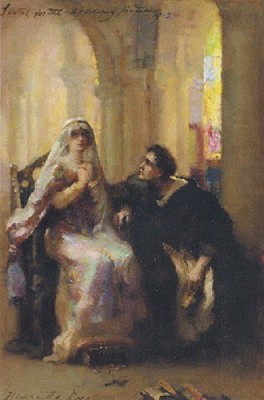
Painting of Ellen Terry and Henry Irving in Abelard and Heloise - by Henrietta Rae

The great Ellen Terry
I ask again. Where is my time machine to go see these two perform together?
March 12, 2009
"This irresistible ... Paris original ... I'm wearing tonight ..."
I've posted this photo before and I want to share it again.
Because it is important to remember, that even when you become an adult, and you are trying to navigate adult relationships, and maybe even nab a husband like this poor character ... inside, you are still an anxious geeky teenager, yearning for acceptance.
It is not a comfortable truth, but it is a truth nonetheless.
Playing this part (Miss Krumholtz in How to Succeed in Business) was hilarious for me, because my God, she is so vulnerable. But also so brave. Putting on a brave smile over the SHRIEKING NEUROSES beneath.
In a humorous side note, my friend Mitchell played my boss. We had very little to do with each other onstage, but of course we made up a whole story that he was sexually harassing me on a daily basis, chasing me around the office, and while Miss Krumholtz was perhaps horrified, because she just wants a husband dammit, and she is a true lady, not a slut in any way - she also endured it because ... maybe it means that her boss 'likes' her?
No, Krummy, I don't think so.
But I don't want to shatter her dreams. I mean, look at her face.

March 6, 2009
RIP Horton Foote
Great American playwright and Academy-Award winning screenwriter Horton Foote has died.
Ben Brantley writes, in his lovely appreciation of Foote's work, that
"[Foote] achieves his deepest effects by indirection and accretion of details, but the words are characteristic of his harsh sentimentality. He infused his characters with warm blood from his own, empathetic heart. But he also looked upon these same people with a cold and ruthless eye.I think he loved all his characters — even the silly, mean and mercenary ones (of which there are many) — but he was too honest to let any of them off the hook. That means that each, on some level, was born to realize that to be alive is to be alone in the dark.
Brantley's article brought me to tears. Don't miss it.
Here are two posts I wrote about Foote:
One about his one-act play "The Old Beginning".
One about his one-act play (one of my favorites of his) "The Blind Date".
Ted has two tributes up:
Our tender sharp-eared cultural chronicler
Ted writes:
I am realizing that this book reminds me of the plays of Horton Foote, but particularly his The Habitation of Dragons so redolent is it of a single moment of tragedy in a family's life. Foote writes in an unfancy American idiom of the dramas that buffet ordinary folk in early 20th century small town Texas, rather than Ireland. His words aren't inherently dramatic, they just contain the simple moments of lives unadorned, but moment builds upon moment until his characters are moved on a mammoth current of action that, in the case of Habitation of Dragons, is heart-rending. Foote is best known for the screenplays of Tender Mercies, To Kill a Mockingbird, and The Trip to Bountiful. He has written for the American theater from its heyday in the 1950s and is, I believe, still writing. I have directed and acted in a couple of his plays. I consider them required reading.
Horton Foote was 92. He was still working, up till the time of his death. The lights of Broadway were dimmed last night in his honor.
His voice will be missed.
March 2, 2009
"The performance is now." - Suzanne Farrell

Like most people, I have heard of Suzanne Farrell and knew she was a big deal in the world of ballet. Names like Gelsey Kirkland and Allegra Kent and Darci Kistler ... well, first of all ... aren't those all just great names? They SOUND like famous people. But their fame is enormous, and while I have never seen any of them perform, I am aware of their status. I'm just doing some ballet catch-up here! I just finished reading Joan Acocella's essay on Suzanne Farrell, in her book Twenty-Eight Artists and Two Saints (post about the book here). Other essays I completed this long weekend of flu-recovery and regrouping (not to mention plotting and scheming and conniving like a teenager) were essays on Jerome Robbins, Bob Fosse, Twyla Tharp, Martha Graham, Frederick Ashton, and Lincoln Kerstein. FASCINATING. I know just enough about these people to make it even more interesting for me. Well, about Fosse I know a bit more ... but I was not aware of Jerome Robbins' actual journey of life, and the back and forth between Broadway and ballet, and how he did what he did, and the style he came up with ... Anyway, these essays are amazing to me and I highly recommend the book. I'm moving now into yet another more intellectual section - essays on Mencken, Dorothy Parker, M.F.K. Fisher, Saul Bellow ... I know a lot of these people only through their writing, so I am interested to hear Acocella's take, and the biographical details that she weaves into her essay in such a graceful manner. This book really came along at the right time for me. Her writing is easy, yet just challenging enough to keep me engaged. I can feel her personality in the writing. This book is the opposite of "dry".
Acocella's essay on Suzanne Farrell came out in The New Yorker in 2003, and was focused on the brand new Suzanne Farrell Ballet, a company run by Farrell, the former star-ballerina and muse of George Balanchine (one of the many muses, but perhaps the most important one?? Out of my league here ...)
In reviewing the latest offering from the Suzanne Farrell Ballet, Acocella takes the opportunity to give us an entire retrospective of Farrell's life, and I am sure to ballet fans all of the details are well-known. Farrell and Balanchine were as talked about in the world of ballet as Brad and Angelina! Acocella really captures that time - and what it was like to be a ballet fan in New York City at that time, the excitement, the sense of involvement and personal ownership. My friend Ted, a native New Yorker, told me a little bit about it - because his mother is one of those huge ballet fans. So exciting!
But I was more interested in the character of Suzanne Farrell herself. A small obsessive personality, she, as a teenager, became the primary focus of Balanchine, who basically turned his entire ballet company into a vehicle for HER. He changed his style, he adjusted his taste, he had a vibrant "late period", which - in a man of his years and experience - is quite extraordinary. Farrell was not well-liked, although respected - there was a lot of envy of course, and she could be aloof and narrow (according to Acocella and the dancers who knew Farrell at the time.) Farrell was 16 when Balanchine plucked her from the barre and made her a prima ballerina. Resentment. But Farrell, like, I am sure, all ballerinas at that level, kept her nose to the grindstone, and didn't get distracted. I was most interested in that dynamic: the geek, the obsessive, the person who openly admitted doing "nothing" on her days off ... she had no interest in any life outside of ballet ... but then also the person who was, apparently, so fearless and so willing in rehearsals, that all Balanchine had to do was ASK and she would say "yes". She had no hesitation, no intellect getting in the way - just sheer physical trust. And so she grew ... she grew as an artist in an accelerated manner, and he grew with her ... and the entire company basically had to get out of the way. So on the one side, we have the prim nerd who does the crossword at home and reads her Bible every morning, and on the other side, we have the wild gyrating muse of the greatest man in ballet in the 20th century. Extraordinary. But I'll let Acocella take it from here. It's a marvelous piece, and I'm glad I got to know Farrell a bit better. One anecdote in particular (her directing another ballerina in her company) brought me to tears. It is just the kind of thing I like to hear: it's about the work.
From Acocella's essay on Farrell called "The Second Act"
Farrell was the most influential ballerina of the late twentieth century. Others before her had done what could be called modernist ballet dancing - lean and wild, as opposed to the plump and decorous nineteenth-century model - but Farrell, under Balanchine's tutelage, carried that project further than anyone else. What she performed was still classical ballet - she got out there with her hair in a bun and did glissade, assemble - but in her the classical style seemed to have sunk to the bones of the dancing. The flesh was something else, an awakened force. When she bent down into an arabesque penchee, you thought she would never stop. (She was the first dancer I ever saw touch her forehead to her knee in penchee.) When she executed a triple pirouette, and tilted as she did it, and then - without ever righting herself - plunged directly into the next jackknife or nosedive, you thought the walls were falling in. As Arlene Croce wrote, Farrell "made audiences sweat".
Here's the current-day anecdote that brought tears to my eyes:
A constant theme of her teaching is symbol-making. Susan Jaffe, formerly a principal dancer with American Ballet Theatre, told me about working with Farrell on Mozartiana for the 1995 season at the Kennedy Center. Balanchine made Mozartiana two years before his death, and many people believe that it is about his death. The music for the first section is Tchaikovsky's resetting of Mozart's Ave, Verum Corpus, a musical prayer, and as the curtain opens the lead woman (Farrell in the original), dressed in black, comes forward in bourree - the gliding-on-point step - meanwhile raising her arms very slowly. In learning the ballet, Jaffe was having trouble with the arms, so Farrell spoke to her. She told her that Balanchine had taken those arms from a statue of the Virgin Mary in the Church of the Blessed Sacrament on West Seventy-first Street, a few blocks from where he lived. Jaffe, who also lived near there, knew the statue, which is actually a rather ordinary marble Madonna, but with lovely arms, which she holds out to us softly, as if she were giving us something nice. No surprises here: death, prayer, Madonna, mercy. And maybe it was the memory of the statue which enabled Jaffe, when she finally performed Mozartiana, to use her arms as wonderfully as she did. I don't think so, though. "In that arm movement," Jaffe said to me later, "you bring your fingers together, and then open your arms. So this movement opens up into art and history - the neighborhood Balanchine lived in, and what he saw, and the history of the world." What Jaffe got from Farrell, it seems, was not so much a description as a suggestion, an idea: of something small, and one's own, opening out into something great, which then becomes one's own, too. With Farrell, Jaffe says, you work "from pictures in your mind, rather than 'Is this a good fifth position?'"
God, I find that so moving. Directors who use suggestion like that ... as opposed to something too literal, or corrective ... are my favorites, and always helped me feel totally free, like I could do this, I could do this on my own.
Obviously Jaffe's technique was fine. Farrell didn't need to work with her on that. She needed her to think about something, that would help her bring out the idea of the moment - and that is something that is very difficult to describe or pass on. Directors who can do that have a gift.
A couple more excerpts:
Farrell, as a dancer, had certain technical shortcomings - she wasn't a jumper, and she couldn't really do allegro (fast, small, fine-cut steps) - but no one in the world was more musical. Her connection to music seemed to be something acutely neurological. ("Even in rehearsal," she says, "when the pianist would start to play, I would get nervous, agitated.") As she sees it, music and dance are much the same thing. "There's sound in movement," she says, and space in sound. The dancer's job is to show - or make - the relation between the two: "There's a clarinet cadenza in Mozartiana that's very hard to count, but say you count it out, and it's thirteen counts. So you tell yourself, 'All right, I've got time for three pirouettes.' But what about the music's internal time? What if one note is louder, so it needs a bigger response from you, and that takes longer? What if the clarinettist doesn't have as much breath that night, so the music sort of fades in and out? You can't really dance to counts, or I couldn't. On any given night, at any given point, I didn't know if I was going to do three turns, or two, or four. You have to dance in the drama of the music, in that timing, at that moment."
And lastly:
[Balanchine] wanted big steps, steps that could fill that echoing stage [at the new theatre at Lincoln Center]. But he was certainly influenced by the fact that he now had, in Farrell, a young wildcat who was dying to do big steps. And so, in collaboration with her, he developed a new style. Farrell calls it "off-balance" dancing, and its off-balance qualities - the reckless tilts and lunges - were indeed the first thing one noticed about it, but it was also new in its utterly plastic musicality and, above all, in its scale. Farrell's movement came in bolts, in waves, in tearing trajectories. (Balanchine rarely sent her out onstage without an expert partner, one who could prevent her from hurling herself into the orchestra pit.) Even when her dancing was slow, it was wild: pooling, flooding. And she performed this way not just in Balanchine's new ballets but in his old ones as well. She changed the repertory, and, as other dancers emulated her, she changed the company. In time, she affected every American company. If, today, American ballet dancers are notably headlong - feat-doers, ear-kickers - that is due in part to Farrell. And if, when they are also profound, they are profound in a cool, exalted, unactory way, that, too, in large measure is Farrell speaking, or Farrell and Balanchine.
Some images below of this teenage phenom, who was so young at the time of her great triumphant debut, that Balanchine had to take her out to Dunkin Donuts afterwards to celebrate. Amazing.


February 27, 2009
Nureyev and gender
I still can't really read, but here are some Nureyev images, since he's been on my mind. I am halfway through the Nureyev book, and hopefully I'll get to finish it some day.
I love the androgyny of Nureyev in the pictures below (especially the one of him and Fonteyn, with him upside down - in the classic swan dive usually associated with females, her head close to his crotch level). It's gorgeous, erotic, but also unsettling to regularized gender roles, up-ending convention, which is one of the main things Nureyev appears to have contributed to ballet. As a youth, in Russia, the style was that the male was basically the "heavy" - he was meant to be statuesque, strong, and classical, and be able to lift the female about. Macho. Unemotional. This sort of static dancing, although highly technical, requiring great skill, bored Nureyev, and he got some intimation of the winds of change going on in the West, through seeing grainy tapes of this or that ballet dancer in the West, and he realized (perhaps without articulating it to himself) that things were changing "out there", outside of Russia, and he needed to be a part of it. Rigid preconceived notions of gender dissolving. Nureyev stopped modeling himself on the male dancers he saw around him, and began focusing on the ballerinas, imitating THEM, bringing their long flowing grace into the male parts ... and at the time it was hugely controversial.
Good for him.
He's so beautiful, and so strong, but there is also a softness about him that lets you, the viewer, in. It was a revelation at the time. It occurs to me that this is similar to the great conversation Catherine, Desirae and I had in the comments section to this post, about Kurt Cobain, that most superstars have a certain amount of androgyny. The hard mixed with the soft, female and male ... We were talking there about rock stars, but you can see it in actors too, especially the old-school actors with their set recognizable personae. Joan Crawford - all woman, all curves and legs, but with a backbone of steel and a hardness to her. Gary Cooper - all man, all lanky legs and straight-edges, but with the ability to show us behind the mask, all the softness and hopes and fears, in a way that would be "typically female". The obvious examples of Marlene Dietrich, who consciously toyed with gender in every role she played. Montgomery Clift, Katharine Hepburn, Rosalind Russell, Cary Grant, Barbara Stanwyck ... each had some aspect of androgyny to them, either conscious or no, which (to me) just makes them even more universal.
Nureyev made this androgyny his stock-in-trade. Well, that, and being the best dancer he could be. I think a lot of his persona was not so much calculated and consciously created, but just the result of a killer instinct.


February 5, 2009
"We only lived when we danced." - Rudolf Nureyev
"They seemed aware of each other even when their backs were turned. When their eye met, a message was passed." -- Alexander Bland on Rudolf Nureyev and Margot Fonteyn

"To see Fonteyn was one thing. To see Nureyev was another thing. But to see Fonteyn and Nureyev together, on the same stage, with their particular love and assurance, was almost indescribably special." -- NY Times, 1979
"Combine the smolder, the mystery, the dynamic presence, the great streaks of vivid movement which Nureyev gives us with the beauty, the radiance, the womanliness, the queenliness and the shining movements of Dame Margot…" -- Walter Terry, ballet critic
"You couldn't believe they both hadn't sprung from the same school." -- Ninette de Valois, director of Royal Ballet
" ... two ends meeting together and making a whole." -- Ninette de Valois
"My husband called it [the partnership of Nureyev and Fonteyn] a celestial accident. To probe into its componenets is like trying to analyze a moonbeam." -- Maude Gosling, (ballerina wife of writer Nigel Gosling - good friends of Nureyev - and the two wrote a dance column together, under a joint pseudonym, Alexander Bland)
"Emotionally, technically, physically - in every way. They were just meant to meet on this earth and dance together." -- Ninette de Valois
Excerpt from Nureyev: The Life
When their rehearsals recommenced in Italy, Margot, despite having broken their deadlock, sensed a major challenge. Who in the audience would look at her "with this young lion leaping ten feet in the air and doing all these fantastic things?" Enormously competitive by nature, she also thrived on adventure and risk (the side that had made her a faux-guerrilla in her husband's abortive minirevolution in Panama in 1959). Tapping into this, Rudolf taunted her one day by saying, "So - you are Great Ballerina. Show me!" Suddenly she found herself virtually outdancing her partner, while he watched "puzzled," asking himself how it was possible that she, "without technique was doing technical things, and me, taught the best technique ... not always there?" Only too aware of her stature - her name in world terms being far better known than that of Ulanova - Rudolf himself now "felt a bit ... Well, when I'm onstage beside her, who's going to look at me?" He had always found it extraordinary the way Margot, even without this new virtuoisic confidence, could make her impact felt not through showy aplomb but through her soft, lyrical, English restraint and unforced line. There was no trace of sensationalism in her artistry, yet something so excitingly internalized that, even when standing motionless, she could draw all eyes toward her. "She came onstage," as Rudolf said, "and she made light."
"I've found the perfect partner." -- Margot Fonteyn
"We become one body. One soul. We moved in one way. It was very complementary, every arm movement, every head movement. There were no more cultural gaps; age difference; we've been absorbed in characterization. We became the part. And public was enthralled." -- Rudolf Nureyev
"In many ways they were very bad for each other. Margot had always been so serious and professional, but she changed entirely when Rudolf was around. They were never on time, and we'd sit in the bus waiting to go to rehearsal until finally they would roll up giggling and joking like a couple of children." -- Annette Page, a Royal Ballet principal
"I never saw her so liberated. The confidence it gave her was incredible. It was a development of somebody who suddenly had about ten years taken off her." -- Ninette de Valois on the 1962 production of Le Corsaire (their debut)
Excerpt from Nureyev: The Life
Waiting in the wings for her entrance, the ballerina admitted that she found it so exhilarating to watch Rudolf that she lost all nervousness for herself. She claimed that it was her belief that the audience was looking at him, not her, that had allowed her to relax, and "really dance for the first time".
"He was transfigured when he danced. I'd never seen such unearthly beauty. He seemed unreal; not of this world - like an archangel." -- Ballet fan on Nureyev
Excerpt from Nureyev: The Life
"We have to remember what Rudolf looked like back then on a staid British stage," says writer and photographer Keith Money: "The bare midriff and all that glitzy Soviet campery were to some the absolute height of bad taste." Most people, however, were transported by the sight of this exquisite youth yearning up toward Margot as the curtain fell, his fingers splayed, his back arched and pelvis thrust forward - "like a great Moslem whore". And it was not only his passion and animality that were so stirring, but the speculation their union prompted about the ballerina's own sexual depths. It made Verdy think of the King Kong legend - a "scene of seduction and cruelty ... like the whole thing really was a bedroom ... and you were watching through the keyhole."

"He brought her to a higher pitch of approach. He came at a period when she had lost Michael [Somes - Fonteyn's dance partner for 14 years] and it was all rather run of the mill. Suddenly this enormous impulse came, and she just responded to him." -- Frederick Ashton
"Had I been younger, I would have found it extremely difficult to accommodate Rudolf's very fixed ideas and his, shall we say, outspoken way of expressing them. Quite simply, we were so far apart that we could come together." -- Margot Fonteyn
Excerpt from Nureyev: The Life
No Royal Ballet premiere had ever been so eagerly anticipated as the charity gala on March 12, 1963. It had been a risk submitting a nineteenth-century penny-novel melodrama to a public just waking up to a new era of kitchen-sink reality (even Ashton admitted his story was "old hat"). But to Peter Brook, reviewing the ballet for The Observer, the dancers' depth of conviction not only brought dramatic credibility to their roles, it breathed life into the genre itself, making "the most artificial old forms suddenly seem human and simple." There was certainly nothing conventionally "balletic" about Margot's display of anguish, the kind of raw, visceral emotion said to have defined Sarah Bernhardt's portrayal of Marguerite. It was a starkness that derived from the novel, not the play, which is as trite, sentimental, and far removed from the original as the 1966 film of Marguerite and Armand is from the stage version of the ballet. Ashton wanted a kind of jarring effect from his dancers, their primal lack of inhibition countering the billet-doux sweetness of what had gone before. Keith Monty still remembers the bluntness of the closing image: "When at last he let her hand fall away, she let it thump of its own weight onto the stage. Audibly. It was simply gut-wrenching, and so final. I'd never experienced quite that sort of theatrical involvement before - of being absolutely wrung out."
"Margot always said that for her, real life comes when she's onstage. I absolutely agree. We functioned between those snatches of real life onstage. We only lived when we danced." -- Rudolf Nureyev


February 3, 2009
Terminal Bar
I've always been a little bit obsessed with the play Terminal Bar

I love the play. It's only a one-act but it feels full-length, with three awesome juicy characters.
I worked on it in grad school, playing the part of my dreams, and it was a lot of fun, although frustrating, because all I wanted to do was rehearse the play for realz and put it up!
The funniest and weirdest thing is that I got a Polaroid camera (of course) to take photos of myself through the scene. The whole point is that she has to look at herself immediately - the Polaroids become her mirror. "How am I doing? Do I look sick? Do I need more Aqua Net? More rouge?"
It's grotesque. But somehow hilarious as well.
It's almost unheard-of to take pictures of yourself in the middle of a scene, so these two photos make me laugh. The second one is TERRIFYING. She really is under the impression that she looks like a million bucks!
And please, where did my upper lip go? I have never smiled like that before or since, thank the good Lord above, JESUS.


February 1, 2009
The Alvin Ailey flat-back series
Here is a picture of my dear friend Shelagh and myself, before dance class at the great Alvin Ailey dance studio. We took classes in the famous Horton technique - which involves the "flat-back series", great for balance and also your abs and thighs - lots of squats and lunges - all with your back flat as a board ... but it sure makes you look ridiculous. We would watch the real dancers - the real Alvin Ailey dancers - taking classes and we would watch them do the same flat-back series and think, "God, it looks so elegant when they do it. We look like crouching Hobbits hidden midgets."

January 30, 2009
Dressing room
This is the dressing room at the Shattered Globe Theatre in Chicago. That place STANK. We all felt that there must be a rat decaying behind the walls or something. But oh, the hilarity in that co-ed dressing room. Hard to even describe, but we all remember it well.

"Even his walk made him different from everyone else."
I'm reading Nureyev: The Life
Additionally, any author who approvingly quotes from Robert Conquest's book to support her themes and to create the appropriate atmosphere is okay in my book. Conquest is one of my all-time idols and I felt a weird proprietary thrill when I saw her quoting from The Harvest of Sorrow: Soviet Collectivization and the Terror-Famine

I also appreciate Kavanagh's honesty about Nureyev's personality, which was notoriously difficult. One of the impressions I am getting from the book, so far, and it is really moving - is that Nureyev was one of those people who was aware, very early on, that life is short, we do not have a lot of time, and you have to take your chances when you can find them. You also must make your own destiny. You want to dance for Balanchine? Make it happen. He was ruthless, relentless, and he always always always had his eye on the ball. This made him a nightmare, even for other geniuses in the field, who perhaps had more of a balanced response to life ... but Nureyev was not balanced. It was dance, and dance only. This was a man with a destiny. You can sense it. And he could too. Such creatures are rare.
I am loving the book. Highly recommended.
Here's a picture of Nureyev, age 14 or 15, in a ballet studio in Ufa, where he grew up. This was before he moved to Leningrad, and joined the Kirov.

January 20, 2009
Scanning Tuesday
The big night of my performance in After the Fall - a big night for me, in general. My parents were there, my sister Jean, my brother Brendan, Brendan's friend Justin, my dear friends Brett and Liz, my aunt Regina and uncle Tom ... the production was at Circle in the Square Downtown and it was just one of those magical nights, when you feel proud, happy, successful, and you are surrounded by people who love you and want to celebrate you. It was a night that glittered.
There's one here of my dad looking at me in a proud and tender way. I think my uncle Tom took this picture, and I am very grateful.


January 18, 2009
Scanning Sunday
Shots from a ridiculously fun show I did about 10 years ago - it was a new play, a spoofy crime noir, with dialogue like Reservoir Dogs, and a mysterious character named "Gertrude" who is never seen, but is omnipresent, frightening. When Gertrude commands, you jump off the bridge. A mix of Pinter and Tarantino - a cast of five women (all awesome funny people) - and their characters all dressed either like floozies or glamour-girls - while I wore an old-fashioned navy blue man's suit, a fedora, a tie, and I also chain-smoked Lucky Strikes. Everyone was afraid of me. I was completely humorless. It might be the most fun I have ever had on stage. It was never explained in the script why my character - a woman - dressed like Humphrey Bogart in a film noir in the 1940s, but I made up a whole story for myself about the whys and wherefores of the whole thing, and loved my costume, almost more than the play itself.
The whole thing was a blast. The script won a couple of nice awards, and that made me happy. It had a lot of wit.


January 16, 2009
Scanning Friday
A couple of things about the photos below:
1. I was in a play (a couple different versions of it over the years) and it told the story of a couple, already on the rocks obviously - who are up late at night, with the rain pouring down (neat effect on the window)... and over the course of the play, some things come out about the past of my character (or, more specifically, something her grandmother did during the Holocaust) that pretty much destroys the relationship between the couple. It was meaty, juicy stuff - and I loved doing it.
2. I did not, however, love the haircut that I got a day before we opened the first production (photos below). I was so upset about the hair (the uneven badly-done layers, the strange swoop of bang in the front) that I actually cried in the chair at the salon. I wouldn't have cared so much but I knew that the haircut would now live on forever in the photos of the production. And so it has.
3. I love these photos because the photographer took them during a production, first of all - not staged scenes during a special photo call with no audience, which sometimes can have an artificial posed look to them. Here, we are actually in the process of doing the show, and it certainly makes a difference in what the photos look like. Also, the dude was in the damn back row, so as to be unobtrusive to the rest of the audience- but look how close he got in his zoom. Love that. I like that closeup one of us on the couch - because it looks (to me) as though we are having a private conversation, but we're in front of a live audience. That's the way it should be. But kudos to photographer-man for capturing the moment.
The theatre was not huge, by the way, but neither was it small. He managed to be everywhere, nowhere, unobtrusive, and also competent - all at the same time. I want a zoom lens like that.


January 14, 2009
Scanning Wednesday
This one's for you, Tracey.
Just wanted you to know that the children are praying now.
I think it's time to call Child Protective Services,

Scanning Wednesday
In college, I played Anne Shirley in the giant production of Anne of Green Gables, the musical. It was a huge coup for me, getting the part, I had to work my ass off, and the show ended up going on to compete in the regional Kennedy Center ACTF (American College Theatre Festival) which was one of the most exciting experiences of my life. The next year, I played a chorus girl in Edwin Drood (and I had no lines) and I almost had more fun with that, because the pressure of being the STAR was off - but there was nothing quite like being "Anne".
The great thing about our college was that we cast from "outside" as well - local actors who were adults - and these were not Catherine O'Hara and Fred Ward in Waiting for Guffman - many of them had acted at Trinity, or in the well-respected second-tier theatres - fantastic actors - so we rarely had 21 year old students putting on wrinkle makeup and grey hair to play the old person... we had the real deal. So we the students usually played our own ages, and then the cast was filled with authentic people who were right for their parts. Makes a huge difference in the feel of the show.
The guy who played Matthew - Chris Brayton - was just a fantastic man, in his late 40s, probably - with a long Amish-type beard, and a gorgeous baritone voice. You just melted when you heard it. And Matthew is a hard part - he stutters, stammers, has no social graces, yet if you don't believe that he falls in LOVE with that talkative 12 year old orphan - the entire thing won't work. He nailed it.
At the end of the play, Anne has had some triumph - maybe academic, the details escape me - and she is wearing the dress with the puffed sleeves that Matthew went and got for her, against Marilla's wishes. Anne is all hyped up in her excitement, and Matthew is quietly proud of her - and at the end of the scene, she sits at his feet - and he sings the heartbreaking simple song "Words" - basically how he "can't find the words" to say what is in his heart.
Not a dry eye in the house, peeps. I'm just sayin'. Especially if you are already familiar with Anne and know about what happens to Matthew.
Here's a photo of him singing "Words". I just think it's a beautiful photo - look at his face. It looks like Lincoln or something. And the way the light is hitting it ...
I would be sitting there, all happy and proud of my Anne triumph, and I would hear the sniffles start to come from the audience, and - in one case - great heaving sobs.
It was awesome!
Cry, bitches, cry!!

Scanning Wednesday
I have written ad nauseum about the half-hour Macbeth I was in. I have detailed the journey of the five witches (YES. FIVE. The play was much shorter but there was enough room for FIVE witches) and how we were alllllll about our makeup.
This is my friend Jen. Over the course of the show, she would systematically try to make her hair bigger and bigger, to shield her face.
I'm not sure, I have to check my notes, but this could be the funniest photo ever taken.

January 13, 2009
Scanning Tuesday
Okay, so I am outrageously proud of this photograph.
I was in a show my freshman year of college - it was a jolly Victorian murder-mystery - and there were a lot of kids in it. Big crowd scenes.
One of the little girls, who wore a red cape in the show, liked to jump rope backstage. I happened to snap this photograph of her coming down the hall backstage - and she looks truly DEMONIC. The lights are off because it is during a show ... so she appears to be coming at me like some demonic angel of death!
I love this picture so much. Especially because it is not posed - she was truly just having an innocent moment of fun during her long boring stretches backstage - but the photo just happened to come out creepy as hell.

January 11, 2009
Scanning Sunday
In the 4th grade, I played Gretl in a production of Hansel and Gretl.
Here I am, slaving away at my sewing, beside my brother Hansel.

Scanning Sunday
More theatrical exploits! This is me backstage during our wonderful college production of Edwin Drood. I played a music hall floozy. I don't think I've ever had so much fun in a show in my LIFE.

Scanning Sunday
"Consider yourself ... AT HOME ..."
Another example of my earlier acting career. I played Artful Dodger in the school play.
Joe Hurley would be so proud.

Scanning Sunday
A snapshot of me during one of my earliest theatrical productions. I played a grumpy cynical mirror in a local production of Sleeping Beauty. I was absolutely brilliant!!
I was 10.

December 30, 2008
The Bard's meme
Got this from Ted.
What was your first introduction to William Shakespeare? Was it love or hate?
I honestly can't remember. Since I've always been obsessed with acting, I imagine my introduction was quite early. It wasn't a literary introduction so much - it was a performance introduction. He was a man of the theatre. I read his stuff looking for monologues, because he counted as "classical". I have always loved Shakespeare. I love the challenge of performing it (it can bring me to my knees!), and I also love reading it out loud, to this day. Other people do yoga. And I suppose I should do some yoga too. But to relax, I read the sonnets out loud. When I was about 12 years old, my parents took me to a production of Twelfth Night at the local university (where I ended up going) and I was transported. Malvolio was such a buffoon! When he descended the stairs wearing the yellow stockings with the blue ribbons, thinking that was what was wanted of him, I almost died laughing. What a pompous ass! The production was marvelous - funny, sexy, and clear as a bell to me, the tween in the audience. When you see a production like that, it makes you want to try to say the words yourself, and make them come as much to life as those actors did.
Which Shakespeare plays have you been required to read?
In my career, I would imagine all of them. I took a couple of Shakespeare courses in college, and we read most of the plays - and the rest were covered by my various acting classes. And now, like I mentioned, I just read them for fun. There isn't one of his plays I haven't read, but I honestly can't remember what I read for class, and what was just for pleasure or preparation. I started this whole Shakespeare project on my blog (here's the Two Gentlemen of Verona piece) and ... well, I would love to get back to it. I had a ton of fun putting that piece together. One thing that I have never done (which was the original point of the Shakespeare project) was read the plays in chronological order.
Do you think Shakespeare is important? Do you feel you are a “better� person for having read the bard?
Of course Shakespeare is important. To say he's "not important" is like dismissing our entire heritage. That would be totally retarded. Of course he's important. And to the second question - I already think it's funny that "better" shows up in the question in quotation marks, which already betrays the bias or insecurity of the person who wrote the quiz. To just blatantly say, sans quotes, "Yeah, I think I'm a better person" is far too assholic to be borne, and so the protective quotation marks are there to keep us all safe. No, I don't think I'm a "better" person. But I do feel grateful and blessed that Shakespeare is in my life, and also that I know him well enough to refer back to him in my mind, in moments of stress or conflict, that I can call upon his plays to provide context to the messes of MY life ... I feel really enriched because I know him. But better? Or, oops, should I say "better"? No. Some of the kindest most loving people I know have never read a play of Shakespeare's. Big whoop. Or should that be "big" whoop? Or big "whoop"? But in all seriousness, I love that I can see a random act of kindness from somebody and immediately go to that line in Merchant of Venice in my head ("how far that little candle throws his beams ... so shines a good deed in a naughty world"). Other people have said things about random acts of kindness ... but no one has said it as well as Shakespeare did in that line.
Do you have a favorite Shakespeare play?
I am partial to As You Like It, Hamlet and Much Ado About Nothing.
How do you feel about contemporary takes on Shakespeare? Adaptations of Shakespeare’s works with a more modern feel? (For example, the new line of Manga Shakespeare graphic novels, or novels like Something Rotten, Something Wicked, Enter Three Witches, Ophelia, etc.) Do you have a favorite you’d recommend?
I love adaptations! I am not a purist. Sometimes, in stage productions, a director has a concept - and it just doesn't work all the way through ... but when the concept really hits it can be exhilarating. I LOVED the recent Macbeth I saw with Patrick Stewart. I didn't think there was possibly a way to make those witches frightening - I've seen the play so many times, I have been a witch myself ... It's usually silly. The Macbeth stuff is gripping, but it's hard to make those witches scary. But this production? Those witches were fucking SCARY. Bra-VO. That probably had a lot to do with the Stalinist concept - and the sense that the witches were the agents of the KGB, or something omniscent ... creatures that could be everywhere at once ... those girls were TERRIFYING. When a concept doesn't work, you can feel the play collapse. I liked Baz Luhrman's adaptation of Romeo and Juliet but he did not deal, sufficiently, with the fact that modern-day gangs would use guns, they would not have sword fights. It was tongue-in-cheek, how he handled it - and I know lots of people liked it, but I didn't. You can't be tongue-in-cheek with Romeo and Juliet. Gangs use guns nowadays. They would not have long-drawn-out fights with swords or knives. I'm not saying you can't transplant the play into a modernday era, but I think you need to deal with that pesky issue in a more honest fashion than he did. The MTV inspired filming is also perfect for that young-teens-in-love story ... but I thought his way of dealing with the fact that there are no guns in the play was a copout. Shakespeare's plays must be dealt with on their own terms. If you try to make Taming of the Shrew into a feminist manifesto (as nearly every production now does), it WILL COLLAPSE. The script does not support your academic and politically correct reading of it. So please, directors, I beg of you. Stop trying. The best "adaptation" of Taming of the Shrew that I ever saw was that one episode of Moonlighting with Cybill Shepard and Bruce Willis sparring around the table in Elizabethan costume. (my favorite clip below) Yes, yes, yes, that is exactly how that text needs to be handled. Taming of the Shrew not only can handle the tongue-in-cheek, but it needs it desperately. If you play it straight, the audience of today will not stand for it. So the asides and snarks are just marvelous in that Moonlighting episode ("If you're a man, you gotta love the 16th century") ... and it makes the play (which is, in actuality, already a play within a play - it is already something totally artificial) perfectly realized. It was absolutely brilliant, a highwater mark in television as far as I'm concerned. Your best bet with that material is to go with a 1930s/40s-era screwball comedy vibe - something that predates the modern gender-definitions (which was also the hot-and-heavy intellectual-and-sexual-sparring vibe captured in the Raul Julia / Meryl Streep version in Central Park - I saw a video of that production, which made Streep a star, and it is, to date, one of the most exhilarating things I have ever seen in my LIFE). But seriously: if you try to make that play into "I am woman, hear me roar" - the text will not support you. So STOP TRYING, GODDAMMIT. The play is good enough on its own. Stop imposing. It doesn't work. Also: the parts that DON'T fit into our modern-day concept of gender are the best parts, the most troubling parts ... don't avoid them, or try to iron them out ... PLAY them for all they are worth.
Thank you.
I know no directors are listening to me, because Taming of the Shrew continues to be a pesky problem, and that's a shame. I really feel that any director who wants to put up that play needs only watch, oh, The Big Sleep or Only Angels Have Wings, or Bringing Up Baby - hell, just watch ANY Howard Hawks movie - and you will be halfway there.
The last exchange in The Big Sleep goes like this:
She: And what about me?
He: You? What's wrong with you?
She: Nothing you can't fix.
I can hear the heads explode in women's studies departments around the country, but that's the whole point. If you watch The Big Sleep and feel that Lauren Bacall is in any way oppressed or victimized, you need to have your head examined.
What’s your favorite movie version of a Shakespeare play?
I loooooooooove the Much Ado About Nothing with Emma Thompson and Branagh and all the rest. More than any other production I have seen of that glorious piece of playwriting - that adaptation captured the sheer joy of the thing. It is a delight.
December 11, 2008
Promoting my peeps: Kerry in "White Christmas"

So White Christmas continues its New York juggernaut, including performing at the NYSE ... and at the moment, my cousin Kerry is pretty much everywhere. Just so you know. It's kind of like those melancholy scenes in Notting Hill when Hugh Grant is trying to forget the lovely Julia and a bus drives by with her face plastered across the side. Not that I'm melancholy. Or trying to forget Kerry.
I'm just saying. She's everywhere. Watch your back.
And Kerry, uhm, not sure if you've noticed but ...

Robert DeNiro appears to have his arm around you.
Just thought you should know. In case you were not aware of it.
Anyone who is coming to New York this holiday season: White Christmas is not a show you want to miss! I saw it last year in Boston and it is a lovely show, beginning to end, funny, smart, heartwarming, and gorgeous, with a heart-stopping number by Kerry in the second act. Jean and I almost held our breath through the whole song, it was just too intense. Chock-full of Irving Berlin songs. What more do you want??
Promoting my peeps: Mitchell: "Santaland Diaries"
Sooner or later, I will be able to promote MYSELF but in the meantime:
Chicago-People! Listen up!
My dear friend Mitchell has returned for (what) the 4th year running (maybe even more) to the Theatre Building to perform in David Sedaris' Holidays On Ice - the hilarious stories of Sedaris' experiences as a Macy's Christmas Elf.
Uhm ...

I find this terrifying. Please look at the Santa mug on the table and tell me you are not scared.
When: Fridays and Saturdays : 9:30 p.m. (ends January 3)
Sundays : 3 p.m. and 7 p.m. (ends January 3)
Thursdays, Fridays, and Saturdays : 7:30 p.m. (ends January 3)
Except December 25 and January 1
Price: $22-$24
Event Phone Number: 773-327-5252
Ticketmaster: 312-902-1500
Box office: 773-327-5252
Mitchell, I'm going to kill you for that photo! I wish I could fly out there and see it!
From the cell phone camera: BAM
This is from when I went out to Brooklyn to BAM to see Patrick Stewart in Macbeth. The night was very windy, as I recall - and there were these giant floodlights that made the sides of buildings look eerie, noirish, or futuristic.


November 22, 2008
White Christmas news

A great compilation of photos from the production is in Playbill.
An interview with the cast of White Christmas in Backstage. I love this one comment from Kerry:
Well, it is a showbiz musical in that it's about entertainers who are doing numbers, but it's not self-mocking in the way that so many shows are of this time. We're not making fun of show business.… It's living in the style, as opposed to commenting on it.
How refreshing! And the show does work on that level: a sweet sincere and un-ironic level. It's gorgeous.
November 16, 2008
Larry Clarke has "Perfect pitch" at the Roundabout
A revival of David Rabe's Streamers just opened here at the Roundabout, and Larry Clarke (great friend of my brother, and of the entire O'Malley clan in general, not to mention Cashel) plays Sergeant Cokes.

Larry and J.D. Williams
The review is up in the Times. It's a great review. I've been looking forward to seeing it. Larry played the role in a production in Boston at the Huntington that garnered such raves they have brought it to New York.
The review closes with these words:
“Streamers� is not perfectly put together. The play circles its themes for too long and becomes repetitive. And the monologue that closes it, delivered with perfect pitch by Larry Clarke as the gonzo Sergeant Cokes, is overwritten.But this last, rambling speech contains a truth that sheds a hard light on all that has passed. Only the soused Sergeant Cokes, suffering from heart problems, achieves a measure of wisdom about what matters and what doesn’t, given the unpredictable coming and the unavoidable fact of death.
Hearing Richie sobbing, he interrupts his tale of a fatal freak accident to ask what’s wrong. “He’s queer,� Roger answers. Unexpectedly, this bleary-eyed man’s man doesn’t flinch. “Boy, I tell you it’s a real strange thing the way havin’ these heart arrhythmias give you a lotta funny thoughts about things,� he says. “Two months ago — or maybe even yesterday — I’da called a boy who was a queer a lotta awful names. But now I just wanna be figurin’ things out.�
Good for you, Larry. Can't wait to see it.
November 10, 2008
Images of Ophelia

Here is a scene from the great Canadian television series Slings and Arrows. The company of actors is rehearsing Hamlet, and it is not going well. The actress playing Ophelia, Claire, is terrible and nobody knows what to do about it. She is a niece of a board member and nobody can get rid of her. She makes a mockery of Ophelia's mad scene, dancing around, letting daisies drop, singing in a fluttery voice, as though she actually believes this is American Idol. Jeffrey, the loose cannon director, fresh out of a mental institution, stops her during rehearsal.
CLAIRE [as Ophelia]
And will not come again
No no he is dead
Go to thy death bed ...
JEFFREY
Stop. For God's sake, stop.
CLAIRE
What?
JEFFREY
Where is this coming from?
CLAIRE
What?
JEFFREY
This staggering about with your mouth open.
CLAIRE
You're being sarcastic again with me. Please don't be sarcastic with me.
JEFFREY
Actually, I'm not. Sorry.
CLAIRE
Ophelia's mad.
JEFFREY
Right.
CLAIRE
I'm playing her madness.
JEFFREY
And how does staggering about with your mouth open suggest madness?
CLAIRE
I'm not mad.
JEFFREY
Right.
CLAIRE
And I never have been, so I have to simulate it.
JEFFREY
Right.
CLAIRE
I'm using sense memory. I'm remembering what it was like being stoned and I'm using that. I'm disoriented, my head is spinning, I think that's what it's probably like when you're insane.
JEFFREY
Right. Well. It's not. Trust me. That's what it's like when you're stoned.
CLAIRE
Oh, forgive me, I mean no disrespect, but I don't have your experience with insanity.
JEFFREY
Right.
CLAIRE
And this is hard, anyway, because I can't take any meaning from the text. Ophelia's just singing nonsense songs.
JEFFREY
Right. Claire. Claire, Claire, Claire with the hair. Ophelia is a child. She has been dominated by powerful men all of her life and suddenly they all disappear. Her brother goes to France, her father is murdered by her boyfriend and he is shipped off to England. She is alone for the first time, grieving and heartbroken and guilty - because, as far as she is concerned, it is all her fault. She ignored her brother's advice and fell in love with Hamlet and now her father is dead - all because of her - and the pain and the loss and the shame and the guilt, all of this, is gnawing away inside this little child's mind and it comes out as 'little songs'. 'And will he not come again? And will he not come again? No. No. He is dead. My father is dead and I killed him.' 'Kay? Now, let's try it again ... without the Vietnam flashback.
And now: the scene itself:
Hamlet, Act IV, scene 5
LAERTES
How now! what noise is that?
Re-enter OPHELIA
O heat, dry up my brains! tears seven times salt,
Burn out the sense and virtue of mine eye!
By heaven, thy madness shall be paid by weight,
Till our scale turn the beam. O rose of May!
Dear maid, kind sister, sweet Ophelia!
O heavens! is't possible, a young maid's wits
Should be as moral as an old man's life?
Nature is fine in love, and where 'tis fine,
It sends some precious instance of itself
After the thing it loves.
OPHELIA
[Sings]
They bore him barefaced on the bier;
Hey non nonny, nonny, hey nonny;
And in his grave rain'd many a tear:--
Fare you well, my dove!
LAERTES
Hadst thou thy wits, and didst persuade revenge,
It could not move thus.
OPHELIA
[Sings]
You must sing a-down a-down,
An you call him a-down-a.
O, how the wheel becomes it! It is the false
steward, that stole his master's daughter.
LAERTES
This nothing's more than matter.
OPHELIA
There's rosemary, that's for remembrance; pray,
love, remember: and there is pansies. that's for thoughts.
LAERTES
A document in madness, thoughts and remembrance fitted.
OPHELIA
There's fennel for you, and columbines: there's rue
for you; and here's some for me: we may call it
herb-grace o' Sundays: O you must wear your rue with
a difference. There's a daisy: I would give you
some violets, but they withered all when my father
died: they say he made a good end,--
Sings
For bonny sweet Robin is all my joy.
LAERTES
Thought and affliction, passion, hell itself,
She turns to favour and to prettiness.
OPHELIA
[Sings]
And will he not come again?
And will he not come again?
No, no, he is dead:
Go to thy death-bed:
He never will come again.
His beard was as white as snow,
All flaxen was his poll:
He is gone, he is gone,
And we cast away moan:
God ha' mercy on his soul!
And of all Christian souls, I pray God. God be wi' ye.
Exit
LAERTES
Do you see this, O God?
I went a little "insane" myself below. Images of Ophelia through the centuries: actresses who have played her, painters who have painted her ... the erotic ones, the violent ones, the pre-Raphaelite ones, the art Deco ones ... I couldn't stop gathering images. Once I decided to do this post (I've been reading a biography of Oscar Wilde, and most of his painter friends - the pre-Raphaelites and decadent aesthetes all did paintings of Ophelia, so I decided to look some of the paintings up - and as I started digging, I found myself getting further and further into the world and moved out of that late 19th century era and into other eras, until finally I was totally and utterly lost (in the best way) - and figured I would do kind of in imitation of this one I did about images of Moby Dick. I very quickly realized that I, to put it mildly, was NOT the first one with this idea. BOOKS have been written about portrayals of Ophelia in paintings and etchings! I also found many old photographs of actresses who have played the role (including one of Ellen Terry - see if you can pick her out!) - not to mention some more modern 20th century ladies.
I love to see all of the different sensibilities of the artists, and how they see it, how they enter in, what it is that calls to them about this particular character, especially her mad scene and her drowning scene.


November 5, 2008
The Books: "The Story Of My Life" (Ellen Terry)

Next book on my "entertainment biography" shelf:
The Story of My Life
This is one of my favorite books in my entire collection, just in terms of it as an object. Second only to the first-edition Ulysses that my dad recently gave to me. The book I have is a second or third edition according to the copyright page (I can't quite tell which) - but either way, the book I own actually came out around the time that it was published. Boy, they knew how to make books back then! The pages are thick and shiny, and you can see the indent of the print on the page. There is a frontispiece of Ellen Terry, and a beautiful title page, with ceremonious curly-cue print. It's a big book, her life was long and full of many events - and scattered throughout are glossy old photographs, etchings, and paintings - of Ellen Terry in all of her great roles. I almost feel strange reading such a book because the book itself is a work of art.
But in terms of the book itself: What a book!!! What a life!!
She writes in simple prosey language, but with an emotionality that shines through. Her character sketches of the people she knew (Tennyson, Oscar Wilde, Shaw, Sarah Bernhardt - the woman knew EVERYONE) are riveting. It's a book that takes its time, too. She doesn't hop and skip over events, she delves in ... to rehearsal processes, and long conversations she had about art, and acting, and Shakespeare. She is interested, primarily, in the work, and the whole book is a long paean to the life of an artist. Anyone interested in acting should definitely read this book - but anyone interested in the entire history of that era should also check it out. The upheavals in art and criticism in England at that time, the pre-Raphaelites, the decadents, the aesthetes ... she was part of that group.
Lewis Carroll (or "Dodson" as she calls him affectionately) adored her and her sisters (not surprisingly) and took this photo of Ellen and her sister Kate.

Ellen Terry was born into a theatrical family. She was third generation "show trash". Her parents were famous comic actors, and they had eleven children - most of whom went into show business as well. Gordon Craig, famous scenic designer, was Terry's illegitimate child. She did not believe in "pushing" her children - whatever they wanted they had to fight for on their own ... but obviously her successes and example rubbed off, as many of them went into the theatre as well. As a matter of fact, the legacy continues. John Gielgud was Ellen Terry's great-nephew. Extraordinary. I love Terry's anecdotes about her children coming to see her perform. Funny stuff:
My little daughter was a severe critic! I think if I had listened to her, I should have left the stage in despair. She saw me act for the first time as Mabel Vane, but no compliments were to be extracted from her."You did look long and thin in your gray dress."
"When you fainted I thought you was going to fall into the orchestra - you was so long."
Ellen Terry describes her own childhood and there are some really funny moments when my 21st century sensibility is gobsmacked by the childrearing practices of the day. Her parents, naturally, had to work at night at the theatre, so they would lock their children in their hotel room and go off to do the show. Some of the children were infants, others only 5 or 6, and in charge of taking care of the little ones. Nothing bad ever happened. Terry describes kneeling on a window seat, looking out into the night, waiting for her parents to return. She has a vivid memory, as most actors do, and she is able to bring that to life in her writing. It's truly wonderful stuff.

Terry, naturally, went on to the stage, because there was really nothing else to do in such a family. She made her debut as a young child in 1856, playing with the great Charles Kean in The Winter's Tale. She traveled with her parents, performing with them at times - but it became clear very early on that light comedy would not be Ellen Terry's forte. She eventually became known as the premiere actress of Shakespeare in England, and that reputation exists to this day. She performed in stock theatre, regional gigs - she was playing major roles in Shakespeare by the time she was 15. As a young woman, she had huge hits - she played Portia in Merchant of Venice in 1875 and it was such a huge hit that it was what she became known for. She re-created the role of Portia many times in her career. Not only was she a star in the theatre world, but she served as muse for the literary types who hovered around her. London was a much smaller place back then (although I suppose the art world is small wherever you go) - and the circles of art intersected. Writers went to the theatre and came home and wrote sonnets to the performances they had just seen. Oscar Wilde, in 1890, wrote a sonnet after seeing Terry play Portia:
PORTIA
to Ellen Terry
I marvel not Bassanio was so bold
To peril all he had upon the lead,
Or that proud Aragon bent low his head,
Or that Morocco's fiery heart grew cold:
For in that gorgeous dress of beaten gold
Which is more golden than the golden sun,
No woman Veronese looked upon
Was half so fair as thou whom I behold.
Yet fairer when with wisdom as your shield
The sober-suited lawyer's gown you donned
And would not let the laws of Venice yield
Antonio's heart to that accursed Jew-
O Portia! take my heart; it is thy due:
I think I will not quarrel with bond.
He also wrote the following poem to her at the Lyceum Theatre:
As one who poring on a Grecian urn
Scans the fair shapes some Attic hand hath made,
God with slim goddess, goodly man with maid,
And for their beauty's sake is loath to turn
And face the obvious day, must I not yearn
For many a secret moon of indolent bliss,
When is the midmost shrine of Artemis
I see thee standing, antique-limbed, and stern?
And yet- methinks I'd rather see thee play
That serpent of old Nile, whose witchery
Made Emperors drunken,- come, great Egypt, shake
Our stage with all thy mimic pageants! Nay,
I am growing sick of unreal passions, make
The world thine Actium, me thine Anthony!
I'm reading Richard Ellmann's majestic biography of Oscar Wilde right now, and he was great friends with the actors of the day - he was trying to become a playwright, first of all, and needed more than anything for one of the star actresses to decide to do his new works (not an easy task) - and he was also always looking for evidence of artifice - not a bad word, in his lexicon - where the surface, the form, completely captured the inner life of beauty. Actors and actresses were perfect examples of this.
Ellen Terry married three times, and her first marriage was to the painter G.F. Watts. This is another example of the circles of art intersecting. Watts had seen all of the Terrys in their various productions - and did many paintings of all of them, the most famous being the ones of Ellen. You'll recognize them.


That last one depicts her as Ophelia in Hamlet (although she had not yet played that role at the time Watts imagined her into it.)
Her performances drew raves, and she eventually crossed the ocean to tackle the American audience and had great triumphs there as well. In 1878, Terry became part of the great Henry Irving's Lyceum Theatre company. She was basically co-producer with him, as well as his leading lady. They were partners for over 20 years, and played every Shakespeare play, multiple times - in London, and also in traveling shows. They were the dynamic duo of the time, an unbeatable team. She made her name (even more so) with some of the roles she performed with Irving. Beatrice in Much Ado About Nothing (one of the best parts for women in the entire Shakespeare canon) was one of her biggest successes. Here she is as Beatrice:

Henry Irving was her dear partner, and friend - and a great inspiration to her. When he died, she found she could not work for a while, because all joy had gone out of the pursuit with him no longer around. She loved him dearly. Listen to this excerpt from her book about him. It makes me want to cry.
Henry Irving is the monument, the great mark set up to show the genius of will. For years he worked to overcome the dragging leg ... he toiled, and he overcame this defect, just as he overcame his difficulty with vowels, and the self-consciousness which in the early stages of his career used to hamper and incommode him.Only a great actor finds the difficulties of the actor's art infinite. Even up to the last five years of his life, Henry Irving was striving, striving. He never rested on old triumphs, never found a part in which there was no more to do. Once when I was touring with him in America, at the time when he was at the highest point of his fame, I watched him one day in the train - always a delightful occupation, for his face provided many pictures a minute - and being struck by a curious look, half puzzled, half despairing, asked him what he was thinking about.
"I was thinking," he answered slowly, "how strange it is that I should have made the reputation I have as an actor, with nothing to help me - with no equipment. My legs, my voice, everything has been against me. For an actor who can't walk, can't talk, and has no face to speak of, I've done pretty well."
And I, looking at that splendid head, those wonderful hands, the whole strange beauty of him, thought, "Ah, you little know!"
Here she is with Irving:
Her correspondence is rightly famous, and she carried on a lengthy one with George Bernard Shaw. After the partnership with Irving ended, Terry became artistic director of the old Imperial Theatre, and wanted to devote their seasons to the new playwrights, such as Ibsen and Shaw. Controversial stuff. The business was not a success - maybe Terry's first failure (besides her marriages) - but the resulting correspondence with Shaw is enough to make me look at it as a ringing success. I love one of the things he wrote to her about playing Shakespeare:
Play to the lines, through the lines, but never between the lines. There simply isn't time for it.
Brilliant. It reminds me of the great anecdote Anthony Hopkins tells about acting in Shakespeare with Laurence Olivier very early on in his career. Hopkins, a melancholic Welshman (is there any other kind) gravitated towards the American style of acting, the "Method" acting of Brando and Clift - and tried to bring all of that to his role in Shakespeare. He was trying to show the subtext, and make it real for himself, etc. etc. not realizing that Shakespeare has already done all of that work and unlike other playwrights - it is all in the language. Olivier coached Hopkins and told him, "The thought is in the line. The only time you pause is at the end of the line where there is punctuation - because that means the thought is over." Don't add more thinking to it. Because the thought is in the line. That is one of the greatest challenges for any actor playing Shakespeare and you can see actors (mainly American) mucking that up time and time again. But I love Shaw's dictum: :"There simply isn't time for it."
Here is Ellen Terry as Lady Macbeth:

Stunningly beautiful, isn't it?
Shaw said about Terry: "Every famous man of the 19th century- provided he were a playgoer- has been in love with Ellen Terry."
She was a great and beloved star. It's interesting - there was a time when Terry had considered giving up the stage, and I think she did stop working for about 1 or 2 years. Her parents were devastated. Hysterical. Other parents are devastated when their children go INTO show business, hers were devastated when she stopped.
From all I have read about her (and she shows up in any biography of that time - her life intersected with so many others) - she comes across as a lovely warm funny and quite formidable person. She was highly unconventional, modern in her attitudes - and yet also part of this ancient trashy enterprise that was the theatre. She was not a glorified prostitute as many of the leading ladies at that time were, with minimal talent, but great beauty to inspire men to lust and dirty thoughts in the midst of the Victorian properness. Ellen Terry was the real deal - an actress and entrepreneur who also had a canny business sense and, along with Henry Irving, helped bring well-produced and insightful productions all across England, ireland and America. She took risks. She had a low tolerance for being bored. And instead of whining about being bored, she would change her life at the first sign of it. When it was time to move on from something (be it an acting role or a marriage), she moved on. She had a "wild nature" (said one of her friends), and she was able to use that wild-ness beautifully in her 50-plus-year career. She did not self-destruct. She did not descend into infamy as so many other actresses of the day did (because theatre was seen as a barely respectable thing to do ... but Terry, being brought up in it, was saved from that attitude. To her, being an actress was the only logical thing she COULD do.)
Her reputation as a great actress remains intact, although no one alive today has seen her perform. She lived long enough to do a couple of silent films, but in general, her retirement was quiet. She lived to the age of 81. She bought a farm in Kent. She loved dogs. She slowly went blind, and eventually succumbed to dementia.


But the love of the populace remained - she was not forgotten. Her fame was still near enough at that point that she was remembered. Her social life was always intense, she was not a recluse or a serious dramatic woman. She was "vivacious" (the word most often used to describe her) and had what can only be described as eternal curiosity about her fellow man and the planet on which she lived. She wasn't "over" anything. She was not a cynic. She did not succumb to sophistication or bored European jaded-ness. There was always something in her that was like a little child, that little child kneeling on the window seat, looking out into the night, and wondering at the beauty of it all.

She must have been something else onstage. How I would love to have seen her.
The book is so PACKED with great anecdotes that I really struggled with which excerpt to pick. I thought I'd go with one where she talks about Irving playing Hamlet. It really gives a feel for the book.
She, of course, had heard of Henry Irving - and even seen him perform - but Hamlet was by far the most ambitious thing he had attempted. Just listen to how she analyzes it, and how she takes us through how great his Hamlet was, step by step. I especially love her observation about how Irving played Hamlet's famous speech to the players. Brilliant!!
She's a wonderful writer.
I had so much fun tracking down all the images for this post.
EXCERPT FROM The Story of My Life
Hamlet was by far the greatest part that he had ever played, or was ever to play. If he had failed - but why pursue it? He could not fail.
Yet the success on the first night at the Lyceum in 1874 was not of that electric, almost hysterical splendor which has greeted the momentous achievements of some actors. The first two acts were received with indifference. The people could not see how packed they were with superb acting - perhaps because the new Hamlet was so simple, so quiet, so free from the exhibition of actors' artifices which used to bring down the house in "Louis XI" and "Richelieu," but which were really the easy things in acting, and in "Richelieu" (in my opinion) not especially well done. In "Hamlet" Henry Irving did not go to the audience. He made them come to him. Slowly but surely attention gave place to admiration, admiration to enthusiasm, enthusiasm to triumphant acclaim.
I have seen many Hamlets - Fechter, Charles Kean, Rossi, Frederick Haas, Forbes Robertson, and my own son, Gordon Craig, among them, but they were not in the same hemisphere! I refuse to go and see Hamlets now. I want to keep Henry Irving's fresh and clear in my memory until I die.
When he engaged me to play Ophelia in 1878 he asked me to go down to Birmingham to see the play, and that night I saw what I shall always consider the perfection of acting. It had been wonderful in 1874. In 1878 it was far more wonderful. It has been said that when he had the "advantage" of my Ophelia, his Hamlet "improved." I don't think so. He was always quite independent of the people with whom he acted.
The Birmingham night he knew I was there. He played - I say it without vanity - for me. We players are not above that weakness, if it be a weakness. If ever anything inspires us to do our best it is the present in the audience of some fellow-artist who must in the nature of things know more completely than any one what we intend, what we do, what we feel. The response from such a member of the audience flies across the footlights to us like a flame. I felt it once when I played Olivia before Eleonora Duse. I felt that she felt it once when she played Marguerite Gauthier for me.
When I read "Hamlet" now, everything that Henry did in it seems to me more absolutely right, even than I thought at the time. I would give much to be able to record it all in detail - but it may be my fault - writing is not the medium in which this can be done. Sometimes I can remember every tone of Henry's voice, every emphasis, every shade of meaning that he saw in the lines and made manifest to the discerning. Yes, I think I could give some pale idea of what his Hamlet was if I read the play.
"Words! words! words!" What is it to say, for instance, that the cardinal qualities of his Prince of Denmark were strength, delicacy, distinction? There was never a touch of commonness. Whatever he did or said, blood and breeding pervaded him.
His "make-up" was very pale, and this made his face beautiful when one was close to him, but at a distance it gave him a haggard look. Some said he looked twice his age.
He kept three things going at the same time - the antic madness, the sanity, the sense of the theatre. The last was to all that he imagined and thought, what charity is said by St. Paul to be to all other virtues.
He was never cross or moody - only melancholy. His melancholy was as simple as it was profound. It was touching, too, rather than defiant. You never thought that he was wantonly sad and enjoying his own misery.
He neglected no coup de theatre to assist him, but who notices the servants when the host is present?
For instance, his first entrance as Hamlet was, what we call in the theatre, very much "worked up". He was always a tremendous believer in processions, and rightly. It is through such means that Royalty keeps its hold on the feeling of the public, and makes its mark as a Figure and a Symbol. Henry Irving understood this. Therefore, to music so apt that it was not remarkable in itself, but merely a contribution to the general excited anticipation, the Prince of Denmark came on to the stage. I understood later on at the Lyceum what days of patient work had gone to the making of that procession.
At its tail, when the excitement was at fever heat, came the solitary figure of Hamlet, looking extraordinarily tall and thin. The lights were turned down - another stage trick - to help the effect that the figure was spirit rather than man.
He was weary - his cloak trailed on the ground. He did not wear the miniature of his father obtrusively round his neck! His attitude was one which I have seen in a common little illumination to the "Reciter", compiled by Dr. Pinches (Henry Irving's old schoolmaster). Yet how right to have taken it, to have been indifferent to its humble origin! Nothing could have been better when translated into life by Irving's genius.
The hair looked blue-black, like the plumage of a crow, the eyes burning - two fires veiled as yet by melancholy. But the appearance of the man was not single, straight or obvious, as it is when I describe it - any more than his passions throughout the play were. I only remember one moment when his intensity concentrated itself in a straight-forward, unmistakable emotion, without side-current or back-water. It was when he said:
"The play's the thing
With which to catch the conscience of the King."
and, as the curtain came down, was seen to be writing madly on his tablets against one of the pillars.
"Oh, God, that I were a writer!" I paraphrase Beatrice with all my heart. Surely a writer could not string words together about Henry Irving's Hamlet and say nothing, nothing.
"We must start this play a living thing," he used to say at rehearsals, and he worked until the skin grew tight over his face, until he became livid with fatigue, yet still beautiful, to get the opening lines said with individuality, suggestiveness, speed, and power.
Bernardo: Who's there?
Francisco: Nay, answer me; stand, and unfold yourself.
Bernardo: Long live the King!
Francisco: Bernardo?
Bernardo: He.
Francisco: You come most carefully upon your hour.
Bernardo: 'Tis now struck twelve; get thee to bed, Francisco.
Francisco: For this relief much thanks; 'tis bitter cold ...
And all that he tried to make others do with these lines, he himself did with every line of his own part. Every word lived.
Some said: "Oh, Irving only makes Hamlet a love poem!" They said that, I suppose, because in the Nunnery scene with Ophelia he was the lover above the prince and the poet. With what passionate longing his hands hovered over Ophelia at her words:
"Rich gifts wax poor when givers prove unkind."
His advice to the players was not advice. He did not speak it as an actor. Nearly all Hamlets in that scene give away the fact that they are actors, and not dilettanti of royal blood. Irving defined the way he would have the players speak as an order, an instruction of the merit of which he was regally sure. There was no patronizing flavor in his acting here, not a touch of "I'll teach you how to do it." He was swift - swift and simple - pausing for the right word now and again, as in the phrase "to hold as 'twere the mirror up to nature." His slight pause and eloquent gesture was the all-embracing word "Nature" came in answer to his call, were exactly repeated unconsciously years later by the Queen of Roumania (Carmen Sylva). She was telling us the story of a play that she had written. The words rushed out swiftly, but occasionally she would wait for the one that expressed her meaning most comprehensively and exactly, and as she got it, up went her hand in triumph over her head. "Like yours in 'Hamlet'," I told Henry at the time.
I knew this Hamlet both ways - as an actress from the stage, and as an actress putting away her profession for the time as one of the audience - and both ways it was superb to me. Tennyson, I know, said it was not a perfect Hamlet. I wonder, then, where he hoped to find perfection!
James Spedding, considered a fine critic in his day, said Irving was "simply hideous ... a monster!" Another of these fine critics declared that he never could believe in Irving's Hamlet after having seen "part (sic) of his performance as a murderer in a commonplace melodrama." Would one believe that any one could seriously write so stupidly as that about the earnest effort of an earnest actor, if it were not quoted by some of Irving's biographers?
Some criticism, however severe, however misguided, remains within the bounds of justice, but what is one to think of the QuarterlyReviewer who declared that "the enormous pains taken with the scenery had ensured Mr. Irving's success"? The scenery was of the simplest - no money was spent on it even when the play was revived at the Lyceum after Colonel Bateman's death. Henry's dress probably cost him about £2!
My Ophelia dress was made of material which could not have cost more than 2s. a yard, and not many yards were wanted, as I was at the time thin to vanishing point! I have the dress still, and, looking at it the other day, I wondered what leading lady now would consent to wear it.
At all its best points, Henry's Hamlet was susceptible of absurd imitation. Think of this well, young actors, who are content to play for safety, to avoid ridicule at all costs, to be "natural" - oh, word most vilely abused! What sort of naturalness is this of Hamlet's?
"O, villain, villain, smiling damned villain!"
Henry Irving's imitators could make people burst with laughter when they took off his delivery of that line. And, indeed, the original, too, was almost provocative of laughter - rightly so, for such emotional indignation has its funny as well as its terrible aspect. The mad, and all are mad who have, as Socrates put it, "a divine release from the common ways of men," may speak ludicrously, even when they speak the truth.
All great acting has a certain strain of extravagance which the imitators catch hold of and give us the eccentric body without the sublime soul.
From the first I saw this extravagance, this bizarrerie in Henry Irving's acting. I noticed, too, its infinite variety. In "Hamlet", during the first scene with Horatio, Marcellus and Bernardo, he began by being very absent and distant. He exchanged greetings sweetly and gently, but he was the visionary. His feet might be on the ground, but his head was towards the stars "where the eternal are." Years later he said to me of another actor in "Hamlet": "He would never have seen the ghost." Well, there was never any doubt that Henry Irving saw it, and it was through his acting in the Horatio scene that he made us sure.
As a bad actor befogs Shakespeare's meaning, so a good actor illuminates it. Bit by bit as Horatio talks, Hamlet comes back into the world. He is still out of it when he says:
"My father! Methinks I see my father."
But the dreamer becomes attentive, sharp as a needle, with the words:
"For God's love, let me hear."
Irving's face, as he listened to Horatio's tale, blazed with intelligence. He cross-examined the men with keenness and authority. His mental deductions as they answered were clearly shown. With "I would I had been there" the cloud of unseen witnesses with whom he had before been communing again descended. For a second or two Horatio and the rest of the world did not exist for him ... So onward to the crowning couplet:
" ... foul deeds will rise,
Though all the earth o'erwhelm them to men's eyes."
After having been very quiet and rapid, very discreet, he pronounced these lines in a loud, clear voice, dragged out every syllable as if there never could be an end to his horror and his rage.
I had been familiar with the scene from my childhood - I had studied it; I had heard from my father how Macready acted in it, and now I found that I had a fool of an idea of it! That's the advantage of study, good people, who go to see Shakespeare acted. It makes you know sometimes what is being done, and what you never dreamed would be done when you read the scene at home.
At one of the audiences I was much struck by Irving's treatment of interjections and exclamations in "Hamlet". He breathed the line: "O, that this too, too solid flesh would melt," as one long yearning, and "O horrible, O horrible! most horrible!" as a groan. When we first went to America his address at Harvard touched on this very subject, and it may be interesting to know that what he preached in 1885 he had practiced as far back as 1874.
"On the question of pronunciation, there is something to be said which I think in ordinary teaching is not sufficiently considered. Pronunciation should be simple and unaffected, but not always fashioned rigidly according to a dictionary standard. No less an authority than Cicero points out that pronunciation must vary widely according to the emotions to be expressed; that it may be broken or cut with a varying or direct sound, and that it serves for the actor the purpose of color to the painter, from which to draw variations. Take the simplest illustration. The formal pronunciation of A-h is 'Ah', of O-h, 'Oh', but you cannot stereotype the expression of emotion like this. These exclamations are words of one syllable, but the speaker who is sounding the gamut of human feeling will not be restricted in his pronunciation by dictionary rule. It is said of Edmund Kean that he never spoke such ejaculations, but always sighed or groaned them. Fancy an actor saying:'My Desdemona! Oh! oh! oh!'"Words are intended to express feelings and ideas, not to bind them in rigid fetters; the accents of pleasure are different from the accents of pain, and if a feeling is more accurately expressed as in nature by a variation of sound not provided by the laws of pronunciation, then such imperfect laws must be disregarded and nature vindicated!"
It was of the address in which these words occur that a Boston hearer said that it was felt by every one present that "the truth had been spoken by a man who had learned it through living and not through theory."
I leave his Hamlet for the present with one further reflection. It was in courtesy and humor that it differed most widely from other Hamlets that I have seen and heard of. This Hamlet was never rude to Polonius. His attitude towards the old Bromide (I thank you, Mr. Gelett Burgess, for teaching me that word which so lightly and charmingly describes the child of darkness and of platitude) was that of one who should say: "You dear, funny old simpleton, whom I have had to bear with all my life - how terribly in the way you seem now." With what slightly amused and cynical playfulness this Hamlet said; "I had thought some of Nature's journeymen had made men and not made them well; they imitated humanity so abominably.
Hamlet was by far his greatest triumph, although he would not admit it himself - preferring in some moods to declare that his finest work was done in Macbeth, which was almost universally disliked.
October 17, 2008
The Books: "Timebends: A Life" (Arthur Miller)
 Next book on my "entertainment biography" shelf:
Timebends: A Life
This is truly bizarre. Today happens to be Arthur Miller's birthday. His is the next book on the shelf. So happy birthday, Arthur Miller.
When Timebends came out, in 1987, I remember there being mixed reviews. I think mainly folks were expecting salacious revelations about Marilyn Monroe - and the book decidedly does not deliver on that score. But why does it not deliver? Because Marilyn Monroe was not some unearthly sexual goddess to Arthur Miller. She was a real girl, sweet, troubled, innocent, lovely - and she was his wife. He does not take us into their bedroom, and he does not "explain" her. She can't be "explained" by one person alone, and it is not up to Miller to interpret her for us. The Marilyn sections of the book are very lovely - I loved the picture of her that emerged ... but it's certainly not the whole book, it is not even the context in which the entire book is placed. It is an event, like any other ... something that made up a good deal of his emotional life for some time, as well as his creative life (as he tried to write material that would show the world she was a "real actress"). (Once upon a time I put together a giant post called "The Making of The Misfits" - filled with photos and book excerpts about that troubled film-shoot. The whole thing really had began as Miller's desire to write something he felt Marilyn could do, something worthy of her.) But in general, the Marilyn in the book is revealed as a real person, maybe more beautiful than most, certainly more famous ... but a woman with anxieties, quirks, and a lovely sense of humor and intellect that he found captivating.

Additionally, there is a lot of politics in the book (which is also not surprising) - and in many ways it gives a grand sweeping look at the journey of the American Left from the 30s to the 50s ... well, and yes, into the 60s - but by then many of the definitions had changed. Miller was from New York, and had grown up going to see productions at the Group Theatre, that bastion of the American Left, and had been gobsmacked by Clifford Odets' fiery language, and the vision that theatre could be somehow relevant and revolutionary. His compassion for the downtrodden, the persecuted, the forgotten masses could be seen as radical (and it certainly was at the time) - yet at the same time he had great contempt for the Soviet system of oppression and censorship, and worked hard through his life to support the persecuted writers in the Soviet bloc. And while he had seen the downside to American capitalism in his own family misfortunes, he was also amazed during the groundbreaking production of Salesman in Beijing in 1983 - which took China by storm. I actually remember some of the news reports about that production trickling down to me in junior high. I had read Salesman by then, so I knew of it ... but that production can be seen, in certain lights, as a watershed moment in China's cultural history. People went NUTS for Salesman in China. They had gone NUTS for Salesman in America in the 1940s and there, 50 years later, in a Communist country, they went nuts again. Even more nuts. Miller was amazed by the response. The curtain would go down at the end of the production, and Chinese men in suits would be hugging one another in the aisles, weeping. Amazing. It had spoken to them, to their experience, their hopes and dreams - another culture, another political system - none of that mattered. The message of Salesman, of the inherent dignity of man, despite his financial success, had a deep deep resonance for the Chinese. Salesman traveled, in other words. John Updike shares an interesting anecdote about Miller, which, I think, might surprise some people who just brush Miller off as a radical:
I went to the Soviet Union [in 1964] for a month as part of a cultural exchange program ... I came way from that month ... with a hardened antipathy to communism ...There was something bullying egocentric about my admirable Soviet friends, a preoccupation with their own tortured situations that shut out all light from beyond. They were like residents of a planet so heavy that even their gazes were sucked back into its dark center. Arthur Miller, no reactionary, said it best when, a few years later, he and I and some other Americans riding the cultural-exchange bandwagon had entertained, in New York or Connecticut, several visiting Soviet colleagues. The encounter was handsomely catered, the dialogue loud and lively, the will toward friendship was earnest and in its way intoxicating, but upon our ebullient guests' departure Miller looked at me and said sighingly, "Jesus, don't they make you glad you're an American?"
Miller's family lost everything in the stock market crash, and so their situation was quite reduced. I believe they moved to Brooklyn, a huge downward step, off the island, so to speak, and Miller was a young child, but very much remembers the stress and fear of that time. Much of his memory would be put to use later on when writing Death of a Salesman - the tenement buildings, the change of Brooklyn from a more rural area to something crowded and fetid ... Not to mention the fact that he did have an uncle who was a salesman, a brash funny and vaguely pathetic man - an early prototype for Willy Loman.
I did not go into Timebends with any specific expectation like some people did. I didn't think, "He had BETTER talk about Marilyn Monroe for 300 pages straight!" Or "He had BETTER dish on how he felt about Kazan and the HUAC - if he doesn't? I will HATE the book" ... or etc. etc. I found some of it didactic and rather humorless, and much of his political sections were boring and preachy ... but you move through them and then get on to the business of theatre. To Miller, it all was one. You can tell that in his plays as well. His plays always have a "message", some social, political, or cultural message ... and it is that reason that they can sometimes seem didactic in a way that Tennessee Williams' plays never do. It's interesting: they were contemporaries, the two giant stars of the American stage, the two men (with O'Neill and Odets in the generations before paving the way) who brought an American voice and an American perspective where before there had been none. Much of the Broadway fare in the early years of the 20th century, up into the 1920s, was written by Americans, sure, but they took as their inspiration the works of Noel Coward, or Shaw, or other Europeans. It was not a truly American art-form. Vaudeville was, but not the mainstage of the Broadway theatres. That began to change with O'Neill - and Odets ... two wildly different playwrights with different perspectives ... but they cleared the space for what would happen in the 40s, and 50s - when out came playwrights like Miller, and Williams, and Inge, and Saroyan. These playwrights are American to the core. It is a voice I am talking about, a sensibility - it is its own thing, and these guys helped put American on the map, at least in a theatrical sense.

Miller's book details his own part of that historic moment in our cultural life.
It has since come to light that Miller and his last wife - Inge Morath, a photographer - had a child who had Down's Syndrome, and Miller was so horrified and embarrassed that he put the child in an institution and never saw him again. He never even acknowledged the child's existence. For decades. Inge Morath would go to visit her son, but it was a horrible situation. The child is now a man, and many of Miller's old friends have reached out to him - but Miller himself never did. And there's not a word of this in Timebends, which is truly chilling. The daughter he had with Morath - Rebecca - is now a director, actress, writer - and wife of Daniel Day-Lewis - and Miller showers her with praise and love in Timebends. The story about the Down's Syndrome child came out this past year - so reading Timebends in the 80s, you'd never ever know that this giant THING was missing. Miller had some major demons going on, obviously, and I do wonder what price he paid (psychologically, I mean) in keeping this huge thing a secret. His last play was Finishing the Picture (2004) and it was (obviously, if you know Miller's life) the story of the making of The Misfits, with its star actress going deeper and deeper into madness and incomprehensibility, as the hard-drinking macho cast and crew wait for her to appear, so that they can "finish the picture". Miller was 90 years old, and there he is ... going back in time to a moment when maybe he thought he could "save" someone ... going over it and over it (as he had done before, in his play After the Fall) ... maybe in doing so he thought he could change his own past. He died before the revelation came out about his abandoned son, so naturally there has been MUCH chatter on the airwaves about it. For my part, it makes me look at his work in a different way: the evocations of fathers and sons, so common in his work ... the passing on of the torch, so important in all matters of family and mortality ... what do we pass on? What have we, as men, as fathers, made of ourselves? What can I give to my son? What do I have to give? There is a whole new way to look at these existential questions now. It's awful, but I wonder if a lot of his torment and didacticism came from the fact that he had done this awful thing and he felt the need to hide it.
The excerpt I share below is giant, so sit back, and get ready. It is the story of the making of Death of a Salesman, and it is not only my favorite section in the book - but perhaps my favorite section of ANY book. He's an elegant writer, not too emotional, but his memories of that time in his life are intense and you really get the sense that he was pushing himself THROUGH something, he was dreaming himself into a space where he could find his voice and share it. Not an easy thing to do. He had already had one success - All My Sons ... but with Salesman he went deeper. It was profound for him. I will not re-cap his thoughts here - they are all below.
But the elements of this story resonate for me, and have for years, ever since I first read it:
-- his experience of seeing Streetcar Named Desire for the first time, and what it said to him, what it did to him ... It basically gave him permission. To go big, to go huge, to be relevant and important ... not to imitate Williams, that could not be done, they were different men ... but to stop being microscopic and go into the macro-level. (His giving-of-the-props to Williams here is incredibly generous. Because he could very easily have taken the credit himself for what happened to American theatre in the 1940s ... Salesman was as huge a phenomenon as Streetcar ... but he doesn't. He hands that to Williams.)
-- his feeling that he needed to build a shack with his own hands to write the play (he didn't know why he had to, but he knew he did ...) Here he is in front of the shack, many years later.

-- the fact that he would finish work on the play after a long day, and find that he had been crying all day ... without even realizing it
-- Kazan signing on to direct - a huge deal. (And Kazan's response to reading the play for the first time ... gulp ...)

-- finding their Willy Loman. The story of Lee J. Cobb - who was really too young for the part, he was the contemporary of Arthur Kennedy who played his own son ... but how Cobb basically insisted that the part was his and his alone.
-- then - the UNBELIEVABLE story of the moment in rehearsal when Lee J. Cobb "got it". I have goosebumps right now just thinking about it.
-- and then: opening night ... and what happened in that theatre that night.


It is a magnificent story, from beginning to end, and one I treasure. It feels, in a weird way, like it belongs to me. In the same way that I feel that the signing of the Declaration of Independence belongs to me, or that Walt Whitman belongs to me, or that the first walk on the moon belongs to me. These are stories that make up our culture, our history ... and they are part of me, mine.
At the end of Death of a Salesman, Willy's wife Linda says what are probably the most famous lines in the entire play:
Don't say he's a great man. Willy Loman never made a lot of money. His name was never in the paper. He's not the finest character that ever lived. But he's a human being, and a terrible thing is happening to him. So attention must be paid. He's not to be allowed to fall into his grave like an old dog. Attention, attention must finally be paid to such a person.
And so it has.
EXCERPT FROM Timebends: A Life
Already in the sixties I was surprised by the common tendency to think of the late forties and early fifties as some sort of renaissance in the New York theatre. If that was so, I was unaware of it. I thought the theatre a temple being rotted out with commercialized junk, where mostly by accident an occasional good piece of work appeared, usually under some disguise of popular cultural coloration such as a movie star in a leading role.
That said, it now needs correction; it was also a time when the audience was basically the same for musicals and light entertainment as for the ambitious stuff and had not yet been atomized, as it would be by the mid-fifties, into young and old, hip and square, or even political left and middle and right. So the playwright's challenge was to please not a small sensitized supporting clique but an audience representing, more or less, all of America. With ticket prices within reason, this meant that an author was writing for his peers, and if such was really not the case statistically, it was sufficiently so to support an illusion that had a basis in reality. After all, it was not thought particularly daring to present T.S. Eliot's The Cocktail Party on Broadway, or Laurence Olivier in a Greek tragedy, or Giraudoux's The Madwomen of Chaillot, or any number of other ambitious works. To be sure, such shows had much shorter lives than the trash, but that was to be expected, for most people would much rather laugh than cry, rather watch an actor being hit on the head by a pig bladder than by some painful truth.
The net of it all was that serious writers could reasonably assume they were addressing the whole American mix, and so their plays, whether successfully or not, stretched toward a wholeness of experience that would not require specialists or a coterie to be understood. As alienated a spirit as he was, O'Neill tried for the big audience, and Clifford Odets no less so, along with every other writer longing to prophesy to America, from Whitman and Melville to Dreiser and Hemingway and so on.
For Europe's playwrights the situation was profoundly different, with society already being split beyond healing between the working class and its allies, who were committed to a socialist destiny, and the bourgeois mentality that sought an art of reassurance and the pleasures of forgetting what was happening in the streets. (The first American plays I saw left me wondering where the characters came from. The people I knew were fanatics about surviving, but onstage everyone seemed to have mysteriously guaranteed incomes, and though every play had to have something about "love", there was nothing about sex, which was all there was in Brooklyn, at least that I ever noticed.) An American avant-garde, therefore, if only because the domination of society by the middle class was profoundly unchallenged, could not simply steal from Brecht or even Shaw and expect its voice to reach beyond the small alienated minority that had arrived in their seats already converted to its aims. That was not the way to change the world.
For a play to do that it had to reach precisely those who accepted everything as it was; great drama is great questions or it is nothing but technique. I could not imagine a theatre worth my time that did not want to change the world, any more than a creative scientist could wish to prove the validity of everything that is already known. I knew only one other writer with the same approach, even if he surrounded his work with a far different aura. This was Tennessee Williams.
If only because he came up at a time when homosexuality was absolutely unacknowledgeable in a public figure, Williams had to belong to a minority culture and understood in his bones what a brutal menace the majority could be if aroused against him. I lived with much the same sense of alienation, albeit for other reasons. Certainly I never regarded him as the sealed-off aesthete he was thought to be. There is a radical politics of the soul as well as of the ballot box and the picket line. If he was not an activist, it was not for lack of a desire for justice, nor did he consider a theatre profoundly involved in society and politics, the venerable tradition reaching back to the Greeks, somehow unaesthetic or beyond his interest.
The real theatre - as opposed to the sequestered academic one - is always straining at the inbuilt inertia of a society that always wants to deny change and the pain it necessarily involves. But it is in this effort that the musculature of important work is developed. In a different age, perhaps even only fifteen years later, in the sixties, Williams might have had a more comfortably alienated audience to deal with, one that would have relieved the pressure upon him to extend himself beyond a supportive cult environment, and I think this might well have narrowed the breadth of his work and its intensity. In short, there was no renaissance in the American forties, but there was a certain balance within the audience - a balance, one might call it, between the alienated and the conformists - that gave sufficient support to the naked cry of the heart and, simultaneously, enough resistance to force it into a rhetoric that at one stroke could be broadly understandable and yet faithful to the pain that had pressed the author to speak.
When Kazan invited me up to New Haven to see the new Williams play, A Streetcar Named Desire - it seemed to me a rather too garishly attention-getting title - I was already feeling a certain amount of envious curiosity since I was still unable to commit myself to the salesman play, around which I kept suspiciously circling and sniffing. But at the same time I hoped that Streetcar would be good; it was not that I was high-minded but simply that I shared the common assumption of the time that the greater the number of exciting plays there were on Broadway the better for each of us., At least in our minds there was still something approximating a theatre culture to which we more or less pridefully belonged, and the higher its achievement the greater the glory we all shared. The playwright was then king of the hill, not the star actor or director, and certainly not the producer or theatre owner, as would later by the case. (At a recently televised Tony Awards ceremony, recognizing achievement in the theatre, not a single playwright was presented to the public, while two lawyers who operated a chain of theatres were showered with the gratitude of all. It reminded me of Caligula making his horse a senator.)
Streetcar - especially when it was still so fresh and the actors almost as amazed as the audience at the vitality of this theatrical experience - opened one specific door for me. Not the story or the characters or the direction, but the words and their liberation, the joy of the writer in writing them, the radiant eloquence of its composition, moved me more than all its pathos. It formed a bridge to Europe for me, to Jouvet's performance in Ondine, to the whole tradition of unashamed word-joy that, with the exception of Odets, we had either turned our backs on or, as with Maxwell Anderson, only used archaically, as though eloquence could only be justified by cloaking it in sentimental romanticism.
Returning to New York, I felt speeded up, in motion now. With Streetcar, Tennessee had printed a license to speak at full throat, and it helped strengthen me as I turned to Willy Loman, a salesman always full of words, and better yet, a man who could never cease trying, like Adam, to name himself and the world's wonders. I had known all along that this play could not be encompassed by conventional realism, and for one integral reason: in Willy the past was as alive as what was happening at the moment, sometimes even crashing in to completely overwhelm his mind. I wanted precisely the same fluidity in the form, and now it was clear to me that this must be primarily verbal. The language would of course have to be recognizably his to begin with, but it seemed possible now to infiltrate it with a kind of superconsciousness. The play, after all, involved the attempts of his son and his wife and Willy himself to understand what was killing him. And to understand meant to lift the experience into emergency speech of an unashamedly open kind rather than to proceed by the crabbed dramatic hints and pretexts of the "natural". If the structure had to mirror the psychology as directly as could be done, it was still a psychology hammered into its strange shape by society, the business life Willy had lived and believed in. The play could reflect what I had always sensed as the unbroken tissue that was man and society, a single unit rather than two.
By April of 1948 I felt I could find such a form, but it would have to be done, I thought, in a single sitting, in a night or a day, I did not know why. I stopped making my notes in our Grace Court house in Brooklyn Heights and drove up alone one morning to the country house we had bought the previous year. We had spent one summer there in that old farmhouse, which had been modernized by its former owner, a greeting card manufacturer named Philip Jaffe, who as a sideline published a thin magazine for China specialists called Amerasia. Mary worked as one of his secretaries and so had the first news that he wanted to sell the place. In a year or two he would be on trial for publishing without authorization State Department reports from John Stewart Service, among a number of other China experts who recognized a Mao victory as inevitable and warned of the futility of America continuing to back her favorite, Chiang Kai-shek. Amerasia had been a vanity publication, in part born of Jaffe's desire for a place in history, but it nevertheless braved the mounting fury of the China lobby against any opinion questioning the virtues of the Chiang forces. At his trial, the government produced texts of conversations that Jaffe claimed could only have been picked up by long-range microphone as he and his friends walked the isolated backcountry roads near this house. Service was one of many who were purged from the State Department, leaving it blinded to Chinese reality but ideologically pure.
But all that was far from my mind this day; what I was looking for on my land was a spot for a little shack I wanted to build, where I could block out the world and bring into focus what was still stuck in the corners of my eyes. I found a knoll in the nearby woods and returned to the city, where instead of working on the play I drew plans for the framing, of which I really had very vague knowledge and no experience. A pair of carpenters could have put up this ten-by-twelve-foot cabin in two days at most, but for reasons I still do not understand it had to be my own hands that gave it form, on this ground, with a floor that I had made, upon which to sit to begin the risky expedition into myself. In reality, all I had was the first two lines and a death - "Will!" and "It's all right. I came back." Further than that I dared not, would not, venture until I could sit in the completed studio, four walls, two windows, a floor, a roof, and a door.
"It's all right. I came back" rolled over and over in my head as I tried to figure out how to join the roof rafters in air unaided, until I finally put them together on the ground and swung them into position all nailed together. When I closed in the roof it was a miracle, as though I had mastered the rain and cooled the sun. And all the while afraid I would never be able to penetrate past those first two lines. I started writing one morning - the tiny studio was still unpainted and smelled of raw wood and sawdust, and the bags of nails were still stashed in a corner with my tools. The sun of April had found my windows to pour through, and the apple buds were moving on the wild trees, showing their first pale blue petals. I wrote all day until dark, and then I had dinner and went back and wrote until some hour in the darkness between midnight and four. I had skipped a few areas that I knew would give me no trouble in the writing and gone for the parts that had to be muscled into position. By the next morning I had done the first half, the first act of two. When I lay down to sleep I realized I had been weeping - my eyes still burned and my throat was sore from talking it all out and shouting and laughing. I would be stiff when I woke, aching as if I had played four hours of football or tennis and now had to face the start of another game. It would take some six more weeks to complete Act II.
My laughter during the writing came mostly at Willy's contradicting himself so arrantly, and out of the laughter the title came one afternoon. Death Comes for the Archbishop, the Death and the Maiden quartet - always austere and elevated was death in titles. Now it would be claimed by a joker, a bleeding mass of contradictions, a clown, and there was something funny about that, something like a thumb in the eye, too. yes, and in some far corner of my mind possibly something political; there was the smell in the air of a new American Empire in the making, if only because, as I had witnessed, Europe was dying or dead, and I wanted to set before the new captains and the so smugly confident kings the corpse of a believer. On the play's opening night a woman who shall not be named was outraged, calling it "a time bomb under American capitalism"; I hoped it was, or at least under the bullshit of American capitalism, this pseudo life that thought to touch the clouds by standing on top of a refrigerator, waving a paid-up mortgage at the moon, victorious at last.
But some thirty-five years later, the Chinese reaction to my Beijing production of Salesman would confirm what had become more and more obvious over the decades in the play's hundreds of productions throughout the world: Willy was representative everywhere, in every kind of system, of ourselves in this time. The Chinese might disapprove of his lies and his self-deluding exaggeration as well as his immorality with women, but they certainly saw themselves in him. And it was not simply as a type but because of what he wanted. Which was to excel, to win out over anonymity and meaninglessness, to love and be loved, and above all, perhaps, to count. When he roared out, "I am not a dime a dozen! I am Willy Loman, and you are Biff Loman!" it came as a nearly revolutionary declaration after what was now thirty-four years of leveling. (The play was the same age as the Chinese revolution.) I did not know in 1948 in Connecticut that I was sending a message of resurgent individualism to the China of 1983 - especially when the revolution it had signified, it seemed at the time, the long-awaited rule of reason and the historic ending of chaotic egocentricity and selfish aggrandizement. Ah. yes. I had not reckoned on a young Chinese student saying to a CBS interviewer in the theatre lobby, "We are moved by it because we also want to be number one, and to be rich and successful." What else is this but human unpredictability, which goes on escaping the nets of unfreedom?
I did not move far from the phone for two days after sending the script to Kazan. By the end of the second silent day I would have accepted his calling to tell me that it was a scrambled egg, an impenetrable, unstageable piece of wreckage. And his tone when he finally did call was alarmingly sober.
"I've read your play." He sounded at a loss as to how to give me the bad news. "My God, it's so sad."
"It's supposed to be."
"I just put it down. I don't know what to say. My father..." He broke off, the first of a great many men - and women - who would tell me that Willy was their father. I still thought he was letting me down easy. "It's a great play, Artie. I want to do it in the fall or winter. I'll start thinking about casting." He was talking as though someone we both knew had just died, and it filled me with happiness. Such is art.
For the first time in months, as I hung up the phone, I could see my family clearly again. As was her way, Mary accepted the great news with a quiet pride, as though something more expressive would spoil me, but I too thought I should remain an ordinary citizen, even an anonymous one (although I did have a look at the new Studebaker convertible, the Raymond Lowery design that was the most beautiful American car of the time, and bought one as soon as the play opened). But Mary's mother, who was staying the week with us, was astonished. "Another play?" she said, as though the success of All My Sons had been enough for one lifetime. She had unknowingly triggered that play when she gossiped about a young girl somewhere in central Ohio who had turned her father in to the FBI for having manufactured faulty aircraft parts during the war.
But who should produce Salesman? Kazan and I walked down Broadway from the park where we had been strolling and talking about the kind of style the production would need. Kazan's partnership with Harold Clurman had recently broken up, and I had no idea about a producer. He mentioned Cheryl Crawford, whom I hardly knew, and then Kermit Bloomgarden, an accountant turned producer, whom I had last seen poring over Herman Shumlin's account books a couple of years before when Shumlin turned down All My Sons. I had never seen Bloomgarden smile, but he had worked for the Group Theatre and Kazan knew him, and as much because we happened to have come to a halt a few yards from his office building as for any other reason, he said, "Well, let's go up and say hello." When we stood across the desk from him and Kazan said he had a play of mine for him to read, Bloomgarden squeezed up his morose version of a smile, or at least a suggestion of one he planned to have next week.
This whimsical transforming of another person's life reminds me of a similar walk with Kazan uptown from a garage on Twenty-sixth Street where he had left his old Pontiac to be repaired. He began wondering aloud whom he should ask to head a new acting school to be called the Actors Studio, which he and Clurman and Robert Lewis and Cheryl Crawford were organizing. None of these founders was prepared to run the place, Kazan, Clurman, and Lewis being too busy with their flourishing directing careers, and Crawford with her work as a producer. "Lee Strasberg is probably the best guy for it. He'd certainly be able to put in the time." In due course Strasberg became not only the head of the Actors Studio but also its heart and soul, and for the general public its organizer. So his work there was made possibly by his having been unemployable at the right moment. But that, come to think of it, is as good a way as any to be catapulted into world fame.
Willy had to be small, I thought, but we soon realized that Roman Bohnen and Ernest Truex and a few other very good actors seemed to lack the size of the character even if they fit the body. The script had been sent to Lee Cobb, an actor I remembered mainly as a mountainous hulk covered with a towel in a Turkish bath in an Irwin Shaw play, with the hilarious oy vey delivery of a forever persecuted businessman. Having flown himself across the country in his own two-engine airplane, he sat facing me in Bloomgarden's office and announced, "This is my part. Nobody else can play this part. I know this man." And he did indeed seem to be the man when a bit later in a coffee shop downstairs he looked up at the young waitress and smiled winsomely as though he had to win her loving embrace before she could be seduced into bringing him his turkey sandwich and coffee - ahead of all the other men's orders, and only after bestowing on his unique slice of pickle her longing kiss.
But while I trusted his and Kazan's experience, I lacked any conviction of my own about him until one evening in our Grace Court living room Lee looked down at my son, Bob, on the floor and I heard him laugh at something funny the child had said. The sorrow in his laughter flew out at me, touched me; it was deeply depressed and at the same time joyous, all flowing through a baritone voice that was gorgeously reedy. So large and handsome a man pretending to be thoroughly at ease in a world where he obviously did not fit could be moving.
"You know - or do you? -," Lee said to me one day in Bloomgarden's office a week or so before rehearsals were about to begin, "that this play is a watershed. The American theatre will never be the same." I could only gulp and nod in silence at his portentousness - which I feared might augur a stately performance - and hope that he would make Willy come alive anyway.
But as rehearsals proceeded in the small, periodically abandoned theatre on the ratty roof of the New Amsterdam on Forty-second street, where Ziegfeld in the twenties had staged some intimate revues, Lee seemed to move about in a buffalo's stupefied trance, muttering his lines, plodding with deathly slowness from position to position, and behaving like a man who had been punched in the head. "He's just learning it," Kazan shakily reassured me after three or four days. I waited as a week went by, and then ten days, and all that was emerging from Lee Cobb's throat was a bumpy hum. The other actors were nearing performance levels, but when they had to get a response from Lee all their rhythms slowed to near collapse. Kazan was no longer so sure and kept huddling with Lee, trying to pump him up. Nor did Lee offer any explanation, and I wondered whether he thought to actually play the part like a man with a foot in the grave. Between us, Kazan and I began referring to him as "the Walrus".
On about the twelfth day, in the afternoon, with Eddie Kook, our lighting supplier, and Jimmy Proctor, our pressman, and Kazan and myself in the seats, Lee stood up as usual from the bedroom chair and turned to Mildred Dunnock and bawled, "No, there's more people now ... There's more people!" and, gesturing toward the empty upstage where the window was supposed to be, caused a block of apartment houses to spring up in my brain, and the air became sour with the smell of kitchens where once there had been only the odors of earth, and he began to move frighteningly, with such ominous reality that my chest felt pressed down by an immense weight. After the scene had gone on for a few minutes, I glanced around to see if the others had my reaction. Jim Proctor had his head bent into his hands and was weeping, Eddie Kook was looking shocked, almost appalled, and tears were pouring over his cheeks, and Kazan behind me was grinning like a fiend, gripping his temples with both hands, and we knew we had it - there was an unmistakable wave of life moving across the air of the empty theatre, a wave of Willy's pain and protest. I began to weep myself at some point that was not particularly sad, but it was as much, I think, out of pride in our art, in Lee's magical capacity to imagine, to collect within himself every mote of life since Genesis and to let it pour forth. He stood up there like a giant moving the Rocky Mountains into position.
At the end of the act, Del Hughes, our sweet but hardheaded, absolutely devoted, competent stage manager, came out from a wing and looked out at us. His stunned eyes started us all laughing. I ran up and kissed Lee, who pretended to be surprised. "But what did you expect, Arthur?" he said, his eyes full of his playful vanity. My God, I thought - he really is Willy! On the subway going home to Brooklyn I felt once again the aching pain in my muscles that the performance had tensed up so tightly, just as in the writing time. And when I thought of it later, it seemed as though Lee's sniffing around the role for so long recapitulated what I had done in the months before daring to begin to write.
The whole production was, I think, unusual for the openness with which every artist involved sought out his truths. It was all a daily, almost moment-to-moment testing of ideas. There was much about the play that had never been done before, and this gave an uncustomary excitement to our discussions about what would or would not be understood by an audience. The setting I had envisioned was three bare platforms and only the minimum necessary furniture for a kitchen and two bedrooms, with the Boston hotel room as well as Howard's office to be played in open space. Jo Mielziner took those platforms and designed an environment around them that was romantic and dreamlike yet at the same time lower-middle-class. His set, in a word, was an emblem of Willy's intense longing for the promises of the past, with which indeed the present state of his mind is always conflicting, and it was thus both a lyrical design and a dramatic one. The only notable mistake in his early concept was to put the gas hot-water heater in the middle of the kitchen, a symbol of menace that I thought obvious and Kazan finally eliminated as a hazard to his staging. But by balancing on the edges of the ordinary bounds of verisimilitude, Jo was stretching reality in parallel with the script, just as Kazan did by syncopating the speech rhythms of the actors. He made Mildred Dunnock deliver her long first-act speeches to the boys at double her normal speed, then he doubled that, and finally she - until recently a speech teacher - was standing there drumming out words as fast as her very capable tongue could manage. Gradually he slacked her off, but the drill straightened her spine, and her Linda filled up with outrage and protest rather than self-pity and mere perplexity. Similarly, to express the plays' inner life, the speech rate in some scenes or sections was unnaturally speeded or slowed.
My one scary hour came with the climactic restaurant fight between Willy and the boys, when it all threatened to come apart. I had written a scene in which Biff resolves to tell Willy that the former boss from whom Biff had planned to borrow money to start a business has refused to so much as see him and does not even remember his working for the firm years ago. But on meeting his brother and father in the restaurant, he realizes that Willy's psychological stress will not permit the whole catastrophic truth to be told, and he begins to trim the bad news. From moment to moment the scene as originally written had so many shadings of veracity that Arthur Kennedy, a very intelligent citizen indeed, had trouble shifting from a truth to a half-truth to a fragment of truth and back to the whole truth, all of it expressed in quickly delivered, very short lines. The three actors, with Kazan standing beside them, must have repeated the scene through a whole working day, and it still wobbled. "I don't see how we can make it happen," Kazan said as we left the theatre that evening. "Maybe you ought to try simplifying it for them." I went home and worked through the night and brought in a new scene, which played much better and became the scene as finally performed.
The other changes were very small and a pleasure to make because they involved adding lines rather than cutting or rewriting. In Act I, Willy is alone in the kitchen muttering to himself, and as his memories overtake him the lighting brightens, the exterior of the house becomes covered with leaf shadows as of old, and in a moment the boys are calling to him in their youthful voices, entering the stage as they were in their teens. There was not sufficient time, however, for them to descend from their beds in the dark on the specially designed elevators and finish stripping out of their pajamas into sweaters and trousers and sneakers, so I had to add time to Willy's monologue. But that was easy since he loved talking to himself about his boys and his vision of them.
The moving in and out of the present had to be not simply indicative but a tactile transformation that the audience could feel as well as comprehend, and indeed come to dread as returning memory threatens to bring Willy closer to his end. Lighting was thus decisively important, and Mielziner, who also lit the show, with Eddie Kook by his side, once worked an entire afternoon lighting a chair.
Willy, in his boss's office, has exploded once too often, and Howard has gone out, leaving him alone. He turns to the office chair, which in the old days was occupied by Frank, Howard's father, who had promised Willy shares in the firm as a reward for all his good work, and as he does so the chair must become alive, quite as though his old boss were in it as he addresses him: "Frank, Frank, don't you remember what you told me? ..." Rather than being lit, the chair subtly seemed to begin emanating light. But this was not merely an exercise in theatre magic; it confirmed that we had moved inside Willy's system of loss, that we were seeing the world as he saw it even as we kept a critical distance and saw it for ourselves.
To set the chair off and make the light change work, all surrounding lights had to dim imperceptibly. That was when Eddie Kook, who had become so addicted to the work on this play that his office at his Century Lighting Company had all but ceased operations, turned to me and said, "You've been asking me why we need so many lights. [We were using more than most musicals.] The reason is right there in front of you - it takes more lights to make it dark." With fewer lights each one would have to be dimmed more noticeably than if there were many, each one fractionally reduced in intensity to create the change without apparent source or contrivance.
Salesman had its first public performance at the Locust Street Theatre in Philadelphia. Across the street the Philadelphia Orchestra was playing Beethoven's Seventh Symphony that afternoon, and Kazan thought Cobb ought to hear some of it, wanting, I suppose, to prime the great hulk on whom all our hopes depended. The three of us were in a conspiracy to make absolutely every moment of every scene cohere to what preceded and followed it; we were now aware that Willy's part was among the longest in dramatic literature, and Lee was showing signs of wearying. We sat at either side of him in a box, inviting him, as it were, to drink of the heroism of that music, to fling himself into his role tonight without holding back. We thought of ourselves, still, as a kind of continuation of a long and undying past.
As sometimes happened later on during the run, there was no applause at the final curtain of the first performance. Strange things began to go on in the audience. With the curtain down, some people stood to put their coats on and then sat again, some, especially men, were bent forward covering their faces, and others were openly weeping. People crossed the theatre to stand quietly talking with one another. It seemed forever before someone remembered to applaud, and then there was no end of it.
October 16, 2008
Happy birthday, Eugene O'Neill
Today is the birthday of American playwright Eugene O'Neill.
He made his New York debut - with a one-act play presented in a night of three one-acts - at the new Playwrights Theatre - on 139 Macdougal Street, in Greenwich Village. It was the first season for this new theatre. The evening of one-acts were:
The Game, by Louise Bryant (ahem)
King Arthur's Socks, by Floyd Dell
Bound East for Cardiff, by Eugene O'Neill. (I posted an excerpt of this play here)
O'Neill was completely unknown at the time. He went on to write some of the most influential American plays ever written - he won 4 Pulitzer Prizes - and he is the only American playwright to win the Nobel Prize. His work is untouchable, as far as I'm concerned. Nobody else even comes CLOSE.
In 1916, the Playwrights Theatre was formed by a group of young artists - they all were up in Provincetown on vacation - and they built the Playwrights Theatre on a wharf.

They called themselves the Provincetown Players. They did everything, they were a true ensemble.
When the idyllic summer ended (and you can see Warren Beatty's version of all of this in Reds) - the Provincetown Players relocated to Greenwich Village (where many of them lived already) - and opened up their theatre on Macdougall.
This was the beginning of Eugene O'Neill's career. He got enough of his short plays produced over the next 4 years - that his reputation began to grow - until finally Beyond the Horizon, his first full-length, opened on Broadway in 1920.
In the premiere of Bound East for Cardiff - O'Neill played the "second mate" which is basically a walk-on. He had one line:
"Isn't this your watch on deck., Driscoll?"
O'Neill's father, James, had been an actor, very popular, very successful, touring about with popular plays of the day. Long Day's Journey Into Night was autobiographical. Eugene O'Neill was raised Irish Catholic, and his rejection of the faith devastated his father - just like in the play. O'Neill's father was also an alcoholic (like James Tyrone) - and has also given up a career as a Shakespearean actor for a part in a very commercial (but worthless) production called Monte Cristo. James Tyrone is haunted by the great Shakespearean actor he could have been ... and so was O'Neill's dad. Like Mary Tyrone, O'Neill's mother in real-life was a morphine addict. Just like in the play, she became addicted to morphine after an incompetent doctor proscribed it to her following a difficult childibrth. Jamie is modeled after O'Neill's real-life brother, an alcoholic whoremonger who was basically a huge failure at whatever he tried to accomplish. Eugene had an older brother named Edmund - who had died when he was a baby. In the play, the baby who died is named Eugene. Like Edmund, Eugene O'Neill sailed for years, living a restless peripatetic constantly-broke life. He took odd jobs. O'Neill was also not what you would call a hearty man with a hearty constitution. He was fragile, and eventually got tuberculosis. He spent 6 months in a sanatorium for treatment - turberculosis was a very dangerous disease.
O'Neill was a man with demons, make no mistake. His plays are all personal, all drawing from his own life, but it was as though he held off on family matters until the very end ... it was too dangerous, too frightening to even face. There's a reason why Long Day's Journey is so relentless, so depressing, so spectacular. It had been boiling up in him for decades.
On Sunday, Aug. 13, 1916 - A.J. Philpot, a journalist for the Boston Globe wrote a piece about the Provincetown Players - and mentioned Eugene O'Neill - the first moment of recognition of this great great writer:
Many people will remember James O'Neill who played "Monte Cristo." He had a son - Eugene O'Neill - who knocked about the world in tramp steamers - and saw life "in the raw," and thought much about it. He is one of the Players, and he has written some little plays which have made a very deep impression on those who have seen them produced here.
"some little plays". Amazing, right?? Knowing what was coming? Knowing the impact that O'Neill would eventually have?
Here's a photograph of O'Neill at Sea Island Bend (photographer: Carl van Vechten)

O'Neill, due to ill health, was unable to attend the Nobel Prize banquet in honor of him (in 1936) ... but he wrote his speech out, and had James E. Brown read it for him. Here it is in its entirety, but I liked this part especially:
This thought of original inspiration brings me to what is, for me, the greatest happiness this occasion affords, and that is the opportunity it gives me to acknowledge, with gratitude and pride, to you and to the people of Sweden, the debt my work owes to that greatest genius of all modern dramatists, your August Strindberg.It was reading his plays when I first started to write back in the winter of 1913-14 that, above all else, first gave me the vision of what modern drama could be, and first inspired me with the urge to write for the theatre myself. If there is anything of lasting worth in my work, it is due to that original impulse from him, which has continued as my inspiration down all the years since then - to the ambition I received then to follow in the footsteps of his genius as worthily as my talent might permit, and with the same integrity of purpose.
Of course, it will be no news to you in Sweden that my work owes much to the influence of Strindberg. That influence runs clearly through more than a few of my plays and is plain for everyone to see. Neither will it be news for anyone who has ever known me, for I have always stressed it myself. I have never been one of those who are so timidly uncertain of their own contribution that they feel they cannot afford to admit ever having been influenced, lest they be discovered as lacking all originality.
No, I am only too proud of my debt to Strindberg, only too happy to have this opportunity of proclaiming it to his people. For me, he remains, as Nietzsche remains in his sphere, the Master, still to this day more modern than any of us, still our leader. And it is my pride to imagine that perhaps his spirit, musing over this year's Nobel award for literature, may smile with a little satisfaction, and find the follower not too unworthy of his Master.
Beautiful. Beautiful.
Oh, and naturally, because I must:

Eugene O'Neill wrote Long Day's Journey Into Night (what a title) in 1939, but it was never performed in his lifetime. His wife remembered the summer he wrote it. He would stay in his study all day working, and emerge in the evening, with his eyes puffed up and red from weeping. He wrote and wept. He wept and wrote. All day long, in his study, emerging as though from a nightmare every night, before going back in to face it every day. And damn, you can tell that from the language in that play that he had ripped out a piece of his own heart in writing it. An astonishing and painful exorcism has taken place. It's a bleak play. If you find the hope in it, lemme know, would ya?
On his twelfth wedding anniversary with his wife Carlotta, O'Neill gave her the script of the play with this note:
For Carlotta,
on our 12th Wedding Anniversary
Dearest: I give you the original script of this play of old sorrow, written in tears and blood. A sadly inappropriate gift, it would seem, for a day celebrating happiness. But you will understand. I mean it as a tribute to your love and tenderness which gave me the faith in love that enable me to face my dead at last and write this play, write it with deep pity and understanding and forgiveness for all the four haunted Tyrones.These twelve years, Beloved One, have been a Journey into Light, into love. You know my gratitude. And my love!
Gene
Tao House
July 22, 1941
The haunted Tyrones. O'Neill knew what it would take to get that story out of him. Naturally, he put it off. A couple of his plays (Moon for the Misbegotten and Long Day's Journey) had their major ground-breaking productions after O'Neill's death. It is not that his success was posthumous, that is obviously not the case ... but his stature has just grown over the years. To me, even with the Tennessee Williams' and the Arthur Miller's ... he is THE American playwright. In many ways, his work paved the way for the others.
So happy birthday, "Gene". Thank you for "facing your dead" at last, and putting that to paper.

EXCERPTS FROM O'NEILL'S WORK
Moon of the Caribees
Bound East for Cardiff
The Long Voyage Home
In the Zone
Ile
The Iceman Cometh
Anna Christie
Long Day's Journey Into Night
October 3, 2008
The Seagull on Broadway
On January 20 of this year, I bemoaned the fact that I did not have a private jet to zip over to London to see the latest production of The Seagull, starring Kristin Scott Thomas as Arkadina which sounded so delectable and brilliant - the reviews were universal raves, the kind that emanate across the Atlantic. It doesn't happen with all plays - but it happened with that one.
Well, it's now come to Broadway - with a couple of cast changes - but it is essentially the same production. It only plays through December 21 so I have to scare up the cash (not an easy thing right now) to go see it. Some productions are once-in-a-lifetime opportunities - like seeing Christine Ebersole in Grey Gardens. This is one of those moments.
Ben Brantley's review just came out and it's one of those goosebumpy reviews that makes me realize: Okay, better buy a ticket NOW because once the entirety of New York reads that review they'll all want tickets as well. It's a thoughtful examination of what works in the play and I also like his thoughts on Chekhov:
As willfully idiosyncratic as Chekhov’s characters are, they are all cut from the same nubbly cloth of exasperated loneliness and misfired intentions. Chekhov’s work sees the human condition as an exercise in frustration that is both comic (“Ha! They can’t get what they want�) and tragic (“Sob! They can never get what they want�). And he works both sides of that equation more successfully than any playwright.
I also was excited to read this bit about the actress playing Nina:
Ms. Mulligan’s delectably dewy but determined Nina is just the girl to rouse him from his lethargy. More than any actress I’ve seen, she captures the raw hunger within Nina’s ambition, the ravening vitality as well the vulnerability. This is no mere fluttery sacrificial seagull. There’s a reason that the mother-fixated Konstantin falls in love with her.
Such a hard part. I've seen the play many times, and I have to say: I have never seen a good Nina. Natalie Portman was terrible in the production in Central Park - she just did not know how to use her instrument (her acting talent, I mean) in that context ... it couldn't be big enough, sad enough, pathetic enough ... She is skilled in film-acting, but she failed miserably on a stage where she needed to project - not just her voice, but her spirit and energy - out to the cheap seats. Not only that - but the matter of interpretation is always difficult with Nina - but you have to "interpret" it - you can't just say the lines and hope the play fills in the rest for you. Nina goes through a shattering journey. She is destroyed. Yet ... "I am a seagull" ... she survives. Her innocence is tarnished forever, and she also has realized that she does not have the talent that she burns to have ... she can never be a Duse. It's a terrible revelation. Tough part. I am excited to see this Nina - because Nina has the potential to be the most wrenching memorable person in the play ... if played well!!
And here is Brantley on Kristin Scott Thomas - as Arkadina - the manipulative scene-stealing mother/big star in the play ... her performance was hailed so strongly in the British production that it basically just seemed UNFAIR that I couldn't see it:
Ms. Scott Thomas’s performance is funnier, sadder and braver than it was in London. Arkadina’s fears of fading away assume an almost clownish aspect as she scampers coquettishly to show she could play a girl of 15 or literally grovels in self-abasement before Trigorin. Striking grandly theatrical postures from the age of Duse and Bernhardt, this Arkadina knows that the only way to get attention in life is to be larger than life. Ms. Scott Thomas draws her with a vividness that is equally free of mercy and malice.
"equally free of mercy and malice". Pretty damn fine observation there.
I loved this photo of the production because to me - her pose (speaking of Duse or Bernhardt) looks like something you would see in an old daguerrotype ... of a production at the old Yiddish theatre in New York ... or one of those smoky vaudeville houses where occasionally a play of substance would be put on ... What I am trying to say is that her attitude in the photo below is not modern. Nor should it be. This is an actress from the 19th century. As Arkadina is.

September 24, 2008
Look out, Winter Garden
My friend Sean joins the Broadway cast of Mamma Mia tonight after touring with the show for what now feels like a decade and a half. He and his boyfriend Guy (Guy of the "purple signs") have just moved to New York and I have not had a chance to see either of them yet - due to the fact that I have been out of town for two weeks - and also that the second they hit town they began to search for an apartment to buy (and my God, is that a full-time occupation - I think they found one though) - and also Sean has been full-time rehearsing for his Broadway debut. But September 24th - tonight - is the night he goes on ... and I'm really excited for him.
I stole this picture from his Facebook. Because that's what I'm all about these days. Theft and dishonesty.

I just loved it - the excitement in the picture, and the anticipation of the big moment which is now, finally, HERE.
Congratulations, Pastor Sean! Break a leg!
July 18, 2008
Happy birthday, Clifford Odets

Clifford Odets (playwright in the 30s and 40s - inspiration to Arthur Miller, Tennessee Williams, a generation of playwrights - and he inspires still although some of his plays have dated badly) kept a journal throughout his tumultuous life.
One year of that journal has been published - 1940 - and the title of the book is "The time is ripe: The 1940 journal of Clifford Odets
A couple biographical notes:
Clifford Odets was catapulted into fame in the early 30s with his play Waiting for Lefty. He became a resident playwright with the influential Group Theatre - and they put on many of his plays - which are now considered classics: Awake and Sing, Paradise Lost, Golden Boy - just to name a few. He was the voice of the Great Depression, of the angry radical, the Jewish New Yorker, the downtrodden, the hopeful. Odets was a Zeitgeist kind of guy. It's one of the reasons why he found his later career so strenuous and difficult ... when you tap into a Zeitgeist of a certain time and place (and not just tap into it - but give voice to it) it can be nigh on impossible to translate that into another time/place. I love all of Odets' plays - not just his famous 1930s plays - I love Big Knife, I love Country Girl, I love The Flowering Peach ... but his time, his PLACE, was the mid-1930s. And that's IT. Without context, Odets' work does not translate. HIs writing does ... and he is imitated to this day. Sylvester Stallone counts Odets as an influence in writing Rocky (and you can totally hear it - the street poetry, the rough edges) ... Tony Kushner ... everyone. Odets was the start of that kind of playwriting in this country.

His work is very much of a time and place - although the writing is good enough for ALL times. But his plays all have "the Great Depression" as an extra character. Without understanding that context, his plays may seem ... trite, or small, or naive. His theme is how the individual man can maintain his dignity, his human worth, in the middle of a capitalist society. He has written lines like, "Is life written on dollar bills?" WORTH has nothing to do with money ... but when you have no money, it sure as shit is difficult to remember that. His plays in the 30s insist upon human dignity, but also (like in Golden Boy) insist on the fact that there is compromise, and tragedy. This is where he can seem, to modern eyes, a bit naive - but it is essential to place him in his context.
But what remains (for me anyway) is not so much the thematic elements, the snapshot of urban life in the 30s - but the language. Odets' language!! It's raw, it's poetic, and it's not realistic. It's street poetry.
We got the blues, Babe -- the 1935 blues. I'm talkin' this way 'cause I love you. If I didn't, I wouldn't care ...
Or
You won't forget me to your dyin' day -- I was the first guy. Part of your insides. You won't forget. I wrote my name on you -- indelible ink!
Or this, from the same scene = I love this line:
So I made a mistake. For Chris' sake, don't act like the Queen of Romania!
Or
Yes, yes, the whole thing funnels up in me like a fever. My head'll bust a vein!
Or
A sleeping clam at the bottom of the ocean, but I'll wake you up. I'm through with the little wars: no more hacking, making a pound in a good day. Like old man Pike says, every man for himself nowadays, and when you're in a jungle you look out for the wild life. I put on my Chinese good luck ring and I'm out to get mine. You're the first stop!

And then this famous exchange from Golden Boy, immortalized in millions of acting classes across the country:
JOE. What did he ever do for you?LORNA. [with sudden verve] Would you like to know? He loved me in a world of enemies, of stags and bulls! ... And I loved him for that. He picked me up in Friskin's hotel on 39th Street. I was nine weeks behind in rent. I hadn't hit the gutter yet, but I was near. He washed my face and combed my hair. He stiffened the space between my shoulder blades. Misery reached out to misery --
JOE. And now you're dead.
LORNA. [lashing out] I don't know what the hell you're talking about!
JOE. Yes, you do ...
Excerpts from his plays:
The Flowering Peach
The Country Girl
The Big Knife
Rocket To the Moon
Golden Boy
Paradise Lost
Till The Day I Die
Awake and Sing
Waiting For Lefty
Harold Clurman wrote about Odets:
Odets wrote some of the finest love scenes to be found in American drama. An all-enveloping warmth, love in its broadest sense, is a constant in all Odets' writing, the very root of his talent. IT is there in tumultuous harangues, in his denunciations and his murmurs. It is by turns hot and tender. Sometimes it sounds in whimpers. It is present as much in the scenes between grandfather and granson in Awake as in those of Joe and Lorna in Golden Boy. It is touchingly wry in Rocket. This explains why these scenes are chosen by so many actors for auditions and classwork.
The Group Theatre lasted almost a decade - from 1931 to 1940.

Odets' first play was Waiting for Lefty. He had been ignored by Strasberg (the leader of the Group) when he kept saying he had plays he wanted to be put on. He just wasn't seen as serious. As the left-wing political world heated up in the early 1930s, Odets became involved in various Communist organizations - and found that his talents were actually wanted in that world. The Group Theatre actors were also looking for ways to become involved - and Odets wrote this play called Waiting for Lefty - which was going to be performed at the Civic Repertory Theatre, one-night-only - as part of a larger programme - It was a benefit for New Theatre magazine. The play was rehearsed on its own, Strasberg had nothing to do with it ... but all the Group actors were involved. Kazan, Ruth Nelson, Carnovsky, Phoebe Brand, John Garfield (known as "Julie" then) ...
Waiting for Lefty was performed for the first time at the benefit on January 6, 1935. It is a night that has gone down in American theatrical history. One of our most important events. In it, the "new theatre" was, indeed, born. Yes, many others at the time were also pushing the boundaries and breaking down the oh-so-polite and witty and high-class themes to be seen on Broadway. Orson Welles and his Mercury Theatre - the "voodoo Macbeth" - there were theatrical EVENTS in those days ... when an audience, struggling with the Depression, with hard times, were looking for something else ... were looking for a change of tone from the Philip Barry Noel Coward material so popular at that time. Nothing against those masters of their craft ... but in 1935, their time was done. It had grown stale. There was a Depression going on ... where was that being expressed in the theatre? Waiting for Lefty occurred like a lightning bolt from another planet - the planet of Truth.
January 6, 1935 is a crucial day in our cultural history in this country. Almost up there with the opening of Glass Menagerie on an ice-drenched night in Chicago a little over a decade later.
Wendy Smith, in her comprehensive book on The Group
NOW. Onto that historic night in 1935:
Lefty was one of several works scheduled as part of an evening organized by the League of Workers Theatres to aid New Theatre. The benefit staff assigned it no particular importance: the mimeographed one-sheet program simply said, "Waiting for Lefty, presented by the cast of Gold Eagle Guy," with no mention of either author or individual actors. The stage manager, Robert Riley, who booked the entertainment and decided the order of appearance, believed that Anna Sokolow's troupe of dancers was more important than a new play by an unknown actor/writer, and he announced that they would appear last. Odets was furious, arguing vehemently that his play deserved the favored final spot. Riley gave in, only to encounter a new problem. The Group hadn't warned him that the show required lighting cues; he had to work them out hastily with the electrician during the intermissions between the other acts. When the lights went up on the bare stage, with Morris Carnovsky as the corrupt union leader directly addressing the audience as if they were his rebellious membership, no one expected anything except another casual piece of agitprop thrown together for a good cause.Within moments everyone in the theatre knew better. As the actors began to speak Odets' stingingly authentic language - so radically different from either the affected patter of the Broadway show-shops or the wooden sloganeering of agitprop - audience members found themselves swept up in a drama they seemed to know intimately, from deep inside themselves, even though they'd never heard a word of it before.
They gasped when Ruth Nelson as the angry wife said, "Sure, I see it in the papers, how good orange juice is for kids ... Betty never saw a grapefruit. I took her to the store last week and she pointed to a stack of grapefruits. 'What's that,' she said." They cheered when Tony Kraber, playing the scientist who refuses to develop poison gas, punches his evil boss (Carnovsky again) in the nose. They murmured sadly when the young lovers Phoebe Brand and Julie Garfield were forced by poverty to part. They jeered at Russell Collins as a company guy and applauded when Gadget Kazan exposed him as "my own lousy brother!" They laughed sympathetically at Bill Challee as a desperate young actor too ignorant to know what a manifesto is and took Paula Miller to their hearts as the tough producer's secretary who gives him a dollar to buy some food and a copy of The Communist Manifesto, telling him, "Come out in the light, Comrade." When Luther Adler, playing a young doctor fired because he is a Jew, closed his scene with the communist salute, more than one person answered him from the auditorium with a clenched fist thrust in the air. It was beyond politics. They used the CP salute as Odets defined it in Lefty's last scene: "the good old uppercut to the chin," a rejection of all the forces that hurt people and kept them down, a commitment to fight for a better life.
To Kazan, seated in the auditorium waiting for his cue, the response was "like a roar from sixteen-inchers broadside, audience to players, a way of shouting, 'More! More! More! Go on! Go on! Go on!'" Swept up by the passion they had aroused, the actors were no longer acting. "They were being carried along as if by an exultancy of communication such as I have never witnessed in the theatre before," wrote [Harold] Clurman. The twenty-eight-year-old playwright was awed by the emotional conflagration he'd ignited. "You saw theatre in its truest essence," Odets remembered years later. "Suddenly the proscenium arch of the theatre vanished and the audience and actors were at one with each other."
As the play mounted to its climax, the intensity of feeling on and offstage became almost unbearable. When Bobby Lewis dashed in with the news that Lefty has been murdered, no one needed to take an exercise to find the appropriate anger - the actors exploded with it, the audience seethed with it. They exulted as Joe Bromberg, playing the union rebel Agate Keller, tore himself loose from the hired gunmen and declared their independence: "HELLO AMERICA! HELLO. WE'RE STORMBIRDS OF THE WORKING-CLASS ... And when we die they'll know what we did to make a new world!"
"Well, what's the answer?" Bromberg demanded. In the audience, as planned, Odets, Herbie Ratner, and Lewis Leverett began shouting "Strike!" "LOUDER!" Bromberg yelled - and, one by one, from all over the auditorium, individual voices called out, "Strike!" Suddenly the entire audience, some 1,400 people, rose and roared, "Strike! Strike!" The actors froze, stunned by the spontaneous demonstration. The militant cries gave way to cheers and applause so thunderous the cast was kept onstage for forty-five minutes to receive the crowd's inflamed tribute. "When they couldn't applaud anymore, they stomped their feet," said Ruth Nelson. "All I could think was, 'My God, they're going to break the balcony down!' It was terrible, it was so beautiful." The actors were all weeping. When Clurman persuaded Odets to take a bow, the audience stormed the stage and embraced the man who had voiced their hopes and fears and deepest aspirations. "That was the dram all of us in the Group Theatre had," said Kazan, "to be embraced that way by a theatreful of people."
"The audience wouldn't leave," said Cheryl Crawford. "I was afraid they were going to tear the seats out and throw them on the stage." When the astounded stage manager finally rang down the curtain, they remained out front, talking and arguing about the events in a play taht seemed as real to them as their own lives. Actors and playwright were overwhelmed and a little frightened by the near-religious communion they had just shared. Odets retreated to a backstage bathroom; his excitement was so intense he threw up, then burst into tears. The dressing room was hushed as the actors removed their makeup. They emerged onto 14th Street to find clusters of people still gathered outside, laughing, crying, hugging each other, clapping their hands. "There was almost a sense of pure madness about it," Morris Carnovsky felt.
No one wanted to go home. Sleep was out of the question. Most of the Group went to an all-night restaurant - no one can remember now which one - and tried to eat. Odets sat alone: pale, withdrawn, not talking at all. Everyone was too dazed to have much to say. It was dawn before they could bring themselves to separate, to admit that the miracle was over.
There had never been a night like it in the American theatre. The Group became a vessel into which were poured the rage, frustration, desperation, and finally exultation, not just of an angry young man named Clifford Odets, but of every single person at the Civic Rep who longed for an end to personal and political depression, who needed someone to tell them they could stand up and change their lives. The Group had experienced the "unity of background, of feeling, of thought, of need" Clurman had said was the basis for a true theatre: during his inspiring talks at Brookfield, at the thrilling final run-through of Connelly, in some of the best performances of Success Story. Never before had they shared it with an entire theatre full of people, never before had it seemed as though the lines they spoke hadn't been written but rather emerged from a collective heart and soul. Theatre and life merged, as Clurman had promised they could.
Waiting for Lefty changed people's ideas of what theatre was. More than an evening's entertainment, more even than a serious examination of the contemporary scene by a thoughtful writer, theatre at its best could be a living embodiment of communal values and aspirations. Theatre mattered, art had meaning, culture wasn't the property of an affluent, educated few but an expression of the joys and sorrows of the human condition as they could be understood and shared by everyone.
Goosebumps. No matter how many times I read that (or descriptions from anyone who was there that night - either in the audience or up on stage) - I get goosebumps.
No wonder Odets had a sharp fall later in life. How on EARTH could anything he would EVER do top such a debut??
The Time is Ripe describes the year of the Group's demise. Night Music, Odets' latest play (which I ADORE - it is very difficult to find, and never produced anymore - my dad found it for me in the library and Xeroxed me a copy - Great play.) - was a huge flop. This was devastating for Odets - the critics were very cruel. They had built Odets up - and man, they loved tearing him down.

The theatre ensemble folded.
All members scattered to the 4 winds - John Garfield, Franchot Tone, Frances Farmer, Morris Carnovsky, Stella Adler, Lee Strasberg, Elia Kazan - and yet they were forever linked, they forever had a relationship with one another - because of their experiences in the 1930s.
In honor of his birthday, I've posted a bunch of excerpts from his journal below. Some are funny, some are thought-provoking, some are lyrical - he is at the height of his powers here. He is about to go into his long decline - which is sad, because he has such fire and energy here. In 1944, he made his directorial debut with None but the Lonely Heart - starring Cary Grant. This was the second part Grant was nominated for an Oscar for - mainly because of the big crying scene at the end. (The fact that Grant would not be nominated - then or now - for his performance in His Girl Friday - is just indicative of how silly those awards can be!!)

He and Grant were friends until the very end - and Odets had a particularly sad end. The guy had a long way to fall, and boy, did he fall. Grant would lend him money, or go and sit with him and talk and laugh and try to help his friend. None but the Lonely Heart is obviously Odets-ian - the themes, the compromises (it's always about choosing money or love, choosing money or humanity) - but what's really interesting about it is how great it LOOKS. The MOOD of the movie is really the reason to see it. It has an almost Fritz Lang-ish feel to it, eerie, melancholy, big empty urban streets, the alienation of urban life made manifest in the dark cobblestones - it's a great looking movie.
But now, in honor of his birthday, some excerpts from his journal from 1940. Obviously Clifford was all about Beethoven. Beethoven, and thoughts on FORM. Great stuff.
January 21, 1940
I am growing uneasy -- a new play is coming on. For me, this creative uneasiness excuses everything. Otherwise my inability to follow up assumed personal responsibilities would be another strong item to make my life unhappier than it is. Everything-for-the work is practically the only way I can feel and think -- notice that I put the word feel before think. Right now, these days and weeks, I am very clear in my relationships with the theatre, friends and intimates, almost the world. And that clarity of relationship is the prime necessity for doing good work.Loneliness -- the business of living alone -- seems to have one of two results for a man. Either it makes him excessively romantic; or it makes him sour and bitter. Sometimes, however, there is a curious blending of both, a tart personality emerging, a sort of eccentric. In fact, all three results add up to an eccentric.
January 23, 1940
The period of courtship, in any matter, gets to be a shorter and shorter affair with me. This is because I am getting shorter and shorter on self-delusion. Let us get to the heart of the matter, I feel, and let us get there quickly and put things on a working basis. I am anxious for results and impatient, unfortunately, with the steps which lead up to the results. This is growth from one point of view; from another it is sheer backsliding.
January 21, 1940
John Barbirolli conducting the Schubert Seventh this afternoon, on the radio. An English musician or conductor! -- the very words are contradictory! Although there are some good words to say for [Sir Thomas] Beecham, who seems to have lifted himself into the top ranks of conductors by sheer will. He plays everything with great muscularity, forcing the music. Particularly true is this of his Mozart. He has discovered the "demon" in Mozart and will have the demon out even if he breaks the orchestra apart! But he really has his points, Beecham.But Barbirolli? We went over on the same ship when we went to London with Golden Boy...He scowled and strode darkly through the passageways of the ship, romantic and glamorous, or trying to be. It's easy to hear, in his conducting, that he is quite a mild fellow, so mild that I keep looking to see what is holding up the music from behind. The symphony board here, in the case of Toscanini -- since they claimed that people came to see and hear only T. -- erred on the side of distinction. Then they got Barbirolli, whose personality would not overshadow the aggregate personality of the orchestra ... and they erred on the side of extinction!
March 24, 1940
Form, form. I go crazy when I hear some of these goofs say I have no form! Debussy had no form? Certainly not -- he had none of Beethoven's form! And some of Beethoven's last piano sonatas had no form. Yes, none of Mozart's form. These idiots do not realize that there is no such thing as abstract form! Form is, like style, an intensely personal thing. The trust is that my plays have much more form and shape and pattern than thousands of well-made American plays which are simply a scaffolding holding up nothing. I am a talented individual, seeing and handling material in an individual and creative way. And these so-called critics do not understand that when they ask for a ready-made form from me they are simultaneously asking for the death of my talent.Well, everything is your own fault -- you read what those stupid men write!
April 8, 1940
In the music of Berlioz you will find something petulant, like a man with a toothache. I write this because I am thinking of the "Roman Carnival" overture which I played this afternoon. There is something historical about this piece, some strange and new outburst -- the "peeve" has come into art, the sense of personal rejection, the man unwanted and unheeded. What a strange sad man Berlioz must have been. Aaron Copland says the music of Berlioz is strange too, in the sense that one never knows where it is going or what the artist's intention is (if I am reporting correctly) but I don't understand what Aaron means: the music is followable enough to me. One might almost say that the nerves and hysteria of the modern man have come into the art with Berlioz, too.
April 25, 1940
Every [movie] studio has its own style in writing. A Warner Brothers picture always has an interesting linear quality about it, but is always dead in parts. The picture I saw last night, Dr. Ehrlich's Magic Bullet, In some ways it is such an ordinary picture that one is apt to overlook the remarkable assembly and compression of the machinery, for it is a piece of machinery, dead all over, inhuman, but machinelike in its precision and use of parts. Characters never have any doubts which pull them two ways -- they are one thing, one color, good or bad, moving only in one direction, on one dimension. In a word, they are not dialectic -- they are without those contradictions which are in themselves the source of the deepest human drama.But I most not forget the superb old German actor, [Albert] Basserman, who played Koch, the great German scientist, in this picture. He had only several small scenes in the picture, but he immediately made every American or English actor in the cast look like a boy. How he did this I am unable to say, perhaps with great repose, a WHOLE grasp of the character, really talking to the other characters instead of acting talking. He was well aware of the meaning of every situation in which he found himself and it was to that meaning he gave himself, never to something abstract, never to, for instance, nobility in general. In a word, he acted, he was active, he understood, he dealt with!
April 17, 1940
In the early evening went to Lee Strasberg's house for dinner. Paula's mother was there [Ed: Paula was Lee Strasberg's wife - an INFAMOUS individual - Marilyn Monroe's controlling acting coach - the bane of John Huston's life - there's a whole story in there], preparing the dinner, and I understood a great deal about Paula from seeing her mother's weak face. For the first time in ten years the tensions are down between Lee and myself -- so we were both able to relax.He spoke of what he called "the blight of Ibsen", saying that Ibsen had taught most writers after him how to think undramatically. He illustrated this by an example. A man has been used to living in luxury finds he is broke and unable to face life -- he goes home and puts a bullet in his head. That, Lee said, any fair theatre person can lay out into a play. But it is not essentially a dramatic view of life. Chekhov is dramatic, he said, for this is how he treats related material: a man earns a million rubles and goes home and lies down on them and puts a bullet in his head.
I LOVE that!!
April 12, 1940
Perhaps the main activity of the romantic, often idealist, is that of giving, that of offering himself up, of throwing himself at the world. The trouble beings when the world coldly refuses him. Nothing daunted, again the leap, again the throwing of the self. Again repulsed, again and again! Finally, you have a tired, embittered, and frustrated man, or one of resignation, or one who has learned to modulate his behavior and values to those of the world.In Beethoven we have the glorious exception to all the rules.
He never stopped the fierce activity of throwing himself at the world, of demanding attention for his values above all others, of insisting on the validity of what he was above all current social values.
This persistence created, finally, one of the greatest bodies of art the world has ever seen, but it cost the man dearly -- it cost him his life, his home, his friends, all ordinary comforts and amenities. It crippled him almost beyond recognition. But even on his deathbed he suddenly started up and threw himself at the world with a clenched fist.
April 9, 1940
Mozart, in his best work, has the profound sadness of a man trying to break out of a form not his own personally: which is to say a man trying to break out of prison. Child and man of his age, he was above it by being underground in it. On the other hand, the personal tragedy of Beethoven, the man, is that HE DID BREAK THROUGH THE FORM! (In Mozart's case it is like the Negro who walks around, personal life in him, contained in a social form which he did not make and from which he can never escape!)In certain periods where the forms of art are breaking down (because of social breakdowns and changes) it is a bondage, a sign of servility, to work within those forms when one's content is in advance of the times. It was between these two worlds that Mozart was beginning to be caught by the time he had reached the age of independent manhood. Against him was ranged the entire world of common usage of the artist, represented by his employers and his very own father, a perfect servant and minor diplomat. The overlords did not want to know or hear what he was feeling and sensing; they wanted only the shell of his genius, never the substance. Here, in the simple and natural protection of his genius, is where Mozart began a subtle change in his life.
He pretended a servility (as Haydn did not have to pretend) by retaining the old decaying forms. And this is how he went underground -- he moved around in these forms freely, saying exactly what he wanted to say, loading them with a rare precise vehemence (which Beethoven was later to bring up into daylight!), often expressing all sorts of censorable materials behind opera masks.
He is a man of great elegance in his art, not all of it natural to his nature. His technical equipment is excellent and enviable. His playing contains a contained feeling of which he is somewhat afraid; and he possesses, when you think of it, little quality of the spirit. His name is Heifetz, and you know all of this when you hear him fiddle Mozart.
March 29, 1940
The man of genius walks, talks, sleeps, eats, loves, and works with a load of dynamite in him. If he carries this load carefully -- balance -- its power for good work and use is enormous -- it can landscape a whole mountainside. Abuse -- out of balance -- is suicide and a bitter grave.It is in this sense that the artist, if he makes a proper amalgam, is beyond good and evil, for everything in him is for creation and life.
For example, let us say that Dostoevsky had impulses of rape in his heart.... See how a great artist held this part of himself within his recognition and acceptance of what he was. Its creative uses were enormous. It gave him work, tone, feeling, anguish, a wealth of feeling. Finally, it was just such "weaknesses" which gave Dostoevsky's novels their religious ecstatic fervor.
In other words ... inner contradictions are not solved by throwing out half of the personality, but by keeping both sides tearing and pulling, often torturing the self, until an AMALGAM ON A HIGH LEVEL OF LIFE AND EXPERIENCE IS ACHIEVED! For the artist there is not "bad". He must throw out nothing, exclude nothing, but always hold in balance. When he has made this balance he has made and found his form.
March 25, 1940
Life was mysterious and impressive to Beethoven, and like a true artist, he was gratified when it showed his face to him. The caprice of fortune he understood very well, the uncertainties of life were always with him. This is clearly in all of his music. What is the romantic temperament? It is amazed, impressed, delighted and enraged by the caprice of life. It is impulsive, swaggering, remonstrating, scolding, pleading, straining, sulking, appealing, denouncing the unfairness of life. It is the romantic who cries out that he is out of harmony with life -- by which he means that life is not in harmony with his vision of the way he saw it as a youth with moral and idealistic hunger to m ix his hands in it and live it fully and deeply. The classic art is to accept life, the romantic to reject it as it is and attempt to make it over as he wants it to be. The classic accepts the forms and conventions of life around it, the romantic breaks them down, rejects, and rebels against them -- they do not fit him -- they were made for the dead and let the dead clutch them in the graves! Yes, with the romantic it is all self-discovery and self-exploration. The injustice and coldness of life is constantly throwing him back on himself, and it is from this center of the expanding demanding growing ego that the romantic functions. The romantic's nature inwardly is one of chaos; this is because there are no accepted or standard values for him -- he will not and does not accept a code made by others. Everything must be tested and measured by his own experience -- anything else is rejected.It is typical that Beethoven scorned the teachings of Haydn and only when much older was able to return to those lesson books and say that he should have paid attention in his youth to the lessons. But to have paid attention would have implied not a Beethoven but a Haydn! The roar of pain which comes from the romantic is real pain, albeit often a pain self-made.
Beethoven roars, Chopin complains, Brahms is resigned and sad. But in each case their pain comes from this real meeting: their ideal vision of life met the reality of life, and they are left with this utterance, "What, is that all it is? Is this all? Nothing else? Down with it!"
True, there is something vastly self-destructive in the essential nature of the romantic, but when he is a good artist he builds a form to gird him in, to prevent the scattering of his life -- his art teches him a way of life and he lives it! Simply that he insisted till the moment he died that his ideal vision of life, of the conduct of men and their interrelationships, was the correct and most valid way to live -- his world was better, and he was willing to fight and die for this belief: he did!
The romantic of the Stendahl type is rare. He understands what has happened to him and his aspirations -- HE DOES NOT ASPIRE IN HIS WORK -- and this detached sense of what has happened later forms the basis of his work, writing, in this case. But this is possible only when the man waits for a good ripe age before setting to work. Stendahl, if we chose, we could call a "romantic iconoclast", the romantic turned ironist, psychologist who looks underneath to reveal with contempt the pitifully paltry forms of life and convention around him.
March 24, 1940
You cannot live in old forms, or work in them, when your life has brought you ahead to a new point. Try better to keep a child in last year's coat. It is simply an intolerable contradiction which must be resolved consciously in order to bring the life and/or work up for a higher level of creativity. Otherwise the spirit dies a death and sterility is the only outcome.Beethoven is the only man or artist I can think of at the moment who never once faltered in this difficult task: he was a fanatic! He hacked and chopped, twisted and tortured, but he did not EXCLUDE a drop of his experience from his work; in each phase of his life he found the right form for an increasingly higher and deeper experience. That is Beethoven's final lesson, if an artist may teach a lesson. Life is a series of rebirths, year after year more difficult, never to be refused, but always to be worked with, coped with, understood, used and used by, never going back, but always moving ahead and higher. Which is what Beethoven did. Easy words to write, these!
Why is Brahms an inferior artist, all other things equal? Because his last period is given over to "resignation" and acceptance. he did not have that same passion of the HEART which was Beethoven's. That is why any last Brahm's work is child's play compared to any last Beethoven work.
Beethoven's work, it must be said, represents the deepest expression of man's faith in life which has ever been written by a man. No artist before or since has expressed so deeply the will to live and accept every fact of life, to be both figuratively and literally crucified for his belief that the way to conquer life is to live without ever once relenting or letting up in that living.
It was Beethoven who understood the passion of Christ, not Bach, for he lived it and experienced it while Bach heard about it in a sort of secondhand way. What some writer once said is true: Bach sacrificed the Church, Beethoven sacrificed himself. His last quartets, a record of his sacrifice (or crucifixion), are more moving to the modern man than any page in the Bible.
March 17, 1940
The bad reviews of Night Music threw me back on myself, but that was good, that is very good, that is as it should always be! But the self independent, resolute! Let there be light, an inner light, a personal light, a light which touches unconscious negative plates of the plays to come with exactly the correct intensity. Keep away from those sensitive negative plates all light from the outside, but all! Later there will always be time to respond to the outside beams.
In this entry he describes the out-of-town tryout of his new play "Night Music" - It would be the last play the Group Theatre did as a company. The failure of "Night Music" was the death knell for the ensemble - despite the fact that it is a LOVELY play. But Odets - radical revolutionary playwright of the early 1930s - wasn't supposed to write lovely comedic romances. The audience wouldn't forgive him for it. It was seen as a BETRAYAL, not just a play they didn't like.
February 22, 1940
The performance of the play was tip-top -- the cast had never been better. The play suffered from what had always been wrong with it because of a certain lack in the direction -- a lack of clear outlining of situations, a lack of building up scenes, a certain missing in places of dramatic intensity. But none of these things was enough to do vital harm to a beautiful show, smooth, powerful and yet tender, fresh, moving, and touching, with real quality in all the parts. But I could see during the first act that the audience was taking it more seriously than it deserved; and I knew that the old thing was here again -- the critics had come expecting a King Lear, not a small delicate play. It all made me very tired, but at the end I thought to myself that it didn't matter, for the show was more or less what I intended; it was lovely and fresh, no matter what the critics said. And I knew, too, that if another and unknown writer's name had been on the script, there would have been critical raves that day.People surged backstage after the curtain -- they all seemed to have had a good time. There were the usual foolish remarks from many of them -- "Enjoyable, but I don't know why," etc., etc. Also a good deal of insincere gushing from a lot of people who would like nothing better than to stick a knife in your ribs, God knows why!
I invited some people down to the house for a drink. Along came the Eislers, Kozlenkos, Bette, Julie [John] Garfield, Boris Aronson, Harry Carey and his wife, Morris [Carnovsky] and Phoebe [Brand] later, Harold [Clurman], Aaron Copland and Victor [Kraft], Bobby Lewis and his Mecican woman, etc., etc. We drank champagne, Scotch when the wine ran out, talked, smoked, filthied up the house, listened to some music. Then they went and I dropped into bed, dog-tired, unhappy, drunk, knowing what the reviews would be like in the morning. In and out I slept, in and out of a fever -- all of modern twentieth-century life in one day and a night.
February 22, 1940
Stella Adler was there with a party, smoke-eyed and neurotic -- usually when you are dying she is more dramatic about the event than you are!
February 1, 1940
In the Moussorgsky songs, if you do not have the emotion you do not have the song, not even the shadow of the song. Chekhov could hope to find and did find actors to play his plays; where can the talent of Moussorgsky find singers to sing his songs? For the point of each of M's songs is not in the notes, not in the words, but between them, a sort of suggested emotional line without which the song simply does not exist. Here is where the conventional songsinger is shown up for what he is, a tracer on glass, a sharper or duller instrument at his use, but not more. The trouble with the damn singers, unless they are fat and fifty, is that they do not give themselves a chance. They don't listen to the songs, they are not open to the music and what it emotionally suggests. Leaving aside the emotional significance, they can't even play with humor, with charm, deftness, alertness. Their backsides should be kicked off till they ache!
January 27, 1940
Perhaps this constant uncovering of the self is one of the prime impulses in the creative mechanism, it and the constant effort to relate the self to persons, things -- a woman -- outside of the self. All of the characters in my plays have the common activity of "a search for reality". Well, it's my activity before it's theirs. And before it was mine it was the activity of almost any serious artist who ever lived, from the breakdown of feudalism till today. When you say an artist died still looking for his form, as, for instance, Beethovern and Cezanne did, you mean he died still looking for his reality.A man named Turner wrote a book on Beethoven and was very smart -- he called the book "Beethoven -- the search for reality." Woe to the artist who is able someday to look at his life and say, "Yes, this is it. Here I rest."
January 23, 1940
But one must make sure to write from a firm core even though, in my opinion, an attempt to reach as broad an audience as possible should always be taken into consideration. I thought once that it would be enough to play in a small cellar, but I soon saw that those who would come to the cellar were not the ones in need of what I could say.
January 17, 1940
Much of love for me is in giving. Unfortunately, I am not one of the receivers in life. I receive badly, restlessly, shamefully.
That last one kills me. I am the same.
Happy birthday, Clifford. And thank you thank you for your plays.
May 7, 2008
Miss Krumholtz. Unplugged.
I've posted this ridiculous backstage photo of myself before ... but Miss Krumholtz came up the other day in conversation, so here she is again. In all her desperate clunky glory. She's a geek. She cannot compete in the Meat Market of Courtship. The "irresistible Paris original" which makes all the other ladies in the office look willowy and gorgeous makes her look like a halfwit in an ill-fitting prom dress. She cannot see without her glasses. But her smile is courageous. She will survive. And she'll try to be cheerful, no matter what. Even as the world of males completely ignores her.

May 2, 2008
The Gallery Players: Man Of La Mancha

The Gallery Players in Brooklyn celebrates its 41st season this year - 41st! - Bravo!!
Last night I made the trek to go see my dear friend Jen in one of her dream roles Aldonza (or: Dulcinea) in Man Of La Mancha. Kind of a neat thing: Jen's mother has played the role of Aldonza four times, in various theatres - and it was in a production of Man Of La Mancha that Jen's mother met Jen's stepfather. Jen's stepfather has a boat called "Dulcinea". Sniff, sniff. So Man of La Mancha is a real connector in Jen's family, so it is just so so awesome that she would eventually get that same role. Passing on the torch.
Believe it or not, I had never seen a production of Man of La Mancha! I knew the story, and knew a couple of the songs (you know, the famous ones) - but had never seen it. So what a fun experience it was, to see it for the first time. I was mopping tears off my face at the end.
But! I also loved how funny it was! I mean, Spanish Inquisition? Prisoners? Funny? Well, frankly, yes. I loved the spirit of the company, and I loved the kind of improvisational feel that they brought to it (which is totally appropriate, if you think of the set-up - with Don Quixote assigning roles to prisoners who have to just jump up and begin "acting" ... ) Everyone was terrific.
Jen killed me. She KILLED ME.
We were roommates for nine years. Nine. Years. That's more successful than many marriages. We have since parted ways, as roommates, but she's one of my dearest friends.
Watching her at the end of the show, staring up into the lights, with tears on her face, a scarf over her head ....
Fuggedaboutit. I was toast.
It runs through May 18th. If you're a New Yorker, you can buy tickets here.
April 23, 2008
"April hath put a spirit of youth in everything."
Today is (supposedly - at least it's the agreed-upon date) the birthday of William Shakespeare. April 23, 1564.

One of the things I think about when I think about Shakespeare, or one of the things that inevitably comes into my mind, is my late great teacher Doug Moston, who died in 2003 (check out the comments there, too - I don't know any of those people, but they all had worked with Doug at one time or another and found their way to my post. Beautiful). Moston (an awesome awesome teacher) was responsible for getting Shakespeare's first folio
Modern versions of Shakespeare, modern editors ironed out his punctuation, regularizing it, etc. But ... in a lot of cases, the modern editors are looking at these plays as academic texts, works of literature - as opposed to scripts meant for actors to play. If you have the plays in facsimile (ie: how they looked in the first folio) - you can see an even deeper level of Shakespeare's intent as a playwright. Modern editors sometimes have added exclamation points, which I find a bit insulting. An exclamation point is an editorial comment - it says: "Here's how to say this line". It's directorial, mkay? You are saying, with that punctuation: "The emotion behind the line should be THIS." Shakespeare used very little "emotional" punctuation marks in his work. Almost none. He used periods and commas, and that's pretty much it. I don't want some EDITOR to tell me how to play Lady Macbeth.
Let's do a little compare and contrast, shall we?
Awhile back I wrote about what came to be known between me and Michael as the "twixt clock and cock" monologue from Cymbeline which I was working on at the time. I had the folio by me - and I wanted to compare it to the Riverside Shakespeare version - and check it out. Line by line. Fascinating. (And yes - "f" are "s"s in the folio. You get used to it after a while.) Here is how the two stack up, side by side. I'll comment after.
Riverside Shakespeare version:
False to his bed! What is it to be false?
To lie in watch there and to think on him?
To weep 'twixt clock and clock? if sleep charge nature,
To break it with a fearful dream of him
And cry myself awake? that's false to's bed, is it?
Folio version:
Falfe to his Bed? What is it to be falfe?
To lye in watch there, and to thinke on him?
To weepe 'twixt clock and clock? If fleep charge Nature,
To breake it with a fearfull dreame of him
And cry my felfe awake? That's falfe to's bed? Is it?
Let's look at the differences. The first "false to his bed" in the monologue is NOT an exclamation in the folio -although it appears in the Riverside as an exclamation. In the folio it is a QUESTION. Enormous difference, in terms of the playing of it! Also - in terms of the MEANING. What is Imogen DOING here? What is she actually saying?
My interpretation is: when it's a question, she - after reading his letter - is still trying to process what her husband just said to her. She is still in a state of shock, where she must just repeat what she just heard. "False to his bed?" She's stunned, disoriented. She can't believe this has happened. Whereas, with an exclamation mark, like in Riverside - she immediately jumps to the anger and the hurt. She is pissed, and defending herself. "False to his bed!" (Subtext: the NERVE of that guy!)
But no - the folio has it as a question. HUGE difference.
Also, the last line:
In the Riverside, it's all one sentence - with commas added.
"that's false to his bed, is it?"
It's all one thing, one thought. In the folio - it's more choppy. "That's false to his bed? Is it?" Her thought process is still erratic (Olivier was right: the thought is IN THE LINE.) ... so she's asking one question: "That's false to his bed?" Then she realizes she is not done, and questions again: "Is it?"
To me - the folio is MUCH more plain, in terms of emotion. You can feel Imogen's processing of the betrayal - in the punctuation. In the Riverside, it's ironed out a bit - modernized. And so the thought itself has been changed. Tsk tsk tsk.
That's false to his bed? Is it?
I prefer that one.
Let's move on.
In the same way that Shakespeare does not overdo it in terms of exclamation points and emotional punctuation, there are no stage-directions in his plays (as written) except for: Enter and Exeunt. Shakespeare put all of the stage directions INTO the language. Fascinating. If someone needs a torch to see through the darkness, Shakespeare will have the character say something along the lines of, "I can't see. It's too dark. Hand me that torch." The action ("hand me"), the props ("torch"), the motivation ("I can't see"), everything, is all in the language. Modern playwrights would add a stage direction to fill in the blanks: Horatio picks up a torch and squints through the darkness. See the difference? Although it's funny, I knew a playwright once who took the cue from Shakespeare, merely because she had been burned so many times with productions of her plays not being true to her intent. She said, "I have learned that if you want a character to be drinking a cup of coffee during the scene, if you think it is crucial to your plot that your character be drinking coffee - as opposed to tea, or as opposed to not drinking anything at all - you have to have the character say, 'I am going to have a cup of coffee' or something thereabouts. It has to be in the language, not in the stage directions- because then they can't cut it."
Shakespeare's plays, back in the day, were not extensively rehearsed. There wasn't much planning out beforehand. There was a troupe of well-trained actors who could learn things quickly, and knew, basically, how to project their voices, how to fight with swords, and how to play make believe. And because paper was expensive and scarce, they wouldn't be given the whole script - they would only be given their part. Imagine!! So you have to fit it in to the whole, you have to know how to do that. That's where the word "role" comes from: each part was written out on a "roll" of paper, and so you would be handed your "roll" to learn. Moston, as an experiment in classes, would do the same thing ... he would have parts written out on "rolls" and you would have to get up with other actors ... and try to make the scene happen, the way they did back in the day. I mean, people make jokes about Shakespeare's "O! I am slain!"s at the end of sword fights, but if you think about it: that is a stage direction. That is telling the actor (who might not have the whole play at his disposal) Okay. Die now. Those actors at the Globe were pros, man, they knew how to do crap like that ... You see "O I am slain" and you know: Yup. Time to die. Shakespeare doesn't write as a stage direction: Elaborate sword fight. Macbeth eventually dies. Uhm, no. Everything you need to know (as an audience member, and as an actor playing it) is in the language of the play. Marvelous.
The story of the "folio" is an amazing story, and I am so grateful that I studied under Doug Moston, that I worked on Shakespeare, using the folio as opposed to modern versions of the script.
All of this reminds me of something I began on the blog last year and never really followed through with - basically because life happens, and so did Dean Stockwell, and I couldn't keep it going ... but it is on the back burner, as something I would like to continue: read the plays in chronological order - or at least in what is generally agreed-upon to be their chronology - and write posts on each play. I decided to start with Two Gentlemen of Verona - it was either that or Comedy of Errors or the Henrys ... but I went with Two Gents. It was fun - I would like to start that series up again. Many of the plays I have not read in years. There are the old favorites - I read As You Like It and Hamlet for fun, they're plays I dip into all the time - but Richard III? It's been years. Anyway. Just another example of all of my plans and there not being enough time in the damn day.
Came across a very fun article which lets you know only a couple of the phrases (and words) invented (or co-opted) by Shakespeare :
Eaten out of house and home
Pomp and circumstance
Foregone conclusion
Full circle
The makings of
Method in the madness
Neither rhyme nor reason
One fell swoop
Seen better days
It smells to heaven
A sorry sight
A spotless reputation
Strange bedfellows
The world's (my) oyster
And don't forget:
Be not afraid of greatness: some are born great, some achieve greatness, and some have greatness thrust upon them.
Thanks, Bill, for your greatness. Maybe you were born to it. Maybe you achieved it. Maybe it was thrust upon you. Or maybe Christopher Marlowe wrote all the plays, and you just get all the credit. I doubt it, but who knows. Thanks anyway. And happy birthday.
In honor of the Bard, here is a huge post, made up mostly of excerpts from other people. But first - let's look at what the facsimile looks like, what you will get if you look at the folio:

Awesome!!
I'll start with a wonderful excerpt from the book Will in the World: How Shakespeare Became Shakespeare
Here he discusses Midsummer Night's Dream. One of the cool things about Midsummer is that, of all of his plays, it is the one where scholars have been unable to find a souce for it. Shakespeare did not invent plots, he used stories that were already in existence. But scholars believe that Midsummer may very well be the only one of his plays directly from his imagination.
By 1595, Shakespeare clearly grasped that his career was built on a triumph of the professional London entertainment industry over traditional amateur performances. His great comedy [Midsummer] was a personal celebration of escape as well as of mastery. Escape from what? From tone-deaf plays, like Thomas Preston's A Lamentable Tragedy, Mixed Full of Pleasant Mirth, Containing the Life of Cambises, King of Persia, whose lame title Shakespeare parodied. From coarse language and jog trotting meter and rant pretending to be passion. From amateur actors too featherbrained to remember their lines, too awkward to perform gracefully, too shy to perform energetically, or, worst of all, too puffed up with vanity to perform anything but their own grotesque egotism. The troupe of artisans who perform "Pyramus and Thisbe" -- the weaver Nick Bottom, the bellows-mender Francis Flute, the tinker Tom Snout, the joiner Snug, the tailor Robin Starveling, and their director, the carpenter Peter Quince -- are collectively an anthology of theatrical catastrophes.The laughter in act 5 of A Midsummer Night's Dream -- and it is one of the most enduringly funny scenes Shakespeare ever wrote -- is built on a sense of superiority in intelligence, training, cultivation, and skill. The audience is invited to join the charmed circle of the upper-class mockers onstage. This mockery proclaimed the young playwright's definitive passage from naivete and homespun amateurism to sophisticated taste and professional skill. But the laughter that the scene solicits is curiously tender and even loving. What saves the scene of ridicule from becoming too painful, what keeps it delicious in fact, is the self-possession of the artisans. In the face of open derision, they are all unflappable. Shakespeare achieved a double effect. On the one hand, he mocked the amateurs, who fail to grasp the most basic theatrical conventions, by which they are to stay in their roles and pretend they cannot see or hear their audience. On the other hand, he conferred an odd, unexpected dignity upon Bottom and his fellows, a dignity that contrasts favorably with the sardonic rudeness of the aristocratic spectators.
Even as he called attention to the distance between himself and the rustic performers, then, Shakespeare doubled back and signaled a current of sympathy and solidarity. [Note from Sheila: It occurs to me that this is what Christopher Guest accomplished in Waiting for Guffman. Anyone who has been an actor has suffered through shows like that one. Most of us have done loads of community theatre. You can scoff at it, and scorn it ... and there's a lot to scorn. But Christopher Guest approaches it with affection. Which is why I think that movie is so wonderful. Yes, we laugh at those people, but we love them too. Okay, back to Will.] As when borrowing from the old morality plays and folk culture, he understood at once that he was doing something quite different and that he owed a debt. The professions he assigned the Athenian artisans were not chosen at random -- Shakespeare's London theatre company depended on joiners and weavers, carpenters and tailors -- and the tragedy they perform, of star-crossed lovers, fatal errors, and suicides, is one in which the playwirght himself was deeply interested. In the period he was writing the "Pyramus and Thisbe" parody, Shakespeare was also writing the strikingly similar Romeo and Juliet; they may well have been on his writing table at the same time. A more defensive artist would have scrubbed harder in an attempt to remove these marks of affinity, but Shakespeare's laughter was not a form of renunciation or concealment. "This is the silliest stuff that ever I heard," Hippolyta comments, to which Theseus replies, "The best in this kind are but shadows, and the worst are no worse if imagination amend them." "It must be your imagination, then, and not theirs," is her rejoinder (5.1.207-10) -- the spectators' imagination and not the players' -- but that is precisely the point: the difference between the professional actor and the amateur actor is not, finally, the crucial consideration. They both rely upon the imagination of the spectators. And, as if to clinch the argument, a moment later, at the preposterous suicide speech of Pyramus --
Approach, ye furies, fell.
O fates, come, come,
Cut thread and thrum,
Quail, crush, conclude and quell
(5.1.273-76)-- Hippolyta finds herself unaccountably moved: "Beshrew my heart, but I pity the man" (5.1.279).
When in A Midsummer Night's Dream the thirty-year-old Shakespeare, drawing deeply upon his own experiences, thought about his profession, he split the theatre between a magical, virtually nonhuman element, which he associated with the power of the imagination to lift itself away from the constraints of reality, and an all-too-human element, which he associated with the artisans' trades that actually made the material structures -- buildings, platforms, costumes, musical instruments, and the like -- structures that gave the imagination a local habitation and a name. He understood, and he wanted the audience to understand, that the theatre had to have both, both the visionary flight and the solid, ordinary earthiness.
That earthiness was a constituent part of his creative imagination. He never forgot the provincial, everday world from which he came or the ordinary face behind the mask of Arion.
I think that's kind of a beautiful analysis of that play. Mitchell - (a friend who just played Puck in Indiana Rep's production of Midsummer): what say you?
Additionally, I'm going to post a couple of quotes from a book I positively adore: Michael Schmidt's Lives of the Poets
This was a book recommended to me by the doppelganger, and I tore through it ferociously. If you like poetry, I highly recommend you pick it up. What's really great about this book (a survey of English-language poets, from Richard Rolle of Hampole to Les Murray - quite a wide span of time) - but what's great about it is that Michael Schmidt is not an academic. He has nothing to do with academia. He is a publisher, and a reviewer. He is a poetry fan. He doesn't write from the dusty halls of a university, and he is not trying to impress. He chooses poets he loves, and tells us why he loves them and why he thinks so-and-so is important. It's a wonderful book, really accessible.
How he deals with Shakespeare is especially interesting. Because this book spans so much time, Shakespeare is just another name on a long long long list ... and yet ... of course ... he overshadows pretty much everything. His shadow even goes backwards, so that the poets that came just before him don't stand a chance either. It's very interesting.
In Michael Schmidt's view, the poet whose legacy suffers the most is Ben Jonson. Here is what he has to say about that:
Jonson suffers one irremediable disability: Shakespeare. Alexander Pope underlines the point in his Preface to the Works of Shakespeare (1725): "It is ever the nature of parties to be in extremes; and nothing is so probable, as that because Ben Jonson had much the more learning, it was said on the other hand that Shakespeare had none at all; and because Shakespeare had much the most wit and fancy, it was retorted on the other, that Jonson wanted both. Because Shakespeare borrowed nothing, it was said that Ben Jonson borrowed everything."In the plays the proximity of Shakespeare does Jonson the most harm, though he writes plays so different from his friend's that they seem distinct in kind and period. Part of that difference is Jonson's poetic balance, deliberate artistry: he knows what he wants to say and has the means of saying it, no more or less. He speaks for his age, while Shakespeare speaks for himself. Jonson's art is normative, Shakespeare's radical and exploratory. In Jonson there's structure and gauged variegation, in Shakespeare movement and warmth. Coleridge disliked the "rankness" of Jonson's realism and found no "goodness of heart". He condemned the "absurd rant and ventriloquism" in the tragedy Sejanus,staged by Shakespeare's company at the Globe. At times Jonson's words, unlike Shakespeare's, tend to separate out and stand single, rather than coalesce, as though he had attended to every single word. His mind is busy near the surface. He is thirsty at the lip, not at the throat....
Dryden's criticism is telling at one point: Jonson "weaved" the language "too closely and laboriously" and he "did a little too much Romanise our tongue, leaving the words he translated almost as much Latin as he found them." Dryden ends with the inevitable verdict: "I admire him, but I love Shakespeare."
The following excerpts are from Schmidt's chapter on Shakespeare.
When drama began to be printed, blank verse was an ugly medium. Printers did their best to set it out prettily but got little enough thanks for their labors. Not wholly unconnected with this, some of my predecessors harbored bad feelings about William Shakespeare. About the work and the way it broke upon the world. Not about the man, born in the same year as Marlowe yet somehow seeming his junior an dhis apprentice. The great painter William Turner once said of Thomas Girtin, who died at twenty-seven, "Had Tommy Girtin lived, I should have starved." But Girtin died, Marlowe died; and Turner lived, Shakespeare lived. Laurels are awarded accordingly.
Poems vs. the plays - here's what Schmidt has to say:
The greatest poet of the age -- the greatest poet of all time, for all his corruptions -- inspires in publishers and in other writers a kind of vertigo. For Donald Davie Shakespeare represents "a vast area of the English language and the English imagination which is as it were 'charged', radio-active: a territory where we dare not travel at all often or at all extensively, for fear of being mortally infected, in the sense of being overborne, so that we cease to speak with our own voices and produce only puny echoes of the great voice which long ago took over that whole terrain for its own." This is true of the plays. But had Shakespeare produced only the epyllia, the Sonnets and the occasional poems, we'd have a much more proportioned view of him, smaller in scale than Jonson, Donne, Spencer and Marlowe. The poems are excellent, but it is the language and vision of the plays that dazzles. The slightly absurd scenario of Venus and Adonis, the excesses of Lucree and the unevent brilliance of the Sonnets would not by themselves have changed the world. Venus and Adonis was, it's true, Shakespeare's most successful poem. By the time he died, ten editions had been published, and six followed in the two decades after his death. There was money in that large, bossy, blowsy goddess almost eating alive the pretty lad. Nowadays it is read because it is by Shakespeare. And Lucree, with its cruel eloquence, its harsh tracing of one of the most brutal tales of rape in the classical repertory, while better balanced and constructed, touches unreflectingly on matters that require a less restrained psychology than the poet can provide...This is a story about poetry, not drama or literal prostitution; the plays I'll leave to someone else. I'm concerned with "the rest", a handful of works that the poet took most seriously; the epyllia Richard Field published, the 154 Sonnets and "The Phoenix and the Turtle". I could add songs from the plays, but once you dip into a drama, where do you stop? A monologue is like an aria, a description can be like a whole pastoral or satire. And which songs are Shakespeare's, which did he pull out of Anon.'s bran tub? Two Gentlemen of Verona, Love's Lavours Lost, A Midsummer Night's Dream, The Merchant of Venic, Much Ado About Nothing, As You Like It, Twelfth Night, Hamlet, Measure for Measure, Cymbeline, A Winter's Tale and The Tempest all include detachable songs, but the plays snared them and that's where they belong.
Shakespeare is so much at the heart -- is the heart -- of this story that even by skirting around him we take his measure. Apart from his genius, Shakespeare had some real advantages. The world for him was new, as it had been for Chaucer. There were the navigators' discoveries, there was the rising power of the monarch, new industry, new learning.
Here Schmidt talks about the mystery hidden within the Sonnets:
The Sonnets have attracted a critical literature second in vastness only to that on Hamlet, and so various that at times it seems the critics are discussing works entirely unrelated. They contain a mystery, and the critic-as-sleuth is much in evidence. Unlike sonnets by his contemporaries, none of these poems has a traced "source" in Italian or elsewhere; most seem to emerge from an actual occasion, an occasion not concealed, yet sufficiently clouded to make it impossible to say for sure what or whom it refers to. Setting these veiled occasions side by side can yield a diversity of plots: a Dark Lady, a Young Man, now noble, now common, now chaste, now desired, possessed, and lost. All we can say for sure is that desire waxes and wanes, time passes. Here certainly, the critic says, are hidden meanings; and where meanings are hidden, a key is hidden too. Only, Shakespeare is a subtle twister. Each sleuth-critic finds a key, and each finds a different and partial treasure. A.L. Rowse found his key, affirming that Shakespeare's mistress was the poet Emilia Lanyer (1569 - 1645), illegitimate daughter of an Italian royal musician and also an intimate of the astrologer Simon Forman, who gives a brief picture of a brave, cunning operator. Her 1611 volume of poem includes ten dediocations and cleverly celebrates the Dowager Countess of Cumberland, the poet's particular quarry, in company with Christ and biblical heroines. The words she attributes to Eve are the first clear glimmer of English feminism in verse. Eve may -- almost innocently -- have handed Adam the apple, but Adam's sons crucified, in the bright light of day and reason, Jesus Christ. "This sin of yours hath no excuse, or end."There is a further mystery: Who is "the only begetter of these ensuing sonnets Mr. W.H." to whom the poet (or the publisher?) wishes "all happiness and that eternity promised by our ever-living poet"? The T.T. who signs the dedication is Thomas Thorpe, publisher-printer in 1609 of the poems: W.H. may have been his friend, who procured the manuscipt, or Shakespeare's lover, or a common acquaintaince - William Herbert, Earl of Pembroke? Henry Wriothesley, Earl of Southampton (dedicatee of the two epyllia)? William Hervey, Southampton's stepfather, getting the poet to encourage his stepson to marry? Much passionate energy is expended on a riddle without a definitive answer. Thomas Thorpe was a mischievous printer. I suspect he knew what he was doing: no title page in history has been more pored over.
You can tell Schmidt is a publisher, right?
Here's more on the Sonnets:
There is not a linear plot to the sequence of the sonnets. Ther are "runs", but they break off; other "runs" begin. Is it a series of sequences, or a miscellany of them? Some editors reorder the poems without success. Sonnets 1 - 126 are addressed to a young man or men; the remainder to a Dark (-haired) Lady. There may be a triangle (or two): the beloveds perhaps have a relationship as well. The poems are charged with passionate ambiguities.Those who read the poems as a sonnet sequence were for a long while baffled. The Sonnets were neglected, or virtually so, until 1780, when they were dusted down and reedited. They did not immediately appeal, but gradually, during the 19th century, they caught fire -- fitfully, like wet kindling. Wordsworth, Keaths, Hazlitt, and Landor failed to appreciate them. Those who love them properly are fewer than those who enjoy them. Those who love them properly are fewer than those who enjoy arguing about them. W.H. Auden argues (credibly) that "he wrote them ... as one writes a diary, for himself alone, with no thought of a public." T.S. Eliot suggests that like Hamlet they are "full of some stuff that the writer could not drag to light, contemplate, or manipulate into art. And when we search for this feeling, we find it, as in the sonnets, very difficult to localise." Now the public clambers over them, prurient, with several dozen authoritative guides.
And now (you can sense reluctantly) Schmidt talks about the plays.
Drama could be profitable: this discovery coincided with "the coming into the field of the first pupils of the new grammar schools of Edward VI", men who did not resent or distrust commerce and entrepreneurship. A new class of "mental adventurers", the classically educated sons of merchants, made the running. Marlowe was the son of a cobbler, Shakespeare of a prosperous glove maker of Stratford-on-Avon, where the poet was born in 1564. Both were provincials, one educated at the grammar school at Stratford, the other at King's School, Canterbury. They were harbingers of the social change that would culminate in the Commonwealth.One of Shakespeare's advantages was an apparent disadvantage. He was not university-trained. "When Shakespeare attempts to be learned like Marlowe, he is not very clever." That is part of the problem with his epyllia. But Ford Madox Ford reminds us that he had "another world to which he could retire; because of that he was a greater poet than either Jonson or Marlowe, whose minds were limited by their university-training to find illustrations, telles quelles, from illustrations already used in the Greek or Latin classics. It was the difference between founding a drawing on a lay figure and drawing or painting from a keen and delighting memory."
Sidney advises: "Look in thy heart and write." In the Sonnets, Shakespeare takes Sidney's counsel without the platonizing the great courtier intended. The heart he looks into is singularly complex and troubled, and the poems he writes from this impure "I" are as full of life as the plays.
I'll let Puck's words that end Midsummer close this post. They seem appropriate:
If we shadows have offended,
Think but this, and all is mended,
That you have but slumber'd here
While these visions did appear.
And this weak and idle theme,
No more yielding but a dream,
Gentles, do not reprehend:
if you pardon, we will mend:
And, as I am an honest Puck,
If we have unearned luck
Now to 'scape the serpent's tongue,
We will make amends ere long;
Else the Puck a liar call;
So, good night unto you all.
Give me your hands, if we be friends,
And Robin shall restore amends.
April 22, 2008
Moose Murders: "the standard of awfulness against which all Broadway flops are judged"
This great NY Times article by Campbell Robertson made me laugh out loud. Moose Murders, a play that ran on Broadway for one night only (not counting 2 weeks of disastrous previews), garnered some of the worst reviews in recorded theatrical history - they're even worse than the reviews for, oh, Waterworld ... ... and the show has now passed into theatre mythology. It was the biggest flop ever - not so much monetarily but because of the vitriol it spawned. People wonder: "Was it really that bad??" Since no one saw it but that first night audience, who can tell? It's now just part of the oral history of Broadway. Anyway, it's a wonderful article - where they track down the original players, and talk about what, exactly, it was that went so wrong.
I mean, listen to the opening lines of Frank Rich's original review in 1983:
From now on, there will always be two groups of theatergoers in this world: those who have seen ''Moose Murders,'' and those who have not. Those of us who have witnessed the play that opened at the Eugene O'Neill Theater last night will undoubtedly hold periodic reunions, in the noble tradition of survivors of the Titanic. Tears and booze will flow in equal measure, and there will be a prize awarded to the bearer of the most outstanding antlers. As for those theatergoers who miss ''Moose Murders'' - well, they just don't rate. A visit to ''Moose Murders'' is what will separate the connoisseurs of Broadway disaster from mere dilettantes for many moons to come.
Holy crap! Even THEN people seemed to know that they had witnessed something historic! There are lots of flops, sure, but only a precious few become historic flops. I got one word for you. Ishtar. Or no, how 'bout two words. Heaven's Gate. I know it probably wasn't funny at ALL to be in such a play - but still, some of Rich's language here is hilarious:
This loathsome trio is quickly joined by a whole crowd of unappetizing clowns.
Wow.
Frank Rich wrote another piece about Moose Murders, with a bit more distance (oh, say, a MONTH) - it's a rumination on the "particular pleasure" of seeing "a legendary flop". Only a month had passed since Moose Murders had closed and it had already passed into legend. Now that is a bad show.
Rich writes:
What makes certain bombs into legends? It's hard to say, precisely - they don't wear fur coats. Once it was a mark of distinction for a play to close in one night, but in these troubled times even that phenomenon is a sad commonplace. Some theater people define legendary bombs by the amount of money that went down the drain, or the high caliber of talent expended, or the extravagant foolhardiness of the esthetic mission. Others let Joe Allen, the theater district bistro, be the final arbiter: that restaurant has a whole wall bedecked with posters from a select group of famous turkeys. Whatever the definition, it can't be quantified - a flop just must have a certain je ne sais quoi to rise to legendary status. But what I do know is this: the only Playbill I've saved thus far in this decade is the one from ''Moose Murders.''
But now, with over 20 years having gone by, the stories of Moose Murders have grown and it has now become a badge of honor to have been in the damn things. Which I think is so hysterical as well. Campbell Robertson writes:
The reviews, which were not helped by the man reeking of vomit who sat in the third row during a press preview, made the 14 performances of “Moose Murders� legendary in theater history. Cast members trumpet their involvement in Playbill biographies. The number of people who claim to have seen the show, at the Eugene O’Neill Theater, seems to have multiplied beyond physical possibility, like those who claim to have seen the Beatles at Shea Stadium or Game 5 of the 1956 World Series.
Reading the kind of grimly humorous present-day comments from everyone involved - what a delight. Arthur Bicknell, who wrote Moose Murders, was asked if the play was really that bad! He replied, “Was it really that bad? The simple answer is yes.� One critic at the time suggested that Bicknell change his name, that was the only way he would survive such a disaster.
Holland Taylor had replaced Eve Arden after a preview - because Eve Arden had basically said, "Fuck this, I'm outta here." Holland Taylor was reached for comment for the present article and she said that stepping into that nightmare was quite an experience.
“There were things that I put my foot down about and changed,� she said in a telephone interview. “But there were things I couldn’t change. Like the play.�
I love her.
Taylor said that the play was “a misshapen thing at an almost Shakespearean level" (I'm laughing out loud) - but that it also taught her a lot. You always learn more from the bombs than from the successes.
Dammit.
I so wish I had been there.
Great article (read the whole thing). Kudos to the writer for getting such great quotes from everyone, and kudos to all the original players who were so forthright in their memories about such a colossal bomb.
UPDATE: Just found another eyewitness account.
So when people ask me if I saw Moose Murders, I have to answer: "Yes and no." For I lasted--I mean this--11 minutes, still the shortest time I've ever spent at a show. Had I known the play would become infamous and not just another quick closer, I might have stayed on. But I'd been on a business trip, had schlepped my luggage to the theater, was sweaty and hungry and not in the mood to have my intelligence insulted any more than it had to be. So I missed the second-act scene that I heard about later, where the quadriplegic magically bolted from his wheelchair and kicked a moose-suited man below the belt.
And June Gable, who was in the show, is quoted as saying:
"You know, thank God, I have very little memory of the show. It was an outrageous experience and it was one reason why I left the business shortly afterwards. I actually went to India and spent a year there searching for the meaning of life."
April 16, 2008
Happy birthday, John Millington Synge

Today is the birthday of Irish playwright John Millington Synge - born on this day in 1871. He was author of The Playboy of the Western World

Synge wrote:
Ireland, for a few years more, we have a popular imagination that is fiery and magnificent, and tender; so that those of us who wish to write start with a chance that is not given to writers in places where the springtime of the local life has been forgotten, and the harvest is a memory only, and the straw has been turned into bricks.
Synge's time out on the Aran Islands, off the wild west coast of Ireland, gave him the nuggets of inspiration for many of his plays. Out there the "native language" was still spoken, out there he could encounter the real Ireland.
Synge had spent a lot of time in Europe, taking courses in French literature, immersing himself in different cultures, reading Baudelaire, writing poems, chasing girls ... You know, all La Boheme stuff. He remained interested in his own country, his own heritage - but there wasn't really a place for him there. (Interesting: NOW it's hard to imagine Ireland without Synge, but he had to TAKE that ground, he had to claim it - it didn't exist before he came along.) Yeats' whole nationalistic literary (and theatrical) movement (in broader terms - the Irish literary revival) drew Synge back to his home country - the Abbey Theatre was formed - things were HAPPENING in Ireland. In retrospect, it all seems inevitable. Of course Synge would not only come back to be part of that movement, but he would end up defining that movement.
Yeats gave Synge a piece of now legendary advice (and this is a direct quote):
Give up Paris, you will never create anything by reading Racine, and Arthur Symons will always be a better critic of French literature. Go to the Arran Islands. Live there as if you were one of the people themselves; express a life that has never found expression.
In the middle of what was, essentially, an Irish cultural revival, Yeats (having been out to the Aran Islands) recognized that there was something untouched out there, a primitive life, Irish language still spoken, the culture not corrupted. Yet. It was a race against time.
The leaders of the cultural movement in Ireland at that time all had the same idea: Inspiration lay in the West of Ireland. Go west. Go west to find the real Ireland. (Interesting, to think of the final paragraphs of Joyce's The Dead (excerpt here).
So Synge took Yeats' advice and went west.
The story of his four trips out to the Islands make up his book The Aran Islands
Not surprising, then, that Playboy of the Western World would cause such an uproar.
Here is an excerpt from Máire Nic Shiubhlaigh's marvelous book The Splendid Years: Recollections of Máire Shiubhlaigh as told to Edwa
John M. Synge who came to us with his play direct from the Aran Islands, where the material for most of his later works was gathered, was born near Dublin in 1871, graduated at Trinity College, and shortly afterwards left Ireland for the Continent, living alternately in Germany and France, where he made a rather precarious livelihood as a violinist and contributor to literary magazines. Yeats had discovered him in Paris in about 1897 and, recognizing the quality of his writings, had brought him back to Ireland, where he introduced him to Aran, prophesying that in the beautiful lyrical prose of the western peasant he would find an original vehicle for dramatic composition. He was right. Synge went to Aran for a month, and stayed there, on and off, for a matter of years. He drew his inspiration from the hearths of the tiny whitewashed cabins and the harsh rocks of the western seaboard, gathering tales and expressions from the old and the young of the most picturesque portion of Ireland. In a short life -- he died at the early age of 38 -- he wove them into sombre dramatic tapestries, embroidered with the rhythmic language of the Irish peasant. His prose, highly musical and enriched with flashes of the most beautiful poetry, he devised simly by transcribing direct from the Gaelic of the islands. It is most difficult for an actor to master; most effective if delivered correctly.
She's got that right. I did a scene from Playboy in a class in graduate school, and while my scene partner and I had a hell of a lot of fun working on it, it was DAMN difficult to get that language right. Not just the language, but the rhythm, the tone. It doesn't matter if you get the words all correct, and remember all your lines, if you say them in the wrong rhythm. Rhythm is everything.
Back to Synge.
He was a gentle fellow, shy, with that deep sense of humour that is sometimes found in the quietest people. His bulky figure and heavy black moustache gave him a rather austere appearance -- an impression quickly dispelled when he spoke. His voice was mellow, low; he seldom raised it. But for his quiet personality he might have passed unnoticed at any gathering. During rehearsals of his play, he would sit quietly in the background, endlessly rolling cigarettes. This was a typical gesture, born more of habit than of any desire for tobacco -- he gave away more cigarettes than he smoked. At the first opportunity, he would lever his huge frame out of a chair and come up on to the stage, a half-rolled cigarette in eaach hand. Then he would look enquiringly round and thrust the little paper cylinders forward towards whoever was going to smoke them. In later years he became the terror of fire-conscious Abbey stage-managers. He used to sit timidly in the wings during plays, rolling cigarettes and handing them to the players as they made their exits.
He didn't set out to revolutionize Irish theatre. He didn't set out to be a genius, or to write great plays. He just wrote down what he knew. That was the ONLY way this guy could write. And it turned everything upside down.
Here is Máire's description of some of the objections to Shadow, just to give you an idea of what was going on, and to also set the stage for the "Playboy riots". Synge was, indeed, ahead of his time. The world is rarely kind to those born ahead of their time.
The piece was "un-Irish" wrote some reviewers, an "insult" in fact to the peasant women of Ireland whom Nora Burke was taken to typify. There was an immense verbal furore about it. A number of writers claiming that Synge was slyly attacking the institution known as the "made marriage", and attributing it solely to Ireland, raised all sorts of objections. Others wrote of the character of Nora Burke: "Nora Burke is a lie". Of the play they said: "It is no more Irish than the Decameron. It is a staging of the old-world libel on womankind -- the Widow of Ephesus."Now, I do not propose to analyse the extraordinary attitude adopted towards the play. Indeed, the attacks were launched so suddenly that few of us were even able to gather what they were all about. Perhaps it was that the Irish play-going public of that time was so used to the "genteel" comedy of the established theatre which I mentioned earlier -- the entertaining but not very realistic stuff that was time and again put before it -- that it couldn't swallow a credible satire. In those days if an actress played an unpleasant part, then it followed that she was an unpleasant person. Similarly, if a dramatist wrote a nasty play he was a nasty fellow. Then, of course, there was the fact that Ireland was on the threshold of a renaissance. Everybody, writer, politician, artist, was at pains to eulogise over the beauty of the Irish character. The advent of a comparatively unknown writer who painted an unpleasant if realistic picture of the peasantry at such a time was, to say the least, unwelcome. The Dubliners who raised the loudest objections could not accept In the Shadow of the Glen as a play. They refused to be entertained.
In 1907, the Abbey Theatre produced Playboy of the Western World. Máire, who was there, writes:
The "Playboy Riots", as they came to be known, indicate very clearly some of the difficulties that the Abbey was called upon to face during its first years -- and they show how the theatre, under Yeats, managed to surmount them. When this play is produced in Dublin now it is recognised and enjoyed as a work of art. In 1907 it drove a number of people into such a frenzy that they nearly wrecked the Abbey. I am in rather a good position to describe the riots because I was in the audience during some of them. Curiosity had taken me into the theatre, as it had taken many another person that week.It was about the end of 1906 that Synge finished the Playboy ... Yeats later mentioned that Synge took considerable trouble over the piece and scrapped a number of earlier versions before he fixed on the one which was eventually produced...Yeats never tired of recounting the care which Synge lavished on the piece. This, indeed, may have been indirectly responsible for the reception accorded the play by some sections of the public, whose main argument against it was that it was "a slander on the peasantry of Ireland". As in the case of The Shadow of the Glen, its realism gave offence. The only differnce between it and any other play that did not take was that the public, instead of showing its lack of interest in the accepted way -- by its non-attendance -- displayed its disapproval by rioting in the theatre throughout the play's run. The most unusual feature of the affair was that although the players appeared on the stage and acted their parts for a whole week, the uproar caused by the audience was so great that the play was never really heard on any night but the first, and those who took part in the demonstrations on subsequent occasions were dependent on opinions of the firstnight audience and a few rather hysterical newspaper reports. As the week progressed, the trouble instead of lessening, increased, and before the run of the play was half over, the management felt compelled to call for the assistance of the police to preserve order.
The explanations put forward by the rioters during the week were many and varied and it is worth remarking that no two people appeared to base their objections on exactly the same thing. Some objected to the piece because "it made a hero out of a murderer" (the play deals in part with the welcome accorded by a West of Ireland village to a weak-willed boy who believes he has just killed his father); others claimed that the language used was too strong; more contented themselves by saying that the play was "vicious, untrue, and uncalled for" -- a "hideous caricature" in fact; while a considerable number based their objections on the assumption that the piece was a deliberate attack by Synge on Ireland in retaliation for the manner in which The Shadow of the Glen and The Well of the Saints had been received.
(All of this makes me think of what Joyce said, when it became apparent that no Irish publisher would go near The Dubliners and he would have to look outside his own country for a publisher: "It is not my fault that the odour of ashpits and old weeds and offal hangs round my stories. I seriously believe that you will retard the course of civilization in Ireland by preventing the Irish people from having one good look at themselves in my nicely polished looking-glass."
Máire describes what it was like in the theatre, on the opening night of Playboy of the Western World, January 26, 1907.
The first act went well. There was laughter at the right places and the correct degree of solemnity was maintained when it was demanded. But during the second act I began to feel a tenseness in the air around me -- I was sitting in the pit -- and there were murmurs from the stalls and parts of the gallery. Before the curtain fell it was obvious that there was going to be some sort of trouble. Faint calls and ejaculations like "Oh, no! Take it off!" came from various parts of the house and the atmosphere gradually grew taut. In the third act things really came to a head and those around began to stamp the floor and shout towards the stage, the noise gradually increasing until the voices of the players were drowned. People stood up in their seats and demanded the withdrawal of the play, and when it became clear that the cast was determined to see the thing out to the end, tempers began to fray. The auditorium became a mass of people pulling and pushing in all directions. By the time the curtain fell on the last act, the crowd was arguing and fighting with itself. People in front leaned over the back of seats and demanded quiet -- a lot of people seemed to be doing this -- and those at the back responded by shouting and hissing loudly. The crowd which eventually emerged into the street was in an ugly mood.
Despite vicious and hysterical reviews the play went on. One of the objections was that the word "shift" appeared in the play (meaning: "chemise", or "slip", whatever you want to call it). Christy - the lead character in the play - says - in what is now acknowledged to be a fine piece of dramatic literature, and one of the classic monologues of the stage: "It's Pegeen I'm seeking only, and what'd I care if you brought me a drift of chosen females, standing in their shifts itself, maybe, from this place to the eastern world?" This was seen as a shock and an outrage.
The Press and the public called for the play to be closed, the hysteria mounted, but the Abbey refused to capitulate. Obviously, Synge had struck a nerve. But things were getting out of hand, it was a violent atmosphere in the audience ... and so Yeats tried to quell this fire. Máire describes:
On the third night Yeats addressed the audience before the curtain rose. If anyone had anything to say against the piece they would be welcomed at a debate which he would be glad to arrange in the theatre at some other time. He was interrupted several times. He asked the interrupters to at least listen to the play so that they would know what it was they were objecting to.
It is just like those idiots who protested Scorsese's Last Temptation without even seeing it. I have no patience and no tolerance for people like that. I'm pretty open-minded, you know "live and let live", but everyone has their limits, everyone has their thing that they cannot endure - and I cannot bear people like that. I don't want to listen, or try to "understand where they're coming from". That's the thing. I DO understand where they are coming from, and that is why I have contempt for them. My contempt comes directly FROM understanding. Their sense of themselves is so fragile that it's a house of cards. Even the fact that Scorsese's movie EXISTED threatened their entire world view. Fine. Go home then and read only the Bible and close the blinds and don't let the big bad nasty world touch your precious house of cards, and let those of us who actually want to SEE the movie decide for ourselves.
Such people have always existed. Their complaints are always the same. As a matter of fact, without the idiots, there would have been no such thing as "The Playboy Riots" - which catapulted Irish theatre onto an international stage. So I suppose we should be grateful in a way! Nothing like someone screaming, "NO ONE SHOULD SEE THIS" to make something into a big giant hit.
Back to the Playboy Riots:
As on the first night, the opening passages were listened to quietly, and even evoked a little laughter. Halfway through the second act, however, a murmur arose in the pit and a man a few rows away stood up and, without any apparent reason, hit the person beside him. A gasp ran around the whole house and the lights went up. All around him the crowd was breaking into disorder.Within minutes, the audience in the pit and stalls was completely disorganised, and the crowd in thte back and side galleries was almost as bad. Almost everyone was standing. The noise was deafening. Yeats appeared on the stage and pleaded with the sensible members of the audience to remain quiet. His voice was drowned by catcalls, cheers, much stamping of feet, and from somewhere at the back ,the notes of a toy trumpet which came from the centre of a group of young men who looked like university students. He continued to speak, but his words were apparently objected to by those in front, for a howl of protest went up from the stalls and parts of the side gallery, which increased in volume as those behind joined in or tried to cheer the protest down. On the stage the players stood in little knots, discussing the occurrences amongst themselves.
As the noise increased and several arguments broke out around the theatre, Yeats left his place on the stage. A few minutes later the doors into the auditorium opened and to the horror and surprise of most of those present, a body of police entered. At the same time the curtain came down and a semblance of order was restored -- partly due to the sight of the uniforms ...
After a brief speech by Yeats, and the ejection of the more truculent members of the audience, peace was partially restored, and everyone sat down again. At this stage it would have been impossible for anyone to get out. After everyone had been quietened and the greater part of the audience reseated, it would have been dangerous for anyone to stand up. Those who did so were immediately surrounded by hefty policement and shepherded, not too gently, in the direction of the vestibule.
Meanwhile, the orchestra, a recent addition to the theatre, began to play. The music seemed to help matters somewhat, and things almost returned to what they were before the play began. There was much discussion and gesticulation going on however. The affair was still far from settled.
After some time the orchestra retired, the lights were lowered and the curtain went up. Almost immediately the audience reverted to what it had been before the arrival of the police. Not a word of the play could be heard. The cast eventually gave up speaking altogether and went through the piece in pantomime. [Note from Sheila: God, I wish I had been there to see this. It must have been extraordinary.] As the play progressed the noise increased. Men and women stamped the floor, banged the backs of their seats with their fists, shouted and sang alternately. On the stairs from the stalls a man stood, dramatically addressing no one in particular.
The players courageously went through the whole piece. During this time several arrests were made and the police were kept busy operating between the doors and the hall. Just before the play ended I saw an opportunity to escape and took it. Almost everyone in the row where I had been sitting had vanished. I was able to make a dash for the door at the rear of the pit while the police were busy in the front of the house. My last impression of the scene was the sight of a figure standing on a seat somewhere about the centre of the stalls and the sound of a few bars of God Save the King, which were quickly stifled as someone pulled the singer down.
Amazing. The play continued to be performed, and continued to generate riots and protests, garnering the attention of the world. "What is going on over in Ireland right now? What exactly are they protesting??"
Synge died an early death, in 1909, but he left an indelible mark - not only on Ireland, but on theatre as a whole.
I'll end this post now, with a quote from Synge's beautiful book The Aran Islands (and I will post a photo, too, of Synge staring out into the Atlantic, from one of the Islands).
In the following excerpt, he describes leaving the Arans after a couple months' stay ... and returning to the bustle of Galway:
I have come out of an hotel full of tourists and commercial travellers, to stroll along the edge of Galway Bay, and look out in the direction of the islands. The sort of yearning I feel towards those lonely rocks is indescribably acute. This town, that is usually so full of wild human interest, seems in my present mood a tawdry medley of all that is crudest in modern life. The nullity of the rich and the squalor of the poor give me the same pang of wondering disgust; yet the islands are fading already and I can hardly realize that the smell of the seaweed and the drone of the Atlantic are still moving round them.
February 29, 2008
Brooklyn Academy of Music: Macbeth
I saw Patrick Stewart do Macbeth tonight, at the Brooklyn Academy of Music. It was a lovely evening. It's freezing today and I trekked out there, and emerged into the utter chaos of Atlantic and Flatbush. A couple was having a screaming fight about a drug deal gone awry on the sidewalk. The girl shouted, "There's fuckin' police all around us right now. They're already curious about what we talkin' about - let's get the fuck outta here!" And then. The Scottish play! Perfect. It was like I had already seen the Flatbush Avenue version of "Unsex me here"! I had a glass of wine in the lobby, warming up, and people milled about, and it was a wonderful atmosphere. At intermission, a couple struck up a conversation with me about the play, and it was great fun. We were trying to figure out where the hell Banquo was going when he ran off before intermission. We missed a line of dialogue or something. I mean, I get that he knows he will be killed. But where the hell you going, bro? But it was fun. I liked them. They were wondering who MacDuff was - they hadn't caught his name. "Who was that man with the wife and kids?" "That was MacDuff - he's a noble who was really close with Duncan. And I hate to break it to you, but his whole family is dunzo in the next act." hahahaha
This production (highly acclaimed in England, and now here for a run) takes place in Stalinist Russia, which I loved. It had a more chilly quality than some other productions of it I've seen. The set was stark and bare, no scene changes. They used video projections during certain sections - which was QUITE effective, for the most part. Like the forest moving. That was projected. Things abstracted, becoming more and more fragmented - as Macbeth and his Lady wife slowly went mad. There were a couple of moments - just a couple - when I thought it was over-produced. The play itself, just as a work of literature, is terrifying. It's one of the most gruesome of all of Shakespeare's plays. I mean, the monologue that reports on the deaths of MacDuff's family - you just get the picture in your head of children screaming and being slaughtered. You really don't need to add TOO much to it. For the most part, I thought the video projections were awesome (the visions of enormous totalitarian armies marching, with Soviet-esque banners waving - very evocative) - but a couple times I was pulled out of it.
Patrick Stewart was incredible. His soliloquies ... God, he didn't hit a wrong note. I had a moment when he was doing the "tomorrow and tomorrow and tomorrow" monologue where I almost got disoriented and I didn't know what to focus on. First of all, his performance of it - quiet, bitter, underplayed - he just SAID it ... was marvelous. You just lost yourself in it. But because of that, I was suddenly struck by the words - yet again ... you know, it's easy to take Shakespeare for granted. And to hear it - really HEAR it ... to hear that language, to hear those words that are so well-known now, so damn famous ... and to realize, as though for the first time, just how damn brilliant Shakespeare is. It's like being in the actual presence of God. Or a higher power. Whatever you want to call it. It's beyond "good". It is an emanation of a deep and human truth, passed down through the ages ... and here it is. Before us. A man wrote this. A human being wrote this.
To-morrow, and to-morrow, and to-morrow,
Creeps in this petty pace from day to day
To the last syllable of recorded time,
And all our yesterdays have lighted fools
The way to dusty death. Out, out, brief candle!
Life's but a walking shadow, a poor player
That struts and frets his hour upon the stage
And then is heard no more: it is a tale
Told by an idiot, full of sound and fury,
Signifying nothing.
It boggles the mind.
Kate Fleetwood played Lady Macbeth like Eva Peron. She thristed for power. She emasculates her husband like a pro. Patrick Stewart's body language in response to her "are you a man?" comments was wonderful. Subtle, and eloquent. He just kind of collapsed, a little bit. Not hugely. But he strutted in in their first scene together - and she embraced him, and they were kissing, and passionate - saying their opening lines - eating each other up, his hands all over her, her breasts, her thighs ... and then she starts going off on what she thinks needs to happen next, and she is so far beyond him at that point, she is so much further down the path ... that he is struck dumb, in response. A bit helpless. What is she asking me to do? He is wearing military garb, combat boots, he is the picture of a virile strutting man. But Lady Macbeth just unmasks him, disarms him ... He is helpless and she uses that against him. She was terrific.
I have seen so many terrible "Out damn'd spot" monologues ... you know, the actress uses it as an opportunity to become a gibbering gleaming-eyed maniac. Kate Fleetwood was real. And because it was real to her - she WAS out of her mind. Her hands writhed about, and I actually started feeling the sticky blood all over MY hands, just watching her. This was no kitchen-sink acting. She rose to the occasion. But without any fanfare. The play is horrifying. It's horrifying in its action, and the plot points. But even more so - it is horrifying psychologically. The two of them cannot stop their ambition, and for a moment - all seems possible. But to live with the repercussions, to walk through life knowing that murder got you there ... neither of them are up to that.
The relationship those two created was fantastic. You believed they were husband and wife. They played all the notes right. The chiding, the sex, the way they know what the other person is going to say even before the words are out ... They were marvelous together.
But my favorite part of the whole production - was how they handled the witches. SO GOOD. SO SO GOOD. Those witches are tough, man ... tough to play (and I should know, since I played one of them once, in a production so bad it still makes me shiver - post about it here, and photos here, here, here ... horrors. I heard some of my lines come back to me in the play at BAM and felt a shiver of shame. "Doubtless it stood ..." ACK!). It's so easy to go over the top. And how do you make "double double toil and trouble" scary?? It so easily can just be SILLY.
These witches were truly frightening. BRAVO. To the director and the production design, the costume design ... who came up with the theme for those witches. They were omnipresent. They weren't isolated out in a wild heath (the way I've seen it done in many productions) ... they weren't cackling and rubbing their hands over a froggy-filled fire. They all wore grey institutional dresses, with white aprons, and white veils on their heads. They were either nurses on the battlefield, or workers in the kitchen. They were in disguise. They took on many guises. They were all of the same physical type - young women, thin, probably 22, 23 years old. Little thin women. You couldn't tell them apart, they were identical. And they scared the SHIT out of me.
great work. I have never before seen a production of Macbeth where the witches were actually frightening. These girls were malevolent. They had the bodies of teenagers, but they were dressed as rigid identical matrons. Black tights, black shoes. They chopped up food in the kitchen, wielding knives, slashing at bread, and then carrying it to the table, holding the knife behind them in a clenched fist. The action went on around them, but they were always there. And occasionally - Patrick Stewart would glance up at one of them, and hesitate for a bit. It would give him a start. Do I know that girl? Have I seen her before? She ladles soup onto my plate ... but there's something about her ... she seems familiar ...
The witches were my favorite part of the show. Very innovative. I've never seen them handled so well.
February 14, 2008
Last night. 10:30 pm. Union Square Theatre

We were beside ourselves with excitement. So much of Eddie Izzard's stuff is "had to be there" humor. Like his whole discourse on the Church of England and how that somehow inevitably leads to "cake or death". You really just have to see the whole thing. He's not a punchline-type guy. How can one describe why the phrase, "What is it, Sebastien, I'm arranging matches ..." is HILARIOUS? You just have to see the whole thing!
So to describe to you why, at one point last night, I was laughing so hard tears were streaming off of my face ... will be rather difficult. First of all, there was his acting-out of the "Thou must not covet thy neighbor's ox" commandment.If you're familiar with him, you know he starts with something concrete - and then basically plays it out to its logical (and insane) conclusions. Like his re-enactment of the building of Stone Henge. "Oh, we're building a Henge, are we? Lovely! It's not far, is it?" Or also his whole re-enactment of dinosaurs (imagining what it would be like if dinosaurs had morality, and he suddenly became a T. Rex letting someone else go ahead of him in line) and God basically just doodling whatever the fuck he wanted on a sketch pad - "He will weigh 10 tons, he will have three horns on his head, and he will be a vegetarian ..." He also did a re-enactment of Hannibal and the Alps and the elephants - and he did it IN LATIN. The guy is fucking crazy. He discoursed upon the Stone Age, and he did a whole thing about hunter-gatherers - and suddenly he became the best berry-gatherer in the world - (see, it's all "had to be there") - and other people in the tribe had to stand around holding baskets ready to catch the berries because they were coming so quickly. He did a whole thing on giraffes doing charades. hahahahahaha And I was very pleased with his bit on spiders. And how scary they are. "And so straight men and lesbians are left to deal with it ... We may hate spiders, but gay men and straight women hate them more." He's obsessed with Wikipedia. He looked up the word "spoon" for us, onstage. That became a running gag. I never realized how hilarious Wikipedia is ... just the concept of it.
The guy is brilliant. We were in the FIRST ROW. He was right there!
No more transvestite garb. He looked kind of like a scrubby old English professor. Blazer, black T shirt, jeans.
I'm basically in love with him. It was so so so fun. I'm SO glad to have seen him in person.
February 6, 2008
From Tennessee Williams to Irene Selznick
It's 1950 and Tennessee Williams, now famous, is struggling to complete his next play - The Rose Tattoo (excerpt here). He has gone to Rome to finish it, but finds himself anxious, and in the middle of a heat wave. Elia Kazan, his preferred director, had another commitment (to direct Viva Zapata) - and had also expressed doubts about the play itself, which sent Tennessee into a tizzy. As a matter of fact everyone - Audrey Wood, his agent - Cheryl Crawford - a potential producer - and Irene Selznick - had all expressed doubts about the play. He continued to work. He accepted their comments, and he agreed in the most part - he was struggling so much to complete the play that he felt the struggle had to show in his writing. He felt he had lost the ease of his youth - with becoming famous, etc. He took the comments, he worked, he rewrote, he restructured ... and meanwhile, the production began to approach. They found a new director (once Tennessee let the Kazan - or "Gadg" as he was called - thing go) - and they courted Anna Magnani for the part, but she said no (she ended up doing a film version of it). They cast an unknown actress - Maureen Stapleton as the lead. It would make her a star. But before then - was the long struggle to just work on the play, against what felt to Tennessee to be insurmountable odds. Nobody seemed to have belief in it. Nobody was saying, "Yes! This is great! Keep going!"
In the middle of this, he writes a letter to Irene Selznick - who had produced Streetcar, if I'm not mistaken - and had told him her reserves about The Rose Tattoo. I post the letter in full below.
It's one of the most extraordinary documents from an artist I have ever read.
First of all, he is unfailingly polite to all of these people - they are colleagues, they have had great successes together in the past - he trusts their opinions. He's never a snot. He is a true old-school gentleman with elegant manners. But the following letter absolutely blows me away. I suppose it's something I need to hear right now - and I just read it last night ... it spoke to me, the truest part of me, the deepest most personal part - where I am most wounded, where rejection hurts the most ... and yet where I will not give up hope or self-belief.
This made me think of all of the writers on strike right now. The writers - so often misunderstood, sneered at, looked down upon ... and yet to sit down, and still write - in the midst of such an atmosphere - is true courage. That's art.
You must take the criticism. Yes. If it is worthy, and meant to help - not harm. But there also comes a moment when you must OWN your own artistry, whether or not anyone buys it, gives a shit, or even likes it. It's a tough concept because naturally artists do need to make money, and value themselves in the context of the market and how the market values them. But there's a deeper level. There always is. What happens when people DON'T buy? What happens when you hear "No"? And not just once, twice, but thousands of times? Do you crumble? Or do you keep going? Do you let that external "No" become internal?
It's a question of character, yes. And in this case, character = artist.
It's an inspiring letter.
April 1950
Dearest Irene:
It was indeed quite a letter, and yesterday afternoon, when I got it, was very black, the bottom of a long, descending arc that began with the play's completion last month, broken only by the lift given by a brilliantly understanding (though highly critical) letter received from Gadg and a similar one from Molly [Kazan - Gadg's wife] and the enthusiasm of [Paul] Bigelow when I read it aloud which had to be partly discounted as a friend's indulgence - a decline which continued by fairly gentle degrees until yesterday afternoon when your letter knocked the goddam bottom out of it and almost the top off me! For that afternoon, and the night that followed, I believed that you were right, that I had passed into madness and that power of communication was gone. Under the circumstances there [was] hardly any other conclusion to draw. Either you were "dead wrong" or I was crazy. Or that thing had happened which eventually happens to most lyric talents, the candle is burned or blown out and there's no more matches! - Then, of course, came the morning, consistent with its habit. I woke early, recognized Frank [Merlo] and Grandfather and even myself in the mirror - and had my coffee and sat down quietly and rationally to read over the script. Then the amazing thing came about. For the first time since this draft was completed, I liked what I had done and felt that I had done just exactly what I had meant to do in all but a few short passages, that in the play, as a whole, I had said precisely what I had wanted to say as well as it could be said, and the play existed.
Not a ballet, not a libretto, but a play with living characters and a theme of poetic truth, handled with more precision and stringency than ever before in my writing, and in a style, a medium (yes, highly plastic and visual but with those elements an integral, active and very articulate instrument of the play's total expression - not just "effects" for the sake of "effects" or symbols for the sake of being artily symbolic - but a way of saying more clearly, strongly and beautifully those things which could not have been said so well in language if they could have been said at all in language - a progress which I think very marked in the true use of theatre (as distinguished from forms of verbal expression) - a medium worked out with tremendous difficulty in exact, or nearly exact, accord with the very clear and strong conception that it sprang from?
For the first time in my life I knew that I must take a solitary position of self-belief, as an artist, and that I could take it proudly because I had earned it. I had not skimped or scanted or hedged or cheated anytime, anywhere, during the year and four months in which I had struggled with the adversaries of doubt and disappointment and fatigue, the many mornings that were brick walls and the few that came open, the exhausting see-saw of exhilaration and despair, the continual, unsparing drain of all I had in me to give it. That was the history of it, and this was the culmination. I had to believe. I believed.
I hope you will forgive me now for indulging myself in argument with some of your points of objection. It will do me good. You say the emotion is "felt by the characters but not shared by the reader". I wonder if emotions in a play are usually, or even ever, shared by the reader? If they were, would there be any point in the production of a play, in translating it from the cold page to the warm and living instruments of the stage? Would there be any real need for great actors and brilliant directors and for designers and technicians? I don't think a play is so different from a sheet of music, and there are not many people who can read a sheet of music and hear the music in a way that would obviate an orchestra or singer. The parallel is particularly fitting to this particular play which consists, so much, as you have observed, of signals, notations, as though to various instruments whose playing together will create the expression. Then you say: "Were I to see rather than read the play, I fear I would be at a loss to understand the sources of sustained crisis under which Pepina labors". I venture to guess that with the collaboration of someone like [Anna] Magnani and someone like Gadge you would find these "sources" far easier to understand, for then the play would come out of the notes and signals and would live before you. "Sustained crisis" is true. But throughout the play (which is about a "sustained crisis") that condition is fully documented and justified. It opens, for instance, with a highly emotional woman telling her passionately loved husband that she is to bear him a child. A crisis. The death of the husband is, of course, another crisis. But how is either of these difficult to understand? In the following acts of the play - the visual and violent "knife-scene" with the daughter, the devastating revelation of the husband's betrayal, first the struggle against it and finally, gradually, the acceptance of it - this, too, is sustained crisis, but I can't for the life of me see how it would seem not motivated, not comprehendible to any of us who have loved or suffered any great loss or disillusionment in our lives, I don't expect this sustained crisis, which is the play, to be felt in reading but I cannot doubt that in performance, with skill and power, an audience could be made to feel it deeply and to enjoy its katharsis. I was well-aware, while writing the play, that the high pitch of emotion in the characters, in keeping with their race, temperament and most of all with their situation, (the crises in which they're involved) might make exhausting demands on everybody concerned. For this reason many of the scenes are deliberately low-keyed, particularly in the writing, the speeches, and the intensities are given quiet, almost submerged, forms of expression and the burden transferred as much as possible from the actor to the visual, plastic elements which you condemn as "effects". Scenes are cut-off and under-stated but always with at least some (muted) expression of the essential things, and the contrapuntal use of the children is like a modulated counter-theme or "cushion" to these intensities - (this will come out much more clearly in the final draft, for the separate play of the children developed very late in the play's composition). The great advance I have made in this play - technically, as a theatre-craftsman - is what you call its "penalizing minimum" of dialogue and the effects which you seem to think are extraneous ornamentation.
No, I feel no resentment about your letter and I do feel gratitude for your writing me what I hope was exactly what you felt, although I suspect you could have eliminated the pacifying reference to "ballet or libretto" and said, more bluntly, more kindly cruelly - I dislike it intensely! You're not the only one who does. I think Audrey and Bill are probably just as disappointed in it as you are. Who knows, at this point, who is right? But I would like to see it tried, produced, and I shall make an effort to see it.
Thanks and all the love as ever,
Tenn.
January 31, 2008
Acting Chekhov: a compilation of quotes.
 All excerpts below from The Actor's Chekhov : Nikos Psacharopoulos and the Company of the Williamstown Theatre Festival, on the Plays of Anton Chekhov - a book I just adore. It's extensive interviews with all of the actors who were "regulars" at the Williamstown theatre festival (conceived by the fiery Greek Nikos Psacharopoulos) - they were known for their brilliant Chekhov interpretations - with actors such as Blythe Danner, Christopher Walken, Austin Pendleton, Olympia Dukakis - major heavy hitters. Blythe Danner and her daughter Gwyneth Paltrow actually did a production of The Seagull there about 10 years ago - before Paltrow really hit it huge - and Paltrow has talked about how she basically grew up at Williamstown, playing on the lawn while her mother rehearsed, moving her dolls around silently during rehearsal, etc. Kind of wild that she would get to go back there and perform with her mother. Lovely. It's a production I wish I had seen. Frank Langella was a big Williamstown actor - and it was like a family. They would go back summer after summer, sometimes doing the same plays - alternating roles, etc. Anyway, Nikos is now dead - and The Actor's Chekhov is a series of interviews with Nikos and also with all of his "regulars". It's a real actor's book for actors - but hopefully non-actors will get a lot out of it too.
Nikos was all about PROCESS.
Acting Chekhov: "long runs of plays"
Nikos Psacharopoulos:
Actors only ever go wrong in long runs of plays because they haven't found that unfinished part of themselves to filter through whatever role they're playing every night. Find that one unfinished thing in you, which is informed by the circumstances of the play, and you'll never go wrong.
Acting Chekhov: Plums
Interview with Olympia Dukakis:
Something very interesting happened the first time I did Paulina in The Sea Gull. She comes to them in the third act, and says, "Here are the plums for the journey." And when I was researching it I thought, why is she giving him plums for the journey? It always seemed like she was a batty person! And then I began reading what it was like to go on a journey then. There was a long time on the train, it was very difficult, the food was very bad, people would get diarrhea, constipation. And when I read that I knew what it was! Bowel movements! So, I mean, I could play that! That's something that's a private thing, you don't announce it to everyone. I mean, if I came up to you and you were going on a trip and I said, "Here's some Ex-Lax," I wouldn't make a big announcement! I would try to be confidential about it. So that helped me with how the moment should be acted. But even then, I thought the audience doesn't know this, they don't know that that's what plums are about. The line should be prunes! An audience will know prunes.Now the word in the text is plums, there's no getting around it, the specific literal translation was "plums". At least that's what I was told again and again by Kevin McCarthy. Because Kevin had been in that production with Mira Rostova, he considered himself the big Chekhov expert among us. He didn't think it should be changed. As usual I didn't go up to Nikos and say, "Listen, I think we should change this, blah blah blah." I just did it one day in rehearsal. Nikos fell over with laughter! … Kevin was apoplectic. But I felt – it's not the specific word, that's true, but this is the spirit of it, this is what's intended, this is what Chekhov wants the audience to know the woman is doing …
Nikos waited till Kevin had given me my scolding and left the room and then he came over and said, "Keep it in."
Acting Chekhov: Intuition
Interview with AUSTIN PENDLETON
JEAN HACKETT: But playing Tusenbach in Three Sisters was different. You mentioned that with that role, you came to a real breakthrough in your work. What was that all about?AUSTIN PENDLETON: Well, first of all – this was something I always thought Nikos (Psacharopoulos) was wonderful at with people he knew and loved and who loved him. When we did Three Sisters – that was a summer – it was the most painful summer, I think, of my life, so far. Emotionally speaking, I was an open wound walking around up there. Some very painful things in my life that summer. And of course Tusenbach is a character who is in perpetual pain.
And Nikos … Now let me try to find exactly the words for this, because it's a very exact, specific thing. Nikos, as I intuited at the time, knew everything, internally, that was going on with me. I intuited this, but then I much later found out, indirectly, that in fact he actually did know. But he never said a word about it. He just created a rehearsal atmosphere where you knew he wanted everything from you. He wanted you to bring in everything that was going on and he wanted it working in that rehearsal room. So, first of all, I came in with all this – woundedness – it was all with me, in the rehearsal room. And then Nikos immediately put me on to how active Tusenbach is. And what I saw – I say I "saw" but it wasn't really an intellectual process. The realization happened somewhere in the body, although I don't know where, but it happened. But what I saw was that Tusenbach was a person who converted his pain, he converted all of his great pain into – an appetite for joy.
I sat that, very early on, from the things that Nikos was guiding me to. And, as I said, on top of everything else, I knew that Nikos knew what was going on with me personally, although he never said a word about it. He had that with people he liked and trusted … He would never ever say anything, never presume really, to talk about your life with you, but you knew he knew. And you knew that you were not only being given permission to bring it into rehearsal, but you were being urged to. And through all of this, through all the spoken and unspoken things between us, he got me into the perception that Tusenbach turns his pain into an appetite for joy.
JEAN: And wouldn't you say that's the play too?
AUSTIN: Exactly. Once that alignment took place, I was incapable of not being in the moment in that play.
Acting Chekhov: "in mourning for my life"
Olympia Dukakis:
I remember my brother and I came to New York when I was in college and saw The Sea Gull with Maureen Stapleton as Masha. That was the one with Mira Rostova as Nina. And in this production, when Nina said to Trigorin, "Do you think I ought to be an actress," people in the audience, more than one, yelled, "No!" Unbelievable!But in that production, Stapleton was, like, on the edge. I still remember the very first cross she made across the proscenium, trailed by Medvedenko, just barely enduring him, and finally he says the line, "Why do you always wear black?" And she says, "I'm in mourning for my life." She said this like: "Oh my God, I've got this creep following me, asking me questions!" You could see that it was funny, but underneath there was a motor running, the clock was running here. Time is running out on these people.
Acting Chekhov: efficiency
Nikos Psacharopoulos:
I think somebody must have told actors that being efficient is great. When they come into an audition they change shirts and open bags and move chairs and readjust – all these things that are totally unnecessary … I love somebody to come in and do it with a sense of … not a sense of efficiency, but a sense of proportion, to just stand up there and use themselves in the best possible way.
Acting Chekhov: courage
Interview with Roberta Maxwell:
I learned how to be very courageous from – Mr. Psacharopoulos. On the opening night – after the first preview of The Greeks, he said to me, "You didn't let that speech go." Big speech! "Let it go! Let it go!" I said, "I can't. I'm afraid." He said, "Let it go tomorrow night." I said, "I can't. there are going to be critics out front tomorrow night. I can't." He said, "If you're going to fail, fail trying to be successful. Don't fail because you're too scared to be successful."
Acting Chekhov: "smash something"
Interview with Laila Robins:
[Christopher Walken] did something wonderful in that scene [in Ivanov]. Sasha has a line: "Exactly, that's just what you need, to break something, smash something." And Chris did this brilliant thing where he then took a pencil and broke it in half. When she says "break something" I feel that Sasha means for him to throw a vase or a chair or something like that! But Chris just did this little, impotent gesture which was so hilarious. And then his next line is, "You're funny." I felt every night when Chris said, "You're funny," it was really heartfelt. It was like he was looking at my terror as an actress and saying, "You're funny!"
Acting Chekhov: Being moody ...
Nikos Psacharopoulos:
In a Greek play it's not that there is a peculiar kind of delivery, it is that somebody's pain is so great that they cry out: "Oooooooooooh!" rather than "Oh!" … The feeling should be exaggerated in order to meet the form. … Do not try to "show" what you think the play is all about by doing something with your acting that comments on the "form" of the material. Do not try to be poetic with Shakespeare, do not try to be lyrical with Williams, do not try to be expressionistic with Brecht and, please, do not try to be moody with Chekhov!
Acting Chekhov: "dramatically effective"
Anton Chekhov:
The demand is made that the hero and the heroine should be dramatically effective. But in life people do not shoot themselves, or hang themselves, or fall in love, or deliver themselves of clever sayings every minute. They spend most of their time eating, drinking, or running after woman or men, or talking nonsense. It is therefore necessary that this should be shown on the stage.
Acting Chekhov: "Don't be afraid to say you're wrong."
I think this is one of my favorite anecdotes of all time. I've posted it on my blog before, but it's too good to leave out now.
Interview with PETER HUNT:
When you hit your head on a wall, back up and go another direction. Don't be afraid to say you're wrong.My favorite example of that is the Our Town story. Nikos [Psacharapolus] was directing, and Thornton Wilder himself was playing the Stage Manager. For some reason he and I struck up a friendship, and one day we were standing and talking, and Nikos burst out of the rehearsal room and came up to Thornton and said, "The scene isn't working." And Thornton Wilder said, "What? The scene isn't working?" Nikos said, "Yeah, George and Emily, they're on the ladder, doing the homework scene." And Thornton said, "What's wrong with it?" And Nikos said, "It doesn't work." And Thornton said, "What are you talking about, it's a Pulitzer-Prize winning play, it works!" And Nikos said, "It's not working. They're up there, I'm playing all the values, they're in love, he's in love with her, they want to get married – but it's not working." Thornton's jaw drops to the floor and he says, "My lord, what are you doing? It's very simple! He's stupid and she's smart, and if he doesn't get the algebra questions for tomorrow's homework, he's going to flunk. THAT'S IT." And Nikos said, "But Thornton, it's a love scene!" And Thornton said, "That's for the audience to decide." And Nikos said, "Got it!" And he rips open the door to the rehearsal room and yells, "Everything we worked on is off! You're dumb, you're smart! Play it!"
Acting Chekhov: "Imagine things."
Intreview with Nikos Psacharopoulos:
Imagine things. Imagine many more things. Imagine that the water you drink is awful, that the house is hot, imagine that the sheets are smelly, imagine that the house has an echo, imagine there's a big nail, your mother put it underneath, so that you can be stepping on nails all the time. You know? Deal sufficiently with the underlying imaginary circumstances. It's kind of interesting. In life, some people do it, they believe they're always persecuted. I think you should get persecuted on stage, or you should be wooed when you're on stage. … I think you have to allow that paranoia and program for paranoia. Create problems for yourself. … Make your own blocks. If you put a chair in front of the door, there will be something so interesting about opening that goddamn door. Have your props messed up so you can't really reach them. Get something on your hands and have nothing to wipe them with.
Acting Chekhov: Walken as Ivanov
Wish I had seen Walken do Ivanov.
JEAN HACKETT: What was the process with Ivanov?CHRISTOPHER WALKEN: I loved doing that. I'd like to do that again, actually. It's a much better evening than it's given credit for.
JEAN: What happens with that man? It seems like he starts from a place of complete despair and then just goes lower and lower.
WALKEN: Yeah, but, I mean, he's so funny. There's a scene in it where I think he stands on stage and doesn't speak for about 15 minutes. The party scene in the second act. He says nothing, he just stands there and watches everybody. And I used to get a lot of laughs in that scene. He's so ridiculous!
I saw Walken in The Seagull in Central Park - and he was awesome. Small part - Kevin Kline played the real lead - but Walken wandered through the action, punctuating the scenes with lines - that always sounded thrown away ... not punchlines, but he ALWAYS got a laugh. He was great.
January 25, 2008
Go, S. Epatha Merkerson!!!
"I'm 53 years old ... and this is the first time I have ever been offered a lead role." -- from S. Epatha Merkerson's Golden Globe speech for Lackawanna Blues.
I am thrilled to see that she has come back to Broadway in William Inge's haunting play Come Back, Little Sheba ... and I was almost nervous for her. I get weird like that. I get invested in someone's career, as though I am their personal agent or manager. I just think she's so good, and I love her. And imagining her in that part!!! How fascinating! The childlike sad little woman, living in her fantasy world ... what a tragic piece of work. I read the play when I was a teenager, and almost resisted it. I resisted the hopelessness, the unbelievable sadness of that world, that woman. So to picture S. Epatha Merkerson - such a strong woman, an intelligent woman - in that role gave me goosebumps. I was filled with hope ... that she would be fantastic.
The review of Little Sheba just came out and I have cried all the way thru reading it. I must see it. And thankfully, it's in New York City - not Kathmandu, so I can actually see it!

The review opens with:
Sometimes, when she stops the restless chatter with which she fills her days and lets the silence take over, Lola Delaney seems to be staring at nothing in the deeply felt revival of “Come Back, Little Sheba,� which opened Thursday night at the Biltmore Theater. Yet as S. Epatha Merkerson portrays this housebound wife of an alcoholic, in a performance that stops the heart, her gaze is anything but empty.In those moments Ms. Merkerson’s face is devoid of expression, except for her eyes. In them you read, with a clarity that scalds, thoughts that Lola would never admit she is thinking. Because if she did, there would really be no reason for her to keep on living.
The marvel of Ms. Merkerson’s performance in this revitalizing production of a play often dismissed as a soggy period piece is how completely and starkly she allows us to see what Lola sees. Conveying everything while seeming to do nothing is no mean feat — a rare accomplishment expected, perhaps, from seasoned stage stars like Vanessa Redgrave (in “The Year of Magical Thinking�) or Lois Smith (in the recent revival of “The Trip to Bountiful�).
This is so so exciting.
I just mentioned over on Marisa's post about community theatre that Broadway sometimes lags behind community and local theatre - in its resistance to inter-racial casting. In college departments or small towns, it is normal to see blacks playing siblings of whites, etc. - because it's a small pool of actors and everyone must be cast. It gives a nice egalitarian feel to it. Professional opera has gone that route - so if you have the voice, you get the part - regardless of race. But you still don't see that much on Broadway. You get all-black casts of classic white scripts ... but you rarely see that kind of creative casting. Recently, I saw 110 In the Shade, with the marvelous Audra McDonald in the lead role. It's written for a white woman, but again, that doesn't matter. And the character has 2 brothers, and a father. One brother was black, one was white, and the father was played by the fantastic John Cullum (who is white). And it wasn't mentioned, or lingered over - it wasn't a "gimmick" - it was just accepted. I found that SO refreshing. It's about time!! Come Back Little Sheba has gone that route as well, and I'm very pleased to hear it. There is no reason why Romeo couldn't be played by a black man, or Stanley Kowalski being black to a white Blanche or vice versa ... The fact that the marriage in Little Sheba is an inter-racial marriage (and Doc is played by Kevin Anderson - a fine actor) definitely adds some oomph to the script - some layers that might not otherwise be there, although if you know the story - it would TOTALLY make sense. Again, it just makes me happy to see that kind of imaginative production, not limiting itself in terms of its casting. Good for them.
And listen to this excerpt from the review:
[Kevin Anderson's] scalpel-edged viciousness in that scene means that Doc wounds Lola with surgical exactness. And Ms. Merkerson responds with an abjectness that makes you want to rush the stage and intervene. All through the play, Lola has had the air of someone expecting to be rebuffed, put down, hit or sent packing, whether cozying up to Doc or making nice with her supremely competent neighbor (Brenda Wehle, excellent).Her compulsive chattiness on all subjects — including Little Sheba, the dog that disappeared from her life as completely and inexplicably as her youth — is obviously for keeping at bay the fears that steal up on her when it’s quiet. Ms. Merkerson and this production make sure that even when Lola is talking a blue streak, we also always hear the unspeakable gray silence that lies beneath.
Wow.
And Ms. Merkerson responds with an abjectness that makes you want to rush the stage and intervene.
God. If only all plays could make us respond in such visceral ways. I love it when I want to leap into the middle of the action, and try to save/divert/help ... That's the mark of a damn good play, and some awesome performances.
Go, S. Epatha Merkerson. Here's the review again. I'm so there.
January 23, 2008
Reviewing community theatre

For some reason, this marvelous essay by John Barry, a freelance writer in Baltimore, about reviewing local community theatre has brought tears to my eyes!! But it goes on a journey first - and I found myself laughing out loud, too - in recognition - and appreciation. And by the end, it really packs a punch. Yes, yes, yes.
And I loved this part, too:
The people on stage were policemen, computer programmers, starry-eyed sophomores, retired schoolteachers. The plays weren't classics, but they weren't exactly cutting-edge: Broadway standbys (Art), comic dramas (Fuddy Meers), zany madcap farces (Lend Me a Tenor!), and musicals, musicals, musicals. And Sondheim.My readership changed. I was no longer writing for potential theatergoers, people looking for my advice on whether to shell out for tickets. I wasn't even being read by the actors in the plays. I was being read by their best friends and close relatives. And they knew who I was. They knew where I lived. And they knew when I screwed up the names: Thanks for the review and glad you found the show enjoyable. Just a couple of little points...The "stern taskmaster" you describe is actually Florindo, played by Chris Hickle.
hahahahaha God, that is so right ON. But Barry is after a deeper truth, a deeper experience - and it's (for me) at the moment when he recalls a bad review he got 20 years ago ... that I realized: Wow. This essay is not going where I thought it would. Wonderful. (Here's the link to it again) It's one of the best essays I have read in a long long time.
Update:
Marisa's great post on this topic.
January 11, 2008
I laughed, I cried

Siobhan and I went to Avenue Q last night - she had bought me tickets for my birthday - so nice!! Siobhan saw it when it first came out and raved about it.
My God, it is SUCH a fun show. But for some reason, tears rolled down my face throughout. But I had a huge smile on my face. It was THAT kind of a joyful experience.
I'm still re-living it in my mind. There were some seriously laughoutloud moments - I mean, the whole concept is hysterical: actors holding huge puppets - and the actors themselves are visible, but they are acting "through" their puppets - which are of the awesome Jim Henson Sesame Street variety. And there were times (actually, most of the time) I would totally forget that there was a human being actor standing RIGHT THERE, doing the voices ... and I'd be staring at the huge puppet face, like IT was the one who was really alive and speaking.
Especially Rod. The closeted gay puppet. I loved Rod so much that it hurt. Siobhan and I were howling afterwards about the scene when he's in "therapy" with Christmas Eve - the Japanese landlord on their block on Avenue Q - and he's lying with his head in her lap - his big square blue head, with its round green button nose ... and the actor (who was unbelievable - he had two parts - that show must be such a workout for him - not one second of rest) - the actor is sitting right there, manipulating the puppet, talking in "Rod's voice - but it was kind of a serious scene, so the entire audience (and it was a sold out show) was totally quiet, watching the scene. Rapt. Like Siobhan said, when we were howling later, "Like ... everyone was just transFIXED ... by a PUPPET ..." We totally forgot that "Rod" was not real. Rod is totally real. He is a character.
But the whole thing was great. A truly joyful ridiculous and moving experience. I love that something like that is not only on Broadway, but is a smash hit.
December 31, 2007

December 11, 2007
Speaking of Cagney ...
George M. Cohan overlooks the chaos and color of Times Square. He is, as of now, surrounded by construction - which makes him seem even more mythological.

December 6, 2007
saltpeter ... pins ...
I'm thrilled - going to see this tomorrow night. One of my favorite musicals of all time ... and the last time I saw it, live, was at a small barn playhouse in New Hampshire - during the bicentennial year (that seemed to go on forever ... for those of you who remember 1976 as vividly as I do. Like: is it 1977 yet??? One can only take so much red white and blue. That bicentennial year was nuts!! But I do remember seeing 1776 ... and a family friend played John Adams ... and it was one of the best shows I had ever seen, and I was only 9 years old.)
I cannot WAIT to see it again. I'm dying from my own anticipation.
Come ye cool cool conservative men
The likes of which may never be seen again
We have land, cash in hand
Self-command, future planned
Fortune flies, society survives
In neatly ordered lives with well-endowered wives
We sing hosanna, hosanna
To our breeding and our banner
We are cool
With all the great songs in 1776 that one is, perhaps, my favorite. (Obviously.)
I am going to weep. I am already prepared.
Pumpgirl ... and Rocky Balboa
Review of a play I really want to see. Its reputation precedes it. Interesting comments there about Ireland, and also what is going on over there right now, in terms of plays, and playwrights. It's no secret that Ireland is, once again, ruling the roost theatrically - and have been for the last 10 years or so. Beauty Queen was the start of it - although Brian Friel, of course, has been a huge success here and elsewhere forever. Conor McPherson, Martin McDonough - these guys are awesome. It's nice to see a female playwright getting her due as well, in the midst of that macho atmosphere. Additionally: Geraldine Hughes - a wonderful actress, with a round gleaming-eyed face - a face you just LOVE - is getting marvelous reviews. She played the woman in Rocky Balboa - not really a love interest, but a friend, someone who befriends Rocky ... I didn't even know she was Irish then, her American accent was so good. And the casting of her was perfect - it was wonderful that Stallone hadn't cast a "name" in that part. I think some of it had to do with budget, that film was made on shoestrings, and they probably couldn't afford anyone bigger ... but because of that, because she was a new face - with no associations attached to it - we could just focus on the story and the performances. My thoughts on that film are here. Loved every second of it. And a big part of the appeal was in Hughes' performance - and also the performance of the kid who played her son (what a face!!). Best scene in the movie was when Rocky takes the sullen kid out - and they go to the dog pound to pick up a new dog for Rocky. The thing about Stallone is - he's so good at this acting thing that it's not commented on much. I don't know, I think people think he's just "being himself". Which is malarkey. If you've ever seen an interview with Stallone, then you know how articulate he is, how almost ... elegant he is, in his manners and demeanor. So no. Dude is NOT Rocky Balboa. It does him a GREAT disservice to dismiss him as just "playing himself". The dynamic between Stallone and Hughes is subtle, kind, and open. In true Stallone fashion, he sets her up powerfully for the audience. We LOVE her. It's NOT just about Stallone, and his performance - he has always surrounded himself with powerful secondary characters, who can raise him up, and add to the reality of the movies. Anyway, I loved Rocky Balboa, as you can see. I'm eager to see Pumpgirl, and to watch the beautiful Geraldine Hughes at work again.
November 27, 2007
My old stompin' grounds
This past Saturday - a freezing cold day - I went up to URI and wandered around, on the quadrangle - and then went over to the Fine Arts Center, where I spent the majority of my time in college. Like 80% of my time. All the doors were opened. No students - they were all home on Thanksgiving break. But I wandered around to my hearts content, strolling down memory lane. Amazing how nothing has changed!
I went down to the girls dressing room - below the stage. I could still smell the powder, the Aquanet - I could still see all of our reflections in those mirrors ... Brooke, Jackie, Liz, Nancy, Julie, Lee ... all of my friends. Actresses. Costumes hung on the rack. Hustle, bustle, quick changes, curlers, corsets, T-strap shoes, hoop skirts, aprons, bonnets ... My locker was over on the left hand side.


My old stompin' grounds
This past Saturday - a freezing cold day - I went up to URI and wandered around, on the quadrangle - and then went over to the Fine Arts Center, where I spent the majority of my time in college. Like 80% of my time. All the doors were opened. No students - they were all home on Thanksgiving break. But I wandered around to my hearts content, strolling down memory lane. Amazing how nothing has changed!
I went down to the girls dressing room - below the stage. I could still smell the powder, the Aquanet - I could still see all of our reflections in those mirrors ... Brooke, Jackie, Liz, Nancy, Julie, Lee ... all of my friends. Actresses. Costumes hung on the rack. Hustle, bustle, quick changes, curlers, corsets, T-strap shoes, hoop skirts, aprons, bonnets ... My locker was over on the left hand side.
My old stompin' grounds
The Fine Arts Center lobby. I wandered around, staring at all the posters - shows from before my time, shows during my time, and shows after. They're all still there. And that lobby!! How many fights did I have with boyfriends in that lobby. How many embarrassing public meltdowns. How much I have gossiped in that space, whispering with Mitchell, being completely annoying because we couldn't believe what good friends we were. We drove everyone crazy. How many classes did I cut - sitting in that very lobby. LIke: Sheila. You have a class IN THAT BUILDING. If you're going to cut, at least get off the premises!! How many nervewracking waits for auditions - that's where we all would pace and wander, before being brought into the various auditions. How many improvisations were done - with Mitchell and David and Jackie - crazy stuff - David picking us all up over his head and whipping us around. A wonderful advertisement for what it was to be a theatre major. It's a beautiful space and I love how much it has NOT changed.

The box office

Posters for The Five Brothers and The Effect of Gamma Rays on Man-in-the-Moon Marigolds - two shows I was in.

Poster for The Gingham Dog. David starred in that one. I played his bigoted sister.

Poster for Reckless. David and Nancy starred. Mitchell was hysterically funny as the ridiculous cheeseball gameshow host. I played David's deaf (or pretending to be deaf) paraplegic wife.

Poster for Anne of Green Gables. I played Anne with an "e". The highpoint of my college career.

Poster for Edwin Drood. I think that was my favorite theatrical experience in all of college. I just played a music hall girl, no big part ... and it was the most fun I've ever had. Jackie and I, as music hall sluts, were joined at the hip. We danced, we laughed, we did stupid bits, we heckled each other, we strutted about ... we had an absolute blast.
And now ... looking back: on my past, seen through the lobby.

My old stompin' grounds
The Fine Arts Center lobby. I wandered around, staring at all the posters - shows from before my time, shows during my time, and shows after. They're all still there. And that lobby!! How many fights did I have with boyfriends in that lobby. How many embarrassing public meltdowns. How much I have gossiped in that space, whispering with Mitchell, being completely annoying because we couldn't believe what good friends we were. We drove everyone crazy. How many classes did I cut - sitting in that very lobby. LIke: Sheila. You have a class IN THAT BUILDING. If you're going to cut, at least get off the premises!! How many nervewracking waits for auditions - that's where we all would pace and wander, before being brought into the various auditions. How many improvisations were done - with Mitchell and David and Jackie - crazy stuff - David picking us all up over his head and whipping us around. A wonderful advertisement for what it was to be a theatre major. It's a beautiful space and I love how much it has NOT changed.
The box office
Posters for The Five Brothers and The Effect of Gamma Rays on Man-in-the-Moon Marigolds - two shows I was in.
Poster for The Gingham Dog. David starred in that one. I played his bigoted sister.
Poster for Reckless. David and Nancy starred. Mitchell was hysterically funny as the ridiculous cheeseball gameshow host. I played David's deaf (or pretending to be deaf) paraplegic wife.
Poster for Anne of Green Gables. I played Anne with an "e". The highpoint of my college career.
Poster for Edwin Drood. I think that was my favorite theatrical experience in all of college. I just played a music hall girl, no big part ... and it was the most fun I've ever had. Jackie and I, as music hall sluts, were joined at the hip. We danced, we laughed, we did stupid bits, we heckled each other, we strutted about ... we had an absolute blast.
And now ... looking back: on my past, seen through the lobby.
My old stompin' grounds
The light lock. The actor's lounge downstairs. Hallways. Ghosts of my younger self EVERYWHERE. And not just my ghosts - but everyone's. David. Mitchell. Jackie. Nancy. Brooke. Jim. Alec. Judith. All of them. These spaces may LOOK empty, but I assure you: they are not.


My old stompin' grounds
The light lock. The actor's lounge downstairs. Hallways. Ghosts of my younger self EVERYWHERE. And not just my ghosts - but everyone's. David. Mitchell. Jackie. Nancy. Brooke. Jim. Alec. Judith. All of them. These spaces may LOOK empty, but I assure you: they are not.
My old stompin' grounds

The main theatre. Wait til you see the size of the space. We, as students, had no idea how good we had it. You get out in the real world, and you deal with scratchy black-box theatres, seating 70 people ... and you realize: holy crap, the facilities back then were world-class!
Thanksgiving weekend was always the dry tech weekend - students gone, so the technical team can put up the set for the show that opens the following week. I was happy to see nothing had changed. They are doing Little Women, and the dry tech was up and running when I peeked in. I love continuity.


My old stompin' grounds
The main theatre. Wait til you see the size of the space. We, as students, had no idea how good we had it. You get out in the real world, and you deal with scratchy black-box theatres, seating 70 people ... and you realize: holy crap, the facilities back then were world-class!
Thanksgiving weekend was always the dry tech weekend - students gone, so the technical team can put up the set for the show that opens the following week. I was happy to see nothing had changed. They are doing Little Women, and the dry tech was up and running when I peeked in. I love continuity.
My old stompin' grounds

G Studio. Scene of a million acting classes. A million rehearsals. We did a production of Lanford Wilson's Rimers of Eldritch in G Studio - and the place was transformed into an old rickety tumbleweedy kind of town. That place is full of ghosts. Kimber (teacher) smoking his pipe. Scenes being done. Meisner repetition exercises. So many things. Mitchell and I were reminiscing last night about all that went on in G Studio. And it hasn't changed at all. I auditioned for Picnic in G Studio. It was my introduction to the seriousness of what I wanted to do, and how seriously I wanted to take it. That feeling resides in that room to this day.


My old stompin' grounds
G Studio. Scene of a million acting classes. A million rehearsals. We did a production of Lanford Wilson's Rimers of Eldritch in G Studio - and the place was transformed into an old rickety tumbleweedy kind of town. That place is full of ghosts. Kimber (teacher) smoking his pipe. Scenes being done. Meisner repetition exercises. So many things. Mitchell and I were reminiscing last night about all that went on in G Studio. And it hasn't changed at all. I auditioned for Picnic in G Studio. It was my introduction to the seriousness of what I wanted to do, and how seriously I wanted to take it. That feeling resides in that room to this day.
My old stompin' grounds
The exterior of the Fine Arts Center - where I spent the majority of my time in college. The statues say it all. It feels like so many important moments of my life happened within view of those statues. It was a freezing cold day, brisk and blue-skied. With red and yellow leaves abundant everywhere I looked. An autumnal day. Very college-y and it made me very nostalgic.


My old stompin' grounds
The exterior of the Fine Arts Center - where I spent the majority of my time in college. The statues say it all. It feels like so many important moments of my life happened within view of those statues. It was a freezing cold day, brisk and blue-skied. With red and yellow leaves abundant everywhere I looked. An autumnal day. Very college-y and it made me very nostalgic.
November 14, 2007
The barricades are alive!
We read in some of the coverage of the stagehands strike the following statement - obviously referring to Les Mis and trying to be clever:
"So now ... the barricades are silent."
Uhm - the barricades don't sing. The barricades are inanimate objects. That's like answering the question, "So who are you playing in Les Mis?" with "Oh, the barricade."
"Hey, I just got cast in Camelot!"
"That's great! Who are you playing?"
"Camelot."
"Hey, man, haven't seen you in a while - what've you been up to?"
"Great stuff! Just got cast in the road company of Oklahoma!"
"Dude, that's great! Who are you playing?"
"Oklahoma."
Like: the barricades are ALWAYS silent because they are NOT ALIVE.
Anyway, we've been guffawing with laughter about this whole thing - first of all, the image of the barricades singing and then suddenly falling silent - and we have also had fun coming up with much better "puns" for the strike using Les Mis lyrics. We are amusing ourselves on this grey rainy day.
The Master of the House? There IS no Master of the House because the House is closed.
There will be "empty chairs and empty tables" on Broadway tonight due to the stagehands strike.
Do you hear the people sing? Actually, no we don't, because all the shows have closed.
How long will the strike go on? One more dawn, one more day, one day more.
24601 … more days of striking
Come to me, Cosette, the light is fading … because the lighting designers have gone home.
Exeunt.
We can't stop.
July 26, 2007
Saint Joan
A production (and performance) I'd love to see.
As played by Anne-Marie Duff, the latest pinup girl of cerebral London theatergoers, Joan is a raw, guileless lass, without a clue about anything the men around her are doing. That’s usually the way of Joan, of course. But the superb, and ultimately very moving, Ms. Duff doesn’t pull the time-honored trick of flipping the internal switch that says “radiance� and making her voice go all trembly and poetic.This Joan is an energetic, ordinary, irritating lass in all ways but one: her belief. We’ve had plenty of examples of late of how religious conviction can turn ordinary souls into fanatics. And history is filled with unexceptional people who were made exceptional by the fierceness of their confidence, the sense that they always knew they were doing the right thing for the right reason. Ms. Duff makes it clear just how irresistible such confidence can be.
Ah, the ol' Saint Joan "trembly and poetic" trap. Sounds like a really interesting production - love the photos, too.
July 5, 2007
Romeo and Juliet
It's closing this weekend.
I'm psyched for Lauren Ambrose. She had a solid debut in Awake and Sing, getting some of the best reviews in the cast (example) - and now she's playing Juliet in Shakespeare in the Park..
There's something about her that has always moved me. She's so full - of so much and yet (and this is key to her good-ness as an actress) so uncomfortable with being full. She fought against her own expression, her own emotions, in 6 Feet Under - like so many people do in real life - we don't LIKE to cry, or be sad, or give up anger and be forgiving- we fight against these things. Sometimes with actors, tears or anger seem to come really cheap, because it's a "skill". But when Lauren Ambrose cried on 6 Feet Under, you could always feel her clenching her fists, willing the tears to stop, stop, stop, dammit, stop ... She found tears embarrassing. Again, like so many people do. She grew on me . I wasn't wacky about her at first, it took her a while to get into that character - AND once the series was renewed, she almost visibly relaxed, once she knew her job was safe, for at least another 6 or 7 months. You see that a lot - and she, as the most inexperienced actress in that cast, showed the "oh my god, will this job last?" anxiety more than the others. But once she relaxed? Once she knew she was safe? Great great stuff.
The review is interesting - but here I'm all choked up, reading this:
But it�s Ms. Ambrose who gives the production its devastatingly torn heart.Best known as the petulant Claire in �Six Feet Under,� Ms. Ambrose, who recently appeared on Broadway in �Awake and Sing!,� makes Juliet into a compelling bundle of mixed instincts. Even at 14, she�s the smartest person in Verona, capable of analyzing exactly what�s happening to her. Had she lived, she might have been a Viola or Rosalind, a Shakespeare heroine to tutor brash men in the finer arts of loving.
But because she is 14 (and you don�t doubt it), Juliet leads not with her head but her hormones. Every line she utters is infused with equal amounts of intelligence and impetuosity. She has enough erotic life force for both herself and Romeo, but Mr. Isaac gallantly contributes his share. And without a hint of the now usually obligatory nudity, this couple can make a drawn-out kiss light up the night, as Michael Friedman�s mood-enhancing (but never mood-pushing) music swells in the background.
Red-haired and luminously pale, this Juliet is a such a brightly glowing candle that the water motif at last makes perfect sense in that final, fatal scene in the Capulet family tomb. It takes a whole lot of water to quench such a flame. But, ah my friends, before then, it gave a lovely light.
Yay for her!!!
Anyway, look at this photo of her as Juliet. See? There's something about her. I feel all emotional just looking at her face there. She BLAZES with emotion.

And look at this set. I've heard much about it - but just look at this image.

That's Lauren Ambrose as Juliet and Oscar Isaac as Romeo - he was Proteus in the Two Gents musical I saw in the park a couple summers ago. That was his debut - and now he's back, as Romeo.
June 4, 2007
"A birdcage I planned to hang ... I'll get to that someday ..."

Fantastic long article about Christine Ebersole and Grey Gardens in The New York Times Sunday Magazine.
This part made me cry.
“My father started out as a riveter, but he had the soul of an artist,” she said. “He worshiped Shakespeare and had aspirations to be an actor. He claimed that from the first day he laid eyes on me, I was going to be this great dramatic actress.”
And the part about ... standing there, singing with tears streaming down her face at the same time ... but not missing a note, not wavering ... the sound does not suffer from that emotion ... I loved how she talked about that.


May 30, 2007
Commonplace
Play to the lines, through the lines, but never between the lines. There simply isn't time for it.
-- George Bernard Shaw to actress Ellen Terry on performing Shakespeare, 1896
Commonplace
In the time of your life, live - so that in that good time there shall be no ugliness or death for yourself or for any life your life touches. Seek goodness everywhere, and where it is found, bring it out of its hiding-place and let it be free and unashamed.
-- William Saroyan, preface to "Time of Your Life"
Commonplace
"I quite agree with you, sir, but what can two do against so many?"
-- George Bernard Shaw, 1894. "Arms and the Man", opening night - unanimous cheers and hullaballoo - Shaw goes up onto the stage to take his bow. As he does so - ONE man boos. And the quote above was Shaw's response to the boo-er.
May 27, 2007
Stagehands on break.
Hot day.
Hot men.
I couldn't resist - they looked so perfect - their poses, the yellow walls ...

May 17, 2007
"110 in the Shade"
Can't wait!!
May 24 8 p.m. I'm finally gonna see Audra McDonald live in her latest performance - in 110 in the Shade (musical version of The Rainmaker). Seriously - it's about time I see this phenom do her thing in person.
Here's the review in the Times.
Brief excerpt:
Singing for Ms. McDonald is just a more emphatic and articulate way of talking, one that�s needed when emotions are so intense they can�t be captured without the texture and shading of melody. When you listen to Ms. McDonald�s Lizzie sing about the ache of loneliness or her disgust for the words �old maid,� you don�t know how she feels; you feel how she feels. You�re likely to find tears in your eyes by the end of even comic songs.
The woman has gotten reviews along those lines since she first trod Ye Olde Boards ... you know, words like "transcendent", and "powerful" are used repeatedly. I missed her in all of those storied productions. Carousel (1st Tony), Master Class (Tony), Ragtime (Tony). She won 3 Tonys in 5 years. She was 26 years old. I have her albums ... I thrill to her voice ... and I can't wait to see her live. My friend Kate (who just opened in Arcadia in Chicago) saw her in Ragtime and said it was more like watching a "raw nerve" than a Broadway-typical performance. McDonald burned, ached, wailed, crooned - her acting as spectacular as the voice ... but it is the VOICE that makes it all possible.
What is rare is how abandoned she seems at all times. Yet the voice remains in her service. She can use it at will. It is as abandoned, emotionally, as uninhibited, emotionally, as she is. It seems paradoxical - but it takes intense discipline to have a voice be that free. It's like Judy Garland's voice. Or like the young Barbra Streisand's voice. It is capable of expressing everything. There is nowhere that that voice cannot go.
Thrilled! Countdown to May 24 begins.

Audra McDonald in "110 in the Shade"
April 21, 2007
Scanning Saturday
To anyone who remembers the story of the worst show I was ever in ... (or one of them anyway) ...
This is a photo of the cast (plus Jackie) backstage. This was the show where an audience member stood up during a production and shouted at us, as we were acting, "WHO WROTE THIS SHIT?" Good question, sir.
Our continuous game of Uno backstage was the only way we could manage to get through that horrific experience.
We are being brave here. We are merely enduring the production. It's allllll about Uno.

April 17, 2007
Happy birthday, Thornton Wilder!
Today is the birthday of Thornton Wilder, American playwright, author of what might be one of the most beloved American plays ever written: Our Town.
Here is one of my favorite anecdotes about Thornton Wilder. If you want to understand the basics of theatre and the art of acting, it is ALL in this anecdote. (If you remember the plot of Our Town, so much the better.)
Peter Hunt (once Executive and Artistic Director of the Williamstown Theatre Festival) relates a story about Thornton Wilder and Nikos Psacharopoulos (founder of Williamstown). Nikos, by all accounts (except for maybe Colleen Dewhurst's - she couldn't stand him) was a genius of the theatre. His productions of Chekhov plays are still talked about. He is considered one of the best interpreters of Chekhov we've ever had in this country. Anyway, Nikos created the Williamstown Theatre Festival in 1955, and ran it until his death in 1988. Thornton Wilder was very involved in Williamstown, and Peter Hunt (who took over after Nikos' death) tells the following story about a rehearsal of a Nikos-directed production of Our Town at WTF:
Peter Hunt: Directing is sometimes doing nothing, sometimes dowin more than you ever thought you could do, every case is different. But what you just said about there being a way of doing Chekhov at Williamstown -- that struck me, because I am Nikos' offspring. I mean he was my teacher at Yale, my mentor at Williamstown, it all rubbed off. Now obviously I do certain things my own way, but still I'm an extension of that. So, what is that? Part of it is caring and having a commitment to all the elements of the theatre -- a lot of directors don't know how to incorporate a set, how to run a tech rehearsal, don't have a visual sense. At the same time caring about the rehearsal environment so that there is an emotional sense in the room that's correct for the play you're doing. I mean, are you having fun doing a comedy? When do you break tension with a joke, when do you allow it to become very serious? He knew how to play all that. Those are lessons I learned just watching him work. Also honesty. When you hit your head on a wall, back up and go another direction. Don't be afraid to say you're wrong.My favorite example of that is the Our Town story. Thornton Wilder, as I said, was playing the Stage Manager. For some reason he and I struck up a friendship, and one day we were standing and talking ... and Nikos burst out of the rehearsal room and came up to Thornton and said, "The scene isn't working." And Thornton said: "What? The scene isn't working?" Nikos said, "Yeah, George and Emily, they're on the ladder, doing the homework scene." And Thornton said, "What's wrong with it?" And Nikos said, "It doesn't work." And Thornton said, "What are you talking about, it's a Pulitzer-Prize winning play, it works!" And Nikos said, "It's not working. They're up there, I'm playing all the values, they're in love, he's in love with her, they want to get married -- but it's not working." Thornton's jaw drops to the floor and he says, "My lord, what are you doing? It's very simple! He's stupid and she's smart, and if he doesn't get the algebra questions for tomorrow's homework, he's going to flunk. THAT'S IT!" And Nikos said, "But Thornton, it's a love scene!" And Thornton said, "That's for the audience to decide." And Nikos said, "Got it!" And he rips open the door to the rehearsal room and yells, "Everything we worked on is off! You're dumb, you're smart! Play it!" And people were grabbing their handkerchiefs and sobbing during the scene. But the beauty of this story was just -- Nikos' willingness to completely drop it. There was no ego. I mean, this was a man who had a considerable ego, but an ego strong enough to put the work and not himself first.
"Everything we worked on is off! You're dumb, you're smart - GO!" What a beautiful thing for a director to be so flexible.
First of all: There's Thornton Wilder saying: "It's very simple." That's the thing, that's the thing about great playwriting: at its heart, it's very simple. Streetcar Named Desire is a very very simple play. Usually it's the director and actors who over-complicate things. The "keep it simple stupid" mantra is one of the most important things to remember if you're ever blocked, artistically.
The other GENIUS thing about this anecdote is the following exchange:
"But Thornton, it's a love scene!"
"That's for the audience to decide."
And I'll tell ya: that attitude of the playwright is why Our Town will be around long after all of us are gone, it will be performed for generations to come. It's not just a play anymore, it's become part of our cultural tradition. It's not just a respected play, or a well-known play - it is beloved.
Audiences LOVE to be allowed "to decide" things, to not have things handed to them or spelled out. It IS a love scene, but the two characters are talking about algebra. Let the audience decide. Let the audience decide.
And lastly ... I just happen to have this image in my archives. An annotated page in Thornton Wilder's copy of James Joyce's Finnegans Wake [edited!].

March 30, 2007
Couldn't resist
Walked by the Booth on my way to meet the Trinidadian, and took a picture of one of the photos in the marquee.

The Year of Magical Thinking

Joan Didion
The New York Times review by Ben Brantley. Of course I'm going but I just wanted to point out a couple of things in this review that reiterates my love for Ben Brantley - despite his flaws, etc. I've written about him before. He's very perceptive - and not too snobby - although I want my theatre critic to be a little bit snobby, thankyouverymuch. But one of the main reasons why I love him is that he has not forgotten how to be an audience member - if something works for him, he doesn't over-think it (for example - his glowing review of Mamma Mia - which opened in the wake of September 11 - still has the power to bring me to tears today. You can read my thoughts about that here) What I have always liked about Ben Brantley is his ability to hone in on why something works - and to pull out specific moments to illustrate his point. That's harder to do than you might think.
For example - I reference his review of Christine Ebersole in Grey Gardens here - and the excerpts I post show what I'm talking about. When I eventually saw Grey Gardens - it's not that I wouldn't have noticed Ebersole's genius without Brantley pointing it out - but it's that he did what a critic should do. He provided context. He enlarged the conversation. By that I mean, his message was: Make no mistake. Generations to come will be referencing this performance - so just know that - and see it while you still can. I appreciate that. Especially when I agree with it. He wasn't 100% rah-rah - he didn't like the first act (I didn't either), he wasn't wacky about the younger lead (neither was I) ... but to throw out the baby with the bathwater and not give Ebersole the props she deserves - would be ignorant. Too many critics do that.
So here is Brantley's review of Year of Magical Thinking - the adaptation of Joan Didion's stunning book of the same name. It's starring Vanessa Redgrave. As most everybody knows, Didion's husband John Gregory Dunne (brother to Dominick Dunne) died suddenly in 2003. Didion's book is about her immediate response to grief - the unreality of it, the inability to throw away his clothes ... the 'magical thinking' that death is not really real. Now no matter what I say here cannot convey the power of that tiny little book. I had to endure it and force myself to finish it it was so painful, and searing. She's one of my favorite writers anyway - and there's always been something spare and chill about her prose - it's what appeals to me. It's stripped down. It's like you can feel the hot desert sun of her home state beating down on her head, burning away all that is unnecessary. She has been known to spend weeks editing one of her own paragraphs - she's that specific with what she wants. Omit needless words, omit needless words, omit needless words ....
And Year of Magical Thinking is the opposite of what one would expect in our Quick-Fix culture. It's not self-help. It's not a "how to" book, eg: how to deal with your husband's sudden death. No. Anyone who fears being widowed, anyone who fears losing a loved one will find no comfort in this book. It's a woman's impressions from within the maelstrom of her grief. Things are not logical in immediate aftermaths like that. Your thoughts don't go to healing the wound. Your thoughts go (sometimes) to searing regret (thank you for the phrase, Richard Ford), or turning back the clock, or obsessively going over the last moment you spoke to the now-dead person ... trying to reverse time ... It's a horror. Didion does not write with retrospect - that is the main key to the book's power. She writes from the middle of it. It's relentless, comfortless. Open-eyed horror at what has been lost.
Didion's daughter Quintana - who is around my age - got mysteriously ill right before her father passed and was lying in the hospital in a coma when the death occurred. Imagine waking up from a coma to find you have lost your father. And then - even more horrifying - Quintana - who had this mysterious fever and heart condition which came over her quite suddenly - passed away as the book was going to print. Apparently And Didion decided not to include it. But my God. Quintana - not even 40 years old yet - engaged to be married - passed away. Joan and John had no other children.
So Didion's old age now ... will be alone. No daughter to keep her company, no grandchildren. That's it.
Didion's sentences are cold and clear, horrifying in their brutal spareness. Tough book to read.
And now she has adapted it as a one-woman show for Broadway. Here is a photo of Joan and Vanessa Redgrave - who is playing Joan in the production.
Anyway, Brantley's analysis of what works in book-form and what doesn't quite work in theatre-form is quite perceptive - but my main interest here is his discussion of Vanessa Redgrave's acting, which makes the hair on the back of my neck stand up.
Listen. Listen to the details of his observation:
As Ms. Redgrave continues to slide through the narrator’s past and present — from the gray world of hospitals and funeral arrangements to a sunny shared familial past — she gives sharp life to a variety of moods: fury at medical incompetence and evasiveness, passionate maternal solicitude, conspiratorial feyness as she speaks of her belief that her dead husband will come back to her if only she performs the right actions.Some moments — yes, silent ones — are remarkable. I have not, for example, been able to erase from my mind Ms. Redgrave’s face from an early scene. It’s after she, as Ms. Didion, has spoken of seeing her husband silent and slumped in a chair in their apartment at the end of a trying day. “I thought he was making a joke,” she says. “Slumping over. Pretending to be dead.”
Ms. Redgrave’s expression conveys two levels of consciousness: She is in the moment she has just described, irritated with what she perceives to be an ill-timed joke. And she is in the present tense — still angry with herself and the grotesque cosmic prank she has participated in — because her husband wasn’t joking at all.
In that small second or two Ms. Redgrave’s magnificent face, wry and wounded, is the reproachful emblem of the guilt and exasperation that the living so often feel toward the dying and the dead. There is also reflected that disorientation that comes from a death’s abrupt way of changing the rules by which you have always lived your life.
And then an observation like this:
Watch, for example, the attention she gives to a bracelet on her arm, and how she develops it. It will break your heart.
Will do, Ben. I'm seeing it in April.

Vanessa Redgrave as Joan Didion
March 23, 2007
Commonplace Book - Acting quotes
Ellen Terry - from Ellen Terry's Memoirs
Henry Irving is the monument, the great mark set up to show the genius of will. For years he worked to overcome the dragging leg ... he toiled, and he overcame this defect, just as he overcame his difficulty with vowels, and the self-consciousness which in the early stages o fhis career used to hamper and incommode him.Only a great actor finds the difficulties of the actor's art infinite. Even up to the last five years of his life, Henry Irving was striving, striving. He never rested on old triumphs, never found a part in which there was no more to do. Once when I was touring with him in America, at the time when he was at the highest point of his fame, I watched him one day in the train - always a delightful occupation, for his face provided many pictures a minute - and being struck by a curious look, half puzzled, half despairing, asked him what he was thinking about.
"I was thinking," he answered slowly, "how strange it is that I should have made the reputation I have as an actor, with nothing to help me - with no equipment. My legs, my voice, everything has been against me. For an actor who can't walk, can't talk, and has no face to speak of, I've done pretty well."
And I, looking at that splendid head, those wonderful hands, the whole strange beauty of him, thought, "Ah, you little know!"
Ellen Terry and Henry Irving in Abelard and Heloise - by Henrietta Rae
 Henry Irving and Ellen Terry

The great Ellen Terry
Commonplace Book - Acting quotes
Eleanora Duse:
I feel that I have never known nor shall I ever know how to act! Those poor women in my plays have entered so totally into my heart and head, that while I am striving as best I can to make the audience understand them, I almost feel like comforting them ... but it is they who, little by little, end up by comforting me! How - and why, and at what point - this affectionate, inexplicable, and undeniable "exchange" takes place between those women and me ... it would take too long and be too difficult to relate precisely. The fact remains that, while everybody else is suspicious of the women, I get along beautifully with them! I pay no attention if they have lied, if they have betrayed, if they have sinned, if they were born crooked, as long as I feel that they have wept, that they have suffered as a result of lying or betraying or loving.

Commonplace Book - Acting quotes
Chekhov, letter to Olga Knipper, Jan. 2 1901:
Describe at least one rehearsal of Three Sisters for me. Isn't there anything which needs adding or subtracting? Are you acting well, my darling? But watch out now! Don't pull a sad face in the first act. Serious, yes, but not sad. People who had long carried a grief within themselves and have been accustomed to it only whistle and frequently withdraw into themselves. So you can often be thoughtfully withdrawn on stage during conversations. Do you see?

Anton Chekhov and Olga Knipper
February 14, 2007
1997/1998 Acting Notebook
A continuation from this. I've gotten a lot of emails and personal comments about these notebooks - people appreciating them, and feeling inspired by them. So here's another notebook, picking up where that last one left off. It's devastating too because I begin rehearsals for the Macbeth In Half an Hour monstrosity. I shiver in remembrance.
I had so many different projects going on - that I think the notes I kept was my way of keeping myself on track. I probably would not need to take such detailed notes now. But God - it all just rushes back to me, seeing all of this.
PD Unit
Hello Out There - Sam: "2 damaged people find a moment of magic."
11/6 Classics
Rent: Rob Roy - study Tim Roth. His manners. Negotiating status.
11/11 Classics
"hidden direction" in Shakespeare's verse
Hamlet's speech to the players: Live by it.
What is your intention?
To get onto the stage, dear boy. - Sir John Gielgud
"instinctive apprehension of situations" - on Elizabethan actors
1st scene in Merchant - "Ham it up a bit"
"Theatre is nature highly organized." - Ben Kingsley
11/11 PD Unit
"The PD ... boring or otherwise ..." - Sam
"While she's making all this $ on a soap opera, she can do her creepy parts off-Broadway." - Sam
"Don't try to pull yourself together. Fall apart." - Sam to K.
"I feel like a two-bit whore. Next!" - Sam
11/13 Classics
My monologue: don't lie! Keep it simple. Let it go. Plow right through the list - don't linger. Get it out.
Beware of parallel choices, in terms of preparation.
Doug on Ernie Martin: "He ran Actors Studio West with so much love" -
Stimulus - response
Method: create the stimulus - not the response. Pavlov's Dogs, etc.
Doug on inner thought processes of actors: "I'm not a good actor ... I can't create ... my mom and dad will withhold love ..."
Create a situation where you do what the character does.
Doug: "I don't think Polonius ever speaks in prose. He was born speaking in verse. He probably cried in verse."
Doug, on engraving of William Shakespeare: "I mean, this guy looks like a dork."
"We made out inappropriately ... and then he had a moment ..." - Leslie, on Ophelia's speech about Hamlet attacking her
11/13 German Lullaby rehearsal
How long has Polly been gone?
How overdue is she?
It's 3 a.m.
Something's wrong and I know it.
Anxiety.
Smoking?
11/18 Classics
We speak in sound bytes and subtext.
Doug: "Get into a state where you release all of who you are so that control is not an issue."
Doug: "That's the risk. That's the job."
Doug: "Do everything you're scared to do. Go crazy!"
Over-acting is doing more than you feel.
Doug, on failed love: "You may be able to deal with it better, but you don't get over it. You have a hole in your heart forever."
11/18 PD Unit
After the Fall - just relax. Speak. Don't do more than you feel. Be open.
11/20 Classics
"Shakespeare scares you? Why should you teach yourself to run from these things?" - Doug
Incorporate rhetoric into truthful behavior.
If you get the thoughts right, you'll start doing what the character does.
Balanchine's favorite dancers were the ones who spun into walls. Not so careful, not so aware of where they were.
Robin Williams/Jim Carrey - fearless. Moment to moment. Literally second to second expressing what is in their heads.
"Gentle! God! You can call me anything but don't call me gentle!" - John describing a fellow spear-carrier's improvisation during a production of Julius Caesar - they all called him the "Gentle God guy"
11/25 Classics
Doug: "So how was that for you?"
Eileen: "I had fun ... for a chance.
!! Always make the choice that the character is as smart as you or smarter. You may be playing an idiot - but he is negotiating life to the best of his facilities.
Every character has a hidden agenda or secret. Meryl Street in Bridges of Madison County - her secret was she never loved her husband. Make the secret as a conscious choice - and then let it do its work. Use this in As You Like It. I love him. I'm a woman.
"I just gotta get thru the scene." - Al Pacino
"What's it about?" - Doug to Amanda, on her book called Trusting God
"It's about herb gardens." - Amanda
11/25 Macbeth
Try the speech like a telegram - look for only the operative words
What are the most important words to get across the message
11/25 PD Unit
"I don't think it's self-indulgent unless it's self-indulgent." - Sam on crying in stage
Loss. Immediate sensory responses?
WTC bombing.
"Tom?"
"Never mind."
K. says that everything is a "double-edged sword". He uses that phrase all the time. He's so fucking stupid and he thinks that makes him sound smart. Let's count how many times he says "double-edged sword" in the next 3 hours.
"If she's peeing loudly, that's a beer-drinkin' woman." - Tom
Eileen: "I know that women are bad lays, too."
"Are you a spy from Juilliard?" - Sam to Brenda
Sam: "The 'chink in the armor' is not a racial slur ..."
Lesley began throwing paper airplanes at Christine. Everyone is falling apart.
Acting in film:
Think loud.
Talk low.
Sam: "Every scene is Fight or Fuck. Make a choice. Do you want to fight the person you're in the scene with? Or do you want to fuck them? Fight of fuck. Choose."
"You were doing some oddly inappropriate emotional work ..." - Sam to Tom
"in the hallowed halls of ivy ..." - Sam
12/2 PD Unit
"I'm totally confused from an organizational point of view." - Sam
"Totally uninhibited. No apologies. Go." - Sam
Liz: "Every woman in this room has gotten their period --"
Sam: "I don't want that kind of talk here."
According to D., there is only one play in the world. 2 Trains Running. Hamlet? Hedda Gabler? Forget about it. There's only one goddamn play in the world, apparently.
12/4 Classics
Tell the truth.
If you're awkward, give it to the audience with no more or no less than what you feel.
Parenthetical: think of it as an aside
Doug: "Sometimes physicalizing it dissipates the impulse to express it in complex long sentences."
John: "Should I talk about all of my fears before I start?"
Heaven stands in for God (somtimes) - check the edited editions to see what the consensus was
Let the verse direct you
Words at end of lines (with no punctuation): to be punched, accented, but keep going. The operative words at end of line
Mary had a little lamb whose
fleece was white as snow ...
12/4 PD Unit
"Do you want to speak, Richard, or are you just breathing?" - Sam
Brenda told Sam that she is a soprano. Sam said, "I don't care what you call yourself, your high notes stink."
"Life is short. Keep moving." - Sam
Brenda: "Should I use my body?"
Sam: "If you don't use it, I will."
Sam on Method acting: "I'm flopping around honestly in my moments."
Sam: "The punchline is 'The cocksuckers are throwing paper clips' - so you can work your way backwards from there."
I am so sick at heart today for some reason. I hurt all over. My heart hurts. I want to get out of here
12/9 Classics "It came and went ... but it kept going." - Leslie
Cover yourself with the choices you made.
Everything is useful.
Leslie and Amanda - Juliet and the Nurse
obstacles in the scene. "Peter, stay at gate."
"Where is your mother?"
"saying goodbye" - Leslie
Tom "To be or not to be"
musical notes.
1st line: The actor knows his action from the 1st line, 11 beats
Question (capitalized): That is the Quest-ion. Search.
Whether 'tis - contractions are rhetorical figures of speech
Tom: "I'm like racin' ahead on this shit."
Tom: "So should I take it back to the same tired part of the thing?"
Doug: Sublimate means to take your pain, and to make it sublime.
"The demon is smiling because it's being exposed." - Doug to G.
12/9 PD Unit
If you really go after your objective, that takes care of the pacing.
"If you 2 ever decide to start a theatre company ... count me in." - Sam
"Go out, say the line, and get the hell off." - Sam
"They need you to go Ping when it comes up." - Sam on playing the triangle in a huge orchestra
Have you read about Jack Nicholson on the Terms of Endearment set?
"If Alaska is germane to your piece ..." - Leslie
12/9 Macbeth
Gene: "Don't take anything for granted when you're fucking with witches."
12/11 Classics
Taming of the Shrew - Doug told me after I stole his heart. Hugged me after class. "And you ... you stole my heart."
12/11 PD Unit
"I hate it when I don't get jokes." - Elena
There's something weird going on today.
Cosmology. Meryl Streep in House of Spirits
Sam: "Trust yourself. Don't be conservative. Go out on a limb."
Kara: "There's something almost superior to people who are spiritually intact."
Sam: "It's always a mistake for an actor to fight his own instrument. It is like a violin saying, 'I wish I was a piano.'"
"Get Strasberg out of your ass and think about somebody else for a second!" - Sam
"You can't be like - 'I'm not ready for the moment to end' ..." - Sam on being in Les Miz
12/12 Gertrude Down rehearsal
warehouse
outskirts of huge metropolis
Blade Runner
Morning After
Glengarry Glen Ross
Reservoir Dogs
Gertrude: knowledge.
How do you get to Gertrude? The little piece of paper from Gertrude means you're set
Vix: like Michael Madsen. Cool She is the only character who speaks correctly, with proper grammar.
The allegiance of thieves
Territory. Struggle for power
Aggression - get what you want
Lenny's a loose cannon
Chain of command:
Gertrude
|
Her crew
______________________
|
Vix
|
Beadie
|
Huff
|
Lenny
|
Dimples
Vix: am I gay?
"I took an oath" ??
Huff deliverws the plans
Margharitte: who is she?
12/16 PD Unit
"Is that that long-lost play by Chekhov?" - Sam
"I'm a little afraid of my boss." - Barbara
Hamlet to the players: Do not saw the air.
12/16 Gertrude Down Margheritte: did she used to be one of us? Are we missing someone?
I want to break the patterns of my life.
The library: do we normally meet in the library? Leaving messages in books, periodicals? Is Gertrude a librarian?
Whatever my relationship is with Margheritte (lovers?) - it determines how I see Beadie
After the Fall: Notes
Center of attention
Light seems to come from her
She glows
She laughs in the center of her circle of light and love
She looks like an ordinary girl - became American dream girl - she had to dream herself up
Champagne, silver coloring
She feels the image - lives it. I become my own fantasy
Restless and alive
The Misfits: across breakfast table from Clark Gable. She looks at him and says, "You really like me, don't you?"
Walks like a cat in a new house
She is possessable - men sense it
a wild spirit -
like meringue - alabaster -
Innocent. "Here was a girl you'd think would be super aware of guys coming onto her - and she went right past that into another space - far more childlike and interesting."
Modest
I'd rather be a symbol for SEX than some of the other things people are symbols for
Orphan.
Sex is not a dirty word to her - it is others who make it dirty. By itself, it is the purest thing in the world.
She was able to walk into a crowded room and spot anyone who had spent time in orphanages. "Do you like me?" in the eyes - an appeal out of bottomless loneliness
PD Unit
I love how Sam interrupts scenes.
Sam: "So I saw that you had such ecstatic oneness with the part that you were barely in the room with us."
Sam: "The scene lays a royal egg. And I'm thinking: This is not what Stanislavski had in mind."
After the Fall: Notes
Her footprints on a beach are a straight line - this throws pelvis in motion.
Only understands literal truth. Nuance and irony are lost on her.
Raped
Sense of humor collapses when painful images come up
Ludicrously provocative in how she dresses.
ee cummings poem: laughs in thoroughly unaffected way at "it's spring!" - lame balloon man - naive wonder
Surrounded by darkness
She senses she is doomed
She never had the right to her own sadness
No faith
Sees all men as boys with needs for her to fulfill - she just stands aside observing herself
Frigid sexually. No orgasms.
Men = their need
She is incapable of condemning other people
Has no common sense
She knows that men only want happy girls.
She likes old men. Aged men evoke in her an intense awareness of her own power - it turns to pity, love - this is security
Yawning terror
unrelenting uncertainty
can't rest or sleep - addicted to pills, bourbon
adores children and old people - everybody else is dangerous and have to be disarmed by her sexuality
Given power over others by mysterious common consent - no one knows why
quick to laugh
she demands a hero
crazy nobility
uncanny instinct for threat - no reserves to withstand it
Botticelli's Venus
doesn't believe in her own innocence
cursed by her mother
Remember how she listens in Bus Stop
After the Fall: Notes
Quentin's quest for connection to his own life
Tenuousness of human connection
Suddenly - after being loved - you can be thrown into the street - abolished
Play is in the form of a confession
Maggie: seeming truth-bearer
Quentin: constricted, mind-bound - looks to her for the revival of his life
Miller searching for a form that would unearth the dynamics of denial
Unstated question in Camus' book: not how to live with a bad conscience - but how to find out why one went to another's rescue - only to help in his defeat by collaborating in obscuring reality
Camus' The Fall:
about trouble with women - but this is overshadowed by the male narrator's concentration on ethics
How can one ever judge another person once one has committed the act of indifference to a stranger's call for help?
The play: stream of consciousness, abrupt disappearances, verges on montage
Survivor Guilt
After the Fall: Fact Sheet
I work at the switchboard of a law firm in NY
They don't allow dogs where I live. Is it a hotel? SRO?
I don't have a refrigerator
Just bought a phonograph - paying in installments - I only have one record (what record is it?)
"They laugh. I'm a joke to them." They/Them: Men
"I had about 10 or 20 records in Washington but my friend got sick and I had to leave." What does that mean? Washington? What's that about?
Judge Cruise - dying - I tried to say goodbye - Family offered me $1000 - Alexander the chauffeur drove me out to his grave
I left Judge a couple times, but he didn't want me to leave
Used to demonstrate hair preparations in department stores
Sent to conventions - supposed to entertain businessmen - (call girl)
I sleep in the park when it's hot in my room
Quentin: "She's quite stupid, silly kid. She said some ridiculous things. But she wasn't defending anything, or accusing - she was just there, like a tree or a cat."
Quentin: "It would have been easy to make love to her."
Never graduated high school
I like poetry
In the top 3 as a singer
Being courted by a prince - met him at El Morocco
"went up" to see my father - where's up?
My father left when I was 18 months - said I wasn't his
Christening a submarine in Groton shipyard - public appearances
I go to an analyst
Mother used to get dressed in the closet (modest() and smoke in there. She was very moral. She tried to kill me once with a pillow on my face cause I would turn out bad because of her
Masseurs say I have a good back
I disguise myself when I go out
My fake name: Miss None. Like nothing. "I can never remember a fake name, so I just have to think of nothing and that's me."
Sex: "I was with a lot of men, but I never got anything for it. It was like charity, see. My analyst said I gave to those in need. Whereas, I'm not an institution ..."
"She was chewed and spat out by a long line of grinning men."
"You seem to think you owe people whatever they demand."
The worst thing I ever did: I slept with 2 men on the same day. I am haunted by this.
Cream puffs, birthday dress, apples
Tried to die long before I met Quentin
"I been killed by a lot of people. Some couldn't hardly spell."
Who is Frank?
Transition Idea:
2nd scene: Bathrobe lying on mattress
Flowers
Drink/glasses - one drink already poured
I walk out of first scene
"Little Girl Blue" plays
I am in the new set - lights dim - I want to be a sort of silhouette
Take off shoes - unbutton dress - take off dress - take off bra - put on robe - tie robe - drink from drink already poured - sit on bed - Quentin enters
White terricloth robe with hotel insignia - too big - it's important that my pajamas be too big - obviously belonging to a man
Need: 50s bra. Half-slip. Or maybe full slip? Like Maggie in Cat on a Hot Tin Roof?
Notes from Mitchell:
Trust Sheila's innocence. Don't try to show her innocence. Trust that it is already there. She is you already. She's you without your edge.
1/7/98 After the Fall
Is Quentin different? What about him is different? What is Quentin? Not who?
Why did mom get dressed in the closet? Shame, rigid, repressed - or ashamed of smoking?
Where is my mother now?
Refrigerator references: I have no refrigerator in the first scene, and 2 freezers in the second scene
What is the relationship with my agent? I'm obviously sleeping with him. Or blowjobs in return for professional protection and career management.
Focus on Quentin. Full focus. Do not get distracted by my own stuff. Eyes always on him. Soak him up
Her line of logic - like a child.
Dog - refrigerator.
It makes perfect sense to me
Page 5: "Why, they going to fire me now?"
Open book. "How could I keep a dog?" (Come on, you know my life!)
Who is Judge Cruze?
"NOW" - in the moment impulsive
Conscious afterwards (Scuse me about my hair ...)
2nd scene: What is frightening me?
I call Quentin - not expecting him to answer - it is midnight. I ask him Can you come over? Why?
The mother story: what is the logic of it? She is "absorbed in her own connections" - what is that about?
Does Maggie know she is smart?
"You're like a god" - what do I mean by this?
My entire life has happened because of him - why?
"You're very moral" he says to me. No one has ever said that to me before.
What do I want from him in this scene?
"They laughed" - it is a stab in the chest (Betty the Loon) - where is my self-esteem?
She is not philosophical about herself.
"I hate the taste" - what do I love about the effect of alcohol? Be specific. Why do I bring it up? How much have I had before this? Is it a martini?
What would other men in this situation do to me? How would they behave as opposed to Q?
Am I testing him at all?
I respect him for not making a pass at me - but do I feel rejected too?
What role dow sex play in my life? What do I get out of it?
1/9/98 After the Fall
1st scene: What usually happens in this sort of situation - talking to strange men? It's not happening her. This surprises me. Who is this man?
--Dirt from Judge's grave - why?
--What is the relationship with Alexander? Give him a blowjob so that he will take me to the grave
-- Why did I leave the judge a couple of times?
2nd scene: Try to use sex to make my panic go away
Panic attack
Need for physical contact - it makes the bad stuff go away - sex is the only remedy
Drunkenness - don't forget she's drunk
p. 9: "What did you mean - it gave you a satisfaction?"
-- where does that come from?
-- It's a clear shift in thought - a gear shift
p. 11 "I don't know anybody like that" - cover up disappointment - he won't be staying with me. I did call someone, asshole! I called you!
Would you open the closet door? Everything stripped away.
Do I normally spend my time with men ignoring my fears so I can alleviate theirs?
It's okay for you to be a man with me, Quentin
2nd scene: If this scene didn't happen, what would I be doing?
My agent is in Jamaica - am I in his house? Who usually deals with my loneliness and depression and where are they now? Why don't I call my analyst? Is he in California? Or is Quentin the last person I called? What would have happened if he didn't answer?
1st scene: What am I doing in the park? Does it have to do with Judge Cruze's family?
Dirt: Have I been carrying it around with me for a while? Did I just come back from the grave?
1/12/98 Gertrude Down
Don't look for approval from anyone
Bank heist
-- Beadie is in the middle of telling the story
You have to have arrogance to survive in this world
Down the rope - close to Gertrude - Knowledge - Power
Vix: Narcissist. Self-involved. It's all about me.
I'm late to the meeting. Why am I late?
We are all operating on different levels of knowlege - Secrets - Everything has meaning
Don't get distracted. Be like a lion staring at an unaware zebra.
1/13/98 Actors Studio Session
Estelle Parsons moderating
1st scene: director Pete Masterson
Tom and Kelly
Okay, what is happening in this scene? Is this an improv? What is the objective?
Acting on your impuluses only is not acting. Remember John Strasberg. I'm just seeing impulse going on.
Relationship?
Her gum?
Pete: letting the actors explore the scene. This is beginning work.
God, you really just have to be so honest up there. Don't pull your punches - don't defend - talk about your choices
How do you effectively say what you worked on.
Arthur Penn's here too.
How to talk about your work without just talking about the plot, or explaining the script.
Estelle: "You talk about him, you talk about the play ... what about you?"
*What did you work on today?*
Just answer the ?
I feel like she judges the character. I feel like she thinks the character is stupid.
Estelle: "A lot of the work was very general."
Harvey Keitel is moderating on Jan. 27
2nd scene - improv
He belches. "What the fuck is that supposed to mean?" Belch. "You motherfucker."
"You're a fuckin' fruitcake, you know that?"
"Whatsa matter, guru?"
"You don't know, Mr. Skirt Man, what I'm gonna do to you."
"Let's see what it does to me. Don't impose. And I really succeeded in that."
"I did not trust my own quiet. I didn't trust that I didn't want to speak."
Arthur Penn: "That was so intensely joyful to watch. I could have stayed here for days. I could have had sandwiches brought in."
I am in love with him!!
Now that is an actor.
"My character has a problem."
"Well, I've been known to make weak chocies."
"Well, when you put it that way ......" Laughter. "Always nice talking wtih you, Arthur."
If you try to avoid cliches ... you go into Cliche-Land.
1/14/98 After the Fall: Notes I've always wanted people to see me, the real person You know why I make fun of myself? So I'll do it before they do. That way it's not so bad, doesn't hurt so much. It's either commit suicide or laugh. Gemini hold nothing back. "She personalized the whole world." Monroe freaked out once about eating a chicken - started weeping: "It had a mother." Intense identification with animals. No shame She could be so subverient and helpless and yet she wound up dominating everyone Her life was like a war zone. She was parasitic. Take take take take. Demand. Live off the juice of others. She's a good liar. Life is balck and white - all or nothing - life is intense. She never forgets, and never forgives. Obsessed with finding Freudian theories for everything.
countless abortions
rapes
no self-consciousness about her body
not a material girl
* What would happen if she allowed herself to be strong? Could anyone tolerate it?
2nd scene: "I have to initiate relationships. With men it's hands off. They don't know what the hell to do with me. After they get me, they don't know what to do either."
She has the psychology of a loving woman who has been treated like a whore her whole life
Help Help Help
I feel life coming closer
When all I want is to die
I saw a star slide down the sky,
blinding the North as it went by,
too burning and too quick to hold,
too lovely to be bought or sold,
good only to make wishes on
and then forever to be gone.
1/18/98 Gertrude Down
Gautier wardrobe, maybe?
Men's suits tailored for women
Elastica
1/20/98 Classics
"Rules are designed to minimize thinking." - Doug
Concentration is a barometer. It's God's way of telling you you didn't make a strong enough choice.
Don't apply yourself to the task if it's not working. Change the task.
After the Fall: Mitchell's notes
"See what happens if you do one rehearsal just as Sheila."
"This is a woman who hasn't learned not to play the subtext."
-- dresses too sexy for office
-- lays it too much on the line
"You open yourself up for attack if you play the subtext."
Think about me, and my role at Lounge Ax with P.: that line I was afraid to cross of being perceived as a joke, a bimbo, a whore. Paranoid about how I was perceived. Am I a joke? What are people saying about P. and me? I have to be in control of that - of how I am perceived - so make a joke out of myself before others can. The point is is that I am in on the joke.
"Men are at the mercy of her sexuality - and so is she."
1/20/98 PD Unit "And if you're a talented prick, who needs you?" - Sam
You aren't only emotionally connected in naturalism
Lee Strasberg: "Your trump card is always the disaster that's befalling you in the moment."
February 5, 2007
Fall 1996: Acting Notebook
This was the beginning of my second year in grad school. My second year was all about my acting class with Sam. A man who changed my life - just one of those amazing mentors you find - a real "fan" - and yet a person who will make you work harder, who is such a fan that he can say, 'Well, your acting just really bored me. What is going on?" - making me work harder, probe deeper, and also lighten up, laugh a little bit, trust that I had talent - I didn't have to work so hard - How on earth he was able to do all of this, I will never know, and I don't even care. It was a rough year for me on many levels - but I thank God that I found Sam. He's still there for me. It's intense.
So these are notes from his class - and also notes from the 2nd Year Playwriting/Director's Unit. This Unit was led by David Garfield - it was the beginning percolatings of putting together thesis projects, and it was a big drag, I'll tell you that. Drudgery. It wasn't until the next year that I started doing what I wanted to do, and declaring myself - keeping myself independent from those who wanted to either drag me down (Kate, Mitchell - if you're reading this, please think: "How are you, Isis???"), own me, or ... whatever, freeze me out of projects.
This is the beginning of the Summer and Smoke obsession. Just the beginning. I still get goosebumps thinking about that play.
Sept. 5 Sam's Class
"Acting can be like a hand reaching out in the darkness." - Sam
Sept. 6 PD Unit
Lights off. All seems grey. The sky outside, the roofs below us, the floor. Even the air seems grey. The green blackboard has a greyish tint to it. Good energy here. Quiet. Grey. Cool.
Read Garfield's book History of the Actors Studio
Garfield - taught at the Strasberg Institute - studied with Lee, Meisner, Uta Hagen - in the road company of Fiddler on the Roof with Luther Adler
This unit has got to be terrifying to the playwrights.
Garfield: "I was waiting for some brilliant Kazanian insights ... and he said, 'Do it faster.' And it was better.
Sept. 9 Sam's Class
Maybe work on Beirut with Charley
"I have never subscribed to the 'Colors School of Acting.'" - Sam [This is such a funny statement. Basically - a lot of teachers, and actors - believe that an actor needs to show all these different "colors". That an audition monologue should show different "colors" - your "mad" color, your 'sad" color - and so material is chosen because it shows different "colors". This is almost an accepted creed of the craft. Sam was not a big fan of "colors" - but I just thought it was so funny how he said it.]
Sam: "In every scene, pick an objective. A strong one. ATTACK. SEDUCE. BEG."
Sept. 11 Sam's Class
"The difficult must become habit, habit easy, and the easy beautiful." - Sergei Volkonski
Sam: "Acting craft is there if you need it. It's like any carpenter. You don't obsess about hammers. You can use a screw driver if you need one."
Sam: "This business of sucking ..."
Objective. Play the objective. Don't act. DO.
"It's not that important to know who are you are. It's important to know what you do - and then do it like Hercules." - Stella Adler
Sept. 16 Sam's Class Don't worry about feeling, or emotion. Do.
God, I am so happy here. I can't even express it.
Isolate issues. Then re-combine.
"In what ways are you and the character different?"
Sam: "There is a difference between pushing and expressing."
Mind in 2 places at once.
Behavior - It's not there to be interesting. You do it to explore the predicament of your character.
Sept. 16 MARK RYDELL
- leads Actors Studio West
Sandy Meisner: really doing something, as opposed to imitating doing something.
No one wants to talk about Lee Strasberg!
Rydell worked on As the World Turns as an actor. He said it was great training. "Conversational reality."
Movies: "Movies are like trying to catch lightning in a bottle."
On The Fox - Sandy Dennis - "I was the talk of the town for a minute."
On The Rievers and Steve McQueen: "He was psychotic. A wonderful actor. But he was really crazy."
"The material makes its own demands."
On The Cowboys - "I learned very quickly. You don't say to cows: 'Go.'"
"It's all personal. The work is all personal."
On The Rose:
He said to Bette: "Try to fill the bottomless pit every day."
To the cinematographer: "I want the picture to be like an abdominal operation."
On Bette Midler: "She is so precious that I think she should be protected. Like a National monument. Funds should be taken up so that she remains protected. She's that preciolus to me."
On working with actors: "Find the button that frees them to say, 'Oh! I know what to do now!'
Movies: RECORD THE EVENT. That's it. Be very clear what the event actually is. And then record it.
Sam's class
Sam to Stephen: "You're addicted to suffering."
Stephen: "It's the only thing I know."
Sam to Stephen: "You have a quality of latent aggression and vague intensity." !!!!!
Philadelphia Story
Moment before the scene: I have been talking with Mike. I have read his stories. I find them "damned beautiful, almost poetry." I say to him, "I believe you put the toughness on, to save your skin." I recognize a kindred spirit in him. I offer him my little house in Unionville for a place to work. I'm only there in hunting season. I want Mike to stay with me during my conversation with Dexter.
Me and Dexter
He drank whiskey
His drinking made him unattractive to me
I got drunk once on champagne, climbed out on the roof, stood there naked, and wailed at the moon. I have absolutely no recollection of doing this.
Dexter said it was an "affair of the spirit".
Was I frigid?
I despise weakness.
Summer and Smoke 1916 Glorious Hill, Mississippi On the Gulf
Miss Alma Winemiller - had an adult quality as a child
now prematurely spinsterish
excessive propriety and self-consciousness
nervous laughter
years of playing hostess at Rectory
belongs to a more elegant age
airy, graceful
I have attacks of "nervous heart trouble" - panic attacks? I run over to see Dr. Buchanan at 2 or 3 a.m.
I teach singing. I sing in church, at weddings.
I belong to an intellectual group that meets every Wednesday
Father didn't want me to take Nellie Ewell on as a pupil because of her mother's reputation - but I did it anyway. "No one should presume to judge and condemn anyone else."
I keep saying, 'I have a touch of malaria" - True? I am responding to John's observation that I am shaking.
John and I grew up together. "It used to delight you to embarrass me."
John has been away in medical school (Johns Hopkins) - his father has raved to me about his accomplishments (graduated magna cum laude). How long has he been away? How many years?
My mother had a nervous breakdown when I was in high school. I managed the rectory ever since. "In a way, it may have - deprived me of - my youth."
When I go out - it's to the public library or to the park. I have to be selective.
I say to John: "Most of us have no choice but to lead useless lives." He is wasting his divine gift!
John to me: "Sometimes when I come home late at night I look over at the rectory and I see something white at the window."
Insomnia
Heartache
I wait up till he comes home
Dr. John Sr. is a father-figure to me. I say to him, "I don't think I will be able to get thru the summer."
Do people think: "Miss Alma's fading this summer"?
Roger proposed to me. This may be my last proposal. He is:
-- an active church worker
-- he lives with his mother
-- they just moved here
-- he plays the French horn
-- has a position at the bank
Dr. John Sr. is "the one person in town that I have ever been able to rely on for a kind and honest and understanding discussion of my ----- problems."
I am sexually frustrated. And I cannot picture myself in bed with Roger.
All the girls I grew up with have married.
My aunt: "a mysteriously colorful career" in New Orleans "on the old side of town". Shades of Blanche?
I may accept Roger's proposal. I am afraid of being left "high and dry"
I believe in the possibility of deep love between a man and a woman - but with me it could not be based on physical passion.
It offends me when Roger touches me.
When John touches me, I am not offended. "I am not a cold person."
I watch over him at night - every night - sometimes at daybreak when he comes home, sprawled on the steps - whenever he comes in at night I rush downstairs to peek out at him from behind the curtain
I am pitied. People thnk I am an old maid. "I'm still young!" My mother has taken my youth away from me. She never says thank you.
27 Wagons Blue Mountain, Mississippi gnats Masochism - I like pain Think child!!!
Saint Joan Orders from my Lord - Capt. Robert de Baudricourt is to give me armor/horse and some soldiers - and send me to the dauphin. I am being sent to the Dauphin to raise the siege of Orleans. Bertrand de Porlengey and John of Metz have agreed to go with me.
My Lord is the King of Heaven
Faith!
My real father is a farmer.
The English - hold half of the country - right down to the Loire - they have Paris
The Dauphin is in Chinon - like a rat in a corner - and he won't fight
February 1, 2007
1997: Acting Notebook
Here is where things start to get a bit manic and insane in the acting notebooks. You can tell the difference from the more earnest first-year notebook. I've written before, I think, about the "PD Unit" - which stands for the "Playwriting/Directors Unit" - which basically met all day on Fridays. Or - I had a class in the morning - and then went to the PD Unit - which was, like, from 12 to 7 - brutal. You started to get slap-happy, stir-crazy, whatever ... and sometimes it was so nuts that NOTHING looked good. Everything started to look like crap work. You lost your sharpness of perception. The PD Unit is where plays were developed, directors presented scenes, and actors jostled for position in projects they wanted to be involved in. Sometimes it was a great experience - sometimes it was grueling. Sam - my acting teacher - was the head of my PD Unit - he's a practical man, years of experience, no problem saying to anybody, "Okay, well THAT stunk. How can we make it better" - which was just what the PD Unit needed. The least precious atmosphere possible. We had a great group in our unit - many of whom I am still friends with today. (Eileen? Are you reading? Some of this shit is going to crack you UP.) I would take notes on whatever scenes people were working on - and also the actors involved in each ... but I wouldn't write down whether I thought it was good or not. I wrote down mainly down funny things that Sam would say in response to the scenework. Or profound things, but mostly funny.
So there was the PD Unit ... and I also was taking a Shakespeare class - with Doug Moston - I wrote about him here, one of my best teachers ever. I adored that class. I had no experience with Moston before that class - so his way of teaching, his blunt ham-and-eggs approach to stuff like Shakespeare and Moliere was just terrific. Great class.
This, again, is a mish-mash. Funny quotes from the insane PD Unit - when things would get tense, or whatever - and that was a funny group of people. Even though we were all focused on one goal, which was serious to us, the hilarity that hovered on the edges of all interactions in there ... was so delicious. I hated and loved Fridays, at the same time.
9/4/97 Doug Moston - Classics
"That's where your juvenile delinquents were manufactured." - Doug Moston on Hell's Kitchen
the power of words -
Don't give a word more power than it can handle
Not every word has the same weight
PD Unit
"It's like you've been thru some sort of horrific marriage." - Sam
"A half-hour where you stink is no great shakes." - Sam
Go back and look at Brando's private moment in Last Tango in Paris
Sam is a born teacher. It is his calling.
Hello Out There - we just got a big ol' green light - move forward with the project
Sam: "I wanted people to be ready to bring in work today---"
Barbara: "Oh, for cryin' out loud."
This room is so dreadful. The lighting. The air conditioning noise. That wavy thing above us. What the FUCK is that?
9/7 German Lullaby rehearsal
Death is present here. Eroticism. Codependent.
Sim: caretaker?
Truth or Dare game
Beginning of scene: so happy to see her! Don't play the subtext. Deny what is going on. It is not happening.
9/9 Classics
"He was known as Midtown Murray." - Doug on his father running the most famous actor's poker game
"I want the work." - Harvey Keitel on why he had invested in Lee's classes
antithetical thought - play the opposites off of each other.
Iambic pentameter - the character acknowledges his own cleverness with that rhythm - and double entendre
No extra words
9/9 PD Unit
Cowboy Mouth - Chaos.
"That's a Greek word." - Sam
Alexander Haig: "I'm in charge here!"
"We could do a merchandising tie-in." - Sam
"We have 2 striving artists yearning to be free." - Sam
Classics
Macbeth monologue:
dead for breath - assonance. It sounds - perhaps the Messenger is out of breath? It has a panting sound to it. "here" "Thane" "had" "breathe" had" "than" ...
Announcing the arrival of the King that night - some urgency perhaps.
Thane - soft vowels, short words
The sense is in the iambic pentameter. Do not invent more. Go to the verse already there.
*To be or not to be
That is the question.*
9/11 Classics
"I'll give you a hint. Boats." - Doug Moston trying to make the class say "Spanish Armada" - After the Armada, Britain ruled the waves - people started investing in boats - strong upperclass emerges - the theatre begins (the Burbidges - John and Richard) - 1576 - The Theatre - built by John Burbidge - round
9/11 PD Unit
Arcadia - Tom Stoppard -
actors: Matt and Barbara
Sam: "The grapes don't solve the problem."
Sam: "Not everything is Hat Full of Rain."
Barefoot in the Park - actors: Elena, Michael
Sam: "It's like trying to revive a 2nd rate dead horse."
I need to re-read Brendan Behan's The Hostage and Moonchildren by Michael Weller
Home Free - actors: Wade and Kara
We see Lawrence in a room alone, tapping the wall with the end of a coat hanger to get the attn. of his "audience" - Claypone and Edna are his students for the moment. Kara's character, at this point, know that she is going to die.
"This play is like 2 panic attacks meeting each other." - Sam
2 scared people trying to find comfort.
"Hoffman's won Oscars playing morons and bums." - Sam
Somehow I think that if actors are bored watching something ... what is the good of doing this? Like Sam said: Recognize when you are bored. It's not that you are being rude to your fellow students by being inattentive. Boredom is a sign that something is not working. It is a valid response.
"The Ski Lift Named Denial." - Jen on doing Streetcar in Vermont
9/16 Classics
"So the idea is - she's not there. She's in between those sticks." - Doug
Lady Anne: Set down, set down your honorable load
"I am not a necrophiliac," said Tom in dead earnest.
Learn enough about Shakespearia so that you look like a native citizen, not a tourist.
Shakespeare controls the traffic onstage with the language. As Doug says, he lets the actors know - "Stop. This broad's makin' a speech."
If it's heightened language - then you choose to speak in heightened language. Heightened state of emotion.
Simple and complex language.
Simple? Keep it simple
Complex? What verbal conceits make it complicated?
Lady Macbeth: The raven himself is hoarse.
Give me the daggers
9/16 PD Unit
Buried Child - actors: Tom, Nina
"Anything can be good. If it's good." - Sam
To extract a scene: it needs to have its own internal arc. Make sense on its own
Am I Blue - by Beth Henley - actors: Michael, Kara, Cheryl
The writing of this play is lousy. Lifeless. You'd have to invent the subtext. With plays like Streetcar or Death of a Salesman - the subtext is IN the lines.
"If there's any poetic dimension to this, it escapes me." - Sam
"She's not a waif physically. She's a waif emotionally." - Sam - on This Property is Condemned)
Breathless - movie - long scenes, jump cuts
The thing that gives it its stature is the legends. When you stand back, you see the universal. It is in the fragments that you ahve the uniqueness.
"Then why these scenes in this specific order?"
Sam: "I have no idea."
St. Joan - actors: Tom, Kelly
"Yeah, fuck you, Rich!" - Sam
"Tom, you fuck-head, listen to me!" - Sam
"Do whatever you want to do. Just don't have a rod up your ass and think you're playing Shaw." - Sam
"Cast well, and then shut up." - Gene, to the directors
"All the plans that you think you've made may be just delusions on your part." - Sam
9/17 German Lullaby rehearsal
The monologue: Did I really kill the cat? Who's the predator in the relationship? Play the ambivalences in the piece. There's a time bomb in this house.
9/18 Classics Lady Macbeth - "infirm of purpose" - complex way of saying you're weak. Heightened state. Shakespeare puts that texture into the text.
12th Night: "This is Illyria, Lady." Beautiful.
Suit the action to the word and the word to the action.
As You Like It
seem ... semen?
If you think it's bawdy, it's bawdy. If you don't think it's bawdy - it's only because you haven't worked it out yet.
9/18 PD Unit
A Loss of Roses - by William Inge - actors: Barbara, Tom
Warren Beatty made his stage debut in this
"I know I've been manipulating you, but I think I've been helpful to you." - Sam to Barbara
Barbara: "You have."
Snow Angel - Elena, Michael
It's one thing to act material - it's another thing to embody material.
"It looks like your soul is adrift in the wrong play." - Sam to Michael
Gertrude Down
Kevin: "What's it about?"
Matt: "It's about a door."
"You talk a little bit like a French art critic." - Sam to Rich
9/18 Hello Out There rehearsal
Looking at myself in the mirror.
His heart is larger than life.
Remember that feeling of: This encounter is going to change my life.
In a world of stick figures, he is a Michelangelo.
9/20 Ludlow Fair rehearsal
Moment before - work on that.
What do I want from her?
What would I be doing if this scene weren't happening?
Really work the flu
9/22 Shirley Maclaine
"We all came out of the same cave."
On dancing: "I loved the regimentation. I loved the freedom."
"I learned how to negotiate movement under duress."
"I was the only virgin on that train."
George Abbott under the pool with her on his shoulders - "to prove how virile he was"
Hitchcock in the audience when she went on for Carol Haney: "You see why I believe in destiny."
The Trouble with Harry - directed by Hitchcock
He said to her: "Before you say that line - dog's feet." (Pause.)
Some Came Running
Frank Sinatra: "Let the kid die, and she'll get the nomination." And that's what happened.
"That's why men don't like to marry actresses!"
She loves sex. It oozes off of her.
On the Rat Pack: "I took the crackers out of their beds."
The Apartment - directed by Billy Wilder
On Wilder: "He had this magnificent yardstick of a brain."
That last scene was done in one take.
On Wilder: "He would watch us run a scene, and he would say, 'That's very good. Now do it again, and take out 13 seconds.'"
Faster is always better.
"It's all about listening, isn't it?"
Sweet Charity -
On Cy Coleman: "He thought with his fingers."
The Turning Point
On Anne Bancroft: "Annie wanted to always be in character."
Terms of Endearment
"So this brings in my other life. Are we ready to go there?"
On Jack Nicholson: "He makes you a constant surprise to yourself."
On moonlight, and writing: "feminine energy of remembrance"
Steel Magnolias
"collective feminine energy"
Postcards
On Meryl Streep: "This woman is truly channeling."
9/23 Classics
"You mean ... Hamlet gets in the elevator ... but he won't go down?" - Leslie
"I think that you have to establish with your robot ..." - Leslie
Do what the character does. Remember Occam's Razor.
"Friends, Romans, Countrymen
Lend me your ears" - rhetoric - he is building his argument through the verse
9/23 PD Unit
There are more things in heaven and earth,
Horatio, than are dreamt of in your philosophy.
Cloud Tectonics - by Jose Rivera
"This was a bore." - Sam
"You look like you have parentheses around you at all times." - Sam to Cheryl (??)
Michael G.:
"Will you marry me. Let's get married, Sheila."
Las Vegas. New Year's. 1997.
Sam: "Blackout. Slow fade."
Sam: "Renee Taylor, in reality, is larger than life."
9/25 Classics
"The King comes here tonight." - simple
Use the verbal conceits. Play them all. Iambic pentameter, assonance, alliteration.
Clues in the writing help you to be able to play it.
"Berlady". (By Our Lady) - character from the country, this is a regionalism - it means that the Capulets are nouveau riche - it means that Juliet has to marry Paris. Status. Materialism.
The Apothecary in Romeo and Juliet - count the "I" sounds.
9/28 Hello Out There rehearsal
Passion - as well as loneliness
The fire in the play
Good and evil
prairie out the windows
Isolation
Urgency, stakes
9/30 Classics
"I always get cast as the eunuch or the fool." - John
Sections of Hamlet are very close to passages in the Geneva Bible
Verbal conceits: express passion thru language
figures of rhetoric - Antony's speech
euphemism: "My father passed away" as opposed to "My father died"
stychomythia: rapid-fire dialogue overlapping - alternating liunes
onomotopeia
metaphor
Prose: less precision - but it still can be heightened
Verse: precise - the writer is directing you, telling you where to breathe/pause - tells you what to stress
Don't give up who you are when you get into this - but do give it up momentarily in order to break the code
Use the punctuation. Pay attention. This is where Shakespeare is directing you.
"Double, bubble, toil and trouble." - troche - not iambic
Colon: you can drop your voice - do it in a way that still holds the audience's attention - or a shift of gears. You are still traveling in the same direction, you're just shifting gears.
9/30 PD Unit
Barbara, dressed in green, lying spreadeagled on the floor, trying to relax. Sam said, "You look like a human pool table, Barbara."
10/6 Eli Wallach and Anne Jackson
Anne on her first moment "acting" as a little girl: "I said this poem, I got a laugh, and it was ecstasy - and after, I hid in the cellar."
Her Shirley Temple imitation
Studied with Herbert Berghoff at New School 1944 - he got her a scholarship at the Neighborhood Playhouse
"I have an affinity for the Italians. This is an Italian shirt, actually." - Eli
"We were the only Jews in a sea of Italians." - Eli
"Acting means to ACT." - Anne
Eli - onstage in his first big part - with katherine Cornell: "I cut 14 of her lines." Strasberg's main advice to Eli was: "Wait for your cue!"
Anne hated improvisatiion
"In acting, take nothing for granted. You don't know what's going to happen." - Lee Strasberg
"And for the next 7 years, we did nothing but Tennessee Williams." - Eli
On The Misfits - Eli and Clark Gable fooling around - John Huston: "For Christ's sake, would you guys cut it out?"
Anne: "Please. Let's go on. I'm going to say something profound."
"It's a Method, not the Method." - Anne
Eli, arriving in England: "It's so green here."
Laurence Olivier: "Naturally. It's been raining for the past 300 years."
Marlon Brando in Stella's class: "Chickens don't know about atom bombs."
On The Rose Tattoo - directed by Elia Kazan
Elia experimenting with fantasy (Camino Real)
Written for Anna Magnani - Maureen Stapleton auditioned 6 times
Eli turned down From Here to Eternity for Camino Real
On Camino Real
Kazan: "Go on and make friends." He would pit actors against each other.
Anne's break was with This Property is Condemned
Summer and Smoke - directed by Margo Jones
"It was like music."
"Not a hit in those days meant it ran for 6 months." - Eli
Eli talked about Tennessee's laugh. "Make voyages. Attempt them."
O Men, O Women - Anne had a 20 minute monologue
"The more I cried, the more the audience laughed."
Middle of the Night
Edward Robinson - She went to stand up, he put his hand on her shoulder, shook his head
Josh Logan: "Don't ever get attention with a pause."
Anne on pros and cons of working with Eli: "The pros are obvious. You share the same taxi."
Sir John Gielgud said to Anne, about being onstage with Olivier: "Larry is a terrible giggler." (Anne has a problem with laughing on stage)
Anne on marriage: "We drank Manhattans and we have no memory of our wedding night."
Baby Doll - this was Eli's greatest experience.
The Magnificent Seven - 2 gold teeth
Eli: "I've played a lot of Mexican bandits since then. I wonder why."
Steve McQueen shaking the cartridge - taking attention from Yul Brynner. Eli said, "McQueen was very clever."
The Misfits:
Anne: "Marilyn Monroe was a man's friend. She wasn't a woman's friend."
Eli on Clark Gable: "Clark never had a mother in a movie."
Anne on Clark and Marilyn in The Misfits: "The movie was disturbing to our fantasies of these people."
Monty's first scene in the phone booth: one take
Anne, on going to painful places as an actor: "And we go there with delight!"
Eli took a class with Martha Graham. She shouted at him: "Would you for God's sake walk as though you carry the seed?"
Clifford Odets said, "I always start a play in the middle of a fight."
Eli on working with Milo O'Shea - Eli wasn't nervous about the play until Milo whispered in his ear, right before the curtain went up: "Thank God you've got the first line."
Eli on marriage: "Marriage is not for sissies."
Anne looked at him at one point and said, "This relationship isn't going to last."
Coppola to Eli, on Godfather III: "You are an old old OLD friend of the Corleone family."
Eli: "If I'm such an old old OLD friend of the Corleone family ........ then why wasn't I in the other Godfather movies?"
10/8 German Lullaby rehearsal
This is the death of our relationship. It just takes us a while to realize that.
Eroticism in the air.
The intimacy is in the silences, the gestures.
Who is leaving who here?
I am yours. You are mine.
Who is she to me?
I can be on a precipice. I live on the edge.
The night gives us permission to exaggerate.
*I lose myself in her lush dramatic personality. This is where our sex life goes. I fight for my identity.
It's 3 a.m. She's been gone all day.
10/9 Classics
Characters pursue their objectives verbally
"I'll buy that parentheses and I'll raise you a mid-line ending." - Doug
The conspiracy scene in Julius Caesar - all the "s' sounds ... makes it sound like incessant whispering
Gear changes in thought need to be audible
Suit the action to the word and the word to the action.
Sarah Siddons' Lady Macbeth
10/9 PD Unit
We read German Lullaby - Sam said to Lesley afterwards: "Lesley, you should be very proud of yourself for what you have created."
Wade gave me a backrub.
Sam discussed subtext - for him a play needs subtext - that "subterranean tide pulling us forward."
Sam on PD issues: "The main issue is the bored actors."
Sam: So how are you 2 Irish broads doing?
Me: We were just sitting here appreciating you.
Sam: Oh - really? (he got all excited - stretching his arms)
Me: Yeah. You're not afraid of anything, are you?
Sam: No. (He went right there with me)
Me: I can tell. Have you worked really hard to get that?
Sam: Yes.
God, I love him. That no bullshit honesty. He's so there
10/14 Classics
Romeo and Juliet - Eileen and Rebecca
scene between Juliet and the nurse
Line 1339: Juliet: "I would thou hadst ..." play up the "I" sound
Don't forget the given circumstances
The Nurse: aching bones. Sexual innuendo. Maybe it goes over Juliet's head, but it's for the audience and for herself
"Is it good or bad" - antithetical
"Go thy ways, wench" - perhaps to herself
"Where is your mother" - make sure no one hears
Macbeth - Steven, JM
"Hark, peace" - the owl scares the shit out of her - to the audience? Try to get their sympathy - which is a real task
Shakespeare puts the actor in the position of the character
10/14 PD Unit
Sam to the directors: "Actors at their best are fantastic creatures. If you give them the correct stimuli - character, circumstance, objective - and then Get Out of the Way - they can work miracles."
I want to work on Arthur Miller's Some Kind of Love Story
10/15 German Lullaby rehearsal
I love her for all her big-hearted dramatic qualities - i don't have any of that - and the very thing I love about her will become our point of dissension
alarm bells: she hasn't been eating. She also has never disappeared like this before.
The character has never thought all that much about being German
"She was a Jew!" - this is a surprise when it comes out. I have the capacity to say that? We love each other - this is why it is so disturbing.
I always knew she was Jewish - it was never a big deal
The past is haunting our relationship
The collective guilt of the Germans
Rain is the 3rd character in this play. It is in this room with us. And then when it stops, it's like the silence is loud.
What else is wrong in this relationship?
10/16 Classics
Negotiate each moment. Don't act like you've already made choices. Discover the choices.
If you follow the language correctly - it will create an attitude within you that is the character. It's a direct line to the playwright's head.
This stuff can take you over like a mask if you let it.
Augment the performance with performer's instincts - but don't start there
Caesura: rhetorical pause. Provides audience a chance to catch up. Named for Caesar. He was dyslexic probably and paused a lot.
10/16 PD Unit
Speed the Plow - out of context this scene is hard to follow. The relationship is not clear.
"Relaxation should not be a spectacle." - Sam
10/18 Hello Out There rehearsal
p. 19: establishing myself to him
"Since last night" - testing waters? See if I can tell him what happened last night between us.
Moment before - remember: he has just called me Katey.
"Well, yeah, except me." I am trying to segue here into my more personal stuff.
Mike: "If I'm her knight in shining armor, then she is my angel."
I know that feeling with a man.
p. 23 clear and heightened sense of danger. Urgency growing.
Premonition at the end. "I want to tell you something." I would die for him. I would kill for him.
10/19 German Lullaby rehearsal
watch Night Porter again - the eroticism. Pain = pleasure. That is our relationship.
The moment with the clip-on earrings: seduction, uncertainty
Monocle on a ribbon, maybe. Subtly militaristic outfit perhaps.
10/20 LAUREN BACALL
"I have spent half my life quaking with nerves."
"My childhood was not thrilling."
On her father: "He was a negative factor."
She would read Grimm's Fairy Tales with a flashlight under a blanket
On her high school: "I went to school with five thousand girls."
On Juliet's death scene: "It's supposed to be sad. It's not supposed to be pathetic."
"I would cut school and go see Bette Davis movies in the theatre. I'd sit there and cry and smoke."
She stalked Bette Davis.
Graduated high school at 15.
Went to the American Academy of Dramatic Arts - with Kirk Douglas. "I learned how to fall down stairs. I learned how to walk with a book on my head."
On animal exercises: "Yes. We did animal exercises. Never used it in my life."
"I was an usherette."
"George Kaufman was my friend till the end of his life."
Diana Vreeland put her on the cover of Harper's Bazaar. Howard Hawks saw it. "Howard Hawks said to me: You would be good in a movie with either Cary Grant or Humphrey Bogart and I thought: 'Cary Grant!!'"
On To Have and Have Not - "Hawks wanted me to be not tough - but insolent."
On The Big Sleep: "I love that movie because nobody knew what it was about, including us." Who pushed the dude off the pier? "Howard called Raymond Chandler who wrote the book and he didn't know. But it worked."
On Dark Passage: "Bogie was the camera in that movie."
On the Rat Pack: "In he'd come - ring a ding ding - and he'd go right to the bar." - Bacall talking about Frank Sinatra. "Frank loved married couples."
"And I walked into this party and the Hope Diamond was there."
On Key Largo and John Huston:
"If the boom boy had a suggestion, John would listen."
"Huston was also called The Monster. For good reason."
On Young Man With a Horn:
"I had a giant crush on Kirk Douglas."
The African Queen - Katharine Hepburn carrying the full-length mirror in a raft down the river
On Designing Women - this movie was filmed while Bogie was dying at home. "He wanted me to do it. Bogie wanted me to work so that I could come home and have something to talk about."
"Gregory Peck was not bad to look at, you may have noticed."
"Bogie was a last century guy. He lived by the 10 Commandments. I had a great time with him. Some people never have that."
"The 3 people I knew who had such strength of character were Bogie, Katharine Hepburn and my mother."
On The Shootist - filmed while John Wayne was dying: "He never spoke of it."
Lauren to John: "It's a beautiful day, isn't it?"
John: "Every day you wake up, it's a beautiful day."
On her book: "Writing By Myself was very cathartic. And yes, I wrote every word."
On Barbra Streisand and Mirror Has 2 Faces: "I worship talent. Just being in her presence was terrific. She was terrific."
10/21 Classics
Julius Caesar: Portia: says "ungentle" twice - implying that he is normally gentle with her.
Objective: and then add a Why - see if the objective can't go to another level - personalize the choices.
Stella Adler: "Your talent is in your choices."
"The interest in custard pies is seeing them hit people."
"Our consciousness stands guard at what might be revealed."
Doug on DeNiro: "Robert DeNiro doesn't get to be different anymore."
10/22 PD Unit
Me to Wade: "I went to the Book Fair ..."
Wade burst into laughter.
Wade: "I love you, Sheila."
Me: "Oh, Wade. I love you too."
Sam, at one point: "Who do I have to fuck to get out of here is what I want to know."
Sam: "I'm just trying to keep my spirits up."
Liz on SRO hotels: "You could be killing people in there and no one would care."
Wade: "Where is this?"
Kara: "Are we still not allowed to be naked in school?"
Sam: "All this love of Jesus is just as obsessive as any other form of narcissism."
Sam: "You know who originated this part? It was Geraldine Page."
Kara: "I bet she sucked!"
10/23 Classics
Doug to Eileen: "Eileen, you're brilliant. Now I'm going to ask you not to be."
Measure for Measure - the 1st speech of Duke - the punctuation gives him the sound of a gov't official -
10/23 PD Unit
Sam: "Fences is a masterpiece of structure."
"Do you have the time?"
"What am I, fuckin' Swiss?"
10/28 Classics
Julius Caesar - Heaven - elision, almost always one syllable - heav'n
Doug was Harold Clurman's assistant
"Amanda, you need to watch out for the Nice Girl Police." - Doug
It's not about the answers. It's about the questions.
Make the end of the last thought the beginning of the next thought
10/28 PD Unit
"Speaking of surly and disrespectful, where is Kara?" - Sam
Quote from Gingerbread Lady: "My apartment is on a sublet from Mary Todd Lincoln."
Sam: "If you do a high-class piece that lays an egg, no one will think: 'Boy, that's a high-class broad.'"
Sam: "I wouldn't care if you had them do it on pogo sticks."
Sam to D.: "To whatever degree you can get it up, try to create some authentic misery."
Sam: "Method acting the stereotype is eyeballing your partner, mumbling, breaking up your sentences in illogical ways. You can be 100% full of shit and be a Method actor."
Kazan said to Geraldine Page when directing Sweet Bird of Youth - she was afraid of the audience, terrified - He told her that the more frightened she was an actress, the more she should attack the audience. It's one of her greatest performances.
Sam: "I studied with Strasberg for 21 years and I never felt that gave me the license to be an asshole."
Michael: "So where'd you get your license then?"
10/30 Classics
Lesley: "Let's go from 'Where is your mother' - so you can have your moment where you get horrified."
Doug to Marissa: "Your acting is like a little fake tree. Oh, look how real that looks!"
11/4 Classics
Preconceptions get in the way of your talent expressing itself.
Take the car out of drive, put it in neutral, and see the shape of the land.
January 31, 2007
Fall 1995: Acting Notebook
Going through all these old notebooks - I came across the notebooks I kept during grad school. At first they start out all work, no play ... which is interesting in and of itself - but the notebooks I kept over the last 2 years, this sort of manic hilarity started to infuse all of them - and there were times reading some of them where I was HOWLING. The comments from Sam - my great acting teacher and mentor (he came into my life in 1996 - so he's not in this particular notebook). He was so irreverent, and yet also so brilliant. The things that are said in acting class sometimes ... are just the funniest things in the world. Because what we are working on is SERIOUS. And yet ... there is a level of absurdity to the entire endeavor. I always loved that dichotomy.
Anyway, here's the notebook I kept about my acting classes and stuff I was working on - my first fall in New York.
It's a mix. This is kind of the serious all-work-no-play notebook. Book lists. Quotes. Personal ruminations. Acting notes. Mish-mash. A lot of this is just me trying to work stuff out - character stuff, writing questions to myself, answering them, contemplating ... I guess I find it hard to believe that this was written so soon after this stuff. It was quite a year.
FALL 1995
Make Voyages.
Attempt them.
That's all there is.
-- T. Williams
Bobby: "Acting is not so much about letting people in. It's about letting you out."
Well, might it not be part of an actor's expertise to produce what is real?
-- Nicholas Mosley
Sept. 1
Watching Dog Day Afternoon with David.
David: "Did you see how when he was screaming - his whole throat and body remained relaxed? That's acting technique."
Sept. 5
Tomorrow. 10 am. Orientation begins. Total unknown. I am positively unprepared. And also pretty okay with that. Walk in with confidence. You know you're not cocky. Breathe in the air. Remember EVERYTHING. You belong here. You have been invited. Remember that audition. Remember how you felt. You felt validated without one soul telling you you did good. You knew it.
You are a child of the universe,
no less than the trees and the stars;
you have a right to be here.
Set yourself up only to be open, receptive, a sponge, ready to be hurt, ready to be wrong, ready to learn. Run screaming into the void.
Run from safety.
Even in small ways. Be yourself. But see, that has never been the real struggle for me. I carry my snail shell around with me. I hide til I know it's safe. I can't do that here. I must stop setting up barriers, inventing things to be afraid of, reasons to run away. Take your moment, Sheila. Own your own life. I am the sorceress. I dreamt of this, and now it has happened.
Don't be afraid. Remember Michael whispering to me over and over and over in the pitch darkness - I will never forget it - fear is death fear is death fear is death, Sheila, fear is death ... Tears sliding down my cheeks. Michael whispering, "That's right, Sheila - cry - scream - laugh - " From whence all this fear? I do not know.
Feel the fear and run through it screaming.
So tomorrow. Walk slowly. Take your time. Be conscious of your breathing. Be open. I am here for a reason. My feelings are mine. My life is mine.
Also. Remember your angel.
Know that you are not alone and never will be so.
Sept. 7
Boloslovsky - read more Boloslovsky
Anne Jackson: "Actors are braver than astronauts."
Meisner: conflict
Conflict is not just a quarrel. Conflict results from the glue between people. Conflict results when you ask the question, "Can either of those people walk away from that?" and the answer is no.
I don't know how this has happened - but so much of who I am is because of him.
Sally Field: razor blades inside, scraping herself raw - Then, just before it's time - letting that inner stuff start to bleed. Make herself available.
How painful this all has been for me. Moving. Leaving my home, my dear friends, my man. And yet I know now why I subjected myself to all of that. I sit in that darkened room - and there were times when I couldn't stop myself from smiling. I'm home. Here is where I should be.
Sept. 12
"calm brilliant power" - David
Sensory work: as if it were the last thing we were going to explore on this earth. Give it that importance.
Lee Strasberg: "If I ask for an apple, just a slice would be fine. Just don't give me 4 or 5 oranges."
Sept. 13
The key to the treasure chest is the 5 senses.
Concentrate. Focus. Engage your will
Sept. 15 - workshop with Estelle Parsons
she talked of Nijinsky
"Have faith in your gift"
"Bring your instrument to the playing space"
"I am my Stradivarius."
Sunday 17th Watched Scarface
What I saw at work there: besides all the character work that he buried - fucking buried himself in - I saw total utter Zen-like relaxation. No tension in the face, the throat - The ACTOR was relaxed - the CHARACTER was tense.
This is what I believe to be my greatest challenge. This is my goal - what I want - and what I will strive for.
Relaxation.
Walking down the street today after seeing Scarface - thinking about Pacino's relaxation - I remembered Kenny's favorite story about Ruth Nelson. When asked the key to acting, she said: "Love and relaxation."
Mary Stuart Masterson:
"I need to do what I can do to do a good job - not try to be a good girl."
On Chris Walken: "the relaxation with which he works is extraordinary" - Wow
On Johnny Depp: "He is a really safe place for me."
"You learn by observing."
"Practice the art of letting go. Don't try so hard to do it. Try to let it do you."
She said, "If you have a structure - then you have freedom." I so believe that. Madeleine L'Engle taught me that. I still am learning a way to work. You can't wait for inspiration. You have to work whether inspiration comes or not.
9-20
Stanislavsky: "In relaxation lay the whole secret, the whole soul of creativeness on the stage. All the rest would come from this state and perception of physical freedom."
Tuesday Sept. 26 Thinking about Action. Strasberg says that action is the most essential element in acting. I think people forget that about Strasberg. They get all caught up in the controversy of effective memory and forget that above all else, says Strasberg, is action. That's what I see in Lily Taylor's work. All of it. She tackles a scene with action. She is Doing. The reality of the Doing. Holly Hunter is that kind of actor, too. Action. What are you DOING?
"Even as I think of smells, my nose is full of scents that start awake sweet memories of summers gone and ripening fields far away." -- Helen Keller
10-2 Lee Grant She spoke of Meisner. Neighborhood Playhouse: -- breaking down a play so that there isn't a mystery - work thru the mystery. You want something - how badly you want it is what makes it exciting. Meisner taught: Keep your secrets precious.
"I like my secrets. It's where your juice comes from."
"Say yes to everything."
"When I get up to do a tough scene - I just have to trust that all the living I've done will be there."
She brought up Trust a lot
She said she lives and feels more intensely in her work, her acting, than she feels in her real life. Same with me.
10-6 Let the leap of faith immerse you in imaginary circumstances.
"Don't be afraid that it will take you nowhere." - E. Parsons
John Strasberg workshop
Think organically.
He said: "Boredom is very important in life. It helps you feel when something is wrong."
"Don't push through. Just direct yourself towards the life you imagine."
"It is in the accident/in the moment of silence that you find out who you are."
10-16 FAYE DUNAWAY
Kazan said to her: "You must not be ashamed of your emotions."
"The rhythms of being an actress - 1. Intensity, 2. Letting it out. It's like a heartbeat." - Faye D.
Faye: "The world of acting leaves nerve endings exposed. You have to learn that if they are touched, you won't die."
On Chinatown: "I tried to give that character a voice full of money."
On Days of the Condor: "That was very interior".
Pinter said: "No answers, no labels, just investigation."
Faye: "The character doesn't know what she is doing, she doesn't know what is in her subconscious - but the actress does. You have to gear up towards the moment of release."
On Network: "I just had to play that one like a bat out of hell."
On acting, in general: "I like to get in my own little world and play. It's private."
On Mommie Dearest: "There was a rift in that woman's psyche. I played the entire performance from inside that rift."
On Mommie Dearest: "It was really supposed to be more like a piece of kabuki - rather than realistic."
On Mickey Rourke in Barfly: "He works for 4 months before doing a role in order to throw it all away the seconds the cameras start to roll and find something else."
Faye: "When the cameras are rolling, I have permission to be the best of myself."
10-20
Working on The Loveliest Afternoon of the Year by John Guare
Remember what the title of the play is. Think more upon this.
-- 11 months of silence
-- What do I do all day?
-- Why? Why don't I speak to anyone?
-- I moved to NYC from Ohio. Why?
-- surrounded by piles of murder mysteries - what is that about?
I have moved to NYC from Ohio to find my soulmate. I know I'll have a better chance of finding him here. So I will wait. I will see what comes my way. And I would rather die than be without him. Literally.
He says to me: "You've saved my life." Likewise for me.
"I want to be married. I like you. I'd like to be married to you."
"Why fall in love with anybody? You just get hurt. I'm young. I'm pretty. I don't need anybody."
I am ready for love. I live in an empty apartment filled with murder mysteries I'm afraid to read.
I'm pretty. I know I'm pretty. This is why I cannot understand why no one will speak to me. Prettiness. Think more about that.
Uncle Vanya
"Life here is dreary and stupid and sordid." - Astrov
10-24
Elizabeth: "By breaking a pattern - we're already unlocking cages in the psyche."
10-26
Concentrate. Relax. Focus. Think of focus as a liquid thing - so that you can pour it. Be in my soul.
11-13 Glenn Close "Bring your whole day onto the stage with you." - Mike Nichols
She likes to work totally within the imagination. Within a character - she likes to have "a library of images from the character's life."
"I have to love whatever character I'm playing."
On live theatre: "Good live theatre should disturb molecules. An audience should come out of the theatre a little rearranged."
2 Character Play - T. William
'Fear is a monster" - ????
I mention a doctor (a psychiatrist?)
Magnust/Artists Management guaranteed press coverage
Felice says I "rage against fascism" to the press - what is that about? Like Stella Adler?
When I first walk in - where am I coming from? Felice says - "I called you" - was I passed out in the dressing room? We arrived at the theatre and I blacked out in the dressing room.
We have had two disastrous seasons in a row - we have no place to return to - we have to go on.
I told Felice to cut his play. What do I think needs to be cut? When I do cut, why? What do I cut? If I'm supposed to start the play at the window: how does the play really start? Is the first line really "who are you calling?"
Are we twins?
The cablegram: when do I notice it? Does he notice me notice it?
Sunflower: Here he says he saw the flower. At the end, I say it. Which way is it?
Esoteric astrology. Need costume jewelry for this part. T-strap shoes. Vintage dress.
Agoraphobia. Nuclear holocaust. Paralyzing self-consciousness.
I don't want to get lost in the play. He does. One of us has to be in touch with reality or we will never come back. He'll kill us both. I have to keep one foot out of the play.
"Fear is a monster" - some kind of incantation (taught by Father?) - to keep the fear back - is it something he would say before astrology readings (me and Felix under a blanket of tents - listening)
My Painting Project [the following image is pasted into my notebook. My assignment was: write a monologue for this woman - what would she say, whose hat is that on the radiator, who is she - and at some point - during the monologue - assume the pose - so that you "become" the painting - for just a moment. It's one of the best acting projects I've ever been assigned. Seriously. True high point. So these are my notes on creating this whole little show out of nothing. ]

-- Scott Joplin - "Solace"
-- stillness
-- smoking
-- contemplation
-- he loves me. He told me when he left last night.
-- stand at window, staring out.
-- he is too much for me. I am gonna fuck this up.
I can't do this. No way.
You're too much for me. Way too much. I don't like how I'm feeling right now. Something's happening to me. When you leave me - I am set adrift. I wander.
I'm afraid to go outside.
Everything hurts.
The air is full of glass.
I did not feel this way before I knew you. Other people can do this. Have relationships and things. But I can't. I am not made right.
When we make love I feel like I have a chance at a life.
I love you. You're nothing special, either, so I don't understand this.
I don't want to get involved. I don't get involved.
You're so fucking nice about all of this. I can't figure that part out. I know I'm a bitch. I'm a bitch on purpose.
In your presence I am disarmed.
I know what people think when they see me. I know what men think. I know who they think I will be. And I don't disappoint them.
Ever since we started sleeping together, I've been having this dream. It has to do with icebergs. Icebergs scare the shit out of me. Most of an iceberg is underwater. Why does that scare me so much? It just does. Huge skyscrapers of ice - and you see 20 feet of it. Same dream every time. I go into it and I know what's coming, I know the end, and I get ready - I succumb to the inevitable in the dream. It's like I'm blind - I can feel myself moving thru space - not space - but moving - and there is something ahead of me. Then boom! Suddenly I can see - and my entire view is this massive fucking iceberg.
I'm not stupid. I know what the dream means.
I want you to see all of me, not just the tip. I want you to see me. But I don't know how to do it. I am going to fuck this up. I might even fuck it up on purpose. Please. Don't let me do that.
You ever see pictures of what happens when an iceberg melts? It's not a popsicle melting on a hot summer sidewalk. It's huge fucking chunks of ice crashing into the water. That's an iceberg melting.
Need:
-- stool
-- black fringe
-- scarf
-- Daily News
-- little table
2 Character Play
p. 327 - he tells me to "stop repeating" - what am I repeating?
Then comes the section about the opal. It ends with Felice, p. 328 - "Nothing could be unlucky that looks so lovely" -
Why do the sunflowers scare me? Are they a sign we are near the end of the play? Then comes the cablegram section. Seeing it really pulls me out of the play. Am I stalling? Avoiding the sunflowers? But then he brings us back to the sunflower. I seem to be trying to avoid it. Then I say: "Front yard? Now I know you're fooling." What is that about? Where else would they be? He goes off on the sunflowers - I seem to cut him off - strike the piano - I want to get off the subject.
Question: the card isn't really there - but this event really happened. We both GO with the Citizens relief thing - it's like it's a shared memory we are re-living
p. 333 - I seem to wrestle us back to the script. "What's next on the agenda?"
p. 334 - I totally break and look out at the audience: "I don't want to do next" -
Questions:
Who is Fox? Normally he makes our hotel reservations. Is he the tour manager.
Villa Lobos. Brasilianas?
Who is Franz? I want him to get me coffee. He was supposed to call me to the stage. Stage manager?
Eleanor of Aquitaine
caro
I say "a state theatre of a state unknown" - are we in a Communist country? Touring theatres?
Our house in New Bethesda
sunflowers: were they really as tall as the house?
Felice describes us "a recluse brother and his sister"
I say about the flower: "It would be a monster of nature - not marvel - if it existed at all, and I know that it doesn't."
He imagined the monster flower?
Were we children when the event happened?
My secretiveness has served me well. And it no longer does. It is hurting me. I am hiding. Why is revealing such a shameful thing for me?
Wherefore is the shame?
As Olympia Dukakis said - these things like shame, and fear - they have to come with us - come on stage with us - be put into our work.
Uncle Vanya
What does this character want
My marriage - ???
"It wasn't my fault"
This conversation with Sonya would not take place in the day
The air has cleared from the storm
Gout: huge swelling ankles and feet, feet spilling over top of shoes
Boredom - the jumping off place
It is one a.m.
Almost a sleepwalking atmosphere
Vanya just hit on me
The tension between Sonya and me - she's been "sulking" - and no. I do not love her father. She sees me. She's got my number. I feel I need to talk to her about it.
*I am married to her Father. I am 10 years younger than she is.
Music. What have I given up? How talented was I?
Am I in love with Astrov?
Do I sleep with my husband anymore?
How much does he repulse me?
Have I had missed moments with Sonya before? Have I ever tried to connect with her before?
We've had no space
What's the hook here.
Can woman trust each other?
Sonya's unrequited love for Astrov - I relate to it. I also know that he does not love her. I can see it.
In the script:
Serebyakov says: "Ask my wife to come here" when I am right there
Does this happen a lot? I am invisible to him.
I am not invisible to Astrov. Or Vanya. Or Sonya.
When I open up to her - don't assume she wants to make up too. Risk. Higher stakes. Unknown territory. I could be hurt.
Sonya tells me about Astrov and his trees - then in our scene, I tell her about it. I tell her as though she has never told it to me. I have been mulling over what she said about Astrov in my mind. It impressed me.
Opposites. Remember opposites. Cover up how needy you are.
Happiness is not possible for me. I must give up on the hope for love in my life. Guilt: I don't love her father. Tap into that guilt more. I am faithful to him.
One must trust people or life becomes impossible.
I met Alexander when I was 17. He was a sort of celebrity in St. Petersburg. I had just started studying at the College of Music. I had read some of his essays on art and was awed by his brilliance. He kissed my hand when we were introduced. He said he could tell that my soul was on fire. And my soul was on fire when I played the piano. I was swept away. He was married, though. Years went by where I did not see him. I had a very unhappy love affair with another musician. A violinist. I fell in love. He did too. Then he fell out of love with me - suddenly - and married someone else. I stopped playing the piano. Then Alexander sought me out - he was now a widow. I was 25. He courted me beautifully. I had such heartache. He made me feel cured. Here he was again, after all those years. Destiny. He made me feel alive again. He worshipped my beauty. He called me a goddess. We married after only 3 weeks of courtship. I was very lonely. I had no one else in my life. I thought he was a genius. I loved his genius.
Never forget the underbelly. Astrov. Astrov occupies all of my fantasies. I am not free to have him. And Sonya is a threat. Not sexually. But he could marry her. I do need love - but not from Sonya. I need it from him
POWER! - There's the edge. Use your power.
January 12, 2007
I want to make myself clear
First off, here's this to start:

But let me return to my main point. I am not reversing my position on mimes. Repeat: I am NOT reversing my position on mimes. No need to be alarmed. (My main beef with mimes are American mimes who stand in Central Park and "walk in wind tunnels" and hand you "flowers" and make "sad faces" as they "wave" good"bye". I want to punch THOSE mimes in the head. Because you know they're just a backrub boy theatre geek, with dirty toenails, and I just feel implicated and ikky when I am around such people.)
So no. I am not going soft on mimes.
Neither am I going soft on commedia dell arte. So Mitchell, don't yell at me. What I am about to say in this post is not a reversal on our position. Like you: I recognize the importance of commedia in theatrical history. I respect the theatrical form. And also I never want to hear about it again. Don't try to get me excited about commedia. It will just make me angry.
So, to recap:
Mimes: Dumb (mainly of the "let me hang out in Central Park and use this as an excuse to 'flirt' with pretty girls who would never give me the time of day otherwise because I'm so obviously a backrub boy" variety.)
Commedia: I understand the history. I understand the pantaloons, the masks, the historical context. Please don't ever speak to me of commedia again. Thank you.
All of that being said - I have just discovered a Russian theatre company called black SKY white (here's the website) - and I am absolutely entranced by what I see! I must must keep my eyes out for them coming to New York (or Philadelphia, or anywhere on the upper east coast, actually). I would LOVE to see what they are about.
At the moment, they are performing their production called Astronomy For Insects at the Escena Abierta theatre festival in northern Spain.
From what I gather, black SKY white takes as one of their influences Antonin Artaud and his "theatre of cruelty". (Artaud is another one of those artists every actor eventually studies - at least if you go to school - because the books he wrote, and his ideas about theatre, did push the artform forward. But - like many of these voices - his ideas are very very difficult to put into practice. If you start to read Artaud's work, or research what he means by 'theatre of cruelty' - you can't help but start to have practical questions. But ... how would all that WORK, Antonin? How would you make that into a play?? black SKY white appears to be trying to answer those questions.)
I mean check out that first photo. It's so full. It's archetypal - and almost abstract - and yet - to me, it resonates with emotion. It's not static. Okay, you know what I hate about amateur American mimes? You know what I hate most of all? (And I'm just realizing this right now). I can't stand their COYness. I hate coyness in general - in life and in theatre (unless it's part of the play or the character) - but a coy performance? It makes me angry. The understanding of human emotion in coyness is so shallow, so ... peremptory. Like: don't even BOTHER, mime. Don't even TRY, CHiPs.
But that image above? It's full of real emotion.
More from this theatre company below the fold. I will definitely need to keep my eye open for them. (See, and THAT is what I would do if I were rich. You know how you always get that question: "If you were rich, what would you do first?" I would love to own a house, I would love to be able to travel more, I would love to have a Jaguar, but I would also love to - on a whim - book a plane ticket to Spain tomorrow and go hang out at the festival! A couple of years ago I worked on a production with a wonderful theatre director from Iran and I'm not sure what her financial situation was - she must have been wealthy - but that's what she did in her time between productions. She worked in New York, or she worked in London - but then she would fly to Germany for a theatre festival, drive to freakin' Poland to catch a week-long festival there, she would then fly to Moscow to see the latest production of a director she loved... She showed me pictures of some of those productions and I would just drool at some of the images. Theatre that is NOT a profit-making enterprise. Theatre that is NOT just about the bottom line. There's a big world out there. Lots of amaaazing stuff going on and sometimes it's easy to forget that.)
black SKY white photos (oh, and these are not all from the same production - they are from their works through the years.) The second one from the bottom totally freaks me out. That's not just makeup. Whatever is going on in the makeup is also going on deep deep in the eyes. Shiver!


January 8, 2007
The Shakespeare Project: Two Gentlemen of Verona
Two Gentlemen of Verona
2 Gents is thought of, generally, as Shakespeare's earliest attempt at romantic comedy. The "publication" of this play is problematic - some place it before Comedy of Errors - others say that 2 Gents comes after (not too long after - maybe a couple of years). Clifford Leach, editor of the New Arden edition of the plays (1969), theorizes that Two Gentlemen of Verona might have been written in 2 phases - the first phase being in 1592, second phase being in late 1593. This might explain some of the inconsistencies (mistakes) in the play. Like - is the dude a Duke or an Emperor? It changes from scene to scene. Did Speed give the letter directly to Julia? One scene says Yes. Next scene has Lucetta come running in, saying that SHE was given the letter. Did Lucetta dress up as Julia? It's not made clear. It seems like this is an error that subsequent drafts might have ironed out - but nevertheless - the play is full of gllitches like that. You can't catch Shakespeare in such inconsistencies in later plays - they are airtight in every way- and also, with the later plays, I think the publication dates are much less in question. The dating becomes easier, as you get later in Shakespeare's career.
Anyhoo. That's neither here nor there. It makes Two Gentlemen interesting, in my opinion. To know you are looking at something that is basically in process. (That's the thing with all of Shakespeare's plays, though. Scholars who seem uncomfortable at looking at them as PLAYS are guilty of what the majority of civilians are guilty of: thinking that theatre is somehow a disreputable profession. You certainly don't want to be caught taking it seriously, because that's even worse. Some scholars prefer to look at all of this as another version of poetry. Which, naturally, it is, but sorry: They are also PLAYS. Meant to be PERFORMED.) Shakespeare, above all, knew this. So a script is, in its very nature, in process - because there are two things:
1. the words on the page. They can be enjoyed in and of themselves. That's all well and good.
2. But the scripst are also the potential of what will be performed. By living breathing actors. I think some scholars find this ikky. They like their Shakespeare pure. Without any annoying actors mucking up the poetry.
There are certain of Shakespeare's plays which really NEED to be performed. Taming of the Shrew comes to mind. I mean, it's fun to read and all - but ... something happens when you get that play up on its feet. It's a rough and tumble play, with lots of physical stuff, wrestling and rolling around ... but more than that - the characters seem to need to be brought to life more so than others. They can come across as stilted, or caricatur-ish when you just read it. Like they are not alive. While someone like Hamlet already IS alive. Whether or not an actor plays him. Viola IS alive. Petruchio and Kate seem very different on the page than when I've seen it actually performed. I saw a video of the famous Raul Julia/Meryl Streep production (which really launched her career) - and I felt like I was seeing a new play. I thought: Is it really like that? Are they improvising? I don't recognize this from my reading of it! (It's so freakin' good. If you can get your hands on it - I can't recommend it highly enough. You want to see what live theatre is about? That's it.)
Back to Two Gents.
Quotes from Anne Barton's introduction to the play in my Riverside Shakespeare:
The Two Gentlemen of Verona has the uneviable distinction of being the least loved and least regarded of Shakespeare's comedies. Even The Comedy of Errors and The Taming of the Shrew have always enjoyed a robust theatrical life. This fact has enabled them to surmount, even to mock, the disparagements of critics more concerned to praise Shakespeare's mature comedies at the expense of his early work than to distinguish the special qualities and merits of those early plays. As it happens, The Two Gentlemen of Verona does, when sympathetically acted and directed, possess a delicate, lyrical charm. Launce and Julia are splendid acting parts and, on the stage, the dog Crab is invariably seductive. There is some fine verse and some excellent comic invention. Nevertheless, that new critical assessment which has rehabilitated Love's Labor's Lost and discovered that The Comedy of Errors is more than knockabout farce continues to hesitate over The Two Gentlemen of Verona. Although there have been successful productions since Wiilliam Poel demonstrated in 1898 and 1910 that the play could hold an audience, it is still infrequently performed. It continues to engage academic attention less for itself than as a limping forerunner of Shakespeare's developed romantic style in comedy.
I saw a production of it last summer in Central Park. It was a lot of fun. It was certainly not a 'straight' production of it - it was a musical, it was ridiculous - and somehow it was very fitting for the ridiculous material. I had a ball. The play is very weird - and at the last minute, everything is resolved (which is true in other Shakespeare plays - but it is not QUITE as jarring as it is in Two Gents - because of the treachery of that main character. But I'll get to that in a minute.)
Barton writes, as well:
The play's faults of tone and structure, its various inconsistencies and contraditions, should not however be allowed to obscure its very real merits.
I found this to be a very interesting observation about the "immaturity" of Shakespeare as a playwright at this juncture (again from Barton):
Stanley Wells has pointed out to the almost exclusive reliance of this comedy upon soliloquy, duologue, and the aside as comment. Thirteen of its twenty scenes are realized entirely in terms of these three relatively uncomplicated dramatic techniques. Where Shakespeare does attempt a more complex orchestration of voices, the result tends to be awkward and ill-sustained. Characters are left to stand about, forgotten, in uncomfortable silence as the dialogue shifts back by preference to those tete-a-tete conversations which the dramatist knew how to handle. Wells remarks that although a similar technique can be observed in some Tudor interludes, neither The Comedy of Errors nor The Taming of the Shrew is limited in this way. Both these latter comedies are assured and confident in their construction of scenes involving the interplay of three or more characters. So, for that matter, are the three Henry VI plays and Richard III. The contrasted failure of The Two Gentlemen of Verona to make a success ou of anything more extended than the duet seems to suggest that it was the work of a man still more at home with narrative or lyrical verse than with drama: a man who might well have turned subsequently to the discipline of Roman comedy in order to acquire certain formal theatrical skills which he was conscious that he lacked. It is entirely possible that The Two Gentlemen of Verona was Shakespeare's first professional play.
It's interesting that some of the shortcomings of these plays (and please, if I could write a play as "immature" as this one, I could die in peace!) really only show up (at least glaringly) when you try to act them. You realize: Huh. I am onstage, Shakespeare has not had me leave, and yet I don't speak for 3 pages, and I have nothing to do, and ... WHY AM I HERE??? You would never feel that way when acting in, say, The Tempest or Hamlet or Macbeth - because, as mentioned above, Shakespeare is completely at the helm there, orchestrating not just his lead characters, but all of the second leads, and glorified extras, and people who have one line. It's a symphony. You never feel extraneous. He doesn't abandon you to your own devices. Another interesting point is about Richard III - one of Shakespeare's earlier plays - and, obviously, chockfull of the kind of parts that actors wait their entire lives to play. It's great. However: Shakespeare does not build breaks for the actor playing Richard III into his script. Richard III is onstage in pretty much every scene. This NEVER occurs in later plays (especially the tragedies). Shakespeare understood that actors are not superhuman beings, and they, too, need a bit of a break ... especially after a big monologue, a huge fight scene, or anything involving swordplay. You can FEEL it when you do a full production. You can feel, organically; Okay, that scene was exhausting, I kind of need a bit of a break before I go on again - and lo and behold, Shakespeare has given you one. But not so in Richard III. There are no breaks. This is why that role is considered one of the most back-breaking (literally) roles in the entire Shakespeare canon - and actors who have played him have had physical problems for the rest of their lives. (Remember - Richard III is a hunch back. So to do that without any prosthetics - and to sustain it not just for an entire performance but for an entire run of a show - can be quite dangeorus. ) Anthony Sher, who kept a diary of his experience playing Richard III, not only worked on his characterization, and memorized his lines, and tried to act the damn thing. He also worked with a chiropractor on the part ... to see how he could best create that hunchback, and best get through the entire run ... without injuring himself permanently. The fact that Richard III gets no breaks in the action is just a beginner's mistake (and again, please: if I could write such a play as Richard III as a beginner, I would die happy.) But hey - Shakespeare's the one who raised the bar, so he should be able to take it. I'm quoting Seamus Heaney there - who wrote an essay criticizing some of Joyce's verse. He wrote: "He's great enough that he can take this criticism." It's not a house of cards. The greatness is sustained.
Re-reading Two Gentlemen over the last week has been very interesting. First of all: I really noticed how many monologues there are. How much of the play is actors speaking directly to the audience. It's expedient, I suppose - you can cut right to the chase - but you also miss those complex group scenes, like in Midsummer Night's Dream - where 10 people are all on stage, all with different objectives, concerns, inner journeys ... and it's all clear. Glorious!!
The ending of Two Gentlemen is so messed up!!
Proteus - supposedly our "lead" - at least he's set up that way - then proceeds to act in the most disgusting manner imaginable - deceiving everyone - seemingly going after his friend's girl merely because his friend is interested in her - abandoning HIS girl in the process (who then dresses up like a man and follows him, realizing his treachery eventually). The play ends with a near rape by this "lead" character - and then everyone bursts out of the bushes to stop the rape - Proteus is revealed - and he's been such a bastard that you want him to be punished, or shunned, or SOMEthing. But no. It is all forgiven in 2 lines.
Proteus: I am ashamed! Please forgive me!
Valentine: You are forgiven.
Uhm ... you are??
And the women, too, while a BIT more substantial and moral than the guy characters ... also are like: Hey, it's okay you just almost raped me. No hard feelings. And Julia, his old girlfriend, is like: No biggie. I forgive you.
But I want blood! I want revenge! It has to be the most bizarre ending in all of Shakespeare. There is no explanation for it. Actually, there's no explanation for a lot of things in this play - which is why it's hard to pull off a good production of it. We open on Proteus, mooning and sighing over the woman he loves, Julia. We're supposed to like him. His best buddy, Valentine, is going off to serve in the Duke's court (or is it the Emperor? It changes from scene to scene) - and tries to convince Proteus to come with ... but no. Proteus is in love. He will stay behind. So fine, Valentine goes off. Eventually, Proteus' dad gets sick of his son just hanging around doing nothing - so he sends him off to serve in the Duke slash Emperor's court. Proteus arrives in the court, only to find that Valentine has fallen in love with Silvia, the Duke's daughter. IMMEDIATELY, Proteus tosses out the memory of Julia, the one he loves back home, - and decides to steal Silvia away from his friend. But why? Out of jealousy? Or out of Silvia being clearly superior to Julia? Or out of submerged homoerotic urges? (That's how it reads to me, frankly. Why is he so obsessed with Valentine? He doesn't even seem interested in Silvia. He is mainly interested in thwarting the love of his friend. Hmmm.) Anyway, so begins a play of treachery - with Proteus behaving more and more evilly - and poor Julia, left behind at home, decides to chase after her man, dressing up as a boy ... and once she arrives in Verona, she finds her erstwhile lover serenading some other bitch under her window! And Silvia is a great character - Proteus basically says to her: "I love you. You must be mine." Silvia says: "But aren't you best friends with Valentine? How could you do this?" Proteus' point is that romance trumps friendship. Silvia disagrees and tells him that any man who would be so deceitful to his friends is not to be trusted, in general. Also she finds out about Julia, the girl he left behind, and is even MORE offended - this time on behalf of her whole sex. "If you betray her - then why on earth should I take you? I'mon HER side you bastard!" But Proteus is a man on a mission.
Eventually it all becomes right and the 4 couples join hands in holy matrimony but ... uhm ... it's all a bit ikky. Would Valentine ever say to Proteus in the future, "You know we're friends and all that, but are we ever gonna talk about the fact that you nearly raped the woman who is now my wife? How do you explain yourself??"
It's very funny to contemplate how insanely ridiculous all of this is - and it seems to me that the only way to successfully pull it off is to play each part of it at 100%. So it really is like a farce. At the beginning of the play Proteus is 100% in love with Julia. Then he meets Silvia and instantely - INSTANTLY - without ever looking back - is 100% in love with her. Then when she spurns him, he is instantly 100% in a rage, and tries to force her to have sex with him. 100%. Then when he is busted, he is INSTANTLY 100% sorry. Heh. It's funny. Only sociopaths behave like that!
These aren't criticisms. They're just observations. I find it interesting.
Majorie Garber, in her wonderful book Shakespeare After All writes:
Were Shakespeare's play an allegory, like Spenser's Fairie Queene, or a medieval morality play, like Everyman, the unmasking of Julia's assumed identity and the unmasking of Proteus' inner nature would be underscored more pointedly. As it is, the dyad of Proteus and Valentine offers a double visioni of what such young men typically are like: ardent and changeable; selfish and optimistic; needlessly, carelessly cruel and hoping always, to be forgiven. The "friends" are types of friendship, but they are also versions of each other, in different moods and modes; the jealousy-substitution-usurpation plot is both characteristic of self-regarding young men of a certain age and class, and - just one plane below the surface of this deliberately superficial play - indicative of the different ways a single individual may behave in different places and different circumstances.
I love that interpretation.
Garber writes a lot upon the supposedly incomprehensible vacillations of Proteus.
As we have noted, Proteus does not fully appreciate, as the audience will, the determinative function of his name (the "changeable one"). His discrimination between the fair Silvia and Julia (the "swarthy Ethiope") is a fair/dark distinction that will recur in a later and better comedy, A Midsummer Night's Dream, where Hermia is at one point called an "Ethiope" in contrast to her friend and rival, Helena. (Romeo, however, will praise Juliet's beauty by invoking this exotic image: "It seems she hangs upon the cheek of night / As a rich jewel in an Ethiope's ear --" [Romeo and Juliet 1.5.42-43]) This does not mean, of course, that Julia is African, or looks African; "Ethiope" in this context is a deliberate rhetorical overstatement, meant to be comic: Julia may have darker hair, eyes, or brows than the "fair" Silvia, but the two women will be more similar than dissimilar (compare the "dark lady" of Shakespeare's sonnets, also dark-haired, not dark-skinned). And - as in the case of Dream, where the rival ladies are described as contrastingly tall and short, as well as fair and dark - the comedic effect here may be heightened if the distinction is not made too great onstage. What is being exhibited here is Proteus's own unreliable judgment, not some "real" difference between J ulia and Silvia.
That's a great point and one that I think bears out in the text. We do not get the message that Julia is a harpy, or a troll, or unattractive. On the contrary. The play opens with Proteus sighing over her beauty. When he meets Silvia, suddenly SHE is the object of all that sighing. We don't feel that Silvia is in any way a different caliber than Julia. It is all through Proteus's bizarre and biased vision that we "see" these two women. Garber also makes the point that anyone who has been in high school and who found one of the popular kids attractive - merely because they were so popular, rather than because of any characteristic they may have - will understand (perhaps) Proteus's journey here. He is not in love with Silvia because she is more lovable than Julia. He is in love with Silvia because his friend is in love with her, and therefore he must have her. Plain and simple. Proteus and Valentine are mirrors of one another, dear friends, deeply attached to each other since childhood. The prospect of romantic love threatens that primary bond. Proteus seems fine with that - he is perfectly willing to betray his friend in order to capture the girl ... but in the end, balance is restored. They both get domestic bliss, and their friendship survives. Tra-la!
Things about the play I noticed this time around:
-- Launce is a great character and has some terrific monologues. He's a great clown. The main love of his life is his dog Crab - and he has a funny monologue about this (Act 2, scene 3) It also involves a puppet show, telling us of how he loves his dog. You can totally see how in the right hands this monologue could be a highlight of the show.
-- Speed is also a great clown.
-- Listen to this. It's from Act III, scene 2 - in the midst of all the silliness comes this breathtaking poetry:
Say that upon the altar of her beauty
You sacrifice your tears, your sighs, your heart;
Write till your ink be dry, and with your tears
Moist it again, and frame some feeling line
That may discover such integrity:
For Orpheus' lute was strung with poets' sinews,
Whose golden touch could soften steel and stones,
Make tigers tame, and huge leviathans
Forsake unsounded deeps to dance on sands.
Make tigers tame, and huge leviathans
Forsake unsounded deeps to dance on sands.
That is just so good on so many levels. It satisfies. Say it out loud. It's perfect - the alliteration in the repeated "s" sound ... and then the imagery itself. It leapt off the page at me. (Uhm - like a huge leviathan forsaking the unsounded deeps). No, but seriously - the play is not full of lines like that - but wow. It's gorgeous.
-- Oh, and here's the moment of reversal. Actually, I'll back it up further than that. I'll take it from the near rape.
Proteus
Nay, if the gentle spirit of moving words
Can no way change you to a milder form,
I'll woo you like a soldier, at arm's end,
And love you 'gainst the nature of love - force ye.
Silvia
O heaven!
Proteus
I'll force thee yield to my desire.
Valentine
Ruffian! let go that rude
uncivil touch,
Thou friend of an ill fashion!
Proteus
Valentine!
Valentine
Thou common friend, that's without faith or love,
For such is a friend now! treacherous man,
Thou hast beguil'd my hopes! Nought but mine eye
Could have persuaded me; now I dare not say
I have one friend alive; thou would'st disprove me.
Who should be trusted, when one's right hand
Is perjured to the bosom? Proteus,
I am sorry I must never trust thee more,
But count the world a stranger for they sake.
The private wound is deepest: O time most ancient!
'Mongst all foes that a friend should be the worst!
Proteus
My shame and guilt confound me. [Yeah, but why did you do it??]
Forgive me, Valentine; [Uhm, no.] if hearty sorrow
Be a sufficient ransom for offense,
I tender't here: [What - you're sorry for nearly raping Silvia and betraying Julia and deceiving EVERYONE? I don't care that you're sorry.] I do as truly suffer
As e'er I did commit. [Yeah, right. You're just bummed you got BUSTED.]
Valentine
Then I am paid; [!!!!!!!]
And once again I do receive thee honest. [You're an idiot]
Who by repentance is not satisfied
Is not of heaven nor earth [Yeah, but, don't you want to know WHY your friend behaved like such a douchebag?], for these are pleas'd;
By penitence th'Eternal's wrath's appeas'd:
And that my love may appear plain and free,
All that was mine in Silvia I give thee. [!!!!!!!]
Julia
O me unhappy! [Swoons]
Okay - so we're about half a page from the end of the play now. Julia, also hiding in the bushes, dressed as a boy, faints at the prospect of Valentine "giving" Silvia to Proteus - who is HERS ... (meanwhile: what does Silvia have to say about all of this? "Hey, thanks a mil, pal, for passing me off to this would-be rapist here.") ... and they all rush to help "the boy" (Julia) and it is in that moment that it is revealed who she is. That she is Proteus' old flame come to find him. He then gives up his raping ways, takes Julia's hand, Valentine takes Silvia's hand - and she says NOTHING - I hope she gives him hell later - and they all go off happily.
Garber writes in her book about this amazing little sequence:
And yet less than twenty lines later this same Valentine will deliver himself of the play's most astonishing line, one that has sent critics and editors scurrying to find an explanation (a scribal error, a textual variant, a mistaken speaker, a mere strategem on Valentine's part?) of what he could possibly mean. When Proteus offers his apology - "My shame and guilt confounds me. / Forgive me, Valentine" -- Valentine instantly responds by apparently abandoning all claims to the lady he loves, ceding her to his friend instead:And that my love may appear plain and free,
All that was mine in Silvia I give thee.
5.4.82-83The cross-dressed Julia promptly swoons away, again prompting a critical debate. Is she faking, or not? And what is one to make of Valentine's offer? Can he be serious? Is he willing to swap Silvia for Proteus's friendship?
The answer, it seems pretty clear, is that no one is serious here - or, alternatively, that everyone is serious. Valentine follows one social script and then another: the stereotypical lover and the friend-by-the-book. In both he is genially over-the-top.
Ha. I like that.
Sociopaths, all of 'em.
Quotes/exchanges from the play I like
1.2.14-32
Julia
What think'st thou of the gentle Proteus?
Lucetta
Lord, Lord! to see what folly reigns in us!
Julia
How now? what means this passion at his name?
Lucetta
Pardon, dear madam, 'tis a passing shame
That I (unworthy body as I am)
Should censure thus on lovely gentlemen.
Julia
Why not on Proteus, as of all the rest?
Lucetta
Then thus: of many good I think him best.
Julia
Your reason?
Lucetta
I have no other but a woman's reason:
I think him so, because I think him so.
Julia
And wouldst thou have me cast my love on him?
Lucetta
Ay - if you thought your love not cast away.
Julia
Why, he, of all the rest, hath never mov'd me.
Lucetta
Yet he, of all the rest, I think best loves ye.
Julia
His little speaking shows his love but small.
Lucetta
Fire that's closest kept burns most of all.
Julia
They do not love that do not show their love.
Lucetta
O, they love least that let men know their love.
"I think him so, because I think him so." Excellent answer.
And I love this:
2.1.171-175
Speed
Ay, but hearken, sir; though the chameleon Love can feed on the air, I am one that am nourish'd by my victuals, and would fain have meat. O, be not like your mistress - be mov'd, be mov'd.
At the time it was supposed that chameleons subsisted on air. I didn't know that - but the chameleon image comes up more than once in this play, and I love how it is used as a metaphor.
Now here's the little snake Proteus, justifying his treachery, in Act II, scene 6:
Proteus
To leave my Julia - shall I be forsworn?
To love fair Silvia - shall I be forsworn?
To wrong my friend, I shall be much forsworn.
And ev'n that pow'r which gave me first my oath
Provokes me to this threefold perjury.
Love bade me swear, and Love bids me forswear.
O sweet-suggesting Love, if thou hast sinn'd
Teach me, thy tempted subject, to excuse it!
At first I did adore a twinnkling star,
But now I worship a celestial sun.
Unheedful vows may heedfully be broken,
And he wants wit that wants resolved will
To learn his wit t' exchange the bad for better.
Fie, fie, unreverend tongue, to call her bad,
Whose sovereignty so oft thou hast preferr'd
With twenty thousand soul-confirming oaths.
I cannot leave to love, and yet I do;
But there I leave to love where I should love.
Julia I lose, and Valentine I lose.
If I keep them, I needs must lose myself;
If I lose them, thus find I by their loss -
For Valentine, myself; for Julia, Silvia.
I to myself am dearer than a friend,
For love is still most precious in itself,
And Silvia (witness heaven, that made her fair)
Shows Julia but a swarthy Ethiope.
Anyway, he does go on and on ... and it's actually a very interesting monologue. I recognize myself in it at certain times in my life. When I must be true to myself, even if it means hurting another. But when does that kind of thinking go too far? When does it become immoral? What is worth being loyal to? What if your heart tells you one thing and your loyalty tells you another? If you think there are easy cut and dry answers to these questions, then you probably hate all art. Because art isn't designed only to give you answers, or to settle ambiguities. Sometimes it is just there to present the ambiguity. To (like Hamlet says) "put a mirror up to nature".
That's why I like that monologue - even though he is, in essence, justifying his own treachery. Don't we all do that? Even villains in life don't think of themselves as villains. They can tell you WHY they do what they do, and they feel perfectly justified.
Here's more between Julia and Lucetta. Julia now loves Proteus. This is in Act II, scene 7.
Julia
O, know'st thou not his looks are my soul's food?
Pity the dearth that I have pined in,
By longing for that food so long a time.
Didst thou but know the inly touch of love,
Thou wouldst as soon go kindle fire with snow
As seek to quench the fire of love with words.
Lucetta
I do not seek to quench your love's hot fire,
But qualify the fire's extreme rage,
Lest it should burn above the bounds of reason.
Julia
The more thou dam'st it up, the more it burns:
The current that with gentle murmur glides,
Thou know'st, being stopp'd, impatiently doth rage;
But when his fair course is not hindered,
He makes sweet music with th' enammel'd stones,
Giving a gentle kiss to every sedge
He overtaketh in his pilgrimage;
And so by many winding nooks he strays
With willing sport to the wild ocean.
Then let me go, and hinder not my course.
God, I just love that. It just rings with such truth for me. I so know what she is talking about.
The encounter between Speed and Launce in Act III, scene 1 is brilliant. Just perfect ba-dum-ching humor. Can't be improved upon. This is my favorite exchange in it:
Speed
"Item, She is proud.
Launce
Out with that too; it was Eve's legacy, and cannot be ta'en from her.
Another quote I love from the play is said by the Duke, Act III, scene 2:
Duke
This weak impress of love is as a figure
Trenched in ice, which with an hour's heat
Dissolves to water, and doth lose his form.
A little time will melt her frozen thoughts,
And worthless Valentine will be forgot.
I love "trenched in ice".
Oh - and one of the Outlaws who basically kidnap Valentine and turn him into their leader(Act 4, scene 1) says:
Are you content to be our general?
To make a virtue of necessity
And live as we do in this wilderness?
"Make a virtue of necessity". I thought it was Shakespeare who originated that phrase - but turns out its first appearance is in Chaucer's Canterbury Tales.
And I'll finish up with a mini-monologue by Valentine - now ensconced as the leader of the outlaws in the woods (having been banished by the Duke for falling in love with Silvia). Valentine now lives a wild life, on the outskirts of society (a typical theme in Shakespeare, it comes up again and again) - and at the beginning of the last scene in the play, he enteres, alone. He speaks (and I love these lines, they really resonate for me, personally):
Valentine
How use doth breed a habit in a man!
This shadowy desert, unfrequented woods,
I better brook than flourishing peopled towns:
Here can I sit alone, unseen of any,
And to the nightingale's complaining notes
Tune my distresses and record my woes.
O thou that does inhabit in my breast,
Leave not the mansion so long tenantless,
Lest growing ruinous, the building fall
And leave no memory of what it was.
Repair me with thy prresence, Silvia;
Thou gentle nymph, cherish thy forlorn swain.
It moves me. The tenantless mansion of the heart. And yes. It can grow ruinous. The building can fall, if neglected too long. (This brings to mind the end of Tess of the D'Urbevilles - I need to find the appropriate quote, but it has to do with: once you find yourself ready, in terms of outward circumstances lining up, for happiness - it may actually be too late. The building may have fallen. Too much neglect, too much structural damage. I live with this fear.)
I feel for Valentine there. He speaks a deep truth, one I know well.
December 14, 2006
Christine Ebersole
Alex's friend Steve never goes anywhere without his video camera. Recently he went to an awards ceremony ... and after various guests received their awards ... out came Christine Ebersole, and she sang "Around the World" from Grey Gardens.
No stage makeup, no costume, no props. She doesn't need them.
December 13, 2006
Grey Gardens ... thoughts

An in-depth review by Brooke Allen.
You know, I had the same response:
Grey Gardens originally struck me as a thoroughly grotesque idea for a new musical, almost as low on the taste level as the ill-fated attempt, a few years back, to base a musical on the life and death of the suicidal actress Jean Seberg.
I had seen the documentary - and also experienced it as, uhm, fascinating, yes - unforgettable certainly - but also rather lurid and awful - and kind of not at all funny. I mean, there were moments - and Edie actually is quite funny - some of her lines!! - but it was not comfortable laughter, it was laughter out of shock, disbelief, amazement ...
I saw it with two dear friends, gay men, who had seen it a bazillion times - and they cackled throughout. They HOWLED with laughter. They rewound certain sections to watch it again. I only mention they are gay because it's been basically gay men who have kept this movie alive and in circulation. So. They were howling, and I was not. I know it's weird to watch a movie with people who basically know it by heart - but that wasn't what was going on. It was just such a different response I was having ... I felt that movie in my freakin' molecules. I didn't feel like laughing at ALL. I actually had a very bad night that night, as I recall - the movie completely disoriented me, knocked me out of balance for a couple of days, leaving me rather shaky - and I felt like their constant laughter throughout was ... I guess I took it personally. (I wasn't doing very well at that point in my life. I took a lot of stuff personally.) I identified with Little Edie, mentally ill as she was. It was not that I saw myself in her - it was that I saw that I COULD be that. I could be that woman. It terrified me. I remember feeling almost cold watching some of that movie. Almost like she was a huge Medusa or something, and just by looking at her I was solidifying, petrifying. I was unable to think with any confidence, "Nope. That will NEVER be me." I couldn't get the distance from her that I needed in order to just sit back and laugh.
It's like Blanche Dubois - or any of those other Tennessee Williams characters. While there may be humor there, and while Blanche's fluttery nonsense may seem funny - and if you actually met her, you might want to stay as far away from her as possible, because she is obviously nutso - to me it seems not right to laugh. OR - if you laugh, then you are implicated. And that's probably part of Williams' point. Blanche has found only ridicule and abandonment in the world. Judgment and scorn. Her last line is "I have always depended on the kindness of strangers" which - tears my heart out because she found so little kindness in this world. It's easy to ridicule Blanche. It's easy to ridicule the overly made up lady at the end of the bar who still thinks she can pick up 22 year old men. It makes me uncomfortable to be in the presence of somebody so addicted to fantasy, so stuck at one point in her life - long past. It makes me uncomfortable, though, because it strikes a nerve. And that's what happened when I saw Grey Gardens.
I felt the bottom drop out of my stomach, grief and sadness and something else, maybe fear, being stirred up deep down below ... a fear of BEING like that ... a fear of having things get THAT bad ... and yet at the same time, to be honest, Little Edie is a fabulous character - she is not "tragic" in her own eyes. Tennessee Williams said that he had never written a 'tragic heroine' and he had no idea why critics and audiences insisted on referring to Blanche or Miss Alma or whomever as "tragic". He saw them as vibrant tough survivors. Sensitive people who were trying desperately to hang on to their sensitivity in a world that was determined to crush them. Perhaps they did not get what they wanted out of life. But they survived. Blanche did what she had to do to survive. It may have looked ridiculous to Stanley, and to us watching. Like: stop acting like a virginal Southern belle, Blanche - it is grotesque at your age! However: this was how she survived. Her protection. And who can call that tragic?
Little Edie dresses up in the weirdest outfits, all worn backwards and sideways and upside down and held together with safety pins and clips, puts on turbans, plays the records from her girlhood, does shockingly embarrassing dances right at the camera, comes up to the camera and whispers confidentially to it ... She is riveting. I wasn't feeling sadness because SHE felt sadness. My response was not one of sympathy. She seemed to be more irritable and pissed off and resentful than SAD. I felt sad because I could see her struggle to survive (not just physically, but emotionally, spiritually) - in a callous world. A world that probably laughed at her from the beginning. And if they didn't at the beginning, then things went downhill pretty quick for her ... and the lovely debuttante soon became the butt of a million jokes. A recluse. A crazy cat lady (to call her a cat-lady is such an understatement that I am almost embarrassed to use the term. When you watch the documentary and you see the filth these two women live in - you literally can SMELL that house as you watch the movie.)
Anyway ... I'm not obviously saying that everybody needs to have the same response to the movie that I did. But it's one of those things where I sat and I felt like I was seeing a different movie than the ones my friends described. They called it "campy", "hysterical", "amazing". Maybe I'd call it "amazing" - but hysterical? Are you kidding? I saw, in Little Edie, the sadness of the woman who never marries. Who has let one disappointment sink her entire life. She did not "bounce back". Perhaps she was constitutionally unable to bounce back. Perhaps her mother, who completely dominated her, made it impossible for her to break away. It was like the two of them were one person. Who knows.
And Brooke Allen in her review goes on to analyze what it is about the musical that works. The depth that is there. What they have been able to express, show ...
Ebersole's performance is a dead-on impersonation (although it's so good and so real that I would call it "channeling" - she IS Little Edie down to the bone marrow) ... and because it's a musical, and not completely real - the show can ask questions like - what was going on in Edie's mind when she fled the house? Did she regret it? Who IS this woman?? In the documentary, we see her surface - carefully put together to show the film-makers ... she flirts for them, primps, preens ... she's a camera whore. And to be honest - like I said earlier: she is funny, very quotable, very smart, and in LOVE with being the center of attention. She's highly watchable. But you only get glimpses ... glimpses of what is really going on ... how she came to this point: living with her mother in what is still legendary squalor, playing her old records, sleeping surrounded by utter filth - no plumbing - just ... unbelievable unsafe for human habitation circumstances ... It's like they don't even REALLY realize the filth. Edith and Edie just keep on their way, bickering, bantering, gossiping, whining ... and yet the real question is: DUDES. Your HOUSE is a MESS. Like ... who CARES that 40 years ago your mother was a little bit bossy ... DON'T YOU NOTICE THE SMELL AND THE 80 FERAL CATS WHO LIVE WITH YOU???
Anyway - the musical (and Allen is right - it's the second act - the second act that is the real show) is able to slice right into the heart. We still get the surface - we still get the relationship between mother and daughter, and their obsession with the past and their own egos - and the grotesque flirting with the delivery boy - all that stuff we saw in the movie ....
but then ... in songs like "Another Winter in a Summer Town" ... Ebersole, with her beautiful voice, and that face ... opens up the doors to her soul, her heart - and out it all comes. She's not weeping, or wailing or emoting. Oh, and this is key: She doesn't have one drop of self-pity. There are other moments in the show where she has little self-pitying tantrums - but that last song is not one of those moments. All of that drops away, and she stands there, stock-still, the rest of the stage in darkness ... and sings. Simply. And you could have heard a pin drop in that theatre. I was holding back what felt like volcanic sobs. And yet - Ebersole just stood there. She so connected with that moment she didn't even need to do anything but open her throat and sing the words.
My desire to sob was related to the heart-break I felt when I first watched the film ... yet it was more sympathetic, it was softer - it didn't have that same underlying FEAR that I had with the movie, the feeling of: Oh God, if I identify too much with this woman, then I really will become her ... and oh ... oh ... how will I bear it ....
I walked around in that state for a good 3 or 4 days after seeing the film.
(And there is nothing wrong with that response either. I want to say that for anyone who has missed the whole damn point of this post - even after reading this far. I am not saying there is anything WRONG with the movie as it is. I don't mind having a "grotesque" experience at the movies - if it's done well. Grizzly Man was like that, but I can list a million others. It is obvious why Grey Gardens is a cult classic - and maybe because I'm a woman, approaching a certain age, I just couldn't laugh at her. Couldn't do it.)
But the play? Somehow - everything else dissolved, all of that vaguely paranoid fearful stuff in my first response. And all I felt was love for this woman - (I know she is widely loved by that particular group of audience members - namely, gay men - they ADORE her) - all I felt was awe at her survival skills, and searing grief at what she had given up on.
This is all due to Christine Ebersole, naturally - who is so extraordinary that it's still hard to even talk about her performance.
Brooke Allen doesn't find it hard - she comes right out and says it:
Grey Gardens—the musical—is a real work of art, and Christine Ebersole, who portrays Big Edie in the first act and Little Edie in the second, delivers a full-scale star performance which will undoubtedly go down as one of the tours de force of Broadway musical history.
Seriously.
Here is Christine Ebersole as Little Edie:

And here is the real Little Edie Beale:

November 29, 2006
Stoppard's "Coast of Utopia"
I'm going to have to go see this. You know, there are some things that just have to be done. A 9-hour play about Russia spanning an entire century written by Tom Stoppard? Seriously, in my world, in MY crowd, this is not something you miss. Don't be a jackass, you gotta go see it.
Interesting profile of Stoppard, by Daphne Murkin. Stoppard fans, you won't want to miss it. It's juicy - lots of good stuff. He's an odd duck, just as he should be.
I liked this quote:
Stoppard appears to have had the habits of a squire rather than those of a subversive. According to his long-time agent, Kenneth Ewing, his client was always inclined to luxury. “When I first met Tom,” Ewing is quoted in Tynan’s profile, “he had just given up his regular work as a journalist in Bristol, and he was broke. But I noticed that even then he always traveled by taxi, never by bus. It was as if he knew that his time would come.”
I also found it very interesting that Stoppard appears to answer questions in quips, epigrams, anecdotes - and the profile there makes the point that some of these "quips" have been recycled by him, in interview after interview, for years.
I begin to understand, even before I try to draw him out, why everything I have read about Stoppard seems to recycle the same anecdotes and quips. (He tells me, for instance, that he writes poetry, but “only for domestic consumption,” a line that I appreciate a bit less after I come across it in an interview he gave more than a decade earlier.) The critic Clive James has called Stoppard a “dream interview, talking in eerily quotable sentences.” But it strikes me that it is precisely the acrobatically clever quality of those sentences that keeps real scrutiny at bay.
Makes a lot of sense. It's a facade. An airy facade of cleverness which has the added purpose of leaving a lot of space around him, space that is necessary for him to work. Interesting.
Also, this is beautiful:
When I asked him why he chose [theatre] as his medium — and why he stuck with it — he responded via e-mail: “The standing of the theater in 1960 did have a lot to do with it. But it’s not just that. I like the smell of it, and the immediacy. Also the danger: getting it wrong in public. Also the thrill when you get it right in public.”
Coast of Utopia is a big risk. And I love it, I love him for being that kind of playwright. He raises the bar. I'll be there. So much theatre plays it safe nowadays. With ticket prices being what they are, and the public more interested in seeing Mary Poppins than serious theatre. But there MUST be a place for serious theatre, or challenging theatre, or even plays that have sad endings!! ... and there always will be those who push the boundaries of the artform (sometimes they generate enormous hits, like Tony Kushner with Angels in America - and sometimes they are flops) ... but it's the atmosphere of RISK that appeals to me. I felt it sitting in the audience at Grey Gardens as well. That entire project was a risk. And it's not perfect. But Christine Ebersole? She is transcendent. Her performance is triumphant - a personal triumph for her, to be sure ... but more than that, it is unutterably RIGHT for the material. Things came together - material and actress - in a way I've rarely seen before in live theatre. Her performance aches with pathos, humor, grief, courage ... Never seen anything like it. But it's certainly not an EASY show, it's not a happy ending kinda show ... but again, there IS a place for that kind of story ... because if I know that I hunger for it, then there are obviously others who do as well.
So bring it on, Stoppard ... bring on the 9 hours ... I love you.
Also - I've never seen Billy Crudup onstage and I've heard he is phenomenal - I'm still bummed I missed his Elephant Man. Ben Brantley says Crudup is "unmatchable in conveying the discomforts of self-consciousness." Absolutely. I can so see that.
Here's the review of Part 1 of the trilogy ... eventually they will all run together. (Amazingly, Richard Easton, after collapsing onstage due to cardiac arrhythmia during previews - causing Ethan Hawke to stop his performance and shout out into the audience: "Is there a doctor in the house?" - is back up and running. Got a great review too. Amazing.)
Brantley writes in his review:
“Utopia” portrays people who, determined to pursue a life of the mind, keep discovering that life has a disruptive mind of its own.
Can't wait.
November 15, 2006
A Russian kind of night
Last night I went to see an evening of Chekhov one-acts (and also adaptations of his stories into plays). Adaptations done by the wonderful Michael Frayn. I knew one of the actors - the other two in it were previously unknown to me - but everyone was just fantastic. They all played about 15 parts a piece, and each was distinct, separate, recognizable ... The plays were howlingly funny at times - and then there was a moment in one which became so unblinkingly sad and tragic (in that Chekhov end-of-Cherry-Orchard-sound-of-axe-hitting-tree-trunk way) - that my eyes flooded with tears. Chekhov is hard, sometimes, to get - especially for Americans - who either over-psychologize him, or sentimentalize him. Americans are kind of optimistic,so Masha strolling around saying, "I am in mourning for my life" seems kind of ... weird ... but to Russians it would be recognizable, and also FUNNY. Last night was a delight - because it had that Chekhovian mix of tears and laughter - which seem so essential to any of his plays working. Marvelous night.
Then I came home and got into the ol' pajamas, and listened to the rain coming down outside, and finished Mikhail Bulgakov's The Master and Margarita (yes, the first book on my From the Stacks list!)
Written during the Great Terror of the 1930s. Bulgakov knew it would never be published in his lifetime. But he wrote it anyway. He wrote an entire first draft - and then was too afraid to have it lying around - and burned it. (There's a famous line in the book: "Manuscripts don't burn." Multiple meanings there.) And then - Bulgakov reconstructed it from memory later. Extraordinary. He wrote many sections of the book in the last months of his life - so there is an awareness of the approaching of death in the language. Death stalks Moscow in this book - quite literally. Satan is abroad. Wreaking havoc whereever he goes. The book is quite cinematic - entire movies unfurled in my mind as I read it - Satan's grand ball, for example ... It's not just descriptive language - Bulgakov isn't just interested in surfaces, of course - but he certainly knows how to set scenes, erect set pieces, show us where to look. All of this makes sense because he had been a hugely successful playwright - and had even written a play that Stalin approved of. This was why he became famous at the time. More on this later. Master and Margarita is a satire, a VICIOUS satire - the entire thing is describing what was actually happening in Russia at that time - but that nobody was allowed to say. His book was not published in Russia until 1966 - and even then - it was highly censored. And it is only in the last 20 years that translators have brought this book out to the American public. Much of the manuscript was in fragments - and it was often not clear which version Bulgakov would have used - if he had lived to complete the work. So there's a sense of reading a work in progress.
It's a terrifying book, so inventive. The ways he finds to express the Great Terror, without ever mentioning the Great Terror ... the ways he brings in black magic, and mass hypnosis, and strange arrests, and the casual-ness of groupthink ... But it is all done without ever saying what is really going on. He has plausible deniability. He's just writing a fanciful humorous tale about a black magician and his sidekick, a huge cat. He's not writing about the Great Terror. He's writing fiction! There's one section where an entire office building, every staff member, is under the spell of the magician - and they all are singing the same patriotic song - in unison - and they cannot stop. The entire office building. 100s of people, singing en masse. And they WANT to stop. They BEG people to try to break the spell. It is this kind of highly magical event that Bulgakov uses to describe the world around him. And so You want to kiss Bulgakov for his courage. For having the foresight to SEE what was going on. His life was ruined. He could not get anything published. But he kept writing.
I'll write more of my thoughts later.
November 10, 2006
Edie

There was a moment last night during Edie's last number (she's singing it in that picture) "Another Winter in a Summer Town" when I felt this intense burning in my chest and heart - it was hot, like hot lava was bubbling up - it became unbearable - I thought I was going to burst out into crazy sobs - and holding that all back - actually burned. It's not just the song, and the situation, although it is that too. It is the performance. It is HOW she is doing it.
Christine Ebersole is magnificent.
Never seen anything like it.
I'm still processing it. The play itself is kinda flawed - and the first act ... hmmm ... something's not quite right with the first act ...
but her performance ...
New Yorkers: you do not want to miss it.
I'll write more later.
November 6, 2006
This Thursday ...
I'm going to see Grey Gardens. I'm kinda beside myself. Cannot WAIT. I got a great seat too.
Now - everyone has heard about this musical, and its development, and also its off-Broadway run. The buzz has been undeniable. You could hear it from Rhode Island practically. It's weird - there's so much theatre that goes on in this town - and every season there are shows you feel you have to see - good reviews, whatever. But buzz like this is rare. It has more of the feeling of an EVENT - than just a play, however good. I am trying to remember the last time I've had that feeling about a play in New York ... a feeling that it was an EVENT. Kathleen Turner in Virginia Woolf had kind of that feeling to it ... I wasn't around for the original Evita - but it seems like Patti Lupone got that kind of press at the time ... That her performance was not just good, it was an EVENT. Barbra Streisand in Funny Girl. She was a PHENOM. You could feel it in the air. I mean, I wasn't there ... but that's what happened. Christine Ebersole in Grey Gardens ... I got the feeling around last year that something important and different was going on - with her performance - and the advance word of how good it was ... It felt like, I don't know - it's hard to describe - it's more of a zeitgeist feeling than anything else, a sensation that something is "in the air" ... It felt like this wasn't just her moment. But it was a MOMENT, a theatrical MOMENT ... a performance that will be remembered years from now, and talked about. Like Laurette Taylor in Glass Menagerie or Marlon Brando in Streetcar. People who saw Laurette Taylor as Amanda over 60 years ago STILL talk about it. About how they had never seen anything like it. How acting reached some kind of high watermark with her performance. Performances like that don't come along too often. I am having a hard time remembering if I have EVER seen a performance like that. I'm talking stage now. Live theatre. Well - the Irish actress who played Nora in Doll's House at the Abbey Theatre that I saw when I was 14 ... her performance remains so vivid, so wrenching, that I can even remember her BLOCKING. It made that much of an impression on me. She was fantastic. But ... what else? I'll have to think more about it.
This is the kind of advance buzz that Christine Ebersole has been getting. And sometimes buzz is hollow ... it's a fabrication ... it's publicists and agents trying to make a ton of money ... But sometimes buzz exists because the product is so extraordinary. Sometimes the buzz is not a fabrication - but an organic phenomenon. Julia Roberts' success was like that. Which is why she is kind of untouchable, whatever you think of her talent. Pretty Woman was not supposed to "hit" in the way that it did. Roberts didn't even do publicity for it. She was off doing her next movie when it opened. And within one weekend - it had happened. She had "hit". The AUDIENCE decided she would be a success. Not her agent. Not the studio. It was the AUDIENCE. And there is NOTHING more powerful than an audience collectively pointing at one person and saying, in one voice, "Her. We like her. More of her, please." It happens so rarely that you can probably count it on one hand. It happened to Marilyn Monroe, for example. The studios put her in crappy projects, they underpaid her ... and yet the audience (men AND women - another important factor for this kind of organic success - it crosses gender lines) said: "We love her. Please keep putting her in movies. We love her." So - this is the kind of feeling that appears to be "in the air" - when it comes to Ebersole's performance. I have read stuff about it that makes the hair on the back of my neck stand up. Hardened old grumpy critics basically laying down their critical pens and saying, "You must see this. You must see this performance." Critics are CAVING. They are SUCCUMBING to it, rather than resisting.
I read the review in The Times - by Ben Brantley and, to my ears, the TONE here ... the TONE of the review ... is quite out of the ordinary. Something is going ON. Something is going ON with this performance ... Christine Ebersole has HIT it ... What is going on here is bigger than the play, bigger than the actual project she is in. And I could not be more excited for her. I'm also excited to see it - but you know, I've liked Christine Ebersole for a long long time ... she's been around since I was in high school ... and to see her HIT this moment ... and TAKE her moment ... is just exhilarating. I can't wait to see it.
It's like that last moment in Postcards from the Edge, in the hospital - when Shirley Maclaine says to Meryl Streep, "It's your turn now. And I just think it's so important ... that you enjoy your turn."
See, I'm in tears.
Brantley opens his review with:
“Da-da-da-da-dum.”Not exactly a phrase that gleams with Shakespearean eloquence, is it? But once you’ve heard Christine Ebersole sing it — and believe me, this is an experience no passionate theatergoer should miss — “da-da-da-da-dum” is guaranteed to enter your personal memory bank of cherished quotations, the kind you summon when you’re feeling down and thwarted and need to smile.
This already fills me with an urgent sense of NEED. I MUST see what he is talking about.
What is even more powerful (and I haven't even seen it yet) is that Brantley discusses the faults and flaws of the show in great detail. But Ebersole? No. No flaws. She transcends. It is her moment. It is her TURN.
Check out this observation (it's Brantley at his best ... I like it when he actually expresses WHY something is good ... It's rare that a critic can do that. They just say, "The lighting was dreary, the music was not inspiring, and the lead actress left much to be desired." Awesome review ... but WHY??? Can you tell me why?)
But anyway, here's Brantley:
Still, pity the young actress who has to hold her own against Ms. Ebersole, who turns the first act into a personal tour de force. Dressed in the kind of at-home morning wear that wouldn’t look out place in a ballroom (the ubiquitous William Ivey Long did the costumes), Ms. Ebersole works her way through a catalog of period-pastiche numbers (including a hilarious minstrel-show paean to hominy grits) in a coloratura that captures exactly both long-gone musical genres and the particular egotism of the woman singing them.
He refers to Christine Ebersole's performance as "mind-boggling". Mind-boggling. A reviewer, a staid big time reviewer ... resorting to 'mind-boggling'. It must be something else.
And here is the end of the review, and it just makes me want to cry:
The wit, exact detail and, above all, compassion with which Ms. Ebersole infuses each of her numbers as Little Edie are ravishing. Even dancing like a drunken U.S.O. entertainer from World War II, flapping flags as if they were flyswatters, this Edie is never merely ridiculous. And when her voice goes pure and girlish for the show’s most conventionally pretty numbers, she becomes the frightened, resentful and perversely hopeful child that persists in everyone, longing for parental approval and the sanctuary of a real home.There is another phrase, by the way, in addition to the immortal “da-da-da-da-dum,” that I can’t get out of my head. This one is two words, “Oh, God,” and Ms. Ebersole sings them in her climactic number, “Another Winter in a Summer Town,” with a layering of despair, rebellion and surrender that becomes a heartbreaking epitaph for an entire life. Watching this performance is the best argument I can think of for the survival of the American musical.
Unbelievable.
It is an event. What is happening is an organic phenomenon. Ebersole is taking her turn. Stepping into the light. Transcending. What is going on is bigger than the show itself.
And I'm so glad that I'm going to be participating in it - just by seeing it.
November 3, 2006
Today in History: Nov. 3, 1916
Eugene O'Neill made his New York debut - with a one-act play presented in a night of three one-acts - at the new Playwrights Theatre - on 139 Macdougal Street, in Greenwich Village. It was the first season for this new theatre. The evening of one-acts were:
The Game, by Louise Bryant (ahem)
King Arthur's Socks, by Floyd Dell
Bound East for Cardiff, by Eugene O'Neill. (I posted an excerpt of this play here)
O'Neill was completely unknown at the time. So it's kind of a goosebump-y moment in history, his debut ... with a one-act. He went on to write some of the most influential American plays ever written - he won 4 Pulitzer Prizes - and he is the only American playwright to win the Nobel Prize. His work is untouchable, as far as I'm concerned. Nobody else even comes CLOSE.
In 1916, the Playwrights Theatre was formed by a group of young artists - they all were up in Provincetown on vacation - and they built the Playwrights Theatre on a wharf. They called themselves the Provincetown Players. They did everything, they were a true ensemble. Sets, lighting, props, costumes ...
When the idyllic summer ended (and you can see Warren Beatty's version of all of this in Reds) - the Provincetown Players relocated to Greenwich Village (where many of them lived already) - and opened up their theatre on Macdougall.
This was the beginning of Eugene O'Neill's career. He got enough of his short plays produced over the next 4 years - that his reputation began to grow - until finally Beyond the Horizon, his first full-length, opened on Broadway in 1920.
In the premiere of Bound East for Cardiff - O'Neill played the "second mate" which is basically a walk-on. He had one line:
"Isn't this your watch on deck., Driscoll?"
O'Neill's father, James, had been an actor, very popular, very successful, touring about doing Shakespeare (let's remember Long Day's Journey Into Night) - and on Sunday, Aug. 13, 1916 - A.J. Philpot, a journalist for the Boston Globe wrote a piece about the Provincetown Players - and mentioned Eugene O'Neill - the first moment of recognition of this great great writer:
Many people will remember James O'Neill who played "Monte Cristo." He had a son—Eugene O'Neill—who knocked about the world in tramp steamers…and saw life "in the raw," and thought much about it…He is one of the Players, and he has written some little plays which have made a very deep impression on those who have seen them produced here.
"some little plays". Amazing, right?? Knowing what was coming? Knowing the impact that O'Neill would eventually have?
Here's a photograph of O'Neill at Sea Island Bend (photographer: Carl van Vechten)
O'Neill, due to ill health, was unable to attend the Nobel Prize banquet in honor of him (in 1936) ... but he wrote his speech out, and had James E. Brown read it for him. Here it is in its entirety, but I liked this part especially:
This thought of original inspiration brings me to what is, for me, the greatest happiness this occasion affords, and that is the opportunity it gives me to acknowledge, with gratitude and pride, to you and to the people of Sweden, the debt my work owes to that greatest genius of all modern dramatists, your August Strindberg.It was reading his plays when I first started to write back in the winter of 1913-14 that, above all else, first gave me the vision of what modern drama could be, and first inspired me with the urge to write for the theatre myself. If there is anything of lasting worth in my work, it is due to that original impulse from him, which has continued as my inspiration down all the years since then - to the ambition I received then to follow in the footsteps of his genius as worthily as my talent might permit, and with the same integrity of purpose.
Of course, it will be no news to you in Sweden that my work owes much to the influence of Strindberg. That influence runs clearly through more than a few of my plays and is plain for everyone to see. Neither will it be news for anyone who has ever known me, for I have always stressed it myself. I have never been one of those who are so timidly uncertain of their own contribution that they feel they cannot afford to admit ever having been influenced, lest they be discovered as lacking all originality.
No, I am only too proud of my debt to Strindberg, only too happy to have this opportunity of proclaiming it to his people. For me, he remains, as Nietzsche remains in his sphere, the Master, still to this day more modern than any of us, still our leader. And it is my pride to imagine that perhaps his spirit, musing over this year's Nobel award for literature, may smile with a little satisfaction, and find the follower not too unworthy of his Master.
Beautiful. Beautiful.
October 25, 2006
Grey Gardens
I just booked my ticket for this. Nov. 9 is the night. It's one of those theatrical EVENTS which ... well, rarely happens anymore. Now the movie is a whole NOTHER story ... I've never written a post on it because - it's kind of hard to talk about - although I have seen it many times, and been totally wrapped up in it as well. Believe me, if you haven't seen the film - you have not seen anything like it. Ever. It's ... well, it's obvious why it has undeniable cult status. The first time you see it, you realize: well. THIS is why people are obsessed with this film, and pass around battered video tapes of it to their friends who they think will "get it". That's how I saw it first. Ted and Michael had me over to show it to me. It's that kind of film. You just have to experience it.
Here is Ebert's review of the movie. 4 stars. (It's a review so gorgeously written, by the way, that it makes me think, selfishly: get better FASTER, Roger. Come on!!)
Here's an interesting article about the development of the musical, etc. - The article/review was written when the show was still in its off-Broadway incarnation (it's moving to Broadway Nov. 2).
I don't know what to expect from the show - but I am freakin' exCITED. For the whole thing. For Christine Ebersole's performance which is getting the kind of reviews that make you just go ... Uhm. Okay. Kinda HAVE to see that. Once in a lifetime kind of performance. (For example, the review above ends with: "And Christine Ebersole's double triumph is sheer staggering magic: She plays both Act I's Big Edie, a Billie Burke matron with sour milk and Tabasco added, and Act II's frumpy, dotty, desperate Little Edie, a Beckettian tramp weirdly compelled to sing show tunes. When her transcendent energy's switched on, Grey Gardens seems a perfect musical.")
Sheer staggering magic.
I've seen a lot of plays. Haven't seen a lot of sheer staggering magic. I am SO there. I only regret that Mitchell won't be able to fly in and go with me. After I saw the movie for the first time, he was the one I called. I had to talk about it. I had to talk about it with someone who knew. Who had seen it.
I can't wait. Go, Christine. This is your moment. A moment that is (in my opinion) LONG overdue.

October 8, 2006
By request
Member the dress I had to be sliced out of with a razor blade during a quick costume change?
Here it is. With the pajamas for the second scene.
1st costume. Maggie and Quentin in the park. (He was a wonderful actor, by the way. Perfectly cast, too - he just was that guy.)
This is the dress Kyle sliced off of me.

Here's another view of the dress, a fuller view. I've just been sitting down so that's why it's wrinkled and bunched up.

And this is what I had to change into in 12 seconds. (Or, I should say: be changed into, since I had so much help, including, in one panicky moment, Kyle's razor blade.)

September 28, 2006
Ibsen
I really liked this analysis of Ibsen. It continues to blow me away that there were those, at the beginning of the 20th century, who were so interested in Ibsen, so turned on by what he was doing - that they learned Norwegian just in order to read him in the original language. James Joyce did this. But he was not alone. That tells you Ibsen's relevance, his importance. Just amazing.
And for those of you interested in the acting of these plays - I give to you a snippet from one of Stella Adler's many lectures on Ibsen. Adler was (and still is) known for her genius in script analysis - people like DeNiro - still talk about taking that class. Recently - a book was published - of her lectures on Ibsen, Strindberg and Chekhov - which I seriously cannot recommend highly enough. She speaks of them as plays to be acted - she is talking to actors - not literary scholars - but seriously: Anyone interested in literature and playwriting should read this book. You want to learn about how to analyze a text? This is the book you want. These are transcribed lectures - so there is a whiff of immediacy about them - you almost get the sense of Adler's personality, which was gigantic. Again: because she is speaking to actors, her focus is on: what questions should one ask before one sets out to play Nora? Or Torvald? What needs to be explored?
Also: historically: where does Ibsen fit in? What was he doing that was so revolutionary? Why did people storm out of Hedda Gabler? Why were his plays so hated, reviled, feared, and yet admired? What was going on? Adler encouraged actors to have curiosity about all of that - the 360 degree experience of a play and a playwright - to (as Henry Miller said): "Forget yourself". Don't just focus on how YOU will play the part. "Forget yourself" and focus on Ibsen. And by doing that - you will get closer to the pulse of the playwright - and then - the playing of it will come much easier.
Here is one of my favorite excerpts from her Ibsen lecture.
Adler on Ibsen
The sense of place - nature, the scenery - had to be truthful in realism. Where you were had to be as truthful as the new dialogue.
Ibsen desired to replace stilted language by the unbeautiful, unemotional language of every day. To tone down the loudness of tragic, classical acting. To tone down the stage effects with the bourgeois fondness for the intimate and homey.
This is the end of the reign of complete illusion in the theatre. From now on, the effort is to conceal the fictitious nature of how a play is acted and presented. Classical acting portrayed a man with contact to the exterior world but never influenced by it. The bourgeois drama portrays him as a part and function of his environment and shows him not to be controlling reality, as in classical plays, but being controlled and absorbed by it.
From now on, the place where the action happens isn't just background. It takes an active part in shaping him on stage. There is no more break between the inner and outer world; now all action and feeling contain powerful elements of the external world.
In most of Norway, there are only two real months of daylight. People live without the sun - seventeen hours of night. This affects their temperaments, how their houses are lit. How do you light your house when it's dark outside all day? That is up to you to find out.
Ibsen says the lines should sound different depending on whether they are said in the morning or evening. You must know whether your scene is taking place in day or night. Otherwise you will just walk in, out of - and into - nowhere.
An actor who gets up to act without knowing when and where he is is insane. Everybody is somewhere. Except an actor, often. He's the only one who can be somewhere and not know where.
Navigation in Norway is very dangerous. It is continually stormy. The nervousness of the weather affects the personality of the people, dating back to the Vikings. They are dominated by darkness and blackness. The plays are influenced by that. There are very few musical comedies that come out of Norway.
What does "twenty miles south of Oslo" mean? [Ed: Doll's House takes place '20 miles south of Oslo'] I could say, get fifteen books on Oslo, on the Vikings, on the history of the royalty there. I'll give you this free of charge.
But for Christ's sake, learn where you are going to do your acting.
Be interested in the fact that Norway has the largest ice fields in the world and that it's very difficult to travel except by sleigh.
I like that. I like knowing that Nora comes home by sleigh. People pass each other on the narrow road. I know that a sleigh has bells and that sleigh bells have a kind of gaiety in them. If it is dark eight months of the year, they must give themselves something to make them happy. They recognize each other's sleigh bells. Twilight is at noon. That affects you, if night lasts seventeen hours.
If you know this, it will affect your acting. It will make you understand certain things you need to understand.
They have hailstones of a size we can't imagine. These hailstones will be used in the last act of Enemy of the People. People throw them at Dr. Stockmann's house. You have to know such things. You must not be so much with you. Whatever is left of my me, you can have. I do not give a goddamn about my me, only what I can give you. That is what is important. That is why my life has been important.
I am interested in acting, not "being a professional".
When you look out your stage window, you must see water - fjords and water running along the streets. It's 1880, but it's not an 1880 street. It's a 1780 street with planks. The water runs along those planked streets. You can only cross them a certain way. It is not easygoing. You can go by horse or maybe by stagecoach. You come home late because you had to catch the coach. If you're late just because the words say so, you are in trouble. But not if you know that it's because there was too much baggage to put on the coach.
Don't act from the words. Act from knowing whether you arrive by coach or whether you have money enough to hire a sleigh.
The fjords are very threatening. They are black and contain bodies that have been disintegrating very slowly for years because the water is so cold. It is a country with a great many psychological problems. Everybody is in trouble. The churches date from the twelfth century. The twelfth century in this crazy Scandinavia produced a very special kind of architecture. It's a big thing about the churches there. Look them up. They have great gargoyles. Do not think of your own pretty little church in East Hampton. You have to see that church people go to with the gargoyles and the frightening things inside it.
Their unique landscape is unduplicated anywhere on earth.
What made Ibsen so great is that he used this unusual place to give him such great truths. So when you think of this space, think of it not as your space. Think of the mountains, the water. It must inspire awe in you, so when you get to a difficult scene you will have the help of the landscape.
So that if you get to a scene where someone has to flee, you will see the waterfalls, the difficulties.
All of a sudden now, I want to cry ...
The landscape has to inspire you with awe!
The fingers of water reach seventy miles into the land from the sea. That makes quite an obstacle if you are thinking of leaving Norway. To cross the sea from the north and come south means that you have risked death to get there, and when you arrive you must arrive with death in you.
In Mrs. Linde's entrance [in Doll's House], when she says, "I have just arrived from the North," and somebody says, "How did you do it?" -- it does not mean by what conveyance. It means, "How did you survive?"
If the country has no railroads, what do you think a doctor has? He does not have anesthetics, he does not have machines and technology.
Always try to see the difference between you and him - beteween then and now. Try, all through the play, to see how this can open things up to you. You cannot do without it. If you do not know these things, you cannot act. You must know.
What does it mean to live in a small town in Norway 110 years ago?
What is it like in summer and winter there?
What does 'Norway' mean?
Norway is three quarters water, surrounded by dark sea. It is different from any concept you have. Look up pictures of its water and mountains. Get an idea for yourself where these people live. Understand that the landscape is always used by the author.
Before Ibsen, actors had never been told that - never knew it, never thought about it, never learned how to use it.
Chekhov and [Eugene] O'Neill always use the landscape. You cannot move without it. You must know how to behave inland - know what O'Neill means by inland when his captain in Anna Christie keeps saying, "I want to get to the sea!" You will have to understand Mr. O'Neill's sense of inland like you have to understand Ibsen's sense of rain and water.
From now on, the landscape always plays an important part.
Your responsibility is to find out how it is different from your own.
September 27, 2006
Biograph!!

Tomorrow: marquee lights on at the Biograph Theatre (great little news story there). The Biograph Theatre is, apparently, the new home of Victory Gardens (a fact I did not know. I remember going to see movies at the Biograph - but then again, I am old Father William). Across the street from the Biograph was Lounge Ax - great music club (you can see a bit of the interior in High Fidelity) - and it has now closed (sniff - I am not alone in being sad about the closing of that club). But there were a couple of years in my life when I was at Lounge Ax on a weekly basis. And one evening - a bit buzzed - a group of us went into the alley next to the Biograph and re-enacted, drunkenly, the gunning down of John Dillinger. I believe it was Ann, Mitchell, Phil, Kenny and ... maybe Window-Boy? I cannot remember the exact grouping, although I know Phil and Ann were there - but I do remember running down the alley and falling to the ground in a hale of bullets. I was wearing a short schoolgirl kilt, a leather jacket, saddle shoes, and thigh-high black stockings ... just so you can get the full picture of my death throes. Why do I remember my outfit? If you were shot to death in a hale of bullets - wouldn't you remember what you were wearing? I think we all "took turns" being Dillinger. Hahaha It was like one o'clock in the morning. So fun. It's quite fitting that the marquee will light up on Sept. 28. Because Sept. 29, of course, is when we propel ourselves into the blazing star.
I am caring less and less if my posts make sense. They're all written in code.
Heh.
But anyway: congrats to Victory Gardens for getting such a cool new venue ... if I were living in Chicago now, I would totally go to watch the light-the-lights ceremony.
September 23, 2006
Comparison
So I went to check the "twixt clock and cock" monologue in the folio - to compare it to the Riverside Shakespeare version - and check it out. Line by line. Fascinating. (And yes - "f" are "s"s in the folio. You get used to it after a while.)
Riverside Shakespeare:
False to his bed! What is it to be false?
To lie in watch there and to think on him?
To weep 'twixt clock and clock? if sleep charge nature,
To break it with a fearful dream of him
And cry myself awake? that's false to's bed, is it?
Folio text:
Falfe to his Bed? What is it to be falfe?
To lye in watch there, and to thinke on him?
To weepe 'twixt clock and clock? If fleep charge Nature,
To breake it with a fearfull dreame of him
And cry my felfe awake? That's falfe to's bed? Is it?
Check out the differences. That first "false to his bed" in the monologue is NOT an exclamation in the folio -although it appears in the Riverside as an exclamation. But in the folio it is a QUESTION. Enormous difference, in terms of the playing of it. Also - in terms of the MEANING. What is Imogen DOING here? What is she actually saying?
My interpretation is: when it's a question, she - after reading his letter - is still trying to process what her husband just said to her. She is still in a state of shock, where she must just repeat what she just heard. "False to his bed?" Whereas, with an exclamation mark, like in Riverside - she immediately jumps to the anger and the hurt. She is pissed. "False to his bed!" (Subtext: the NERVE of that guy!) But no - the folio has it as a question. HUGE difference.
Also, that last line:
In the Riverside, it's all one sentence - with commas added.
"that's false to his bed, is it?"
It's all one thing. In the folio - it's more choppy. That's false to his bed? Is it? Her thought process is still erratic (see, Olivier was right: the thought is IN THE LINE.) ... so she's asking one question: "That's false to his bed?" Then she realizes she is not done, and questions again: "Is it?"
To me - the folio is MUCH more plain, in terms of emotion. You can feel Imogen's processing of the betrayal - in the punctuation. In the Riverside, it's ironed out a bit - modernized.
That's false to his bed? Is it?
I prefer that one.
September 22, 2006
Twixt clock and .....
This looks like it's going to be a fascinating exchange.
I'm excited to hear Ron Rosenbaum's response. Also - just have to say: Every single person I've heard of who saw Peter Brook's Midsummer in 1970 had a similar response to it that Rosenbaum had. Like- gob-smackingly ecstatic and in awe ... Makes me feckin' MAD I never saw it. I don't want to boil it down - BOOKS have been written about that production, it was apparently a truly transcendental theatrical moment. Never ever to be forgotten. (Here are some images from that production if you are interested: Oberon, Titania and Puck , this one is of Hermia, Oberon, Titania, and the sleeping lovers ) ...) But to hear about that production in this context - that on some level the memory of seeing that production and the revelations it provided - led Ron Rosenbaum - almost 40 years later - to write his latest book.... Incredible.
Check out the Wikipedia entry on the play itself where Brook gets a whole section called "Brook and After".
Another landmark production was that of Peter Brook in 1971. Brook swept away every tradition associated with the play, staging it in a blank white box, in which masculine fairies engaged in circus tricks such as trapeze artistry. Brook also introduced the subsequently popular idea of doubling Theseus/Oberon and Hippolyta/Titania, as if to suggest that the world of the fairies is a mirror version of the world of the mortals. Since Brook's production, directors have felt free to use their imaginations freely to decide for themselves what the play's story means, and to represent that visually on stage.
It goes on a bit more but Brook's influence on this play cannot be over-stated. I didn't even SEE the damn thing and I know all about that production.
I can't wait to read the Shakespeare Wars book too, by the way. I love the Shakespeare controversies, the Shakespeare "wars". I don't have a problem with pondering authorship, pondering who did what, even accepting that I will never ever know the entire story - I enjoy it. I love literary dust-ups anyway - but also - the genius is so intense in this case that on some level it IS unexplainable. And I'm okay with that, whatever the truth actually was. But I've written about the "wars" before. I get all obsessive and manic. I open up the Riverside Shakespeare, and then I open up my copy of the first folio - and do a line by line comparison. Which is chilling, if you know what you're looking for, and if you regard the printed word as somewhat sacred. Also - I'm an actor, which gives a whole other perspective to this whole thing. These are not just pieces of great literature. They are PLAYS meant to be PERFORMED. I do not read them in a literary way, I read them as an actor, trying to imagine how I would say this shit outloud. And when you read the plays that way, and when you double-check the published standard texts that you can buy at freakin' Barnes & Noble with the text in the folio - you realize how much editors have inserted themselves into Shakespeare's words, probably to "make things clear", or because the editors are wannabe directors themselves, and they think they know HOW a line should be said. The editors have added exclamation points, and ellipses, etc. etc. - all of which are EMOTIONAL. An exclamation point conveys an emotion. Shakespeare didn't have to add emotion to the end of a line with an exclamation point - all of the emotion is already in the line. Say the line as he wrote it and you probably WILL feel the correct emotion. He's that good. But editors have added all KINDS of stuff to the texts - because - whatever. Just because. So if the line is, originally: "Give me your hand" - maybe an editor, thinking himself being "helpful", will change it to "Give me your hand!"
Actors notice EVERYTHING when they read a script. EVERYTHING. We are detectives. What's the difference between an ellipses and a dash? There are 2 exclamation points at the end of this sentence. That is important. Etc. And so an actor will read "Give me your hand" much differently than "Give me your hand!" Ya know why? Cause it IS different. The exclamation point is a DIRECTION to the actor. It says, "Say it THIS way."
If you're interested in any of this - and you have a copy of Shakespeare's plays lying around - (like a Penguin copy, or any of the regular copies you can buy anywhere) - take it out and compare it to the text in the first folio, which is now online. And notice how many exclamation points are added. There are more differences - and people have spent their entire lives digging through the first folio, looking for clues, because the folio is the earliest copy in existence of the works of Shakespeare. So it is thought that it is CLOSEST to what he actually MEANT.
(Oh, let me add one contradictory thing - but that's just all of a piece with any conversation about Shakespeare: because the folio lacks those landmarks, emotional landmarks - meaning punctuation marks besides periods and commas - the plays are more difficult to read. At least silently. You realize how much your eye, as it scans along, NEEDS those landmarks - to orient you, to tell you what people are feeling, to skip from one place to another. The editors "made things clear" all right - and it's just flat out easier to sit down and read the Penguin version of As You Like It or whatever. But still: it's good to know the folio is there, if you need it, and my copy of it is MOST treasured and MOST dog-eared.)
Too many mysteries, too many unexplained things. But it's so fun to speculate anyway!!
Gotta put The Shakespeare Wars on my list.
Speaking of Shakespeare, I was preparing for an audition last week while Michael was staying with me. Working on a monologue from Cymbeline. Act III, sc. 4 - where Imogen receives the cold letter from her husband telling her that he has found out she has been "false to his bed" while he is in Italy. She has NOT been false to his bed and so she is SHOCKED to hear his accusations (it comes in letter form). So she reads the letter and then says:
False to his bed! What is it to be false?
To lie in watch there and to think on him?
To weep 'twixt clock and clock? if sleep
charge nature,
To break it with a fearful dream of him
And cry myself awake? that's false to's bed, is it?
(See, even just looking at that I feel the need to go check my folio to see if there's an exclamation point after 'bed" in the first line. If you think it doesn't matter, then you're wrong.)
Anyhoo, I memorized the monologue - Michael read his paper - occasionally Michael would read out loud to me from the paper - and occasionally I would proclaim parts of my monologue to him. Randomly. 20 minutes of silence pass and suddenly I start shouting with no warning, "FALSE TO HIS BED???" Etc. This went on for a couple of hours.
During one of my random proclamations, I messed up the lines and said,
To lie in watch there and to think on him?
To weep 'twixt clock and cock?
Twixt clock and cock.
Which - naturally - became the big joke - we couldn't stop saying it - literally - we tried to work it into every sentence - until it actually made me frightened that I would slip and say that during the audition. I started to think that THAT was the line. Wait ... what is the line again? Twixt clock and CLOCK or twixt clock and COCK?
The morning Michael left I was weepy. The emotions snuck up on me (they always do, I'm retarded). I walked around in tears. I was a leaky faucet. I had to go take a walk to try to calm down. I could not calm down. At some point, Michael called me and said "Hey, before I go let's meet up for coffee." I said, acting all chipper and breezy, "Cool! When?" He said, "How about 12?" Me, acting all chipper and breezy, "12 sounds great!" Michael said, "Uhm, are you upset about something?" (I am laughing out loud. All my chipper lying was for naught!) I responded, "Oh, it's nothing. I've just been weeping twixt clock and cock."
I'll be checking back in on this conversation - and I will definitely be getting the book. I'm excited.
September 4, 2006
Fun with the scanner!
Ridiculous-ness from stage-makeup class. I wish I had the photos of my friends as well - because I was in class with Mitchell and Jackie, and we were basically in rebellion against our required courses (brown wool leg-wraps, you understand). Either Jackie or Mitchell took these photos. So our underlying emotional subtext was: Look, lady, I know how to do stage makeup, mmkay?? But still. Uhm ...
We got into it.

Ah, Sean Young, before she went batshit insane.

I have no idea what this is. The lady in the water? The ho in the pool?
And finally:

Wow. Cheer up, chippy. You're lookin' a little, uhm ... dehydrated would be a nice way to put it.
August 10, 2006
Situational crush
Don't read this story looking for a big finish. There is no big finish. There is merely a split-second of utter perfection, and that is what I want to describe.
I had what I call a "situational crush" on Kyle. I do that sometimes, if I'm bored and need to liven up my daily routine a bit. I'll create a random crush on, oh, the guy who gives me my coffee every morning. So I can look forward to seeing him, have a flirty-flirt, and go on with my day unscathed. It breaks up the routine. I will also create a situational crush if I'm having a particularly great time in my life - (doing something that is out of the ordinary routine). Sometimes the situational crush will blossom into something significant - but more often than not, it's just something to pass the time in a more pleasant way. I believe that a lot of actor marriage breakups begin as "situational crushes". As in: Okay, I am making this movie in Mozambique, and I am out of my ordinary routine for 4 months, home is far far away, I am SO busy doing this movie ... and so .... hmmm ... my costar ... let me just get a little crush on him to make my time here even MORE fun and sparkley and shimmery, etc. If you're married, then the Mozambique situational crush can turn into a tabloid debacle - but if you're not married? Have at it!!
Situational crushes don't need to go anywhere. Situational crushes don't need to be referred to, spoken about, or acknowledged. You do not ever need to declare yourself to your situational crush (ie: "I have a wicked crush on you. Will you please kiss me before I go insane?") . Nothing even needs to HAPPEN with the situational crush. It is just there to be enjoyed, savored. Situational crushes are also good if you are bruised a bit from heartache, and don't feel ready to risk it all again - and yet don't want to traipse through the boroughs of Manhattan having sordid one-night stands. Because there is very little risk in the situational crush. You can pretend you're 13 years old again (but without the baby fat, and crank calls, and horrific social rituals). You can have a crush without needing ANYthing from it. You can just enjoy the other person, and get a little stomach fluttery at the thought of seeing them ... A situational crush can remind you, in key moments, in low moments, that you are still alive. That you are still capable of having those feelings again. Again: without the risk. Did I mention that part? Without the risk. That's my favorite part.
I think sometimes people THINK they are having a situational crush ... they THINK they can handle it ... but then they get all nuts, and they ride a roller coaster of emotion ... and they end up sobbing drunkenly at a party because the situational crush is now making out with the prop girl ... and what about your feelings for him??? What do you do with that crushy feeling NOW?? Uhm, not that I've done that or anything.
You can mistake a situational crush for the real thing because the emotions are so intense. Especially if you're in a vulnerable spot. You can mistake the sweep of 13 year old flirty-flirt for "soulmate comin' towards ya". This is the huge danger with the situational crush. You can get CRUSHED by the situational crush which defeats the whole purpose.
Situational crushes, basically, are not for amateurs.
I have honed my craft. I have it down to a science now. I may not know how to do many things but I know how to do THIS. I have slipped up a couple of times, but I treated those failures as learning experiences. As in: Oh. Okay. I truly thought he was my soulmate, when really - I'm just a wee bit bored right now and I love how he smiles at me when he hands me my beer ... and I am mistaking that friendly bartender smile for true love ... only because I am BORED and looking for excitement. (Again: that is just a hypothetical. Ahem.)
But Kyle? By the time I met Kyle, I was a true expert in this fine art. I knew what I was doing. And I knew it as I was doing it. I was having a particularly intense and important experience (working on my thesis project in grad school) and I wasn't in love with anyone, or dating anyone ... and I just felt that yearning to have a crush. I wanted to add romance to the mix desperately - just for excitement. Not to have anything HAPPEN. But just for FUN. To heighten everything. (withouttherisk. Member that part? withouttherisk)
And then along came Kyle, the stagehand, and after our first conversation I knew I had found my crush for the run of the show. I had been looking for someone - and voila, he appeared. I had been in the cloister of grad school for 3 years. I knew all the guys. I was either not interested in them, vaguely disgusted by them, full of white-hot hatred for them, or they were involved with someone else. It was like being a senior in high school when the dances lose their shimmer and excitement because ... uhm ... who ya gonna meet that you haven't met already??
If you don't understand the lure of the situational crush yet - either your constitution is not cut out for it (and a lot of people are like that - nothing wrong with that - different strokes and all) or I haven't explained it well enough. My interest in Kyle had no GOAL. It was the equivalent of meeting up with Keith M. in the hallways between class, and having a brief amusing conversation before the bell rang. I had no expectation that Keith M. and I would be Homecoming King and Queen. Or Jack and Diane. Or Brenda and Eddie. No. Seeing him in the hallways was something to look forward to, something that gave the monotony of high school a shimmer. Innocent. With no needs. Nothing put on it. It was nothing other than what it was: a crush. Beautiful. I think when we reach adulthood, with our experiences, our heartbreaks, we forget how to do that. There is nothing so lovely as an innocent crush.
And that's what I had on Kyle. He was a stagehand, as I mentioned. He wore baggy battered jeans and big RUINED Doc Martens. He had a beaten-up leather belt - with tools attached to it - all the way around. Like Harriet the Spy. (Scroll down here to see what I'm talking about. That image, by the way, is the wallpaper on my laptop. Check out her belt with all that stuff hooked to it.) Kyle was the go-to man. As all stagehands should be. "Kyle - I need to cross by back here in the dark ... can I get some glow tape?" Kyle whips the glowtape roll off his belt and bites strips of it off - to place along the floor in the darkness so the blind actor can see her way. "Kyle - any idea why this door is stuck? I need to throw it open when I enter but I always have to jerk at it!" Kyle whips a small oil can off his belt and oils the hinges so the door flings open. "Kyle - I need brain surgery - can you remove the tumor before I have to go onstage?" Kyle whips out a scalpel from off his belt and begins to cut open the actress' head. He could do ANYthing - and every tool he needed was on that belt.
Kyle was shlumpy. Blurpy. I do not believe he ever darkened the doors of a gym. But he was sturdy. He could lift entire flats by himself, he could carry an entire single bed on his back (I saw him do it), but he would never be seen pumping iron somewhere. He wore thick Elvis Costello glasses, he was pale - pale like some small glowworm you'd find under a rock - he had a shock of curly blonde hair - and he was from Alabama so he had a mellifluous accent. Not to the people from Alabama, to be sure, but to me it was a beautiful accent. He also was absolutely NUTS. He would show up at cast parties, having changed out of his battered jeans - into black leather pants. He would dance so hard that sweat would literally fly off of his golden locks as he gyrated around. He would do copious shots of tequila in the kitchen with Anya, the gorgeous actress from Russia with the nosejob and the Brazilian wax who weighed 63 pounds. But then there he would be, the next day, in his battered jeans, marking out glow tape all over backstage for the blundering night-blind actors. Kyle was WILD.
Perfect for a situational crush.
I would be sitting in the house, during tech rehearsal, waiting for them to call me - and he would make funny banter-y comments to me as he strolled by (carrying a damn bed on his back, or whatever). He always said Hello. I cherished those moments. Let it just be said here, so we're clear: I was so BUSY, and so all-consumed with my project ... that I didn't want to get all involved in a love affair. I wasn't trying to make anything happen. I didn't give him a second thought outside of our interactions. That would have defeated my purpose. I knew that I was going through a once-in-a-lifetime thing: my thesis project!! And it was, to put it mildly, kind of a struggle to make it all happen. I was consumed with my work. I didn't need any complications, any distractions. But to fully enjoy, in a stomach-fluttery way, Kyle's flirty-flirts with me as he staggered by beneath an armoire? Hell yes.
I don't want to make this into some big build-up. Because the moment I am moving towards probably lasted less than a second - maybe a second - if that. But if you're going to have a situational crush, if you're going to decide to focus your 10 minutes of free time a day on some random person - then it might as well end up in a moment of utter perfection. A moment of, dare I say it, art. I have always made my love affairs into art. Maybe it's just a matter of perception. How I see things. Like Meryl Streep's character in Postcards says, "I want life to be art." So do I. And you know what? More often than not, it is. It's just how I see it. Sometimes it is an unbearable burden. Because then every random guy I meet (Uhm ...) becomes a piece of art. But I can't help it. That's how I see it. That's how I make my way through the maze. My encounters with these people are art. What Kyle did to me was art. I think "art" in its purest form, whatever form it takes, is perfect. That's what I'm leading up to here. Not a makeout session, or a relationship, or a love affair - all of those things which may be beautiful, they may be fun and exciting - but they are always flawed. What I am leading up to here in this story is a moment. Just a moment. And a moment can be perfect.
I guess that's why I remember it. No other reason to remember Kyle, the classic situational crush .. I've had a million of them, and 99% of them I don't remember - but I will ALWAYS remember Kyle ... because the whole thing culminated in a perfect second of art.
I was playing Maggie in After the Fall. It was a rigorous part. I had done a shitload of work on it ... and by the time we opened, all I needed to do was just sit back, relax, and be alive onstage in those imaginary circumstances. But there was most definitely a certain headspace I needed to be in to do this part - it took up a TON of space in my life. I couldn't just roll into the theatre half hour before curtain, slap some makeup on, and go onstage. Or maybe I could have ... it would have been interesting to see what would have happened if I HADN'T had that time ... I'm sure I would have stepped up - but where I was at at that time in my development: getting ready for the show that night took up half my day ... at around 1 or 2 pm, I'd start to get into the headspace of Maggie, and then just keep it percolating until curtain time. Not boiling over, of course not. Boiling over was for the audience. But the percolating always started early in the day. I've done parts where it takes me 5 minutes to get into the headspace of the character. Maggie - just like her character in the play - took up a TON of room. And I gave her that room.
I had two costumes. Now this will be important later. And now is when I really wish I had my own personal scanner because I could show you the two costumes so you could get the idea.
My first costume was: a skintight champagne colored dress. It was zippered up the back and it was made of a thick almost upholster-y fabric. Very early 1960s. It was gorgeous. I had on little white kid gloves. I had on pumps. I also had on a head scarf over my bouffant-ish hairdo. There was jewelry involved. I wore cat-eyed sunglasses. It was a perfect outfit. Based on a couple of different Marilyn Monroe stills taken by Sam Shaw. (This one gives you some idea of what I was going for.) I gave that image and a couple others to the costume shop - and they executed my version of it brilliantly. It's one of my most favorite costumes I have ever worn. I don't mind saying that I looked perfect - and by that I mean: exactly what I dreamed. That's what you want your costume to be. You want to be able to step into your own dream of the character when you put it on. When I put that dress on - it did half my work for me. I didn't have to turn myself inside out, or "work" on Maggie. The dress did most of it. I looked at myself and saw Maggie.
My second costume was much simpler: big striped men's pajamas. Bare feet. Nothing else. This was Maggie coming unglued. This was Maggie at 3 a.m. In her sugar daddy's pajamas. Drunk. Insomniac. Desperate. Terrified. In a hotel room. She has no home. She is famous. But she has NO ONE TO CALL at 3 a.m. She is beloved by the masses but she is the loneliest person in the world. She doesn't even have her own pajamas. The pajamas were my idea. The original costume sketches came to me and I saw the revealing negligee that had been designed and I thought: Uhm. No. That's not right, it's too on the nose. It has to be counter to what you expect. The way I saw it was: she's not a sexpot - like her public image - she's a lonely little girl, swimming in pajamas that are too big for her. Men's pajamas. Which, even unexplained, give a kind of pathetic air to her - also sort of ... it hints at the casting couch which is near Maggie at all times. She deals with the casting couch, she accepts it, she uses it ... but ... at 3 a.m. - all of her choices start to catch up with her. NONE of this is said in the script - but I thought men's pajamas would point to that subtext. You wouldn't NEED the words.
I had a 12 second costume change between these two costumes. I had to go from the full dress to the men's pajamas in 12 seconds - and be back onstage in time to pick up my first cue. All of this would happen in the front lobby of Circle in the Square Downtown - and I would be assisted in this feat by two members of the costume crew. I would exit from my first scene - and then pretty much stand TOTALLY still - as they whipped the clothes off me and put the pajamas on. All I would have to do, pretty much, would be to step out of my shoes - and then lift each one of my legs into the pajama bottoms. But I would not be in charge of any of the dressing itself. Not enough time. (This reminds me that I do need to do a post about memorable Quick Changes in the Theatre - there are so many good stories!!) It just takes practice - nothing left to chance. We worked it out during the first tech - we had our own costume-change rehearsal - it needed to be run. Everyone had their job. It never altered. Ellen would unzip my dress - I would begin to wriggle out of it - she would whip it off me. Meanwhile, Anne would be squatting beside me - holding open the pajama legs - all scrunched up - so I would just step my foot into the hole and she would pull them up. Zoom! At the same time - Ellen will have tossed the dress aside and held open the pajama top for me - I hold out my arms - she puts my arms through the sleeves - ZOOM! I buttoned it myself - only 2 buttons. Off with the earrings. And then BOOM! Onstage for the next scene! Completely changed! 12 seconds! Lights coming up ... and voila ... I stroll right into the scene.
Of course - DURING that frenzied costume change - I am also silently gearing up for the next scene, which requires a completely different mood than the first scene. First scene? I am wandering through the park, I'm kind of a lost little girl, I meet this man, I'm overwhelmed by his kindness, I attach myself to him (a stranger) forevermore ... So first scene I needed to just be totally open, and GUILE-less. An innocent. A sense that she could be taken advantage of at any moment. A softness. A vulnerability. Second scene? Totally different. She's drunk. Drunk drunk drunk. And it is a couple of years later. She is now famous. But she has nightmares. And she is terrified of the closet. And she is having a full-blown panic attack when the scene starts. Okay - so you get the change that needs to occur within Maggie in between those scenes? It's kinda massive.
But I had done all my homework, we had rehearsed it like crazy ... so I was able to do my emotional transition as Ellen and Anne were whipping clothes off of me and throwing clothes onto me. I lifted my feet up, wriggled my body a bit to get the dress off over my hips, lifted my foot up, lifted my other foot up, held my arms out, buttoned 2 buttons ... all going into my Scene 2 Mindspace.
We got this change down to a science. We were able to do it without thinking. There is great exhilaration in a well-done quick change (but I will save those ruminations for a later post.)
I have strayed far from Kyle, my blurpy crush, but I needed to do the set-up - because the moment of perfection would be meaningless without the set-up.
I would arrive at the theatre early and go to the dressing room. I was usually the first one there. I would set my hair in a leisurely manner. I would take the curlers out. Do a bit of teasing. Spraying. No rush. All the time I'm moving slowly into performance mode. I would put on my makeup. It was a ritual. I put on my eyelashes. Then on came the costume. By this point - it was half-hour. So all the other actors are arriving. But I'm done. So I would put on the finishing touches and then go out into the backstage area - quiet, shadowy, blue-lit, deserted - and sit in a chair that I had put back there. I could hear the audience start to come in out in the theatre. But this was my quiet meditative time. The sound of the audience was part of that. Gettin' ready for show time now.
Okay so now we MUST bring Kyle back in because he was such a big part of this blue-lit backstage time.
It was his quiet time as well - he had nothing to do. All glow tape had been placed. All door hinges had been oiled. All beds carried to their proper backstage spot. All brain surgery performed. So he just hung out on the sidelines, a dark hovering presence, quiet, alert. Once the curtain went up - this man would be busier than ANY of us. Moving furniture into place, striking props, sliding flats from here to there ... but for now? He waited. As I waited.
He's used to theatre people - after all, this is his job - so the first night that I sat in that chair backstage, he whispered to me, through the blue light, "Break a leg. Is it okay if I talk to you?"
Stomach fluttery crushy-crush. "Sure. It's okay. We'll have to stop talking in 10 minutes though." (My internal clock ... like i said: Maggie was a demanding bitch!!)
So every night it was a ritual - I would come backstage. Before anybody else. I sat in the blue light - wearing my va-va-voom champagne colored dress, my pumps, my head scarf, my sunglasses - like a woman stepped out of an earlier time ... and he would stand right in front of me, kind of fidgety in his blurpy body (he had a lot of excess energy) and he would crack jokes and make me laugh. He flirted with me. He would silently show me his new "dance moves" - which were too funny to even describe - and I would whisper at him, "Please stop ..." because I was afraid I'd start to laugh so hard I would cry and then my fake eyelashes would drip off. He was so unselfconscious. I loved that about him. He was a PERFECT situational crush. No demands.
Then, I just knew when we would have to stop talking ... because the noise of the audience out front was more intense, louder, curtain-time was probably 10 minutes away ... and I needed to just go within, do my actress thing ... so I would whisper, "Okay. We have to stop talking now." And suddenly, he would disappear. No explanations needed. He's a stagehand. He's an experienced stagehand. Actors have their process just like he has his. It takes both sides to make this show happen. If you have contempt for an actor's process - whatever it may be - then don't feckin' be a stagehand. If you roll your eyes and snicker at the silly vocal warm-up sounds Laurence Olivier makes backstage before going on - then you get fired. That's the deal. It's a collaboration. Two-sided. Practical considerations and artistic considerations. An actor needs to be unselfconscious in her process. You also need to be respectful of others, and do your warmup in a way that doesn't hinder anybody else. But if you have to sit backstage, and do head rolls and make crazy grimacing faces in order to waken up the muscles in your face - then do it. Stagehands (good ones) keep doing what they have to do - double-checking props, murmuring to the stage manager on headset, stepping around the actors doing their silent thing. It's a beautiful collaboration.
Kyle totally got that. I didn't have to patiently explain to him, "Okay ... you need to stop talking to me after the 15-minute call to places ... because I need to get into performance mode ..." I only had to say once, "Okay. No more talking" and POUF. He disappeared in a cloud of smoke. hahahaha But that was our ritual, every night for the run of the show. A whispered hilarious flirty-flirt ridiculous conversation, bathed in the dark-blue and midnight-black of backstage - all colors disappeared - my skin glowing blue - the lenses of his glasses reflecting bluely at me - his pale glowworm skin taking on a bluish tone - and the rest of his body swathed in blackness ... He would make me laugh. He kept me loose. I didn't tense up. I just sat back there, and enjoyed the 5 or 10 minutes of innocent banter. It was one of those small gifts of the run of the show. It's funny the things you remember. I might have gotten overly serious if I hadn't had Kyle to distract me in those moments. I might have over-thought things. But he and I would just sit back there, giggling about, oh, Calvin and Hobbes ... and it was perfect.
Like I said before: relationships are never perfect. But situational crushes can be - IF YOU RECOGNIZE IT AS A SITUATIONAL CRUSH and don't try to make it into something more. It's the "something more" that causes all the problems.
Now comes the split-second of utter perfection. Since it was a situational crush and I recognized it as such - I didn't start behaving like a lovesick girl around him. I didn't hover near him at a party, hoping to talk to him. I didn't angst about it. I didn't think: "Hmmm. Maybe this can go somewhere!" (Good thing I didn't - because it turns out the entire time we had our blue-lit flirty-flirt, the entire run of the show - he was having a TORRID love affair with someone - and it actually ended up being a long-lasting relationship ... so I would have just got my heart broke, and who needs that? Not from a situational crush. No no no.)
But the whole thing culminated in a moment of such ... almost cinematic perfection ... that I still think about it sometimes, and it always makes me laugh. It makes me thankful that the moment happened. Because ... what are the odds? How many people EVER get to experience such a thing when they are having a situational crush?? This could ONLY happen in the theatre - where fantasy and reality don't just blend. They are totally the same thing.
The show was up and running. Everything was going beyond my wildest dreams. And one night - after the first scene - I came rushing off through the audience into the empty lobby - where Ellen and Anne stood, frozen like statues with my next costume in hand (Anne already squatting near the ground, holding out my pajama bottoms). I stood in my position, kicked off my shoes - Ellen went to unzip my dress - and immediately: terror. The zipper stuck. It stuck. Now we only had 12 seconds. So every second was essential. I felt the zipper stuck - we all felt it - I heard Ellen murmur, "Shit" which was enough to send panic flood-waves reverberating through the lobby. The dress was so tight that I could not pull it up over my head, I could not wriggle out of it - I was trapped in my champagne-colored creation. What follows feels like it took 15 or 20 seconds - but it honestly could only have been 2 or 3. How is that possible? So much happened - and I remember it all, every moment. It was Ellen murmuring "Shit" that escalated everything. Okay - so the costume girl is murmuring "Shit"?? We're in big trouble. The next scene started with me. I couldn't be late. How could I get out of this dress? Ellen kept yanking at my zipper. I wanted to RIP MY DAMN DRESS OFF WITH MY BARE HANDS. I immediately was out of my mind. "Oh my God ... ohmigod ohmigod ... get it off me ... get it off me ..." Ellen kept yanking at the zipper - I was wriggling around - the music cue out front was nearing the moment where I was supposed to enter ... Someone save me!! How will this all end???? I MUST GET ONSTAGE. I would have had to do the second scene in my dress - if push came to shove - which would have ruined the entire effect and made for a very confusing audience experience. ("Uhm ... it's 2 years later ... but she's still in that same dress??")
There were other actors in the lobby - waiting around to make their entrances ... and they sensed the panic in the 3 of us - and they all moved back ... watching nervously. (Funny - my friend Eileen said to me later, "Somehow I just knew - that when you went on for your second scene after that disaster - it was gonna be so damn good ... Like: Uh-oh. Look out." )
The zipper-struggle felt interminable - Anne had given up her squat-position and had joined Ellen behind me - looking at the zipper, trying to yank it out of its stuck position. I was almost whimpering. I admit it. I have never felt so trapped. "oh god oh god please get it off me get it off me ...."
At that moment, Kyle entered the lobby - in the middle of his scene change. He was carrying a bench and a lamp, or something like that. He was loaded down with furniture. Ellen hissed, "Kyle - her dress ..."
In a flash, Kyle had put down all the stuff he was carrying - and was there - behind me - Ellen whispered, "It's stuck - the zipper ..." Kyle held onto my arm, whispered to me, "Hold still, baby," (uhm, anything you say, sir) - and I saw him whip his retractable razor blade off of his belt - his awesome belt - I heard the click of the razor come out - Ellen whispered, "Don't move" - and in one quick movement, one flashing movement of his wrist - he sliced my dress off of me - down the seam so the costume designer wouldn't have to remake the entire dress. Let me reiterate: I stood as still as I could (man, it was hard not to wriggle - the sense of urgency was so strong), and Kyle - the guy I had a crush on - the guy I felt all stomach-fluttery about - neatly sliced my dress off of me with a razor blade.
I think lots of people enjoy simple little crushes - with a bartender they see once a week, with a co-worker who comes in from out of town once a month, with the guy at the corner deli who sells the newspaper ... But I think very few women actually get to experience having their crush slice off their dress with a razor blade. It was one of the most delicious erotic ridiculous moments in my entire life. Of course I didn't have time to revel in what had just happened. We were all too intent on just getting me out onstage.
But there was Kyle - a savior with a tool belt - and then whoosh - my dress came off me - and then on went the pajama top the pajama bottoms and I raced onstage - absolutely hysterical - and yes, Eileen was right. I was in such a crazy state that pretty much anything I did in that second scene was correct. Maggie is supposed to be manic, upset, she can't sleep, she's pacing, she's a mess ... I didn't have to act one damn thing that night. I just ran onstage, and kept the vibe going from that lobby when I was trying to get my damn dress off.
It was only later that I could linger over, in my mind, the absolute perfection of that moment. Kyle and I laughed about it at the cast party later that night - we re-enacted it 5 times, we regaled everyone with the story, we told it in tandem ("Okay -now you tell YOUR part!!") - it was a great story - one of my best "quick change" stories that I have. Being cut out of my dress.
Oh - and Kyle's cut was so accurate and so sure - that all the costume designer had to do was put the damn thing under the needle again and sew the seam back up. Kyle, in that fevered moment of urgency, with a wriggling panicky actress under his hands, hadn't cut into that fabric. He had 5 million things going on in his head at one time. First of all: he was in the middle of a set change. He had 3 other things to do before his OWN job was complete. But an emergency came up and he had just the tool for the job. He had to get me out of the dress - that was priority #1 - and if he had to rip the fabric, then so be it. But Kyle also had in his head the costume designer's priorities - so he aimed for the seam - and sliced down it in a straight line. The dude amazes me. The whole thing amazes me to this day.
To be sliced out of my dress in ANY romantic situation is an awesome thing to contemplate. It's like a movie. Where people don't worry about fabric, or whether or not you can replace something. RIP IT OFF.
Like I said in the beginning of this essay, this is not a story with a big finish. This is a story about a breathless moment of almost baffling perfection, gone in a flash, not meant to last ... but it has a reverb in my memory. I was not ever hurt by Kyle. My crush stayed where it needed to be in order for me to enjoy it. But in one tremblingly alive moment, in one panicky moment of need, he - in the most matter-of-fact, and most gentle way possible - holding onto my arm to keep me still - sliced off my dress with a razor blade.
If you're gonna have a situational crush, you might as well have one who can do THAT!
I want life to be art. And in that moment it was.
June 1, 2006
The double life
So I got called to do a reading of a play last night. The script was sent to me, I was told my part, and I just had to show up. It was a fun play - with tons of characters - and my part was a small one. I had 6 lines. I was a dumb French whore at the time of the storming of the Bastille. The play takes place on July 14, 1789. I am a dumb whore (literally - I'm not using the word "whore" as a judgment - like, that was my character's profession) and my lines were like: "Duke de Tremouille, can I play with your sword?" etc. hahahahaha
There's just something so funny and so SATISFYING about leading what I call the "double life". I go about my day, I do my normal things, and then - on occasion - I have to go to a random venue and pretend to be someone else. I can think of nothing more satisfying. It just struck me last night as I hurried through the hot grimy streets to the Stella Adler Studio on 27th - the double-ness of it all, and how natural it seems, and has always seemed to me. As a matter of fact, I can't imagine my life without that double-ness. I'm still like a little kid. You know how little kids must play their make-believe games for a good HOUR before they are ready to join polite society again? (Ahem. Cashel. He goes into his room, shuts the door, and you can hear random laser blasts and explosions ... It's his way of relaxing.) Anyway, I still have that need to play make-believe games. I'm actually really no good as a human being, and no good to polite society, if I DON'T, on occasion, get a chance to play make-believe. And it just seemed so funny: Yesterday I had my normal day. I did my normal adult Sheila things. Then I rushed to the studio, took my place with the rest of the actors - many of whom I knew - I also ran into the fight choreographer from my last show in the hallway there - so cool to see him, then we all sat down, took out our scripts, I pretended to be a dim-witted French whore for 45 minutes, and then I was done, and on my way home. hahahaha But it's like working out. You know how you feel better after working out? That's how I felt. I feel clearer, more open, more available. It doesn't matter WHAT I am pretending to be ... it's just the mere act of accepting another world, another personality, and going with it.
Also it was pretty cool - I love the Stella Adler place because you walk in and there is a massive (I mean: MASSIVE) bust of Harold Clurman and over the reception desk are two HUGE oil paintings of Stella herself, back in her glory days. It's just - the tradition of it. I love it.
And there were some moments last night - with some of the other actors - where I just felt in love with all of them. The HUMOR ... especially this one guy - we were all sitting in chairs in a circle, and every time he said a line he was cutting straight to its comedic center. He was playing a total pretentious blowhard (one of the dudes whose heads would eventually roll in the French revolution) - but also with a deep core of anxiety in regards to his wife's fidelity. He was INSANELY JEALOUS ... and she seemed to give him good reason to be jealous. She was very funny, too. Being blase, and making tons of sexual innuendoes - in a bored voice - which of course drove her poor "husband" insane. But whatever - this actor, whoever he was, was so feckin' FUNNY. Being completely pompous one minute, going off into his own private Idaho of poetic glory ... and then hissing nervously at his wife about this or that indiscretion. I loved this guy. I just loved his commitment. We're all holding scripts, and the whole thing is very casual - we're all drinking coffee, sitting in a circle, no big deal - but he was funny, man. He was making us all GUFFAW. Again, I love it. My kind of crowd. Adults. FUNNY PEOPLE. Who love to randomly come to a random studio on a Wednesday evening and pretend to be other people.
Just another chance to play make-believe.
May 4, 2006
Brotherly love
Just a few words:
My show went great!! Nightfly came with his girlfriend - I've never met either of them - so that was SO cool and it was just so nice that they made the effort to come out. Thanks, guys!
Also - it just goes to show you that a little self-publicity works - because a woman who reads me (but hasn't yet commented) came to the show, just on the basis of my own post about it. SO NICE!!!! It took me a second to even realize that that was what had happened. "Wait a second ... you just ... read about it on my site ... and decided to come? Do you comment on my blog? No? Uhm ... what???' So so nice! Also, she was with a guy who looks so damn familiar that I am still haunted by it. He said he had the same feeling - so I know it will come to me at 3 am where I had met him before.
Anyway - it was so so nice that you all came out. Truly! It meant a lot.
David was there, with my good friends Bill and Bob.
Bob seemed rather morose afterwards. The piece had troubled him. He has a teenage daughter. David (who ... uhm ... WHAT WOULD I DO WITHOUT HIM??) - he's now seen the damn piece 3 times, and so he can give me a play-by-play critique of how it was different from the other times ... he's really seen the piece develop. But anyway, David said to Bob, "So ... what did you think of Sheila's piece?"
Bob said, morosely, "I think women need to be protected. I feel like they need to be driven around in armored cars."
I'm sorry - I started laughing hysterically as I typed that out.
It was SUCH a funny and heartfelt response. Speaking as the father of a teenage girl. Wanting to protect her from future heartache, etc. It was hysterical. I mean - not hysterical that he was so upset - but it was hysterical (and beautiful) that that was his response to the piece. It was also hysterical just HOW he said it. His eyes were on the TV (we were out in a bar) - he didn't look at me, or move his eyes, his face didn't change - but then he came out with THAT.
This other woman came up to me in the lobby and started shouting at me about how her ex-fiance still lived in her neighborhood, and how she couldn't avoid seeing him, and how much it pissed her off, and how he looked like so many other people, so she kept THINKING she saw him ... She didn't even say "Good show." to me - it was AWESOME. People just randomly come up to me and start talking about their own relationships, or whatever. It's so great! This happens all the time when I do the piece, and it's one of my favorite parts of the experience: people come up to me and start talking about themselves. Best. Response. Ever. Anyway, she just HAD to tell me about her ex-fiance living in her neighborhood - and she went on and on, and her voice got louder, and more annoyed, and I asked, innocently, "When did you guys break up?" She replied, "15 years ago." Long silence. Craig then said, with a deadpan face, "But you're over it, right?" Long pause - then we all just BURST into laughter.
So. Back to business. No, I have not been locked up in an armored car for the last 3 days - despite Bob's recommendation - I've been tromping around Philadelphia, getting a bit sunburnt ... and I was able to visit the haunts of all my favorite dudes!!!
And I just need to say this:
In my hotel, there was a sign in the lobby that said, exactly:
Please .......
Shirts & Shoes required
I found the ellipses fascinating. I kept saying it in my head - the way it was written. It wasn't just dot-dot-dot ... It was 7 dots. Yes. I counted. It made it seem like they had been pleading with customers over and over to put on shirts and shoes and finally had been reduced to begging. PLEASE .... I BEG YOU ... PUT ON A DAMN SHIRT!
There's a hell of a lot of EMOTION in that long long ellipses.
I am now home - only to find that my DVD of the first season of Grey's Anatomy has arrived! So I am going to climb into bed, put on pajamas, put aloe on my damn sunburn, and lose myself in a necessary escape. I'm burnt out right now. Literally.
Oh wait. I'll put on pajamas before I climb into bed.
I am fried.
More on Philly later.
I used to live in Philadelphia so there's always this strange rather disorienting sense of deja vu when I go there.
April 18, 2006
Awake and sing
My eyes stung with tears reading the review of the revival of Awake and Sing that just opened here in New York at the Belasco. This was Odets' biggest hit - the story of the rambunctious bickering Berger family in Depression-era New York. If you want to get a small glimpse of the quality of the writing - here's an excerpt. Odets' work has always meant a great deal to me - not just because of its rightful place in American theatrical history, but because of how it has helped shape who I am - as a reader, an actress, whatever. The story of Clifford Odets is a truly American story (this is the year of his centennial - so he's everywhere right now), and his plays are truly great American plays - difficult to do now - the language can seem 'corny' to our more cynical or pessimistic ears ... but it's poetry. Odets was a poet.
The cast of this revival could not be better. The great Ben Gazzara is in it. Lauren Ambrose (from 6 Feet Under) and Mark Ruffalo (awesome) are making their Broadway debuts - and both have gotten great reviews. Ruffalo as the wise-cracking Moe Axelrod - a classic Odets character: He's bitter, cynical, he's been treated roughly by the world - so he treats the world roughly in turn. He has some of the best lines in the play. He's in love with Hennie (played by Ambrose) but for a guy like Moe, love doesn't come easy. He treats her like shit because he can't deal with his feelings. And when his emotions do come flooding out of him, you worry for him. You worry that he won't be able to pay such a price. Ruffalo should be perfect for this part and I am really glad to hear that he is just going for it, and doing it well.
It sounds like the play has been over-designed, from the review. Sigh. STOP doing that, directors. It happened with Rabbit Hole that I just saw too (with Mitchell). Wonderful well-made play, top-notch acting by all involved (the unbelievable Tyne Daly, Cynthia Nixon was fanTAStic, and seeing John Slattery onstage, as opposed to on television, gave me a great appreciation of just how good an actor he really is - KUDOS) - but the production had this revolving set, which - I don't know - it was gorgeous, and very well-done - but I thought it was too much. For the material. The material did not demand a massive revolving set. It's a kitchen-sink drama (yes, an upper-class kitchen sink drama - but still - it's a story about a couple trying to deal wtih the death of their child). No need for a swirling Les Miz set. It bothers me. It shows a lack of trust in the material.
But still, to read paragraphs like this just gives me a thrill of happiness:
All of Mr. Sher's skilled performers manage to locate the dreaming centers of their characters, buried beneath layers of political sloganeering, everyday gripes or street slang. And even when the focus blurs, Odets's zesty dialogue, in which jazzy period colloquialisms are slung around like punches at a prizefight, is a joy to hear.
Amen. Nobody writes dialogue like Clifford Odets. Nobody. He is so difficult to do. You gotta get into his context, you gotta give up your modern self, you gotta give up your shyness about language - and go for it.
Here's the end of the review - mentioning the set, as well as the difficulty of the language - but ending on a ringing note of blessing that brought tears to my eyes:
Nor do Mr. Sher and his actors always finesse the more effusively rhetorical passages in the play, which can strike the contemporary ear as corny in their lyricism or forthright idealism. Ralph's climactic peroration is a case in point. The now-barren stage and a flurry of snow do the work the actor might better be allowed to, infusing this exultant burst of feeling — "I swear to God, I'm one week old!" — with a sense of the provisional, adding a note of poignancy to temper the hokum.But small infelicities don't smudge the overall sharpness of this picture of life being lived for all it's worth, despite the grinding oppressions of subsisting on the knife edge of poverty. The sweep of American history ran roughshod over some of the ideals Odets and other artists championed in the 1930's.
But ideals are not old newspapers, withering into dust. Even tattered, they endure. And as this moving revival reminds us, the song of human aspiration is always sweet to hear.
I need to see this production.
March 16, 2006
Molecular Badness
Someone asked a question about actors reading reviews in the post below this one. I said that in general I try not to read reviews - at least until the show has closed. It can only confuse the issue and it is so damn hard to remind yourself, in the middle of a run, when you might be feeling vulnerable ANYway, that it is just one person's opinion.
However: sometimes you don't NEED the reviewer to tell you a piece of work stinks up the joint. You KNOW it. You KNOW IT IN YOUR DNA. BECAUSE BADNESS LIKE THAT IS MOLECULAR.
So in light of all of that - thought I'd re-post this. I know I wrote it and all, but it still makes me laugh.
Bombs I have been in
I have been in my share of bombs. Plays which made me question whether or not I was doing the right thing with my life. Plays which being a part of made me hate the whole world. Plays through which I understood, on a deeper and more visceral level, just what the word "embarrassment" really means. My long-time dear friend Jackie (she of the brown wool leg-wraps) has labeled the kind of embarrassment you experience when you are up onstage in a HEINOUS piece of theatre as "white-hot shame". That about sums it up. Embarrassment like that is not an emotion. It is a full-body sensation.
The only thing to do when you are in such a cataclysmic bomb is bond ferociously with your fellow cast members about how terrible the play is (hopefully they feel the same way ... If they do not, if they think the play is good, then you are completely screwed ... you will realize what it means to be truly alone) - and have absolutely rocking cast parties where the bacchanals you create will drown out the memory of the SHITE you have just inflicted on an unsuspecting audience.
Some of the best parties I have ever been to, parties that will live on in infamy, were cast parties for some horrific play I was doing. Being in a BAD play is much more condusive to making life-long friends. Because you must cling to one another in agony and white-hot shame.
Bomb #1
I was in a production of Lysistrata in college. Anyone who was unfortunate enough to see it, 15 years ago, continues to use it as a gauge by which to judge other terrible plays. As in: "I saw a TERRIBLE play the other night. It wasn't as bad as that Lysistrata you were in, but it came close."
First of all, the director thought it would be cool (and please, do not ask me why), to call HIS version of the play "Ly-SIS-trata" ... as opposed to the normal pronunciation, which everybody knows is: "Lysis-TRA-ta."
So we, as cast members, were forced, against our will, to participate in this idiocy. He forced us to be accomplices.
Conversations with outsiders would go like this:
"So what play are you working on now, Sheila?"
"Ly-SIS-trata."
"Uh � I think you mean Lysis-TRA-ta." (with a tone of: Wow. You just mispronounced that word, and you're a theatre major!)
"No, no, I know ... but this director wants to call it Ly-SIS-trata."
"Why?"
"Uh ... well...I think he thinks that maybe the audience will ... uh... he wants to show that the play has relevance in today's....Oh, Jesus Christ, I have no idea."
I had countless conversations like that, and I resented it.
3,000 years of Lysis-TRA-ta needed to be upended. For what purpose? If the play had come off brilliantly, then of course the director would be forgiven everything, because it is all about the result. You can be as pretentious and as pompous as you want, as long as the end-result is something to be proud of. That's the deal with the entertainment business. It attracts massive egos. And that's fine. But if you have a massive ego, then you BETTER deliver the goods. Nothing worse than a grandiose personality, filled with dreams of glory, pumped up with a sense of grandeur and originality, who does crap work.
We, as cast members, were held hostage by our own director. He forced us to do things onstage which we found supremely embarrassing and stupid. At one point, I lost it, and pleaded with him, "Oh, come on, you aren't serious, are you?"
I remember one night, as we all were preparing to enter for the first time, I started crying. I just could not go on. I could not subject myself to that meat-grinder of white-hot shame. I wept to my friend Mitchell, as we stood in the wings, "I just don't want to go out there! I feel sick! I don't want to do it! It's so awful!" Meanwhile, of course, we are in our GOOFBALL Roman-toga costumes, talking to each other seriously, having nervous breakdowns at the same moment. The situation was bleak.
Actor-friends would come to see Ly-SIS-trata and not even hold back their contempt and scorn. Normally, when you are in something that is clearly bad, and other actor-friends come to see it, they usually say one of these comments:
"Congratulations!" (complete avoidance of the awful-ness)
"So how did you feel?" (that is my least favorite one)
"Great energy up there!" (subtext: You put all your energy into that???)
"So what's next for you?" (subtext: You need to move on from this nightmare as quickly as possible.)
All of this is code for: "Wow. That was absolutely god-awful."
Well, actor-friends came to see Ly-SIS-trata and couldn't even hide behind any of those stock phrases, they could not lie. To lie about a play that was that offensively bad goes against the grain of human morality. I would come out afterwards, having changed into civilian clothes, washed off the stage makeup, and one of my friends who had come to see it would immediately exclaim, "Oh my GOD, you were NOT KIDDING when you said this was a piece of shit." Or, in the case of my boyfriend at the time: "That was absolutely fucking terrible."
One friend actually recoiled from my hug. As though my even being associated with such an awful production meant that somehow ... my soul was corrupt, or I was a bad person.
The play wasn't just bad. The play was so bad that it made people angry.
Bomb #2
Another TERRIBLE play I was in (and I've been pretty fortunate ... haven't done too many white-hot-shame plays) was a musical version of Jerome K. Jerome's Three Men in a Boat. I did it in Philadelphia.
I knew from the first rehearsal, when I met the Anglophile playwright, that I was in trouble. The only way to save myself was to treat the entire process as one long extended GOOF, which did not endear me to said playwright, who thought that Three Men in a Boat was on par with Portrait of the Artist as a Young Man.
A couple of very good friends (Mitchell, Jackie, and Steven) drove down for opening night, to participate in my goofing on the production.
There was an opening night gala afterwards, where I could not contain my apathy for the playwright.
She kept trying to take my picture, for her photo album. I did not want to be in her photo album. By this point, I hated her, because she had wrote the piece of shit that gave me so much white-hot shame. I don't mind if you write something bad. It's hard to write something good. But if you write something bad, and your level of self-awareness is so low that you cannot at all see that you still have work to do - then you have earned my scorn. I can't stand lack of self-awareness and blithe assumptions of perfection. This chick thought what we did was great. She didn't feel the badness in the molecules. So she would aim her camera at me and I would protest. Openly. Not even trying to be polite. "I told you not to take my picture, okay?"
I wanted no evidence that I had ever been involved with this production. But she trapped me a couple of times, taking candid shots of me, her lead actress, swilling back free wine like a free-loader, drowning my sorrows and white-hot shame, whispering with my friends like a conspiring Roman senator, not being enthusiastic at all. All 4 of us guffawing with irreverent laughter.
My friend Mitchell took one look at the playwright, saw which way the wind was blowing, and murmured to me, "She looks like a retired racehorse." Which was so true, and so spot-on, that the ENTIRE terrible experience was redeemed for me, in that moment. I feel like I did Three Men in a Boat in order for Mitchell to be able to make that frighteningly apt observation.
But the crowning glory was the review. It is, by far, the worst review I have ever received. Actually, I escaped comment. All of the actors did. The full brunt of blame for the debacle was placed on the retired racehorse. As it should have been. I even kept the review. I still have it somewhere.
I don't remember anything but the first sentence:
"Not since the Titanic has there been such a nautical disaster."
Even though there was definitely shame involved in being a part of that "nautical disaster", I also admit that I felt tiny pricks of weird pride at being involved with something so monumentally bad. It wasn't just a bad show, a take-it-or-leave-it show. It wasn't your run-of-the-mill bad show. It was HISTORICALLY bad.
Bomb #3
Another white-hot shame production I was in was a new play, (well, actually: since its inauguration with our production of it, it has never been done again, small wonder, so now it can almost be called an 'old play') called Sitcom. It was a spoof on sit-coms. It was written by a friend of mine, who has written other hit shows, shows which have had long and very successful runs in Chicago.
But Sitcom...Sitcom...
Unfortunately, we all went into it with very high hopes. He had just had a very big success. A very good friend of mine directed it - hugely talented, this guy. And the cast was made up of dear friends.
But it didn't work. It didn't work on multiple levels.
It was obvious what he was going for: It was a diatribe against sit-coms, and the whole thing started out as a kind of Cosby Show spoof, and then descended into darkness and evil. The dark Blue Velvet underbelly of the sitcom world. Simple, right?
It had all the right elements. There was a family: a kind of fluttery flaky mother, and a Father-Knows-Best dad.
I played the over-sexed rebellious teenage daughter, like Christina Applegate in "Married with Children". My costume was basically a doily for a skirt, and a string-bikini for a top. I looked ridiculous. I don't mind looking ridiculous in a HIT show but when it's a white-hot-shame show, wearing a string bikini and a doily makes you feel naaaaaaaaaaaaaaasty.
There was a geeky earnest younger brother, played by Mitchell.
There was a younger sister, supposed to be a little girl, a la the once-innocent Olsen twins on "Full House" ... Every time the younger sister came on (played by a grown woman, Rachel, who is, no doubt, one of the funniest women on the face of the planet), there would be a soundcue of the "studio audience" going "Awwwwwww." You know, treacly, sickly-sweet. It could have been funny. In a nauseating way.
There was also a puppet who lived behind the couch, a la "Alf". The actor who had to lie behind the couch, doing the puppet, Rich, again, is one of the funniest men I know, and a wonderful actor. I see him in national commercials all the time, and occasionally remember our bleak days of doing Sitcom, when he, a very good actor, had to lie behind the couch, with a PUPPET ON HIS HAND, talking in a funny little voice.
My very good friend David played my boyfriend .. whose name was Max or Spike or something like that. Spike was a bruiser, a "juvenile delinquent". A "bad boy", but in a sitcom way. My fluttery square parents were supposed to be very concerned that their sweet young daughter (sashaying around in a ridiculous outfit) was going out with such a reprobate.
There was also the "wacky neighbor", who would walk over to peek his head in the window, wearing a scuba mask for no apparent reason. He was just WACKY!!
At some point during the rehearsal process, it dawned on all of us in the cast: Uh-oh. I think we're involved in a stinker here.
We just could feel it in the air, man. Like I said: it was molecular.
David, in a sheer act of actor-desperation, decided that his character (Max or Spike) should actually be more of a heavy-metal type than a Rebel without a cause. He found a long stringy blonde wig backstage (when I say "long", I mean the hair almost reached his butt), he wore a sleeveless denim vest (sleeves ripped off), he drew fake tattoos all over his arms, and he began to behave like an absolute maniac. Staring at me, his onstage girlfriend, with dead lustful eyes, screaming randomly, pumping the air with his fists, going insane. It was a survival technique, completely understandable.
We had one scene where we had to be making out like wild animals on the couch, and the PUPPET interrupts us. Rich lying behind the couch, puppet on his hand, waiting for his cue. I am laughing right now, remembering all of this. So David, a man I have known since I was 17 years old, is lying back on the couch, I am lying on top of him, and I keep getting the long blonde hairs from his ludicrous wig in my mouth. And David would make this crazy grunting sex noises, becoming this lustful heavy-metal dude lying beneath me - But ... please remember: we are BEST FRIENDS. To behave this way with a stranger is a bit easier, because you can pretend you don't have a long storied history - but David and I - BEST FRIENDS - bumping and grinding on the couch in our horrible costumes was almost too much to bear.
Occasionally, as we would be doing this (filled with white-hot shame the entire time, of course), we would make eye contact. Not as the characters. But as Sheila and David. Trapped in this terrible play. Wearing RIDICULOUS costumes. And behaving like morons. I would see such pain, panic, and shame in his eyes that occasionally I would burst out laughing. Onstage.
The worst moment in Sitcom, though, perhaps the worst moment I have ever had on stage ever, was this:
I was in the middle of a scene with my Father (who, remember, was also the playwright). There was an audience there, an audience sitting in stunned silence. Nobody was laughing. Doing the show felt like doomsday. It wasn't just a bad vibe. There was actually a malevolent atmosphere in the theatre. I have never before done a play where I sensed waves of actual hostility coming up at me from the audience.
And then -- in a completely surreal moment -- an audience member had finally had it. He stood up ... an angry figure out in the darkness, yelled at the stage, "WHO WROTE THIS SHIT?" and then stormed out. (I have never experienced something so odd in my whole entire life. Hearing a voice explode from out the darkness...)
But it took him a while to get out of the theatre for a couple of reasons:
First, because he had to get out of his aisle. So as the scene went on (the show must go on), between myself and the actual person who had "wrote this shit", we could hear this man saying, not even trying to keep his voice down he was so annoyed, "Excuse me ... excuse me ... excuse me..."
The second reason was that either the front door in the lobby was locked from the inside, or it was stuck, I have no idea ... All I know is is that the man literally could not get out of the theatre. The door would not open. So we began to hear his rage escalate out in the lobby. Poor man. As the scene trudged on, we would hear random explosions out in the lobby: "Jesus CHRIST ... would this door just OPEN?" And: "Goddammit, get me OUT." And finally he just succumbed to existential despair: "God, would SOMEBODY just get me OUT OF HERE?"
I am not exaggerating.
As I write this, tears of laughter are streaming down my face.
Bomb #4
The final terrible show I must inflict on you all is: the half-hour version of Macbeth I was unlucky enough to get roped into.
At grad school, we had a season of thesis productions. Each one had to be half an hour long. So the actors would have half-hour scenes, whatever the playwrights wrote for their thesis projects had to be half-hour...you get the picture.
Well, there was a director in our program who (for some unknown STUPID reason) wanted to somehow do the entirety of Macbeth in half an hour. Why his thesis project was approved, I have no clue.
I'm still angry that it was.
Angry because I was playing one of the five witches.
("Hold on a second," you might be thinking, "five witches? Aren't there only three witches in Macbeth?")
You may be thinking that but that is only because you are an intelligent person, with a sense of dignity and logic, which clearly was lacking in the mind of the director.
He made there be FIVE witches.
There are too many problems to even discuss ... because it is hard to get past the wrong-headed-ness of the entire idea of the project to begin with.
People were racing around, murdering each other, casting spells, having duels, seeing blood on their hands ... all in half an hour's time.
The man who played Macbeth had an accent - but ... when he played Macbeth his accent became incomprehensible. So the line: "Have we eaten the insane root that takes the reason prisoner?" consistently came out as: "Have we et the insane RUHT that takes the reason prisoner??" RUHT. And he would emphasize that word. It got worse and worse. I think he thought it sounded good, because he started to draw out the R. Have we et the insane rrrrrrrUHT that takes the reason prisoner? It was heinous.
Every time he would say it, every time he was even close to approaching saying it, the five witches (who all had to be onstage at all times, terrible luck, we could never escape to lick our wounds of white-hot-shame) would put our heads down, as we were casting our spooky spells on the five corners of the stage (not the four corners, the five corners), and shake with laughter.
Finally, the director said tentatively, "Uh ... yeah ... could you please say 'root' and not 'ruht'?"
Macbeth said, "I am saying 'ruht'."
Two or three of the witches burst into inappropriate laughter.
The director, trying to hold us all together, and keep us from spiralling out of control, said, tentatively again: "Actually ... you just did it again. The word is 'root'. With an 'oo' sound. If you say 'ruht', then the meaning of the line is lost."
I held myself back from saying, "If you attempt to do Macbeth in half an hour's time, then the meaning of the ENTIRE PLAY is lost."
At one point, I had to run onstage (the five witches, even worse luck, had to double as other characters in this misbegotten piece of shite) - and announce to Macbeth: "The Queen, my lord, is dead!" Once, during rehearsal, things were getting so out of control, and the witches were reaching such a state of frenzied hysteria - that I raced onstage - shouted - "The Queen - " took a deep breath - and then burst into hysterical guffaws, laughing my way through the rest of the line like some kind of jibbering loony-tunes who thought it was a LAUGH RIOT that the Queen was dead! The energy in the rehearsal room was so irreverent that Queen Macbeth, sitting over on the sidelines, now that she was "dead", said, sarcastically, "Thanks a lot." I was pretty much done for the day. I couldn't get through the line without laughing from there on out.
Boom boom boom, scenes came fast and furious. Boom: Macbeth and Lady Macbeth conspire. Boom: Murder and carnage. Boom: The witches race into place and cackle gleefully. Boom: Lady Macbeth staggers on, shrieking "Out damn'd spot" ... and then just as quickly staggers off. Boom: There is a very quick sword fight. Who knows why. People just had duels back then, I guess. Boom: Everybody dies. Except for the five witches. Who live on, eternally. Exeunt
Actors have different ways of surviving terrible shows. The five witches survived this nightmare by literally becoming ONE. We were a five-some. We shared one brain. The normal backstage competition thing that normally goes on, especially among actresses, was non-existent. We bonded into one amorphous being. We completely separated ourselves from the poor stars of this stupid production, who still were trying to actually do Macbeth. The five witches realized very early on that Macbeth could not be done properly in half an hour, so we refused to take anything seriously. Anything. Anything.
Nobody had told us what our makeup should be like, as witches, so the five of us designed our own looks. Our makeup and hair got more and more elaborate and out of control with every performance. We had to arrive at the theatre earlier and earlier in order to complete our transformations in time for curtain. Our faces were literally caked with Kabuki-mask makeup. The more grotesque the better. It was like we were a KISS cover band.
At one point, Eileen, a beautiful girl, turned from the mirror, to display her horrific makeup job ... red circles around her eyes, red wrinkle lines radiating from her mouth, caved-in cheeks, and said to all of us, brightly, "Do I look really gross?"
We validated her. "Yup. Very gross."
My costume, unfortunately, made me look like the chair of a women's studies department at a small college in Vermont. We would all be sitting at our makeup mirrors, and I would suddenly start to pontificate about the evils of the patriarchy, or about holding focus groups to show women their cervixes, and the rest of the witches, slathering on their own makeup, would be cackling with glee about it. I was also in the midst of reading The Rise and Fall of the Third Reich at the time, so there are a couple of pictures of me, backstage, in my "wymyn's studies" Wiccan outfit, twigs sticking out of my hair, big brownish-purple circles around my eyes, seriously reading my book.
Jen, my roommate, with her long mane of curly hair, made her hair bigger and bigger and bigger every night. That became her main goal. To make her hair as large as possible, so that it would completely shield her face. Also, every time she had a line, Jen disguised her voice. Sometimes it was gruff, and manly. Other times whispery and feeble. Regardless: the point was: it was NOT HER VOICE.
The five witches were so taken up by our stupid costumes and makeup that we would hang out in the backstage hallway before entering, taking pictures of ourselves.
Pictures of all the witches peeking their crazy heads around the corner.
Pictures of all the witches making their way down the stairs, like some demented version of the Von Trapp family singers.

Closer ...

Please realize that these were taken probably 30 seconds before we had to go onstage. Literally. Stage managers were looking for us while these photos were being taken. Obviously we had our priorities straight.
We were collectively late for our entrance one night because we were too busy taking pictures of ourselves. We resented the actual SHOW we were doing, for taking away from our time taking pictures of ourselves in costume.
Each witch had to carry a big gnarled stick. The first witch-scene began with us doing what was supposed to be a Celtic dance, I suppose. Or something randomly pagan. Or randomly Druid-like. Lots of drum-beats, and moving in circles, and banging the sticks on the floor. It was interminably stupid, and horrifically embarrassing to execute.
We had to enter, as one, holding up our sticks in front of our grotesque faces, moving as slowly as glaciers. The effect was supposed to be scary and ominous, I guess, but a couple of nights I heard someone in the audience burst into laughter at the first sight of us. I don't blame them.
And occasionally, as we moved on like that, with our sticks, I would hear either Eileen or Jen or Kimberly start to giggle ...and try to choke it down ... but laughter like that catches on like wildfire. Once it begins, it is nearly impossible to stop. So there we all were, supposed to be the scary 5 witches, moving onto the stage, holding up our sticks, shaking silently with laughter.
Jen made a big announcement backstage to the rest of the witches, on the night of our dress reherarsal.
"I have decided ... that when we come on with our sticks----" Long pause. We all waited, breathlessly, hoping that she might actually have an IDEA about how we could make it all better. But then she concluded, finishing her thought, "We look like assholes."
PBS - thank you!!!! for Broadway: The Golden Age
Last night, I happened to catch the final half-hour of a certain fund-raising drive on my local PBS channel - and they were showing an absolutely MARVELOUS documentary called Broadway: The Golden Age. It's eventually going to be a 3-part extravaganza - and last night the first part was shown - which talks about "the golden age" - Broadway in the late 40s and 1950s. When there were sometimes 80 new plays a season. What??? Some of the interviews were just absolutely classic - I am so glad I caught just a tiny bit of it. I made my pledge (I always need to be reminded - I am on a newsletter that lets me know when these fundraising drives occur) and sat back to just REVEL in the damn thing.
Stevie - Alex - Mitchell - Curly - have you seen this documentary? I know I saw the huge one on the Broadway musical (Broadway: The American Musical)- that was ALSO on PBS, and it was something like a 10-part extravaganza - and it was unbelievable. It was on a couple of months ago, and I was home on a Saturday, and I watched the whole eniter THING.
But back to "The Golden Age": First of all, the people they interviewed are just GIANTS to me. Angela Lansbury - talking about Mame - and how it was really the only part she could remember really wanting. And she really had to convince them that she could do it. She didn't have a big enough name. But of course she ended up giving the performance of her life - a performance that is now seen as iconic. Lansbury said, near the close of the special, "I will never ... ever ... get a part like that again." And she knew it at the time. She needed to come out of this enormous comfort zone to play that part (even though she was already VERY successful) - and boy did she ever.
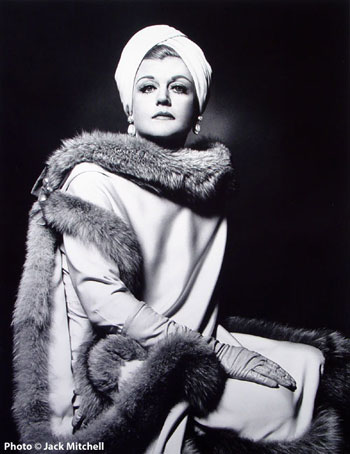
Gena Rowlands! My own personal idol. She said, "We were live - there were no mikes on the actors - I remember watching a play with Ben Gazzara - who had the best speaking voice on Broadway - and I was sitting in the balcony, and he was whispering - and I could hear it. We had trained voices then!" Then - the next clip was Ben Gazzara (who, please. I just absolutely love that guy) saying, with a wry little grin, "I remember whispering during some show I did - and being heard ..."
What I wouldn't give to see Ben Gazzara live. Those performances he gave in the 50s ... I mean, they're also iconic. People still reference them. They're still seen as kind of IT. Here he is with Barbara Bel Geddes in Cat on a Hot Tin Roof:

It also basically brought tears to my eyes to hear how many times Laurette Taylor was referenced. She is the guiding light - she's "the one" we all aspire to. I didn't even SEE her performance as Amanda Wingfield in the original Glass Menagerie - of course I didn't! It was in the 1940s!! But still. It's a landmark. A high-water mark for everybody. Funny and weirdly gratifying thing: I am now #1 on Google for "Laurette Taylor" because of this post. I wrote that over 2 years ago. And slowly, without my knowing it, it has been climbing the Google rankings ... I can't tell you how many people have written to me because of that post. Laurette Taylor really MEANS something to people who know who she is. And most people don't know who she is. One of our greatest American treasures - and no one knows who she is. Shame, shame, shame. Well, I am proud of the fact that my little post is up there at the top of the list - because it's a tribute, basically - a tribute to this giant of American theatre. She should be remembered. And since that post is now #1, more and more people have been finding it (I can see in my traffic reports) - and that makes me feel even better.
People in the PBS special last night even say her name differently ... it's iconic. It means something. All you need to do in certain crowds is say "Laurette Taylor" and people just KNOW.

Elaine Stritch is just amazing, I love her crotchety honest old self. What a phenomenal performer. Truly.

Tommy Tune was interviewed and he said something about how he felt like it was a shame that "revivals" were taking up so much space - when there were so many NEW plays and musicals that should be nurtured! Then they cut immediately to Elaine Stritch and she says, "There are new generations who should see Kiss Me Kate - who should see Guys and Dolls - one of the greatest musicals ever written - I think the revival trend is great!" Wearing her little wool hat, with her pissed honest eyes. Love that woman. Love Tommy Tune, too. I can see both views ...
There was a big section on Marlon Brando which was absolutely awesome. They interviewed Karl Malden - who worked with Brando many many times, also in Truckline Cafe which was Brando's big break. At least in the theatrical community. That's when he became known to THEM. Streetcar was when he crossed over into the public's consciousness - but Truckline was almost a bigger break, because it made Streetcar possible. There are multiple eyewitness accounts (Pauline Kael, for one) of his performance in Truckline - and how exciting it was. People literally thought they had found some guy off the street and put him on stage - it was that believable. Malden said something very interesting - that Brando "shattered the transitional period between two different styles of acting." There was already a trend towards a more "realistic" style of acting - Montgomery Clift, etc. - and Brando basically trashed the old world with one performance. He didn't set out to do that. That was not his goal. He just was a genius - it was his destiny, that's all.
I did a Google search for photos of Brando in Truckline - but nothing came up immediately. I did, however, find a page of his notes that he made for The Godfather on the back of the pages of his script. It's an insight into the mind of a great actor. I love stuff like this because it is evidence that Brando wasn't just a freak-talent - who worked on instinct. He was a craftsman. He thought about his work. He made choices based on script analysis. The things all competent actors should do. It's just that his instrument, his emotional instrument, was 100% available to him when he got "in the moment". Most actors are lucky if they get to 80 or 90 percent, and they cherish those rare moments when they are 100%. Brando just got out of the damn way when he was acting. No barrier between himself and his impulses. Very very rare.
But look at his notes here:

#Nose broken early in youth to account for difficulty ...
Gives me chills.
They interviewed Kim Hunter who said, "When you act opposite that kind of truth - it makes you better than you think you are. You are in a whole new world." Then there was a still from the Broadway production of Streetcar - black and white - Marlon, in his sweat-stained T shirt, holding onto Kim Hunter's arms, and yelling at her. It was a still: And my God. It was so damn real - Humphrey Bogart always said that, in acting, "Truth should be 6 feet back in your eyes." That photograph of Marlon Brando is exactly what he was talking about.
Kim Hunter said something really interesting. She said, "Brando made bad choices onstage. Brando made mistakes, and he made wrong choices. But one thing he never was - was a phony."
And that, my friends, is an acting genius.
They interviewed Jerry Orbach quite a bit. I miss that man, I really do. What a career.
Basically, the whole time I was watching last night - I yearned for a time machine. I would literally kill to be able to see Brando as Stanley, or Gena Rowlands in Middle of the Night, Ben Gazzara in Cat on a Hot Tin Roof, Lansbury as Mame, Gwen Verdon in pretty much anything ... these giants. Giants of the American theatre.
I am certainly hoping that there is a repeat of Broadway: The Golden Age - I missed the beginning of it. And I look forward to the next 2 installments which apparently take us up to the present day. Through the revolutionary theatrical moment that was Hair ... up to now.
Oh, and Eli Wallach and Anne Jackson joined the telethon host in the studio - to talk about their experiences in the New York theatre throughout the years. They have seen it all. They were THERE. It was great - Strange. Seeing the two of them is somehow like seeing an old friend. Their work, and not just their work, but their LIVES - have been such an inspiration to me personally.
It's funny: I admire these people SO MUCH for performances I have never seen. I think it was John Gielgud who said that acting in the theatre was like "sculpting in snow" and it is very true. We have eyewitness accounts. And for the more recent shows, we have video of it. But there is nothing like seeing it live. Nothing. It's sacred to me - live theatre - and so seeing these people - like Wallach - who gave performances on Broadway during the 50s and 60s that people STILL talk about - hell, look at me, I'M talking about them and I didn't even see them - is very moving to me. Their work means so much to me.
I grew up on public television (zoom-ah-zoom-ah-zoom-ah-zoom ... hahahaha And, of course, Masterpiece Theater. COME ON!!). Supporting public television is kinda engrained in me. Last night was a gorgeous moment when I remembered why! Money well spent.
Beautiful documentary!!!
March 6, 2006
74 facts
I have been working on my one-woman piece that I will be performing next week. I've done it before for an audience so I know it works, and it's a good piece, and yadda yadda. It's a very different thing performing something that YOU WROTE about YOUR OWN LIFE as opposed to performing someone else's words. It's fascinating - the difference. I'm enough of an exhibitionist and I have enough confidence in my writing and storytelling ability that - it completely lights me UP to perform my own stuff. It's more vulnerable - of course - because if someone doesn't like the piece, I would take it MUCH more personally than if I was in some shitty play and someone didn't like the script - hey, man, it's not MY fault ... but with 74 Facts it's just me and my words. If you don't like it, you're kinda saying, "Uhm - I don't like you." hahaha That's how personal it is. But I LOVE that kind of pressure - The vulnerability is a turn-on, actually (and I don't mean tears - or sensitivity - I just mean: awareness, intense awareness). It's a lot of fun.
But I've noticed - in this last rehearsal period with myself - that it's a little bit ... more challenging to 'get into' it than it has been in the past. I have to do a preparation for it - just like I would for any other play - to get myself into the proper mood. It's not a huge deal, and I don't have to turn myself inside out emotionally - it's not THAT hard - but it's definitely different from the other times I have performed this piece before. I used to be able to slip into the mind-set and mood of that piece at ANY minute of ANY day - mainly because I LIVED there. (If you've read the piece, you'll know what I'm talking about. And man - my friends sure as hell know what I'm talking about. They were sick of hearing about the guy.) But the miracle has happened - I mean, I literally thought it would never happen. Never. I had lived with this sort of low-level sadness for, uhm, years. That's how important and essential he was to me. But ... but ... it's not that it's GONE - I saw him this past summer and that ... connection remains - but that other stuff, the ... living with regrets, and the sadness, etc., is not there for me anymore. I can REMEMBER it - and that's part of what acting is all about - tapping into emotions that you may not be feeling in that very moment in your real life but that are appropriate for the scene. I can be having a great day, a happy day, and then go do my play that night and cry and rage and all that stuff - and then go home and have a good night's sleep. Because I know what it means to be in a rage - I have to tap into that for the show. Whatever. It's just weird to have to do this for a piece that I WROTE. I need to remember my way back into what it felt like for me. This is not only a cool acting challenge - but it's also a revelation to me. Of how far I have really come. Of how much work I have done to close that thing up, to heal, to accept. I have done a HELL of a lot of work ... and I am only realizing now that it has paid off. It took me a couple of rehearsals with myself to realize the problem (like I've said before: I am always the last one to know when something is actually going ON with me - hahaha) - I was like: "Why isn't this flowing like it used to? Why can't I just stand up and DO it?" Then the realization: "Ohhh. Cause I guess I don't really feel this way anymore."
If you know me, and if you know my struggle to get over this guy - you'll know that this is nothing short of a bloody miracle!
I'm excited to do the show next week to see what NEW form it takes - Because here's the deal - I'm proud of a lot of my writing - there are a couple of pieces I've written (one which is going to be published in The Sewanee Review at SOME point this year - at last!!) where I look at it and think: Okay. I just expressed that perfectly. I am done. That piece is done. It did what I meant it to do. There's only a couple of pieces I've written that I feel that way about - I can barely hold myself back from going back and editing old BLOG POSTS for God's sake, because I always see my writing as a work in progress - But sometimes, just sometimes - I write something that comes out exactly as it existed in my dream-space in my head. (oh, and the piece about waiting in line in Central Park is another one where it came out pretty much exactly as I wanted it to come out - I did very little editing with that piece, and I am still able to read it now, 5 years after writing it, and not be overcome with the desire to edit it to death - I can just sit down and read it).
The 74 Facts piece is definitely, in my opinion, one of those pieces. I NEVER feel like tampering with it - the only thing I want to tamper is the facts themselves. Hmmm, should I take out THAT fact and put in another one? Etc. But in terms of its expression, and my objective in writing the piece - it came out just as I wanted it to.
So I have faith in the PIECE itself. Not just as an expression of where I was at at a certain moment in time ... but as an expression of something universal. The responses I have gotten to the piece from total strangers - people who do not know me, who do not know "him" - have had deep and powerful responses to that thing. That tells me that I have expressed something that goes beyond just a story from my own life. Other people can relate to it, they can project onto it, they can have their own response - that's the most fun of this for me. I mean, that's the fun thing about acting - when audience members have some huge response to what you did, it's PERSONAL for them - that's great - but it's even better when it's because of something that came out of your OWN HEAD.
I am excited to see how it will go - knowing now that I myself have moved on past the intense first-person experience of it - into a more universal space. I can certainly, like I said, remember my way into that mind-set very easily. That's not a problem.
It still has the power to amaze me. That I'm past it. What??? When did THAT happen? It happened gradually and over a long space of time. It took work. On my part and on his part. And so here we are. Old war buddies. With no relics, no evidence, except for his words and mine.
January 20, 2006
The Books: "The Flowering Peach" (Clifford Odets)
And here is my next excerpt of the day from my script library:
 Next play in my little unalphabetized pile of Samuel French plays is The Flowering Peach.
And ... it is hard to believe - but this is my last book in this bookshelf!!! I started going through this bookshelf on April 19 - the first excerpt was from Hollywood Babylon. Of course ... I have since acquired books that are now in this bookshelf ... but I haven't read them yet ... so I will leave them for the next round. I am tireless. April 19! Good God! And now it's January whatever it is ... that's some bookshelf, huh???
The Flowering Peach is Odets' last play. I know a couple of people who call this their favorite Odets ... and it's not really well known. It's the story of Noah building his ark. It opens with Noah waking up from a dream, sitting in stillness in his dark house for a while, and then remembering the dream - he stands up abruptly and starts screaming: "No! No!" It's one of the most stunning beginnings of a play I've ever read. How does one play that?? Beginning a play with a vision of the end of the world. Odets. Gotta love him.
I love this play because he doesn't change his language to make it Biblical ... he still writes like Odets. It's a comedy. Suddenly, you get Noah and his wife bantering with each other like two old members of the Yiddish theatre, you get the classic Odets dialogue, crackling off the page ... It's a sweet play, I wish it was done more.
I'll excerpt a bit from the first scene. Noah has confided in Esther his dream. She thinks he's crazy. They have been married for so long that their back-and-forth almost has the quality of a vaudeville team. Noah is horrified ... he needs to get started building his ark ... he has never seen a boat ... he needs to alert his sons ... etc. Esther goes off to make breakfast (oh, and the set is a regular house ... not a tent or anything realistic) - so she goes off to make breakfast leaving Noah alone, and tormented.
He starts to call out to God. This is his monologue.
From The Flowering Peach.
[Alone, Noah rocks himself a little, as an old Jew does, in sorrowful musing, to comfort himself. When he speaks it is sole, humbly, sadly, and with devotion]
NOAH. Lonely times again ...? [sighing] Now I must go out in the world an' make meself for a big nuisance again ...? [Then] Why should she think I'm crazy? [abruptly standing] Now, just a minute! How do I know I'm not? I had a dream or not? [stamping his foot] Floor, listen to me! [slapping the table] Tell me, tell me, table -- I had a dream or not? [He listens, bewildered and fevered, but only silence answers him back, then he abruptly throws his arms upward and speaks angrily] If you spoke to me, Lord, I don't want it! I'm too old everybody should laugh in my face! I ain't got the gizzard for it -- No, sir! [Toning down to a softer devotional tone resting his mouth on clasped hands] Oh GOd, excuse me -- You are All and Everything an' I'm unworthy. You see me -- what am I good for? All I do is cough an' spit. Pass me by -- pass me by. Please ... [Now the Presence of God is heard: it is expressed by a certain musical rustle or widening shimmer, as if a gigantic tuning fork had been struck, its vibrations stern and imperious. With this comes one long thunder roll [which in the theatre is made by one good union stage hand rolling a lead ball across the back of the stage.] Noah falls to his knees as if struck, his head is bowed low. After a moment he tilts his head a little and his nose twitches like a rabbit's. "Lord?" he asks. The musical shimmer deepens, spills everywhere and then softens] You came out, God ...? [Then, listening reverently] Don't be mad. Because if I must, I must ... I must? [Sighing and shaking his head sadly. Gradually growing sly] What do I know about boats? Ast my Esther an' she'll tell you; when was I near water. Bread is bread, I know it -- a pickle is a pickle, a knife is a knife -- but boats? ... [Noah's slyness is reproved by a brief but angry thunder roll. Noah nods meekly but he is heartsick nonetheless] Awright, whatever you tell me to do, I'll do it ... [Then nodding] Yes, I remember everything to a "T". The length of the ark should be three hundred cubits, fifty cubits the breadth an' thirty cubits the height ... [Nodding again] I'll try to convince my sons to do what You say, but with my two oldest boys I'm altogether no good! You'll have to help me, 'cause they'll lock me up for a noisy old man. [Abruptly] You're here yet ... ? But wait a minute -- the main point we didn't get to! You're talking a total destruction of the whole world an' this is something terrible--! [He breaks off suddenly and gazes about, asking in a timid whisper] Lord ...? You're here ...? [He waits a moment and then painfully gets to his feet. The Presence of God has faded away into silence. Noah groans] Am I awake or am I asleep? I'm awake, but I wish I was dead. [But, cocking an eye, he looks around him, wondering if he actually is awake or asleep. He leans his cheek on an open hand, and, whimpering a little, draws delicately into himself. Antiphonal roosters crow proudly in the distance. The stage lights dim out quietly.]
CURTAIN
January 19, 2006
Wicked

Again, I am culturally behind the curve.
This one I find particularly unforgivable. My dear friend Jen made me a mix CD for my birthday - and on it is the song "Defying Gravity" from the musical Wicked. I have been a big Kristin Chenoweth fan since her Charlie Brown breakout- and she is also AWESOME in the Annie movie - as Lily St. Regis. That chick can SING. And Idina Menzel? Fuggedaboutit. But ... I never saw Wicked and I knew NONE of the songs.
Man. I was so missing out.
"Defying Gravity" is a song that lifts me up out of myself. It's truly incredible. And one of those rare rare things: a duet between two women. Kristen and Idina? Just kill me now!
And yes - my friend Betsy pointed out to me that it's the line where Idina suddenly lets loose: "And so if you care to find me ... LOOK to the Western sky ..."
It's one of those musical moments that transcends intellect, or passive appreication. I have a visceral response to that line - over and over and over again. It's not JUST her voice - which is, in that moment, a high high thrilling belt ... it's also the words ... which just call up all kinds of feelings in me ... it's the build-up beforehand ... It is just THRILLING.
The other song which, so far, has been transcendent for me is Elpheba's song "The Wizard and I". Again: the girl's got some major pipes. But it is obvious (in the same way it is obvious with Chenoweth) that she's got acting chops as well. It's not just a pretty voice. It's a powerful voice - with a tidal wave of emotion behind it. Like Barbra Streisand in her younger days, when she let LOOSE. Uhm, "Cry Me a River" anyone?
Wicked is a truly thrilling musical experience and I kinda want to see the show now - even though Menzel and Chenoweth are long gone.
The Books: "Standing On My Knees" (John Olive)
Next in my Daily Book Excerpt:
I am still on my script shelf
 Next play in my little unalphabetized pile of Samuel French plays is Standing On My Knees.
Another favorite with actors because of the long great two-person scenes throughout the play - this play opened in 1982 - and it starred Pamela Reed. I'm not sure about this, but I think this was her first major part - I always wonder: What happened to her? I mean ... I am sure she is still working, and someone can go do an IMDB lookup, and I'm sure she's doing stage ... but sometimes I wonder why a larger level success didn't come to her. I think she's kind of wonderful, I really do. And this role in Standing on my knees is one of those plum parts for an actress - Not only is it a good part, with good scenes, but the character is schizophrenic and has just been released from a mental institution! Awesome! Actors love to play crazy people.
So we have Catherine - a poet, and a schizophrenic. She hears voices. She has just been let out of the institution and she is trying to integrate back into society. She's kind of successful as a poet - she has an agent who keeps talking to her about "when's the new book coming out?" - or "Have you been writing again?" Catherine can barely make it through the day at this point. She comes up against people's fears and prejudices about mental illness ... Her friend Joanne wants her to bounce back ... her friend Joanne also feels like Catherine has always been a little too intense, too much ... Catherine plods along, taking her drugs, she starts dating someone (poor guy, he doesn't stand a chance) - and eventually, she can't live with the fact that the anti-psychotic drugs dull down her imagination, kill her nighttime dream-life, and seems to kill the creative process. So she goes off the drugs, starts writing again, and falls off the deep end. The voices take over. She has her creative process again, she's able to write ... but at what cost?
All the parts in this play are great.
I'll excerpt a scene between Catherine and Alice, her agent. Alice is the one who "discovered" Catherine's poetry and she has ushered her into literary success. Catherine is now out of the hospital for only a couple of weeks, and Alice has lunch with her, basically to ask her: "Are you ready to get back to work again?"
Alice can't deal with mental illness ... although that will become clear once you read the scene. She tries to just talk about it as though it was a normal hospital stay, and Catherine kind of can't take it. It's a very sad uncomfortable scene. Alice tries to make small talk, Catherine can't put up a good front - it's too soon, she's still recovering ... Alice makes blunder after blunder ...
Oh, and just so you know ... the play isn't written in a linear way. The writing itself tries to reflect Catherine's madness - how voices blend together, how time skips around, how transitions don't make sense ...
I used this scene as my SECOND audition to get into the goddamn Actors Studio. Bastards.
From Standing On My Knees.
[A spot fades up on Alice sitting at a table in the bare stage area with the remains of lunch and a bottle of German wine. Catherine starts to get dressed. A pause, and then Catherine and Alice both start speaking at once]
ALICE. You want some --?
CATHERINE. [overlapping] How's business?
ALICE. What?
CATHERINE. Hm?
ALICE. [laughing] You want some more wine?
CATHERINE. No.
ALICE. Coffee?
CATHERINE. Caffeine makes you crazy.
ALICE. Oh. Dessert?
CATHERINE. No.
ALICE. This is a good place, don't you think? German food.
CATHERINE. How's business?
ALICE. Oh, good. The Woman's Guide to Baseball's a big hit. Still understaffed, still have to type my own letters, pain in the ass. God, you look good.
CATHERINE. I feel good. All that healthy hospital food. [Catherine, dressed, goes to the table and sits]
ALICE. [after a beat] So.
CATHERINE. Hm?
ALICE. What was it like?
CATHERINE. [pauses, shrugs] You saw me.
ALICE. Yeah, Jesus, I'll never forget it.
CATHERINE. I don't remember a lot of it. Time flew.
ALICE. Because of the drugs? Thorazine, right?
CATHERINE. Plus a lot of vitamins. Megavitamins. "Orthomolecular Therapy." But mostly Thorazine.
ALICE. The Thorazine make you feel like your brain's gained fifteen pounds?
CATHERINE. It does slow everything down.
ALICE. Yeah? Can I have some? [A beat, looks away] Okay, okay. [Another beat] The hospital's all right, isn't it? I mean, it's not ... Cuckoo's Nest, padded isolation chambers, sadistic nurses, a huge institutional toilet?
CATHERINE. No, it's nice. There's a real sense of ... community.
ALICE. Yeah? The other patients interesting?
CATHERINE. Yeah.
ALICE. You miss 'em?
CATHERINE. Yeah.
ALICE. You glad to be out?
CATHERINE. No.
ALICE. [after an uncomfortable pause] Ed's fine. Some tiny town in Iowa commissioned him to make a huge bronze football for the civic center. He quit bein' a vegetarian, we don't talk much. Wants to go to Mexico. Beer is better there. You're makin' me nervous, babe.
CATHERINE. I make everybody nervous, I know. I feel like I should be wearing a big scarlet S.
ALICE. [nervously, too loud] SchizoWoman!!
CATHERINE. Alice.
ALICE. [looks around sheepishly] Shit. [A beat] Well, I'm jealous, you know that. You get to go lock horns with evil psychiatrists, commune with the supernatural. I have to live with Ed.
CATHERINE. [laughs] God.
ALICE. I know my curiosity is morbid and you hate me for being the gringo I am. [A pause. Alice continues, not looking at Catherine] So how you coming on the book? Working on it? Thinking about it, at least?
CATHERINE. Thinking about it a lot.
ALICE. Well ...
CATHERINE. But I haven't been working on it, Alice.
ALICE. Well, why not?
CATHERINE. Alice, I've been very ill.
ALICE. [laughs nervously] Doesn't that help?
CATHERINE. I can't work on the book right now.
ALICE. You wanna write it off? I'd really rather not. That's a lot of expensive staff time down the --
CATHERINE. Take it easy.
ALICE. [after a pause] You'll start working on it now.
CATHERINE. No.
ALICE. Why?
CATHERINE. Alice.
ALICE. Why?
CATHERINE. I was working on the book when I ... flipped.
ALICE. So? The book made you crazy? [laughs]
CATHERINE. [voice thick, looking away] I don't ...
ALICE. You gonna stop writing? That's what you're saying?
CATHERINE. I have to.
ALICE. [laughs again] You kidding? You'll never --- [stops, looks at her] It's your best book. I don't believe you're gonna --
CATHERINE. Alice. Stop it. Just -- [suddenly stands up]
ALICE. Hey. You okay?
CATHERINE. Gotta go.
ALICE. Oh shit, babe, don't pay any attention to me, I'm fucked up. You're fucked up, Ed's fucked up, everybody I care about's--
CATHERINE. I'm not fucked up. I'm sick. [short pause. Then Alice bursts into laughter. Catherine takes money from hger pocket, puts it on the table] Here. [starts to go]
ALICE. Catherine. [Catherine stops] It was gonna be your best book. The best one we ever did. It was gonna be beautiful. [Stands] Take care. [Exits
January 16, 2006
The Books: "The Country Girl" (Clifford Odets)
Next in my Daily Book Excerpt:
I am still on my script shelf
 Next play in my little unalphabetized pile of Samuel French plays is The Country Girl
Odets. My man Odets. To my ear, nobody else sounds like him. He's one of those guys where you could show me a page of dialogue - and have me guess who wrote it ... Odets is unmistakable. He's like Mamet. Or Williams. Love Odets.
This play was produced in 1950. Steven Hill, of Law & Order fame was in the original cast - he played the hotshot young theatre director Bernie Dodd - a kind of Elia Kazan character. Uta Hagen originated the lead role of Georgie Elgin, the long-suffering wife who had once been Miss America. She won a Tony award for her work. And then of course, it was made into a film in 1954 - with Bing Crosby as the lead guy Frank Elgin, Grace Kelly as Georgie (she won an Oscar), and William Holden as Bernie Dodd. This play is a love letter from Clifford Odets, hero-playwright of the 1930s, to the theatre. He was an exile in Hollywood. Screenwriting and script-doctoring just couldn't hold a candle to his work in the 30s with the Group Theatre. But those days were done ... he needed to make a living ... You can feel his loneliness, his yearning in almost every word of Country Girl. Even his own stage directions - where he describes the darkened theatre, and the two men - Bernie and Frank - sitting alone - talking. You can feel Odets' loneliness for the New York theatre. I love this play and I would love to play Georgie, although I would never get cast as someone who once was Miss America. Just ain't gonna happen. But she is a terrific character - a great great part for an actress.
Frank Elgin is a washed-up actor. He once was considered great. Now he's a drunk. Bernie Dodd - the hot director - guns for him to take the lead in his next production. He really goes to bat for Elgin - he keeps saying, "I saw Frank give at least 2 great performances in 2 different shows ..." He wants to give this actor another chance. Frank, always on the edge, of either physical or mental collapse, says he will take the part - and he does. During rehearsals, he battles with his own demons - his own fear that he won't learn his lines, that he is not a good actor, that he will fail ... The booze just calls to him ... Meanwhile, Georgie is his sharp-as-a-whip wife - who has had a helluva time herself. The marriage is now basically about keeping Frank off the booze. Georgie is on the lookout for any tell-tale signs. She is no dummy. She is a long-suffering wife, but you could never call her a martyr or a victim. She chooses to stay with him. But it's not easy.
Here is the scene, early on in the play, when Bernie Dodd comes to the Elgin's apartment to offer Frank the part. This is the first time he meets Georgie - who can be quite formidable. Georgie's there by herself - at first - Frank eventually joins them - and Bernie cannot snow Georgie, or charm her. Bernie is a sexist ladies man, a perennial bachelor. He's not used to women taking his measure, and seeing right through him. It's unnerving for him.
A bit of background: when the scene opens, we see Georgie alone in her apartment, packing a suitcase. When Bernie knocks on the door, she hastily stuffs the suitcase under the bed.
So she is not just thinking of leaving Frank - she had made plans - she was packing her suitcase to go.
Also - in this scene - watch the subtlety of this unspoken dynamic: Bernie has come to convince Frank to take the part. But by the end of the scene, without saying a word about it, Bernie realizes that it is Georgie who must be convinced. He adjusts his behavior accordingly.
From The Country Girl
BERNIE. I'm a busy man, Frank.
FRANK. What do you want me to do?
BERNIE. Make up your mind -- I want you to play that part.
GEORGIE. I'm an innocent bystander. Don't shoot me -- just tell me what this is all about.
FRANK. Mr. Dodd says he wants me to play the lead in his play ...
BERNIE. [briskly annoyed] It's a starring part that needs an actor who can stay sober and learn lines. Are you that actor, or not?
FRANK. [with flare] Well, I'm not one of those goddam microphone actors, like Billy Hertz! I'm an actor!
BERNIE. [waiting] That's what I used to think ...
FRANK. [evasively] What about the producer? If looks would kill, I was dead.
BERNIE. He's afraid you're a drinker.
FRANK. [sullenly] I don't drink on a show.
BERNIE. [sharply] Not according to Gilbert. I checked with him -- you worked with him in '44? What happened?
[Frank looks at Georgie before answering]
FRANK. We lost our little daughter ... that year.
[Silence. Frank sits on bed. Georgie pours coffee]
BERNIE. Can you stay on the wagon now?
FRANK. Look, son, I think we oughta forget it ...
BERNIE. Don't call me son! You've played bigger parts -- you used to be a star!
FRANK. [gloomily] Yeah, I used to drink a glass of money for breakfast, too.
BERNIE. What's the matter with you?
GEORGIE. [as if waking up] You don't listen, Mr. Dodd. Can't you see he's afraid of the responsibility?
BERNIE. But I'm willing to take a chance -- the gamble's all on my side.
FRANK. Why kid around? They open in Boston the 28th. I couldn't even learn the lines in that time! That part needs a Bennett or a Blinn --
BERNIE. [sardonically] Bad enough to go to Hollywood to cast -- now you suggest I go to heaven! [Bernie stares at them coldly; about to walk out, turns, says earnesly] Listen, Frank, you don't know me. But I was a kid when I saw you give two great performances in mediocre plays -- Proud People and Werba's Millions. I can get the same show out of you right now ... if you lay off the liquor! I have more confidence in you than you have in yourself!
GEORGIE. [sitting back, watching] Why ...?
BERNIE. Because I saw him as a kid -- I was a hat-check boy in the Shubert Theater. [to Frank] You and Lunt and Walter Huston -- you were my heroes. I know everything you did.
FRANK. Hear that, Georgie ..
[Georgie speaks with quiet thoughtfulness]
GEORGIE. Naturally, Mr. Dodd, you exaggerate the sentiment to make your point.
[Bernie turns, looks at her very carefully]
BERNIE. We killed the cat with sentiment? Okay, we'll bring him back to life with some antiseptic truth. I come from realistic people - I'm Italain. [pausing] I'm not blind to Frank's condition - he's a bum! But I'm tough, not one of those nice "humane" people: they hand you a drink and a buck and that's exactly where they stop. [to Frank] I won't hand you a buck ... but I'll think about you, if you take this job. I'll commit myself to you -- we'll work and worry together -- it's a marriage. And I'll make you work, if you take this job: I'll be your will! [Pausing] But if you do me dirt -- only once! -- no pity, Frank! Not a drop of pity! Joke ending, kid.
[Georgie looks carefully at Bernie. We can almost see her come to life as she stands and comes in closer]
GEORGIE. You'll be his "will" ... I like that. That's what he needs, a will. And "no pity". I like that, too. I like the "antiseptic truth". But what kind of contract do you offer?
BERNIE. Standard two-week contract.
GEORGIE. Not run-of-the-play?
BERNIE. No.
GEORGIE. Doesn't that mean you could let Frank out any time with two weeks' notice?
BERNIE. That's what it means.
GEORGIE. But suppose he takes the part and opens the show? He get syou over the top of the hill. How does he know you won't replace him?
BERNIE. No run-of-the-play contract. Suppose we have to drop him? For drinking or for not retaining his lines? What do you want? Drop him, replace him and still pay his salary for run of the show?
GEORGIE. [pausing] I don't think he should take it. He needs confidence. He won't have it with that two weeks' clause over his head. Would you? [She has spiked Bernie's guns by presenting him the same case he previously presented to Cook. Finally, looking from one to another, Bernie says]
BERNIE. I have nothing in my mind except for Frank to play this part!
GEORGIE. That's sentiment again!
BERNIE. I can't believe my ears! I came up here with the best intentions in the world -- now I find I'm victimizing you!
FRANK. May I get a word in edgewise?
BERNIE. What the hell did I do? Bring you a basket of snakes?
GEORGIE. Noblesse oblige, Mr. Dodd. Stop whirling like a dervish.
FRANK. Nobody wants to get your goat, Mr. Dodd. I ... what I mean, Mr. Dodd, it's only a matter of not wanting to bite off more than I can chew ...
BERNIE. You have the offer. We're booked into Boston for two weeks, but the season's young -- we can stay out till you're letter-perfect.
FRANK. And ... would you do that?
BERNIE. Do it? I insist upon it! Do I look green? [Then, looking at Georgie] I take that back -- I am green! [Then, to Frank] Call me at the office by three o'clock. That means not later. [Bernie starts out, stops] You need a twenty-dollar bill? You need it ... [Puts bill on radio and goes. Silence. Frank does not move]
GEORGIE. Is that boy as talented as he throws himself around?
FRANK. Best average in both the leagues ...
GEORGIE. He's wilful, but he meant what he said.
FRANK. I can't do it, can I?
GEORGIE. Doesn't it seem strange for you to ask me that?
FRANK. You're my wife ...
GEORGIE. Frank, we've been through all this before, many time before ... I'm tired, Frank.
FRANK. [brooding, not looking at her] What happened? Where did I get so bolloxed up? I was the best young leading man in this business, not a slouch!
GEORGIE. Scripts didn't come ...
FRANK. I knew it then -- on the coast -- I lost my nerve! And then, when we lost the money, in '39, after those lousy Federal Theatre jobs --! This is the face that once turned down radio work. [Pacing] What ever the hell I did, I don't know what! [abruptly defiant] But I'm good! I'm still good, baby, because I see what they think is good! [He waits, but she is silent] Don't you think I'm good? I think I'm good!
GEORGIE. Then take the part. Make it your own responsibility, not mine ... take the part. [He looks at her, it is plain that the idea frightens him] Don't wiggle and caper, Frank. [suddenly] Can't you admit to yourself you're a failure? You'd die to save your face, not to fail in public -- but I'm your wife; you have no face. Try to be clear about this offer -- think.
FRANK. I didn't hear him say he'd star me.
GEORGIE. [with dry weariness] I have a message for you, Frank: take the part!
FRANK. Yes, but what will you do if I --?
GEORGIE. Leave me out. Take the part and do your level best.
FRANK. But what about that two weeks' clause? You yourself tried --
GEORGIE. All I tried was to get a better deal. But you won't get perfect terms.
FRANK. You certainly gave him a scrap ... Georgie, I'll tell you! That two weeks' clause, they can give me notice any time, but I can give them notice too!
GEORGIE. ???
FRANK. Don't you see? They can let me out, but I can walk out any time I want! If I feel I'm breaking my neck --
GEORGIE. You can quit?
FRANK. Yeah, that's sort of what I mean, yeah. [Bright, shrewd] You see? Get it?
GEORGIE. [dubious, waiting] Yes ...
FRANK. [cunningly grand] Why, with this two weeks' clause, I don't even have to come into New York, do I? [Georgie murmurs a "no" as Frank chortingly seats himself] That's the thing, that's it -- two can play the same game! [Delighted at this discovery, Georgie much less so, Frank abruptly snaps his fingers, lights up even more] Wait a minute! Quarter to seven this morning I had a dream! I laughed so hard it woke me up! That's a sign, Georgie, a hunch!
GEORGIE. A dream ...?
FRANK. A big sign -- now get this -- a big banner was stretched across the street: "Frank Elgin in --" ... I couldn't make out in what. Mayor La Guardia was in the dream -- lots of people laughing and feeling good. I'm going to take that part, Georgie! You don't have to tell me not to drink - haven't I been a good boy all summer? This morning I got up early -- that funny laughing dream. And I was thinking about our lives ...everything ... and now this chance! Don't you see that all those people in the dream, they wish me luck. I won't fail this time! Because that's what counts -- if the world is with you -- and your wife! [Looks at her, earnest, boyish and questioning, appealing for her support. Finally, she says with reluctance]
GEORGIE. I don't have any appointments ... all winter ...
FRANK. That's what counts! I can't fail this time -- I feel like Jack-A-Million! I'll let Dodd know -- I'll go up to the office in person. [taking twenty dollar bill] But my first stop is the barber shop -- I want the tonsorial works. Anything you want me to bring you back?
GEORGIE. No ....
FRANK. Catch that, dear! [He throws her an extravagant kiss, really excited, and she catches the gift with an open hand. Alone, thinking, we see how unhappy Georgie is. Then she remembers her suitcase; she takes it from under bed, opens it and unhappily looks down at its contents. Then, murmuring, "My God, my God, my God ...", she takes out dress and goes back to wardrobe to replace it on a hanger.]
CURTAIN
January 15, 2006
The Books: "My Cup Ranneth Over" (Robert Patrick)
Next in my Daily Book Excerpt:
I am still on my script shelf
 Next play in my little unalphabetized pile of Samuel French plays is My Cup Ranneth Over.
We used to have these one-act festivals in college - student-directed student-acted one-acts - and I swear, some of the best acting I have ever seen in my life came out of those one-acts - and it's weird - only 75 people saw these things, ever. But some of them were just unbelievable. My friends David and Brooke in Home Free. But that's just one example. We all just poured our hearts into our projects.
My Cup Ranneth Over was one of them - my friend Jackie (brown wool leg-wraps) and I were the stars - and Christian Gamella was the director. We rehearsed this thing as intensely as if it were a main-stage production. Christian was a wonderful director - He had a lot of ideas, he had a ton of enthusiasm, and we had so much fun working on this thing. Jackie played Paula - a wanna be writer whose goal in life is to get an article in Cosmo - Cosmopolitan is EVERYTHING to Paula. Paula is unhappy, on the VERGE of getting bitter (but not there yet) - and also (very important) kind of vulnerable. If Paula is played without the vulnerability - then she would just be a bitch on wheels, and that wouldn't be right. Jackie TOTALLY got that balance in her character. And I played her roommate Yucca - a musician (a chick with a guitar - along the lines of Joni Mitchell, or Tracy Chapman, or what have you). Yucca is the polar opposite of Paula - Yucca is laidback (but not lazy) - she sleeps until noon because she always had gigs the night before - and she and Paula are best friends. They support each other in their goals, they are there for each other. Until, randomly - Yucca gets a call that someone HUGE caught her show the night before - and suddenly people want to tour with her, the phone starts ringing off the hook - this magazine wants to interview her, that one ... she becomes an overnight success. Literally. This is the story of the play. And Paula, trying to field all of these phone calls - suddenly has to face up to the fact that Yucca's success bums her OUT because it makes her feel bad. She cannot deal with Yucca pushing ahead in the success factor.
Of course, it's a one-act - and it's a comedy - so everything works out in the end. But the main action of the play is what happens on the first morning of someone becoming an overnight success? What is that like?
Playing Yucca was one of the most satisfying things I've ever done - and on some level I have to say that I think that's the best acting I've ever done. I was completely free. I had no fear. I created somebody ELSE. Yucca was not me. But I felt totally unselfconscious being her. Etc. Etc.
Like I said: those student one-act festivals were pretty juicy. Great acting ... seen by almost nobody!
Here's an excerpt from the play - the scene that takes us to the final moment. Yucca finds herself famous - Paula tries to be a good sport about it - and they drink champagne in celebration. But Paula also has an article she's working on, and she's waiting for Cosmo to call her to let her know if they will take her piece or not - so there's THAT tension with the phone lines being hung up by incoming calls. Yucca keeps trying to bond with Paula, and let her know that their friendship won't change, etc. etc. - but she can never finish a sentence because the phone keeps ringing off the hook.
From My Cup Ranneth Over.
[The phone rings. Yucca answers gracefully, sipping champagne]
YUCCA. Hello?
PAULA. [wheeling and returning to her chair] Thank God!
YUCCA. Yes, this is she. You're very kind. You're very kind. Were you there? Your friends are very kind. You can get other opinions in the papers. All the papers. Daily Variety you read? Isn't that charming of them, and me a mere unknown. No, it's a sweat-stained T-shirt not a tea-stained sweatshirt! No, I don't have an agent. He just called me, though. Oh, you are, too? Are there two agents? That doens't really help me, I don't know any agent's names. I'm sure you are. I'm sure I do. I'm sure we could. You're very kind. You're very kind. You're very fast. Well, who is someone you represent then? [Awed] John Denver? You're very kidding. How do I know that? Look, could we possibly handle this this way? If you put me in touch with John Denver and he says you are you, and you are good, then I'll think about it, provided I think. I hope that's reasonable and I hope I can remember it. His number? John Denver's home phone number? Shoot. 303-236-8790? [Paula types each digit separately with one finger and hands it to Yucca] You're very kind. Thank you.
PAULA. You're very welcome.
YUCCA. Thank you, Paula. Goodbye. [Hangs up]
PAULA. I'm not going anywhere.
YUCCA. [dreamily dialing] Daily Variety said I had American eyes: red, white, and blue. [Door buzzer buzzes] Hello. I haven't finished dialing.
PAULA. It's the door, Yucca. [Presses talk switch] Hello?
MAILMAN. [over speaker] It's the mailman with some more of them heavy envelopes from Cosmopolitan.
PAULA. I'll be right down.
MAILMAN. Hurry it up lady. These streets aren't safe.
PAULA. Right down! [Goes to desk, turns on tape recorder] Yucca?
YUCCA. Hello. Please hold. What, Paula darling?
PAULA. My white knight is below with my daily fix of rejection slips. Whoever you talk to, remember you gave an exclusive on your clothes philosophy to Earl Wilson. [Pause] You've got John Denver on hold. [She exits]
YUCCA. Right. Hello? Oh, God, I'm sorry. Listen, you don't know me, but for various reasons I call myself Yucca Concklin, and -- you do? You did? That's very kind, especially from you, especially if you are -- you are? Well, why I called is this man said -- he represented himself as representing you and -- funny, that's the name he gave, isn't that a coincidence? And anyway he said he wanted you to be my agent. His. Mine. Him to be mine. Yes. You think I should? Well, I never doubted it, only my senses. Probably I will. House seats? I don't know. No, I know what house seats are, I just don't know if I get any. The subject never came up before. If you say so. You're very kind. You're very kind. [Awed] You would? Why sure. Uh -- look. I don't want to seem paranoid, but I've always had the intense conviction that worldwide conspiracies were working against my happiness, so could you please just say "Country Road"? [Pause] You're very John Denver. [Paula enters in great disarray with two or three big envelopes. Yucca hangs up] John Denver wants me to go on the road.
PAULA. I couldn't have put it better myself.
YUCCA. And I'm free after the show tonight.
PAULA. As far as I'm concerned. [Paula hands her the cassette out of the recorder]
YUCCA. Paula. How sweet. You recorded my whole first conversation with John Denver.
PAULA. I thought you might like to frame it in your new house.
YUCCA. New house?
PAULA. Or perhaps you'll move to a hotel. Where you can call room service. When you want more room.
YUCCA. [sees envelopes] Are those your rejections?
PAULA. All I've thought up so far.
YUCCA. Papers! I've got to go out and get the papers.
PAULA. You can't.
YUCCA. Sure. I'll put on shoes. And an official Yucca Concklin white T-shirt. [Phone rings]
PAULA. Yucca, you can't go out on the street.
YUCCA. Sure, I can. I've bled on those streets.
PAULA. Not yet you haven't. Listen. [She drags Yucca to door and presses listen button]
YUCCA. That isn't the door ringing, it's the phone.
PAULA. Yucca, listen.
VOICES. Yucca. Yucca. This is her house. This ain't her house. Yes it is. Whose house? Yucca Concklin. The big new singer. The one that wears the T shirts. Yeah, this is her house.
YUCCA. They're talking about me.
PAULA. They're talking about you.
YUCCA. They're bandying my name about on the streets.
VOICES. She lives here? Yucca Concklin? Yeah, this is her house. This is where she lives. The one that they were talking about on TV!
YUCCA. [into squawk-box] TV! What channel?
PAULA. [dragging her away] Yucca!
VOICES. This is it. Three thirty three. Just like in the song. See there's her name. Hey, Yucca!
YUCCA. Hey, yourselves!
VOICES. That's her mailbox. There's her name. Hey, let's take her mailbox! [Hideous wrenching sound, then silence. Phone is still ringing]
PAULA. Yucca, what song are they talking about?
YUCCA. It must be the new one I put into the act last night.
PAULA. What's it called?
YUCCA. "I'm just a street punk, just like you, from three thirty-three First Avenue." I'll take it out of the act.
PAULA. No, just take the act out!
YUCCA. What are you trying to say?
PAULA. I'm trying to say I want you to move!
YUCCA. Because you think I'm going commercial.
PAULA. Because I know I'm going crackers. This is impossible.
YUCCA. But it can't last. [answers phone] Hello? People Magazine? Can you call back in five minutes? [Aghast] You can? [Hangs up] Okay, it can last. [Phone rings immediately]
PAULA. But I can't. I want you to find another place.
YUCCA. It may not be real. [answers] Hello? Playboy? [Pause] Really? Can you call back in ten minutes? Thank you. [Hangs up] They want to photograph me without my T-shirt. It's real. [Phone rings at once]
PAULA. It's real, Yucca. You have made the jump. Turned the corner. Gone over the rainbow. Through the looking-glass. Round the bend. Taken the veil. Hit the parade. Made the grade. Started school. Crossed the street by yourself. You're late weather and news.
YUCCA. [runs to hall door] No, I haven't. Look, it's over already. [Presses listen button] See, they've stopped talking about me.
PAULA. No, they stole the squawk-box for a souvenir.
YUCCA. But I don't want to move. Where would I move?
PAULA. Maybe John Denver needs a roommate.
YUCCA. We've always stuck together.
PAULA. Stick it yourself, Yucca.
YUCCA. But I'm a success now. I'm surrounded by false friends.
PAULA. You won't know they're false after a while, yucca, they'll be the only friends you've got.
YUCCA. Maybe I'm not a success. You can never be sure.
PAULA. [with a harsh laugh] Answer the phone.
YUCCA. [does] Hello? [curt] Time Magazine? Call back in fifteen minutes. [Hangs up. Phone rings] I can be sure.
PAULA. You can be sure.
YUCCA. All right, I can be sure. But I owe it all to you.
PAULA. And three months back rent.
YUCCA. Oh, I know, Paula, but I can pay it all back now. I can help you now. Look what all I've got out of our relationship. What do you want out of our relationship?
PAULA. Out of our relationship.
YUCCA. You can't mean that. I owe so much to you. Every time I'd start to give up, I'd think of you over there, clawing away at that machine, writing articles no one wants, collecting rejection slips, people returning your stuff without buying it, without reading it, editors begging you not to waste your time, and no matter how many of thtem told you to go into social work or home economics, you kept on! Without hope or promise, all your friends laughing behind your back, editors taking sexual advantage of you, love and life and youth passing you by, and I'd say, Golly. If she can take all of that and still believe in herself, who am I to flag. That's what I owe you!
PAULA. Well, and here it comes back with interest. That's beautiful. That's some of your best work! Now would you like to hear the flip side? You've changed, Yucca, you've changed, success has changed you!
YUCCA. Me? [Answers phone] Newsweek? Later! [Hangs up] Me? [Phone rings]
PAULA. Anybody else in this house had success? You've changed overnight. You all of a sudden expect me to get the phone for you, pour your champagne, give your interviews, sacrifice my writing time!
YUCCA. I haven't changed.
PAULA. You have. You used to do everything for me and now you won't even move.
YUCCA. I haven't changed, I haven't had time.
PAULA. And on top of everything else, you insult my work!
YUCCA. I didn't insult it, I just said nobody wants it!
PAULA. Is that your concept of a rave?
YUCCA. I was just being honest.
PAULA. Well, that's a change.
YUCCA. I'm always honest. You just never listen.
PAULA. I listen to you practicing on your twelve-string torture instrument night and day for five years grinding out dime-a-dozen despair. [Imitates Yucca singing] "Oh, you may be goin' to Buffalo, but you ain't goin' to Buffalo me!"
YUCCA. Well, I listened to you on your [quick glance at typewriter] forty-two key racket-package and I listened to all those fumble-fingered rewrites of Sexual Politics and I never said anything.
PAULA. You never say anything! What's too silly to be said can be sung! [Phone is still ringing]
YUCCA. I thought you liked my music.
PAULA. I do. I love your stupid music, and now you've got me insulting it. You've changed, Yucca, you've changed!
YUCCA. I've changed? Honestly, Paula. You do a few simple things for me at a time of extreme crisis, things you never do for me, by the way, and which most friends would do for each other without even asking, you scream at me because I've had success, which you all of a sudden act like you never thought I'd have, and after we've struggled and starved together ever since matriculation, you try to throw me out on the streets!
PAULA. [running to hall door] You've bled on 'em, now live on 'em. [Into squawk-box] Look out, world, here comes Yucca Concklin! [Phone is still ringing]
YUCCA. I haven't changed. You've changed.
PAULA. You just hung up on Playboy, People, Time and Newsweek. You never did that before.
YUCCA. I only did it so I could beg you not to throw me out.
PAULA. Don't do me any favors.
YUCCA. Watch out or I won't!
PAULA. Just answer the phone!
YUCCA. It's afternoon now, it's your turn. If you don't want things to have changed, you answer it!
PAULA. All right. I'll keep up the empty shallow, hollow ... [Answers phone] Hello? [She listens, pales] --- Yucca, it's for you.
YUCCA. Paula, I'm obviously in hysterics. Can you take it?
PAULA. I can take a lot, but not this.
YUCCA. Oh God, who is it, National Geographic?
PAULA. It's Cosmo-Fucking-politan.
YUCCA. It can't be! I guess it can. What does Cosmopolitan want with me?
PAULA. Margaux Hemingway broke an eyebrow.
YUCCA. [takes phone] Look, can you hold? Oh, my God. [Grabs Paula by the arm]
PAULA. What is it? What did they say?
YUCCA. They said for me they'd hold anything. I'm sorry, Paula.
PAULA. I'm thrilled for you, Yucca. I'm tickled, I'm delighted, but will you please let go of my arm, give Cosmopolitan your fiftieth exclusive interview of the day, then bundle up your banjo picks and move!
YUCCA. I don't wanna move. I'll never be here anyway. I'll be on the road with John Denver.
PAULA. Oh, rub it in!
YUCCA. Paula, you're jealous!
PAULA. Gee, that would explain so many things.
YUCCA. You're jealous of me!
PAULA. I'm ecstatic for you, Yucca, but my cup ranneth over about two minutes ago!
YUCCA. I don't want you to be jealous.
PAULA. Then let go of my wrist so I can cut it. That's the alternative.
YUCCA. We've always had this very special feeling of trust between us, respect for one another's talents and abilities. We've always believed in each other, haven't we? Haven't we? We haven't? All right, I never believed in myself but I always knew you did and that's what pulled me through. Has that feeling just gone?
PAULA. Yucca, this is embarrassing.
YUCCA. But has it?
PAULA. It's just too humiliating to live together, Yucca. I'm jealous -- and for Christ's sake, of you!
YUCCA. What do you mean, of you? What's wrong with you? Me, I mean? What's not to be jealous of?
PAULA. I don't want to fight, Yucca.
YUCCA. Okay, but has the feeling gone?
PAULA. Only from my left hand! [Yucca releases her] Thank you, Yucca. I'm very glad for you.
YUCCA. You're being unreasonable.
PAULA. It isn't unreasonable to be glad for a friend.
YUCCA. All right.
PAULA. I just cannot spend the rest of my life thinking up clever quotes for your interviews, Cora Sue Concklin.
YUCCA. You what?
PAULA. I said ...
YUCCA. I heard you. [Into phone with great and growing style] Hey, Cosmo? Shoot. I want to be a star because I'm lazy, and stars only come out at night. I thought Yucca was my full name because my folks always looked at me and said, "Yuck". I wear T-shirts because I've always liked getting into men's underwear. Overnight success? I just hope it's not over tonight. My ambition? I want to go gold before I go grey. You want to print a cover story on me? Won't that hurt? But, seriously, I'd love it ... on one condition. It must be written by my roommate, Paula Tissot. She writes. I believe you are familiar with her work. That's the one. Now, come on, be fair -- give the kid a chance. She knows me better than anyone. In fact, she used to be my best friend. Here -- I'll give her to you ... [She extends the phone to Paula, who sits looking at it.]
CURTAIN
January 14, 2006
The Books: "Andromache" (Jean Racine)
Next in my Daily Book Excerpt:
I am still on my script shelf
 Next play in my little unalphabetized pile of Samuel French plays is Andromache
Francois Mauriac wrote, in regards to translating Racine into English: "Of all our authors, Racine is one of the least accessible to people of other countries." Translating French (especially poetry) into English is really difficult - I've read bad translations of Moliere and you think: What the hell is the big deal about this playwright? The rhymes clunk, the rhythm is predictable ... I don't get it. When you read it in French, it's a whole other ballgame. Moliere is stupendous in his own language.
The translation I have of Racine's Andromache is done by poet Richard Wilbur and for some reason I really loved it in college - but now, reading it again, I think the same thing I think when I read a bad translation of Moliere ... what on earth is the big deal here? The rhymes come off sounding like nursery-school rhymes.
I should probably get another translation - I know Robert Lowell did one. There are many translations. Tackling Racine and trying to make him LIVE in English is one of those rites of passage that many poets go through. Or maybe I should just give it a shot and try reading it in French even though I am so rusty that that might be a terrible idea.
But oh well. I have Richard Wilbur's and I absolutely loved it in college. I worked on a scene from it - and that's the scene I'll excerpt. It's a scene between Andromache - Hector's widow, prisoner of Pyrrhus - and her confidante Cephisa. I can't remember the plot-line exactly, and what just happened before - but it will all become clear within moments of this scene. And Andromache has a terrific monologue in this scene - it's a stand-alone kind of monologue and would make a fantastic audition piece for an actress. (It's the monologue that starts with "He may forget those deeds, but I cannot.")
From Andromache
CEPHISA.
I told you that, despite the Greeks, you'd be
Once more the mistress of your destiny.
ANDROMACHE.
Alas! You see where your advice has led!
Now, through my fault, my child's blood shall be shed.
CEPHISA.
Madam, your faithlessness persists too long:
Excess of any virtue can beb wrong.
Hector himself would urge you to comply.
ANDROMACHE.
And marry Pyrrhus in his place? Not I!
CEPHISA.
Not for your son, whose life's in jeopardy?
D'you think that Hector's shade would blush to see
You wed a conquering king who will restore
The sceptered rank which once your family bore,
Who'll tread your Grecian foes into the mire.
Forget that fierce Achilles was his sire,
Disown his deeds, and bid them be forgot?
ANDROMACHE.
He may forget those deeds, but I cannot.
Hector's dishonored corpse -- how not recall
Who dragged it round and round our city wall?
How not remember Priam fallen dead
Across his altar, staining it with red?
Think, think, Cephisa, of that night which for
A slaughtered nation ended nevermore;
Imagine Pyrrhus, his eyes alight with flame
As though our burning palaces he came,
Over my brothers' bodies picked his way
And, drenched with blood, still urged his men to slay;
Hear too the victors' shouts, their victims' cries
Cut short by flame or sword; and let your eyes
Find in that hell, half-crazed Andromache:
That was how Pyrrhus first appeared to me;
Such were the deeds for which Fame wreathed his brow;
Such is the man you'd have me marry now.
No, I'll not share his blood-guilt. Let him kill
Us, as his final victims, if that's his will.
I can't blot out such horrors and be his wife.
CEPHISA.
Come then, and see your dear son lose his life.
They bide your answer ... Madam, what makes you start?
ANDROMACHE.
You've waked a memory that stops my heart.
Cephisa! Can I watch them kill my boy,
Dear Hector's image and my only joy?
His son, the pledge of our fidelity?
Ah, I recall how on the day when he
Strode forth to meet Achilles and to die,
He held his son, and kissed the babe goodbye:
"Dear wife," he said, wiping my tears away,
"I know not what my fate shall be today;
This son, this pledge of love, I leave behind me:
If I am lost to him, through you he'll find me.
Tell him how in our days of happiness
You loved his father; and love my son no less."
How can I see this precious life undone,
And all Troy's lineage perish with my son?
O barbarous king, why must he bear my guilt?
Because I hate you, must his blood be spilt?
Has he bewailed the kin you would not spare?
Taxed you with crimes of which he's unaware?
But oh, my son, you die unless the blade
He holds above your head is somehow stayed.
I could avert it; and can I see you slain?
No, you'll not die; I could not bear that pain.
Let's go find Pyrrhus. But no: Cephisa, pray
Go find him for me.
CEPHISA.
What would you have me say?
ANDROMACHE.
Tell him I love my son so much that I ...
D'you think he means it, that my son must die?
Could passion make a man so barbarous?
CEPHISA.
Madam, he'll soon come raging back to us.
ANDROMACHE.
Go then, and say --
CEPHISA.
Say what? That you'll wed the king?
ANDROMACHE.
Alas! Am I free to promise such a thing?
O ashes of my husband! O Father! O Troy!
Ah, but your life would cost me dear, my boy.
Come.
CEPHISA.
Where, my lady? What have you decided?
ANDROMACHE.
I'll kneel at Hector's tomb, and there be guided.
January 13, 2006
The Books: "Hello Out There" (William Saroyan)
Next in my Daily Book Excerpt:
I am still on my script shelf
 Next play in my little unalphabetized pile of Samuel French plays is Hello Out There: A one-act play
A simple and powerful one-act play by one of our most treasured American playwrights. I did this play in grad school and it was a total gift to work on it.
Here's the plot (this is the synopsis written by Saroyan at the start of the play): Hello Out There tells about the bad luck of an itinerant gambler who is arrested and jailed in a small Texas town, charged with rape. The charge is a lie, but the only one who hears his call for justice and understanding is a young girl who cooks for the jail. The gambler gives all his money to the girl before a mob breaks into the jail and the lying woman's husband shoots him.
It's a tragic play. But the beauty of it is the connection formed between these two lonely characters. There's a fire of urgency beneath them as well. The young man knows that a crowd of vigilantes will come and kill him in his cell - which has pretty much been left undefended. He needs to get out of that cell. This young girl is his only chance. You think the play is going to be one thing - about this wrongly accused man's fight for justice ... but it ends up being a love story. Or maybe more just a kindred spirit story. These two people, in the tiny prison, in the middle of the night, understand each other. They 'get' each other ... in a way that neither of them have ever been 'gotten' in their lives. It's gorgeous and very sad.
Here's the start of this play.
From Hello Out There: A one-act play
[There is a fellow in a small-town prison cell, tapping slowly on the floor with a spoon. After tapping half a minute as if he were trying to telegraph words, he gets up and begins walking around the cell. At last he stops, stands at the center of the cell, and doesn't move for a long time. He feels his head, as if it were wounded. Then he looks around. Then he calls out]
YOUNG MAN. Hello -- out there! [Pause] Hello -- out there! [Long pause] Hello -- out there!
[A girl's voice is heard]
THE VOICE. Hello.
YOUNG MAN. Is that you, Katey?
THE VOICE. No -- this here is Emily.
YOUNG MAN. Who?
THE VOICE. Emily.
YOUNG MAN. Emily who? I don't know anybody named Emily. Are you the girl I met at Sam's in Salinas about three years ago?
THE VOICE. No -- I'm the girl who cooks here. I'm the cook. I've never been to Salinas. I don't even know where it is.
YOUNG MAN. You say you cook here?
THE VOICE. Yes, I do.
YOUNG MAN. Well, why don't you cook something good?
THE VOICE. I just cook what they tell me to. [Pause] You lonesome?
YOUNG MAN. Lonesome as a coyote. Hear me hollering? Hello out there!
THE VOICE. Who you hollering to?
YOUNG MAN. Well -- nobody, I guess. I been trying to think of somebody to write a letter to, but I can't think of anybody.
THE VOICE. What about Katey?
YOUNG MAN. I don't know anybody named Katey.
THE VOICE. Then why did you say, Is that you, Katey?
YOUNG MAN. Katey's a good name. I always did like a name like Katey. I never knew anybody named Katey, though.
THE VOICE. I did.
YOUNG MAN. Yeah? What was she like? Big girl, or little one?
THE VOICE. Little.
YOUNG MAN. What sort of girl are you?
THE VOICE. Oh, I don't know.
YOUNG MAN. Didn't anybody ever tell you? Didn't anybody ever talk to you that way?
THE VOICE. What way?
YOUNG MAN. You know. Didn't they?
THE VOICE. No, they didn't.
YOUNG MAN. They should have. I can tell from your voice you're OK.
THE VOICE. Maybe I am and maybe I ain't.
YOUNG MAN. I never missed yet.
THE VOICE. Yeah, I know. That's why you're in jail.
YOUNG MAN. The whole thing was a mistake.
THE VOICE. They claim it was rape.
YOUNG MAN. No -- it wasn't.
THE VOICE. That's what they claim it was.
YOUNG MAN. They're a lot of fools.
THE VOICE. Well, you sure are in trouble. Are you scared?
YOUNG MAN. Scared to death. [Suddenly] Hello out there!
THE VOICE. What do you keep saying that for all the time?
YOUNG MAN. I'm lonesome. I'm as lonesome as a coyote. [A long one] Hello -- out there!
[The girl appears, over to one side. She is a plain girl in plain clothes]
THE GIRL. I'm kind of lonesome, too.
YOUNG MAN. [turning and looking at her] Hey -- No fooling? Are you lonesome, too?
THE GIRL. Yeah -- I'm almost as lonesome as a coyote myself.
YOUNG MAN. Who you lonesome for?
THE GIRL. I don't know.
YOUNG MAN. It's the same with me. The minute they put you in a place like thsi you remember all the girls you ever knew, and all the girls you didn't get to know, and it sure gets lonesome.
THE GIRL. I bet it does.
YOUNG MAN. Ah, it's awful. [Pause] You're a pretty girl, you know that?
THE GIRL. You're just talking.
YOUNG MAN. No, I'm not just talking -- you are pretty.
THE GIRL. I'm not -- and you know it.
YOUNG MAN. No -- you are. I knew Texas would bring me luck.
THE GIRL. Luck? You're in jail, aren't you? You've got a whole gang of people all worked up, haven't you?
YOUNG MAN. Ah, that's nothing. I'll get out of this.
THE GIRL. Maybe.
YOUNG MAN. No, I'll be all right -- now.
THE GIRL. What do you mean -- now?
YOUNG MAN. I mean after seeing you. I got something now. You know for a while there I didn't care one way or another. Tired. [Pause] But I'm not tired any more. Hello out there.
THE GIRL. Who you calling now?
YOUNG MAN. You.
THE GIRL. Why, I'm right here.
YOUNG MAN. I know. [softly] Hello out there!
THE GIRL. Hello.
YOUNG MAN. Ah, you're sweet. [Pause] I'm going to marry you. I'm going away with you. I'm going to take you to San Francisco. I'm going to win myself some real money, too. I'm going to study 'em real careful and pick myself some winners, and we're going to have a lot of money.
THE GIRL. Yeah?
YOUNG MAN. Yeah. Tell me your name.
THE GIRL. Emily Smith.
YOUNG MAN. Honest to God?
THE GIRL. Honest. That's my name -- Emily Smith.
YOUNG MAN. Ah, you're the sweetest girl in the whole world.
THE GIRL. Why?
YOUNG MAN. I don't know why, but you are, that's all. Where were you born?
THE GIRL. Matador, Texas.
YOUNG MAN. Where's that?
THE GIRL. Right here.
YOUNG MAN. Is this Matador, Texas?
THE GIRL. Yeah, it's Matador. They brought you here from Wheeling.
YOUNG MAN. Is that where I was -- Wheeling?
THE GIRL. Didn't you even know what town you were in?
YOUNG MAN. All towns are alike. It doesn't make any difference. How far away is Wheeling?
THE GIRL. Sixteen or seventeen miles. Didn't you know they moved you?
YOUNG MAN. How could I know when I was out -- cold? Somebody hit me over the head with a lead pipe or something. What'd he hit me for?
THE GIRL. Rape -- that's what they said.
YOUNG MAN. Ah, that's a lie. [amazed, almost to himself] She wanted me to give her money.
THE GIRL. Money?
YOUNG MAN. Yeah. If I'd have known she was a woman like that, I'd have gone on down the street and stretched out in a park somewhere and gone to sleep.
THE GIRL. Is that what she wanted -- money?
YOUNG MAN. Yeah. A fellow like me traveling all over the country, trying to break his bad luck, going from one poor little town to another, trying to find somebody good somewhere, and she asks for money. I thought she was lonesome. She said she was.
THE GIRL. Maybe she was.
YOUNG MAN. She was something.
THE GIRL. I guess I'd never see you, if it didn't happen, though.
YOUNG MAN. Oh, I don't know -- maybe I'd just mosey along this way and see you in this town somewhere. I'd recognize you, too.
THE GIRL. Recognize me?
YOUNG MAN. Sure, I'd recognize you the minute I laid eyes on you.
THE GIRL. Well, who would I be?
YOUNG MAN. Mine, that's who.
THE GIRL. Honest?
YOUNG MAN. Honest to God.
THE GIRL. You just say that because you're in jail.
YOUNG MAN. No, I mean it. You just pack up and wait for me. We'll high-tail the hell out of here to San Francisco.
THE GIRL. You're just lonesome.
YOUNG MAN. I been lonesome all my life -- there's no cure for that -- but you and me -- we can have a lot of fun hanging around together. You'll bring me luck. I know you will.
THE GIRL. What are you looking for luck for all the time?
YOUNG MAN. I'm a gambler. I don't work. I've got to have luck or I'm no good. I haven't had any luck in years. Two whole years now -- one place to another. Bad luck all the time. That's why I got in trouble back there in Wheeling, too. That was no accident. That was my bad luck following me around. So here I am, with my head half busted. I guess it was her old man that did it.
THE GIRL. You mean her father?
YOUNG MAN. No, her husband. If I had an old lady like that, I'd throw her out.
THE GIRL. Do you think you'll have better luck if I go with you?
YOUNG MAN. Yes, of course. It's no good searching the streets for anything that might be there at the time. You got to have somebody who's right. Somebody who knows you, from way back. You got to have somebody who even knows you're wrong but likes you just the same. I know I'm wrong, but I can't help it. If you go along with me, I'll be the best man anybody ever saw. I won't be wrong any more. You know when you get enough money, you can't be wrong anymore -- you're right because the money says so. I'll have a lot of money and you'll be just about the prettiest girl in the whole world. I'll be proud walking around San Francisco with you on my arm and people turning to look at us.
THE GIRL. Do you think they will?
YOUNG MAN. Sure they will. When I get back in some decent clothes, and you're on my arm -- well, Katey, they'll turn and look, and they'll see something, too.
THE GIRL. Katey?
YOUNG MAN. Yeah -- that's your name from now on. You're the girst girl I ever called Katey. I've been saving it for you. OK?
THE GIRL. OK.
YOUNG MAN. How long have I been here?
THE GIRL. Since last night. You didn't wake up until late this morning, though.
YOUNG MAN. What time is it now? About nine?
THE GIRL. About ten.
YOUNG MAN. Have you got the key to this lousy cell?
THE GIRL. No. They don't let me fool with any keys.
YOUNG MAN. Well, can you get it?
THE GIRL. No.
YOUNG MAN. Can you try?
THE GIRL. They wouldn't let me get near any keys. I cook for this jail when they've got somebody in it. I clean up, and things like that.
YOUNG MAN. Well, I want to get out of here. Don't you know the guy who runs this joint?
THE GIRL. I know him, but he wouldn't let you out. They were talking of taking you to another jail in another town.
YOUNG MAN. Yeah? Why?
THE GIRL. Because they're afraid.
YOUNG MAN. What are they afraid of?
THE GIRL. They're afraid those people from Wheeling will come over in the middle of the night and break in.
YOUNG MAN. Yeah? What do they want to do that for?
THE GIRL. Don't you know what they want to do it for?
YOUNG MAN. Yeah, I know all right.
THE GIRL. Are you scared?
YOUNG MAN. Sure I'm scared. Nothing scares a man more than ignorance. You can argue with people who ain't fools, but you can't argue with fools -- they just go to work and do what they're set on doing. Get me out of here.
THE GIRL. How?
YOUNG MAN. Well, go get the guy with the key, and let me talk to him.
THE GIRL. He's gone home. Everybody's gone home.
YOUNG MAN. You mean I'm in this little jail all alone?
THE GIRL. Well -- yeah -- except me.
YOUNG MAN. Well, what's the big idea -- doesn't anybody stay here all the time?
THE GIRL. No, they go home every night. I clean up and then I go, too. I hung around tonight.
YOUNG MAN. What made you do that?
THE GIRL. I wanted to talk to you.
YOUNG MAN. What did you want to talk about?
THE GIRL. Oh, I don't know. I took care of you last night. You were talking in your sleep. You liked me, too. I didn't think you'd like me when you woke up, though.
YOUNG MAN. Yeah? Why not?
THE GIRL. I don't know.
YOUNG MAN. Yeah? Well, you're wonderful, see?
THE GIRL. Nobody ever talked to me that way. All the fellows in town -- they -- [Pause]
YOUNG MAN. What about 'em? [Pause] Well, what about 'em? Come on -- tell me.
THE GIRL. They laugh at me.
YOUNG MAN. Laugh at you? What do they know about anything? You go get your things and come back here. I'll take you to San Francisco. How old are you?
THE GIRL. Oh, I'm of age.
YOUNG MAN. How old are you? -- Don't lie to me! Sixteen?
THE GIRL. I'm seventeen.
YOUNG MAN. Well, bring your father and mother. We'll get married before we go.
THE GIRL. They wouldn't let me go.
YOUNG MAN. Why not?
THE GIRL. I don't know, but they wouldn't. I know they wouldn't.
YOUNG MAN. You go tell your father not to be a fool, see? What is he, a farmer?
THE GIRL. No -- nothing. He gets a little relief from the government because he's supposed to be hurt or something -- his side hurts, he says. I don't know what it is.
YOUNG MAN. Ah, he's a liar. Well, I'm taking you with me, see?
THE GIRL. He takes the money I earn, too.
YOUNG MAN. He's got no right to do that.
THE GIRL. I know, but he does it.
YOUNG MAN. [almost to himself] You shouldn't have been born in this town anyway, and you shouldn't have had a man like that for a father, either.
THE GIRL. Sometimes I feel sorry for him.
YOUNG MAN. Never mind feeling sorry for him. [Pointing a finger] I'm going to talk to your father some day. I've got a few things to tell him.
THE GIRL. I know you have.
YOUNG MAN. [suddenly] See if you can get that fellow with the keys to come down and let me out.
THE GIRL. Oh, I couldn't.
YOUNG MAN. Why not?
THE GIRL. I'm nobody here -- why, all they give me is fifty cents every day I work here -- sometimes twelve hours. I'm nobody here.
YOUNG MAN. Get me out of here, Katey. I'm scared.
THE GIRL. I don't know what to do. Maybe I could break the door down.
YOUNG MAN. No, you couldn't do that. Is there a hammer there or anything?
THE GIRL. Only a broom. Maybe they've locked the broom up, too.
YOUNG MAN. Go and see if you can find anything.
THE GIRL. All right. [She goes. She returns] There isn't a thing out there. They've locked everything up for the night.
YOUNG MAN. Any cigarettes?
THE GIRL. Everything's locked up -- all the drawers of the desk -- all the closet doors -- everything.
YOUNG MAN. I ought to have a cigarette.
THE GIRL. I could get you a package, maybe, somewhere. I guess the drug store's open. It's about a mile.
YOUNG MAN. A mile? I don't want to be alone that long.
THE GIRL. I could run all the way, and all the way back.
YOUNG MAN. You're the sweetest girl that ever lived.
THE GIRL. What kind do you want?
YOUNG MAN. Oh, any kind -- Chesterfields or Camels or Lucky Strikes -- any kind at all.
THE GIRL. I'll go get a package. [She turns to go]
YOUNG MAN. What about the money?
THE GIRL. I've got some money. I've got a quarter I been saving. I'll run all the way. [She is about to go]
YOUNG MAN. Come here.
THE GIRL. [going to him] What?
YOUNG MAN. Give me your hand. [He takes her hand and looks at it, smiling. He lifts it and kisses it] I'm scared to death.
THE GIRL. I am, too.
YOUNG MAN. I'm scared nobody will ever come out here to this God-forsaken broken-down town and find you. I'm scared you'll get used to it and not mind. I'm scared you'll never get to San Francisco and have 'em all turning to look at you. Listen -- go get me a gun.
THE GIRL. I could get my father's gun. I know where he hides it.
YOUNG MAN. Go get it. Never mind the cigarettes. Run all the way.
[The girl turns and runs. The Young Man stands at the center of the cell for a long time. The girl comes running back in. Almost crying]
THE GIRL. I'm afraid. I'm afraid I won't see you again. If I come back and you're not here, I -- It's so lonely in this town. I'll stay here. I won't let them take you away.
YOUNG MAN. Listen, Katey. Do what I tell you. Go get that gun and come back. Maybe they won't come tonight. Maybe they won't come at all. I'll hide the gun and when they let me out you can take it back and put it where you found it. And then we'll go away. Now, hurry --
THE GIRL. All right. [Pause] I want to tell you something.
YOUNG MAN. OK.
THE GIRL. [very softly] If you're not here when I come back, well, I'll have the gun and I'll know what to do with it.
YOUNG MAN. You know how to handle a gun?
THE GIRL. I know how.
YOUNG MAN. Don't be a fool. [Takes off his shoe and brings out some currency] Don't be a fool, see? Here's some money. Eighty dollars. Take it and go to San Francisco. Look around and find somebody. Find somebody alive and halfway human, see? Promise me -- if I'm not here when you come back, just throw the gun away and go to San Francisco. Look around and find somebody.
THE GIRL. I don't want to find anybody.
YOUNG MAN. [swiftly, desperately] Now, do what I tell you. I'll meet you in San Francisco. I've got a couple of dollars in my other shoe. I'll see you in San Francisco.
THE GIRL. [with wonder] San Francisco?
YOUNG MAN. That's right -- San Francisco. That's where you and me belong.
THE GIRL. I've always wanted to go to some place like San Francisco -- but how could I go alone?
YOUNG MAN. Well, ytou're not alone any more, see?
THE GIRL. Tell me a little what it's like.
YOUNG MAN. [very swiftly, almost impatiently at first, but gradually slower and with remembrance, smiling and the girl moving closer to him as he speaks] Well, it's on the Pacific to begin with -- ocean all around. Cool fog and sea gulls. Ships from all over the world. It's got seven hills. The little streets go up and down, around and all over. Every night the fog-horns bawl. But they won't be bawling for you and me.
THE GIRL. Are people different in San Francisco?
YOUNG MAN. People are the same everywhere. They're different only when they love somebody. That's the only thing that makes 'em different. More people in San Francisco love somebody, that's all.
THE GIRL. Nobody anywhere loves anybody as much as I love you.
YOUNG MAN. [whispering] Hearing you say that, a man could die and still be ahead of the game. Now, hurry. And don't forget, if I'm not here when you come back, I'll meet you in San Francisco. [The girl stands a moment looking at him, then backs away, turns and runs. The Young Man stares after her, troubled and smiling. He sits down suddenly and buries his head in his hands. From the distance the sound of several automobiles approaching is heard.]
January 12, 2006
The Books: "Sexaholics" (Murray Schisgal)
Next in my Daily Book Excerpt:
I am still on my script shelf
 Next play in my little unalphabetized pile of Samuel French plays is Sexaholics
A very funny and also frightening play - about two people who are sex addicts. When we first meet them, they are having a mad sexual encounter, and are the kinds of people who are instantly emotionally intimate. We think it's great ... but slowly, as we watch the first scene unfold, we realize how messed up it all is. They are both married to other people ... and they are risking everything to have these one-night stands. It's a compulsion - they can't stop themselves. She (Julie) starts to really feel bad about it during the first scene ... and she starts to talk about wanting to go to "a meeting" where other people who can't stop themselves from giving in to the sex drive meet and talk and 12-step to Health. He (Tony) is totally offended by the suggestion that he might need help. I'm making this sound rather dreary and actually, it's a very funny play.
They both get into recovery - and the next time we meet them is a couple years later - when they have gotten the sex drive under control, they are "happily" married to their respective spouses, and all is well. But of course all is NOT well. The play is a kind of lampoon on the self-help culture in general.
Here's a very funny excerpt from the first scene. The two of them have just met. They just had mind-blowing sex. They come out of the bedroom and say, "So what's your name again?" They start to talk. It's obvious that these people are emotional vacuums. They have completely glommed onto one another because that's what addicts do. In this section of the first scene, they start to confess some of their past sins to each other. As you'll see, it is a mix of amusing and disturbing. Schisgal's a master at that.
From Sexaholics
TONY. I once had sex with two nurses. In the operating room of a city hospital.
JULIET. I once had sex with two bus drivers. On a bus traveling over eighty miles an hour.
TONY. I once had sex with a stewardess on a DC-10 going to Frankfurt, Germany.
JULIET. I once had sex with a scuba-diver, under water in Montego Bay, Jamaica.
TONY. How old was the oldest man you ever slept with?
JULIET. Arnie Schneider. Sixty-eight. You?
TONY. Emily Rhinebeck. Sixty-one. The youngest was sixteen.
JULIET. Fourteen for me.
TONY. Did you ever sleep with a black man?
JULIET. Of course. Did you ever sleep with a yellow woman?
TONY. In San Francisco. Did you ever sleep with a midget?
JULIET. I almost married a midget.
TONY. YOu're kidding.
JULIET. No. I was only eighteen when he proposed. I didn't wanna tie myself down.
TONY. I don't blame you.
JULIET. How much did the heaviest person you ever slept with weigh?
TONY. Two hundred and thirty-seven pounds.
JULIET. [skeptically] Tony ...
TONY. I'm telling you the truth! I met her in Miami, when I was nineteen.
JULIET. How did you know she weighed exactly two hundred and thirty-seven pounds?
TONY. Because I saw her weigh herself. In a drugstore. She said she wouldn't go to bed with me if she weighed over two hundred and forty pounds.
JULIET. Why not?
TONY. Because she was on a diet, that's why not! She said the only way she could keep her weight down was by not having sex every time she weighed over two hundred and forty pounds. Lucky for me she was three pounds under the limit.
JULIET. [hands him second martini] Listen to this. I once had an affair with a married man who decided he was getting too fat. He thought if he lost weight his sex life would improve. So he started a diet under a doctor's supervision. He ate nothing but steaks, skirt steaks, sirloin steaks, any kind of steak. And he went from two hundred and sixteen pounds to one hundred and fifty pounds in less than six months.
TONY. Did his sex life improve?
JULIET. Now that's the strangest thing. The more weight he lost and the more steaks he ate, the less interested he was in sex. He went from having sex three times a week, to one time a week, to one time a month until eventually he became completely impotent.
TONY. Did he go off his diet?
JULIET. No, he moved to California.
January 11, 2006
The Books: "Anne of Green Gables" (adapted by Donald Harron)
Next in my Daily Book Excerpt:
I am still on my script shelf
 Next play in my little unalphabetized pile of Samuel French plays is Anne of Green Gables : A Musical
Well. I played Anne Shirley in a college production of this musical. I don't quite know what to say about it and I haven't written much about it - at least not directly. I've written about it indirectly - because of the boyfriend I had at the time - who played Gilbert Blythe. (Here's one of those posts.) We were co-stars. We started going out during the rehearsal process. And we proceeded to break up and get back together again and break up and get back together again throughout the entire run of the show. We were SO tiresome. But the fact of playing Anne of feckin' Green Gables - it was an absolute dream come true. I can't even describe it. It's rare that a dream that runs THAT deep can ever come true, but this one did. My experience of being that girl made such a deep impact on me - it changed me forever. It also was one of the most challenging things I had ever done. I'm a singer - but this role was way more difficult than anything I had ever done - being in the chorus is worlds away from being the lead - and having to carry the show - It was a daunting prospect. I lost 25 pounds. I have never been so skinny in my life. I weighed 100 pounds. I had amazing costumes. I had to go from the age of 11 to the age of 17 during the course of the show. I did this with costume changes, etc., but I had to ACT that change as well. I had to go from little girl to young woman. I had one quick change which had to occur in 20 seconds. I stood backstage, stock still, arms stuck straight out - and a crew of costume people basically undressed me and dressed me again - just in time for me to race back onstage in time for my next line. I wasn't allowed to "help" - no. It was quicker to have the team do it. It was amazing. Teamwork. Collaboration. I had three wigs (one that had to be green, for the infamous moment when Anne accidentally dyes her red hair green) ... it was a huge event. I felt famous. For a good month, I felt as famous as I had ever felt. I was famous. In Rhode Island, I was famous. The show became a finalist in the ACTF - a big deal in college theatre - THE big deal in college theatre - and we traveled the show to New Hampshire to the finalists. On a stage bigger than any stage I have been on since. Amazing experience. One for the books. To quote Anne Shirley herself, it was an "epoch in my life". A high-water mark. A true triumph. And well-deserved. I worked my ASS off.
The production was spectacular.
Here's the scene when Matthew first brings Anne home from the train station. Marilla and Matthew Cuthbert, farmers, brother and sister, had sent away for an orphan boy to help on the farm. But there was a mix-up and the orphanage sent a girl. Matthew, who is shy, was unable to tell the ecstatic Anne that she needed to be sent back ... they have a long drive home to the farm, and Anne, a chatty little girl who has had a terrible loveless life, raves about her happiness, and how excited she is. Matthew walks into the house with Anne - and Marilla - a stern spinster - immediately says: "Where is the BOY?" All hell breaks loose. Anne is devastated. Anne is a melodramatic fantasist - she speaks in flowery language - she "acts" out her life ... and yet, and yet ... she is always completely real. She is precocious - but she is not obnoxious. She must be, at all times, completely and utterly sincere. Mark Twain sent a note through his secretary to LM Montgomery after the publication of Anne of Green Gables
Mr. Clemens directs me to thank you for your charming book and says I may quote to you from his letter to Francis Wilson about it: "In Anne of Green Gables, you will find the dearest and most moving and delightful child since the immortal Alice."
It's wild - I'm looking at my script right now - filled with my stage directions and emotional notes ("Always retreat from pain. Retreat from any painful situation") scribbled in the margins. I was 19 years old. I feel very odd right now. Kind of melancholy. There are ghosts in this script.
From Anne of Green Gables : A Musical
[Enter Matthew and Anne. Matthew hesitates, takes a deep breath]
MATTHEW. You come right on in.
MARILLA. [upstairs] Matthew?
MATTHEW. Yes, Marilla.
[Marilla comes downstairs]
MARILLA. Why, Matthew Cuthbert!
MATTHEW. Yes.
MARILLA. Who's that?
MATTHEW. Eh?
MARILLA. Where's the boy?
MATTHEW. Oh well ... well now, there wasn't any boy. There was only ... her.
MARILLA. There must have been a boy. We sent word to Mrs. Spencer to bring us a boy.
MATTHEW. Well, she didn't. She brought her.
MARILLA. This is a pretty piece of business!
ANNE. [slamming down the suitcase] You don't want me! You don't want me because I'm not a boy! Oh, I might have known it! [Sits in a slump at the table]
MATTHEW. I got to water the mare. [Exits]
MARILLA. There, there, child, there's no need to cry so!
ANNE. There is need! This is the most tragic thing that has ever happened to me!
MARILLA. Well, we're not going to throw you out of doors, tonight at any rate. Now what's your name?
ANNE. Would you please call me Cordelia?
MARILLA. Call you Cordelia? Is that your name?
ANNE. Well, no, it's not exactly my name ... actually it's Anne. Anne Shirley, but whenver I'm in dire anguish, I've always imagined that my name is Cordelia. At least I always have of late years.
MARILLA. Fiddlesticks! If your name is Anne, that's what you should be called. It's a good plain sensible name, you've no need to be ashamed of it.
ANNE. Well, if you call me Anne, would you please call me Anne spelled with an "e"?
MARILLA. What difference does it make how it's spelled?
ANNE. Oh, it looks so much nicer.
MARILLA. Very well, then, Anne with an "e", can you tell me how this mistake came to be made? We sent word to Mrs. Spencer to bring us a boy. Were there no boys at the orphanage?
ANNE. Oh yes, an abundance. But I distinctly heard Mrs. Spencer say that you wanted a girl, and the matron said she thought I'd do.
MARILLA. A girl would be of no use to us! We want a boy to help Matthew on the farm. Take your hat off over there. And help me with the table; we'll have supper.
ANNE. Oh, I couldn't eat. I'm in the depths of despair. Can you eat when you're in the depths of despair?
MARILLA. I don't know. I've never been there so I can't say.
MATTHEW. [entering] She's tired, Marilla. Best put her to bed.
MARILLA. Very well, child, bring your bag and come with me.
MATTHEW. Good night.
ANNE. How can you say it's a good night when you know it must be the very worst night I've ever had! My life is a perfect graveyard of broken hopes. [Follows Marilla upstairs]
MARILLA. What was that!
ANNE. That's a sentence I read in a book once and I say it to myself whenever I'm disappointed in anything.
MARILLA. You can sleep in here.
ANNE. [flops on the bed and stares out the window] .... OOOOOOH!
MARILLA. Mercy, child, what's the matter?
ANNE. A tree of your very own! Imagine!
MARILLA. It's a big tree and it blooms great, but the cherries don't amount to much. Small and wormy.
ANNE. Snow Queen.
MARILLA. What?
ANNE. I'll call the tree Snow Queen, because it reminds me of the blinding vision of the White Way of Delight.
MARILLA. You've got a tongue in your head, that's for certain. Now I want you to get undressed.
ANNE. I have my best underwear on. The matron said you never know when you might get cut up in a train wreck.
MARILLA. [looking in the suitcase] I suppose you have a nightgown?
ANNE. I have two.
MARILLA. They look kinda flimsy. You'd best wear both of them. After you're undressed I want you to say your prayers.
ANNE. Oh, I never say any prayers.
MARILLA. Don't you know who God is?
ANNE. The matron at the orphanage told me that God is the one who made my hair red and I've never cared about Him since.
MARILLA. I'm afraid you're a very wicked little girl to talk this way. This is a Christian house and while you're in it you'll say your prayers. And when you've finished, I want you to blow out the candle. No, on second thought I'd best wait here 'til you're done. You're liable to set the house on fire.
ANNE. You may take the candle. After I'm in bed I'll imagine out a nice prayer to say.
MARILLA. No, no, child. You must kneel by your bed to pray to your Maker.
ANNE. [kneels] I'm ready. What do I say?
MARILLA. Uh ... ah ... now I lay me down to sleep ... You'd best talk to the Lord in your own words, child.
ANNE. [Her voice getting deeper in tone] I'll do my best. "Gracious heavenly Father, infinite, eternal, and unchangeable ..."
MARILLA. Mercy on us, what was that?
ANNE. That's the way the minister who came to the orphanage used to do it.
MARILLA. Stop your chattering and get on with your prayers. And use your own words.
ANNE. My dear God ... Oh, Miss Cuthbert, even though I'm not going to stay here at Green Gables, I think I could make a much nicer prayer if I imagined that I am.
MARILLA. Never mind your imaginings. Just thank Him humbly for the blessings He has given.
ANNE. That's where I need my imagination!
Dear God,
Thank you for the White Way of Delight
and the Snow Queen.
I'm really extremely grateful for them.
And that's all the blessings I can think of just now
to thank You for.
As for the things I want
it would take a great deal of time to mention them all,
so I'll only name the two most important:
Please let me stay at Green Gables,
And please let me good-looking when I grow up.
I remain,
Yours respectfully,
Anne Shirley.
There, did I do it alright? I could have made it much more flowery if I'd had time to think it over!
MARILLA. Go to sleep now.
ANNE. Oh, I just thought. I should have said "Amen" in place of "yours respectfully", the way the ministers do. Do you suppose it will make any difference?
MARILLA. I don't suppose so. Now go to sleep. [Goes downstairs. Matthew is waiting in the rocking chair] This is what comes of sending someone instead of going ourselves. One of us will have to drive over to Mrs. Spencer's tomorrow, that's for certain. The child will have to go back to the orphanage.
MATTHEW. Yes, I suppose so.
MARILLA. You suppose so? Don't you know it?
MATTHEW. Well, now, she's a nice little thing, Marilla. It seems kind of a pity to send her back when she's so set on staying.
MARILLA. Matthew Cuthbert! You don't mean to say you think we ought to keep her! What good would she be to us?
MATTHEW. We might be some good to her.
MARILLA. I never heard of such a thing. She'll have to be dispatched straightaway back to where she came from.
MATTHEW. Well now, I could maybe hire a boy to help me ... and she'd be company for you. She's a real interesting little thing.
MARILLA. I'm not suffering for company ... I believe that child has you bewitched! I can see plain as plain that you want to keep her.
MATTHEW. You should have heard her talk coming from the station.
MARILLA. Oh, she can talk. I saw that straightaway. It's nothing in her favor either. I don't like children who have so much to say. I don't want an orphan girl, and if I did she isn't the style I'd pick out. We're not going to keep her, so you might as well spare your breath to cool your porridge.
MATTHEW. Well now, it's just as you say, of course, Marilla.
MARILLA. Where are you gadding off to? You haven't touched a bite of your supper.
MATTHEW. I don't suppose I'm hungry either. [Picks up lantern and exits]
MARILLA. How could Mrs. Spencer have made such a mistake?
January 10, 2006
The Books: "Mary of Scotland" (Maxwell Anderson)
Next in my Daily Book Excerpt:
I am still on my script shelf
 Next play in my little unalphabetized pile of Samuel French plays is Mary of Scotland
Awesome play. First produced by the Theatrical Guild in 1930 with Helen Hayes playing Mary of Scotland. It's in verse. It's kick-ass. I've worked on the last scene before in acting class - it's between Elizabeth and Mary - Mary's imprisoned, Elizabeth comes to visit her. Historically inaccurate but HUGELY theatrical, and devastating to both characters - it's a vicious scene, absolutely fantastic - two women circling one another, trying to win. You think Elizabeth has the upper hand, and then Mary seizes it ... you think Mary is winning, and then Elizabeth seizes the reins back ... it's great great stuff for actors. Of course, because of the title of the play - Mary ends up being the emotional victor in the play - even though Elizabeth wins in the eyes of the real world.
I'll excerpt from that scene - it's the very end of the play.
EXCERPT FROM Mary of Scotland
MARY. I have seen but a poor likeness, and yet I believe
This is Elizabeth.
ELIZABETH.
I am Elizabeth.
May we be alone together?
[At a sign from Mary the maids go out. Elizabeth enters and the doors swing to behind her]
MARY.
I had hoped to see you.
When last you wrote you were not sure.
ELIZABETH.
If I've come
So doubtfully and tardigrade, my dear,
And break thus in upon you, it's not for lack
Of thinking of you. Rather because I've thought
Too long, perhaps, and carefully. Then at last
It seemed if I saw you near, and we talked as sisters
Over these poor realms of ours, some light might break
That we'd never see apart.
MARY.
Have I been so much
A problem?
ELIZABETH.
Have you not? When the winds blow down
The houses, and there's a running and arming of men,
And a great cry of praise and blame, and the center
Of all this storm's a queen, she beautiful --
As I see you are --
MARY. Nay --
ELIZABETH.
Aye, with the Stuart mouth.
And the high forehead and French ways and thoughts --
Well, we must look to it. -- Not since that Helen
We read of in dead Troy, has a woman's face
Stirred such a confluence of air and waters
To beat against the bastions. I'd thought you taller,
But truly, since that Helen, I think there's been
No queen so fair to look on.
MARY. You flatter me.
ELIZABETH.
It's more like envy. You see this line
Drawn down between my brows? No wash or ointments
Nor wearing of straight plasters in the night
Will take that line away. Yet I'm not much older
Than you, and had looks, too, once.
MARY.
I had wished myself
For a more regal beauty such as yours,
More fitting for a queen.
ELIZABETH.
Were there not two verses
In a play I remember!
"Brightness falls from the air;
Queens have died young and fair" --?
They must die young if they'd die fair, my cousin.
Brightness falls from them but not from you yet,
believe me,
It's envy, not flattery.
MARY.
Can it be -- as I've hoped --
Can it be that you come to me as a friend --
Wishing me well?
ELIZABETH. Would you have me an enemy?
MARY. Oh! if that were so, if that were so.
ELIZABETH. Aye?
MARY.
I have great power to love! Let them buzz forever
Between us, these men with messages and lies,
You'll find me still there, and smiling, and open-hearted,
Unchanging while the cusped hills wear down!
ELIZABETH.
Nay, pledge
Not too much, my dear, for in these uncertain times
It's slippery going for all of us. I, who seem now
So firm in my footing, well I know one mis-step
Could make me a most unchancy friend. If you'd keep
Your place on this rolling ball, let the mountains slide
And slip to the valleys. Put no hand to them
Or they'll pull you after.
MARY.
But does this mean you can lend
No hand to me, or I'll pull you down?
ELIZABETH.
I say it
Recalling how I came to my throne as you did,
Some five or six years before, beset as you were
With angry factions -- and came there young, loving truth,
As you did. This was many centuries since,
Or seems so to me, I'm so old by now
In shuffling tricks and the huckstering of souls
For lands and pensions. I learned to play it young,
Must learn it or die. -- It's thgus if you would rule;
Give up good faith, the word that goes with the heart,
The heart that clings where it loves. Give these up, and love
Where your interest lies, and should your interest change
Let your love follow it quickly. This is queen's porridge
And however little stomach she has for it
A queen must eat it.
MARY.
I, too, Elizabeth,
Have read my Machiavelli. His is a text-book
Much studied in the French court. Are you serious
To read me this lesson?
ELIZABETH.
You have too loving a heart,
I fear, and too bright a face to be a queen.
MARY.
That's not what's charged againt me.
I've been traduced as a murderess and adultress
And nothing I could have said, and nothing done
Would have warded the blow. What I seek now is only
My freedom, so that I may return and prove
In open court, and before my witnesses,
That I am guiltless. You are the Queen of England,
And I am held prisoner in England. Why am I held,
And who is it holds me?
ELIZABETH.
It was to my interest, child,
To protect you, lest violence be offered to a princess
And set a precedent. Is there anyone in England
Who could hold you against my will?
MARY.
Then I ask you as a sovereign,
Speaking to you as an equal, that I be allowed
To go and fight my own battles.
ELIZABETH. It would be madness.
MARY. May I not be judge of that?
ELIZABETH. See, here is our love!
MARY.
If you wish my love and good-will you shall have it freely
When I am free.
ELIZABETH.
You will never govern, Mary. If I let you go
There will be long broils again in Scotland, dangers,
And ripe ones, to mym peace at home. To be fair
To my own people, this must not be.
MARY.
Now speak once
What your will is, and what behind it! You wish me here,
You wish me in prison -- have we come to that?
ELIZABETH. It's safer.
MARY. Who do you wish to rule in Scotland,
If not my Stuart line?
ELIZABETH.
Have I said, my dear,
That I'd bar the Stuarts from Scotland, or bar your reign
If you were there, and reigned there? I say only
You went the left way about it, that since it's so
And has fallen out so, it were better for both our kingdoms
If you remained my guest.
MARY. For how long?
ELIZABETH.
Until
The world is quieter.
MARY. And who will rule in my place?
ELIZABETH. Why, who rules now? Your brother.
MARY. He rules by stealth!
ELIZABETH.
But all this could be arranged,
Or so I'm told, if your son were to be crowned king,
And Moray made regent.
MARY.
My son in Moray's hands --
Moray in power --
ELIZABETH. Is there any other way?
[A pause]
MARY.
Elizabeth -- I have been here a long time
Already -- it seems so. If it's your policy
To keep me -- shut me up -- I can argue no more --
No -- I beg now. There's one I love in the north,
You know that -- and my life's there, my throne's
there, my name
To be defended -- and I must lie here darkened
From news and from the sun -- lie here impaled
On a brain's agony -- wondering even sometimes
If I were what they said me -- a carrion thing
In my desires -- can you understand this? -- I speak it
Too brokenly to be understood, but I beg of you
As you are a woman and I am -- and our brightness falls
Soon enough at best -- let me go, let me have my life
Once more -- and my dear health of mind again --
For I rot away here in my mind -- in what
I think of myself -- some death-tinge falls over one
In prisons --
ELIZABETH.
It will grow worse, not better. I've known
Strong men shut up alone for years -- it's not
Their hair turns white only; they sicken within
And scourge themselves. If you would think like a queen
This is no place for you. The brain taints here
Till all desires are alike. Be advised and sign
The abdication.
MARY.
Stay now a moment. I begin to glimpse
Behind this basilisk mask of yours. It was this
You've wanted from the first.
ELIZABETH. This what I wanted?
MARY.
It was you sent Lord Throgmorton long ago
When first I'd have married Bothwell. All this while
Some evil's touched my life at every turn.
To cripple what I'd do. And now -- why, now --
Looking on you -- I see it incarnate before me --
It was your hand that touched me. Reaching out
In little ways -- here, a word, there an action -- this
Was what you wanted. I thought perhaps a star --
Wildly I thought it -- perhaps a star might ride
Astray -- or a crone that burned an image down
In wax -- filling the air with curses on me
And slander; the murder of Rizzio, Moray in that
And you behind Moray -- the murder of Darnley,
Throgmorton
Behind that too, you with them -- and that winged scandal
You threw at us when we were married. Proof I have none
But I've felt it -- would know it anywhere -- in your eyes --
There -- before me.
ELIZABETH.
What may become a queen
Is to rule her kingdom. Had you ruled yours I'd say
She has her ways, I mine. Live and let live
And a merry world for those who have it. But now
I must think this over -- sadness has touched your brain.
I'm no witch to charm you, make no incantations:
You came here by your own road.
MARY.
I see how I came.
Back, back, each step the wrong way, and each sign followed
As you'd have me go, till the skein picks up and we stand
Face to face here. It was you forced Bothwell from me --
You there, and always. Oh, I'm to blame in this, too!
I should have seen your hand.
ELIZABETH.
It has not been my use
To speak mcuh or spend my time --
MARY.
How could I have been
Mistaken in you for an instant?
ELIZABETH.
You were not mistaken.
I am all women I must be. One's a young girl,
Young and harrowed as you are -- one who could weep
To see you here -- and one's a bitterness
At what I have lost and can never have, and one's
The basilisk you saw. This last stands guard
And I obey it. Lady, you came to Scotland
A fixed and subtle enemy, more dangerous
To me than you've ever known. This could not be borne,
And I set myself to cull you out and down,
And down you are.
MARY. When was I your enemy?
ELIZABETH.
Your life was a threat to mine, your throne to my throne,
Your policy a threat.
MARY. How? Why?
ELIZABETH.
It was you or I.
Do you know that?
The one of us must win
And I must always win.
The Lords have brought a parchment
For you to sign. Sign it and live.
MARY.
If I sign it
Do I live where I please? Go free?
ELIZABETH.
Nay, I would you might,
But you'd go to Bothwell, and between you two
You might be too much for Moray. You'll live with me
In London. There are other loves, my dear.
You'll find amusement there in the court. I assure you
It's better than a cell.
MARY.
And if I will not sign
This abdication?
ELIZABETH.
You've tasted prison. Try
A diet of it.
MARY.
And so I will. I wait for Bothwell --
And wait for him here.
ELIZABETH.
Where you will wait, bear in mind,
Is for me to say. Give up Bothwell,
Give up your throne if you'd have
A life worth living.
MARY.
I will not.
This trespass
Against God's right will be known. The nations will know it,
Mine and yours. They will see you as I see you
And pull you down.
ELIZABETH.
Child, child, I've studied this gambit
Before I play it. I will send each year
This paper to you. Not signing, you will step
From one cell to another, step lower always,
Till you reach the last, forgotten, forgotten of men,
Forgotten among causes, a wraith that cries
To fallen gods in another generation
That's lost your name. Wait then for Bothwell's rescue.
It will never come.
MARY. I may never see him?
ELIZABETH.
Never.
It would not be wise.
MARY.
Oh! Oh! --
And suppose indeed you won
Within our lifetime, still looking down from the heavens
And up from men around us, God's spies that watch
The fall of the great and little, they will find you out --
I will wait for that, wait longer than a life,
Till men and the times unscroll you, study the tricks
You play, and laugh, as I shall laugh, being known
Your better, haunted by your demon, driven
To death or exile by you, unjustly. Why,
When all's done, it's my name I care for, my name and heart,
To keep them clean.
Win now, take your triumph now,
For I'll win men's hearts in the end -- though the sifting takes
This hundred years -- or a thousand.
ELIZABETH.
And you are gulled
By what men write in histories, this or that,
And never true? I am careful of my name
As you are, for this day and longer. It's not what happens
That matters, no, not even what happens that's true,
But what men believe to have happened.
What will be said about us in after years
By men to come, I control that, being who I am.
It will be said of me that I governed well,
And wisely, but of you, cousin, that your life,
Shot through with ill-loves, battened on lechery, made you
An ensign of evil, that men tore down and trampled.
Shall I call for the Lords' parchment?
MARY.
And still I win.
This crooked track
You've drawn me on, cover it, let it not be believed
That a woman was a fiend. Yes, cover it deep,
And heap my infamy over it, lest men peer
And catch sight of you as you were and are. In myself
I know you to be an eater of dust. Leave me here
And set me lower this year by year, as you promise,
Till the last an oubliette, and my name inscribed
On the four winds. Still, still I win! I have been
A woman, and I have loved as a woman loves,
Lost as a woman loses. I have borne a son,
And he will rule Scotland -- and England. You have
no heir!
A devil has no children.
ELIZABETH.
You shall suffer
For this.
MARY.
And that I can do. A woman
Can do that. Come turn the key. I have a hell
For you in my mind, where you will burn and feel it,
Live where you like, and softly.
ELIZABETH.
Once more I ask you,
And patiently. Give up your throne.
MARY.
No, devil.
My pride is stronger than yours, and my heart beats blood
Such as yours has never known. And in this dungeon, I win here, alone.
ELIZABETH. [turning]
Good night, then.
MARY. Aye, good night.
[Elizabeth goes to the door]
Beaton!
ELIZABETH.
You will not see your maids again,
I think. It's said they bring you news from the north.
MARY.
I thank you for all kindness.
[Elizabeth goes out. Mary stands for a moment in thought, then, going to the window, she sits again in her old place and looks out into the darkness]
CURTAIN
January 9, 2006
The Books: "North of Providence" (Edward Allan Baker)
Next in my Daily Book Excerpt:
I am still on my script shelf
 Next play in my little unalphabetized pile of Samuel French plays is North of Providence
A Rhode Island playwright ... this was one of his early successes. I think it's a bit shrill and obvious - although I love his later stuff. Here, you can see him as a young playwright - turning up the heat on the characters, making sure the obstacles were in place - it has a bit of an artificial feel to it. Also - he fills his plays with Rhode Island references, which - naturally - I love. Here he goes a bit overboard - every other line has some reference to a RI landmark. It's funny, I still love it - but it's self-conscious. That's what this play is, even though the writing is quite good: it's self-conscious. It's like Tennessee Williams' first play - you read it, and you can see the later playwright there in embryo, you can see his themes, his concerns ... but he's a bit heavy-handed with the plot, you can see the puppet strings, etc.
The story of this play: Bobbie and Carol, brother and sister, in their 20s. They live in Providence, Rhode Island. Their father is dying of cirrhosis of the liver. They have a couple other brothers and sisters as well, but none of them are in the play. Their dying fahter was a son of a bitch. Bobbie lives at home with his parents still and is kind of a loser. He plays the Lotto, smokes cigarettes, and bums around. Carol has "gotten out". She's married, has a kid. The story of this play (it's very short) - is this: Carol comes to the house to MAKE Bobbie go to the hospital to say goodbye to his father. She has HAD it. Bobbie is refusing to believe that this is it - "He's been this close so many times before - what makes this one different?" Carol knows that this is it, and it is urgent - in her mind - that Bobbie come with her to the hospital. Of course the two of them end up fighting - and of course all kinds of old old stuff comes out. There's a ton of baggage there. The main thing is: Carol was raped while she was babysitting when she was 16 and ... Bobbie , who was supposed to have been babysitting with her, wasn't there. The two of them have never discussed it. The rape destroyed the family. Bobbie and Carol's dad had always thought Carol was perfect, called her Miss America - and after she got raped, he basically dropped her like a hot potato. His little girl was "ruined". Bobbie has never forgiven himself for not being there. He has given up on life.
Finally - all of this comes out during the play.
I'll post one of the lighter passages of the script - because his dialogue really is quite good. You also totally get the sense of siblings in this excerpt. It sounds very real to me.
From North of Providence
CAROL. Anything out in the kitchen I can get for you? [He watches her put down pocketbook then looks back up at her]
BOBBIE. What?
CAROL. Anything out in the kitchen to eat?
BOBBIE. Probly something. Why don't you go look. [Bobbie gives a slight nod of his head. Carol exits. Bobbie immediately picks up her pocketbook and takes out billfold. He removes the cash and stuffs it into his pocket. Upon putting back billfold, he finds gun. He looks to the dresser and quickly puts gun in his suit-coat pocket. Pause. Carol re-enters]
CAROL. [sandwich on plate] Need I tell you what baloney is made of?
BOBBIE. Baloney is baloney.
CAROL. Tony went to see Dad the other night. He said Dad told him that if he found out Tony voted for Reagan, he'd haunt him forever. [Pause. Carol is eating raisins] You ever see that girl ... uh ... the one who had tits that stuck out like canons, uh ... she worked at Bess Eaton doughnuts.
BOBBIE. [eating] Cheryl.
CAROL. Who?
BOBBIE. Cheryl. [He puts down sandwich and looks around for large butt in ashtray]
CAROL. You smoke too much.
BOBBIE. Takes a man to face cancer. [Lights up]
CAROL. That's sick. [A beat] Cheryl, right. You brought her to Karen's wedding.
BOBBIE. Ann's wedding.
CAROL. Who was that you brought to Karen's wedding?
BOBBIE. I didn't go to Karen's wedding.
CAROL. You were too at Karen's wedding.
BOBBIE. Nope.
CAROL. It was my wedding you didn't come to.
BOBBIE. Where was Karen's wedding?
CAROL. I couldn't believe you didn't come to my wedding. I was pissed.
BOBBIE. [puts shoes on] Where was Karen's wedding?
CAROL. You went to all the other weddings but not to mine.
BOBBIE. I didn't go to Jean's first wedding.
CAROL. Nobody did.
BOBBIE. I went to Karen's wedding?
CAROL. You were with some other fat girl. I can't remember who but she was a blimpola, I remember that.
BOBBIE. Marsha?
CAROL. Fatter.
BOBBIE. Where was Karen's wedding?
CAROL. Harp and Shamrock.
BOBBIE. That the one when Uncle Ritchie was doin the strip tease and his false teeth fell outta his mouth?
CAROL. That was Kathy's wedding.
BOBBIE. At the Harp and Shamrock?
CAROL. Brunswick. [Beat] I was hurt you didn't come to mine. My only brother an you couldn't drag ya lazy ass to Seekonk.
BOBBIE. [putting sweater on] I was doin somethin. I forget.
CAROL. We were close Bobbie, me an you. Was always Carol and Bobbie. Like Donny and Marie cept we can't sing.
BOBBIE. Donna Cotter.
CAROL. What?
BOBBIE. Donna Cotter is the one I brought to ...
CAROL. Right, right. She had the legs that looked like they were upside down.
BOBBIE. [combing hair, putting on more aftershave] All you sistas married wops an I never said nothin about it.
CAROL. [on her own train of thought] We sort of ... uh drifted apart ... it was right after the ...
BOBBIE. Stop! Don't even talk about it.
CAROL. It's all right now. I can talk about it.
BOBBIE. I don't want you to!
CAROL. Too bad what you want!
BOBBIE. I don't want to hear it!
CAROL. It was strange ... well not too strange ... [Bobbie is nervously going through ashtray again] I thought it was weird that -- that you were at the trial the whole time an havin to listen to uh ... the details.
BOBBIE. Do you have to bring this shit up? Huh? Do you have to bring ...
CAROL. Yes! Talkin about it is what made it all better! It became thin an went away. It was back in another life!
BOBBIE. Let's drop the subject.
January 8, 2006
The Books: "Philadelphia Story" (Philip Barry)
Next in my Daily Book Excerpt:
I am still on my script shelf
 Next play in my little unalphabetized pile of Samuel French plays is The Philadelphia Story
The story of Katharine Hepburn's self-generated comeback with Philadelphia Story is well known. It's one of the greatest theatrical triumphs an actress has ever had. She was DEAD in Hollywood. But she was determined and she went back to Broadway, playing Tracy Lord - a part tailored just for her. Hepburn was weird and very specific. She needed a part that would humanize her. Audiences tired of her haughty righteousness. Bringing Up Baby, which shows a softer more whimsical side, was a box office flop. Barry created Tracy Lord for her ... a "goddess" - a woman of implacable convictions, a woman who held other people to such high ideals that they could never live up to it ... a woman who needed to be "brought down" in order to join the human race. Genius. And if you think about it - most of the Spencer Tracy-Katharine Hepburn films (made after Philadelphia Story) had this dynamic as a theme. She was hoity-toity, independent, unflappable ... and it was up to Spencer Tracy to cut her down to size. Audiences loved seeing that. It was funny, it made her human.
Philadelphia Story was the first. It was the perfect marriage between actress and role.
Here's the scene between Tracy and Dexter out by the swimming pool. Oh, and Mike is looking on. This scene is deceptively simple. It's mostly exposition, though - which makes it extremely difficult to play. Dexter has all the exposition - and to watch Cary Grant make this scene real, and seem natural, is quite miraculous. He makes it seem effortless. All the information we need about their stormy marriage - about her virgin goddess pose - about her susceptability to alcohol - is in this scene. All of it will be very important later. This scene is necessary and it must be played perfectly - otherwise the rest of the play will not work.
From The Philadelphia Story
DEXTER. [sees Mike] We met at lunch, didn't we?
MIKE. Yes, I seem to remember. Connor's my name.
DEXTER. -- The writer -- of course! Do you drink, Mr. Connor?
MIKE. A little. Why?
DEXTER. Not to excess?
MIKE. Not often.
DEXTER. -- And a writer! It's extraordinary. I thought all writers drank to excess, and beat their wives. I expect that at one time I secretly wanted to be a writer. [He looks up at him and grins.]
TRACY. Dexter, would you mind doing something for me?
DEXTER. Anything, what?
TRACY. Get the hell out of here.
DEXTER. Oh, no, I couldn't do that. That wouldn't be fair to you. You need me too much.
TRACY. Would you mind telling me just what it is you're hanging around for? [Mike moves toward left] No -- please don't go! I'd honestly much prefer it if you wouldn't.
DEXTER. So should I. Do stay, Mr. Connor. As a writer, this ought to be right up your street.
TRACY. Don't miss a word!
DEXTER. Honestly, you never looked better in your life; you're getting a fine tawny look --
TRACY. Oh, we're going to talk about me, are we? Goody.
DEXTER. It's astonishing what money can do for people, don't you agree, Mr. Connor? Not too much, you know -- just more than enough. Particularly for girls. Look at Tracy. There's never been a blow that hasn't been softened for her. There'll never be one that won't be softened -- why, it even changed her shape -- she was a dumpy little thing originally.
TRACY. -- Only as it happens, I'm not interested in myself, for the moment. What interests me now is what, if any, your real point is, in --
DEXTER. Not interested in yourself! My dear, you're fascinated! You're far and away your favorite person in the world.
TRACY. Dexter, in case you don't know it -- I -- !
DEXTER. Shall I go on --?
TRACY. Oh, yes, please do, by all means.
DEXTER. Of course she is kindness itself, Mr. Connor --
TRACY. -- Itself, Mr. Connor.
DEXTER. She is generous to a fault -- that is, except to other people's faults. For instance, she never had the slightest sympathy toward nor understanding of what used to be known as my deep and gorgeous thirst.
TRACY. That was your problem!
DEXTER. It was a problem of a young man in exceptionally high spirits, who drank to slow down that damned engine he'd found nothing yet to do with -- I refer to my mind. You took on that problem with me, when you took me -- You were no helpmate there, Tracy -- you were a scold.
TRACY. It was disgusting. It made you so unattractive.
DEXTER. A weakness -- sure. And strength is her religion, Mr. Connor. She is a goddess, without patience for any kind of human imperfection. And when I gradually discovered that my relation to her was expected to be not that of a loving husband and a good companion, but -- Oh -- never mind --
TRACY. Say it!
DEXTER. -- But that of a kind of high priest to a virgin goddess, then my drinks grew more frequent and deeper in hue, that's all.
TRACY. I never considered you as that, nor myself!
DEXTER. You did without knowing it. And the night that you got drunk on champagne, and climbed out on the roof and stood there naked, with your arms out to the moon, wailing like a banshee --
[Mike slides off the chaise and exits]
TRACY. I told you I never had the slightest recollection of doing any such thing!
DEXTER. I know; you drew a blank. You wanted to -- Mr. Connor, what would you say in the case of -- [Turns and sees Mike gone]
TRACY. He's a reporter, incidentally. He's doing us for Destiny.
DEXTER. Sandy told me. A pity we can't supply photographs of you on the roof.
TRACY. Honestly, the fuss you made over that silly, childish --
DEXTER. It was enormously important, and most revealing. The moon is also a goddess, chaste and virginal.
TRACY. Stop using those foul words! We were married nearly a year, weren't we?
DEXTER. Marriage doesn't change a true case like yours, my dear. It's an affair of the spirit -- not of the flesh.
TRACY. Dexter, what are you trying to make me out as?
DEXTER. Tracy, what do you fancy yourself as?
TRACY. I don't know that I fancy myself as anything.
DEXTER. When I read you were going to marry Kittredge, I couldn't believe it. How in the world can you even think of it?
TRACY. I love him, that's why! As I never even began to love you.
DEXTER. It may be true, but I doubt it. I think it's just a swing from me, and what I represent -- but I think it's too violent a swing. That's why I came on. Kittredge is no great tower of strength, you know, Tray. He's just a tower.
TRACY. You've known him how long? -- Half a day.
DEXTER. I knew him for two days two years ago, the time I went up to the fields with your father, but half a day would've done, I think.
TRACY. It's just personal, then --
DEXTER. Purely and completely.
TRACY. You couldn't possibly understand him or his qualities. I shouldn't expect you to.
DEXTER. I suppose when you come right down to it, Tray, it just offends my vanity to have anyone who was ever remotely my wife, remarry so obviously beneath her.
TRACY. "Beneath" me! How dare you -- any of you -- in this day and age use such a --?
DEXTER. I'm talking about difference in mind and imagination. You could marry Mac, the nightwatchman, and I'd cheer for you.
TRACY. And what's wrong with George?
DEXTER. Nothing -- utterly nothing. He's a wizard at his job, and I'm sure he is honest, sober and industrious. He's just not for you.
TRACY. He is for me -- he's a great man and a good man; already he's of national importance.
DEXTER. Good Lord -- you sound like Destiny talking. Well, whatever he is, you'll have to stick, Tray. He'll give you no out as I did.
TRACY. I won't require one.
DEXTER. I supposed you'd still be attractive to any man of spirit, though. There's something engaging about it, this virgin goddess business, something more challenging to the male than the more obvious charms.
TRACY. Really?
DEXTER. Oh yes! We're very vain, you know -- "This citadel can and shall be taken -- and I'm just the boy to do it."
TRACY. You seem quite contemptuous of me, all of a sudden.
DEXTER. Not of you, Red, never of you. You could be the damndest, finest woman on this earth. If I'm contemptuous of anything, it's of something in you you either can't help, or make no attempt to; your so-called "strength" -- your prejudice against weakness -- your blank intolerance --
TRACY. Is that all?
DEXTER. That's the gist of it; because you'll never be a first class woman or a first class human being, till you have learned to have some regard for human frailty. It's a pity your own foot can't slip a little sometime -- but no, your sense of inner divinity won't allow it. The goddess must and shall remain intact. -- You know, I think there are more of you around than people realize. You're a special class of American female now -- the Married Maidens. -- And of Type Philadelphiaensis, you're the absolute tops, my dear.
TRACY. Damn your soul, Dext, if you say another --!
DEXTER. I'm through, Tracy -- for the moment I've had my say.
January 7, 2006
The Books: "Laughing Wild" (Christopher Durang)
Next in my Daily Book Excerpt:
I am still on my script shelf
 Next play in my little unalphabetized pile of Samuel French plays is Laughing Wild and Baby with the Bathwater: Two Plays
A two-person play about two absolute wack-jobs. The woman is literally a demented person wandering the streets of NYC, laughing hysterically (laughing wild) for no reason. She has a long and absolutely HILARIOUS monologue that opens the show. She obsesses on certain things - until she goes nuts. Like Sally Jessy Raphael. The thought of Sally Jessy Raphael makes this woman ANGRY. She can't understand why she is successful, and she can't stop thinking about it. Etc. The other character is a gay man who is also filled with obsessions - only he's not as crazy. He obsesses about Chernobyl, and nuclear winter, and the end of the world ... He cannot get black thoughts out of his mind. But he just took a "personality workshop" which taught him some positive mantras - which he keeps trying to utilize to block out all of his depressing thoughts. Naturally, it doesn't work. But he keeps trying.
Eventually - these two crazy people cross paths ... Because this is Christopher Durang, things get insane, surreal - The woman and the man both have the same dream - which is re-enacted. The woman has killed Sally Jessy Raphael and takes over her show. She ends up interviewing the Infant of Prague (played by the man) - don't ask me how that happens, but it all makes a sort of bizarre sense in the context of the play.
I loved this play in college - it was one of my favorites. Mitchell and I always wanted to do this play. It's way over-done now, everyone does it ... but still. It would be fun to work on.
I'll excerpt the Sally Jessy/Infant of Prague scene because it is just TOO BIZARRE. Anytime you see the woman say: "Ahahahahahaha" that, of course, means that she starts "laughing wild".
From Laughing Wild and Baby with the Bathwater: Two Plays
WOMAN. And then the next night I dreamt that I killed Sally Jessy Raphael.
MAN. [from offstage] And now the Sally Jessy Raphael show! [The stage transforms itself into a talk show setting. In the New York production, a section of the supermarket aisle turned around revealing a blue carpet and a blue "interview" chair; behind it was just more of the supermarket cans, but all color-coordinated blue -- blue cans of soda, blue boxes of laundry detergent, etc. Thus the setting rather than being a literal talk show became a kind of crackpot "dream" talk show, mixing up the supermarket and the TV show. The Woman discovers a microphone and red-framed glasses, which she puts on]
WOMAN. Hello. Sally Jessy Raphael can't be here today because I killed her. My aggression finally got the better of me, but what can you expect living in New York? These are her red-framed glasses, however. Do you like me in them? Now when my eyes are bloodshot from weeping or from allergies, you won't be able to tell whether it's my eyes that are red or my glasses!
This isn't my first time before the cameras you know. The late Andy Warhol discovered me, and he said I should be as famous as Edie Sedgwick. That isn't very famous, of course, but those of you who follow the East Village scene and take drugs know who I mean. Ahahahahahahahahahahaa.
I hope you don't mind if I do that, but I'm hoping to make that my signature on the air rather than these fuckin' glasses. Ahahahaha.
Let's see. Sally Jessy Raphael used to say "troops" a lot. I'll try that. Hey, troops! How are you? Do you like my glasses? That way when my eyes are red, you can't tell if I've been crying or someone's punched me! Ahahahaha. Did I tell you about my father in the baked potato? I ate him. Now, troops, I don't mean sexually, I mean I ate him cannibalistically. Ahahahaha. Just kidding about that, troops, but know that my pain is sincere.
However, our show today isn't about cannibalism and it isn't about oral sex, although Dr. Ruth is a friend of mine ... That's a lie, I hate Dr. Ruth and I hate Mother Theresa! I want them to fight to the death with chains and nuclear-fueled revolving dildos! I'm sorry ...
[calls out to technicians in the distance or off-stage] ... can I say the word "dildo" on television? What? Read off the cards? Read off what cards? [Sees something, reads from it] A E I O U. [tries to pronounce it] Aeiou? Well, that's an eye chart, not an idiot card. No, these cards are not useful. I am not an optimist. No, that's a slip of the tongue. I am not an optometrist. I am a talk show host or hostess.
Today our show is about nuclear proliferation. And it's also about the destruction of the ozone layer. And it's about sex education in the schools -- should we tell our children about condoms or just wait until they get AIDS? And it's about AIDS, and it's about society's views on homosexuality -- is it disgusting or is it delightful? And it's about the electoral college in our voting system -- should we change it, should we rethink it, should we charge the delegates to the electoral college a tuition fee? And it's about free speech versus pay speech. Should people be allowed to say what they think? Should we demand that people who talk more pay more taxes? And it's about President Reagan and taxes. Does he know what he's talking about, or is he already dead?
Anyway, it's about all these topics -- nuclear proliferation, condoms and children, the ozone layer, AIDS, homosexuality, heterosexuality, free speech, necrophilia and the presidency, and changing the electoral college -- and we have to cover all these topics in under thirty minutes! So I better stop talking and birng out my first guest. Won't you please join me in welcoming the Infant of Prague!
[Enter the Man dressed as the Infant of Prague. Now what do I mean by this? The Infant of Prague is a 17th-century artist's invention of what the Christ Child, triumphant, might look like. Catholics are familiar with the look of this -- usually in Infant of Prague statues -- found in their churches, or sometimes on dashboards. Non-Catholics usually have not heard of the Infant of Prague, but some may recognize the "look". The "look" is this: a golden-haired child (of about ten to twelve maybe), dressed ornately. The most common look has white robes, embroidered with pearls and jewels, covered with a bright red cape, with white ruffles at the neck and wrists. On the top of the child's golden curls is a great big whopping crown, of gold and red, not unlike the crown in Imperial Margarine commercials on TV. [That is, it's big and has the "ball-like" red thing at the top of it. The Infant in his left hand always carries a large orb [usually blue, and with a gold cross on top of it], and always has his right hand raised, with his first two fingers held upright, and his thumb and other two fingers folded in on one another. Since the Infant of Prague is usually a statue or sometimes a large doll whose silhouette often spreads out like an inverted "Y" due to the fullness of his robes, the New York designer chose to make the costume resemble a statue rather than a person. The robes spread out very wide to the side [on a kind of inner tubing] so that as costumed the Infant looked rather like an enormous, walking chess piece. When the audience saw underneath the Infant's robes, they saw a smooth, stretched white covering out of which two slippered feet protruded -- again, looking very much like the bottom of a statue, and not that of a human being. Anyway, that, in words, is what the Infant of Prague looks like. And that is how the Man is dressed on his entrance. The Infant's personality, by the way, as played by the Man, is sunny and beatifically unflappable.]
WOMAN. [to herself] Why am I dreaming about the Infant of Prague? I don't even know what that is.
MAN. [to audience, not in character as the Infant, and perhaps lowering his upraised right hand] I dreamt I was the Infant of Prague appearing on the Sally Jessy Raphael show, though I've never even heard of her. [The Man raises his right hand, with its two upraised fingers, and resumes being the Infant]
WOMAN. Infant of Prague, won't you sit down?
MAN. Thank you, Sally, I only stand.
WOMAN. I'm not Sally. Sally is dead.
MAN. [with sympathy] Oh. And is she in heaven with my father?
WOMAN. I really don't know. Enough chit-chat. Tell me -- "Infant of Prague" -- is that your first name?
MAN. My name is the Infant of Prague, and I am a representation of the Christ Child.
WOMAN. Really. Where do you live?
MAN. I am housed in the Church of Our Lady of Victory in Prague, capital of Czechoslovakia.
WOMAN. [a penetrating question] Where is Prague exactly?
MAN. It's in Czechoslovakia.
WOMAN. And where in Czechoslovakia?
MAN. [confused] It's in Prague.
WOMAN. Ahahahahahahaha! [to Infant] That's my signature. Do you like my glasses? They're red. That way you can't tell if roving street gangs beat me up or not.
MAN. What?
WOMAN. Never mind. Tell us, Infant, a little bit about yourself. [The Infant addresses a lot of his comments directly and happily to the audience because he is a born teacher, and because he is divine]
MAN. A statue of me was given to the Discalced Carmelites in Prague in 1628 by princess Polyzena Lobkowitz.
WOMAN. Polly who Lobka-what?
MAN. The statue was a gift from her mother, Maria Mariquez de Lara, who had brought the statue with her to Bohemia when she married the Czech nobleman, Vratislav of Pernstyn.
WOMAN. Princeton? Princeton, new Jersey?
MAN. No, not Princeton. Pern-styn.
WOMAN. Uh huh> I wonder if I have any other guests that could come on. [calls off stage] Oh, Ed? Is there anybody back there? [to herself] Who's Ed? I don't know any Ed. Oh, never mind. [to Infant] Tell us, Infant, a little about what you're wearing. [to audience] That's pretty wild, isn't it troops?
MAN. I'm glad you asked me that, Sally.
WOMAN. I'm not Sally. Sally's dead.
MAN. Then she's in heaven with my father. My inner garments are similar to the priest's alb, and are made of white linen and of lace. [proudly shows a bit of his undergarments, or beneath a ruffle]
WOMAN. Oooh, this is getting racy.
MAN. Please don't make any sacrilegious remarks or I'll have to leave.
WOMAN. I always get the difficult guests. First Eartha Kitt, and now a tea cozy.
MAN. [turning as in a fashion show] Covering my inner garments is a miniature liturgical cope, made of heavy damask, richly woven with gold and embroidered with pearls. [In the NY production, the Woman actually went out into the audience to ask her questions, rather as Phil Donahue and Sally Jessy Raphael often do]
WOMAN. Wow, you could really feed a lot of starving people with that outfit there, couldn't you, Infant?
MAN. [firmly] Most people do not eat gold and pearls, Sally.
WOMAN. Sally's dead, how many times do I have to tell you that!
MAN. Three times, representing the Blessed Trinity. Father, Son, and Holy Spirit.
WOMAN. [referring to the orb] What's that little paperweight in your hand?
MAN. This is not a paperweight. It is a miniature globe, signifying the world-wide kingship of the Christ Child.
WOMAN. Uh huh. Well, fine, let's move on, shall we? [a glint in her eye] Let's talk about condoms for a bit. Your church isn't very big on condoms, is it?
MAN. When people ask me, the Infant of Prague, for advice on sexuality, I sometimes think to myself, what do I know about sex? -- I'm an infant. What's more, I'm the Infant of Prague. I can't sit down, let alone have sex. [laughs goodnaturedly at his quip] But what people don't realize sometimes is that God my father has a holy and blessed purpose to the mystery of sexuality, and that purpose is to create other little infants like myself to glorify God and creation. That is why condoms are wrong because anything that intercepts -- or contra-cepts -- this process is deeply wrong.
WOMAN. Now let's get real for a second here, Infant. People are always going to have sex, and now we have this deadly disease AIDS which is killing people, and one of the ways to protect oneself is to use a condom. Now don't you think we better get practical here, and get people to use condoms? Whaddya say, Infant of Prague???
MAN. We must instruct the people at risk to abstain from sex.
WOMAN. Oh, well, fine. And we can tell the waterfall to stop falling, but is that practical?
MAN. Moses parted the Red Sea. [smiles at the audience, having made an unassailable point]
WOMAN. Uh huh. So let's get this straight -- you would prefer that adolescents die from AIDS rather than tell them about condoms?
MAN. I do not prefer this at all, Sally. Yes, I know, Sally is dead. Sorry, I keep forgetting, Sally, I would tell all the teenagers of the world to be like me, an infant without sexual urges, until they were much, much older and ready to commit to one person for life, and to glory in the sacramental beauty of sex, within marriage, where during the actual act of intercourse all you can think about is "Procreation! Procreation! I am going to have a little baby, a little infant to glorify God!"
WOMAN. Well the teenagers in New Jersey are gonna love that answer. Come on, Infant. Don't you think you're a little impractical?
MAN. The Divine is impractical, that's why it's divine. [The Infant smiles delightedly, another unassailable point. The Woman would like to kill him]
WOMAN. [to audience] We have to take a little break here but we'll be right back with more of the Infant of Prague. [ON THE AIR sign goes off; and theme music starts. Off the air, the Woman unleashes her pent-up fury and begins to pummel the Infant] YOU JERK, YOU STUBBORN SHIT, YOU EFFEMINATE EUNUCH, YOU MAKE ME WANT TO VOMIT WITH YOUR HOLIER THAN THOU ATTITUDE! WHY SHOULD WE LISTEN TO YOU ABOUT SEX??? YOU'RE AFRAID OF SEX, YOUR IDEAS ON SEX ARE RIGID AND INSANE, AND SOMEONE SHOULD HAVE YOU KILLED! I WANT YOU DEAD! DIE, DIE, DIE! [The Infant looks startled and alarmed during this outburst. Towards the end of her outburst, one of her hits makes him fall over backwards, and the Woman dives on top of him, continuing her pummeling. The ON THE AIR sign comes back on, as does the theme music. The Woman looks out, caught in the act of straddling and beating up her guest. She gets off of him, and talks to the camera. The Infant remains on the ground, unable to stand up due to the weight of his clothes and crown. He struggles from time to time, moving his slippered feet about pathetically] Well, we're back on the air now. Ahahahahaha. Let's talk about "air", and the ozone layer, shall we? [Notices the Infant's struggling, explains to the camera] He fell down during the commercial.
MAN. Would you help me stand up please?
WOMAN. Wait a minute. Give me your opinion on the destruction of the ozone layer.
MAN. I am opposed to the destruction of the ozone layer, Sally.
WOMAN. Who did we tell you was dead?
MAN. Sally.
WOMAN. Right answer. Alright, I'll help you up now. [The Woman helps the Infant stand up. He looks disoriented for a moment] Okay. Let's go for the "gold". What about homosexuality -- is it disgusting or is it delightful?
MAN. It is a grievous sin. But I love homosexuals, I just want them to be celibate until I die.
WOMAN. Who booked this jerk on here anyway? [calls off-stage again] Ed, I'm talking to you!
MAN. Where is Sally?
WOMAN. Who is Ed?
MAN. I don't want to be interviewed by you anymore. [starts to wander toward off-stage, and to call out] Sally? Sally!
WOMAN. [takes out a gun and aims it at him] I killed Sally Jessy Raphael, and I can kill you! [shoots him several times]
MAN. It is not possible to kill the Infant of Prague. [He exits happily. She is enraged]
WOMAN. [calling out after him] I hate you, I hate you, you Infant of Prague! [to audience] I hate religious bigots. And I hate people who think they know what's right. And I hate people who are filled with hate. And I hate people who are filled with love. I wish my mother had had me killed when I was a fetus. That's the kind of person I am. Do you get it? Ahahahahahahahaha!
WOMAN'S VOICE. [on tape] My next guest today is Rama Sham Rama.
WOMAN. I don't want no fucking next guest! [shoots her gun off-stage, apparently stopping Rama Sham Rama; then calls off in the other direction] Ed! You're fired! [shoots her gun off in Ed's direction. The theme music plays nightmarishly, and the talk show set disappears or recedes into the distance. The Woman is now back in her waking-dream state again, and addresses the audience as herself once more, out of her Sally dream] Why is there so much violence in my dreams? I'm always killing people or they're killing me. The other night I dreamt I killed Sally Jessy Raphael. And then I tried to kill the Infant of prague, whoever the hell that is. Then Rama Sha Rambus somebody. I have to let go of this rage, I can't live this way anymore.
January 6, 2006
The Books: "Here" (Michael Frayn)
Next in my Daily Book Excerpt:
I am still on my script shelf
 Next play in my little unalphabetized pile of Samuel French plays is Here
, by Michael Frayn

Author of Noises Off, Copenhagen and the list goes on and on - this playwright just dazzles me. With his range, his thematic complexity - his ... just the fact of him.
This play Here is little known and has not been produced in the States. A good friend of mine, who is a wonderful director, had a dream to do this play - we did a couple of readings of it - I LOVE this play - I mean, I am HUNGRY to do this play - but Frayn won't release the rights. Not sure why - if another theatre company has been promised it, or if he doesn't want this play out competing with his later works - don't know - but periodically, year after year, we try to get the rights to this damn thing.
Goldurnit, I want to do this play.
I think about it and I feel this little bruise in my heart ... like I just want to do it. I wish we could do it. I would lie and steal and cheat to get to do it.
I don't know why it turns me on so much, but it does. There's something about the play that is a little bit like a blank slate ... and when you read the dialogue, you'll see what I mean. There's a Pinter-esque feel to it. Most of the important stuff is NOT said. People leave things unspoken. There are worlds of subtext. The lines are, for the most part, simple and prosaic ... but the truth beneath is just ... fantastically rich.
Even just writing about it makes me feel all yearning and wistful. grrrrr. NOBODY can love this play like I do.
Cath and Phil are a young couple. They are going to move in together. The first scene is the two of them looking at an apartment and trying to decide whether or not they like it. But you get the sense - without either of them saying a word - what is really going on is that they're both a little freaked out by commitment.
I'll excerpt from Scene 2. Cath and Phil have now moved into that apartment. They're both quietly flipping out at the closeness and intimacy.
Watch the fireworks. I'm dying to say these lines.
From Here
, by Michael Frayn
Scene 2
A mattress now occupies the center of the room, with a small TV and an alarm clock on the floor beside it. A simple table, with two chairs. By the window stands a small pot plant. On the wall, a picture or two. There are a few objects carefully arranged on the shelves, including a dozen books and the toy dog. The curtain is drawn across the alcove. Phil and Cate are sitting on the mattress, looking at the room. She is wearing a long, shapeless jumper. He has his arms round her.
PHIL. Yes?
CATH. Yes. Yes!
PHIL. Yes ... [Pause] Or ... [He gets up and goes towards the shelves]
CATH. Come back!
PHIL. What?
CATH. Don't go away!
PHIL. Just ...
CATH. What?
PHIL. This. [He moves the toy dog to a new position] Better?
CATH. Better.
PHIL. Or worse?
CATH. Better. Isn't it?
PHIL. Yes. Much better. [He returns to the mattress and puts his arms round her] Yes?
CATH. Yes!
PHIL. [looks around the room] Cath, I think ... I think ...
CATH. ... we've got it.
PHIL. I think.
CATH. I think we have.
PHIL. I think we may just possibly have.
CATH. You have.
PHIL. We have.
CATH. You did it.
PHIL. We did it.
CATH. Anyway, we're there.
PHIL. So ...
CATH. So we can just ... I don't know!
PHIL. Sit back.
CATH. Yes! sit back and ... what?
PHIL. Live. Or whatever.
CATH. Oh, love ...
[She kisses him. He looks at the shelves]
PHIL. Hold on.
CATH. What?
[He jumps up and goes back to the shelves]
CATH. What are you doing?
PHIL. Nothing. [He moves the toy dog to the floor by the bed, and the alarm clock to the shelf where the dog was]
CATH. You're moving him?
PHIL. No. I just wanted to see if the clock ...
CATH. Leave it, leave it! [She holds out her arms to him]
PHIL. Just a moment ... [He moves it again]
CATH. You had it right before!
PHIL. Yes, but I just wanted to try something ... [He moves it again] How about that?
CATH. No.
PHIL. No?
CATH. I liked him where he was before.
PHIL. What -- here?
CATH. Not there ...
PHIL. Here?
CATH. Where he was before!
PHIL. This is where he was before.
CATH. Anyway, it doesn't matter.
PHIL. Doesn't matter?
CATH. It's not going to start a world war if you put the dog there instead of there!
PHIL. It might! We don't know!
CATH. Don't be silly, love.
PHIL. Cath, we can't foresee what the consequences will be! We're standing at a crossroads ...
CATH. What -- putting it there or putting it there?
PHIL. Putting it there or putting it there -- and there's no signpost, and we can't possibly see where the two different paths lead. All we know is that whichever one we take, that's the one we'll have taken.
CATH. We can always move it.
PHIL. That won't alter the fact that it was here to start with. It will always have been here. We'll have that with us forever. Forever and ever. It's like looking up at the sky at night. We're staring into infinity.
CATH. Yes, well, I don't want to think about it.
PHIL. All right, then we won't think about it.
CATH. Do you mind?
PHIL. Then on and on the effects of not thinking about it will go ...
CATH. Yes, but let's not even talk about it.
PHIL. And if we don't even talk about it ...
CATH. I know.
PHIL. If we don't talk about not even talking about it ...
CATH. I know. I know!
PHIL. But, Cath ...
CATH. Don't. Don't. Sorry. But just don't.
[Pause]
PHIL. Cath, all I'm saying is -- we've got to take control.
CATH. Yes.
PHIL. Because here we are.
CATH. Here we are.
PHIL. Now.
CATH. Yes.
PHIL. As it happens.
[Pause]
CATH. As it happens?
PHIL. We might not be.
CATH. What do you mean?
PHIL. We might be in some other room altogether. If we hadn't seen the board that day.
CATH. Phil, don't start all this again! We did see the board that day, and that's that.
PHIL. But we wouldn't have seen the board that day if we hadn't been walking down this particular street.
CATH. But we were walking down this particular street.
PHIL. But why were we walking down this particular street?
CATH. Why were we walking down this particular street?
PHIL. We didn't usually.
CATH. No.
PHIL. So why did we, on that particular day?
CATH. I don't know.
PHIL. No. I don't know!
CATH. We just did.
PHIL. We just did. Yes. We just did.
CATH. But since we did ...
PHIL. Oh, sure. But isn't it a tiny bit ...?
CATH. What?
PHIL. I don't know. A tiny bit ... well ...
CATH. No!
PHIL. No? I mean, look. [He gets up and walks about the room] We wouldn't have been walking down this particular street or any other particular street if ... well ... if we'd never met.
CATH. Never met? What are you talking about? What is all this? We did meet, we did meet!
PHIL. Yes, but we shouldn't have met if I hadn't gone to that place where you were that day.
CATH. No ...
PHIL. And I shouldn't have gone to that place if I hadn't known that man.
CATH. All right.
PHIL. And I shouldn't have known that man if I hadn't walked up that mountain, and I shouldn't have walked up that mountain if there hadn't been a mountain to walk up, and there wouldn't have been a mountain to walk up if the rock strata hadn't been tilted the way they are, and the rock strata wouldn't have been tilted the way they are if the earth had cooled down differently five thousand million years ago, and if it had, Cath, if it had, if the earth had cooled down slightly differently five thousand million years ago, then I wouldn't be here now -- you wouldn't be here now -- you'd be sitting in some completely different room with some completely different man.
CATH. No, I shouldn't.
PHIL. Yes, you would. If you'd met someone else instead of me.
CATH. If I'd met someone else instead of you?
PHIL. Yes.
CATH. I shouldn't have fallen in love with them!
PHIL. Yes, you would. Of course you would. If I hadn't been there. You'd have fallen in love with someone.
CATH. You mean, you would?
PHIL. All right.
CATH. You'd be sitting here with some completely different woman?
PHIL. Yes! No ... [He goes back to the mattress and puts his arms around her]
CATH. You would, wouldn't you.
PHIL. No. As it happens.
CATH. Yes, you would. I know you would.
[Pause]
PHIL. I'll put it back. [He gets up and moves everything back to its original position] This was here. Yes? This was here ... All right?
CATH. No.
PHIL. Cath! I've put it back!
CATH. I don't know what you mean, it all just happened.
PHIL. I mean things happened that we didn't decide ...
CATH. But we did decide!
PHIL. In the end.
CATH. We decided about this place!
PHIL. Exactly. We took over ...
CATH. We walked down the street, we saw the board, we looked at this place, and we decided!
PHIL. Yes, so njow we've got to go on deciding.
CATH. "It all just happened"! It didn't all just happen! We made it happen!
PHIL. That's what I'm saying! We're saying the same thing!
CATH. This is us.
PHIL. Yes! So now we have to go on deciding together till death us do part.
CATH. We have gone on deciding. I don't know what you're talking about. We put this here, we put that there. [She jumps up and moves things round] We could have put this there and that here.
PHIL. We could have done. [He moves them back] But we didn't.
CATH. We still could. [She moves them back again]
PHIL. What are you doing?
CATH. We could put anything anywhere!
PHIL. Cath! We had it almost right!
CATH. We don't have to have things right! We can have them wrong if we want to!
PHIL. Yes, but we don't want them wrong!
CATH. I want them wrong! [She moves the mattress]
PHIL. Cath -- not the bed!
CATH. I want the bed here!
PHIL. You can't want it here if it's wrong!
CATH. I can! I do!
PHIL. Cath, stop. Stop. Stop. Stop.
CATH. You're always telling me what I want.
PHIL. OK, you want the bed here. May I ask one simple question?
CATH. Why do I want the bed here?
PHIL. No. How do you know you want it here?
CATH. How do I know I want it here? Don't be silly.
PHIL. I'm not being silly. How, in actual fact, do you know you want it here?
CATH. I just do.
PHIL. Oh. You just do.
CATH. All right?
PHIL. All right. Fine. Wonderful.
CATH. So then the television goes here ...
PHIL. Hold on. You just know you want it here. I just know you don't want it here.
CATH. You just know I don't want it here?
PHIL. Yes.
CATH. So how do you just know that?
PHIL. I just do. The same as you just do.
CATH. But I'm me and you're you!
PHIL. Also because I know you're simply trying to make a point. Because no one in the entire world could possibly want the bed here.
CATH. Except me.
PHIL. Anyway, I don't want it here.
CATH. That's another matter.
PHIL. Cath, come on! What I mean is, we have to agree!
CATH. No, we don't.
PHIL. So how do we decide?
CATH. We can fight.
PHIL. Fight?
CATH. Why not?
PHIL. How?
CATH. Like this. [She grabs his ankle and tips him backwards onto the mattress] I've won!
PHIL. That's not fair!
CATH. So the bed goes here.
PHIL. But I wasn't ready! [He jumps up] All right. If you want to fight, we'll fight.
[They stand on the mattress, facing each other]
PHIL. All right?
CATH. All right.
PHIL. You say, then.
CATH. What do you want me to say?
PHIL. Say ready steady.
CATH. Ready steady?
PHIL. Yes ...
CATH. Go! [She grabs his ankle, and tips him backwards]
PHIL. Don't be ridiculous!
CATH. What?
PHIL. [He gets up] You can't just say go!
CATH. I said ready steady!
PHIL. You said ready steady query.
CATH. I didn't say ready steady query.
PHIL. You did!
CATH. I said ready steady go! [She grabs his ankle and tips him over backwards]
PHIL. Cath, that's cheating!
[He attemps to get up. She squats on top of him]
PHIL. Get off! Cath, will you get off me ...? I shall get angry in a minute ... You're crushing things ... Agh! Pax! Cath, I said pax ...
CATH. [she pulls the duvet up around them] We've fallen into a snowdrift! We're at the South Pole!
PHIL. Cath, stop messing around ...
CATH. The wind's howling. It's dark. We don't know where we are. [She lies full length on top of him, in the confusion of the duvet]
PHIL. What's all this?
CATH. We'll freeze to death. We'll die. The wind's blowing us away ...
[They begin to roll away off the mattress, wrapped in the duvet. There is a knocking at the door]
CATH. We're out of control!
PHIL. What's that banging?
CATH. Stop us, someone! We're going to roll off the edge of the world ...!
PHIL. Hold on ...
CATH. Help! Help!
[More knocking at the door]
January 5, 2006
The Books: "Lovers" (Brian Friel)
Next in my Daily Book Excerpt:
I am still on my script shelf
 Next play in my little unalphabetized pile of Samuel French plays is Lovers
A sad sad play. Not only is the plot sad, but the structure of the play adds to the sadness. It is the story of two Irish teenagers - Joe and Mag. They are 17. She is pregnant. They are going to be married in 3 weeks. They sit on top of a hill and study for their final exams. Mag is a chatter-box, not interested in school. Joe is serious, and kind of burdened down by his life - he needs to do well on his exams so that he can get a good job.
Two other characters - Man and Woman - sit off to the sidelines of Joe and Mag's scenes and occasionally, the lights will go down on Joe and Mag and come up on Man and Woman, who both hold open books in their laps - They sometimes refer to the books as they speak - as they tell the ending of the story. Joe and Mag end up disappearing - the town searches for them - and finally, their drowned bodies are found on the shore of a nearby lake.
So as we Joe and Mag fighting and laughing and studying on the hill - we know that something dreadful happened to them. We know it from the beginning of the play - because it opens with Man and Woman describing the events, almost like a police report. The knowledge that this time up on the hill is the last day Joe and Mag will be alive colors the entire play. It's really sad.
You can see that Joe and Mag have "relationship issues" - he feels trapped into marrying her, he's scared of her pregnancy, she feels lost and alone - she wants to talk, he doesn't - she tries to force him to share his feelings - but then occasionally, the problems will melt away and they'll start laughing like little kids about something.
A sad play - it has the feeling of a Greek tragedy - the same sort of inevitability. You know that the ending will be bad - because the Man and Woman keep coming in and reciting facts, like an obituary in a newspaper - but you can't help but hope that everything will work out.
Here's a scene where Mag lies asleep on the hill and Joe starts opening up to her. Of course he can only do so because she is asleep.
From Lovers
MAN. On Tuesday, June 21, a local boy was driving his father's cows down to the edge of Lough Gorn for a drink when he saw what he described as "bundles of clothes" floating just off the north shore. He ran home and told his mother.
WOMAN. The police were informed, and Sergeant Finlay accompanied by two constables went to investigate. The "bundles" were the bodies of Margaret Mary Enright and Joseph Michael Brennan. They were floating, fully clothed, face down, in twenty-seven inches of water.
MAN. A post-morten was held in the parochial hall at 7:00 pm that evening.
[Joe has returned. He speaks with a dignified sincerity]
JOE. Mag, there is something I never told you. And since you are going to be my wife, I don't want there to be any secrets between us. I have a post office book. I have had it since I was ten. And there is £23/15/0d. in it now. I intend spending that money on a new suit, new shoes, and an electric razor. And I'm mentioning this to you now in case you suspect I have other hidden resources. I haven't.
[He cannot maintain this tone. He continues naturally]
And I was working out our finances. The rent of the flat's two-ten. That'll leave us with about four-ten. And if I could get some private pupils, that would bring in another -- say -- thirty bob. We can manage on that, can't we? I mean, I can. What about you?
[Looks down at her]
Mag? You asleep, Mag? How the hell can you sleep when you have no work done! Maggie? ... [He kneels beside her and looks into her face. He gently puts her hair away from her eyes. He straightens up as he remembers the word Caesarean] Dictionary. [He gets his own dictionary and searches for the word] Cadet ... cadge ... Caesar ... Caesarean, pertaining to Caesar or the Caesars -- section -- an operation by which the walls of the stomach are cut open and ... [shocked and frightened] ... Cripes! [Reads] -- as with Julius -- oh my God! If I see you on that bike again I'll break your bloody neck! As with Julius -- good God! Maggie, are you all right, Maggie? Oh God, that's wild, wild! Sleep, Mag, that's bound to be good for you. [He lifts her blazer and spreads it over her] There. God almighty! Cut open. [Takes the blazer off] Maybe you'll be too warm. God, I'd sit ten exams every day sooner than this! Don't say a word, Maggie; just sleep and rest! That twenty-three pound fifteen -- it's for you, Maggie. And I want you to -- to -- to squander it just as you wish: fur coats, dresses, perfumes, makeup, all that stuff -- anything in the world you want -- don't even tell me what you spend it on; I don't want to know. It's yours. And curtains for the window -- whatever you like. God, Mag, I never thought for a minute it was that sort of thing!
[He looks closely at her] Mag. [whispers] Mag, I'm not half good enough for you. I'm jealous and mean and spiteful and cruel. But I'll try to be tender to you and good to you; and that won't be hard because even when I'm not with you -- just when I think of you -- I go all sort of silly and I say to myself over and over again: I'm crazy about Maggie Enright; and so I am -- crazy about you. You're a thousand times too good for me. But I'll try to be good to you; honest to God, I'll try.
[He kisses her hand and replaces it carefully across her body. Then with sudden venom] Those Caesars were all gets!
[He takes an apple from one of the lunchbags, gets out his penknife and peels it. As he does he talks to Mag even though he knows she is asleep] I hope it's a girl, like you; with blonde hair like yours. 'Cause if it's a boy it'll be a bloody hash, like me. And every night when I come home from Skeehan's office I'll teach her maths and she'll grow up to be a prodigy. I saw a program on TV once about an American professor who spoke to his year-old daughter in her cot in four different languages for an hour every day; and when the child began to talk she could converse in German, French, Spanish and Italian. Imagine if my aul fella looked down into our wee girl's cot and she shouted up to him "Buenos dias!!" Cripes, he'd think she was giving him a tip for a horse! I hope to God it's a girl. But if it's twins I'd rather have two boys or two girls than ...
[He glances shyly at Maggie and trails off sheepishly when he realizes he has fallen into her speech pattern]
... D'You hear me? That's the way married people go. They even begin to look alike. Wonder, is old Skinny Skeehan married? I bet she looks like a gate-post ... Your father, Mag, my God, he's such a fine man. And your mother -- I mean she's such a fine woman. I remember -- oh, I was only a boy at the time -- I remember seeing them walking together out the DublinRoad; And I thought they were so -- you know -- so dignified looking. I'd like to be like him. God, such a fine man. And so friendly to everyone. You're lucky to have parents like that ... My aul fella -- lifting the dole on a Friday -- that's what he lives for. She laughs and calls him her man Friday; but I don't know how she can laugh at it. And to listen to him talking -- cripes, you'd think he was bloody Solomon. How can he sit on his backside and watch her go out every morning with her apron wrapped in a newspaper under her arm -- Honest to God, I don't know how he does it. I said to her once, you know; called him a loafer or something. And you should have seen her face. I thought she was going to hit me! "Don't you ever -- ever -- say the likes of that again. You'll never be half the man he is." Loyalty, I suppose; 'cause when you're that age, you hardly -- you know -- really love your husband or wife anymore ... Did I ever tell you what he does when there's no racing? He has this tin trunk under his bed; he keeps all my old school reports in it. And he sits up there in the cold and takes out the trunk and pores over all those old papers -- term reports and all, away back to my primary school days! Real nut! I know damn well when he's at it 'cause I can hear the noise of the trunk on the lino. And once when I went into the room he tried to stuff all the papers out of sight. Strange, too, isn't it ... You know, we never speak at all, except maybe "Is the tea ready" or "Bring in some coal." ... Sitting up there in that freezing attic, going over my old marks ... Maybe when I'm older, maybe we'll go to football matches together, like Peadar Donnelly and his aul fella ... I don't like football matches but he does; and we wouldn't have to speak to each other -- except going and coming back ... Three years is no length for a degree. And I think myself I'd be a good teacher.
[Mag speaks but does not move or open her eyes. Her voice is sleepy]
MAG. What time is it?
JOE. Quarter to two.
MAG. Call me at half-past, will you? I have a bit of revision to do.
JOE. A bit! You've done nothing! [Mag has dropped off again] Mag!
MAG. Mm?
JOE. That's all right! You go ahead and sleep! But I'm tellin gyou; if I die of a heart attach and leave you with a dozen kids, you'll be damned sorry you haven't your GCE ordinary levels! [Mag sits up and stares at him. He goes on defiantly] I'm just being practical. Nowadays you're fit for nothing unless you have an education. And you needn't stare at me like that; any qualification is better than nothing. You'll always get some sort of job. Hennigan that teaches us PT -- that's all he has -- is GCE. And I'm telling you, I wouldn't give a shilling for your chances at the moment!
MAG. And the children?
JOE. What children?
MAG. Who's going to look after the dozen children when I'm up at St. Kevin's teaching physical jerks?
JOE. Oh, you're very smart.
MAG. And where, may I ask, did the round dozen come from all of a sudden?
JOE. Cut it out, will you? YOu know what I meant.
MAG. Indeed I do. And if you think I'm going to spend my days like big Bridie Brogan --
JOE. Who's she supposed to be?
MAG. She's married to a second cousin once removed of Joan O'Hara's --
JOE. God, I might have known! If there's anyone I hate --
MAG. -- and after her third baby the doctor told her she'd die if she had any more; but her husband was an Irish brute and she had a fourth baby ---
JOE. And she died.
MAG. She didn't die, smartie. But she lost her sight. And then she had a fifth baby --
JOE. And she died.
MAG. -- and she went deaf. And she couldn't watch after the sixth. And after the seventh she had to get all her teeth out --
JOE. Sounds like the Rose of Tralee.
MAG. And by the time she had ten --
JOE. Her husband died laughing at her.
MAG. She developed pernicious micropia.
JOE. Pernicious what?
MAG. I'm not in the habit of repeating myself. Anyhow she's thirty-three now and --
JOE. You made that word up.
MAG. I did not.
JOE. You did, Maggie.
MAG. I did not.
JOE. Say it again, then.
MAG. I told you -- I'm not in ---
JOE. Pernicious what?
MAG. You're too ignorant to have heard of it. My father came across frequent cases of it. I don't suppose your parents ever heard of it. [As soon as she has said this, she regrets it. But she cannot retract now. Joe's banter is suddenly ended. He is quietly furious.]
JOE. Just what do you mean by that?
MAG. What I say.
JOE. I said, what do you mean by that remark?
MAG. You heard me.
JOE. You insulted my parents -- deliberately.
MAG. I was talking about a disease.
JOE. You think they're nobody, don't you?
MAG. You were mocking me.
JOE. And you think your parents are somebody, don't you?
[Mag picks up a book, opens it at random, turns her back to him, and begins to read]
MAG. I have revision to do.
JOE. Well, let me tell you, madam, that my father may be temporarily unemployed, but he pays his bills; and my mother may be a charwoman but she isn't running out to the mental hospital for treatment every couple of months. And if you think the Brennans aren't swanky enough for you, then, by God, you shouldn't be in such a hurry to marry one of them! [As soon as he has said this, he regrets it. But he cannot retract now.] You dragged that out of me. But it happens to be the truth. And it's better that it should come out now than after we're married. At least we know where we stand ... [His anger is dead] Margaret? ... Maggie? ... [stiff again] Well, it was you that started it. And if you're going into another of your huffs, I swear to you I'm not going to be the first to speak this time. [He picks up a book, opens it at random, turns his back to her, and begins to read]
WOMAN. At the post-mortem on the evening of June 21, evidence of identification was given by Walter Enright. He said that the body recovered form Lough Gorm was the body of his daughter, Margaret Mary Enright.
MAN. Michael Brennan identified the male body as that of his son, Joseph Michael Brennan.
WOMAN. Doctor Watson said that he examined the bodies of both the deceased. There were no marks of violence on either, he said. And in his opinion -- which, he submitted, was given after a hasty examination -- death in both cases was due to asphyxiation.
MAN. Mr. Skeehan, the coroner, asked was there any evidence as to how both deceased fell into the water. Sergeant Finlay replied that there was no evidence.
WOMAN. A verdict in accordance with the medical evidence was returned. Mr. Akeehan and Sergeant Finlay expressed their grief and the grief of the community to the parents. And it was agreed that the inquest should be held as soon as possible because the coroner took his annual vacation in the month of July.
January 4, 2006
The Books: "Sylvia" (AR Gurney)
Next in my Daily Book Excerpt:
I am still on my script shelf
 Next play in my little unalphabetized pile of Samuel French plays is Sylvia
So. Gurney's Sylvia
FUNNY play. I would loooove to play Sylvia.
The plot is this: Greg and Kate are married and have been married for 25 years or something like that. They have grown children, blah blah. They have lived in the suburbs their whole lives - but now that their kids are grown, they have moved into Manhattan. They're at a transition in their marriage. Greg's career is a bit stalled - while Kate's career (she's a teacher) is starting to heat up. In the middle of this - Greg finds a stray dog in the park - she has the name "Sylvia" on her dog tag. Sylvia is played by an actress. We get the inner monologue of the dog. SO FUNNY. It's not like it's a talking dog. Sylvia is just barking. But we, the audience, hears what she's really saying. Greg actually does have conversations with her - in-depth conversations - but Sylvia could be just barking in response - and Greg FEELS like they are having a deep deep talk. Sarah Jessica Parker originated this role. It would just be so fun to do, I think! Sylvia starts to drive a wedge between Greg and Kate. The tensions in the marriage come to the forefront. Kate starts to see the dog as a rival. Greg clearly prefers hanging out with Sylvia to hanging out with her. But in the scene I'm about to post - Greg also has some jealousy issues, in regards to Sylvia. He wants to be the only "man" in her life. The whole thing is ridiculously funny - but also very touching and real.
I just love the thought process of the dog.
This scene takes place in the park. Sylvia has a "crush" on another dog named Bowser. Greg and Bowser's owner Tom, watch Sylvia - who is "playing" offstage with Bowser.
From Sylvia
, by AR Gurney
GREG. Sylvia's having a ball out there.
TOM. Life of the party, isn't she?
GREG. She's been to the beauty parlor again. [Both watch]
TOM. Or else she's in heat.
GREG. Naw.
TOM. She may be.
GREG. What makes you think so?
TOM. The way she carries her tush. [They watch] Did you ever get her spayed?
GREG. Not yet. I took your advice about waiting. [They watch] Is Bowser fixed?
TOM. Nope. It's different.
GREG. Is it? [They watch]
TOM. Call her. See if she'll come.
GREG. Of course she'll come.
TOM. Not if she's in heat.
GREG. [calling] Sylvia! ... Sylvia, come! [to Tom] See? She's coming immediately. [Sylvia comes on]
SYLVIA. Hi, Greg! [to Tom] Hello, Tom. Did I ever tell you how fond I was of Bowser?
GREG. You're not in heat, are you, sweetheart?
SYLVIA. Me? Naw. No way.
GREG. Didn't think so.
SYLVIA. [to herself] I just feel like fucking, that's all.
TOM. She seems to be asking for it.
GREG. She's just being affectionate.
SYLVIA. [to herself] I want to fuckie-fuck-fuck.
TOM. I think she's definitely in heat.
GREG. It's just natural affection.
SYLVIA. May I go now?
GREG. Sure, Sylvia. Go play.
SYLVIA. [going off] Hey Bowser! Ready or not, here I come! And I want to fuck toot sweet! [She runs off. Pause]
GREG. You may be right. She may be in heat.
TOM. I think she is.
GREG. What do I do if she is?
TOM. Keep her inside.
GREG. With my wife?
TOM. Then send her away.
GREG. My wife?
TOM. Sylvia!
GREG. I'm not going to send her away.
TOM. Just for the duration.
GREG. Out of the question.
TOM. Then keep her on a leash at all times. And don't bring her into the park. If you let her loose, you're just asking for -- [Looks out] Uh oh.
GREG. What?
TOM. Where's Bowser?
GREG. Where's Sylvia? [They look around]
TOM. Look. Over there. Behind that bush.
GREG. Shit.
TOM. I told you!
GREG. [starting off] I'll break it up!
TOM. Too late. They're locked.
GREG. I don't care. I've got to --
TOM. You'd hurt her.
GREG. But ...
TOM. Hey, Greg! Think about her for a change! This is her big moment! What has she done for most of her life? Lie around in an apartment. Take an occasional walk at the end of a leash. Give her this, at least. Let her have something to remember. [They stand watching]
GREG. That bastard.
TOM. Who? Bowser?
GREG. He raped her.
TOM. Come off it.
GREG. Bowser raped Sylvia!
TOM. She asked for it! She shoved it right in his face!
GREG. [grabbing Tom by the shirt] Listen, fella. You're talking about my ... [Lets go] dog.
TOM. See? See what we're doing? We're thinking of them as people.
GREG. Right. [They watch] Oh Sylvia ... Sylvia ... Sylvia ...
TOM. After this, you should have her fixed.
GREG. And you should have Bowser neutered.
TOM. Nope. Sorry. It would ruin his personality. There's a major difference between castration and just having your tubes tied, Greg. Think about it.
GREG. [poking him in the chest] I see. So once again, the women of this world are being asked to suffer the consequences of male aggression. Oh boy, I'm tellin gyou. I'm learning a lot about life these days.
TOM. Cool it, Greg. [They watch]
GREG. Do these things always take?
TOM. Not always.
GREG. I almost wish it would.
TOM. Why?
GREG. Sylvia'd make a wonderful mother.
TOM. It's tough having puppies. Particularly in town.
GREG. But I'd be there for her. I'd pitch right in. I'd build a special box for her, with newspapers and a blanket and get right in there and give a hand. It would give us more in common. Hey, when Kate and I had our kids, I pulled my weight, let me tell you. I helped feed them, and change them, and give them their baths. And on Sunday mornings, we'd bring them into our bed, and we'd all hunker down under the covers. I'd do the same with Sylvia and her pups. Why we'd all ... Together we'd ... Why, we'd ... [He runs out of steam. Pause]
TOM. You're sick, man.
GREG. I know it.
TOM. Get her to the vet. First thing.
GREG. Right.
TOM. And get yourself to a shrink.
GREG. Mmmm.
TOM. [looks out] Well. [Watches vicariously] Looks like they're done. [checks watch] Hey. It's late ... [stretches, flexes, lights a cigarette] Come on, Bowser! Let's go, Big Guy! Shake a leg, O Studly One! [he goes off proudly, smoking]
GREG. [calling after him] You macho bastard! [Greg kicks the ground angrily. After a moment, Sylvia comes on. Pause. They look at each other] Well, well.
SYLVIA. You speaking to me?
GREG. Have a good time out there?
SYLVIA. I believe it's time to go home.
GREG. I said, did you have a good time?
SYLVIA. I'd prefer not to discuss it.
GREG. Do you like Bowser?
SYLVIA. Who?
GREG. You know damn well who. Bowser. That big guy with his tail up, heading home.
SYLVIA. [looking off] Oh him.
GREG. Do you like him?
SYLVIA. It's really none of your business, Greg.
GREG. Oh no? Seems to me out there you made it everybody's business.
SYLVIA. Look, Greg. I happen to be exhausted.
GREG. I'll bet you are.
SYLVIA. I am tired, I am hungry, and I am not going to stand around this park discussing ancient history. What happened between me and Bowser is over and done with. It was just a fling, Greg. Just a dumb, silly fling. We both got temporarily carried away. Now, let's leave it at that.
GREG. Will it happen again?
SYLVIA. What do you mean?
GREG. Are you still in heat, Sylvia?
SYLVIA. [rubbing her back against something] I refuse to recognize that expression. I find it somewhat demeaning.
GREG. You are, aren't you?
SYLVIA. I'm not saying I am, I'm not saying I'm not.
GREG. Seem sto me a little operation is in order.
SYLVIA. Which means?
GREG. Never mind, but I'm calling the vet first thing.
SYLVIA. That sounds like you plan to punish me.
GREG. No, no.
SYLVIA. It certainly sounds that way.
GREG. It's for your own good.
SYLVIA. Oh yeah, sure. Tell me another.
GREG. I just wish you could exercise a little more self-control.
SYLVIA. May we change the subject, please? May we get on with our lives? [taking the leash, handing him his end] May we make some attempt to move towards home. I happen to be quite hungry.
GREG. I'll bet you are. Let's go. [They start off. Suddenly she stops]
SYLVIA. Hold it.
GREG. What?
SYLVIA. [jumping onto the bench] Get a load of that dalmatian over there.
GREG. What about him?
SYLVIA. Look at the balls on that guy!
GREG. Let's go, Sylvia.
SYLVIA. On second thought, maybe I want to stay.
GREG. [pulling at her] Jesus, you're a slut, Sylvia. You're a promiscuous slut. It's under the knife for you, kid. First thing.
SYLVIA. You're jealous, aren't you?
GREG. Not at all.
SYLVIA. Yes you are. You're jealous!
GREG. I am not! I just happen to think you can do better, that's all!
SYLVIA. Yeah, yeah, yeah ... [They exit]
January 3, 2006
The Books: "Steel Magnolias" (Robert Harling)
Next in my Daily Book Excerpt:
I am still on my script shelf
 Next play in my little unalphabetized pile of Samuel French plays is Steel Magnolias(DPS Acting Edition)
I understudied the role of Annelle (Darryl Hannah's part in the movie) at the Walnut Street Theatre in Philadelphia. I never got to go on, sadly. I had to learn the role by myself, learn the blocking from watching the show, and keep it all in my head for the entirety of the run - just in case the actress playing Annelle broke her ankle or whatever. It was quite nerve-wracking, but also kind of fun. Too bad I didn't get to go on.
I probably don't need to go over the plot. Y'all know it. The movie made of this script pretty much kept the spirit of the original intact - the only thing added in the film is all the male characters. There are no males in the play - they are just referenced, and talked about. The whole play takes place in the salon.
I'll excerpt the opening scene of the play:
From Steel Magnolias(DPS Acting Edition)
[The Curtain rises on Truvy's beauty shop. There are the sounds of gunshots and a dog barking. Annelle is spraying Truvy's hair with more hairspray than necessary]
ANNELLE. Oops! I see a hole.
TRUVY. I was hoping you'd catch that.
ANNELLE. It's a little poofier than I would normally do, but I'm nervous.
TRUVY. I'm not really concerned about that. When I go to bed I wrap my entire head with toilet tissue so it usually gets a little smushed down anyway in that process.
ANNELLE. In my class at the trade school, I was number one when it came to frosting and streaking. I did my own.
TRUVY. Really? I wouldn't have known. And I can spot a bottle job at twenty paces. Well ... your technique is good, and your form and content will improve with experience. So, you're hired.
ANNELLE. [overcome] Oh!
TRUVY. And not a moment too soon! This morning we're going to be as busy as a one-armed paper hanger.
ANNELLE. Thank you, Miss Truvy! Thank you ...
TRUVY. No time. Now. You know where the coffee stuff is. Everything else is on a tray next to the stove. [Truvy removes her smock]
ANNELLE. Here. Let me help you. [dusts her off] You've got little tiny hairs and fuzzies all over you.
TRUVY. Honey, there's so much static electricity in here I pick up everything except boys and money. [points Annelle toward the kitchen] Be a treasure. [Annelle exits into the kitchen. Truvy immediately starts redoing her hairdo] Annelle? This is the most successful shop in town. Wanna know why?
ANNELLE. Why?
TRUVY. Because I have a strict philosophy that I have stuck to for fifteen years ... "There is no such thing as natural beauty". That's why I've never lost a client to the Kut and Kurl or the Beauty Box. And remember! My ladies get only the best. Do not scrimp on anything. Feel free to use as much hair spray as you want. [Annelle returns with the tray. The sound of a gunshot makes her jump, but she recovers] Just shove that stuff to one side, it goes right there. [pointing out the room] Manicure station here ..
ANNELLE. There's no such thing as natural beauty ...
TRUVY. Remember that, or we're all out of a job. Just look at me, Annelle. It takes some effort to look like this.
ANNELLE. I can see that. How many ladies do we have this morning?
TRUVY. I restrict myself to the ladies of the neighborhood on Saturday mornings. Normally that would be just three, but today we've got Shelby Eatenton. She's not a regular, she's the daughter of a regular. I have to do something special with her hair. She's getting married this afternoon. Now. How long have you been here in town?
ANNELLE. A few weeks ...
TRUVY. New in town! It must be exciting being in a new place. I wouldn't know. I've lived here all my life.
ANNELLE. It's a little scary.
TRUVY. I can imagine. Well ... tell me things about yourself.
ANNELLE. There's nothing to tell. I live here. I've got a job now. That's it. Could I borrow a few of these back issues of Southern Hair?
TRUVY. Uh ... sure. It's essential to keep abreast of the latest styles. I'm glad to see your interest. I get McCall's, Family Circle, Glamour, Mademoiselle, Ladies' Home Journal, every magazine known to man. You must live close by. Within walking distance, I mean. I didn't see a car.
ANNELLE. My car's ... I don't have a car. I've been staying across the river at Robeline's Boarding House.
TRUVY. That's quite a walk. Ruth Robeline ... now there's a story. She's a twisted, troubled soul. Her life has been an experiment in terror. Husband killed in World War II. Her son was killed in Vietnam. I have to tell you, when it comes to suffering, she's right up there with Elizabeth Taylor.
ANNELLE. I had no idea. [There is a loud gunshot and barking] Is that a gunshot?
TRUVY. Yes, dear. I believe it is. Plug in the hotplate, please.
ANNELLE. But why is someone firing a gun in a nice neighborhood like this?
TRUVY. It's a long story. It has to do with Shelby's wedding and her father. [More gunfire and barking] You'll be happier if you just ignore it like the rest of the neighborhood.
CLAIREE. [entering] Knock, knock!
TRUVY. Morning, Clairee!
CLAIREE. Morning, Truvy.
TRUVY. I tried to call you and tell you I was running late.
CLAIREE. I was at the high school. I was out at the crack of dawn.
TRUVY. Annelle, I want you to meet the former first lady of Chinquapin, Mrs. Belcher. Clairee, this is Annelle. She's taking Judy's place.
ANNELLE. Pleased to meet you.
CLAIREE. I'm a little embarrassed. If I had known I was meeting new people, I would have taken a little more pride in my appearance. I have been at the dedication of our new football field. I am not always this windblown.
TRUVY. Annelle. They named the stadium after her late husband ... Lloyd Belcher Memorial Coliseum. The team has voted her all sorts of special titles.
CLAIREE. I have the pom-poms to prove it. What is your name, dear?
ANNELLE. Oh. My married name's Dupuy.
CLAIREE. I don't think I know any Dupuys.
ANNELLE. I just moved here. I'm originally from Zwolle.
CLAIREE. That explains it. Truvy? I thought I brought you those recipes. [She fumbles with her shirt that has no pockets]
TRUVY. Clairee. The reason I called is, do you mind if I do Shelby first?
CLAIREE. That's fine. I'll amuse myself. Shelby's the most important one today. [A gunshot] That man! I'll swanee ... I think the situation is worse than ever.
TRUVY. Annelle? We're going to need more towels. They're stacked up next to the washing machine. [Annelle exits]
CLAIREE. Sweet girl. Where'd you find her?
TRUVY. She heard I had a position open and she just walked in. I think there's a story here.
CLAIREE. What makes you say that?
TRUVY. For starters. She's married ... but she lives at Ruth Robelines. [Clairee reacts] Alone.
CLAIREE. I'd get to the bottom of this, if I were you. You have some nice silverware you'd like to keep.
TRUVY. Oh, I'm not worried about that. She's very nice. I just love the idea of hiring someone with a past.
CLAIREE. She can't be more than eighteen. She hasn't had time to have a past.
TRUVY. Honey. It's the eighties. If you can achieve puberty, you can achive a past.
[Annelle enters carrying towels. Clairee sips her coffee and grimaces.]
CLAIREE. Yuck! [Truvy, concerned, takes a sip]
TRUVY. Annelle? How did you make this coffee?
ANNELLE. Like you said. I poured hot water through the thing.
TRUVY. Where'd you get the water?
ANNELLE. It was boiling on the stove.
TRUVY. Did you notice the hot dogs in the bottom of the pot?
ANNELLE. No.
TRUVY. Make some more, please.
ANNELLE. I'm so sorry.
CLAIREE. Don't worry. I love a good hot dog. Just not with cream and sugar. [Annelle exits]
TRUVY. She's probably not an international spy.
January 2, 2006
The Books: "Coastal Disturbances" (Tina Howe)
Next in my Daily Book Excerpt:
I am still on my script shelf
 Next play in my little unalphabetized pile of Samuel French plays is Coastal Disturbances
I wrote more about Tina Howe's plays here. Coastal Disturbances got its first production on Broadway in the mid-80s - 1986, I think. It was Annette Bening's big break. I remember the buzz around her performance - and I remember her performance from the Tony Awards show. They did a scene from the show. Also - Tim Daly was in it. I LOVE Tim Daly - where is he now? What a handsome talented actor.
There are many challenges to Coastal Disturbances - the main one being that it takes place on a beach. So the stage needs to be covered in sand. There are sand castles to be made - people need to buried in the sand, all of this is written into the script. Tina Howe thought that was an interesting thing to put on the stage: She wrote in the notes to the play: "There's something wonderfully audacious about setting a play on a beach. Since the audience is sitting indoors, major trickery is called for. The key is embracing it with high spirits. It's all just a matter of illusion. Only four elements are needed, and none of them cost very much -- sand, scrim, paint and light. The amount of sand you'll need will depend on the size of your stage. Be sure to hollow out several pits, one so Holly can be buried, and otehrs to accommodate beach umbrella poles and the tent at the end. Also, the sand must be watered down before each performance so the actors won't sneeze or choke to death. The real challenge of the design is capturing the movement of the beach because the weather and time of day are always changing. One scene takes place at dawn, another on a dappled afternoon, the next during a violent thunderstorm. The restlessness of the ocean and sky have to read on dry land. Of course the actors are a great help in playing it all, but finally it's paint, light, fabric and imagination that make it real."
The other challenge of the play is that there are two kids in it - and they have pretty big parts - and they have to be kind of CRAZY kids, kids on summer vacation - and finding child actors who are not disgusting is always a challenge. You have to find kids who are real kids.
The play takes place on a private beach on the North Shore of Massachusetts. Leo, a 28 year old HOTTIE, is the lifeguard (Tim Daly played him). His physical beauty is referenced all the time. He is recovering from a bad breakup. He likes to escape on his sailboat. He's a great character. He is a lightning rod for controversy. Everyone on the beach either finds him hot, or creepy - the opinions are split. People also wonder why he is a lifeguard - aren't lifeguards supposed to be 18? Why is he such a loser that he is still a lifeguard?
Holly (played by Annette Bening) is a neurotic girl who is staying with her aunt - she's in the middle of having a nervous breakdown. She can't stop crying. She does her best to keep it together, but she bursts into sobs at the drop of a hat. She is a photographer. She also is recovering from a bad breakup - with a French gallery owner, I believe - who sounds like a pretentious jackass. He does show up on the beach towards the end of the play, wearing his gorgeous clothes, looking so out of place ... he's looking for Holly.
So Leo has the hots for Holly from the second he sees her. He hovers over her. He asks her out. She is usually crying when he does ask her out, so she misses the message. Any time Leo touches her, even casually, she jumps back as if burned. She is completely awed and overcome by his beauty - which is the main reason she pushes him away. Her lust for him makes her feel totally out of control.
There are other people who hang out on the beach - people who live along that stretch. There's an elderly retired couple - she's an amateur watercolorist, he is a retired surgeon who now collects shells. They squabble. There are also two women, once friends of Holly, who now live in the world of marriage, divorce, and kids. They look at Holly, with her artistic career, and her nervous breakdown, as though she is some exotic bird. They are judgmental. But really they're just jealous. The two kids are Miranda and Winston - they are best buddies - and they wreak havoc up and down the beach.
Here is the scene where Leo and Holly finally ... "hook up". This was the scene they did on the Tony Awards show, so many years ago. The "hook up" happens after Leo gets a piece of broken glass out of Miranda's foot. He is the hero of the moment. Holly still doesn't know how to talk to Leo, because she basically just wants to gape at his beauty - but here is the conversation that occurs.
From Coastal Disturbances
[Holly sits alone on the beach, deeply affected by Leo's gallantry. He returns and walks over to her. A silence]
LEO. Well, that was quite a ... [He moves to sit next to her] May I ...?
HOLLY. Sure. [They sit side by side. The sun begins to set giving the sky a rosy glow]
LEO. Listen, about what happened the other day, I'm ...
HOLLY. Hey, no problem.
LEO. ... really sorry. I don't know what ...
HOLLY. It's okay. [a silence]
LEO. I usually don't come on like that.
HOLLY. It's okay.
LEO. If you've been with somebody a long time, you forget how to ... You know, three years is a ...
HOLLY. [putting her hand on his arm] You were really wonderful just now.
LEO. Come on.
HOLLY. No, you were. [a silence] The way you lifted her up in your arms ... [Leo moves to kiss her. She edges away] Leo, no.
LEO. [tries again] Holly ...
HOLLY. I can't ... [she starts to cry]
LEO. [putting his arm around her] Holly ....
HOLLY. Oh boy, here we go again ...
LEO. What's wrong?
HOLLY. Once I get started I ...
LEO. Hey, hey ...
HOLLY. I'm sorry, I'm sorry, I didn't mean to ... Oh God! ... See, I'm just recovering from something myself. It's so ... DUMB! I mean, you lived with someone for three years ... Talk about setting yourself up ...! He just owns the most important photography gallery in the city, that's all. You know, power and promises ... beautiful women falling all over him ... the whole charismatic thing ... sweeping into rooms and making everyone's heart stop.
LEO. Ah yes, there's nothing like the good old charismatic thing.
HOLLY. The sexy accent and swimming eyes ... kissing you on either cheek ...
LEO. The good old charismatic-kissing-you-on-either-cheek thing.
HOLLY. Lowering his voice and swearing allegiance to only you.
LEO. The good old charismatic-kissing-you-on-either-cheek-swearing-allegiance-to-only-you thing.
HOLLY. Tying yourself in knots, trying to impress him all the time. I mean, who are we trying to kid ...? What if the man were a chef or a jockey instead ...? But of course he isn't. So round and round I go, trying not to be crazy, but then he walks into the room and ... [she starts weeping again] I'm sorry, I'm sorry.
LEO. Yeah, well, what can you do ...? It's like with me and Linda. She keeps saying I'm too much for her, but instead of backing off, I just get crazier.
HOLLY. I know, I know.
LEO. It's a vicious circle.
HOLLY. Tell me about it.
LEO. You try and control yourself ....
HOLLY. Forget it.
LEO. You try not to get upset.
HOLLY. Please!
LEO. You say, just wait 'til next time.
HOLLY. I know. [Leo sighs deeply. Holly sighs deeply. A silence. Holly stretches out on the sand] God, I love this beach.
LEO. Yeah ...
HOLLY. It's so comforting to think it's always been here.
LEO. Mmmm ...
HOLLY. Before the Pilgrims .. before Christopher Columbus ... before the Indians even.
LEO. Yeah.
HOLLY. It's funny, you never picture Indians being at the beach, but they must have been. Can't you just see it ...? Teepee cabanas dotting the sand ... braves surf boarding on totem poles ... squaws sunning themselves on Navajo blankets ... [Leo starts drizzling sand over her legs] And before them, cavemen and saber-toothed tigers ... three-toed horses tiptoing across the sand like little pigs ... [She makes little rooting noises and laughs] Oh, that feels good ... You know what I read in a book ...? That the island of Atlantis was really inhabited by dolphins.
LEO. Come on.
HOLLY. No, it's true. They used to have legs and live on land.
LEO. Sure, sure.
HOLLY. I'm serious. If you dissect a dolphin, you'll find these residual flippers tucked up beneath its stomach. They used to be legs, but when Atlantis sank, the dolphins had to go with it and adapt.
LEO. And if a cat had a square ass, it would shit bricks.
HOLLY. I'm telling you, it's a fact! Dolphins used to walk around just like people! They wore pin-striped suits and carried briefcases!
LEO. Whatever you say.
HOLLY. Come on, everyone knows dophins are more like us than any other species. So, the resemblance has slipped a little, they probably had colonies right here -- on this very spot. I can feel it! ... They were tremendously social, you know. They loved to party. [Leo begins burying her in earnest] ... During the mating season, out came the dancing shoes and there'd be this ... stampede down the Atlantic coast. The men, or bulls, I guess you'd call them, wearing seaweed tuxedoes with mother-of-pearl studs, and the cows draping themselves with garlands of periwinkle and abalone ... Don't you love it how they always call male sea animals ... bulls?! "Hey, I caught me a great bull walrus today!" ... "Woa, look at that bull manatee go!" ... [She starts laughing breathless freom the weight of the sand] Oh God, I can just see it! ... Wall-to-wall dophins boogying from Miami clear up to Canada ... This pulsing silver tide for as far as the eye can see ... The surf creeping higher and higher, packing them in ... lovesick couples sinking down to the ground ... flippers arching, backs yielding, avalances of seaweed and sand starting to roll ... Boy, do I feel weird ... [laughing and giddy] I'm so lighthanded all of a sudden. I mean, headed. Lights in the head. Get it? Head lights! Boy, I really do feel strange ... [Leo finished with his handiwork, stands over her and sings a wavering note of triumph]
HOLLY. [tries to rise] Hey, what's ...
LEO. [dancing around her] I've got you now.
HOLLY. I CAN'T MOVE!
LEO. [circling her, rubbing his hands like a villain] You're mine, all mine!
HOLLY. [struggling to get out] LEO, WHAT HAVE YOU DONE TO ME?
LEO. [laughing tenderly] I wish you could see yourself.
HOLLY. It's not funny! Get me out of here!
LEO. [starts to leave] Well, so long. Don't take any wooden nickels.
HOLLY. HEY, WHERE ARE YOU GOING? I'LL BE EATEN ALIVE BY SEA GULLS AND HORSESHOE CRABS! [He exits. Holly's voice gets weaker and weaker] HELP ... Help ... Hellllp ... [A silence, then in a sexy sing-song] LEO ...? Oh Leo ...?
LEO. [popping into view and settling beside her] You called?
HOLLY. You're a real son of a bitch, you know that?
LEO. Actually, I'm a very sweet guy.
HOLLY. Sure, sure.
LEO. No, that's my problem. I just come on a little strong. But underneath ...
HOLLY. You're crazy, you know that?
LEO. I'm a nice guy. [A silence] So how're you doing?
HOLLY. I've got an itch on my nose.
LEO. [scratches it] How's that?
HOLLY. Thank you.
LEO. Any time, any time.
HOLLY. Actually, you are a sweet guy, you just have a peculiar way of ...
LEO. Holly, I'm falling in love with you. I don't know what to do. [Silence] I don't know. I can't get my signals straight. I keep thinking you feel the same way. I have these dreams and you're always beckoning to me, opening your arms and smiling, I'm so confused all the time.
HOLLY. Leo, don't ...
LEO. No, I've got to say it. Last night you began undressing me and whispering all these things ...
HOLLY. [losing more and more ground] Please ...
LEO. Like all that shit just now about dolphins making it on the beach. I had the feeling something else was going on. You know what I mean ...? That you were telling me you wanted me -- all that crap about arching backs and waving flippers. I mean, Jesus Christ ...
HOLLY. Leo, no ...
LEO. So admit it.
HOLLY. Don't ...
LEO. Just admit it, for Christsakes! [Holly sighs long and deeply] Come on, what are you afraid of ...?
HOLLY. I'm just so ...
LEO. I can't take this anymore. I mean, are yo uplaying with me or what?
HOLLY. No, no, I'm ...
LEO. So then I'm right.
HOLLY. Oh God ...
LEO. You do ... you know ...
HOLLY. [in a whisper, shutting her eyes] Oh yes, yes. If you knew how much.
LEO. [kneeling down next to her] Holly, Holly ...
HOLLY. Leo!
LEO. [eases down over her, covering her face with kisses] Oh baby! [Waves crash in the distance.]
AS THE CURTAIN QUICKLY FALLS
January 1, 2006
The Books: "The Dark at the Top of the Stairs" (William Inge)
Next in my Daily Book Excerpt:
I am still on my script shelf
 Next play in my little unalphabetized pile of Samuel French plays is The Dark at the Top of the Stairs
Man, I did this play once. I was so miscast. I was 22 years old and I was cast as Cora - who is the mother of two teenagers. And my husband was a CHEESY actor who was probably 45 years old. He WASN'T miscast - but I WAS - and the fact that we were married ... It just was ridiculous. It made me look like Helen Hunt in the child bride of Short Creek. But you know, I did my best. I tried to create an older woman, yadda yadda, and it didn't work, but whatever. I was only 2 years older than the girl cast as my teenage daughter.
I haven't read the play in years so I picked it up this this morning to flip through it. I remember nothing. So weird! The only scene I have a vague memory of is the one between Cora and her sister Lottie. I think the reason I remember that is because I became friends with the woman who played Lottie - she was a terrific actress, and I liked working with her.
As far as I can tell, the plot is this:
It takes place in the 1920s in a small Oklahoma town that is experiencing a boom economically - you can feel the Jazz Age hovering on the fringes of the culture. The teenage girls in the play want to bob their hair - they love Rudolph Valentino - etc. Cora and Rubin are married. They have two children - Reenie and Sonny. Sonny is about 8 years old, and Reenie is in high school and she is an introspective withdrawn type girl - she would rather sit at home and play the piano than go out on dates, etc. Cora is very frustrated with Reenie. She kind of wants a different daughter - one that's a bit more girlie-girlie. Also, Reenie is kind of a whiner. Cora has had it.
There are problems in the marriage. Something's going on. Rubin is not very involved in his duties as a parent. Cora begs with him, pleads. Eventually things come to such a head (he slaps her one night) that she throws him out of the house. She wants to take her kids and go and live with her sister Lottie and her husband. Somehow this doesn't work out - because Lottie has problems of her own. She basically says to Cora: "You need to grow up, and figure out your own solution."
Reenie is forced (by her mother) to go to a party. Cora has ordered a dress for her, had it altered - even arranged for her to have a date - with a young man who is actually from California, but he is going to the military academy nearby. His name is Sammy Goldenbaum. Reenie is shy (and annoying) but Cora forces her to go through with it. Now Sammy just shows up for one scene - he comes to pick up Reenie for the party - but this is just one instance of Inge's beauty as a playwright - He invests Sammy with a lot of meaning, almost right away. He has become a symbol - at least in Cora's eyes - but also: Nobody in an Inge play is two-dimensional. Even someone with 2 lines has depth. Sammy is a terrific character. Inge describes him on his first entrance: "He is a darkly beautiful young man of 17, with lustrous black hair, black eyes, and a captivating smile. Yet, there seems something a little foreign about him at least in comparison with the Midwestern company in which he now finds himself. He could be a Persian prince, strayed from his native kingdom. But he has become adept over the years in adapting himself, and he shows an eagerness to make friends and be liked." In casual conversation, it is revealed that his mother is "in moving pictures" - and you can get the sense that she is kind of wild, and that she couldn't deal with having a kid - so she just shuffled him off to military school. He is the only Jew in the school. But Sammy seems always determined to put a positive spin on things. (This is all the more interesting and tragic because Sammy commits suicide at the end of the play. He is NOT doing well, he is NOT okay ... he has just been really good at pretending.)
I think Sammy - even though he's only in one scene - is the best character in the play. I'd like to see a whole play about him!
I'll excerpt from the scene where Sammy (and his friend Punky) come to the house to pick up Reenie (and her friend Flirt - a wild flapper) - to go to the party. Cora has thrown Rubin out - so it's just Cora, and Sonny (her son) - and Lottie and her husband Morris. When Sammy and Punky arrive, Cora is upstairs still trying to force Reenie to get into her dress. Lottie takes over trying to entertain the guests until Cora can come downstairs. Lottie is also a great character - loud, nosy, warm-hearted, straight to the point ...
One of Inge's underlying theme (as it is in all of his plays) is the problems inherent in a sexually repressed culture. How things get twisted, morph into something ugly ... the whole split between "good girls" and "bad girls" - Sex is the great unspoken force in everyone's lives and nobody talks about it. Inge was gay. He was a tormented man. He keeps returning to this theme. He doesn't bash you over the head with it, no. It is just the air that people breathe in Inge plays. It is part of the atmosphere. This is one of the reasons why Inge's plays seem "dated" - and why you really cannot lift them out of their time period.
Oh, and in the original production on Broadway in 1957 (directed by Elia Kazan) - Cora was played by the lovely Teresa Wright - who just died. What a wonderful actress.
EXCERPT FROM The Dark at the Top of the Stairs
LOTTIE. My, you're a long way from home, aren't you?
SAMMY. Yes, Ma'am.
LOTTIE. Morris and I went to California once. A Shriner's convention. Oh, we thought it was perfectly wonderful, all those oranges and things. Didn't we, Morris? I should think you'd want to go home on your spring vacation.
SAMMY. Well, I ... I guess I don't really have a home ... Mrs. Lacey. [Sonny wanders back fromt he parlor. Sammy fills him with curiosity and fascination]
LOTTIE. Did you tell me your mother lived out there?
SAMMY. yes, but you see, she's pretty busy in moving pictures, and ... Oh, she feels awfully bad that she doesn't have more time for me. Really she does. But she doesn't have a place where I could stay right now ... and ... But it's not her fault.
LOTTIE. Where's your father?
SAMMY. Oh, I never knew him.
LOTTIE. You never knew your father?
SAMMY. No. You see, he died before I was born. My mother has been married ... a few times since then. But I never met any of her husbands ... although they were all very fine gentlemen.
LOTTIE. Well -- I just never knew anyone who didn't have a home. Do you spend your whole life in military academies?
SAMMY. Just about. I bet I've been in almost every military academy in the whole country. Well, I take that back. There's some I didn't go to. I mean ... there's some that wouldn't take me.
SONNY. [out of the innocent blue] My mother says you're a Jew.
LOTTIE. [aghast] Sonny!
SAMMY. Well ... yes, Sonny. I guess I am.
LOTTIE. That's perfectly all right. Why, we don't think a thing about a person's being Jewish, do we, Morris?
MORRIS. No. Of course not.
SAMMY. My father was Jewish. Mother told me. Mother isn't Jewish at all. Oh, my mother has the most beautiful blond hair. I guess I take after my father ... in looks, anyhow. He was an actor, too, but he got killed in an automobile accident.
LOTTIE. That's too bad. Sonny, I think you should apologize.
SONNY. Did I say something bad?
SAMMY. Oh, that's all right. It doesn't bother me that I'm Jewish. Not any more. I guess it used to a little ... Yes, it did used to a little.
LOTTIE. [who must find a remedy for everything] You know what you ought to do? You ought to join the Christian Science Church. Now I'm not a member myself, but I know this Jewish woman over in Oklahoma City, and she was very, very unhappy, wasn't she, Morris? But she joined the Christian Science Church and has been perfectly happy ever since.
SONNY. I didn't mean to say anything wrong.
SAMMY. You didn't say anything wrong, Sonny. [The piano begins playing with precise, automatic rhythm. Flirt dances in from the parlor]
FLIRT. Come on, Punky, let's dance. [She sings] "The Shiek of Araby -- boom -- boom -- boom -- his heart belongs to me." Come on, Punky.
SAMMY. [to Lottie, always courteous] Would you care to dance, Ma'am?
LOTTIE. Me? Good heavens, no. I haven't danced since I was a girl. But I certainly appreciate your asking. Isn't he respectful, Morris? [exits]
SAMMY. Wanna wild west ride, Sonny? [He kneels on the floor, permitting Sonny to straddle his back. Then Sammy kicks his feet in the air like a wild colt, as Sonny holds onto him tight.]
FLIRT. [Instructing Punky in the intricacies of a new step] No, Punky. That's not it. You take one step to the left and then dip. See? Oh, it's a wonderful step, and all the kids are doing it.
LOTTIE. [enters with a plate of cookies which she offers Sammy and Sonny] Would you like a cookie?
SAMMY. [getting to his feet, the ride over] Gee, that gets to be pretty strenuous.
[Flirt and Punky now retire to the parlor where they indulge in a little private petting]
SONNY. Where did you get those clothes?
SAMMY. They gave them to me at the academy, Sonny.
FLIRT. [in the parlor, protesting Punky's advances] Punky, don't. [Lottie observes this little intimacy, having just started into parlor with the plate of cookies. It rouses some of her righteousness]
SAMMY. No. I take that back. They didn't give them to me. They never give you anything at that place. I paid for them. Plenty!
SONNY. Why do you wear a sword?
SAMMY. [pulls the sword from its sheath like a buccaneer and goes charging about the room in search of imagined villains] I wear a sword to protect myself! See! To kill off all the vilvlains in the world. [He frightens Lottie] Oh, don't worry, Ma'am. It's not sharp. I couldn't hurt anyone with it, even if I wanted to. We just wear them for show.
SONNY. Can I have a sword? I want a sword.
SAMMY. Do you, Sonny? Do you want a sword. Here, Sonny, I'll give you my sword, for all the good it'll do you.
LOTTIE. [to Morris] Cora will probably buy Sonny a sword now. [Now Sammy takes the sword and imitates the actions of Sammy. Lottie is apprehensive] Now you be careful, Sonny.
SAMMY. What do you want a sword for, Sonny?
SONNY. [with a lunge] To show people.
LOTTIE. Sonny! Be careful with that thing.
SAMMY. And what do you want to show people, Sonny?
SONNY. I just want to show 'em. [He places the sword between his arm and his chest, then drops to the floor, the sword rising far above his body, giving the appearance that he is impaled. Lottie is horrified]
LOTTIE. Oh, darling -- put it down. Sonny, please don't play with that nasty thing any more. [Sonny rises now and laughs with Sammy. Lottie puts the sword away in the parlor where she again detects Flirt and Punky, now engaged in more serious necking. Morally outraged, she runs up the stairs to inform Cora]
SAMMY. [kneeling beside Sonny] What'll we do now, Sonny? Are there any games you want to play? Do you want to fight Indians? or set bear traps? or go flying over volcanoes? or climb the Alps?
SONNY. [eagerly] Yes ... yes.
SAMMY. Gee, so do I, Sonny. But we can't. Not tonight anyway. What else can we do?
SONNY. I can show you my movie stars.
SAMMY. I've had enough of movie stars. What else?
SONNY. I can speak a piece.
SAMMY. You can? [jumps to his feet] Hey, everyone! Stop the music. Sonny's going to speak a piece. [Sammy stops the piano, giving Flirt some annoyance]
LOTTIE. [hurrying downstairs] Did you hear that, Morris? Sonny's going to speak a piece.
FLIRT. [to Sammy] Hey, what are you doing?
SAMMY. [to Sonny] Where do you want to stand, sir?
LOTTIE. He's got a little platform in the parlor where he practices.
SAMMY. [having taken over like an impresario] Into the parlor, everyone. Into the parlor to hear Sonny speak his piece.
FLIRT. Come on, Punky. Come on. We have to listen, don't we?
SAMMY. Quiet everyone. Quiet! [All enter the parlor but Morris who crosses right as Sonny begins the famous soliloquy. Morris looks as though he might share some of Hamlet's woes. After Sonny begins, Cora starts down the stairs with Reenie.]
SONNY.
To be or not to be, that is the question
Whether tis nobler in the mind to suffer
The slings and arrows of outrageous fortune
Or to take arms against a sea of troubles,
And by opposing end them.
To die: to sleep:
No more; and, by a sleep to say we end the heartache and
the thousand natural shocks that flesh is heir to, 'tis a
consummation devoutly to be wish'd.
To die, to sleep. To sleep; perchance to dream.
Ay, there's the rub,
For in that sleep of death what dreams may come when we have shuffled off this mortal coil, Must give us pause.
[There is immediate loud acclaim for Sonny]
CORA. Oh, Sonny's reciting. Why, he's reciting Shakespeare. He must have gotten out that dusty volume of Shakespeare over in the bookcase, and memorized that speech all on his own. [Points to Sammy in the parlor] Reenie, there's your young man. Isn't he handsome? Now you're going to have a good time. I can feel it in my bones.
SAMMY. That was wonderful, Sonny. [All come from parlor now, Sammy carrying Sonny on his shoulders like a triumphant hero]
LOTTIE. He's a second Jackie Coogan.
FLIRT. That was just wonderful, Sonny.
LOTTIE. Cora, you should have been here. Sonny recited Shakespeare. It was just wonderful.
CORA. Yes. I heard him.
SAMMY. Sonny's a genius. I'm going to take you to Hollywood, and put you in the movies. You'll be the greatest actor out there, Sonny.
FLIRT. Oh, I think Shakespeare's just wonderful. I'm going to read him sometime, really I am.
CORA. [going to Sammy] Good evening, young man. I'm Mrs. Flood.
SAMMY. [putting Sonny down] Beg your pardon, Ma'am. I'm Sammy Goldenbaum.
CORA. Welcome. I see my son's been entertaining you.
SAMMY. He sure has, Ma'am.
CORA. He started speaking pieces about a year ago. Just picked it up. Some people think he's talented.
SAMMY. I think so, too, Ma'am. Very.
CORA. [brings Reenie forth] Reenie! Sammy, this is my daughter Reenie.
SAMMY. Good evening, Reenie.
REENIE. [reluctantly] Good evening.
SAMMY. You certainly look nice. That's a very beautiful dress.
FLIRT. Isn't it cute! I helped her pick it out! [Cora quietly takes hold of Flirt's arm and prevents her from taking over] Ouch!
SAMMY. Gee! I didn't expect you to be ... like you are. I mean ... well, Punky told me you were a friend of Flirt's so I just naturally thought you'd be ... well, kind of like Flirt is. Although Flirt is a very nice girl. I didn't mean to imply anything against her. But ... you're very nice, too, in a different way.
REENIE. [still a little distrustful] Thank you ...
SAMMY. Would you call me Sammy?
REENIE. Sammy?
SAMMY. And may I call you Reenie?
REENIE. I guess so.
SAMMY. It's awfully nice of you to let me take you to the party. I know just how a girl feels, going out with some crazy guy she doesn't even know.
REENIE. Oh ... that's all right. After all, you don't know anything about me, either.
SAMMY. You know, I've never been to many parties, have you?
REENIE. Not many.
SAMMY. I always worry that maybe people aren't going to like me when I go to a party. Isn't that crazy? Do you ever get kind of a sick feeling in the pit of your stomach when you dread things? Gee, I wouldn't want to miss a party for anything. But every time I go to one, I have to reason with myself to keep from feeling that the whole world's against me. See, I've spent almost my whole life in military academies. My mother doesn't have a place for me, where she lives. She ... she just doesn't know what else to do with me. But you mustn't misunderstand about my mother. She's really a very lovely person. I guess every boy thinks his mother is very beautiful, but my mother really is. She tells me in every letter she writes how sorry she is that we can't be together more, but she has to think of her work. One time we were together, though. She met me in San Francisco once, and we were together for two whole days. Just like we were sweethearts. It was the most wonderful time I ever had. And then I had to go back to the old military academy. Every time I walk into the barracks, I get kind of a depressed feeling. It's got hard stone walls. Pictures of generals hanging all over ... oh, they're very fine gentlemen, but they all look so kind of hard-boiled and stern ... you know what I mean. [Cora and Lottie stand together, listening to Sammy's speech with motherly expressions. Flirt is bored, Punky is half asleep, and gives now a sudden, audible yawn that startles everyone] Well, gee! I guess I've bored you enough, telling you about myself.
CORA and LOTTIE. Oh, no. You haven't either.
FLIRT. [impatient] Come on, kids. Let's hurry.
SAMMY. [tenderly, to Reenie] Are you ready?
CORA. [as though fearing Reenie might bolt and run] Reenie?
REENIE. Yes.
SAMMY. May I help you into your wrap. [The word "wrap" is a false glorification of her Sunday coat, which he offers her, helping her into it]
REENIE. Thank you.
CORA. [whispering to Lottie] I wish I could have bought her one of those little fur jackets like Flirt is wearing.
FLIRT. Stand up straight, Punky, and say good night to everyone. [Punky tries again, but remains inarticulate]
CORA. [assuming that Punky said good night] Good night, Punky. Tell your mother hello for me.
FLIRT. Very pleased to have met you, Mr. and Mrs. Lacey. Good night, Mrs. Flood.
CORA. Good night, Flirt.
LOTTIE and MORRIS. Good night.
December 31, 2005
The Books: "Reckless" (Craig Lucas)
Next in my Daily Book Excerpt:
I am still on my script shelf
 Next play in my little unalphabetized pile of Samuel French plays is Reckless and Other Plays
I did this play in college. It's one of the funnest craziest things I've ever worked on. It deserves an entire post of our backstage shenanigans - but for now I'll just say - we all were in it. I played Pooty - the paraplegic wife of Lloyd, one of the main characters. Pooty PRETENDS to be deaf and mute. I can't remember why - but she is fluent in sign language - Lloyd believes she is deaf - and she just can't bring herself to tell him the truth, because she knows how much it will hurt him. She loves him. She lives her life as a deaf-mute woman. This is the only time I've gotten to do a death scene on stage. I drink poisoned champagne at a Christmas celebration and die in my wheelchair, shrieking in agony - thereby revealing to Lloyd, right at the moment of my death, that I had been lying for our entire marriage. It was hilarious. The play is obviously a black BLACK comedy. At the time of Pooty's death, she sits in her wheelchair, and she is wearing reindeer antler's on her head, in honor of Christmas - antlers draped with fir garlands. So ... dying with that damn thing on my head was one of the greatest pleasures I have ever had as an actress.
Believe it or not, though, Pooty is not the lead of the show. heh heh The lead of the show is a neurotic woman named Rachel who basically flees her husband in the first scene - for no apparent reason - and surges out into a snowstorm where she proceeds to have all kinds of weird adventures. She meets Lloyd. Lloyd and Pooty take her in. Rachel's husband finds her, shows up at the door, and pretends to be fine with her betrayal - gives her a bottle of champagne (which he has poisoned). The champagne was meant for her. But Pooty drinks it instead.
Then things start to go downhill. Lloyd goes off the rails. When Pooty dies, he was wearing a Santa hat. So he refuses to ever take the Santa hat off again. He becomes a drunk on the level of Charles Bukowski in two days. He holes up in cheap motels, raving about the joys of Christmas, wearing his Santa hat. My friend David played Lloyd to perfection - and his scene in the motel room, where he stands on the bed, wasted, shouting in a drunken slur about Christmas - was so goddamn funny that I would sneak around to the vom where I could watch the whole scene every night, unseen by the audience.
Mitchell played a bunch of characters - but his main scene was some kind of TV game show host. I can't remember why - but Lloyd, Pooty, and Rachel all go onto a game show - kind of like a Family Feud type thing. Each "team" has to dress in costumes. We dress up as the solar system. So please imagine: each one of us has a huge papier mache globe around our head - with a little hole cut out for our faces. I believe I was the earth. So my globe was blue with white cotton-ball clouds floating across it. David's globe was the sun, so his globe made him look like the Heat Miser. Rachel was Venus, I think. I so wish I had photographs of us in those globes. Especially because I was in a wheelchair. And talking in sign language. All with a globe on my head. It was one of the funnest plays I've ever done.
For old times sake, I will excerpt the game show scene.
EXCERPT FROM Reckless and Other Plays
ANNOUNCER. And here's your host, Tim Timko.
TIM. Okay, here we go, how does this game work, where are we? Oh yes, it all comes back to me, like last night. Who was that girl? Okay, enough of that, it's good to be back, let's see who's here. [Houselights reveal families dressed as vegetables, household appliances, etc.] All you need's a mother, a wife, and the crazy idea that you could tell the difference. Looks like an awful lot of bag ladies slipped in, how're we all doing? ["Great, Tim!" "We're fine!" "Over here, Tim!"] Anybody want to play this thing, what's it called, Your Brother's Wife? ["We do!" "Pick us!" "We're a salad!"] Your Sister's Best Friend's Mother-in-law? [Sign lights] Your Mother Or Your Wife. Knew it would come to me -- Wait, wait a minute, nobody move, I know what I like and don't tell me now: you folks are dressed as the solar system, aren't you? [Rachel, Lloyd, and Pooty with globes over their heads]
LLOYD. That's right, Tim.
RACHEL. [at the same time] Yes, Tim!
TIM. Uh-huh. This looks like the planet earth down there. [Pooty]
LLOYD. That's my mother, Tim.
RACHEL. [same time] Mother Earth!
TIM. Mother Earth. I'll bet your world revolves around your sun too, doesn't it?
RACHEL. That's right!
TIM. Okay, what's your name, Sir?
LLOYD. Lloyd.
TIM. You have a last name, Lloyd?
LLOYD. Bophtelophti.
TIM. Say it?
LLOYD. Bophtelophti.
RACHEL. [same time] Bophtelophti!
TIM. Okay. This is the little lady.
LLOYD. That's right, Tim.
RACHEL. Venus!
TIM. One touch of Venus.
RACHEL. That's right!
TIM. Okay, you've met all our requirements, Lloyd.
LLOYD. I should tell you, Tim, my mother is deaf.
TIM. What's that?
LLOYD. But my wife speaks sign language.
TIM. I don't see any problem and she won't have to listen to my jokes, so get yourselves up here and get set to play Your Mother or Your Wife. [Music] Correctly identify which of these two lovely ladies answered each of three scintillating questions supplied by our highly educated audience of Nobel Prize laureates and win yourself up to twenty thousand dollars, Lloyd, and a chance to play for our grand prize.
ANNOUNCER. Tim, the Bophtelophtis will be playing for a grand cash total of one hundred and twenty thousand dollars!
TIM. A hundred and twenty thousand dollars. All right, Lloyd, are you ready for our glass booth?
LLOYD. I guess so, Tim.
TIM. Then take him away! Okay -- [Lloyd is escorted into the wings] What Lloyd doesn't realize is there are no air holes in our glass booth and it will quickly fill up with carbon monoxide, but never mind. Ladies, welcome.
RACHEL. It's great to be here, Tim!
TIM. You're going to translate?
RACHEL. That's right.
TIM. No funny business. Anybody here speaks deaf, keep an eye on these two. Venus, first question: Would you say Lloyd is more like a pingpong ball or a paper clip. Venus? A pingpong ball or a paperclip?
RACHEL. Oh, I'll say a pingpong ball.
TIM. Any particular reason?
RACHEL. Oh, he bounces around a lot. I don't know.
TIM. Okay, Mom? A pingpong ball or a paperclip? Two P's.
RACHEL. She says a paperclip.
TIM. Because --?
RACHEL. Because he holds the family together.
TIM. Aw. Okay, question number two: If blank were a salad dressing, what flavor would he be? Mom first this time. If Lloyd were a salad dressing, what flavor would he be?
RACHEL. She says blue cheese.
TIM. Getting a little moldy.
RACHEL. And I'll say blue cheese.
TIM. Blue cheese it is. Ladies, third question: if you could choose between your husband leaving you for another woman or, in Mom's case, her son leaving her for another Mom ... Guys, this question doesn't make sense. What's he going to do, get another mother? ... Judges say fly with it. All right -- choose between your husband leaving you for another woman or staying together, knowing he didn't love you, Venus -- Which would it be? Okay, fair enough.
RACHEL. I'll have to say another woman.
TIM. Another woman. All right, Mom: between losing your son to another mother or knowing he didn't love you ...
RACHEL. She says another mother.
TIM. M is for the many ways. All right, ladies, for our grand prize: who does Lloyd love most, you or Mom? Good question. Venus?
RACHEL. Oh gosh, his mother.
TIM. Mom? This should be interesting. Who does Lloyd really love, his mother or his wife? And -- she says you! All right, we'll be back with the three happy Boopy-boppies after this word from the good folks at Nu-Soft. Don't go away.
ANNOUNCER. We're going right on. [Lloyd is escorted back onstage] Ten seconds.
TIM. Say your name for me.
RACHEL. Bophtelophti.
TIM. Bophtelophti.
ANNOUNCER. Five, four, three ... Rolling.
TIM. And we're back with the Bophtelophtis --
RACHEL. Right!
TIM. From Springfield, Massachusetts. Bophtelophti, is that Polish?
RACHEL. Yes, Tim --
LLOYD. [same time] No, well, it's --
RACHEL. It's ...
LLOYD. Welsh, actually.
RACHEL. Welsh and Polish.
TIM. Welsh and Polish. How long have you been married?
LLOYD. Ten --
RACHEL. Ten.
LLOYD. Years.
RACHEL. [same time] Years.
TIM. Ten years. Any kids so far?
LLOYD. None so far, Tim --
RACHEL. [same time] Nope.
LLOYD. But we're hoping.
TIM. Well, best of luck to you.
LLOYD. Thank you.
RACHEL. [same time] Thanks!
TIM. Because you're going to need it. Okay, here we go, round two, Lloyd, for five thousand dollars -- when asked if you reminded them of a paper clip or a pingpong ball, who said "Paper clip" and I quote "because he holds the family together" -- Your mother or your wife?
LLOYD. Uh ... my mother.
TIM. Right you are if you think you are. For ten thousand dolalrs, when asked what type of salad dressing you reminded them of, who said "Blue cheese" -- your mother or your wife?
LLOYD. That's my favorite.
TIM. We're not all that interested in your personal life, Lloyd. No, I'm just kidding, take your time.
LLOYD. Oh, I'll say both.
TIM. Both it is for a quick ten grand. All right. For twenty thousand dollars and a chance to lose it all, Lloyd: Which ... Wait, let me get this straight: Which of the women in your life said they would rather lose you to another woman, wife or mother as the case may be, than believe you to be unhappy in your home? Mother Earth or the Venus de Milo, Lloyd? Lose to another woman before they would see you unhappy in their home.
LLOYD. Both?
TIM. Both it is! Congratulations, Lloyd Bophtelophti from Warsaw, Wales, you've just won twenty thousand dollars and a chance to go home before you ruin your marriage.
LLOYD. No, we want to keep going.
TIM. Remember, if you miss this one we keep it all, Lloyd, but you do go home with a free home version of Your Mother or Your Wife.
LLOYD. We'll play.
TIM. He said he'll play. All right, Mr., Mrs. and Mom -- no eye contact now and no help from those salad ingredients, you know who you are -- Lloyd, for one hundred and twenty thousand dollars, we asked your mother and your wife: Who does Lloyd love most, his mother or his wife. Who said -- keep breathing, Lloyd -- you love your wife the most? Your mother, your wife or your mother and your wife, it could be both, don't think too hard, Lloyd.
LLOYD. Boy.
TIM. Your mother, your wife or your mother and your wife ... We're running out of time. We'll have to have an answer, Lloyd, I'm sorry.
LLOYD. My mother.
TIM. Lloyd Bophtelophti from Springfield Massachusetts, you've said the magic word, take the money, be happy, this is Tim Timko, saying goodnight, we'll see you next week with your mother, your wife, your mistress --
ANNOUNCER. For tickets to Your Mother or Your Wife, all you do is write your name and address ona postcard and mail it to Your Mother or Your Wife, Box Twelve Twenty-five, New Hope Station, New Hope California.
RACHEL. [same time as announcer] We didn't lose!
LLOYD. [same time] We didn't lose!
RACHEL. [same time] We didn't lose!
LLOYD. [same time] Pooty!
RACHEL. [same time] We didn't lose!
LLOYD. [same time] We didn't lose!
RACHEL. For once! We didn't lose!
LLOYD. One hundred and twenty thousand dollars!
RACHEL. I'll never complain again as long as I live, I swear!
LLOYD. A hundred and twenty thousand dollars!
RACHEL. A hundred and twenty thousand dollars!
LLOYD. A hundred and twenty thousand dollars!
December 30, 2005
The Books: "The Owl and the Pussycat" (Bill Manhoff)
Next in my Daily Book Excerpt:
I am still on my script shelf
 Next play in my little unalphabetized pile of Samuel French plays is The Owl and the Pussycat: A Comedy in Three Acts (Samuel French Play Series)
I remember seeing the film version of this when I was a kid - 10 or 11 - and laughing so hard at the whole "the sun spits morning" sequence that I was incapacitated for about 5 minutes. Also - Barbra Streisand's ridiculous nightie is ... pure comedy. They're having these serious scenes and she's wearing THAT. Also, you want to see why Barbra Streisand is such a good actress? Watch her during the scene where she is laid low by a case of the hiccups. Hiccups are HARD to re-create. And the hiccups have to come at certain points in the lines - in order to achieve the greatest comedic effect. You can't just hiccup randomly. Barbra Streisand being taken over by hiccups is just a wonderful piece of physical acting and you never - for a SECOND - think that she's acting or "pretending" to have hiccups. I love that.
So. The script. It was originally produced in 1964 with Alan Alda as Felix and Diana Sands as Doris. If you've seen the movie you know the plot. It's another one of those two-person plays - get two people into a room - two wildly different people - and see what happens.
Felix is a "writer". He also considers himself an intellectual. He is snobby, elitist, and finicky. Doris is a whore who lives across the alley. Felix has binoculars and has basically been spying on Doris - and when he sees that she is having sex for money - he tells the landlord of her building. Doris gets thrown out on her ass. And she somehow finds out that Felix is the one who turns her in - so she comes a-knockin' on his door, dragging a suitcase and her television set - demanding that he put her up until she can find a new place. They've never met. This is how the play begins - with Doris banging on his door at 2 in the morning.
Felix resists Doris. Felix condescends to Doris. Doris is VERY sensitive about not having an education and she FLIPS OUT when he uses a word she doesn't know. Somehow she wears down his resistance and he lets her sleep on the couch. There is a VERY funny moment where she can't sleep and she asks him to read to her. He ends up starting to read his unpublished novel to her and the first sentence of it is: "The sun spit morning into Werner's face". Doris kind of can't get past it ... she's never read a book in her life but she knows that "the sun spit morning" is crappy writing. She keeps referencing it throughout the rest of the play. "Okay, so the sun spit morning, I know, I know ..."
They end up having a steamy sexual relationship which rocks the foundations of Felix's beliefs about himself - that he has conquered his body with his mind, that (to quote the Elphant Man) HE IS NOT AN ANIMAL - He has split himself off into different compartments.
The relationship progresses. Felix decides that Doris is train-able - he starts giving her little tasks - she is supposed to look up a word a day in the dictionary and then use it in a sentence, etc. hahahaha She resents this, but she does her best.
Here's a scene from later in the play - when there is trouble in paradise.
EXCERPT FROM The Owl and the Pussycat: A Comedy in Three Acts (Samuel French Play Series)
FELIX. How many times did you say you used the dictionary today?
DORIS. I don't know. What's wrong, honey?
FELIX. Please go over to the dictionary and look at it closely.
DORIS. [Doris goes and looks at the dictionary] What am I supposed to see?
FELIX. Look at the edges -- at the top --
DORIS. What's this? [Peeling off a strip of scotch tape]
FELIX. That is a strip of Scotch tape. It's been there for two days. Undisturbed. Where were you this afternoon?
DORIS. That's such a nasty thing to do.
FELIX. Where were you yesterday afternoon?
DORIS. I do not care for the tone of your voice.
FELIX. Where did you get the dirty but brand new radio?
DORIS. I'm warning you -- stop it -- this warning will not be repeated.
FELIX. We're not going to fight. We're going to have an honest unemotional discussion.
DORIS. Yeah? So you start out by calling me a liar.
FELIX. I did not call you a liar. I'm not going to lose my temper.
DORIS. You might as well. I'm gonna lose mine!
FELIX. Would you care to tell me what's wrong?
DORIS. What's wrong? You're a creep that puts scotch tape on the dictionary -- you know that word -- "creep"? Used in a sentence: "Fred Sherman is a big creep".
FELIX. [starting at "Fred"] What did you call me?
DORIS. It's your name. Fred -- Freddie -- I thought that would jar your apricots! I found your yearbook from school -- Fred Sherman. You didn't tell me you changed your name, did you? You creep. I'm sorry -- pardon my language, but you are a creep.
FELIX. It's all right -- it's a step up from "fink". Congratulations -- now -- I'd like to hear why you feel you have to sneak out afternoons and lie to me.
DORIS. I just got bored. I had to get out. Look -- I tried. I tried working on hats. I tried looking for a job, right? I tried.
FELIX. Have you been plying your old trade?
DORIS. Have I been what? No, I haven't. I told you I was through doing that.
FELIX. Where'd you get the radio?
DORIS. I collected some money. Somebody owed me some money and they paid me.
FELIX. I see. Why didn't you tell me that?
DORIS. Because I knew you wouldn't believe it. I knew what you'd think.
FELIX. I see.
DORIS. Dont' say "I see", like you were looking through your lousy spy glasses. Listen -- why don't you stop trying to make out like you're a human being? I mean the strain must be terrible -- why don't you just relax and admit you're God and you know all about everything?
FELIX. Why did you have to lie? I just want to know why you lied to me about going out and about looking up words.
DORIS. Because I'm a liar, okay?
FELIX. Why didn't you tell me?
DORIS. Why didn't you tell me you changed your name from Fred to Felix?
FELIX. [ignoring her question] I'm very sad. You had a chance to do something important for yourself and you're quitting. You're not giving yourself a chance.
DORIS. I gave myself a chance -- you had me going there for a while, but it's silly. I'm a dope and that's all there is to it.
FELIX. You're not a dope. You're a bright girl.
DORIS. Not when it comes to dictionaries and the history of philosophy, I'm not.
FELIX. You have a potential capacity for --
DORIS. No, I don't have any potential anything.
FELIX. [losing the fight against his temper] Don't interrupt me -- who do you think is better qualified to judge mental capacity -- you or I?
DORIS. You --
FELIX. Then why are you arguing with me?
DORIS. Felix, I --
FELIX. Would I be wasting my time with you if you didn't have a brain?
DORIS. Felix --
FELIX. Do you think an intellectual such as myself would waste his time with a dumbbell?
DORIS. Felix, I know myself -- you can't tell me --
FELIX. I tell you you're a very intelligent girl, and you'd know it yourself if you weren't so damned stupid!
DORIS. I am not stupid! I've got good healthy everyday brains. I haven't got your kind of brains and I'm glad, because I'm gonna tell you something -- I think your brains are rotten!
FELIX. Ah -- the cat turns inevitably and bares her atavistic fangs.
DORIS. To use those ugly, lonely words nobody else uses -- that's all your brains are good for. To keep people away because you're scared to death of people!
FELIX. She spits in inarticulate fury!
DORIS. You know what your brains are good for? To make up your own lousy little language that the rest of the world can't even understand.
FELIX. Well, all right -- stay with the rest of the world -- don't let anybody make you a foreigner there by teaching you to speak the English language!
DORIS. [going to closet] What a dope I was to listen to you. [Mimicking him] I'm gonna save you, Doris! [In her own voice] You are such a phony. I can't believe it. You don't write for money but you keep sending your junk to magazines, don't you? And you keep getting it sent back, don't you? Meanwhile all you got is a phony job, a phony girlfriend, a phony apartment and a phony bunch of words. [she has taken the suitcase from the closet and started to throw garments into it as she talks]
FELIX. What are you doing?
DORIS. What does it look like I'm doing?
FELIX. Now don't get washed away. Think, Doris. Try to understand one basic thing. Try to hold on to what I see in you.
DORIS. [Yelling] You see nothing! You don't see me at all! You don't see anything. Because even your eyes are phony! [Knock on the wall. Doris addresses the wall; yelling] I'll be through in a minute! [To Felix] You know what you see in me? You never had a girl that made you feel like a big man in bed -- that's all.
FELIX. Doris --
DORIS. Well, I want to tell you something about what a hot stud you think you are in the sack --
FELIX. Don't say it, Doris --
DORIS. You leave me cold, Fred. You're nothing at all.
FELIX. You're raising your voice.
DORIS. You do nothing to me, Freddie -- you only think you do. You know why?
FELIX. I know -- you're a great actress and to you that bed is theatre in the round -- I know all about it -- well, now I'm going to tell you something -- I don't leave you cold -- I find you cold -- "frigid" -- is that word in your meager stock?
DORIS. Drop dead.
FELIX. Sure you're an actress in bed -- because you can't be a woman.
DORIS. With a man I can, Fred -- Freddie, it takes a man.
FELIX. Sometimes. Even with fantasies, and dirty words and the guilty stink of the sewer you can only sometimes whip yourself into a parody of passion -- sometimes! Isn't that right?
DORIS. Stop yelling. Nobody's listening to you. [She's closing the suitcase]
FELIX. All right. You're lost. Goodbye. I tried.
DORIS. Now try shutting up. I'll send for the TV. I'll send a man! Takes a good look at him.
FELIX. [following her to the door] No matter where you go or what you do or what you call yourself -- you are now and forever a whore named Doris Wilgus.
DORIS. Okay. And what are you now and forever? A miserable magazine peddler named Freddie Sherman and a lousy writer and you always will be and you wanna know why --? [Hitting him deliberately with every word] Because, God damn it! The -- sun -- does -- not -- spit!
BLACKOUT
December 29, 2005
The Books: "The Woolgatherer" (William Mastrosimone)
Next in my Daily Book Excerpt:
I am still on my script shelf
 Next play in my little unalphabetized pile of Samuel French plays is The Woolgatherer
A play beloved by actors everywhere. Two great characters who have big long juicy monologues - and great dialogue - two characters with objectives and obstacles - it's just an actor's dream. The play is so overdone by now that I truly would not recommend to any actress that she do "the cranes" monologue for an audition. I know. I know it's a terrific monologue - up there in the pantheon of great monologues - but it is TOO done. You will walk in and say, "Hi my name is so-and-so, and I will be doing a monologue from The Woolgatherer" and the people behind the table will secretly roll their eyes. Oh Jesus, the damn cranes monologue again? There's a reason why it is loved - it's feckin' great - but just don't do it!!!
The plot is simple: it's the typical device used by playwrights around the globe: get two characters in a room, and let them just talk. Cliff is a truck driver. His truck has broken down and he is stranded in south Philly for the night while the repairs are done. He meets Rose. He thinks she's cute. He strikes up a conversation with her and she ends up taking her back to his apartment. Naturally he thinks he is in for a night of romance, laughter, sex - a fun one-night-stand. Little does he know that Rose is kind of a wack job. She is prim, proper - she gets shocked and angry when he curses - she has no food in the refrigerator except for wilted produce - she is so broke that she rummages through garbage cans behind grocery stores - She is very literal - doesn't get any of his jokes (he has some great lines) - and she is also like a little prissy virgin. Turns out, though, that she has a MAJOR secret - which is not revealed until the end of the play. She was once a slut - actually, no, let's not characterize her behavior that way: she was a whore. That's a better term. She took guys back to her place and had sex with them for money. But now she has killed off that other person - she speaks about her in the third person - "a girl used to live here ... but she killed herself ..." And now she is a whole new Rose - rigid, uncompromising, and inflexible. Cliff realizes what he's gotten himself into far too late.
Of course by the end of the play - the two characters come to an understanding - they connect on a pretty profound level - It's a classic little piece of playwrighting.
I'll excerpt a bit from the beginning of the play. Rose has taken Cliff home. She is chattering on and on about stuff he doesn't care about. Cliff just wants to have a fun night. This is the scene with Rose's famous "crane monologue". It truly is amazing - and if the actress really goes there and does it well, it is a devastating moment. I've seen actresses do it and your breath catches in your throat - it's so tragic - and I've seen actresses do it where it's a histrionic stupid melodramatic hoo-hah.
From The Woolgatherer
ROSE. What's your Zodiac sign?
CLIFF. You believe in that crap?
ROSE. It's not ...
CLIFF. What?
ROSE. What you said.
CLIFF. Crap?
ROSE. They proved it's true.
CLIFF. Who proved it?
ROSE. Scientists. When were you born?
CLIFF. Soon after my mother had contractions, and tell you the truth I don't want to hear no bartalk zodiacs with a rising Scorpion on the cusp of diddlydo. Just a bunch of some crap some lazyass cooked up to sell a book.
ROSE. You want to go to the museum and see a dinosaur?
CLIFF. A sore what?
ROSE. A dinosaur. It's about, o, I don't know, fifty or forty feet high. Tyrannosaurus.
CLIFF. Do they let you feed it?
ROSE. No! It's dead.
CLIFF. Rope!
ROSE. No! It's all bones. Bones this thick all wired together. I made friends with the curator and he took me in the cellar and showed me how they wire the bones.
CLIFF. In the cellar, huh?
ROSE. Of the museum.
CLIFF. And did he show you his bone?
ROSE. No. The bones belong to the museum.
CLIFF. O, I see.
ROSE. He told me the dinosaurs disappeared off the face of the earth very suddenly.
CLIFF. How come?
ROSE. Nobody knows.
CLIFF. Mysterious.
ROSE. They think it was the temperature.
CLIFF. They died of fever?
ROSE. No. The climate changed and the dinosaurs couldn't get used to it. It was called The Great Ice Age.
CLIFF. Why didn't they go to Florida?
ROSE. You want to hear this? This is a serious subject.
CLIFF. I know. Never know when you might come across a dinosaur.
ROSE. And guess what? They just found a wooly mammoth in Siberia, or Algeria, or, I don't know, someplace far. And it was froze in ice in perfect condition like it was in a refrigerator for ten thousand years. C'mon. We still have a chance before the museum closes.
CLIFF. That's romantic as hell. Go look at bones.
ROSE. People who can't appreciate culture are just ignorant.
CLIFF. I must be people.
ROSE. Mankind does not understand its past.
CLIFF. That what the museum guy says? Tell him if he wants to know about mankind, tell him stop playing with his bone down in the cellar there and go in a city where you don't know anybody and have your truck breakdown and try and get somebody give you ahand! Don't tell me about bones.
ROSE. It's interesting.
CLIFF. Yeah, so are rock fights. Look, Rose, I'm not too big on culture, see. Now I can get all hepped up over a t-bone or prime rib, but that's about it for bones.
ROSE. I don't think you understand.
CLIFF. Hey, look, sweetheart, I understand. I got two hours to kill in Philly and I'm not gonna spend it looking at bones. Hey, why don't we hoof it to a joint, lay out some frogskin, do a pizza with the works to go, jump on some vino, bring it here, chow down, talk about the moon, acouple laughs, sing dance, waterski, la la la, whatever.
ROSE. I have food here.
CLIFF. I don't want to use your food.
ROSE. I have a lot of food.
CLIFF. C'mon, what do you want to do -- it's up to you.
ROSE. I'd rather stay here.
CLIFF. Terrific. What do you got?
ROSE. This.
CLIFF. Boneless sardines.
ROSE. Magic mountain herb tea. And this.
CLIFF. Cranberry sauce. Dusseldorff mustard.
ROSE. Bouillon cubes. Cinnamon sticks. And this!
CLIFF. My favorite! Sea-weed soup!
ROSE. I got that in a health store.
CLIFF. I thought maybe a pet shop.
ROSE. Dried fruits and nuts. Corn niblets. Artichokes hearts. Asparagus. Jerkins.
CLIFF. Jerkins? [Opening the refrigerator, coming up with a limp celery stalk. Rose grabs it out of his hand and tosses it in the garbage] Hey! Don't!
ROSE. It's wilted.
CLIFF. [picking it out of the garbage] Never know. It might come alive again. [Rose throws it back into the garbage] You live on this stuff?
ROSE. I get fruits and vegetables on Ninth Street when they close.
CLIFF. What, steal it?
ROSE. No, you should see the good stuff they throw away.
CLIFF. Garbage?
ROSE. I wash it off. They throw away lettuce leaves just because it has a brown edge. Or if a peace has a bruise, I cut it out. And stick bread this long. A day old. But I don't eat it all. I break it up and feed the pigeons on the roof.
CLIFF. Get your poncho. I'll take you out for a steak.
ROSE. I thought you wanted to make something here.
CLIFF. Out of this shit? I'd have to be a goddamn magician.
ROSE. You don't have to curse.
CLIFF. What'd I say?
ROSE. You cursed.
CLIFF. No shit. Fuck fuck fuck fuck fuck. [Pause] Hey, sorry. I meant to say all shucks and golly gee.
ROSE. Don't make fun of me.
CLIFF. I'm not.
ROSE. I hate when they make fun of me.
CLIFF. You make a big deal out of every fuckin thing.
ROSE. If you want to curse, you can do it somewhere else.
CLIFF. You don't curse?
ROSE. No.
CLIFF. Bull shit.
ROSE. I don't. And don't say I do.
CLIFF. You never cursed?
ROSE. Never. Not once.
CLIFF. No shit? Why not?
ROSE. Because.
CLIFF. Why because?
ROSE. Because I don't. That's all.
CLIFF. What do you say when you stub your toe? O gosh darn chocolate kisses?
ROSE. I say ouch. And I don't like people who curse.
CLIFF. So you don't like me.
ROSE. Not when you curse like that.
CLIFF. So what are you, a nun?
ROSE. No.
CLIFF. Eh, Sister Rose?
ROSE. If you don't like it ...
CLIFF. Stick it?
ROSE. No.
CLIFF. Sit on it?
ROSE. No!
CLIFF. Shove it?
ROSE. No!
CLIFF. Fry it up with onions? What? If I don't like it what? Eh, Sister Rose?
ROSE. If you don't like it you can go.
CLIFF. For cursing?
ROSE. Yes.
CLIFF. Why?
ROSE. It's ugly.
CLIFF. I didn't invent it.
ROSE. You use it.
CLIFF. It's part of the language.
ROSE. Not my language.
CLIFF. You have some paper and pen?
ROSE. What for?
CLIFF. I'll write a thousand times, I will not say fuck, I will not say fuck, I will not say ...
ROSE. STOP IT! I hate that!
CLIFF. I'm sorry.
ROSE. No you're not! I hate when they curse. Like them kids at the zoo. I hate it.
CLIFF. Here we go.
ROSE. Their radios up against their ears and that wild ugly music and cursing! I hate that!
CLIFF. What kids?
ROSE. I hate that.
CLIFF. What kids at the zoo?
ROSE. Nothing.
CLIFF. They cursed at you?
ROSE. No. At those birds.
CLIFF. O, they cursed at those birds, huh?
ROSE. Those tall birds with the long thin legs.
CLIFF. Ah, yes. The tall thin-legged bird of North America.
ROSE. Derricks!
CLIFF. Derricks?
ROSE. No. Cranes. Some kind of cranes.
CLIFF. And what did the derricks say, Rose?
ROSE. Stop making fun of me.
CLIFF. Did the derricks ask you if you needed a lift?
ROSE. You may think it's funny but I was the last one to see them alive last summer. There was alone seven of them in the world and the zoo had four of them. I used to walk there every night just to watch them stand so still in the water. And they walked so graceful, in slow motion. And they have legs as skinny as my little finger. Long legs. And there was only seven in the world because they killed them off for feathers for ladies hats or something. And one night a gang of boys came by with radios to their ears and cursing real bad, you know, F, and everything. And I was, you know, ascared. And they started saying things to me, you know, dirty things, and laughing at the birds. And one kid threw a stone to see how close he could splash the birds, and then another kid tried to see how close he could splash the birds, and then they all started throwing stones to splash the birds, and then they started throwing stones at the birds, and I started screaming STOP IT! and a stone hit a bird's leg and it bended like a straw and the birds keeled over in the water, flapping wings in the water, and the kids kept laughing and throwing stones and I kept screaming STOP IT! STOP IT! but they couldn't hear me through that ugly music on the radios and kept laughing and cursing and throwing stones, and I ran and got the zoo guard and he got his club and we ran to the place of the birds but the kids were gone. And there was white feathers on the water. And the water was real still. And there was big swirls of blood. And the birds were real still. Their beaks alittle open. Legs broke. Toes curled. Still. Like the world stopped. And the guard said something to me but I couldn't hear him. I just saw his mouth moving. And I started screaming. And the cops came and took me to the hospital and they gave me a needle to make me stop screaming. And they never caught the gang. But even if they did, what good's that? They can't make the birds come alive again.
CLIFF. [Long pause] Yeah, well. I'm really sorry to hear about it. But the fact of the matter is ... it's a rough-tough world out there, and like everything else, if the birds can't hack the jive, maybe it's better they're not around gettin in the way because if you want to survive you got to be rough and tough right back.
ROSE. But they don't have a way to be rough and tough.
CLIFF. Then maybe it was meant to be for 'em to bite the dust.
ROSE. That's mean.
CLIFF. That's life.
ROSE. That's not life.
CLIFF. That's the way Niagara Falls.
ROSE. You're just as bad as them.
CLIFF. I'm not them. I'm me.
ROSE. You stick up for them, you mise will be them!
CLIFF. Hey, did I kill the birds? Did I?
ROSE. You mise well if you stick up for them!
CLIFF. But did I kill the fuckin' birds?
ROSE. NO! [Pause. Apologetic for screaming] No. [Pause] I think you should go.
CLIFF. Yeah, me too. Afterall, you don't want it to get around you hang out with bird killers. Well, kid, it was nice.
ROSE. You think they fixed your truck?
CLIFF. No. Wasn't meant to be.
ROSE. I hope you get the new job.
CLIFF. As they say when you can't stop your rig -- them's the breaks.
ROSE. What kind of job is it?
CLIFF. Testing parachutes.
ROSE. What kind of job is that?
CLIFF. Fifty bucks an hour plus they let you keep the chutes that don't open.
ROSE. What would you do with a parachute?
CLIFF. Make handkerchiefs. Big ones. [Pause. They face each other. Cliff offers a handshake. She slowly accepts] Cold hands.
ROSE. I'm anemic.
CLIFF. Know what's good for that?
ROSE. What?
CLIFF. Boneless sardines. Hey, Rosie-posey, mind if I smoke?
ROSE. No, but don't call me that.
CLIFF. Why not?
ROSE. You're making fun.
CLIFF. No I'm not. Honest. I just can't believe somebody like you exists.
ROSE. What do you mean somebody like me?
CLIFF. I mean you're beautiful.
ROSE. Don't say that kind of stuff to me. I know I'm not beautiful. You're making fun.
CLIFF. I'm afraid to talk. Everything I say hurts you. Maybe I don't use the right words. Hey, I'm gonna watch myself from now on.
December 28, 2005
The Books: "Frankie and Johnny in the Clair de Lune" (Terrence McNally)
Next in my Daily Book Excerpt:
I am still on my script shelf:
 Next play in my little unalphabetized pile of Samuel French plays is Frankie and Johnny in the Clair de Lune
First done in New York with Kathy Bates and F. Murray Abraham. A huge sensation. An acting triumph for both of them. Kathy Bates had already become kind of a sensation with her performance in Marsha Norman's 'Night Mother in 1983. She was nominated for a Tony. Frankie and Johnny was a massive success for her. How I would have LOVED to see her in this part. Then, of course, Hollywood made the movie of it - and suddenly Frankie looked like Michelle Pfeiffer. What? Can you imagine how much more moving that film would have been if that character looked like Kathy Bates??? That's one of the POINTS of the play. That's who Frankie is. She looks like Kathy Bates. Hollywood lost its nerve - as it so often does - and I'm sorry - Michelle Pfeiffer is a good actress and all, but just putting dark circles under her eyes does not convince me, or anyone, that she is not beautiful. Sorry. Nice try, Michelle, but no cigar. Johnny falls absolutely head over heels in love with Frankie - and she, because of her issues, because of being abused in the past, because of her distrust of men, cannot accept it. She finds Johnny too "intense". She doesn't like how much he loves her, she can't bear it when he goes on and on raving about her beauty. I just think it's so much more moving, and human, and RIGHT that Frankie not be a conventionally beautiful woman. Because love is not reserved for those who are, empirically, beautiful. All kinds of people fall in love with each other. And when you're madly in love with someone - they seem to be the most beautiful person in the world. This is one of those cases when I understand why the powers-that-be decided to put Michelle Pfeiffer in that part - but I truly believe the movie suffered because of it.
Also, it became kind of a joke - to Kathy Bates: she would create these roles on Broadway - it happened to her, I think, 3 or 4 times - and not only would she create the roles, but she would get critical acclaim like you would not believe (if you go back and read some of the original reviews of these shows - it's breathtaking - she was one of THOSE actresses - a Broadway heavy-hitter) - but anyway, she would create these amazing parts, and then Hollywood would buy the script - they'd "let her" audition for it - just to throw her a bone - and then give the part to someone already established. Sissy Spacek in Night Mother, Michelle in Frankie and Johnny - I understand the reality. I understand that Broadway success doesn't mean CRAP to people in Hollywood. But I love it that Kathy Bates has the last laugh now. Look at her career. Look at what happened with her first major role. Uhm - SHE WON A FECKIN' OSCAR, OKAY??? I think she is one of the great examples, one of the great examples of do not give up, do not let it get to you, do not let the set-backs destroy you. Just keep going. Keep going.
The standards of physical beauty are insanely high in California - and Kathy Bates just could not be put into a romantic film like Frankie and Johnny - even though THAT'S WHAT MCNALLY WROTE. Sigh. Again, I understand why this happened, but I still think it stinks. Especially in this case. Frankie and Johnny the movie was not a huge success and most of the reviews made mention of the fact that Pfeiffer was miscast. The fact that she's not skinny is referenced in the text. The fact that she is not beautiful is referenced in the text. Michelle Pfeiffer is generally regarded as one of the most beautiful women in the world. Come on. It was ridiculous. It HURT the movie, that casting choice. Okay - I'll let it go.
Kathy Bates definintely had an uphill road with all of this - she probably had moments of despair about it - to put so much heart and effort into stuff and then not to be able to do the film?? argh! - but still, she had a highly successful New York career - but then along came Misery and her entire life changed. I guess I just really admire her. Always have. Her career, to me, is one of those triumphs, something that I really respect.
So. Back to Frankie and Johnny.
He's a short-order cook. He's also an ex-con. She's a waitress. They're both in their 40s. They both have problems. They go on a date. They end up in bed. It is implied that they have the best sex either of them ever had. But immediately afterwards (which is the start of the play) - when they actually have to deal with each other, things get complicated. Frankie recoils. She revealed too much in her lovemaking, too much tenderness, whatever. She puts the walls back up. Johnny - who is very emotional - a big tough-guy but actually very emotional - wants more from her, feels like he's in love with her - She basically tries to kick him out of the apartment. He keeps pushing. He wants intimacy. She can't deal with intimacy. He is "too much" for her. He keeps telling her how beautiful she is, no matter what she says he thinks it's great ("I love meatloaf" she says and he says, "You do??? I do too! See, this is perfect!") He drives her crazy. She drives him crazy too - but in a different way. Of course the beauty of this play is that you know, deep down, under her scarred exterior - she has fallen for him as well. It's one of the most romantic plays ever written. The entire play takes place over the course of one night. A life-changing night. A night where the barriers between people eventually disappear. But it's a wrenching change - Intimacy is not easy for some people. Intimacy (another word for love, I guess) actually hurts some people. Frankie is one of those people. She is DESPERATE for him to leave. And he will NOT leave. At one point, Johnny spontaneously calls the radio station they have been listening to all night and tells the DJ their story - that their names are Frankie and Johnny - that they are making love in the moonlight - and would he please play "the most beautiful music in the world" so that this thing between them will not "self-destruct". The DJ eventually does come on the radio - and kind of laughs because of the names "Frankie and Johnny" - and then plays "Clair de Lune" for them. The radio, and the music, are a huge part of the play.
I'll excerpt the end of the play. They have tried to make love a second time but Johnny couldn't perform. He's touchy about it. She tries to reassure him. He is devastated. He goes to make her an omelette - she's very hungry - but he keeps talking, raving about how much they are connected, yadda yadda - it makes her more and more uncomfortable. Eventually, they have a bit of a scuffle, he backs into the stove, and gets burned by the skillet. Mayhem ensues - with Frankie trying to put butter on his back, or ice cubes ... They are getting closer and closer to actually being able to talk to each other, actually being able to connect.
Here's the end of the play.
EXCERPT FROM Frankie and Johnny in the Clair de Lune
[Frankie has stopped working on Johnny's back. Instead she just stares at it. Johnny looks straight ahead. The music has changed to the Shostakovich Second String Quartet]
JOHNNY. What are you doing back there?
FRANKIE. Nothing. You want more butter or ice or something? [Johnny shakes his head]
JOHNNY. It's funny how you can talk to people better sometimes when you're not looking at them. You're right there. [He points straight ahead] Clear as day.
FRANKIE. I bet no one ever said this was the most beautiful music ever written.
JOHNNY. I don't mind.
FRANKIE. I don't know what the radio was doing on that station in the first place. That's not my kind of music. But I could tell you were enjoying it and I guess I wanted you to think I had higher taste than I really do.
JOHNNY. So did I.
FRANKIE. I liked what he played for us though, but he didn't say its name.
JOHNNY. Maybe it doesn't need one. You just walk into a fancy record shop and ask for the most beautiful music ever written and that's what they hand you.
FRANKIE. Not if I was the salesperson. You'd get "Michelle" or "Eleanor Rigby" or "Lucy in the Sky with Diamonds". Something by the Beatles. I sort of lost interest in pop music when they stopped singing.
JOHNNY. The last record I bought was the Simon and Garfunkel Reunion in Central Park. It wasn't the same. You could tell they'd been separated.
FRANKIE. Sometimes I feel like it's still the Sixties. Or that they were ten or fifteen years ago, not twenty or twenty-five. I lost ten years of my life somewhere. I went to Bruce Springsteen last year and I was the oldest one there.
JOHNNY. Put your arms around me. [Frankie puts her arms over Johnny's shoulders] Tighter. [Frankie's hands begin to stroke Johnny's chest and stomach] Do you like doing that?
FRANKIE. I don't mind.
JOHNNY. We touch our own bodies there and nothing happens. Something to do with electrons. We short-circuit ourselves. Stroke my tits. There! [He tilts his head back until he is looking up at her] Give me your moth. [Frankie bends over and kisses him. It is a long one.] That tongue. Those lips. [He pulls her down towards him for another long kiss] I want to die like this. Drown.
FRANKIE. What do you want from me?
JOHNNY. Everything. Your heart. Your soul. Your tits. Your mouth. Your fucking guts. I want it all. I want to be inside you. Don't hold back.
FRANKIE. I'm not holding back.
JOHNNY. Let go. I'll catch you.
FRANKIE. I'm right here.
JOHNNY. I want more. I need more.
FRANKIE. If I'd known what playing with your tit was gonna turn into --
JOHNNY. Quit screwing with me, Frankie.
FRANKIE. You got a pretty weird notion of who's screwing with who. I said I liked you. I told you that. I'm perfectly ready to make love to you. Why do you have to start a big discussion about it. It's not like I'm saying "no".
JOHNNY. I want you to do something.
FRANKIE. What?
JOHNNY. I want you to go down on me.
FRANKIE. No.
JOHNNY. I went down on you.
FRANKIE. That was different.
JOHNNY. How?
FRANKIE. That was then.
JOHNNY. Please.
FRANKIE. I'm not good at it.
JOHNNY. Hey, this isn't a contest. We're talking about making love.
FRANKIE. I don't want to right now.
JOHNNY. You want me to go down on you again?
FRANKIE. If I do it will you shut up about all this other stuff?
JOHNNY. You know I won't.
FRANKIE. Then go down on yourself.
JOHNNY. What happened? You were gonna do it.
FRANKIE. Anything to get you to quit picking at me. Go on, get out of here. Get somebody else to go down on you.
JOHNNY. I don't want somebody else to go down on me.
FRANKIE. Jesus! I just had a vision of what it's going to be like at work Monday after this! I'm quitting my job. I was there first.
JOHNNY. What are you talking about?
FRANKIE. I don't think we're looking for the same thing.
JOHNNY. We are. Only I've found it and you've given up.
FRANKIE. Yes! Long before the sun ever rose on your ugly face.
JOHNNY. What scares you more? Marriage or kids?
FRANKIE. I'm not scared. And I told you: I can't have any.
JOHNNY. I told you: we can adopt.
FRANKIE. I don't love you.
JOHNNY. That wasn't the question.
FRANKIE. You hear what you want to hear.
JOHNNY. Do you know anybody who doesn't?
FRANKIE. Not all the time.
JOHNNY. You're only telling me you don't love me so you don't have to find out if you could. Just because you've given up on the possibility, I'm not going to let you drag me down with you. You're coming up to my level if I have to pull you by the hair.
FRANKIE. I'm not going anywhere with a man who for all his bullshit about marriage and kids and Shakespeare ...
JOHNNY. It's not bullshit!
FRANKIE. ...Just wants me to go down on him.
JOHNNY. Pretend it's a metaphor.
FRANKIE. Fuck you it was a metaphor! It was a blowjob. What's a metaphor?
JOHNNY. Something that stands for something else.
FRANKIE. I was right the first time. A blowjob.
JOHNNY. A sensual metaphor for mutual acceptance.
FRANKIE. Fuck you. Besides, what's mutual about a blowjob?
JOHNNY. I made that up. I'm sorry. It wasn't a metaphor. It was just something I wanted us to do.
FRANKIE. And I didn't.
JOHNNY. Let go, will you! One lousy little peccadillo and it's off with his head!
FRANKIE. Stop using words I don't know. What's a peccadillo?
JOHNNY. A blowjob! Notice I haven't died you didn't do it!
FRANKIE. I noticed.
JOHNNY. And let me notice something for you: you wouldn't have died if you had. Thanks for making me feel about this big. [He gets up and starts gathering and putting on his clothes] I'm sorry, I mistook you for a kindred spirit. Kindred: two of a kind, sharing a great affinity.
FRANKIE. I know what kindred means!
JOHNNY. Shall we go for affinity?
FRANKIE. That's the first really rotten thing you've said all night. Somebody who would make fun of somebody else's intelligence, not worse, their education or lack of -- that is somebody I would be very glad not to know. I thought you were weird, Johnny. I thought you were sad. I didn't think you were cruel.
JOHNNY. I'm sorry.
FRANKIE. It's a cruelty just waiting to happen again and I don't want to be there when it does.
JOHNNY. Please! [There is an urgency in his voice that startles Frankie] I'm not good with people. But I want to be. I can get away with it for long stretches but I always hang myself in the end.
FRANKIE. Hey, c'mon, don't cry. Please, don't cry.
JOHNNY. It's not cruelty. It's a feeling I don't matter. That nobody hears me. I'm drowning. I'm trying to swim back to shore but there's this tremendous undertow and I'm not getting anywhere. My arms and legs are going a mile a minute but they aren't taking me any closer to where I want to be.
FRANKIE. Where's that?
JOHNNY. With you.
FRANKIE. You don't know me.
JOHNNY. Yes, I do. It scares people how much we really know one another, so we pretend we don't. You know me. You've known me all your life. Only now I'm here. Take me. Use me. Try me. There's a reason we're called Frankie and Johnny.
FRANKIE. There's a million other Frankies out there and a billion other Johnnys. The world is filled with Frankies and Johnnys and Jacks and Jills.
JOHNNY. But only one this Johnny, one this Frankie.
FRANKIE. We're too different.
JOHNNY. You say po-tah-toes? All right, I'll say po-tah-toes! I don't care. I love you. I want to marry you.
FRANKIE. I don't say po-tah-toes. Who the hell says po-tah-toes?
JOHNNY. Are you listening to me?
FRANKIE. I'm trying very hard not to!
JOHNNY. That's your trouble. You don't want to hear anything you don't think you already know. Well I'll tell you something, Cinderella: your Prince Charming has come. Wake up before another thousand years go by! Don't throw me away like a gum wrapper because you think there's something about me you may not like. I have what it takes to give you anything and everything you want. Maybe not up here ... [he taps his head] ... or here ... [he slaps his hip where he wears his wallet] ... but here. And that would please me enormously. All I ask back is that you use your capacity to be everyone and everything for me. It's within you. If we could do that for each other we'd give our kids the universe. They'd be Shakespeare and the most beautiful music ever written and a saint maybe or a champion athlete or a president all rolled into one. Terrific kids! How could they not be? We have a chance to make everything turn out all right again. Turn our back on everything that went wrong. We can begin right now and all over again but only if we begin right now, this minute, this room and us. I know this thing, Frankie.
FRANKIE. I want to show you something, Johnny. [She pushes her hair back] He did that. The man I told you about. With a belt buckle. [Johnny kisses the scar]
JOHNNY. It's gone now.
FRANKIE. It'll never go.
JOHNNY. It's gone. I made it go.
FRANKIE. What are you? My guardian angel?
JOHNNY. It seems to me the right people are our guardian angels.
FRANKIE. I wanted things too, you know.
JOHNNY. I know.
FRANKIE. A man, a family, kids ... He's the reason I can't have any.
JOHNNY. He's gone. Choose me. Hurry up. It's getting light out. I turn into a pumpkin.
FRANKIE. [Looking towards the window] It is getting light out! [Frankie goes to the window]
JOHNNY. You are so beautiful standing there.
FRANKIE. The only time I saw the sun come up with a guy was my senior prom. [Johnny has joined her at the window. As they stand there looking out, we will be aware of the rising sun] His name was Johnny Di Corso but everyone called him Skunk. [She takes Johnny's hand and clasps it to her but her eyes stay looking out the window at the dawn] He was a head shorter than me and wasn't much to look at but nobody else had asked me. It was him or else. I was dreading it. But guess what? That boy could dance! You should have seen us. We were the stars of the prom. We did Lindys, the mambo, the Twist. The Monkey, the Frug. All the fast dances. Everybody's mouth was down to here. Afterwards we went out to the lake to watch the sun come up. He told me he was going to be on American Bandstand one day. I wonder if he ever made it. [Johnny puts his arm around her and begins to move her in a slow dance step]
JOHNNY. There must be something about you and sunrises and men called Johnny.
FRANKIE. You got a nickname?
JOHNNY. No. You got to be really popular or really unpopular to have a nickname.
FRANKIE. I'll give you a nickname. [They dance in silence a while. Silence, that is, except for the Shostakovich which they pay no attention to] You're not going to like me saying this but you're a terrible dancer.
JOHNNY. Show me.
FRANKIE. Like that.
JOHNNY. There?
FRANKIE. That's better.
JOHNNY. You're going to make a wonderful teacher. [He starts to hum]
FRANKIE. What's that supposed to be?
JOHNNY. Something from Brigadoon.
FRANKIE. That isn't from Brigadoon. That isn't even remotely from Brigadoon. That isn't even remotely something from anything. [They dance. Frankie begins to hum] That's something from Brigadoon. You can't have kids in a place this size.
JOHNNY. Who says?
FRANKIE. How big is your place?
JOHNNY. Even smaller. We'll be a nice snug family. It'll be wonderful.
FRANKIE. Does it always get light so fast this time of year?
JOHNNY. Unh-unh. The sun's in a hurry to shine on us.
FRANKIE. Pardon my French but that's bullshit.
JOHNNY. You can sleep all day today.
FRANKIE. What are you planning to do?
JOHNNY. Watch you.
FRANKIE. You're just weird enough to do it, too. Well forget it. I can't sleep with people watching me.
JOHNNY. How do you know?
FRANKIE. I was in the hospital for my gall bladder and I had a roommate who just stared at me all the time. I made them move me. I got a private room for the price of a semi. Is this the sort of stuff you look forward to finding out about me?
JOHNNY. Unh-hunh!
FRANKIE. You're nuts.
JOHNNY. I'm happy.
FRANKIE. Where are you taking me?
JOHNNY. The moon.
FRANKIE. That old place again?
JOHNNY. The other side this time. [Johnny has slow-danced Frankie to the bed. The room is being quickly flooded with sunlight]
FRANKIE. If you don't turn into a pumpkin, what do you turn into?
JOHNNY. You tell me. [He kisses her very gently]
FRANKIE. Just a minute. [She gets up and moves quickly to the bathroom. Johnny turns off all the room lights. He starts to close the blinds but instead raises them even higher. Sunlight pours across him. The Shostakovich ends. Johnny moves quickly to the radio and turns up the volume as the announcer's voice is heard]
RADIO ANNOUNCER ... that just about winds up my stint in the control room. This has been Music Till Dawn with Marlon. I'm still thinking about Frankie and Johnny. God, how I wish you two really existed. Maybe I'm crazy but I'd still like to believe in love. Why the hell do you think I work these hours? Anyway, you two moonbeams, whoever, wherever you are, here's an encore. [Debussy's "Clair de Lune" is heard again. Johnny sits, listening. He starts to cry he is so happy. He turns as Frankie comes out of the bathroom. She is brushing her teeth]
JOHNNY. They're playing our song again.
FRANKIE. Did they say what it was this time?
JOHNNY. I told you! You just walk into a record shop and ask for the most beautiful music ...
FRANKIE. Watch us end up with something from The Sound of Music, you'll see! You want to brush? [She motions with her thumb to the bathroom. She steps aside as Johnny passes her to go in] Don't worry. It's never been used. [Still brushing her teeth she goes to the window and looks out] Did you see the robins? [She listens to the music] This I can see why people call pretty. [She sits on the bed, listens and continues to brush her teeth. A little gasp of pleasure escapes her.] Mmmmm! [Johnny comes out of the bathroom. He is brushing his teeth]
JOHNNY. I'm not going to ask whose robe that is.
FRANKIE. Sshh! [She is really listening to the music]
JOHNNY. We should get something with fluoride.
FRANKIE. Sshh!
JOHNNY. Anti-tartar build-up, too.
FRANKIE. Johnny! [Johnny sits next to her on the bed. They are both brushing their teeth and listening to the music. They continue to brush their teeth and listen to the Debussy. The lights are fading.]
END OF THE PLAY
December 26, 2005
The Books: "Pterodactyls" (Nicky Silver)
Next in my Daily Book Excerpt:
I am still on my script shelf:
 Next play in my little unalphabetized pile of Samuel French plays is Pterodactyls.
, by Nicky Silver. - who is certifiable! He reminds me of Christopher Durang. (Example of Durang wackiness here) Nicky Silver is nuts. (In a good way). He's a fearless playwright. I don't know what you would call his style. Surreal, maybe? Definitely comedy of the blackest dye.

Pterodactyls was one of Silver's first big hits. It also pretty much launched Hope Davis' career. I wasn't even living in New York in 1993 and I remember the buzz about her performance as Emma reaching me in Chicago.
I find this type of material extremely difficult. It's black comedy - it's zany - it's dark, man - and you can't ever stop to take a breath. It's challenging stuff. If you miss the guts of it - if you only go for the cross-fire dialogue, if you only go for PACE - (fast and funny) - then I think the play could fail miserably. There's a lot going on beneath the surface here. But you have to realize very early on to not take ANYthing at face value. Sentimentality and regular old human feeling is also something that does not exist in Pterodactyls. This family does atrocious things to each other, they say terrible unforgivable things to each other - but it's a COMEDY.
Okay - enough trying to describe it.
Briefly, here is the wackadoodle plot:
The Duncan family. They are very very wealthy. The father - Arthur - is rather clueless as a father and husband, but president of the bank. The mother - Grace - is a socialite, consumed with trivial details of life, and also a raging alcoholic. They have two children. There is Emma - who is, at the beginning of the play, going to get married to a boy she has known for 3 weeks. She also has a problem in that she can't remember anything. Her own brother walks in the room and she screams bloody murder, thinking he is an intruder. She cannot hold onto her own life. She has NO MEMORIES. She also is a complete hypochondriac, and really quite mad (meaning: insane). The other Duncan child is a son named Todd - who is obsessed with dinosaurs. He is building a dinosaur skeleton in their palatial living room. He has just returned home after a long time away. He has now contracted AIDS from ragingly unsafe gay sex up and down the Eastern seaboard (he has a graphic monologue about his activities) - and the rest of the family is a state of COMPLETE DENIAL that he is dying. He doesn't have any symptoms - so how can he be dying, is their attitude. Also - everyone is also just really distracted with planning Emma's wedding - they just don't pay attention to anything else. Meanwhile: Mr. Duncan (bank president) is so bummed out that he has a gay son that he won't even call his own son by his real name. He calls him "Buzz" because that's the name of the son he would have LIKED to have had. Butch, manly, blah blah. At the end of the play, Todd has protested about this enough that his father finally caves - and calls him "Buzz-Todd".
Emma's fiance is a guy named Tommy. He is a waiter at something like Olive Garden. Also, he's a really hostile and defensive film buff and is always interjecting into conversations at inappropriate moments: "Have you seen Night Porter?" Or whatever.
Mrs. Duncan cannot bear the thought of having a son-in-law who is a WAITER - so she offers Tommy a job as her maid. He accepts. And he gets so into the job that he basically becomes a raging homosexual in 24 hours time. He wears a small French maid's outfit, he becomes obsessed with banana nut loaf, he loses interest in Emma, and falls in love with Emma's brother Buzz-Todd. And Buzz-Todd falls in love with him. Although Buzz-Todd - with his obsession with dinosaurs, and his disease - can't really care too much about the present moment. He knows that everything is transient - even things like dinosaurs, or true love.
But Tommy - on the day of this GINORMOUS wedding being frantically planned - blurts out his true feelings. Chaos ensues. But chaos is already ensuing so no one really notices.
The play has, of course, a dark ending. Todd gives his sister Emma a gun for a wedding present. When the revelation about Tommy (her fiance) comes out - and he tells her he doesn't want to marry her - she walks offstage and shoots herself. Meanwhile: Tommy and Todd have already had sex - and Todd has passed on the virus to Tommy. Meanwhile: Mr. Duncan lost his job as president of the Bank. The family descends into utter poverty.
It's all kind of hard to describe - so I will just stop. Here's an excerpt from the big pre-wedding scene - with everyone onstage at once - all of them shouting about different things - trying to plan the wedding, dealing with last-minute crises, trying to communicate -
It's a whirlwind. Try to keep up!!
Oh yes - and occasionally - characters will turn "out" and comment on stuff to the audience. Very funny. So if you see a stage direction that says [Out] that's what it means.
From Pterodactyls.
, by Nicky Silver
[The lights come up, revealing Emma, on the sofar, writing thank you notes, wearing a cocktail length wedding dress. Gifts are scattered about. Through the French doors we see that it is autumn. Grace fiddles with the place cards]
EMMA. How do you spell 'escargot'?
GRACE. All the place cards are out of order.
EMMA. You don't know how to spell escargot?
GRACE. Thirty-two is man heavy.
EMMA. What does that mean?
GRACE. It's all men. How did that happen?
EMMA. What difference does it make?
GRACE. Good God, Emma. It makes all the difference -- who on earth sent you snails?
EMMA. Not snails, Mother. Forks. Escargot forks. Two dozen.
GRACE. From whom?
EMMA. Cousin Paul.
GRACE. Typical. Never marries. Sends forks.
EMMA. I like Cousin Paul. I think he's funny.
GRACE. Oh, he's funny all right.
EMMA. "... love, Emma." Can I stop now?
GRACE. How many have you done?
EMMA. Forty-two. And I have writer's block.
GRACE. [shuffling cards] You mean writer's cramp -- If I put Louise at thirty-two, I can put David Cumstock at eleven.
EMMA. Can I change please?
GRACE. Let me see the hem. [As Emma rises, Tommy enters from outdoors, wearing his maid's uniform]
TOMMY. Has anyone called for me?
EMMA. Shut your eyes! Shut your eyes!
TOMMY. Have they?
EMMA. You're not supposed to see me before the wedding!
TOMMY. I see you when I shut my eyes.
GRACE. Isn't that sweet?
TOMMY. Has anyone called?!
GRACE. Tommy, would you mind not sitting with Emma, tomorrow?
TOMMY. No.
EMMA. I'd mind.
GRACE. Have you tried on your tux?
TOMMY. Has anyone called!?
EMMA. No.
GRACE. You're going to look dashing in pants.
TOMMY. Thank you.
GRACE. And isn't Emma's dress beautiful? I'm so glad we decided against the full-length. Is the hem straight?
TOMMY. The hem?
EMMA. I can't breathe.
TOMMY. I think so.
GRACE. I hope I ordered enough champagne.
EMMA. You did.
GRACE. Well, do me a favor and don't drink champagne.
EMMA. At my wedding?
GRACE. Drink Scotch.
EMMA. I don't like Scotch.
GRACE. You haven't given it a chance. Trust me, drink enough of it, you'll like it. [Phone rings. Tommy rushes to answer it]
TOMMY. Hello ... It's for you. [He hands the phone to Grace]
GRACE. Hello? Oh, hello, Mr. Lavie.
EMMA. Where were you all morning?
TOMMY. Out.
EMMA. Out. Out? Out? Out where?
TOMMY. I had some errands to run.
EMMA. What does that mean?
GRACE. [into the phone] Oh, that is too bad --
TOMMY. I had things to do.
EMMA. What kind of things?
TOMMY. Personal things. Private things.
GRACE. [into the phone] No. I don't understand --
EMMA. You have secrets. I hate secrets.
TOMMY. I don't have secrets. I have boundaries.
EMMA. I hate them more. Boundaries make me feel insecure. They make me feel unworthy of being loved. Boundaries make me feel fat.
TOMMY. Don't be stupid.
EMMA. Name calling makes me feel needy and unwanted.
TOMMY. I'm sorry. I'm just nervous.
GRACE. [Into the phone] That simply won't do. [Hangs up] This is terrible!
EMMA. What is it, Mother?
GRACE. That was Mr. Lavie. There's a problem with the rabbit pate.
TOMMY. Rabbit pate?
GRACE. For the cocktail hour -- it seems all the rabbits had cervical cancer and the pate is contaminated.
TOMMY. Ick.
EMMA. I don't like the idea of eating bunnies anyway.
GRACE. That leaves us short on hors d'oeuvres! What am I supposed to do? Pass out Ritz crackers?
EMMA. I like Ritz crackers!
GRACE. I hate Mr. Lavie! He wears a pinkie ring with a diamond in it. And did you see? The tent is mustard and navy! I specifically asked for burnt ochre and midnight!
TOMMY. What's burnt ochre?
EMMA. Mustard.
GRACE. The orchids are heliotrope!
TOMMY. What's heliotrope?
EMMA. Purple.
GRACE. They look like giant bruises! I ordered aubergine!
TOMMY. What's aubergine?
EMMA. Purple.
GRACE. It's all part of the harvest -- the vegetable theme I'm doing. The ochre, the aubergine -- it's a visual cornucopia -- [The phone rings. Grace answers it] Hello?
TOMMY. Is it for me?
GRACE. [waving him away] Oh hello dear!
TOMMY. You were right. I'm sorry we didn't elope.
GRACE. [into the phone] That is too bad. Of course I understand. I'll call you soon. Bye, bye. [She hangs up the phone] I hate her!!!!
EMMA. Who's that?
GRACE. Nina Triten!
EMMA. Who?
GRACE. You remember her, from the club.
EMMA. No.
GRACE. Well, she begs me to have her children at the wedding -- you know I hate children, socially, at an affair -- but she begs me. She plays the devoted mother, can't leave them home, can't leave them with strangers. So I acquiesce. And now, when it's too late to fill her table, she cancels! She and her six, screaming, sticky-fingered little brats!
EMMA. Why?
GRACE. Oh, I don't know. I wasn't listening. Something about death, cancer, lymphoma, one of her children. Who cares? It's obviously an excuse!
TOMMY. Cancer?
GRACE. I should just throw the place cards in the air and start from scratch. Twenty-seven is empty! I could put your father O'Hara there, and the Gideon twins -- I know! Tommy, do you think if I called them right now, eight or nine of those Nuns who raised you might be free tomorrow?
TOMMY. I don't know.
GRACE. Of course they are. What else do they have to do all day?
TOMMY. They supplicate.
GRACE. Oh, they can skip that for one day. This is an emergency. God won't mind -- I better go through my address book -- Oh, why does everything happen to me? [Grace exits up the stairs]
EMMA. I have something to tell you.
TOMMY. Then just tell me! Do you have to narrate everything you do? Can't you just do things? It's not normal.
EMMA. I'm pregnant.
TOMMY. What?
EMMA. I'm going to have a baby.
TOMMY. Who's the father?
EMMA. You are of course! I knew something was happening to me. My colon wasn't hurting and my leg stopped cramping.
TOMMY. Those aren't signs.
EMMA. And I missed my last two periods. The doctor called this morning. Do you want to feel it?
TOMMY. No thank you.
EMMA. Your seed is growing inside of me. I hope it's a boy. Or a girl! I love children. Don't you?
TOMMY. No.
EMMA. What do you mean?
TOMMY. What could I mean by "no"?
EMMA. Children are nice.
TOMMY. Noisy, screaming bundles of goo.
EMMA. You'll come around. No one likes children until they have one.
TOMMY. We'll see.
EMMA. Tomorrow we'll leave here and never come back.
TOMMY. Don't you think we should stay until the baby comes.
EMMA. Why?
TOMMY. You don't know anything about babies.
EMMA. There's nothing to know. My breasts'll make milk.
TOMMY. I just think --
EMMA. You promised me!
TOMMY. I know I did.
EMMA. I can't stay here! It's been all right! I've been all right because I knew I was escaping! I knew there was an end!
TOMMY. I don't want to go.
EMMA. [Not listening to him] Todd scares me! He's creepy. He spends all of his time with the bones of dead things! And my father's possessed -- I know it! He speaks in tongues!
TOMMY. Don't be dramatic.
EMMA. I don't let on because I don't want him to eat me! He comes to me at night. He wears a halo of fire. His feet are cloven, his hair is a tangle of snakes and his tongue is a mile long!
TOMMY. Your father?
EMMA. I can't breathe!
TOMMY. Mr. Duncan?
EMMA. You promised me you'd save me!!
TODD. [Offstage] Hello.
EMMA. [To Tommy] CHEESE IT! [Todd enteres, carrying books on dinosaurs and a gift. To Todd, cheery] Hello.
TODD. You look very beautiful in your dress.
EMMA and TOMMY. Thank you.
TODD. I meant Emma.
TOMMY. Oh.
EMMA. Thank you.
TODD. Although you look well too, Tommy.
TOMMY. This old thing?
EMMA. I had another memory today! We were in a beautiful hot air balloon, with tiny twinkling lights on the basket, listening to "Moonlight Serenade".
TODD. That never happened.
EMMA. But I remember it.
TODD. I've never been in a hot air balloon.
TOMMY. That's from the cult-favorite, much maligned, 1980 Woody Allen film, Stardust Memories.
TODD. [Out] Never saw it.
TOMMY. [Out] Self-indulgent.
EMMA. [Out] Guess I liked it.
TOMMY. How are you feeling?
TODD. Fine.
EMMA. It's remarkable that you have no symptoms.
TODD. I brought you a gift.
EMMA. I love presents! What's the occasion?
TODD. Your wedding.
TOMMY. It's very nice of you.
EMMA. [Unwrapping it] It's beautiful! It's ... a gun.
TODD. Your pattern.
EMMA. It's sweet. It's a sweet looking gun.
TODD. I hope you like it.
EMMA. It's lovely, but, do you really think a gun is an appropriate gift?
TODD. I didn't know what to get you.
EMMA. I like earrings.
TOMMY. Don't be ungrateful.
EMMA. It's pretty!
TODD. [taking the gun, loading it] I thought you might need it.
EMMA. And we don't have a gun. Do we honey?
TODD. I thought since you're leaving --
EMMA. You told him?! I can't believe you told him!
TOMMY. I didn't mean to. It slipped out.
EMMA. We promised we wouldn't.
TOMMY. He won't tell anyone.
EMMA. That's not the point! We agreed!
TOMMY. Well I did it and I can't undo it!
TODD. You'll need it out there. Everything is ending. People are corpses. They trample each other and never notice the cry of sorrow. While mothers, doctors, and civilized men practice their genocide.
EMMA. [bewildered, retrieving the gun] Well ... I'll just go toss this in my hope chest. [Emma exits]
TOMMY. I'm going to die.
ARTHUR. [enters and hangs his jacket on the dinosaur] Grace! Where's Mrs. Duncan? Grace!
TODD. I've asked you not to do that!!!
TOMMY. [removing it] I'll take it sir.
ARTHUR. How are you feeling Buzz-Todd?
TODD. Fine!
ARTHUR. No symptoms?
TODD. No! [Phone rings. Tommy rushes to it, dropping Arthur's jacket on the floor. Todd goes to work on the dinosaur]
TOMMY. Hello?
ARTHUR. Where's your Mother?
TODD. Upstairs.
ARTHUR. Grace!
TOMMY. [irritated, into the phone] Oh, just a minute. [Grace enters]
GRACE. Is that you Arthur? What are you doing home? Isn't it the afternoon? I've lost the thread of the day --
TOMMY. [Handing Grace the phone] It's for you.
GRACE. Thank you, Tommy. Hello?
TOMMY. Can I get you something, Sir?
ARTHUR. Privacy.
GRACE. [into phone] You must be kidding me.
TOMMY. [Hostile] I'm just doing my job.
GRACE. [hanging up] This is terrible!
TOMMY. What is it?
GRACE. Arthur, can you play the violin?
ARTHUR. Of course not.
GRACE. Viola?
ARTHUR. Grace!
GRACE. It seems our violinist was killed this morning by a stray bullet during a bank hold-up.
TOMMY. Did he work at a bank?
GRACE. He was holding one up.
ARTHUR. Who cares? No one'll miss one violin from an orchestra.
GRACE. It's a string quartet.
TODD. Not any more.
ARTHUR. I have to talk to you, Grace.
GRACE. [starting to rush off] Can't it wait? I have to locate a violin and practice like mad.
ARTHUR. No! Something terrible has happened.
GRACE. Oh I know it. The tent is wrong, the flowers are off, the rabbits' malignant and I've got a table full of nuns at twenty-seven.
ARTHUR. [sitting] Get me a drink.
TOMMY. [bitterly] Yes'm Massa Duncan. [Tommy exits]
GRACE. I wish, Arthur, you'd say please to the servants. Your curtness is read as ingratitude. You're the reason we can't keep good help.
ARTHUR. Don't criticize me. I've had a terrible day.
GRACE. So have I. See your set-backs as challenges. That's what I do.
TODD. I had a nice day.
GRACE. Did you?
TODD. But I see my set-backs as set-backs.
ARTHUR. Please. I don't know how to say this -- [Tommy enters with a drink]
TOMMY. Here.
ARTHUR. Why are you still wearing that?
TOMMY. It's my uniform.
ARTHUR. I asked you to wear pants.
TOMMY. Mrs. Duncan said --
ARTHUR. It's awful.
GRACE. It's snappy.
ARTHUR. It's faggy.
GRACE. Arthur, please.
ARTHUR. Well, it is. It's the fruitiest thing I've ever seen.
GRACE. [under her breath] You'll offend Todd.
ARTHUR. Oh, he doesn't care. Do you Buzz-Todd?
GRACE. Arthur, he's homosexual.
ARTHUR. That doesn't mean he's effeminate.
GRACE. He'll have another "fit".
ARTHUR. That's all behind ya, isn't it, Buzz-Todd?
TODD. No.
TOMMY. I think I look like Tony Curtis in Some Like it Hot!
ARTHUR. I hated that movie.
TOMMY. [hostile] It's a classic.
GRACE. [to Arthur] You never had a sense of humor.
TODD. I found it politically incorrect in its portrayal of transvestites as buffoons.
GRACE. Didn't you have something to tell me? I left Emma on a stool upstairs with pins in her hem.
ARTHUR. Don't look at me. I don't think I can say this if anyone is looking at me. [The others turn away from Arthur]
GRACE. Oh my. Maybe I should have a drink too.
ARTHUR. Why?
GRACE. It sounds as if I'm going to need one.
ARTHUR. Do you have to?
GRACE. Just one.
ARTHUR. It always starts with "just one", doesn't it?
GRACE. [turning back to Arthur] What does?
ARTHUR. You know very well.
GRACE. I don't know what you're talking about -- Tommy, a scotch. [Tommy rises]
ARTHUR. Sit down, Tommy. [Tommy sits] I'm asking you not to.
GRACE. If I understood your implication, I'd be insulted. A drink, please. [Tommy rises]
ARTHUR. Sit Tommy. [Tommy sits]
GRACE. Stand Tommy. [Tommy rises]
ARTHUR. Grace, it's not even four.
GRACE. So what?
ARTHUR. If you start now, you'll be gone by dinner.
GRACE. Gone? Gone where? Try to avoid the vague euphemism.
TOMMY. Would you like me to leave?
ARTHUR. That would be best. [Tommy starts to exit]
GRACE. Stay put, Tommy. [Tommy sits] If Mr. Duncan wishes to hurl ugly accusations, let him do so in public. What are you trying to say, Arthur?
ARTHUR. You're an alcoholic, Grace.
GRACE. [very still] What did you say to me?
TODD. He called you an alcoholic.
ARTHUR. I wish you wouldn't drink so much!
GRACE. What's "so much"?
ARTHUR. You drink yourself blind every night.
GRACE. You call that "so much"? Please.
December 24, 2005
The Books: "Same Time Next Year" (Bernard Slade)
Next in my Daily Book Excerpt:
I am still on my script shelf:
 Next play in my little unalphabetized pile of Samuel French plays is Same Time, Next Year A Comedy in Two Acts (acting edition)
This play is a joy to read. Just like Philip Barry's plays are a joy to read. I don't know - they remind me of one another. The dialogue is rollicking - you get the sense of a finely tuned craftsman at work - He just knows what the hell he is doing. It's FUNNY - you read it and you can FEEL the jokes - they are written into the dialogue (this is not always the case with plays) - Slade was a humorist. And yet - same as Philip Barry - the humor never seems gimmicky or outside of the action of the play. The characters themselves are funny - and this is a comedic universe - where people say funny things. I love playwrights who can do that.
Even though Same Time Next Year is funny - I mean, pretty much every other line is funny - it has a relentless ba-dum-ching rhythm - the heart is not sacrificed, the sense of reality is not sacrificed. These are two people - who have a real relationship - the stakes are high - they run the gamut.
The story is well-known: Two people (married - but not to each other) meet year after year after year - for one weekend a year - to have sex in a nice little country inn. It's only one weekend - after that weekend, they go back to their lives, their kids, their spouses - but one weekend a year, they have a liaison. Of course it is about WAY more than "just sex" - but they turn themselves inside out trying to justify it.
This one-weekend-a-year affair goes on for 25 years. Each scene is a different year.
I feckin' love this play and I would KILL to do this play.
I'll excerpt the opening scene - which is their first night together - the night they met. They think it's going to be a one-night stand - but neither of them have ever cheated on their spouses before - they're not really one-night-stand people ... but - what Slade does here is set up a couple of things: these two people are NEUROTIC. And also: these two people, from the get-go, have a huge connection. It cannot be denied. They do not understand it, it frightens them - since they are already married - but they feel it. This is what makes the one night stand turn into a 25 year affair.
All of that is set up in this opening scene - they have just met - they have just spent the night together.
Just watch how relentlessly funny Slade is. If this is played right, there should be a laugh on almost every other line.
EXCERPT FROM Same Time, Next Year A Comedy in Two Acts (acting edition)
ACT ONE SCENE 1
THE TIME: A day in February, 1951
THE PLACE. A bed-sitting room in the cottage of a Spanish style inn near Mendecino, North of San Francisco. It is a cozy comfortable room, large enough to contain a double bed, dressing table, chintz-covered sofa, a baby grand piano, wood burning fireplace and an ottoman. There are two leaded pane glass windows, a closet, a door leading to the bathroom and another door which opens onto the patio-entrance to the cottage. The room's aura of permanence is not an illusion. The decor has been the same for the past 25 years and will not change for the next 25.
AT RISE. George and Doris are in bed. George is sitting up against the headboard of the bed rigidly staring into space. Doris is lying in a sleeping position but her eyes are wide open. Very slowly and carefully George gets out of the bed. When she feels George move, Doris shuts her eyes and pretends to be asleep. George picks up his jacket and puts it on, then he finds a sock and puts that on. As he is putting on the second sock Doris turns to watch him
DORIS. That's a very sharp looking outfit.
GEORGE. Hello.
DORIS. Hi.
GEORGE. Did I wake you?
DORIS. I was awake.
GEORGE. How'd you sleep?
DORIS. Fine, thank you. [Doris reaches for her petticoat which is on the dressing table stool beside the bed. She pulls it under the sheet and puts the sheet over her head while she gets into her slip. George meanwhile has found his trousers and quickly puts them on] What time is it?
GEORGE. My watch is on the bedside table.
DORIS. [Picks up watch] Ten to twelve!
GEORGE. No, it's twenty-five after eight. The stem is broken. It's three hours and twenty-five minutes fast.
DORIS. Why don't you get it fixed?
GEORGE. I was going to. I got used to it.
DORIS. Doesn't it mix you up?
GEORGE. No. I'm very quick with figures.
DORIS. Why are you looking at me like that?
GEORGE. We're in a lot of trouble.
DORIS. Yeah?
GEORGE. Why do you have to look so luminous? It would make it a lot easier if you woke up with puffy eyes and blotchy skin like everyone else.
DORIS. I guess God figured chubby thighs were enough.
GEORGE. Look, this is not going to just go away. We've got to talk about it.
DORIS. Okay. [She gets out of bed, the sheet around her, and starts for the bathroom]
GEORGE. Where are you going?
DORIS. I'm going to brush my teeth.
GEORGE. Dorothy, please sit down. [Doris starts to speak] Please sit down and let me say this. [She sits on the end of the bed] Dorothy, first of all, I want you to know last night was the most beautiful, wonderful, crazy thing that's ever happened to me and I'll never forget it -- or you.
DORIS. Doris.
GEORGE. What?
DORIS. My name is Doris.
GEORGE. Your name is Doris. I've been calling you Dorothy all night. Why didn't you tell me earlier?
DORIS. I didn't expect us to end up like we did. Then I did try to tell you but you weren't listening.
GEORGE. When?
DORIS. Right in the middle of everything.
GEROGE. It was incredible wasn't it?
DORIS. It was -- nice. Especially the last time.
GEORGE. I'm an animal. I don't know what got into me. What was the matter with the first two times?
DORIS. What? Oh -- well, the first time was kinda fast and the second -- look, I feel funny talking about this.
GEORGE. It was a very beautiful thing, Doris. There was nothing disgusting or dirty in what we did.
DORIS. Then how come you look so down in the dumps?
GEORGE. My wife is going to kill me.
DORIS. How is she going to find out?
GEORGE. She knows.
DORIS. You said she was in New Jersey.
GEORGE. It doesn't matter. She knows.
DORIS. How?
GEORGE. Was it as incredible for you as it was for me?
DORIS. Do all men like to talk about it a lot afterward?
GEORGE. Why? You think I'm some sort of pervert or something?
DORIS. No. I just wondered. See, I was a virgin when I got married. At least sort of.
GEORGE. Sort of?
DORIS. Well, I was pregnant but I don't count that.
GEORGE. Doris, that counts.
DORIS. I mean it was by the man I married.
GEORGE. Oh, I'm sorry.
DORIS. [putting on her blouse] That's okay. Harry and me would've gotten married anyway. It just speeded things up a bit. Turns out I get pregnant if we drink from the same cup. [He looks at her] What's the matter?
GEORGE. It's okay. Trojans are very reliable.
DORIS. Who are?
GEORGE. Never mind. I'm in a lot of trouble. I think I love you. It's crazy! It's really crazy! I don't even know if you've read "Catcher in the Rye".
DORIS. I didn't graduate high school.
GEORGE. You see? I don't even care! Of course, I should've known this would happen. There's something about me I didn't tell you.
DORIS. What? [She puts on her skirt]
GEORGE. When it comes to life I have a brown thumb.
DORIS. What do you mean?
GEORGE. Nothing I do ever turns out right. Ever. The first time I had sex I was eighteen years old. We were in the back seat of a parked 1938 Dodge sedan. Right in the middle of it we were rear ended.
DORIS. Gee, that's terrible. Did you have insurance?
GEORGE. You know the song they were playing on the juke box last night when we met?
DORIS. No?
GEORGE. "If I Knew You Were Coming I'd've Baked A Cake"!
DORIS. So?
GEORGE. So that's going to be "our song"! Other people would get "Be my Love" or "Hello Young Lovers". Me -- I get "If I Knew You Were Coming I'd've Baked A Cake"!
DORIS. You're very romantic. I like that.
GEORGE. I think I'm in love with you. Now you want to know the luck I have? I'm happily married!
DORIS. Are you Jewish?
GEORGE. No.
DORIS. Well, how come you're so guilty?
GEORGE. Don't you feel guilty?
DORIS. Are you kidding? Half my high school became nuns.
GEORGE. Catholics have rules about this sort of thing.
DORIS. We have rules about everything. That's what's so great about being Catholic. You always know where you stand.
GEORGE. I tell you, Doris, I feel like slitting my wrists.
DORIS. Are you Italian?
GEORGE. What's with you and nationalities?
DORIS. You're so emotional.
GEORGE. I happen to be a CPA. I can be as logical as the next person.
DORIS. You don't strike me as an accountant type.
GEORGE. It's very simple. My whole life has been a mess. Figures always come out right. I like that. What are you?
DORIS. I'm Italian.
GEORGE. Why aren't you more emotional?
DORIS. When you grow up in a large Italian family, it's enough to turn you off emotion for life.
GEORGE. I wondered why you weren't crying or yelling.
DORIS. I did before in the bathroom.
GEORGE. Crying?
DORIS. Yelling.
GEORGE. I didn't hear you.
DORIS. I stuffed a towel in my mouth.
GEORGE. I'm sorry.
DORIS. That's all right. There's no sense crying over spilt milk.
GEORGE. You're right.
DORIS. Then how come we feel so terrible?
GEORGE. Because we're two decent, honest people and this thing is tearing us apart. I mean I know it wasn't our fault but I keep seeing the faces of my children and the look of betrayal in their eyes. I keep thinking of our marriage vows, the trust my wife has placed in me, the experiences we've shared together. And you know the worst part of it all? While I'm thinking of all these things, I have this fantastic hard on.
DORIS. I really wish you hadn't said that.
GEORGE. I'm sorry. I just feel we should be totally honest with each other.
DORIS. No, it's not that. I have to go to confession.
GEORGE. We're both crazy. I mean this sort of thing happens to millions of people every day. We're just normal, healthy human beings who did a perfectly healthy, normal thing. You don't use actual names in confession do you?
DORIS. No.
GEORGE. May I ask you something?
DORIS. Sure.
GEORGE. Would you go to bed with me again?
DORIS. George, we can't!
GEORGE. Why not?
DORIS. We'll feel worse afterwards!
GEORGE. No. I'm over that now; I just remembered something.
DORIS. What?
GEORGE. The Russians have the bomb! We could all be dead tomorrow!
DORIS. George, you're clutching at straws!
GEORGE. Don't you understand? We're both grown up people who have absolutely nothing to be ashamed or afraid of!!! [There is a knock at the door. They both freeze] Just a second! [Then they go into frantic action. He attempts to straighten up the room. She grabs her hat, jacket, purse and starts for the bathroom] Don't go into the bathroom!
DORIS. Why not?
GEORGE. It's the first place they look! Just a second! I'm coming! [She heads for the window and climbs out. He spots her girdle on the hearth, grabs it and stuffs it part way into his pocket. He opens the door about six inches and squeezes outside, closing the door behind him. We hear a muffled exchange offstage before he reenters carrying a breakfast tray which he places on the coffee table. He looks around for Doris, sees open window and crosses to it] Doris? Doris? [While he is looking out the window, she comes through the front door]
DORIS. You have a woman in here?
GEORGE. [startled, he turns to face her] It's okay. I was very calm. It was old Mr. Chalmers with my breakfast. He didn't suspect a thing.
DORIS. He didn't ask about your girdle?
GEORGE. What? [He looks at his pocket and sees her girdle] Oh, great! Now he probably thinks I'm a homo!
DORIS. [She takes the girdle and puts it into her purse] What do you care?
GEORGE. I stay here every year.
DORIS. You do, why?
GEORGE. I have a friend who went into the wine business near here. I fly out the same weekend every year to do his books.
DORIS. From New Jersey?
GEORGE. He was my first client. It's kind of a sentimental thing.
DORIS. Oh.
GEORGE. Doris, there's something I want to tell you.
DORIS. What?
GEORGE. I know I must appear very smooth and glib -- sexually. Well, I want you to know that since I've been married this is the very first time I've done this.
DORIS. Don't worry, I could tell. Do you mind if I have some of your breakfast?
GEORGE. Go ahead. I'm not hungry. It's funny when I was single I was no good at quick, superficial affairs. I had to be able to really like the person before ... What do you mean -- you could tell? In what way could you tell?
DORIS. What? Oh -- I don't know -- the way you tried to get your pants off over your shoes and then tripped and hit your head on the coffee table. Little things like that.
GEORGE. It's great to be totally honest with another person isn't it?
DORIS. It sure is.
GEORGE. I haven't been totally honest wtih you.
DORIS. No?
GEORGE. No. I told you I was a married man with two children.
DORIS. You're not?
GEORGE. No. I'm a married man with three children. I thought it would make me seem less married. Look, I just didn't think it through. Anyway, it's been like a lead weight inside me all morning. I mean denying little Debbie like that. I don't normally behave like this, I was under a certain stress. You understand?
DORIS. Sure, we all do dopey things sometimes. How come your wife doesn't travel with you?
GEORGE. Phyllis won't go on a plane.
DORIS. Is she afraid of flying?
GEORGE. Crashing.
DORIS. [Noticing that George is staring at her] Why are you looking at me like that?
GEORGE. I love the way you eat.
DORIS. You wanta share some coffee with me?
GEORGE. No thank you. Doris, do you believe that two perfect strangers can look at each other across a crowded room and suddenly want to possess each other in every conceivable way possible?
DORIS. No.
GEORGE. Then how did this whole thing start?
DORIS. It started when you sent me over that steak in the restaurant.
GEORGE. They didn't serve drinks. They're known for their steaks.
DORIS. Then when I looked over and you toasted me with your fork with a big piece of steak on it, that really made me laugh. I never saw anybody do that before. What made you do it?
GEORGE. Impulse. Usually I never do that sort of thing. I have a friend who says that life is saying "yes". The most I've ever been able to manage is "maybe".
DORIS. So then why did you do it?
GEORGE. I was lonely and you looked so vulnerable. You had a run in your stocking and your lipstick was smeared.
DORIS. You thought I looked cheap?
GEORGE. I thought you looked beautiful.
DORIS. I really should be going. The nuns will be wondering what happened to me.
GEORGE. Nuns?
DORIS. Yeah. It didn't seem right to bring up when we met yesterday in the restaurant but I was on my way to retreat.
GEORGE. Retreat?
DORIS. It's right near here. I go every year at this time when Harry takes the kids to Bakersfield.
GEORGE. What's in Bakersfield?
DORIS. His mother. It's her birthday.
GEORGE. She doesn't mind that you don't go?
DORIS. No, she hates me.
GEORGE. Why?
DORIS. I got pregnant.
GEORGE. Her son had something to do with that.
DORIS. She blocks that out of her mind. You see, he was in his first year of dental college and he had to quit and take a job selling waterless cooking. And so now every year on her birthday I go on retreat.
GEORGE. To think about God?
DORIS. Well, Him too, sure. See I have three little kids. I got pregnant the first time when I was eighteen and so I never really had any time to think about what I want. Never mind ... sometimes I think I'm crazy.
GEORGE. Why?
DORIS. Well, take my life. I live in a two bedroom duplex in downtown Oakland, we have a 1948 Kaiser, a blond three piece dinette set, Motorola TV, and we go bowling at least once a week. I mean what else could anyone ask for? But sometimes things get me down, you know? It's dumb!
GEORGE. I don't think it's dumb.
DORIS. You don't? Boy, I can really talk to you. It's amazing. I find myself saying things to you that I didn't know I thought. I noticed that yesterday right after we met in the restaurant.
GEORGE. We had instant rapport! Did you notice that too?
DORIS. No, but I know we really hit it off. Harry's not much of a talker. How about your wife. Do you two talk a lot?
GEORGE. Doris, naturally we're both curious about each other's husband and wife. But rather than dwelling on it and letting it spoil everything why don't we do this. I'll tell you two stories one showing the best side of my wife and the other showing the worst. Then you do the same about your husband and then let's forget that. Okay?
DORIS. Okay.
GEORGE. I'll go first. I'll start with the worst side. Phyllis knows about us.
DORIS. Now you said that before. How could she know?
GEORGE. She has this thing in her head.
DORIS. Oh, you mean like a plate?
GEORGE. Plate?
DORIS. My uncle has one of those. He was wounded in the war and they put this steel plate in his head and now he says he can always tell when it's going to rain.
GEORGE. I'm in a lot of trouble.
DORIS. Why?
GEORGE. I find everything you say absolutely fascinating.
DORIS. Tell me about your wife's plate.
GEORGE. No, it's not a plate -- it's more like a bell. I could be a million miles away, but if I even look at another girl she knows it. Last night at 1:22 I just know she sat bolt upright in bed with her head going, ding, ding, ding, ding!
DORIS. How'd you know it was 1:22?
GEORGE. My watch said 4:47.
December 23, 2005
The Books: "The Great Nebula in Orion" (Lanford Wilson)
Next in my Daily Book Excerpt:
I am still on my script shelf:
 Next play in my little unalphabetized pile of Samuel French plays is a one-act by Lanford Wilson - called The Great Nebula in Orion
Two old college friends - Carrie and Louise - who have not seen each other in 6 years - bump into each other in Bergdorf's. After exclaiming and carrying on, Louise invites Carrie to come back to her apartment for a cup of coffee - so they can catch up. The play is that "catch up' conversation in Louise's incredible apt. overlooking Central Park.
One very funny thing about this play is that the two characters are constantly turning and speaking to the audience - confiding in the audience. It's supposed to be private - like, what Carrie says to the audience will not be heard by Louise, and vice versa - but there are moments when it is acknowledged by the other what is going on. It's like they give each other the space to have their moments with the audience. Like Louise starts to say something to Carrie, notices that she is talking to the audience, and says, "Oh. Excuse me" and goes back to what she was doing. It would have to be played just right in order to work - but I think it's hysterical. It's also poignant - a way to let the audience know the inner feelings. Because this is a meeting between people who haven't seen each other in years - not a lot of TRUTH is being told. But they both turn and tell the truth to the audience - how hard it is to see that the friend is growing old, because it means they are growing old, etc. Carrie and Louise are not just carefree old friends - there's a lot underneath - a lot not being said. But in this particular play, they get to say it to the audience. (In a way it reminds me of one of my favorite JD Salinger short stories Uncle Wiggly in Connecticut. It has the same "plot". The same tragic undertones.)
Things are not what they seem with these two old friends. Carrie was once an activist - she dated poets, etc. - she then married David, a wealthy guy, and now has 2 kids and lives in a suburb of Boston. She's kind of adrift but she does all the right things - bridge clubs, golf, etc. But ... there's something missing in her life ... meaning, maybe? And Louise is single - a fashion designer - highly successful - no kids, no marriage ... their lives are completely different now ... but by the end of the play, they've both had about 3 brandies and they're pretty LOOPED and all of the subtext comes flooding out. It's gorgeous. I'd love to play either one of these characters. They're beautifully written.
I'll excerpt from the middle of the play. They're both already a bit trashed. Notice the to-the-audience comments, and how they are almost casual - as though this whole thing is happening in retrospect, and they are narrating their own lives.
From The Great Nebula in Orion
LOUISE. We haven't talked about school.
CARRIE. No.
LOUISE. Thank God. Whatever. [Undecided] Happened to Phyllis Trahaunt?
CARRIE. [But interested] I haven't a clue.
LOUISE. [At random] She was going with someone I think ...
CARRIE. Oh, no. No. You knew.
LOUISE. I've wondered. She's one of the few women I've wanted to dress; she carried herself so well.
CARRIE. [in a hush-hush tone, implying scandal] Oh, she was beautiful. For all the good. But she wasn't going with anyone. Never.
LOUISE. I heard she was.
CARRIE. I don't much think so from what I heard,
LOUISE. No?
CARRIE. She didn't much like the boys, I hear.
LOUISE. Oh, really.
CARRIE. I'm surprised you didn't know. She was in your class.
LOUISE. I guess I never really thought. We had a few classes together.
CARRIE. But she never dated. She was always in Philadelphia.
LOUISE. I just assumed she had family there.
CARRIE. I haven't heard a word of her.
LOUISE. Huh. Nor I. [Pouring another]
CARRIE. None for me. [Louise looks to the audience as if to say something serious, decides against it, corks the bottle. Carrie is looking away, deep in troubled thought. The tone of her voice, serious and troubled, comes from the blue] Louise ...?
LOUISE. [startled, seriously in return] What, darling?
CARRIE. Oh.
LOUISE. I'm sorry, that sounded so odd. I'm hearing oddly today.
CARRIE. Well, I've joined practically everything there is to join. I mean I know yhou aren't interested in politics or anything like that --
LOUISE. Well, more than I was, actually --
CARRIE. Oh, darling, I am glad. But I know I have my children and they are -- well, I won't show you again --
LOUISE. [to the audience] Small favor -- no they're lovely.
CARRIE. And I have a wonderful home and David and the kids --
LOUISE. And you've joined everything.
CARRIE. I've even taken some night courses -- not like your friend --
LOUISE. Berilla, no; I'm sure. I don't mean --
CARRIE. I know. I really, in spite of that, envy you. You're like some of the girls and I don't know how they do it. I know it's just an attitude, I mean a state of mind, but know that doesn't help, does it?
LOUISE. It might, if I knew what the hell we were talking about.
CARRIE. Well ...
LOUISE. I mean they say the first thing an alkie has to do is admit he's hooked.
CARRIE. Well, then, what I've got to admit is that I'm not. Hooked. Even with all my activities I really envy you -- you're --
LOUISE. Darling, I'll trade anytime.
CARRIE. Well, see, though, that's -- you wouldn't really, would you?
LOUISE. Well, no, not really. But then really neither would you.
CARRIE. But I would. When I first saw you I thought you looked all six years older and probably so did I, and I didn't really want to think about it -- and of course I know you're a wonderful success and that's probably never easy but you seem -- engaged.
LOUISE. Oh, I'm engaged.
CARRIE. Well, I'm not much.
LOUISE. What is it, David?
CARRIE. No, I don't really think it's David. I'm afraid it's more me. David is the happiest married man I know of. [Count six] Well, that's silly. It's not really anything. It's just seeing you again after all this time. You start thinking back about the times we had and those times. It's silly.
LOUISE. Is there anything --
CARRIE. [Irritated. Almost uppity] Oh, don't be ridiculous. That's ridiculous.
LOUISE. What is?
CARRIE. Well, weren't you going to ask me if I need help or something? What I need is about two less drinks.
LOUISE. Or two more.
CARRIE. I don't think. [To the audience] Well, now I am uncomfortable and I thought ...
LOUISE. Have another drink then.
CARRIE. No! Thank you.
LOUISE. have you been trying to solve the world's problems again?
CARRIE. No, I don't crusade anymore. It would look rather hypocritical. David has so many very rich friends.
LOUISE. And is no pauper himself.
CARRIE. Oh, dear. I really had no idea when we were married. I mean I knew he had money, but I'd no idea. It's just that being around them you realize that actually the country isn't run quite the way you thought it -- I mean, they're really very powerful people.
LOUISE. I'm sure they are.
CARRIE. And, well, the country isn't run quite the way you think it is. The way people are led to believe it is.
LOUISE. I don't really think people believe it is.
CARRIE. I mean, it's worse than that.
LOUISE. How?
CARRIE. Well, it's all a sham. I don't actually think I should say anything. It's just things I sense. The way they talk. I only meant that I decided crusading wouldn't have much effect. I don't mean I drift and mope. I diet and run about from this to that. You should see my schedule, but I'm just not --
LOUISE. Engaged.
CARRIE. Well, my mind isn't. Or I'm losing it or something. I'm not all there is all. This brandy is something else.
LOUISE. A present, isn't it great?
CARRIE. I'm not so sure. [She finishes it off as Louise looks at her]
LOUISE. [Not too obviously] Richard Roth.
CARRIE. Huh?
LOUISE. I don't know. I think you may have written about him.
CARRIE. I thought I must have. [To the audience] We used to write years ago. But you know, we slacked off and finally just dwindled down to exchanging Christmas cards. [To Louise] Dick never wrote a letter in his life.
LOUISE. Dick Roth. What's he up to now?
CARRIE. Oh, now, who knows? Removed to Australia the last I heard. That was years ago. I wouldn't have any idea now.
LOUISE. I don't know about poets.
CARRIE. Oh, he was great but he was a nut. Everyone reviewed his work, if that means anything. I didn't really know him when he wrote; I really met him in California. I've probably told you: he had these enormous gaps and he knew practically nothing about astronomy or any of that, so I guess it came as a shock to him. He read somewhere that the sun -- you know, our sun -- would burn up in about a billion years or two. Or whatever it's supposed to do: burn out or blow up, and he never wrote a word after that. I suppose he reasoned that anything that was written would simply always be around somewhere but if there was going to be an end to it all one day he didn't see any point. As I said he was a nut. So he left school and came out to California.
LOUISE. Why California?
CARRIE. Astronomy. Mount Palomar. I guess he got very interested in cosmology or something. He was really crazy about it for a while. You know he was one of those types that's never interested in any one thing for any length of time. I think for about a month he was even interested in me. His sister was ecstatic, apparently he'd never been interested in a person before.
LOUISE. [to the audience] After Carrie left school she went for a year out --
CARRIE. A little less.
LOUISE. Out to California.
CARRIE. We used to sit on the beach at night. It was incredible. You've never seen skies like they have. And the nights aren't really cold but you need a sweater. We used to build up a bonfire. There's tons of driftwood around on the beach that washes up and we dragged it in from everywhere. You could have seen it for miles out to sea. You aren't supposed to but no one says anything. There was a group of probably twenty of us. Dick and I used to wander out down the beach -- you couldn't get lost -- and you could see the fire wiht little people running off and dragging up more wood all the time. I even learned a few of the constellations. They're really easy. I mean at first they're just stars, but once you start getting them placed in your mind the whole sky starts dividing up into patterns like a quilt. And you can't look up without seeing, recognizing, Andromeda and Orion and the bears and the seven sisters. It's amazing.
LOUISE. I can't even find the Big Dipper.
CARRIE. Oh, you could -- there's a way -- you just have to find Polaris -- well, I mean, I couldn't either, but you learn. Orion is the one though; you've seen him, you just didn't know what he was.
LOUISE. I don't imagine.
CARRIE. No, you had to. He's the one that you say, I'll bet anything that's some damn constellation. This is Orion. See, there are three stars -- [On the table, with her finger, dot dot dot] big ones across. That's the belt. And here ... [To the audience] Do you know this? [Back to Louise] ... perpendicular to the belt there are three more, closer together and fainter. [On the table] And that's his sword. And this -- the center star in the sword is the Great Nebula in Orion.
LOUISE. The Great Nebula in Orion.
CARRIE. Or of Orion, whichever. Which isn't a star at all.
LOUISE. Of course not.
CARRIE. Do you know this?
LOUISE. No. [To the audience] Crocked, right? Plastered.
CARRIE. Well, it's very interseting. The Great Nebula is a lot of hydrogen gas that's lit up by a couple of stars behind it somewhere, and some by its own heat, because it's condensing. It's moving, like a whirlpool; all the time and getting tighter and tighter -- what was that?
LOUISE. [who has uttered a polite "umm" at "tighter"] Nothing.
CARRIE. And hotter and hotter -- and it will keep getting more and more compact and hotter and smaller -- I mean it's vast -- and tighter and smaller until it's so hot and compact -- just a ball of fire, burning by itself -- that it will be a star. And we could actually see that. I mean the center star, we could see that it was fuzzy; a big fuzzy spot. And Dick said that would be a star someday.
LOUISE. A star is born.
CARRIE. Oh, come on. I thought it was interesting.
LOUISE. I think you had to be there.
December 22, 2005
The Books: "Serenading Louie" (Lanford Wilson)
Next up in my Daily Book Excerpt:
Still on the shelf of scripts:
 Next play in my little unalphabetized pile of Samuel French plays is another play by the always wonderful Lanford Wilson - this one is a real heartbreaker called Serenading Louie
One example of this from the excerpt below: "I remember, when I was ... You'll remember ... everyone remembers ... I don't know when it was ... twelve years ago or more ... I was a kid. No, I was only about twelve or so, so it was longer ago than that."
The language isn't cleaned up - the way playwrights so often do. Look how - through that language - you can feel the character THINKING. You can see how he thinks he knows when it was - but then he remembers that he was "only about twelve" - so he has to adjust. Etc. It's deceptively simple. Almost noboby writes dialogue that sounds so effortless and so human.
But then there are some KICK ASS theatrical monologues as well - revealing human moments - which just blow you away. Lanford Wilson is quite remarkable.
Serenading Louie, if I had to compare it to something with wider appeal - is like The Big Chill. Very much so. In that way it is probably dated now. The baby boomers getting out of college, graduate school - and then having crises of conscience. In Serenading Louie - there's a group of friends - all Northwestern graduates (well, except for one) - and they are all dealing with the harsh realities of adulthood, of actually making promises to one another, of actually accepting commitment, yadda yadda. It sounds tiresome - and maybe to some listeners it would be - but the WRITING. The characters! I love this play of Wilson's. It's wonderful.
There are two couples: Mary and Carl and Alex and Gabby. Mary and Carl were college sweethearts - Carl was a football legend at Northwestern. He is a salt of the earth kind of guy. Went into the army after college. Came home and married Mary. Mary was homecoming queen in college. She is much more protected than Carl. Kind of cold. There is no other woman for Carl. But for Mary ... well ... she's in the middle of having an affair. An affair that doesn't even MEAN anything to her. She is hard and selfish (but also - strangely likable - such is the genius of Wilson). There are no villains here. In a way, Carl - the big strong jock - is a slave to Mary. An uneasy balance. Mary has an affair right under his nose and somehow he just can't care about it. Then there is Alex and Gabby. Alex was part of Mary and Carl's Northwestern crowd - he is ambitious. He's a lawyer with political ambitions. Ambitions which are now coming to fruition. Gabby is his wife - the only non-Northwesterner. And she is just LOST. She knows she is losing her husband - and she gets more and more desperate - it all becomes about sex. If she can get her husband to have sex with her on a daily basis, then that means she isn't losing him. Alex knows this isn't love - he feels exhausted by her - he sleeps on the couch - she hovers over him - it is a bad situation.
There are too many scenes to choose from. There's one amazing group scene when all 4 of them have a dinner party - and everyone is overlapping each other and talking at once - classic Wilson- but ... I thought I'd pick a part of one really long and intense scene between Carl and Alex - the two old college buddies. The jock and the brain. The scene is so long I can only excerpt a part of it. I picked the part where Carl opens up.
Carl is one of my favorite characters that Wilson ever wrote. He touches me at a really deep place. I love this man. I feel I know what he needs ... and if he only had a woman like me ... he'd be happy ... This is good playwriting - because it involves me, an adience level, at a visceral level. We identify - we think we could change the outcome IF ONLY WE WERE THERE ... but we can't. We are helpless. We have to just sit back and watch.
Here's the end of the scene. Alex and Carl are hanging out. Alex opened up a bit about Gabby and the whole sex thing. He is really bummed out about it. He doesn't think he loves her anymore. Carl's wife is cheating on him. They are old friends. Here's what happens. I think my friend David would be absolutely SPECTACULAR as Carl. Okay. Here we go.
Watch how the scene develops. Watch how it ends. Watch where the actors need to go. It is an absolutely thrilling scene. Look at the journey Carl needs to take in this one excerpt alone - the emotional place where he starts, and look at where he ends. Amazing.
EXCERPT FROM Serenading Louie
CARL. What's with Gabby now? Why isn't that working? What's antagonizing things?
ALEX. I don't want to discuss it; it's fine ...
CARL. You look happy enough to me -- when I see you, the two of you ... you're the perfect couple.
ALEX. I'm happy. I'm OK. I feel great! I don't know why! Of course we look happy to you. We got out and she's fine. We have a ball. We get home and she changes completely. Her voice changes, the way she walks changes, she stops laughing, or she starts laughing seductively.
CARL. He's off again.
ALEX. It's like she has a little movie of the evening up in her head and we've come to the X-rated scene. You should see the array of nightgowns she's got. She must think I've got a fetish. Or maybe she has. Why should it only be men who have fetishes? Outside with you and Mary she's fine. She comes home with just me and she changes completely. I love her too ... out. I could fuck her under the table. We get home and she practically turns to oatmeal on the threshold. She loses every bone in her body. I have to hold her up. Her kisses all turn to tongue. Like she was trying to get me hot. Hell, I was hot already. If I don't bang her in the pachysandra, she's going to turn me off by the time I can get my pants unzipped.
CARL. Your problem is you don't like big sloppy kisses. Other guys I could name live for big sloppy kisses. Some people think big and sloppy is the only way to kiss. Every bood you read, "She melted into his arms with her mouth moist and open ..."
ALEX. I don't know what books you've been reading lately.
CARL. You're making a big issue out of what is basically a matter of taste. I'd say offhand that you didn't love her, but I don't want to hear it.
ALEX. No, not that. Well. Less and less. You don't love someone all the time. You love them for moments. A while now and a while after a while. And with Gabby the times are getting fewer and -- all right -- you like to get me going. Prove my lack of convictions. Get me going. I'm sorry to be such a drag-ass, kvetching about my problems when your business is in such good shape, your married life is on such solid rock, so idyllic -- and so ...
CARL. I didn't say that. Don't start in on me now.
ALEX. The one good island in a shit-soup of disillusions.
CARL. Come on.
ALEX. Carl, you're completely transparent. Never play poker, Carl; you're going to lose your shirt.
CARL. We're not at your hearings, Alex; you're not on the House floor. Don't cross-examine me.
ALEX. Then what is it? You're turning all wooly and introspective. Morbidly thumbing over your ...
CARL. I haven't felt well.
ALEX. You're a physical horse, Carl. Mentally, the species is somewhat different lately.
CARL. I've had headaches for the past ...
ALEX. I don't know how you can tell a hangover from a headache in the condition you're usually in.
CARL. Alex, I'm not interested in being the subject of one of our tirades.
ALEX. Hell's bells and goddamn, Carl; you know she's cheating on you, don't you?
CARL. You son of a bitch!
ALEX. Don't you? [A long pause]
CARL. Does everybody know?
ALEX. I don't think so. Gabby told me.
CARL. She isn't a whore ... I think she really loves him ... it isn't like that.
ALEX. Did she tell you?
CARL. No, she doesn't know I know. I don't imagine. I saw them once. Well, I knew before that. I mean, it's something you know. There uh ... "there needs no ghost", you know? "Come from the grave to tell me this ..."
ALEX. Yeah, yeah, I know, got it.
CARL. He has a family too. Three girls.
ALEX. You know who he is?
CARL. Oh, sure ... no, skip it. This isn't any good. It's no big deal. It's a comedy ... it's a farce; it's not to be serious about.
ALEX. But you know who he is?
CARL. Yes. He's my CPA. See? His firm does the accounts for my office. Now, no more. I don't think about it. It's all the same to me.
ALEX. Mary is a powerhouse, Carl, you've got to keep ahead of her ... Hell, you know that. You used to be ahead of things.
CARL. At least you didn't say I got to keep on top of her.
ALEX. What are you doing? Joking? What are you doing?
CARL. Alex, I see it like I see everything else -- like I'm up in the air and it's down on the ground happening to someone else. It doesn't affect me. Nothing, now ... shut up about it. Please.
ALEX. OK.
CARL. I am doing nothing. To my surprise. Nothing. Waiting.
ALEX. Floating.
CARL. Waiting. It'll burn out. My God, we've been married nine years; it's normal. It's no big deal. I envy your energy that you can be concerned. It isn't Mary; Alex, I'm sorry. I can't get involved with anything. What did you call me, "wooly"?
ALEX. No, no.
CARL. "Wooly" is perfectly fair. But I'm sorry, even as you're going on about Gabby and you, I keep thinking -- I mean, I love you very much -- but if it came to the worst, you'd split up and she'd get the house and alimony and you'd get Washington and the car. And besides, I know it won't come to that. I can't imagine you taking old silent Hayes's seat in the House because I can't imagine anything. I come home and I read what you've been saying and watch the roundup of the day's news events and all that's happening in the world and it seems like a lot is, but I don't follow it. I watch and hope along that something will involve me. Touch me. Grab me. Piss me off. Something. Involve. It's the same thing as with Mary. I can't galvanize any concern. Nothing anyone says is real - how am I supposed to relate to it? Involve. I have an office manager who boils over ... gets worked up over ... I remember,w hen I was ... You'll remember ... everyone remembers ... I don't know when it was ... twelve years ago or more ... I was a kid. No, I was only about twelve or so, so it was longer ago than that. Somewhere in Colorado or Ohio or Wyoming or somewhere in the world a little girl was playing in her backyard or near a mine shaft or somewhere, and the ground caved in or she got too close to the well, but she fell down, way down -- forty or seventy feet or so into a hole. I don't know where it was, but this little girl was in this hole in the ground. She was about three years old or five or something like that. And they couldn't reach her, and firemen came and men with various kinds of gear -- and they were afraid of caving in the sides of the hole, and they tried to dig her ... reach her ... dig her out. They could hear her and knew she was alive. And everyone all over the country stayed around their radios and prayed for her. And teleprogrammed the parents' hope and messages of compassion and love and hope for this little girl. It was like a war, it was like a kidnapping or like that. A whole country -- the whole world -- people twenty thousand miles away -- were alarmed and concerned for this one ... one ... one girl. Little girl. This little kid.
[A long pause]
ALEX. And what? [Beat] What happened?
CARL. [Looking at Alex] Huh? You don't remember that? I thought everyone would remem ... No, I didn't mean it like ... It isn't a story or something. It happened. That wasn't what I meant ... I remember she dies before they could reach her, but that wasn't why I ... I didn't tell it to be sad. I just think of that time as a time when people were involved. Those events where the whole world goes into suspension and holds its breath at once, and for a little while comes together in something they realize is in some way, more important -- significant -- than anything else at that mometn. Some crisis. Some danger. [A wondering, a brief pause] We've gotten much too civilized for our own good, Alex. And I wonder ... at times .. what ... the pagans ... the p;rimitive people .. .how they felt after a public sacrifice. There's a need, some need, somewhere, for that important ... contribution. So many people feel compelled to sacrifice themselves in one way or another, excuse or another, cause or another. Themselves or something very dear. Or expose it to danger. I try to understand her. Mary. I try to understand that she needs for some reason to expose our marriage to danger. That she needs the danger more than she needs whoever it is ... more than she wants anything with Donald. Not sacrifice it if possible, but expose it to danger, herself, our marriage, Ellen. But then probably I just want to think that because I don't like believing that she loves someone else more than she does ... It's usually the man's place to have the affair, isn't it? I thought that was our downfall. [Beat]
ALEX. From the last statistics I read I understand it takes two.
CARL. Maybe I'm just naive about that. Ironic thing, of course, being she's safe really, because I can't for the life of me seem to get involved in being betrayed. Even by someone I love so ... well, you know. Because like everything else for the last two years or so it just doesn't seem worthwhile Al. Alex. Alexander. It happens to someone else. Of course you're tied up into things, various concerns, you're ...
ALEX. Oh, hell, yes. I have concerns out the ass. The government, birth control, the aged, the starving, the homeless and the shiftless, the useless ...
CARL. Yeah. Well, I see it and I try to say all the things I feel, express my concerns, but deep down I'm not fooling myself because I know that really ... honestly ... at bottom ... I don't care. I don't care. I envy you that you can, but I just don't care. I don't care. Care. C-A-R-E.
ALEX. I know how to spell it. I see it on "El" posters.
CARL. When's the last time you were on the el train?
ALEX. A lot. Really, I go. All the time. Never mind. Skip it.
CARL. They make love in the afternoon, for God's sake. When they can get away. We never did that, even before we got married. When I was getting my degree. She was a morning repeater. But not afternoons. She never like to. Does Gabby? [Carl gets a drink]
ALEX. Oh, come on, Carl.
CARL. No, no lie, does she? Gabby? if you don't mind ...
ALEX. You can't learn it by the books. Your experience is not my experience, my experience isn't yours. It isn't even Gabby's experience. Sure. Sometimes. Given Gabby. We have. She loves it!
CARL. [suddenly] Cathy Fiscus. Was the little girl's name. Little Cathy Fiscus.
ALEX. [looks to him, smiles. Pause.] In the afternoons, yeah, sure. Afterwards ... should we go out ... among people ... Saturday afternoon, Sunday. I feel ... well, like I've had it. Castrated. Shot. And I don't mean it funny or clever -- spent. Oh God, now you'll go to work or get on the phone, someone'll ask you what you did you'll say, oh ... spent the whole goddamned weekend hearing this story about a castrating female or about this guy who felt castrated ... but try to see what I mean, past all this, what really is ... for me ... or for you ... or Gabby. I mean walking with her, if we've made love in the afternoon, and go out, sometimes I get really mad at her for having robbed me of something. It's like I'm "safe" now. I feel like I'm this temporary eunuch in her ... power. It's nothing strong, and it's only in the back of my mind, fizzing away back there where it's worse ... But I get furious with her. I'd just like to be reassured that I wasn't the world's only man who felt cut, gelded -- after sleeping with his own wife. Ravaged ... I'd like jus tonce, dear God take me back to the good old eras past, just once like to ravage her! I wish to hell it was Gabby who was ... You don't know how easy you have it.
CARL. Sure, right.
ALEX. You'll never have that delicious feeling of being in service.
CARL. You know I don't agree with any of your ... I always feel very proud ...
ALEX. Hell, you don't know how good you've got it. Mary plays around with your accountant and you stay home ...
CARL. Come on.
ALEX. ... Crocheting a goddamned afghan or something.
[Carl slugs Alex quite hard -- and immediately, with a cry, grabs hold of Alex's shoulders -- holding him tightly]
CARL. Alex, Alex. I do! I do! I try to understand and see what's going on, and I see it all go by sometimes like a movie. But I try to understand why she needs this or how it happened and because I rattle on about it I think it doesn't move me any more than anything else ... Alex, why does she have to do it? [Alex, taken completely off stride, is trying to answer, trying to comfort, but neither is possible. Shouting] WHAT'S SHE TRYING TO DO? I DON'T KNOW WHAT TO SAY. I DON'T KNOW HOW TO FEEL, ALEX. I DON'T KNOW HOW TO FEEL. I WANT IT BACK -- LIKE IT WAS. IT WAS GOOD THEN. [Flooding. Alex, over, can mumble, "What, Carl, what?"] IT WAS GOOD THEN, GODDAMNIT, WHEN I WAS OVER THERE -- OVERSEAS -- AND WE WROTE LETTERS TO EACH OTHER; IT WAS GOOD THEN, IT WAS GOOD THEN. IT WAS GOOD! IT WAS!
[Blackout]
December 21, 2005
The Books: "Split" (Michael Weller)
Next up in my Daily Book Excerpt:
Still on the shelf of scripts:
 Next play in my little unalphabetized pile of Samuel French plays is another one-act by Michael Weller - a companion piece to At Home
I'll excerpt from the first scene - basically because I LOVE the monologue that opens this play.
Margie is .. well, her mind just doesn't work like other people's minds. She's sort of like Phoebe from Friends. The opening monologue cracks me up.
EXCERPT FROM Split
[Table. A cafe. Paul and Margie with coffee. Cafe noises]
MARGIE. O.K. Stevie Wonder's blind. He's black and he's blind. That's a lot of things to have going against you, right, but instead of letting it mess him up he turns into this genius level songwriter-arranger-performer who's very fulfilled spiritually according to his songs anyway plus he's famous and rich and cool and he's able to write all these incredibly happy upbeat numbers ... and here I am this white middle-class girl with two good eyes and a college education. That's what I was trying to explain to my shrink. Stevie Wonder makes me deeply deeply depressed. The fact that he exists is really depressing to me. And of course he said I was being adolescent, which he always says. I mean I don't need him to tell me I'm adolescent. I need him to tell me it's all right that I'm adolescent. [Pause] Do you want to stop talking and we'll just sit for a while?
PAUL. No, that's OK. Talk. It's OK.
MARGIE. Why don't you tell me about what happened?
PAUL. There's nothing to tell.
MARGIE. Well, for instance, was it more of a thing where you left her, or did she leave you or what?
PAUL. I don't want to keep boring my friends talking about it. People split up all the time.
MARGIE. A lot of them haven't been married for six years.
PAUL. A lot of them have.
MARGIE. A lot of them aren't my best friends.
PAUL. It's just over, that's all. It's over. There's nothing to say.
MARGIE. You know what I think, Paul? I think it's temporary. You guys belong together. [Pause] Look, you want me to move in with you?
PAUL. Move in? You?
MARGIE. Just for a few days. While you're getting used to Carol not being there. I'd invite you to stay with me and Bob but Bob's learning how to play GO ... it's this Japanese game and you'd probably have to end up having to let him teach you how to play, which might not be kind of what you want to be doing for the next few days.
PAUL. No it's not what I had in mind. Thanks anyway.
MARGIE. I'm just trying to help. It's really lonely at the beginning. I remember when I left this guy once. He said he was a genuine Oglala Sioux Indian and I believed him for two years. Blond hair and blue eyes the guy had. He looked like Sven the Swede. Boy was he full of shit. And I was really naive. Anyway, I really missed him at the beginning even though I didn't like him. You don't look too good.
PAUL. There have been times in my life when I felt better, I must admit. It's crazy; last night I ... I didn't feel like calling anyone. I didn't feel like doing anything. I was just sitting at home watching TV and getting a little drunk and I found I was thinking an awful lot about suicide.
MARGIE. Well. It's something you should think a lot about before you take it up.
PAUL. I'm glad you called, Margie. And I have to start teaching again tomorrow.
MARGIE. You want me to talk to Carol?
PAUL. What's the point. It's just over.
MARGIE. I'll talk to her. First chance I get I'm going to talk to her. I like you guys. I hate to see this happening to you. Other people, I'm glad. You I'm not glad. [Pause] Oh, that's the other thing I meant to tell you about Stevie Wonder. He has this manager, I forgot what the guy's name is, but he goes around killing people. Really. This guy I'm working with, the video guy I told you about before ... oh, I didn't tell you what he does, he takes movies, well, actually they're videotapes, he takes these tapes of himself dancing to all the hit tunes ... all alone in his studio. That's one of the things he does, and the other thing ... oh, and he doesn't wear any clothes. Well, he told me his sister works at a place where there's this guy who used to work for Stevie Wonder's manager and he saw the guy kill someone. He actually saw it. Isn't that amazing. Oh, and anyway, this video guy shows his tapes at parties. And all his friends dance to them, but they turn the sound off so they're only dancing to the way the guy moves and he's a terrible dancer. Don't tell him I said that if you meet him. I'll tell you next time he has a party. [Pause] Don't worry, Paul. I'll talk to her. It'll be all right.
[Enter Waiter with small tray]
WAITER. Coffee and english?
MARGIE. Me.
WAITER. And ice coffee.
PAUL. And some milk with that, please.
WAITER. Did you hear something about an assassination?
MARGIE. What assassination?
WAITER. That's what I was wondering. I guess you didn't hear anything, huh? A guy just said. I think that's what he said. Maybe it was 'examination'. Gotta get my ears checked. Milk, right?
PAUL. Yes.
[The Waiter exits]
MARGIE. I know just what I'm going to say, too. Don't worry, Paul, really.
END OF SCENE
December 20, 2005
The Books: "At Home" (Michael Weller)
And here is my next excerpt of the day from my library.
Next play in my little unalphabetized pile of Samuel French plays is a one-act by Michael Weller which I had completely forgotten about until this morning: At Home. I LOVE Michael Weller. I don't know why he always slips my mind! He's a wonderful playwright - very kitchen sink drama - but also very funny. He wrote Moonchildren - one of his major successes. At Home is a two-character play - Carol and Paul are married. The beginning of the play finds them right after they have had a fight. They are having another couple over for dinner - who have not arrived yet. As they make the salad, they fight about the vegetables or whatever - and eventually, of course, it is revealed that they are fighting about WAY more than vegetables. It's a small play - it's a slice of life play -
I just love his dialogue. It's funny, it's human, it's surprising - it sounds like people talk. I need to get more Michael Weller in my library, actually.
I'll excerpt a bit from the beginning of the play.
From At Home, by Michael Weller
CAROL. Well?
PAUL. She's on her way. She's not there.
CAROL. Who were you talking to?
PAUL. Her machine.
CAROL. Oh. How is it.
PAUL. Fine. Her machine is fine.
CAROL. Are you going to give me a hand?
PAUL. What happened to the other wine glass?
CAROL. It broke.
PAUL. It broke? It just sat there and broke?
CAROL. I broke it.
PAUL. When?
CAROL. A few weeks ago. You put it at the edge of the shelf. I opened the door and it fell out.
PAUL. I did not put the wine glasses near the edge of the shelf. I never put the wine glasses near the edge of the shelf. I always put them in back.
CAROL. Some people broke in. Four men. They moved the wine glasses to the edge of the shelf, closed the cabinet door and got away undetected. I didn't call the police because I didn't want to upset you, I know how important those wine glasses are to you ...
PAUL. They're a wedding present, Carol. It's not funny.
CAROL. All right, it was only two men ...
PAUL. Why does everything get broken around here? Why don't we have a single complete set on anything any more.
CAROL. Well get married again and cash in. We'll get divorced and then get married again.
PAUL. You say the most incredibly stupid things sometimes.
CAROL. So do you. This is still the argument, isn't it. We're still arguing.
PAUL. No. I mean, I don't know.
CAROL. Come on, give me a hand with the salad and show me what I'm supposed to do with that potato thing creation stuff you started.
PAUL. I thought I fuck everything up in the kitchen.
CAROL. Sweetie, I was angry. You're not supposed to listen to what I say when I'm angry. You're just supposed to listen to the noise. It's just noise, it's not words. It didn't happen. I didn't say anything. I take it all back.
PAUL. But why did you get angry, that's what I don't understand. What did I say? What did I do.
CAROL. Nothing. There was no reason. I just got angry, that's all.
PAUL. I thought you liked her. I thought you two were friends.
CAROL. Who? Jean? I do. I like her. I think she's super-duper.
PAUL. She's a friend.
CAROL. That's right, she's a friend. That's why I think she's super-duper. That's why I'm dying to meet her new boopsie, that's why I'm dying to know all about him and it's going to be a great evening and then they're going to go home and leave us alone and we can talk about them behind their backs. Now please, sweetie, give me a hand.
PAUL. You're jealous of her, aren't you.
CAROL. Oh, you know us married women, we're always jealous of the single gals.
PAUL. That's right, make a joke out of it.
CAROL. All right, yes, I'm jealous of Jean. No, I'm not jealous of Jean per se. I'm just ... I'm pissed off, that's all ... I'm tired of her ...
PAUL. Of what?
CAROL. Of her goddamn fucking insinuations. I'm tired of her hovering around all the time ... I'm tired of ... I don't like the way she keeps making such an effort to be my friend when she doesn't like me all that much really and I barely like her at all and she knows it and I ... why does she keep wanting me to go shopping with her and take yoga classes and have lunch.
PAUL. But she does like you.
CAROL. She likes you, Paul. She's your friend. She keeps wanting to hang around with me so we can all be friends so she can be your friend and it won't look so obvious what's going on.
PAUL. That's bullshit.
CAROL. You know what she talks about when we're together? You. What a great guy you are. How lucky I am. How she wishes she had someone like you. How much fun she has with us, meaning you, what a perfect couple we are. I mean, I get the point.
PAUL. Well if you feel that way why do you keep hanging around with her.
CAROL. Because I'm not going to give her the satisfaction of not hanging around with her.
PAUL. You're being absurd, you know that? Jean is a friend. She happens to be a woman. What's wrong with that. What's wrong with the fact that I have a best friend that's a woman. I'm a freak, all right, I'm not normal, I don't like baseball, I don't like poker, I don't like talking about women I'd like to sleep with ... I don't like beer. I like women, I like to be with them, I prefer it. It's not sexual. I just enjoy spending time with Jean.
CAROL. Well that's terrific.
PAUL. You have men friends. It's not sexual.
CAROL. Who?
PAUL. Who? Well, Larry, for one.
CAROL. Larry's gay.
PAUL. Gay? He's living with Vickie.
CAROL. He needs time. He's a slow developer.
PAUL. I don't believe this conversation. This isn't us. I don't recognize us in this conversation.
CAROL. Paul. I'm sorry about ... before. I was just in a good mood. I don't know why you took it the way you did. I mean, don't you think it's a little much for you to get so worked up over a carrot. It's not the end of the world, you know. We do have other carrots. Can I have some wine? [Paul pours her a glass. She drinks. After a moment.]
PAUL. It wasn't the carrot.
CAROL. Thenw hat was it?
PAUL. It was your poking the carrot with a pencil.
CAROL. This is a really grown-up conversation. I feel really adult.
PAUL. You asked.
CAROL. Paul, could we please have a talk-talk. This is stupid. This isn't getting us anywhere.
PAUL. We have to do the meal.
CAROL. I don't care about the meal right now. If we don't figure out what this was all about before they get here I swear when she walks through that door with her Elrod or Ogden or Travis or whatever his name is I'm going to shove the roast down her blouse. I can't stand this, Paul, I can't stand it.
PAUL. All right, we'll talk-talk.
CAROL. Good.
PAUL. You frist.
CAROL. Can I have a little more wine? [He pours for both of them. She giggles]
PAUL. What?
CAROL. You're just so cute. [They drink]
PAUL. Well? It's your turn.
CAROL. All right. Talk-talk. I want to tell you what I think happened. This is how I see it. You were makikng the salad. You were cutting the carrots. I was putting the roast in the oven. You were talking about Jean. Do you agree so far?
PAUL. Yes.
CAROL. OK. Now ... you were saying how much fun Jean is. How she really listens to what you're saying, how she really seems to understand you, how she's really interesting. [Pause] Well, isn't that what you were saying.
PAUL. What are you getting at.
CAROL. Well, I am too, goddamnit, I'm all those things.
PAUL. I never said you weren't.
CAROL. It's still my turn, let me finish.
PAUL. May I just say one thing?
CAROL. What?
PAUL. I think you're all those things, too. It's just that I happened to be talking about Jean.
CAROL. OK, you can tell me when it's your turn.
PAUL. I love you, Carol.
CAROL. OK, don't forget anything you're going to say, but let me finish.
PAUL. You're beautiful ...
CAROL. You were making the salad ...
PAUL. You're sexy ...
CAROL. Thank you ... so I looked at the salad ...
PAUL. I want to make love ...
CAROL. Babe, please, let me finish. Let's just clear this up but don't keep trying to change the subject.
PAUL. All right, but I just want you to know while you're talking, I want you to keep in mind the fact that I have an erection.
CAROL. Paul, why do you always do this!
PAUL. Get an erection ...?
CAROL. Forget it ... [Carol rises angrily and starts out]
PAUL. All right, I'm sorry, I'm sorry, I'm sorry, I'm an asshole. Come back.
CAROL. Will you listen to me?
PAUL. Yes, I will listen to you. Come on, sit down. [Carol sits back down]
C AROL. You were cutting the carrots and talking about Jean and you didn't see me but I was looking at you. And I was wondering why you always think everyone is so great and interesting and wonderful all the time. And then I wondered what it would be like if I was the same way ... if I felt the same way about everything ... maybe that would be better, maybe I'd be a better person ... I'm just telling you what I was thinking about, and then suddenly I thought you're the most beautiful man I ever saw and that surprised me because we've been married six years and sometimes I look at you and you seem like someone I just met and I want to have a date with you and make you fall in love with me and then I realize you're my husband and it seems amazing to me. So, anyway, I saw you cutting the carrot and I thought wouldn't it be nice if we were bunny rabbits.
PAUL. Bunny rabbits?
CAROL. Yeah. We could be furry brown bunny rabbits and dig a hole in the ground and cuddle up together and ... and never ever see anybody ... and that'd be all I want. It was just a thought. But I also thought this isn't the kind of thing I can say to you because ... well, because that kind of thing makes you uncomfortable so ... so instead I ...
PAUL. You poked my carrot with a pencil.
CAROL. Sweetie, I was just joking around. It's a carrot for christ sake. I thought it was funny. I was having a good time, like wives can have with their husbands, just like their husbands can have with their best non-sexual female friends.
PAUL. I asked you to stop. I didn't get angry at first. I asked nicely. The carrot is for the salad. You don't poke a pencil into a carrot that is going into a salad. It's unsanitary, you could get lead poisoning.
CAROL. Graphite poisoning, they don't use lead in pencils. Look, Jean's weird, she's very weird, but she's not so weird that she's going to go rooting through the salad looking for carrots with puncture holes. We're not suspected of being carrot puncturers.
PAUL. Why did you do it, that's all I want to know.
CAROL. I told you, I was a bunny rabbit.
PAUL. Bunny rabbits eat carrots. They don't poke pencils into them.
CAROL. I was being a bunny rabbit with penis envy. [They laugh briefly]
PAUL. This still feels like an argument. [Suddenly, Carol cries openly, no warning. Paul holds her]
CAROL. What we said before ... we didn't mean it, did we?
PAUL. God, I hope not.
CAROL. You don't want to split up, do you?
PAUL. Of course not ... we were just ... I don't know ...
CAROL. Why did we say it?
PAUL. It doesn't matter. We didn't mean it.
CAROL. We're the best couple I know. You're not tired of being together are you?
PAUL. Carol, we were just angry. That's all. Let's forget about it.
CAROL. Jean told me people think we're the perfect couple.
PAUL. Well then we can't split up, can we. We have too much to live up to. We can't disappoint all our friends.
CAROL. Splitting up was not mentioned tonight. I declare it to have never been mentioned.
PAUL. I second the motion.
CAROL. Let's get drunk before they get here. Let's be really disgusting hosts. See if we can gross-out Jean's new guy. Damn, the beans. Pour me a little more wine. [Carol exits into the kitchen. Paul pours more wine]
PAUL. I never thought you were jealous, that's all. You never have been. That's why I was surprised when ... we have all these friends, we see them all the time, we talk about them behind their backs, they talk about us behind our backs, we all wonder who has the best life, the best relationship, the best sex, the best apartment, the most happiness. I mean, that's what friends are for.
[Carol re-enters]
CAROL. Beans are on. What?
PAUL. I said that's what friends are for, to make you feel your life isn't as good as theirs, or that it's better, or that it even makes any difference. What are you looking at?
CAROL. It scared me, the things we said.
PAUL. It scared me too.
CAROL. Was it moving out of the city? Have you changed your mind?
PAUL. No, I want to get out of here.
CAROL. Was it having a baby?
PAUL. No, I want that, I want everything we've been planning. I want it. I'm happy.
CAROL. Then what was it?
PAUL. Do you really think Jean's trying to get something going with me?
CAROL. If she isn't she's stupid. I would if I were her.
PAUL. Come here. [Carol sits on his lap] I don't know why we talked about splitting up. I don't want to. And I know you don't want to. So, therefore, we never said it. All right.
December 19, 2005
I am still me
I stood in line at Actors Equity, holding my contract, and my membership form. I was so excited. This has been a day I have long awaited - not that it means anything - not really - but it is definitely a step forward. I have waited a long time. I got a bit choked up when I left the office, emerging onto the throngs on 46th Street, the cold wind whipping across town from the Hudson ... feeling: Just remember this moment. Take a second to revel in this moment. Actors Equity, by the way, is right next door to my favorite church in the city. It's on 46th in between 7th and 6th. If you're ever in town, and like beautiful churches - this one - squished in between two massive office buildings - is a MAGICAL spot. I walk in there and I literally can't even hear the traffic anymore - even though I know that that's just an illusion. It is a true enclave of peace. I even feel like my heart rate slows down when I pass through the big front doors. It's a nice block - and now that block will be MUCH more in my life in a regular way. Which is cool. I can also visit "my" church more often. Equity card goes hand in hand with church-visiting. Good stuff.
But my main anxiety was that my name would already be taken by someone else in the Union. I've talked about this before. I already had a couple of names in my head - to use in case Sheila O'Malley was already taken - but ... I don't know. It would be quite stressful. To suddenly have to have a new name, professionally. To have to change everything - my voice mail, my photos, yadda yadda. Also, I just like my name. I think it's a nice name. I'm not Englebert Humperdinck (and please - let us all remember that his name was actually Arnold George Dorsey and he changed it to ENGLEBERT HUMPERDINCK- Eddie Izzard does a brilliant bit on it - "I just wish I could have been in the room when that decision was made.") But anyway. I had my fingers crossed.
I got in line in the bustling membership department. There were a couple of windows open and two windows became available at the same time - so there were two of us getting our membership at the same moment - and she (the girl next to me) was 30 seconds ahead of me in the process - so as MY representative was looking to see if MY name was taken - she was already getting word that HER name was available. She breathed a sigh of relief, we made eye contact, and she said, "Sometimes you just get lucky" and she showed me her membership application, and her name is, indeed VERY common. I said, "Congratulations! I hope that my name ... well ... my name is Sheila O'Malley." I saw the look cross over her face. She winced. hahahaha There are a gazillion Irish people in Actors Equity - not to mention a gazillion O'Malleys - the majority of whom are my cousins - and Sheila O'Malley is not an uncommon name. She said, "Uh-oh. Good luck with that." Then came a laughing conversation about ridiculous names that we would have chosen if our real names had been taken. I made some STUPID joke about changing my name to something in the Xhosa language - which was SUCH a stupid joke, but everyone just started cracking UP. SO DUMB. Like - you walk into the audition room: "Hi, my name is click!!CLOCK-clock-clickclick and I will be doing a monologue from Macbeth. Thank you." SO STUPID. But it certainly broke up the tension of waiting to see if there was another Sheila O'Malley on the books.
Then my lovely representative said, with a tone of surprise, "Your name has not been taken yet!" It shocked even HER. I said, "Yay!!" And the other girl got so excited - and we actually hugged. "Congratulations, Sheila O'Malley!" she exclaimed.
hahaha One of those random moments of warmth that you sometimes (very rarely) find in the middle of a bureaucracy.
So now I can still be me.
December 18, 2005
The Books: "The Big Knife" (Clifford Odets)
And here is my next excerpt of the day from my shelf o' scripts.
 Next play in my little unalphabetized pile of Samuel French plays is Clifford Odets' marvelous The Big Knife.
Odets wrote it about (and for) his good friend Cary Grant. But Cary Grant - ever the cautious major star - wouldn't play the part. Perhaps it came too close to home - perhaps he was afraid to go back and do a play after so long. It was produced in 1949 so Grant was the biggest star in the world at that point, and had been for over a decade. Success makes men cautious. But it's a terrific play. John Garfield ended up playing the part - which, if you think about it, is also quite appropriate. He was also a MAJOR star - with roots in the theatre. The play is about a major movie star - the biggest in the world - named Charlie Castle (he changed his name from Charlie Cass). He is now far too successful to ever "go back" and do a play - even though he can't stand the movies he makes now - stupid pictures - and he would LOVE to go back to New York and do quality work. This was always one of Odets' major themes: how does art mix with commerce? How does idealism exist alongside of major monetary success? Odets lived that contradiction himself. Most of his plays deal with this issue (a very American issue, I might add - especially for artists). The "plight" of the artist in a capitalist society. I know many people will roll their eyes at this - but whatever. I can't stop them rolling their eyes, but I stick to my guns. These are questions that people who give a shit about their art really ask themselves. You can see actors struggle with it all the time - and the ones who are able to keep a balance within themselves - are the ones who are not destroyed by their own success. Someone like Johnny Depp deserves all the praise he gets - because he seems to have his own inner compass - what he will and will not do - and he now ends up doing projects because he wants to do them. It so could have gone the other way with him - he could have been used up and spit out by Hollywood - you see it happen with other stars - who maybe have one big success - and then continuously try to recreate it - until they have become a bastardization of themselves. Depp didn't go that route. Actually, come to think of it - Cary Grant is a great example of this as well. Cary Grant, very early on, had control of his own career, at a time when this was unheard of. He had no agent, for God's sake. He was a free agent, moving around from studio to studio. NOBODY did that. And without that freedom, his incredible run from 1938 and 1940 - when he made the movies for which he will be forever known (Bringing Up Baby, Holiday, Gunga Din, His Girl Friday and Philadelphia Story - I don't think any actor since has come close to having such a run - maybe Tom Hanks in the late 1990s, and early 2000s - that's pretty much as successful as any actor can ever get!) would never have been possible.
Anyway - it's an interesting thing to contemplate and Odets spent his whole career contemplating this. It was one of the reasons why he and Cary Grant were such good friends. They both understood this problem intuitively - they had lived it. Their politics could not have been more opposite - but on this cultural level, they were completely in sync.
The story of The Big Knife is one of greed, ambition, and loneliness. Charlie Castle is a major movie star. His marriage has fallen apart. His wife, Marion, knew him when - had married him when he was "just" an actor, in New York, doing plays. She misses THAT man. She doesn't know what happened to her husband. There is much strain between the two of them - they have separated. Meanwhile - the studio has presented Castle with a renewal of his contract - but this time - it will be fourteen years. Castle would be in his 50s when the contract expired. It's a long time. It's too long. It means the studio would own him. There are good and bad sides to being owned by the studio - you are protected, financially. But the bad side is that you have to make their crappy pictures. Castle dreams of going back to New York and trying to do a play again - if he signed this new contract, he would have to give that dream up. Marion has had another marriage proposal from a mutual friend - she tells Charlie that if he signs the new contract, she will leave him for good - and get married again. Try to have a normal life. See how Odets turns up the heat on this? It's all very tense and taut - it all rides on this one decision: will Castle decide to be his own man? But then ... the studio has threatened to sue his ass off if he doesn't sign. The stakes are huge.
To add to these high stakes - Castle has a drinking problem. And a year before, he was driving drunk and he hit and killed a small child. The studio covered up the entire event - and Castle's publicist - Buddy Bliss - a man who has devoted his LIFE to Charlie Castle - went to jail FOR Charlie. Buddy Bliss was willing to say that HE was the one at the wheel - in order to protect Castle's reputation. This event has, obviously, poisoned Castle's soul. As well as Marion's. She cannot respect her husband if he would let a good friend take the fall for him to such a degree. She has grown to LOATHE Hollywood and all it represents. She wants OUT.
Odets is one of my favorite writers. Nobody writes like him although many people try. Tony Kushner (of Angels in America
Example: Marion starts to confront Charlie about something and then backs off, saying, "No, if I tell you you'd get too excited."
Charlie's response is: "Play billiards, Angel, or put the cue down."
I just LOVE that. A lesser playwright would have Charlie say, "Come on. Don't back off. Tell me what's on your mind."
But "play billiards, Angel, or put the cue down"?? Now THAT'S dialogue.
Here's the first scene in Act Two. Marion and Charlie - late at night, after a small dinner party with another couple. After the other couple departs - Marion and Charlie talk. They are still warily circling around one another - separated - trying to decide which way to go next.
GREAT scene.
From The Big Knife.
[Alone, Marion thoughtfully lights a cigarette and pours herself a small drink. Charlie returns]
MARION. Now that it's over, what was this dinner for?
CHARLIE. I've been ducking him for months. He kinda felt it the other day when Patty Benedict was here! I still can't look him in the eye...
MARION. Yes, I saw. Doesn't Connie know we're separated?
CHARLIE. I don't think she knows. Ain't it dark in here? [He snaps on another lamp and picks up his drink]
MARION. Why do you keep using words like "ain't"?
CHARLIE. [grinning] Ain't ain't a word?
MARION. Not to a man who worked his way through college.
CHARLIE. You know my type, a tight-lipped, reliable, unemotional man of the people -- rock-bottom stuff. Can't let my fans down, can I? You wouldn't castigate my catachresis, would you? How's that for college? [Looking intently at her, he laughs to her smile] You're looking very austere tonight.
MARION. Tired, I'm afraid.
CHARLIE. Me too. I'd give three senators and a dozen congressmen for one real night's sleep.
[Marion holds the Chartreuse up to the light]
MARION. Why can't you sleep ...?
CHARLIE. [soberly] For the same reasons you can't. [Waiting] You've buried me so deep, Angel. Are we really ... at the end?
MARION. [reluctantly] I think so, Charlie. You've been and gone and done it. You've blown up the bridge ... we can't go back.
CHARLIE. Do you think you're being fair ...?
MARION. As fair as I can be. Or at least as human and honest as I can be, after twelve glorious years in Hollywood.
CHARLIE. You think I'm dishonest, don't you?
MARION. [with a moue] No, but I believe the fairy tale is a lie. In real life no one ever comes to wake us up.
CHARLIE. You go on grieving for the past, like a weeping bird. What the hell was Charlie Cass? A hot-head with clenched fists and a big, yammering mouth!
MARION. I liked him mighty fine ...
CHARLIE. There are lots of attractive things about Hollywood. Could Cass guarantee you next week's meals? I never heard you kick about barbecuing four-inch steaks!
MARION. You're right, there's nothing so habit-forming as money! But that's stupid, as justification.
CHARLIE. What do I have to justify? Do I have to be in politics to hold my head up? What, making money? Is that the sin?
MARION. Your sin is living against your own nature. You're denatured -- that's your sin!
CHARLIE. You talk like a fresh, moralistic college kid, who took a course!
MARION. Aren't you the one who says he wants to live a certain way and do a certain kind of work? ... And then pushes a pie in the face of everything he says? Men like Hoff and Coy have their own integrity -- they're what they are! The beetle and the fervid Christian can't be equally corrupted! You can laugh -- you can snort! But the critic who called you the Van Gogh of the American theatre saw, as I did, that you had a Christian fervor! [Beginning to cry] And now you're nothing, common trash -- coarsened down to something I don't even recognize! [Pausing] Don't think I ever condoned what you did to Buddy. Or my part in what you did! [Weeping bitterly] But you're helpless, you're sick and unhappy ... and I go on, trying to help a little, defenseless because you're sick. You feel guilty and it makes you vicious! You've taken the cheap way out -- your passion of the heart has become passion of the appetites! Despite your best intentions, you're a horror ... and every day you make me less a woman and more the rug under your feet! And ... and I won't have it, I won't, I can't, I can't ... [Then, dropping her voice] I can't ... [Charlie waits quietly, giving her his handkerchief which she uses]
CHARLIE. Take it easy, dear.
MARION. Taking it easy is where the trouble begins ...
CHARLIE. Come on now, be yourself ...
MARION. That's another good local remark: "Be yourself," which means "Be just like me, don't be yourself!"
CHARLIE. Can I get you another drink?
MARION. I don't need another drink. [Pausing] Oh God, I wish the world would get serious so I could be my superficial self again! [She stands, rubbing her forehead] Where did I put my car? Oh ... Hank drove me in. He's supposed to pick me up. What time is it now?
CHARLIE. [Looking] Ten of one. Is your car bust?
MARION. I was tired and Hank mentioned he was driving in. [Charlie is really moved by his wife, but as she soon points out, he assumes a light bantering tone now]
CHARLIE. Marion ... don't you miss me out at the beach, in the wilderness of waves and highway traffic roaring past the door?
MARION. Poetry at this late hour?
CHARLIE. Why don't you stay here tonight? You can phone Hank, head him off. [She smiles at his negligent attitude]
MARION. You'd have to want me more than that ...
CHARLIE. Don't I want you ...?
MARION. At the moment you want most to keep your easy pose of detachment. Why expose yourself? After all, I might refuse. Could the great Charlie Castle take rejection?
CHARLIE. [lightly ironic] So ends my love song ...
MARION. It's a burp of the ego, not a love song ...
CHARLIE. Thanks and thanks ... [Shrugging, he drops into a chair]
MARION. [pausing] I'd tell you something ... but you'd get too excited. [Then.] The day I was here, the day you renewed with Hoff ... No, you'd get too excited.
CHARLIE. [smirking] Play billiards, Angel, or put the cue down. [She looks at him with a certain grimness before going on]
MARION. The next day I went and had an abortion.
CHARLIE. [turning slowly] You went and had ... ? [Disbelieving] Why don't you stop it, chum!
MARION. [bitterly, taking his tone] Latch on, while I tell you ... [He slowly stands and stares at her, seeing her seriousness] I waited six long, nervous weeks ... until you signed the contract.
CHARLIE. Why didn't you tell me?
MARION. A husband should know when his wife is three months pregnant. The cook in the kitchen knew.
CHARLIE. All right, I'm a louse. And what about good old Hankus? He knew it too?
MARION. No ... [He stands, looking at her with a menacing quiet, neck stretched, like a snake about to strike. Immobile, after a moment, he crosses and stands behind a heavy chair, gripping it with his hands]
CHARLIE. I'm putting this chair between us. Otherwise ... I might tear your head off ... [Not raising his voice] You come here and fling this handful of naked pigeons in my face and it's all my fault!
MARION. No, I made my own decisions.
CHARLIE. [not changing his tone] How do you feel? Sit down?
MARION. I'm sitting ...
CHARLIE. Would it have killed you to have another child?
MARION. I think I did the sensible thing.
CHARLIE. [blowing up] Will you, for Chris' sake, not be so goddam awful sensible and objective all the time! Are you such a clever lady? Why don't you fall down and let me pick you up, for a change? Why the hell don't you go to pieces? [He begins to prowl like an animal, he turns and shouts] Do you realize what you did?
MARION. Yes.
CHARLIE. [Burning] The zeal with which you ran to do it -- the ZEAL! [Then, twisting and turning] Did it hurt?
MARION. I'll live -- there are coonskin caps on my father's side.
CHARLIE. BUT DO YOU REALIZE WHAT YOU DID?
MARION. [quietly] It's all over, Charlie, a week ago. Let's talk about something else. We have a handsome intelligent boy. What about his future?
CHARLIE. You don't get Billy! You're leaving me! Then the boy belongs to me!
MARION. Don't be so smug -- who told you you're a father? I'd sooner Billy was raised in a bawdy house.
CHARLIE. Is that what you'd tell the judge?
MARION. [temper slipping] It's what I'm telling you!
CHARLIE. [abruptly] But, Marion, what did you do? What did you go and do?
MARION. Is that the bell?
CHARLIE. I'll go.
MARION. It's probably Hank.
CHARLIE. I said I'll go! [He goes quickly. Alone, Marion finishes her little drink. She is lipsticking her mouth when Charlie enters with Hank Teagle in tow. Hank, nearing 50, limps slightly. He is smiling, tender and affectionate by nature and experience, his face hides a quiet gaiety and a sharper insight. He is unpretentious, quiet and mature, with a gift for devotion. A man with his own tremor, he respects a tremor in another. He is a civilized man in the sense that he makes you feel guilty or inadequate on no score whatsoever]
HANK. Hello, Marion dear.
MARION. Hello, Hank.
HANK. There's the wonderful Rouault ... [Sullen, Charlie hovers near the bar, off balance for the moment]
CHARLIE. Drink?
HANK. [with a chortle] I'm a convert to water. Didn't you hear?
CHARLIE. How did you manage that?
HANK. With prayer.
CHARLIE. You believe in prayer?
HANK. I've always believed in prayer. [Smiling, noting Charlie's sullenness, he turns and asks Marion] How was your dinner?
MARION. I've been more stimulated in my time! [Nervously] How was your dinner?
HANK. Well, get seven of Hollywood's intellectual hill-billies at one night club and you're in titanic trouble. Men of a thousand causes and quips, not one unpopular or human. And then to be so dull -- success has made them all so dull. And think of me -- dull without success ... [He looks at Charlie, who now feels he has to say something]
CHARLIE. You're leaving for New York, I hear. To write a book.
HANK. Yes, another little book.
CHARLIE. [pausing] Marion says you asked her to marry you.
HANK. I did ...
CHARLIE. Let me get this straight. Aren't you my friend?
HANK. Yes, but your butler thinks I'm a wine merchant. I called here twice. He thinks I'm selling wine. Or so he says. I thought you were being "out" to me. [Quietly] Marion makes me want to live; most people affect me differently. I'm sorry you're unhappy, but you lost her years ago. In fairness, you can't blame me.
CHARLIE. I'm not fair tonight. But where the hell did you stash your angel wings? Who gave you the right to make decisions here?
HANK. My only right is to make my own decisions.
CHARLIE. Nuts to you, dear Beau Heart! Marion isn't leaving me, Hank!
MARION. I'll make my own decisions, too.
CHARLIE. Marion, listen --
MARION. No, I want to go home.
CHARLIE. But, Marion, let me say ten words -- ! [Then, morosely] Sorry, Marion, sometimes I rave and rant as if I had something against you. But you've been only good to me. [Grimacing, taking off his tie, he steps behind the bar] It's all a bleak and bitter dream, a real dish of doves. The only friends I can keep are the classy pimps, like Coy. [grimacing] There's only two ways to forget everything -- get drunk or stick a pencil in your eye.
MARION. I'll see the lawyer in the morning ...
CHARLIE. Right. [She turns and starts for the archway, but Charlie beats her to it and blocks her way, arms spread out] But I swear I'm innocent, Marion. I swear that while I'm charming the world with my light fantastic ... I'm bleeding under my shirt. Can't you wait, sweetheart, with the lawyer? Am I the worst oaf in the world?
MARION. [Unsteadily] The world's a big place ... but you're the worst one in my life. Good night. [She walks around him and disappears. Charlie slowly drops his arms and looks at Hank]
CHARLIE. When are you leaving, Hank?
HANK. Tuesday or Wednesday.
CHARLIE. I'll see you before you go? Is Monday good?
HANK. Any time you say ...
CHARLIE. Monday. How can I blame you for loving Marion? Don't think badly of me, Hank.
HANK. I don't. [They shake hands. Hank limps out, saying, "Good night".]
CHARLIE. Good night ...
December 17, 2005
The Books: "Some Kind of Love Story" (Arthur Miller)
And here is my next excerpt of the day from my library.
 Next play in my little unalphabetized pile of Samuel French plays is Arthur Miller's one-act Some Kind of Love Story. I love this play - I've worked on it before in scene study class - it's really fun. It's a two-person play and it's written in a very self-conscious film noir style. There's a hard-boiled Irish detective - and there's a floozy woman (who also is schizophrenic) who holds the key to this criminal case he has been working on - and obsessing over - for five years. He keeps coming back - she keeps stringing him along with new clues, new evidence - He is a man obsessed and he has become the laughing stock of the police force because he can't let it go, and he also can't solve it! Along the way he fell in love with her - or - let's say - they slept together many times, and that whole experience awakened something in him. He can't stop coming to her apartment, he is addicted to her - addicted to the case, to sex with her, addicted to the fight to get this innocent man out of jail. And SHE is the key. She has all the answers. Or ... does she? You get the feeling, reading it, that she (a woman who is a hooker, who has been abused and raped her whole life) is madly in love with him - and she knows - that if she divulges all she knows about the case - she will never see him again. It's a dance of evasion and disclosure. Meanwhile - she keeps going in and out of different personalities when the situation gets too stressful. She's like Sybil. She is convinced she's being followed, that she is the main character in a massive conspiracy - So there is much reason to doubt that she has any knowledge at all about the case.
An additional stress is that both characters are married. She (her name is Angela) is married to a violent man who basically acts as her pimp. He hovers on the outskirts of the play - even though he never shows his face. At the beginning of the play, Angela's face is battered because he punched her in the jaw. Great character.
I'll excerpt the beginning of the play.
From Some Kind of Love Story, by Arthur Miller
[A bed in a darkened room. A window. The headboard of the bed is white plastic tufting with gold trim, Grand Rapids Baroque. Skirts, bras, shoes, articles of clothing dropped everywhere. Angela is barely visible sitting up on the bed. The door opens. Tom O'Toole sticks his head in.]
TOM. Are we decent?
ANGELA. Christ's sake, close the door.
TOM. Lemme get in first! [Shuts door behind him. Pushes back his narrow brimmed hat, unbuttons his raincoat, and is forced to peer through the murky air to see her face] Well! -- You're sounding nice and spunky, how's it goin' tonight?
ANGELA. Philly out there?
TOM. In the kitchenette, lip-readin' his racin' form.
ANGELA. Say anything to you?
TOM. Nooo. Just laid one of his outraged-husband looks on me again. What do you say I buy you a spaghetti? -- Come on.
ANGELA. You can turn on the light. And lock the door, will you?
TOM. What's with the rollers? You going out? [She undoes a roller now that her attention has been drawn to it. He locks the door and switches a lamp on. She is sitting up in bed, permed hair, black slip, pink wrapper. Lights a cigarette] Jeeze, you really are swollen. You want ice?
ANGELA. [works her jaw, touching it] It's going down.
TOM. [sitting on a stool beside bed] Hope you don't mind, darlin', but a man who takes his fists to his wife ought to be strung up by his testicles one at a time.
ANGELA. [a preoccupied air] Nobody's perfect. He can't help himself, he's immature.
TOM. Well, maybe I'll understand it sometime -- It's amazing, I always leave here with more questions than I came in with.
ANGELA. He's still the father of my daughter. [gets off bed, tidies up the room a bit] By the way, she called me from LA. She's going to apply to the University of California, being she's so fantastic in basketball.
TOM. [dropping into a chair, hat and coat still on] Well, that'd be nice, wouldn't it. You're lucky to have a kid these days who loves you.
ANGELA. Don't yours?
TOM. Yeah, but they're exceptional. Anyway, I'm unusually loveable. [He guffaws]
ANGELA. What're you laughing at? -- It's true. [Sadly] You're probably the most loveable man I've ever met.
TOM. [to get down to business] You caught me climbin' into bed when you called.
ANGELA. I appreciate you coming, Tom -- this had to be my worst day yet. [She moves to window to look into the backyard]
TOM. No kiddin'. On th ephone you sounded like you seen a ghost.
ANGELA. [a wan smile] You ever going to love me again?
TOM. Always will, honey -- in spirit. [The answer turns her sadder; she restlesslly walks in sighing frustration] I explained it, Ange--
ANGELA. What'd you explain?
TOM. You are part of the case in a certain way; and I can't be concentrating on this case and banging you at the same time. It's all wrong. I'm being as straight as I can with you. -- What happened today?
ANGELA. I don't know -- it just hit me again like a ton of bricks that Felix is still sitting in that cell.
TOM. That's right; it'll be five years October.
ANGELA. You tend to get used to it after so long but today I simply ... I couldn't stand it all over again.
TOM. I can't stand it every day.
ANGELA. [as though reawakened to his value] You're a wonderful man, Tom. You're really one of a kind.
TOM. Personally, I wouldn't mind sharin' the distinction, but I don't see too many volunteers on this case.
ANGELA. [she looks off, shaking her head with wonder at his character] Be proud of yourself -- I mean with all the great people in this state, the colleges, the churches, the newspapers, and nobody lifts a finger except you ... I simply can't believe he's still in there!
TOM. [sensing attenuation] What'd you want to see me about, Ange?
ANGELA. [glances at him, then gets up again, moves] I'm really teetering. My skin is so tight I could scream.
TOM. What happened today?
ANGELA. God how I love to see you sitting here and the sound of your voice ... [at the window] ... Is that drizzle comin' down again?
TOM. But it's kind of warm out; you want to try to walk it off? Come on, I'll take you to the boardwalk, buy you a chowder.
ANGELA. [moves restlessly] God, how I hate this climate.
TOM. I thought it reminded you of Sweden.
ANGELA. I'm a Finn, not a Swede; I said it was like Finland -- Not that I was ever in Finland.
TOM. [a grin] So how's my standing tonight?
ANGELA. You're always in my top three; you know that.
TOM. [wryly] Not always, Ange -- last time I was practically wiped off the scoreboard.
ANGELA. [genuinely surprised] What are you talkinga bout?
TOM. You ordered me never to show my face again, don't you remember?
ANGELA. [vaguely recalling a probability] Well, you were probably pressuring me, that's all; I will not submit to pressure ...
TOM. Well, you called me tonight, kid. So what's it about?
ANGELA. What the hell is this goddam rush, suddenly?
TOM. [Laughs] Rush! You have any idea how long we've been bullshitting around together about this case? It's damn near five years!
ANGELA. And every single thing you know about it came from me and don't you forget it either.
TOM. Well ... not everything ...
ANGELA. [a shot of angry indignation] Everything!
TOM. [a sigh] Well, all right. -- But I'm still nowhere.
ANGELA. This is a whole new side of you, isn't it?
TOM. [sensing her fear -- gently] Baby Doll, the last time on Thursday I spent seven-and-one-half hours in this room with you ...
ANGELA. It was nowhere near seven and ...
TOM. [suppressing explosion] Until two-thirty AM when you give me such a kick in the balls that if it'd landed I'd have gone into orbit. So we can call tonight a strictly professional visit to hear whatever you got to say about the case of Felix Epstein ... and nothing else -- Now what'd you want to tell me?
ANGELA. [dismissing him] Well, I can't talk to you in a mechanical atmosphere.
TOM. [gets up] Then goodnight and happy dreams.
ANGELA. What are you doing?
TOM. [a strained laugh] Gettin' back into my pajamas! -- I have driven here through half an hour of fog and rain!
ANGELA. [open helplessness] I'm desperate to talk to you! Why don't you give me a chance to open my mouth? [turning her back on him, moving ...] I mean, shit, if you want a mechanical conversation go see your friendly Ford dealer.
TOM. I'll tell you something, Angela -- you're just lucky I'm still in love with you.
ANGELA. [She smiles now, tragically] You wouldn't be kidding about that if I wasn't a sick woman -- I'd have walked you off into the sunset five years ago and don't think I couldn't have done it.
TOM. My wife thinks you still could do it.
ANGELA. Go on, she knows why you see me nowadays.
TOM. Maybe that's why she's talkin' separation.
ANGELA. One of the nicest things about you, Tom, is that you're so obvious when you're full of shit.
TOM. She thinks we're still making it, Angela.
ANGELA. [she breaks into a smile, warm and pleasured, gets up and comes to him, takes off his hat and kisses the top of his head] Honestly?
TOM. I mean it. From the way I talk about you she says she can tell.
ANGELA. [sliding her hand toward his crotch] Well as long as she believes it, why don't we, again?
TOM. [grasping her wrists] Y'know ... I had to give up the booze twenty years ago, and then the cigarettes because the doctor told me I have the makeup of an addicts. If I went into you again I'd never come out the rest of my life.
ANGELA. [seizing the respite] Were you ever really in love, Tom?
TOM. [hesitates, then nods] Once.
ANGELA. I don't mean as a kid ...
TOM. No. I was about twenty-five.
ANGELA. What happened to her?
TOM. [hesitates, then grins in embarrassment] My mother didn't approve.
ANGELA. Why not, she wasn't Catholic?
TOM. She was Catholic.
ANGELA. [a wide grin] A tramp?
TOM. No! But she knew I'd stayed over with her a couple of times. And we were a strict family, see.
ANGELA. You've still got a lot of priest in you, Tom -- I love that about you.
TOM. You do? I don't. Leaving that woman was the biggest mistake I ever made. In fact, five or six years later, I was already married but I went back looking for her -- I was ready to leave my wife -- But she was gone, nobody knew where.
ANGELA. [romantically] And you really still think of her?
TOM. More now than ever. In that respect I lived the wrong life.
ANGELA. [she is staring at him, an open expression on her face. On her knees beside his chair she rests her head on his shoulder] Life is so wrong -- a man like you ought to be happy all day and all night long.
December 16, 2005
The Books: "Picnic" (William Inge)
And here is my next excerpt of the day from my library.
Next play in my little unalphabetized pile of Samuel French plays is William Inge's Picnic. Inge - one of THE biggest playwrights of the 1950s - his success did not go beyond that decade - but what he was able to capture, in his few plays (he didn't write all that much, actually) is quite remarkable. His main theme - the thread running through all of his plays - was an indictment of the sexual repression of that particular decade. He wrote Splendor in the Grass after all - a devastating story - and that is what it's about. He's not a "whoo-hoo anything goes" type guy - he's far too conventional for that - but he couldn't help but see the damage done to people (especially young women) by totally denying that huge part of themselves. By splitting up the female population into Good Girl/Bad Girl - and "good girls don't do that" yadda yadda - I mean, the lead female character in Splendor in the Grass ends up going crazy and spending time in a mental institution because she cannot deal with that split in her OWN mind. The good girl/bad girl split. Her own personality was cracked.
Anyway - I love William Inge - I've done two of his plays (one to great success, and one to ... er ... not so great success) but still - I love him.
He's such an AMERICAN playwright. He's a meat and potatoes type writer - he has all the essentials down - he knows how to do exposition, set up a plot, throw in some obstacles, create three-dimensional characters, write believable dialogue that illuminates the personalities but also pushes the story along - These are all almost lost arts in terms of playwriting. Any playwright who wants to take a look at how to do some of these really technical and yet so important story-telling things - would do well to look at Inge. He does it effortlessly - you never see the strings moving, you never sense the playwright there, manipulating events from behind the curtain.
If you're interested, I wrote a long piece about William Inge a while back. I LOVE his plays - they aren't done all that much now because - well, it's weird - but they are dated. They are totally "period pieces" now. The repressive world of the 1950s that he depicts is gone. You cannot transfer his plays to other eras and have them work. You have to "go back" and do them in the time they were written. He is very much of his time. That's not an insult. I think he, more than any other playwright writing at that moment, captured a slice of American life - or - to be more accurate - a part of the American psyche.
There's a great tension in his plays - between freedom and responsibility, between love and sex, between male and female, between brains and beauty - He was always pitting these opposing forces against one another - and in his view, there really wasn't a right answer. You had to look within yourself. Characters who were not able to do that, who just went along with what they thought they should be doing, are seen as tragic.
I did a production of Picnic - it was a really important show for me. I was 16, 17 - and it was the first time I really worked. I had been in shows before, I had been good, whatever - but Picnic was my first real part - that I worked on, and researched, and did preparation for - It's the birth of me as a real actress.
Here's a little photo album I put together of the transformation of my character in that play - Millie - tomboyish Millie.
The plot of Picnic is relatively simple. It takes place in Independence, Kansas, a small town. Flo is a mother of two daughters. Flo had married a handsome sexy wild man who ended up abandoning the family. One of Inge's subtle points - and he never comes out and says it - but it is THERE - is that in order to have sex, you had to get married. Many people made big errors in choosing their mate - because they couldn't get all that stuff out of their system - so they married for sex - and of course, chose unwisely. This is what happens in the course of the play. Flo, obviously, married because her attraction to her husband was white-hot - and he turned out to be a jagoff. She is determined that her daughters will not make the same mistake. Her older daughter, Madge, is pretty, a beauty-queen (literally) - and she is dating a "nice boy" named Alan - who is boring and conventional. But then - a drifter comes to town - and lives in the house next door - and his name is Hal. Hal messes up the conventions. Madge basically falls into wild lust with him - but because she can't accept being a "bad girl" - well, there's all sorts of ramifications. They MUST get married - but marriage to Hal will be, you know it, a disaster. The younger daughter, Millie, the girl I played, is 16. She's a determined tomboy - mainly because she doesn't want ANY part of ANY of that. She will live her OWN life. She will play by her OWN rules, and she can see that the rules for women SUCK so she will dress like a boy, and not follow all the silly conventions. She is William Inge's stand-in. She wants to be a writer and eventually move to New York. And you know that she will do it.
Here's a scene in the beginning of the play between Flo and her two daughters.
From Picnic, by William Inge
FLO. Did you and Alan have a good time on your date last night?
MADGE. Uh-huh.
FLO. What'd you do?
MADGE. We went over to his house and he played some of his classical records.
FLO. [after a pause] Then what'd you do?
MADGE. Drove over to Cherryvale and had some barbecue.
FLO. [a hard question to ask] Madge, does Alan ever -- make love?
MADGE. When we drive over to Cherryvale we always park the car by the river and get real romantic.
FLO. Do you let him kiss you? After all, you've been going together all summer.
MADGE. Of course I let him.
FLO. Does he ever want to go beyond kissing?
MADGE. [embarrassed] Mom!
FLO. I'm your mother, for heaven's sake! These things have to be talked about. Does he?
MADGE. Well -- yes.
FLO. Does Alan get mad if you -- won't?
MADGE. No.
FLO. [to herself, puzzled] He doesn't ...
MADGE. Alan's not like most boys. He doesn't wanta do anything he'd be sorry for.
FLO. Do you like it when he kisses you?
MADGE. Yes.
FLO. You don't sound very enthusiastic.
MADGE. What do you expect me to do -- pass out every time Alan puts his arm around me?
FLO. No, you don't have to pass out. [gives Madge the dress she has been sewing on] Here. Hold this dress up in front of you. It'd be awfully nice to be married to Alan. You'd live in comfort the rest of your life, with charge accounts at all the stores, automobiles and trips. You'd be invited by all his friends to parties in their homes and at the Country Club.
MADGE. [a confession] Mom, I don't feel right with those people.
FLO. Why not? You're as good as they are.
MADGE. I know, Mom, but all of Alan's friends talk about college and trips to Europe. I feel left out.
FLO. You'll get over those feelings in time. Alan will be going back to school in a few weeks. You better get busy.
MADGE. Busy what?
FLO. A pretty girl doesn't have long -- just a few years. Then she's the equal of kings and she can walk out of a shanty like this and live in a palace with a doting husband who'll spend his life making her happy.
MADGE. [to herself] I know.
FLO. Because once, once she was young and pretty. If she loses her chance then, she might as well throw all her prettiness away. [giving Madge the dress]
MADGE. [holding the dress before her as Flo checks length] I'm only eighteen.
FLO. And next summer you'll be nineteen, and then twenty, and then twenty-one, and then the years'll start going by so fast you'll lose count of them. First thing you know, you'll be forty, still selling candy at the dime store.
MADGE. You don't have to get morbid.
MILLIE. [comes out of the house with sketch book, sees Madge holding dress before her] Everybody around here gets to dress up and go places except me.
MADGE. Alan said he'd try to find you a date for the picnic tonight.
MILLIE. I don't want Alan asking any of these crazy boys in town to take me anywhere.
MADGE. Beggars can't be choosers!
MILLIE. You shut up.
FLO. Madge, that was mean. There'll be dancing at the pavilion tonight. Millie should have a date, too.
MADGE. If she wants a date, why doesn't she dress up and act decent?
MILLIE. Cause I'm gonna dress and act the way I want to, and if you don't like it you know what you can do!
MADGE. Always complaining because she doesn't have any friends, but she smells so bad people don't want to be near her!
FLO. Girls, don't fight.
MILLIE. [ignoring Flo] La-de-da! Madge is the pretty one -- but she's so dumb they almost had to burn the schoolhouse down to get her out of it!
MADGE. That's not so!
MILLIE. Oh, isn't it? You never would have graduated if it hadn't been for Jumpin' Jeeter.
FLO. [trying at least to keep up with the scrap] Who's Jumpin' Jeeter?
MILLIE. Teaches history. Kids call him Jumpin' Jeeter cause he's so jumpy with all the pretty girls in his classes. He was flunking Madge till she went in his room and cried and said ... [mimics Madge] "I just don't know what I'll do if I don't pass history!"
MADGE. Mom, she's making that up.
MILLIE. Like fun I am! You couldn't even pass Miss Sydney's course in shorthand and you have to work in the dime store!
MADGE. [the girls know each other's most sensitive spots] You are a goon!
FLO. [giving up] Oh, girls!
MILLIE. [furious] Madge, you slut! You take that back or I'll kill you! [She goes after Madge who screams and runs on the porch]
FLO. Girls! What will the neighbors say!
[Millie gets hold of Madge's hair and yanks. Flo has to intercede]
MILLIE. No one can call me goon and get by with it!
FLO. You called her worse names!
MILLIE. It doesn't hurt what names I call her! She's pretty, so names don't bother her at all! She's pretty, so nothing else matters. [She storms inside]
FLO. Poor Millie!
MADGE. [raging at the injustice] All I ever hear is "poor Millie", and poor Millie won herself a scholarship for four whole years of college!
FLO. A girl like Millie can need confidence in other ways. [This quiets Madge. There is a silence]
MADGE. [subdued] Mom, do you love Millie more than me?
FLO. Of course not!
MADGE. Sometimes you act like you did.
FLO. [with warmth, trying to effect an understanding] You were the first born. Your father thought the sun rose and set in you. He used to carry you on his shoulder for all the neighborhood to see. But things were different when Millie came.
MADGE. How?
FLO. [with misgivings] They were just -- different. Your father wasn't home much. The night Millie was born he was with a bunch of his wild friends at the road house.
MADGE. I loved Dad.
FLO. [a little bitterly] Oh, everyone loved your father.
MADGE. Did you?
FLO. [after a long pause of summing up] Some women are humiliated to love a man.
MADGE. Why?
FLO. [thinking as she speaks] Because -- a woman is weak to begin with, I suppose, and sometimes -- her love for him makes her feel -- almost helpless. And maybe she fights him -- cause her love makes her seem so dependent. [There is another pause. Madge ruminates]
MADGE. Mom, what good is it to be pretty?
FLO. What a question!
MADGE. I mean it.
FLO. Well -- pretty things are rare in this life.
MADGE. But what good are they?
FLO. Well -- pretty things -- like flowers and sunsets and rubies -- and pretty girls, too -- they're like billboards telling us life is good.
MADGE. But where do I come in?
FLO. What do you mean?
MADGE. Maybe I get tired of being looked at.
FLO. Madge!
MADGE. Well, maybe I do!
FLO. Don't talk so selfish!
MADGE. I don't care if I am selfish. It's no good just being pretty. It's no good!
HAL. [comes running on from passageway] Mam, is it all right if I start a fire?
FLO. [jumps to see Hal] What?
HAL. The nice lady, she said it's a hot enough day already and maybe you'd object.
FLO. [matter-of-factly] I guess we can stand it.
HAL. Thank you, ma'am. [Hal runs off]
FLO. [looking after him] He just moves right in whether you want h im to or not!
MADGE. I knew you wouldn't like him when I first saw him.
FLO. Do you?
MADGE. I don't like him or dislike him. I just wonder what he's like.
December 15, 2005
The Books: "A Coupla White Chicks Sitting Around Talking"
And here is my next excerpt of the day from my library.
 First play in my little unalphabetized pile of Samuel French plays is John Ford Noonan's A Coupla White Chicks Sitting Around Talking - which has pretty much entered the theatrical repertoire. At least in scene study classes. I have seen more scenes from Coupla White Chicks than I care to remember. I have worked on scenes from Coupla White Chicks myself. Sometimes I worked on Maude, sometimes I worked on Hannah. I'm not sure what it is about this play that really HITS - but it does. Maybe not now - it is way overdone - too overdone - but it sure has become a staple in scene study classes across America. It's a two-person play - so that's one good reason - lots of long juicy scenes - and also, it's two WOMEN. It's rare to find good scenes for two women. I immediately think of the Sonya and Elena scene in Uncle Vanya - every actress in the world has worked on that scene. Because it's rare to have a scene between two women that is that GOOD. Men don't have that problem. They have other problems, but they don't have that problem. There have been awesome scenes written for two men since the daaaawn of tiiiiiiiime. Women have less to choose from so something like Coupla White Chicks is leapt upon.
The original production of this was in 1980, 1981 - and Susan Sarandon played Maude - the uptight (and yet inside - wild) housewife from Westchester and the great Eileen Brennan played Hannah, the blowsy next-door neighbor who just moved in from Texas. There's a big regional split depicted in the play - something that both characters need to overcome. They have assumptions about one another, based on the region of the country they both are from. Maude is uptight. She likes privacy. Hannah Mae is nosy and loves "just popping over" for a cup of coffee - southern hospitality, all that. Hannah Mae is determined to crack Maude's uptight shell - Maude refuses to play along. But eventually - of course - they become friends.
Hannah (the woman from Texas) is not shy, or embattled or put off by Maude's reserve. Hannah just keeps stopping by for a cup of coffee in the morning, and no matter how much Maude tries to hurry her out - Hannah refuses. You kind of love Hannah. She's funny, she's open - she's kind of crazy - but once you just accept her for who she is - she probably would be a blast.
Hannah and Maude both have husband trouble. Hannah's husband is named Carl Joe (you never meet the men in the play, we just hear about them) - and he is a big dumb LUG - but Hannah still finds him so gorgeous that she basically becomes a little puddle around him. She knows he's not bright - but when she looks at his body - she finds herself not caring.
I forget the story with Maude's husband - he is always calling to talk about picking up dry cleaning, and errandy stuff - but obviously something bad is afoot. Maude is miserable. But Maude is a MUCH more stiff-upper-lip person than Hannah. She doesn't just babble her problems to everyone.
The story of the play is mainly these two becoming fast friends - despite all of their surface differences. It's also the story of the two characters coming to a deeper understanding of their husbands, and their marriages.
Kind of conventional, right? It's a very conventional play. But it has two great opposing characters with opposing objectives and long involved scenes - which you just don't find for two women that much. And so - it has lasted. And lasted. And lasted.
Here's a big revelatory scene that happens pretty early on in Act One - it's Scene 3. The first two scenes establish the conflict between the two women: Hannah Mae wants to be friends, Maude doesn't. Then comes Scene 3 which changes the dynamic. This is "the staple" of the acting classes I spoke about. It's easy to understand why.
From A Coupla White Chicks Sitting Around Talking by John Ford Noonan
[Lights up. Maude sits at kitchen table in a bathrobe and pajamas, head down on table. Hannah Mae walks up to window, looks inside, then enters with a single red rose in a vase. Hannah Mae tiptoes to the table and puts vase down in front of Maude. The sound of glass against kitchen table startles Maude into sitting position]
HANNAH MAE. A red rose of apology. It's the Texas way of making up to someone you really care about. Yesterday I got way too pushy. Everything great I see in you that you refuse to deal with is one thing, but to get you to see it, that's where I got to clean up my act. One step at a time. When it wilts, I'll take the vase back. [She goes to the sink. Screams out] Goddang shit fuck piss!
MAUDE. What's wrong? [Hannah Mae holds up broken cup. It's the cup she brought on her first visit] There was an accident before. I'll replace it.
HANNAH MAE. Can't. I made it in college. Ceramics. Only "A" I ever got.
MAUDE. Somehow I'll make it up to you.
HANNAH MAE. It's my fault. I shouldn't have left it behind. Did it on purpose, leaving it behind. That way I'd always have an excuse to come back another morning, that is, in case we didn't hit it off real great like we did. You look real fragile in that bathrobe and pajamas.
MAUDE. Don't get dressed on Wednesdays.
HANNAH MAE. Never?
MAUDE. Today I did. You were coming and I felt something special in the air. I'm very sensitive to things in the air. Then something came up that made me get out of my grey suit. Last thing I expected, but after it was over I ... I ... couldn't ... I mean I couldn't see getting back into a suit anymore. [Puts face in hands]
HANNAH MAE. Are you crying?
MAUDE. I never cry.
HANNAH MAE. I heard something.
MAUDE. It wasn't tears.
HANNAH MAE. Then you were sobbing or something. I know real feeling when I hear it come out.
MAUDE. You're wrong! It was disgust, utter disgust.
HANNAH MAE. So you're disgusted with me. I deserve no better. It's a disease, I couldn't cure myself.
MAUDE. Hannah Mae, what are you talking about? Cure what?
HANNAH MAE. My spying. I was at it again last night.
MAUDE. But that's not what I'm disgusted with!
HANNAH MAE. Shame on you then, you outghta be. Asking me to do that little chittlin of a favor and I can't even make it through the first night.
MAUDE. Hannah Mae, please listen to me for a second.
HANNAH MAE. But my sin was worth it 'cause it forced Carl Joe out into the open. Turns out while I been spying on you, he's been spying on me.
MAUDE. I know.
HANNAH MAE. Anyway, last night I'd been watching you for about an hour reading, right, and then you put your book down and started doing sit-ups. I'm entranced. I keep count whispering but it must have been louder than I realized cause I'm saying "49 ... 50 ... 51" when suddenly Carl Joe's hand's on my shoulder and he says, "I'm going to put a stop to this!" [Suddenly stopping] Hold it! I just said "Turns out while I been spying on you, Carl Joe's been spying on me," and you said, "I know!" [Pause] How do you know, Maude?
MAUDE. Carl Joe came by this morning.
HANNAH MAE. Were you in that bathrobe and pajamas?
MAUDE. [shaking her head] The grey suit.
HANNAH MAE. Thank God you were all well protected! I mean, a bathrobe, no buttons, half open ... not much of a problem getting through to the inside ... My Carl Joe's not a naturally bad person. It's just those wandering hands. Always putting them places they don't belong. Even when he's asleep, those hands of his are feeling around all the time until they get hold of something. [Pause] So how long was it before he started in with the wandering hands?
MAUDE. Right away.
HANNAH MAE. You poor thing! He played football for Texas and goddang if that ain't about the biggest thing in the whole state. [Pause] So what did you finally say to get him to leave?
MAUDE. Didn't say anything.
HANNAH MAE. Then how the heck did you do it?
MAUDE. I didn't.
HANNAH MAE. Didn't what?
MAUDE. Didn't make him leave. Puts his hand inside my suit, snaps open my bra ... it clips in the front ... and PRESTO, he's home!
HANNAH MAE. Which hand did he use?
MAUDE. The right.
HANNAH MAE. That's Carl Joe all right. Never leads with his left. Always goes at it with his right. Natural enough, being right-handed. Maude, I got to hand it to you! What a great trick!
MAUDE. What great trick?
HANNAH MAE. Giving him a little tittie when all he expected was a rebuff. Startled him by going one way and coming back the other, right? Right? Was he startled bad or easy when you finally cut him off?
MAUDE. Hannah Mae, I slept with Carl Joe!
HANNAH MAE. [bursting into laughter] That's funny! That's very very funny!
MAUDE. Funny?
HANNAH MAE. Slept with my Carl Joe? [She stands up] What did he do? Throw you on the table and do you with your legs dangling?
MAUDE. Hannah Mae, don't do this.
HANNAH MAE. Did he keep twisting your hips a little to the left while massaging real slow at the base of your spine with those crafty long fingers?
MAUDE. How do you know? Were you watching?
HANNAH MAE. How do I know? I taught the lug every slick move he knows! You don't think he learned that kind of technique playing with no stuffed pillow, do ya? [Sits] Okay, did he make his moans? [Maude shakes her head no] Any coyote calls? Did he stop in the middle and start singing MY WAY?
MAUDE. Nothing, no.
HANNAH MAE. You mean, he didn't scream when it was over? He always yells, "Oh God, don't let me die, I'm dying, but don't let me die?"
MAUDE. There wasn't a sound.
HANNAH MAE. That proves it. His heart wasn't in it! It wasn't the sex. It was us. He just did that to break you and me apart. It's true. I like being around you much more. He's got to learn to live with it. [stands, paces] The dumb cluck thinks he can come in here and screw you on your kitchen table and turn me back into his little Texas cheerleader. Well, look at us. Are we screaming at each other? Am I threatening to tear out your eyes? No. We're sitting here ...
MAUDE. I'm sitting, you're standing.
HANNAH MAE. [sits] Okay, now we're both sitting, right? Right!
MAUDE. [jumps up, crosses to door, holds it open] I have got to take a shower, I have to get some water on me.
HANNAH MAE. You go ahead, Honey. [takes a magazine from a pile, and pages through it] I'll just flip through one of your magazines while I'm waiting.
MAUDE. Hannah Mae, I committed ADULTERY with your husband!
HANNAH MAE. You couldn't help it. He's one big fella. Even a strong woman don't stand a cow cud's chance against that kind of stampede.
MAUDE. This is not how you feel! You're in a rage, you feel like killing me. Stop all this crap and start feeling like killing me. Start screaming at me, scream!
HANNAH MAE. The only thing I feel, Honey, is closer to you. [Reaches out to Maude.]
MAUDE. Get those hands off me! I already had his on me, I don't need yours.
HANNAH MAE. Maude, I know just how you feel. When it first started happening, I used to go up the goddang walls too.
MAUDE. How often does this happen?
HANNAH MAE. Oh, the guy's got the wandering hands bad. What am I going to do, chop them off at the wrists?
MAUDE. You mean I'm just another on a long list? Oh, this is the absolute pits!
HANNAH MAE. Maude, you're getting excited. Take deep breaths.
MAUDE. [pacing back and forth, as Hannah Mae follows her, trying to calm her down] Of course I'm getting excited!
HANNAH MAE. [takes deep breath]
MAUDE. I don't know why I did it! The minute I heard the knock at the door, I knew who it was, what he wanted, and that I was going to give it to him! I just did it because I did it. I can't get hold of the reason why! Maybe I did it because I was lonely, maybe I did it because ...
HANNAH MAE. No one else cares why you did it, why should you?
MAUDE. I think maybe we shouldn't see each other again for a very long time.
HANNAH MAE. Carl Joe's just putting us to the test. This is no time to be getting silly.
MAUDE. Silly? You are calling me silly? Well, let me tell you a thing or two that may have passed you by in all those years cheerleading back in Texas. Up here we don't ...
HANNAH MAE. All you're getting, Honey, is sillier by the minute!
MAUDE. My name is Maude.
HANNAH MAE. All you are getting, Maude, is sill ...
MAUDE. I don't want your intensity. I don't need all your feeling. I know all about what that does. Intensity and feeling do nothing but confuse people. For our purposes they are absolutely unnecessary. Is that clear?
HANNAH MAE. [kissing Maude on the forehead] Very!
MAUDE. [wiping her forehead] That's what Judas did to Christ! Just like that on the forehead! This is the final straw! You will never set those feet in this kitchen again. Get the message?
HANNAH MAE. Sleep on it.
MAUDE. Get out!
HANNAH MAE. [at door] Let your dreams lead you.
MAUDE. Get out!
HANNAH MAE. I'm gettin'. [Runs out door]
MAUDE. [at door, after Hannah Mae] This isn't Texas, Honey. This is Westchester County. This is one of the ten richest spots on God's green earth! You can't just gallop in here off some ranch and invade our lives. We worked hard to get this high up. We have earned the right to keep our distance. We pay far too much tax to have our peace disturbed.
[Hannah Mae appears at the window]
HANNAH MAE. If I had to share Carl Joe with anyone, I'm real glad that anyone was you.
MAUDE. [picks up cup from dish drain and throws it at door] Get out! [It smashes. As she sweeps up the broken cup, the phone rings]
MAUDE. I know that's you, Tyler, I know it! Up yours, Tyler, up yours. If you had been here, this never would have happened! [drops dustpan and broom]
BLACKOUT
END OF ACT ONE
December 13, 2005
The Books: "The Effect of Gamma Rays on Man-in-the-Moon Marigolds" (Paul Zindel)
And here is my next excerpt of the day from my library.
As is obvious, from the alphabet, we are almost at the end of my first bookshelf. I can't believe it! I feel like I've been excerpting my plays forever. I have this last play on the shelf - and then a small pile of Samuel French plays to excerpt - and then I will move on to another bookshelf.
 But now is a script I've been very excited to get to - for my own personal reasons: The Effect of Gamma Rays on Man-in-the-Moon Marigolds, by Paul Zindel - who also happens to be the author of one of my favorite books: The Pigman. He has written a couple of plays, but this one is his most well-known. He makes no bones about it that it's about his mother - and here he is how describes the writing of this devastating play:
Marigolds was written when I was 25 years old. One morning I awoke and discovered the manuscript next to my typewriter. I suspect it is autobiographical, because whenever I see a production of it I laugh and cry harder than anyone else in the audience. I laugh because the play always reminds me of still another charmingly frantic scheme of my mother's to get rich quick -- a profusion of schemes all of which couldn't possibly appear in the play ... I remember a series of preposterous undertakings -- hatcheck girl, PT boat riveter, unlicensed real estate broker.But my tears come from a time several years after the play was written, when I returned to my mother's house knowing she had only a few months to live; she was unaware of the fact that she was dying. We had long before made that peace between parent and son which Nature insists not happens until the teen years have passed. During that privleged time just before she died, we enjoyed each other as friends ... Always we talked of the past -- of her father, of his vegetable wagon in old Stapleton, of a man who rented a room in her father's house in which to store thousands of Christmas toys. There was always the unusual, the hilarity, the sadness. In her own way she told me of her secret dreams and fears -- so many of which somehow I had sensed, and discovered written into that manuscript next to my typewriter, many years before.
Uhm, write much, Paul?
I did this play in college. I played Tillie. Up to that point in my life, it was my dream role. I had read the script when I was 13, 14 - I saw the movie directed by Paul Newman (starring his wife, Joanne Woodward) - and I literally remember praying to God at the time, "Please let me play Tillie some day ..." Many years later I was in college, and I remember when someone said to me casually, as we walked across campus together, "Yeah, I heard we're doing Gamma Rays next season ..." I felt this JOLT of electricity shoot through me. It was almost unpleasant - that kind of need and desire and ... ambition. Like: I HAD to get the role. I HAD to. But of course ... just because you really want something doesn't mean you will get it. So in this particular case, I was right up against the everyday realities of the theatre, acting, what have you. I wanted it so bad that my stomach was in a knot, I felt very GRIM about it ... like: No fucking WAY will ANYONE ELSE play Tillie. NO WAY. And I had to wait till 'next season" to audition - so the whole thing was kind of agonizing. I put it out of my mind, thought of other things, and when the time came - I auditioned for it - and I got the part. Mission accomplished. I read the posting of the cast list, and felt this grim satisfaction within me - No jumping up and down, no "whoo-hoo" - No. It meant too much to me to leap about screaming.
The story of the play is simple. (Oh, and if you ever get a chance - Joanne Woodward is so fantastic in the role of the mother - it's such a great performance - There should be times, when you watch this play, when you need to turn away - it's too embarrassing, too AWFUL to contemplate ... Joanne Woodward gets that. She gets that so well).
There is a mother (Beatrice) and two daughters - Ruth and Matilda (Tillie). The father left, I believe - and the mother, basically, is insane. Insane from her own bitterness - her own disappointment. She's a tragic woman - even though you HATE her during the play because of how she treats those two girls. The house they live in should be condemned. Nobody has ever cleaned the house. It is complete chaos. Beatrice has taken in her aged deaf blind mother - who has dementia and lives in a stuffy room in the back. Beatrice feels like life has given her a raw deal. She looks at her two teenage daughters and sees that THEY are the reason she has no life - her daughters have ruined her life just by existing. Ruth, the older daughter, is wild, and kind of slutty - she also has pretty severe epilepsy and spent some time in a mental institution. She has a cruel streak - but in a way, the cruel streak helps Ruth to survive her brutal home life. Tillie will have a tougher road. She is the younger daughter. She is a scientist in training. It is her "way out". She looks to the stars, and studies stars and chemistry and anything she can get her hands on ... During the course of the play, Tillie is doing a science project for a science competition - growing man-in-the-moon marigolds in a couple of different environments, and - under the guidance of her science teacher - bombarding the marigolds with gamma rays and charting the effects. Obviously - Ruth and Tillie have grown up in a poisonous atmosphere. Their mother is a big fat gamma ray who embarrasses them, and who not only embarrasses them - but tries to wreck whatever is positive and good in their lives. She cannot bear there to be hope in the air. She cannot bear anyone who is positive, or who has a good attitude. She must crush any enthusiasm - because what was done to HER was so awful that she will be DAMN sure that her kids will have the same treatment. Tillie's science teacher (who is a mentor - and obviously a man who realizes the horror Tillie lives under at home) gives Tillie a rabbit - which Tillie takes care of, nurtures, and loves. Beatrice HATES the fucking rabbit. She ends up killing it - just to crush Tillie. Tillie will not be allowed to have anything good or sweet or hopeful in her life. NO.
The genius of this play, though, is that Beatrice, with all her awfulness, is not evil. She is a tragic woman, who has been beaten by life ... she has one line, in a moment of crisis, "What's left for me?"
Argh - it's a devastating play. It really is. You hope that Tillie gets out. She is the marigold, bombarded by gamma rays ... Obviously the poison will have SOME effect on her ... but maybe that monstrous part of her, the poisoned part of her - will be the very thing that will help her survive. Ruth is probably going to fall off the rails - she's a wild child and also very ill - but Tillie, while extremely anti-social, she can barely speak above a whisper - has curiosity about the outside world, and it has somehow been left intact. Her mother hasn't yet destroyed her love of science - no matter how hard she has tried.
I'll post the opening of the play. God - the words just bring back so many memories.
I wanted to play that part so badly that it kept me up at night ... I would think: "Be realistic ... someone else could get the part ..." and the other side of my brain would shut that off: "No. No. You can't think that way. You WILL get the part because you HAVE to."
From The Effect of Gamma Rays on Man-in-the-Moon Marigolds, by Paul Zindel
[The lights go down slowly as music creeps in -- a theme for lost children, the near misbegotten. From the blackness Tillie's voice speaks against the music]
TILLIE'S VOICE. He told me to look at my hand, for a part of it came from a star that exploded too long ago to imagine. This part of me was formed from a tongue of fire that screamed through the heavens until there was our sun. And this part of me -- this tiny part of me -- was on the sun when it itself exploded and whirled in a great storm until the planets came to be.
[Lights start in]
And this small part of me was then a whisper of the earth. When there was life, perhaps this part of me got lost in a fern that was crushed and covered until it was coal. And then it was a diamond millions of years later -- it must have been a diamond as beautiful as the star from which it had first come.
TILLIE. [taking over from the recorded voice] Or perhaps this part of me became lost in a terrible beast, or became part of a huge bird that flew above the primeval swamps.
And he said this thing was so small -- this part of me was so small it couldn't be seen -- but it was there from the beginning of the world.
And he called this bit of me an atom. And when he wrote the word, I fell in love with it.
Atom. Atom. What a beautiful word.
[The phone rings]
BEATRICE. [offstage] Will you get that please? [The phone rings again before Beatrice appears in her bathrobe from the kitchen.] No help! Never any help! [She answers the phone] Hello? Yes it is. Who is this? ... I hope there hasn't been any trouble at school ... Oh, she's always been like that. She hardly says a word around here, either. I always say some people were born to speak and others born to listen ...
You know I've been meaning to call you to thank you for that lovely rabbit you gave Matilda. She and I just adore it and it's gotten so big.
Well, it certainly was thoughful. Mr. Goodman, I don't mean to change the subject but aren't you that delightful young man Tillie said hello to a couple of months back at the A & P? You were by the lobster tank and I was near the frozen foods? That delightful and handsome young man? ... Why, I would very much indeed use the expression handsome. Yes, and ...
Well, I encourage her at every opportunity at home. Did she say I didn't? Both my daughers have their own desks and I put 75-watt bulbs right near them ... Yes ... Yes ... I think those tests are very much overrated, anyway, Mr. Goodman ... Well, believe me she's nothing like that around this house ...
Now I don't want you to think I don't appreciate what you're trying to do, Mr. Goodman, but I'm afraid it's simply useless. I've tried just everything, but she isn't a pretty girl -- I mean, let's be frank about it -- she's going to have her problems. Are you married, Mr. Goodman? Oh, that's too bad. I don't know what's the matter with women today letting a handsome young man like you get away ...
Well, some days she just doesn't feel like going to school. You just said how bright she is, and I'm really afraid to put too much of a strain on her after what happened to her sister. You know, too much strain is the worst thing in this modern world, Mr. Goodman, and I can't afford to have another convulsive on my hands, now can I? But don't you worry about Matilda. There will be some place for her in this world. And, like I said, some were born to speak and others just to listen ... and do call again, Mr. Goodman. It's been a true pleasure speaking with you. Goodbye.
[Beatrice hangs up the phone and advances into the main room. The lights come up]
Matilda, that wasn't very nice of you to tell them I was forcibly detaining you from school. Why, the way that Mr. Goodman spoke, he must think I'm running a concentration camp. Do you have any idea how embarrassing it is to be accused of running a concentration camp for your own children?
Well, it isn't embarrassing at all.
That school of yours is forty years behind the times anyway, and believe me you learn more around here than that ugly Mr. Goodman can teach you!
You know, I really feel sorry for him. I never met a man with a more effeminate face in my life. When I saw you talking to him by the lobster tank I said to myself, "Good Lord, for a science teacher my poor girl has got herself a Hebrew hermaphrodite." Of course, he's not as bad as Miss Hanley. The idea of letting her teach girl's gym is staggering.
And you have to place me in the embarrassing position of giving them a reason to call me at eight-thirty in the morning, no less.
TILLIE. I didn't say anything.
BEATRICE. What do you tell them when they want to know why you stay home once in a while?
TILLIE. I tell them I'm sick.
BEATRICE. Oh, you're sick all right, the exact nature of your illness not fully realized, but you're sick all right. Any daughter that would turn her mother in as the administrator of a concentration camp has got to be suffering from something very peculiar.
TILLIE. Can I go in today, Mother?
BEATRICE. You'll go in, all right.
TILLIE. Mr. Goodman said he was going to do an experiment --
BEATRICE. Why, he looks like the kind that would do his experimenting after sundown.
TILLIE. On radioactivity --
BEATRICE. On radiocactivity? That's all that high school needs!
TILLIE. He's going to bring in the cloud chamber --
BEATRICE. Why, what an outstanding event. If you had warned me yesterday I would've gotten all dressed to kill and gone with you today. I love seeing cloud chambers being brought in.
TILLIE. You can actually see --
BEATRICE. You're giving me a headache.
TILLIE. Please?
BEATRICE. No, my dear, the fortress of knowledge is not going to be blessed with your presence today. I have a good number of exciting duties for you to take care of, not the least of which is rabbit droppings.
TILLIE. Oh, Mother, please ... I'll do it after school.
BEATRICE. If we wait a minute longer this house is going to ferment. I found rabbit droppings in my bedroom even.
TILLIE. I could do it after Mr. Goodman's class. I'll say I'm ill and ask for a sick pass.
BEATRICE. Do you want me to chloroform that thing right this minute?
TILLIE. No!
BEATRICE. Then shut up.
[Ruth comes to the top of the stairs. She is dressed for school, and though her clothes are simple she gives the impression of being slightly strange. Her hair isn't quite combed, her sweater doesn't quite fit, etc.]
RUTH. Do you have Devil's Kiss down there?
BEATRICE. It's in the bathroom cabinet.
[Ruth comes downstairs and goes to the bathroom door, located under the stairs. She flings it open and rummages in the cabinet]
RUTH. There's so much junk in here it's driving me crazy.
BEATRICE. Maybe it's in my purse ... If you don't hurry up you'll be late for school.
RUTH. Well, I couldn't very well go in without Devil's Kiss, now could I?
BEATRICE. Doesn't anyone go to school these days without that all over their lips?
RUTH. [finding the lipstick] Nobody I know, except Tillie, that is. And if she had a little lipstick on I'll bet they wouldn't have laughed at her so much yesterday.
BEATRICE. Why were they laughing?
RUTH. The assembly. Didn't she tell you about the assembly?
BEATRICE. Ruth, you didn't tell me she was in an assembly.
RUTH. Well, I just thought of it right now. How could I tell you anything until I think of it -- did you ever stop to consider that? Some crummy science assembly.
BEATRICE. [to Tillie] What is she talking about?
RUTH. I thought she'd tell the whole world. Imagine, right in front of the assembly, with everybody laughing at her.
BEATRICE. Will you be quiet, Ruth? Why were they laughing at you?
TILLIE. I don't know.
RUTH. You don't know? My heavens, she was a sight. She had that old jumper on -- the faded one with the low collar -- and a raggy slip that showed all over and her hair looked like she was struck by lightning ...
BEATRICE. You're exaggerating.
RUTH. She was cranking this model of something --
TILLIE. The atom.
RUTH. This model of the atom ... you know, it had this crank and a long tower so that when you turned it these little colored balls went spinning around like crazy. And there was Tillie, cranking away, looking weird as a coot ... that old jumper with the raggy slip and the lightning hair ... cranking away while some boy with glasses was reading this stupid speech ... and everybody burst into laughter until the teachers yelled at them. And all day long, the kids kept coming up to me saying, "Is that really your sister? How can you bear it?" And you know, Chris Burns says to me -- "She looks like the one that went to the looney doctors." I could have kissed him there and then.
BEATRICE. [taking a backscratcher] Matilda, if you can't get yourself dressed properly before going in to school you're never going to go again. I don't like the idea of everybody laughing at you, because when they laugh at you they're laughing at me. And I don't want you cranking any more ... atoms.
RUTH. [putting the lipstick back in Beatrice's bag] You're almost out of Devil's Kiss.
BEATRICE. If you didn't put so much on it woudl last longer.
RUTH. Who was that calling?
BEATRICE. Matilda turned me in to the Gestapo.
RUTH. Can I earn a cigarette this morning?
BEATRICE. Why not? [Beatrice offers her the backscratcher along with a cigarette]
RUTH. Was it Mr. Goodman?
BEATRICE. Who?
RUTH. [lighting the cigarette] The call this morning. Was it Mr. Goodman?
BEATRICE. Yes.
RUTH. [using the backscratcher on Beatrice, who squirms with ecstasy] I figured it would be.
BEATRICE. A little higher, please.
RUTH. There?
BEATRICE. Yes, there ... Why did you figure it would be Mr. Goodman?
RUTH. Well, he called me out of sewing class yesterday -- I remember because my blouse wasn't all buttoned -- and he wanted to know why Tillie's out of school so much.
BEATRICE. Lower. A little lower ... And what did you tell him?
RUTH. I wish you'd go back to Kools. I liked Kools better.
TILLIE. [gravely concerned] What did you tell him?
RUTH. I told him you were ill, and he wanted to know what kind, so I told him you had leprosy.
TILLIE. You didn't!
RUTH. You should have seen his face. He was so cute. And I told him you had ringworm and gangrene.
BEATRICE. What did he say?
RUTH. And I told him you had what Mother's last patient had ... whatchamacallit?
BEATRICE. Psoriasis?
RUTH. Yeah. Something like that.
TILLIE. Tell me you didn't, Ruth!
RUTH. OK, I didn't ... But I really did.
BEATRICE. He knew you were joking.
RUTH. And then I told him to go look up the history and then he'd find out. Whenever they go look up the history then they don't bother me anymore 'cause they think I'm crazy.
BEATRICE. Ruth --
RUTH. And I told him the disease you had was fatal and that there wasn't much hope for you.
BEATRICE. What kind of history is it?
RUTH. Just a little folder with the story of our lives in it, that's all.
BEATRICE. How did you ever see it?
RUTH. I read the whole thing last term when Miss Hanley dragged me into the record room because I didn't want to climb the ropes in gym and I told her my skull was growing.
BEATRICE. A little lower, please.
RUTH. Lower! Higher! I wish you'd make up your mind. If you'd switch back to Kools it might be worth it, but ugh! These are awful. You know -- I really did think my skull was growing. Either that or a tumor. So she dragged me out of gym class, and she thought I couldn't read upside down while she was sitting opposite me with the history. But I could.
BEATRICE. What does it say?
RUTH. Oh, it says you're divorced and that I went crazy ... and my father took a heart attack at Star Lake ... and now you're a widow --
BEATRICE. [referring to the backscratching] That's it! Hold it right there! Aaah!
RUTH. And it says that I exaggerate and tell stories and that I'm afraid of death and have nightmares ... and all that stuff.
BEATRICE. And what else does it say?
RUTH. I can't remember everything you know. Remember this, remember that ... remember this, that ..
[Go to dark. Music in]
TILLIE'S VOICE. Today I saw it. Behind the glass a white cloud began to form. He placed a small piece of metal in the center of the chamber and we waited until I saw the first one -- a trace of smoke that came from nowhwere and then disappeared. And then another ... and another, until I knew it was coming from the metal. They looked like water-sprays from a park fountain, and they went on and on for as long as I watched.
And he told me the fountain of smoke would come forth for a long time, and if I had wanted to, I could have stayed there all my life and it would never have ended -- that fountain, so close I could have touched it. In front of my eyes, one part of the world was becoming another. Atoms exploding, flinging off tiny bullets that caused the fountain, atom after atom breaking down into something new. And no one could stop the fountain. It would go on for millions of years -- on and on, this fountain from eternity.
December 12, 2005
The Books: "Balm in Gilead" (Lanford Wilson)
And here is my next excerpt of the day from my library.
 The next Lanford Wilson play on my shelf - is his first full-length - a play that, in its original off-off-off-OFF Broadway production caused a sensation in 1965 - is Balm in Gilead. It was one of the landmark productions of that era which shook up the entire theatre community.
Here - unlike most of his early one-acts - he crams the stage with characters - There have to be 30 characters in this play, although I haven't counted. It takes place in an all-night coffee shop on Upper Broadway. The characters are low lifes: hustlers, prostitutes, pimps, heroin addicts ...
The script is fascinating and difficult to read because Wilson doesn't have just one scene going on at one time - there are multiple scenes happening simultaneously - but if it's done correctly, with proper overlapping and pauses - you would hear every word. Scenes across the stage from each other inform one another - they comment on one another - It must have been an amazing experience to see it for the first time.
Basically, the overriding theme of Balm in Gilead is loss of innocence. If there are "leads" in this play - it would be Darlene and Joe. Darlene is a girl who just arrived in NYC from the Midwest, and she has started hooking. It is clear that she is dumb as a box of rocks. Wilson makes that clear from the beginning - while she is new to town, and naive - it should be clear that she is DUMB, and not a sweet-faced ingenue. And Joe - an amateur hustler. He's young, mid-20s, middle class, good-looking ... again - he still has one foot in the civilized world - while the majority of the characters you see in the play have let go of civilization completely.
This is the story of how easy it is to fall off the face of the earth.
I'll post a random excerpt of one of the massive group scenes - there are a couple of reaaaallly good monologues in this play - but I thought I'd post the mish-mash symphonic chaos of the group stuff so you could get a feel for what it looks like on the page.
So in this scene we've got John (the guy who works the grill in the coffee shop), Darlene (the new prostitue), Joe (the new fresh-faced hustler), Kay (the waitress), Ann (a prostitue - an old pro), Terry and Rust (a couple of lesbian prostitutes - tough girls who have boy's nicknames), Al (a bum), Bonnie (a prostitute), Dopey (a male prostitute and heroin addict), Judy (another lesbian hooker), Bob (a general hood), Tig (a male prostitute), and Ernesto (another male prostitute - from Colombia).
Watch how the dialogue overlaps.
From Balm in Gilead, by Lanford Wilson
[Dopey enters cafe, takes a seat]
JOHN. Come on, Dopey, you're going to fall asleep.
TIG. Don't bother to speak. [Goes to the back of cafe]
BOB. Screw it.
DOPEY. What do you mean, I'm awake. Look! I want a cup of coffee.
JOHN. I know, but I'll give it to you and you'll be asleep on the damn table. You do it every time, Dopey.
[John turns to get him coffee]
KAY. [to Bob who has stopped in the doorway] Come on, you're holdin' the door open!
TERRY. [much louder] I don't give a good goddam if she sleeps with Margaret Truman!
[Bob exits]
DOPEY. [to prove he's awake] Kay? Could you hand me the cream, please?
[At the back of the cafe Terry falls against a booth. Much commotion. She has spilled coffee on Bonnie. They sit her down again.]
RUST, BONNIE, TERRY [variously]
Come on.
God, look at that all over me!
Where the hell.
For Christ's sake, where the hell are you going?
Watch it, fellow.
Sit down, take it easy.
All over me. Goddam.
Do you have a rag?
Miss? Now just take it easy.
Why don't you sober up?
[Lights dim for aonly a second, during the above exchange, with a spot on Darlene]
AL. [to John] They every one of them steal. They all steal, you know?
TIG. [to Ernesto] Spices and things, you know.
[Anne re-enters]
JOHN. Yeah. Well.
[Darline and Joe exchange several glances]
AL. Every girl you see; they all steal. You take them up to your room and they'll steal something every time. You fall asleep and they'll sneak out and steal something.
TERRY. [over, from the back] I'm sorry. I'm sorry. I am.
[Dopey is falling asleep on the table]
AL. And then they tell you they left the door open.
JOHN. I know. No, I don't, but I know.
AL. They all steal.
[Momentary lull. The quartette begins a soft blues from the back]
JOHN. When it gets quiet in here you almost think something's gonna happen.
KAY. Quiet all of a sudden, ain't it?
ANN. [to John] You want somebody should scream or something?
JOHN. Oh, go back out on the street!
ANN. It's dirty out there. I think I'm going to write to the Department of Sanitation. I made sixty tonight.
JOHN. Sixty scores or sixty bills?
ANN. Four scores -- ha! -- and thirty-eight cents. I always end up with odd change; never can figure out where the hell it came from.
JOHN. You're so rich, so buy me a drink, teacher.
ANN. Sammy would slug me, I spend my money on you.
TERRY. She can just kiss it.
JOHN. Why do you keep him anyway?
ANN. God, you'd better gp back to school.
RUST. Miss, could we have another coffee? Two more.
[Darlene moves her cup now to the seat by Joe. Takes the seat next to him]
DARLENE. Do you mind?
JOE. How should I mind?
DARLENE. Well, look, if you're thinking or waiting for someone ...
JOE. No, I'm not waiting for someone.
DARLENE. I saw you looking at the clock.
JOE. I'm waiting for ten o'clock. [He drinks. She takes a cigarette out, he lights hers and his own]
DARLENE. Thanks.
TIG. [to Ernesto] You know in Egypt they had salves and things that could cure anything.
DARLENE. That's better than those other two creeps were acting. Did you see them?
JOE. They're just high. They're okay usually.
TIG. Cancer even! It says so.
ERNESTO. Show me where, you can't.
TIG. It does.
DARLENE. Why are you waiting for ten o'clock?
TIG. Hey, John, you ever read the Bible?
JOE. I'm meeting someone.
JOHN. What?
TIG. The Bible, stupid.
JOE. Like a business deal. A transaction.
JOHN. Sure. When I was about twelve.
ERNESTO. Yeah?
JOHN. I didn't understand it.
TIG. Hell, you wouldn't anyway. You know they had embalming fluid back then?
ANN. What'd they do, drink it?
ERNESTO. Show me where.
TIG. Go away.
DARLENE. What were they high on?
JOE. Huh? How should I know?
[Ernesto pays check and exits to corner]
DARLENE. On dope, or just drinking?
JOE. You don't get high on ginger. Bombinos, deedees; you don't scream it out -- you know, you don't yell it out like that.
DARLENE. Do you like that?
JOE. Are you kidding?
DARLENE. Me either -- eye-ther.
JOE. Not on your life. Once is enough.
DARLENE. Oh. What was it like?
JOE. Are you kidding? Like getting sick as a bitch. Depends on what you're talking though. New, are you?
DARLENE. Well, have you seen me before?
JOE. No.
DARLENE. Are you sure?
JOE. Yeah.
DARLENE. How do you know?
JOE. I'd know.
DARLENE. [complimented] Thanks.
JOE. I remember faces. You see me standing around, you'd think I was just as stupid as the next guy, but I look - and I watch people, you know? And I study them when they don't know. You learn a lot. Where you from?
DARLENE. I'm from Chicago.
TIG. [comes from the booth to John at the cash register] Could I have change fior cigarettes?
DARLENE. [pausing] My sister used to come around here, though. She's living off somewhere right now.
JOE. Who's your sister?
DARLENE. Oh, you wouldn't know her. It must have been four years ago. She used to write me.
TIG. [hits the machine] This damn thing!
DARLENE. Sometimes.
JOE. What'd she do?
DARLENE. Oh, I don't know. [Affected] We used to exchange letters. She'd write and I'd think, God -- New York! [Pause] She was ... like her. [Nods to Ann] Of course, she was very pretty, you know.
JOE. Ann? A hooker. She sold it?
DARLENE. Well, you needn't be high and mighty about it.
JOE. Who is?
DARLENE. She used to make -- sometimes a hundred dollars a night ... twice that sometimes.
JOE. So does Ann, but she loves it. [Yelling out] Don't you, Ann?
ANN. Don't I what?
JOE. Just say yes.
ANN. No. Hell, no; it's a lie if he's saying it. [Turns away]
JOE. She goes for free as much as she charges.
DARLENE. She didn't come here for that, of course. She came here to do something else. I forget what; you know. But you look and you don't get anything and you -- resort, you know? To something else.
RUST. [to Terry] I wouldn't worry about it.
JOE. Naw, Ann didn't either. Ann's a schoolteacher. Was going to be; came here to do something like that. When she got here they tell her she can work part-time or something.
TERRY. It doesn't affect me.
JOE. She told 'em to kiss it. She got a raw deal.
DARLENE. Yeah. You know what I'd make as a waitress? Maybe sixty dollars a week. Less maybe. Tips included.
JOE. You been here long?
DARLENE. A month.
JOE. Month? You must have saved up.
DARLENE. Are you kidding? I came here with about seven dollars.
JOE. You got a room around here yet?
DARLENE. I'm across the street, in the Tower. And probably I'll get ...
JOE. And one upstairs? Everybody does.
DARLENE. My sister had a room; this same place. I didn't ask you what your ten-o'clock business deal was.
JOE. Yeah, you did.
DARLENE. Well, I didn't care. [Pause] It's a filthy place upstairs. Have you seen it up there? I looked around this afternoon already. I've never seen cockroaches like that. I mean they should get a bravery medal or something. They play games on the floor right in front of you. They don't even run from you.
[Dopey has awakened. He looks at his coffee and gets up to leave]
KAY. [to Dopey] Hey, you pay?
DOPEY. I don't have anything.
KAY. Coffee.
DOPEY. I didn't even touch it. I gotta get outside. [He leaves cafe]
JOE. You knwo I might be able to help you get a room. Save you some dough, maybe. After the first week or two they'll get on to you and kick you out. They got fellas that hang around to spot girls who take people up. You'll have to get one of the boys around to rent a room in his name and he'll rent it to you. See? They don't really care, just so long as they look legal. Most of the cats, though, would make you pay through the nose.
DARLENE. Why? I mean why should I get a room from someone else?
[Judy enters and goes to cash register]
JOE. It's just the way you have to do it. All these guys in here - a lot of them - they rent a room out for about eight bucks a night. That's not much when you're making a hundred.
KAY. [to Judy] You owe for a burger and a Coke.
JUDY. I'll get it.
DARLENE. It sounds like a lot to me. Eight dollars a day? A room's only twelve a week. No girl's gonna do that.
JOE. They got nothing better to do with their money. Most of the girls keep a fellow anyway. Give most of their money to some guy. Then he treats them like shit. Don't ask me. Over half of them. So they can be seen with someone steady, you know?
JUDY. [regarding Rust and Terry in the back booth] Well, isn't that cozy.
DARLENE. I wouldn't believe it. [Joe shrugs] I mean I believe it, but how can they ever get any money saved up or anything? If they're giving it away? It's pretty sick, isn't it? Everybody living off everybody like that?
JOE. You won't get away from that, I don't care where you go. You'll either make a mint of money or go broke. But like I said, more guys would charge eight bucks. I could probably get you a room for maybe only four or five.
DARLENE. I don't think so.
JUDY. [to Kay] How much do I owe you?
JOE. You'll either go broke or make a pile.
KAY. Ninety-five and that guy's two teas.
DARLENE. I made two hundred dollars one night. That's what I've been living off of. One guy; man, one night.
JUDY. Just me; he can come back and pay.
JOE. Don't expect it every time.
[Rust comes to the counter]
DARLENE. And I didn't have to do anything.
RUST. Give me a glass of water, Kay.
JOE. Much.
KAY. Just hold it a minute!
DARLENE. Nothing. He felt sorry for me or something. He was a customer -- in this cafe? And the boss fired me. I was right out on the floor and got fired on the spot. And th is guy came over to me on the floor, and said let's go have a steak or something to eat, you don't want to work here anyway. Let's go have a steak. He was my first customer at the cafe. I walked right off the floor and we went to his room and he gave me two hundred dollars.
RUST. Could I have a glass of water?
JOE. What, did you roll him?
JUDY. [to Rust] First things first, honey!
DARLENE. No! I told you. He gave it to me. He felt sorry for me or something.
December 10, 2005
The Books: "Ludlow Fair" (Lanford Wilson)
And here is my next excerpt of the day from my library.
 Another Lanford Wilson one-act is the next play on my shelf - one of my favorites of his - called Ludlow Fair. "Another Sheila" and I had a fun discussion about it here - we both played Agnes. So much fun!!
So this excerpt is for Sheila!!
Ludlow Fair is the story of two roommates - Agnes and Rachel. It is the early 1960s - Wilson wrote the play in 1964. So it's pre-hippie 60s - at least for these girls. They are in their mid-20s. They live and work in New York City - but mainly - well, what's going on is that they have men trouble. Rachel is a neurotic girl who is pretty much a dating MANIAC. Man after man after man ... and each time, each loser is "the one". The latest loser was named Joe and he stole a bunch of money from both of them and then disappeared. Rachel is so upset about this because she turned him into the cops ... and she TORMENTS herself with guilt over this ... because ... she looooooved him! Agnes is a wise-cracking woman who doesn't have much luck with men - she's a bit more realistic about dating - and she tries to talk some sense into Rachel - "The guy's a loser. Calm down." Rachel has worked herself up into such a frenzy that the beginning of the play is her on stage, pacing around the apartment, by herself, waiting for Agnes to get out of the tub - and she gets herself so upset that she begins to do a word-association game WITH HERSELF. Clutching a dictionary. It's hysterical. Wilson writes like people talks. I find the language of this play so funny, so ... it's the kind of thing where the lines are EASY to memorize because ... they're just exactly what you would say, if you were in that situation.
The end of the play has a darker mood - Agnes is left alone onstage after Rachel passes out in her bed - and Agnes, who has been doing a pretty involved pre-bedtime beauty ritual throughout the play - sits and looks at herself in the mirror, and talks. It's a lonely lonely moment. You see beneath the wisecracks. You see her sadness - that she has not found a mate, and that that dream, of finding a mate, of having a romance, is already pretty much dead for her. She has a date the next day with her boss's son who sounds like - a fussbudgety yukky humanoid. But this is the best she can get. Rachel, with all her neuroses, gets the good-looking studs. Agnes has to take what she can get.
I love this play.
I'll excerpt a bit from the middle, and go through to the end. Funny - how so many of the lines came back to me - even though I did this play in ... 1990? 1991?
From Ludlow Fair, by Lanford Wilson
AGNES. You gonna stay up all night or what?
RACHEL. I don't know. [She stretches out in bed]
AGNES. Why did you ask for the bathroom if you don't want to shower or something, huh?
RACHEL. Look -- Agnes -- [sitting up. Rather intense] Can we talk? Straight on this? So I can decide what I think for a minute, huh? Really, now -- just straight for a minute or two and I'll be all right. I'll swear I don't know what the hell I'm going to do from here if I don't straighten myself out on this. I don't want to call Mom any more than you want me to, but I just want to --
AGNES. [getting up, she goes for a cigarette] Sure. Of course we can; talk to Doctor Muller. My fees are reasonable.
RACHEL. No, now -- not even like that -- just straight. So I know what I feel or think or something! Sit down, now, stop flying around. See, I did like Joe and an awfully lot, too --
AGNES. [She has lit the cigarette. She sits down on the side of the bed] Fine. Okay.
RACHEL. Well, don't interrupt! God.
AGNES. Okay, okay.
RACHEL. While you wrinkled up in that damn tub I honestly thought I was losing my mind; you come back in here and I say, Agnes, I think I'm losing my mind, could you take a minute out of your life to listen to me and I get twenty minutes of Charlie Chaplin.
AGNES. Okay. [Pause] So go on.
RACHEL. I'm sorry. It's just, Jesus. I don't know anything; I just can't seem to do something that doesn't backfire, boomerang in my face. Blow up right in my face. I do something, heatedly, because I'm mad and it's the right thing to do, I know -- and then the whole thing blows up in my face. They're practically ready to hang Joe and all because I turned him in for filching some money from us. Not that much, really, either; I didn't talk to him, I just turned him in. God knows what kind of fix he was to take money from us. [A rapid exchange follows between Agnes and Rachel]
AGNES. You want a cigarette?
RACHEL. I just ... NO! God! I don't want a cigarette.
AGNES. Okay, so you don't want a cigarette.
RACHEL. I just put one out. I have no urge for a cigarette at all. Thank you.
AGNES. I only asked, don't make a production out of it!
RACHEL.. Well, I do not want a cigarette.
AGNES. Okay.
RACHEL. Is there anything else?
AGNES. All right, I said. Christ!
RACHEL. [intensely] Well, I'm trying to say something and little Miss Helpful Agnes butts in with --
AGNES. Would you hand me the ash tray anyway?
RACHEL. [takes the ash tray, slams it down on the bed beside Agnes. Very loud. Jerky.] Christ! Here! Cram it!
AGNES. I merely asked for the ash tray. [Rachel looks away, disgusted. Pause] Any particular place you'd like me to cram it? [Silence] Well, I'm waiting for you to go on.
RACHEL. [still looking the other way. Quietly] Whenever you're ready.
AGNES. I'm ready.
RACHEL. [still not looking at Agnes] There's no point in me talking to myself. I could talk to myself by myself.
AGNES. I was listening to you.
RACHEL. [beginning to get tired, weary] Sure.
AGNES. I was. I heard every feeble-minded word you said.
RACHEL. Sure.
AGNES. You want me to repeat it?
RACHEL. No.
AGNES. You said, "God knows what kind of fix he was in to have to take money from us."
RACHEL. [Silence. Then she turns to Agnes] Did I?
AGNES. You did. You said you do something and it blows up in your face; boomerangs, orangoutangs, backfires. And you do what's right and an innocent guy -- which is a lie -- is going to get hanged -- which is a lie, and "God knows what kind of fix he was in to have taken money from us." One more word and you'd have said, "It's only money."
RACHEL. Well, that's the stupidest thing I've ever said in my life then.
AGNES. [gets up] I'm going to roll my hair.
RACHEL. I can't even talk about him straight.
AGNES. What it boils down to is he was a damn good-looking stud and you --
RACHEL. Now, I resent that! For Christ's sake --
AGNES. Well, a good-looking guy then. And you're damn mad that you misjudged him and that you won't have him around again. And on top of that you trusted him enough to leave him here for a few hours when he was short -- and you have to admit he was often short -- and he took a month's pay from you. Now it's reasonable that you'd be pissed off. I would be too. I'd call the cops. [She turns to the mirror and continues to roll her hair]
RACHEL. I did.
AGNES. Well, there you have it.
RACHEL. [sitting up in bed. Pause. Quietly, defensively] It isn't just physical.
AGNES. [Not turning] When someone says it isn't just physical, you can be pretty sure it's just physical.
RACHEL. [sliding back down into bed] I guess I am tired. I didn't sleep at all last night. Are you going to bed?
AGNES. Not now. I probably couldn't breathe anyway. I need a respirator.
RACHEL. How come?
AGNES. All night long I've been telling you I was a dying woman. I have a cold.
RACHEL. Oh.
AGNES. In my head.
RACHEL. [sleepy, from beneath the covers] Why don't you rub yourself with Vicks or something?
AGNES. Because I've got a luncheon date with the boss's son and I don't want to smell like Vicks. Even for him. I'll give him my cold first.
RACHEL. That's silly.
AGNES. [Quite to herself] His soup would probably taste like menthol for Christ's sake.
RACHEL. [flopping over on her other side] I think I'm going to sleep.
AGNES. [Paying no attention] "Suddenly it's springtime". [Drops one of the rollers] Fuck ... I've got to quit saying that. [Looks at the roller, gets up and picks it up, goes back to the vanity] Get some sleep.
RACHEL. It won't look so bad tomorrow -- I know. You know, though; you're probably right. I just miss him a lot and in a few days I'll see everything in a better perspective.
AGNES. In a few days you'll be knocked up by some stud named Herkimer probably.
RACHEL. [sitting up] I will not be knocked up by anybody. In a few days or nothing.
AGNES. Okay. I just meant, you've established a pattern by now. An orbit, so to speak and by Thursday you'll be head-over-heels mad for someone totally different. You'll pass the sun again, so to speak.
RACHEL. [under the covers again] I'm not that bad.
AGNES. Very well, you're not that bad.
RACHEL. At least my mother would have told me it would be better tomorrow. That's all I need to get to sleep probabaly.
AGNES. [Gaily] It'll be exactly the same tomorrow. "The world it was the old world yet. And I was I; my things were wet."
RACHEL. [half sitting up again, disgusted] What?
AGNES. Nothing.
RACHEL. What do you mean, "My things were wet?"
AGNES. Nothing. It's a poem.
RACHEL. I know it's a --
AGNES. "Down in lovely muck I've lain; happy till I woke again. The world it was the old world yet and --"
RACHEL. "And I was I, my things were wet." So all right. What's lovely about a muck?
AGNES. He was drunk.
RACHEL. At Ludlow fair or some place, I know he was drunk. What's lovely about a muck?
AGNES. Well, maybe they pronounced it differently in Shropshire.
RACHEL. Very funny. [flopping back down] Are you comingt o bed? I'm dead. I've just knocked myself out.
AGNES. Sure. You keep me awake all morning and ask me if I'm coming to bed.
RACHEL. [covered up by the blankets] I'm sorry.
AGNES. Sure. You going to sleep or what?
RACHEL. [a little muffled] I said I was. If I can.
AGNES. Well sleep it off. I don't know why you should worry any more about Joe than you did about whoever it was before. You've got to admit the pattern is evident there somewhere. Maybe you should go to an analyst, you know? No joke. You probably have some kind of problem there somewhere. [She turns to her. Rachel turns over. Agnes turns back to the mirror] I mean no one's n ormal. He's bound to find something. It might keep you away from dictionaries, you know? Jesus. [Muffled noise from Rachel] Well, I say if it helps, do it. To hell with how funny it looks. God knows I'd like to find -- I'm absolutely getting pneumonia. [Gets up to get the box of Kleenex and carries it back to the vanity, talking all the while] I'm going to be a mess tomorrow. I probably won't make it to work let alone lunch. A casual lunch, my God. I wonder what he'd think -- stupid Charles -- if he knew I was putting up my hair for him; catching pneumonia. No lie, I can't wait till summer to see what kind of sunglasses he's going to pop into the office with. [Turns] Are you going to sleep? [Pause. No reply] Well, crap. [Turns back to mirror] I may be tendering my notice, anyway. You've gone through six men while I sit around and turn to fungus. It's just not a positive atmosphere for me, honey. Not quite. You're out with handsome Val or someone and I'm wondering if the boss's skinny, bony son will come up to the water cooler if I ... [Trails off, becomes interested in the roller. Now to someone as at dinner] No. No Stroganoff. No, I'm on a diet. [Correcting herself] No. I will not admit that. Good or bad if he says Stroganoff and baked potatoes it's Stroganoff and baked potatoes. And sour cream. And beer. He's probably on a diet himself. He could fill out, God knows. [Turning to Rachel] You know what Charles looks like? [Pause] He looks like one of those little model men you make out of pipe cleaners when you're in grade school. [Turning] Remember those? If I ever saw Charles iwthout his clothes, he's so pale and white, I swear to God I'd laugh myself silly. He's Jewish, too. I'll bet his mother is a nervous wreck. I'll bet she thinks every woman on the block is pointing at her. Look, there goes Mrs. Schwartz: starving her children to death. Poor Charles. Shakes like a leaf. Of course Mrs. Schwartz wouldn't admit that either. No woman would admit her son was nervous; what's he got to be nervous about? The nerve of being nervous. My kid brother got an ulcer, my mother went to bed for three weeks, totally destroyed. Of course she spent about two thirds of her life totally destroyed. Upset -- bawling. Weeks on end sometimes. My brother was great. He never paid the slightest attention to her; she'd get one of her spells and run off to bed bawling, it never bothered him for a minute. Off she'd go, the slightest provocation. Eric would say, "Mother's bedridden with the piss-offs again." [As if directly to someone, over lunch. Casually] You know, Charles, you've got nice eyes. You really have. Deep. I like brown eyes for a man. I don't like blue eyes, they always look weak or weepy. Either that or cold. You know? Brown eyes are warm; that's good. They're gentle. [Quickly] Not weak, but gentle. [Half to herself. Lightly] I used to want to have a girl; a little girl with blue eyes. For a girl that's good. So I used to always picture -- God, idealize, really -- very heavy-set blond men. Swedish types, you know. [Back to Charles] But a son I'd want to have brown eyes. That's better for boys. [Looks at the sleeve of her robe] You think? [Almost embarrassed] I don't know any more. Oh, yes. I got it at Sak's. It was on sale, I believe. [Breaking off, disgusted] Now, what the hell does he care where I got it? And it wasn't on sale, knucklehead. And it wasn't Saks. [Concentrating on her hair] It was Bonds. Not that he'd know the damn difference. [She drops a roller, it bounces across the floor. She picks up another without even looking after the first one.] Fuck. [Finishing her hair] I've got to quit saying that. [This last said without listening to herself; second nature. She picks up a jar of cold cream, slowly, distantly, applies a dab to her lower lip. Pause. She sits still, staring off vacantly. A full thirty-second pause.]
CURTAIN
December 9, 2005
The Books: "Home Free!" (Lanford Wilson)
And here is my next excerpt of the day from my library.
I feel so weird, but ... I'm now done with Tennessee Williams. Argh! I feel like if I move on I'll be cheating on him or something ... How long have we been on Tennessee??? I am afraid to even look. Months, I think. I'm still on the bottom shelf of the first bookshelf in my kitchen - most plays don't take up a lot of space so there's a lot of them there.
Next playwright after Tennessee Williams is Lanford Wilson. He was one of the most influential playwrights of the 1960s and 70s - helping to create the outburst of experimental theatre in New York - His production of Balm in Gilead was a watershed moment. I wish I had been there the first night it opened. People flipped. It's like jazz - there is rarely a straight linear thru-line with him - he has multiple scenes going on at the same time, the audience has to look this way and that - and YET - unlike all the lesser playwrights who imitated him (and imitate him to this day) - he can actually WRITE, and he also creates real breathing characters - He wasn't being experimental just to be experimental. It was how he heard dialogue, and how he saw the world. Balm in Gilead and Burn This are probably his most well-known plays. Oh wait - Fifth of July too - that one is still performed in repertory companies everywhere. I've done a bunch of Lanford Wilson plays - The Rimers of Eldritch, The Gingham Dog, Ludlow Fair - many of his plays are among my favorites. He's a terrific writer. Also - he's famous for "overlapping". He never wants one actor to finish a line completely before the other actor says his next line. That's not how conversation goes in real life. We interrupt each other all the time. Wilson doesn't leave that to chance - he puts the "overlapping" into the script.
First play of his that I own is a one-act called Home Free. I will always always ALWAYS think of the production done at my college of this freaky little one-act - starring my dear friends David and Brooke. It is so vivid in my mind that I can remember their blocking. I look at the lines on the printed page and can hear their voices - I still remember how they said certain things. And I can still remember the bolt of alarm and sadness at the very last moment. The two of them were absolutely PHENOMENAL in their roles.
Home Free! takes place in one room - a cluttered dingy little New York apartment. In the apartment live two people: Lawrence and Joanna. They are adults. They are brother and sister. Lawrence never leaves the apartment. He has a huge stuttering problem out in the world - he is agoraphobic - so Joanna is the one who goes out foraging for food, etc. In the apartment he doesn't stutter - he's fine when he's inside - but he is incapable of survival without her. Joanna is pregnant. Lawrence is the father. They live as man and wife. (All of this is revealed over the whole course of the play - it unfolds slowly). Joanna and Lawrence live in a fantasy world - they have two imaginary friends - Claypone and Edna - who are children, young children, who they reprimand, who they talk to openly, ordering them around. They make Claypone and Edna sit down and listen, they send them out of the room, they tell them to cover their ears at certain moments ... Joanna and Lawrence have game rituals that they play, the same ones every day - Joanna pretends to be a queen. They have a "Surprise Box" that they open ... they have a little Ferris wheel toy that they play with. They are adults but this is how they live. Obviously, these two are all messed up!
Joanna is having a difficult pregnancy. She gets pains in her heart occasionally - after climbing stairs. You get the sense, eventually, that Joanna is actually aware that they are playing games - that this is not real - she doesn't really believe in Claypone and Edna (this becomes clear in one DEVASTATING moment at the very end of the play) - but she keeps up the pretense because Lawrence so needs her. Lawrence actually cannot function out in the real world. She can.
Basically the end of the play is this: Lawrence starts to chase Joanna. They are laughing and screaming. She runs, they leap over couches, they scream - she is hugely pregnant - eventually, she gets a pain in her heart - a bad one - and stops - Lawrence can't stop the game at first, but he realizes that something is wrong with her. She clutches her heart. He tries to joke her out of it. She tells him to go and get a doctor. He can't. The agoraphobia ... for an entire page, they go back and forth - the pain is getting worse for her, she can't breathe - he refuses to go outside, to even admit that something might be wrong with her - Finally, she knocks over a glass to get his attention - and screams: GET A DOCTOR! Lawrence gets a 'brilliant' idea. He says, "I'll send Claypone and Edna - they'll go get the doctor!" Joanna then screams: "No, Lawrence, no Lawrence, YOU GO." (This is the devastating moment. She knows the doctor will never come if the imaginary friends are sent to fetch him. In that moment, you realize that all along, she has been pretending to believe for Lawrence's sake) But of course, Lawrence cannot go outside - his fear is too great - so he sends Claypone and Edna to get the doctor - and Joanna then basically has a heart attack and dies. Leaving Lawrence to ... what? The options are horrible to contemplate. But that's the end of the play.
It's really not a happy play.
All I can say is: I'm so sorry that only 100 people or so saw the small production done at my college with David and Brooke. It was one of those moments of live theatre that you never forget.
I'll excerpt the beginning of the play. Joanna has returned from the market.
From Home Free!, by Lanford Wilson
[Joanna slips in and shuts the door quickly. She stands just inside the door, her back to the wall. She locks the door quietly]
JOANNA. Shhh! She saw me! [Still whispering] She saw me coming in. She was right behind me. She's right outside. Shh! Listen!
LAWRENCE. [as soon as she comes in he begins to whine. Over above] Where have you been? They were just awful, they got so upset I hardly could control them.
JOANNA. Shhh! [Now Lawrence listens at the door too]
LAWRENCE. [quickly to Claypone and Edna] Don't say anything.
JOANNA. She was right behind me. I think she's outside the door. Listen.
LAWRENCE. Did she see you?
JOANNA. I don't think so. [stops a moment, listens. In a normal voice, very casual] No, it's okay, now.
LAWRENCE. [still at the door] Shhh! Listen!
JOANNA. [a little winded] No, it's okay now. Let me tell you!
LAWRENCE. I thought I heard something.
JOANNA. No, she's gone now. Sit down and I'll tell you about the adventure. [still not able to catch her breath, she lays her hand against her pregnant belly] Oh, poor old Tiberius and Coriolanus. They must wonder what I'm doing running upstairs. I'm sorry, Tiberius. I'm sorry, Coriolanus. My heart is just beating away.
LAWRENCE. Shhh! You aren't listening.
JOANNA. No. It's okay now. My heart is just pounding like crazy.
LAWRENCE. [over to Claypone and Edna] You two!
JOANNA. Am I turning blue?
LAWRENCE. [still whispering] That isn't fair!
JOANNA. Feel how it's pounding. I shouldn't have run up those stairs but Pruneface was after me.
LAWRENCE. I'll feel the baby.
JOANNA. [disgusted] No, Claypone, sit down.
LAWRENCE. They were just awful while you were out. They were just terrible. I told Edna I was just gonna spank her good! If she didn't sit down and behave.
JOANNA. [taking off her head scarf] Well, she's young yet.
LAWRENCE. I said when my sister gets back here she's just gonna spank you good and proper.
JOANNA. Oh! [Big announcement] He knows! Mr. Fishface knows. He said, "Where's your brother, Miss Brown?" And I said, "He isn't my brother, he's my husband; we're going to have a baby."
LAWRENCE. He said that?
JOANNA. Naturally I lied. He'll believe anything: I said, "He's my husband and he's in Bermuda just now and when he comes back he'll have a lovely dark tan." So you have to get a tan.
LAWRENCE. No.
JOANNA. Well, I'll think of something. Now. Sit down so I can tell you about the adventure.
LAWRENCE. Okay, Claypone sit there, she's going to tell us about the adventure, Edna, you stand there. And keep quiet!
JOANNA. Edna has to leave the room.
LAWRENCE. Edna, you must leave the room. Yes, you must! Through the kitchen and into the scullery and shut the door. And not a whimper out of you --
JOANNA. [in exactly the same voice] -- young miss! Go on this minute. [She looks at Edna a moment] Well, I --!
LAWRENCE. What?
JOANNA. No, I wouldn't have said that. You can't say things that I wouldn't have said when I was a little girl.[She has started out reprovingly but softens now] You might grow up to be different from me. You must wear tall black stockings and a long gray skirt and a wine-colored apron and your hair will be combed straight back and pulled into a bun and clipped with -- [She makes a sudden, violent attack.] Yes, it will, I did! [Instantly sweet again.] And clipped with a tortoise-shell bow. And you will sit with both your hands on your knees or folded in your lap and you will not think about what's between little boys' legs and you will speak when you're spoken to. [She watches Edna go to the kitchen]
LAWRENCE. She's left.
JOANNA. She's listening. She has her ear against the door, she always does. [Abruptly] Snoop! [Listens] She's gone now. You know where she gets that -- from that busybody landlady, Pruneface. [She surveys Claypone and Lawrence and finds the situation satisfac tory] Now. Actually, I only asked her to leave because I have an announcement to make. I will stand to -- [As she starts to rise she catches her heart -- lightly. Her voice is now surprised, serious] Oh, golly! [She sits]
LAWRENCE. [Over a bit] No, no, no announcements. You have to tell us about the adventure.
JOANNA. No, wait, golly - I shouldn't run. Well, This is.
LAWRENCE. [to Claypone] She's going to tell us about the adventure.
JOANNA. I will deliver my announcement from a seated position. Claypone, i want you to pay particular attention because you're involved.
LAWRENCE. I don't want to hear any old --
JOANNA. On my way outside to the grocery, this afternoon, Miss Pruneface was in the hallway and she made me stop --
LAWRENCE. [Over] What a silly thing to say -- I don't know anybody by that name at all.
JOANNA. [without pause] And she said, "Mrs. Brown, I have told you before, you will have to move. You make too much noise as it is and--"
LAWRENCE. [Over] She didn't say any such thing.
JOANNA. "And I'm afraid it will be impossible for to live here after your baby is born."
LAWRENCE. [Over a little] She did not. [Both speak at once]
JOANNA. "And I'm afraid it will be impossible for you to live here with an infant. You know I told you that when you moved in here." And I told you -- and I told her we would -- I did -- you were not either -- I was there. I told her we would be out next week!
LAWRENCE. She didn't even say one word to you. She didn't say anything. I went out. I was there. I went out after you did and she said we could stay here like we have been and we could stay on, she said as long as we wanted to!
JOANNA. [Wins] So there!
LAWRENCE. No.
JOANNA. She looks at me in the hall and shakes her finger at me.
LAWRENCE. You told her a hundred times that we were moving and she never says anything more. You say that every week.
JOANNA. No. She looks at me and she says I can't have the baby here -- because they don't want the noise, Lawrence.
LAWRENCE. It doesn't matter what they want. [There is a fast exchange between them]
JOANNA. They don't want the mess.
LAWRENCE. We just won't talk to her, then.
JOANNA. No, she'll throw us out in the street -- !
LAWRENCE. We won't answer the door -- Claypone, shut up!
JOANNA. [almost panicked] They're afraid of the baby, don't you know that?
LAWRENCE. Claypone's making noise!
JOANNA. They don't want the pain!
LAWRENCE. We won't go! We're not going. If you're not going to tell me about the adventure, I'm going to call Edna back into the room -- Claypone go get Edna.
JOANNA. You sit right back down.
LAWRENCE. Well, then, we're going to look in the Surprise Box -- it's wonderful.
JOANNA. No. No, you can't until two o'clock today.
LAWRENCE. No, come on -- It's especially lovely, I bet, today.
JOANNA. Not until after I tell you about the adventure. I have not told you.
LAWRENCE. Very well -- first she's going to tell us about the adventure.
JOANNA. To begin -- there was a shadow across the door downstairs.
LAWRENCE. The sun is shining.
JOANNA. [She notices the interruption but goes on] It was all crooked because of the panels in the door, as usual; exactly the same number of squares in the sidewalk from here to the corner.
LAWRENCE. [quickly] Eighteen.
JOANNA. And -- [Quietly] I guess you just don't want to hear about it, do you?
LAWRENCE. [Meaning: "What did I do?"] What?
JOANNA. [continuing to look sharply at him] The same number of parking meters from here to the corner. [Lawrence starts to speak up automatically; her look intensifies; he stops without really knowing why. When she is satisfied he is not going to interrupt she continues] Out of which eight were expired this morning. If you must know, I was thinking about the Ferris wheel most of the time I was out.
LAWRENCE. Do you want to look in the Surprise Box?
JOANNA. I don't think so; not till it's time. Unless you want to. It wasn't much of an adventure except for Mr. Fishface at the market. The Skinner was watching me so I couldn't slip anything. I think he's catching on. Old Fishface, though, he said: "Oh, how's your brother, Miss Brown?" I said, "It's Mrs. Brown, and he's not my brother as you are mistakenly referring to the gentleman whose compnay you've seen me in. That's Mr. Brown, and he's away in the Canary Islands trapping finches but we're expecting him shortly, Mr. Fishface. I'll give him your best."
LAWRENCE. Lie.
JOANNA. I said that, I did.
LAWRENCE. You didn't say, "Mr. Fishface".
JOANNA. I most certainly did.
LAWRENCE. Claypone, she didn't. [They are beginning to laugh]
JOANNA. I did. And I said, "How's Mrs. Fishface?"
LAWRENCE. [Laughing] You did not.
JOANNA. [Laughing] And all the little tadpoles that must be swimming around at home. And all --
LAWRENCE. -- And the pollywogs! And -- [They degenerate into a giggling mess, falling all over each other and slapping at each other. They fall onto the bed, giggling]
JOANNA. And the little baby perch.
LAWRENCE. And the whole Fishface family. [They try to stop laughing. Joanna tries to sit up on the bed]
JOANNA. Come on. Be serious.
LAWRENCE. [pulling her back down] No.
JOANNA. [sitting up again] Yes -- Go away, Claypone -- sit down. [To Lawrence] I don't know why we keep him around, he's so stupid. [As he tries to pull her back down] Oh, don't -- I get dizzy today.. YOu know I can't play much at a time.
LAWRENCE. Oh, you're always dizzy. Now let's look in the Surprise Box.
JOANNA. No, wait! I forgot the most important part! A cat! [This is used to draw his attention away from the Surprise Box as she slips a fountain pen in it a bit later] A yellow and gray and white and brown and --
LAWRENCE. Not brown. Lie!
JOANNA. Brown! With black ears -- all spots -- ran across from the market and under a parked car. I called to her but she wouldn't come. She only looked out from behind a tire and wouldn't come.
LAWRENCE. How did you know it was a she-cat?
JOANNA. Because she was fat and pregnant like me! No tomcat is going to have kittens.
LAWRENCE. Maybe you'll have kittens though! Spotted kittens!
JOANNA. Oh, wouldn't that be rare? Why how rare! But I know I won't. I just couldn't. Nothing ever happens like that. Seldom ever.
LAWRENCE. Or pups! You never know what can happen. [Joanna slips the pen into the box] Now let's look in the Surprise Box. [The lid bumps softly] Did you peek? You peeked!
JOANNA. Lie! I never did! [To Claypone] Tell him! Now see?
LAWRENCE. Okay. Let's look now. [They walk to either side of the bix]
JOANNA. Okay. [They both close their eyes]
LAWRENCE. Open it. [She does]
JOANNA. It's open. [They open their eyes]
LAWRENCE. A pen! Where did you find it?
JOANNA. I have no idea where it came from. Maybe you can use it to write your book. [Looking into the box with wonder] Ohhh! I'll bet someone sure has been busy. Another seat for the Ferris wheel. [She slips it out gently] Oh, it's lovely. It's so lovely. This is the best one so far -- it's so fragile!
LAWRENCE. It's not too fragile, though, I don't think.
JOANNA. Oh, no. It just looks --
LAWRENCE. Where do you suppose it came from?
JOANNA. I'll bet I know. I'll bet Lawrence Brown made it while I was out.
LAWRENCE. Do you suppose ...
JOANNA. I certainly do suppose. Can I put it on? You can come over, Claypone, and watch.
LAWRENCE. [Nods] Carefully.
JOANNA. Well, I won't break it. It's my surprise, after all. [She sets it gently on the Ferris wheel] There. Is that all? Count them, Claypone.
LAWRENCE. One more to go yet.
JOANNA. Then it'll be totally finished.
LAWRENCE. I'll bet no one has anything at all like this Ferris wheel.
December 8, 2005
Ha!
This makes me so happy. And the title is perfect - I read the title AFTER I read the post, and the title was expressing exactly my emotions. hahaha
Also, small insider observation: Of COURSE it happened at that intersection. Makes perfect sense.
The Books: "Something Cloudy, Something Clear" (Tennessee Williams)
And here is my next excerpt of the day from my library.
 Next (AND LAST - OH MY GOD) Tennessee Williams play on the shelf is a full-length play called Something Cloudy, Something Clear.
This is a big moment. It's my last Tennessee Williams play that I own. It's also the last play that he wrote. (One of the leads in my show right now originated the main role in the original production. Cool stories here.) Produced by the Jean Cocteau Rep here in New York in 1981, it was not a critical success. Once again: Williams would not be forgiven for not writing Streetcar again. It's ridiculous - if you take these plays AS IS, and try to forget Streetcar, etc., - they are STILL startlingly good, and better than most crapola written by most playwrights. That's one of the curses of early success. The fact that critics were not only indifferent toward his later work, but also - somehow personally insulted - as though he, personally, had let them down - crushed Tennessee. And yet - he couldn't change himself. He couldn't write for them. He wouldn't. But the repercussions of not playing along with people's expectations were harsh.
Something Cloudy, Something Clear is the play of an old playwright. He is nearing the end of his life. He is looking back. He is self-reflective. A 78 year old playwright probably would not write Streetcar - that is the play of a young vibrant man.
Something Cloudy, Something Clear is the most blatantly autobiographical Williams ever got. Actual people he knew wander through the play - he is in it - only his name is August - but old lovers make appearances, Hazel (a real person) - his childhood sweetheart, who guessed he was gay long before he did - Tallulah Bankhead (whom he idolized, and whom he wrote a play for) - his producers - etc.
It takes place on Provincetown - a place Tennessee discovered in 1940 when he spent a crazy and beautiful summer there. The 1940 summer was enough for him, he kept going back to Provincetown til the end of his life. It was a place of refreshment, renewal - but also, judging from this play - a place where the past had a way of creeping up on you and overwhelming the present. That's what the play is about.
Everyone in the play is dead, except for the main character - August. He is haunted by all those from his past. But they go back into the past, and re-enact it - and occasionally stop and speak to one another, from the present moment: "God, we were so young then ..." or "How DID you know my name?" etc. It's very very sad. I'm trying to imagine going back in time to when I was young and vibrant and alive - say, my first summer in Chicago - and re-enacting all of that stuff - and yet now, with retrospect - there would be a lot of sadness in it ...
Past and present intertwined. Now this was a theme that always interested Tennessee, obviously - he was always a man who was RUNNING from his past (but thank God for his gift - he was able to put that into his work - otherwise, he might have just become psychotic like his sister) - but in this one, I don't know ... I mean, I can feel that this is a playwright looking at his own death - and not only that - but looking at his own legacy.
August - the main character - is a playwright. In the 1940 version of events, he is working on his first play - he has big backers for it - and he keeps getting letters from them asking him to "change" the last act. He is tormented by this. (Funny - I was just bitching about Reality Bites below and this play has some of the same themes. Only - it's written by an adult - a man who actually LIVED all of that - art vs. commerce was very very real to Tennessee Williams in particular - because of the nature of his plays - he was always being censored, or being asked to tone things down, etc.) He meets two characters - Clare and Kip. Clare is a wonderful character - the only fictional one in the play - she acts as August's conscience. She tells him to not give up, to not compromise. Kip is a dancer, his idol is Nijinsky (he is a real person - that Tennessee knew) - only he has a brain tumor. He is losing his balance. He is a gorgeous speciment of man. August wants him. Clare is in love with Kip (although they pretend to be brother and sister - Kip is also a draft-dodger from Canada - remember, it's 1940) - but he knows that Kip needs to be taken care of ... so maybe August can take care of him?
August has a cataract in one eye (as did Tennessee Williams) - so one eye is cloudy, one eye is clear. The dual nature of things. One of the main images in the play is double exposure: vision being doubled by things like brain tumors, cataracts - but also the past wandering through the present, being haunted by your younger selves ... double exposure. Things happening simultaneously.
This is Tennessee Williams' last play.
Amazing. An amazing man with an amazing life's work.
I'll post part of the beginning scene with Clare and August. Clare wanders into August's beach shack. Notice how they go in and out of the past. It's like that killer last scene in Eternal Sunshine when they "re-enact" their first meeting.
From Something Cloudy, Something Clear, by Tennessee Williams
CLARE. Oh, I'm sorry. I'm interrupting your work.
AUGUST. You did me a favor by that. I was about to make a concession to the taste of someone else, a powerful man with practically no taste.
CLARE. Then why were you about to make the concession?
AUGUST. Because there are certain vital necessities such as money on which to survive.
CLARE. I think any kind of artist -- but never mind - my presumption -- I'm -- breathless --
AUGUST. You do seem breathless.
CLARE. No, no, just -- an argument with my brother.
AUGUST. Breathtaking, is he? -- Sit down.
CLARE. On what?
AUGUST. Chair or the --?
CLARE. That cot's a mess.
AUGUST. I'm a restless sleeper.
CLARE. I was about to offer a moral judgment of some kind.
AUGUST. [smoothing covers] On disorderly cots?
CLARE. No, not cots. Concessions in art, no less. [She clears her throat] You resume your seat while I --
AUGUST. Pontificate?
CLARE. I think.
AUGUST. Do you? Are you sure that you're thinking?
CLARE. [ with sudden urgency] Not yet!
AUGUST. [smiling slowly] The double exposure. You're right. I concede that point.
KIP. [at the window, interrupting] Excuse me.
CLARE. What is it, Kip? Oh, Kip, this is --
KIP. [extending his hand through the window] Oh. Yes, we met last night. Do you have any drinking water in here?
AUGUST. A bottle of tepid soda.
KIP. Fine. Anything wet but not salty.
CLARE. [to Kip] I'm about to deliver a lecture to him on making concessions in art.
KIP. For or against?
CLARE. I think any kind of artist -- a painter like Van Gogh, a dancer like Nijinsky --
AUGUST. Both of them went mad.
CLARE. But others didn't, refused to make concessions to bad taste and yet managed survival without losing their minds. That's purity. You've got to respect it or not.
AUGUST. I do, I will. But it will be years before I've mastered the craft of my work. I'll try to survive the time till then.
CLARE. You're young and strong and healthy. I don't know your talent, but if you do and it's good -- forget concessions.
AUGUST. You have a rather precocious -- knowledge of such things.
CLARE. Had to have that, exigency of --
AUGUST. -- Survival?
CLARE. Had to have that early.
AUGUST. Why so early?
CLARE. My family in Newport, Rhode Island, were shocked by my lack of the conventions they valued too much.
KIP. Wow! I'll continue my exercises. [He returns to the platform. Over the following he begins a series of slow, lyrical warmup exercises which will blend gracefully, later, into the pavane]
CLARE. So -- I learned to outwit them precociously, had no other option.
AUGUST. I'll make many mistakes but they'll be my own mistakes, I'll never concede to manipulation by --
CLARE. Don't -- don't ever. In the end you'll take pride in having never.
AUGUST. We can delude ourselves, you know, now and then. Let's -- drop this subject of why --
CLARE. Yes. A heavy subject. I just came in to ask you if it's all right to use your platform out there as a --
AUGUST. I don't own anything here but the typewriter and paper, and this little assortment of records for my silver Victrola. I'm -- just a squatter. [He is pouring rum drinks into two glasses. Outside, the light lowers as Kip continues his slow, lyrical movements]
CLARE. [as August offers her the rum] None of that for me, August.
AUGUST. You know my name?
CLARE. You don't remember meeting me last night on the wharf?
AUGUST. You knew I did. But people seldom remember last night's names.
CLARE. What's my name?
AUGUST. Yours is Clare and your brother is Kip. Sure you won't have a drink?
CLARE. I can't. I have diabetes.
AUGUST. I thought only middle-aged people had diabetes.
CLARE. I'm sorry to say there's such a thing as congenital diabetes and I've got it.
AUGUST. I never heard of it, you look very healthy to me.
CLARE. Hmmmm. -- Doesn't it rain in, without any window panes or door to close?
AUGUST. Oh, sure. But I have this tarpaulin that I put over the cot, and I put my portable typewriter and silver Victrola under the platform out there.
CLARE. You're a playwright. You told me that last night.
AUGUST. I write plays. Stories. Poems. Right now it's a play, yes. I was about to make a change in it that I didn't believe in when you called through the window, like my -- like a -- conscience?
CLARE. Don't you ever look at people directly when you talk to them?
AUGUST. Not unless I'm drink.
CLARE. Why?
AUGUST. Why?
CLARE. Uh-hmmm.
AUGUST. Because I'm getting a little walleyed and -- a little dishonest, I guess.
CLARE. If you were dishonest, you wouldn't make such an honest confession of it.
AUGUST. [looking out] Beautiful dancer, your brother.
CLARE. YOu met him on the wharf last night, too.
AUGUST. I know, but -- I was blind last night.
CLARE. [with an edge] Not too blind to stare at him like a bird dog at a -- quail.
AUGUST. [turning to smile at her] No. No, not too blind for that. Well. He seemed oblivious to my attention, so I turned it on a much less attractive object, a drunk merchant sailor at the bar. He was a dog, in comparison, a mongrel dog. However. Beggars can't be very particular in their -- choices, you know, and -- beautiful as it is out here, it's also very lonely out here at night. [He goes to the victrola, places a record on it, and winds it up]
CLARE. You have a strange voice.
AUGUST. Are you sure you hear it? [We hear the record, Ravel's "Pavane pour une infante defunte."]
CLARE. It isn't as clear as it was, that summer.
AUGUST. Forty years ago, Clare.
CLARE. [closing her eyes for a moment] I feel -- lightheaded. Is it deja vu?
AUGUST. You said not yet.
KIP. [from the platform] Not yet! [He clasps his head]
AUGUST. Artists always continue a theme with variations. If lucky, several themes with numerous variations.
CLARE. But they mustn't get tiresome.
AUGUST. Must take a chance on that as making concessions.
CLARE. [turning her head in sudden anguish] That, oh, I know that!
AUGUST. You should, you heard it often on my silver Victrola that summer of --
CLARE. Please. Don't name the summer.
AUGUST. Life turned upon that summer.
CLARE. [fiercely derisive] Moth around a --
AUGUST. [indicating Kip through the window] Flame!
CLARE. Stop! Are you cruel? August?
AUGUST. I'd rather be cruel than sentimental, Clare.
CLARE. Nothing in between for you?
AUGUST. Yes, yes, naturally much. You know if you remember. [He tenderly clasps her head between his hands a moment]
CLARE. Dead princesses don't remember their pavanes on your silver Victrola. Is it as bad to die when you're young as Kip and I were and even you were that summer? Tell me. You've lived to discover an answer.
AUGUST. To live as long as forty years after that ecstasy ... It's enough to reconcile you to exile, at last, to the dark side of the moon or to the unfathomably dark hole in space.
CLARE. Perhaps you, perhaps he --
AUGUST. Perhaps I've transfigured him in my memory? [He stares out the window at Kip] No. I've memorized him, exactly as he was.
CLARE. This is the summer of 1940, August. Let's drop the metaphysics, play it straight, play it not like summer long past, but as it was then.
AUGUST. Then! Yes! But I'm no prompter, you have to remember your lines.
[A pause]
CLARE. [as if awaking] -- Why do you keep everything under the platform?
AUGUST. Under the floor of a next-door shack blown away.
CLARE. Why do you hide your valuables beneath it?
AUGUST. I don't always do that.
CLARE. Why do you ever do it?
AUGUST. Well, now and then, I have visitors out here.
CLARE. Thieves?
AUGUST. Potentially, yes. And what would I do if I lost my portable typewriter and my silver Victrola?
CLARE. I see. Mmmmm. Did you hear our conversation out there? [The sea booms. He grins without looking at her. She smiles slowly] My brother discovered that platform out there to dance on. I wouldn't have known he was here if I hadn't found his footprints in the dunes, pointing this way. He's very peculiar, my brother.
AUGUST. And very beautiful, too.
CLARE. Oh, that he is, too, he's that. If he wasn't my brother he'd drive me out of my mind.
AUGUST. He looks like the young Nijinsky.
CLARE. I'll tell him you said that. You see, Nijinsky's his god, his idol.
AUGUST. So he's reproduced the young Nijinsky for us. He has terrific control of his body. Is he a professional dancer?
CLARE. He's never danced professionally, but he's studied dancing.
AUGUST. You don't look like each other, there's no family resemblance.
CLARE. No.
AUGUST. You're both beautiful but in totally different ways.
CLARE. Oh, not totally, thank you.
AUGUST. Excuse me. I'm going back to work now. Without concessions, maybe.
CLARE. How long will you go on working?
AUGUST. Till I die of exhaustion. -- But not now. [Pause] No, a long time from now. Today I'd rather watch Kip dance.
CLARE. I dance, too.
AUGUST. I noticed that last night.
CLARE. I thought you just noticed Kip. When you stare at Kip like you stared at him last night, you're not seeing into his --
AUGUST. Mind? Spirit? Look, I work myself to the point of self-immolation before I go into P-town and honestly Clare, I don't go looking for rarefied minds or spirits.
CLARE. Have you got a toilet, I need to puke, I'm --
AUGUST. Ocean or dunes.
CLARE. Never mind. [She sinks to her knees, head bowed. August kneels behind her, raising her head tenderly. Her eyes moisten with tears]
AUGUST. I knew you cared for him, Clare, very deeply, and didn't want him used.
CLARE. I didn't want his body violated, to satisfy yours.
AUGUST. Clare, you have to know a person intimately, sometimes for al ong time, to know about his mind, sometimes even slightly.
CLARE. I trust intuition about it. And in Kip's case, I had the advantage of knowing him in New York under special circumstances that -- [They are both looking out the window at Kip. He had been performing slow dance exercises then he abruptly lost his balance and lowered himself awkwardly to the platform with a dazed look. Clare draws a startled breath. The music stops suddenly as Kip falls]
AUGUST. What happened?
CLARE. You offered me a drink.
AUGUST. You said you --
CLARE. I'd like a bit of it, now. Something happened to Kip on the platform, he -- he stumbled.
AUGUST. Some of the boards onj that platform sag a little. [He hands her the drink]
December 7, 2005
More bragging
What the hell. I brag nowhere else in my life and am normally so self-deprecating that I cause myself actual psychological harm on an almost daily basis.
So here I brag:
1. Last night when I exited the stage after my scene, the audience burst into applause. It's not the end of the play when I exit ... that was clapping for what I had just done. Words can't express how that feels. It's not just praise that comes in applause like that - or, that's not why I find it so moving. It's not about the praise. It's a way of saying "Thank you". Applause like that is a sound of gratitude. I couldn't believe it when I heard it.
Of course, after the show, everyone in the cast teased me mercilessly about my own personal ovation in the middle of the play - You can always count on the cast to keep your feet on the ground!!
2. A stranger sent a drink across a crowded bar to me last night. Good work, sir! Very gracefully done. Of course it was Jaegermeister which ... I find abhorrent ... but whatever. I was sitting with a couple of gorgeous women, so I got all neurotic with the bartender who brought the drink to me: "Me?? You're sure this is for me???? Not her? Or her?" The bartender, a scruffy Irish dude with crazy black hair (bestill my heart), gave me a bemused and patient grin (he's obviously used to women being a little bit insane, but he does not judge us). "Yes, lass, it's for you." (Excuse me, but did you just call me "lass"? Ya did? Can I tell you that I love you? Without seeming too insane?? LASS??? Oh, bestill the heart ...)
Again with the learning to accept compliments gracefully. I picked up the shot (I can't stand Jaeger), looked around the crowded bar - and saw a man smiling at me from across the way. I lifted the shot glass in thanks to him, even though I felt AWKWARD. Would he expect ... something ... what does it mean ... what are the rules ...
Oh, well. Never mind. He was sending me the shot as an appreciation thing. "Hello. I see you. I appreciate you." I may think he's nuts, especially considering the babealicious goddesses I was sitting with - but it is NOT FOR ME TO JUDGE.
Be polite, Sheila. Thank the man for the shot and keep your neurosis to yourself!!
December 5, 2005
The Books: "The Red Devil Battery Sign"(Tennessee Williams)
And here is my next excerpt of the day from my library.
 Next Tennessee Williams play on the shelf is a full-length play (yes, another full-length!!) called The Red Devil Battery Sign.
This play was written in 1980, and I honestly have no idea what it's about, how to talk about it, or ... It's such a weird weird play. I wonder about his state of mind when he wrote it - and I almost NEVER wonder that with Williams. His technique is so solid, everything just flows - but this play? Uhm ....
There's a woman. We never know her name. She has esaped from a mental asylum. She lives in a hotel in Dallas. She also apparently has photocopied documents from some ... I don't know. The government wants to get the documents from her. It's a dangerous situation. But because she's loony tunes, you don't know if it's true or not. There's a guy named King who used to be in a mariachi band with his daughter - and somehow that all fell apart ... and he can't get over his lost glory. There's a place called The Hollow - just outside the city - where wild ravening Lord of the Flies type youths terrorize the population. There are explosions on the horizon - unexplained. The nameless woman and King have a romance. Or - a love affair. Whatever. She claws at his back. Somehow that is symbolic of her wild nature. She sees people walking around the hotel wearing red-devil hats - or ... she sees them out the window ... not sure ... and she is very paranoid about what it all means. Are the red devils coming to get her?
I could go on and on but that's about as coherent as I can get about this play.
The play ends with the nameless woman joining the Lord of the Flies group - as their goddess-mother-muse. She gives up on her humanity, on language - and stands amidst the ravening youths - howling like a wolf - as they all worship her.
Of course the writing itself is wonderful - his writing is always wonderful - I have had so much fun with these Williams excerpts - I know they've gone on forever, but I'm almost done!! But anyway, I have just loved re-visiting his wriitng, on a play by play basis. I don't think I've ever sat down and just read his stuff, in its entirety, like I have done over the past couple of months. I have just loved doing this. And of course - there is some amazing writing in Red Devil Battery Sign - but the entire thing is just strange, and i would love to read Williams' own thoughts on what he was attempting.
So here's part of a scene between King and the nameless woman, who refers to herself as Woman Downtown.
From The Red Devil Battery Sign, by Tennessee Williams
[He looks up as if listening to something, a reverberation, an ominous thing, still not too close -- beyond the room and the Woman Downtown -- a thing that gives his words a meaning deeper than their surface: a distant warning trumpet
KING. Life is only a while. Love -- longer. [The Woman Downtown smiles and caresses him] Now, now, honey, leggo, I'm supposed to go home early tonight.
WOMAN DOWNTOWN. Whose supposition is that?
KING. You heard of Perla, my wife.
WOMAN DOWNTOWN. Not as much as your daughter, La Niña.
KING. This involves La Niña.
WOMAN DOWNTOWN. [sitting up] How?
KING. I didn't tell you? She's comin' home tomorrow for a visit. I won't be downtown tomorrow ...
WOMAN DOWNTOWN. Neither will I, King. Not down this town, anyhow ...
KING. She's only comin' home for a short visit before she goes back to work.
WOMAN DOWNTOWN. [pouring herself a drink] I didn't mean I was leaving because of her. Actually her visit is very well-timed, coincides with a trip I'm obliged to make. Your friend Juan in the kitchen, can he still be trusted?
KING. ¡Si! Amigo. Amigo fiel. ¿Por qué?
WOMAN DOWNTOWN. The Judge and I have been using him as a go-between, a messenger service. Tonight under a metal cover from room service he sent me this letter. It's from the Judge. Read it.
KING. [reading with some difficulty] "Congress which otherwise would -- would ..."
WOMAN DOWNTOWN. [assisting him] "-- adjourn -- adjourn the weekend, will hold special session ..."
KING. How do you know this is from the Judge? Not fake?
WOMAN DOWNTOWN. Juan has called him for me frequently. From a pay phone in town. Last night a manservant of the Judge got on Juan's bus and passed him this. -- It's not fake. [She reads] "You will accompany me. Reservation made on Braniff Airlines. Flight 68, departing for Washington D.C., 5:00 p.m. My car will pass service entrance at 4:15 exactly ..."
[King looks up. There is a pause]
KING. When?
WOMAN DOWNTOWN. Tomorrow. [He looks at her darkly] -- Originals of those photostate papers I mentioned once -- remember? -- have been decoded. Judge Collister and I are taking them to the capital and I -- if I shouldn't be able, after I testify, to return to here, or anywhere near here -- would it mean I'd never see you again?
[She sits down very gravely and searches his face with her eyes]
KING. This trip you're taking is -- peligroso -- muy peligroso.
WOMAN DOWNTOWN. Dangerous, yes, very yes, very -- [She continues to stare at him gravely. He takes the drink from her hand and drains it. He pours another and returns the tumbler to her. She drinks, he drinks again. Sounds are heard: fireworks crackling and horns blowing below] -- Once you said, "Time has no limit for us."
KING. Madre de Cristo, forget it. The Judge is old, let him go! You? No.
WOMAN DOWNTOWN. No I'm going, it's an obligation, a, a, -- my God, it sounds like all hell's broken out down there! [She crosses abruptly to the window, raises the shade, then cries out repeatedly and wildly.] His sign, his sign, the Red Devil Battery sign, grinning at me through the window!
[A red glare pulses in]
KING. [holding her] It's just an electric sign, honey. The building is being opened tonight by the Mayor. That's all, that's --
WOMAN DOWNTOWN. All? All? Battery Empire's devil-face grinning in at me?!
KING. Lie down, I'll --
[He rushes to lower the shade]
WOMAN DOWNTOWN. I can still see it; it pulses like blood through the shade!
[The red glare is extinguished. She crouches sobbing on the bed. He crosses to her. She plunges to him and starts tearing his clothes off.]
KING. Now, now, love, you're -- acting like a --
WOMAN DOWNTOWN. She-wolf? -- Make love! Make love!
[Pause]
KING. -- After -- all that? [She is undressing him. After a while she lets go of him and lies back on the pillows. He finally speaks huskily, shamed] I'm sorry about that, but you k now sometimes in a man it just don't work ... [He sits on the edge of the bed] -- I want a cigarette.
WOMAN DOWNTOWN. I want a drink.
KING. Forget it. You don't need a drink.
[They are both frustrated and angry]
WOMAN DOWNTOWN. I've got to have something tonight.
[She reaches for the bottle]
KING. Put down the bottle. [She doesn't] I don't like what you're doing; there's no future in it.
WOMAN DOWNTOWN. Just to wash down a pill, can't swallow it dry.
KING. You're going to wind up not young anymore, not beautiful, not elegant, but --
WOMAN DOWNTOWN. Yes, yes, puta!
KING. The kind that's picked up by any stranger and banged in alleys and back of trucks -- I am -- going to go home. How do I know what a wolf-howling woman might do or not do 'cause a -- invalid man couldn't satisfy her one night out of a month.
[Abruptly tender, she sits up, breasts exposed in the dim, aqueous light]
WOMAN DOWNTOWN. That was awful, forgive me! It made me vicious because I needed you so terribly this time that could be the last time.
KING. I guess a little of him was bound to rub off on you, love.
WOMAN DOWNTOWN. Moments, only moments. I turn to an animal. [Pause. He seems away] -- Am I with you or alone in space?
KING. -- I think this Washington trip is --
WOMAN DOWNTOWN. I know what you think. You're right. Maybe just a gesture, and maybe -- fatal. But doesn't it make a sort of dignified monument to mark where I was, a woman without a name, inclined to wolf-howls at night? Are you still on the bed? [He nods] Just seated beside me, not touching? [He slowly turns to look at her, then throws himself into her arms. The room is dimmed out. Music. When the room is lighted again, he is beside the bed, nearly dressed. She is watching him from the bed] You know, there's somewhere beyond, and that time I think we went there.
KING. -- Sleep, now?
WOMAN DOWNTOWN. Yes, now, quickly. This kind of exhaustion's a comfort, all the truth and then love. [He crosses to the window and opens the drapes] Don't!
KING. I think it's daybreak. [He raises the shade to the pulsing red glare. She stares at it unblinking. He raises his right forearm and strikes it with his left palm] Battery Man, here is to you, my salute!
WOMAN DOWNTOWN. Again, for me!
KING. Yeah, again, for us both!
THE SCENE DIMS OUT AND FAST CURTAIN
December 3, 2005
The Books: "Clothes for a Summer Hotel"(Tennessee Williams)
And here is my next excerpt of the day from my library.
Next Tennessee Williams play on the shelf is a full-length play (yes, another full-length!!) called Clothes for a Summer Hotel.
Produced in 1980 - this is a gorgeous play. Williams is working at the top of his game here. As is common knowledge, Williams' sister Rose was institutionalized in the 1930s, 1940s - and ended up being brutally lobotomized. It was referred to in his family as "the operation" - and she never recovered from it. She lived in an institution for the rest of her life. Williams never forgave himself for "getting out", and used his writing, over and over and over again, to re-visit that event. Not that his plays should be seen as biographical or autobiographical - no, they are works of art - but over and over again, we see Williams delving into the realm of madness, of what he termed "sensitivity" (sensitivity cannot exist in this world - it will be destroyed) - the realm of sensitive women.
Clothes for a Summer Hotel is the story of F. Scott Fitzgerald and his wife Zelda. It is a "ghost story", Williams tells us in the beginning. Everyone in the play is already dead - Hemingway makes an appearance, Scott and Zelda are the leads ... and they move in and out of the past, the present ... but they also know their own ends. They know what ended up happening, in terms of their own deaths. And yet here they are - re-enacting moments from their lives, still trying to come to terms with the past. Zelda was, of course, institutionalized. And - horrifically - she died in a fire that broke out in the asylum - and she and the other patients were in a locked ward - a door that locked from the outside - and they could not get out - and they all were incinerated. It must have been unspeakable. I can't even think about it without shivering in horror. Williams obviously was haunted by the death of Zelda Fitzgerald - she who had always had this strange unreasoning horror of dying by fire. It was her greatest fear. Good Lord. Such horror.
Scott and Zelda had this intense symbiotic relationship - parasitic almost - I blithered about it here and here.
Clothes for a Summer Hotel begins with Scott coming to the asylum to see Zelda - who has gone mad - and who believes she will be a great ballerina. Even though she is way too old and has no talent. (Geraldine Page played Zelda in the premiere production of this play - that must have been amazing!) Scott, meanwhile, is now whoring out his talent in Hollywood (that's how he saw it anyway) - and his body is already deteriorating from his liquor intake. He has quit drinking, but the damage is done. Zelda and Scott haven't seen each other in a year? Something like that. Zelda is completely mad. Scott is horrified at her condition. She dances around in a bedraggled tutu. But because this is a ghost play, and people move in and out of different time zones, etc., there are premonitions of what is to come for both of these people ... They are not JUST in the present moment, they have a vague awareness of what is coming ...
I love this play.
It's elegiac. It's tragic. Hemingway's cameo is awesome. The scene between he and Scott is most illuminating of their relationship - they were competitors - and very different sorts of men - they had a wary respect for the talent of the other - but also a hostility.
I'll excerpt a bit from the first scene - when Scott arrives to see Zelda. Interns and doctors hover on the edges of these scenes - giving you the impression that Zelda is, indeed, imprisoned. She is mad - but there is a kind of unforgiving honesty in the insane - they see things clearly - they just can't live with it. Zelda has that.
From Clothes for a summer hotel, by Tennessee Williams
[The intern exits into the asylum closing the doors behind him. Zelda begins a slow descent and moves downstage. Despite her increase of weight and the shapeless coat, her approach has the majesty of those purified by madness and by fire. Her eyes open very wide. Scott is barely able to hold his ground before their blaze. Zelda has to shout above the wind]
ZELDA. Is that really you, Scott? Are you my lawful husband, the celebrated F. Scott Fitzgerald, author of my life? Sorry to say you're hard to recognize now. Why didn't you warn me of this -- startling reunion, Scott?
SCOTT. I had to come at once when the doctors advised me of your remarkable improvement.
ZELDA. -- Not exactly an accurate report. -- Aren't you somewhat unseasonably dressed for a chilly autumn afternoon?
SCOTT. When I got the doctors' report, well, I forgot the difference in weather between the West Coast and here, just hopped right onto the first plane -- bought a spare shirt at a shop at the airport.
ZELDA. I see, I see, that's why you're dressed as if about to check in at a summer hotel.
SCOTT. It's all right, Zelda.
ZELDA. Is it all right, Scott?
SCOTT. Since I have to fly back tomorrow. -- Don't be so standoffish, let me kiss you.
[He goes to Zelda and tentatively embraces and kisses her in a detached manner]
ZELDA. -- Well.
SCOTT. I would describe that as a somewhat perfunctory response.
ZELDA. And I'd describe it as a meaninglessly conventional -- gesture to have embraced at all -- after all ... [He draws back, wounded: she smiles, a touch of ferocity in her look] -- Sorry, Goofo. It's been so long since we've exchanged more than letters ... And you fly back tomorrow? We have only this late afternoon in which to renew our -- acquaintance.
SCOTT. [uncomfortably] Work on the Coast, film-work, is very exacting, Zelda. Inhumanly exacting. People pretend to feel but don't feel at all.
ZELDA. Don't they call it the world of make-believe? Isn't it a sort of madhouse, too? You occupy one there, and I occupy one here.
SCOTT. I'm working on such a tight schedule. Never mind. Here's the big news I bring you. I'm completing a novel, a new one at last, and it will be one that will rank with my very best, controlled as Gatsby but emotionally charged as Tender Is the --
[Pause]
ZELDA. -- Good ... will I be in it?
SCOTT. Not -- recognizably ...
ZELDA. Good. -- So what is the program for us now? Shall we make a run for it and fall into a ditch to satisfy our carnal longings, Scott?
SCOTT. That was never the really important thing between us, beautiful, yes, but less important than --
ZELDA. [striking out] What was important to you was to absorb and devour!
SCOTT. I didn't expect to find you in this -- agitated mood. Zelda, I brought you a little gift. A new wedding band to replace the one you lost.
ZELDA. I didn't lose it, Scott, I threw it away.
SCOTT. Why would you, how could you have --?
ZELDA. Scott, we're no longer really married and I despise pretenses.
SCOTT. I don't look at it that way.
ZELDA. Because you still pay for my confinement? Exorbitant, for torture.
SCOTT. You always want to return here, you're not forced to, Zelda.
ZELDA. I only come back here when I know I'm too much for Mother and the conventions of Montgomery, Alabama. I am pointed out on the street as a lunatic now.
SCOTT. Whatever the reason, Zelda, you do return by choice, so don't call it confinement. And even if you don't want a new marriage ring, call it a ring of, of -- a covenant with the past that's always still present, dearest.
ZELDA. I don't want it; I will not take it!
SCOTT. [with a baffled sigh] Of course we do have nonmaterial bonds, memories such as -- "Do you remember before keys turned in locks -- when life was a close-up, not an occasional letter -- how I hated swimming naked off the rocks -- but you liked nothing better?"
ZELDA. No, no, Scott, don't try to break my heart with early romantic effusions. No, Goofo, it's much too late!
SCOTT. I wasn't warned to expect this cold, violent attitude in you!
ZELDA. Never in all those years of coexistence in time did you make the discovery that I have the eyes of a hawk which is a bird of nature as predatory as a husband who appropriates your life as material for his writing. Poor Scott. Before you offered marriage to the Montgomery belle, you should have studied a bit of ornithology at Princeton.
SCOTT. I don't believe a course in ornithology was on the curriculum at Princeton in my day!
ZELDA. [distracted, looking vaguely about] What a pity! You could have been saved completely for your art -- and I for mine ...
SCOTT. Didn't hear that, the wind blows your voice away unless you shout. Is it always so windy here?
[The wind blows]
ZELDA. Sunset Hill on which this cage is erected is the highest to catch the most wind to whip the flame-like skirts as red as the sisters' skirts are black. Isn't that why you selected this place for my confinement? [Scott moves toward her, extending his arms and gesturing toward the bench] Are you studying ballet, too?
SCOTT. [attempting to laugh] Me, studying ballet?
ZELDA. You made a gesture out of classic ballet, extending your arms toward me, then extending the right arm toward that bench which I will not go near -- again.
SCOTT. Now, now, Zelda, stop play acting, come here!
ZELDA. I won't approach that bench because of the bush next to it. Besides I'm only taking a little recess from O.T.
BECKY. [offstage voice] The head of the Harlow, the platinum of it, the bleach! -- My personal salon was only a block from Goldwyn's ...
[Zelda starts drifting back to the doorway of the asylum. Scott grabs her]
SCOTT. Zelda, don't withdraw! -- What are you -- Tell me, Zelda, what are you working on mostly in Occupational Therapy now, dear?
ZELDA. The career that I undertook because you forbade me to write!
SCOTT. Writing calls for discipline! Continual!
ZELDA. And drink, continual, too? No, I respect your priority in the career of writing although it preceded and eclipsed my own. I made that sacrifice to you and so elected ballet. Isadora Duncan said, "I want to teach the whole world to dance!" -- I'm more selfish, just want to teach myself.
SCOTT. The strenuous exercises will keep your figure trimmer.
ZELDA. Than writing and drinking?
SCOTT. Oh, I've quit that.
ZELDA. Quit writing?
SCOTT. Quit drinking.
ZELDA. QUIT? DRINKING?
SCOTT. Completely.
ZELDA. Cross your heart and hope to die?
SCOTT. I cross my heart but I don't hope to die until my new book is finished. [Scott has maneuvered Zelda toward the bench. He sits and gets her to sit] Zelda, I've had -- several little heart disturbances lately ...
ZELDA. You mean the romance? Or romances?
SCOTT. I mean -- cardiac -- incidents. At a movie premiere last week, as the film ended, it all started -- fading out ....
ZELDA. Films always end with the fade-out.
SCOTT. I staggered so. I thought the audience would think I was drunk.
ZELDA. [sarcastically] Were they so foolish as that?
SCOTT. Luckily I had a friend with me who helped me out.
ZELDA. Oh, yes, I know about her.
SCOTT. You -- she -- you'd like her.
ZELDA. Certainly, if you do. Well -- Scott? Let me say this quickly before I become disturbed and am hauled back in for restraint. You were not to blame. You needed a better influence, someone much more stable as a companion on the -- roller-coaster ride which collapsed at the peak. You needed -- her? Out there, utterly vulgar but -- functioning well on that level.
SCOTT. Who are you, what are you -- referring to, Zelda?
ZELDA. Who or what, which is it? Some are whats, some are whos. Which is she? -- Never mind. You are in luck whichever ... But can we turn this bench at an angle that doesn't force me to look at the flaming bush here?
SCOTT. It's such a lovely bush.
ZELDA. If you're attracted by fire. Are you attracted by fire?
SCOTT. The leaves are -- radiant, yes, they're radiant as little torches. I feel as if they'd warm my hands if I --
ZELDA. I feel as if they'd burn me to unrecognizable ash. You see, the demented often have the gift of Cassandra, the gift of --
SCOTT. The gift of --?
ZELDA. Premonition! I WILL DIE IN FLAMES!
SCOTT. Please, Zelda, don't shout, don't draw attention. The doctors will think my visits disturb you -- I won't be allowed to come back.
ZELDA. Visits? Did you say visits? That is plural. I wouldn't say that your presence here today qualifies as a very plural event.
[She starts toward the gates. Scott rises to follow]
SCOTT. You're going inside?
ZELDA. I have my own little Victrola. Mama sent it to me for Christmas. I'm preparing for Diaghilev; he's offered me an audition. I'm going to do a Bach fugure with almost impossible tempi I was told. Hah!
SCOTT. Zelda, I didn't come all the way out here to listen to a Bach fugure, and watching you dance is a pleasure I've -- exhausted ...
ZELDA. Sorry. But I'm working against time!
December 2, 2005
Not to brag ...
... but whatever, let me brag.
After one of our shows last week, I was walking out through the lobby, on my way to see my brother and his girlfriend. Sometimes audience members are clustered around out there, and lots of times they stop me to talk to me. It's nice. It's nice on many levels - one of them being that it FORCES you to take a compliment gracefully - which is a dying art, if you ask me. Watch how people routinely denigrate themselves when you compliment them (and having your compliment denigrated is SUCH a dis). Watch how often people blow off your compliment by saying, "Ahhh, I was really off tonight --" or whatever. If you look at examples of 18th century and 19th century correspondence - the MANNERS are breathtaking. And MANNERS make you the OPPOSITE of stiff and insincere. Good manners actually warm the room up.
It is hard for me to just calmly accept compliments - whether it comes from a stranger or from my boyfriend or from a friend. I still get awkwzrd when I am praised. I have a tendency to blow it off - to do that self-deprecating thing - to change the subject. Maybe it's because I actually don't like all the attention. I mean, of course I do - when I'm on stage, I LOVE the attention - but when I'm off, I can feel awkward with people just standing around talking to me about the play and my work in it. Any actor who is out there will totally get what I'm talking about.
I was going out into the lobby to find my brother - which I did. We were heading back into the theatre for the Q and A session we were holding ... and suddenly this woman stopped me and said - with a sincerity that could not be faked, or phoned in, or replicated: "Oh my God. You. You. You were so wonderful." Her openness kind of stunned me - this was not your garden variety, "Good show" compliment. She had been moved by what I had done.
It's not that I don't appreciate compliments!!!! No! It's just that I feel awkward while they are occurring. Anyhoo: I said, and I meant it- "Oh God, thank you so much - it means a lot to hear ..."
"I just ... I just ... I don't even know what to say ..." I could tell then: something had happened to her, she had taken my performance personally ...
She was so sweet - enthusiastic, open, kind.
"Thank you so much! I am so glad to hear you enjoyed it ..."
She ended up joining the QA, and her questions were sweet, and open. I kind of loved her, truth be told. Not because she loved me but because she was so obviously moved by the entire experience.
And the next day I found out that that woman was SHARON OLDS.
SHARON OLDS!!!!!!!!
One of my favorite living poets ON THE PLANET shows up at my show and gushes at me in the nicest most open way possible and I DON'T KNOW IT'S HER????
SHARON OLDS? ARE YOU KIDDING ME?
I guess it's kind of good that I DIDN'T know who she was - because I would have bombarded her with my own compliments - and we would have gotten nowhere.
"You're great -" "No, you're great!"
But still.
I kind of am pretty damn proud that Sharon Olds pulled me aside as I walked by her and gushed at me in an inarticulate way (Sharon Olds??? INARTICULATE???) about how much she loved my acting.
Man. It meant so much.
Uhm ...
SHARON OLDS????????
December 1, 2005
The Books: "A Lovely Sunday for Creve Coeur" (Tennessee Williams)
And here is my next excerpt of the day from my library.
Next Tennessee Williams play on the shelf is a full-length play (yes, another full-length!!) called A Lovely Sunday for Creve Coeur.
Another one of Williams' late full-length plays. These plays were not commercial successes - and there are flaws in them - unlike Cat on a Hot Tin Roof or Streetcar which - I think - are pretty much without flaws. But Williams' late plays are no less wonderful. People could not forgive him for not writing Streetcar II over and over and over. I admire him MORE that he didn't go that route. He kept creating, kept writing ... and like he said once: "I keep writing ... Sometimes I like what I write. That's enough."
Creve Coeur had its premiere in 1979.
It's quite wonderful. I would love to play Dorothea. She's a great part. She's in the Miss Alma vein of Williams females. The play takes place in the 1930s in St. Louis. The mores are different than, obviously, what was going on in 1979. The spectre of spinsterhood hung over women like a sharp sword. A fate worse than death. Also: no possibility of experiencing sexual pleasure without being completely shamed by society. You HAD to get married ... or you were beyond the pale. What were passionate and ... kind of "off" women ... supposed to do? This is Williams' main milieu. Today, Miss Alma would not have had to make such a horrendous choice. A mild dose of Prozac, and a couple of love affairs ... and she might have been all right. Being unmarried at age 30 isn't seen as an utter tragedy. That sort of pressure doesn't exist anymore, thank God - at least not with as much intensity.
The two main characters are Bodey and Dorothea. They are roommates. Obviously spinster women. Upstairs lives Sophie Gluck, a baffled German woman who speaks no English and just hangs out in Bodey and Dorothea's apartment. Bodey has an incredibly intense and weird relationship with her twin brother Buddy. Every Sunday they make a picnic and go have it at a park called Creve Coeur. Buddy (who is not in the play) sounds like a big doofus. All he does is drink beer, smoke cigars, and eat sausages. Buddy and Bodey are Germans - that is a big deal in the play, because it takes place in the 30s. They are proud Germans, and they deal with a lot of generalized prejudice. People saying, "Isn't that just like the Huns...." etc. Dorothea is a teacher of civics at the local high school. She is a nervous wreck. Every day she exercises like a fiend in her room, even though she has some kind of nervous condition. The play opens and she is feverishly doing knee bends in the corner, nearly passing out from exertion. Dorothea is having an affair with the principal, Ralph Ellis. Now - again with Williams - you get the sense that the REALITY of the situation is that Dorothea is MADLY IN LOVE with him, in a kind of schoolgirl way, and one night (which she describes in the most romantic way possible) - Ralph screwed her in the back seat of his car. It was a one-time deal. But to Dorothea it was EVERYTHING. Dorothea has constructed an elaborate fantasy around Ralph. She doesn't just HOPE that he will marry her. It is GOING to happen. It is REAL to her. She is making plans based on this fantasy. He is her way out. Williams is brilliant in this regard. What was, in reality, something that sounds very cheap and gross - an asshole cheating on his wife with someone he KNOWS is in love with him- is interpreted by one of the characters into something magical, powerful, and redemptive. Of course this sets up the inevitable life-crushing disillusionment in the end. It's not just a relationship that ends. It's an entire dream that dies. The future closes shut like a door. It's final.
You can tell that this play takes place in the past. Pre sexual revolution. Dorothea has slept with a man out of wedlock. He was her only lover. He HAS to marry her.
Anyway - Helena, another teacher at the school, shows up one morning - when Bodey is busy packing her picnic for Creve Coeur. Helena is there to check up on Dorothea who has planned to move into an apartment with Helena - a nicer one - where she hopes she will be able to 'entertain' Ralph Ellis. This new apartment is a stepping-stone to respectability, to marriage. Dorothea has not informed Bodey that she is moving out.
Oh, and to add to all of this: Bodey is relentless in trying to get Dorothea set up with her fat doofus brother. Dorothea continues to insist that she is seriously involved with someone. Bodey is kind of an idiot, and never shuts up, but she's not stupid. She knows that Ralph Ellis is a jerk, and that Dorothea was just used. She holds out hope that Dorothea will fall in love with her brother, even though Dorothea finds him repulsive.
Dorothea has a fantasy for herself, where she belongs in life. She can't be the wife of a big gross farting German. This would not suit her. She has her standards - but sadly, her time has passed. She is no longer young. She will now no longer have her pick of men. She will have to accept that Buddy is the best that she will be able to get. In Tennessee Williams' world, this is a tragedy.
I'll excerpt the end of the play - when all of the illusions shatter for Dorothea. Bodey has seen in the Sunday paper that Ralph Ellis has gotten engaged. She tears the notice out and throws it out, hiding it from Dorothea. In this last scene, all is discovered.
Good times, good times.
From A Lovely Sunday for Creve Coeur, by Tennessee Williams
BODEY. Dotty, remember, Buddy is waiting for us at the Creve Coeur station, we mustn't let him think we've stood him up.
DOROTHEA. [sighing] Excuse me, Helena, there really has been a terrible problem with communication today. [She crosses to Bodey and adjusts her hearing aid for her] Can you hear me clearly, now at last?
BODEY. You got something to tell me?
DOROTHEA. Something I've told you already, frequently, loudly, and clearly, but which you simply will not admit because of your hostility toward Ralph Ellis. I'm waiting here to receive an important call from him, and I am not going anywhere till it's come through.
BODEY. Dotty. It's past noon and he still hasn't called.
DOROTHEA. On Saturday evenings he's out late at social affairs and consequently sleeps late on Sundays.
BODEY. This late?
HELENA. Miss Bodenhafer doesn't know how the privileged classes live.
BODEY. No, I guess not, we're ignorant of the history of art, but Buddy and me, we've got a life going on, you understand, we got a life ...
DOROTHEA. Bodey, you know I'm sorry to disappoint your plans for the Creve Coeur picninc, but you must realize by now -- after our conversation before Miss Brookmire dropped in -- that I can't allow this well-meant design of yours to get me involved with your brother to go any further. So that even if I were not expecting this important phone call, I would not go to Creve Coeur with you and your brother this afternoon -- or ever! It wouldn't be fair to your brother to, to -- lead him on that way ...
BODEY. Well, I did fry up three chickens and I boiled a dozen eggs, but, well, that's --
HELENA. Life for you, Miss Bodenhafer. We've got to face it.
BODEY. But I really was hoping -- expecting --
[Tears appear in Bodey's large, childlike eyes]
HELENA. Dorothea, I believe she's beginning to weep over this. Say something comforting to her.
DOROTHEA. Bodey? Bodey? This afternoon you must break the news to your brother that -- much as I appreciate his attentions -- I am seriously involved with someone else, and I think you can do this without hurting his feelings. Let him have some beer first and a -- cigar ... And about this superabundance of chicken and deviled eggs. Bodey, why don't you call some girl who works in your office and get her to go to Creve Coeur and enjoy the picnic with you this afternoon?
BODEY. Buddy and I, we -- don't have fun with -- strangers ...
DOROTHEA. Now, how can you call them strangers when you've been working in the same office with these girls at International Shoe for -- how many years? Almost twenty? Strangers? Still?
BODEY. -- Not all of 'em have been there long as me ... [She blows her nose]
DOROTHEA. Oh, some of them must have, surely, unless the death rate in the office is higher than -- a cat's back.
[Dorothea smiles half-apologetically at Helena. Helena stifles a malicious chuckle]
BODEY. -- You see, Dotty, Buddy and me feel so at home with you now.
DOROTHEA. Bodey, we knew that I was here just for a while because it's so close to Blewett. Please don't make me feel guilty. I have no reasons to, do I?
BODEY. -- No, no, Dotty -- but don't worry about it. Buddy and me, we are both -- big eaters, and if there's somethin' left over, there's always cute little children around Creve Coeur that we could share with, Dotty, so --
DOROTHEA. Yes, there must be. Do that. Let's not prolong this discussion. I see it's painful to you.
BODEY. -- Do you? No. It's -- you I'm thinking of, Dotty. -- Now if for some reason you should change your mind, here is the schedule of the open-air streetcars to Creve Coeur.
HELENA. Yellowing with antiquity. Is it legible still?
BODEY. We'll still be hoping that you might decide to join us, you know that, Dotty.
DOROTHEA. Yes, of course -- I know that. Now why don't you finish packing and start out to the station?
BODEY. -- Yes. -- But remember how welcome you would be if -- shoes. [She starts into the bedroom to put on her shoes] I still have my slippers on.
DOROTHEA. [to Helena after Bodey has gone into the bedroom] So! You've got the postdated check. I will move to Westmoreland Place with you July first, although I'll have to stretch quite a bit to make ends meet in such an expensive apartment.
HELENA. Think of the advantages. A fashionable address, two bedrooms, a baby grand in the front room and --
DOROTHEA. Yes, I know. It would be a very good place to entertain Ralph.
HELENA. I trust that entertaining Ralph is not your only motive in making this move to Westmoreland Place.
DOROTHEA. Not the only, but the principal one.
HELENA. [leaning forward slowly, eyes widening] Oh, my dear Dorothea! I have the very odd feeling that I saw the name Ralph Ellis in the newspaper. In the society section.
DOROTHEA. In the society section?
HELENA. I think so, yes. I'm sure so.
[Rising tensely, Dorothea locates the Sunday paper which Bodey had left on the sofa, in some disarray, after removing the "certain item" -- the society page. She hurriedly looks through the various sections trying to find the society news]
DOROTHEA. Bodey? -- BOOO-DEYY!
BODEY. What, Dotty?
DOROTHEA. Where is the society page of the Post-Dispatch?
BODEY. -- Oh ...
DOROTHEA. What does "oh" mean? It's disappeared from the paper and I'd like to know where.
BODEY. Dotty, I --
DOROTHEA. What's wrong with you? Why are you upset? I just want to know if you've seen the society page of the Sunday paper?
BODEY. -- Why, I -- used to to wrap fried chicken up with, honey.
DOROTHEA. [to Helena] The only part of the paper in which I have any interest. She takes it and wraps fried chicken in it before I get up in the morning! You see what I mean? Do you understand now? [She turns back to Bodey] Please remove the fried chicken from the society page and let me have it!
BODEY. -- Honey, the chicken makes the paper so greasy that --
DOROTHEA. I will unwrap it myself! [She charges into the kitchenette, unwraps the chicken, and folds out the section of pages] -- A section has been torn out of it? Why? What for?
BODEY. Is it? I --
DOROTHEA. Nobody possibly could have done it but you. What did you do with the torn out piece of the paper?
BODEY. -- I -- [She shakes her head helplessly]
DOROTHEA. Here it is! -- Crumpled and tossed in the wastebasket! -- What for, I wonder? [She snatches up the crumpled paper from the wastebasket and straightens it, using both palms to press it hard against the kitchen table so as to flatten it. She holds up the torn-out section of the paper so the audience can see a large photograph of a young woman, good looking in a plain fashion, wearing a hard smile of triumph, then she reads aloud in a hoarse, stricken voice] Mr. and Mrs. James Finley announce the engagement of their daughter, Miss Constance Finley, to Mr. -- T. Ralph Ellis, principal of --
[Pause. There is much stage business. Dorothea is stunned for some moments but then comes to violent life and action. She picks up the picnic shoebox, thrusts it fiercely into Bodey's hands, opens the door for her but rushes back to pick up Bodey's small black straw hat trimmed with paper daisies, then opens the door for Bodey again with a violent gesture meaning "Go quick!" Bodey goes. In the hall we hear various articles falling from Bodey's hold and a small panting gasp. Then there is silence. Helena gets up with a mechanical air of sympathy]
HELENA. That woman is sly all right but not as sly as she's stupid. She might have guessed you'd want the society page and notice Mr. Ellis' engagement had been torn out. Anyway, the news would have reached you at the school tomorrow. Of course I can't understand how you could be taken in by whatever little attentions you may have received from Ralph Ellise.
DOROTHEA. -- "Little -- attentions?" I assure you they were not -- "little attentions", they were --
HELENA. Little attentions which you magnified in your imagination. Well, now, let us dismiss the matter, which has dismissed itself! Dorothea, about the postdated check, I'm not sure the real estate agents would be satisfied with that. Now surely, Dorothea, surely you have relatives who could help you with a down payment in cash?
DOROTHEA. -- Helena, I'm not interested in Westmoreland Place. -- Now.
HELENA. What?
DOROTHEA. I've -- abandoned that idea. I've decided not to move.
HELENA. [aghast] -- Do you realize what a shockingly irresponsible thing you are doing? Don't you realize that you are placing me in a very unfair position? You led me to believe I could count on your sharing the expense of the place, and now, at the last moment, when I have no time to get hold of someone else, you suddenly -- pull out. It's really irresponsible for you. It's a really very irresponsible thing to do.
DOROTHEA. -- I'm afraid we wouldn't have really gotten along together. I'm not uncomfortable here. It's only two blocks from the school and -- I won't be needing a place I can't afford to entertain -- anyone now. -- I think I would like to be alone.
HELENA. All I can say is, the only thing I can say is --
DOROTHEA. Don't say it, just, just -- leave me alone, now, Helena.
HELENA. Well, that I shall do. You may be right, we wouldn't have gotten along. Perhaps Miss Bodenhafer and her twin brother are much more on your social and cultural level than I'd hoped. And of course there's always the charm of Miss Gluck from upstairs.
DOROTHEA. The prospect of that is not as dismaying to me, Helena, as the little card parties and teas you'd had in mind for us on Westmoreland Place ...
HELENA. Chacun a son gout.
DOROTHEA. Yes, yes.
HELENA. [at the door] There is rarely a graceful way to say goodbye. [She exits]
[Pause. Dorothea shuts her eyes very tight and raises a clenched hand in the air, nodding her head several times as if affirming an unhappy suspicion regarding the way of the world. This gesture suffices to discharge her sense of defeat. Now she springs up determinedly and gets to the phone. While waiting for a connection, she notices Miss Gluck seated disconsolately in a corner of the kitchenette]
DOROTHEA. Now Miss Gluck, now Sophie, we must pull ourselves together and go on. Go on, we must just go on, that's all that life seems to offer and --demand. [She turns her attention to the phone] Hello, operator, can you get me information, please? -- Hello? Information? Can you get me the number of the little station at the end of the Delmar car-line where you catch the, the -- open streetcar that goes out to Creve Coeur Lake? -- Thank you.
MISS GLUCK. [speaking English with difficulty and a heavy German accent] Please don't leave me alone. I can't go up!
DOROTHEA. [her attention still occupied with the phone] Creve Coeur car-line station? Look. On the platform in a few minutes will be a plumpish little woman with a big artificial flower over one ear and a stoutish man with her, probably with a cigar. I have to get an important message to them. Tell them that Dotty called and has decided to go to Creve Coeur with them after all so will they please wait. You'll have to shout to the woman because she's -- deaf ... [For some reason the word "deaf" chokes her and she begins to sob as she hangs up the phone. Miss Gluck rises, sobbing louder] No, no, Sophie, come here. [Impulsively she draws Miss Gluck into her arms] I know, Sophie, I know, crying is a release, but it -- inflames the eyes. [She takes Miss Gluck to the armchair and seaets her there. Then she goes to the kitchenette, gets a cup of coffee and a cruller, and brings them to Sophie.] Make yourself comfortable, Sophie. [She goes to the bedroom, gets a pair of gloves, then returns and crosses to the kitchen table to collect her hat and pocketbook. She goes to the door, opens it, and says ...] We'll be back before dark.
THE LIGHTS DIM OUT.
November 30, 2005
Red's Bookshelf: Excerpt from "Vieux Carré"
And here is my next excerpt of the day from my library.
Next Tennessee Williams play on the shelf is a full-length play (yes, another full-length!!) called Vieux Carré. This one was produced in 1978 - and it's very much like the film Moulin Rouge - same basic plot and theme.
A young idealistic writer comes to New Orleans to write. He gets a room in a rooming house - a famous one that's on the tourist track - Vieux Carré - on Toulouse Street. And during his stay there - he encounters all kinds of degenerates, and people on the fringe of society - and he writes it all down - but at the same time, being side by side with such sadness, loneliness, degeneracy - changes him forever. He loses his idealism forever.
Some great characters. There's Nightingale - the gay painter - who is dying of tuberculosis and refuses to admit that it is anything more than a cold. He is a lecherous old queen, always sneaking into other people's rooms (men's rooms) and trying to feel people up. He believes that he is a great painter, that his major work is left undone - but in the meantime, he sits in various gay coffee houses and bars in the cities and does watercolors of the clientele. This is his way of picking people up. He's a sad and kind of disgusting character.
There's a couple: Jane and Tye. Tye is a barker at a stripshow - a gorgeous young hunk of man, but completely corrupt in his soul. He uses heroin. Jane was a fashion designer, and she comes from "the North" (meaning "the Northeast") - she used to be respectable - but she met Tye - and basically no one has ever touched her the way Tye touches her - and so, with his help, she sinks down into the gutter. Tye is not faithful. Of course not. But there is something in the sex they have together that completely entraps Jane, time and time again, no matter how many times she tries to get away.
There's the loony landlady Mrs. Wire (played by Sylvia Miles in the original production). She knows that her rooming house is famous, a historical landmark, and she relentlessly harasses all of the loser tenants - she monitors their comings and goings, she eavesdrops ... she thinks they're a bunch of losers. She's a lunatic - great character.
There are two little spinster ladies who live together in the rooming house - they have no money - they are behind in their rent - and they scrounge through garbage cans during the daytime for food. They huddle together in spinsterish fright, they are like one person.
There's Sky - a beautiful young drifter - who takes on symbolic meaning to all the people in the house. He's a clarinet player. He's planning a trip "West". He has no money, just a car ... he kind of befriends The Writer and invites him to come along on the trip with him.
The Writer, within 4 months of staying at Vieux Carré, starts to find it impossible to even contemplate leaving. The sadness and desperation all around him has seeped into him. He is as trapped as they are.
Occasionally, the Writer will turn out to the audience and narrate. He is our guide through Vieux Carré.
I'll excerpt from one of the scenes between The Writer and Nightingale, the lecherous dying gay painter.
From Vieux Carré, by Tennessee Williams
[There is a spotlight on the writer, stage front, as narrator]
WRITER. That Sunday I served my last meal for a quarter in the Qyarter, then I returned to the attic. From Nightingale's cage there was silence so complete I thought, "He's dead." Then he cried out softly --
NIGHTINGALE. Christ, how long do I have to go on like this?
WRITER. Then, for the first time, I returned his visits. [He makes the gesture of knocking at Nightingale's door] -- Mr. Rossignol ... [There is a sound of staggering and wheezing. Nightingale opens the door; the writer catches him as he nearly falls and assists him back to his cot] -- You shouldn't try to dress.
NIGHTINGALE. Got to -- escape! She wants to commit me to a charnal house on false charges ...
WRITER. It's raining out.
NIGHTINGALE. A Rossignol will not be hauled away to a charity hospital.
WRITER. Let me call a private doctor. He wouldn't allow them to move you in your -- condition ...
NIGHTINGALE. My faith's in Christ -- not doctors.
WRITER. Lie down.
NIGHTINGALE. Can't breathe lying -- down ....
WRITER. I've brought you this pillow. I'll put it back of your head. [He places the pillow gently in back of Nightingale] Two pillows help you breathe.
NIGHTINGALE. [leaning weakly back] Ah -- thanks -- better ... Sit down.
[A dim light comes up on the studio area as Tye, sitting on the table, lights a joint]
WRITER. There's nowhere to sit.
NIGHTINGALE. You mean nowhere not contaminated? [The writer sits.] -- God's got to give me time for serious work! Even God has moral obligations, don't He? -- Well, don't He?
WRITER. I think that morals are a human invention that He ignores as successfully as we do.
NIGHTINGALE. Christ, that's evil, that is infidel talk. [He crosses himself] I'm a Cath'lic believer. A priest wouldl say that you have fallen from Grace, boy.
WRITER. What's that you're holding?
NIGHTINGALE. Articles left me by my sainted mother. Her tortoise-shell comb with a mother-of-pearl handle and her silver framed mirror. [He sits up with difficulty and starts combing his hair before the mirror as if preparing for a social appearance] Precious heirlooms, been in the Rossignol family three generations. I look pale from confinement with asthma. Bottom of box is -- toiletries, cosmetics -- please!
WRITER. You're planning to make a public appearance, intending to go on the streets with this -- advanced case of asthma?
NIGHTINGALE. Would you kindly hand me my Max Factor, my makeup kit?
WRITER. I have a friend who wears cosmetics at night -- they dissolve in the rain.
NIGHTINGALE. If necessary, I'll go into Sanctuary! [The writer utters a startled, helpless laugh; he shakes with it and leans against the stippled wall] Joke, is it, is it a joke? Foxes have holes, but the Son of Man hath nowhere to hide His head!
WRITER. Don't you know you're delirious with fever?
NIGHTINGALE. You used to be kind -- gentle. In less than four months you've turned your back on that side of your nature, turned rock-hard as the world.
WRITER. I had to survive in the world. Now where's your pills for sleep, you need to rest.
NIGHTINGALE. On the chair by the bed.
[Pause]
WRITER. Maybe this time you ought to take more than one.
NIGHTINGALE. Why, you're suggesting suicide to me which is a cardinal sin, would put me in unhallowed ground in -- potter's field. I believe in God the Father, God the Son, and God the Holy Ghost ... you've turned into a killer?
WRITER. [compulsively, with difficulty] Stop calling it asthma -- the flu, a bad cold. Face the facts, deal wtih them. [He opens the pillbox] Press tab to open, push down, unscrew the top. Here it is where you can reach it.
NIGHTINGALE. -- Boy with soft skin and stone heart ...
[Pause. The writer blows the candle out and takes Nightingale's hand]
WRITER. Hear the rain, let the rain talk to you, I can't.
NIGHTINGALE. Light the candle.
WRITER. The candle's not necessary. You've got an alcove, too, with a window and bench. Keep your eyes on it, she might come in here before you fall asleep. [A strain of music is heard. The angel enters from her dark passage and seats herself, just visible faintly, on Nightingale's alcove bench] Do you see her in the alcove?
NIGHTINGALE. Who?
WRITER. Do you feel a comforting presence?
NIGHTINGALE. None.
WRITER. Remember my mother's mother? Grand?
NIGHTINGALE. I don't receive apparitions. They're only seen by the mad.
[The writer returns to his cubicle and continues as narrator]
WRITER. In my own cubicle, I wasn't sure if Grand had entered with me or not. I couldn't distinguish her from a -- diffusion of light through the low running clouds. I thought I saw her, but her image was much fainter than it had ever been before, and I suspected that it would fade more and more as the storm of my father's blood obliterated the tenderness of Grand's. I began to pack my belongings. I was about to make a panicky departure to nowhere I could imagine ... The West Coast? With Sky?
[He is throwing things into a cardboard suitcase]
November 29, 2005
The Books: "Something Unspoken" (Tennessee Williams)
And here is my next excerpt of the day from my library.
Next Tennessee Williams play on the shelf is a one-act called Something Unspoken.
Another example of Williams' genius. Any of you out there who are Williams fans: I highly recommend you checking out this one-act if you haven't already. It's in the collection 27 Wagons Full of Cotton. Again: the amount of informaiton that he is able to pack into a one-act - without any of it seeming forced or artificial - is truly extraordinary. These plays are slices of life. Entire worlds are suggested in their meagre pages.
Here's the plot: Miss Cornelia Scott is a wealthy Southern spinster in her 60s. She is a grande dame. She dresses elaborately, does her hair up in pompadours, and lives her life with a lot of pomp and circumstance. The amazing thing that Williams does with her character, though, is ... by the end of the play, he has completely shown us what is going on beneath her facade - we completely see the REAL Miss Cornelia Scott - even though she would never be in charge of letting us see her so intimately. Her defenses are too strong for that - but no matter: Williams lets us see inside anyway. She is so lonely it aches. She is so eager for approval that she loses sleep at night. She is so afraid of rejection that she can barely even think about it. But nobody would ever guess that Miss Cornelia Scott was so vulnerable.
She has a secretary - a woman in her 40s - who has been with her for 15 years. Her name is Grace. They have a complex codependent relationship. There is tension between them - something unacknowledged (ahem - notice the title of the play) - we are not sure WHAT are the guts of this relationship but we know something is there.
Miss Cornelia Scott is waiting on tenterhooks (uhm - have I ever used that phrase before? What does it mean??) to hear about the elections of the local chapter of the Daughters of the Confederacy. She has been a member for years. She wants to be Regent. She has held every other office - but she wants to be Regent. The only problem is: her fear of rejection is so huge that she cannot submit to the indignities of campaigning - and unless it is a unanimous vote - unless everyone says, as one, "WE MUST HAVE CORNELIA SCOTT AS OUR LEADER" then she feels she must resign from the organization. Williams, in his genius way, lets us see that what is really going on here is that Cornelia Scott has no one in her life who loves her. Everyone fears her, and tiptoes around her - but no one loves her. And even though Cornelia Scott pretends that this doesn't matter, it eats away at her.
All of this ends up coming to a head in a confrontation between her and her secretary.
An incredible relationship portrayed.
Grace ends up having a monologue that, in the context of the play, knocks my socks off (I'll include it in my excerpt). Nobody pulls back the veil to reveal the truth like Tennessee Williams. And watch how when Grace finally starts to spit out that "something unspoken" - Miss Cornelia is not angry or offended. She eagerly listens, she wants more. Because it is THE TRUTH. And nobody in her life ever tells her the truth, good or bad.
Here's an excerpt from the play. Miss Cornelia Scott has given Grace a gift - 15 roses to commemorate her 15 years as her secretary. The bouquet is the catalyst for all that follows.
From Something Unspoken, by Tennessee Williams
GRACE. Thank you for the roses.
CORNELIA. I don't want thanks from you either. All that I want is a little return of affection, not much, but sometimes a little!
GRACE. You have that always, Cornelia.
CORNELIA. And one thing more: a little outspokenness, too.
GRACE. Outspokenness?
CORNELIA. Yes, outspokenness, if that's not too much to ask from such a proud young lady!
GRACE. [rising from table] I am not proud and I am not young, Cornelia.
CORNELIA. Sit down. Don't leave the table.
GRACE. Is that an order?
CORNELIA. I don't give orders to you, I make requests.
GRACE. Sometimes the requests of an employer are hard to distinguish from orders. [She sits down]
CORNELIA. Please turn off the victrola. [Grace rises and stops the machine] Grace! -- Don't you feel there's -- something unspoken between us?
GRACE. No. No, I don't.
CORNELIA. I do. I've felt for a long time something unspoken between us.
GRACE. Don't you think there is always something unspoken between two people?
CORNELIA. I see no reason for it.
GRACE. But don't a great many things exist without reason?
CORNELIA. Let's not turn this into a metaphysical discussion.
GRACE. All right. But you mystify me.
CORNELIA. It's very simple. It's just that I feel that there's something unspoken between us that ought to be spoken ... Why are you looking at me like that?
GRACE. How am I looking at you?
CORNELIA. With positive terror!
GRACE. Cornelia!
CORNELIA. You are, you are, but I'm not going to be shut up!
GRACE. Go on, continue, please, do!
CORNELIA. I'm going to, I will, I will, I -- [The phone rings and Grace reaches for it] No, no, no, let it ring! [It goes on ringing] Take it off the hook!
GRACE. Do just let me --
CORNELIA. Off the hook, I told you! [Grace takes the phone off the hook. A voice says: "Hello? Hello? Hello? Hello?"]
GRACE. [suddenly she is sobbing] I can't stand it!
CORNELIA. Be STILL! Someone can hear you!]
VOICE. Hello? Hello? Cornelia Scott? [Cornelia seizes phone and slams it back into its cradle]
CORNELIA. Now stop that! Stop that silly little female trick!
GRACE. You say there's something unspoken. Maybe there is. I don't know. But I do know some things are better left unspoken. Also I know that when a silence between two people has gone on for a long time it's like a wall that's impenetrable between them! Maybe between us there is such a wall. One that's impenetrable. Or maybe you can break it. I know I can't. I can't even attempt to. You're the strong one of us two and surely you know it. -- Both of us have turned grey! -- But not the same kind of grey. In that velvet dressing-gown you look like the Emperor Tiberius! -- In his imperial toga! -- Your hair and your eyes are both the color of iron! Iron grey. Invincible looking! People nearby are all somewhat -- frightened of you. They feel your force and they admire you for it. They come to you here for opinions on this or that. What plays are good on Broadway this season, what books are worth reading and what books are trash and what -- what records are valuable and -- what is the proper attitude toward -- bills in Congress! -- Oh, you're a fountain of wisdom! -- And in addition to that, you have your -- wealth! Yes, you have your -- fortune! -- All of your real-estate holdings, your blue-chip stocks, your -- bonds, your -- mansion on Edgewater Drive, your -- shy little -- secretary, your -- fabulous gardens that Pilgrims cannot go into ...
CORNELIA. Oh, yes, now you are speaking, now you are speaking at last! Go on, please go on speaking.
GRACE. I am -- very -- different! -- Also turning grey but my grey is different. Not iron, like yours, not imperial, Cornelia, but grey, yes, grey, the -- color of a ... cobweb ... [She starts the record again, very softly] -- Something white getting soiled, the grey of something forgotten. [The phone rings again. Neither of them seems to notice it] -- And that being the case, that being the difference between our two kinds of grey, yours and mine -- You mustn't expect me to give bold answers to questions that make the house shake with silence! To speak out things that are fifteen years unspoken! That long a time can make a silence a wall that nothing less than dynamite could break through and -- [She picks up the phone] I'm not strong enough, bold enough, I'm not --
CORNELIA. [fiercely] You're speaking into the phone!
GRACE. [into phone] Hello? Oh, yes, she's here. It's Esmerelda Hawkins. [Cornelia snatches the phone]
CORNELIA. What is it, Esmerelda? What are you saying, is the room full of women? What a babble of voices! What are you trying to tell me? Have they held the election already? What, what, what? Oh, this is maddening! I can't hear a word that you're saying, it sounds like the Fourth of July, a great celebration! Ha, ha, now try once more with your mouth closer to the phone! What, what? Would I be willing to what? You can't be serious! Are you out of your mind? [She speaks to Grace in a panicky voice] She wants to know if I would be willing to serve as vice-Regent! [into phone] Esmerelda! Will you listen to me? What's going on? Are there some fresh defections? How does it look? Why did you call me again before the vote? Louder, please speak louder, and cup your mouth to the phone in case they're eavesdropping! Who asked if I would accept the vice-regency, dear? Oh, Mrs. Colby, of course! -- that treacherous witch! -- Esmerelda!! Listen! I -- WILL ACCEPT -- NO OFFICE -- EXCEPT -- THE HIGHEST! Did you understand that? I -- WILL ACCEPT NO OFFICE EXCEPT -- ESMERELDA! [She drops phone into its cradle]
GRACE. Have they held the election?
CORNELIA. [dazed] What? -- No, there's a five-minute recess before the election begins ...
GRACE. Things are not going well?
CORNELIA. "Would you accept the vice-Regency," she asked me, "if for some reason they don't elect you Regent?" -- Then she hung up as if somebody had snatched the phone away from her, or the house had -- caught fire!
GRACE. You shouted so I think she must have been frightened.
CORNELIA. Whom can you trust in this world, whom can you ever rely on?
GRACE. I think perhaps you should have gone to the meeting.
CORNELIA. I think my not being there is much more pointed.
GRACE. [rising again] May I be excused, now?
CORNELIA. No! Stay here!
GRACE. If that is just a request, I --
CORNELIA. That's an order! [Grace sits down and closes her eyes] When you first came to this house -- do you know I didn't expect you?
GRACE. Oh, but Cornelia, you'd invited me here.
CORNELIA. We hardly knew each other.
GRACE. We'd met the summer before when Ralph was --
CORNELIA. Living! Yes, we met at Sewanee where he was a summer instructor.
GRACE. He was already ill.
CORNELIA. I thought what a pity that lovely, delicate girl hasn't found someone she could lean on, who could protect her! And two months later I heard through Clarabelle Drake that he was dead ...
GRACE. You wrote me such a sweet letter, saying how lonely you were since the loss of your mother and urging me to rest here till the shock was over. You seemed to understand how badly I needed to withdraw for a while from -- old associations. I hesitated to come. I didn't until you wrote me a second letter ...
CORNELIA. After I received yours. You wanted urging.
GRACE. I wanted to be quite sure I was really wanted! I only came intending to stay a few weeks. I was so afraid that I would outstay my welcome!
CORNELIA. How blind of you not to see how desperately I wanted to keep you here forever!
November 28, 2005
The Books: "Talk To Me Like the Rain ... And Let Me Listen" (Tennessee Williams)
And here is my next excerpt of the day from my library.
Next Tennessee Williams play on the shelf is a one-act called Talk To Me Like the Rain ... And Let Me Listen.
A favorite with actors - it's a two person play. There are two unnamed characters: Man and Woman. They live in a cold-water flat on the Lower East Side. He is a drunk. She is wasting away to nothing. There is intimacy between them - the intimacy of desperation. He woke up that morning in some random hotel in a bathtub full of ice cubes. No idea how he got there. He found his way home. Meanwhile, she has drunk nothing but water for 3 days. She stares out the window. She is wasting away. On purpose. Actors love this play because both characters have nice long juicy monologues - and also it's one of those plays where all you need to do is just show up, be honest, be in the moment, and connect to the other actor. It's a very rich piece of writing. He keeps begging her to talk: "talk to me like the rain ... and let me listen ..."
I've seen this play done where it's been TERRIBLE. The writing is poetic, heightened, Williams-esque ... and when the actors don't get inside of it, don't own the language, and also don't connect to each other - they look like jagoffs. But I have also seen this play done (my friend Jen did it - this is the production I'm talking of) where it is absolutely RIVETING. You are drawn into the world of these two people who ... even though they are on their last legs ... love each other more than anything.
The play doesn't "go" anywhere - there is no plot ... so I'll just excerpt a bit from their conversation.
From Talk To Me Like the Rain ... And Let Me Listen, by Tennessee Williams
MAN. Can you talk to me, honey? Can you talk to me, now?
WOMAN. Yes!
MAN. Well, talk to me like the rain and -- let me listen, let me lie here and -- listen ... [He falls back across the bed, rolls on his belly, one arm hanging over the side of the bed and occasionally drumming the floor with his knuckles. The mandolin continues] It's been too long a time since -- we levelled with each other. Now tell me things: What have you been thinking in the silence? -- While I've been passed around like a dirty postcard in the city ... Tell me, talk to me! Talk to me like the rain and I will lie here and listen.
WOMAN. I --
MAN. You've got to, it's necessary! I've got to know, so talk to me like the rain and I will lie here and listen, I will lie here and --
WOMAN. I want to go away.
MAN. You do?
WOMAN. I want to go away!
MAN. How?
WOMAN. Alone! [She returns to window] I'll register under a made-up name at a little hotel on the coast ...
MAN. What name?
WOMAN. Anna -- Jones ... The chambermaid will be a little old lady who has a grandson that she talks about ... I'll sit in the chair while the old lady makes the bed, my arms will hang over the -- sides, and -- her voice will be -- peaceful ... She'll tell me what her grandson had for supper! -- tapioca and -- cream ... [The Woman sits by the window and sips the water] -- The room will be shadowy, cool, and filled with the murmur of --
MAN. Rain?
WOMAN. Yes. Rain.
MAN. And?
WOMAN. Anxiety will -- pass -- over!
MAN. Yes ...
WOMAN. After a while the little old woman will say, Your bed is made up, Miss, and I'll say -- Thank you ... Take a dollar out of my pocketbook. The door will close. And I'll be alone again. The windows will be tall with long blue shutters and it will be a season of rain -- rain -- rain ... My life will be like the room, cool -- shadowy cool and -- filled with the murmur of --
MAN. Rain....
WOMAN. I will receive a check in the mail every week that I can count on. The little old lady will cash the checks for me and get me books from a library and pick up -- laundry ... I'll always have clean things! -- I'll dress in white. I'll never be very strong or have much energy left, but have enough after a while to walk on the -- esplanade -- to walk on the beach without effort ... In the evening I'll walk on the esplanade along the beach. I'll have a certain beach where I go to sit, a little way from the pavillion where the band plays Victor Herberg selections while it gets dark ... I'll have a big room with shutters on the windows. There will be a season of rain, rain, rain. And I will be so exhausted after my life in the city that I won't mind just listening to the rain. I'll be so quiet. The lines will disappear from my face. My eyes won't be inflamed at all any more. I'll have no friends. I'll have no acquaintances even. When I get sleepy, I'll walk slowly back to the little hotel. The clerk will say, Good evening, Miss Jones, and I'll just barely smile and take my key. I won't ever look at a newspaper or hear a radio; I won't have any idea what's going on in the world. I will not be conscious of time passing at all ... One day I will look in the mirror and I will see that my hair is beginning to turn grey and for the first time I will realize that I have been living in this little hotel under a made-up name without any friends or acquaintances or any kind of connections for twenty-five years. It will surprise me a little bit but it won't bother me any. I will be glad that time has passed as easily as that. Once in a while I may go out to the movies. I will sit in the back row with all that darkness around me and figures sitting motionless on each side not conscious of me. Watching the screen. Imaginary people. People in stories. I will read long books and the journals of dead writers. I will feel closer to them than I ever felt to people I used to know before I withdrew from the world. It will be sweet and cool this friendship of mine with dead poets, for I won't have to touch them or answer their questions. They will talk to me and not expect me to answer. And I'll get sleepy listening to their voices explaining the mysteries to me. I'll fall asleep with the book still in my fingers, and it will rain. I'll wake up and hear the rain and go back to sleep. A season of rain, rain, rain ... Then one day, when I have closed a book or come home alone from the movies at eleven o'clock at night -- I will look in the mirror and see that my hair has turned white. White, absolutely white. As white as the foam on the waves. [She gets up and moves about the room as she continues] I'll run my hands down my body and feel how amazingly light and thin I have grown. Oh, my, how thin I will be. Almost transparent. Not hardly real any more. Then I will realize, I will know, sort of dimly, that I have been staying on here in this little hotel, without any -- social connections, responsibilities, anxieties or disturbances of any kind -- for just about fifty years. Half a century. Practically a lifetime. I won't even remember the names of the people I knew before I came here nor how it feels to be someone waiting for someone that -- may not come ... Then I will know -- looking in the mirror -- the first time has come for me to walk out alone once more on the esplanade with the strong wind beating on me, the white clean wind that blows from the edge of the world, from even further than that, from the cool outer edges of space, from even beyond whatever there is beyond the edges of space ... [She sits down again unsteadily by the window] -- Then I'll go out and walk on the esplanade. I'll walk alone and be blown thinner and thinner.
MAN. Baby. Come back to bed.
WOMAN. And thinner and thinner and thinner and thinner and thinner! [He crosses to her and raises her forcibly from the chair] -- Till finally I won't have any body at all, and the wind picks me up in its cool white arms forever, and takes me away!
MAN. [presses his mouth to her throat] Come on back to bed with me!
WOMAN. I want to go away, I want to go away! [He releases her and she crosses to center of room sobbing uncontrollably. She sits down on the bed. He sighs and leans out the window, the light flickering beyond him, the rain coming down harder. The Woman shivers and crosses her arms against her breasts. Her sobbing dies out but she breathes with effort. Light flickers and wind whines coldly. The Man remains leaning out. At last she says to him softly --] Come back to bed. Come on back to bed, baby ... [He turns his lost face to her as --]
THE CURTAIN FALLS
November 27, 2005
The Books: "This Property is Condemned" (Tennessee Williams)
And here is my next excerpt of the day from my library.
Next Tennessee Williams play on the shelf is, along with 27 Wagons Full of Cotton (excerpt here), probably his most famous one-act - and it is called This Property is Condemned. This Property is Condemned is also probably one of his most difficult pieces to stage, for various reasons, the first being: the lead girl is 13 years old. Finding a child actor who can act is difficult enough - but to find one who can play this lead part?? It would require a Jodie Foster level of child actor talent. A child actress who can also convey a world-weary sense of knowingness. This is a damaged young girl. A Blanche DuBois in training. She is sexually knowing. She is a child. A tough mix. Other child actresses who could do it ... Anna Paquin would have been great ... maybe a young Claire Danes ... And the other character, Tom, has to be a 16 year old boy. So again - there are casting struggles here. If the characters are not in their teens, the play doesn't really work.
Also - it's only 9 or 10 pages long, but it is an entire WORLD created. This is why it's so famous, I think. The two characters - Willie and Tom - are complete individuals, three-dimensional ... Williams is amazing how he just tosses you right into their world.
It takes place in Mississippi - in the middle of nowhere. A nowhere town with train tracks running through it.
Willie is a 13 year old girl. Listen to how Williams describes her to us. Makes me think he also could have written novels:
She is a remarkable apparition -- thin as a beanpole and dressed in outrageous cast-off finery. She wears a long blue velvet party dress with a filthy cream lace collar and sparkling rhinestone beads. On her feet are battered silver kid slippers with large ornamental buckles. Her wrists and her fingers are resplendent with dimestone jewelry. She has applied rouge to her childish face in artless crimson daubs and her lips are made up in a preposterous Cupid's bow. She is about thirteen and there is something ineluctably childlike and innocent in her appearance despite the makeup. She laughs frequently and wildly and with a sort of precocious, tragic abandon.
God. Williams just helps actors out enormously with character descriptions like that one.
The curtain goes up and we see her balancing herself precariously on a railroad track, walking along, trying to keep steady - it is a game, she tries to go further and further every day, starting at the water tank - in one hand she holds a doll, in the other she holds a rotten banana. Tom strolls along, he is holding a kite ... he strikes up a conversation with Willie. He has heard about her, in the town, through gossip, but hasn't met her before. She dropped out of school years ago.
Her story is this: She and her parents and her older sister Alva ran a boarding house right next to the train tracks. The main clientele were railroad men - and most of them continued to stop over there because of the attraction of Alva. All of this comes out in Willie's conversation with Tom. We can read between the lines of Willie's tale - Alva was sleeping with these men for money, and for things. They gave her chocolates, "jewels", they took her out ... But make no mistake - "they" took her out, not just one of the guys. Alva was sleeping with the entire staff of the railroad. The boarding house was a sort of one-girl whorehouse. Willie, a child, witnessed all of this and knew that the only thing she wanted to be when she 'grew up' was to be just like Alva. Meanwhile, Alva was probably 16 years old while all this was going on ... so the entire story is sordid, depressing, and awful.
Then, Willie informs Tom, her mother died ... her father disappeared ... and for a while it was just Willie and Alva. Then Alva got sick in the lungs, and after a brief illness, she died. Willie is now on her own, orphaned, and still living in the old boarding house - which now has a big sign outside saying: THIS PROPERTY IS CONDEMNED. Willie hides upstairs when the inspectors come. She rummages through garbage pails for food. And she dresses up in her dead sister's whorish clothes. She puts makeup on her face. She is a garish little whore-in-training.
The whole thing is just awful. AWFUL. Williams is remarkable how he gets all of this information out. The entire play is exposition - basically Tom asking questions, and Willie answering - but none of it feels like exposition. It feels like this awful story being revealed, slowly ... and the MOST awful thing about it is that Willie doesn't really see it as awful. She wants to be a whore - she wishes the railroad men would come around again - she wants them to give her chocolates, and jewelry, and take her out dancing ... but she is only 13 years old.
Argh. Great one-act. One of the best ever written I'd say. Beginning playwrights would do well to study the CRAP out of this play!!
I'll start my excerpt almost 3/4 of the way through the play and take it to the end.
From This Property is Condemned, by Tennessee Williams
TOM. Frank Waters said that ...
WILLIE. What?
TOM. You know.
WILLIE. Know what?
TOM. You took him inside and danced for him with your clothes off.
WILLIE. Oh. Crazy Doll's hair needs washing. I'm scared to wash it though 'cause her head might come unglued where she had that compound fracture of the skull. I think that most of her brains spilled out. She's been acting silly ever since. Saying an' doing the most outrageous things.
TOM. Why don't you do that for me?
WILLIE. What? Put glue on your compound fracture?
TOM. Naw. What you did for Frank Waters.
WILLIE. Because I was lonesome then an' I'm not lonesome now. You can tell Frank Waters that. Tell him that I've inherited all of my sister's beaus. I go out steady with men in responsible jobs. The sky sure is white. Ain't it? White as a clean piece of paper. In Five A we used to draw pictures. Miss Preston would give us a piece of white foolscap an' tell us to draw what we pleased.
TOM. What did you draw?
WILLIE. I remember I drawn her a picture one time of my old man getting conked with a bottle. She thought it was good, Miss Preson, she said, "Look here. Here's a picture of Charlie Chaplin with his hat on the side of his head!" I said, "Aw, naw, that's not Charlie Chaplin, that's my father, an' that's not his hat, it's a bottle!"
TOM. What did she say?
WILLIE. Oh, well. You can't make a school-teacher laugh.
You're the only star
In my blue hea-VEN ...
The principal used to say there must've been something wrong with my home atmosphere because of the fact that we took in railroad men an' some of 'em slept with my sister.
TOM. Did they?
WILLIE. She was The Main Attraction. The house is sure empty now.
TOM. You ain't still living there, are you?
WILLIE. Sure.
TOM. By yourself?
WILLIE. Uh-huh. I'm not supposed to be but I am. The property is condemned but there's nothing wrong with it. Some county investigator come snooping around yesterday. I recognized her by the shape of her hat. It wasn't exactly what I would call stylish-looking.
TOM. Naw?
WILLIE. It looked like something she took off the lid of the stove. Alva knew lots about style. She had ambitions to be a designer for big wholesale firms in Chicago. She used to submit her pictures. It never worked out.
You're the only star
In my blue hea-ven ...
TOM. What did you do? About the investigator?
WILLIE. Laid low upstairs. Pretended like no one was home.
TOM. Well, how do you manage to keep on eating?
WILLIE. Oh, I don't know. You keep a sharp lookout you see things lying around. This banana, perfectly good, for instance. Thrown in a garbage pail in back of the Blue Bird Cafe. [She finishes the banana and tosses away the peel]
TOM. [grinning] Yeh. Miss Preston for instance.
WILLIE. Naw, not her. She gives you a white piece of paper, says, "Draw what you please!" One time I drawn her a picture of -- Oh, but I told you that, huh? Will you give Frank Waters a message?
TOM. What?
WILLIE. Tell him the freight sup'rintendent has bought me a pair of kid slippers. Patent. The same as the old ones of Alva's. I'm going to dances with them at Moon Lake Casino. All night I'll be dancing an' come home drunk in the morning! We'll have serenades with all kinds of musical instruments. Trumpets an' trombones. An' Hawaiian steel guitars. Yeh! Yeh! [She rises excitedly] The sky will be white like this.
TOM. [impressed] Will it?
WILLIE. Uh-huh. [She smiles vaguely and turns slowly toward him] White -- as a clean -- piece of paper ... [then excitedly] I'll draw -- pictures on it!
TOM. Will you?
WILLIE. Sure!
TOM. Pictures of what?
WILLIE. Me dancing! With the freight sup'rintendent! In a pair of patent kid shoes! Yeh! Yeh! With French heels on them as high as telegraph poles! An' they'll play my favorite music!
TOM. Your favorite?
WILLIE. Yeh. The same as Alva's. [breathlessly, passionately]
You're the only STAR --
In my blue HEA-VEN ...
I'll ---
TOM. What?
WILLIE. I'll -- wear a corsage!
TOM. What's that?
WILLIE. Flowers to pin on your dress at a formal affair! Rosebuds! Violets! And lilies-of-the-valley! When you come home it's withered but you stick 'em in a bowl of water to freshen 'em up.
TOM. Uh-huh.
WILLIE. That's what Alva done. [She pauses, and in the silence the train whistles] The Cannonball Express ...
TOM. You think a lot about Alva. Don't you?
WILLIE. Oh, not so much. Now an' then. It wasn't like death in the movies. Her beaux disappeared. An' they didn't have violins playing. I'm going back now.
TOM. Where to, Willie?
WILLIE. The water-tank.
TOM. Yeah?
WILLIE. An' start all over again. Maybe I'll break some kind of continuous record. Alva did once. At a dance marathon in Mobile. Across the state line. Alabama. You can tell Frank Waters everything that I told you. I don't have time for inexperienced people. I'm going out now with popular railroad men, men with good salaries, too. Don't you believe me?
TOM. No. I think you're drawing an awful lot on your imagination.
WILLIE. Well, if I wanted to I could prove it. But you wouldn't be worth convincing. [She smooths out Crazy Doll's hair] I'm going to live for a long, long time like my sister. An' when my lungs get affected I'm going to die like she did -- maybe not like in the movies, with violins playing -- but with my pearl earrings on an' my solid gold beads from Memphis ...
TOM. Yes?
WILLIE. [examining Crazy Doll very critically] An' then I guess --
TOM. What?
WILLIE. [gaily but with a slight catch] Somebody else will inherit all of my beaux! The sky sure is white.
TOM. It sure is.
WILLIE. White as a clean piece of paper. I'm going back now.
TOM. So long.
WILLIE. Yeh. So long. [She starts back along the railroad track, weaving grotesquely to keep her balance. She disappears. Tom wets his finger and holds it up to test the wind. Willie is heard singing from a distance]
You're the only star
In my blue heaven --
[There is a brief pause. The stage begins to darken]
An' you're shining just --
For me!
CURTAIN
November 26, 2005
The Books: "Hello from Bertha" (Tennessee Williams)
And here is my next excerpt of the day from my library. Still in Tennessee Williams land.
Next Tennessee Williams play on the shelf is a one-act called Hello from Bertha.
This play takes place in "the valley" - a red-light district in East St. Louis. Bertha, a whore who works in a whore-house, is ... well, she's dying. But she won't admit it. Something is seriously wrong with her. She has been lying on her bed for two weeks, unable to do anything, she feels awful, she knows deep down inside that this is the end. Goldie, the woman who runs the whore-house, comes into Bertha's room at the top of the play and demands: "what are you going to do?" Basically, she can't continue to put Bertha up if Bertha will no longer work and bring in money. Goldie is not a bad woman, just a practical business-minded woman - so she pushes Bertha to decide: what are you going to do? Bertha resists, becoming hysterical. Goldie threatens to call the hospital and have her taken away. Goldie then suggests that Bertha write to "Charlie" - Charlie owns a hardware store in Memphis and Bertha used to work in the store before she moved away. And from the sound of it, they had a torrid affair, involving "the back room" of the store, etc. This was years ago. But apparently, Charlie once said to her: "If you ever need anything, you just let Charlie know." Bertha has never forgotten. Charlie is now married, with a kid ... but Bertha still remembers Charlie, and kind of keeps the Charlie option open in her heart ... as something that she can always call upon when things get too bad. (As an audience member, I am not so sure of Charlie's goodness - he sounds like a sleaze-bag to me - but I think that's the whole point. It doesn't matter what I think - to this Bertha person, she would not have been able to get through her rough years as a whore without knowing that out there, somewhere, was a man who had been kind to her, and cared about her welfare. Loneliness does horrible things to a person's soul.) Bertha has Charlie's address memorized. Goldie keeps telling her to write to him, have him wire some money, help her out so she can get looked at by a doctor ... Bertha gets more and more hysterical. Bertha probably has some kind of mental illness - she's paranoid, suspicious, delusional, etc. Goldie keeps pushing her to decide - she asks her if she wants a priest, she thinks it might be time to confess her sins ... it is obviously the end of the road for Bertha. Finally, Goldie leaves the room - and she does, indeed, go and call an ambulance to come take Bertha away. But we don't know that. Bertha is left alone in her room for a bit. She is hysterical.
I'll excerpt from that point to the end of the play.
From Hello from Bertha, by Tennessee Williams
BERTHA. Oh, Charlie, Charlie, you were such a sweet, sweet! [Her head rocks and she smiles in agony] You done me dirt more times than i could count, Charlie -- stood me up, married a little choir-singer -- Oh, God! I love you so much it makes my guts ache to look at your blessed face in the picture! [Her ecstasy fades and the look of schizophrenic suspicion returns] Where's that hell-cat gone to? Where's my ten dollars? Hey, YOU!! Come back in here with that money! I'll brain you if ever I catch you monkeying around with any money belonging to me! ... Oh, Charlie ... I got a sick headache, Charlie. No, honey. Don't go out tonight. [She gets up from the rocker] Hey, you! Bring me a cold ice-pack -- my head's aching. I got one hell of a hang-over, baby! [She laughs] Vagrancy, huh? Vagrancy your Aunt Fanny! Get me my lawyer. I got influence in this town. Yeah. My folks own half the oil wells in the state of -- of -- Nevada. [She laughs] Yeah, that's a laugh, ain't it? [Lena, a dark Jewish girl in pink satin trunks and blouse, comes in the door. Bertha looks at her with half-opened eyes] Who're you?
LENA. It's me, Lena.
BERTHA. Oh, Lena, huh? Set down an' take a load off yer feet. Have a cigarette, honey. I ain't feeling good. There ain't any cigarettes here. Goldie took 'em. She takes everything I got. Set down an' -- take a --
LENA. [in doorway] Goldie told me you weren't feelin' so good this evening so I thought I'd just look in on you, honey.
BERTHA. Yeah, that's a laugh, ain't it? I'm all right. I'll be on the job again tonight. You bet. I always come through, don't I, kid? Ever known me to quit? I may be a little down on my luck right now but -- that's all! [She pauses, as if for agreement] That's all, ain't it, Lena? I ain't old. I still got my looks. Ain't I?
LENA. Sure you have, Bertha. [There is a pause]
BERTHA. Well, what're you grinning about?
LENA. I ain't grinning, Bertha.
BERTHA. [herself slightly smiling] I thought maybe you thought there was something funny about me saying I still had my looks.
LENA. [after a pause] No, Bertha, you got me wrong.
BERTHA. [hoarsely] Listen, sweetheart, I know the Mayor of this God damn little burg. Him and me are like that. See? I can beat any rap you try to hang on me and I don't give a damn what. Vagrance, huh? That's a sweet laugh to me! Get me my traveling bag, will you, Lena? Where is it? I been thrown out of better places than this. [She rises and drags herself vaguely about the room and then collapses on bed. Lena moves toward the bed] God, I'm too tired. I'll just lay down till my head stops swimming ... [Goldie appears in the doorway. She and Lena exchange significant glances]
GOLDIE. Well, Bertha, have you decided yet?
BERTHA. Decided what?
GOLDIE. What you're gonna do?
BERTHA. Leave me be. I'm too tired.
GOLDIE. [casually] Well, I've called up the hospital, Bertha. They're sending an ambulance around to get you. They're going to put you in a nice clean ward.
BERTHA. Tell 'em to throw me in the river and save the state some money. Or maybe they're scared I'd pollute the water. I guess they'll have to cremate me to keep from spreadin' infection. Only safe way of disposin' of Bertha's remains. That's a sweet laugh, ain't it? Look at her, Lena, that slut that calls herself Goldie. She thinks she's big-hearted. Ain't that a laugh? The only thing big about her is the thing that she sits on. Yeah, the old horse! She comes in here talking soft about callin' a priest an' havin' me stuck in the charity ward. Not me. None a that stuff for me, I'll tell you!
GOLDIE. [with controlled fury] You better watch how you talk. They'll have you in the strait-jacket, that's what!
BERTHA. [suddenly rising] Get the hell out! [She throws a glass at Goldie, who screams and runs out. Bertha then turns to Lena] Set down and take a letter for me. There's paper under that kewpie.
LENA. [looking on the dresser] No, there ain't, Bertha.
BERTHA. Ain't? I been robbed a that, too? [Lena walks to the table by the bed and picks up a tablet]
LENA. Here's a piece, Bertha.
BERTHA. All right. Take a letter. To Mr. Charlie Aldrich, owner of the biggest hardware store in the City of Memphis. Got that?
LENA. What's the address, Bertha?
BERTHA. It's 563 Central Avenue. Got it? Yeah, that's right. Mr. Charlie Aldrich. Dear Charlie. They're fixing to lock me up in the city bug-house. On a charge of criminal responsibility without due process of law. Got that? [Lena stops writing] And I'm as sane as you are right this minute, Charlie. There's nothing wrong with my upper-story and there never will be. Got that? [Lena looks down and pretends to write] So come on down here, Charlie, and bail me out of here, honey, for old times' sake. Love and kisses, your old sweetheart, Bertha ... Wait a minute. Put a P.S, and say how's the wife and your -- No! Scratch it out! That don't belong in there. Scrach it all out, the whole damn thing! [There is a painful silence. Bertha sighs and turns slowly on the bed, pushing her damp hair back] Get you a clean sheet of paper. [Lena rises and tears another sheet from the tablet. A young Girl sticks her head in the door]
GIRL. Lena!
LENA. Coming!
BERTHA. Got it?
LENA. Yes.
BERTHA. That's right. Now just say this. Hello from Bertha -- to Charlie -- with all her love. Got that? Hello from Bertha -- to Charlie ...
LENA. [rising and straightening her blouse] Yes.
BERTHA. With all ... her love ... [The music in the lower room recommences]
CURTAIN
November 21, 2005
The Books: "The Long Goodbye" (Tennessee Williams)
And here is my next excerpt of the day from my library. Still in Tennessee Williams land.
Next Tennessee Williams play on the shelf is a one-act called The Long Goodbye.
A sad sad sad little play. Ouch. It makes my heart hurt.
Joe is a frustrated writer. He is haunted (literally) by the ghost of his dead mother. He still lives in the apartment where he grew up - and as the play opens - movers have come and are taking the furniture away. He will be moving on. But this is not easy for him. In leaving this apartment, he will be leaving his past. He has a kid sister - Myra - who was a hot little number. He hasn't seen her in years - she has moved away. The dead mother AND Myra (in a couple of different incarnations through the years) walk in and out of the present action, as the movers take the stuff away ... Joe is literally a haunted man. He's a writer. He can't write. He has lost touch with Myra - who was, when he knew her, a hot young thing - but a good kid with a good heart. She just happened to be a swimming champion who looked great in her bathing suit - and so had a lot of attention from boys. But then when she would go out with them, wanting a little bit of fun (really - just fun - like dancing, and flirting, etc.) - the guys would always turn nasty and try stuff with her. She fended them off the best she could. But now Myra - as is so often the case with girls who develop early - has slid off the rails. By the end of the play, when she "appears" to Joe - she is now a blowsy whorish woman - obviously wearing rich clothes given to her by some sugar daddy. Innocence lost. Sexuality cheapened.
Oh, and the father ... the father is a total mystery. He is only spoken of in passing ... a silent, grumpy man ... who one day just basically got up, walked out of the house, and was never heard from again. He has left everyone baffled in his wake. Did he just ... not love them at all? WTF??
The play is the movement of Joe ... trying to accept his past, his losses ... and trying to move on.
It's tragic.
I'll post the bit where he talks to his dead mother. Some gorgeous writing here. Williams at his best.
From The Long Goodbye, by Tennessee Williams.
[Mother appears in the door -- a worn, little woman in a dingy wrapper with an expression that is personally troubled and confused]
MOTHER. Joe, aren't you going to bed?
JOE. Yes. In a minute.
MOTHER. I think you've written enough tonight, Joe.
JOE. I'm nearly finished. I just wanta finish this sentence.
MOTHER. Myra's still out.
JOE. She went to the Chase Roof.
MOTHER. Couldn't you go along with her sometimes? Meet the boys that she goes out with?
JOE. No, I can't horn in on her dates. Hell, if I had a job I couldn't pay tips for that crowd!
MOTHER. I'm worried about her.
JOE. What for? She says she's older than I am, Mother, an' I guess she's right.
MOTHER. No, she's only a baby. You talk to her, Joe.
JOE. Okay.
MOTHER. I regret that she took that job now, Joe. She should've stayed on at high school.
JOE. She wanted things -- money, clothes -- you can't blame her. 'S Dad out?
MOTHER. Yes ... She's given up her swimming.
JOE. She got kicked off the Lorelei team.
MOTHER. What for, Joe?
JOE. She broke training rules all the time. Hell, I can't stop her.
MOTHER. She listens to you.
JOE. Not much.
MOTHER. Joe --
JOE. Yes?
MOTHER. Joe, it's come back on me, Joe.
JOE. [facing her slowly] What?
MOTHER. The operation wasn't no use. And all it cost us, Joe, the bills not paid for it yet.
JOE. Mother -- what makes you think so?
MOTHER. The same pain's started again.
JOE. How long?
MOTHER. Oh, some time now.
JOE. Why didn't you ---?
MOTHER. Joe ... what's the use?
JOE. Maybe it's -- not what you think! You've got to go back. For examination, Mom!
MOTHER. No. This is the way I look at it, Joe. Like this. I've never liked being cramped. I've always wanted to have space around me, plenty of space, to live in the country on the top of a hill. I was born in the country, raised there, and I've hankered after it lots in the last few years.
JOE. Yes. I know. [Now he speaks to himself] Those Sunday afternoon rides in the country, the late yellow sun through an orchard, the twisted shadows, the crazy old wind-beaten house, vacant, lop-sided, and you pointing at it, leaning out of the cary, trying to make Dad stop --
MOTHER. Look! That house, it's for sale! It oughta go cheap! Twenty acres of apple, a hen-house, and look, a nice barn! It's run-down now but it wouldn't cost much to repair! Stop, Floyd, go slow along here!
JOE. But he went by fast, wouldn't look, wouldn't listen! The snake-fence darted away from the road and a wall of stone rose and the sun disappeared for a moment. Your face was dark, your face looked desperate, Mother, as though you were starving for something you'd seen and almost caught in your hands -- but not quite. And then the car stopped in front of a road-side stand. "We need eggs." A quarter, a dime -- you borrowed a nickel from Dad. And the sun was low then, slanding across winter fields and the air was cold ...
MOTHER. Some people think about death as being laid down in a box under earth. But I don't. To me it's the opposite, Joe, it's being let out of a box. And going upwards, not down. I don't take stock in heaven, I never did. But I do feel like there's lots of room out there and you don't have to pay rent on the first of each month to any old tight-fisted Dutchman who kicks about how much water you're using. There's freedom, Joe, and freedom's the big thing in life. It's funny that some of us don't ever get it until we're dead. But that's how it is and so we've got to accept it. The hard thing to me is leaving things not straightened out. I'd like to have some assurance, some definite knowledge of what you were going to do, of how things'll work out for you ... Joe!
JOE. Yes?
MOTHER. What would you do with three hundred dollars?
JOE. I'm not going to think about that.
MOTHER. I want you to, Joe. The policy's in your name. It's in the right hand drawer of the chiffonier, folded up under the handkerchief box and it's got ... [Her voice fades out and two of the Movers come in carrying a floor-lamp]
November 19, 2005
The Books: "The Strangest Kind of Romance" (Tennessee Williams)
And here is my next excerpt of the day from my library. Still in Tennessee Williams land. Funny - my sister Jean said to me last night: "Uhm ... will we moving on soon? I had NO IDEA the guy wrote so much. Sheesh ... take a break, buddy!!" haha
Next Tennessee Williams play on the shelf is a one-act called The Strangest Kind of Romance. It takes place (of course) in a rooming-house. A falling-down rooming house in an industrial town. The factory chugs away outside the window. It starts with the landlady showing a room to a potential tenant (the character name is Little Man). The tenant is a nervous sickly man, who shakes uncontrollably. He hopes to get a job at the factory. She shows him the room - all the men who have stayed there before have written their names on the wall. And one of them left a cat behind. The cat stays in the room and is a character in the play. The nervous man ends up taking the room basically because he feels a bond with the cat. The landlady is a talkative blowsy woman who pretty much accepts whatever male tenant comes as her lover, because her husband is ill. The nervous man kind of falls into a thing with the landlady - but the "strangest kind of romance" in the title is the romance between the man and the cat. The man has never loved anything. He loves this cat.
I'll excerpt from the second scene. It opens with the Little Man telling the sleeping cat about his day. He talks and talks and talks ... and the Landlady ends up walking in on this. Oh, and the Landlady also carried around a balalaika with her, and plays it occasionally. She sits down and starts to talk to the Little Man.
From The Strangest Kind of Romance, by Tennessee Williams.
LANDLADY. Some nights I hear you -- talking through the door. Who is he talking to, I used to wonder. [She chuckles] At first I imagined you had a woman in here. Well, I'm a tolerant woman. I know what people need is more than food and more than work at the plant. [She plays dreamily for a moment] So when I heard that talking I was pleased. I said to myself -- "That lonely little man has found a woman!" I only hoped it wasn't one picked up -- you know -- on the street. Women like that aren't likely to be very clean. Female hygiene's a lot more -- complicated. Well ... [The Little Man looks down in an agony of embarrassment[
LITTLE MAN. It wasn't -- a woman.
LANDLADY. I know. I found that out. Just you. Carrying on a one-sided conversation with a cat! Funny, yes -- but kind of pitiful, too. You a man not even middle-aged yet -- devoting all that care and time and affection -- on what? A stray alleycat you inherited just by chance from the man who stayed here before you, that fool of a Russian! The strangest kind of a romance ... a man -- and a cat! What we mustn't do is disregard nature. Nature says -- "Man takes woman or -- man is lonesome!" [She smiles at him coyly and moves a little closer] Nature has certainly never said, "Man take cat!"
LITTLE MAN. [suddenly, awkwardly rising] Nature has never said anything to me.
LANDLADY. [impatiently] Because you wouldn't listen!
LITTLE MAN. Oh, I listened. But all I ever heard was my own voice -- asking me troublesome questions!
LANDLADY. You hear me, don't you?
LITTLE MAN. I hear you singing when I come home sometimes. That's very good, I like it.
LANDLADY. Then why don't you stop in the parlor and have a chat? Why do you act so bashful? [She rises and stands back of him] We could talk -- have fun! When you took this room you gave me a false impression.
LITTLE MAN. What do you mean?
LANDLADY. Have you forgotten the conversation we had?
LITTLE MAN. I don't remember any conversation.
LANDLADY. You said you wanted to do just like the Russian.
LITTLE MAN. I meant about the cat, to have her with me!
LANDLADY. I told you he also helped about the house!
LITTLE MAN. I'm on the night-shift now!
LANDLADY. Quit dodging the issue! [There is a pause and then she touches his shoulder] I thought I explained things to you. My husband's a chronic invalid, codein, now, twice a day! Naturally I have -- lots of steam to blow off! [The Little Man moves nervously away. She follows ponderously, reaching above her to switch off the electric globe] Now -- that's better, ain't it?
LITTLE MAN. I don't think I know -- exactly.
LANDLADY. You ain't satisfied with the room?
LITTLE MAN. I like the room.
LANDLADY. I had the idea you wasn't satisfied with it.
LITTLE MAN. The room is home. I like it.
LANDLADY. The way you avoided having a conversation -- almost ran past the front room every night. Why don't we talk together? The cat's got your tongue?
LITTLE MAN. You wouldn't be talking -- to me.
LANDLADY. I'm talking to you -- direckly!
LITTLE MAN. Not to me.
LANDLADY. You! me! Where is any third party?
LITTLE MAN. There isn't a second party.
LANDLADY. What?
LITTLE MAN. You're only talking to something you think is me.
LANDLADY. Now we are getting in deep.
LITTLE MAN. You made me say it. [turning to face her] I'm not like you, a solid, touchable being.
LANDLADY. Words -- wonderful! The cat's let go of your tongue?
LITTLE MAN. You're wrong if you think I'm -- a person! I'm not -- no person! At all ...
LANDLADY. What are you, then, little man?
LITTLE MAN. [sighing and struggling] A kind of a -- ghost of a -- man ...
LANDLADY. [laughing] So you're not Napoleon, you're Napoleon's ghost!
LITTLE MAN. When a body is born in the world -- it can't back out ....
LANDLADY. Huh?
LITTLE MAN. But sometimes --
LANDLADY. What?
LITTLE MAN. [with a bewildered gesture] The body is only -- a shell. It may be alive -- when what's inside -- is too afraid to come out! It stays locked up and alone! Single! Private! That's how it is -- with me. You're not talkingn to me -- but just what you think is me!
LANDLADY. [laughing, gently] Such a lot of words. You've thrown me the dictionary. All you needed to say was that you're lonesome. [She touches his shoulder] Plain old lonesomeness, that's what's the matter with you! [He turns to her and she gently touches his face] Nature says, "Don't be lonesome!" [The curtain begins to fall] Nature says -- "Don't -- be lonesome!"
CURTAIN
November 18, 2005
The Books: "Lord Byron's Love Letter" (Tennessee Williams)
And here is my next excerpt of the day from my library. Still in Tennessee Williams land. Williams was prolific!
Next Tennessee Williams play on the shelf is a one-act called Lord Byron's Love Letter. A funny sad little play. There are four characters: The Spinster, The Old Woman, The Matron, and The Husband. It takes place in New Orleans during Mardi Gras in the late nineteenth century.
The Old Woman and the Spinster (they are either mother and daughter or grandmother and granddaughter) live in a dilapidated residence and claim to have, in their possession, a love letter from Lord Byron, written to The Spinster's grandmother. They charge money to anyone who wants to see it, and hear them tell the tale of how this meeting took place. At the very end of the play, it becomes clear that the entire thing is a scam. But, because it's a Tennessee Williams play, your heart kind of aches for the two con artists - because, yes, they are con artists - but also: for whatever reason, they have constructed this elaborate fantasy - the closeness of their family to the legendary Lord Byron - and they have created this fantasy not just to make money, but to give some meaning to their lives, to touch immortality. It is a fantasy they adore, it makes them feel important, as though their lives were somehow blessed by his presence. The Spinster and The Old Woman are fantasists of the highest order.
A woman (The Matron) shows up to see the letter. She is in town with her husband for Mardi Gras. Her husband tags along, uninterested in the letter - mainly because he is wasted. The Matron politely asks to hear the story of the romance between Lord Byron and their ancestor ... so The Spinster and The Old Woman read out loud from their ancestor's journal (again - you realize at the end of the play that none of this was real) - and then ... the big moment ... they let the guests SEE the letter. No one is allowed to READ the letter, though. They are only allowed to look at the envelope. Kind of a gyp, if you ask me!
Strange: whenever anyone arrives to see the letter and hear the story, The Old Woman, in some kind of ritual that I don't understand, goes and stands behind one of the window curtains so she is out of sight. And yet - as The Spinster starts to tell the story, The Old Woman continuously chimes in with corrections, additions, from behind the curtain.
There is a possibility - from reading the play - that the whole thing actually did happen (or something like it) to the Old Woman herself. Not at all the way these two say it, but perhaps she SAW Lord Byron once ... and elaborated that sighting of him into an entire love affair -- her excuse to retire from the world, and never go out again ... her excuse to bury her heart ... This would explain why she feels the need to hide behind the curtain ... and also would explain why, even though she is hidden, she has to keep chiming in with corrections.
I'll excerpt a bit from when the two are telling the story, and reading out loud from the journal.
From Lord Byron's Love Letter, by Tennessee Williams
SPINSTER. Near the end of her tour, my Grandmother and her Aunt went to Greece, to study the classic remains of the oldest civilization.
OLD WOMAN. [correcting] The oldest European civilization.
SPINSTER. It was an early morning in April of the year eighteen hundred and --
OLD WOMAN. Twenty-seven!
SPINSTER. Yes. In my Grandmother's journal she mentions --
OLD WOMAN. Read it, read it, read it.
MATRON. Yes, please read it to us.
SPINSTER. I'm trying to find the place, if you'll just be patient.
MATRON. Certainly, excuse me. [She punches her Husband who is nodding] Winston!
SPINSTER. Ah, here it is.
OLD WOMAN. Be careful! remember where to stop at, Ariadne!
SPINSTER. Shhh! [She adjusts her glasses and seats herself by the lamp] "We set out early that morning to inspect the ruins of the Acropolis. I know I shall never forget how extraordinarily pure the atmosphere was that morning. It seemed as though the world were not very old but very, very young, almost as though the world had been newly created. There was a taste of earliness in the air, a feeling of freshness, exhilarating my senses, exalting my spirit. How shall I tell you, dear Diary, the way the sky looked? It was almost as though I had moistened the tip of my pen in a shallow bowl full of milk, so delicate was the blue in the dome of the heavens. The sun was barely up yet, a tentative breeze disturbed the ends of my scarf, the plumes of the marvelous hat which I had bought in Paris and thrilled me with pride whenever I saw them reflected! The papers that morning, we read them over our coffee before we left the hotel, had spoken of possible war, but it seemed unlikely, unreal: nothing was real, indeed, but the spell of golden antiquity and rose-colored romance that breathed from this fabulous city."
OLD WOMAN. Skip that part! Get on to where she meets him!
SPINSTER. Yes .... [She turns several pages and continues] "Out of the tongues of ancients, the lyrical voices of many long-ago poets who dreamed of the world of ideals, who had in their hearts the pure and absolute image--"
OLD WOMAN. Skip that part! Slip down to where --
SPINSTER. Yes! Here! Do let us manage without any more interruptions! "The carriage came to a halt at the foot of the hill and my Aunt, not being too well--"
OLD WOMAN. She had a sore throat that morning.
SPINSTER. "-- preferred to remain with the driver while I undertook the rather steep climb on foot. As I ascended the long and crumbling flight of old stone steps --"
OLD WOMAN. Yes, yes, that's the place! [The Spinster looks up in annoyance. The Old Woman's cane taps impatiently behind the curtains] Go on, Ariadne!
SPINSTER. "I could not help observing continually above me a man who walked with a barely perceptible limp--"
OLD WOMAN. [in hushed wonder] Yes -- Lord Byron!
SPINSTER. "-- and as he turned now and then to observe beneath him the lovely panorama --"
OLD WOMAN. Actually he was watching the girl behind him!
SPINSTER. [sharply] Will you please let me finish? [There is no answer from behind the curtains, and she continues to read] "I was irresistibly impressed by the unusual nobility and refinement of his features!" [She turns a page]
OLD WOMAN. The handsomest man that ever walked the earth! [She emphasizes the speech with three slow but loud taps of her cane]
SPINSTER. [flurriedly] "The strength and grace of his throat, like that of a statue, the classic outlines of his profile, the sensitive lips and the slightly dilated nostrils, the dark lock of hair that fell down over his forehead in such a way that --"
OLD WOMAN. [tapping her cane rapidly] Skip that, it goes on for pages!
SPINSTER. "... When he had reached the very summit of the Acropolis he spread out his arms in a great, magnificent gesture like a young god. Now, thought I to myself, Apollo has come to earth in modern dress."
OLD WOMAN. Go on, skip that, get to where she meets him!
SPINSTER. "Fearing to interrupt his poetic trance, I slackened my pace and pretended to watch the view. I kept my look thus carefully averted until the narrowness of the steps compelled me to move close by him."
OLD WOMAN. Of course he pretended not to see she was coming!
SPINSTER. "Then finally I faced him."
OLD WOMAN. Yes!
SPINSTER. "Our eyes came to gether!"
OLD WOMAN. Yes! Yes! That's the part!
SPINSTER. "A thing which I don't understand had occurred between us, a flush as of recognition swept through my whole being! Suffused my --"
OLD WOMAN. Yes ... Yes, that's the part!
SPINSTER. "'Pardon me,' he exclaimed, 'you have dropped your glove!' And indeed to my surprise I found that I had, and as he returned it to me, his fingers ever so slightly pressed the cups of my palm."
OLD WOMAN. [hoarsely] Yes! [Her boxy fingers clutch higher up on the curtain, the other hand also appears, slightly widening the aperture]
SPINSTER. "Believe me, dear Diary, I became quite faint and breathless, I almost wondererd if I could continue my lonely walk through the ruins. Perhaps I stumbled, perhaps I swayed a little. I leaned for a moment against the side of a column. The sun seemed terribly brilliant, it hurt my eyes. Close behind me I heard that voice again, almost it seemed I could feel his breath on my --"
OLD WOMAN. Stop there! That will be quite enough! [The Spinster closes the journal]
MATRON. Oh, is that all?
OLD WOMAN. There's a great deal more that's not to be read to people.
MATRON. Oh.
SPINSTER. I'm sorry, I'll show you the letter.
MATRON. How nice! I'm dying to see it! Winston? Do sit up! [He has nearly fallen asleep. The Spinster produces from the cabinet another small packet which she unfolds. It contains the letter. She hands it to the Matron, who starts to open it]
OLD WOMAN. Watch out, watch out, that woman can't open the letter!
SPINSTER. No, no, please, you mustn't. The contents of the letter are strictly private. I'll hold it over here at a little distance so you can see the writing.
OLD WOMAN. Not too close, she's holding up her glasses! [The Matron quickly lowers her lorgnette]
SPINSTER. Only a short while later Byron was killed.
MATRON. How did he die?
OLD WOMAN. He was killed in action, defending the cause of freedom! [This is uttered so strongly the husband starts]
SPINSTER. When my Grandmother received the news of Lord Byron's death in battle, she retired from the world and remained in complete seclusion for the rest of her life.
MATRON. Tch-tch-tch! How dreadful! I think that was foolish of her. [The cane taps furiously behind the curtain]
SPINSTER. You don't understand. When a life is completed, it ought to be put away. It's like a sonnet. When you've written out the final couplet, why go on any further? You only destroy the part that's already written!
November 17, 2005
The Books: "Auto-Da-Fé" (Tennessee Williams)
And here is my next excerpt of the day from my library. Still in Tennessee Williams land. Williams was prolific!
Next Tennessee Williams play on the shelf is a one-act called Auto-Da-Fé. A bizarre little play - but, in my opinion it is amazing how Williams can establish two distinct characters, with distinct voices, in 7 pages. The two characters created here are their own people - it doesn't matter that it's a little one-act, that it's only 25 minutes long ... They are fully fleshed out complex people. He doesn't save all his good stuff for his full-length plays. The two characters in this play don't, to my knowledge, show up in other versions of longer plays - the way some of his one-act characters do. These two seem very distinct.
It is a mother and son who live in the Vieux Carré in New Orleans. The son is in his 30s. Williams writes, of the both of them: "Mother and son are both fanatics and their speech has something of the quality of poetic or religious incantation".
The son, Eloi (pronounced Ell-wah), is sickly. He is asthmatic, nervous, prone to colds, and a fanatical puritan. He finds living where he does to be nearly intolerable - surrounded by all that open SIN. He feels that the moral filth is actually in the air, like pollution.
His mother, Mme. Duvenet, is a bit more laid-back about it - or, no - not laid-back. She runs a boarding house, she is a practical woman - she believes that the spirit can take care of itself wherever it is.
Eloi spends most of his time ranting and raving about the evils around him, and about how the entire town should be razed. (Ouch.) He yearns for the purification of fire. He thinks burning down the French Quarter would be a good thing for mankind, in terms of redemption.
Meanwhile, a week earlier he happened to come across a nudie picture - through various circumstances - and it has almost prompted him to have a nervous breakdown. He wants to prosecute the person who sent it through the mail, he begins his own investigation - Meanwhile, though, his moral outrage has become so acute that he is pretty much shattered, psychically. He's like any fundamentalist. The rigidity is actually NOT a sign of strength and certainty. The rigidity makes the fundamentalist way more fragile. Trees that bend in the wind don't crack during wind-storms. But more rigid trees snap when the wind picks up, snap and fall over. This is the perfect analogy for the fundamentalist. As long as there's no wind, the fundamentalist will be fine. But look out - when there's a windstorm, the fundie will SNAP!! Eloi has snapped. The play ends with him running into the house (the two of them have been sitting on the porch) - locking the door - so his mother can't get in - and then setting fire to the place. With himself in it. He burns himself alive.
The play is a comedy.
No, just kidding.
I'll post a small excerpt from the beginning of the play. This is before Eloi tells his mother about the nudie picture that has shattered his entire world.
From Auto-Da-Fé, by Tennessee Williams
ELOI. Even the air in this neighborhood is unclean.
MME. DUVENET. It is not as clean as it might be. I love clean window-curtains, I love white linen, I want immaculate, spotless things in a house.
ELOI. Then why don't we move to the new part of town where it's cleaner?
MME. DUVENET. The property in this block has lost all value. We couldn't sell our place for what it cost us to put new paint on the walls.
ELOI. I don't understand you, Mother. You harp on purity, purity all the time, and yet you're willing to stay in the midst of corruption.
MME. DUVENET. I harp on nothing. I stay here because I have to. And as for corruption, I've never allowed it to touch me.
ELOI. It does, it does. We can't help breathing it here. It gets in our nostrils and even goes in our blood.
MME. DUVENET. I think you're the one that harps on things around here. You won't talk quietly. You always fly off on some tangent and raise your voice and get us all stirred up for no good reason.
ELOI. I've had about all that I can put up with, Mother.
MME. DUVENET. Then when do you want to do?
ELOI. Move, move. This asthma of mine, in a pure atmosphere uptown where the air is fresher, I know that I wouldn't have it nearly so often.
MME. DUVENET. I leave it entirely to you. If you can find someone to make an acceptable offer, I'm willing to move.
ELOI. You don't have the power to move or the will to break from anything that you're used to. You don't know how much we've been affected already!
MME. DUVENET. By what, Eloi?
ELOI. This fetid old swamp we live in, the Vieux Carré! Every imaginable kind of degeneracy springs up here, not at arm's length, but right in our presence!
MME. DUVENET. Now I think you're exaggerating a little.
ELOI. You read the papers, you hear people talk, you walk past open windows. You can't be entirely unconscious of what goes on! A woman was horribly mutilated last night. A man smashed a bottle and twisted the jagged end of it in her face.
MME. DUVENET. They bring such things on themselves by their loose behavior.
ELOI. Night after night there are crimes taking place in the parks.
MME. DUVENET. The parks aren't all in the Quarter.
ELOI. The parks aren't all in the Quarter but decadence is. This is the primary lesion, the -- focal infection, the -- chancre! In medical language, it spreads by -- metastasis! It creeps through the capillaries and into the main blood vessels. From there it is spread all through the surrounding tissue! Finally nothing is left outisde the decay!
MME. DUVENET. Eloi, you are being unnecessarily violent in your speech.
ELOI. I feel that strongly about it.
MME. DUVENET. You mustn't allow yourself to sound like a fanatic.
ELOI. You take no stand against it?
MME. DUVENET. You know the stand that I take.
ELOI. I know what ought to be done.
MME. DUVENET. There ought to be legislation to make for reforms.
ELOI. Not only reforms but action really drastic!
MME. DUVENET. I favor that, too, within all practical bounds.
ELOI. Practical, practical. You can't be practical, Mother, and wipe out evil! The town should be razed!
MME. DUVENET. You mean this old section torn down?
ELOI. Condemned and demolished!
MME. DUVENET. That's not a reasonable stand.
ELOI. It's the stand I take.
MME. DUVENET. Then I'm afraid you're not a reasonable person.
ELOI. I have good precedence for it.
MME. DUVENET. What do you mean?
ELOI. All through the Scriptures are cases of cities destroyed by the justice of fire when they got to be nests of foulness!
MME. DUVENET. Eloi, Eloi.
ELOI. Condemn it, I say, and purify it with fire!
MME. DUVENET. You're breathing hoarsely. That's what brings on asthma, over-excitement, not just breathing bad air!
ELOI. [after a thoughtful pause] I am breathing hoarsely.
MME. DUVENET. Sit down and try to relax.
ELOI. I can't any more.
MME. DUVENET. You'd better go in and take an amytal tablet.
ELOI. I don't want to get to depending too much on drugs. I'm not very well, I'm never well any more.
MME. DUVENET. You never will take the proper care of yourself.
ELOI. I can hardly remember the time when I really felt good.
MME. DUVENET. You've never been quite as strong as I'd like you to be.
ELOI. I seem to have chronic fatigue.
MME. DUVENET. The Duvenet trouble has always been mostly with nerves.
ELOI. Look! I had a sinus infection! You call that nerves?
MME. DUVENET. No, but ---
ELOI. Look! This asthma, this choking, this suffocation I have, do you call that nerves?
MME. DUVENET. I never agreed with the doctor about that condition.
ELOI. You hate all doctors, you're rabid on the subject!
MME. DUVENET. I think all healing begins with faith in the spirit.
ELOI. How can I keep on going when I don't sleep?
MME. DUVENET. I think your insomnia's caused by eating at night.
ELOI. It soothes my stomach.
MME. DUVENET. Liquids would serve that purpose!
ELOI. Liquids don't satisfy me.
MME. DUVENET. Well, something digestible, then. A little hot cereal maybe with cocoa or Postum.
ELOI. All that kind of slop is nauseating to look at!
MME. DUVENET. I notice at night you won't keep the covers on you.
ELOI. I can't stand covers in summer.
MME. DUVENET. You've got to have something over your body at night.
ELOI. Oh, Lord, oh, Lord.
MME. DUVENET. Your body perspires and when it's exposed, you catch cold!
ELOI. You're rabid on the subject of catching cold.
MME. DUVENET. Only because you're unusally prone to colds.
ELOI. [with curious intensity] It isn't a cold! It is a sinus infection!
MME. DUVENET. Sinus infection and all catarrhal conditions are caused by the same thing as colds!
ELOI. At ten every morning, as regular as clock-work, a headache commences and doesn't let up till late in the afternoon.
MME. DUVENET. Nasal congestion is often the cause of headache.
ELOI. Nasal congestion has nothing to do with this one!
MME. DUVENET. How do you know?
ELOI. It isn't in that location!
MME. DUVENET. Where is it, then?
ELOI. It's here at the base of the skull. And it runs aorund here.
MME. DUVENET. Around where?
ELOI. Around here!
MME. DUVENET. [touching his forehead] Oh! There!
ELOI. No, no, are you blind? I said here!
MME. DUVENET. Oh, here!
ELOI. Yes! Here!
MME. DUVENET. Well, that could be eye-strain.
ELOI. When I've just changed my glasses?
MME. DUVENET. You read consistently in the wrong kind of light.
ELOI. You seem to think I'm a saboteur of myself.
MME. DUVENET. You actually are.
ELOI. You just don't know. [darkly] There's lots of things that you don't know about, Mother.
MME. DUVENET. I've never pretended nor wished to know a great deal. [They fall into a silence, and Mme. Duvenet rocks slowly back and forth. The light is nearly gone. A distant juke-box can be heard playing "The New San Antonio Rose". She speaks, finally, in a gentle liturgical tone.] There are three simple rules I wish that you would observe. One: you should wear under-shirts whenever there's changeable weather! Two: don't sleep without covers, don't kick them off in the night! Three: chew your food, don't gulp it. Eat like a human being and not like a dog! In addition to those three very simple rules of common hygience, all that you need is faith in spiritual healing! [Eloi looks at her for a moment in weary desperation. Then he groans aloud and rises from the steps] Why that look, and the groan?
ELOI. [intensely] You -- just -- don't -- know!
MME. DUVENET. Know what?
ELOI. Your world is so simple, you live in a fool's paradise!
MME. DUVENET. Do I indeed?
ELOI. Yes, Mother, you do indeed! I stand in your presence a stranger, a person unknown! I live in a house where nobody knows my name!
MME. DUVENET. You tire me, Eloi, when you become so excited!
ELOI. You just don't know. You rock on the porch and talk about clean white curtains! While I'm all flame, all burning, and no bell rings, nobody gives an alarm!
MME. DUVENET. What are you talking about?
ELOI. Intolerable burden! The conscience of all dirty men!
MME. DUVENET. I don't understand you.
ELOI. How can I speak any plainer?
MME. DUVENET. You go to confession!
ELOI. The priest is a cripple in skirts!
MME. DUVENET. How can you say that?
ELOI. Because I have seen his skirts and his crutches and heard his meaningless mumble through the wall!
MME. DUVENET. Don't speak like tha tin mym presence!
ELOI. It's worn-out magic, it doesn't burn any more!
MME. DUVENET. Burn any more? Why s hould it?
ELOI. Because there needs to be burning!
MME. DUVENET. For what?
ELOI. [leaning against the column] For the sake of burning, for God, for the purification! Oh, God, oh, God. I can't go back in the house, and I can't stay out on the porch! I can't even breathe very freely, I don't know what is about to happen to me!
MME. DUVENET. You're going to bring on an attack. Sit down!
Catharsis
Tonight is rainy and cold. I made my way to the theatre through the rain, and I had no umbrella. I dried off at the theatre and then started my preparation for the show. It's a long process, and I'm obsessive about it: I do certain things at certain times ... I can't start a certain part of the preparation until a certain time ... I'm like Nomar Garciaparra. I hear the stage manager out on stage calling out each numbered light cue - for the assistant stage manager in the booth to run the cue ... it always happens at a certain time and it lets me know where I'm at, in terms of time left, and what I should be doing. I like ritual. It's very relaxing. So I hear her voice calling out, methodically: "23 ..." long pause as the cue is run ... "24 ..." another pause ... "25 ..."
We had a full house tonight. A couple of good friends of mine were going to be in attendance. I was looking forward to performing for them. It's good to never forget the audience.
In a way I cannot quantify yet - being in this show has changed my life. It's not "just another show" for some reason. It's so many other things.
I am in the first scene very briefly - but I have no lines and I am in the background. It's someone else's scene and the lights are not on me. The house is FULL of people. I am facing out during that first scene - and obviously I am not sitting up there, scanning the audience for my friends ... tee hee - I can be seen, I'm in character ... but there's that dual thing that goes on where you have multiple levels of consciousness going on. You are aware of the audience, and yet you are in the world of the play. I think such moments are only possible if you are relaxed. If you are tense - you can barely do ONE thing at a time, let alone 2 or 3. Hence: the long rituals before the show.
So anyway, I'm there for the first scene. I glance up at the audience. And immediately see my acting mentor - one of the most important men in my life - sitting smack dab in the front row. He will be sitting directly beneath me when I have my big moment in my scene. He will be looking STRAIGHT UP MY NOSE. Now - this man deserves an enormous post of his own - I haven't really talked about him, because I don't know how to talk about it. This man has seen me at my most raw. This man has seen stuff that even my dearest friends haven't seen - because when you're involved in an acting process, often you get even MORE raw there ... than you would with your friends. This man knows me.
I have not seen him in a couple of years, for various reasons ... and I have felt guilty about losing touch. I know where he is now, what he's doing ... through the grapevine but every time I have thought about picking up the phone, I hesitate. There's never enough time. (Lame excuse) I need to be completely focused and clear when I talk to him and I'm always too rushed. (Lame excuse)
What it really is is that ... just the FACT of seeing him makes me confront myself, my dreams for myself, my hopes, my goals. HE holds onto all of those things. FOR me. If I'm not able to believe in myself, HE is there to do it for me until I get back on my feet again. He has gone to bat for me. It is an amazing thing to have someone believe in you the way he believes in me - but it also can be quite a responsibility. And if I'm not in a good space with myself, I tend to withdraw from him. I can't deal with him then. The guilt pangs are amazing.
So. There he was. There he was.
I took a moment to register this. I didn't lose my shit, I didn't suddenly forget my blocking ... but knowing that he was there completely changed everything. I had to factor him in.
I know I'm not explaining that part right. It's not like I suddenly went backstage and feverishly tried to change my performance so I would be "good enough" for him. No. I have more confidence in my ability than that. Nothing would be changed. But he was out there. And suddenly - like I knew I would be - like I have been avoiding over the past year when I haven't picked up the phone to call him - I was confronted, yet again, by his unswerving belief in me. Also confronted by ... this deep sense of anxiety and loss. Wondering if I will seem very changed to him. If he will think: "Wow. What has happened to Sheila." The man has power over me, no doubt about it. I happen to think he more than deserves it - but there it was.
There it was. In that theatre with me.
My scene went very well. The second I was on, and the lights were on me, and the second I opened my mouth - I forgot his watching eyes, I forgot all of that stuff, and I played the scene.
After the show, I raced around getting out of my costume - I had my friends to go out and see, yes, but I had to see him, too - and I felt like ... I felt like a little impatient kid. I could not get out there soon enough. GET. THIS. COSTUME. OFF. ME. Why are these pantyhose NOT COMING OFF? GET. THEM. OFF. ME. NOW.
I went out into the lobby and there were my three friends. Hugs all around. People coming over to me to say stuff to me - people I don't know - my attention being scattered - but the whole while, my eyes scanned the lobby.
Then I saw him - he had started back into the theatre, obviously to go look for me - and I broke away from my friends - and took a couple of steps, calling out his name. He turned back, saw me, opened his arms - and suddenly we were hugging - and out of nowhere, I BURST into tears. I hadn't thought I would cry - but then I BURST out crying. Which I never do. Maybe trickly tears, easy to deal with - but this was a sudden storm.
And once I started - I couldn't stop. I still haven't stopped. I cried and cried and cried into his shoulder, saying his name over and over, and he was squeezing me so tight it almost hurt, and kissing the side of my face, and laughing out loud in joy at seeing me again. And I just clung to him, crying into his down parka like a little girl.
It was amazing.
I feel like something that has been a bit broken in my heart for a while has now been mended. I feel blessed. I cried the entire time we talked - and we were talking about the show, and his work, and how much he loved my work, and we laughed about how he had been looking up my nose for my entire scene, and we made an appointment to have lunch next week - and the entire time, tears kept welling up, spilling over, welling up, spilling over ... faster than I could wipe them away.
November 16, 2005
The Books: "Portrait of a Madonna" (Tennessee Williams)
And here is my next excerpt of the day from my library. Still in Tennessee Williams land. Williams was prolific!
Next Tennessee Williams play on the shelf is a beautiful little one-act called Portrait of a Madonna. There are elements in this play that show up very prominently in his major full-length plays: the ending is straight out of Streetcar, with the kindly doctor leading away the fearful insane woman. The main character - Lucretia Collins - is how Miss Alma from Summer and Smoke very likely will end up. It's tragic. What life gives to some people.
Miss Lucretia Collins (like Miss Alma) was a minister's daughter once upon a time, a good girl, a respectable girl. And she fell in love with a boy in her town ... but, like Miss Alma, nothing ever worked out with him. He married someone else. And Lucretia Collins never recovered from that blow.
She is now, at the play's open, living in a small dingy apartment. And every night, she believes that Richard (the man she once loved) breaks into her room every night to "indulge his senses". heh heh That's a direct quote from Summer and Smoke. The play opens, and you can hear her voice pleading with someone from behind a closed door. This person is not real. It is her fantasy come to life. Lucretia Collins has become unhinged from reality.
Meanwhile, everyone in the apartment building sort of knows that she's crazy ... and time has run out for Miss Collins. Miss Collins has called down to the building manager to report that she has had an intruder. The porter and the elevator boy come up to "investigate" but really: a doctor has been called to come take her away to an institution.
This play shows the moments leading up to the doctor's arrival. The elevator boy (a cocky young guy who thinks Miss Collins is a creature of fun, to be laughed at) and the porter (an infinitely compassionate man, who sees the deep pain behind Miss Collins' fantasy) stand in her main room, waiting for the doctor to come. Miss Collins now believes that she is pregnant with her fantasy-lover's baby ... etc.
She's a tragic character. But, in true Tennessee Williams, fashion, she is noble. In his view: someone who is able to love like that, with a love so burning that it consumees their entire psyche, is noble - no matter what the end. If we all were able to love one another like that, maybe the world would be a kinder place.
Lucretia Collins is a great character. I'd love to play her.
I'll excerpt from the scene between the elevator boy, the porter, and Miss Collins.
From Portrait of a Madonna, by Tennessee Williams
ELEVATOR BOY. Is the man still here, Miss Collins?
MISS COLLINS. Oh, no. No, he's gone now.
ELEVATOR BOY. How did he go, out the bedroom window, Miss Collins?
MISS COLLINS. [vaguely] Yes ...
ELEVATOR BOY. I seen a guy that could do that once. He crawled straight up the side of the building. They called him The Human Fly! Gosh, that's a wonderful publicity angle, Miss Collins -- "Beautiful Young Society Lady Raped By The Human Fly!"
PORTER. [nudging him sharply] Git back in your cracker box!
MISS COLLINS. Publicity? No! It would be so humiliating! Mr. Abrams surely hasn't reported it to the papers!
PORTER. No, ma'am. Don't listen to this smarty pants.
MISS COLLINS. [touching her curls] Will pictures be taken, you think? There's one of him on the mantel.
ELEVATOR BOY. [going to the mantel] This one here, Miss Collins?
MISS COLLINS. Yes. Of the Sunday School faculty picnic. I had the little kindergardeners that year and he had the older boys. We rode in the cab of a railroad locomotive from Webb to Crystal Springs. [She covers her ears wiht a girlish grimace and toss of her curls] Oh, how the steam-whistle blew! Blew! [giggling] Blewwwww! It frightened me so, he put his arm round my shoulders! But she was there, too, though she had no business being. She grabbed his hat and stuck it on the back of her head and they -- they rassled for it, they actually rassled together! Everyone said it was shameless! Don't you think it was?
PORTER. Yes, Miss Collins.
MISS COLLINS. That's the picture, the one in the silver frame up there on the mantel. We cooled the watermelon in the springs and afterwards played games. She hid somewhere and he took ages to find her. It got to be dark and he hadn't found her yet and everyone whispered and giggled about it and finally they came back together -- her hangin' on to his arm like a common little strumpet -- and Daisy Belle Huston shrieked out, "Look, everybody, the seat of Evelyn's skirt!" It was -- covered with -- grass-stains! Did you ever hear of anything as outrageous? It didn't faze her, though, she laughed like it was something very, very amusing! Rather triumphant she was!
ELEVATOR BOY. Which one is him, Miss Collins?
MISS COLLINS. The tall one in the blue shirt holdiing onto one of my curls. He loved to play with them.
ELEVATOR BOY. Quite a Romeo -- 1910 model, huh?
MISS COLLINS. [vaguely] Do you? It's nothing, really, but I like the lace on the collar. I said to Mother, "Even if I don't wear it, Mother, it will be so nice for my hope-chest!"
ELEVATOR BOY. How was he dressed tonight when he climbed into your balcony, Miss Collins?
MISS COLLINS. Pardon?
ELEVATOR BOY. Did he still wear that nifty little stick-candy striped blue shirt with the celluloid collar?
MISS COLLINS. He hasn't changed.
ELEVATOR BOY. Oughta be easy to pick him up in that. What color pants did he wear?
MISS COLLINS. [vaguely] I don't remember.
ELEVATOR BOY. Maybe he didn't wear any. Shimmied out of 'em on the way up the wall! You could get him on grounds of indecent exposure, Miss Collins!
PORTER. [grasping his arm] Cut that or git back in your cage! Understand?
ELEVATOR BOY. [snickering] Take it easy. She don't hear a thing.
PORTER. Well, you keep a decent tongue or get to hell out. Miss Collins here is a lady. You understand that?
ELEVATOR BOY. Okay. She's Shoiley Temple.
PORTER. She's a lady!
ELEVATOR BOY. Yeah! [He returns to the gramophone and looks through the records]
MISS COLLINS. I really sh ouldn't have created this disturbance. When the officers come I'll have to explain that to them. But you can understand my feelings, can't you?
PORTER. Sure, Miss Collins.
MISS COLLINS. When men take advantage of common white-trash women who smoke in public there is probably some excuse for it, but when it occurs to a lady who is single and always com-pletely above reproach in her moral behavior, there's really nothing to do but call for police protection! Unless of course the girl is fortunate enough to have a father and brothers who can take care of the matter privately without any scandal.
PORTER. Sure. That's right, Miss Collins.
MISS COLLINS. Of course it's bound to cause a great deal of very disagreeable talk. Especially 'round the church! Are you gentleman Episcopalian?
PORTER. No, ma'am. Catholic, Miss Collins.
MISS COLLINS. Oh. Well, I suppose you know in England we're known as the English Catholic church. We have direct Apostolic succession through St. Paul who christened the Early Angles -- which is what the original English people were called -- and established the English branch of the Catholic church over there. So when you hear ignorant people claim that our church was founded by -- by Henry the Eighth -- that horrible, lecherous old man who had so many wives -- as many as Blue-beard they say! -- you can see how ridiculous it is and how thoroughly obnox-ious to anybody who really knows and understands Church History!
PORTER. [comfortingly] Sure, Miss Collins. Everybody knows that.
MISS COLLINS. I wish they did, but they need to be instructed! Before he died, my father was Rector at the Church of St. Michael and St. George at Glorious Hill, Mississippi ... I've literally grown up right in the very shadow of the Episcopal church. At Pass Christian and Natchez, Biloxy, Gulfport, Port Gibson, Columbus and Glorious Hill! [with gentle, bewildered sadness] But you know I sometimes suspect that there has been some kind of spiritual schism in the modern church. These northern dioceses have completely departed from the good old church traditions. For instance our Rector at the Church of the Holy Communion has never darkened my door. It's a fashionable church and he's terribly busy, but even so you'd think he might have time to make a stranger in the congregation feel at home. But he doesn't though! Nobody seems to have the time any more ... [She grows more excited as her mind sinks back into illusion] I ought not to mention this, but do you know they actually take a malicious de-light over there at the Holy Communion -- where I've recently transferred my letter -- in what's been going on here at night in this apartment? Yes!! [She laughs wildly and throws up her hands] They take a malicious deLIGHT in it!! [She catches her breath and gropes vaguely about her wrapper]
PORTER. You lookin' for somethin', Miss Collins?
MISS COLLINS. My -- handkerchief ... [She is blinking her eyes against tears]
PORTER. [removing a rag from his pocket] Here. Use this, Miss Collins. It's just a rag but it's clean, except along that edge where I wiped off the phonograph handle.
MISS COLLINS. Thanks. You gentlemen are very kind. Mother will bring in something cool after a while ...
ELEVATOR BOY. [placing a record on the machine] This one is got some kind of foreign title. [The record begins to play Tschaikowsky's "None but the Lonely Heart".]
MISS COLLINS. [stuffing the rag daintily in her bosom] Excuse me, please. Is the weather nice outside?
PORTER. [huskily] Yes, it's nice, Mr. Collins.
MISS COLLINS. [dreamily] So wa'm for this time of year. I wore my little astrakhan cape to service but had to carry it home, as the weight of it actually seemed oppressive to me. [Her eyes fall shut] The sidewalks seem so dreadfully long in summer ...
ELEVATOR BOY. This ain't summer, Miss Collins.
MISS COLLINS. [dreamily] I used to think I'd never get to the end of that last block. And that's the block where all the trees went down in the big tornado. The walk is simply glit-tering with sunlight. [pressing her eyelids] Impossible to shade your face and I do perspire so freely! [She touches her forehead daintily with the rag] Not a branch, not a leaf to give you a little protection! You simply have to en-dure it. Turn your hideous red face away from all the front-porches and walk as fast as you decently can till you get by them! Oh, dear, dear, Savior, sometimes you're not so lucky and you meet people and have to smile! You can't avoid them unless you cut across and that's so ob-vious, you know ... People would say you're peculiar ... His house is right in the middle of that awful leafless block, their house, his and hers, and they have an automobile and always get home early and sit on the porch and watch me walking by -- Oh, Father in Heaven -- with a malicious delight! [She averts her face in remembered torture] She has such penetrating eyes, they look straight through me. She sees that terrible choking thing in my throat and the pain I have in here -- [touching her chest] -- and she points it out and laughs and whispers to him, "There she goes with her shiny big red nose, the poor old maid -- that loves you!" [She chokes and hides her face in the rag]
PORTER. Maybe you better forget all that, Miss Collins.
MISS COLLINS. Never, never forget it! Never, never! I left my parasol once -- the one with long white fringe that belonged to Mother -- I left it behind in the cloak-room at the church so I didn't have anything to cover my face with when I walked by, and I couldn't turn back either, with all those people behind me -- giggling back of me, poking fun at my clothes! Oh, dear, dear! I had to walk straight forward -- past the last elm tree and into that merciless sunlight. Oh! It beat down on me, scorching me! Whips! ... Oh, Jesus! ... Over my face and my body! ... I tried to walk on fast but was dizzy and they kept closer behind me ---! I stumbled, I nearly fell, and all of them burst out laughing! My face turned so horribly red, it got so red and wet, I knew how ugly it was in all that merciless glare -- not a single shadow to hide in! And then -- [Her face contorts with fear] -- their automobile drove up in front of their house, right where I had to pass by it, and she stepped out, in white, so fresh and easy, her stomach round with a baby, the first of the six. Oh God! ... And he stood smiling behind her, white and easy and cool, and they stood there waiting for me. Waiting!! I had to keep on. What else could I do? I couldn't turn back, could I? No! I said dear God, strike me dead! He didn't though. I put my head way down like I couldn't see them! You know what she did? She stretched out her hand to stop me! And he -- he stepped up straight in front of me, smiling, blocking the walk with his terrible big white body! "Lucretia," he said, "Lucretia Collins!" I -- I tried to speak but I couldn't, the breath went out of my body! I covered my face and -- ran! ... Ran! ... Ran! [beating the arm of the sofa] Till I reached the end of the block -- and the elm trees -- started again ... Oh, Merciful Christ in Heaven, how kind they were! [She leans back exhaustedly, her hand relaxed on sofa. She pauses and the music ends] I said to Mother, "Mother, we've got to leave town!" We did leave after that. And now after all these years he's finally remembered and come back! Moved away from that house and the woman and come here -- I saw him in the back of the church one day. I wasn't sure -- but it was. The night after that was the night that he first broke in -- and indulged his senses with me ... He doesn't realize that I've changed, that I can't feel again the way that I used to feel, now that he's got six children by that Cincinnati girl -- three in high school already! Six! Think of that! Six children! I don't know what he'll say when he knows another one's coming! He'll probably blame me for it because a man always does! In spite of the fact that he forced me!
ELEVATOR BOY. [grinning] Did you say -- a baby, Miss Collins?
MISS COLLINS. [lowering her eyes but speaking with tenderness and pride] Yes -- I'm expecing a child.
ELEVATOR BOY. Jeez! [He claps his hand over his mouth and turns away quickly]
MISS COLLINS. Even if it's not legitimate, I think it has a perfect right to its father's name -- don't you?
PORTER. Yes. Sure, Miss Collins.
MISS COLLINS. A child is innocent and pure. No matter how it's conceived. And it must not be made to suffer! So I intend to dispose of the little property Cousin Ethel left me and give the child a private education where it won't come under the evil influence of the Christian church! I want to make sure that it doesn't grow up in the shadow of the cross and then have to walk along blocks that scorch you with terrible sunlight!
November 15, 2005
The Books: "The Last of My Solid Gold Watches" (Tennessee Williams)
And here is my next excerpt of the day from my library. Still in Tennessee Williams land. Williams was prolific!
Next Tennessee Williams play on the shelf is The Last of My Solid Gold Watches. Kind of a Death of a Salesman for the Missisissippi Delta. It's a one-act - and Williams dedicated it to Sydney Greenstreet "for whom the principal character was hopefully conceived". You read it and you just SEE Sydney Greenstreet in the role, in all his glorious girth, his sense of self-importance ... What a classic actor.
Mr. Charlie Colton (the lead role) is a traveling shoe salesman. Once one of the best. But now ... the world is changing ... people don't care about quality anymore ... even the younger salesmen don't care about quality ... and worse than that: they have never even heard of the great Charlie Colton. Colton is a Willy Loman-esque character, at least in his plight, and in his pathos.
He shows up at a hotel in some Mississippi Delta town - where he has always stayed - and he and the old "Negro porter" kind of bond over how much the hotel has deteriorated since Colton was there last. Colton remembers coming to the hotel when it was glittering, packed with people, and when he could get a bunch of high-rollers to play poker in his room. No more. You can tell that he and the Negro porter are both, actually, members of a dying world.
He sends the Negro porter down to the lobby to find one of the younger salesman and have him come up to play cards. This younger salesman, Harper, is visibly bored in Colton's company - he doesn't do the proper thing, which would be: to laugh uproariously at Colton's bad jokes, listen agog to his stories of how it used to be on the road, never interrupt him, etc. Colton is kind of a bore ... but, like Willy Loman, you ache for him. His time is ending. He knows it. It fills him with despair. What, then, was his entire life?
I'll excerpt part of the long exchange between Colton and Harper that leads into the end of the play.
From The Last of My Solid Gold Watches, by Tennessee Williams
HARPER. [restively squirming and glancing at his watch] How long you been on th' road?
MR. CHARLIE. Fawty-six yeahs in Mahch!
HARPER. I don't believe yuh.
MR. CHARLIE. Why would I tell you a lie about something like that? No, suh, I want you t'know -- I want you t'know -- Hmmm ... I lost a mighty good customer this week.
HARPER. [with total disinterest, adjusting the crotch of his trousers] How's that, Charlie?
MR. CHARLIE. [grimly] Ole Ben Summers -- Friar's Point, Mississippi ... Fell over dead like a bolt of lightning had struck him just as he went to pour himself a drink at the Cotton Planters' Cotillion!
HARPER. Ain't that terrible, though! What was the trouble?
MR. CHARLIE. Mortality, that was the trouble! Some people think that millions now living are never going to die. I don't think that -- I think it's a misapprehension not borne out by the facts! We go like flies when we come to the end of the summer ... And who is going to prevent it? [He becomes depressed] Who -- is going -- to prevent it! [He nods gravely] The road is changed. The shoe industry is changed. These times are -- revolultion! [He rises and moves to the window] I don't like the way that it looks. You can take it from me -- the world that I used to know -- the world that this boy's father used t'know -- the world we belonged to, us old time war-horses! -- is slipping and sliding away from under our shoes. Who is going to prevent it? The ALL LEATHER slogan don't sell shoes any more. The stuff that a shoe's made of is not what's going to sell it any more! No! STYLE! SMARTNESS! APPEARANCE! That's what counts with the modern shoe-purchaser, Bob! But try an' tell your style department that. Why, I remember the time when all I had to do was lay out my samples down there in the lobby. Open up my order-book an' write out orders until my fingers ached! A sales-talk was not necessary. A store was a place where people sold merchandise and to sell merchandise the retail-dealer had to obtain it from the wholesale manufacturer, Bob! Where they get merchandise now I do not pretend to know. But it don't look like they buy it from wholesale dealers! Out of the air -- I guess it materializes! Or maybe stores don't sell stuff any more! Maybe I'm living in a world of illusion! I recognize that possibility, too!
HARPER. [casually, removing the comic paper from his pocket] Yep -- yep. You must have witnessed some changes.
MR. CHARLIE. Changes? A mild expression. Young man -- I have witnessed -- a REVOLUTION! [Harper has opened his comic paper but Mr. Charlie doesn't notice, for now his peroration is really addressed to himself] Yes, a revolution! The atmosphere that I breathe is not the same! Ah, well -- I'm an old war-horse. [He opens his coat and lifts the multiple golden chains from his vest. An amazing number of watches rise into view. Softly, proudly, he speaks] Looky here, young fellow! You ever seen a man with this many watches? How did I acquire this many time-pieces? [Harper has seen them before. He glances above the comic sheet with affected amusement] At every one of the annual sales conventions of the Cosmopolitan Shoe Company in St. Louis a seventeen-jewel, solid-gold, Swiss-movement Hamilton watch is presented to the ranking salesman of the year! Fifteen of those watches have been awared to me! I think that represents something! I think that's something in the way of achievement! ... Don't you?
HARPER. Yes, siree! You bet I do, Mistuh Charlie! [He chuckles at a remark in the comic sheet. Mr. Charlie sticks out his lips with a grunt of disgust and snatches the comic sheet from the young man's hands]
MR. CHARLIE. Young man -- I'm talkin' to you, I'm talkin' for your benefit. And I expect the courtesy of your attention until I am through! I may be an old war-horse. I may have received -- the last of my solid gold watches ... But just the same -- good manners are still a part of the road's tradition. And part of the South's tradition. Only a young peckerwood would look at the comics when old Charlie Colton is talking.
HARPER. [taking another drink] Excuse me, Charlie. I got a lot on my mind. I got some business to attend to directly.
MR. CHARLIE. And directly you shall attend to it! I just want you to know what I think of this new world of yours! I'm not one of those that go howling about a Communist being stuck in the White House now! I don't say that Washington's been taken over by Reds! I don't say all of the wealth of the country is in the hands of the Jews! I like the Jews and I'm a friend to the niggers! I do say this -- however .... The world I knew is gone -- gone -- gone with the wind! My pockets are full of watches which tell me that my time's about over! [A look of great trouble and bewilderment appears on his massive face. The rather noble tone of his speech slackens into a senile complaint] All of them -- pigs that was slaughtered -- carcasses dumped in the river! Farmers receivin' payment not t'grow wheat an' corn an' not t'plant cotton! All of these alphabet letters that's sprung up all about me! Meaning -- unknown -- to men of my generation! The rudeness -- the lack of respect -- the newspapers full of strange items! The terrible -- fast -- dark -- rush of events in the world! Toward what and where and why! ... I don't pretend to have any knowledge of now! I only say -- and I say this very humbly -- I don't understand -- what's happened ... I'm one of them monsters you see reproduced in museums -- out of the dark old ages -- the giant rep-tiles, and the dino-whatever-you-call-ems. BUT -- I do know this! And I state it without any shame! Initiative -- self-reliance -- independence of character! The old sterling qualities that distinguished one man from another -- the clay from the potters -- the potters from the clay -- are -- [kneading the air with his hands] How is it the old song goes? ... Gone with the roses of yesterday! Yes -- with the wind!
HARPER. [whose boredom has increased by leaps and bounds] You old-timers made one mistake. You only read one side of the vital statistics.
MR. CHARLIE. [stung] What do you mean by that?
HARPER. In the papers they print people dead in one corner and people born in the next and usually one just about levels off with the other.
MR. CHARLIE. Thank you for that information. I happen to be the godfather of several new infants in various points on the road. However, I think you have missed the whole point of what I was saying.
HARPER. I don't think so, Mr. Charlie.
MR. CHARLIE. Oh, yes, you have, young fellow. My point is this: the ALL LEATHER slogan is not what sells any more -- not in shoes and not in humanity, neither! The emphasis isn't on quality. Production, production, yes! But out of inferior goods! Ersatz -- that's what they're making 'em out of!
HARPER. [getting up] That's your opinoin because you belong to the past.
MR. CHARLIE. [furiously] A piece of impertinence, young man! I expect to be accorded a certain amount of respect by whippersnappers like you!
HARPER. Hold on, Charlie.
MR. CHARLIE. I belong to -- tradition. I am a legend. Known from one end of the Delta to the other. From the Peabody Hotel in Memphis to Cat-Fish Row in Vicksburg. Mistuh Charlie -- Mistuh Charlie! Who knows you? What do you represent? A line of goods of doubtful value, some kike concern in the East! Get out of my room! I'd rather play solitaire, than poker with men who're no more solid characters than the jack in the deck! [He opens the door for the young salesman who shrugs and steps out with alacrity. Then he slams the door shut and breathes heavily. The Negro enters with a pitcher of ice water]
NEGRO. [grinning] What you shoutin' about, Mistuh Charlie?
MR. CHARLIE. I lose my patience sometimes. Nigger --
NEGRO. Yes, suh?
MR. CHARLIE. You remember the way it used to be.
NEGRO. [gently] Yes, suh.
MR. CHARLIE. I used to come in town like a conquering hero! Why, my God, nigger -- they all but laid red carpets at my feet! Isn't that so?
NEGRO. That's so, Mistuh Charlie.
MR. CHARLIE. This room was like a throne-room. My samples laid out over there on green velvet cloth! The ceiling-fan going -- now broken! And over here -- the wash-bowl an' pitcher removed and the table-top loaded with liquor! In and out from the time I arrived till the time I left, the men of the road who knew me, to whom I stood for things commanding respect! Poker -- continuous! Shouting, laughing -- hilarity! Where have they all gone to?
NEGRO. [solemnly nodding] The graveyard is crowded with folks we knew, Mistuh Charlie. It's mighty late in the day!
MR. CHARLIE. Huh! [He crosses to the window] Nigguh, it ain't even late in the day any more -- [He throws up the blind] It's NIGHT! [The space of the window is black]
NEGRO. [softly, with a wise old smile] Yes, suh ... Night, Mistuh Charlie!
CURTAIN
November 14, 2005
The Books: "The Lady of Larkspur Lotion" (Tennessee Williams)
And here is my next excerpt of the day from my library. Still in Tennessee Williams land. Williams was prolific!
Next Tennessee Williams play on the shelf is The Lady of Larkspur Lotion. Yes, Williams was prolific - it is kind of amazing. There has to be about 20 plays left (at least in my collection - I'm sure I've missed some). The Lady of Larkspur Lotion is another pretty famous of his one-acts. He's really working at the top of his game here, I think.
It takes place in a cockroach-infested boarding house in the French Quarter. There are three characters:
Mrs. Hardwicke-Moore - one of the tenants. She is a woman in her 40s, with dyed blonde hair. She has sex with men for money, but denies that she does. She has made up a fantasy first of all - she is one of the Hapsburgs - and second of all - that she owns a rubber plantation in Brazil - and that her money comes from the periodic checks she receives. She rhapsodizes about her time on the rubber plantation. It is the one thing that keeps her going, as she sits in her room full of cockroaches. Meanwhile: every night she "entertains" men in her room. A bleak existence. She can barely make her rent.
Mrs. Wire is the landlady. An abrasive sort of woman who knows that Mrs. Hardwick-Moore is lying about the Brazilian rubber plantation - but humors her (in a very snarky way) - until she can't make her rent. Then the gloves come off. She also wants her to stop using the boarding house as a house of prostitution. So the play begins with her coming into Mrs. Hardwick-Moore's room and confronting her about this. Mrs. Hardwick-Moore, who can't even admit to herself that she is a whore, keeps talking about the cockroaches, and how she refuses to live under such conditions ... Mrs. Wire demands the rent she is owed. Mrs. Hardwick-Moore says she is waiting for a check from the rubber plantation. Mrs. Wire pushes her even further. Mrs. Hardwick-Moore continues to insist, with growing frenzy, that there IS a rubber plantation, and she is waiting for a check from them.
Oh, yes, and the Larkspur Lotion of the title? It was, apparently, a remedy used for lice and body vermin. Ewwwww. There's a bottle on the dresser, and Mrs. Wire asks about it and Mrs. Hardwick-Moore says she uses it to take polish off her nails. Mrs. Wire, again, knows better.
In the middle of Mrs. Wire badgering Mrs. Hardwick-Moore, the door bursts open and in comes the third and final character: The Writer. He also stays at the rooming house. He is a raging alcoholic. Supposedly he has a 780 page manuscript in his drawer - a novel he has been working on for 20 years. So anyway, the Writer bursts in and starts shouting at Mrs. Wire to stop harassing poor Mrs. Hardwick-Moore.
The Writer, as we shall see, is on the side of the dreamers. Even if it means they're a bit loony.
Mrs. Hardwick-Moore has made up a fantasy about a rubber plantation so that she is able to survive the bleakness of her everyday life. Who is Mrs. Wire, who is ANYONE, to take that away from her?
Tennessee Williams was always on the side of those who had a hard time navigating - because of their own shattered hearts, or broken dreams, or sensitivity. He was that way himself. His sister Rose was that way - and she ended up lobotomized. I always think of the following quote when I read certain plays of his like Lady of Larkspur Lotion: A reporter asked Williams, during an interview, "What's your definition of happiness?" Tennessee thought a bit and said, "Insensitivity, I guess."
I could think about that one forever.
So I am going to excerpt the end of this beautiful and sad little play. It's in the middle of the argument - but I really want to get The Writer's big speech in - because I think it pretty much states one of Tennessee Williams' most enduring philosophies.
The fight between the two ladies is escalating. The Writer bursts into the room ... and I'll excerpt the rest of the scene that goes to the very end of this play.
From The Lady of Larkspur Lotion, by Tennessee Williams
WRITER. Stop!
MRS. WIRE. Oh! It's you!
WRITER. Stop persecuting this woman!
MRS. WIRE. The second Mr. Shakespeare enters the scene!
WRITER. I heard your demon howling in my sleep!
MRS. WIRE. Sleep? Ho-ho! I think that what you mean is your drunken stupor!
WRITER. I rest because of my illness! Have I no right --
MRS. WIRE. [interrupting] Illness -- alcoholic! Don't try to pull that beautiful wool over my eyes. I'm glad you come in now. Now I repeat for your benefit what I just said to this woman. I'm done with dead beats! Now is that plain to yah? Completely fed-up with all you Quarter rats, half-breeds, drunkards, degenerates, who try to get by on promises, lies, delusions!
MRS. HARDWICK-MOORE. [covering her ears] Oh, please, please, please stop shrieking! It's not necessary!
MRS. WIRE. [turning to Mrs. Hardwick-Moore] You with your Brazilian rubber plantation. That coat-of-arms on the wall that you got from the junk shop -- the woman who sold it told me! One of the Hapsburgs! Yes! A titled lady! The Lady of Larkspur Lotion! There's your title! [Mrs. Hardwick-Moore cries out wildly and flings herself face down on the sagging bed]
WRITER. [with a pitying gesture] Stop badgering this unfortunate little woman! Is there no mercy left in the world anymore? What has become of compassion and understanding? Where have they all gone to? Where's God? Where's Christ? [He leans trembling against the armoire] What if there is no Brazilian rubber plantation?
MRS. HARDWICK-MOORE. [sitting passionately erect] I tell you there is, there is! [Her throat is taut with conviction, her head thrown back]
WRITER. What if there is no rubber king in her life? There ought to be rubber kings in her life! Is she to be blamed because it is necessary for her to compensate for the cruel deficiencies of reality by the exercise of a little -- what shall I say? -- God-given -- imagination?
MRS. HARDWICK-MOORE. [throwing herself face down on the bed once more] No, no, no, no, it isn't -- imagination!
MRS. WIRE. I'll ask you to please stop spittin gme in the face those high-flown speeches! You with your 780-page masterpiece -- right on a part with the Lady of Larkspur Lotion as far as the use of imagination's concerned!
WRITER. [in a tired voice] Ah, well, now, what if I am? Suppose there is no 780-page masterpece in existence. [He closes his eyes and touches his forehead] Supposing there is in existence no masterpiece whatsoever! What of that, Mrs. Wire? But only a few, a very few -- vain scribblings -- in my old trunk-bottom ... Suppose I wanted to be a great artist but lacked the force and the power! Suppose my books fell short of the final chapter, even my verses languished uncompleted. Suppose the curtains of my exalted fancy rose on magnificent dramas -- but the house-lights darkened before the curtain fell! Suppose all of these unfortuante things are true! And suppose that I -- stumbling from bar to bar, from drink to drink, till I sprawl at last on the lice-infested mattress of this brothel -- suppose that I, to make this nightmare bearable for as long as I must continue to be the helpless protagonist of it -- suppose that I ornament, illuminate -- glorify it! With dreams and fictions and fancies! Such as the existence of a 780-page masterpiece -- impending Broadway productions -- marvelous volumes of verse in the hands of publishers only waiting for signatures to release them! Suppose that I live in this world of pitiful fiction! What satisfaction can it give you, good woman, to tear it to pieces, to crush it -- call it a lie? I tell you this -- now listen! There are no lies but the lies that are stuffed in the mouth of the hard-knuckled hand of need, the cold iron fist of necessity, Mrs. Wire! So I am a liar, yes! But your world is built on a lie, your world is a hideous fabrication of lies! Lies! Lies! ... Now I'm tired and I've said my say and I have no money to give you so get away and leave this woman in peace! Leave her alone. Go on, get out, get away! [He shoves her firmly out the door]
MRS. WIRE. [shouting from the other side] Tomorrow morning! Money or out you go! Both of you. Both together! 780-page masterpiece and Brazilian rubber plantation! BALONEY! [Slowly the derelict Writer and the derelict woman turn to face each other. The daylight is waning grayly through the skylight. The Writer slowly and stiffly extends his arms in a gesture of helplessness]
MRS. HARDWICK-MOORE. [turning to avoid his look] Roaches! Everywhere Walls, ceiling, floor! The place is infested with them.
WRITER. [gently] I know. I suppose there weren't any roaches on the Brazilian rubber plantation.
MRS. HARDWICK-MOORE. [warming] No, of course there weren't. Everything was immaculate always -- always. Immaculate! The floors were so bright and clean they used to shine like -- mirrors!
WRITER. I know. And the windows -- I suppose they commanded a very lovely view!
MRS. HARDWICK-MOORE. Indescribably lovely!
WRITER. How far was it from the Mediterranean?
MRS. HARDWICK-MOORE. [dimly] The Mediterranean? Only a mile or two!
WRITER. On a very clear morning I daresay it was possible to distinguish the white chalk cliffs of Dover! ... Across the channel?
MRS. HARDWICK-MOORE. Yes -- in very clear weather it was. [The Writer silently passes her a pint bottle of whiskey.] Thank you, Mr. ---?
WRITER. Chekhov! Anton Pavlovitch Chekhov!
MRS. HARDWICK-MOORE. [smiling wiht the remnants of coquetry] Thank you, Mr. -- Chekhov.
CURTAIN
November 13, 2005
Opening night snapshots
Whoo-hoo! We finally OPENED!! It's been a long haul. And now here it is. We had a packed house ... and it was incredible to have ... you know ... PEOPLE THERE to see what we have all been working on so hard. The first time I said something that got a laugh, I felt a thrill quite unlike any other ... I've felt it before ... I truly don't think there is anything like that sound when you know that it's because of YOU ... I can see why people devote their entire lives to making people laugh ... but anyway, the first time I heard a laugh, I got so excited that I felt on the verge of becoming what is known as a "laugh whore" ... It happens sometimes early on in the run. You've been working in isolation. It's lonely. You feel insecure. You wonder if you're any good. Then you get your first laugh, and suddenly - all the work you've done goes OUT THE WINDOW and ALL YOU CARE ABOUT is making people LAUGH LIKE THAT AGAIN. I felt a laugh-whore impulse within me - that very human Sally Fields response of: "You like me!!" - and then I took a breath, let it go, and kept going on with what I was doing ... It's amazing, though, what the sound of laughter can do to an actor. It's visceral. You MUST hear that sound again. It takes a lot of focus to not just go for the laughs (I mean, if you're not Robin Williams - and you're trying to do an actual role where it's not always appropriate to get laughs.)
Here are some snapshots of the evening:
-- the full-length mirror in my dressing room was designed by Satan himself. I find my reflection in it so upsettingly fat that I took a piece of black drop-cloth that I found backstage and draped it over the entire mirror. I use the full-length mirror in the boys' dressing room to check out my total look. Problem solved. So there, Satain!
-- at the party we had in the lobby after the show, I found myself talking to a guy I've met before who is a poet. We drank champagne. Within 30 seconds of speaking with him (I am not kidding: 30 seconds) I said the following words: "I don't care what the Plath freaks say: Ted Hughes is an amazing fucking poet." Shut up, Sheila. But I have to say, even though I'm an asshole, he overwhelmingly agreed with me.
-- my parents were there. HEART CRACK. During one of my monologues - where I am facing out front - I caught a glimpse of my father's glasses glimmering through the darkness. What I felt in that moment was indescribable.
-- Mr. Lion came!! I was so touched! He said he would come opening night - and he did. Thank you, Lion!! Day-um - his review is already up. You are a true gentleman, sir.
-- We had a run-thru this afternoon. Yup. Before our opening. What can I say - tech week has been NUTS. In the hour we had in between shows, I raced to the gym, galloped upon the treadmill for a feverish 20 minutes, did an insanely rushed steam room where I could not keep my mind from racing even though I tried to relax in my nude steamy glory, and then hurried back to the theatre for my call time. This is the beauty of doing a show in Times Square. It's CONVENIENT. My gym is everywhere in New York - but there are about 3 of them in the Times Square district alone.
-- Speaking of how I have no time, I have now convinced myself that pretzels are one of the five major food groups.
-- The sound people, the lighting people - all our technical team - are absolutely extraordinary. And that's all I can really say. What they have created, for a limited off-Broadway run, with minimal equipment is nothing less than miraculous. There's also half a car onstage. And it has to be a car that is semi-functional - people get in and out of it, they hang out in it, they slam doors, they have fights and are rammed up against the car - and because of an amazing guy who works in a junkyard in Brooklyn, we have our car. This guy was unbelievable. He built us a friggin' CAR. He hauled it into Manhattan, in parts, and built it on the stage - and it is just PERFECT.
-- One example of how amazing our team is: I have to come out and sit down at a desk where a bunch of things are already set: a tea kettle, tea cup, saucer, crackers ... Our wonderful assistant stage manager who is in charge of pre-setting all the props - has been putting all of the stuff on the table in a very logical way - tea kettle with handle towards me, so that it's convenient, tea cup with tea bag perfectly placed ... etc. But ... I just knew I needed them to be set a little bit MESSILY. Because I (the character) had not put them there myself - I am not in my home where I can have things just as I want them - I have come into an unfamiliar setting and the tea things have been set up FOR me by someone who thinks I'm a bit loony, and doesn't really care about me. So if HE was setting up all that stuff, he would place everything any which way ... to show how much he didn't care about me and my stupid demands. I felt a bit awkward but I approached her after the run-thru this afternoon and said, "I know this is really anal ... but can we discuss how everything is set on the table?" She immediately took her pencil in her hand. I'm telling you: IMMEDIATELY. "Yes. What do you need?" So I blunderingly explained to her the concept: "If you could set things up a bit MESSIER so that I then have to neaten things up ... that would be so helpful. If you could set the tea kettle so the handle is facing AWAY from me ... and if you could put the tea cup just out of my reach, and maybe turn it upside down ... that would be great ..." All of this may sound silly to a layman's ears, but that's just it: to a layman it WOULD sound silly. But we're in the business of art here. We're trying to create some kind of illusion of reality FOR the layman. And so to the assistant stage manager, it sounded like just another task on her long list. So I come into the theatre tonight at my call-time, and I go around and check my props (I have to do that - it's relaxing to know that everything is there for me) ... and I go to the desk onstage, and I see that the tea kettle has been set with the handle away from me, and the tea cup is placed at the far corner of the table, and the tea cup is upside down ... I cannot even tell you how much these small seemingly trivial details end up adding to the performance. They don't just HELP. They are INTEGRAL to what I am trying to do. It helps establish my character if - the first time you see her - she is rearranging the tea things how SHE wants them to be. THAT'S the kind of technical team you want to have working with you as actors. Who don't treat a request like mine as some diva weirdness - but as PART of creating this show. It's beautiful.
-- I enjoyed nothing more than standing out in the lobby afterwards with my parents, chatting about the show. It made me so happy that I am just HIGH right now.
-- A fellow actor and I commiserated over champagne about how we get to sleep in tomorrow. We have a matinee but nothing beforehand. Now we can settle in to the run. He said, "I get to go home ... have a shot of scotch ... and a Vicodin ... and go to SLEEP."
Uhm ... please don't OD and miss your call time. No, just kidding.
It's been a long haul. But now we are finally here. The show is what it is, it is now up and running, and now - maybe - we can enjoy it.
November 12, 2005
The Books: "The Purification" (Tennessee Williams)
And here is my next excerpt of the day from my library. Still in Tennessee Williams land. Williams was prolific!
Next Tennessee Williams play on the shelf is The Purification. This play, an extended poem, contains some absolutely superb writing - although the format is pretty pretentious. It's one of those plays which you can easily imagine being done SO EARNESTLY and SO AWFULLY at some community theatre --- with horrible declamatory acting, and people behaving as though they are really upset and earnest. You would have to REALLY treat this material delicately and sensitively - or it could be god-awful. First of all: the whole thing is in in verse. So there's a lot of opportunity for schmacting here. It takes place in the 19th century, out in the western ranch-lands of America. The wild west. A trial is taking place. A woman has been murdered. The community gathers. It's informal - because there isn't a real structure set in place yet for justice ... but there is a Judge - an honorable member of his community - to hear all the sides.
What is eventually revealed is that the murdered woman had been having an affair with her brother. Her husband (a grizzled lonely old rancher) found out about it, and murdered her with an axe.
Occasionally, the murdered woman appears in the courtroom - but there are two versions of her - depending on who sees her. When the brother sees his dead sister, she is Elena of the Springs - a cool refreshing image, supposed to represent mountains and cool mountain springs, holding a candle, smiling. When the rancher sees her, she is Desert Elena - a parched vision - wearing a bleached-out dress, holding dried flowers. The rancher, in a sexless marriage to her, felt parched with her, deprived. He always felt that she had some reservoir within her, some deep spring she could draw on ... This made him feel left out.
Other characters are a cackling old Indian servant - who was a witness to the fact that brother and sister were having an affair.
Mother and Father refuse to believe it.
Meanwhile, as background (Tennessee usually adds some element of nature into his plays - the heat in Cat on a Hot Tin Roof is as much a character in the play as Brick is) - they are in a drought. The land has dried up. Everyone is just waiting for rain, watching every wisp of cloud hopefully. But they are all losing hope. The rain will never come.
Other elements: there is a Chorus, meant to be watching members of the community - they speak in unison - repeating things that other characters say in a droning mantra ... There is a guitar player, who sits in the courtroom, and accompanies the entire thing with music.
And there you have it!
I'll excerpt a bit from when the Rancher starts to tell the story of his marriage to the woman.
From The Purification, a play in verse by Tennessee Williams.
THE JUDGE.
Senores,
Your passion is out of season.
This is the time for reflection to calm the brain,
as later, I hope, the rain will cool our ranches.
I know that truth
evades the certain statement
but gradually and obliquely filters through
the mind's unfettering in sleep and dream.
The stammered cry gives more of truth than the hand
could put on passionless paper ...
My neighbor from Casa Rojo,
Stand and speak your part in this dark recital.
You say that the woman Elena
never allowed you freely the right of marriage?
RANCHER.
Never freely, and never otherwise.
It was no marriage.
They have compared her to water -- and water, indeed, she was.
Water that ran through my fingers when I was athirst.
Oh, from the time that I worked at Casa Blanca,
a laborer for her people, as they have mentioned,
I knew there was something obscure -- subterranean --
cool -- from which she drew her persistence,
when by all rights
of what I felt to be nature
she should have dried -- as fields in a rainless summer,
a summer like this one that presently starves our grain-fields,
she should have dried, this seemingly loveless woman,
and yet she didn't.
Yes, she was cool, she was water,
even as they have described her --
but water sealed under the rock -- where I was concerned.
I burned.
I burned.
I burned ...
[Three dissonant notes are sounded on the guitar. There is a feverish, incessant rustling sound like wind in a heap of dead leaves]
RANCHER. [hoarsely]
I finally said to her once,
in the late afternoon it was, and she stood in the doorway ....
[The dissonant notes are repeated. The rustling is louder. A sound of mocking laughter outside the door, sudden and brief. The Desert Elena appears. It is the same lost girl, but not as the brother had seen her. This is the vision of the loveless bride, the water sealed under rock from the lover's thirst -- not the green of the mountains and the clear swift streams, but the sun-parched desert. Her figure is closely sheathed in a coarse-fibered bleached material, her hair bound tight to her skull. She bedars a vessel in either hand, like balanced scales, one containing a cactus, the other a wooden grave-cross with a wreath of dry, artificial flowers on it. Only The Rancher observes her.]
RANCHER.
'Woman,' I said to her, 'Woman, who keeps you alive?'
'What keeps you sparkling so, you make-believe fountain?'
[to the vision]
'You and the desert,' I told her,
'You are sisters -- sisters beneath the skin!'
But even the desert is sometimes pregnant with something,
distorted progeny,
twisted, dry, imbecilic,
gives birth to the cacti,
the waterless Judas tree.
The blood of the root makes liquor to scorch the brain and put foul oaths on the tongue.
But you -- you, woman, bear nothing,
nothing ever but death -- which is all you will get
with your pitiful -- stone kind of body.
ELENA.
Oh, no -- I will get something more.
RANCHER.
More? You will get something more?
Where will it come from -- lovely, smiling lady?
[The dead leaves rustle]
Will it come singing and shouting and plunging bare-back
down canyons
and run like wild birds home to Sangre de Criso
when August crazes the sky?
ELENA. [smiling]
Yes!
RANCHER. [to the Judge]
Yes, she admitted, yes!
For in their house, these people from Casa Blanca -- no one
can say they fear to speak the truth!
ELENA.
Perhaps it will come as you say -- but until then
The fences are broken -- mend them.
The moon is needing a new coat of white-wash on it!
Attend to that, repair man! Those are your duties.
But keep your hands off me!
RANCHER.
My hands are empty -- starved!
ELENA.
Fill them with chicken-feathers! Or buzzard-feathers.
RANCHER.
My lips are dry.
ELENA.
Then drink from the cistern. Or if the cistern is empty, moisten your lips with the hungry blood of the fox that kills our fowls.
RANCHER.
The fox-blood burns!
ELENA.
Mine, too.
I have no coolness for you:
my hands are made of the stuff in the dried sulphur pools.
These are my gifts:
the cactus, the bleached grave-cross with the wreath of dead vines on it.
Listen! The wind, when it blows,
is rattling dry castanets in the restless grave-yard.
The old monks whittle -- they make prayer-beads in the cellar.
Their fingers are getting too stiff to continue the work.
They dread the bells. For the bells are heavy and iron
and have no wetness in them.
The bones of the dead have cracked from lack of moisture.
The sisters come out in a quick and steady file and their black skirts whisper dryer and dryer and dryer,
until they halt
before their desperate march has reached the river.
The river has turned underground.
The sisters crumble: beneath their black skirts crumble,
the skirts are blown and the granular salty bodies
go whispering off among the lifeless grasses ...
I must go too,
For I, like these, have glanced at a burning city.
Now let me go!
[She turns austerely and moves away from the door. Three dissonant notes on the guitar and the sound of dead rustling leaves is repeated. A yellow flash of lightning in the portal, now vacant, and the sound of wind.]
RANCHER.
My hand shot-out, whip-like, to catch at her wrist,
But she had gone ...
My wife -- that make-believe foundtain -- had fled from the door.
[He covers his face with his hands]
THE JUDGE. [rising]
Player, give us the music
of wind that promises rain.
The time is dry.
But clouds have come,
and the sound of thunder is welcome.
Now let the Indian women tread the earth
in the dance that destroys the locust!
[The three white-robed women rise from their bench and move in front. They perform a slow, angular dance to drums and guitar. Their movement is slow. The music softens. The dance and the music become a reticent background for the speech]
RANCHER.
Elena had fled through the door as the storm broke on us.
She had fled through the open door, out over the fields
darkening down the valley
where rain was advancing
its tall silent squadrons of silver.
Her figure was lost
in a sudden convulsion of shadows
heaved by the eucalyptus.
[The dancers raise their arms]
The rain came down
as sound of rapturous trumpets rolled over the earth,
and still
and delicate warmthless yellow
of late afternoon persisted
behind
that transparent curtain of silver.
At once the clouds
had changed their weight into motion,
their inkiness thinned,
their cumulous forms rose higher,
their edges were stirred
as radiant feathers, upwards, above the mountains.
Distant choral singing. Wordless. "La Golondrina" is woven into the music]
A treble choir
now sang in the eucalyptus,
an Angelus rang!
[Bells]
The whole wide vault of the valley,
the sweep of the plain
assumed a curious lightness under the rain.
The birds already, the swallows,
before the rainstorm ceased,
had begun to climb
the atmosphere's clean spirals.
Ethereal wine
intoxicated these tipplers,
their notes were wild
and prodigal as fool's silver.
The moon,
unshining, blank, bone-like,
stood over the Lobos mountains
and grinned and grinned
like a speechless idiot where
the cloud-mass thinned ...
I saw her once more -- briefly,
running along by the fence at the end of the meadow.
The long and tremendous
song of the eucalyptus described this flight:
the shoulders inclined stiffly forward,
the arms flung out, throat arched,
more as though drunk
with a kind of heroic abandon -- tahn blinded -- by fright.
[He covers his face]
Forgive me ...
[The cloud that darkened the sun passes over. The stream of fierce sunlight returns through the door and the window. The women return to the bench]
END OF SCENE II
November 11, 2005
The Books: "27 Wagons Full of Cotton" (Tennessee Williams)
And here is my next excerpt of the day from my library. Still in Tennessee Williams land. Williams was prolific!
Next Tennessee Williams play on the shelf is 27 Wagons Full of Cotton. This is probably Tennessee's most famous one-act. It was expanded upon and developed into the film Baby Doll, which is a riot - I love that movie.
Baby Doll was written strictly as a screenplay - there is much in it that is not recognizable to the original - but it's all the same characters, same plot (babyish woman-child, swarthy neighbor, doofus husband - burning-down cotton gin ... etc.) - only the tone of the film is much lighter, more madcap ... 27 Wagons, the one-act, is bleak, man. The characters are slightly altered, to become a bit more palatable to a movie-going public (like the main character is not so much a mentally handicapped woman obsessed wtih Coca Cola and her plastic purse - but a woman-child sexpot, trapped in a loveless marriage). Still shocking - but not so much as the spectre of raping a mentally disturbed woman, as payment for financial losses.
However, the movie was still condemned by the Catholic Church, and community groups, and moral police, etc. It is, actually, quite a perverse film. But that's, in my opinion, something to recommend it - not something against it. There was a billboard in Times Square of Carroll Baker, as the character of Baby Doll, which caused an uproar. heh heh heh
Here was the image on the billboard - 3 blocks long in Times Square:

Like I said, perverse.
Baby Doll is a grown woman. But she's a child. In the film version, this is all taken to its logical conclusion: she sleeps IN A CRIB. She sucks her thumb. She sashays around her house sucking on lollipops. She's married to a man who controls her and roughs her up ... and ... she likes it. She enjoys pain. She screams and cries and tries to get away, but something in her likes it.
The upstanding people of the 1950s flipped OUT when they saw all this. It was far too ambiguous.
The film basically has a happy ending. But there is no happy ending in the one-act. However, just to throw a wrench into all of this, the full title of the one- act is 27 Wagons Full of Cotton - a Mississippi Delta Comedy. An insight into how he saw the whole thing. Actors would do well to remember that when they try to play these scenes. They SEEM dark ... but there should be a comedic level to all of it. It's not a tragedy.
Okay, so off of the film and into the one-act.
Baby Doll, in the play, is named Flora. Flora is married to Jake. Jake owns a cotton gin, and is a big stupid brute of a man. Flora is content in her life as long as she has bottles of Coca Cola in the house, and she gets to carry her nice little white kid purse. She is probably mildly retarded, actually. Or maybe just "simple". Who knows. She's in a marriage that has this sado-masochistic element to it. Jake treats her like a big dumb nobody, she ignores it, or tries to protest.
The play opens with an enormous explosion offstage. The plantation next door, owned by an Italian man named Silva Vicarro, caught on fire - and the cotton gin burned down. Flora watches the fire from the porch, incredibly annoyed because Jake had promised to take her downtown for a Coke, and now he is nowhere to be found.
He finally returns ... and within 2 or 3 lines it is obvious that he has set fire to the plantation next door, in order to boost up his business - Vicarro will need to have someone take care of the 27 wagons full of cotton that were just picked - and Vicarro will have to come to him, out of the convenience of it. Jake tries to coach Flora into believing that he never left the house, that he was there the whole time - setting up his alibi - but Flora doesn't get it. She keeps insisting, "You was NOT here!" Finally, with a little physical force, Jake gets Flora to say, "You were here the whole time!!" That's scene 1.
Scene 2 is one of the staples in scene classes across America. I did this scene. All my friends have done this scene. I've seen it a gazillion times. There's a reason why: it's a perfectly crafted two character scene. Two opposing objectives - clashing. It's great stuff.
Scene 2 opens with Silva Vicarro (played by Eli Wallach in the film) talking with Jake about handling the 27 wagons full of cotton. You can just tell that Vicarro knows that Jake set the fire. Vicarro is laid back, though - like a snake waiting to pounce - he doesn't make accusations - he just knows what he's dealing with - knows what Jake is - and has decided to get his revenge another way. Jake goes off to oversee the cotton, and leaves Flora with Vicarro, giving her the instruction to make Vicarro feel comfortable. Flora is all a-flutter, and Vicarro hones in on her ... he keeps her off-balance, he asks her sudden penetrating questions about where her husband was the night before - she gets all flustered - He starts coming on to her - and she is so susceptible to being touched that she starts to melt almost immediately. Against her will. He also has a riding whip with him - he switches it at her playfully throughout the scene - but it's a threat. Anyway, the whole scene ends with him raping her inside the house. He gets his revenge on the man who burned down his plantation by terrorizing his wife.
Uh ... yeah. I'd call that a comedy!!
Great scene, though - so, of course, I will excerpt a bit from that scene. It's a long one, but I'll just excerpt the end of it.
From 27 Wagons Full of Cotton, by Tennessee Williams
VICARRO. There's a lot of fine cotton lint floating round in the air.
FLORA. I know there is. It irritates my nose. I think it gets up in my sinus.
VICARRO. Well, you're a delicate woman.
FLORA. Delicate? Me? Oh, no, I'm too big for that.
VICARRO. Your size is part of your delicacy, Mrs. Meighan.
FLORA. How do you mean?
VICARRO. There's a lot of you, but every bit of you is delicate. Choice. Delectable, I might say.
FLORA. Huh?
VICARRO. I mean you're altogether lacking in any -- coarseness. You're soft. Fine-fibered. And smooth.
FLORA. Our talk is certainly taking a personal turn.
VICARRO. Yes. You make me think of cotton.
FLORA. Huh?
VICARRO. Cotton!
FLORA. Well! Should I say thanks or something?
VICARRO. No, just smile, Mrs. Meighan. You have an attractive smile. Dimples!
FLORA. No ...
VICARRO. Yes, you have! Smile, Mrs. Meighan! Come on -- smile! [Flora averts her face, smiling helplessly] There now. See? You've got them! [He delicately touches one of the dimples]
FLORA. Please don't touch me. I don't like to be touched.
VICARRO. Then why do you giggle?
FLORA. Can't help it. You make me feel kind of hysterical, Mr. Vicarro. Mr. Vicarro --
VICARRO. Yes?
FLORA. I hope you don't think that Jake was mixed up in that fire. I swear to goodness he never left the front porch. I remember it perfeckly now. We just set here on the swing till the fire broke out and then we drove in town.
VICARRO. To celebrate?
FLORA. No, no, no.
VICARRO. Twenty-seven wagons full of cotton's a pretty big piece of business to fall in your lap like a gift from the gods, Mrs. Meighan.
FLORA. I thought you said that we would drop the subjeck.
VICARRO. You brought it up that time.
FLORA. Well, please don't try to mix me up any more. I swear to goodness the fire had already broken out when he got back.
VICARRO. That's not what you told me a moment ago.
FLORA. You got me all twisted up. We went in town. The fire broke out an' we didn't know about it.
VICARRO. I thought you said it irritated your sinus.
FLORA. Oh, my God, you sure put words in my mouth. Maybe I'd better make us some lemonade.
VICARRO. Don't go to the trouble.
FLORA. I'll go in an' fix it direckly, but right at this moment I'm too weak to get up. I don't know why, but I can't hardly hold my eyes open. They keep falling shut ... I think it's a little two crowded, two on a swing. Will you do me a favor an' set back down over there!
VICARRO. Why do you want me to move?
FLORA. It makes too much body heat when we're crowded together.
VICARRO. One body can borrow coolness from another.
FLORA. I always heard that bodies borrowed heat.
VICARRO. Not in this case. I'm cool.
FLORA. You don't seem like it to me.
VICARRO. I'm just as cool as a cucumber. If you don't believe it, touch me.
FLORA. Where?
VICARRO. Anywhere.
FLORA. [rising with great effort] Excuse me. I got to go in. [He pulls her back down] What did you do that for?
VICARRO. I don't want to be deprived of your company yet.
FLORA. Mr. Vicarro, you're getting awf'ly familiar.
VICARRO. Haven't you got any fun-loving spirit about you?
FLORA. This isn't fun.
VICARRO. Then why do you giggle?
FLORA. I'm ticklish! Quit switching me, will yuh?
VICARRO. I'm just shooing the flies off.
FLORA. Leave 'em be, then, please. They don't hurt nothin'.
VICARRO. I think you like to be switched.
FLORA. I don't. I wish you'd quit.
VICARRO. You'd like to be switched harder.
FLORA. No, I wouldn't.
VICARRO. That blue mark on your wrist --
FLORA. What about it?
VICARRO. I've got a suspicion.
FLORA. Of what?
VICARRO. It was twisted. By your husband.
FLORA. You're crazy.
VICARRO. Yes, it was. And you liked it.
FLORA. I certainly didn't. Would you mind moving your arm?
VICARRO. Don't be so skittish.
FLORA. Awright. I'll get up then.
VICARRO. Go on.
FLORA. I feel so weak.
VICARRO. Dizzy?
FLORA. A little bit. Yeah. My head's spinning round. I wish you would stop the swing.
VICARRO. It's not swinging much.
FLORA. But even a little's too much.
VICARRO. You're a delicate woman. A pretty big woman, too.
FLORA. So is America. Big.
VICARRO. That's a funny remark.
FLORA. Yeah. I don't know why I made it. My head's so buzzy.
VICARRO. Fuzzy?
FLORA. Fuzzy an' -- buzzy ... Is something on my arm?
VICARRO. No.
FLORA. Then what're you brushing?
VICARRO. Sweat off.
FLORA. Leave it alone.
VICARRO. Let me wipe it. [He brushes her arm with a handkerchief]
FLORA. [laughing weakly] No, please, don't. It feels funny.
VICARRO. How does it feel?
FLORA. It tickles me. All up an' down. You cut it out now. If you don't cut it out I'm going to call.
VICARRO. Call who?
FLORA. I'm going to call that nigger. The nigger that's cutting the grass across the road.
VICARRO. Go on. Call, then.
FLORA. [weakly] Hey! Hey, boy!
VICARRO. Can't you call any louder?
FLORA. I feel so funny. What is the matter with me?
VICARRO. You're just relaxing. You're big. A big type of woman. I like you. Don't get so excited.
FLORA. I'm not, but you --
VICARRO. What am I doing?
FLORA. Suspicions. About my husband and ideas you have about me.
VICARRO. Such as what?
FLORA. He burnt your gin down. He didn't. And I'm not a big piece of cotton. [She pulls herself up] I'm going inside.
VICARRO. [rising] I think that's a good idea.
FLORA. I said I was. Not you.
VICARRO. Why not me?
FLORA. Inside it might be crowded, with you an' me.
VICARRO. Three's a crowd. We're two.
FLORA. You stay out. Wait here.
VICARRO. What'll you do?
FLORA. I'll make us a pitcher of nice cold lemonade.
VICARRO. Okay. You go on in.
FLORA. What'll you do?
VICARRO. I'll follow.
FLORA. That's what I figured you might be aiming to do. We'll both stay out.
VICARRO. In the sun?
FLORA. We'll sit back down in th' shade. [He blocks her] Don't stand in my way.
VICARRO. You're standing in mine.
FLORA. I'm dizzy.
VICARRO. You ought to lie down.
FLORA. How can I?
VICARRO. Go in.
FLORA. You'd follow me.
VICARRO. What if I did?
FLORA. I'm afraid.
VICARRO. You're starting to cry.
FLORA. I'm afraid.
VICARRO. What of?
FLORA. Of you.
VICARRO. I'm little.
FLORA. I'm dizzy. My knees are so weak they're like water. I've got to sit down.
VICARRO. Go in.
FLORA. I can't.
VICARRO. Why not?
FLORA. You'd follow.
VICARRO. Would that be so awful?
FLORA. You've got a mean look in your eyes and I don't like the whip. Honest to God he never. He didn't, I swear!
VICARRO. Do what?
FLORA. The fire ...
VICARRO. Go on.
FLORA. Please don't!
VICARRO. Don't what?
FLORA. Put it down. The whip, please put it down. Leave it out here on the porch.
VICARRO. What are you scared of?
FLORA. You.
VICARRO. Go on. [She turns helplessly and moves to the screen door. He pulls it open]
FLORA. Don't follow. Please don't follow! [She sways uncertainly. He presses his hand against her. She moves inside. He follows. The door is shut quietly. The gin pumps slowly and steadily across the road. From inside the house there is a wild and despairing cry. A door is slammed. The cry is repeated more faintly.
CURTAIN
November 10, 2005
The Books: "This Is the Peaceable Kingdom or Good Luck God" (Tennessee Williams)
Next in my Daily Book Excerpt:
The next play on the script shelf is:
 Next Tennessee Williams play on the shelf is This Is the Peaceable Kingdom or Good Luck God
It's set in a nursing home during the strike - where everything is on the verge of chaos. There is no staff in the nursing home. The (haha I was going to say "inmates" - but I meant "patients") patients are dependent on family to come take care of them, feed them, etc., but many do not have family. There are a lot of racial tensions in the nursing home. The blacks against the Jews against the whites ... Animosity and tensions growing. It's a very depressing play. Everyone is in wheelchairs and everyone has just been shuffled off into the nursing home so that no one will see them. Only the Jews appear to "take care of their own" and come visit their family members on a regular basis. This causes envy among the other patients.
Oh, and there's graffitti on the walls in the nursing home - like the kind you used to see on subway cars in New York - and the words "GOOD LUCK GOD" are clearly visible across the back wall.
Occasionally, in the middle of the action of the play, a "strange voice" will suddenly intone - as though over a loudspeaker: "This is the Peaceable Kingdom, this is the Kingdom without fear ..." It is never explained what the voice is, or where it comes from ... but it has an effect on the cantankerous nature of pretty much everyone on the stage. Things become gentler, more compassionate - for just a SECOND.
Eventually, the tensions become too much and the nursing home explodes into violence and rage. It's not done in a realistic way - because realistically these people would be too infirm to riot and fight - but as the riots go on, they all seem to gain strength, and power. They become a force to be reckoned with. Charity do-gooders who come to the nursing home, bearing food as gifts, are pretty much torn to shreds, their clothes ripped off them ... television crews clamor to get into the nursing home ... etc. etc.
You get the picture.
Meanwhile, the strange voice warns, beckons, cajoles: "This is the Peaceable Kingdom, this is the Kingdom without fear ..."
I'll excerpt from one of the group scenes. We have Saul and Bernice Shapiro, brother and sister in their 60s, who are there to feed and take care of their drooling aged infirm toothless mother who only speaks Yiddish. We have Lucretia and Ralston - two people in wheelchairs - we're not sure what the connection is between them, but there is a connection - Lucretia is impatient, and angry - Ralston tries to calm her - and then we have two old black men in wheelchairs (offstage) making ribald jokes. The two old black men are kind of like Waldorf and Statler, the muppets in the balcony. They provide a running commentary of bad jokes, and loud laughter that drives everyone else crazy. But they're managing to have a great time.
There are a bunch of separate scenes going on here - but they overlap. Saul and Bernice to one side of the stage - Lucretia and Ralston to the other.
From This Is the Peaceable Kingdom or Good Luck God
LUCRETIA. Why am I left here, surviving?
RALSTON. Maybe for me. -- I need you.
LUCRETIA. The time will come when we won't recognize each other or one of us will be taken and the other remain here, alone.
RALSTON. [touching her hand again] Lucretia, you seem a little depressed today.
MRS. SHAPIRO. [with a retching sound] Anh!
SAUL. Stop pushing food in her. I think she's about to vomit.
LUCRETIA. [raising her voice] Has anyone here got the time?
FIRST BLACK MAN [from offstage] I got th' time, but who'll hold the hawses. Haw haw, that's an ole one, that one's older'n me.
SECOND BLACK MAN [from offstage] What's it mean by hawses, what hawses?
FIRST BLACK MAN. Hawses used to draw the ice wagon down the alleys. This honkey bitch wants to git laid ev'ry day by the iceman when he come by so she wait on the back step and she always holler out to him, "You got the time?" meanin' time for a layt, and after a while he'd had enough of that business so this time he hollers, "Yeh, I got the time but who's gonna hole the hawses?" - Haw, haw, haw ...
SECOND BLACK MAN. Aw. [He gives a perfunctory laugh]
LUCRETIA. Ain't that awful, them Blacks talkin' so dirty?
RALSTON. Best not to hear 'em.
LUCRETIA. How'm I not gonna hear him loud as they talk. Dirty talk, dirty talk, all th' time dirty talk. Why don't you wheel your chair over there toward 'em and tell 'em it's bad enough to go hungry without this constant dirty talkin' makin' me want to puke with nothin' in me to, to -- puke ...
RALSTON. -- I reckon you're right. They's got to be some limit. [He slowly wheels his chair stage right and calls out in a loud quaver] You black fellers ought notta talk so much dirty talk with ladies round here to hearya!
FIRST BLACK MAN. [from offstage] What lady you tawkin' about?
RALSTON. I'm with a white lady here, Mrs. Lucretia Dempsey.
FIRST BLACK MAN. She think she the Queen of Sheba?
SECOND BLACK MAN. [from offstage] Is she Jew? To be the Queen of Sheba she gotta be Jew.
LUCRETIA. I'm not a Jew or a nigger, I am a white Christian woman!
RALSTON. Be careful what you say.
LUCRETIA. At my age in my circumstances, I am not going to start being careful of what I say when I know it's the truth.
SAUL. A pair of anti-Semites, shouting in there!
BERNICE. Be careful what you say.
RALSTON. [leaning towards Lucretia] You hear that remark? Anti-Semites? That's the key word to look out for.
LUCRETIA. Why?
RALSTON. Influence. Power.
[Bernice whispers to Saul, gesturing toward the recreation room]
SAUL. You are the one to be careful what you say.
BERNICE. Remember your dignity, Saul. And Mama's complete dependence on the attitudes here.
LUCRETIA. Do they outnumber?
RALSTON. Lucretia, will you be careful what you say? It's not the number.
LUCRETIA. Money. Influence. Huh?
RALSTON. Lucretia, you've got a powerful voice for your age and your circumstances.
LUCRETIA. And so I've got to be careful what I say? I think that you'd better set an example for that.
[Saul looks round the door, then returns to Bernice]
SAUL. Senile couple. Senility and anti-Semitism are --
LUCRETIA. I HEARD THAT REMARK!
BERNICE. For God's sake, remember Mama and don't agitate them against us. This is not a classroom at NYU.
LUCRETIA. It's plain to me that they are back in the saddle.
SAUL. The secret of Jewish survival over the ages --
LUCRETIA. All right, Mr. Ralston, say nothing? 'Sthat what you mean by be careful what you say?
BERNICE. I am not a student of yours in your classes at NYU.
SAUL. No. I'd have you expelled.
BERNICE. Be careful what you say in front of Mama. I feel her shaking.
SAUL. Mama's gone past understanding and I am grateful for that. The time of the closed cattle cars with human excrement on the floors for two and three nights and days to Auschwitz and --
BERNICE. Be careful what you say. You know perfectly well that this place is goyim, goyim.
LUCRETIA. This place is Christian, Christian!
RALSTON. Lucretia, Lucretia, be careful what you say in that powerful voice of yours with them at the door, taking notes.
LUCRETIA. I repeat it is CHRISTIAN! Hail, Mary, full of Grace, blessed art Thou among women, and blessed is the fruit of Thy womb, Jesus.
BERNICE. It's not too late for Mama to be transferred to the B'Nai Brith Home for the Aged.
SAUL. Look at Mama, drooling, no teeth in her mouth, deaf, blind, reduced to a vegetable and then you tell me transfer her. She will not be transferred.
BERNICE. Saul, you had better be careful what you say, we are surrounded by goyim.
LUCRETIA. CHRISTIAN!
BERNICE. GOYIM!
LUCRETIA. Country admitted them freely for what? To be robbed and insulted! Christ, I wish I was --- [She bangs her hand violently against the wall back of the chairs]
STRANGE VOICE. [resonant, all pervading] This is the Peaceable Kingdom, the kingdom of love without fear. The Peaceable Kingdom is without --
BERNICE. All right, I teach high school math, you teach Hebrew at NYU. However --
SAUL. I teach ancient tongues, yes, but humanities also, as you know, Bernice, if you know your faith is Judaic.
BERNICE. All I know is be careful what you say here.
SAUL. Limit of your knowledge? You admit it?
BERNICE. Imperative to face it! Be careful what you say.
LUCRETIA. SUFFERING! BE QUIET! DYING PEOPLE DON'T CARE ABOUT RELIGIONS OR DIFFERENT RACES OR NOTHING BUT DARK FALLING!
RALSTON. Oh, Lucretia! You refused to be careful of what you say ...
STRANGE VOICE. [audibly but faintly] Peaceable Kingdom, kingdom of love without fear.
November 9, 2005
The Books: "Now the Cats with Jewelled Claws" (Tennessee Williams)
Next in my Daily Book Excerpt:
The next play on the script shelf is:
Williams was prolific!
Next Tennessee Williams play on the shelf is Now the Cats with Jewelled Claws
It takes place at a lunch counter in New York. Outside the window of the lunch counter is a street. The street is deserted. Across the street is a movie theatre showing a porno movie (that's why I think this play is from the late 70s) called "Defiance of Decency". Occasionally, during the action of the play, a man will walk down the street - carrying various signs. These signs are omens, or they are comments on what is going on ... You are supposed to feel that something is coming down, something is approaching ... a huge event. Along the lines of the Second Coming. Jesus Christ hovers over this play. People seem to be waiting for Him. His name is never said - he is referred to as "the Mystic Rose". And while people wait for the Mystic Rose - they re-enact the torture he went through - only through rough sex in public bathrooms. Or something like that. Honestly, I have no idea. It's very unclear to me.
Madge and Bea are two bickering friends having lunch at the counter. Bea just returned from a department store where people were literally fighting over certain toys. She arrives disheveled from the ordeal.
The waitress is pregnant with a black eye. She rarely speaks.
The manager is an old lascivious queen - with dentures. He wants to fire his female waitress and hire hot young boys. Give the place a different feel. He has hostility for women. He hates that Madge and Bea are sitting there. He despises women, and keeps going over and reprimanding them for stupid things. Mainly because he wants to live in a male-only universe. I don't think it's a coincidence that one of the characters has a line in the play about how the word for "hysteria" is, in Greek origin, the word for female sexual organs - hence: "hysterectomy". This fact (along with the whole "pudendum" factoid - Greek root meaning "shame") is one of those things that if I think about it too long I become a man-hating rageful feminazi. The hatred of women built into the language. I try not to dwell on it. So I think Tennessee was making a point there.
Eventually, two young gay hustlers walk in. They are in love - but they make money hustling guys to have sex for money. They wear pink leather jackets that say "Mystic Rose" on the back.
I don't know what ANY of this means.
I do love the title of the play, though. Especially the "Now" part of it. A nice touch. "The Cats with Jewelled Claws" is a way more obvious title - but putting the "Now" in there adds an immediacy, and a mystery. I like it.
Oh, and to add to all of this: occasionally these characters stand up and do a musical number. They dance. They sing. They speak in rhyme. Then they see the guy go by outside with a placard, and they freak out at what it means. Only ... I have no idea what it means.
Tennessee, does any of this add up or were you just high? Please advise.
One of my other thoughts is that - even though the Manager of the luncheon has very few lines - he is really Tennessee's alter ego on stage. The plight of the old gay man. The manager is the one who ends the play ... A tragedy occurs outside. One of the hustlers (called "first young man") - who earlier expressed disgust at "the old fruit" (meaning: the manager) - and says something like: "I would die before going with a guy like that" - anyway, the play ends with him succumbing, and going into the men's restroom with the manager. Right before they leave the stage, the first young man says to the manager: "Who in hell are you?" The manager replies, chillingly, "Your future. I'll introduce you to it."
The gay fetish of YOUTH. The manager (old, decrepit, dentures) is everything that gay men never want to be. The young hustler doesn't even want to LOOK at the manager, because it is like looking into a dark mirror. In the end, though, the first young man stops fighting. He goes to meet his future.
Which is very depressing, if you think about it. Why is the ONLY option for a gay man to become an old decrepit toothless queeny-queen? Well, that's how Tennessee saw it. That was the world he grew up in. And that is also why I say he has to have written this play as an old man. Because he was already THERE. His youth was gone. He IS the manager.
Just a thought.
I'll excerpt from a scene between the two young men in the pink leather jackets.
From Now the Cats with Jewelled Claws
FIRST YOUNG MAN. The old fruit is giving us the eye.
SECOND YOUNG MAN. Don't speak contemptuously of our admirers, Babe.
FIRST YOUNG MAN. I never go with that type.
SECOND YOUNG MAN. You will. You will.
FIRST YOUNG MAN. I'd die first. No shit.
SECOND YOUNG MAN. Sure, but eventually -- death becomes a habit.
FIRST YOUNG MAN. Not for me. There's a limit.
SECOND YOUNG MAN. Constantly -- ex -- tending.
[Their lines here are a capella]
FIRST YOUNG MAN. Christ, you're bringing me down.
SECOND YOUNG MAN. From what glorious height? Top floor of the old Ansonia?
FIRST YOUNG MAN. It's this solitary hustling of yours, the types you go with. You adopt their attitudes and their talk; there's even a slightly different expression in your eyes.
SECOND YOUNG MAN. And so?
FIRST YOUNG MAN. Let's quit it.
SECOND YOUNG MAN. The hustling?
FIRST YOUNG MAN. The solitary hustling. Look. I'm going to say it.
SECOND YOUNG MAN. Don't.
FIRST YOUNG MAN. It's degrading to our love.
SECOND YOUNG MAN. The alternative?
FIRST YOUNG MAN. If we've got to hustle, we could do it together.
SECOND YOUNG MAN. They're scared of pairs.
FIRST YOUNG MAN. Don't they like to be scared? Isn't that part of the mystique of the leather and the bikes? I'm getting sick of it. I'm getting scared of it. You know what they say.
SECOND YOUNG MAN. Yeah. They say, "How much?" and if it's less than fifty, I laugh, "Ha ha!"
FIRST YOUNG MAN. Then I guess you must be gratifying them.
SECOND YOUNG MAN. Meaning?
FIRST YOUNG MAN. You know what I mean. Doing what they request.
SECOND YOUNG MAN. Oh, I do kinky things, like pissing in their faces and calling them dirty names, and if they want chains and ropes and a bit of correction, yeah, I gratify them.
FIRST YOUNG MAN. They don't get into you, do they?
SECOND YOUNG MAN. You know fucking well they don't and never will.
FIRST YOUNG MAN. They say.
SECOND YOUNG MAN. What?
FIRST YOUNG MAN. You know. Today's trade is tomorrow's joke. I'm scared. I love you and I'm scared. You're my life. I'm -- scared ...
SECOND YOUNG MAN. Of what?
FIRST YOUNG MAN. Tomorrow and -- Look! Look out the window!
[The hunched man passes the window with another placard on which is printed, "Mr. Black".]
SECOND YOUNG MAN. What about it? He's paging Mr. Black?
FIRST YOUNG MAN. [rising] See him go, black as a crow? A placard bearing along the street? The name of the rap that we can't beat? [He faces in turn, Bea and Madge, the waitress, the manager] Do you see him? Do you see him? Do you see him? [They all shake their heads in denial] There, now, you see, he's visible only to you and me!
SECOND YOUNG MAN. Sit down, Babe. Hysteria's for girls with beauty parlor curls. Mr. Black could be anyone under -- [He rises, too, then staggers back from the apparition passing along the walk] -- the fading of the -- sun ... [He falls back into his chair] Hysteria, ha ha! The word is derived from the Greek word for female organs. Hysterectomy, when they're removed, partial or total. Okay, now?
FIRST YOUNG MAN. Don't give me Greek, you poor man's shiek. You saw him, too, and your face turned pale as if you'd lived your life in jail.
SECOND YOUNG MAN. Roses are red, violets are blue, I have a late, late date with you.
FIRST YOUNG MAN. Your place or mine?
SECOND YOUNG MAN. If we're going to argue about it, forget it. Old joke ... He's past, at last.
FIRST YOUNG MAN. But not burned in your brain?
SECOND YOUNG MAN. I forget what I can't explain, drop a white cross that lifts me high.
FIRST YOUNG MAN. Height of a hill, where He died, the first Mystic Rose was crucified.
[The duet ends]
SECOND YOUNG MAN.
November 8, 2005
The Books: "Lifeboat Drill" (Tennessee Williams)
Next in my Daily Book Excerpt:
The next play on the script shelf is:
Next Tennessee Williams play on the shelf is Lifeboat Drill
This very short one-act takes place in a first-class stateroom on the Queen Elizabeth II. Mr. and Mrs. Taske, an ancient couple riddled with physical issues, are staying in the stateroom. They are cantankerous and it appears that they cannot stand one another, and have NEVER been able to stand each other. They bicker. They fumble with dentures, glasses ... They can barely move without falling over and breaking their hips. Mrs. Taske is very very prudish and makes a big stink about having had a male steward help her get dressed the other day. She wants a female steward because she felt the male steward got a bit too familiar. Meanwhile - on the ship, a lifeboat drill is going on. The male and female stewards come into the room and tell them not to worry - they don't need to participate in the drill. Mr. and Mrs. Taske are horrified at this ... they will be left behind in case of an emergency .... so once the stewards leave, they try to read the lifeboat drill instructions and figure out what they should do if they need to evacuate the ship. A comedy of errors ensue, as they try to put on the life jackets, as they try to understand the instructions - all of this is punctuated by one or the other of them falling down. They are on their last legs. It becomes a battle of survival - between the two of them. Who is MORE healthy, who is the LEAST infirm ...
From Lifeboat Drill
MR. TASKE. [reading the instructions slowly and loudly] The signals for attendance are a succession of seven or more short blasts followed by one long blast on the ship's whistle, supplemented by electrically operated gongs.
MRS. TASKE. Department of useless. Who cares what operates them?
MR. TASKE. If I were you, Ella, I would give this drill more serious attention. Of course, if you feel it doesn't apply to you and that you're not concerned in it, laugh it off, ignore it. After all, it's up to you. Nobody's forcing you to.
MRS. TASKE. I reserve the right.
MR. TASKE. I'm not arguing with you.
MRS. TASKE. How about the life jacket? It seems to me you're supposed to wear a life jacket. -- Well? -- Where is it? You'd better locate it first before you follow those red arrows to the lifeboat station.
MR. TASKE. Life jacket, huh? Life jacket?
MRS. TASKE. Yes, exactly, life jacket, necessary for boat drill. [Mr. Taske scrambles awkwardly about the bed, panting and wheezing] Are you having convulsions?
MR. TASKE. Looking for printed instructions. You have the printed instructions? Give me the printed instructions.
MRS. TASKE. [angrily] I don't have the printed instructions. [She raises her hands] Do I appear to have the printed instructions? I was not permitted to look at the printed instructions.
MR. TASKE. Not permitted, did you say not permitted?
MRS. TASKE. I reached for them, you held them back.
MR. TASKE. [panting] Ludicrous -- accusation! Why would I hold back the printed instructions?
MRS. TASKE. The reason was obvious to me if not to you. Survival, your own, is all that has ever concerned you. However, be that as it may, it is I, not you, who will participate in the lifeboat drill. You will remain in stateroom, wallowing like a walrus beached on your bed, but I will get into my life preserving, the jacket, and proceed as instructed. Now will you hand over the printed instructions? That is not a request, that is a demand to which I suggest you comply unless you wish to explain your refusal to do so in court. And if you think for one moment I don't intend to call Shawl, Shawl, Shawl, SAUL, shit to, SHIP to -- SHORE! -- immediately after this lifeboat drill is over, you have a surprise coming to you, oh, do you ever, I tell you! So now hand over to me that sheet of printed instructions or else!
MR. TASKE. Hell and damnation, Ella, take the printed instructions if you can find them!
MRS. TASKE. You had the printed instructions in your hand!
MR. TASKE. Did, yes, but now don't!
MRS. TASKE. Lost, are they? Where are they lost?
MR. TASKE. If I knew where they were lost, they would not be lost. HAH! WHAT'S THIS? [He holds up a crumpled piece of paper]
MRS. TASKE. Well?
MR. TASKE. Found! Found! [He holds the sheet at various distances from his face] And now, by God, the print's invisible to me!
MRS. TASKE. The fact you've removed your glasses could explain that, you know.
MR. TASKE. Not removed, dropped off.
MRS. TASKE. Off where?
MR. TASKE. Look between beds, Ella! -- LOOK BETWEEN THE BEDS!
MRS. TASKE. How DARE, don't you DARE, shout me orders like to a domestic.
MR. TASKE. You can see, have on glasses.
MRS. TASKE. Have on my own, not yours! What would I do with your glasses? My lenses not cataract lenses, thick as plate glass! [He falls with a crash between the beds. There is a pause.] --Now what? -- Did you take a spill? [Pause. He clambers slowly onto her bed] OFF! -- Senile lechers -- disgust me!
MR. TASKE. Presence on -- your bed -- accidental, assure you.
MRS. TASKE. Not assured. Hope to resume relations? Of what nature impossible to conceive. I SAID OFF! MEANING OFF! [She shoves him off the bed. Pause. Slowly, he sits up, putting on his glasses]
MR. TASKE. One -- lens -- only. Broke other.
MRS. TASKE. One's better than none. Read instructions out loud, since both concerning.
MR. TASKE. [reading hoarsely] Life jacket -- will be found in -- accessible position in -- the stateroom.
MRS. TASKE. Very illuminating, that piece of information. Stateroom's full of accessible positions. Which accessible position is referred to, if any? Floors, walls, ceiling?
MR. TASKE. Inquire of steward, it says. Says -- "usually under bed".
MRS. TASKE. Is it?
MR. TASKE. See it!
MRS. TASKE. Get it!
[Mr. Taske attempts to crawl beneath the bed but can't make it]
MR. TASKE. HELP!
MRS. TASKE. What?
MR. TASKE. Stuck! Ring! Steward!
MRS. TASKE. Never, never!
MR. TASKE. Hahhhh -- GOT IT!
November 7, 2005
Tech week
So. We're going into tech week. Tech week is grueling. Tech week is important. It is when you add all of the technical elements to the acting elements. We have been rehearsing for a month. The technical people have been planning and designing and working out problems for that whole month ... and this is their week. This is when they take over. And eventually - by the end of tech week - we come together. The actors come together with the technical elements - and ideally - we all become one. And we become THE PLAY. Something bigger than ourselves. THE PLAY. We all have one goal. It's truly beautiful if I step out of the whirlwind and really look at it. I walked into the theatre tonight on 43rd Street - our first "time" in the theatre - and "load in" was today. All the flats loaded in, etc - everything that eventually will be our set. So I walked in, through the lobby, to see a total Willy Wonka Chocolate Factory situation in the theatre. People were EVERYWHERE. People were hanging from the rafters with screw guns, guys with cloth gloves were moving flats, there was wood and wood shavings EVERYWHERE - stuff piled up, cables running out into the lobby - it looks like utter chaos, although it is completely controlled. Hard to believe it will all be cleaned up not only by Saturday but by tomorrow. There were groups of people huddled over the floor plans ... sudden called-out questions - everyone moving, and passing, and crossing - carrying ladders ... people moving out of the way ... a beautiful dance of cooperation. Meanwhile, the sound people sat up in the house, working out their cues - so random bursts of sound would come out into the air, adding to the cacophany. Snippets of music, a motorcycle starting up, a police siren ... the levels adjusted ... Otis Redding ("Try a little tenderness" is an important cue in the play) ... So we've got buzzing electric saws, we've got banging hammers, and we've got "Try a little tenderness" booming through the space ...
I just LOVE tech week. Mainly because it's about collaboration. We, the actors, have been working our asses off. We are focused on ONE THING. Our performances. That's as it should be. But meanwhile - off out of sight (at least as far as the cast is concerned) - are all these OTHER people ... figuring out how to make the floor, how to hang the lights, collecting sound cues ... trying to bring the vision of the playwright and the director to fruition. These are practical people, sure, they walk around with tool belts - but they're artists, make no mistake about it.
The girl designing our sound is just wonderful - she's been coming to rehearsals to take notes on where she thinks sounds should go - she is a completely technical person. That's her job. But I've seen her take notes from our director. During a break, she will play for him some of the sound cues she's put together ... He will listen, and he will think about it, and then say, "I think it needs to be darker. More eerie. You know ... like it suggests a whole other underground world. Something from out of a dream." He speaks to her in the language of an artist. It is her job to interpret it, and to find the right thing. She will nod, take notes, and come back with another choice ... It's just BEAUTIFUL. How all the elements come together, and how everyone is so essential.
I was early, so I sat out in the theatre to watch for a while. Of course, pretty much every seat in the theatre was filled with ... STUFF. People's knapsacks, coats ... electrical saws lying peacefully in a plush seat that by next week will be occupied by some blue-haired subscription member ... heh heh ... There are tables placed over some of the seats ... so that the sound people can spread out their work and see what they're doing.
I watch two guys put down the floor. They're both big beefy guys, they're wearing cloth gloves, they have enormous tape measures clipped to their belts. They are serious, focused. They are working on OUR show. They are CARPENTERS but they are working in the theatre. They are here ... for US. By next week, it's going to be ALL ABOUT US ... the ones in the spotlight ... but literally: it cannot be overstated how important these people are. Their job at the moment is huge and takes up a lot of space - they need people to get out of their way ... they gently tap people on the shoulder with their big cloth-glove fingers ... "Sorry ... maybe you could move over there?" People give, bend, are flexible ... because everyone has the same goal. Occasionally, one of the big beefy guys makes a joke to the other one ... and the other one guffaws with laughter.
I fell deeply in love with them both, frankly.
I'm a sucker for the tech guys.
I could have sat there watching for hours ... although that would have been highly obnoxious. To watch other people working. It would have been rude not to pitch in.
But the thing about tech week that so GETS me ... is the practicality of it all. The marriage of practicality with the high-flying ups and downs of art.
Watching everyone bustle around like Oompa Loompas made me ache with pride. That I'm a small part of it all.
It's gonna be a long feckin' week.
Also - I had a moment of exhilaration: walking to work through Times Square. I work here. Most of the other shows I have done have been way downtown. Below Houston. If you're a New Yorker, you'll know what that means. It's great, it's always great to have a job ... but to have a job in Times Square ...
I have been going non-stop for weeks now ... and I know I need to just take a moment, occasionally, and look around me and ... give thanks. I walked on 42nd Street, with the crazy lights, and the neon, and the throngs, and the nuttiness ... and I took a second, a quick second to say, "Thank you ... whoever ... thank you ... This is just so ... cool ..."
Imagining the little girl that I was ... the little girl with the huge dreams ... and how she would feel if she could see me now ...
Now I'm crying.
But that's okay. It's all a part of tech week.
The Books: "A Perfect Analysis Given By a Parrot" (Tennessee Williams)
And here is my next excerpt of the day from my library. Still in Tennessee Williams land.
Next Tennessee Williams play on the shelf is A Perfect Analysis Given By a Parrot
This is a one-act written in 1958. There's really not much TO it ... the ending kind of leaves you with nothing ... but the dialogue, I think, is very good. There's just no story. I think some of these one-act plays (and I've read them all) are places where Williams would experiment ... or ... he would have a THEME that he couldn't get out of his mind ... something ... and so to start off, he'd put that theme into a one-act. That seems to have happened quite a bit. Later on, that same theme (or even same characters, etc) might show up in a huge complex three-act play ... but he would start off with the one-act. Just to get it OUT.
A Perfect Analysis Given By a Parrot takes place in a divey bar in St. Louis. Two giggly over-the-top women, dressed in violently loud colors, with enormous flouncy hats, enter ... They are from Memphis and are members of the "Women's Auxiliary of the Jackson Haggerty Post of the Sons of Mars" - and they are in St. Louis for the National Convention of the Sons of Mars which happens once a year. Their names are Flora and Bessie. They are looking for a good time. They are nearing 40 and yet they are "boy crazy". There's something adolescent about them. Every year they go to the National Convention. And they pretty much tag along with "the boys" ... Or they hang out in hotel bars looking for "fun" - which means picking up men. And yet - they're kind of fussy fidgety prissy women with their hats, their gloves, their giggles ... It's an interesting contrast. As the play opens, they have lost the "boys" from Sons of Mars that they were tagging along - So they stop off at this tavern for a drink.
I'll excerpt a snippet from their conversation. It's interesting - in terms of character development, and the theme that Williams seems to be working on.
From A Perfect Analysis Given By a Parrot
BESSIE. A Son of Mars wouldn't blow his nose on this place.
FLORA. Well, you was all for stoppin' at th' Statler.
BESSIE. And what's wrong with the Statler?
FLORA. When did we ever have any luck at the Statler?
BESSIE. Twice.
FLORA. In whose recollection?
BESSIE. Mine! You wasn't along.
FLORA. Nope, I guess I wasn't.
BESSIE. But you've heard me speak of that restaurant man from Chicago?
FLORA. Heard you speak of him? Continually -- yes ...
BESSIE. The Statler was where I made that man's acquaintance.
FLORA. And well do I remember how that turned out.
BESSIE. I don't regret it; I have no regret whatsoever.
FLORA. Bessie, you've got no pride where men are concerned.
BESSIE. [slowly and sententiously] No, I've got no pride where men are concerned, and you haven't got any pride where men are concerned and nobody's got any pride where men are concerned. That's how it is, so let's face it! I'm not coldhearted and when I get out with a boy I am just as anxious as he is to have a good time.
FLORA. More.
BESSIE. Yes, that's right, often more. That is to say, I always go halfway with him.
FLORA. More than halfway, honey.
BESSIE. Yes, I sometimes even go more than halfway and I see no reason why I should be criticized for it.
FLORA. Nobody's spoken a word of criticism.
BESSIE. I do my part to create some happiness in the world, even if it's just for one night only. It isn't a crime to give a good time and a pleasant memory, even to a stranger.
FLORA. Whoever said that it was?
BESSIE. Some people seem to take that attitude.
FLORA. I certainly never.
BESSIE. You talked about pride as if I didn't have any. [She leans back with considerable effort in order to stare at Flora from under the brim of the cartwheel]
FLORA. [quickly] I said false pride, not pride. There's a difference, Bessie.
BESSIE. That's exactly what I was pointing out.
FLORA. All I mean is a girl mustn't compromise with her self-respect.
BESSIE. She don't need to -- and I don't see why she should.
FLORA. That's exactly the point I was making.
BESSIE. Except you sometimes go to the other extreme.
FLORA. I do?
BESSIE. Uh-huh.
FLORA. Extreme of what, may I ask?
BESSIE. Self --- respect.
FLORA. You mean I'm not a good sport?
BESSIE. That is just the opposite of my meaning.
FLORA. Your meaning is private as far as I am concerned.
BESSIE. The trouble with you is your mind wanders off a subject but you go right on chopping your gums together as if you weighed every single word that was spoken. [She is powdering her face furiously] That's what makes it so difficult to talk with you!
FLORA. Oh -- foot! [She looks slowly and wearily away from her girlfriend, but Bessie's look remains on Flora. Flora's head begins to droop like a heavy flower on a thin stem]
BESSIE. [suspiciously] A penny for your thoughts, Miss Merriweather.
FLORA. I had my character read this afternoon.
BESSIE. Who by? A gypsy?
FLORA. No, it was read by a parrot.
BESSIE. Are you kidding?
FLORA. No, I gave a man a dime and he opened the parrot's cage and the parrot hopped out and stuck his head in a box and picked up a piece of paper in his beak. I took the piece of paper and guess what it said?
BESSIE. How would I guess what it said on that piece of paper?
FLORA. I'll tell you, Bessie. "You have a sensitive nature, and are frequently misunderstood by your close companions!"
BESSIE. Huh!
FLORA. Imagine it, Bessie. A perfect analysis given by a parrot!
BESSIE. I don't have very much faith in that sort of thing. [Flora tilts her head way back to give her girlfriend a long and critical look]
BESSIE. [nervously] Well?
FLORA. Wipe your chin off, Bessie. You've got foam on it.
BESSIE. Thank you, Miss Merriweather. [There is a pause] May I ask you a question?
FLORA. [suspiciously] What, Miss Higginbotham?
BESSIE. Are you still keeping up those Youthful Beauty treatments?
FLORA. I had a Youthful Beauty treatment this afternoon.
BESSIE. How are you satisfied with what they're doing?
FLORA. I have noticed one-hundred-percent improvement in my skin since I started taking those Youthful Beauty treatments, Bessie.
BESSIE. I'm glad you've noticed it, honey.
FLORA. Why, haven't you?
BESSIE. [lighting a cigarette] Flora, your main beauty problem is not blackheads. It's large pores, honey.
FLORA. [with fierce conviction] I haven't a single blackhead left in my face, just a few little whiteheads, and this little do-hickey here which is just a spot where I squeezed out one with a hairpin!
BESSIE. Well, Flora, your problem is skin and you might as well face it.
FLORA. Everyone's problem is skin, including yours, Bessie. But of course your primary problem is keeping down weight.
BESSIE. I am a type that can carry a good deal of weight because I have large bone structure. However, it's always been well-distributed on me.
FLORA. As long as you won't face facts, it's no use talking. Complacency's one thing and -- optimism's another!
BESSIE. What does a man look at with greater int'rest, a straight-back chair or a rocker?
FLORA. Depends on the man an' the relative size of the rocker.
November 6, 2005
The Books: "The Gnädiges Fräulein" (Tennessee Williams)
And here is my next excerpt of the day from my library. Still in Tennessee Williams land.
Next Tennessee Williams play on the shelf is The Gnädiges Fräulein
This play is WACKED.
There are two gossipy old bitches - one who runs a boarding house (she calls it "the big dormitory") and has social-climbing aspirations, and one who is the gossip columnist of the local newspaper. (It takes place on one of the Florida Keys - it's called Cockaloony Key. Obviously because the key is filled with these birds) So the two old bitches are named Molly and Polly - and Molly (the one with the boarding house) is constantly conniving to get Polly (the gossip columnist) to write a flattering column about her and all the work she has done for the community. Of course - Polly is more interested in dirt and scandal ... and always comes sniffing around the boarding house for any news. The boarding house is full of weirdo disreputable characters ... Indian Joe has to be one of Williams' strangest creations. Williams says, in the character desription, that Indian Joe could be played by a dancer - because he has next to no lines - and it is more important that he be a perfect physical specimen than an actual actor. He is an Indian, and he dresses up in buckskins, wears no shirt, has a feather in his hair, and carries a tomahawk. But his hair is straw-blonde, and his skin a pale gold ... He is very weird, he speaks in mono-syllables, and I can't even begin to describe his character, and what he's all about. He's just WEIRD.
But then there is The Gnädiges Fräulein - another boarder. This woman was a singer of some repute in the days of the Hapsburgs - apparently she was part of a very successful vaudeville act in Austria - something that now, 40 years later or whatever, SHE CANNOT GET OVER. She barely has any lines. She looks through her old scrapbooks. She has memorized all of her clippings. She dresses as though she is a reject from the Moulin Rouge. She is broke. And Molly told her that if she brings fish to the kitchen 3 times every day - for lunch - then she won't be evicted. So 3 times every day The Gnädiges Fräulein, dressed in her Moulin Rouge outfit, races down to the fish docks to gather up any thrown away fish. She has to RACE because if she doesn't get there first, the cockaloonies will get all the fish. So basically - the cockaloonies have it IN for this new competition - and they start to crowd her, follow her around ... and eventually, by the end of this damn weird little play - they have pecked out both her eyeballs.
Good times, good times.
I'll excerpt a bit from when Molly tells Polly the story of The Gnädiges Fräulein's early career.
From The Gnädiges Fräulein
MOLLY. OK. Now open you rnotebook and spit on the point of your pen. I'm gonna give you the historical data on the Gnädiges Fräulein. [She rises from rocker, slings drum over her shoulders, and advances onto the forestage] I'm going to belt it out with my back to you and the face of me uplifted to the constellation of Hercules toward which the sun drifts with the whole solar system tagging along on that slow, glorious joyride toward extinction. [She beats the drum] -- "The Gnädiges Fräulein!" -- Past history leading to present, which seems to be now discontinued! [She beats the drum] -- Upon a time, once, the Gnädiges Fräulein performed before crowned heads of Europe, being the feminine member of a famous artistic trio! [She beats drum]
POLLY. Other two members of the artistic trio?
MOLLY. Consisted of a trained seal and of the trained seal's trainer. [Drum]
POLLY. This don't sound right, it don't add class to the write-up.
MOLLY. The trained seal trainer was a Viennese dandy. [Drum] Imagine, if you can, a Viennese dandy -- can you?
POLLY. Continue!
MOLLY. This was in the golden age of Vienna, the days of the Emperor Franz Josef and the trained seal trainer, the Viennese dandy, was connected collaterally with the House of Hapsburg -- a nobleman, a young one, with a waxed blond mustache and on his pinkie a signet ring with the Hapsburg crest engraved on it. Now! [Drum] Imagine, if you can, the Viennese dandy ...
POLLY. Figure?
MOLLY. Superb.
POLLY. Uniform?
MOLLY. Glove-silk: immaculate: gold epaulettes, and, oh, oh, oh, many ribbons, all the hues of the rainbow. Eyes? Moisture-proof, but brilliant. Teeth? Perfect. So perfect you'd think they were false, as false as the smile that he threw at his admirers. Now can you imagine the Viennese dandy?
POLLY. Sure I can, I know him.
MOLLY. Everybody's known him somewhere and sometime in their lives -- if they've lived -- in their lives. [Drum] Now hear this! [Drum] Scene: a matinee at the Royal Haymarket in London? Benefit performance? Before crowned heads of Europe?
POLLY. The Gnädiges Fräulein!
MOLLY. The Gnädiges Fräulein! -- The splendor, the glory of the occasion, turned her head just a bit. She overextended herself, she wasn't content that day just to do a toe dance to music while bearing the paraphernalia back and forth between the seal and the trainer, the various props, the silver batons and medicine ball that the seal balanced on the tip of his schnozzola. Oh, no, that didn't content her. She had to build up her bit. She suddenly felt a need to compete for attention with the trained seal and the trained seal's trainer.
POLLY. How beautiful was the beautiful Viennese dandy?
MOLLY. I described him.
POLLY. I lost concentration during the description.
MOLLY. Imagine the Viennese dandy like Indian Joe. [Polly gasps and scribbles frantically for a few moments] Now then ... the climax of the performance. [Drum] The seal has just performed his most famous trick, and is balancing two silver batons and two gilded medicine balls on the tip of his whiskery schnozzle while applauding himself with his flippers. [Drum] The audience bursts into applause along with the seal. [Drum] Now, then. The big switcheroo, the surprising gimmick. The trained seal trainer throws the trained seal a fish. What happened? It's intercepted. Who by? The Gnädiges Fräulein. NO HANDS. [She imitates the seal] She catches the fish in her choppers! [Drum] Polly, it brought down the house. [Drum] This switcheroo took the roof off the old Royal Haymarket, and she's got clippings to prove it! I seen them in her scrapbook!
POLLY. Why'd she do it?
MOLLY. Do what?
POLLY. Intercept the fish that was thrown to the seal.
MOLLY. Why does a social leader like me, in my position, have to defend her social supremacy against the parvenu crowd, the climbers and Johnny-Come-Latelies? [She shouts through the megaphone] HANH? HANH? ANSWER ME THAT!
POLLY. I figured that maybe she had a Polynesian upbringing and dug raw fish.
MOLLY. You're way off, Polly. Y'see herer's how it was, Polly. Always before when he threw a fish to the seal, he would throw to the Gnädiges Fräulein an insincere smile, just that, a sort of a grimace, exposing white teeth and pink gums, while clicking his heels and bending ever so slightly in an insincere bow.
POLLY. Why?
MOLLY. WHY! -- He regarded her as a social inferior, Polly. A Viennese dandy? Elegant? Youthful? Ravishingly attractive? Hapsburg crest on the signet ring on his pinkie? What could he throw to the Gnädiges Fräulein but an insincere smile with a very slight insincere bow tha tbroke her heart every time she received it from him. He couldn't stand her because she adored him, Polly. Well, now. A gimmick like that, a switcheroo, a new twist as they say in show biz, well, it can't be discarded, Polly. If the public buys it, its' got to be kept in the act, regardless of jealous reactions among the rival performers. Well -- [Drum] There was, of course, a hell of a hassle between the trained seal's agent and the Gnädiges Fräulein's. There was complaints to Equity and arbitrations and so forth. But it was kept in the act because it was such a sensation. The trained seal's agent threatened to break the contract. But popular demand was overpowering, Polly: the new twist, the switcheroo, had to be kept in the act. The trained seal's agent said: Sit tight! [Drum] Bide your time! [Drum] And it appeared for a time, for a couple of seasons, that the trained seal and the trained seal trainer would accept, acquiesce to force majeure, as it were! However -- Now hear this! [Drum] At a gala performance before crowned heads in Brussels, no, no, I beg your pardon, before the crowned heads at the Royal in Copenhagen! [Drum] -- Tables were turned on the Gnädiges Fräulein! [Drum] -- When she made her sudden advance, her kangaroo leap, to intercept the fish that was thrown to the seal, the seal turned on her and fetched her such a terrific CLOUT! [Drum] -- Left flipper, right flipper! [Drum] -- To her delicate jawbone that her pearly whites flew from her mouth like popcorn out of a popper. [Drum] Honest to Gosh, sprayed out of her choppers like foam from a wild wave, breaking! [Drum] -- They rang down the curtain. -- The act was quickly disbanded ... After that? She drifted. The Gnädiges Fräulein just drifted and drifted and drifted ... -- She lost her sense of reality and she drifted ... -- Eventually she showed on the Southernmost Key. Hustled B-drinks for a while at the old Square Roof. Celebrated Admiral Dewey's great naval victory in the Spanish-American War, by mounting a flag-pole on the courthouse lawn in the costume of Lady Godive but with a GI haircut. All this while she was running up a big tab at the big dormitory. However! -- [Drum] -- In business matters, sentiment isn't the cornerstone of my nature. I wasn't about to carry her on the cuff when her cash gave out. Having read her press clippings, I said, OK! Hit the fish-docks, baby! Three fish a day keeps eviction away. One fish more keeps the wolf from your door. -- All in excess of four fish do as you please with! -- POLLY! TELESCOPE, PLEASE! [She has turned her attention to a sudden increase of disturbance down at the fish-docks. Polly tosses a telescope to her as she crosses to the gate]
POLLY. -- Any sign of her, Molly?
MOLLY. Yep, she's on her way back.
POLLY. Alone?
MOLLY. No. With a cockaloony escort.
POLLY. Is she making much progress?
MOLLY. Slow but sure. I admire her.
POLLY. [sentimentally] I admire her, too.
MOLLY. I hope you'll give her a sympathetic write-up.
POLLY. I'm gonna pay tribute to her fighting spirit.
MOLLY. Don't forget to mention the big dormitory.
POLLY. I'll call it The Spirit of The Big Dormitory.
November 5, 2005
The Books: "The Frosted Glass Coffin" (Tennessee Williams)
And here is my next excerpt of the day from my library. Still in Tennessee Williams land.
Next Tennessee Williams play on the shelf is The Frosted Glass Coffin
It takes place on the sidewalk outside the Ponce de Leon - a cheap hotel filled with old people in Miami. They all live there. Across the street is the cheapest cafeteria in Miami, and every meal-time all the geriatric cases line up in the blinding hot sun for a cheap meal. There's a huge controversy afoot because the cafeteria is raising their prices by about a nickel. And now you can't get free refills of coffee. This sends shock-waves of alarm and anger through the Ponce de Leon.
Three old men - (called One, Two, and Three) sit outside the Ponce de Leon, early one morning, watching the line form across the street. They talk about the price hike, they talk about a woman in the hotel who died suddenly the night before, they gossip. Underneath all of this casual chit-chat, is an overwhelming awareness of death. They are all close to death. Not that they are sick ... but when you're in your 70s and 80s, you know that you've gotta be close.
One is only in his 60s while the other two are in their 70s - and One was also once the mayor of a small town in one of the Carolinas - so he basically feels superior to the other two. He's kind of a blowhard, truth be told.
Three is almost completely deaf.
I'll excerpt the part of the play where, while watching the line form across the street, they see one of the little old ladies collapse from heat exhaustion. I like this play because there's a lot of humor in the banter between the three old men. I like it when Williams lets his humorous side out. It's wonderful.
From The Frosted Glass Coffin
[Excited outcries across the street catch their attention]
ONE. What's that commotion over?
TWO. Looks like one of 'em's collapsed right before the locked door.
[They rise and shuffle out to the proscenium, leaning forward peering, commenting]
THREE. Man or woman?
TWO. Woman.
ONE. Then it ain't coronary, women don't git coronaries.
TWO. I've known 'em to get heart failure.
ONE. Unusual.
THREE. Too damn unusual.
VOICE. [offstage] Will somebody call an ambulance for the lady?
TWO. Can you see who collapsed, is it anybody we know?
ONE. Yep, it's little old Miss Walker. I thought it was but I wanted to be sure before I said so because in this company, it's absolutely imperative to be absolutely certain before you commit yourself to an opinion of something.
TWO. Little Miss First-One-In, well, how about that.
ONE. Yep, Little Miss First-One-In is now Miss First-One-Out before she even got in.
[They chuckle together. Three loses his balance and almost falls into the orchestra pit]
VOICE. [shrieking] You men over there, will one of you run to the taxi stand on Flagler and git a taxi for this unconscious woman?
[They turn about and shuffle back to their seats, not desiring involvement]
ONE. [sitting down] "Run", she said. [He chuckles sadly] She must be practickly blind. In our age bracket you're living in a glass coffin, a frosted coffin, you just barely see light through it.
TWO. Yep: that's about it.
THREE. What?
ONE. Light through it.
THREE. Who? What?
ONE. [turning away from Three who is cupping his ear] In some cases the conversation consists of almost nothing but one-syllable questions like who, who, what, what, where? The silent question is WHEN. The silent meaning of it is: when do I go? There's no one to answer that question, if it was asked out loud, and mighty damn few would have the guts to ask it if there was. Now take what happened last night to Mr. and Mrs. Kesley ....
THREE. What, what? Who?
ONE. See what I mean about living in a frosted glass coffin unburied? He don't even know what happened last night to the Kelseys.
THREE. What about the Kelseys?
ONE. Frosted glass coffin, unburied! [He raises his voice to Three] You mean to sit here and tell me you're the only resident of this twelve-story hotel that don't yet know what happened to the Kelseys last night at Mercy?
THREE. Not a word of it: what happened?
ONE. [oratorically and unctuously] At nine p.m. last night little Mrs. Kelsey was struck by what they thought was a little gall-bladder trouble. She had put Kelsey to bed: you know he has to be cared for like an infant. Then this sharp pain hits her in her abdomin, in the gall-bladder region, so she got dressed and came down to the lobby so she wouldn't distract ole Kelsey. I was down there, jawing with the night clerk. She don't come up to the desk. She sits down on a sofa. After a while I notice she's clutching the right side of her abdomin and that she had sweat on her forehead which she kept patting off with those sheets of toilet tissue she carries instid of Kleenex. I whisper to the night cler, I said, "Sam, will you look at Mrs. Kelsey? That woman's in pain, and she's sitting down here at this hour so Kelsey won't know about it." Sam, he looked over at her and said, "Goddam it, you're right, she's got the death-sweat on her," and without another word he picked up the phone and called up Mercy Hospital to send an ambulance for her.
THREE. Holy Moses. Great Scott.
ONE. They picked her up and removed her to Mercy Hospital just before eleven p.m. An hour later I was about to go up to our room, when the telephone rang. It was Mercy. They said, "We'd like to speak to Mr. Kelsey about his wife." Sam said, "I don't think I better disturb Mr. Kelsey unless it's absolutely critical." Well, they said it was so critical that unless Kelsey got out there inside of an hour, they couldn't promise he'd see her alive again.
THREE. Lawdamighty!
ONE. Well, I woke up Betsy and between the two of us, we got Kelsey up. Of course we didn't inform him how critical it was, we just said Mrs. Kelsey had had a little stomach upset and had gone to Mercy.
TWO. Sam got a taxi for him and I gave him the fare. Well, he got there too late.
ONE. Betsy went with him to Mercy. She says that Mrs. Kelsey had the sheet over her head and was already cold. You know what Kelsey said? He said, "She seems sort of weak," and Betsy said he wouldn't believe she was gone even when they rolled her down to the morgue at Mercy.
THREE. I never thought Mrs. Kelsey would go before Kelsey.
ONE. Vital statistics show that two or three times as many men go as wimmen.
TWO. That's a ridiculous statement: if that was true, the world population would of been nothing but female for a thousand years now.
ONE. I'm talking about OLD COUPLES! There must be --
TWO. Excuse me: Mr. Geriatrics Journal: I'd like to point out that the men fight the wars and that the wars have hit every single generation of men in this country, and if, in addition to that --
ONE. You're off on some tangent.
TWO. Wait: if in addition to that, what you say is true about men dying two or three times the rate of wimmen --
ONE. Will you shut up for a second so I can say what I was actually saying?
[There is a pause. One glares at Two in real fury]
TWO. --- What was you actually saying?
ONE. --- Nothing. My time and my breath are too valuable, too important to me, to --
THREE. [cutting in] Who would of thought that Kelsey would outlive his Mrs.? Why, Kelsey was in and out of Mercy like a jack rabbit.
TWO. Yep. Ev'ry whipstitch little ole Mrs. Kelsey would come down without him. I'd say, "Where's your ole man this mawnin'?" -- The answer was: "Back in Mercy."
THREE. In, out, out, in, in, out like a jack rabbit. So now she's gone. Explains why they haven't come down yet. Did they keep him at Mercy?
ONE. Nope, he's back. Betsy had him hauled out of Mercy in a wheelchair and all the way out to the taxi he kept calling for Winnie. In the taxi she held onto his hand: and he thought her hand was his Missus'.
THREE. Don't he realize she's gone yet?
ONE. Betsy says he started to realize it when she'd got him back into bed and hollered to him, "Now go to sleep, Mr. Kelsey. Everything is going to be taken care of, don't you worry." Then he seemed to realize a little that Winnie was gone, not till then. -- You know, it's not so surprising that Winnie went first after all, because old Kelsey has crossed that age limit where the human body, all its functions and its processes, are so slowed down that they live a sort of crocodile existence that seems to go on forever. The question is what to do with him.
TWO. He ought to have a practical nurse but can't afford one, I reckon.
ONE. The answer's a nursing home, huh?
TWO. I reckon that's the only possible answer unless they chloroform him like an old dog.
November 4, 2005
The Books: "Confessional" (Tennessee Williams)
Next in my Daily Book Excerpt:
The next play on the script shelf is:
Next Tennessee Williams play on the shelf is Confessional
All the elements that end up in Small Craft Warnings are here, in some form ... only simplified, not so complex and human.
I love it when different versions of Williams' stuff is published - I love to read both versions in tandem. I just love to do that ... to really try to get a sense of how he worked.
In general, he ALWAYS made the correct choices, in terms of editing himself. So many playwrights, when they edit, make their plays worse. I can't even tell you how much that is the norm. They do not know how to FIX things. Williams, man - he knew how to fix stuff if it wasn't working.
Anyway, here's an excerpt from Confessional - one of Leona's big long monologues at the beginning of the play. It's not exactly her confession here - at least it doesn't start out that way - she actually is addressing the drunken patrons of the bar. But by the end, all the lights dim, and Leona turns to the audience ... Leona is a blowsy hairdresser, a drifter, a mean drunk, loud-mouthed and obnoxious - she lives in a trailer, she picks up men ... but she is a survivor. She lands on her feet. The wonderful thing about these "confessions" is that they reveal the truth. We all have a social face we put on (unless we're insane). We all manage to say, on occasion, "I'm fine", when we are NOT fine. If someone says to you, "How was your weekend?" - unless you are insane, with no boundaries, in general you say, "Good! Busy! Too short! Got a lot done! Had a nice time!" Whatever. You don't say (especially if the person asking you the question is a co-worker or your doorman or whatever): "I spent Saturday night drunk alone in my apartment, staring at myself in the mirror, and wondering why I had ever been born." So the confessions of this play gives these characters - these tough street-wise characters who HAVE to put on a big show of how FINE they are - a chance to open up, to let us know that they actually are NOT doing okay.
Leona's following speech is a perfect example.
From Confessional
LEONA. I don't care how I look as long as I'm clean and decent -- and self-supporting. When I haul into a new town, I just look through the yellow pages of the telephone directory and pick out a beauty shop that's close to my trailer camp. I go to the shop and offer to work a couple of days for nothing, and after that couple of days I'm in like Flynn, and on my own terms which is fifty percent of charges for all I do, and my tips, of course, too. They like my work and they like my personality, my approach to customers. I keep them laughing.
BILL. You keep me laughing, too.
LEONA. -- Of course, there's things about you I'll remember with pleasure, such as waking up sometimes in the night and looking over the edge of the upper bunk to see you asleep in the lower.
[Bill leaves the table. She raises her voice to address the bar-at-large]
Yeah, he slept in the lower cause when he'd passed out or nearly, it would of taken a derrick to haul him into the upper bunk. So I gave him the lower bunk and took the upper myself.
BILL. As if you never pass out. Is that the idea you're selling?
LEONA. When I pass out I wake up in a chair or on the floor, but when you pass out, which is practically every night, I haul you onto your bunk. I never would dream of leaving you stoned on the floor, I'd get you into your bunk and out of your shoes when you passed out on the floor, and you know Goddam well you never done that for me, oh, no, the floor was good enough for me in your opinon, and sometimes you stepped on me even, yeah, like I was a rug or a bug, and that's the God's truth and you know it, because your nature is selfish. You think because you've lived off one woman after anotehr woman after eight or ten other women you're something superior, special. Well, you're special but not superior, baby. I'm going to worry about you after I've gone and I'm sure as hell leaving tonight, fog or no fog on the highway, but I'll worry about you because you refuse to grow up and that's a mistake that you make, because you can only refuse to grow up for a limited period in your lifetime and get by with it. -- I loved you! -- I'm not going to cry.
[Violet starts weeping for her]
When I come to a new place, it takes me two or three weeks, that's all it takes me, to find somebody to live with in my home on wheels and to find a night spot to hang out in. Those first two or three weeks are rough, sometimes I wish I'd stayed where I was before, but I know from experience that I'll find somebody and locate a night spot to booze in, and get acquainted with -- friends .... [The light has focused on her. She moves downstage with her hands in her pockets, her face and voice very grave as if she were less confident that things will be as she says] And then, all at once, something wonderful happens. All the past disappointments in people I left behind me, just disappear, evaporate from my mind, and I just remember the good things, such as their sleeping faces, and -- Life! Life! I never just said, "Oh, well," I've always said, "Life!" to life, like a song to God, and when I die, I'll say "death" like a song to God, too, because I've lived in my lifetime and not been afraid of -- changes ... [She goes back to the table] -- However, y'see, I've got this pride in my nautre. When I live with a person I love and care for in my life, I expect his respect, and when I see I've lost it, I GO, GO! -- So a home on wheels is the only right home for me.
November 3, 2005
Visual joke
... which no one will get ... because you cannot see me in my costume for my play ...
But I do think that how a fellow actor described me in my costume will let you know exactly what I looked like.
Guys, I literally have been unable to stop HOWLING about this since he said it. I just had to leave a public space because I was making a scene with my hysterics, and go take a brief walk, guffawing out into the open air.
My costume is great. It transforms me. I will not wow anyone with my beauty in this costume. I will not get any erotic notes from audience members passed to me backstage. No. But I'm not supposed to. Trying not to be vain about it is hard. I want to be PRETTY. But she's not supposed to be. The costume is perfect. When I put it on, half my acting work is done for me.
Costumes are serious business. The shoes, the glasses, the rings to wear ... important decisions made. So I'm in my costume. And I'm serious. I'm discussing the hem-length of my skirt. I am turning this way and that. I am putting my glasses on, taking my glasses off. I am trying out some of the movements I have to do in the play, to make sure the costume won't give me any problems.
Another actor for the show walks in for his appointment. I really like this guy. Very nice, very funny.
But I didn't know HOW funny until this moment.
He took one look at me and stated, "You look like the head of the Parapsychology department at Delaware State."
Cannot. Stop. Laughing.
He is so right that his words felt like a bolt from the divine blue.
"the head of the Parapsychology department at Delaware State ..." WHAT?????
Don't try to improve on it, people. You can't improve perfection.
I need to go take another walk to guffaw out loud into the city streets.
The Books: "I Can't Imagine Tomorrow" (Tennessee Williams)
Next in my Daily Book Excerpt:
The next play on the script shelf is:
Next Tennessee Williams play on the shelf is I Can’t Imagine Tomorrow
But anyway - how we decided upon a scene from this random snippet of a play, I must go back into the memory banks and figure out ... Maybe because it was vague and random enough that we could come at it as a blank slate, we could just go in there and be ourselves, pretty much ... and not have to worry about the auditors' preconceived notions of the characters we were playing. Like if you walk into an audition and say, "Yes, I will be doing Stanley's 'Stella' monologue from Streetcar" ... well, first of all, you are an idiot. But second of all: the SECOND you say the word Streetcar ... immediatley, whether you like it or not, visions of Marlon Brando will start floating through people's heads. And you will have to contend with that ghost. And you do not want that kind of stress and distraction in an audition. Actors who play the role now still have to deal with the ghost of Brando ... it's inevitable. So I think David and I wanted to avoid that, if possible.
Anyhoo. Enough about that ... I should do a proper post about that whole experience someday.
But for now - here's an excerpt. The play's alternate title was Dragon Country which I think is a MUCH better title. "I can't imagine tomorrow" is the last line of the play ... so I think making it the title is a weeeee bit heavy-handed. I know Tennessee was in a bad way in the 1960s, but still ... I love him so much that I feel I can criticize him a little bit without taking anything away from him. Dragon Country is a much better title.
The play's about loneliness. Loneliness and the hope for human connection. Tennessee's main theme throughout his life: can we reach past the barriers we have between us ... can we ever break through and really connect?
I'll post the opening moment.
From I Can’t Imagine Tomorrow
[One and Two are, respectively, a woman and a man approaching middle age: each is the only friend of the other. There are no walls to the set, which contains nonly such pieces of furniture (a sofa, a chair, another chair on the landing of a low flight of stairs, a lamp table and a card table) that are required by the action of the play. There is a doorframe far down stage left. Soft blue evening dusk is the lighting of the play, with soft amber follow spots on the players. The sofa and chair should be upholstered in satin, pastel-colored, perhaps light rose and turquoise. Beside the chair on the stair landing there might be a large potted palm or fern. The woman, One, stands downstage, near the doorframe, with her arms spread apart as if she were dividing curtains to look out a window. She wears a white satin robe with a wine stain on it. The man, two, appears before the doorframe; the woman draws back and covers her face with her hands. Two raises an arm as if to knock at a door. This action is repeated two or three times before the woman crosses to the doorframe and makes the gesture of opening the door]
ONE. Oh, it's you.
TWO. Yes, it's me.
ONE. I thought so. [There is a strangely prolonged silence, during which neither moves] You have on your ice-cream suit. [Two laughs at this, embarrassed] Well, don't just stand there like a delivery boy without anything to deliver.
TWO. You didn't say come in.
ONE. Come in, come in -- enter!
TWO. [entering] Thank you. [There is another strange pause] As I came up the drive I saw you at the window. Then you closed the curtain.
ONE. What's wrong with that?
TWO. I had to knock and knock before you -- opened the door.
ONE. Yes, you nearly broke the door down.
TWO. I wondered if --
ONE. If what?
TWO. You didn't want to -- to --
ONE. Want to what?
TWO. -- to see me this -- this evening.
ONE. I see you every evening. It wouldn't be evening without you and the card game and the news on TV.
TWO. But --
ONE. It's not getting any better, is it?
TWO. What?
ONE. I said it's not getting any better, your difficulty in speaking.
TWO. It will. It's -- temporary.
ONE. Are you sure? It's been temporary for a long time now. How do you talk to your students at the high school, or do you say nothing to them, just write things on the blackboard?
TWO. No, I --
ONE. What?
TWO. I've been meaning to tell you. It's been five days since I've met my high school classes.
ONE. Isn't that strange. I thought so. I thought you'd stopped. What next? Something or nothing?
TWO. There's always --
ONE. What?
TWO. Got to be something, as long as --
ONE. Yes, as long as we live.
TWO. Today. Today I did go.
ONE. To the clinic?
TWO. Yes. There.
ONE. What did you tell them? What did they tell you?
TWO. I only talked to the girl, the --
ONE. Receptionist?
TWO. Yes, she gave me a paper, a --
ONE. An application, a --
TWO. Questionnaire, to --
ONE. Fill out?
TWO. I -- I had to inform them if I --
ONE. Yes?
TWO. Had ever before had --
ONE. Psychiatric?
TWO. Treatment, or been -- hospitalized.
ONE. And you?
TWO. Wrote no to each question.
ONE. Yes?
TWO. No.
ONE. [impatiently] Yes, I know, you wrote no.
TWO. Then the receptionist told me --
ONE. Told you what?
TWO. There wasn't an opening for me now, right now, but -- I'd be informed as soon as -- one of the --
ONE. Doctors?
TWO. Th-- therapists could -- fit me into his -- schedule.
ONE. Did you tell her you were a teacher and the situation was desperate because you can't talk to your classes?
TWO. She was just the receptionist so I -- didn't go into that. But I put on the, the --
ONE. Questionnaire?
TWO. That there was only one person that I -- could still talk to -- a little. I underlined desperately and I underlined urgent.
[He pauses. Abashed, he turns away slightly]
ONE. [gently] In this dim light you could pass for one of your students, in your ice-cream suit, just back from the cleaners.
[She drifts away from him]
TWO. On the way coming over I passed a lawn, the lawn of a house, and the house was dark and the lawn was filled with white cranes. I guess at least twenty white cranes were stalking about on the lawn.
ONE. Oh? So?
TWO. At first I thought I was seeing things.
ONE. You were, you were seeing white cranes.
TWO. I suppose they were migrating on their way further south.
ONE. Yes, and stopped off on the lawn of the dark house, perhaps to elect a new leader because the oldone, the one before, was headed in the wrong direction, a little disoriented or losing altitude, huh? So they stopped off on the lawn of the dark house to change their flight plans or just to feel the cool of the evening grass under their feet before they continued their travels.
TWO. It's only a block from here. Would you like to go over and see them?
ONE. No. Your description of them will have to suffice, but if you would like to go back over and have another look at them, do it, go on. I think they'd accept y ou in your lovely white suit.
TWO. The maid didn't come today?
ONE. She came but couldn't get in, the door was bolted.
TWO. Why?
ONE. i didn't want her fussing around in the house. She knocked and called, and called and knocked and finally gave up and -- went away ...
TWO. Everything's just like it was yesterday evening. The cards are still on the table. You still have on your white robe with the wine stain on it.
ONE. I've stayed down here since last night. I haven't gone upstairs. I finished the wine and I slept on the sofa. Oh. No supper tonight. None for me. I did go into the kitchen and opened the Frigidaire, but the sight and smell of the contents made me feel sick. So go in the kitchen and make yourself a sandwich or whatever you want while I deal the cards.
TWO. I'll make something for us both.
ONE. No, just for yourself! Do you hear me? And eat it out there, in the kitchen. [He goes out of the lighted area. She wanders back to the windowframe and draws her hands apart as if dividing curtains] --- Dragon Country, the country of pain, is an uninhabitable country which is inhabited, though. Each one crossing through that huge, barren country has his own separate track to follow across it alone. If the inhabitants, the explorers of Dragon Country, looked about them, they'd see other explorers, but in this country of endured but unendurable pain each one is so absorbed, deafened, blinded by his own journey across it, he sees, he looks for, no one else crawling across it with him. It's uphill, up mountain, the climb's very steep: takes you to the top of the bare Sierras. -- I won't cross into that country where there's no choice anymore. I'll stop at the border of the Sierras, refuse to go any further. -- Once I read of an old Eskimo woman who knew that her time was finished and asked to be carried out of the family home, the igloo, and be deposited alone on a block of ice that was breaking away from the rest of the ice floe, so that she could drift away, separated -- from -- all ... [Two returns with a plate of sandwiches] Back, back, take it back or I'll send you away!
November 2, 2005
The Books: "The Mutilated" (Tennessee Williams)
Next in my Daily Book Excerpt:
The next play on the script shelf is:
 Next Tennessee Williams play on the shelf is The Mutilated
A one-act play published and produced originally in 1966 - it has the feel, to me, of a full-length play, though. It's not a snippet, or a moment in time. There are 3-dimensional characters, a whole world created ... it's a dense rich play. I actually saw this done once at the Actors Studio. Nobody's heard of it, except for Williams fans, but I definitely think it's one of his best one-acts.
It takes place in the French Quarter in New Orleans - and the whole world he describes is like ... oh, Ironweed or Bar Fly. This is a world of con artists, drunks, whores, and homeless people. But of course it is also a world of lonely people, the loneliest people in the world. People on the fringe of society. It takes place on Christmas Eve which adds to the melancholy mood. To be alone in a cockroach-ridden hotel on Christmas Eve is pretty bleak.
The two main characters are Celeste and Trinket. Celeste is a whore. She is also a shoplifter, and probably mentally challenged in some way. There's something wrong with her, mentally. She has no impulse control. She has a large bosom - and she is very proud of her breasts. Always displaying them, stroking them, leading with them. She's a pathetic character. Everyone in town knows she's a drunk, knows she's broke, knows she's a shoplifter - so she basically can't go anywhere. No one will serve her, she is thrown out of every place she goes into.
Trinket lives in the Silver Dollar Hotel (a cheap hotel filled with drunks and thieves). But Trinket is actually loaded. Her father has three oil wells that he left to her - and she walks around with a load of cash in her purse. She stays at the crappy hotel because she has stayed there for years, and she is very attached to her room. She kind of treats the Silver Dollar Hotel as though it is a five-star hotel. Trinket is a tormented character. She obviously has cancer - even though that word is never spoken. One of her breasts has been removed, and she is morbidly sensitive about it. (This is revealed WAY into the play ... you don't know what exactly is going on because she is too freaked out to even mention it ... she just keeps talking about her "mutilation") She no longer can have lovers, because she doesn't want to subject them to her mutilation. But again - all of this is revealed in a very sideways manner ... What we are mainly faced with is a character who sits in her room, on the edge of panic, and who constantly keeps one of her hands on her chest. She is in a lot of pain. Always.
She has kept her "mutilation" a secret. But she and Celeste had become friends - of a sort - a friendship based on loneliness. Also, Trinket would invite Celeste into her room and give her cups of wine and food. That was mainly why Celeste was interested in being friends with Trinket: for the food. Trinket confessed her mutilation to Celeste. (This all happened before the play starts) And now: the two of them have had a falling out, Trinket has locked her door against Celeste, and Celeste has gone berserk - writing grafitti all over the walls of the hotel - about Trinket's mutilation.
So. The course of the play is one Christmas Eve ... with Trinket trying to keep Celeste out of her room - and Celeste making a nuisance of herself in the hotel lobby ... Christmas carollers wander the streets, and sing - showing up at the ends of each scene ... Trinket goes out to her one bar that she goes to, sits by herself, and orders her absinthe frappe. Two soldeirs from the Navy enter the bar looking for someone. Trinket is completely struck by the appearance of one of them - he seems like an angel to her. Trinket ends up taking him home with her - even though she is "mutilated".
I'm going to excerpt from the scene between Trinket and Slim, the sailor - once they are alone in her room. You can see that Trinket just wants love ... not sex. She wants a connection. But Slim ... obviously Slim has other ideas. Trinket is also putting off the sex - because she doesn't want him to know she is mutilated. That's one of the reasons she talks so much.
I love this play. I'd love to play either Trinket or Celeste - two great characters.
From The Mutilated.
[Trinket's bedroom is lighted, as she comes up the outside stairs with Slim, who is leaning heavily on her]
TRINKET. Well, here we are. Did you think we'd ever make it?
SLIM. Yeh, I thought we'd make it.
TRINKET. I wasn't so sure. I mean that we'd make it together. But here we are, together. This is my -- little home ...
SLIM. Not much to it.
TRINKET. No, there's not much to it, but it's -- familiar, it's -- home. I lived here before my father's good luck in the oilfields and I became so attached to this room that I stay on and on. You know, you can love a room you live in like a person you live with, if you live with a person. I don't. I live alone here. I have the advantage of a private, outside entrance, and that's an important advantage, especially if I, when you -- have a guest with you at night. I don't, you, uh, don't -- always want to have to go through the hotel lobby which I'd have to do at any big hotel with --
SLIM. -- With house dicks in it?
TRINKET. With anyone, everyone in it.
SLIM. [suspiciously] Hmmmm.
TRINKET. You're so tall you make the ceiling seem low. Take off your coat and sit down.
SLIM. Not till I make up my mind if I want to stay here or not.
TRINKET. [nervously] Oh.
SLIM. "Oh." I can take care of myself in this situation or any Goddam situation that that wop Bruno's ever gotten me into. Las' week-en' he innerduced me to a rich ole freak that had a two-story apartmenet at the Crescent Hotel. I looked around and I was alone with this freak. I said to the freak, "Something's not natural here," an' the freak said to me, "I'm your slave! I'm your slaaaa-ve!" -- I said, "OK, slave, show me the color of your money!"
TRINKET. [sadly] Oh.
SLIM. What do you mean by "oh".
TRINKET. I just mean oh.
SLIM. [broodingly] Oh. Then that rich freak says, "Master, I am your slave. My money is green as lettuce and good as gold." I said, "Slave, forget the description, lemme see it -- Show me the color of your money!"
TRINKET. -- Are you speaking to me, or --?
SLIM. I'm telling you something that happened las' week-en' which cost me home leave for Christmas. This character, this freak, fell down on her knees an' said, "You hit me, oh, boo, hoo, you hit me." I hadn't touched this freak. But then I got the idea. The freak wanted me to hit her. "OK, slave, get up." The freak got up and I shoved her into a gold frame mirror so hard it cracked the glass. "Now, slave, I don't wanna hear a description of you rmoney, I wanna see it." -- What're you messing aroun' with over there?
TRINKET. Me?
SLIM. You.
TRINKET. I'm boiling some water to make you some instant coffee. [She comes from behind an ornamental screen or hanging]
SLIM. Are you having a heart attack?
TRINKET. Oh, no! Why? Why?
SLIM. You keep a hand over your chest. [He reaches out to pull her hand away. She gasps and retreats.]
TRINKET. No, no, no, no, no! [In panic, to divert him, she snatches a photograph from the dresser] Look at this! Would you recognize me? In this newspaper photo I am standing between the Mayor and the president of the International Trade Mart. Then, at that time, I was in the field of public relations, I was called the Texas Tornado. I planned and organized the funeral of Mr. Depression, yes, I had the idea of burying Mr. Depression, holding an exact imitation of a funeral for him. All civic leaders backed me. There was a parade, I mean a funeral procession -- no, no, no, no, no! [He has stretched his hand out again to remove her hand from her chest] For, for Mr. Depression! [It should be apparent that this was the climax of her life]
SLIM. There's something not natural here.
TRINKET. Oh? No! -- Mr. Depression was carried along Canal Street and up Saint Charles with big paper lilies on his twelve-foot coffin and there was a band playing a funeral march and I led the band, I walked in front of it dressed like a widow sobbing in a black veil. [He reaches again for her hand still clasped in panic to her chest.] No, no, no, no, no! -- It went, the procession went, all the way to Audobon Park: and then can you guess what happened? [Slim, weaving, pays no attention to this] -- It rained like rain had never fallen before upon the earth! Cats, dogs, crocodiles -- ZEBRAS! The procession broke up, band quit, everything dissolved, dispersed in the cloudburst! -- Kettle's whistling ... [She rushes back of the screen or hanging]
SLIM. Morbid!
TRINKET. [rushing back out] Here, but let it cool first before you -- [He takes the cup and empties it onto the floor] -- Oh, you spilt it, I'll -- [She rushes back of the screen and back out with a towel, mops up the spilt coffee] -- Now I'm no longer in public relations at all, it seems like another life in another world to me. It's hard to imagine the energy, confidence, drive I had when I first hit this town. Personalities go through such radical changes when something happens to change the course of their lives. Don't they? Haven't you noticed? [There is a pause between them. Celeste appears before the hotel. She has two pursues: Trinket's and hers. She stands at the foot of the outside stairs to Trinket's room and stamps her foot twice]
SLIM. There's somethin' Goddam wrong ehre, peculiar, not natural, morbid.
TRINKET. -- I don't know what it could be except that you won't sit down and you won't take coffee. -- Is it somethinga bout me? I'm a simple, ordinary person, and you're my guest and I'm your friend, not your slave. I've always maintained that this city is hard on the unformed characters of young people that come here, especially if they, oh, now, please sit down! Do! I'd be so happy!
SLIM. I don't sit down and stay down in any morbid place till I know if I want to stay in it. Be my slave. And show me the lettuce color of your money. -- Good as -- gold ... [Celeste remains at the foot of the stairs. She stamps her foot twice more]
TRINKET. [in a shamed voice] It's green as lettuce and it's -- good as my father's continual gusher in Texas ... [Celeste stamps her feet twice more and tosses Trinket's purse onto the sidewalk. She stamps on the purse]
CELESTE. [in a strange changing voice, separating each syllable]
Sa-rah Bern-hardt had one leg.
The oth-er was a wood-en peg
But good she did, yep, she did good,
Clump-ing on a STUMP OF WOOD.
[She throws back her head and laughs at the sky]
TRINKET. It's a pity so many people choose the night of Our Savior's birth to behave in such a -- [Celeste kicks Trinket's purse into the orchestra pit as a policeman comes on]
POLICEMAN. Move along.
CELESTE. That's just what I'm doing. [She goes off one way, the policeman the other]
SLIM. What've you got to drink here?
TRINKET. You don't want more to drink, Slim.
SLIM. Don' argue with me or I'll throw you across a room an'---
TRINKET. Oh, Slim, you don't mean that. You only say that because I'm afraid your friend has led you into the wrong kind of company, Slim. Oh, your hair is red gold, red gold, your skin is like -- sunlight on snow ...
SLIM. Liquor! Out with it! Quick, before I --
TRINKET. I have nothing but wine here.
SLIM. Produce it, out with it, quick, before I -- break you a -- mirror!
TRINKET. No one can frighten me, Slim, but -- [She pours a glass of wine from her crystal decanter] -- here!
SLIM. You take a drink of it, first, I'm takin' no chances.
TRINKET. Why, thank you, I will. I can use it. [She sips the wine, then offers the glass to him]
SLIM. Pour me a clean other glass. I don't wanna drink outa yours an' catch somethin' morbid.
TRINKET. You mustn't talk like that to me, even though you don't mean it. Do you know how long it's been since a man has been in this room? Several years. And it seemed like a lifetime -- a death time. [Celeste marches into sight again, stops at the foot of the stairs, and stamps her foot twice as if about to commence the formal parade of a palace guard]
SLIM. [falling onto the bed] I'm paralyzed here in a morbid -- situation ...
[Celeste opens her huge purse and removes a key: then she mounts the stairs, saying "Clump!" with each step. Trinket gasps and rushes to bolt the outside door. Celeste tries the door with her key: no luck: then she throws back her head like a dog yowling at the moon and she cries out--]
CELESTE. Agnes -- JOOOOOO -- OOOOOnes!
TRINKET. Yes, it's the whore that snatched my purse on the street! [She gasps and turns out the light as if that would protect her from Celeste's maniacal steps]
CELESTE. You'll find your empty purse outside in the gutter where I kicked it, you FINK! It's got your rosary in it an' your father's picture standin' next to his GUSHER! You better come out an' get it before the trashman sweeps it into a sewer!
TRINKET. Celeste, go back to the House of Detention and ask for medical help there. You are out of your mind, howling like a mad dog on my stairs.
CELESTE. You told Bernie and Katz I'd been to jail, you fink.
TRINKET. You scratched a hideous lie on the stairs about me!
CELESTE. I scratched the truth about you! You got two mutilations, not one! The worse mutilation you've got is a crime of the Christian commandments, STINGINESS, CHEAPNESS, PURSE PRIDE! Your rosary's in the gutter with your GUSHER! Goddam, you got me thrown out, out, out! [She stamps her foot with each "out"] And everything that I owned is locked up in a basement!
TRINKET. You know what you did, I don't have to remind you, and now go back down the stairs before I -- I have the phone in my hand! [She has picked up the telephone]
CELESTE. FINK! MUTILATED FINK!
TRINKET. [into the telephone] BERNIE! [Celeste runs down the stairs. At the bottom, she stops and looks up sobbing at the sky, weeping like a lost child. There is a pause, a silence. Celeste approaches the orchestra pit, stoops, her hand extended. The purse is handed back to her from below. She returns sobbing to the bottom of the outside staircase; she removes the rosary from Trinket's purse and begins to "tell her beads," sobbing] I believe she --
SLIM. -- I'd a-been home for Christmas an' not broke Mom's heart if I hadn' gone AWOL las' week-en' but 'stead of home I'm paralyzed here in a morbid situation with a morbid hooker an' Goddam Bruno's gone where?
TRINKET. [at the telephone] Bernie? Trinket! [Bernie is lighted dimly at the switchboard in the lobby] -- Be a doll, Bernie, and fetch me two hamburgers from the White Castle and a big carton of black coffee, and hurry back with it. This is a five-dollar tip night for you, Bernie. [Celeste stands shivering in a blue spotlight at the foot of the outside stairs]
CELESTE. Anyhow, I'm not mutilated. She is. [Bernie walks past her to the White Castle] Bernie! -- Sweetheart? [He ignores her as he goes. Slim falls back onto the bed. Trinknet unties his shoes]
SLIM. [falling asleep] Morbid, unnatural -- slave .....
TRINKET. Oh, please stay awake with me!
SLIM. Ah-gah-way ... [He rolls away from her and begins to snore]
TRINKET. -- Well, anyhow, I have somebody here with me. Celeste's alone but I'm not, I'm not alone and she is.
CELESTE. [sinking onto the bottom step of the outside stairs] No, I'm not mutilated. She is. [Trinket switches on the radio: it's soundless]
TRINKET. -- The candlelight service is over. -- The Holy Infant has been born in the manger. Now He's under the starry blue robe of His Mother. His blind, sweet hands are fumbling to find her breast. Now He's found it. His sweet, hungry lips are at her rose-petal nipple. -- Oh, such wanting things lips are, and such giving things, breasts! [The carollers have quietly assembled before the hotel. As the bedroom scene dims out, they begin to sing.]
CAROLLERS.
I think for some uncertain reason
Mercy will be shown this season
To the wayward and deformed,
To the loney and misfit
A miracle! A miracle!
The homeless will be housed and warmed.
SINGLE CAROLLER. [stepping out of the group]
I think they will be housed and warmed
And fed and comforted a while
And still not yet, not for a while
The guileful word, the practiced smile.
CAROLLERS.
A miracle! A miracle!
The dark held back a little while.
[They disperse]
November 1, 2005
The Books: "I Rise in Flame Cried the Phoenix" (Tennessee Williams)
Next in my Daily Book Excerpt:
The next play on the script shelf is:
 Next Tennessee Williams play on the shelf is I Rise in Flame Cried the Phoenix
This is a one-act play Williams wrote in 1951. One of Williams' artistic idols (if not THE artistic idol) was DH Lawrence. He actually ended up befriending Lawrence and his wife Frieda ... and this was mainly because he pursued Lawrence like a maniac. He wanted to write a play about him, he wanted to write a play about his volatile marriage with Frieda. He wanted Lawrence's involvement in the play. The three of them ended up traveling together a bit, across the American Southwest, planning out this project, talking about it ....
It ended up not happening. But Williams did write this one-act about DH Lawrence and Frieda Lawrence.
His small preface tells us of his feelings for the man:
Lawrence felt the mystery and power of sex, as the primal life urge, and was the life-long adversary of those who wanted to keep the subject locked away in the cellars of prudery. Much of his work is chaotic and distorted by tangent obsessions, such as his insistence upon woman's subservience to the male, but all in all his work is probably the greatest modern monument to the dark roots of creation.
Williams explains the background of the play:
Not long before Lawrence's death an exhibition was held of his paintings in London. Primitive in technique and boldly sensual in matter, this exhibition created a little tempest. The pictures were seized by the police and would have been burned if the authorities had not been restrained by an injunction.
Williams set the play in the French Riviera, directly following this exhibition - when Lawrence gets word of the calamitous response. The play is only 15 pages long. Lawrence is very ill, very frail, and is being taken care of by his robust wife Frieda. Bertha, the third character in the play, is a friend of the Lawrences and she returns to them from London, having been sent back there by Lawrence to report on the exhibition. Bertha completely idolizes DH Lawrence.
From I Rise in Flame Cried the Phoenix
[Frieda returns with Bertha, a small, sprightly person, an English gentlewoman with the quick voice and eyes of a child]
FRIEDA. My God, he's got up!
BERTHA. He shouldn't?
FRIEDA. Another hemorrhage will kill him. The least exertioin is likely to bring one on. Lorenzo, where are you?
LAWRENCE. [from the rear] Quit clucking, you old wet hen. I'm fetching the tea.
BERTHA. Go back to him, make him stop!
FRIEDA. He wouldn't.
BERTHA. Does he want to die?
FRIEDA. Oh, no, no, no! He has no lungs and yet he goes on breathing. The heart's worn out and yet the heart keeps beating. It's awful to watch, this struggle, I wish he would stop, I wish that he'd give it up and just let go!
BERTHA. Frieda!
FRIEDA. His body's a house that's made out of tissue paper and caught on fire. The walls are transparent, they're all lit up with the flame! When people are dying the spirit ought to go out, it ought to die out slowly before the flesh, you shouldn't be able to see it so terribly brightly consuming the walls that give it a place to inhabit!
BERTHA. I never have believed that Lorenzo could die. I don't think he will even now.
FRIEDA. But can he do it? Live without body, I mean, be just a flame with nothing to feed itself on?
BERTHA. The Phoenix could do it.
FRIEDA. The Phoenix was legendary. Lorenzo's a man.
BERTHA. He's more than a man.
FRIEDA. I know you always thought so. But you're mistaken.
BERTHA. You'd never admit that Lorenzo was a god.
FRIEDA. Having slept with him -- no, I wouldn't.
BERTHA. There's more to be known of a person than carnal knowledge.
FRIEDA. But carnal knowledge comes first.
BERTHA. I disagree with you.
FRIEDA. And also with Lawrence, then. He always insisted you couldn't know women until you had known their bodies.
BERTHA. Frieda, I think it is you who kept him so much in his body!
FRIEDA. Well, if I did he's got that to thank me for.
BERTHA. I'm not sure it's soemthing to be thankful for.
FRIEDA. What would you have done with him if ever you got your claws on him?
BERTHA. Claws? -- Frieda!
FRIEDA. You would have plucked him out of his body. Where would he be? -- In the air? -- Ahhh, your deep understanding and my stupidity always!
BERTHA. Frieda!
FRIEDA. You just don't know, the meaning of Lawrence escapes you! In all his work he celebrates the body! How he despises the prudery of people that want to hide it!
BERTHA. Oh, Frieda, the same old quarrel!
FRIEDA. Yes, let's stop it! What's left of Lorenzo, let's not try to divide it!
BERTHA. What's left of Lorenzo is something that can't be divided!
FRIEDA. Shhh! -- He's coming.
BERTHA. [advancing a few steps to the door] Lorenzo!!
LAWRENCE. [out of sight] "Pussycat, pussycat, where have you been?"
BERTHA. [her voice catching slightly] "I chased a little mouse -- under a chair!"
[Laughing, he appears in the doorway, pushing a small teacart. Bertha stares aghast]
LAWRENCE. Yes, I know -- I know .... I look an amateur's job of embalming, don't I?
BERTHA. [bravely] Lorenzo, you look very well.
LAWRENCE. It isn't rouge, it's the fever! I'm burning, burning, and still I never burn out. The doctors are all astonished. And disappointed. And as for that expectant widow of mine - she's almost given up hope.
[Bertha moves to assist him with the table]
LAWRENCE. Don't bother me, I can manage.
FRIEDA. He won't be still, he won't rest.
LAWRENCE. Cluck-cluck-cluck-cluck! You better watch out for the rooster, you old wet hen!
FRIEDA. A wonderful Chanticleer you make in that lavendar shawl!
LAWRENCE. Who put it on me? You, you bitch! [He flings it off] Rest was never any good for me, Brett.
BERTHA. Rest for a little while. Thenw e go sailing again.
LAWRENCE. We three go sailing again!
"Rub-adub-dub!
Three fools in a tub!
The Brett, the Frieda,
the old Fire-eater!"
BERTHA. [tugging at his beard] The old Fire-eater!
LAWRENCE. Watch out! Now I'll have to comb it! [He takes out a little mirror and comb]
FRIEDA. So vain of his awful red whiskers!
LAWRENCE. [combing] She envies my beard. All women resent men's whiskers. They can't stand anything, Brett, that distinguishes men from women.
FRIEDA. Quite the contrary. [She pours the tea]
LAWRENCE. They take the male in their bodies -- but only because they secretly hope that he won't be able to get back out again, that he'll be captured for good.
FRIEDA. What kind of talk for a maiden-lady to hear!
LAWRENCE. There she goes again, Brett -- obscene old creature! Gloating over your celibacy!
FRIEDA. Gloating over it? Never! I tink how lucky she is that she doesn't have to be told a hundred times every day that man is life and that woman is just a passive hunk of protoplasm.
LAWRENCE. I never said passive. I always said malignant. [He puts the comb away and stares in the mirror] Ain't I the devil to look at?
October 31, 2005
The Books: "In the Bar of a Tokyo Hotel" (Tennessee Williams)
Next in my Daily Book Excerpt:
The next play on the script shelf is:
Next Tennessee Williams play on the shelf is In the Bar of a Tokyo Hotel
So. Now we're moving into Williams' work from the mid to late 1960s... During this time, he broke away almost completely from realistic forms, and his plays get weirder and weirder, and more abstract. The language loses its accessibility, although it still has moments of sheer poetry. He is now going inward ... He also was drinking and drugging heavily in the 60s. He lost his sharpness. Full-length works of the kind of complexity he was capable of at the beginning of the 1960s (Iguana) were no longer in his reach in the mid to late 60s. He also stopped creating memorable characters. He started describing directly his own personal experience (with aging, with art, with sex) - He had ALWAYS been a very personal playwright - but he had dressed up his personal concerns and fears and hopes with 3-dimensional vivid characters. They were STORIES. He wrote PLAYS. Not tone-poems on aging and art and gay sex. The plays in the 1960s are tone poems. They're almost never performed nowadays.
Still some lovely stuff in here, though.
In the Bar of a Tokyo Hotel premiered off-Broadway in 1969. Clive Barnes, reviewer for the New York Times, had this to say:
Some psychiatrists have, I think, a treatment known as an abreaction, where the patient is encouraged to reenact his deepest fears. Some novelists have been known to write a novel about a novelist unable to write a novel. Yet such devices, while doubtless salutary in the case of the patient and at least useful in the case of the novelist, can be justified as art only by their human insights. And the actual human insights in this new play are regrettably obvious and shallow.Beyond the actual anecdote of a death in Tokyo, Mr. Williams seems to be hinting -- and usually very broadly hinting, almost nudging in fact -- at the nature of an artist. The nature indeed of himself, for the message here is surely nothing if not personal. The man and his wife are apparently the two sides of the artist. The man is the spiritual, and the woman, feckless creature, is the carnal. One is always betraying the other, until -- and this is the final fear flapping its wings at the window pane -- the spirit dies.
Luckily the spirit has not died. Mr. Williams can take heart. There are more flashes of genius here than in any of his later plays. Mixed with the feeble jokes -- such as a Japanese who comically confuses "public conveyance" with "public convenience" -- and all the hesitations of style the play is heir to, there is gold, gossamer and fire here, and there are bursting sharp exchanges of dialogue that recall "The Glass Menagerie" in their suddenly poignant pertinence.
Mark, a painter, has gone off the deep end. He is with his wife Miriam in Tokyo. He is already on the edge, from alcohol, and inner suffering. While in Tokyo, he basically feels like he discovers color. It is a painful discovery and he goes mad. He goes mad from being THE FIRST to ever TRULY discover color. He locks himself in his hotel room, spreads canvas on the floor, sprays paint at the canvases with a spray gun, and rolls around in it. He is a mess.
Miriam is a hot number, although no longer young. She sits in the bar of the Tokyo hotel, and she wants OUT. She wants out of her marriage to nutso Color Boy upstairs. She is sick of his dependence on her. She cables Leonard in New York - Leonard, who is Mark's art-dealer - to tell him that Mark has lost it - and "please come to Tokyo immediately to deal with your client, because I no longer can."
The whole thing takes place in the bar. Miriam and Mark have various scenes. She tries to tell him she's leaving him. He can't accept that. He arrives in the bar covered in paint. She is mortified. He has the shakes because of his nervous breakdown. They no longer make love. They have long conversations (arguments) about art, and painting and color ...
Then Leonard arrives. Leonard understands. Leonard understands that Mark has lost it. He tries to convince Miriam to stay with her husband ... chastising her for her abandonment. Miriam is firm. No. She is DONE.
The play ends with Mark dying.
I am going to excerpt the small last scene between Leonard and Miriam - the one that closes the play - because it has my favorite writing in the play. Barnes is right, there are sudden flashes of transcendence in Williams' writing in this play - most of the writing is hesitations, stop-starting - no finished sentences ... but then suddenly: whoosh. You hear that Williams voice.
Anyway. Here's the scene! Mark has just died. Staggered out of the hotel bar, and died.
EXCERPT FROM In the Bar of a Tokyo Hotel
LEONARD. Miriam, he's.
MIRIAM. I know. -- A long ten minutes.
LEONARD. The concierge is making the. Arrangements.
MIRIAM. Released!
LEONARD. -- Yes, he's released from.
MIRIAM. I meant that I am released.
LEONARD. If that's you feeling, it's one that shouldn't be spoken even to me. -- How do you know I won't repeat what you said? We live in a gossipy world. I might, accidentally, but.
MIRIAM. I'm sure that you will repeat but it doesn't concern me aat all.
LEONARD. I think we should leave this room, and.
MIRIAM. I've never been to a mortuary and I'm not going to visit one now.
LEONARD. Let's get out of the bar and sit in the garden. The Barman hears and understands the savage things you're saying. [She lights a cigarette] Miriam.
MIRIAM. Leonard. [The wind chimes are heard] -- There's an edge, a limit to the circle of light. The circle is narrow. And protective. We have to stay inside. It's our existence and our protection. The protection of our existence. It's our home if we have one.
LEONARD. Not to be trusted always.
MIRIAM. You know and I know it's dangerous not to stay in it. There's no reason to take a voluntary step outside of the. Do you understand that? [He nods] Miriam Conley is not going to step outside the circle of light. It's dangerous, I don't dare to or care to. This well-defined circle of light is our defense against. Outside of it there's dimness that increases to darkness: never my territory. It's never been at all attractive to me. When someone at a party says, "Let's all go to the new club or something street, or even out of the country," I say, "Wonderful. Let's go." With Mark? No! Mark was bored with this party before it started. But oh I go. Do I go! The circle of light stays with me. Until. Until can be held off but not forever eluded. You've seen how fatal it is to step out of the.
LEONARD. I'm not sure I know what you mean.
MIRIAM. Animation. Liveliness. People at a smart restaurant talking gaily together. Interested in jewelry, clothes, shopping, shows. Leonard, you know it's imperative for us to stay inside of. As for the others. You know and I know incurably ill people, especially those with dreaded diseases such as. And people gone mad that need an acre of pacifying meadows, trees around them. [The tinkling chimes are heard] A few perfunctory visits is all that they can expect and all that they'll receive. Ask God if you don't believe me. It's like they'd violated a law that's.
LEONARD. Inviolable.
MIRIAM. Yes. Double yes. The circle of light won't be and can't be extended to include them. The final black needle is their visitor, Leonard.
LEONARD. Take this handkerchief and pretend to cry.
MIRIAM. I'll pretend to do nothing.
LEONARD. Let me tell you something that. When my grandmother died, after an agony of several hours, my mother called a correct undertaker, and then said to us, "She put up a good fight. Now come downstairs and I will make us some cocoa and some cinnamon toast." We were children, but even so I thought the suggestion was shockingly inappropriate to the agony and death of her mother. Completed a minute before.
MIRIAM. She was in the circle that attends us faithfully as long as our bodies don't betray us and our minds don't make excursions of a nature that's incompatible with the.
LEONARD. Well.
MIRIAM. He was removed so quickly. If I should say that the circle of light is the approving look of God it would be romantic which I refuse to be. The program for today should not be changed except for the.
LEONARD. Absence of Mark.
MIRIAM. Mark that made the mistake of deliberately moving out of the.
LEONARD. Yes, Mark's absence.
MIRIAM. Of the man who has made a crossing that neither of us but each of us. I will bow my head to the table as an appearance of being stricken with. Then when we go to the street, put your arm about me as if I were overcome with the expected emotion.
LEONARD. Have you got everything, dear?
MIRIAM. It would be strange but possible if later I discovered that I cared for him deeply in spite of. He thought that he could create his own circle of light.
LEONARD. Miriam, what are your actual plans?
MIRIAM. I have no plans. I have nowhere to go.
[With abrupt violence, she wrenches the bracelets from her arms and flings them to her feet. The stage darkens.]
CURTAIN
October 30, 2005
The Books: "The Night of the Iguana" (Tennessee Williams)
Next in my Daily Book Excerpt:
The next play on the script shelf is:
 Next Tennessee Williams play on the shelf is The Night of the Iguana
With Night of the Iguana, produced on Broadway in 1961, Williams is back in familiar territory - after his strange departure TO THE SUBURBS the year before.
Night of the Iguana is a powerful feckin' play, and, I believe, one of Williams' best. It has a hallucinatory quality - everyone is on the edge - everyone is at the end of their ropes ... and, like all of his great plays, the setting is a character in the play. You can't imagine Streetcar
Absolutely. It is THERE.
I think this is one of his best. It's hypnotic. I've read it a gazillion times, and am always discovering new things.
I would imagine that this play is nearly impossible to do well. I've actually never seen a production of it, and I would like to - because there are so many elements in it which MUST occur - and which, to put it mildly, could drive any production designer to distraction.
A couple of the things that have to happen:
-- there needs to be a heavy rainfall, on stage. The rain has to be lit up by the moonlight so it looks like a sheer silver curtain. Good luck, production designer.
-- there has to be a live iguana on stage. It has to break free of its captors and run around the stage ... and then it has to be caught and tied up.
Not to mention the acting challenges. I think the lead male - the Reverend Shannon - has to be one of Williams' most difficult parts. I cannot imagine an actor pulling it off. There is so much going on, so many layers - and he has to be riiiiiiight on the verge of a mental crackup - on the verge but not there yet ... and he's weaning himself from alcohol, and he also is haunted by a spooky mask of death (that he calls "the spook") - he climbs into bed and it's there, he lies on the hammock and it's above him - There are so many more layers, too - and all of them have to be going on simultaneously. You can't just play "oooh, I'm haunted by the spook" on the lines where you say, "The spook is with me again". Or, you can, but that's bad acting. Shannon is haunted by the spook AT ALL TIMES ... whether he references it or not. He is shaking from withdrawal from alcohol AT ALL TIMES ... whether he discusses his "thirst" or not. It's a lot of balls to keep in the air. The Reverend Shannon is a great great character - one of Williams' best.
One of the lead females, Maxine Faulk, was played by Bette Davis in the original production - and it sounds like it was almost written for her, tailored to her natural tendencies. She has a habit of barking out a laugh at random moments: "Hah!" And listen to Tennessee's description of her: "She is a stout swarthy woman in her middle forties -- affable and rapaciously lusty ... Maxine always laughs with a harsh, loud bark, opening her mouth like a seal expecting a fish to be thrown to it". It's an amazing role for her. Would love to have seen it.
Plot:
It takes place on top of a jungle-covered mountain in Mexico. It's 1940. So World War II is going on. Maxine Faulk runs an inn on top of this mountain - with the jungle pretty much encroaching onto her property on a daily basis. Her husband died a week before the play begins. She had a deep respect for him, but they did not have a sexual relationship - and she's a lusty woman, and that didn't work for her. She goes skinny-dipping with the young Mexican boys who are her kitchen staff.
The only people staying at her inn are a group of Germans - who constantly listen to the radio, listen to the accounts of London in flames, and then cheer happily for their Fuhrer. They are meant to be psychedelic presences - they are not realistic. They troop behind in the background of other scenes, singing marching songs, all wearing bathing suits, and holding huge rubber horses - on their way down to the beach. Bizarre. Nazis on the run. They speak solely in German and occasionally you hear the words "Goering" or "Fuhrer" - Everyone else pretty much ignores them.
Reverend Shannon, someone who goes a long way back with Maxine, arrives at the top of the mountain at the very beginning of the play. He is a de-frocked priest who now runs tours through Mexico. But the company who hired him is always extremely upset with him, because instead of taking the little church groups he is in charge of to see the tourist sites - he drags them into the poverty-struck areas, makes them eat the local food, they all get dysentery ... And there is also the small problem that he has a penchant for seducing the youngest girl on every tour. He likes teenage girls. Which is, of course, why he is DE-frocked priest. There's also a little problem that he despises God. He despises God and he loves teenage girls. Not a good mix for a priest. He's also a raging alcoholic, and has had multiple nervous breakdowns. He's in the middle of one when he arrives at the top of the mountain. He and Maxine go way back ... he comes to her place whenever he needs to "relax" - which means lie in a hammock and drink rum, and have no responsibilities. Sadly, though, he is in the middle of conducting a tour - and he forces the busload of Baptist women to sit at the bottom of the mountain while he climbs up it to go see his friend. He has kept the ignition key in his pocket. He is insisting that the entire tour stay at Maxine's inn for the next couple of days. This causes a huge brou-haha - because Maxine's inn is primitive. It's not in a city. It's bug-infested. Also; the Reverend Shannon seduced the youngest girl on the tour bus, as always - a 17 year old music prodigy traveling with her stuffy Baptist music teacher. So basically Shannon is in big BIG trouble. Add on to this the fact that he is constantly haunted by a grinning face of death ... and you've got a man on the edge of an abyss.
Maxine, in her own way, has a thing for Shannon. She pretty much wants him to stay on at her inn, lie in her hammock, and fuck her. She needs sex. She knows that he is a sex-pot (although of course consumed with guilt about it ... also, she is about 25 years too old for him - but she figures that he is a desperate man, and will take what he can get). He arrives - in a state of panic and frenzy - you can hear the shouts of the pissed-off tourists at the bottom of the mountain - he's out of his mind ... Maxine just laughs her big laugh, and keeps trying to make him drink. "Have a rum coco ..." He keeps refusing.
Two other people arrive ... looking for lodgings ... a 40 year old spinster named Hannah and her ancient deathly-ill grandfather, called Nonno. The two of them are basically hustlers - with a genteel edge. They travel the world and hustle people out of their money. Hannah is a watercolorist. She will set herself up in some chi-chi restaurant, or square, or cafe - and paint people for money. And Nonno was once a minor poet 15 years before. He is now on the verge of death ... is losing his sight, can't see, is losing his memory ... and every night he dictates lines of what he says will be "his last poem" to his granddaughter. He has been working on the same poem for 15 years.
Hannah is a professional virgin. Chaste. But not innocent. She knows how to get what she needs. She knows her grandfather will never leave Maxine's mountaintop. He is going to die. She doesn't have the money to pay the bill - and Maxine is less than friendly to her - mainly because from the moment they met, Hannah and Shannon felt connected to one another. They've never met before ... but there is immediately some deep strain of sympathy between the two characters and Maxine will have NONE of that. Shannon will be HERS or NO ONE'S.
I'll excerpt the scene where Maxine pretty much lays down the law with Hannah. See if you can hear Bette Davis saying Maxine's lines. I know I can.
EXCERPT FROM The Night of the Iguana
[Maxine has pushed one of those gay little brass and glass liquor carts around the corner of the verandah. It is laden with an ice bucket, coconuts and a variety of liquors. She hums gaily to herself as she pushes the cart close to the table]
MAXINE. Cocktails, anybody?
HANNAH. No, thank you, Mrs. Faulk, I don't think we care for any.
SHANNON. People don't drink cocktails between the fish and the entree, Maxine honey.
MAXINE. Grampa needs a toddy to wake him up. Old folks need a toddy to pick 'em up. [She shouts into the old man's ear] Grampa! How about a toddy? [Her hips are thrust out at Shannon]
SHANNON. Maxine, your ass -- excuse me, Miss Jelkes -- your hips, Maxine, are too fat for this veranda.
MAXINE. Hah! Mexicans like 'em, if I can judge by the pokes and pinches I get in the busses to town. And so do the Germans. Ev'ry time I go near Herr Fahrenkopf he gives me a pinch or a goose.
SHANNON. Then go near him again for another goose.
MAXINE. Hah! I'm mixing Grampa a Manhattan with two cherries in it so he'll live through dinner.
SHANNON. Go on back to your Nazis, I'll mix the Manhattan for him. [He goes to the liquor cart]
MAXINE. [to Hannah] How about you, honey, a little soda with lime juice?
HANNAH. Nothing for me, thank you.
SHANNON. Don't make nervous people more nervous, Maxine.
MAXINE. You better let me mix that toddy for Grampa, you're making a mess of it, Shannon.
[With a snort of fury, he thrusts the liquor cart like a battering ram at her belly. Some of the bottles fall off it; she thrusts it right back at him]
HANNAH. Mrs. Faulk, Mr. Shannon, this is childish, please stop it!
[The Germans are attracted by the disturbance. They cluster around, laughing delightedly. Shannon and Maxine seize opposite ends of the rolling liquor cart and thrust it toward each other, both grinning fiercely as gladiators in mortal combat. The GHermans shriek with laughter and chatter in German]
HANNAH. Mr. Shannon, stop it! [She appeals to the Germans] Bitte! Nehmen Sie die Spirtuosen weg. Bitte, nehmen Sie die weg.
[Shannon has wrested the cart from Maxine and pushed it at the Germans. They scream delightedly. The cart crashes into the wall of the verandah. Shannon leaps down the steps and runs into the foliage. Birds scream in the rain forest. Then sudden quiet returns to the verandah as the Germans go back to their own table]
MAXINE. Crazy, black Irish Protestant son of a ... Protestant!
HANNAH. Mrs. Faulk, he's putting up a struggle not to drink.
MAXINE. Don't interfere. You're an interfering woman.
HANNAH. Mr. Shannon is dangerously ... disturbed.
MAXINE. I know how to handle him, honey -- you just met him today. Here's Grampa's Manhattan cocktail with two cherries in it.
HANNAH. Please don't call him Grampa.
MAXINE. Shannon calls him Grampa.
HANNAH. [taking the drink] He doesn't make it sound so condescending, but you do. My grandfather is a gentleman in the true sense of the word, he is a gentle man.
MAXINE. What are you?
HANNAH. I am his granddaughter.
MAXINE. Is that all you are?
HANNAH. I think it's enough to be.
MAXINE. Yeah, but you're also a deadbeat, using that dying old man for a front to get in places without the cash to pay even one day in advance. Why, you're dragging him around with you like Mexican beggars carry around a sick baby to put the touch on the tourists.
HANNAH. I told you I had no money.
MAXINE. Yes, and I told you that I was a widow -- recent. In such a financial hole they might as well have buried me with my husband.
[Shannon reappears from the jungle foliage but remains unnoticed by Hannah and Maxine]
HANNAH. [with forced calm] Tomorrow morning, at daybreak, I will go in town. I will set up my easel in the plaza and peddle my water colors and sketch tourists. I am not a weak person, my failure here isn't typical of me.
MAXINE. I'm not a weak person either.
HANNAH. No. By no means, no. Your strength is awe-inspiring.
MAXINE. You're goddam right about that, but how do you think you'll get to Acapulco without the cabfare or even the busfare there?
HANNAH. I will go on shanks' mare, Mrs. Faulk -- islanders are good walkers. And if you doubt my word for it, if you really think I came here as a deadbeat, then I will put my grandfather back in his wheelchair and push him back down this hill to the road and all the way back into town.
MAXINE. Ten miles, with a storm coming up?
HANNAH. Yes, I would -- I will. [She is dominating Maxine in this exchange. Both stand beside the table. Nonno's head is drooping back into sleep]
MAXINE. I wouldn't let you.
HANNAH. But you've made it clear that you don't want us to stay here for one night even.
MAXINE. The storm would blow that old man out of his wheelchair like a dead leaf.
HANNAH. He would prefer that to staying where he's not welcome, and I would prefer it for him, and for myself, Mrs. Faulk. [She turns to the Mexican boys] Where is his wheelchair? Where is my grandfather's wheelchair?
[This exchange has roused the old man. He struggles up from his chair, confused, strikes the floor with his cane and starts declaiming a poem]
NONNO:
Love's an old remembered son
A drunken fiddler plays,
Stumbling crazily along
Crooked sideways.
When his heart is mad with music
He will play the --
HANNAH. Nonno, not now, Nonno! He thought someone asked for a poem. [She gets him back into the chair. Hannah and Maxine are still unaware of Shannon]
MAXINE. Calm down, honey.
HANNAH. I'm perfectly calm, Mrs. Faulk.
MAXINE. I'm not. That's the trouble.
HANNAH. I understand that, Mrs. Faulk. You lost your husband just lately. I think you probably miss him more than you know.
MAXINE. No, the trouble is Shannon.
HANNAH. You mean his nervous tate and his ...?
MAXINE. No, I just mean Shannon. I want you to lay off him, honey. You're not for Shannon and Shannon isn't for you.
HANNAH. Mrs. Faulk, I'm a New England spinster who is pushing forty.
MAXINE. I got the vibrations between you -- I'm very good at catching vibrations between people -- and there sure was a vibration between you and Shannon the moment you got here. That, just that, believe me, nothing but that has made this ... misunderstanding between us. So if you just don't mess with Shannon, you and your Grampa can stay on here as long as you want to, honey.
HANNAH. Oh, Mrs. Faulk, do I look like a vamp?
MAXINE. They come in all types. I've had all types of them here.
[Shannon comes over to the table]
SHANNON. Maxine, I told you don't make nervous people more nervous, but you wouldn't listen.
MAXINE. What you need is a drink.
SHANNON. Let me decide about that.
HANNAH. Won't you sit down with us, Mr. Shannon, and eat something? Please. You'll feel better.
SHANNON. I'm not hungry right now.
HANNAH. Well, just sit down with us, won't you?
[Shannon sits down with Hannah]
MAXINE. [warningly to Hannah] O.K. O.K. ...
NONNO. [rousing a bit and mumbling] Wonderful ... wonderful place here ...
[Maxine retires from the table and wheels the liquor cart over to the German party]
SHANNON. Would you have gone through with it?
HANNAH. Haven't you ever played poker, Mr. Shannon?
SHANNON. You mean you were bluffing?
HANNAH. Let's say I was drawing to an inside straight. [The wind rises and sweeps up the hill like a great waking sigh from the ocean] It is going to storm. I hope your ladies aren't still out in that, that ... glass-bottomed boat, observing the, uh submarine ... marvels.
SHANNON. That's because you don't know these ladies. However, they're back from the boat trip. They're down at the cantina, dancing together to the jukebox and hatching new plans to get me kicked out of Blake Tours.
HANNAH. What would you do if you ...
SHANNON. Got the sack? Go back to the Church or take the long swim to China. [Hannah removes a crumpled pack of cigarettes from her pocket. She discovers only two left in the pack and decides to save them for later. She returns the pack to her pocket] May I have one of your cigarettes, Miss Jelkes? [She offers him the pack. He takes it from her and crumples it and throws it off the verandah] Never smoke those, they're made out of tobacco from cigarette stubs that beggars pick up off sidewalks and out of gutters in Mexico City. [he produces a tin of English cigarettes] Have these -- Benson and Hedges, imported, in an airtight tin, my luxury in my life.
HANNAH. Why -- thank you, I will, since you have thrown mine away.
SHANNON. I'm going to tell you something about yourself. You are a lady, a real one and a great one.
HANNAH. What have I done to merit that compliment from you?
SHANNON. It isn't a compliment, it's just a report on what I've noticed about you at a time when it's hard for me to notice anything outside myself. You took out those Mexican cigarettes, you found you just had two left, you can't afford to buy a new pack of even that cheap brand, so you put them away for later. Right?
HANNAH. Mercilessly accurate, Mr. Shannon.
SHANNON. But when I asked you for one, you offered it to me without a sign of reluctance.
HANNAH. Aren't you making a big point out of a small matter?
SHANNON. Just the opposite, honey, I'm making a small point out of a very large matter. [Shannon has put a cigarette in his lips but has no matches. Hannah has some and she lights his cigarette for him] How'd you learn how to light a match in the wind?
HANNAH. Oh, I've learned lots of useful little things like that. I wish I'd learned some big ones.
SHANNON. Such as what?
HANNAH. How to help you, Mr. Shannon ....
SHANNON. Now I know why I came here!
HANNAH. To meet someone who can light a match in the wind?
SHANNON. [looking down at the table, his voice choking] To meet someone who wants to help me, Miss Jelkes ... [He makes a quick embarrassed turn in the chair, as if to avoid her seeing that he has tears in his eyes. She regards him steadily and tenderly, as she would her grandfather]
HANNAH. Has it been so long since anyone has wanted to help you, or have you just ...
SHANNON. Have I -- what?
HANNAH. Just been so much involved with a struggle in yourself that you haven't noticed when people have wanted to help you, the little they can? I know people torture each other many times like devils, but sometimes they do see and know each other, you know, and then, if they're decent, they do want to help eacah other all that they can. Now will you please help me? Take care of Nonno while I remove my water colors from the annex verandah because the storm is coming up by leaps and bounds now.
[He gives a quick jerky nod, dropping his face briefly into the cup of his hands. She murmurs "Thank you" and springs up, starting along the verandah. Halfway across, as the storm closes in upon the hilltop with a thunderclap and a sound of rain coming, Hannah turns to look back at the table. Shannon has risen and gone around the table to Nonno]
SHANNON. Grampa? Nonno? Let's get up before the rain hits us, Grampa.
NONNO. What? What?
[Shannon gets the old man out of his chair and shepherds him to the back of the verandah as Hannah rushes toward the annex. The Mexican boys hastily clear the table, fold it up and lean it against the wall. Shannon and Nonno turn and face toward the storm, like brave men facing a firing squad. Maxine is excitedly giving orders to the boys]
MAXINE. Pronto, pronto, muchachos! Pronto, pronto! Llevaros todas las cosas! Pronto, pronto! Recoje los platos! Apurate con elmantel!
PEDRO. Nos estamos dando prisa!
PANCHO. Que el chubasco lave los platos!
[The German party look on the storm as a Wagnerian climax. They rise from their table as the boys come to clear it, and start singing exultantly. The storm, with its white convulsions of light, is like a giant white bird attacking the hilltop of the Costa Verde. Hannah reappears with her water colors clutched at her chest]
SHANNON. Got them?
HANNAH. Yes, just in time. Here is your God, Mr. Shannon.
SHANNON. [quietly] Yes, I see him, I hear him, I know him. And if he doesn't know that I know him, let him strike me dead with a bolt of his lightning.
[He moves away from the wall to the edge of the verandah as a fine silver sheet of rain descends off the sloping roof, catching the light and dimming the figures behind it. Now everything is silver, delicately lustrous. Shannon extetnds his hands under the rainfall, turning them in it as if to cool them. Then he cups them to catch the water in his palms and bathes his forehead with it. The rainfall increases. The sound of the marimba band at the beach cantina is brought up the hill by the wind. Shannon lowers his hands from his burning forehead and stretches them out through the rain's silver sheet as if he were reaching for something outside and beyond himself. Then nothing is visible but those reaching-out hands. A pure white flash of lightning reveals Hannah and Nonno against the wall, behind Shannon, and the electric globe suspended from the roof goes out, the power extinguished by the storm. A clear shaft of light stays on Shannon's reaching out hands till the stage curtain has fallen, slowly.]
October 29, 2005
fight call
So every night before our rehearsal, we have what is known as a 'fight call'. Where the actors run through all the fights in the play - but not with any acting, or anything - they just run through the fully choreographed moves. Like it's a dance. Or a tricky trapeze maneuver. Our fight choreographer is incredible. He's also doing The Color Purple right now - which is about to open on Broadway - so he is one busy busy man. We had one rehearsal devoted to the fights. Just move to move to move ... He showed up with everything plotted out, based on his multiple readings of the script, nothing done on the fly here, he had it all written out on a piece of paper, who does what, who goes where, and each move was numbered. So when they would go back to run stuff again, he refers to the number: "We need to run 3 again - that punch was a little sloppy ..." And everyone moves back into position, as if on rewind. It's FASCINATING. The fights need to be choreographed so specifically so that no one gets hurt, obviously. And you have to run the fights a ton of times with NO ACTING - because when you start acting - you start to have emotions - of rage, and fear - an adrenaline rush - and that can make you more sloppy when executing the moves. You have to run it plainly, and with no emotion - as though it were a dance move you were practicing. You have to be able to eventually have the rage that you would have - in the middle of a fight - but still be able to go from number to number to number through the choreography. That takes a lot of practice. If you get a bit sloppy and grab someone by the shoulders as opposed to by the biceps - that could mess everything up. People could get hurt. If your timing is off, and you are one foot to the left of where you are supposed to be ... then the sequencing and placement is off ... and someone eventually could get hurt. Fights (on stage) need to be CLEAN. But they need to LOOK messy. It's a bit different in films. Fights need to actually be realler in films, because of the medium. Also - because you have multiple takes - you can work it out and then just go for it - once - full-out - and then you're done with it. But on stage, if you have a long run - you have to be able to run the damn thing over and over, ad nauseum, you have to be a bit more calculated. It's fascinating to watch actors work on this, and it's fascinating to watch our wonderful choreographer coach them through it. (I'm not in any of the fights - but I still show up for fight call, because I love to watch it.) And now - the fights are starting to come alive. They are able to do them "at speed". During the fight call, they are not run "at speed", which means - as fast as it will happen during the performance. It can't look like fight choreography, it has to look real. We've all seen shows where the fights look embarrassing, and fake. But for fight call, they are slowed down - and the actors "mark it" - meaning they go through the choreography from number to number to number, with no acting. Just the fight moves. One of the actors in the show has been chosen as "fight captain" - because our fight choreographer will obviously not be there throughout our run, and we have to have a fight call before every performance. Things inevitably get sloppy during the run of a play ... and with fights, you need to keep them crisp, and specific. So someone needs to keep an eye on the fights - and our fight captain was coached by the fight choreographer in how to look for certain things, what to keep his eye on ...
And then, during our run-thrus, of course, the fights are run "at speed". They are no longer isolated pieces of choreography - they are a part of the plot. They happen within the context of the play. There is acting going on. People are attacking one another. Punches flown, people choking each other, what have you. And now, they're saying their lines as well, they're not just doing choreography - they're pursuing their objectives, and playing the scene. What is thrilling is that you can STILL see them going from number to number to number through the choreography - but because they have worked it so hard in isolation, worked each move so specifically, and so repeatedly - you no longer can see the specific numbers of the choreography moves standing out. The fights flow together.
And this is a credit to our fight choreographer. The fights look REAL.
There's one moment where one of the actors picks up an actress - who has been struggling with him - and he scoops her up in his arms and drags her struggling towards the car. She is flailing about, fighting back at him, and he is being a caveman, basically, dragging her off. Last night I got goose bumps watching it. Because I could see that they were being faithful to the choreography - there was NOTHING in their movements that was spontaneous. But it LOOKED spontaneous.
Fantastic.
October 28, 2005
The Books: "Period of Adjustment" (Tennessee Williams)
Next in my Daily Book Excerpt:
The next play on the script shelf is:
 Next Tennessee Williams play on the shelf is The Period of Adjustment
This play was produced in 1960 - and it was directed by the legendary producer from the Group Theatre - Cheryl Crawford. I feel disloyal saying this - but I'm not wacky about this play. I wonder if he needed a hit at this point in his life. I wonder if he was going for a commercial success. That's what it feels like, to me, a bit - and it doesn't work. Williams has to write for himself, write out of himself - or it seems hollow. I feel strange, like I'm one of the critics saying to him, "Why don't you write another Streetcar??" but that's not what I mean at all. I love his later experimental work, I love his forays into non-realistic settings ... But Period of Adjustment is none of that. It's a realistic two-act "serious comedy" - and it just seems like Williams was trying to please middle America. Or the Broadway audiences. He was looking to have broad appeal.
Does not work for an artist like him to care about that stuff. If you care about stuff like "middle America" (what the hell is that, anyway? It's kind of a myth - but let's just call it: broad appeal, mass appeal) then plays like Streetcar
Tennessee Williams was an outcast. He described himself that way, and uses that word quite pointedly in many of his plays. He chose to live that way. He chose to, and he had to. He was gay, he was an artist. He could have hidden his gayness, he could have given up the art and been a steno clerk. He didn't. He went the other way. His sympathy is NOT with the "everyman". His sympathy is always with those on the fringe. Those on the edge. Those about to fall off the edge. Etc. His sensibility lies THERE, in flop-houses, and casinos, and 2-dollar hotels. Those are the people that make him come alive - as a playwright.
Period of Adjustment takes place in a suburb. A SUBURB. This is the only Williams play that takes place in a middle-class suburb, and it just doesn't really ... It's not that it doesn't work. There are truly beautiful moments in this play, and a couple of really great characters created. It's just that that kind of locale does not set Williams' imagination and creativity free. He's a deep-South rural or small-town playwright. Nature is ever-present in all of his plays. It's almost another character - the heat, the mugginess, the sounds of the country night, the sunset ... He puts all of these things into all of his plays. It's part of the atmosphere, part of what lets the audience into the world of the play.
Anyhoo. Period of Adjustment stands out so clearly from all the rest of his plays - and I do wonder at why he wrote it. It doesn't FEEL like a Williams play, except for a few of the themes explored (men and women trying to connect, and sex - a "frigid" woman on the verge of sexual hysteria, etc. Those are classic Williams calling-cards, but the rest?
Stuff that doesn't "feel" like Williams:
-- It takes place in a suburb.
-- Two of the main characters are veterans from the Korean War - and they talk about it all the time. This wasn't Williams' real style. He wasn't Odets. He wasn't Miller. He wasn't writing about "the issues of the day". At least not so directly.
-- THERE IS A TELEVISION in the house where the play takes place. Hahahaha Man, just goes to show you how much the world had changed. The television plays a pretty big part in the whole play, it's turned on occasionally, you can hear the dialogue of whatever show is on ... There's a fascination with the television, and also there's an attempt to look at the symbolic ramifications of "a television in every household". What will that mean?? But still: imagine Stella and Stanley sitting down to watch TV. I mean ... I guess they WOULD ... but still, it's hard to imagine. They don't do that. They are from another universe - the universe of the FIRST half of the 20th century. No TVs there. At night Stanley plays poker, or he takes Stella bowling. Or they have sex. They don't sit around and watch TV. But ANYWAY: in the house in Period of Adjustment, there is a television.
You can tell that, with these three elements (suburb, Korean war, television) - Williams is grappling with some new concepts, grappling with the new American culture - the 1950s American culture. Again, he's an outcast. That culture wanted no part of him. That culture STILL wants no part of outcasts. But because he's an outcast, he can't really get inside the world of the suburb, the two-car garage, the neat little mini-bar, and etc. etc. This is just my judgment. Tennessee Williams remains outside this play. He can't "get in" there. He couldn't in real life, and he can't in his art.
The plot is creaky and mechanical - the symbolism overdone. Isabel and George are newlyweds. They show up on Ralph's doorstep on Christmas Eve - the day after they got married. Ralph and George are old war buddies from Korea. Ralph's wife actually just left him - and she took their son with her. Ralph is perturbed because his wife apparently has turned their son into a "sissy". This embarrasses him. (Another Williams calling card). Ralph and his wife's marriage was going down the toilet. Ralph had basically married her because her father was going to set him up in business- which he did. Ralph was never really attracted to his wife - so their sex life was no great shakes, either - although his wife, a homely woman, apparently LOVED sex. She just "took to it". hahaha Ralph has done well for himself. Except for the fact that he lives in a house which is built over a hollow cavern in the earth, and every year the ground sinks about a foot. (Uhm - symbolism alert!!) So throughout the play, occasionally you hear this deep earth rumble - and a picture will fall off the wall - or the glasses will shake ... This is the house sinking. George and Isabel have not gotten off to a ringing start. As a matter of fact, George basically dumps Isabel on Ralph's doorstep (she has never met Ralph) - and drives off into the night. For a drink? To abandon her? We don't know why. Isabel is a wreck. She and George had a disastrous wedding night. She is a virgin, and her father made her so terrified of the opposite sex that she was completely unprepared for that side of marriage - even though she was a nurse, and she also loves George. And George, on the wedding night, instead of being patient with her, tried to just "take her" - and she flipped OUT. So now they have arrived in a full-blown crisis on Ralph's doorstep. It is Xmas Eve. Ralph's wife has just walked out on him. By the end of the play, though - Ralph's wife has come back. The two of them circle each other like old war horses, and realize that there is a lot of affection between the two of them. He actually loves her. And Isabel and George work it out. Happy ending!! What? In a Williams play? Where am I?
Ralph, I do have to say, after all my bitching about this play, is a lovely character. He's kind of coarse, but what you really get from him is that he is a realistic man, and he is someone you would feel COMPLETELY comfortable going to with your problems. You could even cry on his shoulder. He would make you feel better. He would get you laughing. He would fix you a drink, keep things light ... and let you be in the crisis the whole time.
So I'll excerpt a bit from the first scene - which is Isabel being dropped off at Ralph's house ... without her husband ... not knowing Ralph at all ... and Ralph trying to make her feel welcome, comfortable, all that ... until he finally realizes that Isabel is in the middle of some kind of a meltdown. There's a couple of LOVELY moments when the two of them connect ... they're my favorite moments in the play. Look for the one in the following scene where she confesses to him why she became a nurse - her fantasies about being a Florence Nightingale ... watch how he not only "gets it" - but joins in the fantasy with her. It's a beautiful moment - warm and human.
EXCERPT FROM The Period of Adjustment
ISABEL. My philosophy professor at the Baptist college I went to, he said one day, "We are all of us born, live and die in the shadow of a giant question mark that refers to three questions: Where do we come from? Why? And where, oh where, are we going?
RALPH. When did you say you got married?
ISABEl. Yesterday. Yesterday morning.
RALPH. That lately? Well, he'll be back before you say -- Joe Blow.
[He appreciates her neat figure again]
ISABEL. What?
RALPH. Nothing.
ISABEL. Well!
RALPH. D'you like Christmas music?
ISABEL. Everything but "White Christmas".
[As she extends her palms to the imaginary fireplace, Ralph is standing a little behind her, still looking her up and down with solemn appreciation]
RALPH. Aw, y'don't like "White Christmas"?
ISABEL. The radio in that car is practically the only thing in it that works! We had it on all the time. [She gives a tired laugh] Conversation was impossible, even if there had been a desire to talk! It kept playing "White Christmas" because it was snowing I guess all the way down here, yesterday and -- today ...
RALPH. A radio in a funeral limosine?
ISABEL. I guess they just played it on the way back from the graveyard. Anyway, once I reached over and turned the volume down. He didn't say anyting, he just reached over and turned the volume back up. Isn't it funny how a little thing like that can be so insulting to you? Then I started crying and still haven't stopped! I pretended to be looking out the car window till it got dark.
RALPH. You're just going through a little period of adjustment to each other.
ISABEL. What do you do with a bride left on your doorstep, Mr. Bates?
RALPH. Well, I, ha ha! -- never had that experience!
ISABEL. Before? Well, now you're faced with it, I hope you know how to handle it. You know why I know he's left me? He only took in my bags, he left his own in the car, he brought in all of mine except my little blue zipper overnight bag, that he kept for some reason. Perhaps he intends to pick up another female companion who could use its contents.
RALPH. Little lady, you're in a bad state of nerves.
ISABEL. Have you ever been so tired that you don't know what you're doing or saying?
RALPH. Yes. Often.
ISABEL. That's my condition, so make allowances for it. Yes, indeed, that sure is a mighty far drugstore ...
[She wanders back to the window, and parts the curtains to peer out]
RALPH. He seems gone twice as long because you're thinking about it.
ISABEL. I don't know why I should care except for mym overnight bag with my toilet articles in it.
RALPH. [obliquely investigating] Where did you spend last night?
ISABEL. [vaguely] Where did we spend last night?
RALPH. Yeah. Where did you stop for the night?
ISABEL. [rubbing her forehead and sighing with perplexity] In a, in a -- oh, a tourist camp called the -- Old Man River Motel? Yes, the Old Man River Motel.
RALPH. That's a mistake. The first night ought to be spent in a real fine place regardless of what it cost you. It's so important to get off on the right foot. [He has freshened his drink and come around to the front of the bar. She has gone back to the window at the sound of a car] If you get off on the wrong foot, it can take a long time to correct it. [She nods in slow confirmation of this opinion] Um-hmmmm. Walls are built up between people a hell of a damn sight faster than -- broken down ... Y'want me to give you my word that he's coming back? I will, I'll give you my word. Hey. [He snaps his fingers] Had he bought me a Christmas present? If not, that's what he's doing. That explains where he went to. [There is a pause. She sits sadly by the fireplace] What went wrong last night?
ISABEL. Let's not talk about that.
RALPH. I don't mean to pry into such a private, intimate thing, but --
ISABEL. No, let's don't! I'll just put it this way and perhaps you will understand me. In spite of my being a student nurse, till discharged -- my experience has been limited, Mr. Bates. Perhaps it's because I grew up in a small town, an only child, too protected. I wasn't allowed to date till my last year at High and then my father insisted on meeting the boys I went out with and laid down pretty strict rules, such as when to bring me home from parties and so forth. If he smelled liquor on the breath of a boy? At the door? That boy would not enter the door! And that little rule ruled out a goodly number.
RALPH. I bet it did. They should've ate peanuts befo' they called for you, honey. [He chuckles, reflectively poking at the fire] That's what we done at the Sisters of Mercy Orphans' Home in Mobile.
ISABEL. [touched] Oh. Were you an orphan, Mr. Bates?
RALPH. Yes, I had that advantage.
[He slides off the high stool again to poke at the fire. She picks up the antique bellows and fans the flames, crouching beside him.]
ISABEL. So you were an orphan! People that grow up orphans, don't they value love more?
RALPH. Well, let's put it this way. They get it less easy. To get it, they have to give it: so yeah, they do value it more.
[He slides back onto the bar stool. She crouches at the fireplace to fan the fire with the bellows. The flickering light brightens their shy tender faces]
ISABEL. But it's also an advantage to have a parent like my daddy. [She's again very close to tears] Very strict but devoted. Opposed me going into the nursing profession but I had my heart set on it, I thought I had a vocation, I saw myself as a Florence Nightingale nurse. A lamp in her hand? Establishin' clinics in the -- upper Amazon country ... [She laughs a little ruefully] Yais, I had heroic daydreams about myself as a dedicated young nurse working side by side with a --
[She pauses shyly]
RALPH. With a dedicated young doctor?
ISABEL. No, the doctor would be older, well, not too old, but -- older. I saw myself passing among the pallets, you know, the straw mats, administering to the plague victims in the jungle, exposing myself to contagion ...
[She exhibits a bit of humor here]
RALPH. Catchin' it?
ISABEL. Yais, contractin' it eventually m'self ...
RALPH. What were the symptoms of it?
ISABEL. A slight blemish appearing on the -- hands? [She gives him a darting smile]
RALPH. [joining in the fantasy with her] Which you'd wear gloves to conceal?
ISABEL. Yais, rubber gloves all the time.
RALPH. A crusty-lookin' blemish or more like a fungus?
[They laugh together]
ISABEL. I don't think I -- yais, I did, I imagined it being like scaa-ales! Like silver fish scales appearing on my hands and then progressing gradually to the wrists and fo'-arms ...
RALPH. And the young doctor discovering you were concealing this condition?
ISABEL. The youngish middle-aged doctor, Mr. Bates! Yais, discovering I had contracted the plague myself and then a big scene in which she says, Oh, no, you musn't touch me but he seizes her passionately in his arms, of course, and -- exposes himself to contagion.
[Ralph chuckles heartily getting off stool to poke at the fire again. She joins him on the floor to fan the flames with the bellows]
ISABEL. And love is stronger than death. You get the picture?
RALPH. Yep, I've seen the picture.
ISABEL. We've had a good laugh together. You're a magician, Ralph, to make me laugh tonight in my present situation. George and I never laugh, we never laugh together. Oh, he makes JOKES, YAIS! But we never have a really genuine laugh together and that's a bad sign, I think, because I don't think a married couple can go through life without laughs together any more than they can without tears.
RALPH. Nope. [He removes his shoes] Take your slippers off, honey.
ISABEL. I have the funniest sensation in the back of my head, like --
RALPH. Like a tight rope was coming unknotted?
ISABEL. Exactly! Like a tight rope was being unknotted!
[He removes her slippers and puts them on the hearth, crosses into the bedroom and comes out with a pair of fluffy pink bedroom slippers. He crouches beside her and feels the sole of her stocking]
RALPH. Yep, damp. Take those damp stockings off.
ISABEL. [unconsciously following the suggestion] Does George have a sense of humor? In your opinion? Has he got the ability to laugh at himself and at life and at -- human situations? Outside of off-color jokes? In your opinion, Mr. Bates?
RALPH. [taking the damp stockings from her and hanging them over the footlights] Yes. We had some good laughs together, me an' -- "Gawge", ha ha ...
ISABEL. We never had any together.
RALPH. That's the solemnity of romantic love, little lady, I mean like Romeo and Juliet was not exactly a joke book, ha ha ha.
ISABEL. "The solemnity of romantic love"! -- I wouldn't expect an old war buddy of George's to use an expression like that.
RALPH. Lemme put these on your feet, little lady. [She sighs and extends her feet and he slips the soft fleecy pink slippers on them] But you know something? I'm gonna tell you something which isn't out of the joke books either. You got a wonderful boy in your hands, on your hands, they don't make them any better than him and I mean it. [He does.]
ISABEL. I appreciate your loyalty to an old war buddy.
RALPH. Naw, naw, it's not just that.
ISABEL. But if they don't make them any better than George Haverstick, they ought to stop making them, they ought to cease production! [She utters a sort of wild, sad laugh which stops as abruptly as it started. Suddenly she observes the bedroom slippers on her feet] What's these, where did they come from?
RALPH. Honey, I just put them on you. Didn't you know?
ISABEL. No! -- How strange! -- I didn't. I wasn't at all aware of it ... [They are both a little embarrassed] Where is your wife, Mr. Bates?
RALPH. Honey, I told you she quit me and went home to her folks.
ISABEL. Oh, excuse me, I remember. You told me ...
[Suddenly the blazing logs make a sharp cracking noise; a spark apprently has spit out of the grate onto Isabel's skirt. She gasps and springs up, retreating from the fireplace, and Ralph jumps off the bar stool to brush at her skirt. Under the material of the Angora wool skirt is the equal and warmer softness of her young body. Ralph is abrtuptly embarrassed, coughs, turns back to the fireplace and picks up copper tongs to shift the position of the crackling logs.
This is a moment between them that must be done just right to avoid misinterpretation. Ralph would never make a play for the bride of a buddy. What should come out of the moment is not a suggestion that he will or might but that Dotty's body never felt that way. He remembers bodies that did. What comes out of Isabel's reaction is a warm understanding of his warm understanding; just that, nothing more, at all.]
ISABEL. Thank you. This Angora wool is, is -- highly inflammable stuff, at least I would -- think it -- might be.
RALPH. Yeah, and I don't want "Gawge" to come back here and find a toasted marshmallow bride ... by my fireplace.
October 26, 2005
The Books: "Sweet Bird of Youth" (Tennessee Williams)
Next in my Daily Book Excerpt:
The next play on the script shelf is:
 Next Tennessee Williams play on the shelf is Sweet Bird of Youth
Anyone ever see this film? I think it's one of Paul Newman's better performances. He's really wonderful in it. But everyone's good in it. It's one of those times when pretty much the entire Broadway cast was transplanted into the film. It's all the same - Geraldine Page, Rip Torn, Newman ... That so rarely happens - so in a way, when I see the film I feel like I get a glimpse of what it must have been like to see them all do it live.

The production was in 1959 (sorry - jumping around in chronology - not that anyone cares or notices - but I'm obsessive and I started out with the idea that I would take us through Williams' body of work in chronological order - but then I tragically left one of my books at another location, an undisclosed location - and had to wait until I could retrieve it.) So now we're back on the timeline. Again: NOBODY CARES BUT ME.
Paul Newman plays Chance Wayne - the young stud. Literally. He's a guy who basically makes a "living" off of his looks. He's not a gigolo - at least he doesn't SAY that he is one - but that's pretty much the deal. I mean, Paul Newman played him - so you can get a sense of the level of beauty Williams was talking about here. Chance Wayne is, ultimately, a TRAGIC character. He's the kind of character that is usually female. Williams' plays are full of these on-the-verge-of-aging pretty boys - who have corrupted their souls - who latch on to rich lonely people - who sell their bodies for money - but who have also sold their soul somewhere along the line. Chance has big dreams. He wants to be an actor. He has latched on to one of Tennessee Williams' greatest creations: an aging flamboyant actress who goes by the name of The Princess Kosmonopolis (played by Geraldine Page). She likes to have him around because she likes having sex with him and he makes her feel young. She is desperate. Losing her youth is no joke to her. She cannot accept growing old gracefully. Bit by bit, she is losing her power - not just over men, but over her own career. It's a great portrait of what women go through in show business - how they "disappear" after a certain date. Chance has latched on to her with the hopes that she can help him along in his career. He hates himself for who he has become. He is actually in love with someone else. But his ambition, his dying hope that he will have a meaningful life, that he will be famous, overrides his purer emotions. He's an animal, basically. Both of them are. They are desperate clawing animals - who need each other - but who also DESPISE each other - because of all they are reminded of. The Princess looks at Chance and sees that she is no longer young. And yet ... she cannot let him go, because at the same time he is the only thing that makes her feel young - Also, it can't hurt to have someone who looks like Paul feckin' Newman on your arm! It gives you power. Chance despises her, despises who he is with her, despises being around someone who is so desperate - he refuses to believe that it is the end of the line for him.
Another thing about Chance, and this is his main secret - his main reason for his intense self-loathing - is that he was in love with a girl named Heavenly - a beautiful pure Southern belle. And they slept together (she was a virgin, and only 15 years old) and he gave her a horrible venereal disease. I forget which one. And it was so bad that she was given a full hysterectomy. (Her father refers to it as "a whore's operation".) Chance ruined her life, basically. And he was run out of town by her powerful family. He is DEAD to the town. But in this play ... he has returned to the town ... again, I forget why ... but he is with the Princess ... and they hole themselves up in the hotel in the town, and he tries to get back in good with Heavenly (her family does not make this easy) - and he struggles, every single second, with his shame and self-hatred ... Being back in the town makes him realize how far he has fallen, and just how low he is.
And the Princess is a pot-smoking neurotic frenzied head-case - who pretty much has lost her short-term memory. At any moment, she is bound to look around her and have no idea where she is, who she is with, and how she got there. She is LOSING it.
Chance and the Princess have scene after scene after scene where they fight and make love and bitch at each other and hurt each other ... it's just incredible. Tennessee Williams, man ... I know he was shy around actors. He never quite knew what to say to them, he was a bit afraid of them, and he was also intimidated by what they did - acting remained, essentially, mysterious to him. He never get over it. He thought it was amazing. He didn't understand the craft of actors - and so to watch actors basically transform themselves, and put themselves out there, and expose themselves so brutally - was, to him, nothing less than a miracle. All of that being said, it is obvious, through his writing, how much he LOVED actors. How much he KNEW what they would need. How much he GAVE them to latch onto. He never ever leaves actors hanging. He never leaves things vague. He creates vivid characters, with massive objectives - and then just throws obstacle after obstacle in their paths. And through that comes great drama. I had a great acting teacher once who described good acting as: "trying to achieve your objective despite the obstacles". You may not succeed in reaching your objective - but you have to TRY. This is true of the silliest movie - and of the deepest drama. Hamlet must avenge his father's death. And yet - of course - the universe doesn't make that easy for him. He has to deal with one obstacle after another. Without obstacles, there is no drama. An objective is NOTHING without the obstacle. A lot of times, if the playwriting is weak, then the actor has to make shit up. Like: "Okay, what is my objective in this scene? Uhm ... okay, I will choose that I want to fuck her. That is my objective." And then, if the playright is weak, the actor also has to make up the obstacle: "Okay, I want to fuck her - that is all I want - but ... because of my messed-up past, I can't ever make a move on her. I am afraid. I am paralyzed." Now all that is fine - and an actor who knows how to take care of himself will always give himself tasks like that. If it's not in the script - then you MUST make something up so that it seems real, and you can latch onto the situation. But with Williams (and all the great playwrights) - you don't EVER have to make stuff up. It's there. Just say the words and play the scene. Just GO. Play the damn scene like a bat out of hell. He gives BOTH sides equally strong objectives - (I'm thinking of Summer and Smoke
That same acting teacher I mentioned earlier said once that there are really only two objectives to choose from, when you boil all the choices down: Fight or Fuck. Every scene is either a fight scene or a fuck scene - and you have to figure out which one it is. And if you're not sure - because sometimes it's not clear - (there are "fuck" scenes that feel like "fight" scenes, etc.) - anyway, if you're not sure - then just choose one and play that objective (in a rehearsal, please, not a performance) and see what happens. See if it works. If it doesn't, then try the other one. Usually, with a good playwright it's obvious - and it helps to keep things simple. An objective should never be intellectual. Because that makes for boring acting. And it usually should be life or death. The stakes need to be huge. Again, with weak playwrights you have to turn up the heat under the stakes yourself ... but with someone like Williams, or Shakespeare, or Chekhov - you don't have to. Just figure out your objective - and I have found my teacher's advice to be true: Do you want to fight the other person in the scene or do you want to fuck them? And then go for your objective wiht all your might. The obstacles will keep coming - but keep going for that objective. Exciting stuff.
You can relax when you're in a Williams play. I mean, you better have some talent and all that ... but you don't have to turn yourself inside out, making up for the lacks in the writing. Just relax, say his words, and take the leap.
I'll post an excerpt from Scene Two - when Chance tells Princess about what happened with Heavenly.
EXCERPT FROM Sweet Bird of Youth
CHANCE. -- I was born in this town. I was born in St. Cloud.
PRINCESS. That's a good way to begin to tell your life story. Tell me your life story. I'm interested in it, I really would like to know it. Let's make it your audition, a sort of screen test for you. I can watch you in the mirror while I put my face on. And tell me your life story, and if you hold my attention with your life story, I'll know you have talent, I'll wire my studio on the Coast that I'm still alive and I'm on my way to the Coast with a young man named Chance Wayne that I think is cut out to be a great young star.
CHANCE. Here is the town I was born in, and lived in till ten years ago, in St. Cloud. I was a twelve-pound baby, normal and healthy, but with some kind of quantity "X" in my blood, a wish or a need to be different ... The kids that I grew up with are mostly still here and what they call "settled down," gone into business, married and bringing up children, the little crowd I was in with, that I used to be the star of, was the snobset, the ones with the big names and money. I didn't have either ... [The Princess utters a soft laugh in her dimmed-out area] What I had was ... [The Princess half turns, brush poised in a faint, dusty beam of light]
PRINCESS. BEAUTY! Say it! Say it! What you had was beauty! I had it! I say it, with pride, no matter how sad, being gone, now.
CHANCE. Yes, well ... the others ... [The Princess resumes brushing her hair and the sudden cold beam of light on her goes out again] ... are all now members of the young social set here. The girls are young matrons, bridge-players, and the boys belong to the Junior Chamber of Commerce and some of them, clubs in New Orleans such as Rex and Comus and ride on the Mardi Gras floats. Wonderful? No boring ... I wanted, expected, intended to get, something better ... Yes, and I did, I got it. I did things that fat-headed gang never dreamed of. Hell when they were still freshmen at Tulane or LSU or Ole Miss, I sang in the chorus of the biggest show in New York, in "Oklahoma", and had pictures in LIFE in a cowboy outfit, tossin' a ten-gallon hat in the air! YIP ... EEEEEEE! Ha-ha ... And at the same time pursued my other vocation ... Maybe the only one I was truly meant for, love-making ... slept in the social register of New York! Millionaires' widows and wives and debutante daughters of such famous names as Vanderbrook and Masters and Halloway and Connaught, names mentioned daily in columns, whose credit cards are their faces ... And ...
PRINCESS. What did they pay you?
CHANCE. I gave people more than I took. Middle-aged people I gave back a feeling of youth. Lonely girls? Understanding, appreciation! An absolutely convincing show of affection. Sad people, lost people? Something light and uplifting! Eccentrics? Tolerance, even odd things they long for ... But always just at the point when I might get something back that would solve my own need, which was great, to rise to their level, the memory of my girl would pull me back home to her ... and when I came home for those visits, man oh man how that town buzzed with excitement. I'm telling you, it would blaze with it, and then that thing in Korea came along. I was about to be sucked into the Army so I went into the Navy, because a sailor's uniform suited me better, the uniform was all that suited me, though ...
PRINCESS. Ah-ha!
CHANCE. [mocking her] Ah-ha. I wasn't able to stand the goddam routine, discipline ... I kept thinking, this stops everything. I was twenty-three, that was the peak of my youth and I knew my youth wouldn't last long. By the time I got out, Christ knows, I might be nearly thirty! Who would remember Chance Wayne? In a life like mine, you just can't stop, you know, can't take time out between steps, you've got to keep going right on up from one thing to the other, once you drop out, it leaves you and goes on without you and you're washed up.
PRINCESS. I don't think I know what you're talking about.
CHANCE. I'm talking about the parade. THE parade! The parade! the boys that go places that's the parade I'm talking about, not a parade of swabbies on a wet deck. And so I ran my comb through my hair one morning and noticed that eight or ten hairs had come out, a warning signal of future baldness. My hair was still thick. But would it be five years from now, or even three? When the war would be over, that scared me, that speculation. I started to have bad dreams. Nightmares and cold sweats at night, and I had palpitations, and on my leaves I got drunk and woke up in strange places with faces on the next pillow I had never seen before. My eyes had a wild look in them in the mirror ... I got the idea I wouldn't live through the war, that I wouldn't come back, that all the excitement and glory of being Chance Wayne would go up in smoke at the moment of contact between my brain and a bit of hot steel tha thappened to be in the air at the same time and place that my head was ... that thought didn't comfort me any. Imagine a whole lifetime of dreams and ambitions and hopes dissolving away in one instant, being blacked out like some arithmetic problem washed off a blackboard by a wet sponge, just by some little accident like a bullet, not even aimed at you but just shot off in space, and so I cracked up, my nerves did. I got a medical discharge out of the service and I came home in civvies, then it was when I noticed how different it was, the town and the peopl ein it. Polite? Yes, but not cordial. No headlines in the papers, just an item that measured one inch at the bottom of page five saying that Chance Wayne, the son of Mrs. Emily Wayne of North Front Street had received an honorable discharge from the Navy as the result of illness and was home to recover ... that was when Heavenly became more important to me than anything else ...
PRINCESS. Is Heavenly a girl's name?
CHANCE. Heavenly is the name of my girl in St. Cloud.
PRINCESS. Is Heavenly why we stopped here?
CHANCE. What other reason for stopping here can you think of?
PRINCESS. So ... I'm being used. Why not? Even a dead race horse is used to make glue. Is she pretty?
CHANCE. [handing Princess a snapshot] This is a flashlight photo I took of her, nude, one night on Diamond Key, which is a little sandbar about half a mile off shore which is under water at high tide. This was taken with the tide coming in. The water is just beginning to lap over her body like it desired her like I did and still do and will always, always. [Chance takes back the snapshot] Heavenly was her name. You can see that it fits her. This was her at fifteen.
PRINCESS. Did you have her that early?
CHANCE. I was just two years older, we had each other that early.
PRINCESS. Sheer luck!
CHANCE. Princess, the great difference between in this world is not between the rich and the poor or the good and the evil, the biggest of all differences in this world is between the ones that had or have pleasure in love and those that haven't and hadn't any pleasure in love, but just watched it with envy, sick envy. The spectators and the performers. I don't mean just ordinary pleasure or the kind you can buy, I mean great pleasure, and nothing that's happened to me or to Heavenly since can cancel out the many long nights without sleep when we gave each other such pleasure in love as very few people can look back on in their lives ...
PRINCESS. No question, go on with your story.
CHANCE. Each time I came back to St. Cloud I had her love to come back to ...
PRINCESS. Something permanent in a world of change?
CHANCE. Yes, after each disappointment, eacah failure at something, I'd come back to her like going to a hospital ...
PRINCESS. She put cool bandages on your wounds? Why didn't you marry this Heavenly little physician?
CHANCE. Didn't I tell you that Heavenly is the daughter of Boss Finley, the biggest political wheel in this part of the country? Well, if I didn't I made a serious omission.
PRINCESS. He disapproved?
CHANCE. He figured his daughter rated someone a hundred, a thousand percent better than me, Chance Wayne ... The last time I came back here, she phoned me from the drugstore and told me to swim out to Diamond Key, that she would meet me there. I waited a long time, till almost sunset, and the tide started coming in before I heard the put-put of an outboard motor boat coming out to the sandbar. The sun was behind her, I squinted. She had on a silky wet tank suit and fans of water and mist made rainbows about her ... she stood up in the boat as if she was water-skiing, shouting things at me an' circling around the sandbar, around and around it!
PRINCESS. She didn't come to the sandbar?
CHANCE. No, just circled around it, shouting things at me. I'd swim toward the boat, I would just about reach it and she'd race it away, throwing up misty rainbows, disappearing in rainbows and then circling back and shouting things at me again ...
PRINCESS. What things?
CHANCE. Things like, "Chance, go away." "Don't come back to St. Cloud." "Chance, you're a liar." "Chance, I'm sick of your lies!" "My father's right ab out you!" "Chance, you're no good any more." "Chance, stay away from St. Cloud." The last time around the sandbar she shouted nothing, just waved goodby and turned the boat back to shore.
PRINCESS. Is that the end of the story?
CHANCE. Princess, the end of the story is up to you. You want to help me?
PRINCESS. I want to help you. Believe me, not everybody wants to hurt everybody. I don't want to hurt you, can you believe me?
CHANCE. I can if you prove it to me.
PRINCESS. How can I prove it to you?
CHANCE. I have something in mind.
PRINCESS. Yes, what?
CHANCE. Okay, I'll give you a quick outline of this project I have in mind. Soon as I've talked to my girl and shown her my contract, we go on, you and me. Not far, just to New Orleans, Princess. But no more hiding away, we check in at the Hotel Roosevelt there as Alexandra Del Lago and Chance Wayne. Right away the newspapers call you and give a press conference ...
PRINCESS. Oh?
CHANCE. Yes! The idea briefly, a local contest of talent to find a pair of young people to star as unknowns in a picture you're planning to make to show your faith in YOUTH, Princess. You stage this contest, you invite other judges, but your decision decides it!
PRINCESS. And you and ...
CHANCE. Yes, Heavenly and I win it. We get her out of St. Cloud, we go to the West Coast together.
PRINCESS. And me?
CHANCE. You?
PRINCESS. Have you forgotten, for instance, that any public attention is what I least want in the world?
CHANCE. What better way can you think of to show the public that you're a person with bigger than personal interest?
PRINCESS. Oh, yes, yes, but not true.
CHANCE. You could pretend it was true.
PRINCESS. If I didn't despise pretending!
CHANCE. I understand. Time does it. Hardens people. Time and the world that you've lived in.
PRINCESS. Which you want for yourself. Isn't that what you want? [She looks at him and then goes to the phone. In phone:] Cashier? Hello, Cashier? This is the Princess Kosmonopolis speaking. I'm sending down a young man to cash some travelers' checks for me. [She hangs up]
CHANCE. And I want to borrow your Cadillac for a while ...
PRINCESS. What for, Chance?
CHANCE. [posturing] I'm pretentious. I want to be seen in your car on the streets of St. Cloud. Drive all around town in it, blowing those long silver trumpets and dressed in the fine clothes you bought me ... can I?
PRINCESS. Chance, you're a lost little boy that I really would like to help find himself.
CHANCE. I passed the screen test!
PRINCESS. Come here, kiss me, I love you. [She faces the audience] Did I say that? Did I mean it? [Then to Chance, with arms outstretched] What a child you are ... Come here ... [He ducks under her arms, and escapes to the chair]
CHANCE. I want this big display. Big phony display in your Cadillac around town. And a wad a dough to flash in their faces and the fine clothes you've bought me, on me.
PRINCESS. Did I buy you fine clothes?
CHANCE. [picking up his jacket] The finest. When you stopped being lonely because of my company at the Palm Beach Hotel, you bought me the finest. That's the deal for tonight, to toot those silver horns and drive slowly around in the Cadillac convertible so everybody that thought I was washed up will see me. And I have taken my false or true contract to flash in the faces of various people that called me washed up. All right that's the deal. Tomorrow you'll get the car back and what's left of your money. Tonight's all that counts.
PRINCESS. How do you know that as soon as you walk out of this room I won't call the police?
CHANCE. You wouldn't do that, Princess. [He puts on his jacket] You'll find the car in back of the hotel parking lot, and the left-over dough will be in the glove compartment of the car.
PRINCESS. Where will you be?
CHANCE. With my girl, or nowhere.
PRINCESS. Chance Wayne! This was not necessary, all this. I'm not a phony and I wanted to be your friend.
CHANCE. Go back to sleep. As far as I know you're not a bad person, but you just got into bad company on this occasion.
PRINCESS. I am your friend and I'm not a phony. [Chance turns and goes to the steps] When will I see you?
CHANCE. [at the top of the steps] I don't know -- maybe never.
PRINCESS. Never is a long time, Chance, I'll wait.
[She throws him a kiss]
CHANCE. So long.
[The Princess stands looking after him as the lights dim and the curtain closes]
October 25, 2005
The Books: "Two-Character Play" (Tennessee Williams)
Next in my Daily Book Excerpt:
The next play on the script shelf is:
 Next Tennessee Williams play on the shelf is The Two-Character Play
I'm nervous to even start discussing this play. It's too personal.
Let me just say this: this play has my 'dream role' in it. I have a couple of "dream roles" - and Miss Alma is one, from Williams' Summer and Smoke
I feel like no one likes this play - or GETS it - The only people who GET IT are me and my dear friend Ted - actor, and director. I'm sure there are more of us out there - but that's how it feels to us. We have dreamed of doing a production of this play for YEARS. Nobody cares about this play. It's like we're members of a small two-persona cult.
I will say this: I WILL do a production of this play someday. I WILL. Even if it's just a damn reading in my apartment and only 3 people see it. I don't care.
This play is SO IMPORTANT TO ME.
AHHHHHHHHHHHH HELP ME!!!!!!!!!!
I CAN'T SPEAK ABOUT IT IN ANY NORMAL WAY! IT MEANS TOO MUCH TO ME!!!!!!!!!!!!!!!!!!!!!!!!!!!!!!!!!!!!!!
I wonder if only actors would really 'get' it. It's about life in the theater. It reminds me of one of my favorite movies - Opening Night - by John Cassavetes. If you weren't "in the theatre" you might see that movie and think: Jesus, lady, what is the big deal??? That movie, and this play, describes one of the deepest parts of me ... a part of me that I hesitate even going into here on the blog. Because it's private. It's the artist part of me. The part of me that thinks that art is, hands down, THE MOST important thing on earth. It is THE MOST important endeavor that humans can participate in. It's the cave drawings that let us know what ancient cultures cared about, who they were. It's the crumbling statues of civilizations long gone. How MUCH we learn from those crumbling statues. It is the artists who pass along information ... about the culture from which they sprung ... it is the artists who let us know what concerned the people of their age ... This is what art means to me. This is what Tennessee Williams attempts to delve into in this play.
It is the story of a brother and sister - Felice and Clare. They are the only two characters in the play (duh. look at the title). They are aging actors ... Felice is the playwright, he is also an actor. Clare is the actress. Felice writes plays for the two of them.
But they are both so insane, so out of it, that they cannot keep an acting company going. Everyone keeps quitting on them. Nobody wants to be around them. For a while, they were able to keep afloat but now ... at the opening of this play ... everyone has abandoned them. It is just the two of them now. That's it. They are alone.
Felice and Clare grew up in the South ... and their father was an astrology expert ... and a wacko, frankly. He ended up shooting his wife (their mother) - and then shooting himself - in front of the two of them. They saw this happen.
So now... it is 40 years later ... and they have not moved past it at all. It is like it just happened yesterday - and every moment of their lives they have to re-enact the moment before ... the moment before the murder-suicide. Felice is working on his great masterpiece - a play called "The Two-Character Play" - where they act out what it was like for them in the aftermath of this thing that happened with their parents.
And yet there's a problem. Neither of them ever want to END the play. They act out the play ... avoiding the ending ... they know it's coming ... they know the gun is a prop and it's there ... ready for their father to pick up ... but both of them resist it like there's no tomorrow. So basically the essential problem of the play, the "two-charactre play" - is that they are unable to act it. They are unable to give over to the circumstances - they cannot let go - they can no longer "act".
The play begins with the two of them in a huge cavernous theatre - with remnants of another set there. It's not the set for THEIR play, but another set. The effect should be like Ozymandias ... a world gone away ... the two of them wandering through this destroyed world ... The play opens and Felice sits on this empty stage, working on 'the ending' of his great masterpiece. The play he can't finish. Because if he finishes it ... it means he actually has to accept that his father killed his mother and then killed himself ... He can't accept that alone. He needs Clare to accept it too. But Clare is a LOSER. She is a drug addict and an alcoholic, she staggers around wearing a tiara, acting like a grande dame of the theatre ... she is NO help to Felice, in terms of being in touch with reality.
Anyway. I could go on and on and maybe someday I should.
This is the most important play in the world to me. And nobody's ever even HEARD of it. It's one of my wee goals to DO this play and DO IT RIGHT.
Someday.
I WILL be Clare. I AM Clare!
Anyway. The play is psychedelic, and nuts, and stream-of-conscious ... and the two of them are completely delusional, so I'm just going to start at the beginning. I'll post a couple pages of their first scene.
And let me reiterate:
I MUST DO THIS PLAY. I MUST PLAY CLARE.
This is my declaration of intent.
EXCERPT FROM The Two-Character Play
[At curtain rise, Felice, the male star of an acting company on a tour which has been far more extensive than was expected, comes out of a shadowy area, hesitantly, as if fearful of the light. He has a quality of youth without being young. He is a playwright, as well as player, but you would be likely to take him for apoet with sensibilities perhaps a little deranged. His hair is almost shoulder length, he wears a great coat that hangs nearly to his ankles; it has a somewhat mangy fur collar. It is thrown over his shoulders. We see that he wears a bizarre shirt -- figured with astrological signs -- "period" trousers of soft-woven fabric in slightly varying shades of grey: the total effect is theatrical and a bit narcissan.
He draws a piano stool into the light, sits down to make notes for a monologue on a scratch pad]
FELICE. [slowly, reflectively, writing] To play with fear is to play with fire. [He looks up as if he were silently asking some question of enormous consequence] -- No, worse, much worse, than playing with fire. Fire has limits. It comes to a river or sea and there it stops, it comes to stone or bare earth that it can't leap across and there is stopped, having nothing more to consume. But fear --
[There is the sound of heavy door slamming off stage]
Fox? Is that you, Fox?
[The door slams again]
Impossible! [He runs his hands through his long hair] Fear! The fierce little man with the drum inside the rib cage. Yes, compared to fear grown to panic which has no -- what? -- limits, at least none short of consciousness blowing out and not reviving again, compared to that, no other emotion a living, feeling creature is capable of having, not even love or hate, is comparable in -- what? -- force? -- magnitude?
CLARE. [from off stage] Felice!
FELICE. -- There is the love and the -- substitutions, the surrogate attachments, doomed to brief duration, no matter how -- necessary ... -- You can't, you must never catch hold of and cry out to a person, loved or needed as deeply as if loved -- "Take care of me, I'm frightened, don't know the next step!" The one so loved and needed would hold you in contempt. In the heart of this person -- him-her -- is a little automatic sound apparatus, and it whispers, "Demand! Blackmail! Despicable! Reject it!"
CLARE. [in the wings] Felice!
FELICE. Clare! ... What I have to do now is keep her from getting too panicky to give a good performance ... but she's not easy to fool in spite of her -- condition.
[Clare appears in the Gothic door to the backstage area. There is a ghostly spill of light in the doorway and she has an apparitional look about her. She has, like her brother, a quality of youth without being young, and also like Felice an elegance, perhaps even arrogance, of bearing that seems related to a past theatre of actor-managers and imperious stars. But her condition when she appears is 'stoned' and her grand theatre manner will alternate with something startlingly coarse, the change occurring as abruptly as if fanother personality seized hold of her at these moments. Both of these aspects, the grand and the vulgar, disappear entirely from the part of Clare in "The Performance," when she will have a childlike simplicity, the pure and sad precociousness of a little girl.
A tiara, several stones missing, dangles from her fingers. She gives a slight startling laugh when she notices it, shrugs, and sets it crookedly on her somewhat dishelved and streaked blonde head. She stars to move forward, then gasps and loudly draws back]
Now what?
CLARE. [with an uncertain laugh] I thought I was --
FELICE. Apparitions this evening?
CLARE. No, it was just my -- shadow, it scared me but it was just my shadow, that's all. [She advances unsteadily from the doorway] -- A doctor once told me that you and I were the bravest people he knew. I said, "Why, that's absurd, my brother and I are terrified of our shadows." And he said, "Yes, I know that, and that's why I admire your courage so much ..."
[Felice starts a taped recording of a guitar, then faces downstage]
FELICE. Fear is a monster vast as night --
CLARE. And shadow casting as the sun.
FELICE. It is quicksilver, quick as light --
CLARE. It slides beneath the down-pressed thumb.
FELICE. Last night we locked it from the house.
CLARE. But caught a glimpse of it today.
FELICE. IN a corner, like a mouse.
CLARE. Gnawing all four walls away.
[Felice stops the tape]
CLARE. [straightening her tiara] Well, where are they, the ladies and gentlemen of the press, I'm ready for them if they are ready for me.
FELICE. Fortunately we --
CLARE. Hmmm?
FELICE. -- don't have to face the press before this evening's performance.
CLARE. No press reception? Artists' Managemtn guaranteed, Magnus personally promised, no opening without maximum press coverage on this fucking junket into the boondocks -- Jesus, you know I'm wonderful with the press ... [She laughs hoarsely]
FELICE. You really think so, do you, on all occasions?
CLARE. Know so.
FELICE. Even when you rage against fascism to a honking gaggle of -- crypto-fascists? ... With all sheets to the wind?
CLARE. Yes, sir, especially then. -- You're terrible with the press, you go on and on about "total theatre" and, oh, do they turn off you and onto me ... Cockroach! Huge! [She stamps her foot] Go! -- I read or heard somewhere that cockroaches are immune to radiation and so are destined to be the last organic survivors of the great "Amen" -- after some centuries there's going to be cockroach actors and actresses and cockroach playwrights and -- Artists' Management and -- audiences ... [She gestures toward the audience]
FELICE. Have you got an "upper"?
CLARE. One for emergency, but --
FELICE. I think you'd better drop it.
CLARE. I never drop and upper before the interval. What I need now is just coffee. [She is struggling against her confusion] -- Tell Franz to get me a carton of steaming hot black coffee. I'm very annoyed with Franz. He didn't call me ... [She laughs a little] -- Had you forbidden him to?
[There is no response]
So I'm left to while the long night away in an unheated dressing room in a state theatre of a state unknown -- I have to be told when a performance is canceled! -- or won't perform! [Her tiara slips off. She crouches unsteadily to retrieve it]
FELICE. The performance has not been canceled and I called you, Clare.
CLARE. After I'd called you.
FELICE. I have some new business to give you, so come here.
CLARE. I'll not move another step without some -- Oh, light, finally something almost related to daylight! But it's not coming through a window, it's coming through a --
FELICE. [overlapping] -- There's a small hole in the backstage wall. [He crosses to look out at the audience] They're coming in.
CLARE. Do they seem to be human?
FELICE. No -- Yes! It's nearly curtain time, Clare.
CLARE. Felice! Where is everybody? -- I said, "Where is everybody?"
FELICE. Everybody is somewhere, Clare.
CLARE. Get off your high horse, I've had it! -- Will you answer my question?
FELICE. No cancelation!
CLARE. No show!
FELICE. What then? -- In your contrary opinion?
CLARE. Restoration of -- order!
FELICE. What order?
CLARE. Rational, rational! [Her tiara falls off again]
FELICE. Stop wearing out your voice before the --
CLARE. Felice, I hear gunfire!
FELICE. I don't!
CLARE. [sadly] ... We never hear the same thing at the same time any more, caro ... [She notices a throne-chair, canopied wiht gilded wooden lions on its arms: on the canopy, heraldic devices in gold thread] Why, my God, old Aquitaine Eleanor's throne! I'm going to usurp it a moment -- [She mounts the two steps to the chair and sits down in a stately fashion, as if to hold court]
FELICE. [holding his head] I swear I wouldn't know my head was on me if it wasn't aching like hell.
CLARE. What are you mumbling?
FELICE. An attack of migraine?
CLARE. You'd better take your codeine.
FELICE. I've never found that narcotics improve a performance, if you'll forgive me for that heresy, Clare.
CLARE. -- Is this tour nearly over?
FELICE. It could end tonight if we don't give a brilliant performance, in spite of --
CLARE. Then it's over, caro, all over ... How long were we on the way here? All I remember is that it would be light and then it would be dark and then it would be light and then dark again, and mountains turned to prairies and back to mountains, and I tell you honestly I don't have any idea or suspicion of where we are now.
FELICE. After the performance, Clare, I'll answer any questions you can think of, but I'm not going to hold up thte curtain to answer a single one now!
CLARE. [rising] -- Exhaustion has -- symptoms ...
FELICE. So do alcohol and other depressants less discreetly mentioned.
CLARE. I've only had half a grain of --
FELICE. Washed down with liquor, the effect's synergistic. Dr. Forrester told you that you coul dhave heart arrest -- on stage!
CLARE. Not because of anything in a bottle or box but --
FELICE. [overlapping] What I know is I play with a freaked out, staggering --
CLARE. [overlapping] Well, play with yourself, you long-haired son of a mother!
FELICE. [overlapping] Your voice is thick, slurred, you've picked up -- vulgarisms of -- gutters!
CLARE. [overlapping] What you pick up is stopped at the desk of any decent hotel.
FELICE. [overlapping] Stop it! I can't take any more of your --
CLARE. [overlapping] Truth!
FELICE. [overlapping] Sick, sick -- aberrtations!
[There is a pause.]
CLARE. [like a child] When are we going home?
FELICE. -- Clare, our home is a theatre anywhere that there is one.
CLARE. If this theatre is home, I'd burn it down over my head to be warm a few minutes ... You know I'm so blind I can't go on without crawling unless you --
FELICE. Wait a minute, a moment, I'm still checking props -- bowl of soapwater but only one spool ...
[Clare encounters the Gothic wood figure of a Madonna]
CLARE. -- You know, after last season's disaster, and the one before last, we should have taken a long, meditative rest on some Riviera instead of touring these primitive God-knows-where places.
FELICE. You couldn't stop any more than I could, Clare.
CLARE. If you'd stopped with me, I could have.
FELICE. With no place to return to, we have to go on, you know.
CLARE. And on, till finally -- here. I was so exhausted that I blacked out in a broken-back chair.
FELICE. I'm glad you got some rest.
CLARE. [hoarsely] The mirrors were blind with dust -- my voice is going, my voice is practically gone!
FELICE. --Phone where? Piano top. No. Table. -- Yes, you never come on stage before an opening night performance without giving me the comforting bit of news that your voice is gone and ... [imitating her voice] "I'll have to perform in pantomime tonight."
CLARE. Strike a lucifer for me.
[He strikes a match and she comes unsteadily into the interior set: he gives her a despairing look]
FELICE. -- Why the tiara?
CLARE. [vaguely] It was just in my hand, so I put it on my head.
October 24, 2005
The Books: "Small Craft Warnings" (Tennessee Williams)
Next in my Daily Book Excerpt:
The next play on the script shelf is:
 Next Tennessee Williams play on the shelf is Small Craft Warnings
Another one of his plays from the early 70s. I think it's his best title as well. There's something about it that is just so evocative, so symbolically perfect once you read the play ... Small Craft Warnings. Those words are said in the play only once, and in a real throwaway moment ... it's not a big pointed-out thing ... but the more you think about it, the more levels you see to that title. This is a play about those who live on the utter fringe of society - those who have either checked out of life, because they are alcoholics - or those who couldn't adjust to normal life, whether clean and sober or not. All of them: small craft. It's just a perfect title.
It takes place in a bar on the southern California coast. The bar is right on the beach. It's a dive. Maybe it's right off a highway or something - because occasionally, drifters come in - and the owner has a real problem with people who have nowhere to go, and show up at the bar expecting handouts.
The play is not meant to be totally realistic. Each character (and there are only 7, I think) has a moment when all the action around him or her stops - a spotlight falls on them - and they have a monologue spoken directly to the audience. So we see who they are, socially - we see their interactions - we judge who they are, of course, on how they behave - as we judge all people - but then, in a moment of revelation, each one gets to describe what is REALLY going on - and not only that - but what it is LIKE to be them. There's no real plot, only a bare bones of one.
The people in the bar are: Monk, the owner, who lives upstairs. Doc, a raging alcoholic who was kicked out of the medical profession for doing surgeries while drunk. He still practices, though - only now he has to do it in secret. He's a pathetic character. There's Leona and Bill - a "couple" - but really only out of convenience. Leona is a beautician who lives in a trailer - and Bill, a hustler, who pretty much has sex with people for money, has been shacking up with her. Bill is on the verge of losing his looks - he's not able to really sell himself anymore - he's another pathetic character. He is all about his penis. He is obsessed with his penis - Leona describes his relationship to his genitals as "his religion" to someone else during the play - Bill basically expects that everyone else will be obsessed with his penis, too. He is a rapidly fading hustler. Pathetic. He's the male equivalent of the older female floozy. The woman who is a bit too old to be wearing bright red lipstick, and a bit too old to be out flirting with strangers at 3 in the morning. It's okay when you're 22, 23, but ... 50? It starts to get ikky. That's Bill. Leona, during the course of the play, breaks up with Bill - he's a free-loader. Then there's Violet - a slut, basically. But a slut, Tennessee Williams style. She pretty much can't stop crying throughout the entire play. Leona, at one point, refers to her as a 'water plant' - also 'an amorphous creature' - unable to ever put down a root. Violet lives out of her suitcase, and rents a room above an amusement arcade - She hangs out at the arcade and picks up sailors. She's a very very very weird woman. Men walk by her and she literally can't stop herself - she reaches out and grabs their crotch. It's a compulsion - she can't stop herself. It drives Leona insane, especially because Violet knows no boundaries and is always going after Bill's crotch as well. Violet is a MESS. All she does is drink, and cry. She never eats. Then there's Steve - the short-order cook. Another pathetic dude who thinks that he is Violet's boyfriend. It embarrasses him, though - that he is at a point in his life when VIOLET is the best he can do for himself. These people are always in the bar.
During the course of the play, two strangers come in: Quentin and Bobby. Quentin is an older gay man (but Tennessee says that he should not give off an "effeminate" vibe, but more of a "sexless" vibe) - who has picked up the young gorgeous Bobby, who was riding his bike along the highway. Bobby is from Iowa, I believe - and is the only "innocent" one in the play. Quentin is such a jaded old queen - that any real human feeling or real human warmth is not possible for him. He is the epitome of "over it". He has been there, done that, in a COSMIC sense. (I know people like that. They are colossal bores.) But there he is with Bobby, a fresh-faced free-spirited kid - Quentin has picked Bobby up for the express purpose of having sex with him. Bobby is kind of laid-back, and complies. But Quentin has this whole weird older-gay-man psychodrama going on ... and Bobby eventually realizes this and gets the hell away from him. He doesn't want to become a sad old queen. That's really his only option, and he doesn't want to be anything like Quentin. He doesn't even want to be "gay" because of the entire WORLD that inevitably comes along with that label - a world that he sees as sad, lonely, and pathetic.
Meanwhile: Leona once had a brother - a beloved brother - who died of TB. This younger brother was gay - and the second Bobby walks into the place, Leona is stunned at the resemblance. She becomes attached to Bobby. She follows him around. She asks him to live in her trailer with her. She wants to be "a gay man's moll". Bobby resists - he is young - he is not yet at the end of the road, like everybody else in the bar. You only live with Leona in her trailer when you are at the end of the road. Leona basically never recovered from losing her brother. In her mind, he was all that was good and pure and perfect -and when he died, he took the possibility of goodness with him.
I'll post a bit from an exchange between Quentin and Leona - which then leads into Quentin's inner-monologue moment. Just so you can see how the structure of the play works.
And man. What a title. Small Craft Warnings.
EXCERPT FROM Small Craft Warnings
LEONA. Name?
QUENTIN. Quentin ... Miss?
LEONA. Leona. Dawson. And he's?
QUENTIN. Bobby.
LEONA. Bobby, come back to the party. I want you back here, love. Resume your seat. [Resting a hand on the boy's stiff shoulder] You're a literary gent with the suede shit-kickers and a brass-button blazer and a ... [flicks his scarf]
BILL. [leering from bar] Ask him if he's got change for a three-dollar bill.
QUENTIN. Yes, if you have the bill.
LEONA. Ignore the peasants. I don't think that monkey-faced mother will serve us that bourbon ... I never left his bar without leaving a dollar tip on the table, and this is what thanks I get for it, just because it's the death-day of my brother and I showed a little human emotion about it. Now, what's the trouble between you and this kid from Iowa where the tall corn blows, I mean grows?
QUENTIN. I only go for straight trade. But this boy ... look at him! Would you guess he was gay? ... I didn't, I thought he was straight. But I had an unpleasant surprise when he responded to my hand on his knee by putting his hand on mine.
BOBBY. I don't dig the word "gay". To me they mean nothing, those words.
LEONA. Aw, you've got plenty of time to learn the meanings of words and cynical attitudes. Why he's got eyes like my brother's! Have you paid him?
QUENTIN. For disappointment?
LEONA. Don't be a mean-minded mother. Give him a five, a ten. If you picked up what you don't want, it's your mistake and pay for it.
BOBBY. I don't want money from him. I thought he was nice, I liked him.
LEONA. Your mistake, too. [She turns to Quentin] Gimme your wallet.
[Quentin hands her his wallet]
BOBBY. He's disappointed. I don't want anything from him.
LEONA. Don't be a fool. Fools aren't respected, you fool. [She removes a bill from the wallet and stuffs it in the pocket of Bobby's shirt. Bobby starts to return it] Okay, I'll hold it for you till he cuts out of here to make another pickup and remind me to give it back to you when he goes. He wants to pay you, it's part of his sad routine. It's like doing penance ... penitence.
BILL. [loudly] Monk, where's the head?
MONK. None of that here, Bill.
QUENTIN. [with a twist of smile toward Bill] Pity.
LEONA. [turning to Quentin] Do you like being alone except for vicious pickups? The kind you go for? If I understood you correctly? ... Christ, you have terrible eyes, the expression in them! What are you looking at?
QUENTIN. The fish over the bar ...
LEONA. You're changing the subject.
QUENTIN. No, I'm not, not a bit ... Now suppose some night I woke up and I found that fantastic fish ... what is it?
LEONA. Sailfish. What about it?
QUENTIN. Suppose I woke up some midnight and found that peculiar thing swimming around in my bedroom? Up the Canyon?
LEONA. In a fish bowl? Aquarium?
QUENTIN. No, not in a bowl or aquarium: free, unconfined.
LEONA. Impossible.
QUENTIN. Granted. It's impossible. But suppose it occurred just the same, as so many impossible things do occur just the same. Suppose I woke up and discovered it there, swimming round and round in the darkness over my bed, with a faint phosphorescent glow in its big goggle-eyes and its gorgeously iridescent fins and tail making a swishing sound as it circles aorund and about and around and bout right over my head in my bed.
LEONA. Hah!
QUENTIN. Now suppose this admittedly preposterous thing did occur. What do you think I would say?
LEONA. To the fish?
QUENTIN. To myself and the fish.
LEONA. ... I'll be raped by an ape if I can imagine what a person would say in a situation like that.
QUENTIN. I'll tell you what I would say, I would say, "Oh, well ..."
LEONA. ... Just "Oh, well"?
QUENTIN. "Oh, well!" is all I would say before I went back to sleep.
LEONA. What I would say is: "Get the hell out of here, you goggle-eyed monstrosity of a mother," that's what I'd say to it.
MONK. Leona, let's lighten it up.
QUENTIN. You don't see the point of my story?
LEONA. Nope.
QUENTIN. [to Bobby] Do you see the point of my story? [Bobby shakes his head] Well, maybe I don't either.
LEONA. Then why'd you tell it?
QUENTIN. What is the thing that you mustn't lose in this world before you're ready to leave it? The one thing you mustn't lose ever?
LEONA. ... Love?
[Quentin laughs]
BOBBY. Interest?
QUENTIN. That's closer, much closer. Yes, that's almost it. The word that I had in mind is surprise, though. The capacity for being surprised. I've lost the capacity for being surprised, so completely lost it, that if I woke up in my bedroom late some night and saw that fantastic fish swimming right over my head I wouldn't be really surprised.
LEONA. You mean you'd think you were dreaming?
QUENTIN. Oh, no. Wide awake. But not really surprised. [The special spotlight concentrates on him. The bar dims, but an eerie glow should remain on the sailfish over the bar] There's a coarseness, a deadening coarseness, in the experience of most homosexuals. The experiences are quick, and hard, and brutal, and the pattern of them is particularly unchanging. Their act of love is like the jabbing of a hypodermic needle to which they're addicted but which is more and more empty of real interest and surprise. This lack of variation and surprise in their ... "love life" ... [He smiles harshly] ... spreads into other areas of ... "sensibility" ... Yes, once, quite a long while ago, I was often startled by the sense of being alive, of being myself, living! Present on earth, in the flesh, yes, for some completely mysterious reason, a single, separate, intensely conscious being, myself: living! ... Whenever I would feel this ... feeling, this ... shock of ... what? ... self-realization? ... I would be stunned, I would be thunderstruck by it. And by the existence of everything that exists, I'd be lighning-struck with astonishment ... it would do more than astound me, it would give me a feeling of panic, this sudden sense of ... I suppose it was like an epileptic seizure, except that I didn't fall to the ground in convusions; no, I'd be more apt to try to lose myself in a crowd on a street until the seizure was finished ... They were dangerous seizures. One time I drove into the mountains and smashed the car into a tree, and I'm not sure if I meant to do that, or ... In a forest, you'll sometimes see a giant tree, several hundred years old, that's scarred, that's blazed by lightning, and the wound is almost obscured by the obstinately still living and growing bark. I wonder if such a tree has learned the same lesson that I have, not to feel astonishment any more but just go on, continue for two or three hundred years more? ... This boy I picked up tonight, the kid from the tall corn country, still has the capacity for being surprised by what he sees, hears and feels in this kingdom of earth. All the way up the canyon to my place, he kept saying, I can't believe it, I'm here, I've come to the Pacific, the world's greatest ocean! ... as if nobody, Magellan or Balboa or even the Indians had ever seen it before him, yes, like he'd discovered this ocean, the largest on earth, and so now, because he'd found it himself, it existed, now, for the first time, never before ... And this excitement of his reminded me of my having lost the ability to say: "My God!" instead of just: "Oh, well." I've asked all the questions, shouted them at deaf heaven, till I was hoarse in the voice box and blue in the face, and gotten no answer, not the whisper of one, nothing at all, you see, but the sun coming up each morning and going down that night, and the galaxies of the night sky trooping onstage like chorines, robot chorines: one, two, three, kick, one, two, three, kick ... Repeat any question too often and what do you get, what's given? ... A big carved rock by a desert, a ... monumental symbol of wornout passion and bewilderment in you, a stupid stone paralyzed sphinx that knows no answers that you don't but comes on like the oracle of all time, waiting on her belly to give out some outcries of universal wisom, and if she woke up some midnight at the edge of the desert and saw that fantastic fish swimming over her head ... y'know what she'd say, too? She'd say: "Oh, well" ... and go back to sleep for another five thousand years. [He turns back; and the bar is relighted. He returns to the table.]
October 23, 2005
The Books: "Kingdom of Earth (The Seven Descents of Myrtle)" (Tennessee Williams)
Next in my Daily Book Excerpt:
The next play on the script shelf is:
Next Tennessee Williams play on the shelf is Kingdom of Earth (The Seven Descents of Myrtle)
This play was produced on Broadway in 1971, I think - early 1970s. Estelle Parsons was the star, she played Myrtle. There are seven scenes in the play - each one describing another level of "descent" for the main character of Myrtle. Again, any playwright who wants to learn about how to craft a play would do well to just study the works of Tennessee Williams. He just knows how to do it. He sets up the plot, he presents the characters, and then he just keeps turning up the fire. It's all about keeping the pressure on, keeping the stakes high - every scene is between two people, battling for their lives. Or battling for their perspective on life to be paramount, to win. And to lose? Is unthinkable. These are all elements of great playwriting, in my opinion.
The plot here is this:
Myrtle, a blowsy ex-show girl with a loud obnoxious voice, has just married Lot - a man she has known for only 24 hours. Lot takes her home to his family place - which is now being run by Chicken, his half-brother who is suspected of being half-black. In the world Williams is describing - rural Mississippi in 1960 - this makes a huge difference in Chicken's life. He is an outcast. Women spit on him when he tries to pick them up. Yadda yadda. But anyway. That's a side issue. Lot takes Myrtle home to his family house - only he hasn't warned her that Chicken lives there, that Chicken is determined to inherit the house when Lot dies - which will probably be soon. Lot only has one working lung, he is dying of TB, and should kick the bucket at any moment. Myrtle has been informed of NONE of this. She thinks her new husband just needs a rest. She doesn't know anything about a half-brother with a claim on the family house.
More character stuff:
Lot's mother recently died. And Lot is a frail boy with a big ol' mother complex. He takes Myrtle into his house, and all he does is talk about his mother - how she washed the chandelier, how she knew about style and what to wear, etc etc. Myrtle is turned off by this grown man's attachment to his dead mother. She assures him that she is NOT his mother, but his wife. And she will do the best she can to be the lady of the house, but she will NOT be his mother.
Lot is obviously gay. On their wedding night - just a couple hours earlier - he was impotent with Myrtle. Myrtle tries to reassure him that it's okay, no big deal, they will try again ... but Lot knows better. At the end of the play - Lot, in a ritualistic manner, slowly puts on all of his mother's clothes while Myrtle is out of the room. He puts on her dress, her pumps, her little hat ... he puts on lipstick ... he picks up her old-lady purse with the mother-of-pearl clasp ... and then basically falls down on the floor, and dies. A strange image ... a strange ritual ... Lot's only love of his life was his mother.
But through the rest of the play, all Lot does is sit in a rocking chair, smoking cigarettes (using a long ivory cigarette holder) and smiling off into the distanct with a "Mona Lisa smile". Myrtle is loud, brash, kind of common - immediately starts washing her underwear in the sink, and hanging up the undies to dry around the room - all stuff that kind of insults Lot's very fey and delicate view of the world, and aesthetics, and how women should be. All women should be just like his mother - a woman who wore little hats with veils, and had purses with mother-of-pearl clasps, etc. But he married Myrtle - an earthly ex-show girl with a loud harsh voice.
You kind of fall in love with Myrtle, even though she is loud and a bit oblivious. She says at the end of the play that she has a "warm nature" and that is true. She wants to take care of Lot. She informs him that the "deepest chord" in her is the "maternal streak" she has. You wouldn't think that would be the case, but it is obviously true. She just wants to feed him right, and keep him warm, and make sure he gets better. She has no idea that he is about to die.
Chicken is the polar opposite of Lot. It is the two sides of masculinity - that Williams was always exploring. Lot isn't just "gay". He is a fairy. I don't mean to be insulting - but that's what Williams wrote. He is an ineffectual, impotent, cross-dressing, mother-dominated fairy. You kind of despise him, actually. Not for those reasons, really - but because he is dishonest, and cold. You understand why he is ... the entire play is Lot sitting in a chair, contemplating the open door of death. He knows that's where he must go, and he just needs to finish up his affairs in the "kingdom of earth" before he takes that first step. But I admit: There are some parts with Lot where I want to slap his face, slap the smirk off his face, and tell him to be a man. This is what Williams wants us to feel. We have sympathy for him - but - no. It's more that we PITY him. We pity anyone who is at death's door. Our sympathy, and our compassion, ALL go with Myrtle. We see the world through her eyes - and we see that a woman like her, a hot-blooded woman, needs a "real man" - even though she is afraid of the prospect, because she is afraid of losing control. The course of the play, the "seven descents of Myrtle" is her eventually relinquishing control. And it is THIS which allows her to be a "real woman". This is another of Williams' themes - that he explored to the fullest in Summer and Smoke. The image of femininity that Lot reveres in the memory of his dead mother is one of prissy refinement. A love of nice things, of beautiful accessories, of propriety. Tennessee Williams always saw that this was DEATH to a woman expressing her true nature - he saw it in his own domineering prissy mother, and he saw it in the downfall of his sister Rose - a warm-blooded warm-natured woman who had passionate feelings, and ended up being institutionalized and lobotomized because she had no legitimate outlet. You either become a priss or you become a whore. Williams saw that as the unfair choices women had to make - and was constantly trying to explore ways that women could integrate, could have BOTH and still be respectable members of society. In the world he grew up in, that was not a possibility. He saw that as a tragedy. All of this could be seen as an extended metaphor for his homosexuality - and sure, that's part of it. But I prefer to not just see his plays as biographical explorations. I see them as works of art, with themes he found compelling and important. He loved women, and he loved men - big gruff rough men. He understood the helplessness and attraction women felt when confronted by a certain kind of man - the kind of man that cannot be dominated (the Stanley Kowalskis, the John Buchanans) - wild rough masculine men. In order to succumb to such a man - women, who were raised to be little prisses - had to abandon their senses of pride and propriety. That is what Stella had to do in order to accept her marriage to Stanley in A Streetcar Named Desire
But in the end, we also realize that Lot had yet another secret up his sleeve - and that he's actually a kind of hero. We don't have to LIKE our heroes personally - but it certainly should be recognized that Lot IS a hero.
Lot's brother Chicken is an outcast. He lives and works at the family farm - which has been left to him (because it was understood that Lot was not long for this earth). The family farm is all he has. Chicken lives like an animal. He is a big rough gruff working man - who wipes his dirty hands on his clothes - who eats with his mouth open - who has put nudie pictures all over the kitchen - and who despises his fairy brother. When Lot walks in the door with his brand-new wife, Chicken is merciless about it. He knows Lot isn't a 'real man' - but what Chicken fears is that because Lot is now married - his claim on the house could be challenged if Lot dies. Maybe Myrtle will now become "the lady of the house" - and he would be kicked to the curb. So Chicken begins a course of intimidation and humiliation - to cut Myrtle down to size, to not let her get any funny ideas.
He is an uncivilized animal.
And yet ... naturally ... he is also a powerfully sexual magnetic guy ... and Myrtle, living with her impotent TB-infected transvestite husband ... is drawn to him. Yet she is also disgusted by him, and his filthy manners.
BUT - and here is Williams' genius - Myrtle and Chicken are actually, when you get right down to it, kindred spirits. They are from the same world. Lot is already moving into the land of the spiritual, he is not of this earth. But Myrtle and Chicken are undeniably of this earth. Myrtle tries to maintain her dignity, tries to resist Chicken - but Chicken, from the first time he laid eyes on her, knows that she is "like him". He goes after her. She is terrified of him.
Eventually, of course, she succumbs. While Lot sits upstairs, smoking, smiling off into the distance.
Now here is where Lot is a hero: He knew all along that he could never be a proper husband to Myrtle. He knew he was impotent, and he knew he did not have long for this earth.
But somewhere he also knew: that his hated half-brother Chicken needed a mate. So on some level - he has brought Myrtle back - as a present to his outcast brother.
Chicken (who you start out DESPISING and by the end of the play - you actually really like him) has a great monologue at the very end, where he explains himself:
I'll tell you how I look at life in my life, or in any man's life. There's nothing in the world, in the whole kingdom of earth, that can compare with one thing, and that one thing is what's able to happen between a man and a woman, just that thing, nothing more, is perfect. The rest is crap, all of the rest is almost nothing but crap. Just that one thing's good, and if you never had nothing else but that, no property, no success in the world, but still had that, why, then I say this life would still be worth something, and you beteter believe it. Yes, you could come home to a house like a shack, in blazing heat, and look for water and find not a drop to drink, and look for food and find not a single crumb of it. But if on the bed you seen you a woman waiting, maybe not very young or good-looking even, and she looked up at you and said to you, "Daddy, I want it," why, then I say you got a square deal out of life, and whoever don't think so has just not had the right woman. That's how I look at it, that's how I see it now, in this kingdom of earth.
So Lot does die, but not before he presents Chicken with a mate. A woman who eventually gets over her fear of Chicken and realizes her immense attraction to him.
It's a wonderful play. Oh, and just to add to the stakes: It is hurricane season, and the town is being flooded as the course of the play goes on. Everyone has evacuated - except for the 3 characters in the play. The play ends with Chicken and Myrtle running to climb up on the roof, because the levee has broken and the flood is now coming. Lot lies dead on the parlor floor, dressed in his mother's clothes.
In the world of Tennessee Williams, this is a happy ending.
I'll excerpt from the opening scene - when Lot and Myrtle arrive at the house. Chicken has locked himself in the kitchen. Myrtle doesn't even know of his existence yet.
EXCERPT FROM Kingdom of Earth (The Seven Descents of Myrtle)
MYRTLE. -- Well, this is an elegant parlor, an elegant little parlor.
LOT. My mother did all she could to give some quality to the place, but my father -- [deep breath] -- He was a man that liked to sit in a kitchen and wouldn't let Mother build a dining room onto the house. When he died, howling like a wild beast, Mother was free to transform this place or tear it down to the ground, but life was cruel to Mother. It gave her no time to carry out her plans. Outlived my father by shortly less than one year.
MYRTLE. -- Sad ...
LOT. -- Yes. -- Tragic.
MYRTLE. -- Hmmmm. A parlor with gold chairs is -- like a dream!
LOT. The chandelier is crystal but the pendants are dusty, they've got to be all taken down, one by one, dipped in hot soapy water. Then rinsed in a bowl of clear water, then dried off with soft tissue paper and hung back up. [Chicken grins savagely in the kitchen] Mother and I used to do it, she never allowed the colored girl to touch a thing in this parlor or even come in it. Beautiful things can only be safely cared for by people that know and love them. The day before she died, do you know what she did? [Myrtle shakes her head, staring curiously at her exotic young husband] -- She removed each crystal pendant from the little brass hook it hung on, passed it down to me, to be soaped and rinsed and dried, and then replaced on its little brass hook.
MYRTLE. Baby, you got a mother complex, as they call it, and I'm gonna make you forget it. You hear me?
LOT. You;ve got a voice that no one in a room with you could help but hear when you speak.
MYRTLE. That's awright. When I speak I want to be heard. Now, baby, this mother complex, I'm gonna get that out of you, Lot, cause I'm not just your wife, I'm also your mother, and I'm not daid, I'm livin'. A-course I don't mean I'm gonna replace her in your heart, but -- [She draws up one of the little gilded chairs close to the one on which he is seated]
LOT. Don't sit on Mother's gold chairs. They break too easy.
MYRTLE. You are sittin' on one.
LOT. I'm lighter than you.
MYRTLE. Well! I stand corrected! -- Mr. Skin and Bones! -- Do I have to stay on my feet in this parlor or can I sit on the sofa?
LOT. Yes, sit on the sofa. [Slight pause. His head droops forward and his violet-lidded eyes close] -- The little animal has to make a home of its own ...
MYRTLE. I didn't catch the remark.
LOT. -- What?
MYRTLE. You said something about an animal.
LOT. I'm too tired to know what I'm saying.
MYRTLE. Are you too tired to hear what I'm saying?
LOT. What are you saying?
MYRTLE. I'm saying that all my electric equipment is sitting out there under the leaky roof of your car.
LOT. -- Oh. -- Yes ....
MYRTLE. Didn' you tell me you had niggers here working fo' you?
LOT. There's a house girl named Clara and her unmarried husband.
MYRTLE. How do you call this unmarried couple of niggers when you want something done?
LOT. You -- [deep breath] -- have to step outside and ring a bell for 'em.
MYRTLE. Where is this bell you ring for 'em?
LOT. The bell is -- [deep breath] -- in the kitchen.
MYRTLE. Well, kitchen, here I come! [During the above, Chicken has opened the kitchen door to hear the talk in the parlor. Now he closes it and locks it silently] The unmarried nigra couple're gonna step pretty lively fo' Mrs. Lot Ravenstock. [She charges to the kitchen door behind which Chicken is lurking. Lot sways and falls off the chair, staggers to the sofa. Myrtle finds the door locked, rattles the knob and calls out --] Who is in there? Who is in this kitchen? -- Somebody's in there! [She presses her ear to the door. Chicken breathes loudly as if he'd been fighting. Myrtle rattles the knob again and a key falls to the floor inside the ktichen. Myrtle is startled and subdued. She returns to the parlor as if a little frightened] -- If that's a dawg in there, why don't it bark?
LOT. -- Dawg?
MYRTLE. That kitchen door was locked or it was stuck mighty tight. And I swear I heard something breathing right behind it, like a big dawg was in there. Will you wake up an' lissen t'what I tell you?
LOT. [in a hoarse whisper] I thought he was hiding in there.
MYRTLE. Who? What?
LOT. -- Chicken.
MYRTLE. Chicken? Hiding? A chicken, you say, is hiding in the kitchen? What are you tawkin about? -- No chicken breathes that loud that I ever met!
LOT. Myrtle, when I say Chicken I don't mean the kind of chicken with feathers. I mean my half brother Chicken who runs this place for me.
MYRTLE. I'll be switched! This is a piece of news!
LOT. Keep your voice down, please. I got some things to tell you about the situation on this place.
MYRTLE. -- Maybe you should've told me about it before?
LOT. Yes, maybe. But anyhow ... now ...
MYRTLE. You are making me nervous. You mean your brother is hiding in that kitchen while we are sitting in here half frozen?
LOT. Cain't you talk quiet?
MYRTLE. Not when I am upset. If he is in there, why don't you call him out?
LOT. He'll come out after awhile. The sight of a woman walking in this house must have give him a little something to think about in that kitchen, is what I figure.
MYRTLE. Well, all I can say is -- "Well!"
LOT. -- That's what I figure.
MYRTLE. And that's why you're shaking all over.
LOT. I'm shaking because I am cold with no fire anywhere in this house except in the kitchen. And it's locked up. With him in it.
MYRTLE. This makes about as much sense as a Chinese crossword puzzle to me. Can you explain why this half brother of yours would be hiding in the kitchen when we come home, pretending not to be here or -- God knows what?!
LOT. Everything can't be explained to you all at once here, Myrtle. Will you try to remember something? Will you just try to get something in your haid?
MYRTLE. What?
LOT. This place is mine. You are my wife. You are now the lady of the house. Is that understood?
MYRTLE. Then why --?
LOT. Sh! Will you? Please? Keep your voice down to something under a shout?
MYRTLE. But --
LOT. Will you? Will you PLEASE?
MYRTLE. Awright. [sniffs] Now I got the shivers, too. -- If he's in the kitchen, why don't he come out?
LOT. He won't come out till he's ready. Be patient. Do you like sherry wine?
MYRTLE. I don't think I ever had any.
LOT. Some of Miss Lottie's sherry's still left in this ole cutglass decanter.
MYRTLE. [absently] Aw. Good. Good ...
LOT. [in his thin, breathless voice] This is Bohemian glass, these here wineglasses, are.
MYRTLE. -- What d'ya know ...
LOT. Ev'ry afternoon about this time, Miss Lottie would take a glass of this Spanish sherry with a raw egg in it to keep her strength up. It would always revive her, even when she was down to eighty-two pounds, her afternoon sherry and eggs, she called it her sherry flip, would pick her right up and she'd be bright an' lively.
MYRTLE. -- Imagine me thinkin' that that was a dawg in there. Yeah, I thought that huffing I heard in there was a big old dawg in the kitchen, locked up in there, I didn't -- ha ha! -- suspect that it was -- ha ha! -- your -- brother ... [He begins to cough; it shakes him like a dead leaf, the cough, and he leans panting against the wall staring at Myrtle with pale stricken eyes. She gathers him close in her arms ...] Why, baby! Precious love! -- That's an awful cough! -- I wonder if you could be comin' down with th' flu?
[Lot coughs -- stops. Chicken's frozen attitude by the door was released by the sound of Lot's paroxysm of coughing. He crosses to a cupboard, takes out a jug and takes a long, long drink]
LOT. -- A place with no woman sure does all go to pieces.
MYRTLE. Well, now they's a woman here.
LOT. That's right: we'll make some changes.
MYRTLE. You bet we will. And bright and early tomorrow, the first thing we do after breakfast, we'll, we'll, we'll -- we'll get out that ole stepladder and wash those whatch-ma-call-ems and make them shine like the chandelier in Leow's State on Main Street in Memphis! And we will -- oh, we'll do a whole lot of things as soon as this weather clears up. And soon it's going to be summer. You know that, sugar? It's going to be summer real soon and --
LOT. Yeah, it'll be summer, the afternoons'll be long and hot and yellow, the damp'll dry out of the walls and --
MYRTLE. I'M GONNA MAKE YOU REST! And build you up. You hear me? I'm gonna make you recover your lost strength, baby -- you and me are gonna have us a baby, and if it's a boy we're going to call it Lot, and if it's a girl we're gonna name her Lottie.
LOT. [his eyes falling shut] If beds could talk what stories they could tell ...
MYRTLE. Baby, last night don't count. You was too nervous. I'll tell you something I know that might surprise you. A man is twice as nervous as a woman, and you are twice as nervous as a man.
LOT. Do you mean I'm not a man?
MYRTLE. I mean you're superior to a man. [She hugs him to her and sings --]
"Cuddle up a little closer, baby mine.
Cuddle up and say you'll be my clinging vine!"
Mmmm, Sugar! Last night you touched the deepest chord in my nature, which is the maternal chord in me. Do you know, do you realize what a beautiful thing you are?
LOT. I realize that I resemble my mother.
MYRTLE. To me you resemble just you. The first, the most, the only refined man in my life. Skin, eyes, hair any girl would be jealous of. A mouth like a flower. Kiss me! [He submits to a kiss] Mmmm, I could kiss you forever!
LOT. I wouldn't be able to breathe.
MYRTLE. You're refined and elegant as this parlor.
LOT. I want you to promise me something. If Chicken asks you, and when he gets drunk he will ask you --
MYRTLE. Chicken will ask me nothing that I won't answer in aces and spades.
LOT. There's something you mustn't answer if he asks you.
MYRTLE. What thing is that, baby?
LOT. If I'm a --
MYRTLE. If you're a what?
LOT. Strong lover. -- Tell him I satisfy you.
MYRTLE. Oh, now, baby, there'd be no lie about that. Y' know, they's a lot more to this sex business than two people jumpin' up an' down on each other's eggs. You know that, or you ought to.
LOT. I'm going to satisfy you when I get my strength back, and meanwhile -- make out like I do. Completely. Already. I mean when talking to Chicken.
MYRTLE. Aw, Chicken again, a man that huffs like a dawg an' hides in the kitchen, do you think I'd talk about us to him, about our love with each other? All I want from that man is that he opens the kitchen door so I can go in there and grab hold of that bell and ring the clapper off it for that girl that works here, that Clara. I'll make her step, all right, and step quick, too. The first thing she's gotta do is haul in all that electric equipment in the car, before it gits damp an' rusts on me.
LOT. Myrtle, I told you that when there's danger of flood, the colored help on a place cut out for high ground. Till the danger's over.
MYRTLE. Then what're we doin' on low ground instid of high ground?
LOT. To protect our property from possible flood damage. This is your house, your home. Aren't you concerned with protecting it for us?
MYRTLE. My house, my home! I never suspected, how much havin' property of my own could mean to me will all of a sudden I have some. Home, home, land, a little dream of a parlor, elegant as you, refined as you are.
[During this talk, Chicken has his ear pressed to the kitchen door, fiercely muttering phrases from the talk]
LOT. -- Chicken calls me a sissy.
MYRTLE. Well, he better not call you no sissy when Myrtle's around. I'll fix his wagon up good, I mean I WILL!
LOT. SHH! -- Myrtle, you've got an uncontrollable voice. He's listening to us. -- You think you could handle Chicken?
MYRTLE. Want to make a bet on it? I've yet to meet the man that I couldn't handle.
LOT. You ain't met Chicken.
MYRTLE. I'm gonna meet him! -- Whin he comes outa that kitchen ...
LOT. He will, soon, now. It's gettin' dark outside, and I heard him set the jug down on the kitchen table.
MYRTLE. Awright, I'm ready for him, anytime he comes out, I'm ready to meet him, and one thing I want to git straight. Who's going to be running this place, me or this Chicken?
LOT. This place is mine. You're my wife.
MYRTLE. That's what I wanted to know. Then I'm in charge here.
LOT. You're taking the place of Miss Lottie. She ran the house and you'll run it.
MYRTLE. Good. Then that's understood.
LOT. It better be understood. Cause Chicken is not my brother, we're just half brothers and the place went to me. It's mine.
MYRTLE. Did you have diff'rent daddies?
LOT. No, we had diff'rent mothers. Very diff'rent mothers! [Chicken snorts like a wild horse] He's coming out now! [Chicken emerges slowly from the kitchen and starts up the dark narrow hall]
MYRTLE. Let's go meet him.
LOT. No. Wait here. Sit right. And remember that you're the lady of the house.
[Chicken pauses, listening in the dim hall]
MYRTLE. It don't seem natural to me. [Lot removes an ivory cigarette holder from a coat pocket, puts a cigarette in it and lights it. His hands are shaky. Myrtle says nervously:] -- A parlor with gold chairs is like a dream!
LOT. -- A woman in the house is like a dream.
October 22, 2005
The Books: "The Milk Train Doesn't Stop Here Anymore" (Tennessee Williams)
Next in my Daily Book Excerpt:
The next play on the script shelf is:
 Next Tennessee Williams play on the shelf is The Milk Train Doesn't Stop Here Anymore
Produced in 1963 - this haunting play shows the direction Tennessee Williams began to take as he got older. He moved further and further away from traditional drama, traditional plots - and began to experiment with other theatrical elements. I love his stuff in the 60s - even as it gets more and more phantasmagoric, and fantastic. The writing is still solid. But Tennessee Williams was not the kind of writer to just keep trying to repeat himself. He did not become a caricature of his earlier self. So refreshing. I admire his journey as an artist so much - because of many things, but mainly because of his insistence on growth. He INSISTED on it. It was not easy. He was not always applauded for it. His plays in the 60s and 70s were greeted with baffled silence broken up by occasional questions along the lines of: "Why don't you write another Streetcar?" To him the answer was simple. He was younger when he wrote Streetcar, he had different concerns, different energy ... and it was natural that that energy would change as the years went on.
Anyway. I've always admired him because he didn't sit back on his laurels. He said once: "I write. Sometimes I like what I write. That is enough." Incredible.
So this play. Tallulah Bankhead starred as Mrs. Goforth (uhm - you can see, just by her name, that he is moving into more obvious symbolic territory). And Tab Hunter starred as Christopher Flanders (another symbolic name - since this character, whenever and wherever he shows up, is usually a harbinger of impending death).
Mrs. Goforth is an old rich widow (married 4 times) - a former Ziegfeld girl - a woman with a legendary past (in her own mind, anyway) - kind of a famous party girl, once upon a time. She is now dying (only she will not admit it) - and she lives on top of a mountain overlooking the Mediterranean. She has her entire house wired with microphones, because she is dictating her memoirs - into the thin air - and wants to make sure that whatever room she is in, whatever time she wakes up, the microphones will be there to pick up her detailed exquisite memories. She has a fantasy that her book will be better than Proust's Remembrance of Things Past. Basically: deep down she knows she's dying, and she is terrified. Her memoir MUST be complete before she goes. But none of this is admitted to herself. She just staggers around her mansion, in her old Ziegfeld costumes and jewelry, shouting out her memories into thin air - to be transcribed later - she pops codeine, she coughs until she bleeds, and she maintains a fantasy that she suffers from bursitis.
Great character. Paranoid, inappropriate, an aging floozy who stalks around her bedroom naked - demanding that whoever is in there with her (a servant, whoever) compliment her body. She's a nut. But of course, you have tremendous sympathy for her - because of how Williams writes her. She's running from her demons. Williams had a deep abiding love for anyone tormented by demons - because he was as well.
Then one random day - a drifter beatnik poet climbs up the mountainside to see her. He arrives unannounced, uninvited. This is Christopher Flanders. He's kind of a creepy fellow. He has a nose for death. Especially old dying rich women. He seems to show up right before they go ... sometimes becoming their last lover ... and then many of them (of course) re-adjust their wills, leaving everything to him ... causing enormous family brou-hahas, etc. Chris is not well-liked, obviously. He shows up and people start to get worried. He has a nose for death.
The journey of this play (only 6 scenes long) is Mrs. Goforth's gradual realization that she is dying - and her gradual acceptance of that fact. She could not accept it without the presence of Chris. He is a patient (kind of creepy) presence ... who refuses to leave until his "job" is done.
Williams was probably really depressed when he wrote this play. It's very creepy. A real end-of-the-road play.
I'll print an excerpt from one of the long scenes between Mrs. Goforth and Chris. He is starving, he's been walking through Italy on foot, and Mrs. Goforth is pretty much refusing to feed him - unless he plays along with her game. She is trying to figure out what he's about, and he's trying to figure out what she's about.
EXCERPT FROM The Milk Train Doesn't Stop Here Anymore
CHRIS. How does it feel, Mrs. Goforth, to be a legend in your own lifetime?
MRS. GOFORTH. [pleased] If that's a serious question, I'll give it a serious answer. A legend in my own lifetime, yes, I reckon I am. Well, I had certain advantages, endowments to start with: a face people naturally noticed and a figure that was not just sensational, but very durable, too. Some women my age, or younger, 've got breasts that look like a couple of mules hangin' their heads over the top rail of a fence. [touches her bosom] This is natural, not padded, not supported, and nothing's ever been lifted. Hell, I was born between a swamp and the wrong side of the tracks in One Street, Georgia, but not even that could stop me in my tracks, wrong side or right side, or no side. Hit show-bix at fifteen when a carnival show, I mean the manager of it, saw me and dug me on that one street in One Street, Georgia. I was billed at the Dixie Doxy, was just supposed to move my anatomy, but was smart enough to keep my tongue moving, too, and the verbal comments I made on my anatomical motions while in motion were a public delight. So I breezed through show-biz like a tornado, rising from one-week "gigs" in the sticks to star billing in the Follies while still in m'teens, ho ho ... and I was still in my teens when I married Harlan Goforth, a marriage into the Social Register and Dun and Bradstreet's, both. Was barely out of my teens when I became his widow. Scared to make out a will, he died intestate, so everything went to me.
CHRIS. Marvelous. Amazing.
MRS. GOFORTH. That's right. All my life was and still is, except here, lately I'm a little run down, like a race horse that's been entered in just one race too many, even for me ... How do you feel about being a legend in your own lifetime? Huh?
CHRIS. Oh, me! I don't feel like a -- mythological -- griffin with gold wings, but this strong fresh wind's reviving me like I'd had a -- terrific breakfast!
MRS. GOFORTH. Griffin, what's a grffin?
CHRIS. A force in life that's almost stronger than death. [He springs up and turns to the booming sea] The sea's full of white race horses today. May I -- would you mind if I -- suggested a program for us? A picnic on the beach, rest on the rocks in the sun till nearly sundown, then we'd come back up here revitalized for whatever the lovely evening has to offer?
MRS. GOFORTH. What do you think it would have to offer?
CHRIS. Dinner on the terrace with the sea still booming? How is that for a program? Say, with music, a couple of tarantella dancers brought up from the village, and --
[Rudy appears on the terrace]
RUDY. Mrs. Goforth, I've taken care of that for you. They're going -- on the way out.
MRS. GOFORTH. No trouble?
RUDY. Oh yeah, sure, they want to see the Signora.
MRS. GOFORTH. No, no, no. I won't see them! [But "they" are appearing upstage: the members of her kitchen staff, who have been discharged] Here they come, hold them back! [She staggers up, turns her back on them. They cry out to her in Italian. Rudy rushes upstage and herds them violently off. A wave crashes.]
CHRIS. [quietly] Boom. What was their --?
MRS. GOFORTH. What?
CHRIS. -- transgression?
MRS. GOFORTH. They'd been robbing me blind. He caught them at it. We had -- an inventory and discovered that -- they'd been robbing me blind like I was -- blind ...
CHRIS. [his back to her, speaking as if to himself] When a wave breaks down there, it looks as delicate as a white lace fan, but I bet if it hit you, it would knock you against the rocks and break your bones ...
MRS. GOFORTH. What?
CHRIS. I said it's so wonderful here, after yesterday in Naples ...
MRS. GOFORTH. What was wrong with yesterday in Naples? Were you picked up for vagrancy in Naples?
CHRIS. I wasn't picked up for anything in Naples.
MRS. GOFORTH. That's worse than being picked up for vagrancy, baby.
[She chuckles, he grins agreeably]
CHRIS. Mrs. Goforth, I'm going to tell you the truth.
MRS. GOFORTH. The truth is all you could tell me that I'd believe -- so tell me the truth, Mr. Flanders.
CHRIS. I'll go back a little further than Naples, Mrs. Goforth. I'd drawn out all my savings to come over here this summer on a Jugoslavian freighter than landed at Genoa.
MRS. GOFORTH. You're leading up to financial troubles, aren't you?
CHRIS. Not so much that as -- something harder, much harder, for me to deal with, a state of -- Well, let me put it this way. Everybody has a sense of reality of some kind or other, some kind of sense of things being real or not real in his, his -- particular -- world ...
MRS. GOFORTH. I know what you mean. Go on.
CHRIS. I've lost it lately, this sense of reality in my particular world. We don't all live in the same world, you know, Mrs. Goforth. Oh, we all see the same things -- sea, sun, sky, human faces and inhuman faces, but -- they're different in here! [touches his forehead] And one person's sense of reality can be another person's sense of -- well, of madness! -- chaos! -- and, and --
MRS. GOFORTH. Go on. I'm still with you.
CHRIS. And when one person's sense of reality, or loss of some of reality, disturbs another one's sense of reality -- I know how mixed up this --
MRS. GOFORTH. Not a bit, clear as a bell, so keep on, y'haven't lost my attention.
CHRIS. Being able to talk: wonderful! When one person's sense of reality seems too -- disturbingly different from another person's, uh --
MRS. GOFORTH. Sense of reality. Continue.
CHRIS. Well, he's -- avoided! Not welcome! It's -- that simple ... And -- yesterday in Naples, I suddenly realized that I was in that situation. [He turns to the booming sea and says "Boom".] I found out that I was now a -- leper!
MRS. GOFORTH. Leopard?
CHRIS. Leper! -- Boom! [She ignores the "Boom".] Yes, you see, they hang labels, tags of false identification on people that disturb their own sense of reality too much, like the bells that used to be hung on the necks of -- lepers! -- Boom! The lady I'd come over to visit, who lives in a castle on the top of Ravello, sent me a wire to Naples. I walked to Naples on foot to pick it up, and picked it up at American Express in naples, and what it said was: "Not yet, not ready for you, dear -- Angel of -- Death ..."
[She regards him a bit uncomfortably. He smiles very warmly at her. She relaxes]
MRS. GOFORTH. Ridiculous!
CHRIS. Yes, and inconvenient since I'd --
MRS. GOFORTH. Invested all your remaining capital in this standing invitation that had stopped standing, collapsed, ho, ho, ho!
CHRIS. -- Yes ...
MRS. GOFORTH. Who's this bitch at Ravello?
CHRIS. I'd rather forget her name, now.
MRS. GOFORTH. But you see you young people, well, you reasonably young people who used to be younger, you get in the habit of being sort of -- professional house guests, and as you get a bit older, and who doesn't get a bit older, some more than just a bit older, you're still professional house guests, and --
CHRIS. Yes?
MRS. GOFORTH. Oh, you have charm, all of you, you still have your good looks and charm and you all do something creative, such as writing but not writing, and painting but not painting, and that goes fine for a time but --
CHRIS. You've made your point, Mrs. Goforth.
MRS. GOFORTH. No, not yet, quite yet. Your case is special. You've gotten a special nickname, "dear Angel of Death". And it's lucky for you I couldn't be less superstitious, deliberately walk under ladders, think a black cat's as lucky as a white cat, am only against the human cats of this world, of which there's no small number. So! What're you looking around for, Angel of Death, as they call you?
CHRIS. I would love to have some buttered toast with my coffee.
MRS. GOFORTH. Oh, no toast with my coffee, buttered, unbuttered -- no toast. For breakfast I have only black coffee. Anything solid takes the edge off my energy, and it's the time after breakfast when I do my best work.
CHRIS. What are you working on?
MRS. GOFORTH. My memories, my memoirs, night and day, to meet the publisher's deadlines. The pressure has brought on a sort of nervous breakdown, and I'm enjoying every minute of it because it has taken the form of making me absolutely frank and honest wiht people, comparatively. But now much more so. No more pretenses at all ...
CHRIS. It's wonderful.
MRS. GOFORTH. What?
CHRIS. That you and I have happened to meet at just this time, because I have reached the same point in my life as you say you have come to in yours.
MRS. GOFORTH. [suspiciously] What? Which? Point?
CHRIS. The point you mentioned, the point of no more pretenses.
MRS. GOFORTH. You say you've reached that point, too? [Chris nods, smiling warmly] Hmmmm. [The sound is skeptical and so is the look she gives him]
CHRIS. It's true, I have, Mrs. Goforth.
MRS. GOFORTH. I don't mean to call you a liar or even a phantasist, but I don't see how you could afford to arrive at the point of no more pretense, Chris.
CHRIS. I probably couldn't afford to arrive at that point any more than I could afford to travel this summer.
MRS. GOFORTH. Hmmm. I see. But you traveled?
CHRIS. Yes, mostly on foot, Mrs. Goforth -- since -- Genoa.
MRS. GOFORTH. [rising and walking near the balustrade] One of the reasons I took this place here is because it's supposed to be inaccessible except from the sea. Between here and the highway there's just a goatpath, hardly possible to get down, and I thought impossible to get up. Hmmm. Yes. Well. But you got yourself up.
CHRIS. [pouring the last of the coffee] I had to. I had to get up it.
MRS. GOFORTH. [turning back to him] Let's play the truth game. Do you know the truth game?
CHRIS. Yes, but I don't like it. I've always made excuses to get out of it when it's played at partied because I think the truth is too delicate and, well, dangerous a thing to be played with at parties, Mrs. Goforth. It's nitroglycerin, it has to be handled with the -- the carefulest care, or somebody hurts somebody and gets hurt back and the party turns to a -- devastating explosion, people crying, people screaming, people even fighting and throwing things at each other. I've seen it happen, and there's no truth in it -- that's true.
MRS. GOFORTH. But you say you've reached the same point that I have this summer, the point of no more pretenses, so why can't we play the truth game together, huh, Chris?
CHRIS. Why don't we put it off till -- say, after -- supper?
MRS. GOFORTH. You play it better on a full stomach, do you?
CHRIS. Yes, you have to be physically fortified for it as well as -- morally fortified for it.
MRS. GOFORTH. And you'd like to stay for supper? You don't have any other engagement for supper?
CHRIS. I have no engagements of any kind now, Mrs. Goforth.
MRS. GOFORTH. Well, I don't know about supper. Sometimes I don't want any.
CHRIS. How about after --?
MRS. GOFORTH. -- What?
CHRIS. After lunch?
MRS. GOFORTH. Oh, sometimes I don't have lunch either.
CHRIS. You're not on a healthful regime. You know, the spirit has to live in the body, and so you have to keep the body in a state of repair because it's the home of the -- spirit ...
MRS. GOFORTH. Hmmmm. Are you talking about your spirit and body, or mine?
CHRIS. Yours.
MRS. GOFORTH. Our long-ago meeting between us, and you expect me to believe you care more about my spirit and body than your own, Mr. Flanders?
CHRIS. Mrs. Goforth, some people, some people, most of them, get panicky when they're not cared for by somebody, but I get panicky when I have no one to care for.
MRS. GOFORTH. Oh, you seem to be setting yourself up as a -- as a saint of some kind ...
CHRIS. All I said is I need somebody to care for.
October 19, 2005
Awkward
Last night we had what is known as our first "stumble-through". We've worked on each of the scenes in the play separately - and last night, come hell or high water, we put it all together. It was also the night we had to be off book. Ah, the stumble-through. Fascinating and frustrating. It's cool because you get to see the other scenes that you're not in - you also can get a sense of the whole thing - but man. There is so much dialogue in this play. We all have been working our asses off to get off book. As soon as I got cast, I started memorizing my lines, knowing I had a huge task in front of me. Not as huge as some of the other people in the play, who have four times as much to say as I do.
But there we all were, without our scripts in hand, stumbling through the thing in its entirety. Sometimes literally stumbling.
There were moments when we transcended - when you could see the wheels stop turning in the brain, the mind suddenly knew what it was doing, what it was supposed to say next - and we could actually start acting, playing, doing. But then there were other times when we were like 5 retarded robots in the middle of misfiring. Sudden absolutely BLANK expressions would come over our faces - as though all intelligent thought had been washed away - in the middle of a big moment, in the middle of an emotional sequence. Blankness. Then, you have to admit defeat, and you call out, "LINE!" The line comes from the ASM, and then you are back on track. For a while.
There were some funny moments. During an enormous fight between two of the characters (we got one of the best fight choreographers in New York to do the fights for us - pretty cool!!) - one of the witnesses is supposed to have a big emotional moment, say a speech, and then race off for help. She stood there, watching the fight - with absolutely no expression on her face. None. Blank. She watched this strange drifter attack her boyfriend with no expression whatsoever. Whatever. He's just beating the crap out of the guy I love. No worries. What I'm really worried about is ... what the hell am I supposed to say next?? hahahaha
Or in the middle of one of the fights - as the two actors are beating the crap out of each other - (also funny: they couldn't help themselves - they were making sounds like "pow!" and "boom" - totally unconsciously - like little boys having a fake gun battle) - but they're rolling around on the floor, pummeling each other, and shouting out, desperately, "LINE???" hahahahaha
Ohhh, tis an awkward stage, to be sure, to be sure.
I was standing downstage center. One of my big moments. Tears are rolling down my face. You know. I was ACTING. Or at least ... I was. For a brief second. And then in the next moment ... a vast expanse of nothingness as white and cold and empty as Antarctica. In the blink of an eye, I become a big BLANK because I DO NOT KNOW WHAT I AM SUPPOSED TO SAY NEXT. I stood there like a retarded clunky awkward robot. My arms felt 5 feet long, and as though there were weights on the ends of my hands. I racked my brains, trying to picture the page in the script in my head ... trying to SEE what the next line was.
Turns out, I was supposed to be all the way over stage left as well - and not downstage center - but apparently: talking, acting, AND moving is FAR too much to ask of me at one time in this stage of my development.
Tonight? We try again. It's always good when you get the stumble-through out of the way because then you can get down to some real work.
October 17, 2005
The Inseam latte
Met with the costume designer in her half-hour free before she left for Vegas where she is costuming another show. We met at a Starbucks near Penn Station - which was packed. We had no time to spare. I've never met her. We were like: "Hi! How are you! Okay ... so ... costumes!" We sat down (found seats, amazing) - and DIDN'T order. Nobody had a heart attack about this. We then looked over costume sketches, and photographs, and discussed - hair, shoes, glasses, and jewelry. Accessories, basically. I love it because I've never met this woman, but it doesn't matter. We speak the same language. The language of theatre. I showed her some photographs that struck ME as the way I wanted to go (I had been nervous she would take the character another way - clothes are so important - and I had put my two cents in with the director at the beginning of rehearsal) - so I'm like: "And here ... see where the skirt falls on her calves? That's sort of what I'm thinking ... and definitely sensibile shoes - maybe like this?" Showing photographs - just pieces of people - a shoe here, a scarf there, a skirt there ... She showed me her sketches (we were amazingly in sync - yay!) - and then - right in the middle of the throng of Starbucks patrons - she took my measurements.
Why does this make me laugh ...
It just does. The absurdity of it, and how we just started to do what we needed to do, regardless of how ... uhm ... bizarre it must have seemed, to have one woman measure another woman's inseam in the middle of a midtown Starbucks.
But I'm telling you: it was half an hour and it was so productive I felt like the energy we generated could sustain the power on the island of Manhattan for a good 20 minutes.
Love work. And I love people who are IN my line of work, every aspect of it - people who are serious and committed to their part of the puzzle.
It's the best business in the world.
October 16, 2005
The Books: "Suddenly Last Summer" (Tennessee Williams)
Next in my Daily Book Excerpt:
The next play on the script shelf is:
I'm in Tennessee Williams land now, and will be there for quite some time! I am having such a great time re-acquainting myself with all of his plays.
Next Tennessee Williams play on the shelf is Suddenly Last Summer
This play is really really gross. Hahaha Topics touched on: lobotomies, cannibalism, insect-eating plants, sickness, decay, the filth of poverty ... that's just a short list. It's a hard play to take - it's a vision of horror. As I'm sure many of you know, Tennessee Williams' sister Rose was institutionalized (her story is such a tragic one - and it's like you can see Tennessee working it all out in his work over the years - Rose is always there in his work - think about The Glass Menagerie

And in Suddenly Last Summer - Tennessee took on the topic of lobotomies head-on, for the first and only time. In the play, Catherine - the young woman threatened with a lobotomy if she doesn't change her story - has to fight for her life - literally - has to fight with the powers that be to first of all believe her incredible story - and also, to let her have horrible memories. To not insist that her brain be cleaned up, cauterized. That's one of the themes of the play: there is horror in this world. Cruelty. Betrayal. Poverty. Let's look at it head on. Let's not escape it. The lobotomy is a potential escape. How wonderful it would be to have those awful memories cut out of the brain!! Yes, but would it? What price do you pay when you choose oblivion and peace?
These questions had particular poignancy for Tennessee Williams.
So. The plot: Mrs. Venable (played by Katharine Hepburn in the film) has this whole elaborate fantasy wrapped about her son Sebastian (who is dead - died recently). The two of them were a pair - they traveled the world together - etc. etc. Until "last summer" - when Mrs. Venable became ill and couldn't go abroad with him - so he took his cousin Catherine instead. And while touring Europe with Catherine, something terrible happened. He was killed in a small town in ... Spain, I think. Catherine told the tale to the police, returned home, told the tale to Mrs. Venable - who promptly put her in an institution, and set the lobotomy wheels in motion. Mrs. Venable, a true fantasist, refuses to believe the tale that Catherine tells. She must have the tale "cut out of her brain". She cannot live without her fantasy of who her son was. Catherine's tale is that Sebastian had been pursued down the street by a roving band of desperate poverty-struck children - and they eventually caught up with him, and tore him to pieces, and devoured him. Literally. They ate Sebastien alive.
So - the basic plot structure of the book is Catherine defending her story to Dr. Sugar (played by Montgomery Clift in the film) - he is the one she needs to convince, because he is a lobotomy expert. He is one of its pioneers. He has been hired by Mrs. Venable to examine Catherine, and see if she is lying. More than anything, Mrs. Venable wants Catherine to stop telling the awful tale, to stop "blabbing".
The other thing that becomes apparent as Catherine tells her tale - is that Sebastien was not the golden-boy that Mrs. Venable remembers - we all remember things the way we want them to. It slowly becomes clear that Sebastien was actually a high-class gay gigolo (Mrs. Venable is completely unaware of this). He would always travel with good-looking women - so that he could attract male attention. Mrs. Venable doesn't realize that Sebastien was just a user - using his own mother - and that once she fell ill, she was no longer any use to him. - but Catherine picks up on it right away. Mrs. Venable insists that Catherine is just a crazy lying slut - that Sebastien wasn't like that at all. He was actually pure - above earthly cares - didn't need the love of anyone other than his own mother. But Catherine knew Sebastien didn't care about her - that she was there like honey for the bees. Let the men come close ... so that Sebastien could then pounce on them.
The whole story is completely grotesque - a bit hard to take ... but there is some startlingly good writing in it. Catherine has one of my favorite monologues in all of Williams' work - the one that starts: "Suddenly last winter I started writing in my journal in the third person".
I'll excerpt a bit from the opening scene - which is between Mrs. Venable and the doctor. In it, Mrs. Venable tells her version of Sebastien - the version that she insists is the true version, the only version that should be allowed to exist.
EXCERPT FROM Suddenly Last Summer
DOCTOR. Don't you want to sit down now?
MRS. VENABLE. Yes, indeed I do, before I fall down. (He assists her into wheelchair) --Are your hind-legs still on you?
DOCTOR. (still concerned over her agitation) --- My what? Oh -- hind-legs! -- Yes ...
MRS. VENABLE. Well, then you're not a donkey, you're certainly not a donkey because I've been talking the hind-legs off a donkey -- several donkeys ... But I had to make it clear to you that the world lost a great deal too when I lost my son last summer ... You would have liked my son, he would have been charmed by you. My son, Sebastian, was not a family snob or a money snob but he was a snob, all right. He was a snob about personal charm in people, he insisted on good looks in people around him, and, oh, he had a perect little court of young and beautiful people around him, always, wherever he was, here in New Orleans or New York or on the Riviera or in Paris and Venice, he always had a little entourage of the beautiful and the talented and the young!
DOCTOR. Your son was young, Mrs. Venable?
MRS. VENABLE. Both of us were young, and stayed young, Doctor.
DOCTOR. Could I see a photograph of your son, Mrs. Venable?
MRS. VENABLE. Yes, indeed you could, Doctor. I'm glad that you asked to see one. I'm going to show you not one photograph but two. Here. Here is my son, Sebastian, in a Renaissance pageboy's costume at a masked ball in Cannes. Here is my son, Sebastian, in the same costume at a masked ball in Venice. These two pictures were taken twenty years apart. Now which is the older one, Doctor?
DOCTOR. This photograph looks older.
MRS. VENABLE. The photograph looks older but not the subject. It takes character to refuse to grow old, Doctor -- successfully to refuse to. It calls for discipline, abstention. One cocktail before dinner, not two, four, six -- a single lean chop and lime juice on a salad in restaurants famed or rich dishes.
(Foxhill comes from the house)
FOXHILL. Mrs. Venable, Miss Holly's mother and brother are ---
(Simultaneously Mrs. Holly and George appear in the window)
GEORGE. Hi, Aunt Vi!
MRS. HOLLY. Violet dear, we're here.
FOXHILL. They're here.
MRS. VENABLE. Wait upstairs in my upstairs living room for me. (to Foxhill) Get them upstairs. I don't want them at that window during this talk. (to the Doctor) Let's get away from the window. (He wheels her away)
DOCTOR. Mrs. Venable? Did your son have a -- well -- what kind of a personal, well, private life did --
MRS. VENABLE. That's a question I wanted you to ask me.
DOCTOR. Why?
MRS. VENABLE. I haven't heard the girl's story except indirectly in a watered-down version, being too ill to go to hear it directly, but I've gathered enough to know that it's a hideous attack on my son's moral character which, being dead, he can't deend himself from. I have to be the defender. Now. Sit down. Listen to me ... (the Doctor sits) ... beore you hear whatever you're going to hear from the girl when she gets here. My son, Sebastian, was chaste. Not c-h-a-s-e-d! Oh, he was chased in that way of spelling it, too, we had to very fleet-footed I can tell you, with his looks and his charm, to keep ahead of pursuers, every kind of pursuer! -- I mean he was c-h-a-s-t-e! -- Chaste ....
DOCTOR. I understood what you meant, Mrs. Venable.
MRS. VENABLE. And you believe me, don't you?
DOCTOR. Yes, but ---
MRS. VENABLE. But what?
DOCTOR. Chastity at -- what age was your son last summer?
MRS. VENABLE. Forty, maybe. We really didn't count birthdays ...
DOCTOR. He lived a celibate life?
MRS. VENABLE. As strictly as if he'd vowed to! This sounds like vanity, Doctor, but really I was actually the only one in his life that satisfied the demands he made of people. Time after time my son would let people go, dismiss them! -- because their, their, their! -- attitude toward him was --
DOCTOR. Not pure as --
MRS. VENABLE. My son, Sebastian, demanded! We were a famous couple. People didn't speak of Sebastian and his mother or Mrs. Venable and her son, they said, "Sebastian and Violet, Violet and Sebastian are staying at the Lido, they're at the Ritz in Madrid, Sebastian and Violet, Violet and Sebastian have taken a house at Biarritz for the season," and every appearance, every time we appeared, attention was centered on us! -- everyone else! Eclipsed! Vanity? Ohhhh, no, Doctor, you can't call it that --
DOCTOR. I didn't call it that.
MRS. VENABLE. -- It wasn't folie de grandeur, it was grandeur.
DOCTOR. I see.
MRS. VENABLE. An attitude toward life that's hardly been known in the world since the great Renaissance princes were crowded out of their palaces and gardens by successful shopkeepers!
DOCTOR. I see.
MRS. VENABLE. Most people's lives -- what are they but trails of debris, each day more debris, more debris, long long trails of debris with nothing to clean it all up but, finally, death ... (We hear lyric music) My son Sebastian and I constructed our days, each day, we would -- carve out each day of our lives like a piece of sculpture. -- Yes, we left behind us a trail of days like a gallery of sculpture! But, last summer -- (Pause. The music continues) I can't forgive him for it, not even now that he's paid for it with his life! -- he let in this -- vandal! This --
DOCTOR. The girl that --?
MRS. VENABLE. That you're going to meet here this afternoon! Yes. He admitted this vandal and with her tongue for a hatchet she's gone about smashing our legend, the memory of --
DOCTOR. Mrs. Venable, what do you think is her reason?
MRS. VENABLE. Lunatics don't have reason!
DOCTOR. I mean what do you think is her -- motive?
MRS. VENABLE. What a question! -- We put the bread in her mouth and the clothes on her back. People that like you for that or even forgive you for it are, are -- hen's teeth, Doctor. The role of the benefactor is worse than thankless, it's the role of a victim, Doctor, a sacrificial victim, yes, they want your blood, Doctor, they want your blood on the altar steps of their outraged, outrageous egos!
DOCTOR. Oh. You mean she resented the --
MRS. VENABLE. Loathed! -- They can't shut her up at St. Mary's.
DOCTOR. I thought she'd been there for months.
MRS. VENABLE. I mean keep her still there. She babbles! They couldn't shut her up in Cabeza de Lobo or at the clinic in Paris -- she babbled, babbled! -- smashing my son's reputation. -- On the Berengaria bringing her back to the States she broke out of the stateroom and babbled, babbled; even at the airport when she was flown down here, she babbled a bit of her story before they could whisk her into an ambulance to St. Mary's. This is a reticule, Doctor. (She raises a cloth bag) A catch-all carry-all bag for an elderly lady which I turned into last summer ... Will you open it or me, my hands are stiff, and fish out some cigarettes and a cigarette holder. (He does)
DOCTOR. I don't have matches.
MRS. VENABLE. I think there's a table-lighter on the table.
DOCTOR. Yes, there is. (He lights it, it flames up high) My Lord, what a torch!
MRS. VENABLE. (with a sudden sweet smile) "So shines a good deed in a naughty world," Doctor -- Sugar ...
(Pause. A bird sings sweetly)
DOCTOR. Mrs. Venable?
MRS. VENABLE. Yes?
DOCTOR. In your letter last week you made some reference to a, to a -- fund of some kind, an endowment fund of --
MRS. VENABLE. I wrote you that my lawyers and bankers and certified public accountants were setting up the Sebastian Venable Memorial Foundation to subsidize the work of young people like you that are pushing out the frontiers of art and science but have a financial problem. You have a financial problem, don't you, Doctor?
DOCTOR. Yes, we do have that problem. My work is such a new and radical thing that people in charge of state funds are naturally a little scared of it and keep us on a small budget, so small that -- We need a separate ward for my patients, I need trained assistants, I'd like to marry a girl I can't afford to marry! -- But there's also the problem of getting right patients, not just -- criminal psychopaths that the State turns over to us for my operation! -- because it's -- well -- risky ... I don't want to turn you against my work at Lion's View but I have to be honest with you. There is a good deal of risk in my operation. Whenever you enter the brain with a foreign object ...
MRS. VENABLE. Yes.
DOCTOR. -- Even a needle-thin knife ...
MRS. VENABLE. Yes.
DOCTOR. -- In a skilled surgeon's fingers ...
MRS. VENABLE. Yes.
DOCTOR. -- There is a good deal of risk involved in -- the operation ...
MRS. VENABLE. You said that it pacifies them, it quiets them down, it suddenly makes them peaceful.
DOCTOR. Yes. It does that, that much we already know, but ---
MRS. VENABLE. What?
DOCTOR. Well, it will be ten years before we can tell if the immediate benefits of the operation will be lasting or -- passing or even if there'd still be -- and this is what haunts me about it! -- any possibility, afterwards, of reconstructing a -- totally sound person, it may be that the person will always be limited afterwards, relieved of acute disturbances, but -- limited, Mrs. Venable.
MRS. VENABLE. Oh, but what a blessing to them, Doctor, to be just peaceful, to be just suddenly -- peaceful ... (A bird sings sweetly in the garden) After all that horror, after those nightmares: just to be able to lift up their eyes and see -- (She looks up and raises a hand to indicate the sky) -- a sky not as black with savage, devouring birds as the sky that we saw in the Encantadas, Doctor.
DOCTOR. -- Mrs. Venable? I can't guarantee that a lobotomy would stop her -- babbling!
MRS. VENABLE. That may be, maybe not, but after the operation, who would believe her, Doctor?
(Pause. Faint jungle music)
DOCTOR. (quietly) My God. (Pause) -- Mrs. Venable, suppose after meeting the girl and observing the girl and hearing the story she babbles -- I still shouldn't feel that her condition's -- intractable enough! to justify the risks of -- suppose I shouldn't feel that non-surgical treatment such as insulin shock and electric shock and --
MRS. VENABLE. SHE'S HAD ALL THAT AT SAINT MARY'S! Nothing else is left for her.
DOCTOR. But if I disagreed with you?
(Pause)
MRS. VENABLE. That's just part of a question: finish the question, Doctor.
DOCTOR. Would you still be interested in my work at Lion's View? I mean would the Sebastian Venable Memorial Foundation still be interested in it?
MRS. VENABLE. Aren't we always more interested in a thing that concerns us personally, Doctor?
DOCTOR. Mrs. Venable!! (Catharine Holly appears between the lace window curtains) You're such an innocent person that it doesn't occur to you, it obviously hasn't even occurred to you that anybody less innocent than you are could possibly interpret that offer of a subsidy as -- well, as sort of a bribe?
MRS. VENABLE. (laughs, throwing her head back) Name it that -- I don't care --. There's just two things to remember. She's a destroyer. My son was a creator! -- Now if my honesty's shocked you -- pick up your little black bag without the subsidy in it, and run away from this garden! -- Nobody's heard our conversation but you and I, Doctor Sugar ...
(Miss Foxhill comes out of the house)
FOXHILL. Mrs. Venable?
MRS. VENABLE. What is it, what do you want, Miss Foxhill?
FOXHILL. Mrs. Venable? Miss Holly is here with --
(Mrs. Venable sees Catherine at the window)
MRS. VENABLE. Oh my God. There she is, in the window! -- I told you I didn't want her to enter my house again, I told you to meet them at the door and lead them around the side of the house to the garden and you didn't listen. I'm not ready to face her. I have to have my five o'clock cocktail first, to fortify me. Take my chair inside. Doctor? Are you still here? I thought you'd run out of the garden. I'm going back through the garden to the other entrance. Doctor? Sugar? You may stay in the garden if you wish to or run out of the garden if you wish to or go in this way if you wish to or do anything that you wish to but I'm going to have my five o'clock daiquiri, frozen! -- before I face her ...
(All during this she has been sailing very slowly off through the garden like a stately vessel at sea with a fair wind in her sails, a pirate's frigate or a treasure-laden galleon. The young Doctor stares at Catherine framed by the lace window curtains. Sister Felicity appears beside her and draws her away from the window. Music: an ominous fanfare. Sister Felicity holds the door open for Catharine as the Doctor starts quickly forward. He starts to pick up his bag but doesn't. Catharine rushes out, they almost collide with each other)
CATHARINE. Excuse me.
DOCTOR. I'm sorry ...
(She looks after him as he goes into the house)
SISTER FELICITY. Sit down and be still till your family come outside.
(DIM OUT)
October 15, 2005
The Books: "Orpheus Descending" (Tennessee Williams)
Next in my Daily Book Excerpt:
The next play on the script shelf is:
I'm in Tennessee Williams land now, and will be there for quite some time! I am having such a great time re-acquainting myself with all of his plays.
Next Tennessee Williams play on the shelf is Orpheus Descending
Williams' first play (Battle of Angels) was basically a first draft for this later (much later) version. Battle of Angels was produced in 1940, Orpheus Descending had its first production in 1957. It's interesting to read the two plays in tandem, to watch his development as a writer, craftsman. I mean, of course, he developed his craft - but it's really interesting to see how it manifests itself in these two versions of the same play.
The main female character is no longer named Myra. She is now referred to as Lady Torrance - and everyone calls her "Lady". She is still trapped in a loveless marriage, to an awful man who is dying - an awful man who was responsible for her father being burned alive some 10 years before. She despises her husband. Maureen Stapleton played Lady.
And again - into this small Southern town comes an outsider. A virile young man named Val, a drifter. In Orpheus Descending his character is way more developed than in Battle of Angels. In Orpheus, he's kind of a hustler. Or - he was. He's trying to go clean. He wants to join the legitimate world. Lady gives him a chance, and hires him as a clerk in her candy shop.
Lady and Val end up having an affair. Right under her dying husband's nose, basically. The situation is fraught with danger. Nobody trusts or likes Val in the town - and Williams is very clever - he keeps the audience on edge as well. WE aren't sure if we should trust Val. Sure, he's charming, and sexy, and he has a way with words ... but can we trust him?
There's a minor character in the play, though, named Carol Cutrere who kind of haunts me. She has 2, maybe 3 scenes - she's not a lead - although she is referred to all the time. I think she's the best part in the play. I would LOVE to play that part.
She's a member of one of the best families in town. And yet ... well. Something's "off" about her. She is as wild as they come. She is brazen. Corrupt. She has no scruples, no morals. Her family has demanded that she leave town, and has given orders to every shop, every bar, to not serve her. Carol Cutrere can't seem to leave town - so she keeps haunting around the edges of things - trying to enter the drugstore, the candy shop ... just to use the phone, or have a Coke ... As with all of Williams' wanton women - there's something broken inside of her. She's looking for something. She yearns for something. Softness, maybe. Tenderness. The only way she thinks she can get it is by molesting men in the back seats of their cars. She's a tragic character. A GREAT character.
So I'll excerpt a bit of one of her scenes. It's just a perfectly crafted small scene. It tells you everything - without telling it to you straight out. I just LOVE it.
Val makes his first entrance into the play. He enters Lady Torrance's shop. Lady is there, and a bunch of other gossipy women. Carol Cutrere has snuck in to use the phone. Everyone eavesdrops on her conversation. She is talking to her sister, who lives outside the county lines, and I think she's going to go stay with her for a while ... but it's obvious, from how Tennessee writes it ... that her sister doesn't want her to come. Nobody wants Carol Cutrere. She is completely on the outside of society.
So. Anyway. Val enters. The women flutter about him. Eventually, they leave - on errands - and Carol is left there alone with Val. And Carol ... like a moth to the flame ... eventually makes her move. She's one of those women who can't help herself. Not because she's just a gross slut. But because her loneliness is so deep and so wide.
It is important that Carol Cutrere not be like an adult. But like a little girl, wide-eyed, wondrous, trapped in an adult body. She's a child. Very important. Notice how, in the start of the scene, she says, "Boys like you are always fixing something." Boys. There's your clue right there. If she's played as a knowing woman, a calculated floozy - it's completely missing the point.
Oh, and just a tip: The long story Carol tells Val about meeting him at a party and the lady osteopath, etc. etc. ... is true.
EXCERPT FROM Orpheus Descending
[She crosses into the main store, watching Val with the candid curiosity of one child observing another. He pays no attention but concentrates on his belt buckle, which he is repairing with a pocketknife]
CAROL. What're you fixing?
VAL. Belt buckle.
CAROL. Boys like you are always fixing something. Could you fix my slipper?
VAL. What's wrong with your slipper?
CAROL. Why are you pretending not to remember me?
VAL. It's hard to remember someone you never met.
CAROL. Then why'd you look so startled when you saw me?
VAL. Did I?
CAROL. I thought for a moment you'd run back out the door.
VAL. The sight of a woman can make me walk in a hurry but I don't think it's ever made me run. --- You're standing in my light.
CAROL. [moving aside slightly] Oh, excuse me. Better?
VAL. Thanks...
CAROL. Are you afraid I'll snitch?
VAL. Do what?
CAROL. Snitch? I wouldn't; I'm not a snitch. But I can prove that I know you if I have to. It was New Year's Eve in New Orleans.
VAL. I need a small pair of pliers ...
CAROL. You had on that jacket and a snake ring with a ruby eye.
VAL. I never had a snake ring with a ruby eye.
CAROL. A snake ring with an emerald eye?
VAL. I never had a snake ring with any kind of an eye ... [Begins to whistle softly, his face averted]
CAROL. [smiling gently] Then maybe it was a dragon ring with an emerald eye or a diamond or a ruby eye. You told us that it was a gift from a lady osteopath that you'd met somewhere in your travels and that any time you were broke you'd wire this lady osteopath collect, and no matter how far you were or how long it was since you'd seen her, she'd send you a money order for twenty-five dollars with the same sweet message each time. "I love you. When will you come back?" And to prove the story, not that it was difficult to believe it, you took the latest of these sweet messages from your wallet for us to see ... [She throws back her head with soft laughter. He looks away still further and busies himself with the belt buckle] --- We followed you through five places before we made contact with you and I was the one that made contact. I went up to the bar where you were standing and touched your jacket and said, "What stuff is this made of?" and when you said it was snakeskin, I said, "I wish you'd told me before I touched it." And you said something not nice. You said, "Maybe that will learn you to hold back your hands." I was drunk by that time, which was after midnight. Do you remember what I said to you? I said, "What on earth can you do on this earth but catch at whatever comes near you, with both your fingers, until your fingers are broken?" I'd never said that before, or even consciously thought it, but afterwards it seemed like the truest thing that my lips had ever spoken, what on earth can you do but catch at whatever comes near you with both your hands until your fingers are broken ... You gave me a quick, sober look. I think you nodded slightly, and then you picked up your guitar and began to sing. After singing you passed the kitty. Whenever paper money was dropped in the kitty you blew a whistle. My cousin Bertie and I dropped in five dollars, you blew the whistle five times and then sat down at our table for a drink, Schenley's with Seven Up. You showed us all those signatures on your guitar ... Any correction so far?
VAL. Why are you so anxious to prove I know you?
CAROL. Because I want to know you better and better! I'd like to go out jooking with you tonight.
VAL. What's jooking?
CAROL. Oh, don't you know what that is? That's where you get in a car and drink a little and drive a little and stop and dance a little to a juke box and then you drink a little more and drive a little more and stop and dance a little more to a juke box and then you stop dancing and you just drink and drive and then you stop driving and just drink, and then, finally, you stop drinking ...
VAL. --- What do you do then?
CAROL. That depends on the weather and who you're jooking with. If it's a clear night you spread a blanket among the memorial stones on Cypress Hill, which is the local bone orchard, but if it's not a fair night, and this one certainly isn't, why, usually then you go to the Idlewild cabins between here and Sunset on the Dixie Highway ...
VAL. --- That's about what I figured. But I don't go that route. Heavy drinking and smoking the weed and shacking with strangers is okay for kids in their twenties but this is my thirtieth birthday and I'm all through with that route. [Looks up with dark eyes] I'm not young any more.
CAROL. You're young at thirty -- I hope so! I'm twenty-nine!
VAL. Naw, you're not young at thirty if you've been on a goddam party since you were fifteen!
[Picks up his guitar and sings and plays "Heavenly Grass". Carol has taken a pint of bourbon from her trench coat pocket and she passes it to him]
CAROL. Thanks. That's lovely. Many happy returns on your birthday, Snakeskin.
October 14, 2005
The Books: "Cat on a Hot Tin Roof" (Tennessee Williams)
Next in my Daily Book Excerpt:
The next play on the script shelf is:
I'm in Tennessee Williams land now, and will be there for quite some time! I am having such a great time re-acquainting myself with all of his plays.
 Next Tennessee Williams play on the shelf is Cat on a Hot Tin Roof
I think Brick is one of Williams' best male creations. He's up there with Stanley, in my opinion. And in a way, he's more ... haunting. Because Stanley just does what he does, and feels very little shame about it - even when he does feel shame, it's more of a manipulative thing, to get back in good with his wife. He has no TRUE sense of shame. Or sin. And a sense of shame and sin is ALL that Brick has. And so he is a man in torment. What a tragic character. I know a guy like Brick. He was one of my dearest old flames. And ... sometimes I think about him and just shake my head. Not in judgment, but in sadness. How can someone commit to drinking like that? As a full-time job? What is it within them? In Brick it is self-disgust. Loathing at his own buried (and unadmitted to himself) homosexuality. The way Williams presents Brick to us is genius. We only know about who Brick used to be through inference and exposition. We hear that he was a college football star. That he was the golden boy of the town. That he was a professional football player for only one season ... that he became a sportscaster for one year ... and then ... something happened. An event. And after that he began to drink himself to death. The depiction of alcoholism that Williams gives us in Brick is so chilling - it's not your typical lush-y drunk, there's no stereotype in it. Brick gets vague, dreamy, and yet at the same time - completely committed to alcohol. It is his only concern. He says that he has to drink until he feels "the click" - and after he feels "the click" - he can get calm and peaceful. And Brick is so matter of fact about it. Maggie, his wife, is trying to talk to him, or argue with him, and he'll down another drink, and get a baffled expression on his face and say, "I should be feeling the click by now ..." It's tragic.
Ben Gazzara originated the role on Broadway. And Barbara Bel Geddes (love her!!) originated the role of Maggie - which gives you some idea of the difference between Broadway and Hollywood. Barbara Bel Geddes vs. Elizabeth Taylor. I think because Taylor played the role in the film, there's a misunderstanding about Maggie (basically because people get Taylor the actress mixed up with the character). At least there seems to be - in the couple of productions I've seen. Where the actress plays Maggie like some kind of wanton open-legged whore. That's so wrong. Maggie is not a slut. She is the opposite of a slut. But she is indeed "in heat". She's a cat on a hot tin roof. She's about to explode from lack of affection. But slut? Whore? That's such a disgusting interpretation of this character. I think some people, or some critics, still have a problem with women expressing sexual needs, and find Maggie being so bold about it as somehow grotesque. I don't know - a lot of the commentary about "Maggie the Cat" has a veiled sense of disgust towards this poor woman who is so desperate for a little love from her husband. I don't like that. She is a loyal woman, born to be loyal to her husband til death do them part, and that one man is Brick - and he won't touch her - and so, through that deprivation, she slowly goes out of her mind. Just because she wants and needs sex doesn't make her a slut, or a sex bomb. She is a human being, yearning for connection, for love with her husband, for intimacy. He cannot give it to her. She guesses why. She guesses at his deep dark secret. She tries to talk to him about it, with love, with understanding - But he, with his self-hatred, will not let her come close to naming it. The two of them are locked in a kind of battle. She continuously walks around him in her underwear, talking about how she's fertile, how beautiful she finds him ... all hoping that that will spark his interest. Meanwhile, he stands by the liquor cabinet, waiting to feel "the click".
The scene that opens this play - which, with the exception of 1 or 2 interruptions - is a masterpiece. It's just the two of them in their bedroom. Brick has begun to drink. Maggie talks and talks and talks, realizing the rejection in his silence, but she can't stop herself ... because she desires him so much, she loves him so much, she is starving basically - starving - she can't live without touch for much longer.
You feel for Brick - man, do you feel for him - but you feel for Maggie as well. How I would have loved to see Gazzara and Bel Geddes battle it out. Man, oh man, must have been incredible.
I'll post a bit from that enormous first scene. Also, pay close attention to Tennessee Williams' italicized directions - So many times with playwrights that stuff is useless (and actually sometimes harmful to an actor - you want to block that shit out) - but with Williams, you had better listen. It's amazing.
For example, he writes for 2 pages at the beginning of the play about what the set should be like. He has obviously dreamed this place into reality in his mind. Williams is always thinking on 2 levels: the realistic and the metaphoric. He rarely lets the symbols outweigh the reality - but you MUST have both levels going on at the same time to really be doing Williams. This includes set design, sound design, costume ... Williams ends his two page set description with this:
I once saw a reproduction of a faded photograph of the verandah of Robert Louis Stevenson's home on that Samoan Island where he spent his last years, and there was a quality of tender light on weathered wood, such as porch furniture made of bamboo and wicker, exposed to tropical suns and tropical rains, which came to mind when I thought about the set for this play, bringing also to mind the grace and comfort of light, the reassurance it gives, on a late and fair afternoon in summer, the way that no matter what, even dread of death, is gently touched and soothed by it. For the set is the background for a play that deals with human extremities of emotion, and it needs that softness behind it.
Brilliant. Just brilliant. It's that kind of specific duality - the concrete (photograph of Samoan Island) and the poetic ("it needs that softness behind it") is why I cherish Williams.
The awful event that happened, by the way, that made Brick start to drink is this:
He had the "platonic ideal" of male friendship with a fellow football player named Skipper. They were thick as thieves once upon a time. But the way it is discussed - even if Brick can't admit it - you just know there was something sexual between them. Maybe Skipper loved Brick more than Brick loved Skipper - who knows - but Skipper, desperate to prove to himself and the world that he was not "queer" (ugly word) - he seduced Maggie (who is Brick's wife and who - of course - was starving for love at the time). And basically, Skipper found that he could not perform sexually. This was the crushing moment. Skipper basically checked out of life at that moment. So deep was the self-hatred of gay people at that time. There were no ... options ... you would be beyond the pale ... it just wasn't done ... And Skipper couldn't admit it to himself. Skipper died in a car crash. And Brick lost interest in life at that moment.
Skipper hovers over every moment of this play like a ghost. Skipper was Brick's perfect love.
Anyway - here's some of that long first scene. Just a snippet - I'll pick it up in the middle of something, so you just have to leap in. Oh, and lastly: Brick broke his ankle the night before because he was drunk and he went to the track and tried to leap over the hurdles. He is now hobbling around on crutches.
EXCERPT FROM Cat on a Hot Tin Roof
MARGARET. Y'know what happened to poor little Susie McPheeters?
BRICK. [absently] No. What happened to little Susie McPheeters?
MARGARET. Somebody spit tobacco juice in her face.
BRICK. [dreamily] Somebody spit tobacco juice in her face?
MARGARET. That's right, some old drunk leaned out of a window in the Hotel Gayoso and yelled, "Hey, Queen, hey, hey, there, Queenie!" Susie looked up and flashed him a radiant smile and he shot out a squirt of tobacco juice right in poor Susie's face.
BRICK. Well, what d'you know about that.
MARGARET. [gaily] What do I know about it? I was there, I saw it!
BRICK. [absently] Must have been kind of funny.
MARGARET. Susie didn't think so. Had hysterics. Screamed like a banshee. They had to stop th' parade an' remove her from her throne an' go on with ---
[She catches sight of him in the mirror, gasps slightly, wheels about to face him. Count ten]
--- Why are you looking at me like that?
BRICK. [whistling softly, now] Like what, Maggie?
MARGARET. [intensely, fearfully] The way y' were lookin' at me just now, befo' I caught your eye in the mirror and you started t' whistle! I don't know how t' describe it but it froze my blood! -- I've caught you lookin' at me like that so often lately. What are you thinkin' of when you look at me like that?
BRICK. I wasn't conscious of lookin' at you, Maggie.
MARGARET. Well, I was conscious of it! What were you thinkin'?
BRICK. I don't remember thinking of anything, Maggie.
MARGARET. Don't you think I know that --? Don't you ---? Think I know that ---?
BRICK. [coolly] Know what, Maggie?
MARGARET. [struggling for expression] That I've gone through this -- hideous! --- transformation, become --- hard! Frantic!
[Then she adds, almost tenderly:]
--- cruel!! That's what you've been observing in me lately. How could y' help but observe it? That's all right. I'm not -- thin-skinned anymore, can't afford t' be thin-skinned any more.
[She is now recovering her power]
-- But Brick? Brick?
BRICK. Did you say something?
MARGARET. I was goin to say something: that I get -- lonely. Very!
BRICK. Ev'rybody gets that ...
MARGARET. Living with someone you love can be lonelier -- than living entirely alone! -- if the one that y' love doesn't love you ...
[There is a pause. Brick hobbles downstage and asks, without looking at her]
BRICK. Would you like to live alone, Maggie?
MARGARET. No! --- God! --- I wouldn't!
[Another gasping breath. She forcibly controls what must have been an impulse to cry out. We see her deliberately, very forcibly, going all the way back to the world in which you can talk about ordinary matters]
Did you have a nice shower?
BRICK. Uh-huh.
MARGARET. Was the water cool?
BRICK. No.
MARGARET. But it made y' feel fresh, huh?
BRICK. Fresher ...
MARGARET. I know something would make y' feel much fresher!
BRICK. What?
MARGARET. An alcohol rub. Or cologne, a rub with cologne!
BRICK. That's good after a workout but I haven't been workin' out, Maggie.
MARGARET. You've kept in good shape, though.
BRICK. [indifferently] You think so, Maggie?
MARGARET. I always thought drinkin' men lost their looks, but I was plainly mistaken.
BRICK. [wryly] Why, thanks, Maggie.
MARGARET. You're the only drinkin' man I know that it never seems t' put fat on.
BRICK. I'm gettin' softer, Maggie.
MARGARET. Well, sooner or later it's bound to soften you up. It was just beginning to soften Skipper up when --
[She stops short]
I'm sorry. I never could keep my fingers off a sore -- I wish you would lose your looks. If you did it would make the martyrdom of Saint Maggie a little more bearable. But no such goddam luck. I actually believe you've gotten better looking since you've gone on the bottle. Yeah, a person who didn't know you would think you'd never had a tense nerve in your body or a strained muscle.
[There are sounds of croquet on the lawn below; the click of mallets, light voices, near and distant]
Of course, you always had that detached quality as if you were playing a game without much concern over whether you won or lost, and now that you've lost the game, not lost but just quit playing, you have that rare sort of charm that usually only happens in very old or hopelessly sick people, the charm of the defeated. --- You look so cool, so cool, so enviably cool.
[Music is heard]
They're playing croquet. The moon has appeared and it's white, just beginning to turn a little bit yellow ...
You were a wonderful lover ...
Such a wonderful person to go to bed with, and I think mostly because you were really indifferent to it. Isn't that right? Never had any anxiety about it, did it naturally, easily, slowly, with absolute confidence and perfect calm, more like opening a door for a lady or seating her at a table than giving expression to any longing for her. Your indifference made you wonderful at lovemaking -- strange? -- but true ...
You know, if I thought you would never, never, never make love to me again -- I would go downstairs to the kitchn and pick out the longest and sharpest knife I could find and stick it straight into my heart, I swear that I would.
But one thing I don't have is the charm of the defeated, my hat is still in the ring, and I am determined to win!
[There is the sound of croquet mallets hitting croquet balls]
--- What is the victory of a cat on a hot tin roof? --- I wish I knew ...
Just staying on it, I guess, as long as she can ...
[More croquet sounds]
Later tonight I'm going to tell you I love you an' maybe by that time you'll be drunk enough to believe me. Yes, they're playing croquet ...
Big Daddy is dying of cancer ...
What were you thinking of when I caught you looking at me like that? Were you thinking of Skipper?
[Brick crosses to the bar, takes a quick drink, and rubs his head with a towel]
Laws of silence don't work ...
When something is festering in your memory or your imagination, laws of silence don't work, it's like shutting a door and locking it on a house on fire in hope of forgetting that the house is burning. But not facing a fire doesn't put it out. Silence about a thing just magnifies it. It grows and festers in silence, becomes malignant ....
Get dressed, Brick.
[He drops his crutch]
BRICK. I've dropped my crutch.
[He has stopped rubbing his hair dry but still stands hanging onto the towel rack in a white towel-cloth robe]
MARGARET. Lean on me.
BRICK. No, just give me my crutch.
MARGARET. Lean on my shoulder.
BRICK. I don't want to lean on your shoulder, I want my crutch!
[This is spoken like sudden lightning]
Are you going to give me my crutch or do I have to get down on my knees on the floor and ---
MARGARET. Here, here, take it, take it!]
[She has thrust the crutch at him
BRICK. [hobbling out] Thanks ...
MARGARET. We mustn't scream at each other, the walls in this house have ears ...
[He hobbles directly to liquor cabinet to get a new drink]
-- but that's the first time I've heard you raise your voice in a long time, Brick. A crack in the wall? -- Of composure?
-- I think that's a good sign ...
A sign of nerves in a player on the defensive!
[Brick turns and smiles at her coolly over his fresh drink]
BRICK. It just hasn't happened yet, Maggie.
MARGARET. What?
BRICK. The click I get in my head when I've had enough of this stuff to make me peaceful ...
October 12, 2005
The Books: "Camino Real" (Tennessee Williams)
Next in my Daily Book Excerpt:
The next play on the script shelf is:
I'm in Tennessee Williams land now, and will be there for quite some time! I am having such a great time re-acquainting myself with all of his plays.
 Next Tennessee Williams play on the shelf is Camino Real
Camino Real opened on Broadway in 1953 and completely baffled critics and audiences. Nothing Williams had done up to that point prepared anyone for this departure. It was not a success. Camino Real pre-dates the experimental theatre of the 1960s by over 10 years. His fantastical psychedelic poetic-repetition non-literary play would become all the rage in a mere decade. But in the 1950s, at the height of kitchen-sink realism, it did not find its audience.
However Williams has had the last laugh. Camino Real has ended up withstanding the test of time. The world was ready for such theatrical experiments 10 years later, and now - we're all pretty much used to seeing non-linear deconstructed theatre pieces. It might not be everyone's cup of tea - but at least we know WHAT IT IS.
Camino Real is actually one of my favorites of his (I know I keep saying that, but so be it) - I like to read it not as a play, but as a long poem. It has that feeling to it.
It also contains what is my favorite Tennessee Williams line in all of his plays. I've had dark times when literally this line was a shining candle in the darkness. I held onto it. I have it written on a piece of paper and it's stuck up on my closet door. It means that much to me.
In the play it is said by Byron (yes - THAT Byron):
"Make voyages. Attempt them. There's nothing else."
My relationship to those simple words has changed over the years ... sometimes I cling to the "make voyages" part - and all the wisdom seems to be in THAT part of the line - sometimes all I can do is cling to the "attempt them" part ... and then there are other times when all I can really relate to is the "there's nothing else" part. Taken all together, it is as simple and deep a truth as you can get. It's the meaning of life. To me, anyway. That's IT. That's what it is all about.
It's not about a feeling, or an emotion, or a philosophy. It's about taking action.
Make voyages. Attempt them. There's nothing else.
Still has the power to stop my breath in my throat.
So - briefly - here is the "plot" of Camino Real. In this play, the "Camino Real" is the "end of the road". Literally, and metaphorically. It's the end of the actual road ... and also, it's where people go to die. Many of them fight this knowledge. Surrounding the small outpost is forbidding desert. There is no escape. There is definitely the feel of a powerful STATE in the play ... vaguely totalitarian ... human beings ground to dust in the wheels of the state ...
And gathered at this end of the road is a motley crew of characters - some you would recognize - others are brand-new. For example: Don Quixote arrives. Dazed, raggedy, still journeying ... Casanova is held up there - he is known as Jacques - and he has now pretty much gone to seed - the sad lover growing old ... Byron is there, flamboyant, bombastic, filled with yearning ... All of these kind of iconic characters are hanging out at this dusty frontier town - waiting to either die or escape.
Into this hopeless mix comes an American, named Kilroy.
He was played by Eli Wallach. It's a tremendous part - any actor would be lucky to have such a part. He doesn't "get" what Camino Real is - he doesn't accept the "rules" of the place - that it is "the end" ...
By the end of the play - miraculously - there is some hope. The fountain in the square starts gushing water again - a symbol of plenty, nourishment, life ... people start to wake out of their haze ... start to be able to connect again.
That's what it's all about for Tennessee Williams: loneliness. And the possibility, the heart-breaking possibility of human connection. Like Blanche DuBois' most famous line: "I have always depended on the kindness of strangers." That's it. In a nutshell.
So. The scene I will excerpt here is between Casanova (known as Jacques) and Marguerite (who was once known as Camille). They are two aging courtesans ... they are two people who trafficked in sex when they were young and were able to ... but now? It's not so easy. It's a desperate connection they make, grasping, frightened - Marguerite is on the edge - she has become a faded ghost of herself -
At one point, a plane arrives. It is called "Fugitivo". It is reminiscent of the one plane out of Casablanca in the movie. The plane lands, and chaos explodes, everyone trying to get on it at once. No one has money. People are desperate. It is a mob scene. People run about, flinging coins at the soldiers, who say: "Only this kind of currency - not that kind ..." People flinging their jewelry at the guards ... "Please! I beg you! Take my jewels and let me on that plane!"
Marguerite tries desperately to get on that plane - she begs, she screams - it's a very difficult scene to read ... They will not take her jewels - and then - with her screaming at the edge of the stage, screaming in agony - you can hear the plane take off.
There will not be another plane for years to come. It was her last chance.
She is near collapse. Casanova comes to her aid, helping her cross the street - she can barely stand.
Marguerite then has what is, arguably, the most important monologue in the entire show. It's the theme. All in one place.
Anyway. Just go with it. The play is really meant to be seen and experienced - not read. Tennessee Williams never really wrote anything in this vein again. He was WAY ahead of his time.
I also love this because the cast list is like a who's who of the Actors Studio. I have now met many of those people - and of course now they are, for the most part, ancient. Vivien Nathan - Mike Gazzo was in this - who a couple of years later would write Hat Full of Rain AT the Studio, through improvisation ... Jo Van Fleet ... Martin Balsam ... In fact, I dated the son of one of the actors who was in the original production of Camino Real. Strange. Of course, the guy I dated wasn't even born in 1953 ... but the man who eventually would be his father was acting on Broadway throughout the 40s and 40s. I know his father now as an old man with a hearing aid. (Still sharp, still with it, teaching acting, etc.) But there he was back then, on Broadway in the 1950s, young, vital, surrounded by all that talent - so awesome!
EXCERPT FROM Camino Real
MARGUERITE. Lost! Lost! Lost! Lost!
[She is still clinging brokenly to the railing of the steps. Jacques descends to her and helps her back up the steps.]
JACQUES. Lean against me, cara. Breathe quietly, now.
MARGUERITE. Lost!
JACQUES. Breathe quietly, quietly, and look up at the sky.
MARGUERITE. Lost ...
JACQUES. These tropical nights are so clear. There's the Southern Cross. Do you see the Southern Cross, Marguerite? [He points through the proscenium. They are now on the bench before the fountain; she is resting in his arms] And there, over there, is Orion, like a fat, golden fish swimming north in the deep clear water, and we are together, breathing quietly together, leaning together, quietly, quietly together, completely, sweetly together, not frightened, now, not alone, but completely quietly together ... [Lady Madrecita, led into the center of the plaza by her son, has begun to sing very softly; the reddish flares dim out and the smoke disappears] All of us have a desperate bird in our hearts, a memory of -- some distant mother with -- wings ...
MARGUERITE. I would have -- left -- without you ...
JACQUES. I know, I know!
MARGUERITE. Then how can you --- still --- ?
JACQUES. Hold you? [Marguerite nods slightly] Because you've taught me that part of love which is tender. I never knew it before. Oh, I had -- mistresses that circled me like moons! I scrambled from one bed chamber to another bed chamber with shirttails always aflame, from girl to girl, like buckets of coal oil poured on a conflagration! But never loved until now with the part of love that's tender ...
MARGUERITE. -- We're used to each other. That's what you think is love ... You'd better leave me now, you'd better go and let me go because there's a cold wind blowing out of the mountains and over the desert and into my heart, and if you stay with me now, I'll say cruel things, I'll wound your vanity, I'll taunt you with the decline of your male vigor!
JACQUES. Why does disappointment make people unkind to each other?
MARGUERITE. Each of us is very much alone.
JACQUES. Only if we distrust each other.
MARGUERITE. We have to distrust each other. It is our only defense against betrayal.
JACQUES. I think our defense is love.
MARGUERITE. Oh Jacques, we're used to each other, we're a pair of captive hawks caught in the same cage, and so we've grown used to each other. That's what passes for love at this dim, shadowy end of the Camino Real ... What are we sure of? Not even of our existence, dear comforting friend! And whom can we ask the questions that torment us? "What is this place?" "Where are we?" -- a fat old man who gives sly hints that only bewilder us more, a fake of a Gypsy squinting at cards and tea leaves. What else are we offered? The never-broken procession of little events that assure us that we and strangers about us are still going on! Where? Why? and the perch that we hold is unstable! We're threatend with eviction, for this is a port of entry and departure, there are no permanent guests! And where else have we to go when we leave here? Bide-a-While? "Ritz Men Only"? Or under that ominous arch into Terra Incognita? We're lonely. We're frightened. We hear the Streetcleaners' piping not far away. So now and then, although we've wounded each other time and again -- we stretch out hands to each other in the dark that we can't escape from -- we huddle together for some dim-communal comfort -- and that's what passes for love on this terminal stretch of the road that used to be royal. What is it, this feeling between us? When you feel my exhausted weight against your shoulder -- when I clasp your anxious old hawk's head to my breast, what is it we feel in whatever is left of our hearts? Something, yes, something -- delicate, unreal, bloodless! The sort of violets that could grow on the moon, or in the crevices of those far away mountains, fertilized by the droppings of carrion birds. Those birds are familiar to us. Their shadows inhabit the plaza. I've heard them flapping their wings like old charwomen beating worn-out carpets with grey brooms ... But tenderness, the violets in the mountains -- can't break the rocks!
JACQUES. The violets in the mountains can break the rocks if you believe in them and allow them to grow!
[The plaza has resumed its usual aspect. Abdullah enters through one of the downstage arches]
ABDULLAH. Get your carnival hats and noisemakers here! Tonight the moon will restore the virginity of my sister!
MARGUERITE. [almost tenderly touching his face] Don't you know that tonight I am going to betray you?
JACQUES. --- Why would you do that?
MARGUERITE. Because I've outlived the tenderness of my heart.
October 11, 2005
The Books: "The Rose Tattoo" (Tennessee Williams)
Next in my Daily Book Excerpt:
The next play on the script shelf is:
I'm in Tennessee Williams land now, and will be there for quite some time! I am having such a great time re-acquainting myself with all of his plays.
 Next Tennessee Williams play on the shelf (and again - I am attempting to go chronologically) is The Rose Tattoo
It premiered in 1950 - and Maureen Stapleton starred as Serafina, in a career-making performance. She apparently was marvelous. Eli Wallach was her co-star ... Sal Mineo had a tiny part. He was just a kid. I love looking at the old cast lists ... to see who shows up.
The Rose Tattoo, for me, stands out in Tennessee Williams' line of plays ... It has a light touch, there are some almost slapstick scenes (when Serafina and Alvaro both can't stop crying, for example) - and also - it has a blatantly happy hopeful ending. Things work out.
Serafina is an Italian widow - who lives in a small town on the Gulf Coast, and is a dressmaker. She has a daughter. She maintains a fantasy of her dead husband in her mind - he was a truck driver - and she puts him on a pedestal. Everything about him was perfect, including his love for her. He had a rose tattoo on his chest. Anyway, she is distraught when he dies ... and goes nearly mad from grief. She wears mourning for 3 years. She blatantly talks to the statue of the Madonna in her house, in a casual conversational tone. She is always looking for signs. She keeps the ashes of her dead husband in an urn on the mantel. Her daughter is 15 and is trying to break free of her mother's clutches.
At the start of the play, two gossipy neighborhood women basically tell Serafina, out of malice, gleeful malice, that her husband was actually NOT faithful to her, and he had been having an affair all along with the town whore who worked at a casino.
This absolutely crushes Serafina's heart, ruins her entire world ... without the fantasy of her perfect husband, then what does her life add up to? She starts to lose her grip. She can't leave her house. She cries uncontrollably. She prays in front of the Madonna statue for hours on end.
Into this environment comes Alvaro - a young truckdriver (Of course - the outsider) - whose truck breaks down. Eli Wallach played this part. You immediately love this guy. He is also Italian. He pretty much falls in love with the much older Serafina immediately. He begins to court her. Which is not an easy prospect, due to the fact that she lives in the past, pretty much, fantasizing about her dead husband and his rose tattoo. Serafina is middle-aged. Alvaro is in his early 20s.
Anyway - the play actually ends with the two of them together. They are mis-matched, but they recognize their own loneliness, and feel comfort when they are together. It's quite hopeful and happy. Their love scenes together are delicious - beautifully written, long scenes - definitely a push-and-pull, like with all good love scenes - there has to be SOME obstacle to people getting what they want. Therein lies the drama.
The excerpt I'll post is from a scene between Serafina and Father De Leo, her priest. Of course she is Catholic. Father De Leo has been trying to help Serafina move through her grief, he doesn't approve of the urn on the mantel, he is shocked by how HUGE her sense of loss is ... Anyway, he stops by early on in the play (before the arrival of Alvaro) because she called him, asking for him. I picked this scene because in it - in Tennessee's very clever way - we get to know exactly who Serafina is. It's all character exposition this scene - which can be so boring or clunky - but it never reads that way when Williams does it. It flows naturally. In this scene, Serafina ends up explaining herself and her emotions to us, the audience. It's very helpful. It's information we NEED to have.
EXCERPT FROM The Rose Tattoo
FATHER DE LEO. Serafina?
SERAFINA. Che, che, che cosa vuole?
FATHER DE LEO. I am thirsty. Will you go in the house and get me some water?
SERAFINA. Go in. Get you some water. The faucet is working -- I can't go in the house.
FATHER DE LEO. Why can't you go in the house?
SERAFINA. The house has a tin roof on it. I got to breathe.
FATHER DE LEO. You can breathe in the house.
SERAFINA. No, I can't breathe in the house. The house has a tin roof on it and I ...
[The Strega has been creeping through the canebrake pretending to search for a chicken]
THE STREGA. Chick, chick, chick, chick, chick? [She crouches to peer under the house]
SERAFINA. What's that? Is that the ...? Yes, the Strega! [She picks up a flower pot containing a dead plant and crosses the yard] Strega! Strega! [The Strega looks up, retreating a little] Yes, you, I mean you! You ain't look for no chick! Getta hell out of my yard! [The Strega retreats, viciously muttering, back into the canebrake. Serafina makes the protective sign of the horns with her fingers. The goat bleats]
FATHER DE LEO. You have no friends, Serafina.
SERAFINA. I don't want friends.
FATHER DE LEO. You are still a young woman. Eligible for -- loving and -- bearing again! I remember you dressed in pale blue silk at Mass one Easter morning, yes, like a lady wearing a -- piece of the -- weather! Oh, how proudly you walked, too proudly! -- But now you crouch and shuffle about barefooted; you live like a convict, dressed in the rags of a convict. You have no companions; women you don't mix with. You ...
SERAFINA. No. I don't mix with them women. [glaring at the women on the embankment] The dummies I got in my house, I mix with them better because they don't make up no lies! -- What kind of women are them? [mimicking fiercely] "Eee, Papa, eeee, baby, eee, me, me, me!" At thirty years old they got no more use for the letto matrimoniale, no. The big bed goes to the basement! They get little beds from Sears Roebuck and sleep on their bellies!
FATHER DE LEO. Attenzione!
SERAFINA. They make the life without glory. Instead of the heart they got the deep-freeze in the house. The men, they don't feel no glory, not in the house with them women; they go to the bars, fight in them, get drunk, get fat, put horns on the women because the women don't give them the love which is glory. --- I did. I give him the glory. To me the big bed was beautiful like a religion. Now I lie on it with dreams, with memories only! But it is still beautiful to me and I don't believe that the man in my heart gave me horns! [The women whisper] What, what are they saying? Does ev'rybody know something that I don't know? -- No, all I want is a sign, a sign from Our Lady, to tell me the lie is a lie! And then I ... [The women laugh on the embankment. Serafina starts fiercely twoard them. They scatter] Squeak, squeak, squawk, squawk! Hens -- like water thrown on them! [There is the sound of mocking laughter]
FATHER DE LEO. People are laughing at you on all the porches.
SERAFINA. I'm laughing, too. Listen to me. I'm laughing! [She breaks into loud, false laughter, first from the porch, then from the foot of the embankment, then crossing in front of the house.] Ha, ha, ha, ha, ha, ha, ha! Now ev'rybody is laughing! Ha, ha, ha, ha, ha, ha!
FATHER DE LEO. Zitto ora! -- Think of your daughter.
SERAFINA. [Understanding the word "daughter] You, you think of my daughter! Today you give out the diplomas, today at the high school you give out the prizes, diplomas! You give to my daughter a set of books call the Digest of Knowledgge! What does she know? How to be cheap already? -- Oh, yes, that is what to learn, how to be cheap and how to cheat! -- You know what they do at this high school? They ruin the girls there! They give the spring dance because the girls are man-crazy. And there at that dance my daughter goes with a sailor that has in his ear a gold ring! And pants so tight that a woman ought not to look at him! This morning, this morning she cuts with a knife her wrist if I don't let her go! -- Now all of them gone to some island, they call it a picnic, all of them, gone in a -- boat!
FATHER DE LEO. There was a school picnic, chaperoned by the teachers.
SERAFINA. Oh, lo so, lo so! The man-crazy old-maid teachers! -- They all run wild on the island!
FATHER DE LEO. Serafina delle Rose! [He picks up the chair by the back and hauls it to the porch when she starts to resume her seat] I command you to go in the house.
SERAFINA. Go in the house? I will. I will go in the house if you will answer one question. --- Will you answer one question?
FATHER DE LEO. I will if I know the answer.
SERAFINA. Aw, you know the answer! -- You used to have the confession of my husband.
FATHER DE LEO. Yes, I heard his confessions ...
SERAFINA. [with difficulty] Did he ever speak to you of a woman?
[A child cries out and races across in front of the house. Father De Leo picks up his panama hat. Serafina paces slowly toward him. He starts away from the house]
SERAFINA. [rushing after him] Aspettate! Aspettate un momento!
FATHER DE LEO. [fearfully, not looking at her] Che volete?
SERAFINA. Rispondetemi! [She strikes her breast] Did he speak of a woman to you?
FATHER DE LEO. You know better than to ask me such a question. I don't break the Church laws. The secrets of the confessional are sacred to me. [He walks away]
SERAFINA. [pursuing and clutching his arm] I got to know. You could tell me.
FATHER DE LEO. Let go of me, Serafina!
SERAFINA. Not till you tell me, Father. Father, you tell me, please tell me! Or I will go mad! [in a fierce whisper] I will go back in the house and smash the urn with the ashes -- if you don't tell me! I will go mad with the doubt in my heart and I will smash the urn and scatter the ashes -- of my husband's body!
FATHER DE LEO. What could I tell you? If you would not believe the known facts about him ...
SERAFINA. Known facts, who knows the known facts?
[The neighbor women have heard the argument and begin to crowd around, muttering in shocked whispers at Serafina's lack of respect]
FATHER DE LEO. [frightened] Lasciatemi, lasciatemi stare! -- Oh, Serafina, I am too old for this -- please! -- Everybody is ...
SERAFINA. [in a fierce hissing whisper] Nobody knew my rose of the world but me and now they can lie because the rose ain't living. They want the marble urn broken; they want me to smash it. They want the rose ashes scattered because I had too much glory. They don't want glory like that in nobody's heart. They want -- mouse-squeaking! -- known facts. -- Who knows the known facts? You -- padres -- wear black because of the fact that the facts are known by nobody!
FATHER DE LEO. Oh, Serafine! There are people watching!
SERAFINA. Let them watch something. That will be a change for them. -- It's a long time I wanted to break out like this and now I ...
FATHER DE LEO. I am too old a man; I am not strong enough. I am sixty-seven years old! Must I call for help, now?
SERAFINA. Yes, call! Call for help, but I won't let you go till you tell me!
FATHER DE LEO. You're not a respectable woman.
SERAFINA. No, I'm not a respectable; I'm a woman.
FATHER DE LEO. No, you are not a woman. You are an animal!
SERAFINA. Si, si, animale Sono animale! Animale. Tell them all, shout it all to them, up and down the whole block! The Widow Delle Rose is not respectable, she is not even a woman, she is an animal! She is attacking the priest! She will tear the black suit of him unless he tells her the whores in this town are lying to her!
[The neighbor women have been drawing closer as the argument progresses, and now they come to Father De Leo's rescue and assist him to get away from Serafina, who is on the point of attacking him bodily. He cries out, "Officer! Officer!" but the women drag Serafina from him and lead him away with comforting murmurs]
SERAFINA. [striking her wrists together] Yes, it's me, it's me! Lock me up, lock me, lock me up! Or I will -- smash! -- the marble ... [She throws her head far back and presses her fists to her eyes. Then she rushes crazily to the steps and falls across them]
ASSUNTA. Serafina! Figlia! Figlia! Andiamo a casa!
SERAFINA. Leave me alone, old woman.
[She returns slowly to the porch steps and sinks down on them, sitting like a tired man, her knees spread apart and her head cupped in her hands. The children steal back around the house. A little boy shoots a beanshooter at her. She starts up with a cry. The children scatter, shrieking. She sinks back down on the steps, then leans back, staring up at the sky, her body rocking]
SERAFINA. Oh, Lady, Lady, Lady, give me a sign!
October 10, 2005
The Books: "Summer and Smoke" (Tennessee Williams)
Next in my Daily Book Excerpt:
The next play on the script shelf is:
Next Tennessee Williams play? Summer and Smoke
No way can I talk about this play in any rational or logical way. I am too close to it. I have too much affinity for it. In this play - perhaps not one of Williams' best - I see myself, I see myself in all my flaws, my hopes, my dreams ... It is one of the clearest purest expressions of who I am that was not actually written by me. I worked on this play intensely for about a year - with my acting mentor and another actor (my friend David - a terrific actor). We had the hopes of putting up a production of it which did not come to pass - but the weeks and weeks and weeks we worked on it (the play is basically made up of long long scenes between the two main characters - and we worked on them all) is an experience that enriched my life immeasurably. It was one of those times when not only did I feel like we were actually getting close to what a good teacher of mine called "the pulse of the playwright" - but I also felt like I learned and grew as a person. I started to understand myself better - what motivates me, what holds me back, what my true concerns are ... Miss Alma, the spiritual virginal librarian, her fate intertwined with her childhood friend - Dr. John Buchanan ... a wild man, a bucking horse of a man ... spoke so deeply to me that I can't really describe it. I kept a journal of our Summer and Smoke rehearsals the entire time we worked on it ... and it's incredible reading. I've never worked so hard on a thing in my life. It got INSIDE me. Miss Alma was no longer words on the page ... she actually has a life, she lives and breathes ... and she was the one showing me the way. A total mind-meld.
This is a lot of actor talk. But that's what I think of when I think of Summer and Smoke. I think of immersing myself in that world, in the mind of that woman, for a solid year. I think of how it changed me forever.
She says: "Oh, I suppose I am sick, one of those weak and divided people who slip like shadows among you solid strong ones. But sometimes, out of necessity, we shadowy people take on a strength of our own. I have that now."
The truth in that. For me ....
John says to Alma: "I thought it was just a Puritanical ice that glittered like flame. But now I believe it was flame, mistaken for ice."
This has resoundingly personal implications. That has happened to me before. My flame has been mistaken for ice.
It was just one of those experiences where I couldn't tell where my life ended and the play began. Never had that before. David and I had some truly profound moments together working on that piece. It changed our friendship forever.
I still have hopes that someday I will be able to be in a production of this play. Miss Alma continues to teach me, continues to help me ... She reappears at the darndest times, reminding me of what she learned during her life ... She knows. She understands.
She is one of his most tragic heroines. I am absolutely in love with her. In all her complexity, all her problems ... I feel grateful that I was able to get that close to her.
The story is simple:
Alma is the daughter of a minister. She is a spiritual woman, and was a spiritual girl. A typical Tennessee Williams female character - not really attached to the earth. (Therein lies her problem. Underneath that spirituality is a fire that burns so hot that she eventually is consumed. In the world she lives in - where "good girls" don't feel things like that ... she is doomed to live a life where she is split off from the most vital part of herself.)
John Buchanan is the boy who lives next door to Alma. He grows up to be a doctor. But he is wild. He sleeps with whores, he drinks to excess ... Everyone had very high hopes for him, including his disapproving father ... and while Dr. John is a wonderful doctor - you might say that it is his vocation - his lifestyle scandalizes the small town. He gambles, drinks, whores around ... and yet somehow ... there is still some connection with Alma ... his childhood friend.
It's a classic dichotomy situation:
Alma represents the Spirit. John represents the Earth. It is so apparent that these two, with their different outlooks and lifestyles, are actually made for each other. And not only that - but there is nobody else on earth for either one of them. Alma has loved John all her life. She has a wrenching monologue at the end when she admits this: "I have loved you all the days of my life ..." John takes her out on a couple of dates which are disasters. Something about her - her spirituality, her insistence on seeing that there is good on this planet, that people are redeemable - makes him feel ashamed of himself, and his vile ways. So he takes it out on her. He decides to rub her face in filth. He takes her to a gambling casino for their date, he drives 100 miles an hour, he tries to get her drunk ... but the thing that makes this play so tragic, so heartrendingly tragic ... is that John is not a bad guy. He's not Stanley Kowalski. John is a damaged soul, and he is determined to live up to everyone's horrible opinions of him. Fine, you think I'm a whoring drunkard? Then I will BE a whoring drunkard. Alma tries to convince him that he has a soul ... that his soul is pure ... John will hear none of it.
And yet ... he can't help but be drawn to Alma.
There are these painful scenes of the two of them ... both in their separate houses ... standing at the windows, looking through the curtains at one another ... at 3 o'clock in the morning.
The love they have for each other is tormenting. Unexpressed. And could they ever come together? Could Alma ever let go of her relatively prissy pose (she's very eccentric ... she's an oddball) and accept that underneath all of that is an animal drive for sex? Like we all have? Can she accept that part of herself? And can John accept that above his drive for earthly pleasures is actually a soul? Something more to life than just eating, drinking, fucking?
They have extended scenes together - they are really the only two people in the play - where they battle this out.
The ending never fails to rip my heart out. I still cannot read that last scene ... where they say goodbye ... without tears rolling down my face.
A true unrequited love. On both sides.
The ending is tragic. You can tell, at the end, that Alma is on her way to becoming Blanche DuBois. In the very last scene, Alma - who has had a nervous breakdown (again, with Williams' theme of sexual hysteria) - emerges from her seclusion only to find that John Buchanan, due to a tragic event in his life, has reformed his ways. He is making his way as a doctor, gaining success, and he is now engaged to Nellie, a girl from the town. An unremarkable girl. Nobody special. At the same time - because of this horrible event in his life (he basically was responsible for the murder of his father) - he has realized that Alma, with all her philosophizing about the soul, was onto something all along. He decides that he will continue to strive upward, to reach for a better life, to be a better man ... Alma must realize that her only chance at happiness is now past. There is no other man on earth for her. She has become addicted to sleeping pills. She pops them all the time. She goes down to the park and sits on a bench, in a doped-out haze. A traveling salesman comes and sits down by her. They have a short sweet scene of introduction. And the play ends with Alma picking him up. Alma - the town virgin, the spiritual light of the earth - will now begin to give her body away. She has finally realized that her animal side must have a release ... and yet she had hoped, beyond hope, that it would be with John - that sex with John would not just be an animalistic experience - but something filled with love. Her ideal. Sex must be paired with love. It must be something that would bring her closer to God ... because it has to do with love. Now that she has no chance at love ... there is some inner shift that happens. She decides to take pleasure where she can. She becomes a whore.
They switch places. John strives for spiritual growth. Alma descends into the purely physical. It is too late for either of them to save each other. Kindred spirits always, but destined to be apart.
It's just fucking awful.
I will excerpt the killer last scene between the two of them. Alma comes to Dr. John - unaware that he has become engaged ... and basically offers herself to him sexually. It is an enormous sacrifice to someone like her ... it represents a betrayal of all her deepest held convictions ... but she is now desperate, and completely broken. She laughs hysterically for no reason. She is always on the verge of panic. Dr. John then must inform her that there is no hope ... he has promised himself to another woman. The key here - something that most actors who play Dr. John forget (but that David never forgot) - is that it is as wrenching for him to let her go as it is for her to let him go. He just has better coping skills. But he, too, is saying goodbye to his last chance at real happiness. And he knows it. They both know it.
EXCERPT FROM Summer and Smoke
[A bell tolls the hour of five as Alma comes hesitatntly in to John's office. She wears a russet suit and a matching hat with a plume. The light changes, the sun disappearing behind a cloud, fading from the steeple and the stone angel till the bell stops tolling. Then it brightens again.]
ALMA. No greetings? No greetings at all?
JOHN. Hello, Miss Alma.
ALMA. [speaking with animation to control her panic] How white it is here, such glacial brilliance! [She covers her eyes, laughing]
JOHN. New equipment.
ALMA. Everything new but the chart.
JOHN. The human anatomy's always the same old thing.
ALMA. And such a tiresome one! I've been plagued with sore throats.
JOHN. Everyone has here lately. These Southern homes are all improperly heated. Open grates aren't enough.
ALMA. They burn the front of you while your back is freezing!
JOHN. Then you go into another room and get chilled off.
ALMA. Yes, yes, chilled to the bone.
JOHN. But it never gets quite cold enough to convince the damn fools that a furnace is necessary so they go on building without them.
[There is the sound of wind]
ALMA. Such a strange afternoon.
JOHN. Is it? I haven't been out.
ALMA. The Gulf wind is blowing big, white -- what do they call them? cumulus? -- clouds over! Ha-ha! It seemed determined to take the plume off my hat, like that fox terrier we had once named Jacob, snatched the plume off a hat and dashed around and around the back yard with it like a trophy.
JOHN. I remember Jacob. What happened to him?
ALMA. Oh, Jacob. Jacob was such a mischievous thief. We had to send him out to some friends in the country. Yes, he ended his days as -- a country squire! The tales of his exploits!
JOHN. Sit down, Miss Alma.
ALMA. If I'm disturbing you ...?
JOHN. No -- I called the Rectory when I heard you were sick. Your father told me you wouldn't see a doctor.
ALMA. I needed a rest, that was all ... You were out of town mostly ...
JOHN. I was mostly in Lyon, finishing up Dad's work in the fever clinic.
ALMA. Covering yourself with sudden glory!
JOHN. Redeeming myself with good works.
ALMA. It's rather late to tell you how happy I am, and also how proud. I almost feel as your father might have felt -- if ... And -- are you -- happy now, John?
JOHN. [uncomfortably, not looking at her] I've settled with life on fairly acceptable terms. Isn't that all a reasonable person can ask for?
ALMA. He can ask for much more than that. He can ask for the coming true of his most improbably dreams.
JOHN. It's best not to ask for too much.
ALMA. I disagree with you. I say, ask for all, but be prepared to get nothing! [She springs up and crosses to the window.] No, I haven't been well. I've thought many times of something you told me last summer, that I have a doppelganger. I looked that up and I found that it means another person inside me, another self, and I don't know whether to thank you or not for making me conscious of it! --- I haven't been well ... For a while I thought I was dying, that that was the change that was coming.
JOHN. When did you have that feeling?
ALMA. August. September. But now the Gulf wind has blown that feeling away like a cloud of smoke, and I know now I'm not dying, that it isn't going to turn out to be that simple ...
JOHN. Have you been anxious about your heart again? [He retreats to a professional manner and takes out a silver watch, putting his finger on her wrist]
ALMA. And now the stethoscope? [He removes the stethoscope from the table and starts to loosen her jacket. She looks down at his bent head. Slowly, involuntarily, her gloved hands lift and descend on the crown of his head. He gets up awkwardly. She suddenly leans toward him and presses her mouth to his] Why don't you say something? Has the cat got your tongue?
JOHN. Miss Alma, what can I say?
ALMA. You've gone back to calling me "Miss Alma" again.
JOHN. We never really got past that point with each other.
ALMA. Oh yes, we did. We were so close that we almost breathed together.
JOHN. [with embarrassment] I didn't know that.
ALMA. No? Well, I did. I knew it. [Her hand touches his face tenderly] You shave more carefully now? You don't have those little razor cuts on your chin that you dusted with gardenia talcum ...
JOHN. I shave more carefully now.
ALMA. So that explains it! [Her fingers remain on his face, moving gently up and down it like a blind person reading Braille. He is intensely embarrassed and gently removes her hands from him] Is it -- impossible now?
JOHN. I don't think I know what you mean.
ALMA. You know what I mean, all right! So be honest with me. One time I said "no" to something. You may remember the time, and all that demented howling from the cock-fight. But now I have changed my mind, or the girl who said "no", she doesn't exist anymore, she died last summer -- suffocated in smoke from something on fire inside her. No, she doesn't live now, but she left me her ring -- You see? This one you admired, the topaz ring set in pearls ... And she said to me when she slipped the ring on my finger -- "Remember I died empty-handed, and so make sure that your hands have something in them!" [She drops her gloves. She clasps her head again in her hands] I said, "But what about pride?" -- She said, "Forget about pride whenever it stands between you and what you must have!" [He takes hold of her wrists] And then I said, "But what if he doesn't want me?" I don't know what she said then. I'm not sure whether she said anything or not -- her lips stopped moving -- yes, I think she stopped breathing! [He gently removes her craving hands from his face] No? [He shakes his head in dumb suffering] Then the answer is "no"!
JOHN. [forcing himself to speak] I have a respect for the truth, and I have a respect for you -- so I'd better speak honestly if you want me to speak. [Alma nods slightly] You've won the argument that we had between us.
ALMA. What -- argument?
JOHN. The one about the chart.
ALMA. OH -- the chart!
[She turns from him and wanders across to the chart. She gazes up at it with closed eyes, and her hands clasped in front of her]
JOHN. It shows that we're not just a package of rose leaves, that every interior inch of us is taken up with something ugly and fucntional and no room seems to be left for anything else in there.
ALMA. No ...
JOHN. But I've come around to your way of thinking, that something else is in there, an immaterial something -- as thin as smoke -- which all of those ugly machines combine to produce and that's their whole reason for being. It can't be seen so it can't be shown on the chart. But it's there, just the same, and knowing it's there -- why, then the whole thing -- this -- this unfathomable experience of ours -- takes on a new value, like some -- some wildly romantic work in a laboratory! Don't you see?
[The wind comes up very loud, almost like a chorus of voices. Both of them turn slightly, Alma raising a hand to her plumed head as if she were outdoors]
ALMA. Yes, I see! Now that you no longer want it to be otherwise you're willing to believe that a spiritual bond can exist between us two!
JOHN. Can't you believe that I am sincere about it?
ALMA. Maybe you are. But I don't want to be talked to like some incurably sick patient you have to comfort. [A harsh and strong note comes into her voice] Oh, I suppose I am sick, one of those weak and divided people who slip like shadows among you solid strong ones. But sometimes, out of necessity, we shadowy people take on a strength of our own. I have that now. You needn't try to deceive me.
JOHN. I won't.
ALMA. You needn't try to comfort me. I haven't come here on any but equal terms. You said, let's talk truthfully. Well, let's do! Unsparingly, truthfully, even shamelessly, then! It's no longer a secret that I love you. It never was. I loved you as long ago as the time I asked you to read the stone angel's name with your fingers. Yes, I remember the long afternoons of our childhood, when I had to stay indoors to practice my music -- and heard your playmates calling you, "Johnny, Johnny!" How it went through me, just to hear your name called! And how I -- rushed to the window to watch you jump the porch railing! I stood at a distance, halfway down the block, only to keep in sight of your torn red sweater, racing about the vacant lot you played in. Yes, it had begun that early, this affliction of love, and has never let go of me since, but kept on growing. I've lived next door to you all the days of my life, a weak and divided person who stood in adoring awe of your singleness, of your strength. And that is my story! Now I wish you would tell me -- why didn't it happen between us? Why did I fail? Why did you come almost close enough -- and no closer?
JOHN. Whenever we've gotten together, the three or four times that we have ...
ALMA. As few as that?
JOHN. It's only been three or four times that we've -- come face to face. And each of those times -- we seemed to be trying to find something in each other without knowing what it was that we wanted to find. It wasn't a body hunger though -- I acted as if I thought it might be the night I wasn't a gentleman -- at the Casino -- it wasn't the physical you that I really wanted!
ALMA. I know, you've already ...
JOHN. You didn't have that to give me.
ALMA. Not at the time.
JOHN. You had something else to give.
ALMA. What did I have?
[John strikes a match. Unconsciously he holds his curved palm over the flame of the match to warm it. It is a long kitchen match and it makes a good flame. They both stare at it with a sorrowful understanding that is still perplexed. It is about to burn his fingers. She leans forward and blows it out, then she puts on her gloves]
JOHN. You couldn't name it and I couldn't recognize it. I thought it was just a Puritanical ice that glittered like flame. But now I believe it was flame, mistaken for ice. I still don't understand it, but I know it was there, just as I know that your eyes and your voice are the two most beautiful things I've ever known -- and also the warmest, although they don't seem to be in your body at all ...
ALMA. You talk as if my body had ceased to exist for you, John, in spite of the fact that you've just counted my pulse. Yes, that's it! You tried to avoid it, but you've told me plainly. The tables have turned, yes, the tables have turned with a vengeance! You've come around to my old way of thinking and I to yours like two people exchanging a call on each other at the same time, and each one finding the other one gone out, the door locked against him and no one to answer the bell! [She laughs] I came here to tell you that being a gentleman doesn't seem so important to me any more, but you're telling me I've got to remain a lady. [She laughs rather violently] The tables have turned with a vengeance -- The air in here smells of ether -- It's making me dizzy ...
JOHN. I'll open a window.
ALMA. Please.
JOHN. There now.
ALMA. Thank you, that's better. Do you remember those little white tablets you gave me? I've used them all up and I'd like to have some more.
JOHN. I'll write the prescription for you. [He bends to write. Nellie is in the waiting room. They hear her voice]
ALMA. Someone is waiting in the waiting room, John. One of my vocal pupils. The youngest and prettiest one with the least gift for music. The one that you helped wrap up this handkerchief for me. [She takes it out and touches her eyes with it. The door opens, first a crack. Nellie peers in and giggles. Then she throws the door wide open with a peal of merry laughter. She has holly pinned on her jacket. She rushes up to John and hugs him with childish squeals]
NELLIE. I've been all over town just shouting, shouting!
JOHN. Shouting what?
NELLIE. Glad tidings!
[John looks at Alma over Nellie's shoulder]
JOHN. I thought we weren't going to tell anyone for a while.
NELLIE. I couldn't stop myself. [She wheels about] Oh, Alma, has he told you?
ALMA. [quietly] He didn't need to, Nellie. I guessed ... from the Christmas card with your two names written on it!
[Nellie rushes over to Alma and hugs her. Over Nellie's shoulder Alma looks at John. He makes a thwarted gesture as if he wanted to speak. She smiles desperately and shakes her head. She closes her eyes and bites her lips for a moment. Then she releases Nellie with a laugh of exaggerated gaiety.]
NELLIE. So Alma you were really the first to know!
ALMA. I'm proud of that, Nellie.
NELLIE. See on my finger! This was the present I couldn't tell you about!
ALMA. Oh, what a lovely, lovely solitaire! But solitaire is such a wrong name for it. Solitaire means single and this means two! It's blinding, Nellie! Why it ... hurts my eyes!
[John catches Nellie's arm and pulls her to him. Almost violently Alma lifts her face; it is bathed in tears. She nods gratefully to John for releasing her from Nellie's attention. She picks up her gloves and purse]
JOHN. Excuse her, Miss Alma. Nellie's still such a child.
ALMA. [with a breathless laugh] I've got to run along now.
JOHN. Don't forget your prescription.
ALMA. Oh yes, where's my prescription?
JOHN. On the table.
ALMA. I'll take it to the drug store right away!
[Nellie struggles to free herself from John's embrace, which keeps her from turning to Alma]
NELLIE. Alma, don't go! Johnny, let go of me, Johnny! You're hugging me so tight I can't breathe!
ALMA. Goodbye.
NELLIE. Alma! Alma, you know you're going to sing at the wedding! The very first Sunday in Spring! -- which will be Palm Sunday! "The Voice that Breathed o'er Eden."
[Alma has closed the door. John shuts his eyes tight with a look of torment. He rains kisses on Nellie's forhead and throat and lips. The scene dims out with music]
October 9, 2005
The Books: "Streetcar Named Desire" (Tennessee Williams)
Next in my Daily Book Excerpt:
The next play on the script shelf is: I'm in Tennessee Williams land now, and will be there for quite some time!
Next Tennessee Williams play?

I personally cannot think of Streetcar without immediately thinking of Marlon Brando. It is one of those rare times when an actor so completely "owned" a role that even actors 50 years later, 60 years later, have to deal with the comparison. Perhaps that wouldn't be the case if he hadn't done the film as well - but I'm not so sure. Laurette Taylor did Amanda Wingfield in The Glass Menagerie
Stella Adler, who had Marlon Brando in her class, said, "Sending Marlon Brando to acting class was like sending a tiger to jungle school."
He had innate natural ability. He had a nose for bullshit. He was highly intelligent (not book-smart - but people-smart). He understood human behavior. And he was just this slovenly gorgeous kid who didn't really take himself seriously at all. But he had ability.
Here's the obituary I wrote for Marlon Brando when he died. I ramble a bit. And I know I wrote it and all, but I just re-read it just now and felt a lump come to my throat. Well done, Sheila! hahaha I wrote that one from the heart. But again: I start to write about Marlon Brando, and I can't help but start talking about Streetcar. It's a natural progression.
When Streetcar opened - Marlon Brando found himself a star. Not just a "oooh, the latest success" kind of thing, but a massive star. He had created something. It's like he moved apart the Red Sea - on a molecular level. No one had realized that the space was even there - until he TOOK it. It was THAT kind of stardom, and you can count on one hand the people who achieve it. Elvis achieved it. I mean, it's that bizarre, that huge.
Look at this.
I mean ... it still has the power to stun me to silence.
So anyway: It took a while for Marlon to really 'get' what had happened. He did not, as so many actors would have, take the success for his due ... Stanley had infiltrated his head for a while ... he was nothing like Stanley Kowalski, Marlon Brando ... He was actually kind of shy, and tender, and sweet, and liked plain girls who wore glasses - that was his type ... so by "being" Stanley night after night, he had to just plunge himself into it. He slept in the theatre. He started boxing. He didn't even realize he had become a star.
But let me have Marlon describe it. I love this quote. Just love how he describes that moment in his life:
You can't always be a failure. Not and survive. Van Gogh! There's an example of what can happen when a person never receives any recognition. You stop relating: it puts you outside. But I guess success does that, too. You know, it took me a long time before I was aware that that's what I was - a big success. I was so absorbed in myself, my own problems, I never looked around, took account. I used to walk in New York, miles and miles, walk in the streets late at night, and never see anything. I was never sure about acting, whether that was what I really wanted to do; I'm still not. Then, when I was in "Streetcar", and it had been running a couple of months, one night -- dimly, dimly -- I began to hear this roar.
Amazing.
So. All of that Marlon talk out of the way, I'm actually not going to excerpt a scene that Stanley's in. Not the Stella scene, not the "tiger tiger" scene ... as fantastic as they all are.
I want to excerpt a bit from the date that Blanche goes on with Mitch, the sad sweet mother-dominated guy who is Stanley's friend - and who has compassion for Blanche, and really really likes her, actually ... but he has NO idea what he is getting into. None. He is naive in the ways of women. Blanche goes out with him ... and, of course, because she is a Tennessee Williams heroine, creates this elaborate fantasy around him ... she is running scared at this point, her demons are catching up to her ... maybe Mitch could help her out-run them?
Sometimes thinking about what it must be like to be Blanche DuBois makes me feel like crying.
Here's the section of the date when Blanche finally comes clean about what really happened with her marriage. This is a famous famous monologue - most actors I know can say the first couple of lines by heart. Another thing: the censors were all over this section ... and this particular monologue was edited like crazy for the movie version. You can barely tell what the problem was between Blanche and her husband ... something big, though. Even here, Williams had to be very careful ... and not just come out and say, "He was gay!" In a way, though, and I've said this before when talking about old movies - like The Big Sleep, and all the others ... the fact that there was censorship like that made the writers have to be so much more clever and innovative with how they got their point across. They had to load the script with innuendo ... but without ever speaking the actual name of things. I mean: "you just put your lips together and blow"????? You kind of can't miss the implication there - or you can, but that would just mean that you are a dim-witted literal dolt.
I think those old movies are some of the hottest movies I've ever seen - because of the things they DON'T say. I'm not advocating censorship. I'm just congratulating the writers for getting around the limitations in such beautiful unforgettable ways.
Tennessee Williams, who wrote so openly about sex, had to deal with this for most of his career. How to say what he needed to say ... without really saying it ...
In the monologue below, Blanche is clearly saying: "We got married. And we never had sex. I obviously didn't please him. He couldn't get it up when he was with me ... and I felt like such a failure! I couldn't arouse him ... no matter how hard I tried ... The one day, I discovered ...."
I mean, Williams does come right out and say what she discovered. But that part was edited in the movie version ... loaded up with innuendo ... everything becomes inferred, rather than stated openly.
EXCERPT FROM A Streetcar Named Desire
MITCH. Can I ask you a question?
BLANCHE. Yes. What?
MITCH. How old are you?
[She makes a nervous gesture]
BLANCHE. Why do you want to know?
MITCH. I talked to my mother about you and she said, "How old is Blanche?" And I wasn't able to tell her. [There is another pause]
BLANCHE. You talked to your mother about me?
MITCH. Yes.
BLANCHE. Why?
MITCH. I told my mother how nice you were, and I liked you.
BLANCHE. Were you sincere about that?
MITCH. You know I was.
BLANCHE. Why did your mother want to know my age?
MITCH. Mother is sick.
BLANCHE. I'm sorry to hear it. Really?
MITCH. She won't live long. Maybe just a few months.
BLANCHE. Oh.
MITCH. She worries because I'm not settled.
BLANCHE. Oh.
MITCH. She wants me to be settled down before the -- [His voice is hoarse and he clears his throat twice, shuffling nervously around with his hands in and out of his pockets]
BLANCHE. You love her very much, don't you?
MITCH. Yes.
BLANCHE. I think you have a great capacity for devotion. You will be lonely when she passes on, won't you? [Mitch clears his throat and nods] I understand what that is.
MITCH. To be lonely?
BLANCHE. I loved someone, too, and the person I loved I lost.
MITCH. Dead? [She crosses to the window and sits on the sill, looking out. She pours herself another drink] A man?
BLANCHE. He was a boy, just a boy, when I was a very young girl. When I was sixteen, I made the discovery -- love. All at once and much, much too completely. It was like you suddenly turned a blinding light on something that had always been half in shadow, that's how it struck the world for me. But I was unlucky. Deluded. There was something different about the boy, a nervousness, a softness and tenderness which wasn't like a man's, although he wasn't the least bit effeminate looking -- still -- that thing was there ... He came to me for help. I didn't know that. I didn't find out anything till after our marriage when we'd run away and come back and all I knew was I'd failed him in some mysterious way and wasn't able to give the help he needed but couldn't speak of! He was in the quicksands and clutching at me -- but I wasn't holding him out, I was slipping in with him! I didn't know that. I didn't know anything except I loved him unendurably but without being able to help him or help myself. Then I found out. In the worst of all possible ways. By coming suddenly into a room that I thought was empty -- which wasn't empty, but had two people in it ... the boy I had married and an older man who had been his friend for years ...
[A locomotive is heard approaching outside. She claps her hands to her ears and crouches over. The headlight of the locomotive glares into the room as it thunders past. As the noise recedes she straightens slowly and continues speaking.]
Afterward we pretended that nothing had been discovered. Yes, the three of us drove out to Moon Lake Casino, very drunk and laughing all the way.
[Polka music sounds, in a minor key faint with distance]
We danced the Varsouviana! Suddenly, in the middle of the dance the boy I had married broke away from me and ran out of the casino. A few moments later -- a shot!
[The polka stops abruptly. Blanche rises stiffly. Then, the polka resumes in a major key]
I ran out -- all did! -- all ran and gathered about the terrible thing at the edge of the lake! I couldn't get near for the crowding. Then somebody caught my arm. "Don't go any closer! Come back! You don't want to see!" See? See what! Then I heard voices say -- Allan! Allan! The Grey boy! He'd stuck the revolver into his mouth, and fired -- so that the back of his head had been -- blown away!
[She sways and covers her face]
It was because -- on the dance floor -- unable to stop myself -- I'd suddenly said -- "I saw! I know! You disgust me ..." And then the searchlight which had been turned on the world was turned off again and never for one moment since has there been any light that's stronger than this -- kitchen -- candle ...
[Mitch gets up awkwardly and moves toward her a little. The polka music increases. Mitch stands beside her]
MITCH. [drawing her slowly into his arms] You need somebody. And I need somebody, too. Could it be -- you and me, Blanche?
[She stares at him vacantly for a moment. Then with a soft cry huddles in his embrace. She makes a sobbing effort to speak but the words won't come. He kisses her forehead and her eyes and finally her lips. The polka tune fades out. Her breath is drawn and released in long, grateful sobs]
BLANCHE. Sometimes -- there's God -- so quickly!
[Curtain]
October 8, 2005
The Books: "The Glass Menagerie" (Tennessee Williams)
Next in my Daily Book Excerpt:
The next play on the script shelf is:
 Next Tennessee Williams play? His first success, the play that made him a star: The Glass Menagerie
After the flop of his first play, Battle of Angels
Tennessee Williams: "that nice little guy" (That's about the opening in Chicago)
The Glass Menagerie, continued
Happy birthday, Tennessee Williams
The first production of Glass Menagerie (especially in Chicago - before it moved to New York) is one of those events where - dammit - I wish I had a time machine. What I wouldn't give to have been there ...
I will post an excerpt from the scene where Tom tells his mother (Amanda) that they will be having a "gentleman caller" the next evening. The tragedy of the ending of this play hovers and trembles through every line of this scene. Because the high-flying hopes, the wishes, the dreams ... that all go shooting through the ceiling at the expectation of this gentleman caller's visit ... are bound to come back to earth someday. Amanda is a fantasist. Watch how she hears the news, prosaic really, that they will have company for dinner - watch how she hears that news and leaps off the cliff into the abyss of a fantasy. I know people who do that. Hell, I've done it myself. To pretty much disastrous results. But Amanda lives her life that way. It's a runaway train - and Tom can't put on the brakes.
I love the part where Tom tells Amanda the gentleman caller's last name and her immediate response is: "That, of course, means fish. Tomorrow is Friday."
EXCERPT FROM The Glass Menagerie, by Tennessee Williams
AMANDA. What are you looking at?
TOM. The moon.
AMANDA. Is there a moon this evening?
TOM. It's rising over Garfinkel's Delicatessen.
AMANDA. So it is! A little silver slipper of a moon. Have you made a wish on it yet?
TOM. Um-hum.
AMANDA. What did you wish for?
TOM. That's a secret.
AMANDA. A secret, huh? Well, I won't tell you mine either. I will be just as mysterious as you.
TOM. I bet I can guess what yours is.
AMANDA. Is my head so transparent?
TOM. You're not a sphinx.
AMANDA. No, I don't have secrets. I'll tell you what I wished for on the moon. Success and happiness for my precious children! I wish for that whenever there's a moon, and when there isn't a moon, I wish for it, too.
TOM. I thought perhaps you wished for a gentleman caller.
AMANDA. Why do you say that?
TOM. Don't you remember asking me to fetch one?
AMANDA. I remember suggesting that it would be nice for your sister if you brought home some nice young man from the warehouse. I think that I've made that suggestion more than once.
TOM. Yes, you have made it repeatedly.
AMANDA. Well?
TOM. We are going to have one.
AMANDA. What?
TOM. A gentleman caller!
[The annunciation is celebrated with music. Amanda rises. Image on screen: A caller with a bouquet]
AMANDA. You mean you have asked some nice young man to come over?
TOM. Yup. I've asked him to dinner.
AMANDA. You really did?
TOM. I did!
AMANDA. You did, and did he -- accept?
TOM. He did!
AMANDA. Well, well -- well, well! That's -- lovely!
TOM. I thought that you would be pleased.
AMANDA. It's definite then?
TOM. Very definite.
AMANDA. Soon?
TOM. Very soon.
AMANDA. For heaven's sake, stop putting on and tell me some things, will you?
TOM. What things do you want me to tell you?
AMANDA. Naturally I would like to know when he's coming!
TOM. He's coming tomorrow.
AMANDA. Tomorrow?
TOM. Yes. Tomorrow.
AMANDA. But, Tom!
TOM. Yes, Mother?
AMANDA. Tomorrow gives me no time!
TOM. Time for what?
AMANDA. Preparation! Why didn't you phone me at once, as soon as you asked him, the minute that he accepted? Then, don't you see, I could have been getting ready!
TOM. You don't have to make any fuss.
AMANDA. Oh, Tom, Tom, Tom, of course I have to make a fuss! I want things nice, not sloppy! Not thrown together. I'll certainly have to do some fast thinking, won't I?
TOM. I don't see why you have to think at all.
AMANDA. You just don't know. We can't have a gentlemancaller in a pigsty! All my wedding silver has to be polished, the monogrammed table linen ought to be laundered! The windows have to be washed and fresh curtains put up. And how about clothes? We have to wear something, don't we?
TOM. Mother, this boy is no one to make a fuss over!
AMANDA. Do you realize he's the first young man we've introduced to your sister? It's terrible, dreadful, disgraceful that poor little sister has never received a single gentleman caller! Tom, come inside! [She opens the screen door]
TOM. What for?
AMANDA. I want to ask you some things.
TOM. If you're going to make such a fuss, I'll call it off, I'll tell him not to come!
AMANDA. You certainly won't do anything of the kind. Nothing offends people worse than broken engagements. It simply means I'll have to work like a Turk! We won't be brilliant, but we will pass inspection. Come on inside. Tom follows her inside, groaning] Sit down.
TOM. Any particular place you would like me to sit?
AMANDA. Thank heavens I've got that new sofa! I'm also making payments on a floor lamp I'll have sent out! And put the chintz covers on, they'll brighten things up! Of course I'd hoped to have these walls re-papered ... What is the young man's name?
TOM. His name is O'Connor.
AMANDA. That, of course, means fish -- tomorrow is Friday! I'll have that salmon loaf -- with Durkee's dressing! What does he do? He works at the warehouse?
TOM. Of course! How else would I --
AMANDA. Tom, he -- doesn't drink?
TOM. Why do you ask me that?
AMANDA. Your father did!
TOM. Don't get started on that!
AMANDA. He does drink, then?
TOM. Not that I know of!
AMANDA. Make sure, be certain! The last thing I want for my daughter's a boy who drinks!
TOM. Aren't you being a little premature? Mr. O'Connor has not yet appeared on the scene!
AMANDA. But will tomorrow. To meet your sister, and what do I know about his character? Nothing! Old maids are better off than wives of drunkards!
TOM. Oh, my God!
AMANDA. Be still!
TOM. [leaning forward to whisper] Lots of fellows meet girls whom they don't marry!
AMANDA. Oh, talk sensibly, Tom -- and don't be sarcastic! [She has gotten a hairbrush]
TOM. What are you doing?
AMANDA. I'm brushing that cowlick down! [She attacks his hair with the brush] What is this young man's position at the warehouse?
TOM. [submitting grimly to the brush and the interrogation] This young man's position is that of a shipping clerk, Mother.
AMANDA. Sounds to me like a fairly responsible job, the sort of a job you would be in if you just had more get-up. What is his salary? Have you any idea?
TOM. I would judge it to be approximately eighty-five dollars a month.
AMANDA. Well -- not princely, but --
TOM. Twenty more than I make.
AMANDA. Yes, how well I know! But for a family man, eighty-five dollars a month is not much more than you can just get by on ...
TOM. Yes, but Mr. O'Connor is not a family man.
AMANDA. He might be, mightn't he? Some time in the future?
TOM. I see. Plans and provisions.
AMANDA. You are the only young man that I know of who ignores the fact that the future becomes the present, the present the past, and the past turns into everlasting regret if you don't plan for it!
TOM. I will think that over and see what I can make of it.
AMANDA. Don't be supercilious with your mother! Tell me some more about this -- what do you call him?
TOM. James D. O'Connor. The D. is for Delaney.
AMANDA. Irish on both sides! Gracious! And doesn't drink?
TOM. Shall I call him up and ask him right this minute?
AMANDA. The only way to find out about those things is to make discreet inquiries at the proper moment. When I was a girl in Blue Mountain and it was suspected that a young man drank, the girl whose attentions he had been receiving, if any girl was, would sometimes speak to the minister of his church, or rather her father would if her father was living, and sort of feel him out on the young man's character. That is the way such things are discreetly handled to keep a young woman from making a tragic mistake!
TOM. Then how did you happen to make a tragic mistake?
AMANDA. That innocent look of your father's had everyone fooled! He smiled -- the world was enchanted! No girl can do worse than put herself at the mercy of a handsome appearance! I hope that Mr. O'Connor is not too good-looking.
TOM. No, he's not too good-looking. He's covered with freckles and hasn't too much of a nose.
AMANDA. He's not right-down homely, though?
TOM. Not right-down homely. Just medium homely, I'd say.
AMANDA. Character's what to look for in a man.
TOM. That's what I've always said, Mother.
AMANDA. You've never said anything of the kind and I suspect you would never give it a thought.
TOM. Don't be so suspicious of me.
AMANDA. At least I hope he's the type that's up and coming.
TOM. I think he really goes in for self-improvement.
AMANDA. What reason have you to think so?
TOM. He goes to night school.
AMANDA. [beaming] Splendid! What does he do, I mean, study?
TOM. Radio engineering and public speaking.
AMANDA. Then he has visions of being advanced in the world! Any young man who studies public speaking is aiming to have an executive job some day! And radio engineering? A thing for the future! Both of these facts are very illuminating. Those are the sort of things that a mother should know concerning any young man who comes to call on her daughter. Seriously or -- not.
TOM. One little warning. He doesn't know about Laura. I didn't let on that we had dark ulterior motives. I just said, why don't you come and have dinner with us? He said okay and that was the whole conversation.
AMANDA. I bet it was! You're eloquent as an oyster. However, he'll know about Laura when he gets here. When he sees how lovely and sweet and pretty she is, he'll thank his lucky stars he was asked to dinner.
TOM. Mother, you mustn't expect too much of Laura.
AMANDA. What do you mean?
TOM. Laura seems all those things to you and me because she's ours and we love her. We don't even notice she's crippled any more.
AMANDA. Don't say cripped! You know that I never allow that word to be used!
TOM. But face facts, Mother. She is and -- that's not all --
AMANDA. What do you mean "not all"?
TOM. Laura is very different from other girls.
AMANDA. I think the difference is all to her advantage.
TOM. Not quite all -- in the eyes of others -- strangers -- she's terribly shy and lives in a world of her own and those things make her seem a little peculiar to people outside the house.
AMANDA. Don't say peculiar.
TOM. Face the facts. She is.
[The dance hall music changes to a tango that has a minor and somewhat ominous tone]
AMANDA. In what way is she peculiar -- may I ask?
TOM. [gently] She lives in a world of her own -- a world of little glass ornaments, Mother ... [He gets up. Amanda remains holding the brush, looking at him, troubled] She plays old phonograph records and -- that's about all -- [He glances at himself in the mirror and crosses to the door]
AMANDA. [sharply] Where are you going?
TOM. I'm going to the movies. [He goes out the screen door]
AMANDA. Not to the movies, every night to the movies! [She follows him quickly to the screen door] I don't believe you always go to the movies! [He is gone. Amanda looks worriedly after him for a moment. Then vitality and optimism return and she turns from the door, crossing to the portieres] Laura! Laura!
[Laura answers from the kitchenette]
LAURA. Yes, Mother.
AMANDA. Let those dishes go and come in front! [Laura appears with a dish towel. Amanda speaks to her gaily] Laura, come here and make a wish on the moon!
[Screen image: The Moon]
LAURA. [entering] Moon -- moon?
AMANDA. A little silver slipper of a moon. Look over your left shoulder, Laura, and make a wish! [Laura looks faintly puzzled as if called out of sleep. Amanda seizese her shoulders and turns her at an angle by the door.] Now! Now, darling, wish!
LAURA. What shall I wish for, Mother?
AMANDA. [her voice trembling and her eyes suddenly filling with tears] Happiness! Good fortune!
[The sound of the violin rises and the stage dims out]
October 6, 2005
The Books: "Battle of Angels" (Tennessee Williams)
Next in my Daily Book Excerpt:
Still on the script shelf:
I had to take a slight breather in the "excerpt of the day" thing. (haha. For me, a 'slight breather' means one day) Why? Because I finished with Oscar Wilde and now we have Tennessee Williams coming up. I just needed to gear up for it. I have all of his plays. Many I haven't read in years. But God. He's my favorite. Also, there's a slight case of autism here in that I know WAY too much about his life, and will want to jam all the information in. I know some about Oscar Wilde's life, I know some about Eugene O'Neill's life ... but I have studied Tennessee Williams' life - like a lulnatic ... so I feel a bit nervous about what to leave out, how to move forward. But regardless - here we go! I will also attempt to go in chronological order (without making a fetish out of it).
 Tennessee Williams' first produced play was Battle of Angels
Battle of Angels was not a success. As a matter of fact, it flopped - and also whipped the censors into a frenzy. This would not be the last time it happened. Here was a new voice. But the things he wrote about, with such honesty: sexuality, mainly. The censors didn't like that. Especially when it has to do with female sexuality, which he always wrote about. It's a good trick to remember that Tennessee always did put himself into his plays - but always through the female characters. The men he created: Stanley, Brick, Dr. John - these were the kind of men who made HIM swoon. These were the kind of men who made him feel helpless, erotic, in love. It's an interesting dynamic. You feel for Blanche. You do not ridicule her. Tennessee had great great compassion for his female characters, and we see the world through their eyes, mainly.
In Battle of Angels, a young virlile guy named Val (described by Tennessee as: "a fresh and primitive quality, a virile grace and freedom of body, a strong physical appeal") is driving through a small town when his car breaks down. He walks into a dressmaker's shop - obviously a world of women ... and sets everyone a flutter. One of the women actually says to him, "All of the women here are suffering from sexual malnutrition!" Bet the censors loved that one. Women? Sexual malnutrition? What?? That whole vibe: that you can actually suffer from a lack of sex - especially if you are a certain type of female (and not a slut - actually quite opposite - Tennessee is talking about love here) - anyway, that whole vibe predicts the entire plot of Summer and Smoke, one of my favorites of his. "Sexual malnutrition" is actually something that crushes the soul, if you are a sensitive spiritually-minded woman, looking for a mate in life. It warps you. It kills all that is good in your heart. Poor Miss Alma. But I'm getting ahead of myself. (I think this whole "sexual malnutrition" idea which comes up again and again in his plays - think of Maggie the Cat!! her sexual frustration - comes a lot out of the mental breakdown and eventual lobotomy of his sister Rose. There are stories of Rose masturbating in the public room in the institution where she was locked up. Rose was what you hear about: a woman suffering from sexual hysteria. She was a virgin, though. This is not about a woman who actually gets what she needs. It's tragic. No other playwright has really touched on this theme - at least not so often, and so compassionately and well.)
Myra, the female lead, is described by Tennessee as: "a woman who met emotional disaster in her girlhood and whose personality bears traces of the resulting trauma. Frequently sharp and suspicious, she verges on hysteria under slight strain. Her voice is often shrill and her body tense. But when in repose, a girlish softness emerges -- evidence of her capacity for great tenderness." Stuff like that is why you should always read the italicized parts in Tennessee Williams plays. Often, with other playwrights, they're just stage directions, or adverbs, or adjectives - nothing that will help you as an actor. But a character description like that, actually written by Tennessee, is enormously revealing.
Okay. See this is why I had to take a breath before the Williams section of the bookcase. Why? Because I'm a total blowhard.
Onward.
Myra is trapped in a loveless marriage to a dying man named Jabe. She gives Val a job in her store. And of course - the mere presence of a man stirs up a bunch of shit for everyone. Especially such a man. He's not conventional, he's not bound by polite society, he's a man who works with his hands, his body - he's a REAL man.
Here's a brief excerpt. Val has been at the store for a while. This is the end of Act Two, Scene One. Watch how carefully Tennessee has crafted this. There are no accidents here. And while this play certainly is a bit stiff, and a bit stilted - please remember that a mere 2 years later, he would write Glass Menagerie. This is amazing. The leap he took. Yes, Battle of Angels was a flop, and its failure crushed Tennessee. But he learned fromt he mistakes - although that's probably a tad too easy to say, too tepid. He harnessed his energies once again, he focused everything down to a laser, and out came Glass Menagerie - which catapulted him to such success that it still cannot be matched by other playwrights. He hada written an instant classic. People KNEW that Glass Menagerie would be done again and again and again ... that they were seeing the birth of a new voice, a new important voice ... It's so thrilling.
But anyway. Here's the scene. It's between Val - the virle man, and Myra - the damaged sensitive woman.
EXCERPT FROM Battle of Angels
VAL. Myra, did you ever see a red church steeple?
MYRA. [absently] No.
VAL. [chuckling] Neither did I.
MYRA. Jabe's took a turn for the worse. I had to give him morphine.
VAL. So?
MYRA. He must be out of his mind; he says such awful things to me. Accuses me of wanting him to die.
VAL. Don't you?
MYRA. No! Death's terrible, Val. You're alive and everything's open and free, and you can go this way or that way, whichever direction you choose. And then all at once the doors start closing on you, the walls creep in, till finally there's just one way you can go -- the dark way. Everything else is shut off.
VAL. Yes ... [then abruptly] You got the sun at the back of your head. It brings the gold out in your hair!
MYRA. [diverted] Does it?
VAL. Yes, it looks pretty, Myra. [They stand close together. She moves suddenly away with a slight, nervous smile]
MYRA. It's closing time.
VAL. Uh-huh. I'll put these back on the shelves. [He picks up the wedding slipper] She had a small foot.
MYRA. Rosemary Wildberger?
VAL. Naw, naw, that Whiteside bitch.
MYRA. I could wear these slippers.
VAL. They'd be too small.
MYRA. You want to bet? Try them on me.
VAL. [laughing] Okay! [He slips the shoes on her feet] Pinch, don't they?
MYRA. No, they feel marvelous to me!
VAL. [doubting] Aw!
MYRA. They do! [She looks down at them] Silver and white. Why isn't everything made out of silver and white?
VAL. Wouldn't be practical, Myra.
MYRA. Practical? What's that? I never heard of practical before. I wasn't cut out for the mercantile business, Val.
VAL. What was you cut out for? [A derelict Negro, Loon, stops outside the door and begins to play his guitar in the fading warmth of the afternoon sun. At first the music is uncertain and sad; then it lifts suddenly into a gay waltz] What was you cut out for, Myra?
MYRA. [enrapt with the music] Me cut out for? Silver and white! Music! Dancing! The orchard across from Moon Lake! You don't believe me, do you? Well, look at this. You know where I am? I'm on the Peabody Roof! Yes, with silver stars on it! And in my hair I've got lovely Cape jasmine blossoms! I'm whirling; I'm dancing faster and faster! A Hollywood talent scout, a Broadway producer: "Isn't she lovely!" Photographers taking my pictures for the Commercial Appeal and for the Times-Picayune, for all the society columns and for the rotogravure! I'm surrounded by people. Autograph seekers, they want me to sign my name! But I keep on laughing and dancing and scattering stars and lovely Cape jasmine blossoms! [Her raphsodic speech is suddenly interrupted by Jabe's furious knocking on the ceiling. Her elation is instantly crushed out. She stops dancing] I thought he had enough to go to sleep ...
VAL. Why don't you give him enough to ...?
MYRA. Val! I'm a decent woman.
VAL. What's decent? I never heard of that word. I've written a book full of words but I never used that one. Why? Because it's disgusting. Decent is something that's scared like a little white rabbit. I'll give you a better word, Myra.
MYRA. What word is that? [The guitar changes back to its original slow melody]
VAL. Love, Myra. The one I taught the little girl on the bayou.
MYRA. That's an old one.
VAL. You've never heard it before.
MYRA. You're wrong about that, my dear. I heard it mentioned quite often the spring before I got married.
VAL. Who was it mentioned by -- Jabe?
MYRA. No! By a boy named David.
VAL. Oh. David.
MYRA. We used to go every night to the orchard across from Moon Lake. He used to say, "Love! Love! Love!" And so did I, and both of us meant it, I thought. But he quit me that summer for some aristocratic girl, a girl like Cassandra Whiteside! I seen a picture of them dancing together on the Peabody Roof in Memphis. Prominent planter's son and the debutante daughter of ... Of course, after that, what I really wanted was death. But Jabe was the next best thing. A man who could take care of me, although there wasn't much talk about love between us.
VAL. No. There was nothing but hate.
MYRA. No!
VAL. Nothing but hate. Like the cancer, you wish you could kill him.
MYRA. Don't! You scare me. Don't talk that way. [She crosses slowly to the door and Loon sings as the scene dims out]
October 4, 2005
The Books: "The Importance of Being Earnest " (Oscar Wilde)
Next in my Daily Book Excerpt:
Still on the script shelf:
More Oscar Wilde!
 Next play on the shelf is The Importance of Being Earnest
Ah, Earnest. Just the thought of this play makes me laugh. Mistaken identities, misunderstandings, country vs. city ... deception. The men in this play employ deception when it is convenient to them. They all seem to have second identities, secret imaginary friends (Bunbury is Algernon's imaginary invalid friend whom he uses whenever he wants to get out of anything), Jack pretends his name is "Ernest" when he's in the city ... Jack proposes to Gwendolen but she says she would prefer to be married to someone named "Ernest" because it sounds more aristocratic. (The play's all about status, too - class. Jack is too low a status for Gwendolen - at least according to her aunt, Lady Bracknell) Back in the country, we meet little Cecily, who is Jack's 'ward'. Miss Prism is Cecily's governess, and she sings Jack's praises to Cecily, comparing him very favorably to his wicked brother Ernest. Algernon arrives (Jack won't be arriving until the following Monday) and pretends to be this mythical wicked brother Ernest. Unfortunately, Jack arrives early dressed in mourning clothes - claiming that his brother Ernest has died. He is shocked to find Algernon already there - pretending to be his brother. Who is supposed to be dead. He tries to shuffle Algernon back to the city but it is too late - Algernon has already fallen in love with little country-mouse Cecily, and wants to propose to her. When he does propose to Cecily, she takes out her little diary and shows him the evidence that she (just like Gwendolen) has always wanted to marry someone named Ernest. In the middle of all of this, Miss Gwendolen (glamorous city mouse) arrives - in pursuit of Jack - and finds that Cecily - his "ward" - is actually a beautiful young woman. Gwendolen and Cecily have a brilliant biting scene over tea, they're trading barbs, psyching each other out ... and they both realize that they are both engaged to someone named "Ernest Worthing". Has anyone actually ever SEEN Ernest Worthing? Jack and Algernon arrive and try to straighten the situation out - but in the process, they piss both women off. The men agree to be re-christened as Ernest - and this seems to be a good solution to all. Lady Bracknell then shows up and demands to know the marriage plans of everyone. She consents to Algernon marrying Cecily (when she learns of Cecily's fortune). Jack, though, says that he will not consent to Cecily marrying unless he is allowed to marry Gwendolen (Lady Bracknell is still concerned about his lowly birth, etc.). A reverend then arrives and says he is ready for "the christenings". Anyway, through a final twist of fate - it soon is revealed that Miss Prism was actually the same governess who "lost" Lady Bracknell's own nephew 28 years before ... and ... soon after this revelation, it is revealed that Jack, of the so-called lowly status, is actually Algernon's older brother - son of Ernest Montcrieff - who died many years ago. So Jack now really is Ernest. And all's well that ends well. Jack gets Gwendolen, Algernon gets Cecily ... and both men realize (finally) how important it it to be "earnest".
I'll excerpt the scene between Cecily and Gwendolen - and at the end Algernon and Jack both come in ... and the tangled web gets even more tangled. It's way over-done (at least in acting classes. Every 3rd actress in the room works on this scene at one time or another.) - but there's a reason it's worked on all the time. Because it's a classically put-together scene, it can't be improved upon. It's a perfect example of two objectives battling one another. Only secretly. Just as we do in real life.
EXCERPT FROM The Importance of Being Earnest
CECILY. [Advancing to meet her.] Pray let me introduce myself to you. My name is Cecily Cardew.
GWENDOLEN. Cecily Cardew? [Moving to her and shaking hands.] What a very sweet name! Something tells me that we are going to be great friends. I like you already more than I can say. My first impressions of people are never wrong.
CECILY. How nice of you to like me so much after we have known each other such a comparatively short time. Pray sit down.
GWENDOLEN. [Still standing up.] I may call you Cecily, may I not?
CECILY. With pleasure!
GWENDOLEN. And you will always call me Gwendolen, won�t you?
CECILY. If you wish.
GWENDOLEN. Then that is all quite settled, is it not?
CECILY. I hope so. [A pause. They both sit down together.]
GWENDOLEN. Perhaps this might be a favourable opportunity for my mentioning who I am. My father is Lord Bracknell. You have never heard of papa, I suppose?
CECILY. I don�t think so.
GWENDOLEN. Outside the family circle, papa, I am glad to say, is entirely unknown. I think that is quite as it should be. The home seems to me to be the proper sphere for the man. And certainly once a man begins to neglect his domestic duties he becomes painfully effeminate, does he not? And I don�t like that. It makes men so very attractive. Cecily, mamma, whose views on education are remarkably strict, has brought me up to be extremely short-sighted; it is part of her system; so do you mind my looking at you through my glasses?
CECILY. Oh! not at all, Gwendolen. I am very fond of being looked at.
GWENDOLEN. [After examining Cecily carefully through a lorgnette.] You are here on a short visit, I suppose.
CECILY. Oh no! I live here.
GWENDOLEN. [Severely.] Really? Your mother, no doubt, or some female relative of advanced years, resides here also?
CECILY. Oh no! I have no mother, nor, in fact, any relations.
GWENDOLEN. Indeed?
CECILY. My dear guardian, with the assistance of Miss Prism, has the arduous task of looking after me.
GWENDOLEN. Your guardian?
CECILY. Yes, I am Mr. Worthing�s ward.
GWENDOLEN. Oh! It is strange he never mentioned to me that he had a ward. How secretive of him! He grows more interesting hourly. I am not sure, however, that the news inspires me with feelings of unmixed delight. [Rising and going to her.] I am very fond of you, Cecily; I have liked you ever since I met you! But I am bound to state that now that I know that you are Mr. Worthing�s ward, I cannot help expressing a wish you were - well, just a little older than you seem to be - and not quite so very alluring in appearance. In fact, if I may speak candidly -
CECILY. Pray do! I think that whenever one has anything unpleasant to say, one should always be quite candid.
GWENDOLEN. Well, to speak with perfect candour, Cecily, I wish that you were fully forty-two, and more than usually plain for your age. Ernest has a strong upright nature. He is the very soul of truth and honour. Disloyalty would be as impossible to him as deception. But even men of the noblest possible moral character are extremely susceptible to the influence of the physical charms of others. Modern, no less than Ancient History, supplies us with many most painful examples of what I refer to. If it were not so, indeed, History would be quite unreadable.
CECILY. I beg your pardon, Gwendolen, did you say Ernest?
GWENDOLEN. Yes.
CECILY. Oh, but it is not Mr. Ernest Worthing who is my guardian. It is his brother - his elder brother.
GWENDOLEN. [Sitting down again.] Ernest never mentioned to me that he had a brother.
CECILY. I am sorry to say they have not been on good terms for a long time.
GWENDOLEN. Ah! that accounts for it. And now that I think of it I have never heard any man mention his brother. The subject seems distasteful to most men. Cecily, you have lifted a load from my mind. I was growing almost anxious. It would have been terrible if any cloud had come across a friendship like ours, would it not? Of course you are quite, quite sure that it is not Mr. Ernest Worthing who is your guardian?
CECILY. Quite sure. [A pause.] In fact, I am going to be his.
GWENDOLEN. [Inquiringly.] I beg your pardon?
CECILY. [Rather shy and confidingly.] Dearest Gwendolen, there is no reason why I should make a secret of it to you. Our little county newspaper is sure to chronicle the fact next week. Mr. Ernest Worthing and I are engaged to be married.
GWENDOLEN. [Quite politely, rising.] My darling Cecily, I think there must be some slight error. Mr. Ernest Worthing is engaged to me. The announcement will appear in the Morning Post on Saturday at the latest.
CECILY. [Very politely, rising.] I am afraid you must be under some misconception. Ernest proposed to me exactly ten minutes ago. [Shows diary.]
GWENDOLEN. [Examines diary through her lorgnettte carefully.] It is certainly very curious, for he asked me to be his wife yesterday afternoon at 5.30. If you would care to verify the incident, pray do so. [Produces diary of her own.] I never travel without my diary. One should always have something sensational to read in the train. I am so sorry, dear Cecily, if it is any disappointment to you, but I am afraid I have the prior claim.
CECILY. It would distress me more than I can tell you, dear Gwendolen, if it caused you any mental or physical anguish, but I feel bound to point out that since Ernest proposed to you he clearly has changed his mind.
GWENDOLEN. [meditatively.] If the poor fellow has been entrapped into any foolish promise I shall consider it my duty to rescue him at once, and with a firm hand.
CECILY. [Thoughtfully and sadly.] Whatever unfortunate entanglement my dear boy may have got into, I will never reproach him with it after we are married.
GWENDOLEN. Do you allude to me, Miss Cardew, as an entanglement? You are presumptuous. On an occasion of this kind it becomes more than a moral duty to speak one�s mind. It becomes a pleasure.
CECILY. Do you suggest, Miss Fairfax, that I entrapped Ernest into an engagement? How dare you? This is no time for wearing the shallow mask of manners. When I see a spade I call it a spade.
GWENDOLEN. [Satirically.] I am glad to say that I have never seen a spade. It is obvious that our social spheres have been widely different.
[Enter Merriman, followed by the footman. He carries a salver, table cloth, and plate stand. Cecily is about to retort. The presence of the servants exercises a restraining influence, under which both girls chafe.]
MERRIMAN. Shall I lay tea here as usual, Miss?
CECILY. [Sternly, in a calm voice.] Yes, as usual. [Merriman begins to clear table and lay cloth. A long pause. Cecily and Gwendolen glare at each other.]
GWENDOLEN. Are there many interesting walks in the vicinity, Miss Cardew?
CECILY. Oh! yes! a great many. From the top of one of the hills quite close one can see five counties.
GWENDOLEN. Five counties! I don�t think I should like that; I hate crowds.
CECILY. [Sweetly.] I suppose that is why you live in town? [Gwendolen bites her lip, and beats her foot nervously with her parasol.]
GWENDOLEN. [Looking round.] Quite a well-kept garden this is, Miss Cardew.
CECILY. So glad you like it, Miss Fairfax.
GWENDOLEN. I had no idea there were any flowers in the country.
CECILY. Oh, flowers are as common here, Miss Fairfax, as people are in London.
GWENDOLEN. Personally I cannot understand how anybody manages to exist in the country, if anybody who is anybody does. The country always bores me to death.
CECILY. Ah! This is what the newspapers call agricultural depression, is it not? I believe the aristocracy are suffering very much from it just at present. It is almost an epidemic amongst them, I have been told. May I offer you some tea, Miss Fairfax?
GWENDOLEN. [With elaborate politeness.] Thank you. [Aside.] Detestable girl! But I require tea!
CECILY. [Sweetly.] Sugar?
GWENDOLEN. [Superciliously.] No, thank you. Sugar is not fashionable any more. [Cecily looks angrily at her, takes up the tongs and puts four lumps of sugar into the cup.]
CECILY. [Severely.] Cake or bread and butter?
GWENDOLEN. [In a bored manner.] Bread and butter, please. Cake is rarely seen at the best houses nowadays.
CECILY. [Cuts a very large slice of cake, and puts it on the tray.] Hand that to Miss Fairfax.
[Merriman does so, and goes out with footman. Gwendolen drinks the tea and makes a grimace. Puts down cup at once, reaches out her hand to the bread and butter, looks at it, and finds it is cake. Rises in indignation.]
GWENDOLEN. You have filled my tea with lumps of sugar, and though I asked most distinctly for bread and butter, you have given me cake. I am known for the gentleness of my disposition, and the extraordinary sweetness of my nature, but I warn you, Miss Cardew, you may go too far.
CECILY. [Rising.] To save my poor, innocent, trusting boy from the machinations of any other girl there are no lengths to which I would not go.
GWENDOLEN. From the moment I saw you I distrusted you. I felt that you were false and deceitful. I am never deceived in such matters. My first impressions of people are invariably right.
CECILY. It seems to me, Miss Fairfax, that I am trespassing on your valuable time. No doubt you have many other calls of a similar character to make in the neighbourhood.
[Enter Jack.]
GWENDOLEN. [Catching sight of him.] Ernest! My own Ernest!
JACK. Gwendolen! Darling! [Offers to kiss her.]
GWENDOLEN. [Draws back.] A moment! May I ask if you are engaged to be married to this young lady? [Points to Cecily.]
JACK. [Laughing.] To dear little Cecily! Of course not! What could have put such an idea into your pretty little head?
GWENDOLEN. Thank you. You may! [Offers her cheek.]
CECILY. [Very sweetly.] I knew there must be some misunderstanding, Miss Fairfax. The gentleman whose arm is at present round your waist is my guardian, Mr. John Worthing.
GWENDOLEN. I beg your pardon?
CECILY. This is Uncle Jack.
GWENDOLEN. [Receding.] Jack! Oh!
[Enter Algernon.]
CECILY. Here is Ernest.
ALGERNON. [Goes straight over to Cecily without noticing any one else.] My own love! [Offers to kiss her.]
CECILY. [Drawing back.] A moment, Ernest! May I ask you - are you engaged to be married to this young lady?
ALGERNON. [Looking round.] To what young lady? Good heavens! Gwendolen!
CECILY. Yes! to good heavens, Gwendolen, I mean to Gwendolen.
ALGERNON. [Laughing.] Of course not! What could have put such an idea into your pretty little head?
CECILY. Thank you. [Presenting her cheek to be kissed.] You may. [Algernon kisses her.]
GWENDOLEN. I felt there was some slight error, Miss Cardew. The gentleman who is now embracing you is my cousin, Mr. Algernon Moncrieff.
CECILY. [Breaking away from Algernon.] Algernon Moncrieff! Oh! [The two girls move towards each other and put their arms round each other�s waists protection.]
CECILY. Are you called Algernon?
ALGERNON. I cannot deny it.
CECILY. Oh!
GWENDOLEN. Is your name really John?
JACK. [Standing rather proudly.] I could deny it if I liked. I could deny anything if I liked. But my name certainly is John. It has been John for years.
CECILY. [To Gwendolen.] A gross deception has been practised on both of us.
GWENDOLEN. My poor wounded Cecily!
CECILY. My sweet wronged Gwendolen!
GWENDOLEN. [Slowly and seriously.] You will call me sister, will you not? [They embrace. Jack and Algernon groan and walk up and down.]
CECILY. [Rather brightly.] There is just one question I would like to be allowed to ask my guardian.
GWENDOLEN. An admirable idea! Mr. Worthing, there is just one question I would like to be permitted to put to you. Where is your brother Ernest? We are both engaged to be married to your brother Ernest, so it is a matter of some importance to us to know where your brother Ernest is at present.
JACK. [Slowly and hesitatingly.] Gwendolen - Cecily - it is very painful for me to be forced to speak the truth. It is the first time in my life that I have ever been reduced to such a painful position, and I am really quite inexperienced in doing anything of the kind. However, I will tell you quite frankly that I have no brother Ernest. I have no brother at all. I never had a brother in my life, and I certainly have not the smallest intention of ever having one in the future.
CECILY. [Surprised.] No brother at all?
JACK. [Cheerily.] None!
GWENDOLEN. [Severely.] Had you never a brother of any kind?
JACK. [Pleasantly.] Never. Not even of any kind.
GWENDOLEN. I am afraid it is quite clear, Cecily, that neither of us is engaged to be married to any one.
CECILY. It is not a very pleasant position for a young girl suddenly to find herself in. Is it?
GWENDOLEN. Let us go into the house. They will hardly venture to come after us there.
CECILY. No, men are so cowardly, aren�t they?
[They retire into the house with scornful looks.]
October 3, 2005
RIP August Wilson
One of our greatest living playwrights has died. That's a huge obituary in the New York Times there ... Great information on the life and work of August Wilson.
As seems fitting, his last play Radio Golf (which just premiered) was the closing chapter in a theatrical cycle he began a decade ago. Amazing. He "finished" his work.
From the obit:
Mr. Wilson did not establish the chronological framework of his cycle until after the work had begun, and he skipped around in time. Although "Radio Golf," the last play to be written, was set in the 1990's, "Gem of the Ocean," which immediately preceded it in production (it came to Broadway in the fall of 2004), was set in the first decade of the 20th century.His first success, "Ma Rainey," which took place in a Chicago recording studio in 1927, depicted the turbulent relationship between a rich but angry blues singer and a brilliant trumpet player who also wants to succeed in the white-dominated world of commercial music. From there Mr. Wilson turned to the 1950's, with "Fences," his most popular play, about a garbageman and former baseball player in the Negro leagues who clashes with his son over the boy's intention to pursue a career in sports. His next play, "Joe Turner's Come and Gone," considered by many to be the finest of his works, was a quasi-mystical drama set in a boardinghouse in 1911. It told of a man newly freed from illegal servitude searching to find the woman who abandoned him.
The other plays in Mr. Wilson's theatrical opus are "The Piano Lesson," set in 1936, in which a brother and sister argue over the fate of the piano that symbolizes the family's anguished past history; "Two Trains Running," concerning an ex-con re-ordering his life in 1969; "Seven Guitars," about a blues musician on the brink of a career breakthrough in 1948; "Jitney," a collage of the everyday doings at a gypsy cab company in 1977; and "King Hedley II," in which another troubled ex-con searches for redemption as the Hill District crumbles under the onslaught of Reaganomics in 1985.
As the cycle developed, Mr. Wilson knit the plays together through overlapping themes and characters. Many of the primary conflicts concern the dueling prerogatives of characters poised between the traumatizing past and the uncertain future. The central character in "Radio Golf" is the grandson of a character in "Gem of the Ocean." The guiding spirit of the cycle came to be Aunt Esther, a woman said to have lived for more than three centuries, who was referred to in several plays and who appeared at last in "Gem." She embodied the continuity of spiritual and moral values that Mr. Wilson felt was crucial to the black experience, uniting the descendants of slaves to their African ancestors.
I found the text of a talk August Wilson gave on writing - and he opens with this gem of a sentence - it makes me love him:
When I discovered the word breakfast, and I discovered that it was two words, I think then I decided I wanted to be a writer.
Ha!
I saw Larry Fishburne in Two Trains Running in LA before it opened in New York. (Roscoe Lee Browne was in it as well - God, he was fantastic!!) But Fishburne was the revelation to me. I always knew he was a good actor, always had been a fan of his (Apocalypse Now was my first encounter with him, and yeah, The Matrix, whatever - but I think my favorite role of his is the renegade chess player in Searching for Bobby Fischer - just thinking about that movie gives me chills!) ... but my admiration for him exploded when I saw him on stage. Yeah, he's a movie star, whatever ... but he looked at HOME on the stage. He was amazing. When it opened on Broadway, the review called Fishburne "the jewel of the production". True, true.
The original review for Ma Rainey's Black Bottom, (which premiered in NYC in the mid 1980s, and which was August Wilson's first success), closes with these lines:
Mr. Wilson can't mend the broken lives he unravels in ''Ma Rainey's Black Bottom.'' But, like his heroine, he makes their suffering into art that forces us to understand and won't allow us to forget.
Yup.
Rest in peace, Mr. Wilson. And thank you.
The Books: "An Ideal Husband" (Oscar Wilde)
Next in my Daily Book Excerpt:
Still on the script shelf:
More Oscar Wilde!
 Next play on the shelf is An Ideal Husband
Has anyone seen the film version of this script? With Rupert Everett? (And a host of others) I thought it was a lot of fun. Rupert Everett is the perfect actor to play Wilde. That language sounds perfectly natural coming out of his mouth. Oh, and I experienced the first signs of Minnie Driver fatigue when I saw the film back in 1999. I found her sooooo tiresome, and sooooo pleased with herself in that movie that I thought: Okay. I need her to go away now. I liked her a lot in Circle of Friends and Good Will Hunting but ... Ewan McGregor nailed it when he said about her (in his earlier days, when he was much more volatile with the press, showing up to junkets hungover and then saying anything he felt like to them!!) "Minnie Driver would go to the opening of an envelope." I sensed that over-eagerness for success in her performance in Ideal Husband and it turned me off. Of course you have to be eager for success if you want to be an actor, but you can't let that ambition get into your acting itself - it's grotesque. Anyway, I have strayed far from the path.
In the play, Sir Robert Chiltern, a prestigious member of the House of Commons, and married to Mabel Chiltern, has all of this threatened when Mrs Cheveley arrives in London, and begins showing up here and there. It's all very vicious - because Mrs. Cheveley was actually a schoolgirl enemy of Lady Chiltern - so there are layers upon layers of motive here. Mrs. Cheveley shows up at a party being held at the Chiltern home, and tries to blackmail Sir Robert into supporting a fraudulent scheme to build canals in Argentina. Why does Sir Robert Chiltern agree to her demand? Because she has evidence of not only a shady business deal in his past - but evidence that his entire fortune was made because of that shady business deal. Mrs. Cheveley, whose dead mentor was the other partner in this "business deal", has the letter to prove the crime. Sir Robert is terrified of what the revelation of all of this will do not only to his career but to his marriage (that is the key to the play - the whole marriage part) - and so he submits to her demands. He is trapped. He agrees to support the Argentinian canal project, even though it's widely known to be a scam.
Enter one of the most pivotal roles (played beautifully in the film by Cate Blanchett) - Sir Robert's wife - Lady Childtern. They have the "ideal" marriage. Based on love, mutual respect, shared goals and ideals. (The marriage is wonderfully played in the film. Sir Robert is played by Jeremy Northam. You truly get the sense that there is a deep love between the two). However, there's a deep dishonesty there: Lady Chiltern does not know about her husband's shady past, and the marriage is a house of cards because not only does she need to love her husband, but her entire ideal of marriage is predicated on the fact that she must worship his character - in the private AND the public realm. This is her entire life goal. And she thought she had it. When she learns of the deal that Mrs. Cheverley has roped him into, a deal he had formerly rejected, she insists that he renege on his promise. She doesn't know he is being blackmailed. She does not know the real truth. The vise begins to tighten for him ... He caves to his wife's demands, because, after all, he loves her, but he also loves her worship. He also needs a marriage that is based on seeming unimpeachable in all of his decisions. (Am I being clear here? I am making it sound more complex than it is. It all is vibrantly alive and simple when you see the film) Wilde is making a point here, obviously. When we fall in love with an ideal, when we expect mere human beings to live up to some spotless ideal, we are doomed to fail.
Meanwhile - there are other guests at this same house party and we get involved with them as well. Sir Robert's good friend Lord Goring (played by Rupert Everett) - who is a dandy, a confirmed old bachelor, and a major troublemaker. Along the lines of Puck. A guy who likes to create intrigues, and then snicker in the corner as he watches the fallout. He's got kind of a partner in crime in this, namely Mabel Chiltern (Robert's sister) - played tiresomely by Minnie Driver. There's a whole intrigue with a diamond brooch that they find at the party - a brooch that Lord Goring gave to someone many years ago. Hmmmm. Who left it? Goring gives the brooch to Mabel and asks her to inform him if anyone comes looking for it.
The play's plot moves on inexorably. It's kind of a light-hearted version of Doll's House - with a shady secret business deal threatening not just a specific marriage - but the entire institution of marriage itself. Lord Goring, who knows all, goes to his friend, Sir Robert, and tries to convince him to just come clean to his wife. He also reveals that once upon a time he had been engaged to the now-threatening Mrs. Cheverley. (Typical Wilde. All the different threads of the plot woven, interwoven, tangled up, coincidences abound) In the same meeting at the Chiltern house, Lord Goring goes to Lady Chiltern and gives her some advice, (without giving her husband's secret away). He suggests that she not be so morally inflexible, so unforgiving. Such rigidity is actually very fragile. After Lord Goring leaves, Mrs. Cheverley arrives at the door - saying that she had misplaced her brooch the night before at the party - had anyone found it? During this scene with Lady Chiltern, it is revealed that Lord Chiltern has gone back on his promise to Mrs. Cheverley, and will not support the fraudulent scheme. Mrs. Cheverley (played so sweetly sinister in the film by Julianne Moore) is so enraged by this news that she comes clean with Lady Chiltern, and reveals everything to her about her husband's shady past. Lady Chiltern cannot, and will not, accept her husband as anything less than "ideal" - so she denounces him and refuses to forgive him.
Horrible. It's awful in the movie - you really feel the pain of those two people (the Chilterns). They love each other, no doubt about it, but there's a deep lie at the heart of their relationship - and finally when they both admit to it - their marriage crumbles.
Meanwhile - Lord Goring's father is constantly showing up at Lord Goring's residence demanding when his son will be married. You honestly can't imagine Lord Goring ever being married. He's too sly, too cunning, and way way too cynical to ever fall in love. He's got the flirty thing going with the tiresome Mabel - who is kind of his female equivalent - a troublemaker, kind of above the muck and mire of actual human relationships, too busy snickering about everyone else's problems to actually have problems of her own.
So the plot rolls on. Goring receives a letter at his home from Lady Chiltern asking for his help. The letter is on pink paper. (Important detail) The letter could be mistaken, in appearance and in its cryptic tone, for a love letter. Mrs. Cheverley arrives at Goring's home, and is ushered into the parlor by the butler to wait for Sir Robert. At the same moment, Sir Robert also shows up at Lord Goring's house - to ask Lord Goring for advice. He is unseen (at first) by Mrs. Cheverley, waiting in the parlor. While Mrs. Cheverley waits, she finds the pink letter from Lady Chiltern. A very compromising letter, indeed. Sir Robert eventually discovers Mrs. Cheverley in the parlor, and is immediately convinced that Lord Goring and Mrs. Cheverley have revved up their old affair. He is enraged by this (Lord Goring is his friend, after all - what about loyalty? Why would his friend pick up with a woman who is trying to destroy him??) and storms out of the house.
Lord Goring finally comes in to see Mrs. Cheverley - she confronts him with the pink letter - and offers up a bargain. She offers to exchange the old business letter (evidence of Lord Chiltern's shady deal) for Lord Goring's hand in marriage. She says that she is still in love with him. Lord Goring says no. He say has reduced marriage to a financial transaction, and he can't abide by that, and he also can't stand that she had ruined the marriage of the Chilterns. Then Lord Goring goes to a desk drawer, takes out the brooch, and suddenly goes at her, and attaches it (with some hidden clasp thingie) to her wrist. Mrs. Cheverley is confused by this whole thing - and then Lord Goring comes clean: he knows that Mrs. Cheverley actually stole the brooch from his own cousin years and years ago. He threatens to call the police to arrest her for the old theft. In order to avoid arrest, the trapped Mrs. Cheverley hands over the old incriminating letter. Lord Goring throws it in the fire. While his back is turned - the conniving Mrs. Cheverley pockets the "pink letter" from Lady Chiltern. Her plan? To send it to Sir Robert Chiltern - who will obviously read it as a love letter from his wife to his bachelor best friend.
We are nearing the end now ...
In the last act: We are in Lord Goring's house on Grovesnor Square. Lord Goring proposes marriage to Mabel, his partner in crime. She says yes. (Minnie Driver says "yes" with such smug giggling self-pleased glee that I found her despicable. Ew.) We learn that Sir Robert stood up in the House of Commons and publicly denounced the fraudulent Argentinian canal scheme. It was a desperate ploy to get his wife back, to get back in her high regard. Lady Chiltern appears at the door, and Lord Goring tells her the whole story about how he burned the old letter - but then he tells her that her own letter, on the pink paper, had been stolen by Mrs. Cheverley. She obviously is going to use that as blackmail - because Mrs. Cheverley is now determined to destroy the Chiltern marriage. Sir Robert enters the house, and he is reading the pink letter from Lady Chiltern to Lord Goring - but he mistakes it for a letter of forgiveness to HIM. (It's an ambiguous letter). Because of this "mistake" - the two are able to reconcile.
Lord Goring asks Sir Robert for his sister's hand (Mabel's hand) in marriage. Sir Robert, who knows Lord Goring's reputation as a bachelor better than anyone, says no. Remember: he also believes that Lord Goring is also cavorting about with that conniving bitch Mrs. Cheverley. So he refuses. In light of this misunderstanding, which threatens to derail two lives - Lord Goring's and Mabel's - Lady Chiltern, she of the "ideal" fantasies, finally comes clean. She explains about the pink letter, and what it was really about. This puts to rest the rumor that Lord Goring is going around with Mrs. Cheverley - so Sir Robert finally says: Yes, Lord Goring can marry Mabel. That self-pleased giggling over-eager wench. No, just kidding.
Okay, so did you get all that?
I had forgotten many of the details - and relied on IMDB's plot summary to remind me of the intricacies - but it's actually quite a satisfying morality tale, and it's one of my favorite Oscar Wilde plays.
Too many good scenes with too many epigrams to count!
I will excerpt the scene when Mrs. Cheverley arrives at Lord Goring's house and is shown into the parlor - where she sees the pink letter. Here is the scene between Lord Goring and Mrs. Cheverley. Watch the sparks fly!! Such fun language, such a battle of wits. Sharp-edged, too, one shouldn't forget the sharp edge, and the stakes involved here.
EXCERPT FROM Next play on the shelf is An Ideal Husband
LORD GORING: Mrs. Cheveley! Great heavens! . . . May I ask what you were doing in my drawing-room?
MRS. CHEVELEY: Merely listening. I have a perfect passion for listening through keyholes. One always hears such wonderful things through them.
LORD GORING: Doesn't that sound rather like tempting Providence?
MRS. CHEVELEY: Oh! surely Providence can resist temptation by this time. [(Makes a sign to him to take her cloak off, which he does.)]
LORD GORING: I am glad you have called. I am going to give you some good advice.
MRS. CHEVELEY: Oh! pray don't. One should never give a woman anything that she can't wear in the evening.
LORD GORING: I see you are quite as wilful as you used to be.
MRS. CHEVELEY: Far more! I have greatly improved. I have had more experience.
LORD GORING: Too much experience is a dangerous thing. Pray have a cigarette. Half the pretty women in London smoke cigarettes. Personally I prefer the other half.
MRS. CHEVELEY: Thanks. I never smoke. My dressmaker wouldn't like it, and a woman's first duty in life is to her dressmaker, isn't it? What the second duty is, no one has as yet discovered.
LORD GORING: You have come here to sell me Robert Chiltern's letter, haven't you?
MRS. CHEVELEY: To offer it to you on conditions. How did you guess that?
LORD GORING: Because you haven't mentioned the subject. Have you got it with you?
MRS. CHEVELEY: [(sitting down.)] Oh, no! A well-made dress has no pockets.
LORD GORING: What is your price for it?
MRS. CHEVELEY: How absurdly English you are! The English think that a cheque-book can solve every problem in life. Why, my dear Arthur, I have very much more money than you have, and quite as much as Robert Chiltern has got hold of. Money is not what I want.
LORD GORING: What do you want then, Mrs. Cheveley?
MRS. CHEVELEY: Why don't you call me Laura?
LORD GORING: I don't like the name.
MRS. CHEVELEY: You used to adore it.
LORD GORING: Yes: that's why.
[(MRS. CHEVELEY motions to him to sit down beside her. He smiles, and does so.)]
MRS. CHEVELEY: Arthur, you loved me once.
LORD GORING: Yes.
MRS. CHEVELEY: And you asked me to be your wife.
LORD GORING: That was the natural result of my loving you.
MRS. CHEVELEY: And you threw me over because you saw, or said you saw, poor old Lord Mortlake trying to have a violent flirtation with me in the conservatory at Tenby.
LORD GORING: I am under the impression that my lawyer settled that matter with you on certain terms . . . dictated by yourself.
MRS. CHEVELEY: At that time I was poor; you were rich.
LORD GORING: Quite so. That is why you pretended to love me.
MRS. CHEVELEY: [(shrugging her shoulders.)] Poor old Lord Mortlake, who had only two topics of conversation, his gout and his wife! I never could quite make out which of the two he was talking about. He used the most horrible language about them both. Well, you were silly, Arthur. Why, Lord Mortlake was never anything more to me than an amusement. One of those utterly tedious amusements one only finds at an English country house on an English country Sunday. I don't think any one at all morally responsible for what he or she does at an English country house.
LORD GORING: Yes. I know lots of people think that.
MRS. CHEVELEY: I loved you, Arthur.
LORD GORING: My dear Mrs. Cheveley, you have always been far too clever to know anything about love.
MRS. CHEVELEY: I did love you. And you loved me. You know you loved me; and love is a very wonderful thing. I suppose that when a man has once loved a woman, he will do anything for her, except continue to love her? [(Puts her hand on his.)]
LORD GORING: [(taking his hand away quietly.)] Yes: except that.
MRS. CHEVELEY: [(after a pause.)] I am tired of living abroad. I want to come back to London. I want to have a charming house here. I want to have a salon. If one could only teach the English how to talk, and the Irish how to listen, society here would be quite civilised. Besides, I have arrived at the romantic stage. When I saw you last night at the Chilterns', I knew you were the only person I had ever cared for, if I ever have cared for anybody, Arthur. And so, on the morning of the day you marry me, I will give you Robert Chiltern's letter. That is my offer. I will give it to you now, if you promise to marry me.
LORD GORING: Now?
MRS. CHEVELEY: [(smiling.)] To-morrow.
LORD GORING: Are you really serious?
MRS. CHEVELEY: Yes, quite serious.
LORD GORING: I should make you a very bad husband.
MRS. CHEVELEY: I don't mind bad husbands. I have had two. They amused me immensely.
LORD GORING: You mean that you amused yourself immensely, don't you?
MRS. CHEVELEY: What do you know about my married life?
LORD GORING: Nothing: but I can read it like a book.
MRS. CHEVELEY: What book?
LORD GORING: [(rising.)] The Book of Numbers.
MRS. CHEVELEY: Do you think it is quite charming of you to be so rude to a woman in your own house?
LORD GORING: In the case of very fascinating women, sex is a challenge, not a defence.
MRS. CHEVELEY: I suppose that is meant for a compliment. My dear Arthur, women are never disarmed by compliments. Men always are. That is the difference between the two sexes.
LORD GORING: Women are never disarmed by anything, as far as I know them.
MRS. CHEVELEY: [(after a pause.)] Then you are going to allow your greatest friend, Robert Chiltern, to be ruined, rather than marry some one who really has considerable attractions left. I thought you would have risen to some great height of self-sacrifice, Arthur. I think you should. And the rest of your life you could spend in contemplating your own perfections.
LORD GORING: Oh! I do that as it is. And self-sacrifice is a thing that should be put down by law. It is so demoralising to the people for whom one sacrifices oneself. They always go to the bad.
MRS. CHEVELEY: As if anything could demoralise Robert Chiltern! You seem to forget that I know his real character.
LORD GORING: What you know about him is not his real character. It was an act of folly done in his youth, dishonourable, I admit, shameful, I admit, unworthy of him, I admit, and therefore . . . not his true character.
MRS. CHEVELEY: How you men stand up for each other!
LORD GORING: How you women war against each other!
MRS. CHEVELEY: [(bitterly.)] I only war against one woman, against Gertrude Chiltern. I hate her. I hate her now more than ever.
LORD GORING: Because you have brought a real tragedy into her life, I suppose.
MRS. CHEVELEY: [(with a sneer.)] Oh, there is only one real tragedy in a woman's life. The fact that her past is always her lover, and her future invariably her husband.
LORD GORING: Lady Chiltern knows nothing of the kind of life to which you are alluding.
MRS. CHEVELEY: A woman whose size in gloves is seven and three-quarters never knows much about anything. You know Gertrude has always worn seven and three-quarters? That is one of the reasons why there was never any moral sympathy between us. . . . Well, Arthur, I suppose this romantic interview may be regarded as at an end. You admit it was romantic, don't you? For the privilege of being your wife I was ready to surrender a great prize, the climax of my diplomatic career. You decline. Very well. If Sir Robert doesn't uphold my Argentine scheme, I expose him. Voila tout.
LORD GORING: You mustn't do that. It would be vile, horrible, infamous.
MRS. CHEVELEY: [(shrugging her shoulders.)] Oh! don't use big words. They mean so little. It is a commercial transaction. That is all. There is no good mixing up sentimentality in it. I offered to sell Robert Chiltern a certain thing. If he won't pay me my price, he will have to pay the world a greater price. There is no more to be said. I must go. Good-bye. Won't you shake hands?
LORD GORING: With you? No. Your transaction with Robert Chiltern may pass as a loathsome commercial transaction of a loathsome commercial age; but you seem to have forgotten that you came here to-night to talk of love, you whose lips desecrated the word love, you to whom the thing is a book closely sealed, went this afternoon to the house of one of the most noble and gentle women in the world to degrade her husband in her eyes, to try and kill her love for him, to put poison in her heart, and bitterness in her life, to break her idol, and, it may be, spoil her soul. That I cannot forgive you. That was horrible. For that there can be no forgiveness.
MRS. CHEVELEY: Arthur, you are unjust to me. Believe me, you are quite unjust to me. I didn't go to taunt Gertrude at all. I had no idea of doing anything of the kind when I entered. I called with Lady Markby simply to ask whether an ornament, a jewel, that I lost somewhere last night, had been found at the Chilterns'. If you don't believe me, you can ask Lady Markby. She will tell you it is true. The scene that occurred happened after Lady Markby had left, and was really forced on me by Gertrude's rudeness and sneers. I called, oh!---a little out of malice if you like---but really to ask if a diamond brooch of mine had been found. That was the origin of the whole thing.
LORD GORING: A diamond snake-brooch with a ruby?
MRS. CHEVELEY: Yes. How do you know?
LORD GORING: Because it is found. In point of fact, I found it myself, and stupidly forgot to tell the butler anything about it as I was leaving. [(Goes over to the writing-table and pulls out the drawers.)] It is in this drawer. No, that one. This is the brooch, isn't it? [(Holds up the brooch.)]
MRS. CHEVELEY: Yes. I am so glad to get it back. It was . . . a present.
LORD GORING: Won't you wear it?
MRS. CHEVELEY: Certainly, if you pin it in. [(LORD GORING suddenly clasps it on her arm.)] Why do you put it on as a bracelet? I never knew it could he worn as a bracelet.
LORD GORING: Really?
MRS. CHEVELEY: [(holding out her handsome arm.)] No; but it looks very well on me as a bracelet, doesn't it?
LORD GORING: Yes; much better than when I saw it last.
MRS. CHEVELEY: When did you see it last?
LORD GORING: [(calmly.)] Oh, ten years ago, on Lady Berkshire, from whom you stole it.
MRS. CHEVELEY: [(starting.)] What do you mean?
LORD GORING: I mean that you stole that ornament from my cousin, Mary Berkshire, to whom I gave it when she was married. Suspicion fell on a wretched servant, who was sent away in disgrace. I recognised it last night. I determined to say nothing about it till I had found the thief. I have found the thief now, and I have heard her own confession.
MRS. CHEVELEY: [(tossing her head.)] It is not true.
LORD GORING: You know it is true. Why, thief is written across your face at this moment.
MRS. CHEVELEY: I will deny the whole affair from beginning to end. I will say that I have never seen this wretched thing, that it was never in my possession.
MRS. CHEVELEY tries to get the bracelet off her arm, but fails. LORD GORING looks on amused. Her thin fingers tear at the jewel to no purpose. A curse breaks from her.
LORD GORING: The drawback of stealing a thing, Mrs. Cheveley, is that one never knows how wonderful the thing that one steals is. You can't get that bracelet off, unless you know where the spring is. And I see you don't know where the spring is. It is rather difficult to find.
MRS. CHEVELEY: You brute! You coward! [(She tries again to unclasp the bracelet, but fails.)]
LORD GORING: Oh! don't use big words. They mean so little.
MRS. CHEVELEY: [(again tears at the bracelet in a paroxysm of rage, with inarticulate sounds. Then stops, and looks at LORD GORING.)] What are you going to do?
LORD GORING: I am going to ring for my servant. He is an admirable servant. Always comes in the moment one rings for him. When he comes I will tell him to fetch the police.
MRS. CHEVELEY: [(trembling.)] The police? What for?
LORD GORING: To-morrow the Berkshires will prosecute you. That is what the police are for.
MRS. CHEVELEY: [(is now in an agony of physical terror. Her face is distorted. Her mouth awry. A mask has fallen from her. She it, for the moment, dreadful to look at.)] Don't do that. I will do anything you want. Anything in the world you want.
LORD GORING: Give me Robert Chiltern's letter.
MRS. CHEVELEY: Stop! Stop! Let me have time to think.
LORD GORING: Give me Robert Chiltern's letter.
MRS. CHEVELEY: I have not got it with me. I will give it to you to-morrow.
LORD GORING: You know you are lying. Give it to me at once. [(MRS. CHEVELEY pulls the letter out, and hands it to him. She is horribly pale.)] This is it?
MRS. CHEVELEY: [(in a hoarse voice.)] Yes.
LORD GORING: [(takes the letter, examines it, sighs, and burns it with the lamp.)] For so well-dressed a woman, Mrs. Cheveley, you have moments of admirable common sense. I congratulate you.
MRS. CHEVELEY: [(catches sight of LADY CHILTERN's letter, the cover of which is just showing from under the blotting-book.)] Please get me a glass of water.
LORD GORING: Certainly. [(Goes to the corner of the room and pours out a glass of water. While his back is turned MRS. CHEVELEY steals LADY CHILTERN's letter. When LORD GORING returns the glass she refuses it with a gesture.)]
MRS. CHEVELEY: Thank you. Will you help me on with my cloak?
LORD GORING: With pleasure. [(Puts her cloak on.)]
MRS. CHEVELEY: Thanks. I am never going to try to harm Robert Chiltern again.
LORD GORING: Fortunately you have not the chance, Mrs. Cheveley.
MRS. CHEVELEY: Well, if even I had the chance, I wouldn't. On the contrary, I am going to render him a great service.
LORD GORING: I am charmed to hear it. It is a reformation.
MRS. CHEVELEY: Yes. I can't bear so upright a gentleman, so honourable an English gentleman, being so shamefully deceived, and so---
LORD GORING: Well?
MRS. CHEVELEY: I find that somehow Gertrude Chiltern's dying speech and confession has strayed into my pocket.
LORD GORING: What do you mean?
MRS. CHEVELEY: [(with a bitter note of triumph in her voice.)] I mean that I am going to send Robert Chiltern the love-letter his wife wrote to you to-night.
LORD GORING: Love-letter?
MRS. CHEVELEY: [(laughing.)] `I want you. I trust you. I am coming to you. Gertrude.'
LORD GORING rushes to the bureau and takes up the envelope, finds is empty, and turns round.
LORD GORING: You wretched woman, must you always be thieving? Give me back that letter. I'll take it from you by force. You shall not leave my room till I have got it.
He rushes towards her, but MRS. CHEVELEY at once puts her hand on the electric bell that is on the table. The bell sounds with shrill reverberations, and PHIPPS enters.
MRS. CHEVELEY: [(after a pause.)] Lord Goring merely rang that you should show me out. Good-night, Lord Goring!
Goes out followed by PHIPPS. Her face it illumined with evil triumph. There is joy in her eyes. Youth seems to have come back to her. Her last glance is like a swift arrow. LORD GORING bites his lip, and lights his a cigarette.
October 2, 2005
The Books: "A Woman of No Importance" (Oscar Wilde)
Next in my Daily Book Excerpt:
Still on the script shelf:
More Oscar Wilde!
Next play on the shelf is A Woman of No Importance
And here again is the same theme subtext/theme we saw in Lady Windermere's Fan: Men are applauded for their sins, women are punished for theirs. Men can buck convention with their reputations intact - women cannot. Wilde is, believe it or not, subtle in his observations about this phenomenon. (Although I believe he reached his peak in this area with An Ideal Husband - Here you can still see the puppet strings. It's a bit creaky at times)
Most of the play takes place at a house party at a large country estate. Basic plot: 20 years before the action of the play, Mrs. Arbuthnot had a son by an aristocratic lover who then abandoned her. Now - 20 years later- that very same son (Gerald) is offered a high-level diplomatic career by Lord Illingworth - a man who happens to be his father - although neither of them are aware of this fact. Mrs. Arbuthnot, without revealing her secret, begs her son to refuse the opportunity. Why? Because Lord Illingworth, described by others as a "bad man", ruined her youth. The career Illingworth offers Gerald would take him far away from her ... she can't bear to lose her son ... why should the villain Lord Illingworth get to be with her son, when he threw her out with the trash 20 years before? Etc. Gerald is in the dark about all of this, and does not know why his mother objects so harshly to his new career.
Here's a scene between Gerald and Lord Illingworth. It takes place later in the play, after Mrs. Arbuthnot has relented (she has a long fantastic one-on-one scene with Lord Illingworth - great stuff). Lord Illingworth has some great lines. Example: "Talk to every woman as if you loved her, and to every man as if he bored you, and at the end of your first season you will have the reputation of possessing the most perfect social tact." Also, here is one of my favorites of his lines:
"To win back my youth, Gerald, there is nothing I wouldn't do - except take exercise, get up early, or be a useful member of the community."
hahahahaha
EXCERPT FROM A Woman of No Importance
SCENE: The Picture Gallery at Hunstanton. Door at back leading on to
terrace. LORD ILLINGWORTH and GERALD, R.C. LORD ILLINGWORTH lolling on a sofa. GERALD in a chair.]
LORD ILLINGWORTH. Thoroughly sensible woman, your mother, Gerald. I knew she would come round in the end.
GERALD. My mother is awfully conscientious, Lord Illingworth, and I know she doesn't think I am educated enough to be your secretary. She is perfectly right, too. I was fearfully idle when I was at school, and I couldn't pass an examination now to save my life.
LORD ILLINGWORTH. My dear Gerald, examinations are of no value whatsoever. If a man is a gentleman, he knows quite enough, and if he is not a gentleman, whatever he knows is bad for him.
GERALD. But I am so ignorant of the world, Lord Illingworth.
LORD ILLINGWORTH. Don't be afraid, Gerald. Remember that you've got on your side the most wonderful thing in the world - youth! There is nothing like youth. The middle-aged are mortgaged to Life. The old are in life's lumber-room. But youth is the Lord of Life. Youth has a kingdom waiting for it. Every one is born a king, and most people die in exile, like most kings. To win back my youth, Gerald, there is nothing I wouldn't do - except take exercise, get up early, or be a useful member of the community.
GERALD. But you don't call yourself old, Lord Illingworth?
LORD ILLINGWORTH. I am old enough to be your father, Gerald.
GERALD. I don't remember my father; he died years ago.
LORD ILLINGWORTH. So Lady Hunstanton told me.
GERALD. It is very curious, my mother never talks to me about my father. I sometimes think she must have married beneath her.
LORD ILLINGWORTH. [Winces slightly.] Really? [Goes over and puts his hand on GERALD'S shoulder.] You have missed not having a father, I suppose, Gerald?
GERALD. Oh, no; my mother has been so good to me. No one ever had such a mother as I have had.
LORD ILLINGWORTH. I am quite sure of that. Still I should imagine that most mothers don't quite understand their sons. Don't realise, I mean, that a son has ambitions, a desire to see life, to make himself a name. After all, Gerald, you couldn't be expected to pass all your life in such a hole as Wrockley, could you?
GERALD. Oh, no! It would be dreadful!
LORD ILLINGWORTH. A mother's love is very touching, of course, but it is often curiously selfish. I mean, there is a good deal of selfishness in it.
GERALD. [Slowly.] I suppose there is.
LORD ILLINGWORTH. Your mother is a thoroughly good woman. But good women have such limited views of life, their horizon is so small, their interests are so petty, aren't they?
GERALD. They are awfully interested, certainly, in things we don't care much about.
LORD ILLINGWORTH. I suppose your mother is very religious, and that sort of thing.
GERALD. Oh, yes, she's always going to church.
LORD ILLINGWORTH. Ah! she is not modern, and to be modern is the only thing worth being nowadays. You want to be modern, don't you, Gerald? You want to know life as it really is. Not to be put off with any old-fashioned theories about life. Well, what you have to do at present is simply to fit yourself for the best society. A man who can dominate a London dinner-table can dominate the world. The future belongs to the dandy. It is the exquisites who are going to rule.
GERALD. I should like to wear nice things awfully, but I have always been told that a man should not think too much about his clothes.
LORD ILLINGWORTH. People nowadays are so absolutely superficial that they don't understand the philosophy of the superficial. By the way, Gerald, you should learn how to tie your tie better. Sentiment is all very well for the button-hole. But the essential thing for a necktie is style. A well-tied tie is the first serious step in life.
GERALD. [Laughing.] I might be able to learn how to tie a tie, Lord Illingworth, but I should never be able to talk as you do. I don't know how to talk.
LORD ILLINGWORTH. Oh! talk to every woman as if you loved her, and to every man as if he bored you, and at the end of your first season you will have the reputation of possessing the most perfect social tact.
GERALD. But it is very difficult to get into society isn't it?
LORD ILLINGWORTH. To get into the best society, nowadays, one has either to feed people, amuse people, or shock people - that is all!
GERALD. I suppose society is wonderfully delightful!
LORD ILLINGWORTH. To be in it is merely a bore. But to be out of it simply a tragedy. Society is a necessary thing. No man has any real success in this world unless he has got women to back him, and women rule society. If you have not got women on your side you are quite over. You might just as well be a barrister, or a stockbroker, or a journalist at once.
GERALD. It is very difficult to understand women, is it not?
LORD ILLINGWORTH. You should never try to understand them. Women are pictures. Men are problems. If you want to know what a woman really means - which, by the way, is always a dangerous thing to do - look at her, don't listen to her.
GERALD. But women are awfully clever, aren't they?
LORD ILLINGWORTH. One should always tell them so. But, to the philosopher, my dear Gerald, women represent the triumph of matter over mind - just as men represent the triumph of mind over morals.
GERALD. How then can women have so much power as you say they have?
LORD ILLINGWORTH. The history of women is the history of the worst form of tyranny the world has ever known. The tyranny of the weak over the strong. It is the only tyranny that lasts.
GERALD. But haven't women got a refining influence?
LORD ILLINGWORTH. Nothing refines but the intellect.
GERALD. Still, there are many different kinds of women, aren't there?
LORD ILLINGWORTH. Only two kinds in society: the plain and the coloured.
GERALD. But there are good women in society, aren't there?
LORD ILLINGWORTH. Far too many.
GERALD. But do you think women shouldn't be good?
LORD ILLINGWORTH. One should never tell them so, they'd all become good at once. Women are a fascinatingly wilful sex. Every woman is a rebel, and usually in wild revolt against herself.
GERALD. You have never been married, Lord Illingworth, have you?
LORD ILLINGWORTH. Men marry because they are tired; women because they are curious. Both are disappointed.
GERALD. But don't you think one can be happy when one is married?
LORD ILLINGWORTH. Perfectly happy. But the happiness of a married man, my dear Gerald, depends on the people he has not married.
GERALD. But if one is in love?
LORD ILLINGWORTH. One should always be in love. That is the reason one should never marry.
GERALD. Love is a very wonderful thing, isn't it?
LORD ILLINGWORTH. When one is in love one begins by deceiving oneself. And one ends by deceiving others. That is what the world calls a romance. But a really grande passion is comparatively rare nowadays. It is the privilege of people who have nothing to do. That is the one use of the idle classes in a country, and the only possible explanation of us Harfords.
GERALD. Harfords, Lord Illingworth?
LORD ILLINGWORTH. That is my family name. You should study the Peerage, Gerald. It is the one book a young man about town shouldknow thoroughly, and it is the best thing in fiction the English have ever done. And now, Gerald, you are going into a perfectly new life with me, and I want you to know how to live. [MRS. ARBUTHNOT appears on terrace behind.] For the world has been made by fools that wise men should live in it!
October 1, 2005
The Books: "Lady Windermere's Fan" (Oscar Wilde)
Next in my Daily Book Excerpt:
Still on the script shelf:
So now we move on to Oscar Wilde!! Love love him.
 Next play on the shelf is Lady Windermere's Fan
This was the first play of Oscar Wilde's that got produced, and it was an instant success. Lady Windermere (just love the name - he always gives his characters such great almost onomotopoeic names) is a high society lady in Victorian London - who decides to leave her husband. She's only been married for two years - but she believes her husband has been unfaithful. Well, he has ... sort of ... but not really ... The play is a farce, a catlog of misunderstandings ... but, as always with Wilde, he was interested in deeper implications, in terms of the society in which he lived. It was not just a romp, and none of his plays were. You can see that very clearly with An Ideal Husband
I will excerpt the opening scene. Lady Windermere, in the midst of her turmoil in her marriage (which is all based on a misunderstanding - but of course she does not know that), is at home - when Lord Darlington comes to call. Lord Darlington flirted with her at a gathering the night before, and Lady Windermere is annoyed with him about it.
Listen to the language. And look at the criticisms he makes of society - without sacrificing wit. Sudden lines like this: "If you pretend to be good, the world takes you very seriously. If you pretend to be bad, it doesn't. Such is the astounding stupidity of optimism." I also particularly enjoy this line: "It is absurd to divide people into good and bad. People are either charming or tedious." hahaha Oscar Wilde just takes my breath away.
EXCERPT FROM Lady Windermere's Fan
LORD DARLINGTON. How do you do, Lady Windermere?
LADY WINDERMERE. How do you do, Lord Darlington? No, I can't shake hands with you. My hands are all wet with these roses. Aren't they lovely? They came up from Selby this morning.
LORD DARLINGTON. They are quite perfect. [Sees a fan lying on the table.] And what a wonderful fan! May I look at it?
LADY WINDERMERE. Do. Pretty, isn't it! It's got my name on it, and everything. I have only just seen it myself. It's my husband's birthday present to me. You know to-day is my birthday?
LORD DARLINGTON. No? Is it really?
LADY WINDERMERE. Yes, I'm of age to-day. Quite an important day in my life, isn't it? That is why I am giving this party to-night. Do sit down. [Still arranging flowers.]
LORD DARLINGTON. [Sitting down.] I wish I had known it was your birthday, Lady Windermere. I would have covered the whole street in front of your house with flowers for you to walk on. They are made for you. [A short pause.]
LADY WINDERMERE. Lord Darlington, you annoyed me last night at the Foreign Office. I am afraid you are going to annoy me again.
LORD DARLINGTON. I, Lady Windermere?
[Enter PARKER and FOOTMAN, with tray and tea things.]
LADY WINDERMERE. Put it there, Parker. That will do. [Wipes her hands with her pocket-handkerchief, goes to tea-table, and sits down.] Won't you come over, Lord Darlington?
[Exit PARKER .]
LORD DARLINGTON. I am quite miserable, Lady Windermere. You must tell me what I did. [Sits.]
LADY WINDERMERE. Well, you kept paying me elaborate compliments the whole evening.
LORD DARLINGTON. [Smiling.] Ah, nowadays we are all of us so hard up, that the only pleasant things to pay ARE compliments. They're the only things we CAN pay.
LADY WINDERMERE. [Shaking her head.] No, I am talking very seriously. You mustn't laugh, I am quite serious. I don't like compliments, and I don't see why a man should think he is pleasing a woman enormously when he says to her a whole heap of things that he doesn't mean.
LORD DARLINGTON. Ah, but I did mean them. [Takes tea which she offers him.]
LADY WINDERMERE. [Gravely.] I hope not. I should be sorry to have to quarrel with you, Lord Darlington. I like you very much, you know that. But I shouldn't like you at all if I thought you were what most other men are. Believe me, you are better than most other men, and I sometimes think you pretend to be worse.
LORD DARLINGTON. We all have our little vanities, Lady Windermere.
LADY WINDERMERE. Why do you make that your special one?
LORD DARLINGTON. Oh, nowadays so many conceited people go about Society pretending to be good, that I think it shows rather a sweet and modest disposition to pretend to be bad. Besides, there is this to be said. If you pretend to be good, the world takes you very seriously. If you pretend to be bad, it doesn't. Such is the astounding stupidity of optimism.
LADY WINDERMERE. Don't you WANT the world to take you seriously then, Lord Darlington?
LORD DARLINGTON. No, not the world. Who are the people the world takes seriously? All the dull people one can think of, from the Bishops down to the bores. I should like YOU to take me very seriously, Lady Windermere, YOU more than any one else in life.
LADY WINDERMERE. Why--why me?
LORD DARLINGTON. [After a slight hesitation.] Because I think we might be great friends. Let us be great friends. You may want a friend some day.
LADY WINDERMERE. Why do you say that?
LORD DARLINGTON. Oh!--we all want friends at times.
LADY WINDERMERE. I think we're very good friends already, Lord Darlington. We can always remain so as long as you don't -
LORD DARLINGTON. Don't what?
LADY WINDERMERE. Don't spoil it by saying extravagant silly things to me. You think I am a Puritan, I suppose? Well, I have something of the Puritan in me. I was brought up like that. I am glad of it. My mother died when I was a mere child. I lived always with Lady Julia, my father's elder sister, you know. She was stern to me, but she taught me what the world is forgetting, the difference that there is between what is right and what is wrong. SHE allowed of no compromise. I allow of none.
LORD DARLINGTON. My dear Lady Windermere!
LADY WINDERMERE. [Leaning back on the sofa.] You look on me as being behind the age.--Well, I am! I should be sorry to be on the same level as an age like this.
LORD DARLINGTON. You think the age very bad?
LADY WINDERMERE. Yes. Nowadays people seem to look on life as a speculation. It is not a speculation. It is a sacrament. Its ideal is Love. Its purification is sacrifice.
LORD DARLINGTON. [Smiling.] Oh, anything is better than being sacrificed!
LADY WINDERMERE. [Leaning forward.] Don't say that.
LORD DARLINGTON. I do say it. I feel it--I know it.
[Enter PARKER]
PARKER. The men want to know if they are to put the carpets on the terrace for to-night, my lady?
LADY WINDERMERE. You don't think it will rain, Lord Darlington, do you?
LORD DARLINGTON. I won't hear of its raining on your birthday!
LADY WINDERMERE. Tell them to do it at once, Parker.
[Exit PARKER]
LORD DARLINGTON. [Still seated.] Do you think then--of course I am only putting an imaginary instance--do you think that in the case of a young married couple, say about two years married, if the husband suddenly becomes the intimate friend of a woman of--well, more than doubtful character--is always calling upon her, lunching with her, and probably paying her bills--do you think that the wife should not console herself?
LADY WINDERMERE. [Frowning] Console herself?
LORD DARLINGTON. Yes, I think she should--I think she has the right.
LADY WINDERMERE. Because the husband is vile--should the wife be vile also?
LORD DARLINGTON. Vileness is a terrible word, Lady Windermere.
LADY WINDERMERE. It is a terrible thing, Lord Darlington.
LORD DARLINGTON. Do you know I am afraid that good people do a great deal of harm in this world. Certainly the greatest harm they do is that they make badness of such extraordinary importance. It is absurd to divide people into good and bad. People are either charming or tedious. I take the side of the charming, and you, Lady Windermere, can't help belonging to them.
LADY WINDERMERE. Now, Lord Darlington. [Rising and crossing.] Don't stir, I am merely going to finish my flowers.
[Goes to table.]
LORD DARLINGTON. [Rising and moving chair.] And I must say I think you are very hard on modern life, Lady Windermere. Of course there is much against it, I admit. Most women, for instance, nowadays, are rather mercenary.
LADY WINDERMERE. Don't talk about such people.
LORD DARLINGTON. Well then, setting aside mercenary people, who, of course, are dreadful, do you think seriously that women who have committed what the world calls a fault should never be forgiven?
LADY WINDERMERE. I think they should never be forgiven.
LORD DARLINGTON. And men? Do you think that there should be the same laws for men as there are for women?
LADY WINDERMERE. Certainly!
LORD DARLINGTON. I think life too complex a thing to be settled by these hard and fast rules.
LADY WINDERMERE. If we had 'these hard and fast rules,' we should find life much more simple.
LORD DARLINGTON. You allow of no exceptions?
LADY WINDERMERE. None!
LORD DARLINGTON. Ah, what a fascinating Puritan you are, Lady Windermere!
LADY WINDERMERE. The adjective was unnecessary, Lord Darlington.
LORD DARLINGTON. I couldn't help it. I can resist everything except temptation.
LADY WINDERMERE. You have the modern affectation of weakness.
LORD DARLINGTON. [Looking at her.] It's only an affectation, Lady Windermere.
September 30, 2005
The Books: "Arcadia" (Tom Stoppard)
Next in my Daily Book Excerpt:
Still on the script shelf:
 Next play on the shelf is Arcadia: A Play
This is just a great play. It truly is. The play takes place at two moments in time: April, 1809 and the present day. (Think of the movie Possession - and that's the same idea. Past and present shuttling along beside one another. There are scholars in the present studying the people in the past ... but all they have is what's left behind: letters, journals, fragments ... clues to put together ... They cannot re-enter the past and relive it in all its everyday complexity. But that's what scholars try to do.)
It takes place in a large country house in Derbyshire. Back in 1809, the Coverleys live there and they have a daughter who is pretty much a prodigy. Her name is Thomasina, and she is 13. Great part. She has a special tutor - Septimus Hodge - and the play opens with the two of them doing their lessons together.
200 years later, Hannah Jarvis stands in the same room. She is a garden historian and she has come to the house to investigate a scandal that was supposed to have happened in this very house when Lord Byrom stayed at Sidley Park. She believes it might have something to do with the "hermit" that lived on the grounds.
The plays moves fluidly back and forth between the centuries - and is really a nice big idea play - the kind that we don't really get anymore, and when we do get them? They are usually badly written, didactic, and so self-righteous you could suffocate. Not so Tom Stoppard. He's interested in ideas. In this play he is interested in, obviously, nature. Hannah Jarvis is a garden historian - the way people landscaped their lawns in 1809 is very different from how we landscape our lawns now - and stuff like that says everything about the society beneath it. The play is about time travel, in a way ... what exactly is time? Would it be possible to step back into the past? Etc. etc.
Love this play. Sadly, I've never seen it. I missed the much-lauded first American production which was at Lincoln Center. I was in Chicago at the time.
I'll excerpt one of the scenes from the present day (although I just love all of the scenes with Thomasina in them - she's a great part). Hannah, wandering through the house, has come across Septimus Hodge's old teaching portfolio. She looks through it. She is with Valentine Coverly, the son of the man who lives in the house now. (Actaully - the house has never passed out of the Coverly's hands. It has been their family home for centuries.)
EXCERPT FROM Arcadia: A Play
[Hannah and Valentine. She is reading aloud. He is listening. Lightning, the tortoise, is on the talbe and is not really distinguishable from Plautus. In front of Valentine is Septimus's portfolio, recognizable so but naturally somewhat faded. It is open. Principally associated with the portfolio (although it may contain sheets of blank paper also) are three items: a slim math primer; a sheet of drawing paper on which there is a scrawled diagram and some mathematical notations, arrow marks, etc.; and Thomasina's mathematics lesson book, ie. the one she writes in, which Valentine is leafing through as he listetns to Hannah reading from the primer.]
HANNAH. 'I, Thomasina Coverly, have found a truly wonderful method whereby all the forms of nature must give up their numerical secrets and draw themselves through number alone. This margin being too mean for my purpose, the reader must look elsewhere for the New Geometry of Irregular Forms discovered by Thomasina Coverly.'
[Pause. She hands Valentine the text book. Valentine looks at what she has been reading. From the next room, a piano is heard, beginning to play quietly, unintrusively, improvisationally]
HANNAH. Does it mean anything?
VALENTINE. I don't know. I don't know what it means, except mathematically.
HANNAH. I meant mathematically.
VALENTINE. [Now with the lesson book again] It's an iterated algorithm.
HANNAH. What's that?
VALENTINE. Well, it's ... Jesus ... it's an algorithm that's been ... iterated. How'm I supposed to ...? [He makes an effort] The left-hand pages are graphs of what the numbers are doing on the right-hand pages. But all on different scales. Each graph is a small section of the previous one, blown up. Like you'd blow up a detail of a photograph, and then a detail of the detail, and so on, forever. Or in her case, till she ran out of pages.
HANNAH. Is it difficult?
VALENTINE. The maths isn't difficult. It's what you did at school. You have some x-and-y equation. Any value for x gives you a value for y. So you put a dot where it's right for both x and y. Then you take the next value for x which gives you another value for y, and when you've done that a few times you join up the dots and that's your graph of whatever the equation is.
HANNAH. And is that what she's doing?
VALENTINE. No. Not exactly. Not at all. What she's doing is, every time she works out a value for y, she's using that as her next value for x. And so on. Like a feedback. She's feeding the solution back into the equation, and then solving it again. Iteration, you see.
HANNAH. And that's surprising, is it?
VALENTINE. Well, it is a bit. It's the technique I'm using on my grouse numbers, and it hasn't been around for much longer than, well, call it twenty years.
[Pause]
HANNAH. Why would she be doing it?
VALENTINE. I have no idea. [Pause] I thought you were doing the hermit.
HANNAH. I am. I still am. But Bernard, damn him ... Thomasina's tutor turns out to have interesting connections. Bernard is going through the library like a bloodhound. The portfolio was in a cupboard.
VALENTINE. There's a lot of stuff around. Gus loves going through it. No old masters or anything ...
HANNAH. The maths primer she was using belonged to him -- the tutor; he wrote his name in it.
VALENTINE. [reading] 'Septimus Hodge.'
HANNAH. Why were these things saved, do you think?
VALENTINE. Why should there be a reason?
HANNAH. And the diagram, what's it of?
VALENTINE. How would I know?
HANNAH. Why are you cross?
VALENTINE. I'm not cross. [Pause] When your Thomasina was doing maths it had been the same maths for a couple of thousand years. Classical. And for a century after Thomasina. Then maths left the real world behind, just like modern art, really. Nature was classical, maths was suddenly Picassos. But now nature is having the last laugh. The freaky stuff is turning out to be the mathematics of the natural world.
HANNAH. This feedback thing?
VALENTINE. For example.
HANNAH. Well, could Thomasina have ---
VALENTINE. [snaps] No, of course she bloody couldn't!
HANNAH. All right, you're not cross. What did you mean you were doing the same thing she was doing? [Pause] What are you doing?
VALENTINE. Actually I'm doing it from the other end. She started with an equation and turned it into a graph. I've got a graph -- real data -- and I'm trying to find the equation which would give you the graph if you used it the way she's used hers. Iterated it.
HANNAH. What for?
VALENTINE. It's how you look at population changes in biology. Goldfish in a pond, say. This year there are x goldfish. Next year there'll be y goldfish. Some get born, some get eaten by herons, whatever. Nature manipulates the x and turns it into y. Then y goldfish is your starting population for the following year. Just like Thomasina. Your value for y becomes your next value for x. The question is: what is being done to x? What is the manipulation? Whatever it is, it can be written down in mathematics. It's called an algorithm.
HANNAH. It can't be the same every year.
VALENTINE. The details change, you can't keep tabs on everything, it's not nature in a box. But it isn't necessary to know the details. When they are all put together, it turns out the population is obeying a mathematical rule.
HANNAH. The goldfish are?
VALENTINE. Yes. No. The numbers. It's not about the behavior of fish. It's about the behavior of numbers. This thing works for any phenomenon which eats its own numbers -- measles epidemics, rainfall averages, cotton prices, it's a natural phenomenon in itself. Spooky.
HANNAH. Does it work for grouse?
VALENTINE. I don't know yet. I mean, it does undoubtedly, but it's hard to show. There's more noise with grouse.
HANNAH. Noise?
VALENTINE. Distortions. Interference. Real data is messy. There's a thousand acres of moorland that had grouse on it, and always did till about 1930. But nobody counted the grouse. They shot them. So you count the grouse they shot. But burning the heather interferes, it improves the food supply. A good year for foxes interferes the other way, they eat the chicks. And then there's the weather. It's all very, very noisy out there. Very hard to spot the tune. Like a piano in the next room, it's playing your song, but unfortunately it's out of whack, some of the strings are missing, and the pianist is tone deaf and drunk -- I mean, the noise! Impossible!
HANNAH. What do you do?
VALENTINE. You start guessing what the tune might be. You try to pick it out of the noise. You try this, you try that, you start to get something -- it's half-baked but you start putting in notes which are missing or not quite the right notes ... and bit by bit ... [He starts to dumdi-da to the tune of 'Happy Birthday'] Dumdi-dum-dum, dear Val-en-tine, dumdi-dum-dum to you - the lost algorithm!
HANNAH. [soberly] Yes. I see. And then what?
VALENTINE. I publish.
HANNAH. Of course. Sorry. Jolly good.
VALENTINE. That's the theory. Grouse are bastards compared to goldfish.
HANNAH. Why did you choose them?
VALENTINE. The game books. My true inheritance. Two hundred years of real data on a plate.
HANNAH. Somebody wrote down everything that's shot?
VALENTINE. Well, that's what a game book is. I'm only using from 1870, when butts and beaters came in.
HANNAH. You mean the game books go back to Thomasina's time?
VALENTINE. Oh yes. Further. [And then getting ahead of her thought] No -- really. I promise you. I promise you. Not a schoolgirl living in a country house in Derbyshire in eighteen-something!
HANNAH. Well, what was she doing?
VALENTINE. She was just playing with the numbers. The truth is, she wasn't doing anything.
HANNAH. She must have been doing something.
VALENTINE. Doodling. Nothing she understood.
HANNAH. A monkey at a typewriter?
VALENTINE. Yes. Well, a piano.
[Hannah picks up the algebra book and reads from it]
HANNAH. '... a method whereby all the forms of nature must give up their numerical secrets and draw themselves through number alone.' This feedback, is it a way of making pictures of forms in nature? Just tell me if it is or isn't.
VALENTINE. [irritated] To me it is. Pictures of turbulence -- growth -- change -- creation -- it's not a way of drawing an elephant, for God's sake!
HANNAH. I'm sorry. [she picks up an apple leaf from the table. She is timid about pushing the point] So you couldn't make a picture of this leaf by iterating a whatsit?
VALENTINE. Oh yes, you could do that.
HANNAH. Well, tell me! Honestly, I could kill you!
VALENTINE. If you knew the algorithm and fed it back say ten thousand times, each time there'd be a dot somewhere on the screen. You'd never know where to expect the next dot. But gradually you'd start to see this shape, because every dot will be inside the shape of this leaf. It wouldn't be a leaf, it would be a mathematical object. But yes. The unpredictable and the predetermined unfold together to make everything the way it is. It's how nature creates itself, on every scale, the snowflake and the snowstorm. It makes me so happy. To be at the beginning again, knowing almost nothing. People were talking about the end of physics. Relativity and quantum looked as if they were going to clean out the whole problem between them. A theory of everything. But they only explained the very big and the very small. The universe, the elementary particles. The ordinary-sixed stuff which is our lives, the things people write poetry about -- clouds -- daffodils -- waterfalls - and what happens in a cup of coffee when the cream goes in -- these things are full of mystery, as mysterious to us as the heavens were to the Greeks. We're better at predicting events at the edge of the galaxy or inside the nucleus of an atom than whether it'll rain on auntie's garden party three Sundays from now. Because the problem turns out to be different. We can't even predict the next drip from a dripping tap when it gets irregular. Each drip sets up the conditions for th enext, the smallest variation blows prediction apart, and the weather is unpredictable the same way, will always be unpredictable. When you push the numbers through the computer you can see it on the screen. The future is disorder. A door like this has cracked open five or six times since we got up on our hind legs. It's the best possible time to be alive, when almost everything you thought you knew is wrong.
[Pause]
HANNAH. The weather is fairly predictable in the Sahara.
VALENTINE. The scale is different but the graph goes up and down the same way. Six thousand years in the Sahara looks like six months in Manchester, I bet you.
HANNAH. How much?
VALENTINE. Everything you have to lose.
HANNAH. [Pause] No.
VALENTINE. Quite right. That's why there was corn in Egypt.
[Hiatus. The piano is heard again]
HANNAH. What's he playing?
VALENTINE. I don't know. He makes it up.
HANNAH. Chloe called him 'genius'.
VALENTINE. It's what my mother calls him -- only she means it. Last year some expert had her digging in the wrong place for months to find something or other -- the foundations of Capability Brown's boat-house -- and Gus put her right first go.
HANNAH. Did he ever speak?
VALENTINE. Oh yes. Until he was five. You've never asked about him. You get high marks here for good breeding.
HANNAH. Yes, I know. I've always been given credit for my unconcern.
September 29, 2005
The Books: "Miss Julie" (August Strindberg)
Next in my Daily Book Excerpt:
Still on the script shelf:
 Next play on the shelf is Miss Julie
Miss Julie is a play about status, misogyny, class. Julie, the aristocrat, descends from her social status, to be with Jean, the valet - and Jean feels he is actually improving his social status, through his liaison with Miss Julie. Miss Julie, the daughter of a Count, has just broken her engagement. Set in 1894, on a midsummer night, it takes place mostly in the kitchen of the Count's manor. Miss Julie's engagement broke off because apparently she tried to train her fiance like a dog. She is one of THOSE women. She was raised by her mother - a woman who despised all men. Julie's nature is warped because of this. She desires men, yet she is also disgusted by them. If they show desire for her (like Jean does), then she feels contempt for them.
Strindberg sees Julie as mentally ill. He's one of the most psychological of playwrights - that's what interests him. He writes characters who are not motivated by plot-points, or events in the past ... he writes characters who are motivated by psychology. In his preface to Miss Julie, he writes:
I have motivated Miss Julie's tragic fate by a great number of circumstances: her mother's primary instincts, her father raising her incorrectly, her own nature, and the influence of her fiance on her weak and degenerate brain. Also, more particularly: the festive atmosphere of midsummer night, her father's absence, her monthly indisposition, her preoccupation with animals, the provocative effect of the dancing, the magical midsummer twilight, the powerfully aphrodisiac influence of flowers, and finally, the chance that drives the couple together into a room alone -- plus the boldness of the aroused man.My treatment of the subject has thus been neigher one-sidedly physiological nor exclusively psychological. I have not put the entire blame on what she inherited from her mother, nor on her monthly indisposition, nor on immorality. I have not even preached morality -- this I left to the cook in the absence of a minister.
This multiplicity of motives, it pleases me to assert, is in keeping with the times. And if others have done it before me, then it pleases me that I have not been alone in my "paradoxes", as all discoveries are called.
"Monthly indisposition". I love that. "I have my monthly indisposition right now." Also, the play was written in 1888, and the heroine has her period throughout the entire play. It is openly referred to. I mean ... what?? Strindberg was nuts. But it is fascinating.
The entire play takes place in the kitchen at the manor. There are only 3 characters in the play: Julie, Jean, and Kristine - the Count's cook. She is also Jean's fiance. So there's a little triangle of love going on between these characters. A party is going on out in the rest of the house, but Julie and Jean take a break from the dancing to sit in the kitchen and talk, and flirt, and seduce, and fight.
Julie's got major masochistic tendencies, as the excerpt will reveal. She's self-hating, and yet - imperiously self-loving as well. She's a great character, one of the great female characters. Not likable at ALL, but that's the point. We're not meant to like her. We're meant to try to understand her, see where she's coming from, see the societal forces that made her.
EXCERPT FROM Miss Julie
JULIE. You talk as if you were already above me.
JEAN. I am. You see, I could make you a countess, but you could never make me a count.
JULIE. But I'm the child of a count -- something you could never be!
JEAN. That's true. But I could be the father of counts -- if ...
JULIE. But you're a thief. I'm not.
JEAN. There are worse things than being a thief! Besides, when I'm working in a house, I consider myself sort of a member of the family, like one of the children. And you don't call it stealing when a child snatches a berry off a full bush. [His passion is aroused again] Miss Julie, you're a glorious woman, much too good for someone like me! You were drinking and you lost your head. Now you want to cover up your mistake by telling yourself that you love me! You don't. Maybe there was a physical attraction -- but then your love is no better than mine. ----- I could never be satisfied to be no more than an animal to you, and I could never arouse real love in you.
JULIE. Are you sure of that?
JEAN. You're suggesting it's possible. ----- Oh, I could fall in love with you, no doubt about it. You're beautiful, you're refined -- cultured, lovable when you want to be, and once you start a fire in a man, it never goes out. [putting his arm around her waist] You're like hot, spicy wine, and one kiss from you ... [He tries to lead her out, but she slowly frees herself]
JULIE. Let me go!? -- You'll never win me like that.
JEAN. How then? --- Not like that? Not with caresses and pretty speeches? Not with plans about the future or rescue from disgrace? How then?
JULIE. How? How? I don't know! --- I have no idea! --- I detest you as I detest rats, but I can't escape from you.
JEAN. Escape with me!
JULIE. [pulling herself together] Escape? Yes, we must escape. ---- But I'm so tired. Give me a glass of wine? [Jean pours the wine. She looks at her watch] But we must talk first. We still have a little time. [She drains the glass, then holds it out for more[
JEAN. Don't drink so fast. It'll go to your head.
JULIE. What does it matter?
JEAN. What does it matter? It's vulgar to get drunk! What did you want to tell me?
JULIE. We must escape! But first we must talk, I mean I must talk. You've done all the talking up to now. You told about your life, now I want to tell about mine, so we'll know all about each other before we go off together.
JEAN. Just a minute! Forgive me! If you don't want to regret it afterwards, you'd better think twice before revealing any secrets about yourself.
JULIE. Aren't you my friend?
JEAN. Yes, sometimes! But don't rely on me.
JULIE. You're only saying that. --- Besides, everyone already knows my secrets. --- You see, my mother was a commoner -- very humble background. She was brought up believing in social equality, women's rights, and all that. The idea of marriage repelled her. So, when my father proposed, she replied that she would never become his wife, but he could be her lover. He insisted that he didn't want the woman he loved to be less respected than he. But his passion ruled him, and when she explained that the world's respect meant nothing to her, he accepted her conditions. But now his friends avoided him and his life was restricted to taking care of the estate, which couldn't satisfy him. I came into the world -- against my mother's wishes, as far as I can understand. She wanted to bring me up as a child of nature, and, what's more, to learn everything a boy had to learn, so that I might be an example of how a woman can be as good as a man. I had to wear boy's clothes and learn to take care of horses, but I was never allowed in the cowshed. I had to groom and harness the horses and go hunting -- and even had to watch them slaughter animals -- that was disgusting! On the estate men were put on women's jobs and women on men's jobs -- with the result that the property became run down and we became the laughingstock of the district. Finally, my father must have awakened from his trance because he rebelled and changed everything his way. My parents were then married quietly. Mother became ill -- I don' tknow what illness it was -- but she often had convulsions, hid in the attic and in the garden, and sometimes stayed out all night. Then came the great fire, which you've heard about. The house, the stables, and the cowshed all burned down, under very curious circumstances, suggesting arson, because the accident happened the day after the insurance had expired. The quarterly premium my father sent in was delayed because of a messenger's carelessness and didn't arrive in time. [She fills her glass and drinks]
JEAN. Don't drink any more!
JULIE. Oh, what does it matter. ---- We were left penniless and had to sleep in the carriages. My father had no idea where to find money to rebuild the house because he had so slighted his old friends that they had forgotten him. Then my mother suggested that he borrow from a childhood friend of hers, a brick manufacturer who lived nearby. Father got the loan without having to pay interest, which surprised him. And that's how the estate was rebuilt. --- [drinks again] Do you know who started the fire?
JEAN. The Countess, your mother.
JULIE. Do you know who the brick manufacturer was?
JEAN. Your mother's lover?
JULIE. Do you know whose money it was?
JEAN. Wait a minute -- no, I don't.
JULIE. It was my mother's.
JEAN. You mean the Count's, unless they didn't sign an agreement when they were married.
JULIE. They didn't. --- My mother had a small inheritance which she didn't want under my father's control, so she entrusted it to her -- friend.
JEAN. Who stole it!
JULIE. Exactly! He kept it. --- All this my father found out, but he couldn't bring it to court, couldn't repay his wife's lover, couldn't prove it was his wife's money! It was my mother's revenge for being forced into marriage against her will. It nearly drove him to suicide -- there was a rumor that he tried with a pistol, but failed. So, he managed to live through it and my mother had to suffer for what she'd done. You can imagine that those were a terrible five years for me. I loved my father, but I sided with my mother because I didn't know the circumstances. I learned from her to hate men -- you've heard how she hated the whole male sex -- and I swore to her I'd never be a slave to any man.
JEAN. But you got engaged to that lawyer.
JULIE. In order to make him my slave.
JEAN. And he wasn't willing?
JULIE. He was willing, all right, but I wouldn't let him. I got tired of him.
JEAN. I saw it -- out near the stable.
JULIE. What did you see?
JEAN. I saw -- how he broke off the engagement.
JULIE. That's a lie! I was the one who broke it off. Has he said that he did? That swine ...
JEAN. He was no swine, I'm sure. So you hate men, Miss Julie?
JULIE. Yes! ----- Most of the time! But sometimes -- when the weakness comes, when passion burns! Oh God, will the fire never die out?
JEAN. Do you hate me, too?
JULIE. Immeasurably! I'd like to have you put to death, like an animal ...
JEAN. I see -- the penalty for bestiality -- the woman gets two years at hard labor and the animal is put to death. Right?
JULIE. Exactly!
JEAN. But there's no prosecutor here -- and no animal. So, what'll we do?
JULIE. Go away!
JEAN. To torment each other to death?
JULIE. No! To be happy for -- two days, a week, as long as we can be happy, and then -- die ...
JEAN. Die? That's stupid. It's better to open a hotel!
JULIE. [without listening] --- on the shore of Lake Como, where the sun always shines, where the laurels are green at Christmas and the oranges glow.
JEAN. Lake Como is a rainy hole, and I never saw any oranges outside the stores. But tourists are attracted there because there are plenty of villas to be rented out to lovers, and that's a profitable business. --- Do you know why? Because they sign a lease for six months -- and then leave after three weeks!
JULIE. Why after three weeks?
JEAN. They quarrel, of course! But they still have to pay the rent in full! And so you rent the villas out again. And that's the way it goes, time after time. There's never a shortage of love -- even if it doesn't last long.
JULIE. You don't want to die with me?
JEAN. I don't want to die at all! For one thing, I like living, and for another, I think suicide is a crime against the Providence which gave us life.
JULIE. You believe in God? You?
JEAN. Of course I do. And I go to church every other Sunday ---- To be honest, I'm tired of all this, and I'm going to bed.
JULIE. Are you? And do you think I can let it go at that? A man owes something to the woman he's shamed.
JEAN. [taking out his purse and throwing a silver coin on the table] Here! I don't like owing anything to anybody.
JULIE. [pretending not to notice the insult] Do you know that the law states ...
JEAN. Unfortunately the law doesn't state any punishment for the woman who seduces a man!
JULIE. [as before] Do ytou see any way out but to leave, get married, and then separate?
JEAN. Suppose I refuse such a mesalliance?
JULIE. Mesalliance ...
JEAN. Yes, for me! You see, I come from better stock than you. There's no arsonist in my family.
September 28, 2005
The Books: "Saint Joan" (George Bernard Shaw)
Next in my Daily Book Excerpt:
Still on the script shelf:
I have finished with Shanley.
 Next play on the shelf is Saint Joan
Too many great speeches and scenes in this play to count. But I will excerpt from Scene V - which takes place directly following the coronation of King Charles. Joan, who had predicted he would be King - bullied him into it, basically, prays in the vestry. Eventually, King Charles and the Archbishop come out to talk to "the Maid" - the Maid who had led their troops to victory, and brought Charles to the throne. You can already see that there are troubled times ahead in this scene.
Dunois, the "Bastard of Orleans", a commander in the Army, has the utmost respect for Joan because she showed up one day and gave him a battle plan to attack Orleans - and also, made the wind change - which was to their side's advantage. Dunois is her friend, he sticks up for her. Or - not completely - let's just say he understands her. But when he warns her- he does so out of a sense of friendship, and wanting to save her from trouble (as opposed to the others, who just want to punish her.)
But Joan, obviously, is not interested in making friends. She speaks her mind. You can feel the powerful forces gathering against her in this scene.
EXCERPT FROM Saint Joan
[The Archbishop comes from the vestry, and joins the group between Charles and Bluebeard
CHARLES. Archbishop: The Maid wants to start fighting again.
THE ARCHBISHOP. Have we ceased fighting, then? Are we at peace?
CHARLES. No: I suppose not; but let us be content with what we have done. Let us make a treaty. Our luck is too good to last; and now is our chance to stop before it turns.
JOAN. Luck! God has fought for us; and you call it luck! And you would stop while there are still Englishmen on this holy earth of dear France!
THE ARCHBISHOP. [sternly] Maid: the king addressed himself to me, not to you. You forget yourself. You very often forget yourself.
JOAN. [unabashed, and rather roughly] Then speak, you; and tell him that it is not God's will that he should take his hand from the plough.
THE ARCHBISHOP. If I am not so glib with the name of God as you are, it is because I interpret His will with the authority of the Church, and of my sacred office. When you first came you respected it, and would not have dared to speak as you are now speaking. You came clothed with the virtue of humility; and because God blessed your enterprises accordingly, you have stained yourself with the sin of pride. The old Greek tragedy is rising among us. It is the chastisement of hubris.
CHARLES. Yes: she thinks she knows better than everyone else.
JOAN. [distressed, but naively incapable of seeing the effect she is producing] But I do know better than any of you seem to. And I am not proud: I never speak unless I know I am right.
BLUEBEARD. Ha ha!
CHARLES. Just so.
THE ARCHBISHOP. How do you know you are right?
JOAN. I always know. My voices --
CHARLES. Oh, your voices, your voices. Why don't the voices come to me? I am king, not you.
JOAN. They do come to you; but you do not hear them. You have not sat in the field in the evening listening for them. When the angelus rings you cross yourself and have done with it; but if you prayed from your heart, and listened to the thrilling of the bells in the air after they stop ringing, you would hear the voices as well as I do. [Turning brusquely from him] But what voices do you need to tell you what the blacksmith can tell you: that you must strike while the iron is hot? I tell you we must make a dash at Compiegne and relieve it as we relieved Orleans. Then Paris will open its gates; or if not, we will break through them. What is your crown worth without your capital?
LA HIRE. That is what I say too. We shall go through them like a red hot shot through a pound of butter. What do you say, Bastard?
DUNOIS. If our cannon balls were all as hot as your head, and we had enough of them, we should conquer the earth, no doubt. Pluck and impetuosity are good servants in war, but bad masters: they have delivered us into the hands of the English every time we have trusted to them. We never know when we are beaten: that is our greatest fault.
JOAN. You never know when you are victorious: that is a worse fault. I shall have to make you carry looking-glasses in battle to convince you that the English have not cut off all your noses. You would have been besieged in Orleans still, you and your councils of war, if I had not made you attack. You should always attack; and if you only hold on long enough the enemy will stop first. You don't know how to begin a battle; and you don't know how to use your cannons. And I do.
[She squats down on the flags with crossed ankles, pouting]
DUNOIS. I know what you think of us, General Joan.
JOAN. Never mind that, Jack. Tell them what you think of me.
DUNOIS. I think that God was on your side; for I have not forgotten how the wind changed, and how our hearts changed when you came; and by my faith I shall never deny that it was in your sign that we conquered. But I tell you as a soldier that God is no man's daily drudge, and no maid's either. If you are worthy of it He will sometimes snatch you out of the jaws of death and set you on your feet again; but that is all: once on your feet you must fight with all your might and all your craft. For He has to be fair to your enemy too: don't forget that. Well, He set us on our feet through you at Orleans; and the glory of it has carried us through a few good battles here to the coronation. But if we presume on it further, and trust to God to do the work we should do ourselves, we shall be defeated; and serve us right!
JOAN. But ----
DUNOIS. Sh! I have not finished. Do not think, any of you, that these victories of our were won without generalship. King Charles: you have said no word in your proclamations of my part in this campaign; and I make no complaint of that; for the people will run after The Maid and her miracles and not after the Bastard's hard work finding troops for her and feeding them. But I know exactly how much God did for us through The Maid, and how much He left me to do by my own wits; and I tell you that your little hour of miracles is over, and that from this time on he who plays the war game best will win -- if the luck is on his side.
JOAN. Ah! if, if, if, if! If ifs and ans were pots and pans there'd be no need of tinkers. [Rising impetuously] I tell you, Bastard, your art of war is no use, because your knights are no good for real fighting. War is only a game to them, like tennis and all their other games: they make rules as to what is fair and what is not fair, and heap armor on themselves and on their poor horses to keep out the arrows; and when they fall they can't get up, and have to wait for their squires to come and lift them to arrange about the ransom with the man that has poked them off their horse. Can't you see that all the like of that is gone by and done with? What use is armor against gunpowder? And if it was, do you think men that are fighting for France and for God will stop to bargain about ransoms, as half your knights live by doing? No: they will fight to win; and they will give up their lives out of their own hand into the hand of God when they go into battle, as I do. Common folks understand this. They cannot afford armor and cannot pay ransoms; but they followed me half naked into the moat and up the ladder and over the wall. With them it is my life or thine, and God defend the right! You may shake your head, Jack; and Bluebeard may twirl his billygoat's beard and cock his nose at me; but remember the day your knights and captains refused to follow me to attack the English at Orleans! You locked the gates to keep me in; and it was the townsfolk and the common people that followed me, and forced the gate, and shewed you the way to fight in earnest.
BLUEBEARD. [offended] Not content with being Pope Joan, you must be Caesar and Alexander as well.
THE ARCHBISHOP. Pride will have a fall, Joan.
JOAN. Oh, never mind whether it is pride or not: is it true? is it commonsense?
LA HIRE. It is true. Half of us are afraid of having our handsome noses broken; and the other half are out for paying off their mortgages. Let her have her way, Dunois: she does not know everything; but she has got hold of the right end of the stick. Fighting is not what it was; and those who know least about it often make the best job of it.
DUNOIS. I know all that. I do not fight in the old way: I have learnt the lesson of Agincourt, of Poitiers and Crecy. I know how many lives any move of mine will cost; and if the move is worth the cost I make it and pay the cost. But Joan never counts the cost at all: she goes ahead and trusts to God: she thinks she has God in her pocket. Up to now she has had the numbers on her side; and she has won. But I know Joan; and I see that some day she will go ahead when she has only ten men to do the work of a hundred. And then she will find that God is on the side of the big battalions. She will be taken by the enemy. And the lucky man that makes the capture will receive sixteen thousand pounds from the Earl of Ouareek.
JOAN. [flattered] Sixteen thousand pounds! Eh, laddie, have they offered that for me? There cannot be so much money in the world.
DUNOIS. There is, in England. And now tell me, all of you, which of you will lift a finger to save Joan once the English have got her? I speak first, for the army. The day after she has been dragged from her horse by a goddam or a Burgundian, and he is not struck dead: the day after she is locked in a dungeon, and the bars and bolts do not fly open at the touch of St. Peter's angel: the day when the enemy finds out that she is as vulnerable as I am and not a bit more invincible, she will not be worth the life of a single soldier to us; and I will not risk that life, much as I cherish her as a companion-in-arms.
JOAN. I don't blame you, Jack: you are right. I am not worth one soldier's life if God lets me be beaten; but France may think me worth my ransom after what God has done for her through me.
CHARLES. I tell you I have no money; and this coronation, which is all your fault, has cost me the last farthing I can borrow.
JOAN. The Church is richer than you. I put my trust in the Church.
THE ARCHBISHOP. Woman: they will drag you through the streets, and burn you as a witch.
JOAN. [running to him] Oh, my lord, do not say that. It is impossible. I a witch!
THE ARCHBISHOP. Peter Cauchon knowns his business. The University of Paris has burnt a woman for sayingt hat what you have done was well done, and according to God.
JOAN. [bewildered] But why? What sense is there in it? What I have done is according to God. They could not burn a woman for speaking the truth.
THE ARCHBISHOP. They did.
JOAN. But you know that she was speaking the truth. You would not let them burn me.
THE ARCHBISHOP. How could I prevent them?
JOAN. You would speak in the name of the Church. You are a great prince of the Church. I would go anywhere with your blessing to protect me.
THE ARCHBISHOP. I have no blessing for you while you are proud and disobedient.
JOAN. Oh, why will you go on saying things like that? I am not proud and disobedient. I am a poor girl, and so ignorant that I do not know A from B. How could I be proud? And how can you say that I am disobedient when I always obey my voices, because they come from God.
THE ARCHBISHOP. The voice of God on earth is the voice of the Church Militant; and all the voices that come to you are the echoes of your own wilfulness.
JOAN. It is not true.
THE ARCHBISHOP. [flushing angrily] You tell the Archbishop in his cathedral that he lies; and yet you say you are not proud and disobedient.
JOAN. I never said you lied. It was you that as good as said my voices lied. When have they ever lied? If you will not believe in them: even if they are only the echoes of my own commonsense, are they not always right? and are not your earthly counsels always wrong?
THE ARCHBISHOP. [indignantly] It is a waste of time admonishing you.
CHARLES. It always comes back to the same thing. She is right; and everyone else is wrong.
THE ARCHBISHOP. Take this as your last warning. If you perish through setting your private judgment above the instructions of your spiritual directors, the Church disowns you, and leaves you to whatever fate your presumption may bring upon you. The Bastard has told you that if you persist in setting up your military conceit above the counsels of your commanders --
DUNOIS. [interrupting] To put it quite exactly, if you attempt to relieve the garrison in Compiegne without the same superiority in numbers you had at Orleans --
THE ARCHBISHOP. The army will disown you, and will not rescue you. And His Majesty has told you that the throne has not the means to ransoming you.
CHARLES. Not a penny.
THE ARCHBISHOP. You stand alone: absolutely alone, trusting to your own conceit, your own ignorance, your own headstrong presumption, your own impiety in hiding all these sins under the cloak of a trust in God. When you pass through these doors into the sunlight, the crowd will cheer you. They will bring you their little children and their invalids to heal: they will kiss your hands and feet, and do what they can, poor simple souls, to turn your head, and madden you with the self-confidence that is leading to your destruction. But you will be none the less alone: they cannot save you. We and we only can stand between you and the stake at which our enemies have burnt that wretched woman in Paris.
JOAN. [her eyes skyward] I have better friends and better counsel than yours.
THE ARCHBISHOP. I see that I am speaking in vain to a hardened heart. You reject our protection, and are determined to turn us all against you. In future, then, fend for yourself; and if you fail, God have mercy on your soul.
DUNOIS. That is the truth, Joan. Heed it.
JOAN. Where would you all have been now if I had heeded that sort of truth? There is no help, no counsel, in any of you. Yes: I am alone on earth: I have always been alone. My father told my brothers to drown me if I would not stay to mind his sheep while France was bleeding to death: France might perish if only our lambs were safe. I thought France would have friends at the court of the king of France; and I find only wolves fighting for pieces of her torn body. I thought God would have friends everywhere, because He is the friend of everyone; and in my innocednce I believed that you who now cast me out would be like strong towers to keep harm from me. But I am wiser now; and nobody is any the worse for being wiser. Do not think you can frighten me by telling me that I am alone. France is alone; and God is alone; and what is my loneliness before the loneliness of my country and my God? I see now that the loneliness of God is His strength: what would He be if He listened to your jealous little counsels? Well, my loneliness shall be my strength too; it is better to be alone with God: His friendship will not fail me, nor His counsel, nor His love. In His strength I will dare, and dare, and dare, until I die. I will go out now to the common people, and let the love in their eyes comfort me for the hate in yours. You will all be glad to see me burn; but if I go through the fire I shall go through it to their hearts forever and ever. And so, God be with me!
[She goes from them. They stare after her in glum silence for a moment. Then Gilles de Rais twirls his beard]
BLUEBEARD. You know, the woman is quite impossible. I don't dislike her, really; but what are you to do with such a character?
September 27, 2005
The Books: "Italian American Reconciliation" (John Patrick Shanley)
Next in my Daily Book Excerpt:
Still on the script shelf:
 More John Patrick Shanley! The next play is Italian American Reconciliation
Very funny play. Great characters.
Here's the setup: It takes place in Little Italy. Huey Maximilian Bonfigliano was married to Janice - a woman who haunts every scene she's not in. Everyone talks about her and her shenanigans all the time. The way she is described is horrific. She is not just a bitch, apparently - but she's evil. She shot Huey's dog, for example. She tried to shoot Huey. She is apparently off her rocker. Finally, though, we meet Janice - in a long extended scene - and while she is indeed a bitch, we do discover that there is way more to this woman than just that. It's great that we don't actually meet her until halfway through the play. Shanley builds her up in our mind like some demon goddess, we're almost afraid of her ... and then when she appears, we come to her with all that expectation. It's a great set-up. Anyway - Huey and Janice got divorced. Huey is now dating a nice girl named Teresa. Only Huey cannot get Janice out of his mind. He decides that he wants to break up with Teresa and get back together with Janice. Only he's too scared of Janice to make the first move - so he sends his best friend Aldo to talk to Janice. Huey and Aldo have been best friends since childhood. Actually - all of these characters have known one other since they were little kids. Huey is more vulnerable one than Aldo, who is a tough intense Italian guy. Aldo is very successful with the ladies. He is a babe magnet and he knows it. He's also a nice guy.
So Aldo goes to Janice's house, to see if she would be interested in getting back together with Huey. This is the first time we meet the infamous Janice. This is the scene I'll excerpt. It's obvious what Shanley is going for - because the way we first see Janice is: she is standing on her balcony, looking out into her backyard. She's wearing a soft white nightgown, and she's holding six roses. Quite a different first impression than we were expecting. She has been described as a Dragon Lady, and there she is mooning about on her balcony.
Aldo approaches. They start to talk. Janice is, indeed, very intimidating. For example. Aldo tries to make small talk and says, "Beautiful stars." Janice's blunt reply is: "Stars make me think of death." Janice obviously doesn't "do" small talk.
13 by Shanley: Thirteen Plays (Applause American Masters Series)
Here's the excerpt:
EXCERPT FROM Italian American Reconciliation
ALDO. Janice, Janice, Janice.
JANICE. What?
ALDO. We've seen some stuff, huh?
JANICE. What are you talking about?
ALDO. Member when we were kids? I'd play Julius Caesar and you'd stab me with the rubber knife and yell Die! Die!
JANICE. I remember.
ALDO. You were some nutty little girl.
JANICE. You were a jerk.
ALDO. I was very innocent.
JANICE. You were a jerk.
ALDO. I was a little kid. I was supposed to be a jerk.
JANICE. You did it perfectly.
[A pause]
ALDO. Janice, Janice, Janice.
JANICE. Why do you keep saying that?
ALDO. We've been around the block a few times.
JANICE. Aldo. You are still the same hammerheaded clown you always were. Are you trying to be smooth? You come here outta no place. You send flowers. You say Janice, Janice, Janice. Am I supposed to be getting the idea? How 'bout just spitting it out?
ALDO. Huey wants to make it up with you.
JANICE. Why are you saying this? Where's Huey?
ALDO. He sent me first.
JANICE. Oh, I get it. He always was a coward.
ALDO. Huey is not a coward.
JANICE. Huey always was a coward, and you always were a stooge. If he wasn't a coward he'd be standing here in his own shoes speaking his own words. If you weren't a stooge, you wouldn't be standin in somebody else's love scene. Ain't you got no girl of your own?
ALDO. I got girls comin out my ears.
JANICE. What a picture.
ALDO. I didn't come here to talk about me.
JANICE. That's cause you're a stooge.
ALDO. Stop callin me that! You can be a very difficult woman to talk to, Janice.
JANICE. Really?
ALDO. Yes. I mean, if I was here on my own ... I mean, if I was the specific guy who was tryin to romance you, I gotta tell you I wouldn't even know where to begin. You are so ... nasty.
JANICE. I am?
ALDO. Yeah, you're like a fiend. Your eyes look like vampire vulture monster fiend eyes.
JANICE. They do?
ALDO. Yes, they do. And you always smile only for the wrong, the most horriblest reason. Sometimes when you smile I expect to see like fangs fall down over your lower lip. I've had the experience when you smile where I wanted to run away down the street cause I was afraid you were gonna bite me.
JANICE. Really?
ALDO. You're not angry?
JANICE. Why would I be?
ALDO. I thought cause I was telling you the truth that I might be insulting.
JANICE. Why?
ALDO. You know.
JANICE. No, I don't.
ALDO. You know. Romance. Lies.
JANICE. I like the truth.
ALDO. So do I. You know, sometimes when I catch sight a you unexpected, my balls jump up in a bunch like I dropped 'em inna glass a ice water. [Janice laughs heartily] You think that's funny?
JANICE. Yeah. Don't you?
ALDO. Yeah, but I thought you'd be like the last person in the world to get the joke.
JANICE. You don't know me, Aldo.
ALDO. I guess not.
JANICE. You always amazed me. Why'd you let me stab you and bury you and treat you like a dog?
ALDO. I don't know.
JANICE. You oughta think about these things.
ALDO. I have thought about 'em, and I still don't know.
JANICE. I did all that stuff to you to see how much you'd take. I thought, Maybe if I kick him one more time, he'll stand up and take my shoes away.
ALDO. Take your shoes? Why would I take your shoes?
JANICE. To take charge of me like a man.
ALDO. What are you saying?
JANICE. You still don't get it, do you? I was flirting with you.
ALDO. That was flirting?
JANICE. Sure.
ALDO. No, that wasn't flirting. You may have felt like flirting, but you weren't doing flirting. You were treating me like I was the snake in the apple tree.
JANICE. You just didn't get it.
ALDO. I woulda gotten it if you did it right.
JANICE. YOu would have gotten it if you weren't so supid.
ALDO. Alright. Anyway, thanks.
JANICE. For what?
ALDO. I don't know. For feeling like flirting with me, even if I didn't get it. Listen, I wanna apologize for what I said before. I don't think you're nasty.
JANICE. I am, though.
ALDO. No. It's like this what we were just talking about. I've just misunderstood you, so I was afraid of you.
JANICE. You understood me well enough. I've never asked to be understood any better.
ALDO. But you're not this monster I made you out. You don't have evil eyes. You don't have big teeth and you're not gonna bite me.
JANICE. I might.
ALDO. Listen, Janice, I think you're okay. You've had your problems just like the rest of us and who am I to pass judgement on you? No matter what I said, you an I go back to the beginning and under everything I'm always gonna have a warm sport for you. The final ultimate drift is I know you're a nice person and I'm gonna make a real effort to remember that from now on.
JANICE. Don't bother on my account.
ALDO. I am, though. I'll tell you something. I'm very titillated that you was flirting with me, even in those ancient days. Have you ever ... felt like that ... since?
JANICE. Never.
ALDO. You must have your romantic fantasies here, livin by yourself. Like you're that princess trapped in that castle surrounded by thorny bushes. Waiting for Prince Valiant to happen by. You must have thoughts like that. On occasion.
JANICE. Never.
ALDO. The thought of you has crossed my mind from time to time. In an unterrifying way. I have a fantasy life, you know.
JANICE. Do you?
ALDO. Oh yes. I have a very full and real fantasy life, and from time to time, you appear there.
JANICE. Aldo, are you hitting on me?
ALDO. Maybe I am.
JANICE. This is too delicious.
ALDO. What d'you mean?
JANICE. You're supposed to be here for Huey.
ALDO. So. Maybe I'm not the stooge you thought. Maybe I got my own agenda of feelings. Janice, I'm gonna be out there for you. I've been thinking about you. The thought of your face and your figure has been eating me up lately. How 'bout it?
JANICE. How 'bout what?
ALDO. How 'bout I come up stairs and we rip up the bed a little bit?
JANICE. Just like that.
ALDO. That's right. Impulsive.
JANICE. Alright. What the hell.
ALDO. Really?
JANICE. I'll come down an open the door.
[Janice goes in]
ALDO. [to the audience] That was easy.
[Janice comes back on the terrace with a zip gun. Aldo has his back to her.]
JANICE. Aldo.
[Aldo turns around and sees the gun]
ALDO. Holy Moly!
[Janice fires. The gun, defective, blows up. It burns her fingers. She drops it. Aldo, meanwhile, dives under the table]
JANICE. You dunce! You oaf! You slimey sewer rat. Damn it. Look at that. I burned my finger. What do you take me for, you comical boob? Am I not supposed to see through you? You're like cellophane! Let's rip up the bed a little bit. God!
ALDO. Don't shoot me!
JANICE. I can't. My gun broke.
ALDO. [comes out from under the table] You shot a gun at me.
JANICE. Don't be obvious.
ALDO. You tried to kill me!
JANICE. I burned my finger. That's what I get for usin zip guns. Next time it's Smith and Wesson.
ALDO. Janice. Do you understand what you did? You committed attempted murder on me.
JANICE. I was aiming at your kneecaps.
ALDO. I should come up there an give you a spankin!
JANICE. Oh yeah? Try it. I'll cut your heart out.
[I'll stop there. But the scene goes on and on and on after that ... and they actually come to some deep deep level of understanding ... it's a great scene.]
September 26, 2005
The Books: "the dreamer examines his pillow" (John Patrick Shanley)
Next in my Daily Book Excerpt:
Still on the script shelf:
More John Patrick Shanley! The next play is the dreamer examines his pillow
First of all, I just love that title.
And the play itself - so rich, so weird, so deep ... I've read it about 10 times and I still can't really picture it, how it should be done, how it should be played ... It is not a realistic play, and yet it has a realistic surface. Fascinating - I know many Shanley fans who call dreamer examines his pillow their favorite of his plays.
It's a three-scene play - about 30 pages long. There are three characters - Tommy, Donna, and Dad. Tommy and Donna once had a torrid love affair. Well - not torrid. Let's just call it volatile. Addictive. Painful. Beautiful. Tommy has now broken off with Donna, and is going out with her 16 year old sister Mona. Not only that but he robbed his mother of money, and is living in a filthy apartment, and appears to be losing his mind. The play opens with Donna coming over to confront him about this. They have a long tormented scene, with Donna asking him why why why, and Tommy fighting back ... Occasionally they can't help themselves and they fall into a torrid embrace ... Donna eventually storms out.
The next scene is Donna going to confront her father, who was not a very good father - cheated on her mother, etc. etc. But she goes there to ask for his aid in dealing with the situation. What should be done about Mona seeing a 27 year old guy? On a deeper level, though, she's going to her father to ask him why men are the way they are, and what she should do about being in love with Tommy. The scene between Donna and the father is so wonderful - and that will be what I excerpt from.
13 by Shanley: Thirteen Plays (Applause American Masters Series)
EXCERPT FROM the dreamer examines his pillow
DONNA. Dad. Somethin's happened to me. It's made me have a lotta ideas. And I'm very upset. About it. And it's got to do with you.
DAD. How?
DONNA. Well, inna couple a ways. There's this guy. His name is Tommy. I'm in love with him.
DAD. So go kiss him or somethin.
DONNA. He's hurtin me. A lot.
DAD. So then go talk to him.
DONNA. I just did that. Listen. He ... Well, he's been foolin with Mona, too.
DAD. He's seein you an Mona?
DONNA. Yeah.
DAD. My, my, my.
DONNA. He's all fucked up. He's stealin now. He looks like shit. But all that I can deal with. Even the Mona thing, I think. But this is the thing. In the whole way that this has come down, I thought I knew what I was doin. The me part of it. Till today. Another like level came into it. I always heard that girls went after guys who reminded em of their fathers. An I guess I kinda believed that idea or was spooked by it at least, so ... I've always made double goddamn sure never ta go near any guy I thought was like you, because then I'd turn into my mother, right? A thought that makes me think a the phrase, Fate Worse Than Death. Anyways, I always steered clear of this certain kinda guy for that reason. Like this guy Tommy. I'm like absolutely sure he's totally different than you. And then today, I go to him, inta this pit where he's livin, and up on the wall is a painting a drawing he did.
DAD. This guy your seein?
DONNA. An Mona. A really lousy picture, self-picture. But it scared me. I think more than anything that's ever happened to me. I heard the fuckin Twilight Zone music. Cause here I am, goin along, thinkin things are one way, that I'm choosin an goin my own way, an maybe doin a terrible fuckin botch a that, but doin it. An then I see this picture. And I think, Do I really know what's goin on in my life? Or am I just a complete molecule or some shit. If this guy Tommy is turnin into you, then I'm in some kinda car I don't even know I'm in, and some guy inna scary mask is drivin, an he's had the route the map since the doctor smacked my ass. Where am I? I'm in love with this guy Tommy. He's drivin me crazy, yeah. He's tearin my heart out an steppin on it, yes. The whole thing I'm doin looks to be a total fuckup, but I can deal with that I can live with that. But what I wanna know gotta know is IS THIS MY LIFE OR WHAT? Is this my pain? My love? Or if what's goin on here like history? You treated my mother like shit. You cheated on her. You lied to her. You humiliated her in public. When you had money, you wouldn't give her any. When she had money, you took it. You walked on her face with muddy shoes. When she was in the hospital, you didn't visit her. And then finally she just fuckin died. Now I hate your fuckin guts for that, but I decided a long time since that I wasn't gonna spend my whole life wishin you dead or different, cause I didn't want my life bossed by your life. I even thought, Maybe she deserved it. I knew I didn't know the whole story and never would an what was it my business anyway? But that was before. Today, I saw that picture on Tommy's wall, an it was writin on the wall to me, an the writin said, Watch Out. You could be in the middle of somebody else's life. So that's why I'm here. Because before I thought I didn't have to know about you to do my life, and now I see I better find out a few things. It's like medical history.
DAD. What bullshit.
DONNA. That's what you say when I pour out my heart to you?
DAD. I'm sorry. What you're afraid of just cracks me up, that's all.
DONNA. I don't understand.
DAD. Alright, you want your father's smarts, I'll give you your father's smarts. What you have are women fears.
DONNA. Women fears.
DAD. That's right.
DONNA. I hate what I'm hearin.
DAD. Well, tough shit. You got women fears. That's what I know and I'm tellin you. When I talk to a woman, I feel like I'm yellin across the Indian Ocean. That's cause I'm a man. Do you wanna hear this or not?
DONNA. Yes.
DAD. Women are very concerned about bein trapped. All women, or virtually, anyway. They worry about it, that's been my experience. So what they do, a lot of em, to feel strong, they trap a man. They trap some guy in their dream. And then they feel trapped cause they gotta guard what they caught. At least let me say, this is what happened with me an your mother. But there's a certain universal here.
DONNA. And men don't feel that?
DAD. What happens with men is a little different. I think that men recognize or make up that they are trapped, already, an what they do is, the man feeling is, they long to be free. Of mother, wife, job, art, whatever.
DONNA. Do you hear yourself? You sound like a total jerk. This stuff you're sayin can be knocked down by a three-year-old with a feather.
DAD. So what? I'm tryin to tell you somethin to get somewhere, somewhere maybe you'd like to get to. Don't think you can get everywhere by algebra, honey. Things ain't that straight. Life ain't at all like the psychological section in the New York Times three-warning-signs-to-look-for bullshit. Things ain't like that at all. If somebody's willin to talk to you an tell you shit they think is true, don't be so quick to knock it. People don't usually part with the weird shit they personally know because theyh know how easy it will be to punch holes in. Now I'm tellin you somethin. It's for you to poke through the soup an find the meat. So listen up. There's a level where you fear an want that's a woman level. This shit you just told me about bein afraid you're turnin inta your mother, that's on the woman level, that's a women fear. So my suggestion about that is, you go talk to a woman about that. But there's another place under that place, where men an women can meet an talk, if you know what I mean. It's way down. An it's dark. An it's old as the motherfuckin stars. If you want somethin from me, or if you wanna tell me somethin, that's where we're gonna haveta be.
[A long pause]
DONNA. Alright. [a long pause] Tommy an me ... When he loves me. In bed. When he puts his arms around me, and I can feel his skin, his heart beating, his breath, and I smell him, it's like Africa. It's like, I get scared because all of my guts shake ... Sometimes I press my hands against myself because I think things are coming loose inside. He just touches me, starts to barely touch me, and I'm so frightened because it's so much, it's so hot, it's so close to losing my mind. It's beyond pleasure. It's ... he takes me over. Like there's a storm, I get caught in this storm with electricity and rain and noise and I'm blind I'm blind. I'm seeing things, but just wild, wild shapes flying by like white flyin rain and black shapes. I feel I feel this this rising thing like a yell a flame. My hair I can feel my hair like slowly going up on its toes on my skull my skull. Everything goes up through me from my belly and legs and feet to my head and all these tears come out but it can't get out that way, so it goes down against my throat swells an through down to where it can get out GET OUT GET OUT. But it doesn't go out, so I, I EXPAND. Like to an ocean. To hold the size of it. An then it's maybe something you could speak of as pleasure, since then somehow I can hold it. I'm this ocean with a thousand moons and comets reflecting in me. And then I come back. Slowly. Slowly. From such a long way. And such a different size. And I'm wet. My body my hair. The bed is just soaked, torn up and soaked. There ain't a muscle left in me. I'm all eyes. My eyes are the size of like two black pools of water in the middle of an endless night. And Tommy's there. And he did it to me. He took me completely. I wasn't me anymore. I was just a blast a light out in the stars. What could be better than that? What could be better? It's like gettin to die, an get past death, to get to the universe, an then come back. In the world where we talk and fight and he fucks me over, it all just seems so unimportant after that. I don't understand how he can do that for me an then turn around an be such a, well, smaller. It is a small world this world, in comparison to where we go in bed. And I guess we gotta be smaller in it.
DAD. What are you tryin to tell me, Donna?
DONNA. I'm afraid.
DAD. Of what?
DONNA. I'm afraid to leave him or that he'll leave me. I'm afraid to be without the sex we get to. Everything else seems like nothin next to it. But I can't give up who I am to be his love slave. That's what I'm afraid of. That I'll lose myself if I stay with him, and that I'll lose the sex if I get away.
DAD. I've felt that.
DONNA. You have?
DAD. Yeah.
DONNA. But that seems like a woman thing to me.
DAD. Nope. Men have that too. It's a very down thing. It's very near the bottom.
DONNA. In one way, he don't know a thing about me, not really. And in another way, what he knows is the key that lets me outta my life. It's like what he don't know about me is exactly what I don't care about anyway.
DAD. Yeah.
DONNA. You've really had this?
DAD. Oh yeah. I had this with your mother. It's why I always kept a girlfriend on the side. I hadda keep somethin away from her, so I didn't lose everything when we went nuts in bed. And too, because I wanted to protect what we had in bed by havin somethin else goin that was not that intense. Sort've a comparison, a reminder. Somethin common to underline the extraordinary. Your mother was the love of my life.
DONNA. But if that's true, how the fuck could you treat her like you did?
DAD. That bed was what we had. When I got outta that bed, I didn't walk, I ran. When I got outta that bed the most important thing was that my feet hit the ground, found the fuckin ground. Do you understand? If there was gonna be anything else a me outside a that bed, it hadda be without her. Otherwise, she woulda taken me over all the way. I hadda create a second place in me and outta me where I could work. Do my painting. I got the studio. I got the girlfriend. WHY DO YOU REMIND ME OF THESE THINGS? It's so fuckin painful. Your mother's dead. My baby's dead.
DONNA. I can't believe this. You mean, you really loved her?
DAD. Shut up shut up. Can't you understand? All I have now is that little bit I kept from her. That little room. I can't even paint anymore. Why would I want to? What do I care what I see, why would I describe it? I hid a part a me from her to save somethin cause I was scared. I'm so sorry. I'm so sorry. I shoulda given her that, too. If I'd given her everything, then when she died, I woulda died, too, and that woulda been the merciful end of it. Why did I save something? What for? It wasn't worth it. What I saved wasn't worth a goddamn thing. If I only known.
DONNA. I'm here.
DAD. I can't stand the sight a you. You remind me just enough ta make it unbearable. At least Mona don't look like her. You. Sometimes, the way you ... Sometimes you could be her. But you're not. Sure I treated her like shit. I was so angry cause she had so much a me. I thought it was too much to let somebody have. And when she was dyin in the hospital, sure I didn't go an see her. I couldn't bear it. Don't you get it? I just couldn't bear to watch her leave me. You come here to tell me things you think I don't understand. So maybe you were right. Maybe you are turnin inta your mother. And maybe this guy Tommy is turnin inta me. I don't know. But the big news is you don't know who those people are. I promise you.
DONNA. You never told me.
DAD. It just woulda sounded like an apology for abuse.
DONNA. All my memories seem wrong now.
DAD. Good. Maybe now then you can remember a few things.
DONNA. Who am I?
DAD. Don't worry about it. I think you worry too much.
DONNA. I love this guy.
DAD. Come here, baby. I hate the sight a you, but let me hold you in my arms.
[He holds her]
DONNA. I don't see any future for me.
DAD. Good.
DONNA. It's not good.
DAD. You can't see the future anyway. It's a very realistic feelin you're havin.
DONNA. Can I move back home?
DAD. No.
DONNA. I want to.
DAD. You probably feel like suckin your thumb, too. But there's a time an place, an that an place called home is gone now.
DONNA. What am I gonna do?
DAD. Well, that's a question. You could run away to the circus.
DONNA. This is the fuckin circus.
DAD. You wanna grapple an go inna single direction and stick with it, ride it out inna straight line right to heaven, the grave or whatever?
DONNA. Yes.
DAD. There's only one thing that goes straight, my baby, and it's not love. It is not love. You can chase that one forever, it won't come to you. It won't bow, it won't serve, it won't do what you want, what it should, it won't be how you thought, or was taught how it was meant ta be. You can't lead it cause it'll be draggin you wherever it wants. If you wanna go inna straight line, give up people. People are what zigzag. I'd rather predict the weather three months in advance, my sweet girl, than try to tell you one thing about the future of the dullest heart.
September 25, 2005
The Books: "Women of Manhattan" (John Patrick Shanley)
Next in my Daily Book Excerpt:
Still on the script shelf:
More John Patrick Shanley! The next play is Women of Manhattan
Three friends - Judy, Rhonda, and Billie, sit around in Rhonda's Upper West Side apartment and talk about their lives. Rhonda just threw her boyfriend out of the apartment. These three women are old friends, they love each other.
I'll excerpt a bit from the first scene, although one of my favorite lines is from the last scene where Judy explains her night of sex with Duke - actually, the entire exchange is great:
Judy: We went at it like the primordial forms. There were plateaus, upheavals, ditches. We got so deep into this bed it was like dinosaurs wrestling in a tarpit. At one point my tongue had a spasm that made me squawk like a parrot being electrocuted.
Rhonda: Did you have an orgasm?
Judy: I think so.
hahahahahahahaha After all that, and you just "think so"??? Cracks me up.
But here's a bit from the first scene. They've all been sitting around, drinking wine in Rhonda's apartment. Billie is the only married one. Judy has some of the funniest lines in the play. And even though she uses a word I despise - over and over and over - it seems to be for comic effect. Anyway, it makes me laugh - and I cringe when I hear that word normally. It's a great monologue.
13 by Shanley: Thirteen Plays (Applause American Masters Series)
EXCERPT FROM Women of Manhattan
JUDY. What are those big red sneakers doing shambling around on your nice neat floor? Might those be Jerry's shoes?
RHONDA. Yes. They are Jerry's shoes.
JUDY. But doesn't Jerry not live here anymore? Was he not shown the door some time since?
RHONDA. I threw him out. Which you know.
JUDY. I knew you'd thrown him out of the apartment and your life and so on, but I had no idea that you'd thrown him right out of his red sneakers!
RHONDA. Don't be smart.
JUDY. I wouldn't know how.
RHONDA. He left the sneakers. Or they fell out of a bag. I don't know which. But there they are.
BILLIE. Do you really think I spill my guts?
JUDY. Yes, but hold on to them for a minute. [to Rhonda] I came to dinner. I ate dinner. It was passable. A little fatty for my taste, but I don't think it's right for a guest to speak out.
RHONDA. You could've fooled me.
JUDY. I saw the sneakers when I walked in. Said nothing. The soul of whatever. You've said not a word. I know you're troubled about this character Jerry. That you loved him or were enslaved to something about him or something. I've been patient. I've lain here like a monk on a cot waiting for you to speak. But all I've really gotten is that Billie wants to be in some movie with an awful plot. We're getting to the shank of the evening. When are you going to unveil your pain?
[A long pause]
BILLIE. All I meant by the movie thing ...
JUDY. Billie! Hush!
[Billie complies. A long pause]
RHONDA. I miss him.
JUDY. That's it?
RHONDA. I miss his smell.
JUDY. He had a smell?
RHONDA. Yes.
JUDY. Do his sneakers contain this smell? Is that why the little devils are still here?
RHONDA. I don't know. Maybe. I hate those sneakers.
JUDY. Then why don't you send them back to him?
RHONDA. I don't know where he is.
JUDY. Why don't you throw them out?
RHONDA. I don't know. They're too nice to throw out.
JUDY. They're too nice? Please.
RHONDA. I know what you think this is, but it's not. I don't keep the sneakers because I love him.
JUDY. Uh-huh.
RHONDA. I didn't love him. Not in a way that led anywhere. I mean, I loved him but it was like trying to hug a wall. How do you hug a wall?
JUDY. I don't know.
RHONDA. I guess my big mistake was I revealed myself to him. That's where I really went wrong. You know, that thing that most people can't do? That thing that's supposed to be like the hardest thing to get to with another person? It took me time, but I struggled and strove and succeeded at last in revealing my innermost, my most personal soul to him.
BILLIE. And what is that?
RHONDA. Never you mind.
JUDY. And what did he do?
RHONDA. Nothing. Zip. Nothing. He just sat there with a coke in his hand like he was watching television, waiting for the next thing. Like that was a nice stop on the way to WHAT I CAN'T IMAGINE! The whole thing with him was such a letdown. But why am I surprised? You know? I mean, here I was congratulating myself on being able to show myself, show my naked self to a man. But what's the achievement? I chose to show myself to a wall. Right? That's why I was able to do it. He was a wall and I was really alone, showing myself to nobody at all. How much courage does that take? Even when I got it together to throw him out, and I made this speech at him and got all pink in the face and noble as shit. He just said alright and left. What did I delude myself into thinking was going on between us if that's how he could take it ending? "Alright. Just lemme get my tools together, Rhonda Louise, and I'll get on to the next thing." You know how in that one school a thought you're the only thing real in the world, and everything else is just a dream? All these people and things, the stars in the sky, are just sparks and smoke from your own lonely fire in a big, big night. I always thought what a lotta intellectual nonsense that was until Jerry. I mean, to tell you the naked truth, I'm not even sure there was a Jerry. It seems impossible to me that there was. Sometimes I think I just got overheated, worked myself into a passion and fell in love with that wall right there. It must've been! It must've been that wall and me, crazy, loving it cause I needed to love. And not a human man. I couldn't have poured everything out to a really truly human man, and him just stand there, and take it, and give nothing back. It's not possible. But when I get too far gone in that direction of thinking -- and alone here some nights I do -- at those times it does me good to look and see these sneakers there sitting on the floor. His sneakers. He was here. It happened.
BILLIE. If that had been me, I would've doubted that I existed.
RHONDA. Well, Billie, maybe that's the difference between us.
JUDY. If that happened to me, I think I would've been glad.
RHONDA. How do you come to that?
JUDY. At least something would've happened for me to brood over.
RHONDA. You wanna brood?
JUDY. Oh, I brood. But I'd enjoy brooding about something new.
BILLIE. What do you brood about now?
JUDY. We're not doing me now, we're doing Rhonda Louise.
RHONDA. Forget that. With me you're done. What do you brood about?
JUDY. Sex.
BILLIE. Me too!
JUDY. But you're married.
BILLIE. All the more.
JUDY. Oh, I'm sure. But what I mean is, since you're married, correct me if I'm wrong, you have sex.
BILLIE. Well, yes I do.
JUDY. Well I don't. Or anyway I haven't in a goodly while. So the way I brood about sex is different. It's darker, more perverse, Scandinavian kind of deep deep festering stew.
BILLIE. God.
JUDY. It's not really sex at all. It's too black for that. It's more like a kind of exquisite exasperation. A sullen, slow, galling exasperation having to do with men.
RHONDA. Why you mad at men?
JUDY. Because they're all gay.
BILLIE. They are not!
JUDY. They're all faggots!
RHONDA. Maybe the men you meet.
JUDY. Definitely the men I meet. The men I meet are all faggots! Some of them know they're faggots, and they're bad enough. But a lot of them aren't sure, so they go out with me for clarification. We go back to my place. Maybe we even get to bed before he bursts into tears and starts telling me about his Confusion. He's all mixed up. I'm like his sister. He's like my sister! These fucking sensitive guys out there sniffing flowers in their designer sweaters, I could just spit! And there's only so much you can accomplish alone. At least me. I have a real problem with my ability to fantasize. Because I can only imagine sexual encounters that I feel are plausible. You know, I have to have at least experienced some small bubble of chemistry between me and the guy in order to imagine the rest. These days that limits me to guys I ran into so long ago that they're too young for me to get really excited about. I lie in bed with my eyes clamped shut trying desperately to age some eighteen year old with a skin problem up to the requisite thirty. And then I see myself lying there in the bed, my face all scrunched up like some numbskull telepath trying to communicate with a dolphin, and I think: The faggots have done this to me! This, anyway, is the course that my brooding sometimes takes.
BILLIE. Well. Hmmm. Well, it's your own fault, lady.
JUDY. How do you figure that?
RHONDA. Uh-huh.
BILLIE. I meet straight guys all the time.
RHONDA. Me too.
BILLIE. You're asking for it.
JUDY. I'm asking for fags to come home with me and reveal their fagginess to me?
BILLIE. Basically, yes, that's what you're doing.
RHONDA. I agree. In fact, I really agree.
JUDY. I'll take a piece of pie now.
RHONDA. That's my pie. Not yet. Billie's saying something.
BILLIE. What are you wearing?
JUDY. You can see what I'm wearing.
BILLIE. That jacket.
JUDY. What's wrong with my jacket?
BILLIE. It's MAN-tailored.
JUDY. That's right.
RHONDA. And those shoes. E.G. Marshall could be in those shoes.
JUDY. Well, what are you getting at?
RHONDA. Go on, tell her.
BILLIE. Alright. I will. Because I'm her friend. You're a Fag Hag, Judy! That's right! You march around with that efficient priss, and you wear a woman's version of a man's clothes, and you're arch ... as an arch. Do you think that turns straight guys on?
RHONDA. It makes them nervous.
BILLIE. If you wanna get in a straight man's pants you've gotta make him think he's getting into yours. I've seen how you deal with straight guys. You look them over like you wanna give them an enema.
JUDY. How can you talk to me this way? I'm not a stone! I have feelings!
[Judy cries]
BILLIE. I'm sorry. I forgot. But you see? That's how it is. You get treated like you ask to be treated. And you ask to be treated like, I don't know ...
RHONDA. Like a fag.
JUDY. What?
BILLIE. I don't know. No, I know. I just know I'm on thin ice with you with this. The only people who treat you nice are fags cause they think you're one of them.
JUDY. What about you?
BILLIE. And Rhonda and me treat you nice because we love you. We see through you like you see through us and that's love.
JUDY. I don't want to talk about this.
BILLIE. Talk about it.
JUDY. I don't want to.
RHONDA. Maybe that's why you should.
JUDY. Oh. I'm so lonely!
RHONDA. Me too.
JUDY. But you miss Jerry. With me it's not even that. I'm not lonely for anyone, I'm just lonely in myself. I wish I could meet some nice guy, get involved with some nice guy.
RHONDA. There are no nice guys.
JUDY. Then somebody who was screwed up in a way that complemented what's wrong with me. I wanna be an active heterosexual again! Sounds like volcanoes. "Watch out, Judy's active. Better evacuate the village."
September 24, 2005
The Books: "Savage in Limbo" (John Patrick Shanley)
Next in my Daily Book Excerpt:
Still on the script shelf:
More John Patrick Shanley! The next play is Savage in Limbo
I'll excerpt a fantastic scene from the start of the play. There are so many good scenes ... but this one is particularly good - a scene between Savage and Linda. Linda enters the bar, hysterically crying. Savage starts to talk with her.
I love Savage's monologue about gravity ... I love the whole scene. And Linda's question at the very very end is just hilarious. Perfect character moment.
13 by Shanley: Thirteen Plays (Applause American Masters Series)
EXCERPT FROM Savage in Limbo
SAVAGE. So what's wrong with you? What's the story? Did you get knocked up again?
LINDA. No. It's Anthony. He's gone crazy.
SAVAGE. Is he hittin you?
LINDA. No.
SAVAGE. What's he doin?
LINDA. He wants to see other women.
SAVAGE. What?
LINDA. He wants to see other women.
SAVAGE. And for this you think he's crazy, huh? You are a pisser.
LINDA. You don't understand.
SAVAGE. I understand that. That's very common.
LINDA. No, no. You don't understand.
SAVAGE. Have it your own way.
LINDA. He wants to see ugly women.
SAVAGE. They may look that way to you, honey, but I guess he sees 'em different.
LINDA. You don't understand. He told me. He says, Linda, I wanna see ugly girls.
SAVAGE. He said that?
LINDA. Yes.
SAVAGE. Well, what did he mean?
LINDA. He meant what he said.
SAVAGE. But that's not possible. Men don't go after women they think are ugly. If they end up with an ugly woman, it's because they made a mistake and they think she's good-lookin. Alright a drunk, a crazy guy, a loser. But a guy like Tony? A guy like Tony Aronica would never end up with an ugly woman. You know why? He's just got too much dog in 'em. He thinks like a dog.
LINDA. What are you tellin me? You're tellin me nothin. I tell you what's goin on, and you tell me it ain't goin on. It's goin on. Anthony wants to see ugly girls cause I don't know why, but that's the fuckin news and don't tell me otherwise. Every Monday night I go to his place and we spend time together, and this night I go and he's got this look in his eye. Like he knows somethin, and like he never seen me before. I got a scared feelin right away. I touch him but he puts my hand away. He says he wants to talk. What's he wanna talk about before we go to bed? What's there to talk about? When a woman wants to talk to a man, it's cause she wants the man to see her better. When it's the other way, when the man stops you from touchin to talk, what's there to talk about? It's gotta be bad. I tried to keep him from talkin. I turned myself on. But there was somethin in his mind. Even my mother sees what Anthony's got. Even my mother. She'd like a taste. She knows where I'm goin on Monday nights. I don't come home till late, the mornin sometimes, but she don't say anything. Any other time she would. But she knows where I go, and she wants it for me. Once I was goin, and she whispered to me so's my father wouldn't hear, Take it, Linda. That's all. Take it, Linda. And I did. And now he don't wanna see me cause he wants to see ugly women. I said I'd be ugly for him, but he said no. It didn't work that way. I'm so ashamed. I feel ugly. I feel fat. Anthony don't want me no more.
SAVAGE. You're not fat. You're almost fat. But you're not fat. You wanna play some cards?
LINDA. No.
SAVAGE. These cards are disgusting anyway. I left 'em near the humidifier one night and they got all spongy. I got the humidifier cause my mother was dryin out. She never goes anywhere, she can't, and we got so much heat in that fuckin apartment -- I looked at her one day and she looked like a dead plant. So I went out and I got the humidifier and I run it every night. She still looks like freeze-dried shit, but I feel better cause I did somethin. I didn't just take it. I didn't just fuckin accept it. I believe in action. Anyway, between the humidity and my sloppy ways, these cards are real crappy. Some of these Sister Rosita's, you know, these witchtellers, they're supposed to be able to see your future inna pack a cards. I look at these cards, I never see anything about my future. I just see my fuckin life. I'm gonna go i nsane.
LINDA. What are you talkin about?
SAVAGE. I'm talkin about tension. I'm talkin about somethin snappin at your heels, but you can't get away. Bein apart from everybody else. bein alone. There's a wall there. Like you're inna glass box, a bee inna jar, dreamin about flowers, smelling your own ... death. People look at you, it's through somethin. You touch somebody, there's somethin over your head.
LINDA. I don't get you.
SAVAGE. I'm tryin to tell you somethin, but it's not easy.
LINDA. So tell me anyway.
SAVAGE. I'm a virgin.
LINDA. What?
SAVAGE. You heard me. You're just astounded. I'm a virgin.
LINDA. Why you tellin me a lie?
SAVAGE. In the beginnin, it was just bad luck. I'm not like you, and I got a big mouth, and well, it's easy not to lose it at first. You're scared, they're scared, somebody says: Boo, and everybody runs away. At least that's the way it was for me. To start with. But then it became a thing. Most everybody I knew lost it, you know, over a certain period a time, and there I was, still in the wrapper. It woulda been easy to lose it then. But it became a thing, you know? I felt different. I felt like I was holdin out for somethin. Not some guy, not just some guy. I felt like I was holdin out for somethin, sayin no, no, I'm not takin that life just cause it was the first one I was offered. So here I am. I'm thirty-two. And I'm still sayin no, no. And I still only got offered the one life, and I still don't want that one.
LINDA. You're a virgin?
SAVAGE. Yeah.
LINDA. Wow.
SAVAGE. Say somethin.
LINDA. What's it like?
SAVAGE. It's like holdin your breath, only you never have to let go. No, that's not what it's like ...
LINDA. I never knew anybody grown up who never, you know ... I feel like you know somethin I don't know.
SAVAGE. Well, I know you know somethin I don't know.
LINDA. Yeah, but everybody I know knows what I know. Except you. It's like common knowledge. But what you know, it's like a secret. How does it feel?
SAVAGE. I feel strong. Like I'm wearin chains and I could snap 'em any time. I feel ready. I go to work and I feel like I could take over the company, but I just type. I go home and I see my mother in her chair and I feel like I could pick her up with one hand and chuck her out the window and roll up the rug and throw a big party. Everybody's invited. I go to the library and I wanna take the books down off the shelves and open all the books on the tables and argue with everybody about ideas. I wanna think out loud. I wanna think out loud with other people. You know what's wrong with everybody? Too smart. I know it sounds crazy. I know. But it's true. Everybody's too smart. It's like everybody knows everything and everybody argued everything and everything got hashed out and settled the day before I was born. It's not fair. They know about gravity so nobody talks about gravity. It's a dead issue. Look at me. My feet are stuck to the fuckin floor. Fantastic. But no. That's gravity. Forget it. It's been done it's been said it's been thought, so fuck it. It's not fair. I've been shut outta everything that mighta been good by a smartness around that won't let me think one new thing. And it's been like that with love, too. You're a little girl and you see the movies and maybe you talk to your mother and you definitely talk to your friends and then you know, right? So you go ahead and you do love. And somethin a what somebody told ya inna movie or in your ear is what love is. And where the fuck are you then, that's what I wanna know? Where the fuck are you when you've done love, and you can point to love, and you can name it, and love is the same as gravity the same as everything else, and everything else is a totally dead fuckin issue?
LINDA. That's what it's like to be a virgin?
September 23, 2005
Rehearsal
We rehearse in an old church in the East Village, a church that rents out its two upstairs rooms to theatre companies. I've rehearsed shows there before, and I love the atmosphere - it's much better than the slicker rehearsal studios in Times Square, although those are more convenient. I walk up the steps to go inside. To the left-hand side is the office, where I can see piles of boxes labeled: "Hurricane Relief". Right in front of me is a big common room, and on some nights there are AA meetings going on there. So the actors trooping up the steps to go rehearse mingle with the recovering addicts. I trudge up the wide flights of stairs. On every landing, there are doors leading to offices, and rooms - rooms labeled: "Youth Ministry", stuff like that. There are also these awesome old dark-wood bookcases, with glass doors. The bookcases are filled with books - I would love to have a bookcase like that some day. We rehearse on the 4th floor, a wide echoing room with hard-wood floors, and a major cross-breeze. Every night we've rehearsed, at around 8 o'clock, we can hear the church choir start their rehearsal, maybe 2 flights down. Their windows are open, like our windows are open ... so the sound of their singing floats up to us. It's glorious - a full, rich sound, many voices. It's a vibrant church. One of the actresses in the play goes to this church, it is "her" church. There's a homey feel to it. You can somehow tell that it is a true community. A true neighborhood church. I have to laugh, too - only in New York would a church announce on its billboard outside "reviews", as though it is an off-Broadway show. "New York Times says ..." I've seen that in most churches in New York, a small plug from some area newspaper, saying why the church is great. It's funny to me.
"The best blockbuster sermons of the summer!" "Every week a cliffhanger ... you don't want to miss this one!"
When we move our rehearsals uptown, later in the process, I'll miss the church. I'll miss going there every night. I'll miss hearing that choir, the voices floating up two stories into our window.
The Books: "The Red Coat" (John Patrick Shanley)
Next in my Daily Book Excerpt:
Still on the script shelf:
More John Patrick Shanley!
The next play is a one-act (literally - the play is 5 pages long.) It's called The Red Coat. It was first done, along with 6 of his other one-acts, at the Ensemble Studio Theatre (or EST) here in New York. The Red Coat
EXCERPT FROM The Red Coat
MARY. I got all dressed ... I tasted the wine on your ... mouth. You were waiting for me out here? I wasn't even going to come. I don't like Susan so much. I was going to stay home and watch a movie. What would you have done?
JOHN. I don't know.
[He kisses her again. She kisses him back]
MARY. You go to St. Nicholas of Tolentine, don't you?
JOHN. Yeah.
MARY. I see you on the platform on a hundred and forty-ninth street sometimes.
JOHN. I see you, too! Sometimes I just let the trains go by until the last minute, hoping to see you.
MARY. Really?
JOHN. Yeah.
MARY. I take a look around for you but I always get on my train. What would you have done if I hadn't come?
JOHN. I don't know. Walked around. I walk around a lot.
MARY. Walk around where?
JOHN. I walk around your block a lot. Sometimes I run into you.
MARY. YOu mean that was planned? Wow! I always thought you were coming from somewhere.
JOHN. I love you, Mary. I can't believe I'm saying it ... to you ... out loud. I love you.
MARY. Kiss me again.
[They kiss]
JOHN. I've loved you for a long time.
MARY. How long.
JOHN. Months. Remember that big snowball fight?
MARY. In the park?
JOHN. Yeah. That's when it was. That's when I fell in love with you. You were wearing a red coat.
MARY. Oh, that coat! I've had that for ages and ages. I've had it since the sixth grade.
JOHN. Really?
MARY. I have really special feelings for that coat. I feel like it's part of me ... like it stands for something ... my childhood ... something like that.
JOHN. You look nice in that coat. I think I sensed something about it ... the coat ... it's special to me, too. It's so good to be able to talk to you like this.
MARY. Yeah, this is nice. That's funny how you felt that about my coat. The red one. No one knows how I feel about that coat.
JOHN. I think I do, Mary.
MARY. Do you? If you understood about my red coat ... that red coat is like all the good things about when I was a kid ... it's like I still have all the good kid things when I'm in that red coat ... it's like being grown up and having your childhood, too. You know what it's like? It's like being in one of those movies where you're safe, even when you're in an adventure. Do you know what I mean? Sometimes, in a movie the hero's doin' all this stuff that's dangerous, but you know, becausa the kind of movie it is, that he's not gonna get hurt. Bein' in that red coat is like that ... like bein' safe in an adventure.
JOHN. And that's the way you were in that snowball fight! It was like you knew that nothing could go wrong!
MARY. That's right! That's right! That's the way it feels! Oh, you do understand! It seems silly but I've always wanted someone to understand some things and that was one of them ... the red coat.
JOHN. I do understand! I do!
MARY. I don't know. I don't know. I don't know about tomorrow, but ... right this minute I ... love you!
JOHN. Oh, Mary!
MARY. Oh, kiss me, John. Please!
JOHN. You're crying!
MARY. I didn't know. I didn't know two people could understand some things ... share some things.
[They kiss]
JOHN. It must be terrible not to.
MARY. What?
JOHN. Be able to share things.
MARY. It is! It is! But don't you remember? Only a few minutes ago we were alone. I feel like I could tell you anything. Isn't that crazy?
JOHN. Do you want to go for a walk?
MARY. No, no. Let's stay right here. Between the streetlight and the moon. Under the tree. Tell me that you love me.
JOHN. I love you.
MARY. I love you, too. You're good-looking, did you know that? Does your mother tell you that?
JOHN. Yeah, she does.
MARY. Your eyes are shining.
JOHN. I know. I can feel them shining.
[The lights go down slowly]
September 22, 2005
The Books: "Danny and the Deep Blue Sea" (John Patrick Shanley)
Next in my Daily Book Excerpt:
Still on the script shelf:
I'm done with Pinter, and next playwright on the shelf is John Patrick Shanley - one of my all-time favorites!
First play in this collection is Danny and the Deep Blue Sea: An Apache Dance
Danny and the Deep Blue Sea is a 2 person play beloved by most actors because of the juiciness of the characters. These people are raw. Shanley dedicated this play "to everyone in the Bronx who punched me or kissed me, and to everyone whom I punched or kissed". The play is full of punches and kisses. Roberta and Danny meet in a bar in the Bronx. Roberta is 31, and is described as "physically depleted, with nervous bright eyes". Danny (John Turturro originated the part, in 1984) is 29 - and a bomb waiting to go off. He's full of rage, he doesn't know his own strength, this guy is a mess. Shanley writes: "About both characters: They are violent and battered, inarticulate and yearning to speak, dangerous and vulnerable."
Roberta and Danny start to converse. In typical Shanley-esque dialogue: sparking, rich, profane, angry, vulnerable, poetic ... These people have their guards up. They are both ready to attack at any moment. Danny is covered in cuts and bruises - he has just come from a fight, and he thinks he killed the other guy. He is tormented by this. Roberta and Danny end up going home together, to Roberta's ratty room in her mother's house - and spend the night together. They have sex. But throughout the course of the night - they open up to each other. That sounds so trite. It's not trite how Shanley writes it. Roberta and Danny have been repeatedly brutalized by everyone in their lives. Love is not something that comes easy, and when love does start to blossom - or tenderness - they are suspicious of it, ready to kill it - because it feels weak.
There are three scenes in the play: 1. Takes place in the bar where they meet. 2. Takes place right after they make love, in Roberta's room. 3. Takes place the following morning, when they both wake up.
I'll excerpt a bit of scene 2.
There are a ton of swears, so if that kind of shite offends you, don't read.
EXCERPT FROM Danny and the Deep Blue Sea: An Apache Dance
ROBERTA. I'll light a candle.
DANNY. All right.
ROBERTA. You like my room?
DANNY. Yeah. It's good.
ROBERTA. It used to be a closet. I painted it myself.
DANNY. Uh-huh.
ROBERTA. I light the candle and I close this door ... You see that round light up on that roof?
DANNY. Yeah, I see it.
ROBERTA. The guy who lives over there put that light up because he's got a pigeon coop, and people were stealin his pigeons. Don't you think it looks like the moon?
DANNY. No.
ROBERTA. Come on, look at it!
DANNY. All right. Yeah, it does a little.
ROBERTA. Like a full moon every night.
[Danny howls]
ROBERTA. Shut up! What are you doin?
DANNY. Howlin at the moon.
ROBERTA. Oh. Well, you ain't no wolf out in the woods, so keep it down. My father will hear you.
DANNY. Fuck 'em.
ROBERTA. You got the most beautiful eyes.
DANNY. Shut up.
ROBERTA. I mean it.
DANNY. Shut up.
ROBERTA. Are you blushin?
DANNY. Fuck no. What the fuck you think I am?
ROBERTA. You are!
DANNY. I wanna ask you somethin.
ROBERTA. What?
DANNY. Who ... I mean, how old are you?
ROBERTA. I already told ya! And you have a good memory!
DANNY. Right, right! So how old's your kid?
ROBERTA. You're just tryin to change the subject.
DANNY. So what if I am? No, really. I wanna know. How old is he?
ROBERTA. He's gonna be thirteen.
DANNY. Old.
ROBERTA. Yeah. He's got big hands and feet. He's gonna be a big guy. Now he's gonna be in high school ...
DANNY. Wow, you're gonna have a kid in high school.
ROBERTA. Yeah, ain't that a laugh? I hope he does better than I did. But he won't.
DANNY. Why not?
ROBERTA. He's all fucked up.
DANNY. What's wrong with him?
ROBERTA. He's a jerk. He's got me for a mother.
DANNY. It ain't his fault.
[She slaps him, suddenly furious]
ROBERTA. You're gonna be a wiseass why don't you just get the fuck outta here! I don't need that! I don't need anything like that!
DANNY. What's the fuck's with you?
ROBERTA. Sayin shit about the way I raise my kid!
DANNY. I didn't say nothin! You said it. And keep your hands to yourself or you could lose 'em.
ROBERTA. That kid was just born crazy, that's all. My mother don't understand that. Anyway, if anybody got him nuts it was her. All the time with the eyes. All the time not lookin at anybody ...
DANNY. HEY! I never said nothin about your motherhood. You're probably good.
ROBERTA. No, I'm not.
DANNY. You probably are though.
ROBERTA. You think so?
DANNY. Sure.
ROBERTA. Thanks.
DANNY. You got some smack.
ROBERTA. You all right?
DANNY. Nop big deal. It almost felt ... I feel good.
ROBERTA. So do I.
DANNY. It does look like the moon.
ROBERTA. You think so?
DANNY. Yeah. I was out in the country once. At night you never seen so many stars. It gave me a fuckin headache. Really. But then I saw there was this one bunch that looked like a big fish. A tuna or some shit. A big fish jumpin around in the stars. And cause I could see something in there, you know, somethin that added up, the whole thing didn't gimme a headache no more. That sound stupid?
ROBERTA. You must like the country.
DANNY. I hate the fuckin country.
ROBERTA. Why?
DANNY. All those fuckin trees. They smell bad.
ROBERTA. No!
DANNY. Yeah. They stink up everything out there like aftershave. And bugs all over the place. Mud. Rocks in your shoes. You can keep it.
ROBERTA. You're funny.
DANNY. Who's laughin?
ROBERTA. Not me.
DANNY. I had this teacher. He said I was stupid. Right in front of everybody. So I punched him in his fuckin eye. It swelled up real good. So they sent me to this camp in the woods to straighten my young ass out. I don't know what they was thinkin about. Gettin bit by a buncha bugs and sloppin through the fuckin mud whadn't about to change my mind about some asshole teacher in James Monroe High School.
ROBERTA. I went to the deli this mornin to get a roll. Chinese guy put it in the bag. I looked at his face. And he was happy, I could tell. Bad things happen, I guess, to him sometimes, but you could see things whadn't bad for him.
DANNY. Let's go throw a rock through his window.
ROBERTA. No. I got another idea. Let's be like him, Danny. For tonight anyway. Let's be happy.
DANNY. Whaddaya talkin about?
ROBERTA. Let's be romantic.
DANNY. What?
ROBERTA. Let's be romantic with each other! Say things to each other!
DANNY. No. Like what?
ROBERTA. I don't know. Like ... If you love me, I'll love you, too.
DANNY. I can't say shit like that.
ROBERTA. Sure you can! Oh, I don't know. Sure I do! Let's be romantic to each other, Danny! We've got a bed and we've ... done love, and there's a candle and some kinda moon ... What do we got? What do we got? Touch me? Put your hand on me nice and talk to me.
[Danny, with difficulty, touches her]
DANNY. You're a nut, huh?
ROBERTA. Nice?
DANNY. You're a ... You ... You're ... good-lookin.
ROBERTA. No I'm not.
DANNY. Don't contradict me when I'm tellin you somethin!
ROBERTA. I'm sorry.
DANNY. You're good-lookin.
ROBERTA. Okay.
DANNY. [Pause. He's working hard] You got a nice nose.
ROBERTA. A nice nose?
DANNY. Yeah. It's like ... It looks at ya. That's right! It looks right at ya, your nose, and it says Hello! That's right! And you got a nice chin, too. When you, when you smile, it goes up. Yeah. Like a balloon. No. Better. Like a bird. Like some kinda bird.
ROBERTA. Thank you.
DANNY. Shut up! I ain't finished yet!
ROBERTA. You're not?
DANNY. No. What are you kiddin? I gotta tell you about your mouth. It's ... It's ... beautiful. Like a flower. That's right! A bird flyin and a flower, right there on your face. And all the time your nose sayin Hello.
ROBERTA. Stop!
DANNY. You know what?
ROBERTA. What?
DANNY. Say your name.
ROBERTA. Why?
DANNY. Just say it!
ROBERTA. Stop. Roberta.
DANNY. Say it again!
ROBERTA. Stop. Why?
DANNY. I wanna watch your mouth say your name. Say it again!
ROBERTA. Roberta.
DANNY. Again.
ROBERTA. Roberta. What are you doin?
DANNY. Watchin your beautiful mouth say your beautiful name.
ROBERTA. That's nice! You're bein so nice to me!
DANNY. Roberta.
ROBERTA. Stop!
DANNY. Why?
ROBERTA. It's like ... tickling me.
DANNY. All right.
ROBERTA. Now I'll be nice to you!
DANNY. Nah!
ROBERTA. Yes, I will.
DANNY. You don't have to.
ROBERTA. Yes I do too. I'll save your eyes for last. You did so good, I don't know what to say.
DANNY. Don't do nothin.
ROBERTA. Your hair! Your hair is very sexy.
DANNY. Shut up.
ROBERTA. Very sexy. Cause it's like strong and soft at the same time, and it feels good when you touch it.
DANNY. Comon, comon, let's talk about somethin else.
ROBERTA. All right. You got friendly ears.
DANNY. I ain't got friendly anything.
ROBERTA. You got friendly ears. They make me feel friendly. They make me feel l ike, I wanna shake hands.
DANNY. This is so fuckin silly.
ROBERTA. Don't ... curse.
DANNY. Okay.
ROBERTA. I was savin your eyes. Cause your eyes are very dark and beautiful. And I don't think I know how to say things about 'em. Your heart. I can see your heart.
[She leans forward to kiss him, very slowly. As their lips are about to meet, in a panic, he slaps her]
DANNY. No!
ROBERTA. [Unshaken] Don't be scared, baby.
[This time she succeeds in kissing him, first on his lips, then on each of his bruises]
DANNY. [weakly] No, no. Don't touch me. It burns.
ROBERTA. Somebody hurt my baby. Somebody hurt him. Somebody hurt his hands. Somebody hurt his face. I love you, Danny. I love you. I know you hurt. baby. I love you.
DANNY. What are you doin to me?
ROBERTA. [kissing him] I'm lovin you.
DANNY. Stop.
ROBERTA. No.
DANNY. It's too much.
ROBERTA. Come on.
DANNY. I'm breathin.
ROBERTA. No you're not.
DANNY. I'm breathin too much.
ROBERTA. Don't worry about it.
DANNY. I'm gonna die from this.
ROBERTA. It's just an idea in your mind. Look at me. Look at me.
[He looks at her]
DANNY. I ... I ... You're good ... to be with.
ROBERTA. Oh, thank you, baby! Thank you!
[He slaps her]
DANNY. No! I can't ...
[She goes right on kissing him]
ROBERTA. You don't have to be scared. You don't have to be. I'm not gonna hurt you. I'm never gonna hurt you.
[He chokes back a sob]
DANNY. I'm the Beast!
ROBERTA. No you're not. No you're not.
DANNY. Why you doin this for?
ROBERTA. I'm not doin nothin you ain't doin, too.
DANNY. Yeah?
ROBERTA. That's right. Do you really think you killed that guy?
DANNY. I don't know.
ROBERTA. I hope not.
DANNY. He was a real mess.
ROBERTA. But it takes a lot to kill somebody, right? I mean lots of people've been hurt worse than you hurt that guy, I bet, and they didn't die. Sure! That's right. Babies fall outta windows five stories high and go right on cryin. Old ladies get run over by buses and pop right back up. You hear about it all the time.
DANNY. I don't know. He wasn't ... He wasn't dead when I left.
ROBERTA. Then you probably didn't kill nobody at all.
DANNY. I coulda killed him. Even if I didn't. Ain't that the same?
ROBERTA. Between you and me, yeah. It's the same. One way or the other. [A distant boat horn sounds] Listen! [It sounds again, and then once more] There. You hear it?
DANNY. What is it?
ROBERTA. Big boats.
DANNY. Ain't no boats around here. There's no water.
ROBERTA. Yeah, there is. It's not a block over or like that, but the ocean's right out there. [The horn sounds again] See? That's a big boat goin down some like river to the ocean.
DANNY. Whatever you say.
ROBERTA. That's what it is. There's boats right up by Westchester Square. What's that, twenty blocks? Look, sometime, you'll see 'em. Not the real big ones, but big. Sea boats. I met a sailor in the bar one time. In the outfit, you know? I was all over him. But he turned out to be nothin -- a pothead. He giggled a lot. It was too bad because ... Well, it was too bad. When we got married, me and Billy, that was my husband, we smoked a ball of opium one night. It really knocked me out. I fell asleep like immediately. And I dreamed about the ocean. It was real blue. And there was the sun, and it was real yellow. And I was out there, right in the middle of the ocean, and I heard this noise. I turned around, and whaddaya think I saw? Just about right next to me. A whale! A whale came shootin straight outta the water! A whale! Yeah! And he opened up his mouth and closed it while he was up there in the air. And people on the boat said, Look! The whales are jumpin! And no shit, these whales start jumpin outta the water all over the place. And I can see them! Through one a those round windows. Or right out in the open. Whales! Gushin outta the water, and the water gushin outta their heads, you know, spoutin! And then, after a while, they all stopped jumpin. It got quiet. Everybody went away. The water smoothed out. But I kept lookin at the ocean. So deep and blue. And different. It was different then. 'Cause I knew it had all them whales in it.
September 21, 2005
The Books: "Old Times" (Harold Pinter)
Next in my Daily Book Excerpt:
Still on the script shelf:
 Next on the shelf: another Harold Pinter play: Old Times
There are three characters in this haunting spare play: a man named Deeley, his wife Kate, and Kate's friend Anna - who is visiting them. Kate and Anna haven't seen one another for 20 years. And, of course, there's a lot of suppressed stuff going on in that relationship. Underneath the entire thing, as a matter of fact, is a world of darkness. Questions Pinter makes you ask: Is Kate actually dead, and is Deeley a widow? Is Anna his new wife? Did he actually know Anna from way back when, and he and Anna are only pretending to just meet now? The script gives clues, but never answers.
I'll post the opening of the play.
This play is reaaaaally Pinter-pause heavy. The struggle with it is to NOT ADD MORE PAUSES, which is very difficult, believe it or not. If this play is done with a lethargic pace, it's deadly. But if you keep the pauses specific, and only pause where Pinter says "pause" - then it's fascinating. The pauses are like a musical score - pianissimo, etc. It tells you where to go.
EXCERPT FROM Old Times
[Deeley, slumped in armchair, still.
Kate curled on a sofa, still.
Anna standing at the window, looking out.
Silence.
Lights up on Deeley and Kate, smoking cigarettes.
Anna's figure remains still in dim light or the window.]
KATE. [reflectively] Dark.
[Pause]
DEELEY. Fat or thin?
KATE. Fuller than me. I think.
[Pause]
DEELEY. She was then?
KATE. I think so.
DEELEY. She may not be now.
[Pause]
Was she your best friend?
KATE. Oh, what does that mean?
DEELEY. What?
KATE. The word friend ... when you look back ... all that time.
DEELEY. Can't you remember what you felt?
[Pause]
KATE. It is a very long time.
DEELEY. But you remember her. She remembers you. Or why would she be coming here tonight?
KATE. I suppose because she remembers me.
[Pause]
DEELEY. Did you think of her as your best friend?
KATE. She was my only friend.
DEELEY. Your best and only.
KATE. My one and only.
[Pause]
If you have only one of something you can't say it's the best of anything.
DEELEY. Because you have nothing to compare it with?
KATE. Mmmn.
[Pause]
DEELEY. [smiling] She was incomparable.
KATE. Oh, I'm sure she wasn't.
[Pause]
DEELEY. I didn't know you had so few friends.
KATE. I had none. None at all. Except her.
DEELEY. Why her?
KATE. I don't know. [Pause] She was a thief. She used to steal things.
DEELEY. Who from?
KATE. Me.
DEELEY. What things?
KATE. Bits and pieces. Underwear.
[Deeley chuckles]
DEELEY. Will you remind her?
KATE. Oh ... I don't think so.
[Pause]
DEELEY. Is that what attracted you to her?
KATE. What?
DEELEY. The fact that she was a thief.
KATE. No.
[Pause]
DEELEY. Are you looking forward to seeing her?
KATE. No.
DEELEY. I am. I shall be very interested.
KATE. In what?
DEELEY. In you. I'll be watching you.
KATE. Me? Why?
DEELEY. To see if she's the same person.
KATE. You think you'll find that out through me?
DEELEY. Definitely.
[Pause]
KATE. I hardly remember her. I've almost totally forgotten her.
[Pause]
DEELEY. Any idea what she drinks?
KATE. None.
DEELEY. She may be a vegetarian.
KATE. Ask her.
DEELEY. It's too late. You've cooked your casserole. [Pause] Why isn't she married? I mean, why isn't she bringing her husband?
KATE. Ask her.
DEELEY. Do I have to ask her everything?
KATE. Do you want me to ask your questions for you?
DEELEY. No. Not at all.
[Pause]
KATE. Of course she's married.
DEELEY. How do you know?
KATE. Everyone's married.
DEELEY. Then why isn't she bringing her husband?
KATE. Isn't she?
[Pause]
DEELEY. Did she mention a husband in her letter?
KATE. No.
DEELEY. What do you think he'd be like? I mean, what sort of man would she have married? After all, she was your best -- your only -- friend. You must have some idea. What kind of man would he be?
KATE. I have no idea.
DEELEY. Haven't you any curiosity?
KATE. You forget. I know her.
DEELEY. You haven't seen her for twenty years.
KATE. You've never seen her. There's a difference.
[Pause]
DEELEY. At least the casserole is big enough for four.
KATE. You said she was a vegetarian.
[Pause]
DEELEY. Did she have many friends?
KATE. Oh ... the normal amount, I suppose.
DEELEY. Normal? What's normal? You had none.
KATE. One.
DEELEY. Is that normal? [Pause] She ... had quite a lot of friends, did she?
KATE. Hundreds.
DEELEY. You met them?
KATE. Not all, I think. But after all, we were living together. There were visitors, from time to time. I met them.
DEELEY. Her visitors?
KATE. What?
DEELEY. Her visitors. Her friends. You had no friends.
KATE. Her friends, yes.
DEELEY. You met them. [Pause. Abruptly.] You lived together?
KATE. Mmmmn?
DEELEY. You lived together?
KATE. Of course.
DEELEY. I didn't know that.
KATE. Didn't you?
DEELEY. You never told me that. I thought you just knew each other.
KATE. We did.
DEELEY. But in fact you lived with each other.
KATE. Of course we did. How else would she steal my underwear from me? In the street?
[Pause]
DEELEY. I knew you had shared with someone at one time ... [Pause] But I didn't know it was her.
KATE. Of course it was.
[Pause]
DEELEY. Anyway, none of this matters.
[Anna turns from the window, speaking, and moves down to them, eventually sitting on the second sofa]
ANNA. Queuing all night, the rain, do you remember? my goodness, the Albert Hall, Covent Garden, what did we eat? to look back, half the night, to do things we loved, we were young then of course, but what stamina, and to work in the morning, and to a concert, or the opera, or the ballet, that night, you haven't forgotten? and then riding on top of the bus down Kensington High Street, and the bus conductors, and then dashing for the matches for the gasfire and then I suppose scrambled eggs, or did we? both giggling and chattering, both huddling to the heat, then bed and sleeping, and all the hustle and bustle in the morning, rushing for the bus again for work, lunchtimes in Green Park, exchanging all our news, with our very own sandwiches, innocent girls, innocent secretaries, and then the night to come, and goodness knows what excitement in store, I mean the sheer expectation of it all, the looking-forwardness of it all, and so poor, but to be poor and young, and a girl, in London then ... and the cafes we found, almost private ones, weren't they? where artists and writers and sometimes actors collected, and others with dancers, we sat hardly breathing with our coffee, heads bent, so as not to be seen, so as not to disturb, so as not to distract, and listened and listened to all those words, all those cafes and all those people, creative undoubtedly, and does it still exist I wonder? do you know? can you tell me?
[Slight pause]
DEELEY. We rarely get to London.
September 20, 2005
The Books: "The Dumb Waiter" (Harold Pinter)
Next in my Daily Book Excerpt:
I am now on my script shelf:
 Next on the shelf: another Harold Pinter play, my favorite one: The Dumb Waiter
It's two guys in a basement room, waiting for ... something ... some message to come. There's a dumb waiter. The two guys are similar to Goldberg and McCann in The Birthday Party - there's the obviously senior partner, and then the younger more inexperienced one. Like any buddy movie. They're obviously hit men of some kind. And as the play progresses, the feeling of menace grows - this play is inexplixably ominous. And the two characters - Gus and Ben - it's almost like there's an unspoken rule between them to not talk about what they are doing. And gradually, you get the feeling that maybe they aren't really partners ... that there's some kind of setup here ... that one partner knows way more about the upcoming job than the other and isn't divulging the information ...
Ah whatever. It's classic Pinter. Filled with menace, and long pauses ... none of it arbitrary ... and yet the ultimate meaning is elusive.
Anyway, the play opens. They wait. They shoot the shit. They read the paper. They bicker. Then - suddenly - an envelope is slid under the door. This is obviously not part of the plan. They glance at each other. Nervous. They open the envelope. Inside is a book of matches. This is not at all in the plan. They don't know what the message is.
Ben, the leader of the two, tries to hide his worry - while Gus, the younger, starts to freak out.
Again, notice the specificity of the Pinter pauses.
EXCERPT FROM The Dumb Waiter
GUS. I wonder who it'll be tonight.
[Silence]
Eh, I've been wanting to ask you something.
BEN. [putting his legs on the bed] Oh, for Christ's sake.
GUS. No. I was going to ask you something.
[He rises and sits on Ben's bed]
BEN. What are you sitting on my bed for?
[Gus sits]
What's the matter with you? You're always asking me questions. What's the matter with you?
GUS. Nothing.
BEN. You never used to ask me so many damn questions. What's come over you?
GUS. No, I was just wondering.
BEN. Stop wondering. You've got a job to do. Why don't you just do it and shut up?
GUS. That's what I was wondering about.
BEN. What?
GUS. The job.
BEN. What job?
GUS. [tentatively] I thought perhaps you might know something.
[Ben looks at him.]
I thought perhaps you -- I mean -- have you got any idea -- who's it going to be tonight?
BEN. Who what's going to be?
[They look at each other]
GUS. [at length] Who it's going to be.
[Silence]
BEN. Are you feeling all right?
GUS. Sure.
BEN. Go and make the tea.
GUS. Yes, sure.
[Gus exits, Ben looks after him. He then takes his revolver from under the pillow and checks it for ammunition. Gus re-enters]
The gas has gone out.
BEN. Well, what about it?
GUS. There's a meter.
BEN. I haven't got any money.
GUS. Nor have I.
BEN. You'll have to wait.
GUS. What for?
BEN. For Wilson.
GUS. He might not come. He might just send a message. He doesn't always come.
BEN. Well, you'll have to do without it, won't you?
GUS. Blimey.
BEN. You'll have a cup of tea afterwards. What's the matter with you?
GUS. I like to have one before.
[Ben holds the revolver up to the light and polishes it]
BEN. You'd better get ready anyway.
GUS. Well, I don't know, that's a bit much, you know, for my money. [He picks up a packet of tea from the bed and throws it into the bag] I hope he's got a shilling, anyway, if he comes. He's entitled to have. After all, it's his place, he could have seen there was enough gas for a cup of tea.
BEN. What do you mean, it's his place?
GUS. Well, isn't it?
BEN. He's probably only rented it. It doesn't have to be his place.
GUS. I know it's his place. I bet the whole house is. He's not even laying on any gas now either. [Gus sits on his bed] It's his place all right. Look at all the other places. You go to this address, there's a key there, there's a teapot, there's never a soul in sight -- [He pauses] Eh, nobody ever hears a thing, have you ever thought of that? We never get any complaints, do we, too much noise or anything like that? You never see a soul, do you? -- except the bloke who comes. You ever noticed that? I wonder if the walls are sound-proof. [He touches the wall above his bed] Can't tell. All you do is wait, eh? Half the time he doesn't even bother to put in an appearance, Wilson.
BEN. Why should he? He's a busy man.
GUS. I find him hard to talk to, Wilson. Do you know that, Ben?
BEN. Scrub round it, will you?
[Pause]
GUS. There are a number of things I want to ask him. But I can never get round to it, when I see him.
[Pause]
I've been thinking about the last one.
BEN. What last one?
GUS. That girl.
[Ben grabs the paper, which he reads. Gus rises, looking down at Ben] How many times have you read that paper?
[Ben slams down the paper and rises]
BEN. [angrily] What do you mean?
GUS. I was just wondering how many times you'd --
BEN. What are you doing, criticizing me?
GUS. No, I was just --
BEN. You'll get a swipe round your earhole if you don't watch your step.
GUS. Now look here, Ben --
BEN. I'm not looking anywhere! [He addresses the room] How many times have I -- ! A bloody liberty!
GUS. I didn't mean that.
BEN. You just get on with it, mate. Get on with it, that's all.
[Ben gets back on the bed]
GUS. I was just thinking about that girl, that's all.
[Gus sits on the bed]
She wasn't much to look at, I know, but still. It was a mess though, wasn't it? What a mess. Honest, I can't remember a mess like that one. They don't seem to hold together like men, women. A looser texture, like. Didn't she spread, eh? She didn't half spread. Kaw! I've been meaning to ask you.
[Ben sits up and clenches his eyes]
Who clears up after we're gone? I'm curious about that. Who does the clearing up? Maybe they don't clear up. Maybe they just leave them there, eh? What do you think? How many jobs have we done? Blimey, I can't count them. What if they never clear anything up after we've gone.
BEN. [pityingly] You mutt. Do you think we're the only branch of this organization? Have a bit of common. They got departments for everything.
GUS. What cleaners and all?
BEN. You birk!
GUS. No, it was that girl made me start to think --
[There is a loud clatter and racket in the bulge of wall between the beds, of something descending. They grab their revolvers, jump up and face the wall. The noise comes to a stop. Silence. They look at each other. Ben gestures sharply towards the wall. Gus approaches the wall slowly. He bangs it with his revolver. It is hollow. Ben moves to the head of the bed, his revolver cocked. Gus puts his revolver on his bed and pats along the bottom of the center panel. He finds a rim. He lifts the panel. Disclosed is a serving-hatch, a 'dumb waiter'. A wide box is held by pulleys. Gus peers into the box. He brings out a piece of paper.]
BEN. What is it?
GUS. You have a look at it.
BEN. Read it.
GUS. [reading] Two braised steak and chips. Two sago puddings. Two teas without sugar.
BEN. Let me see that. [He takes the paper]
GUS. [to himself] Two teas without sugar.
BEN. Mmmmm.
GUS. What do you think of that?
BEN. Well --
[The box goes up. Ben levels his revolver]
GUS. Give us a chance! They're in a hurry, aren't they?
[Ben re-reads the note. Gus looks over his hsoulder]
That's a bit -- that's a bit funny, isn't it?
BEN. No. It's not funny. It probably used to be a cafe here, that's all. Upstairs. These places change hands very quickly.
GUS. A cafe?
BEN. Yes.
GUS. What, you mean this was the kitchen, down here?
BEN. Yes, they change hands overnight, these places. Go into liquidation. The people who run it, you know, they don't find it a going concern, they move out.
GUS. You mean the people who ran this place didn't find it a going concern and moved out?
BEN. Sure.
GUS. WELL, WHO'S GOT IT NOW?
[Silence]
BEN. What do you mean, who's got it now?
GUS. Who's got it now? If they moved out, who moved in?
BEN. Well, that all depends --
[The box descends with a clatter and bang. Ben levels his revolver. Gus goes to the door and brings out a piece of paper]
GUS. [reading] Soup of the day. Liver and onions. Jam tart.
[A pause. Gus looks at Ben. Ben takes the note and reads it.He walks slowly to the hatch. Gus follows. Ben looks into the hatch but not up it. Gus puts his hand on Ben's shoulder. Ben throws it off. Gus puts a finger to his mouth. He leans on the hatch and swiftly looks up it. Ben flings him away in alarm. Ben looks at the note. He throws his revolver on the bed and speaks with decision]
BEN. We'd better send something up.
GUS. Eh?
BEN. We'd better send something up.
GUS. Oh! Yes. Yes. Maybe you're right.
September 16, 2005
The Books: "Say Goodnight, Gracie"
Next in my Daily Book Excerpt:
I am now on my script shelf:
 Next play on the shelf is Say Goodnight, Gracie
I love this play. On one level, it's a piece of fluff - there is no plot - it's just five people sitting around, getting stoned out of their minds, and talking. But on another level, it's really about a specific moment in time - a specific generation - a generation that went through much, and is now at its turning point. The play takes place in 1976. There are five characters - Jerry, Ginny, Steve, Bobby, and Catherine. They are going to their high school reunion - and they all convene at Jerry's apartment. They live in New York City. They have various jobs ... writer, aspiring actor ... Catherine, who is the loopy girlfriend of Bobby, is a stewardess. Instead of going to the reunion, they end up sitting around, smoking pot, eating junk food, and talking. Some of it is funny - some of it is nonsensical - you can tell they are all drugged out - but then some of it is poignant and open and revelatory.
I have a fondness for this play.
One of reasons is the following monologue, said by Catherine. It's a knockout monologue. Ralph Pape outdid himself here. It's fantastic. Catherine is the outsider in this old group of friends, she is "the girlfriend" of one of them ... and she is one or two steps away from being a complete flower child. The rest of them are all stressing out about various things - turning 30, not being able to get jobs, what are they doing with their lives ... and none of that stuff seems to concern Catherine. She floats through life in a flower-child make-love-not-war energy shield.
Here's the setup for the monologue. They're all sitting around on the floor, and they are all high. It is very important to remember how deeply stoned everybody is. The conversation that comes before Catherine's monologue is disjointed, interrupted by requests for more soda, or more chips ... People blurt out things randomly, and then subside, not following through on the thought ... Catherine hasn't said much since she first arrived. That is also important to realize. Catherine comes into the room on the arm of her boyfriend, she is a babealicious broad, dressed to the nines ... and while the rest of them all talk and bicker and converse ... she sits back. Is she observing? Is she even listening? Is she conversing with her inner eye, is she meandering through fields of joy within her soul? Who knows.
But then - out of nowhere - she starts to speak. What she says has nothing to do with what just came before. It comes out of nowhere. And she speaks for two pages.
They all sit in stunned stoned silence, listening to her.
When this monologue is done right (and it's hard, man ... this is a very tough one) - the audience is on the floor with laughter. Basically ... she takes a global crisis and turns it into an excuse to behave like a raging 'ho. But the funny thing about it is her delivery. HOW she describes it. She's talking about it as though it's some spiritual thing ... or at least she should be ... That's what makes it funny. She describes her transformation into a raging 'ho as though it is some soaring journey of spiritual awakening. It's hilarious. But that's the important thing in playing it: do not play her as a 'ho. Play her as a hippie-dippie flower child. And therein lies the humor.
Also - remember: she has not said a word at this party up until this point. And then ....
EXCERPT FROM Say Goodnight, Gracie
CATHERINE. I was in high school during the Cuban missile crisis. When the blockade went into effect, they led us downstairs into the basement, and the nuns stood around and everyone had to say the rosary because pepole really believed that a nuclear war could have broken out that morning. I didn't want to stay there. I didn't want to die like that. I was near a flight of steps that led upstairs and when no one was looking, I snuck out. I just ... wanted to be outside. I had never been disobedient or questioned authority before that moment.
BOBBY. [appreciatively] All right ... !
CATHERINE. It was cold outside and there was an incredible blue sky and no wind. There were no people. I walked around the empty schoolyard. I was so afraid. There were tears in my eyes because I really believed I was looking at everything for the last time. It was so beautiful. I felt like a little girl. I began to touch things. The brick wall of the school. The iron railing of the fence that ran around the yard. The bicycle rack. Everything was so cold and yet so beautiful. I filled my lungs with air. I was alive. I had never admitted to myself how much I loved just being alive. And I knew if I survived, I would never forget that morning when i wanted to touch and feel everything around me. I was sixteen at this time. A virgin .. After the crisis had passed, I still felt like I was moving through a very beautiful dream. I had a date with Greg Sutton, the captain of the basketball team, very soon after. That night, without even realizing that I was saying the words, I begged Greg to fuck me. He couldn't believe it. He was probably a virgin, too. I said, Greg, all of us are on this earth for only a short while, and we can't be afraid, we have to open ourselves up to every moment ... so Greg fucked me in the back seat of his car that cold winter's night at the drive-in. Moonlight shone through the windows. I can't begin to describe what it was like. I can only ask you to imagine it. In and out. In and out. In and out. I wrapped my legs around him and I remembered how beautiful and precious the world had seemed to me that morning and I grabbed at him repeatedly and plunged my tongue deep inside his mouth. My breasts were heaving up and down. I was so hot and wet. It was indescribable ... I can only ask you to try to imagine this. Anyway, after that night, Greg must have done some bragging to his friends, because the next week I was literally besieged with requests for dates. All of which I accepted. Greg became jealous, but I explained to him that I needed to reach out and touch everyone for myself, just as, that morning, I had wanted to touch every leaf on the big oak tree outside the school when I thought the world would perish in a fiery holocaust. Before the term was over, I ahd gone to bed with over twenty different boys. And my geometry teacher, Mr. Handfield. That summer, I took a house with some girls down at the Jersey shore. College boys were in and out of that house every night, and I denied myself nothing. At long last, I became a stewardess and travelled all over the world and had innumerable sexual experiences with men of every race and culture imaginable ... also, I was able to see the clouds close up, which I had always wanted to do. I wanted to reach out and touch them. I still do. Perhaps some day I will ... But I have never lost the joy of just being alive ever since that morning in 1962. Bobby always tells me I'm the most passionate person he knows, in or out of bed, and he understands why, although I love him, I have to have the freedom to reach out and touch and commune with my fellow human creatures. Because we are all on this earth for only a very short while ... And I just can't get depressed by that ...
[Pause]
BOBBY. Could I have a glass of soda?
September 14, 2005
The Books: "Look Back in Anger" (Jon Osborne)
Next in my Daily Book Excerpt:
I am now on my script shelf:
 Next play on the shelf is Look Back in Anger
This play was first produced in 1956 in London, at the Royal Court Theatre. To say it was a success is to be putting it so mildly as to be meaningless. It was a cultural and social event, in England. People discuss the impact this play had to this day. Books have been written about it. At the time, in the 50s in England, there were a group of writers who were referred to (and perhaps they referred to themselves as such) as 'angry young men'. They took a rebellious stance towards society, they were critical towards handed-down mores and beliefs ... not just critical. They raged against them. Not only did these writers rage against society - they raged against themselves, their disappointments in their own achievements, in who they were, in how they turned out. The play Look Back in Anger became a lightning rod for that generation. Leslie Allen Paul's autobiography gave this "movement" its name - it was called Angry Young Man. I wonder if Christopher Hitchens has ever written about the "angry young men" writers - I'd be interested to hear what he had to say. Other writers who classed themselves part of this generational shift were Kingsley Amis, John Braine, John Wain, Alan Sillitoe ... I am sure there are more. But John Osborne's 1956 production of his play had an impact like a bomb going off. It is still referenced today.
The play is painful to read. There is no let-up. The plot is simple: Jimmy is married to Allison, who is pregnant. Jimmy is a strong working-class guy - who cannot get a job. He is frightened. He is in a rage at the unfairness of society. He takes out all of his aggressions onto his wife - it's brutal, man. Some of the scenes are so awful that you can't wait for them to be over. The play looks at the class-structure in England. Jimmy is one of those types who is fiercely loyal to his working-class origins - wants no part of the bullshit he sees in the upper levels of society ... and yet, he still wants to live the good life. His wife is pregnant - he still needs to worry about making a living. Throughout the course of the play, he becomes infatuated with a friend of his wife's - an upper-class woman named Helena. All hell breaks loose.
I personally find Jimmy to be an unremitting self-pitying bore ... I know a guy like that. He dominates the room with his own personal dramas, and if you don't immediately jump on board and accept his interpretation of events 100%, he will zero in on you, like a shark smelling blood. He will then find your weakness, exploit it, and humiliate you publicly. I've seen him do it time and time again. If his ego feels threatened in any way, if he doesn't feel that everyone in the room is hanging on his every word ... and also accepting his version of the story totally ... he will attack. Jimmy is in a rage, sure ... but it comes off as "wah wah wah why doesn't anyone understand me" to me. Jimmy wonders why his wife doesn't sympathize more ... why she turns away from him ... It's completely obvious to me why she turns away. Who wants to listen to that crap? What - she doesnt' have her own life? She has to spend 100% of her time being abused by him, but also being lectured at, dominated .. and her only job is to nod sympathetically? Huh?
It's a play that is, on its surface, about this small group of characters, and what happens to them in their lives. But on an uber-level, it's about society as a whole - British society, specifically. John Osborne is pissed, man. He's also a good writer - so that saves the play from just being a pamphlet of propaganda. This is no pamphlet. It is the story of a couple of people, caught up in their own struggle ... a struggle which is deeply universal.
Here's part of a scene from the middle of the play. Helena, Allison, Jimmy ... the three main characters ... are all involved. Oh, and Cliff is there, too. I forget who Cliff is. Helena is staying with Jimmy and Allison, and she and Allison announce casually that they are going to go to church on Sunday morning. Jimmy flips out.
EXCERPT FROM Look Back in Anger
JIMMY. One day, when I'm no longer spending my days running a sweet-stall, I may write a book about us all. It's all here. [slapping his forehead] Written in flames a mile high. And it won't be recollected in tranquility either, picking daffodils with Auntie Wordsworth. It'll be recollected in fire, and blood. My blood.
HELENA. [thinking patient reasonableness may be worth a try] She simply said that she's going to church with me. I don't see why that calls for this incredible outburst.
JIMMY. Don't you? Perhaps you're not as clever as I thought.
HELENA. You think the world's treated you pretty badly, don't you?
ALLISON. Oh, don't try and take his suffering away from him -- he'd be lost without it. [He looks at her in surprise, but he turns back to Helena. Allison can have her turn again later]
JIMMY. I thought this play you're touring in finished up on Saturday week?
HELENA. That's right.
JIMMY. Eight days ago, in fact.
HELENA. Allison wanted me to stay.
JIMMY. What are you plotting?
HELENA. Don't you think we've had enough of the heavy villain?
JIMMY. [to Allison] You don't believe in all that stuff. Why you don't believe in anything. You're just doing it to be vindictive, aren't you? Why -- why are you letting her influence you like this?
ALLISON. [starting to break] Why, why, why, why! [putting her hands over her ears] That word's pulling my head off.
JIMMY. And as long as you're around, I'll go on using it. [He crosses to the armchair and seats himself on the back of it. He addresses Helena's back] The last time she was in a church was when she was married to me. I expect that surprises you, doesn't it? It was expediency, pure and simple. We were in a hurry, you see. Yes, we were actually in a hurry! Lusting for the slaughter! Well, the local registrar was a particular pal of Daddy's, and we knew he'd spill the beans to the Colonel like a shot. So we had to seek out some local vicar who didn't know him quite so well. But it was no use. When my best mate -- a chap I'd met in the pub that morning -- and I turned up, Mummy and Daddy were in the church already. They'd found out at the last moment, and had come to watch the execution carried out. How I remember looking down at them, full of beer for breakfast, and feeling a bit buzzed. Mummy was slumped over her pew in a heap -- the noble, female rhino, pole-axed at last! And Daddy sat beside her, upright and unafraid, dreaming of his days among the Indian Princes, and unable to believe he'd left his horsewhip at home. Just the two of them in that empty church -- them and me. [Coming out of his remembrance suddenly] I'm not sure what happened after that. We must have been married, I suppose. I think I remember being sick in the ventry. [To Allison] Was I?
HELENA. Haven't you finished?
[He can smell blood again, and he goes on calmly, cheerfully]
JIMMY. [to Allison] Are you going to let yourself be taken in by this saint in Dior's clothing? I will tell you the simple truth about her. [articulating with care] She is a cow. I wouldn't mind that so much, but she seems to have become a sacred cow as well!
CLIFF. You've gone too far, Jimmy. Now dry up!
HELENA. Oh, let him go on.
JIMMY. [to Cliff] I suppose you're going over to that side as well. Well, why don't you? Helena will help to make it pay off for you. She's an expert in the New Economics -- the Economics of the Supernatural. It's all a simple matter of payments and penalties. She's one of those apocalyptic share pushers who are spreading all those rumours about a transfer of power. [His imagination is racing, and the words pour out] Reason and Progress, the old firm, is selling out! Everyone get out while the going's good. Those forgotten shares you had in the old traditions, the old beliefs are going up -- up and up and up. There's going to be a change over. A new Board of Directors, who are going to see that the dividents are always attractive, and that they go to the right people. Sell out everything you've got: all those stocks in the old, free inquiry. The Big Crash is coming, you can't escape it, so get in on the ground floor with Helena and her friends whil there's still time. And there isn't much of it left. Tell me, what could be more gilt-edged than the next world? It's a capital gain, and it's all yours. You see, I know Helena and her kind so very well. In fact, her kind are everywhere, you can't move for them. They're a romantic lot. They spend their time mostly looking forward to the past. The only place they can see the light is the Dark Ages. She's moved long ago into a lovely little cottage of the soul, cut right off from the ugly problems of the twentieth century altogether. She prefers to be cut off from all the conveniences we've fought to get for centuries. She'd rather go down to the ecstatic little shed at the bottom of the garden to relieve her sense of guilt. Our Helena is full of ecstatic wind -- aren't you?
[He waits for her to reply]
HELENA. It's a pity you've been so far away all this time. I would probably have slapped your face. [They look into each other's eyes across the table.] You've behaved like this ever since I first came.
JIMMY. Helena, have you ever watched somebody die? [She makes a move to rise] No, don't move away. [She remains seated, and looks up at him] It doesn't look dignified enough for you.
HELENA. [like ice] If you come any nearer, I will slap your face.
[He looks down at her, a grin smouldering round his mouth]
JIMMY. I hope you won't make the mistake of thinking for one moment that I am a gentleman.
HELENA. I'm not very likely to do that.
JIMMY. I've no public school scruples about hitting girls. If you slap my face -- by God, I'll lay you out!
HELENA. You probably would. You're the type.
JIMMY. You bet I'm the type. I'm the type that detests physical violence. Which is why, if I find some woman trying to cash in on what she thinks is my defenceless chivalry by lashing out with her frail little fists, I lash back at her.
HELENA. Is that meant to be subtle, or just plain Irish?
[His grin widens]
JIMMY. I think you and I understand one another all right. But you haven't answered my question. I said: have you watched somebody die.
HELENA. No, I haven't.
JIMMY. Anyone who's never watched somebody die is suffering from a pretty bad case of virginity. [His good humour of a moment ago deserts him, as he begins to remember] For twelve months, I watched my father dying -- when I was ten years old. He'd come back from the war in Spain, you see. And certain god-fearing gentlemen there had made such a mess of him, he didn't have long left to live. Everyone knew it -- even I knew it. But, you see, I was the only one who cared. His family were embarrassed by the whole business. Embarrassed and irritated. As for my mother, all she could think about was the fact that she had allied herself to a man who seemed to be on the wrong side in all things. My mother was all for being associated with minorities, provided they were the smart, fashionable ones. We all of us waited for him to die. The family sent him a cheque every month, and hoped he'd get on with it quietly, without too much vulgar fuss. My mother looked after him without complaining, and that was about all. Perhaps she pitied him. I suppose she was capable of that. [with a kind of appeal in his voice] But I was the only one who cared! Every time I sat on the edge of his bed, to listen to him talking or reading to me, I had to fight back my tears. At the end of twelve months, I was a veteran. All that that feverish failure of a man had to listen to him was a small, frightened boy. I spent hour upon hour in that tiny bedroom. He would talk to me for hours, pouring out all that was left of his life to one, lonely, bewildered little boy, who could barely understand half of what he said. All he could feel was the despair and the bitterness, the sweet, sickly smell of a dying man. You see, I learnt at an early age what it was to be angry -- angry and helpless. And I can never forget it. I knew more about -- love ... betrayal ... and death, when I was ten years old than you will probably every know all your life.
[They all sit silently. Helena rises.]
HELENA. Time we ent. [Allison nods] I'll just get my things together. I'll see you downstairs.
[EXIT. A slight pause]
JIMMY. [not looking at her, almost whispering] Doesn't it matter to you -- what people do to me? What are you trying to do to me? I've given you just everything. Doesn't it mean anything to you? [Her back stiffens. His axe-swinging bravado has vanished and his voice crumples in disabled rage] You Judas! You phlegm! She's taking you with her, and you're so bloody feeble, you'll let her do it!
[Allison suddenly takes hold of her cup and hurls it on the floor. He's drawn blood at last. She looks down at the pieces on the floor, and then at him. Then she crosses the room, takes out a dress on a hanger, and slips it on. As she is zipping up the side, she feels giddy, and she has to lean against the wardrobe for support. She closes her eyes.]
ALLISON. All I want is a little peace.
JIMMY. Peace! God! She wants peace! [hardly able to get his wrods out] My heart is so full, I feel ill -- and she wants peace! [She crosses to the bed to put on her shoes. Cliff gets up from the table and sits in the armchair. He picks up a paper and looks at that. Jimmy has recovered slightly, and manages to sound almost detached] I rage, and shout my head off, and everyone thinks, "poor chap!" or "what an objectionable young man!" But that girl there can twist your arm off with her silence. I've sat in this chair in the dark for hours. And, although she knows I'm feeling as I feel now, she's turned over and gone to sleep. One of us is crazy. One of us is mean and stupid and crazy. Which is it? Is it me? Is it me, standing here like an hysterical girl, hardly able to get my words out? Or is it her? Sitting there, putting on her shoes to go out with that -- [But inspiration has deserted him by now] Which is it? [Cliff is still looking down at his paper] I wish to heaven you'd try loving her, that's all. [Jimmy watches Allison look for her gloves] Perhaps, one day, you may want to come back. I shall wait for that day. I want to stand up in your tears, and splash about in them, and sing. I want to be there when you grovel. I want to be there, I want to watch it, I want the front seat. [Helena enters, carrying two prayer books] I want to see your face rubbed in the mud -- that's all I can hope for. There's nothing else I want any longer.
HELENA. [after a moment] There's a phone call for you.
JIMMY. [turning] Well, it can't be anything good, can it?
[He goes out]
September 13, 2005
The Books: "Long Day's Journey into Night" (Eugene O'Neill)
Next in my Daily Book Excerpt:
I am still on my script shelf:
 Still on Eugene O'Neill - next play on the shelf is Long Day's Journey into Night

It's such a nice cheery play, isn't it? Really fills you with hope. The glass is half full, ya know what I'm sayin'? Life is good, and there's hope for humanity. You can just tell by the title that you are in for a rollicking comedic evening of theatre.
Uhm ... not.
Eugene O'Neill wrote it in 1939, but it was never performed in his lifetime. His wife remembered the summer he wrote it. He would stay in his study all day working, and emerge in the evening, with his eyes puffed up out of his head from weeping. He wrote and wept. And damn, you can tell that from the language in this play. An astonishing and painful exorcism has taken place. It's a wrenching play. Bleak. If you find the hope in it, lemme know, would ya?
On his twelfth wedding anniversary with his wife Carlotta, O'Neill gave her the script of the play with this note:
For Carlotta, on our 12th Wedding AnniversaryDearest: I give you the original script of this play of old sorrow, written in tears and blood. A sadly inappropriate gift, it would seem, for a day celebrating happiness. But you will understand. I mean it as a tribute to your love and tenderness which gave me the faith in love that enable me to face my dead at last and write this play, write it with deep pity and understanding and forgiveness for all the four haunted Tyrones.
These twelve years, Beloved One, have been a Journey into Light, into love. You know my gratitude. And my love!
Gene
Tao House
July 22, 1941
The play is autobiographical. O'Neill's father, like James Tyrone, was a Broadway actor. Eugene O'Neill was raised Irish Catholic, Catholicism was a big deal in their family, and his rejection of the faith devastated his father - just like in the play. O'Neill's father was also an alcoholic (like James Tyrone) - and has also given up a career as a Shakespearean actor for a part in a very commercial (but worthless) production called Monte Cristo. James Tyrone is haunted by the great Shakespearean actor he could have been ... and so was O'Neill's dad. Like Mary Tyrone, O'Neill's mother in real-life was a morphine addict. Just like in the play, she became addicted to morphine after an incompetent doctor proscribed it to her following a difficult childibrth. Jamie is modeled after O'Neill's real-life brother, an alcoholic whoremonger who was basically a huge failure at whatever he tried. Eugene had an older brother named Edmund - who had died when he was a baby. In the play, the baby who died is named Eugene. Like Edmund, Eugene O'Neill sailed for years, living a restless peripatetic constantly-broke life. He took odd jobs. O'Neill was also not what you would call a hearty man with a hearty constitution. He was fragile, and eventually got tuberculosis. He spent 6 months in a sanatorium for treatment - turberculosis was a very dangerous disease.
So anyway. With all of these parallels - these painful parallels - it is not surprising that 1. he would emerge from his study weeping after working on the play, and 2. that the play is so unbelievably great.
Long Day's Journey into Night was first performed in 1956, three years after O'Neill's death. It won a Pulitzer Prize and has often been hailed as O'Neill's greatest play.
The four members of the Tyrone family are as real to me as if I had met them at a recent barbecue. Honestly, they lift off the page. They live on. Nobody can ever convince me that the Tyrone family isn't "out there" somewhere.
Basic plot (but honestly - the plot doesn't capture the true power of this piece of work - you have to read it.):
It's 1912. There's a father, a mother, and two sons.
Father is 65 year old James Tyrone. He was once considered to be the most promising young actor in America. He squandered his talent by appearing for years in melodramas (which paid well, and were crowd-pleasers) - so until he became typecast, and couldn't get work in anything else - and he is bitter about this. He traded artistic excellence for financial success, and this gnaws at him. He lives in constant fear of the poorhouse, so he pinches his pennies in a way that is actually dangerous to the family. He is an alcoholic. He is Irish Catholic. He is hopeless about what has happened to his wife. He knows there is no hope. He badgers his two sons about everything - how they lost their faith, their own drinking, etc. etc. Very fractious relationship with his sons.
Mother is Mary Tyrone. She was once beautiful. Her hands are now twisted up with painful rheumatism. Mary was raised in a prosperous home, and was devoted to her father. Mary was educated in a convent, and wanted to be either a nun or a concert pianist. Music was very important to her, she had a gift. But then she was introduced to James Tyrone and she fell in love immediately. They married. They were very happy - but her life was not easy from the get-go. They traveled constantly, she had to hang out in hotel rooms for weeks on end while he did gigs across the country - she was lonely. Additionally, James' penny-pinching qualities meant that nothing was ever made comfortable for her. They traveled third class, they ate bad food, they stayed in cheap hotels ... Mary gave birth to a baby who died. She went right back on the road with her husband ... and again, even though she was sick, Tyrone would not spend any money on comforts for her. She got sicker. She then gave birth to Edmund, a difficult childbirth which weakened her even more. She finally went to an incompetent doctor, who proscribed morphine. Mary Tyrone becomes addicted to morphine. Despite being sent away for rest cures (and her husband would never spend the money to send her to the best doctors, or to the best sanitariums) - her addiction deepens. There's so much going on in Mary. She is in complete denial that her son Edmund is dying of consumption. She refuses to face reality and sinks into a dream-world. By the end of the play, she has regressed completely. She is once again that young hopeful girl in the convent, playing piano for hours. Only now she can no longer play because rheumatism has ruined her hands.
She is one of THE great female characters ever written.
Jamie Tyrone is the older son. He's in his early 30s. He is a wastoid, pretty much, although he had as much promise as his father once had. He was expelled from countless colleges, but with the help of his father he did gain some success in theatre, doing a couple of long runs on Broadway. But he always spends every penny he earns, so he is constantly broke. He spends the summers taking care of the grounds on the Tyrone summer estate. But he spends most of his time drinking and whoring. Jamie and his father constantly clash. His father is unforgiving towards his son - Jamie is an enormous disappointment to him.
Edmund Tyrone is 23 years old. He is a restless soul. He also was expelled from college, and he went to sea. He was often broke, and homeless, sleeping on park benches in, say, Buenos Aires, other ports. He is not strong like his father, and like Jamie - at least physically. He has tried to commit suicide. He takes after his mother. And he has developed consumption. He is dying. But nobody in the family will admit it. They just pretend that it's a cold that has really been hanging on. He has come home to the family estate - basically to die. Although that is never spoken. He gets a job on a local newspaper, and his father holds out hope that maybe his son will start to be successful, start to take care. Edmund is a gloomy cynical dude. He has rejected Catholicism bitterly - something that breaks his father's heart. He, as opposed to Jamie, holds out hope that his mother might be able to kick her addiction. He is hugely resentful of his father because his father has not spent the money to place his mother in the best care.
So there you have it. The Tyrone family. In the summer of 1912, they are all under the same roof, for the summer.
The play is one long progression towards death. The long day's journey into night.
It is a masterpiece.
The scene I'm going to excerpt is rightly famous (and also done, ad nauseum, in acting classes. It's a great scene for two men ... I've seen it so many times that I have basically memorized the lines).
It's the opening of Act Four. It's midnight. James Tyrone sits up, he has been drinking, he plays solitaire. Edmund Tyrone comes home, drunk. There is a long long late-night scene between father and son. Mary Tyrone, upstairs, lost in a morphine haze, haunts this scene - even though she never appears. Truly a great piece of writing. I'll post some of it, only the first half of it. It's a gigantic scene.
It's one of those scenes that could only take place in the middle of the night.
EXCERPT FROM Long Day's Journey Into Night, by Eugene O'Neill
[As the curtain rises, Tyrone finishes a game and sweeps the cards together. He shuffles them clumsily, dropping a couple on the floor. He retrieves them with difficulty, and starts to shuffle again, when he hears someone entering the front door. He peers over his pince-nex through the front parlor.]
TYRONE. [his voice thick] Who's that? Is it you, Edmund? [Edmund's voice answers curtly, "Yes". Then he evidently collides with something in the dark hall and can be heard cursing. A moment later the hall lamp is turned on. Tyrone frowns and calls.] Turn that light out before you come in. [But Edmund doesn't. He comes in through the front parlor. He is drunk now, too, but like his father he carries it well, and gives little physical sign of it except in his eyes and a chip-on-the-shoulder aggressiveness in his manner. Tyrone speaks, at first with a warm, relieved welcome.] I'm glad you've come, lad. I've been damned lonely. [Then resentfully] You're a fine one to run away and leave me to sit alone here all night when you know -- [with sharp irritation] I told you to turn out that light! We're not giving a ball. There's no reason to have the house ablaze with electricity at this time of night, burning up money!
EDMUND. Ablaze with electricity! One bulb! Hell, everyone keeps a light on in the front hall until they go to bed. [He rubs his knee] I damned near busted my knee on the hat stand.
TYRONE. The light from here shows in the hall. You could see your way well enough if you were sober.
EDMUND. If I was sober? I like that.
TYRONE. I don't give a damn what other people do. If they want to be wasteful fools, for the sake of show, let them be!
EDMUND. One bulb! Christ, don't be such a cheap skate! I've proved by figures if you left the light bulb on all night it wouldn't be as much as one drink!
TYRONE. To hell with your figures! The proof is in the bills I have to pay!
EDMUND. [contemptuously] Yes, facts don't mean a thing, do they? What you want to believe, that's the only truth! [Derisively] Shakespeare was an Irish Catholic, for example.
TYRONE. So he was. The proof is in the plays.
EDMUND. Well, he wasn't, and there's no proof of it in his plays, except to you. [jeeringly] The Duke of Wellington, there was another good Irish Catholic!
TYRONE. I never said he was a good one. He was a renegade but a Catholic just the same.
EDMUND. Well, he wasn't. You just want to believe no one but an Irish Catholic general could beat Napoleon.
TYRONE. I'm not going to argue with you. I asked you to turn out that light in the hall.
EDMUND. I heard you, and as far as I'm concerned it stays on.
TYRONE. Nonne of your damned insolence! Are you going to obey me or not?
EDMUND. Not! If you want to be a crazy miser put it out yourself.
TYRONE. [with threatening anger] Listen to me! I've put up with a lot from you because from the mad things you've done at times I've thought you weren't quite right in your head. I've excused you and never lifted my hand to you. But there's a straw that breaks the camel's back. You'll obey me and put out that light or, big as you are, I'll give you a thrashing that'll teach you ---! [Suddenly he remembers Edmund's illness and instantly becomes guilty and shamefaced] Forgive me, lad. I forgot -- You shouldn't goad me into losing my temper.
EDMUND. [ashamed himself now] Forget it, Papa. I apologize, too. I had no right being nasty about nothing. I am a bit soused, I guess. I'll put out the damned light. [He starts to get up]
TYRONE. No, stay where you are. Let it burn. [He stands up abruptly -- and a bit drunkenly -- and begins turning on the three bulbs in the chandelier, with a childish, bitterly dramatic self-pity] We'll have them all on! Let them burn! To hell with them! The poorhouse is the end of the road, and it might as well be sooner as later! [He finishes turning on the lights]
EDMUND. [has watched this proceeding with an awakened sense of humor -- now he grins, teasing affectionately] That's a grand curtain. [He laughs] You're a wonder, Papa.
TYRONE. [sits down sheepishly -- grumbles pathetically] That's right, laugh at the old fool! The poor old ham! But the final curtain will be in the poorhouse just the same, and that's not comedy! [Then as Edmund is still grinning, he changes the subject] Well, well, let's not argue. You've got brains in that head of yours, though you do your best to deny them. You'll live to learn the value of a dollar. You're not like your damned tramp of a brother. I've given up hope he'll ever get sense. Where is he, by the way?
EDMUND. How would I know?
TYRONE. I thought you'd gone back uptown to meet him.
EDMUND. No. I walked out to the beach. I haven't seen him since this afternoon.
TYRONE. Well, if you split the money I gave you with him, like a fool --
EDMUND. Sure I did. He's always staked me when he had anything.
TYRONE. Then it doesn't take a soothsayer to tell he's probably in the whorehouse.
EDMUND. What of it if he is? Why not?
TYRONE. Why not, indeed. It's the fit place for him. If he's ever had a loftier dream than whores and whiskey, he's never shown it.
EDMUND. Oh, for Pete's sake, Papa! If you're going to start that stuff, I'll beat it. [He starts to get up]
TYRONE. [placatingly] All right, all right, I'll stop. God knows, I don't like the subject either. Will you join me in a drink?
EDMUND. Ah! Now you're talking!
TYRONE. [passes the bottle to him -- mechanically] I'm wrong to treat you. You've had enough already.
EDMUND. [pouring a big drink -- a bit drunkenly] Enough is not as good as a feast. [He hands back the bottle]
TYRONE. It's too much in your condition.
EDMUND. Forget my condition! [He raises his glass] Here's how.
TYRONE. Drink hearty. [They drink] If you walked all the way to the beach you must be damp and chilled.
EDMUND. Oh, I dropped in at the Inn on the way out and back.
TYRONE. It's not a night I'd pick for a long walk.
EDMUND. I loved the fog. It was what I needed. [He sounds more tipsy and looks it]
TYRONE. You should have more sense than to risk --
EDMUND. To hell with sense! We're all crazy. What do we want with sense? [He quotes from Dowson sardonically:]
"They are not long, the weeping and the laughter,
Love and desire and hate:
I think they have no portion in us after
We pass the gate.
They are not long, the days of wine and roses:
Out of a misty dream
Our path emerges for a while, then closes
Within a dream."
[Staring before him] The fog was where I wanted to be. Halfway down the path you can't see this house. You'd never know it was here. Or any of the other places down the avenue. I couldn't see but a few feet ahead. I didn't meet a soul. Everything looked and sounded unreal. Nothing was what it is. That's what I wanted -- to be alone with myself in another world where truth is untrue and life can hide from itself. Out beyond the harbor, where the road runs along the beach, I even lost the feeling of being on land. The fog and the sea seemed part of each other. It was like walking on the bottom of the sea. As if I had drowned long ago. As if I was a ghost belonging to the fog, and the fog was the ghost of the sea. It felt damned peaceful to be nothing more than a ghost within a ghost. [He sees his father staring at him with mingled worry and irritated disapproval. He grins mockingly] Don't look at me as if I'd gone nutty. I'm talking sense. Who wants to see life as it is, if they can help it? It's the three Gorgons in one. You look in their faces and turn to stone. Or it's Pan. You see him and you die -- that is, inside you -- and have to go on living as a ghost.
TYRONE. [impressed and at the same time revolted] You have a poet in you but it's a damned morbid one! [Forcing a smile] Devil take your pessimism. I feel love-spirited enough. [He sighs] Why can't you remember your Shakespeare and forget the third-raters. You'll find what you're trying to say in him -- as you'll find everything worth saying. [He quotes, using his fine voice:] "We are such stuff as dreams are made on, and our little lifle is rounded with a sleep."
EDMUND. [Ironically] Fine! That's beautiful. But i wasn't trying to say that. We are such stuff as manure is made on, so let's drink up and forget it. That's more my idea.
TYRONE. [disgustedly] Ach! Keep such sentiments to yourself. I shouldn't have given you that drink.
EDMUND. It did pack a wallop, all right. On you too. [He grins with affectionate teasing] Even if you've never missed a performance! [Aggressively] Well, what's wrong with being drunk? It's what we're after, isn't it? Let's not kid each other, Papa. Not tonight. We know what we're trying to forget. [Hurriedly] But let's not talk about it. It's no use now.
TYRONE. No. All we can do is try to be resigned -- again.
EDMUND. Or be so drunk you can forget. [He recites, and recites well, with bitter, ironical passion, the Symons' translation of Baudelaire's prose poem.] "Be always drunken. Nothing else matters: that is the only question. If you would not feel the horrible burden of Time weighing on your shoulders and crushing you to the earth, be drunken continually.
Drunken with what? With wine, with poetry, or with virtue, as you will. But be drunken.
And if sometimes, on the stairs of a palace, or on the green side of a ditch, or in the dreary solitude of your own room, you should awaken and the drunkenness be half or wholly slipped away from you, ask of the wind, or of the wave, or of the star, or of the bird, or of the clock, of whatever flies, or sighs, or rocks, or sings, or speaks, ask what hour it is; and the wind, wave, star, bird, clock, will answer you: 'It is the hour to be drunken! Be drunken, if you would not be martyred slaves of Time; be drunken continually! With wine, with poetry, or with virtue, as you will.'" [He grins at his father provocatively]
TYRONE. I wouldn't worry about the virtue part of it, if I were you. [then disgustedly] Pah! It's morbid nonsense! What little truth is in it you'll find nobly said in Shakespeare. [Then appreciatively] But you recited it well, lad. Who wrote it?
EDMUND. Baudelaire.
TYRONE. Never heard of him
EDMUND. [grins provocatively] He also wrote a poem about Jamie and the Great White Way.
TYRONE. That loafer! I hope to God he misses the last car and has to stay uptown!
EDMUND. [goes on, ignoring this] Although he was French and never saw Broadway and died before Jamie was born. He knew him and Little Old New York just the same. [He recites the Symons' translation of Baudelaire's "Epilogue"]
"With heart at rest I climbed the citadel's
Steep height, and saw the city as from a tower,
Hospital, brothel, prison, and such hells,
Where evil comes up softly like a flower.
Thou knowest, O Satan, patron of my pain,
Not for vain tears I went up at that hour;
But like an old sad faithful lecher, fain
To drink delight of that enormous troll
Whose hellish beauty makes me young again.
Whether thou sleep, with heavy vapours fall,
Sodden with day, or, new apparelled, stand
In gold-laced veils of evening beautiful,
I love thee, infamous city! Harlots and
Hunted have pleasures of their own to give,
The vulgar herd can never understand."
TYRONE. [with irritable disgust] Morbid filth! Where the hell do you get your taste in literature? Filth and despair and pessimism! Another atheist, I suppose. When you deny God, you deny hope. That's the trouble with you. If you'd get down on your knees --
EDMUND. [as if he hadn't heard] It's a good likeness of Jamie, don't you think, hunted by himself and whiskey, hiding in a Broadway hotel room with some fat tart -- he likes them fat -- reciting Dowson's Cynara to her. [He recites derisively, but with deep feeling.]
"All night upon mine heart I felt her warm heart beat,
Night-long within mine arms in love and sleep she lay;
Surely the kisses of her bought red mouth were sweet;
But I was desolate and sick of an old passion,
When I awoke and found the dawn was gray:
I have been faithful to thee, Cynara! in my fashion."
[Jeeringly] And the poor fat burlesque queen doesn't get a word of it, but suspects she's being insulted! And Jamie never loved any Cynara, and was never faithful to a woman in his life, even in his fashion! But he lies there, kidding himself he is superior, and enjoys pleasures "the vulgar herd can never understand"! [He laughs] It's nuts -- completely nuts!
TYRONE. [vaguely -- his voice thick] It's madness, yes. If you'd get on your knees and pray. When you deny God, you deny sanity.
EDMUND. [ignoring this] But who am I to feel superior? I've done the same damned thing. And it's no more crazy than Dowson himself, inspired by an absinthe hangover, writing it to a dumb barmaid, who thought he was a poor crazy souse, and gave him the gate to marry a waiter! [He laughs -- then soberly, with genuine sympathy] Poor Dowson. Booze and consumption got him. [He starts and for a second looks miserable and frightened. Then with defensive irony] Perhaps it would be tactful of me to change the subject.
TYRONE. [thickly] Where you get your taste in authors -- That damned library of yours! [He indicates a small bookcase at rear] Voltaire, Rousseau, Schopenhauer, Nietzsche, Ibsen! Atheists, fools, and madmen! And your poets! This Dowson, and this Baudelaire, and Swinburne and Oscar Wilde and Whitman and Poe! Whoremongers and degenerates! Pah! When I've three good sets of Shakespeare there [he nods at the large bookcase] you could read.
EDMUND. They say he was a souse, too.
TYRONE. They lie! I don't doubt he liked his glass -- it's a good man's failing -- but he knew how to drink so it didn't poison his brain with morbidness and filth. Don't compare him with the pack you've got in there. [he indicates the small bookcase again] Your dirty Zola! And your Dante Gabriel Rosettie who was a dope fiend! [He starts and looks guilty]
EDMUND. Perhaps it would be wise to change the subject. [A pause] You can't accuse me of not knowing Shakespeare. Didn't I win five dollars from you once when you bet me I couldn't learn a leading part of his in a week, as you used to do in stock in the old days. I learned Macbeth and recited it letter perfect, with you giving me the cues.
TYRONE. [approvingly] That's true. So you did. [He smiles teasingly and sighs] It was a terrible ordeal, I remember, hearing you murder the lines. I kept wishing I'd paid over the bet without making you provie it. [He chuckles and Edmund grins. Then he starts as he hears a sound from upstairs -- with dread] Did you hear? She's moving around. I was hoping she'd gone to sleep.
EDMUND. Forget it! How about another drink? [He reaches out and gets the bottle, pours a drink and hands it back. Then with a strained casualness, as his father pours a drink:] When did Mama go to bed?
TYRONE. Right after you left. She wouldn't eat any dinner. What made you run away.
EDMUND. Nothing. [abruptly raising his glass] Well, here's how.
TYRONE. [mechanically] Drink hearty, lad. [They drink. Tyrone again listens to sounds upstairs -- with dread] She's moving around a lot. I hope to God she doesn't come down.
EDMUND. [dully] Yes. She'll be nothing but a ghost haunting the past by this time. [He pauses -- then miserably] Back before I was born --
TYRONE. Doesn't she do the same with me? Back before she ever knew me. You'd think the only happy days she's ever known were in her father's home, or at the Convent, praying and playing the piano. [Jealous resentment in his bitterness] As I've told you before, you must take her memories with a grain of salt. Her wonderful home was ordinary enough. Her father wasn't the great, general, noble Irish gentleman she makes out. He was a nice enough man, good company and a good talker. I liked him and he liked me. He was prosperous enough, too, in his wholesale grocery business, an able man. But he had his weakness. She condemns my drinking but she forgets his. It's true he never touched a drop till he was forty, but after that he made up for lost time. He became a steady champagne drinker, the worst kind. That was his grand pose, to drink only champagne. Well, it finished him quick -- that and the consumption -- [He stops with a guilty glance at his son.]
EDMUND. We don't seem able to avoid unpleasant topics, do we?
TYRONE. No. [then with a pathetic attempt at heartiness] What do you say to a game or two of Casino, lad?
EDMUND. All right.
TYRONE. [shuffling the cards clumsily] We can't lock up and go to bed till Jamie comes on the last trolley -- which I hope he won't -- and I don't want to go upstairs, anyway, till she's asleep.
EDMUND. Neither do I.
TYRONE. [keeps shuffling the cards fumblingly, forgetting to deal them] As I was saying, you must take her tales of the past with a grain of salt. The piano playing and her dream of becoming a concert pianist. That was put in her head by the nuns flattering her. She was their pet. They loved her for being so devout. They're innocent women, anyway, when it comes to the world. They don't know that not one in a million who shows promise ever rises to concert playing. Not that your mother didn't play well for a schoolgril, but that's no reason to take it for granted she could have --
EDMUND. [sharply] Why don't you deal, if we're going to play.
TYRONE. Eh? I am. [dealing with very uncertain judgment of distance] And the idea she might have become a nun. That's the worst. Your mother was one of the most beautiful girls you could ever see. She knew it, too. She was a bit of a rogue and a coquette, God bless her, behind all her shyness and blushes. She was never made to renounce the world. She was bursting with health and high spirits and the love of loving.
EDMUND. For God's sake, Papa! Why don't you pick up your hand?
TYRONE. [picks it up -- dully] Yes, let's see what I have here. [They both stare at their cards unseeingly. Then they both start. Tyrone whipsers] Listen!
EDMUND. She's coming downstairs.
TYRONE. [hurriedly] We'll play the game. Pretend not to notice and she'll soon go up again.
EDMUND. [staring through the front parlor -- with relief] I don't see her. She must have started down and then turned back.
TYRONE. Thank God.
EDMUND. Yes. It's pretty horrible to see her the way she must be now. [with bitter misery] The hardest thing to take is the blank wall she builds around her. Or it's more like a bank of fog in which she hides and loses herself. Deliberately, that's the hell of it! You know something in her does it deliberately -- to get beyond our reach, to be rid of us, to forget we're alive! It's as if, in spite of loving us, she hated us!
TYRONE. Now, now, lad. It's not her. It's the damned poison.
EDMUND. She takes it to get that effect. At least, I know she did this time! [abruptly] My play, isn't it? Here. [He plays a card]
TYRONE. [plays mechanically] She's been terribly frightened about your illness, for all her pretending. Don't be too hard on her, lad. Remember she's not responsible. Once that cursed poison gets a hold on anyone --
EDMUND. [his face grows hard and he stares at his father with bitter accusation] It never should have gotten a hold on her! I know damned well she's not to blame! And I know who is! You are! Your damned stinginess! If you'd spent money for a decent doctor when she was so sick after I was born, she'd never have known morphine existed! Instead you put her in the hands of a hotel quack who wouldn't admit his ignorance and took the easiest way out, not giving a damn what happened to her afterwards! All because his fee was cheap! Another one of your bargains!
TYRONE. [stung -- angrily] Be quiet! How dare you talk of something you know nothing about! [Trying to control his temper] You must try to see my side of it too, lad. How was I to know he was that kind of a doctor? He had a good reputation --
EDMUND. Among the souses in the hotel bar, I suppose!
TYRONE. That's a lie! I asked the hotel proprietor to recommend the best --
EDMUND. Yes! At the same time crying poorhouse and making it plain you wanted a cheap one! I know your system! By God, I ought to after this afternoon.
TYRONE. What about this afternoon?
EDMUND. Never mind now. We're talking about Mama! I'm saying no matter how you excuse yourself you know damned well your stinginess is to blame --
TYRONE. And I say you're a liar! Shut your mouth right now, or --
EDMUND. After you found out she'd been made a morphine addict, why didn't you send her to a cure then, at the start, while she still had a chance? No, that would have meant spending some money! I'll bet you told her all she had to do was use a little will power! That's why you still believe in your heart, in spite of what doctors, who really know something about it, have told you!
TYRONE. You lie again! I know better than that now! But how was I to know then? What did I know of morphine? It was years before I discovered what was wrong. I thought she'd never got over her sickness, that's all. Why didn't I send her to a cure, you say? Haven't I? I've spent thousands upon thousands in cures! A waste. What good have they done her? She's always started again.
EDMUND. Because you've never given her anything that would help her want to stay off it! No home except this summer dump in a place she hates and you've refused even to spend money to make this look decent, while you keep buying more property, and playing sucker for every con man with a gold mine, or a silver mine, or any kind of get-rich-quick swindle! You've dragged her around on the road, season after season, on one-night stands, with no one she could talk to, waiting night after night in dirty hotel rooms for you to come back with a bun on after the bars closed! Christ, is it any wonder she didn't want to be cured? Jesus, when I think of it I hate your guts!
TYRONE. Edmund! [then in a rage] How dare you talk to your father like that, you insolent young cub! After all I've done for you.
EDMUND. We'll come to that, what you're doing for me!
TYRONE. [Loooking guilty again -- ignoring this] Will you stop repeating your mother's crazy accusations, which she never makes unless it's the poison talking? I never dragged her on the road against her will. Naturally, I wanted her with me. I loved her. And she came because she loved me and wanted to be with me. That's the truth, no matter what she says when she's not herself. And she needn't have been lonely. There was always the members of my company to talk to, if she'd wanted. She had her children, too, and I insisted, in spite of the expense, on having a nurse to travel with her.
EDMUND. Yes, your one generosity, and that because you were jealous of her paying too much attention to us, and wanted us out of your way! It was another mistake, too! If she'd had to take care of me all by herself, and had that to occupy her mind, maybe she'd have been able to --
TYRONE. [goaded into vindictiveness] Or for that matter, if you insist on judging things by what she says when she's not in her right mind, if you hadn't been born, she'd never -- [He stops, ashamed]
EDMUND. [suddenly spent and miserable] Sure. I know that's what she feels, Papa.
TYRONE. She doesn't! She loves you as dearly as ever mother loved a son! I only said that because you put me in such a God-damned rage, raking up the past, and saying you hate me --
EDMUND. [dully] I didn't mean it, Papa. [He suddenly smiles -- kidding a bit drunkenly] I'm like Mama, I can't help liking you, in spite of everything.
September 12, 2005
The Books: "Anna Christie" (Eugene O'Neill)
Next in my Daily Book Excerpt:
I am still on my script shelf:
 Still on Eugene O'Neill - next play on the shelf is Anna Christie

The play takes place in 1910. It starts in a dive bar near the waterfront in New York City. The bar is filled with off-duty sailors, it's a rough rough crowd. Into this crowd walks Anna - a prostitute, about 20 years old. She has shown up, looking for her father. She is weary, even though she is a young woman. Her desire is to find her father and reconcile with him, make things right.
Anna is a great part, a true juicy morsel of a part.
Here is an excerpt from the first act - when Anna first appears.
EXCERPT FROM Anna Christie, by Eugene O'Neill
[Anna Christopherson enters. She is a tall, blond, fully-developed girl of twenty, handsome after a large Viking-daughter fashion but now run down in health and plainly showing all the outward evidences of belonging to the world's oldest profession. Her youthful face is already hard and cynical beneath its layers of makeup. Her clothse are the tawdry finery of peasant stock turned prostitute. She comes and sinks wearily in a chair by the table]
ANNA. Gimme a whiskey -- ginger ale on the side. [then, as Larry turns to go, forcing a winning smile at him] And don't be stingy, baby.
LARRY. [sarcastically] Shall I serve it in a pail?
ANNA. [with a hard laugh] That suits me down to the ground. [Larry goes into the bar. The two women size each other up with frank stares. Larry comes back with the drink which he sets before Anna and returns to the bar again. Anna downs her drink at a gulp. Then, after a moment, as the alcohol begins to rouse her, she turns to Marthy with a friendly smile] Gee, I needed that bad, all right, all right!
MARTHY. [nodding her head, sympathetically] Sure -- yuh look all in. Been on a bat?
ANNA.. No -- travelling -- day and a half on the train. Had to sit up all night in the dirty coach, too. Gawd, I thought I'd never get here!
MARTHY. [with a start, looking at her intently] Where'd yuh come from, huh?
ANNA. St. Paul -- out in Minnesota.
MARTHY. [staring at her in amazement, slowly] So -- yuh're -- [She suddenly bursts out into hoarse ironical laughter] Gawd!
ANNA. All the way from Minnesota, sure. [flaring up] What are you laughing at? Me?
MARTHY. [hastily] No, honest, kid. I was thinkin' of somethin' else.
ANNA. [mollified -- with a smile] Well, I wouldn't blame you, at that. Guess I do look rotten -- yust out of the hospital two weeks. I'm going to have another 'ski. What d'you say? Have something on me?
MARTHY. Sure I will. T'anks. [She calls] Hey, Larry! Little service! [he comes in]
ANNA. Same for me.
MARTHY. Same here. [Larry takes their glasses and goes out]
ANNA. Why don't you come sit over here, be sociable. I'm a dead stranger in this burg -- and I ain't spoke a word with no one since day before yesterday.
MARTHY. Sure thing. [She shuffles over to Anna's table and sits down opposite her. Larry brings the drinks and Anna pays him]
ANNA. Skoal! Here's how! [She drinks]
MARTHY. Here's luck! [She takes a gulp from her schooner]
ANNA. [taking a package of Sweet Corporal cigarettes from her bag] Let you smoke in here, won't they?
MARTHY. [doubtfully] Sure. [then with evident anxiety] On'y trow it away if yuh hear someone comin'.
ANNA. [lighting one and taking a deep inhale] Gee, they're fussy in this dump, ain't they? [She puffs, staring at the table top. Martha looks her over with a new penetrating interest, taking in every detail of her face. Anna suddenly becomes conscious of this appraising stare -- resentfully] Ain't nothing wrong with me, is there? You're looking hard enough.
MARTHY. [irritated by the other's tone -- scornfully] Ain't got to look much. I got your number the minute you stepped in the door.
ANNA. [her eyes narrowing] Ain't you smart! Well, I got yours, too, without no trouble. You're me forty years from now. That's you! [She gives a hard little laugh]
MARTHY. [angrily] Is that so? Well, I'll tell you straight, kiddo, that Marthy Owen never -- [She catches herself up short -- with a grin] What are you and me scrappin' over? Let's cut it out, huh? Me, I don't want no hard feelin's with no one. [extending her hand] Shake and forget it, huh?
ANNA. [shakes her head gladly] Only too glad to. I ain't looking for trouble. Let's have 'nother. What d'you say?
MARTHY. [shaking her head] Not for mine. I'm full up. And you -- Had anythin' to eat lately?
ANNA. Not since this morning on the train.
MARTHY. Then yuh better go easy on it, hadn't yuh?
ANNA. [after a moment's hesitation] Guess you're right. I got to meet someone, too. But my nerves is on edge after that rotten trip.
MARTHY. Yuh said yuh was just outa the hospital?
ANNA. Two weeks ago. [leaning over to Marthy confidentially] The joint I was in out in St. Paul got raided. That was the start. The judge give all us girls thirty days. The others didn't seem to mind being in the cooler much. Some of 'em was used to it. But me, I couldn't stand it. It got my goat right -- couldn't eat or sleep or nothing. I never could stand being caged up nowheres. I got good and sick and they had to send me to the hospital. It was nice there. I was sorry to leave it, honest.
MARTHY. Did yuh say yuh got to meet someone here?
ANNA. Yes. Oh, not what you mean. It's my Old Man I got to meet. Honest! It's funny, too. I ain't seen him since I was a kid -- don't even know what he looks like -- yust had a letter every now and then. This was always the only address he give me to write him back. He's yanitor of some building here now -- used to be a sailor.
MARTHY. [astonished] Janitor!
ANNA. Sure. And I was thinking maybe, seeing he ain't never done a thing for me in my life, he might be willing to stake me to a room and eats till I get rested up. [wearily] Gee, I sure need that rest! I'm knocked out. [then resignedly] But I ain't expecting much from him. Give you a kick when you're down, that's what all men do. [with sudden passion] Men, I hate 'em -- all of 'em! And I don't expect he'll turn out no better than the rest. [then with sudden interest] Say, do you hang out around this dump much?
MARTHY. Oh, off and on.
ANNA. Then maybe you know him -- my Old Man -- or at least seen him?
MARTHY. It ain't old Chris, is it?
ANNA. Old Chris?
MARTHY. Chris Christopherson, his full name is.
ANNA. [excitedly] Yes, that's him! Anna Christopherson -- that's my real name -- only out there I called myself Anna Christie. So you know him, eh?
MARTHY. [evasively] Seen him about for years.
ANNA. Say, what's he like, tell me, honest?
MARTHY. Oh, he's short and --
ANNA. [impatiently] I don't care what he looks like. What kind is he?
MARTHY. [earnestly] Well, yuh can bet your life, kid, he's as good an old guy as ever walked on two feet. That goes!
ANNA. [pleased] I'm glad to hear it. Then you think's he'll stake me to that rest cure I'm after?
MARTHY. [emphatically] Surest thing you know. [disgustedly] But where'd yuh get the idea he was a janitor?
ANNA. He wrote me he was himself.
MARTHY. Well, he was lyin'. He ain't. He's captain of a barge -- five men under him.
ANNA. [disgusted in her turn] A barge? What kind of a barge?
MARTHY. Coal, mostly.
ANNA. A coal barge! [with a harsh laugh] If that ain't a swell job to find your long lost Old Man working at! Gee, I knew something'd be bound to turn out wrong -- always does with me. That puts my idea of his giving me a rest on the bum.
MARTHY. What d'yuh mean?
ANNA. I s'pose he lives on the boat, don't he?
MARTHY. Sure. What about it? Can't you live on it, too?
ANNA. [scornfully] Me? On a dirty coal barge! What d'you think I am?
MARTHY. [resentfully] What d'yuh know about barges, huh? Bet yuh ain't never seen one. That's what comes of his bringing yuh up inland -- away from the old devil sea -- where yuh'd be safe. Gawd! [the irony of it strikes her sense of humor and she laughs hoarsely]
ANNA. [angrily] His bringing me up! Is that what he tells people! I like his nerve! He let them cousins of my Old Woman's keep me on their farm and work me to death like a dog.
MARTHY. Well, he's got queer notions on some things. I've heard him say a farm was the best place for a kid.
ANNA. Sure. That's what he'd always answer back -- and a lot of crazy stuff about staying away from the sea -- stuff I couldn't make head or tail to. I thought he must be nutty.
MARTHY. He is on that one point. [casually] So yuh didn't fall for life on the farm, huh?
ANNA. I should say not! The old man of the family, his wife, and four sons -- I had to slave for all of 'em. I was only a poor relation, and they treated me worse than they dare treat a hired girl. [after a moment's hesitation -- somberly] It was one of the two sons -- the youngest -- started me -- when I was sixteen. After that, I hated 'em so I'd killed 'em all if I'd stayed. So I run away -- to St. Paul.
MARTHY. [who has been listening sympathetically] I've heard Old Chris talkin' about your bein' a nurse girl out there. Was that all a bluff yuh put up when yuh wrote him?
ANNA. Not on your life, it wasn't. It was true for two years. I didn't go wrong all at one jump. Being a nurse girl was yust what finished me. Taking care of other people's kids, always listening to their bawling and crying, caged in, when you're only a kid yourself and want to go out and see things. At last I got the chance -- to get into that house. And you bet your life I took it! [defiantly] And I ain't sorry neither. [after a pause -- with bitter hatred] It was all men's fault -- the whole business. It was men on the farm ordering and beating me -- and giving me the wrong start. Then when I was a nurse, it was men again hanging around, bothering me, trying to see what they could get. [she gives a hard laugh] And now it's men all the time. Gawd, I hate 'em all, every mother's son of 'em. Don't you?
MARTHY. Oh, I dunno. There's good ones and bad ones, kid. You've just had a run of bad luck with 'em, that's all. Your Old Man now -- old Chris -- he's a good one.
ANNA. [skeptically] He'll have to show me.
MARTHY. Yuh kept right on writing him yuh was a nurse girl still, even after yuh was in the house, didn't yuh?
ANNA. Sure. [cynically] Not that I think he'd care a darn.
MARTHY. Yuh're all wrong about him, kid. [earnestly] I know Old Chris well for a long time. He's talked to me 'bout you lots o' times. He thinks the world o' you, honest he does.
ANNA. Aw, quit the kiddin'.
MARTHY. Honest! Only he's a single old guy, see? He's got nutty notions. But he means well, honest. Listen to me, kid -- [She is interrupted by the opening and shutting of the street door in the bar and hearing Chris's voice.] Ssshh!
ANNA. What's up?
CHRIS. [who has entered the bar. He seems considerably sobered up] Py golly, Larry, dat grub taste good. Marthy in back?
LARRY. Sure -- and another tramp with her. [Chris starts for the entrance to the back room.]
MARTHY. [to Anna in a hurried, nervous whisper] That's him now. He's comin' in here. Brace up!
ANNA. Who? [Chris opens the door.]
MARTHY. [as if she were greeting him for the first time] Why hello, Old Chris.
September 11, 2005
The Books: "The Iceman Cometh" (Eugene O'Neill)
And here is my next excerpt of the day from my library. I am still on my first bookshelf - in my kitchen.
 Still on Eugene O'Neill - next play on the shelf is The Iceman Cometh



Jason Robards' portrayal of Hickey on Broadway in the 1950s (he came back and revived the role in a much later production - 20 years later, I think - but I'm talking about the first time he did the part) is one of those watershed moments in theatrical history that I wish I could have witnessed. Not only did it make him a star, but it raised the bar for stage actors everywhere. Whether or not you are even aware of Robards' performance, it doesn't matter ... It's out there, and it happened, and it apparently was just one of "those" performances. A performance that people do not forget. People who saw him do that part still talk about it with this kind of "I don't know what to say about it" awe. He must have been so amazing.
The role of Hickey has to be one of the most physically and verbally demanding roles in the American theatrical canon. Hickey is rarely offstage. The play is four long dense acts. He has 5, 6, 7 page monologues throughout - It's just a workout. It takes stamina to play that part. Stamina and concentration. And Robards apparently was the definitive Hickey.
Amazing.
Here's just a snippet of Act Four - when Hickey comes clean about his wife Evelyn (the one who supposedly cheated on him with the iceman).
EXCERPT FROM The Iceman Cometh, by Eugene O'Neill.
HICKEY. [suddenly bursts out] I've got to tell you! Your being the way you are now gets my goat! It's all wrong! It puts things in my mind -- about myself. It makes me think, if I got balled up about you, how do I know I wasn't balled up about myself? And that's plain damned foolishness. When you know the story of me and Evelyn, you'll see there wasn't any other possible way out of it, for her sake. Only I've got to start way back at the beginning or you won't understand. [He starts his story, his tone again becomes musingly reminiscent.] You see, even as a kid I was always restless. I had to keep on the go. You've heard the old saying, "Ministers' sons are sons of guns." Well, that was me, and then some. Home was like a jail. I didn't fall for the religious bunk. Listening to my old man whooping up hell fire and scaring those Hoosier suckers into shelling out their dough only handed me a laugh, although I had to hand it to him, the way he sold them nothing for something. I guess I take after him, and that's what makes me a good salesman. Well, anyway, as I said, home was like jail, and so was school, and so was that damned hick town. The only place I liked was the pool rooms, where I could smoke Sweet Corporals, and mop up a couple of beers, thinking I was a hell-on-wheels sport. We had one hooker shop in town, and, of course, I liked that, too. Not that I hardly ever had entrance money. My old man was a tight old bastard. But I liked to sit around in the parlor and joke with the girls, and they liked me because I could kid 'em along and make 'em laugh. Well, you know what a small town is. Everyone got wise to me. They all said I was a no-good tramp. I didn't give a damn what they said. I hated everybody in the place. That is, except Evelyn. I loved Evelyn. Even as a kid. And Evelyn loved me. [He pauses. No one moves or gives any sign except by the dread in their eyes that they have heard him. Except Parritt, who takes his hands from his face to look at Larry pleadingly]
PARRITT. I loved Mother, Larry! No matter what she did! I still do! Even though I know she wishes now i was dead! You believe that, don't you? Christ, why can't you say something?
HICKEY. [too absorbed in his story now to notice this -- goes on in a tone of fond, sentimental remembrance.] Yes sir, as far back as I can remember, Evelyn and I loved each other. She always stuck up for me. She wouldn't believe the gossip -- or she'd pretend she didn't. No one could convince her I was no good. Evelyn was stubborn as all hell once she'd made up her mind. Even when I'd admit things and ask her forgiveness, she'd make excuses for me and defend me against myself. She'd kiss me and say she knew I didn't mean it and I wouldn't do it again. So I'd promise I wouldn't. I'd have to promise, she was so sweet and good, though I knew darned well -- [A touch of strange bitterness comes into his voice for a moment] No, sir, you couldn't stop Evelyn. Nothing on earth could shake her faith in me. Even I couldn't. She was a sucker for a pipe dream. [Then quickly] Well, naturally, her family forbid her seeing me. They were one of the town's best, rich for that hick burg, owned the trolley line and lumber company. Strict Methodists, too. They hated my guts. But they couldn't stop Evelyn. She'd sneak notes to me and meet me on the sly. I was getting more restless. The town was getting more like a jail. I made up my mind to beat it. I knew exactly what I wanted to be by that time. I'd met a lot of drummers around the hotel and liked 'em. They were always telling jokes. They were sports. They kept moving. I liked their life. And I knew I could kid people and sell things. The hitch was how to get the railroad fare to the Big Town. I told Mollie Arlington my trouble. She was the madame of the cathouse. She liked me. She laughed and said, "Hell, I'll stake you, Kid! I'll bet on you. With that grin of yours and that line of bull, you ought to be able to sell skunks for good ratters!" [He chuckles] Mollie was all right. She gave me confidence in myself. I paid her back, the first money I earned. Wrote her a kidding letter, I remember, saying I was peddling baby carriages and she and the girls had better take advantage of our bargain offer. [He chuckles] But that's ahead of my story. The night before I left town I had a date with Evelyn. I got all worked up, she was so pretty and sweet and good. I told her straight, "You better forget me, Evelyn, for your own sake. I'm no good and never will be. I'm not worthy to wipe your shoes." I broke down and cried. She just said, looking white and scared, "Why, Teddy? Don't you still love me?" I said, "Love you? God, Evelyn, I love you more than anything in the world. And I always will!" She said, "Then nothing else matters, Teddy, because nothing but death could stop my loving you. So I'll wait, and when you're ready you send for me and we'll be married. I know I can make you happy, Teddy, and once you're happy you won't want to do any of the bad things you've done any more." And I said, "Of course I won't, Evelyn!" I meant it, too. I believed it. I loved her so much she could make me believe anything. [He sighs. There is a suspended waiting silence. Even the two detectives are drawn into it. Then Hope breaks into dully exasperated, brutally callous protest]
HOPE. Get it over, you long-winded bastard! You married her, and you caught her cheating with the iceman, and you croaked her, and who the hell cares? What's she to us? All we want is to pass out in peace, bejees! [A chorus of dull, resentful protest from all the group. They mumble, like sleepers who curse a person who keeps awakening them, "What's it to us? We want to pass out in peace!" Hope drinks and they mechanically follow his example. He pours another and they do the same. He complains with a stupid, nagging insistence.] No life in the booze! No kick! Dishwater. Bejees, I'll never pass out!
HICKEY. [goes on as if there had been no interruption] So I beat it to the Big Town. I got a job easy, and it was a cinch for me to make good. I had the knack. It was like a game, sizing people up quick, spotting what their pet pipe dreams were, and then kidding 'em along that line, pretending you believed waht they wanted to believe about themselves. Then they liked you, they trusted you, they wanted to buy something to show their gratitude. It was fun. But still, a good time away from Evelyn. In each letter I'd tell her how I missed her, but I'd keep warning her, too. I'd tell her all my faults, how I liked my booze every once in a while, and so on. But there was no shaking Evelyn's belief in me, or her dreams about the future. After each letter of hers, I'd be as full of faith as she was. So as soon as I got enough saved to start us off, I sent for her and we got married. Christ, wasn't I happy for a while! And wasn't she happy! I don't care what anyone says, I'll bet there never was two people who loved each other more than me and Evelyn. Not only then but always after, in spite of everything I did -- [He pauses -- then sadly] Well, it's all there, at the start, everything that happened afterwards. I never could learn to handle temptation. I'd want to reform and mean it. I'd promise Evelyn, and I'd promise myself, and I'd believe it. I'd tell her, it's the last time. And she'd say, "I know it's the last time, Teddy. You'll never do it again." That's what made it so hard. That's what made me feel such a rotten skunk -- her always forgiving me. My playing around with women, for instance. It was only a harmless good time to me. Didn't mean anything. But I'd know what it meant to Evelyn. So I'd say to myself, never again. But you know how it is, traveling around. The damned hotel rooms. I'd get seeing things in the wall paper. I'd get bored as hell. Lonely and homesick. But at the same time sick of home. I'd feel free and I'd want to celebrate a little. I never drank on the job, so it had to be dames. Any tart. What I'd want was some tramp I could be myself with without being ashamed -- someone I could tell a dirty joke to and she'd laugh.
CORA. [with a dull, weary bitterness] Jees, all de lousy jokes I've had to listen to and pretend was funny!
HICKEY. [goes on obliviously] Sometimes I'd try some joke I thought was a corker on Evelyn. She'd always make herself laugh. But I could tell she thought it was dirty, not funny. And Evelyn always knew about the tarts I'd been with when I came home from a trip. She'd kiss me and look in my eyes, and she'd know. I'd see in her eyes how she was trying not to know, and then telling herself even if it was true, he couldn't help it, they tempt him, and he's lonely, he hasn't got me, it's only his body, anyway, he doesn't love them, I'm the only one he loves. She was right, too. I never loved anyone else. Couldn't if I wanted to.
September 10, 2005
The Books: "Ile" (Eugene O'Neill)
And after a brief hiatus - I want to go back to the daily excerpt thing. I am still on my play shelf:
 And another one of Eugene O'Neill's Seven Plays of the Sea
This one is called Ile.
I saw this play once, when I was in college. The actors weren't very good, as I recall, but the play itself haunts me, and haunts me to this day. It's the story of a ship that is caught in the ice, and has been so for ... a year? Can't remember. But a long long time. It takes place in 1895. The captain of the ship has his wife with him on this journey ... and the ice really starts to go to her head. Actually, it goes to everybody's head. The crew is nearing mutiny. They refer to the captain as "a hard man ..." A very bad feeling starts to escalate on the boat. It's a simple play, made up really of one argument: her saying: David, please get me out of here ... when the ice breaks ... you must take me home. And David saying, "Of course, dear, I will take you home ... you have been very patient ..." This being an O'Neill play - the whole thing ends very badly. The captain, after making all these promises to his wife ("once the ice breaks, we will turn around and go home"), bails out on her when he hears that the ice actually is breaking up. He is a man driven forward, he must go on, he cannot turn around. And when the wife realizes this - her mind snaps. Completely.
It's probably 10 pages long this play but damn, there is so much in it. It's a great part for a female - I'd love to play that part. Oh, and here's one thing:
"Emotional" stage directions are sometimes helpful, sometimes hurtful. Like, if a playwright (or the director, or whoever) adds to the script that a character says the line "angrily" - sometimes that's a good clue - but other times, it can just lead the actor into cliched responses. I usually ignore "emotional" stage directions. There are a couple of exceptions. I always read them in Tennessee Williams' plays - and I always read them in O'Neill's plays. They're not just commands, they are revelations about the character's inner life. If you read this excerpt, and read the stuff in italics, you'll see what I mean.
EXCERPT FROM Ile by Eugene O'Neill.
[Keeney hears his wife's hysterical weeping and turns around in surprise -- then walks slowly to her side.]
KEENEY. [putting an arm around her shoulder -- with gruff tenderness] There, there, Annie. Don't be afeard. It's all past and gone.
MRS. KEENEY. [shrinking away from him] Oh, I can't bear it! I can't bear it any longer!
KEENEY. [gently] Can't bear what, Annie?
MRS. KEENEY. [hysterically] All this horrible brutality, and these brutes of men, and this terrible ship, and this prison cell of a room, and the ice all around, and the silence. [After this outburst she calms down and wipes her eyes with her handkerchief.]
KEENEY. [after a pause during which he looks down at her with a puzzled frown] Remember, I warn't hankerin' to have you come on this voyage, Annie.
MRS. KEENEY. I wanted to be with you, David, don't you see? I didn't want to wait back there in the house all alone as I've been doing these last six years since we were married -- waiting, and watching, and fearing -- with nothing to keep my mind occupied -- not able to go back teaching school on account of being Dave Keeney's wife. I used to dream of sailing on the great, wide, glorious ocean, I wanted to be by your side in the danger and vigorous life of it all. I wanted to see you the hero they make you out to be in Homeport. And instead -- [her voice grows tremulous] All I find is ice and cold -- and brutality! [Her voice breaks]
KEENEY. I warned you what it'd be, Annie. "Whalin' ain't no ladies' tea party," I says to you, and "You better stay to home where you've got all your woman's comforts." [shaking his head] But you was so set on it.
MRS. KEENEY. [wearily] Oh, I know it isn't your fault, David. You see, I didn't believe you. I guess I was dreaming about the old Vikings in the story books and I thought you were one of them.
KEENEY. [protectingly] I done my best to make it as cozy and comfortable as could be. [Mrs. Keeney looks around her in wild scorn] I even sent to the city for that organ for ye, thinkin' it might be soothin' to ye to be playin' it times when they was calms and things was dull like.
MRS. KEENEY. [wearily] Yes, you were very kind, David. I know that. [She goes to left and lifts the curtains from the porthole and looks out -- then suddenly bursts forth] I won't stand it -- I can't stand it -- pent up by these walls like a prisoner. [She runs over to him and throws her arms around him, weeping. He puts his arm protectingly over her shoulders] Take me away from here, David! If I don't get away from here, out of this terrible ship, I'll go mad! Take me home, David! I can't think any more. I feel as if the cold and the silence were crushing down on my brain. I'm afraid. Take me home!
KEENEY. [holds her at arm's length and looks at her face anxiously] Best go to bed, Annie. You ain't yourself. You got fever. Your eyes look so strange like. I ain't never seen you look this way before.
MRS. KEENEY. [laughing hysterically] It's the ice and the cold and the silence -- they'd make any one look strange.
KEENEY. [soothingly] In a month or two, with good luck, three at the most, I'll have her filled with ile and then we'll give her everything she'll stand and pint for home.
MRS. KEENEY. But we can't wait for that -- I can't wait. I want to get home. And the men won't wait. They want to get home. It's cruel, it's brutal for you to keep them. You must sail back. You've got no excuse. There's clear water to the south now. If you've a heart at all you've got to turn back.
KEENEY. [harshly] I can't, Annie.
MRS. KEENEY. Why can't you?
KEENEY. A woman couldn't rightly understand my reason.
MRS. KEENEY. [wildly] Because it's a stupid, stubborn reason. Oh, I heard you talking with the second mate. You're afraid the other captains will sneer at you because you didn't come back with a full ship. You want to live up to your silly reputation even if you do have to beat and starve men and drive me mad to do it.
KEENEY. [his jaw set stubbornly] It ain't that, Annie. Them skippers would never dare sneer to my face. It ain't so much what any one'd say -- but -- [he hesitates, struggling to express his meaning] You see -- I've always done it -- since my first voyage as skipper. I always come back -- with a full ship -- and -- it don't seem right not to -- somehow. I been always first whalin' skipper out o' Homeport, and -- Don't you see my meanin', Annie? [He glances at her. She is not looking at him but staring dully in front of her, not hearing a word he is saying.] Annie! [She comes to herself with a start] Best turn in, Annie, there's a good woman. You ain't well.
MRS. KEENEY. [resisting his attempts to guide her to the door in rear] David! Won't you please turn back?
KEENEY. [gently] I can't, Annie -- not yet awhile. You don't see my meanin'. I got to git the ile.
MRS. KEENEY. It'd be different if you needed the money, but you don't. You've got more than plenty.
KEENEY. It ain't the money I'm thinkin' of. D'you think I'm as mean as that?
MRS. KEENEY. [dully] No -- I don't know -- I can't understand -- [Intensely] Oh, I want to be home in the old house once more and see my own kitchen again, and hear a woman's voice talking to me and be able to talk to her. Two years! It seems so long ago -- as if I'd been dead and could never go back.
KEENEY. [worried by her strange tone and the far-away look in her eyes] Best go to bed, Annie. You ain't well.
MRS. KEENEY. [not appearing to hear him] I used to be lonely when you were away. I used to think Homeport was a stupid, monotonous place. Then I used to go down on the beach, especially when it was windy and the breakers were rolling in, and I'd dream of the fine free life you must be leading. [She gives a laugh which is half a sob] I used to love the sea then. [She pauses, then continues with slow intensity] But now -- I don't ever want to see the sea again.
KEENEY. [thinking to humor her] Tis no fit place for a woman, that's sure. I was a fool to bring you.
MRS. KEENEY. [after a pause -- passing her hand over her eyes with a gesture of pathetic weariness] How long would it take us to reach home -- if we started now?
KEENEY. [frowning] 'Bout two months, I reckon, Annie, with fair luck.
MRS. KEENEY. [counts on her fingers -- then murmurs with a rapt smile] That would be August, the latter part of August, wouldn't it? It was on the twenty-fifth of August we were married, David, wasn't it?
KEENEY. [trying to conceal the fact that her memories have moved him -- gruffly] Don't you remember?
MRS. KEENEY. [vaguely -- again passes her hand over her eyes] My memory is leaving me -- up here, in the ice. It was so long ago. [A pause. Then she smiles dreamily] It's June now. The lilacs will be all in bloom in the front yard -- and the climbing roses on the trellis to the side of the house -- they're budding. [She suddenly covers her face with her hands and commences to sob]
KEENEY. [disturbed] Go in and rest, Annie. You're all wore out cryin' over what can't be helped.
MRS. KEENEY. [suddenly throwing her arms around his neck and clinging to him] You love me, don't you, David?
KEENEY. [in amazed embarrassment at this outburst] Love you? Why d'you ask me such a question, Annie?
MRS. KEENEY. [shaking him fiercely] But you do, don't you, David? Tell me!
KEENEY. I'm your husband, Annie, and you're my wife. Could there be aught but love between us after all these years?
MRS. KEENEY. [shaking him again -- still more fiercely] Then you do love me. Say it!
KEENEY. [simply] I do, Annie.
MRS. KEENEY. [gives a sigh of relief -- her hands drop to her sides. Keeney regards her anxiously. She passes her hand across her eyes and murmurs half to herself] I sometimes think if we could only have had a child. [Keeney turns away from her, deeply moved. She grabs his arm and turns him around to her -- intensely] And I've always been a good wife to you, haven't I, David?
KEENEY. [his voice betraying his emotion] No man has ever had a better, Annie.
MRS. KEENEY. And I've never asked for much from you, have I, David, have I?
KEENEY. You know you could have all I got the power to give ye, Annie.
MRS. KEENEY. [wildly] Then do this this once for my sake, for God's sake -- take me home! It's killing me, this life -- the brutality and cold and horror of it. I'm going mad. I can feel the threat in the air. I can hear the silence threatening me -- day after gray day and every day the same. I can't bear it. [sobbing] I'll go mad, I know I will. Take me home, David, if you love me as you say. I'm afraid. For the love of God, take me home! [She throws her arms around him, weeping against his shoulder. His face betrays the tremendous struggle going on within him. He holds her out at arm's length, his expression softening. For a moment his shoulders sag, he becomes old, his iron spirit weakens as he looks at her tear-stained face.]
KEENEY. [dragging out the words with an effort] I'll do it, Annie -- for your sake -- if you say it's needful for ye.
MRS. KEENEY. [with wild joy -- kissing him] God bless you for that!
September 7, 2005
Audition notes
I sit in the hall, waiting for my time slot. Actors are all around me. Some are just chatting. Some are looking over scripts. Some are vocalizing. One guy paces on his cell phone, and I hear him say the words "Superdome" and "so where are you now? You okay?" It is a cornucopia of random sound. You get used to it. You get used to doing what you have to do, relax and focus, in the middle of all of that unfocused noise. I know now that if I am in the middle of rush hour at Grand Central, or a traffic jam going into the Lincoln Tunnel, or a holiday rush at Macy's ... that if I have to clear my mind, "shake off the street" (as one of my acting teachers always used to say), and focus on the task at hand ... I will be able to do so. And it is, indeed, like riding a bike. It doesn't matter how many years has gone by ... the second you get back up on the bike, your body remembers. Oh yes, I know what to do now. That is good training. It has nothing to do with talent. You need to practice to be able to relax like that. To relax at will. It's like a surgeon, maybe ... they have to ignore stress to such a degree that they can perform extremely intricate maneuvers, under extraordinary circumstances. Now this is just acting, but the concentration-task is similar. You must be able to tune out all the white noise, you must be able to tune out (or put to use) your own stress and anxiety - turn it into something constructive and not destructive - and you must be able to rely on your own powers of concentration and be able to say to yourself: "Okay. That conversation over there, that loud loud giggly conversation, and that guy right there, pacing around talking about the Superdome, does not exist right now. All that exists is what I need to do in the next 10 minutes." Concentration and relaxation - the two keys to acting. They're muscles. Without those two things, ya got nothing. Talent is great. You need talent. And talent will take you 75% there. But you need that other 25%. You need need need that other 25%.
I tune out the white noise. Eyes closed. Deep slow breaths. And literally - the entire world dissolves away. The only thing that remains is the piece of paper in front of me, with the words I have to say during my time slot. That's it. That is all that is in my brain.
At one point, I hear, from the audition room, screaming and wailing. Like a banshee during a voodoo ceremony. It's one of the women who is up for my part. Yeah. It's my part. Even though I haven't gotten it yet. So I heard her. And she was literally screaming like a wounded animal, screaming some of the lines on the piece of paper that was sitting on my lap, the lines I am getting ready to say during my time slot. I recognize the lines. They're my lines, being screamed by her from behind a closed door.
Only I am not planning on screaming like a voodoo banshee when it's my turn.
I have worked on the piece. I have worked on it all weekend. And wailing like a voodoo banshee was not on the program.
Suddenly, cold self-doubt floods my entire being, ripping me out of my concentration, ripping me out of my Zen deep breathing. I think: "Have I completely misread this script? Should I scream and wail?"
Funny - how quickly confidence dissipates. With the shriek of a random banshee, all your work flies out the window. Suddenly: voodoo banshee knows best. Voodoo banshee has an "in" you don't have. You MUST have mis-read the script. It's YOU that's the problem. You start to second-guess your choices, you start to think (even though you KNOW it's not true): "Louder is better." You start to wonder if you're on the right track with the script, you start to wonder if it's "your" part after all ...
At the same time that the icy self-doubt takes over ... the brain then counter-acts. (Again - this only can happen with practice.) The brain leapt in immediately, hushing the self-doubt voice. The brain raced over and said, "Okay, okay, ignore voodoo banshee. Ignore her. Just keep doing your work. You have to do what YOU'RE going to do. You can't worry about what everybody else is doing in there."
It requires a sense of ownership.
The script is mine. I must feel that I own it enough that I can walk into that audition room and just GO, with complete confidence. I OWN it. I am not BORROWING it. It is already MINE. Banshee or no banshee.
The audition experience: those hallways, the lines of chairs, the bottled water lying around, the random noise, the rumpled pages of scripts, the muttered lines, and then ... the sounds of screaming and "acting" from the audition room.
As I am going through all of this (relaxing, concentrating, and then getting distracted by banshee, and then having brain talk me out of self-doubt) ... I am watching myself go through it. I can't even explain it. I am in the moment, yet I am above it, too. I am completely alive and awake, but I am also analyzing everything, analyzing my relaxation, going through my body, checklist: "Neck? Check. Ankles? Check", and saying to myself things like: "Okay, you're getting stressed. Stop thinking. Close eyes. Breathe." Giving myself commands.
And yet still, the entire thing is about one thing only:
The 3 pages of the script in my hand. And what was I going to do with those 3 pages.
I have worked on it. I understand it. I have asked my questions. I have provided answers for myself. I made choices. But I also have kept it loose. Not too planned.
Two or three or four threads of experience surge through me at the same time. Lines of the script ... breathing ... tuning out noise ... battling self-doubt due to banshee ... back to my breathing ... oops, here comes self-doubt again ... shoo, shoo!! ... back to the script ... back to the script ... listen to the screaming of the banshee! ... Nope, tune her out, tune her out, back to the script ... breathe ...
The door opens and I hear my name called.
The moment is now. I stand up and walk inside.
September 2, 2005
For laughs (because I know I sure as hell need it)
(and in lieu of Diary Friday, which I can't do today):
Here I am, as the very geeky, and very desperate secretary Miss Krumholtz in How to Succeed in Business Without Really Trying.
All Miss Krumholtz wants is to be married.
Miss Krumholtz has quite an uphill journey in order to reach her goal.
I mean, just look at her.

August 30, 2005
The Books: "In the Zone" (Eugene O'Neill)
Next in my Daily Book Excerpt:
The first collection of plays I have is entitled Seven Plays of the Sea
This one called In the Zone. I wonder if anyone is reading these O'Neill excerpts ... do I have any O'Neill fans in the house? Yes? No?
In the Zone is the fourth play in this series that stars the same set of crewmen from the British ship Glencairn.
It says in the opening descriptions of this play: Five men are in their bunks, apparently asleep. It is about ten minutes of twelve on a night in the fall of the year 1915.
The Glencairn is carrying ammunition through the war zone (they are "in the zone") and the vibe on the ship is tense and silent - much different from the rowdy vibe on the ship we've seen in the other plays, which all took place before the start of WWI. One of their crew members (Smitty) who we've already seen in the other plays to be a bit of an outsider - suddenly has a fog of suspicion around him that he is a German spy. He keeps a black box under his bed - no one knows what is in it. Smitty is out on deck, looking up at the moon, and the crew takes advantage of his absence to air their suspicions to one another. The ending of the play is devastating, in classic O'Neill fashion.
The crew members attack Smitty when he comes back in, and confront him with the black box. Smitty starts to freak out, thrashing, trying to get it back. They hogtie him, and gag him. Driscoll then opens the box - with Smitty's muffled screams as background. It turns out that there is a packet of love letters in the box - from a woman named Edith - the love of Smitty's life, who basically says, in letter after letter, "I love you so much ... but if the black shadow of your drunkenness is going to be in our lives forever ... I can't marry you ..." They are heartbreaking letters. Driscoll reads them all outloud, and at some point, Smitty starts weeping. Still hogtied. The last letter is Edith breaking it off with Smitty, saying that he has ruined her life, but that she will always love him. The crew members silently untie Smitty, who is a wreck, and Driscoll puts all the letters back in the little black box, and returns the box to its place under Smitty's bed.
This excerpt is from the crew's discussion, before Smitty returns. They all stare at the little black box, fearful that it might explode.
EXCERPT FROM In the Zone by Eugene O'Neill.
DRISCOLL. 'Tis a hell av a thing fur grown men to be shiverin' loike children at a bit av a black box. [scratching his head in uneasy perplexity] Still, ut's damn queer, the looks av ut.
DAVIS. [sarcastically] A bit of a black box, eh? How big do you think ehm -- [he hesitates] -- things has to be -- big as this fo'c's'le?
JACK. [in a voice meant to be reassuring] Aw, hell! I'll bet it ain't nothin' but some coin he's saved he's got locked up in there.
DAVIS. [scornfully] That's likely, ain't it? Then why does he act so s'picious? He's been on ship near two year, ain't he? He knows damn well there ain't no thiefs in this fo'c's'le, don't he? An' you know 's well 's I do he didn't have no money when he came on board an' he ain't saved none since. Don't you? [Jack doesn't answer] Listen! D'you know what he done after he put that thing in under his mattress? -- an' Scotty'll tell you if I ain't speakin' truth. He looks round to see if any one's woke up --
SCOTTY. I clapped my eyes shut when he turned round.
DAVIS. An' then he crawls into his bunk an' shuts his eyes, an' starts in snorin', pretendin' he was asleep, mind!
SCOTTY. Aye, I could hear him.
DAVIS. An' when I goes to call him I don't even shake him. I just says, "Eight bells, Smitty", in a'most a whisper-like, an' up he gets yawnin' an' stretchin' fit to kill hisself 's if he'd been dead asleep.
COCKY. Gawd blimey!
DRISCOLL. [shaking his head] Ut looks bad, divil a doubt av ut.
DAVIS. [excitedly] An' now I come to think of it, there's the porthole. How'd it come to git open, tell me that? I know'd well Paul never opened it. Ain't he grumblin' about bein' cold all the time?
SCOTTY. The mon that opened it meant no good to the ship, whoever he was.
JACK. [sourly] What porthole? What're yuh talkin' about?
DAVIS. [pointing over Paul's bunk] There. It was open when I come in. I felt the cold air on my neck an' shut it. It would'a been clear 's a lighthouse to any sub that was watchin' -- an' we s'posed to have all the ports blinded! Who'd do a dirty trick like that? It wasn't none of us, nor Scotty here, nor Swanson, nor Ivan. Who would it be, then?
COCKY. [angrily] Must'a been 'is bloody Lordship.
DAVIS. For all's we know he might'a been signalin' with it. They does it like that by winkin' a light. Ain't you read how they gets caught doin' it in London an' on the coast?
COCKY. [firmly convinced now] An' wots 'e doin' aht alone on the 'atch -- keepin' 'isself clear of us like 'e was afraid?
DRISCOLL. Kape your eye on him, Scotty.
SCOTTY. There's no a move oot o' him.
JACK. [in irritated perplexity] But, hell, ain't he an Englishman? What'd he wanta--
DAVIS. English? How d'we know he's English? Cos he talks it? That ain't no proof. Ain't you read in the papers how all them German spies they been catchin' in England has been livin' there for ten, often as not twenty years, an' talks English as good's any one? An' look here, ain't you noticed he don't talk natural? He talks it too damn good, that's what I mean. He don't talk exactly like a toff, does he, Cocky?
COCKY. Not like any toff as I ever met up wiv.
DAVIS. No; an' he don't talk it like us, that's certain. An' he don't look English. An' what d'we know about him when you come to look at it? Nothin'! He ain't ever said where he comes from or why. All we knows is he ships on here in London 'bout a year b'fore the war starts, as an A.B. -- stole his papers most lik'ly -- when he don't know how to box the compass, hardly. Ain't that queer in itself? An' was he ever open with us like a good shipmate? No; he's always had that sly air about him 's if he was hidin' somethin'.
DRISCOLL. [slapping his thigh - angrily] Divil take me if I don't think ye have the truth av ut, Davis.
COCKY. [scornfully] Lettin' on be 'is silly airs, and all, 'e's the son of a blarsted earl or somethink!
DAVIS. An' the name he calls hisself -- Smith! I'd risk a quid of my next pay day that his real name is Schmidt, if the truth was known.
JACK. [evidently fighting against his own conviction] Aw, say, you guys give me a pain! What'd they want puttin' a spy on this old tub for?
DAVIS. [shakes his head angrily] They're deep ones, an' there's a lot o' things a sailor'll see in the ports he puts in ought to be useful to 'em. An' if he kin signal to 'em an' they blows us up it's one ship less, ain't it? [Lowering his voice and indicating Smitty's bunk] Or if he blows us up hisself.
SCOTTY. [in alarmed tones] Hush, mon! Here he comes!
August 29, 2005
The Books: "The Long Voyage Home" (Eugene O'Neill)
Another entry for "Red's Bookshelf - An Excerpt a Day".
And another one of Eugene O'Neill's Next in my Daily Book Excerpt:
Now we come to Eugene O'Neill. Yay! The first collection of plays I have is entitled Seven Plays of the Sea
This one called The Long Voyage Home. It stars the same cast of characters - crewmen on the British ship Glencairn - who were also in The Moon of the Caribees and Bound East for Cardiff. The crew has now landed back in England ... the play takes place in a small dingy tavern down by the docks in London. There are two barmaids there when the crew bursts in, looking for drinks, and women.
The play ends on a really ugly note. Freda, one of the barmaids, is also a thief. She works with Joe, the proprietor of the dive, in ripping off customers who get too drunk. She butters them up, gets them talking, keeps them distracted, so she can then steal their wallet.
I'll post the excerpt between Freda and Olson, the crew member from Sweden, who's kind of a naive sweet guy. She is beginning to work her scam.
EXCERPT FROM The Long Voyage Home by Eugene O'Neill.
FREDA. [to Olson] Stay 'ere an' 'ave a talk wiv me. They're all drunk an' you ain't drinkin'. [with a smile up into his face] I'll think yer don't like me if yer goes in there.
OLSON. [confused] You wus wrong, Miss Freda. I don't -- I mean I do like you.
FREDA. [smiling -- puts her hand over his on the table] An' I likes you. Yer a genelman. You don't get drunk an' hinsult poor gels wot 'as a 'ard an' uneppy life.
OLSON. [pleased but still more confused -- wriggling his feet] I bane drunk many time, Miss Freda.
FREDA. Then why ain't yer drinkin' now? [She exchanges a quick questioning glance with Joe, who nods back at her -- then she continues persuasively] Tell me somethin' abaht yeself.
OLSON. There ain't nothin' to say, Miss Freda. I bane poor devil sailor man, dat's all.
FREDA. Where was you born -- Norway? [Olson shakes his head] Denmark?
OLSON. No. YOu guess once more.
FREDA. Then it must be Sweden.
OLSON. Yes. I wus born in Stockholm.
FREDA. [pretending great delight] Ow, ain't that funny! I was born there, too -- in Stockholm.
OLSON. [astonished] You wus born in Sweden?
FREDA. Yes; you wouldn't think it, but it's Gawd's troof. [She claps her hands delightedly]
OLSON. [beaming all over] You speak Swedish?
FREDA. [trying to smile sadly] Now. Y'see my ole man an' woman come 'ere to England when I was on'y a baby an' they was speakin' English b'fore I was old enough to learn. Sow I never knew Swedish. [sadly] Wisht I 'ad! [with a smile] We'd 'ave a bloomin' lark of it if I 'ad, wouldn't we?
OLSON. It sound nice to hear the old talk yust once in a time.
FREDA. Righto! No place like yer 'ome, I says. Are yer goin' up to -- to Stockholm b'fore yer ships away agen?
OLSON. Yes. I go home from here to Stockholm. [Proudly] As passenger!
FREDA. An' you'll git another ship up there arter you've 'ad a vacation?
OLSON. No. I don't never ship on sea no more. I got all sea want for my life -- too much hard work for little money. Yust work, work, work on ship. I don't want more.
FREDA. Ow, I see. That's why you give up drinkin'.
OLSON. Yes. [with a grin] If I drink I yust get drunk and spend all money.
FREDA. But if you ain't gointer be a sailor no more, what'll yer do? You been a sailor all yer life, ain't yer?
OLSON. No. I work on farm till I am eighteen. I like it, too -- it's nice -- work on farm.
FREDA. But ain't Stockholm a city same's London? Ain't no farm there, is there?
OLSON. We live -- my brother and mother live -- my father is dead -- on farm yust a little way from Stockholm. I have plenty money, now. I go back with two years' pay and buy more land yet; work on farm. [Grinning] No more sea, no more bum grub, no more storms -- yust nice work.
FREDA. Ow, ain't that luv'ly! I s'pose you'll be gittin' married, too?
OLSON> [very much confused] I don't know. I like to, if I find a nice girl, maybe.
FREDA. Ain't yer got some gel back in Stockholm? I bet yer 'as.
OLSON. No. I got nice girl once before I go to sea. But I go on ship, and I don't come back, and she marry other faller. [He grins sheepishly]
FREDA. Well, it's nice for yer to be goin' 'ome, anyway.
OLSON. Yes. I tank so.
[There is a crash from the room on left and the music abruptly stops. A moment later Cocky and Driscoll appear, supporting the inert form of Ivan between them. He is in the last stage of intoxication, unable to move a muscle. Nick follows them and sits down at the table in rear.]
DRISCOLL. [as they zigzag up to the bar] Ut's dead he is, I'm thinkin', for he's as limp as a blarsted corpse.
COCKY. [puffing] Gawd, 'e ain't 'arf 'eavy!
DRISCOLL. [slapping Ivan's face with his free hand] Wake up, ye divil, ye. Ut's no use. Gabriel's trumpet itself cudn't rouse him. [To Joe] Give us a dhrink for I'm perishing wid the thirst. 'Tis harrd worrk, this.
JOE. Whiskey?
DRISCOLL. Irish whiskey, ye swab.
August 28, 2005
A breathtaking review ...
... of Garry Hynes' Synge marathon going on in Ireland right now. Actually, it's over - they did the marathon all this summer, now it's at the Edinburgh Festival - and I am just crossing my fingers hopefully, prayerfully, that eventually the marathon comes to New York. Listen to that review. It gave me chills. It's marvelously written, so even if you have no interest in JM Synge, or theatre, it's well worth a read. I feel like I must see these plays, as directed by Ms. Hynes.
The project is almost a life's labor for Ms. Hynes, who in 1998 became the first woman to win a Tony Award for directing Mr. McDonagh's "Beauty Queen of Leenane." It is also, in part, an act of restoration. John Millington Synge had a deep if complicated affection for his culture, but the love went largely unrequited during his lifetime. His first plays, which are now considered key works of Irish literature, were greeted with an outraged snarl by The Irish Times at their debuts in the early years of the 20th century."Excessively distasteful" was the verdict on "The Shadow of the Glen." "Riders to the Sea" was deemed "repulsive." And the riots that greeted the premiere of "The Playboy of the Western World" in 1907 have entered the annals of both Irish history and theatrical lore.
I wrote a huge piece on "The Playboy Riots". It's an incredible story - and one of the main theatrical events in history that I so wish I had been a witness to.
And here, in the review, is where I got goosebumps - and suddenly considered flying to Edinburgh TODAY to try to see the Synge cycle - Listen:
The connections are further emphasized by the use of the same basic set, by Francis O'Connor (a dirt floor, looming gray walls mottled by age) and Davy Cunningham's intricate but simple lighting, and by the casting of key actors in leading roles in more than one play. Most rewardingly, Marie Mullen, who starred in Mr. McDonagh's "Beauty Queen" on Broadway, appears in no less than five significant roles, embodying an astonishing range of Synge's powerfully drawn female characters, defining each with indelible artistry, humor and compassion. Even if it is never seen in the English-speaking theatrical capitals of London and New York - as it should be - Ms. Mullen's achievement may well come to rank among the legendary acting accomplishments of the era. She is a great actress, delivering an astonishing series of performances here.
Good God. I don't even HAVE to see it to get that something amazing is going on over there, but damn - I sure would LIKE to see it.
The review ends:
Different in style if not in spirit from Synge's previous work, "Deirdre" is written in a staid, imagistic and almost incantatory language that defies naturalistic interpretation. Its mythic figures are, like all Synge's characters, vividly human in their conflicted desires, but the actors are adrift in these strange waters, and Ms. Hynes herself resorts to some unfortunate stylistic experiments.And yet theatrically ineffective as it is, "Deirdre of the Sorrows," in which the dying Synge wrote movingly, even passionately, about the consolations of a life cut short before time can dampen the fires of a young heart, brings the cycle to an aptly mournful conclusion. The fact that Ms. Hynes' and her collaborators' great success contains an element of failure does not detract from the significance of their achievement - there is even something aptly Syngean in the cycle concluding not with a bravura bang but with quiet letdown.
A flawless presentation of his oeuvre would betray the harsh beauty of his vision. For Synge, loss was as constant and inevitable as the sea and stars. It's the shadow of death moving stealthily toward us that puts the savor in the sip of whiskey, the tall tale or the tender communion of a long hoped-for kiss.
Synge has always been dear to my heart, even though I don't think I fully understand him, and have read his plays many many times, in an attempt to get closer to what he was trying to say. He was a very very important playwright - not just for Ireland - but for the world.
Damn. I so so wish I could transport myself across the ocean, free of charge, to see these plays in person.
Please let them come to New York!!! I'll get in line for tickets right now!
August 26, 2005
The Books: "Bound East for Cardiff" (Eugene O'Neill)
Next in my Daily Book Excerpt:
Uhm ... this is the largest bookshelf on earth, apparently - I'm still on that first bookshelf in my kitchen - However, I will have you know that we are now on the bottom shelf. At last! But we still have a ways to go to get to the end of this particular shelf, because plays, in general, are skinny little books.
Now we come to Eugene O'Neill. Yay! The first collection of plays I have is entitled Seven Plays of the Sea
This play takes place on the same boat as the one in Moon of the Caribees and it's the same cast of characters. This time, though, they are not in the West Indies, but on a voyage from New York to Cardiff. And this play doesn't take place on the deck of the Glencairn but in the forecastle. The men lie around in their bunks, talking. Yank had, earlier that day, fallen from the mast ... and he lies in bed, struggling to breathe. Some of the men keep joking that he's dead, or he's going to die and Driscoll - (you'll definitely remember him from Moon of the Caribees) angrily tells them all off. You can tell that he loves Yank. You can tell that, even more than that, Yank is all he has.
Of course they're all big tough blustery sailors ... but you can tell - that facing losing his best friend Yank is somethign Driscoll is too afraid to contemplate.
(This is the play my friend David made such a huge splash in in college. He played Driscoll. He was amazing.)
EXCERPT FROM Bound East for Cardiff, by Eugene O'Neill.
DRISCOLL. [trying to conceal his anxiety] Didn't I tell you you wasn't half as sick as you thought you was? The Captain'll have you out on deck cursin' and swearin' loike a trooper before the week is out.
YANK. Don't lie, Drisc. I heard what he said, and if I didn't I c'd tell by the way I feel. I know what's goin' to happen. I'm goin' to -- [He hesitates for a second -- then resolutely] I'm goin' to die, that's what, and the sooner the better!
DRISCOLL. [wildly] No, and be damned to you, you're not. I'll not let you.
YANK. It ain't no use, Drisc. I ain't got a chance, but I ain't scared. Gimme a drink of water, will yuh, Drisc? My throat's burnin' up. [Driscoll brings the dipper full of water and supports his head while he drinks in great gulps.]
DRISCOLL. [seeking vainly for some word of comfort] Are ye feelin' more aisy loike now?
YANK. Yes -- now -- when I know it's all up. [A pause] You mustn't take it so hard, Drisc. I was just thinkin' it ain't as bad as people think -- dyin'. I ain't never took much stock in the truck them sky-pilots preach. I ain't never had religion; but I know whatever it is what comes after it can't be no worser'n this. I don't like to leave you, Drisc, but -- that's all.
DRISCOLL. [with a grown] Lad, lad, don't be talkin'.
YANK. This sailor life ain't much to cry about leavin' -- just one ship after another, hard work, small pay, and bum grub; and when we git into port, just a drunk endin' up in a fight, and all your money gone, and then ship away again. Never meetin' no nice people; never gittin outa sailor town, hardly, in any port; travellin' all over the world and never seein' none of it; without no one to care whether you're alive or dead. [with a bitter smile] There ain't much in all that that'd make yuh sorry to lose it, Drisc.
DRISCOLL. [gloomily] It's a hell av a life, the sea.
YANK. [musingly] It must be great to stay on dry land all your life and have a farm with a house of your own with cows and pigs and chickens, 'way in the middle of the land where yuh'd never smell the sea or see a ship. It must be great to have a wife and kids to play with at night after supper when your work was done. It must be great to have a home of your own, Drisc.
DRISCOLL. [with a great sigh] It must, surely; but what's the use av thinkin' av ut? Such things are not for the loikes av us.
YANK. Sea-farin' is all right when you're young and don't care, but we ain't chickens no more, and somehow, I dunno, this last year has seemed rottten, and I've had a hunch I'd quit -- with you, of course -- and we'd save our coin, and go to Canada or Argentine or some place and git a farm, just a small one, just enough to live on. I never told yuh this cause I thought you'd laugh at me.
DRISCOLL. [enthusiastically] Laugh at you, is ut? When I'm havin' the same thoughts myself, toime afther toime. It's a grand idea and we'll be doin' ut sure if you'll stop your crazy notions -- about -- about bein' so sick.
YANK. [sadly] Too late. We shouldn'ta made this trip, and then -- How'd all the fog get in here?
DRISCOLL. Fog?
YANK. Everything looks misty. Must be my eyes gittin' weak, I guess. What was we talkin' of a minute ago? Oh, yes, a farm. It's too late. [His mind wandering] Argentine, did I say? D'yuh remember the times we've had in Buenos Aires? The moving pictures in Barracas? Some class to them, d'yuh remember?
DRISCOLL. [with satisfaction] I do that; and so does the piany player. He'll not be forgettin' the black eye I gave him in a hurry.
YANK. Remember the time we was there on the beach and had to go to Tommy Moore's boarding house to git shipped? And he sold us rotten oilskins and seaboots full of holes, and shipped us on a sky-sail yarder round the Horn, and took two months' pay for it. And the days we used to sit on the park benches along the Paseo Colon with the vigilantes lookin' hard at us? And the songs at the Salor's Opera where the guy played ragtime -- d'yuh remember them?
DRISCOLL. I do, surely.
YANK. And La Plata -- phew, the stink of the hides! I always liked Argentine -- all except that booze, cana. How drunk we used to git on that, remember?
DRISCOLL. Cud I forget ut? My head pains me at the menshun av that divil's brew.
YANK. Remember the night I went crazy with the head in Singapore? And the time you was pinched by the cops in Port Said? And the time we was both locked up in Sydney for fightin'?
DRISCOLL. I do so.
YANK. And that fight on the dock at Cape Town -- [His voice betrays great inward perturbation]
DRISCOLL. [hastily] Don't be thinkin' av that now. 'Tis past and gone.
YANK. D'yuh think He'll hold it up against me?
DRISCOLL. [Mystified] Who's that?
YANK. God. They say He sees everything. He must know it was done in fair fight, in self-defense, don't yuh think?
DRISCOLL. Av course. Ye stabbed him, and be damned to him, for the skulkin' swine he was, afther him tryin' to stick you in the back, and you not suspectin'. Let your conscience be aisy. I wisht I had nothin' blacker than that on my soul. I'd not be afraid av the angel Gabriel himself.
YANK. [with a shudder] I c'd see him a minute ago with the blood spurtin' out of his neck. Ugh!
DRISCOLL. The fever, ut is, that makes you see such things. Give no heed to ut.
YANK. [uncertainly] You don't think He'll hold it up agin me -- God, I mean.
DRISCOLL. If there's justice in hivin, no! [Yank seems comforted by this assurance.]
YANK. [after a pause] We won't reach Cardiff for a week at least. I'll be buried at sea.
DRISCOLL. [putting his hands over his ears] Ssshh! I won't listen to you.
YANK. [as if he had not heard him] It's as good a place as any other, I s'pose -- only I always wanted to be buried on dry land. But what the hell'll I care then? [fretfully] Why should it be a rotten night like this with that damned whistle blowin' and people snorin' all round? I wish the stars was out, and the moon, too; I c'd lie out on deck and look at them, and it'd make it easier to go -- somehow.
DRISCOLL. For the love av God don't be talkin' loike that!
YANK. Whatever pay's comin' to me yuh can divvy up with the rest of the boys; and you take my watch. It ain't worth much, but it's all I've got.
DRISCOLL. But have you no relations at all to call your own?
YANK. No, not as I know of. One thing I forgot: You know Fanny the barmaid at the Red Stork in Cardiff?
DRISCOLL. Sure, and who doesn't?
YANK. She's been good to me. She tried to lend me half a crown when I was broke there last trip. Buy her the biggest box of candy yuh c'n find in Cardiff. [Breaks down.] It's hard to ship on this voyage I'm goin' on -- alone! [Driscoll reaches out and grasps his hand.]
August 25, 2005
two gents in the park
Last night Trav took me to see Two Gentlemen of Verona, playing at the Delacorte, in Central Park. He was reviewing the play, so we didn't have to stand in line. Whoo-hoo! It was hilarious - I made my way to the theatre, strolling through the lush crowded paths of Central Park - and as I came up the hill towards the Delacorte, I saw "the line". It just made me laugh, remembering my own experiences. The line for this play was nowhere near as long as my line - but then again, Two Gents is just opening ... so perhaps by the end of August, we'll see some real growth there.
It was a perfect night for an outdoor theatre experience. Mild, cool, clear, not too windy ... the sunset glow, the black silhouetted trees, the lit-up tops of buildings on the edges of Central Park ... and crowds and crowds of people gathering in the middle of the park to see some Shakespeare. I love New York. I love New Yorkers.
The play was a laugh-riot. They've turned it into a musical - The guy who did the music for Hair (his name escapes me) - wrote the songs - and awesome playwright John Guare wrote the lyrics, as well as did the adaptation of the play. I can't even tell you how amusing some of these songs were - the styles were a full range - reggae, disco, pop, earnest folky songs .... The play, of course, is very silly - a romantic comedy with dark weird undertones - and women dress up as men, and there's a princess trapped in a tower, etc. etc. The ensemble was absolutely hilarious. The chick playing Silvia was my favorite. She was phenomenal - looks like Diane Ross - or, at least was made to look like Diana Ross. She had a huge afro, and was wearing a long slinky dress, a la Diana Ross in the 70s at Studio 54. She was hiLARious. Amazing voice as well.
Oh, and men? Rosario Dawson, making her theatrical debut as Julia, is even more delicious looking in person than on the screen. I swear. Her beauty is not just made for the movies, where everything only works in tight close-up. The second she walked on, her breathtaking face gleamed up off the stage. It is truly a remarkably beautiful face. She can't really sing ... but somehow that was okay, too. Her songs were simple, written for her range obviously - and she did a fine job. I loved when she broke out into Spanish at certain high emotional moments.
It'll be interesting to see what the critics say. I wonder. It's certainly not perfect. There were a couple of songs that could have been cut. A couple of "reprises" that could have been cut. A couple of performances which fell kind of flat for me. But all in all, it was really really fun. If you make me laugh, spontaneously (and I laughed spontaneously throughout the play last night) - then I can forgive the little flaws. But if you don't make me laugh? I will be highly relentless with criticism. So it'll be interesting to see what the critics say. It is not a production that takes itself seriously. at all. If you are stuffy and precious about Shakespeare, then perhaps you would scoff at this rendition of the play. With its random disco dance numbers, and goofy folk ballads. It's a GOOFY production - and completely makes fun of the fact that it is a PLAY, and not really happening. But to me, the material kind of warrants that. There were some very funny choices. Many of the characters wore parodies of Shakespeare costumes, with flowing capes, and puffy sleeves and tight trousers ... You laughed when you saw them come on.
But on another level - I wouldn't even have cared (all that much) if the production was a piece of garbage - because it is just so pleasurable to sit in the park, at night, in this little enclave of an amphitheatre, surrounded by a crowd of watching listening people, the black trees above, the sounds of the city fading away, the night falling around us, the colored spotlights beaming onto the stage ... It's like time stands still. It's like you are transported. It is what theatre should be, and has been - from the beginning of time. That's what it feels like, going to shows there. There's something primal in it, something eternal. It has to do with community. People coming together. And having the whole thing be outside, at night, just adds to the magical feeling.
It was a ton of fun.
Oh, and here's my small geeky moment: Every time I go see a play there ... every. single. time, I'm not kidding ... I take a second to glance up at the sky and think to myself, "Thank you, Joe Papp. Thank you, wherever you are."
August 24, 2005
The Books: "Virginia" (Edna O'Brien)
Next in my Daily Book Excerpt:
That does it for the compilation of Odets' plays - although I do have some more individual plays of his, which I will get to later. Of course you will, Sheila!
 Next play on the script shelf:
Edna O'Brien's Virginia: A Play
Novelist Edna O'Brien created this play about Virginia Woolf. I say "created" because not one word in it is O'Brien's - every single piece of it is taken from the writings (including letters and diaries) of Virginia Woolf, as well as the writings of the two main people in her life: Leonard (her husband) and Vita Sackville-West (her lover). And what's amazing about the accomplishment here is that it is not just a series of dueling monologues ... O'Brien actually creates scenes, and dialogue ... but again; only out of writing that already exists. Amazing.
Virginia Woolf, though, of course - is the lead. She speaks to the audience in long introspective monologues - and sometimes in the middle of a scene with Leonard or Vita, she will suddenly break out of the moment, and turn to the audience and speak - describing her emotions, or clarifying something, or whatever.
I understudied both the roles of Virginia and of Vita in a great production of this play. Understudying is great but it's also one of the most nerve-wracking things in the world - especially if you are understudying a ginormous part like Virginia (and actually, Vita's a pretty huge part, too). You have limited rehearsal. You have to learn all the lines. You sit in on rehearsals, and take note of the blocking - but you rarely get to practice it. You have to be on call for the run of the show. You have to always be ready to go on. Oh, and in the case of this play, you must keep your English accent impeccable. You must be ready to speak in an English accent, convincingly, at any moment. So the mindset is a very odd one. You have a lot of leisure time, and yet you have to maintain the mentality of readiness. I walked around talking in an English accent. I recited the lines to myself obsessively, every day. And then one day, I'll never forget it - I was out and about with Mitchell, and I stopped off at the McDonalds opposite Wrigley Field to call home for my messages. (Pre cell phone). There was the director, saying to me, "Kelly [the actress playing Virginia] is going to take a week off next week ... so ... er ... you're going on." I am not kidding when I say I almost pissed my pants. I felt my knees go weak. Literally. In the McDonalds. The director was generous enough to give me 2 or 3 rehearsals - he was awesome. I got to say the words out loud, on the stage, I got to do the blocking ... but the anxiety!! Also, because the actress playing Virginia had been getting rave reviews and was known in the Chicago theatre - I was nervous that audiences would show up and be disappointed it was me. And of course, some people were. Whatever. My Virginia was different than her Virginia. Necessarily so, since we are different people. So I ended up performing the show for a glorious week. Oh my GOD, it was so amazing. I have never been so proud of myself in my life. Honestly. I DID it. And not only did I DO it, but I enjoyed every stinking second of it. Taking my curtain call was incredible, because I really really felt like I had earned that applause, and I had no problem with taking my moment to bow. I was so damn proud. Because, I'm telling you - Virginia has 5 page monologues in this play. Mkay? And also ... it's Virginia feckin' Woolf, so I had to go mad, I had to sink into despair ... I had to hit those emotional moments or the whole thing would have sucked. The other 2 people in the cast were so supportive of me, and so wonderful with me, that I will never forget them. They just leapt right in, and accepted that I was Virginia, they were welcoming, and warm ... And Kelly [the "real" Virginia] sent me flowers on my first night. It was so damn nice. I didn't have much contact with Kelly, and I didn't know her at all, but in the 5 minutes that we met, she said, "All you need to do to succeed is remember 2 things: You are the star. And you are crazy." hahahahaha
Anyway, I will always have a soft spot in my heart for this play.
Here's a piece of one of Virginia's monologues - that comes early on. When there is reference to "The Man" - that is her father, I believe.
EXCERPT FROM Virginia, by Edna O'Brien.
VIRGINIA. Eros came on dirty wings. My half-brother George was taking me to Lady Sligo's Ball.
My dress was made of green stuff bought at a furniture shop because it was cheaper and also more adventurous. The carriage waiting, the pavement silver in the new moon, half insane with shyness and nervousness, I entered the Ball ... And gallopaded around the room discussing oratory and the Garter with young men from the Foreign Office. Dancing, feeling the queerness and the strangeness of being alone with a complete stranger, striking out this way and that like a beginner on ice. My half-brother George danced with al the ladies and then bowed to them, then brought me home.
I went up to my bedroom, unfastened the brooch that he gave me and then: the door opened and in the dark someone entered -- "Who?" I cried. "Don't be frightened," George replied, "and don't turn on the light, oh beloved."
He flung himself on my bed and took me in his arms. Something in him burst, reticence, you could say, or decency or etiquette, the things that middle-class men are supposed to possess. "Besides I love you, I must have you," he said.
The division in our lives was most curious. There was my father in the next room teaching me the humanities and the sciences, the rules against error. All theory, vapid, theory.
I am unlearned. Make no mistake, the Greeks are for men, the Treasury is for men, Whitehall is for men, the world belongs to men.
[She looks at The Man]
I wanted a mind, a man, a sparring partner, but they were all in Cambridge. My brother Thoby was in Cambridge.
If the spirit of peace dwelt anywhere it was in those rooms in Cambridge, those courts, those quadrangles, colors burning in the windowpane like the beat of an excitable heart ... all the books and smoke and drink and deep armchairs ... the urbanity.
The dignity.
MAN. The privacy.
VIRGINIA. [ignoring him] My brother Thoby knew the most interesting fellows, apostles and geniuses.
[Very excited]
Lytton Strachey, a wit, Sidney Turner another, slept all day and read all night, Woolf a strange wild man, a Jew; Clive Bell an atheist and what is more a muscular atheist, who not only wrote poems but had Edna May to lunch in his rooms, dammit, while we famished at home and tackled Greek and did bookbinding and laid the table and were polite to women, to Aunts, women in constant lachrymose attendance for every death and every deathknock.
MAN. Ginia, you are such a comfort to me, so good to me.
VIRGINIA. If you must die, why don't you?
[Virginia turns as if she is about to recall him but doesn't. She crosses and snaps closed the book that he was reading.]
VIRGINIA. His life would have entirely ended mine -- no writing, no rooks slicing the air, no stories, inconceivable.
It was a question of throwing out all the old things, the stacks of letters, the pictures, the Past, and moving to Gordon Square. It was a most beautiful thing to have distempered walls and bright chintzes, to have coffee instead of tea.
And Nessa and I no longer in white satin but in colored dresses like Gauguin painted.
And so began our Thursdays. The bell would ring after dinner and in they glided, Strachey and Sidney Turner and Leonard Woolf and Clive Bell. Clive Bell, a mixture between Shelley and a country squire. Lytton Strachey.
[Ponderous voice] "Do you hear the music of the spheres." and then fainting; and Sidney Turner, who only spoke the truth, the absolute truth.
And I had to hide the matchboxes because they clashed with the colors.
They would settle themselves in corners and gaze into the distance and for a long time say nothing.
"No."
"No, I have not seen it."
"No, I have not been there."
"No, I do not agree."
Until they got on to something really interesting such as beauty or whether intimacy led to a dust of the soul.
Every word had an aura. Poetry combined the different auras in a sequence.
I would think I am a story, he is a story, she is a story, but how to get it. Not just the theory and the argument, holding the thing -- all the things -- the innumerable things together. Phrases for the moon, how people looked, dropped their cigarette ends. And then Strachey, who hadn't spoken for ages, suddenly pointed to a stain on Nessa's skirt and said, "Semen?" Can one really say it, I thought. And suddenly we were all laughing. Nessa laughed the most. How beautiful she was and how ready.
She was the sunlight and I was the twilight. Love was not mentioned. Anyhow the great artist was Androgynous. I had known that there were buggers in Plato's Greece but it never occurred to me that there could be buggers in our drawing room in Forty-six Gordon Square.
James is in despair, Rupert has been twice jilted, Morgan isn't coping.
Marriage was a lowdown affair and yet
[Reciting]
"Miss Buss and Mr. Beale
Cupid's darts do feel."
I never dreamed it would happen.
August 23, 2005
The Books: "Rocket to the Moon" (Clifford Odets)
Next in my Daily Book Excerpt:
 Another Clifford Odets play - Rocket to the Moon
Here's a scene between Belle and Stark. Stark and Cleo have already begun their affair. And Belle shows up at the office ... trying to get him to leave and enjoy his weekend with her. (Belle's a wonderful part. I would love to play this role. Ruth Nelson originally played her - I bet she was marvelous. Morris Carnovsky played Stark.)
EXCERPT FROM Rocket to the Moon, by Clifford Odets.
[Cleo and Belle look at each other briefly, and Cleo exits]
BELLE. She uses a very heavy perfume.
STARK. [over-brightly] Belle, I'm surprised to see you in town!
BELLE. [quizzically] But pleased?
STARK. Very pleased.
BELLE. The beach is boring.
STARK. It must be cool down there. I wish I didn't have to stick in the office --
BELLE. [wanly] I feel like a poached egg.
STARK. Why don't you stay down there, dear? It's cool, you can rest --
BELLE. [wearily] Don't be funny, Ben. A place is not a place. A place is who you're with!
STARK. [meekly, wondering what she knows] Unfortunately, I have this lecture tonight, at the Clinic. But I'll be down early in the afternoon, tomorrow ... tomorrow? ... Yes, Saturday, and we'll have the whole weekend together.
BELLE. A weekend starts on Friday in the summer. If you saw the other husbands at the beach today you'd know it. [Suddenly she almost sobs, but immediately catches herself. Stark is immediately at her side, his arm around her shoulder. He is both touched and uneasy, a little sick at heart]
STARK. [gently] Is that why you came to town, dear? You felt alone?
BELLE. [dry-eyed] Yes.
STARK. Why don't you have Milly Heitner down till I get there? They can use the other room -- I'll move the table out --
BELLE. Milly and Jack are in San Diego, California.
STARK. I forgot that ... [After a pause] Would you want to stay in town tonight? ...
BELLE. Do you want me to?
STARK. I wouldn't ask if I didn't. [Seeing her distressed face] What's the matter, Belle?
BELLE. Your heart is so faint, the way you ask. Am I being a pest?
STARK. You're not a pest, Belle.
BELLE. For God's sake, tell me if I am. I'll go back to the beach and bury myself in the sand up to the chin!
STARK. [meekly] I was only thinking -- I have that lecture tonight ... [Now Belle begins to flirt with her husband, an activity which does not become her. But she is desperate. The flirting comes out thin, pitiful, dry and nervous. To both of them it is an extremely painful interlude.]
BELLE. Aren't you afraid I'll leave you, Ben? Down there at the beach, alone? All day long? Suppose an interesting man came along? Don't you care?
STARK. [smiling uneasily] You won't run away, dear ...
BELLE. [half smiling] I might ... or don't you think I'm attractive enough for a man --
STARK. You're as attractive as you ever were, Belle.
BELLE. Confess to your wife -- aren't you ever afraid to leave her alone as much as you do?
STARK. [shaking a finger at her] Send me a wire before you elope. [They both laugh weakly]
BELLE. [fishing for affirmations] You'd like to get rid of me.
STARK. Never, never!
BELLE. Admit it --
STARK. Never, dear, not for a day ... And I don't want you to talk that way, even in a joke.
BELLE. [suddenly] I'll make you an offer, Ben. Why don't I take this job?
STARK. This ...
BELLE. [quickly] I'd get my typing back in no time. In one week I'd have this office on an efficient working basis ...
STARK. You don't mean it.
BELLE. Yes, I do.
STARK. You wouldn't want this job.
BELLE. Why not? I'm loyal, honest -- you'd get me cheap --
STARK. A wife in her husband's office? I need a girl here who can take orders. She has to clean instruments, be yelled at, be impersonal --
BELLE. I can be impersonal.
STARK. Why do you bring up a thing like that, after all these years?
BELLE. Why are you so outraged?
STARK. [angrily] Who's outraged?
BELLE. Isn't your tone unreasonable?
STARK. Isn't your request? In all fairness ... Well, I see your point, Belle, but I give in to you on many things. Gee, I know it's no bed of roses for you, but a man's office is his castle --
BELLE. I can be as impersonal as some snip of a girl with vaseline on her eyelids. I want you to fire her and let me --
STARK. Yes? Well, I won't do it!
BELLE. Why does she call you Ben, that little papoose?
STARK. What?
BELLE. I heard her call you Ben when I came in. Is that a habit of hers?
STARK. I didn't noticer that.
BELLE. Ask her to call you Dr. Stark -- do me the favor. Or would that be straining relationships too much?
STARK. [quickly] What relationships?
BELLE. [acidly] Any which might exist. Secondly, I intend to go to that lecture tonight.
STARK. That doesn't frighten me.
BELLE. Will she be there?
STARK. She takes notes.
BELLE. Notes? Will they be printed in a book, "Confessions of a Dentist"?
STARK. Belle, I deplore these suspicions!
BELLE. Let her go or you'll confirm them!
STARK. [going to her after a pause] Belle, can you stand there and seriously tell me ...
BELLE. [eluding him] Off ... the scrawny shoulders, my dental friend. Now make up your mind, Ben ....
STARK. [blazing out] Will you stop that stuff for a change! It's about time you began to realize there are two ends to a rope. I have needs, too! This one-way street has to end! I'm not going to stay under water like an iceberg the rest of my life. You've got me licked -- I must admit it. All right, I'm sleeping, I don't love you enough. But what do you give? What do you know about my needs?
BELLE. Don't you dare speak that way to me!
STARK. You've been speaking like that for ten years!
BELLE. You won't throw me away for that dirty rag of a girl!
STARK. The hell with the girl! I'm talking of us ...
BELLE. [wildly] I gave you too much of my life for that. You've used me up ...
STARK. Belle, for Pete's sake ...!
BELLE. And now you want to throw me off. But you're a man, not an animal -- you can't do that!
STARK. If you can't talk facts, keep quiet!
BELLE. [weeping] My mother sat crying by the window for twenty years ---
STARK. Every word is nonsense!
BELLE. But you can't do that to me. I wasn't born in Europe -- I'm a modern woman -- I don't weep, not me ... [She trails off into silence. Stark gruffly hands her a handkerchief, which she uses.]
STARK. [bitterly] Sonofagun ...
BELLE. Not weep, not weep. [Belle turns scornfully and enters the office, slamming the door in Stark's following face.]
STARK. [at the door] No, open the door, Belle. Open it. [Rattling and turning the knob] Unlock the door, Belle. [Twisting the knob again] Belle? ... Belle? ... Let me in ...
Deer in the headlights
I was in a production of Golden Boy in Chicago. The show, sadly, did not find an audience. We played to nearly empty houses. And it was a long run, too ... It was kind of dreadful, and heartbreaking - because we had worked so hard, and we believed in the show. (This was the production where we sent a letter to William Hurt - asking him to come see it. We had read that Hurt was looking for a theatre company to get involved with - so we contacted him. And he actually came! The night Hurt showed up, with a friend, they were the ONLY TWO PEOPLE IN THE AUDIENCE. Of course we couldn't cancel because ... he had flown in from LA to see it. So we did the ENTIRE 3 act play for William Hurt alone. It was the strangest most moving experience in the world. It was so WEIRD. When we came out for our curtain call ... well. Obviously, bowing to the sound of two people clapping is a highly terrible experience - but it's even more weird, when one of those people is William Hurt. We bowed, looking out at him, and he sat there, clapping, with tears streaming down his face. Mind-blowing night.)
So anyway - back to my story.
Our director continued to give extensive notes following each show. As the run dragged on, we (the actors) started rebelling a bit against this. Like: dude, we just played to 5 people ... you're gonna give us notes???
"Notes" became a rather slap-happy interlude. We all sat around in the empty theatre, listening to our director, sort of ... but all with ants in our pants. Like: get me the feck OUT of here! It's a weird feeling when you're in a bomb. A bomb that you don't think deserves to be a bomb. It's very depressing.
Anyway, one of the cast members was this guy I will remember forever. He played Eddie Fuseli, the gay gangster who basically buys Joe Bonaparte's soul in the play. This actor was good-looking, talented, kind of a prick, but also - when he wanted to be - so FUNNY. He had a way of cutting through the bullshit of the moment and just speaking the truth.
So in one particular note-taking session, our director focused on this actor. Started giving him notes about his entrance. Now remember: we had been up and running with the show for a couple of weeks now. The show IS what it IS ... why with all the notes? Tweaking this or that aspect of a performance is NOT going to suddenly bring in an audience! (I want to make clear, though, that I loved this director. He was not an idiot. He probably had a hard time letting go of the show. It happens a lot.)
ANYWAY.
We're all sitting in the echoey empty theatre. There is a very depressed vibe among the group. It is demoralizing to pour your heart out for NO AUDIENCE. It sucks.
So this actor was listening to the notes being given to him about his entrance. I could just TELL, from the kind of calm empty look on his face, that he thought this entire thing was ridiculous. He didn't say anything, he listened, but he sure as shit didn't write any of the notes down. He felt, as the rest of us did, that we needed to just accept that the show was up, running, and we needed to stop worrying about it, and just play the damn thing and get it over with.
Director goes on and on about his entrance: "I think it's important that when you first appear you blah blah blah ... so make that entrance more blah blah blah ... I mean, we've talked about this ... You need to show that Fuseli is blah blah blah ..."
Finally, this actor interrupts the speech, and says, "I know, I know. I know what I'm supposed to do, but what can I say - I panicked. I had all 8 eyes on me and I just FROZE like a deer in the headlights."
Everyone erupted into laughter and that ended the note-taking session. For that night, anyway.
August 22, 2005
The Books: "Golden Boy" (Clifford Odets)
Next in my Daily Book Excerpt:
Another Clifford Odets play - and this one is probably the most well-known of his plays (although I do not believe it is his best)- Golden Boy
It was turned into a movie, first of all, a couple of times. The play is still done (more so than Odets' other plays). It has a much more simplistic plot than, say, Paradise Lost (excerpt here) - and not just simplistic, but kind of creaky and phony in sections. Odets really shows the playwright puppet strings, I think. You can feel him working for effect, manipulating events. It has some phenomenal scenes - and maybe the most famous love scene he's ever written. I myself know huge chunks of the scene by heart because of how many times I have seen it done in acting classes and workshops. ("He stiffened the space between my shoulder blades. Misery reached out to misery.") It's a huge favorite of actors (for obvious reasons). But all in all: Golden Boy is Odets' most simplistic play.
I did a production of this in Chicago - a very memorable experience. I played Anna Bonaparte, the giggly pleasure-loving sister of Joe Bonaparte (the lead character).
But here's the famous love scene I was talking about. It's between Joe Bonaparte and Lorna Moon. Joe Bonaparte: an Italian kid, who has an aptitude for boxing. But also he has an aptitude for playing violin. (oh no! What shall we do? We Americans all have split personalitieis!!) Should Joe become a boxer - which essentially means turning his back on art??? Or should he become an artist - which essentilally means turning his back on making a buck??? Oh no, what should Joe do??? The plot itself kind of creaks along, it's not natural, BUT ... despite all of that: there is some dialogue in this play that would knock you on your ass. Odets at his very best. Oh, and Lorna Moon is the tough broad who is the girlfriend/gun moll of Joe Bonaparte's boxing manager (Tom Moody). Lorna's had a tough life, and the broad is HARD. At least seemingly so. She is a fantastic part. Because, of course, she has HUGE vulnerability beneath that tough exterior. Actresses have a great time withi this character.
So here's their "love scene". They have started to take long walks in Central Park together ... Lorna is another man's girlfriend, so there's no question of anything between them. However, her boyfriend treats her like shit, and Joe sees that, and hates it. Joe is naive about women. He wants to save her.
That's enough - you can figure out the rest for yourself. It's a great scene.
EXCERPT FROM Golden Boy, by Clifford Odets
[Lorna and Joe sit on the same park bench]
JOE. Some nights I wake up -- my heart's beating a mile a minute! Before I open my eyes I know what it is -- the feeling that someone's standing at my bed. Then I open my eyes ... it's gone -- ran away!
LORNA. Maybe it's that old fiddle of yours.
JOE. Lorna, maybe it's you ...
LORNA. Don't you ever think of it anymore -- music?
JOE. What're you trying to remind me of? A kid with a Buster Brown collar and a violin case tucked under his arm? Does that sound appetizing to you?
LORNA. Not when you say it that way. You said it different once ...
JOE. What's on your mind, Lorna?
LORNA. What's on yours?
JOE. [simply] You ... You're real for me -- the way music was real.
LORNA. You've got your car, your career - what do you want with me?
JOE. I develop the ability to knock down anyone my weight. But what point have I made? Don't you think I know that? I went off to the wars 'cause someone called me a name -- because I wanted to be two other guys. Now it's happening ... I'm not sure I like it.
LORNA. Moody's against that car of yours.
JOE. I'm against Moody, so we're even.
LORNA. Why don't you like him?
JOE. He's a manager. He treats me like a possession! I'm just a little silver mine for him -- he bangs me around with a shovel!
LORNA. He's helped you --
JOE. No, Tokio's helped me. Why don't you give him up? It's terrible to have just a Tuesday-night girl. Why don't you belong to me every night of the week? Why don't you teach me love? ... Or am I being a fool?
LORNA. You're not a fool, Joe.
JOE. I want you to be my family, my life -- Why don't you do it, Lorna, why?
LORNA. He loves me.
JOE. I love you!
LORNA. [treading delicately] Well ... Anyway, the early bird got the worm. Anyway, I can't give him anguish. I ... I know what it's like. You shouldn't kick Moody around. He's poor compared to you. You're alive, you've got yourself -- I can't feel sorry for you!
JOE. But you don't love him!
LORNA. I'm not much interested in myself. But the thing I like best about you ... you still feel like a flop. It's mysterious, Joe. It makes me put my hand out. [She gives him her hand and he grasps it]
JOE. I feel very close to you, Lorna.
LORNA. I know ...
JOE. And you feel close to me. But you're afraid --
LORNA. Of what?
JOE. To take a chance! Lorna darling, you won't let me wake you up! I feel it all the time -- you're half dead, and you don't know it!
LORNA. [half smiling] Maybe I do.
JOE. Don't smile -- don't be hardboiled!
LORNA. [sincerely] I'm not.
JOE. Don't you trust me?
LORNA. [evasively] Why start what we can't finish?
JOE. [fiercely] Oh, Lorna, deep as my voice will reach -- listen!! Why can't you leave him? Why?
LORNA. Don't pull my dress off -- I hear you.
JOE. Why?
LORNA. Because he needs me and you don't --
JOE. That's not true!
LORNA. Because he's a desperate guy who always starts out with two strikes against him. Because he's a kid at forty-two and you're a man at twenty-two.
JOE. You're sorry for him?
LORNA. What's wrong with that?
JOE. But what do you get?
LORNA. I told you before I don't care.
JOE. I don't believe it.
LORNA. I can't help that!
JOE. What did he ever do for you?
LORNA. [with sudden verve] Would you like to know? He loved me in a world of enemies, of stags and bulls! ... And I loved him for that. He picked me up in Friskin's hotel on 39th Street. I was nine weeks behind in rent. I hadn't hit the gutter yet, but I was near. He washed my face and combed my hair. He stiffened the space between my shoulder blades. Misery reached out to misery --
JOE. And now you're dead.
LORNA. [lashing out] I don't know what the hell you're talking about!
JOE. Yes, you do ...
LORNA. [withdrawing] Ho hum ...
[There is silence. The soft park music plays in the distance. The traffic lights change. Lorna is trying to appear impassive. Joe begins to whistle softly. Finally Lorna picks up the last note and continues; he stops. He picks up her note and after he whistles a few phrases she picks him up again. This whistling duet continues for almost a minute. Then the traffic lights change again.]
LORNA. [beginning in a low voice] You make me feel too human, Joe. All I want is peace and quiet, not love. I'm a tired old lady, Joe, and I don't mind being what you call "half dead". In fact it's what I like. [Her voice mounting higher] The twice I was in love I took an awful beating and I don't want it again! [Now half crying] I want you to stop it! Don't devil me, Joe. I beg you, don't devil me ... let me alone .... [She cries softly. Joe reaches out and takes her hand. He gives her a handkerchief which she uses]
LORNA. [finally] That's the third time I cried in my life.
JOE. Now I know you love me.
LORNA. [bitterly] Well ...
JOE. I'll tell Moody.
LORNA. Not yet. Maybe he'd kill you if he knew.
JOE. Maybe.
LORNA. Then Fuseli'd kill him ... I guess I'd be left to kill myself. I'll tell him ...
JOE. When?
LORNA. Not tonight.
JOE. Swiftly, do it swiftly --
LORNA. Not tonight.
JOE. Everything's easy if you do it swiftly.
LORNA. He went up there tonight with six hundred bucks to bribe her into divorce.
JOE. Oh ...
LORNA. [sadly] He's a good guy, neat all over -- sweet. I'll tell himtomorrow. I'd like a drink.
JOE. Let's drive over the Washington Bridge.
LORNA. [standing] No, I'd like a drink.
JOE. [standing and facing her] Lorna, when I talk to you ... something moves in my heart. Gee, it's the beginning of a wonderful life! A man and his girl! A warm living girl who shares your room ...
LORNA. Take me home with you.
JOE. Yes.
LORNA. But how do I know you love me?
JOE. Lorna ...
LORNA. How do I know it's true? You'll get to be the champ. They'll all want you, all the girls! But I don't care! I've been undersea a long time! When they'd put their hands on me I used to say, "This isn't it! This isn't what I mean!" It's been a mysterious world for me! But Joe, I think you're it! I don't know why, I think you're it. Take me home with you.
JOE. Lorna!
LORNA. Poor Tom ...
JOE. Poor Lorna! [The rest is embrace and kiss and clutching each other.]
Slow Fadeout
August 20, 2005
The Books: "Paradise Lost" (Clifford Odets)
Next in my Daily Book Excerpt:
Another Clifford Odets play - and this one is considered to be his best - Paradise Lost
So far - the other plays I've mentioned have some kind of pretty heavy theme or plot. Odets was an idea man. He was an ideal-ist. He wrote about what mattered to him. But with Paradise Lost ... It's a play about a family named the Bergers ... there's only one set ... it's a family, sitting around the table, arguing, making up, chatting. It's CLASSIC Odets. Sure, stuff happens - there are tensions, and - like with most of Odets' earliest plays - you can FEEL the wolf of the Great Depression breathing at the door throughout. But unlike many of his other plays, Paradise Lost goes right into the personal. Politics may be implied ... but they are not overt.
As ever, the language is good enough to eat. The language has a way of DYING in the mouths of later 20th century actors. If you don't speak it like rat-a-tat-tat with next to no pauses then you are already dead in the water. Odets' dialogue has to MOVE.
Let's see - brief background to the scene below:
Leo and Clara Berger have 3 kids - Ben, Julie, and Pearl. Libby (the daughter of a family friend) just married Ben in a quick and secret wedding down at City Hall, blowing everyone away. Kewpie (a taxi driver) is a good friend of Ben's. Kewpie is an awesome part. He was played in the original production by Elia Kazan. He is cynical, unsentimental, he sees EVERYthing and has a way of cutting through the bullshit. The following scene is mainly between Libby and Kewpie - who had a love affair while Ben was away.
It is 1935.
EXCERPT FROM Paradise Lost by Clifford Odets.
LIBBY. I married a man with a big future.
KEWPIE. Good in the receiving department, but lousy in the shipping.
LIBBY. Don't pick on me!
KEWPIE. You and that soft juicy body, like a mushmelon.
LIBBY. You're a hundred miles away.
KEWPIE. Suppose I tell him what happened when he went to Europe?
LIBBY. He don't believe such things about me. He'd throw you around for saying it.
KEWPIE. Don't you know he's yellow in his heart? Get wise to that skyrocket: starts with a bang!
LIBBY. Ben's the most handsome man I know.
KEWPIE. A burnt out spark plug?
LIBBY. Stop pickin' on me!
KEWPIE. You're a little squab, and you laid right down in the sand with me, under the boardwalk.
LIBBY. So what?
KEWPIE. Purely horizontal.
LIBBY. Did I say I was ice, with Ben running races the whole summer in Europe? It happened like that -- down "the island," the summer, the night and all that. I'm not sorry for a thing I done! Telling me -- a cheap cab driver with a dozen phony side lines. You don't drive no gold chariot, Kewpie.
KEWPIE. I do, only you don't see it, Mabel!
LIBBY. Dont' call me Mabel. You're sore because he tells me poems. You act like his best friend, but you're the worst enemy --
KEWPIE. Who said ---?
LIBBY. You'll knife him in the back!
KEWPIE. Who said ---?
LIBBY. Well, I'm telling you so you won't start up again. For me Ben's a home run with the bases full.
KEWPIE. He got everything I laid my hands on first.
LIBBY. Don't tell me!
KEWPIE. [holding her] A sleeping clam at the bottom of the ocean, but I'll wake you up. I'm through with the little wars: no more hacking, making a pound in a good day. Like old man Pike says, every man for himself nowadays, and when you're in a jungle you look out for the wild life. I put on my Chinese good luck ring and I'm out to get mine. You're the first stop!
LIBBY. Goof!
KEWPIE. I start with Joe the Shark next week. You could string along with me. You --
LIBBY. Stop foaming at the mouth.
KEWPIE. [out of control] You know I had a fever for you. You did it to spite me. [Leo enters. Sees them together this way]
LEO. What's wrong?
LIBBY. [breaking away] Kewpie's telling my fortune.
LEO. Libby ... I love my sons better than life. I know ... I know you're inclined to be a little bit wild ...
LIBBY. Where do you get that stuff?
LEO. [painfully] I know you'll make a good wife, but married life brings new responsibilities and ...
LIBBY. You got your nerve!
LEO. Excuse me for ... [He exits]
KEWPIE. Your shell's lined with pearls.
LIBBY. Shut your face!
BEN. [as he enters] Hey, you look swell in that new coat. [embracing her] Who loves Ben?
LIBBY. [throughout aware of the effect on Kewpie] Libby. Who loves Libby?
BEN. [jokingly] Kewpie! Hey, I love your rocks and rills, darling. How your shoulders move when you walk -- I love that too.
LIBBY. Hon, you're mussing me up again.
BEN. Happy?
LIBBY. Sure, every day's Saturday.
BEN. [to Kewpie] What do you think of her?
KEWPIE. [in a low controlled voice] She's a juicy baby, all right.
BEN. [laughing] Four stars!
KEWPIE. [suddenly] But dumb -- nothing between the acts!
LIBBY. I'll smack his face in a minute! He's always making a pass for me, Ben. You shoulda heard him just now.
BEN. What did he say? [She won't answer]
KEWPIE. Tell him ...
LIBBY. That's your worst enemy!
BEN. [amused] Kewpie?
LIBBY. Yeah, a carbon copy who hates your guts.
BEN. I wish ... I could make you out, Kewpie ... you're changing.
KEWPIE. Don't talk soda water. Only take my word -- I'm a better friend than she is.
LIBBY. How do you get this way?
KEWPIE. All my life you got a square deal. Always in front smackin' them down left and right when they got in your way. Now she says ten words -- you're ready to throw me over!
BEN. Christ, life goes like the river; why get excited?
KEWPIE. What did she ever do for you? Did she tell you about Bill Crawford? Eddie Meyers?
LIBBY. If you listen to him I'll walk right out!
BEN. Listen, Kewpie, we intend to stay married! Sore 'cause I took Libby away from you?
KEWPIE. In case you'd like to know, I'm sore on my whole life.
BEN. Why take it out on us?
LIBBY. He even said you couldn't make a living for me!
BEN. [to Kewpie] I never expected to hear that from you. A -- the future's all mapped out. B -- Anything I owe you you get back. And about Libby - X Y Z - if I stepped on your toes, I'm sorry. We fell in love. The best man won.
KEWPIE. [finally] Okay ...
LIBBY. I notice you're not so wise when Ben's around.
KEWPIE. Shut up or I'll poke you one!
BEN. [laughing it off] Coast to coast ...
LIBBY. You think he don't mean it? I'll ride downtown in his cab?!
KEWPIE. Crawl for all I care.
BEN. Say ... what the hell is this?
KEWPIE. I'm outa control, Ben. Take your hand away. You know I got a temper. Whata you let her kid me for? You know you're aces with me. Only don't let her give me the needles. [Ben turns and looks at Libby]
LIBBY. Now it's my fault!
BEN. You know he's got a quick temper.
LIBBY. Sure, little Barney Google! [Kewpie quickly walks over to Libby and slaps her smartly across the mouth. As quickly Ben gets between them and swings a punch to Kewpie who in turn swings over two, the second of which knocks Ben down and out for a few seconds.]
KEWPIE. I'll take on a regiment!
August 19, 2005
The Books: "Till the Day I Die" (Clifford Odets)
Another entry for "Red's Bookshelf - An Excerpt a Day".
Another Clifford Odets play - Till the Day I Die
But still. The writing is so good that you want to chew on it. You want to say the words. They are meant to be spoken.
Here's a scene between two members of the Communist underground. Tilly and Carl. Tilly is going out with Ernst - (the lead character and Carl's brother) - and she has just discovered she's having a baby. Carl and Tilly huddle in this bunker-like atmosphere, typing out pamphlets. Oh, and Ernst (Tilly's lover) has, if I recall correctly, been arrested by the S.S. And the Communists believe that he has turned on them, become an informer. So in the scene below when Carl tells her not to name her baby after "him" - that's what he's referring to. Even though Ernst is his brother - the 'cause' is more important. Ernst is now a traitor.
My favorite exchange in the scene below is:
Tilly. He's your brother!
Carl. That won't sell a postage stamp.
Oh, and by the way ... just take note of Tilly's small monologue following Carl's statement: "Nothing is too good for the proletariat". Read it a couple of times. It can be taken as a literal story, or it can be taken as a metaphor. But Odets, with his playwriting instinct, takes the scene to another place - another level - full of sensory details and personalization - after the propagandistic statement of Carl's. It's amazing. Subtle. Odets never gets enough credit for that - for his subtlety.
EXCERPT FROM Till the Day I Die, by Clifford Odets.
[Carl's room. Only a door set up in center. In darkness we hear two typewriters. When lights fade up we see Carl and Tilly each at a typewriter. Typing. Tilly finally stops.]
TILLY. A few mistakes.
CARL [older]. No matter.
TILLY. My heart hurts. Hurt me all day.
CARL. Take care. Lie down before we go.
TILLY. I can't rest. [Comes down to him]
TILLY. Carl, I want to ask you -- are you ever afraid?
CARL. Sometimes.
TILLY. Now? Tell me the truth.
CARL. Yes, if you want it. The place we're going to is swarming with S.S. men. We might never come out alive. I'm not so masculine that I won't admit I'm scared.
TILLY. All day I had this pain under the heart.
CARL. When will the baby be coming?
TILLY. A long time yet.
CARL. [in a low voice] What will you call him?
TILLY. If it's a girl, I don't know. If it's a boy ...
CARL. Not his name.
TILLY. [suddenly clutching him] Tell me, how do you know? What makes you so sure?
CARL. There's proof -- plenty!
TILLY. You believe it?
CARL. In the beginning I didn't. Maybe the brown shirts spread the tales themselves.
TILLY. They've done it before.
CARL. I don't say no. That's why I didn't believe a word I heard at first.
TILLY. Now you believe it.
CARL. Yes. Too many reliable comrads have checked on his activity.
TILLY. Maybe he's drugged. Maybe he walks in his sleep. You know -- yes, you know -- he would have found some way to do away with himself before he was forced to act as a spy. You know that! You know you do!
CARL. Don't tear my shirt. [Trying to jest]
TILLY. [persistently] Answer the question!
CARL. [finally, in a burst] Goddamit, I say he's guilty!
TILLY. If he came here, broken in mind and body, would you refuse to see him? Can you stand there and tell me you wouldn't even listen to what he has to say?
CARL. To me he has nothing to say!
TILLY. He's your brother.
CARL. That won't sell a postage stamp!
TILLY. Suppose he knocks on the door this minute!
CARL. You're in love.
TILLY. Answer what I ask!
CARL. What makes you think you're the only one? Maybe I slept better at night the last two months. Maybe I cried myself to sleep some nights. This big blustering idiot wept like a girl. [walks around] Yes, yes, the whole thing funnels up in me like a fever. My head'll bust a vein!
TILLY. [catching herself] We're talking too loud.
CARL. [whispering, but with same intense flow] Seeing him at the hospital the last time -- the picture follows me like a dog. I'm sick, I tell you I'm sick of the whole damn affair! [sitting] Perhaps we ought to change -- do our work apart. This way, this is a secret eating thing between us. Each reminds the other.
TILLY. We'll talk about it tomorrow. I want to find a glass of milk before we start to work.
CARL. We'll get some on the corner.
TILLY. The baby has to eat ... [He gets her coat. Smiles at its shabbiness]
CARL. Nothing is too good for the proletariat.
TILLY. I had a nice coat once. I had a mother. I had a father. I was a little girl with pigtails and her face scrubbed every morning. I was a good child. I believed in God. In summer I ate mulberries from our own tree. In late summer the ground was rotten where they fell. [Knock at the door] Open the door. Don't ask who it is. It's Ernst. I know it is.
CARL. [looks at her, puzzled. Tilly goes to open door. He stops her. Whispering.] Are you crazy?
TILLY. I know it's him.
CARL. Let the door alone.
VOICE. [outside] Carl ...
CARL. [covers door] You can't let him in.
TILLY. You can't keep him out. [waits] He's waiting ...
CARL. He'll go away.
TILLY. Maybe he's sick.
CARL. And the others in detention camps, they're not sick?
TILLY. You might be wrong.
CARL. Then better one mistake like this than a thousand arrests and murder.
VOICE. [knocks without] Carl ...
TILLY. He won't leave. [After another knock] Give me the key, Carl. [Carl looks at her. Puts key on table. Walks away. She opens door with it. Opens wide the door. There stands Ernst. Looks terrible. Wears a large velour hat, black, making his face look small. This man, sick, broken, alone, desperate, something of amusement in him too. Has a handful of coins he plays with. Clothes are too big on him. Looks like a ghost.]
ERNST. Tilly ...
TILLY. Come in, Ernst.
ERNST. May I ...?
TILLY. Come in ...
August 18, 2005
The Books: "Awake and Sing" (Clifford Odets)
Next in my Daily Book Excerpt:
Another Clifford Odets play - Awake and Sing
Unlike Waiting for Lefty which is a series of vignettes, culminating in the taxi strike when all the different strands come together ... Awake and Sing is a full-length conventional ensemble drama. It has some of the best lines Odets has ever written. It was a huge Broadway hit at the time, and pretty much established The Group Theatre as a player on the map. The original cast list (all members of The Group) reads like a whos-who of American theatre. Art Smith, Stella Adler, Morris Carnovsky, Phoebe Brand, Jules Garfield (who eventually became JOHN Garfield), Roman Bohnen, Luther Adler, J.E. Bromberg, Sanford Meisner. Stella Adler and Sanford Meisner eventually became two of our most important acting teachers. Hugely influential. It also makes me sad and mad to look at that list of names: many of these people were blacklisted during the McCarthy years - and could no longer work. John Garfield was so harassed by the HUAC, so hounded, that he feckin' DIED at the age of 39. It makes me mad just thinking about it.
So - the excerpt I want to post today is the love scene at the end of Awake and Sing - between Hennie and Moe. Hennie Berger lives with her parents, it is the Great Depression, she feels trapped by life, but she's pretty fatalistic about it. She has a wry sense of humor about it as well. She's not a whiner. She's self-reliant, she knows she can survive. Moe Axelrod is a guy from the neighborhood (which is the Bronx) - he lost a leg in World War I. He's the kind of guy who will do his damndest to never let you see his vulnerability. He fights against his own feelings. Yet - he's madly in love with Hennie. She is ALL that he wants. He's a bitter guy, cynical about most things - and he's also very proud. (That's one of the reasons why Odets' love scenes are so good. He usually gives his characters some sense of pride, and also resistance ... so that they're fighting against the very thing they want the most. Odets writes TOUGH characters. These are tough nuts, hardened, they don't ever do a willing swandive into love, they're too tough and cynical... so when it happens, it's not a gushy surrender. People fight like tooth and nail in Odets' plays to not fall in love, or at least to not lose control. Like in the middle of the scene I post below, Hennie says, "Don't make me laugh!" That's classic Odets - to have a line like that in the middle of a passionate love scene.)
There's a ton more that goes on in the play - it's not just a love story between Hennie and Moe - but I just HAVE to post this one scene. It's got some of my favorite Odets-ian lines ever. For example:
"What do you want? Say the word -- I'll tango on a dime. Don't gimme ice when your heart's on fire!"
Nobody writes like that but Odets.
It's at the end of the play. It's the culmination of a ton of back and forth, of cagey stuff, not admitting their feelings, teasing each other, lying ... the whole tormenting mating game.
EXCERPT FROM Awake and Sing by Clifford Odets.
MOE. Why are you crying?
HENNIE. I never cried in my life. [She is now]
MOE. [starts for door. Stops.] You told Sam you love him ...
HENNIE. If I'm sore on life, why take it out on him?
MOE. You won't forget me to your dyin' day -- I was the first guy. Part of your insides. You won't forget. I wrote my name on you -- indelible ink!
HENNIE. One thing I won't forget -- how you left me crying on the bed like I was two for a cent!
MOE. Listen, do you think --
HENNIE. Sure. Waits till the family goes to the open air movie. He brings me perfume ... He grabs my arms --
MOE. You won't forget me!
HENNIE. How you left the next week?
MOE. So I made a mistake. For Chris' sake, don't act like the Queen of Romania!
HENNIE. Don't make me laugh!
MOE. What the hell do you want, my head on a plate?! Was my life so happy? Chris', my old man was a bum. I supported the whole damn family -- five kids and Mom. When they grew up they beat it the hell away like rabbits. Mom died. I went to the war; got clapped down like a bedbug; woke up in a room without a leg. What the hell do you think, anyone's got it better than you? I never had a home either. I'm lookin' too!
HENNIE. So what?!
MOE. So you're it -- you're home for me, a place to live! That's the whole parade, sickness, eating out your heart! Sometimes you meet a girl -- she stops it -- that's love ... So take a chance! Be with me, Paradise. What's to lose?
HENNIE. My pride!
MOE. [grabbing her] What do you want? Say the word -- I'll tango on a dime. Don't gimme ice when your heart's on fire!
HENNIE. Let me go! [He stops her]
MOE. WHERE?!!
HENNIE. What do you want, Moe, what do you want?
MOE. You!
HENNIE. You'll be sorry you ever started --
MOE. You!
HENNIE. Moe, lemme go -- [Trying to leave] I'm getting up early -- lemme go.
MOE. No! ... I got enough fever to blow the whole damn town to hell. [He suddenly releases her and half stumbles backwards. Forces himself to quiet down.] You wanna go back to him? Say the word. I'll know what to do ...
HENNIE. [helplessly] Moe, I don't know what to say.
MOE. Listen to me.
HENNIE. What?
MOE. Come away. A certain place where it's moonlight and roses. We'll lay down, count stars. Hear the big ocean making noise. You lay under the trees. Champagne flows like -- [Phone rings. Moe finally answers the telephone] Hello? ... Just a minute. [Looks at Hennie]
HENNIE. Who is it?
MOE. Sam.
HENNIE. [starts for phone, but changes her mind] I'm sleeping ...
MOE. [in phone] She's sleeping ... [Hangs up. Watches Hennie who slowly sits] He wants you to know he got home O.K. ... What's on your mind?
HENNIE. Nothing.
MOE. Sam?
HENNIE. They say it's a palace on those Havana boats.
MOE. What's on your mind?
HENNIE. [trying to escape] Moe, I don't care for Sam -- I never loved him --
MOE. But your kid --?
HENNIE. All my life I waited for this minute.
MOE. [holding her] Me too. Made believe I was talkin' just bedroom golf, but you and me forever was what I meant! Christ, baby, there's one life to live! Live it!
HENNIE. Leave the baby?
MOE. Yeah!
HENNIE. I can't ...
MOE. You can!
HENNIE. No ....
MOE. But you're not sure!
HENNIE. I don't know.
MOE. Make a break or spend the rest of your life in a coffin.
HENNIE. Oh God, I don't know where I stand.
MOE. Don't look up there. Paradise, you're on a big boat headed south. No more pins and needles in your heart, no snake juice squirted in your arm. The whole world's green grass and when you cry it's because you're happy.
HENNIE. Moe, I don't know ...
MOE. Nobody knows, but you do it and find out. When you're scared the answer's zero.
HENNIE. You're hurting my arm.
MOE. The doctor said it -- cut off your leg to save your life! And they done it -- one thing to get another.
August 17, 2005
The Books: "Waiting for Lefty" (Clifford Odets)
I've never written a whole post about Clifford Odets ... it's one of those things I've had on the backburner for a while - what his work means to me, what he means to American theatre in general, my experience acting in Golden Boy - yadda yadda. Clifford Odets, more than anything else, is just FUN to work on. The LANGUAGE. It's deceptively simple. Odets' language is really really tough to nail, to do correctly. But damn - it's good. It sparkles, it sparks ... it jumps off the page at you.
Waiting for Lefty
Sure, his plays were relevant to the times, he spoke to the issues of the day, etc. ... but to assume that that is the ONLY reason why people responded so strongly to his plays (Shelley Winters and Arthur Miller both said, 50 years later, that they could remember specific BLOCKING from Odets' plays ... productions they had seen half a century earlier. Amazing) is missing the point.
Waiting for Lefty begins in the MIDDLE of a scene, and not only does it begin in the "middle" of something - it begins in the middle of an argument. That was just NOT done, at that point.
You, as the audience, are thrown into the situation - like an eavesdropper - and you have to play catch up.
The first line of Waiting for Lefty is "You're so wrong I ain't laughing." (I bet most actors know this line by heart ... it changed American theatre - its impact can't be ignored. Look how Odets tosses you right into the middle of the action, the argument has been going on before the curtain came up ... this was revolutionary. There was a sense that there was life OUTSIDE the constraints of the script. We are only seeing a glimpse of it all.) "You're so wrong I ain't laughing."
In the context of those days, the early 30s, if you look at what was on Broadway at the time - Philiip Barry comedies, Moss Hart ... all wonderful playwrights, very very skilled - but they were upperclass drawing-room comedies, essentially.
Odets changed that. Odets paved the way for Arthur Miller, Tennessee Williams - two playwrights who listed him as their primary influence.
Here's Harold Clurman on the language of Odets:
It is an ungrammatical jargon -- and constantly lyric. It is composed of words heard on the street, in drugstores, bars, sports arenas, and rough restaurants. (Odets used to cut out newspaper photos of faces to help him flesh the characters who might speak his language.) It is the speech of New York: half-educated Jews, Italians, Irish, transformed into something new-minted, individual, and unique. Above all it makes for crackling theatre dialogue -- ask the actors! His dialogue is moving, even thrilling, and very often hilarious. It is not "English"; in a sense it is not "realistic" at all. It is "Odets"; and also incontrovertibly ours in unguarded moments. Listen: "That sort of life [the good life] ain't for the dogs which is us. Christ, Baby! I got like thunder in my chest when we're together. God damnit, it's trying to be a man on the earth." "The Clancy family is growing nuts." "You're so wrong I ain't laughing." "The big-shot money men want us like that ... highly insulting us --" "I'm piling up a fortune. Why? To be the richest man in the cemetery?"
This language calls attention to itself. It was different than anything being heard at that time, anywhere. It was a huge attention-getter - but it wasn't a gimmick. Odets would hold a tape recorder under the table, as his raucous immigrant family (all living on the lower East Side in Manhattan) would argue and talk and laugh. Then Odets would play the tape for The Group Theatre (the theatre company he wrote for), saying: "LISTEN to them! The way I write isn't an exaggeration. People really talk like this, and that's how you have to talk in my plays."
Oops one last thing: Harold Clurman wrote about Odets:
Odets wrote some of the finest love scenes to be found in American drama. An all-enveloping warmth, love in its broadest sense, is a constant in all Odets' writing, the very root of his talent. IT is there in tumultuous harangues, in his denunciations and his murmurs. It is by turns hot and tender. Sometimes it sounds in whimpers. It is present as much in the scenes between grandfather and granson in Awake as in those of Joe and Lorna in Golden Boy. It is touchingly wry in Rocket. This explains why these scenes are chosen by so many actors for auditions and classwork.
The scene snippet I'm posting today shows some of what Clurman talks about. Actors love to work on Odets, because he's so rich, so multilayered. In one scene alone, you can go from rage to tears, you can have warmth, with a sudden argument ... just like happens in real life.
Anyway. Here's a bit from one of the scenes from Waiting for Lefty. It's the scene between the young taxi driver and his girl. They're broke, it's the Depression, the taxi drivers are considering striking, it's a very tense situation, the "young hack" wants to make a good life for his girl, they both feel stuck, looking for a way out ...
EXCERPT FROM Waiting for Lefty, by Clifford Odets:
SID. You and me -- we never even had a room to sit in somewhere.
FLOR. The park was nice ...
SID. In winter? The hallways ... I'm glad we never got together. This way we don't know what we missed.
FLOR. [in a burst] Sid, I'll go with you -- we'll get a room somewhere.
SID. Naw ... they're right. If we can't climb higher than this together -- we better stay apart.
FLOR. I swear to God I wouldn't care.
SID. You would, you would -- in a year, two years, you'd curse the day. I seen it happen.
FLOR. Oh, Sid ...
SID. Sure, I know. We got the blues, Babe -- the 1935 blues. I'm talkin' this way 'cause I love you. If I didn't, I wouldn't care ...
FLOR. We'll work together, we'll --
SID. How about the backwash? Your family needs your nine bucks. My family --
FLOR. I don't care for them!
SID. You're making it up, Florrie. Little Florrie Canary in a cage.
FLOR. Don't make fun of me.
SID. I'm not, Baby.
FLOR. Yes, you're laughing at me.
SID. I'm not. [They stand looking at each other, unable to speak. Finally, he turns to a small portable phonograph and plays a cheap, sad, dance tune. He makes a motion with his hand; she comes to him. They begin to dance slowly. They hold each other tightly, almost as though they would merge into each other. The music stops, but the scratching record continues to the end of the scene. They stop dancing. He finally looses her clutch and seats her on the couch, where she sits, tense and expectant.]
SID. Hello, Babe.
FLOR. Hello. [For a brief time they stand as though in a dream.]
SID. [finally]: Good-bye, Babe. [He waits for an answer, but she is silent. They look at each other.]
SID. Did you ever see my Pat Rooney imitation? [He whistles Rosy O'Grady and soft-shoes to it. Stops. He asks:]
SID. Don't you like it?
FLOR. No. [Buries her face in her hands. Suddenly he falls on his knees and buries his face in her lap.]
Blackout
August 13, 2005
Beauty
Standing on a windy street corner with my friend Kate waiting for the bus HOWLING with laughter about a show we were in together (James Agee's Death in the Family) - we never get tired of babbling about that show (which was a wonderful show, by the way). But something about it - the characters who were IN the show with us, the experience itself ... We had SO MUCH FUN doing it. That show is when we became friends ... and for whatever reason, we just strolled down memory lane tonight, and HOWLED over some of the remembered moments ... which I will now list. They will be like a secret code to everyone but Kate and Sheila:
"Martha ... your dress ssstinks."
"How old?" "College." "Thank you!"
"If I hahahahaha could see the wo-orld ..."
"Mama cita, mama cita mama cita ..."
"I love my dead gay costume."
Kate reminded me of another moment when I referred to my own breasts as "udders", and also a moment when I glanced in the dressing room mirror, took in my reflection, and said, "Huh. I'm having a fat day. I thought I was having a thin day, but now it is clear I am actually having a fat day."
Another vivid memory: Martha having a loose thread sticking out of her costume and Stephen BITING it off.
Kate and I had to wear long heavy turn of the century dresses, and yet we both had short boyish haircuts. We looked kind of ridiculous. We totally should have been given wigs. As it was, we looked like two lesbian schoolteachers on the prairie, as opposed to two proper Victorian-era Catholic ladies.
Our dressing room was in a dank SMELLY basement. The cast was a bunch of witty lovable people, all with their own gifts, their own quirks ... That cast bonded in a way I've never really experienced before. We became family. Just like the title of the show (and book) says. We were family.
Why all of this is so RIOTOUS to us is ... well ... maybe because it was the birth of our friendship, and so everything still seems so vivid and powerful.
August 10, 2005
The Books: "Conversations on a Homecoming" (Tom Murphy)
Next in my Daily Book Excerpt:
 Next play on the script shelf :
a small collection of plays 
My dad turned me on to Tom Murphy, who is a major playwright, a major artist. You read his stuff and it's breath-taking. People really don't write such plays anymore - such ambitious and poetic plays - with social, religious, cultural themes running through. (However, the plays completely resist being pamphlets or propaganda. Maybe Tony Kushner is in the same vein - He certainly attempted that with Angels in America and succeeds on a ton of levels - but I don't think Kushner achieves the universality that Murphy achieves. Murphy writes about Ireland, yeah, but he really writes about the human condition.)
Fintan O'Toole observed:
John Millington Synge wrote that "there are sides to all that western life, the groggy patriot/publican/general shop man ... (that) I left untouched in my stuff. I sometimes wish I hadn't a soul and then I could give myself up to putting those lads on stage. God, wouldn't they hop!" Tom Murphy has put precisely those sides of western Irish life on stage in these plays. The remarkable thing is that he does it without neglecting the soul that Synge feared losing.
Murphy's plays wrench at the heart, and yet at the same time - they are not maudlin, or sentimental. They are the opposite: biting, comic, they move right alone - no malingering - a quick pace - overlapping - no dwelling on the tragedy - but tragedy suffuses every word.
The following excerpt is from Murphy's play Conversations on a Homecoming. It's a one-act - but it feels like a full-length.
It takes place in the 1970s, in a small town in the west of Ireland. There was a pub built in the town called The White House - built in honor of John F. Kennedy becoming president in America. The guy who built it - JJ - apparently was a dead ringer for Kennedy - and so, in those times of optimism for Irish people - that really meant something. But (and here's Tom Murphy's laser-sharp point) - that was all that JJ had going for him. He looked a little bit like Kennedy. In all other respects, he was a lazy drunken slob. When Kennedy was assassinated, everything changed - including the spirit of the Irish people who had gotten swept away by what was going on in America, gotten swept away by the optimism. Anyway - this is all just background. Very little of it is expressed in the play - but the feeling of gloom, and downright cynicism permeates the play. JJ (who is never seen) hovers above the action, he is referenced all the time - he still holds sway over the imagination ... He is the character who had seduced them all with optimism (like Kennedy) and then shattered their hearts (Kennedy getting killed).
Michael - a boy from the town - had gone to America to try to be an actor. He has returned, still a young man, but a failure - and kind of on the verge of a nervous breakdown. (He tried to set himself on fire at a party in Greenwich Village). But he's putting on a good show, pretending like he's a success, telling people he's met Al Pacino, etc. He is dying to see JJ - because he wants to get swept away by optimism and glamour again. He wonders why everything is so bleak in Ireland, he wonders where all the passion went, where the culture has gone ... Somehow, for him, JJ holds the key.
His friends, who never left, know better. JJ's a drunk. He's a lazy slob. He's nobody to emulate.
Michael is a typical Irish stereotype: the guy who has left, and then comes back, with all kinds of romantic notions about what needs to be done in Ireland, what the next step should be ...
Irish people have had to deal with that garbage for generations.
The old group of friends sit around in The White House pub, with a picture of Kennedy on the wall, and at first the atmosphere is jovial, friendly, pints being poured ... a nice reunion ... but gradually, the facades come off.
It's a play of amazing power.
Again, from Fintan O'Toole:
Thus in Conversations the image of JJ's desperate apeing of John F. Kennedy and of the long hangover from the 1960s in which the action unfolds, are real and immediately identifiable aspects of the social reality of a country which abandoned itself to American optimism and money in the 1960s and woke up in the 1980s to find itself on the wrong, rain-sodden side of the Atlantic. But JJ is also an image of the God who has abandoned mankind, the deus absconditus of modern philosophy, out on the batter while his worshippers mutter in his empty temple ...Converesations on a Homecoming is perfectly poised between despair and hope. The play is set in the backwash of an illusion, Ireland's infatuation with American modernity as embodied by Jack Kennedy in the 1960s, and its characters are left with little to do but scratch at each other's sores. But in Murphy's work despair is not mere pessimism, but the essential prelude to hope. A spell of false hopes must be broken before an unfrozen life can begin to flow. Michael's despairing of the absent JJ, his final break from the dangerous refuge which JJ provided, leads not to hatred but to love.
Here's an excerpt from the play.
Tom is a great character, another classic Irish type: the bachelor guy who has been engaged to the same woman for 10 years. Tom still lives at home with his mother - has a brilliant mind ... Everyone thought Tom would have been the one to get out. He has not. He's a smart smart man. Do not feel sorry for Tom. Look out - cause he probably feels sorry for you. And rightly so.
Tom and Michael were once great friends. Now, with Michael's homecoming, things have altered a bit. Michael has come home, and wants to shake things up again, wants to put a fire under people's asses, get them proud of Irish culture again, get things moving again ...
People always resent it when such comments come from "an outsider", which Michael now is.
EXCERPT FROM Conversations on a homecoming
TOM. Look, excuse me, Michael, but what is the point, the real issue of what we are discussing!
MICHAEL. Well, maybe I have changed, because my enjoyment in life comes from other things than recognising my own petty malice in others.
TOM. Is that the point?
MICHAEL. A simple matter -- and it's not a dream -- of getting together and doing what we did before.
TOM. Is that the point? To do what we did before? And tell me, what did we do before?
MICHAEL. To do what we did before!
TOM. [to himself] Extraordinary how the daft romantics look back at things.
MICHAEL. Why is everyone calling me a romantic?
TOM. It's more polite.
MICHAEL. You would never have made the statements you are making tonight a few years ago.
LIAM. I'd reckon, fella, that proves he ain't static.
MICHAEL. It depends on which direction he went.
LIAM. I'd reckon, fella, that you are all -- [washed up]
TOM. No. Hold on. I think you're serious, Michael, hmm? I think he's serious. I think we have another leader. Another true progressive on our hands at last, lads. Another white fuckin' liberal.
PEGGY. Shh, love!
TOM. Home to re-inspire us, take a look at our problems, shake us out of our lethargy, stop us vegetating, show us where we went wrong --
MICHAEL. You're choosing the words --
TOM. Show us that we're not forgotten, bringing his new suicidal fuckin' Christ with him!
PEGGY. Love --
MICHAEL. Vegetating, lathargy, forgotten --
TOM. And most surprisingly, I think the poor hoor -- like his illustrious predecessor -- does not know where he is himself.
MICHAEL. [laughs] I've been having a great time --
TOM. No! -- No! --
MICHAEL. Marvellous time!
TOM. You're too depressed, Jack, too much on the defensive Jack --
MICHAEL. Marvellous! But cheers anyway, Jack, cheers!
TOM. The point, Michael, the real point and issue for you, Michael -- D'yeh want to hear? You came home to stay, to die, Michael.
LIAM. Correct.
TOM. And fair enough, do that, but be warned, we don't want another JJ.
MICHAEL. [laugh/smile is gone] I never mentioned I had any intention of staying home.
LIAM. Correct.
MICHAEL. What do you know about JJ?
LIAM. Enough, fella. But leave it to me. I'll rescue this place shortly.
MICHAEL. You spent so much of your time away as a student, the story was they were going to build a house for you in the university.
TOM. Michael.
MICHAEL. And you know nothing about JJ either.
TOM. I'm marking your card for you. JJ is a slob.
MICHAEL. He --
TOM. A slob --
MICHAEL. Isn't.
TOM. Is, was, always will be. He's probably crying and slobbering on somebody's shoulder now this minute, somewhere around Galway. Missus in there treats him as if he were a child.
JUNIOR. [angrily, rising] And what else can the woman do?
TOM. I'm just telling him.
JUNIOR. [exits to Gents] Jesus!
MICHAEL. Why?
TOM. Why what?
MICHAEL. Why are you telling me -- and glorying in it?
TOM. JJ is a dangerous and weak slob. He limped back from England, about 1960. England was finished for him. He could not face it again. I hope this is not ringing too many bells for you personally. And he would have died from drink, or other things, but for the fact that the John F. Kennedy show had started on the road round about then, and some auld woman in the town pointed out doesn't he look like John F. Kennedy. And JJ hoppped up on that American-wrapped bandwagon of so-called idealism --
MICHAEL. He had his own idealism.
TOM. Until he began to think he was John F. Kennedy.
MICHAEL. And in a way, he was.
TOM. And Danny O'Toole up the road thinks he's Robert Mitchum and he only five feet two?
MICHAEL. He re-energised this whole town.
TOM. And Danny O'Toole is winning the west for us? Then people started to look at our new slob-hero afresh. People like Missus in there -- she pinned her hopes on him -- and, he quickly hopped up on her too. And so, became the possessor of her premises, which we, and others, put together for him, restyled at his dictates into a Camelot, i.e., a thriving business for selling pints.
MICHAEL. No --
TOM. Alright, selling pints was a secondary consideration. Like all camelot-pub owners he would have welcomed a clientele of teetotalers. His real purpose of course was to foster the arts, to give new life to broken dreams and the -- horn -- of immortality, nightly, to mortal men ... But then came the fall.
MICHAEL. The assassination.
TOM. Of whom?
MICHAEL. Kennedy.
TOM. Oh, I thought for a minute there you were talking about our president, JJ.
MICHAEL. Well.
TOM. What?
MICHAEL. Well, as I heard it, after Kennedy's death, the character-assassination of JJ started in earnest.
TOM. No.
MICHAEL. Well, as you said yourself earlier, the priest's visits, other people's visits and the people the priest represented.
TOM. No. After Kennedy's assassination, the grief, yes. We all experienced it. But is grief a life-long profession?
MICHAEL. A lot of people feared and hated JJ in this town.
TOM. Feared? No. Never.
August 9, 2005
The Books: "Tamburlaine" (Christopher Marlowe)
Next in my Daily Book Excerpt:
 Next play on the script shelf is Tamburlaine
Marlowe fascinates, intrigues. There's a new biography of him out, and I want to read it.
Here's an excerpt from Act IV, scene 2 of his magnificent work Tamburlaine. I just love that last speech of Tamburlaine's. The imagery! The language!
... wrapped in the bowels of a freezing cloud ...
...when the sky shall wax as red as blood,
It shall be said I made it red myself...
Amazing.
EXCERPT FROM Tamburlaine
Enter Tamburlaine, Techelles, Theridamas, Usumcasane, Zenocrate, Anippe, two Moores drawing Bajazeth in a cage, and Zabina following him.
TAMBURLAINE
Bring out my footstool.
[They take BAJAZETH out of the cage.]
BAJAZETH
Ye holy priests of heavenly Mahomet,
That, sacrificing, slice and cut your flesh,
Staining his altars with your purple blood,
Make heaven to frown, and every fixed star
To suck up poison from the moorish fens,
And pour it in this glorious tyrant's throat!
TAMBURLAINE
The chiefest god, first mover of that sphere
Enchas'd with thousands ever-shining lamps,
Will sooner burn the glorious frame of heaven
Than it should so conspire my overthrow.
But, villain, thou that wishest this to me,
Fall prostrate on the low disdainful earth,
And be the footstool of great Tamburlaine,
That I may rise into my royal throne.
BAJAZETH
First shalt thou rip my bowels with thy sword,
And sacrifice my heart to death and hell,
Before I yield to such a slavery.
TAMBURLAINE
Base villain, vassal, slave to Tamburlaine,
Unworthy to embrace or touch the ground
That bears the honour of my royal weight;
Stoop, villain, stoop! stoop; for so he bids
That may command thee piecemeal to be torn,
Or scatter'd like the lofty cedar-trees
Struck with the voice of thundering Jupiter.
BAJAZETH
Then, as I look down to the damned fiends,
Fiends, look on me! and thou, dread god of hell,
With ebon sceptre strike this hateful earth,
And make it swallow both of us at once!
[TAMBURLAINE gets up on him into his chair.]
TAMBURLAINE
Now clear the triple region of the air,
And let the Majesty of Heaven behold
Their scourge and terror tread on emperors.
Smile, stars that reign'd at my nativity,
And dim the brightness of your neighbour lamps;
Disdain to borrow light of Cynthia!
For I, the chiefest lamp of all the earth,
First rising in the east with mild aspect,
But fixed now in the meridian line,
Will send up fire to your turning spheres,
And cause the sun to borrow light of you.
My sword struck fire from his coat of steel,
Even in Bithynia, when I took this Turk;
As when a fiery exhalation,
Wrapt in the bowels of a freezing cloud,
Fighting for passage, make[s] the welkin crack,
And casts a flash of lightning to the earth:
But, ere I march to wealthy Persia,
Or leave Damascus and th' Egyptian fields,
As was the fame of Clymene's brain-sick son
That almost brent the axle-tree of heaven,
So shall our swords, our lances, and our shot
Fill all the air with fiery meteors;
Then, when the sky shall wax as red as blood,
It shall be said I made it red myself,
To make me think of naught but blood and war.
August 3, 2005
The Books: "After the Fall" (Arthur Miller)
Next in my Daily Book Excerpt:
 Next play on the script shelf is After the Fall
The first production of this was directed by Elia Kazan and it starred Jason Robards and Barbara Loden (who was Kazan's wife, at the time). It was going to be the premiere production of America's very first repertory company: Lincoln Center Repertory. (The story of the short-lived theatre company is very sad.) After the Fall was not only its first prodcution, but it was also its last. The play was controversial - everyone wanted to see it for prurient reasons - Barbara Loden insisted on wearing a platinum wig (against Arthur Miller's wishes) - which didn't really work - because people came looking for Marilyn Monroe, and of course nobody but Marilyn is Marilyn. Also: the play is VERY wordy. And VERY intellectual. Basically, the way I see it is: it is Arthur Miller's purging of his own guilt for not being able to save his wife. He was explaining himself to the audience. "This is how it really was!!! It's not my fault!!!!" And Miller always had a bit of the lecturing didact in him - So in a way - Quentin comes off as this superior know-it-all drip, and Maggie comes off as deeply misunderstood, and rightfully suspicious of his motives.
Anyway - who knows. It's not a perfect work, but I love it deeply. I loved working on it. Playing Maggie changed my life. I didn't think I could do it. But I did. It was wonderful.
There are so many great 2-person scenes in this play it's hard to choose ... Their first meeting in Central Park is wonderful - funny, sweet, sad ... but I'm gonna go with a scene from later in the play, when they are married. She is falling apart. He has realized the depth of the woman's problems - beneath the bombshell exterior - he has begun to back off from her drowning - and she feckin' HATES him for that. Things turn very ugly.
(Oh, and just so you know - Quentin occasionally turns and talks to the audience. To make the whole thing even MORE didactic. It's not a realistic play. People wander in and out of scenes, there are sudden flashbacks - like in a movie - people can be in different settings and times - talking to one another. It is a truly introspective play - like it all takes place in Quentin's brain. As he goes over and over these events, and they get all mixed up in his mind ... trying to figure out where he went wrong with Maggie.)
EXCERPT FROM After the Fall
QUENTIN. By the ocean. That cottage. That night. The last night.
Maggie in a rumpled wrapper, a bottle in her hand, her hair in snags over her face, staggers out to the edge of the pier and stands in the sound of the surf. Now she starts to topple over the edge of the pier, and he rushes to her and holds her in his hands. Maggie turns around and they embrace. Now the sound of jazz from within is heard, softly.
MAGGIE. You were loved, Quentin; no man was ever loved like you.
QUENTIN. [releasing her] Carrie tell you I called? My plane couldn't take off all day --
MAGGIE. [drunk, but aware] I was going to kill myself just now. [He is silent] Or don't you believe that either?
QUENTIN. [with an absolute calm, a distance, but without hostility] I saved you twice, why shouldn't I believe it? [going toward her] This dampness is bad for your throat, you oughtn't be out here.
MAGGIE. [she defiantly sits, her legs dangling] Where've you been?
QUENTIN. [going upstage, removing his jacket] I've been in Chicago. I told you. The Hathaway estate.
MAGGIE. [with a sneer] Estates!
QUENTIN. Well, I have to pay some of our debts before I save the world. [He removes his hat and puts it on bureau box; sits and removes a shoe]
MAGGIE. [from the pier] Didn't you hear what I told you?
QUENTIN. I heard it. I'm not coming out there, Maggie, it's too wet.
[She looks toward him, gets up, unsteadily, enters the room]
MAGGIE. I didn't go to rehearsal today.
QUENTIN. I didn't think you did.
MAGGIE. And I called the network that I'm not finishing that stupid show. I'm an artist! And I don't have to do stupid shows, no matter what contract you made!
QUENTIN. I'm very tired, Maggie. I'll sleep in the living room. Good night. [He stands and starts out upstage]
MAGGIE. What is this?
[Pause. He turns back to her from the exit.]
QUENTIN. I've been fired.
MAGGIE. You're not fired.
QUENTIN. I didn't expect you to take it seriously, but it is to me; I can't make a decision any more without something sits up inside me and busts out laughing.
MAGGIE. That's my fault, huh?
[Slight pause. Then he resolves]
QUENTIN. Look, dear, it's gone way past blame or justifying ourselves, I ... talked to your doctor this afternoon.
MAGGIE. [stiffening with fear and suspicion] About what?
QUENTIN. You want to die, Maggie, and I really don't know how to prevent it. But it struck me that I have been playing with your life out of some idiotic hope of some kind that you'd come out of this endless spell. But there's only one hope, dear -- you've got to start to look at what you're doing.
MAGGIE. You going to put me away somewhere. Is that it?
QUENTIN. Your doctor's trying to get a plane up here tonight; you settle it with him.
MAGGIE. You're not going to put me anywhere, mister. [She opens the pill bottle]
QUENTIN. You have to be supervised, Maggie. [She swallows pills] Now listen to me while you can still hear. If you start going under tonight I'm calling the ambulance. I haven't the strength to go through that alone again. I'm not protecting you from the newspapers any more, Maggie, and the hospital means a headline. [She raises the whiskey bottle to drink] You've got to start facing the consequences of your actions, Maggie. [She drinks whiskey] Okay. I'll tell Carrie to call the ambulance as soon as she sees the signs. I'm going to sleep at the inn. [He gets his jacket]
MAGGIE. Don't sleep at the inn!
QUENTIN. Then put that stuff away and go to sleep.
MAGGIE. [afraid he is leaving, she tries to smooth her tangled hair] Could you ... stay five minutes?
QUENTIN. Yes. [He returns]
MAGGIE. You can even have the bottle if you want. I won't take any more. [She puts the pill bottle on the bed before him]
QUENTIN. [against his wish to take it] I don't want the bottle.
MAGGIE. Member how used talk to me till I fell asleep?
QUENTIN. Maggie, I've sat beside you in darkened rooms for days and weeks at a time, and my office looking high and low for me --
MAGGIE. No, you lost patience with me.
QUENTIN. [after a slight pause] That's right, yes.
MAGGIE. So you lied, right?
QUENTIN. Yes, I lied. Every day. We are all separate people. I tried not to be, but finally one is -- a separate person. I have to survive too, honey.
MAGGIE. So where you going to put me?
QUENTIN. [trying not to break] You discuss that with your doctor.
MAGGIE. But if you loved me ...
QUENTIN. But how would you know, Maggie? Do you know any more who I am? Aside from my name? I'm all the evil in the world, aren't I? All the betrayal, the broken hopes, the murderous revenge? [She pours pills into her hand, and he stands. Now fear is in his voice.] A suicide kills two people, Maggie, that's what it's for! So I'm removing myself, and perhaps it will lose its point. [He resolutely starts out. She falls back on the bed. Her breathing is suddenly deep. He starts toward Carrie, who sits in semi-darkness, praying.] Carrie!
MAGGIE. Quentin, what's Lazarus?
[He halts. She looks about for him, not knowing he has left]
MAGGIE. Quentin? [Not seeing him, she starts up off the bed; a certain alarm ...] Quen? [He comes halfway back.]
QUENTIN. Jesus raised him from the dead. In the Bible. Go to sleep now.
MAGGIE. Wha's 'at supposed to prove?
QUENTIN. The power of faith.
MAGGIE. What about those who have no faith?
QUENTIN. They only have the will.
MAGGIE. But how you get the will?
QUENTIN. You have faith.
MAGGIE. Some apples. [She lies back. A pause.] I want more cream puffs. And my birthday dress? If I'm good? Mama? I want my mother! [She sits up, looks about as in a dream, turns and sees him.] Why you standing there? [She gets out of bed, squinting, and comes up to him, peers into his face; her expression comes alive.] You -- you want music?
QUENTIN. All right, you lie down, and I'll put a little music on.
MAGGIE. No, no; you, sit down. And take off your shoes. I mean just to rest. You don't have to do anything. [She staggers to the machine, turns it on; jazz. She tries to sing, but suddenly comes totally awake.] Was I sleeping?
QUENTIN. For a moment, I think.
MAGGIE. [coming toward him in terror] Was -- was my -- was anybody else here?
QUENTIN. No, just me.
MAGGIE. Is there smoke? [Witha cry she clings to him; he holds her close]
QUENTIN. Your mother's dead and gone, dear; she can't hurt you anymore, don't be afraid.
MAGGIE. [in the helpless voice of a child as he returns her to the bed] Where you going to put me?
QUENTIN. [his chest threatening a sob] Nowhere dear -- the doctor'll decide with you.
MAGGIE. See? I'll lay down. [She lies down.] See? [She takes a strange deep breath.] You -- you could have the pills if you want.
QUENTIN. [stands and, after a hesitation, starts away] I'll have Carrie come in and take them.
MAGGIE. [sliding off the bed, holding the pill bottle out to him] No, I won't give them to Carrie. Only you. You take them.
QUENTIN. Why do you want me to have them?
MAGGIE. [extending them] Here.
QUENTIN. [after a pause] Do you see it, Maggie? Right now? You're trying to make me the one who does it to you? I grab them; and then we fight, and then I give them up, and you take your death from me. Something in you has been setting me up for a murder. Do you see it? [He moves backward] But now I'm going away, so you're not my victim any more. It's just you, and your hand.
MAGGIE. But Jesus must have loved her.
QUENTIN. Who?
MAGGIE. Lazarus?
[Pause. He sees, he gropes toward his vision]
QUENTIN. That's right, yes! He ... loved her enough to raise her from the dead. But He's God, see ... and God's power is love without limit. But when a man dares reach for that ... he is only reaching for the power. Whoever goes to save another person with the lie of limitless love throws a shadow on the face of God. And God is what happened, God is what is, and whoever stands between another person and her truth is not a lover, he is ... [He breaks off, lost, peering, and turns back to Maggie for his clue.] And then she said. [He goes back to Maggie, crying out to invoke her.] And then she said!
MAGGIE. I still hear you. Way inside, Quentin! My love? I hear you! Tell me what happened!
QUENTIN. [through a sudden burst of tears] Maggie, we ... used one another!
MAGGIE. Not me, not me!
QUENTIN. Yes, you. And I. "To live" we cried and "Now" we cried. And loved each other's innocence, as though to love enough what was not there would cover up what was. But there is an angel, and night and day he brings back to us exactly what we want to lose. So you must love him because he keeps truth in the world. You eat those pills to blind yourself, but if you could only say, "I have been cruel", this frightening room would open. If you could say, "I have been kicked around, but I have been just as inexcusably vicious to others, called my husband an idiot in public, I have been utterly selfish despite my generosity, I have been hurt by a long line of men but I have cooperated with my persecutors--"
MAGGIE. [she has been writhing in fury] Son of a bitch!
QUENTIN. "And I am full of hatred; I, Maggie, sweet lover of all life -- I hate the world!"
MAGGIE. Get out of here!
QUENTIN. Hate women, hate men, hate all who will not grovel at my feet proclaiming my limitless love for ever and ever! But no pill can make us innocent. Throw them in the sea, throw death in the sea and all your innocence. Do the hardest thing of all -- see your own hatred and live!
MAGGIE. What about your hatred? You know when I wanted to die. When I read what you wrote, kiddo. Two months after we were married, kiddo.
QUENTIN. Let's keep it true -- you told me you tried to die long before you met me.
MAGGIE. So you're not even there, huh? I didn't even meet you. You coward! What about your hatred! [She moves front] I was married to a king, you son of a bitch! I was looking for a fountain pen to sign some autographs. And there's his desk -- [She is speaking toward some invisible source of justice now, telling her injury] -- and there's his empty chair where he sits and thinks how to help people. And there's his handwriting. And there's some words. [She almost literally reads in the air, and with the same original astonishment] "The only one I will ever love is my daughter. If I could only find an honorable way to die." [Now she turns to him] When you gonna face that, Judgey? Remember how I fell down, fainted? On the new rug? That's what killed me, Judgey. Right? [She staggers up to him and into his face] 'Zat right?
QUENTIN. [after a pause] All right. You pour them back, and I'll tell you the truth about that.
MAGGIE. You won't tell truth.
[He tries to tip her hand toward the bottle, holding both her wrists.]
QUENTIN. [with difficulty] We'll see. Pour them back first, and we'll see.
[She lets him pour them back, but sits on the bed, holding the bottle in both hands]
MAGGIE. [
QUENTIN. [in quiet tension against his own self-condemnation] We'd had our first party in our own house. Some important people, network heads, directors --
MAGGIE. And you were ashamed of me. Don't lie, now! You're still playing God! That's what killed me, Quentin!
QUENTIN. All right. I wasn't ... ashamed. But ... afraid. [Pause] I wasn't sure if any of them ... had had you.
MAGGIE. [astounded] But I didn't know any of those!
QUENTIN. [not looking at her] I swear to you, I did get to where I couldn't imagine what I'd ever been ashamed of. But it was too late. I had written that, and I was like all the others who'd betrayed you, and I could never be trusted again.
MAGGIE. [with a mixture of accusation and lament for a lost life, weeping] Why did you write that?
QUENTIN. Because when the guests had gone, and you suddenly turned on me, calling me cold, remote, it was the first time i saw your eyes that way -- betrayed, screaming that I'd made you feel you didn't exist --
MAGGIE. Don't mix me up with Louise!
QUENTIN. That's just it. That I could have brought two women so different to the same accusation -- it closed a circle for me. And I wanted to face the worst thing I could imagine -- that I could not love. And I wrote it down, like a letter from hell. [She starts to raise her hand to her mouth, and he steps in and holds her wrist] That's rock bottom. What more do you want? [She looks at him; her eyes unreadable] Maggie, we were both born of many errors; a human being has to forgive himself! Neither of us is innocent. What more do you want?
[A strange calm overtakes her. She lies back on the bed. The hostility seems to have gone.]
MAGGIE. Love me, and do what I tell you. And stop arguing. [He moves in anguish up and down beside the bed] And take down the sand dune. It's not too expensive. I want to hear the ocean when we make love in here, but we never hear the ocean.
QUENTIN. We're nearly broke, Maggie; and the dune keeps the roof from blowing off.
MAGGIE. So you buy a new roof. I'm cold. Lie on me.
QUENTIN. I can't do that again, not when you're like this.
MAGGIE. Just till I sleep!
QUENTIN. [an outcry] Maggie, it's a mockery. Leave me something.
MAGGIE. Just out of humanness! I'm cold! [Holding down self-disgust, he lies down on her but holds his head away. Pause.] If you don't argue with me any more, I'll let you be my lawyer again. 'Kay? If you don't argue? Ludwig doesn't argue. [He is silent.] And don't keep saying we're broke? And the sand dune? [The agony is growing in his face, of total disintegration.] 'Cause I love the ocean sound; like a big mother -- sssh, sssh, sssh. [He lifts himself off, stands looking down at her. Her eyes are closed.] You gonna be good now? [She takes a very deep breath. He reaches in carefully and tries to snatch the bottle. She grips it.]
QUENTIN. It isn't my love you want any more. It's my destruction! But you're not going to kill me, Maggie. I want those pills. I don't want to fight you, Maggie. Now put them in my hand.
[She looks at him, then quickly tries to swallow her handful, but he knocks some of them out -- although she swallows many. He grabs for the bottle, but she holds and he pulls, yanks. She goes with the force, and he drags her onto the floor, trying to pry her hands open as she flails at him and hits his face -- her strength is wild and no longer her own. He grabs her wrist and squeezes it with both his fists.]
QUENTIN. Drop them, you bitch! You won't kill me! [She holds on, and suddenly, clearly, he lunges for her throat and lifts her with his grip] You won't kill me! You won't kill me! [She drops the bottle as from the farthest distance Mother rushes to the 'bathroom door', cryuing out -- the toy sailboat in her hand.]
MOTHER. Darling, open this door! I didn't trick you! [Quentin springs away from Maggie, who falls back to the floor, his hands open and in air. Mother continues without halt.] Quentin, why are you running water in there? [She backs away in horror from the "door".] I'll die if you do that! I saw a star when you were born -- a light, a light in the world.
[He stands transfixed as Mother backs into his hand, which of its own volition, begins to squeeze her throat. She sinks to the floor, gasping for breath. And he falls back in horror]
QUENTIN. Murder?
[Maggie gets to her hands and knees, gasping. He rushes to help her, terrified by his realization. She flails out at him, and on one elbow looks up at him in a caricature of laughter, her eyes victorious and wild with fear]
MAGGIE. Now we both know. You tried to kill me, mister. I been killed bya lot of people, some couldn't hardly spell, but it's the same, mister. You're on the end of a long, long line, Frank. [As though to ward off the accusation, he reaches again to help her up, and in absolute terror she springs away across the floor. Stay 'way! ... No! No -- no, Frank. Don't you do that. [Cautiously, as though facing a wild ravening beast. Don't you do that ... I'll call Quentin if you do that. [She glances off and calls quietly, but never leaving him out of her sight.] Quentin! Qu --
[She falls asleep, crumpled on the floor. Now deep, strange breathing. He quickly goes to her, throws her over onto her stomach for artificial respiration, but just as he is about to start, he stands. He calls upstage.]
QUENTIN. Carrie? Carrie! [Carrie enters. As though it were a final farewell:] Quick! Call the ambulance! Stop wasting time! Call the ambulance!
[Carrie exits. He looks down at Maggie, addressing Listener]
QUENTIN. No-no, we saved her. It was just in time. Her doctor tells me she had a few good months; he even thought for a while she was making it. Unless, God knows, he fell in love with her too. [He almost smiles. It is gone. He moves out to the dock] Look, I'll say it. It's really all I came to say. Barbituates kill by suffocation. And the signal is a kind of sighing -- the diaphragm is paralyzed. And I stood out on that dock. [He looks up] And all those stars, still so fixed, so fortunate! And her precious seconds squirming in my hand, alive as bugs; and I heard. Those deep, unnatural breaths, like the footfalls of my coming peace -- and knew ... I wanted them. How is that possible? I loved that girl!
August 2, 2005
The Books: "Death of a salesman" (Arthur Miller)
Next in my Daily Book Excerpt:
 Next play on the script shelf:
Death of a Salesman
This play needs no introduction. Although I will link to this a post where I excerpt Miller's autobiography about the life-changing opening of the first production of Death of a Salesman. It gives me chills - no matter how many times I read it.
The excerpt below is the famous scene (although they're all famous scenes, I guess) where Linda, Willy Loman's wife, castigates her son Biff for how he treats his father. I mean, some of her lines ... I merely read them to myself, and I feel a ginormous lump in my throat ... Extraordinary.
The "attention must be paid" monologue ... Jesus. Playwriting pretty much doesn't get any better than that.
EXCERPT FROM Death of a Salesman
LINDA. Biff, you can't look around all your life, can you?
BIFF. I just can't take hold, Mom. I can't take hold of some kind of a life.
LINDA. Biff, a man is not a bird, to come and go with the springtime.
BIFF. Your hair ... [He touches her hair] Your hair got grey.
LINDA. Oh, it's been gray since you were in high school. I just stopped dyeing it, that's all.
BIFF. Dye it again, will ya? I don't want my pal looking old.
LINDA. You're such a boy! You think you can go away for a year and ... You've got to get it into your head now that one day you'll knock on this door and there'll be strange people here --
BIFF. What are you talking about? You're not even sixty, Mom.
LINDA. But what about your father?
BIFF. [lamely] Well, I meant him too.
HAPPY. He admires Pop.
LINDA. Biff, dear, if you don't have any feeling for him, then you can't have any feeling for me.
BIFF. Sure I can, Mom.
LINDA. No. You can't just come to see me, because I love him. [With a threat, but only a threat, of tears] He's the dearest man in the world to me, and I won't have anyone making him feel unwanted and low and blue. You've got to make up your mind now, darling, there's no leeway anymore. Either he's your father and you pay him that respect, or else you're not to come here. I know he's not easy to get along with -- nobody knows that better than me -- but ...
WILLY. [from the left, with a laugh] Hey, hey, Biffo!
BIFF. [starting to go out after Willy] What the hell is the matter with him? [Happy stops him]
LINDA. Don't -- don't go near him!
BIFF. Stop making excuses for him! He always, always wiped the floor with you. Never had an ounce of respect for you.
HAPPY. He's always had respect for --
BIFF. What the hell do you know about it?
HAPPY. Just don't call him crazy!
BIFF. He's got no character -- Charley wouldn't do that. Not in his own house -- spewing out that vomit from his mind.
HAPPY. Charley never had to cope with what he's got to.
BIFF. People are worse off than Willy Loman. Believe me, I've seen them!
LINDA. Then make Charley your father, Biff. You can't do that, can you? I don't say he's a great man. Willy Loman never made a lot of money. His name was never in the paper. He's not the finest character that ever lived. But he's a human being, and a terrible thing is happening to him. So attention must be paid. He's not to be allowed to fall into his grave like an old dog. Attention, attention must be finally paid to such a person. You called him crazy --
BIFF. I didn't mean --
LINDA. No, a lot of people think he's lost his -- balance. But you don't have to be very smart to know what his trouble is. The man is exhausted.
HAPPY. Sure!
LINDA. A small man can be just as exhausted as a great man. He works for a company thirty-six years this March, opens up unheard-of territories to their trademark, and now in his old age they take his salary away.
HAPPY. I didn't know that, Mom.
LINDA. You never asked, my dear! Now that you get your spending money someplace else you don't trouble your mind with him.
HAPPY. But I gave you money last --
LINDA. Christmas time, fifty dollars! To fix the hot water it cost ninety-seven fifty! For five weeks he's been on straight commission, like a beginner, an unknown.
BIFF. Those ungrateful bastards!
LINDA. Are they any worse than his sons? When he brought them business, when he was young, they were glad to see him. But now his old friends, the old buyers that loved him so and always found some order to hand him in a pinch -- they're all dead, retired. He used to be able to make six, seven calls a day in Boston. Now he takes his valises out of the car and puts them back and takes them out again and he's exhausted. Instead of walking he talks now. He drives seven hundred miles, and when he gets there no one knows him any more, no one welcomes him. And what goes through a man's mind, driving seven hundred miles home without having earned a cent? Why shouldn't he talk to himself? Why? When he has to go to Charley's and borrow fifty dollars a week and pretend to me that it's his pay? How long can that go on? How long? You see what I'm sitting here and waiting for? And you tell me he has no character? The man who never worked a day but for your benefit? When does he get the medal for that? Is this his reward -- to turn around at the age of sixty-three and find his sons, who he loved better than his life, one a philandering bum --
HAPPY. Mom!
LINDA. That's all you are, my baby! [to Biff] And you! What happened to the love you had for him? You were such pals! How you used to talk to him on the phone every night! How lonely he was till he could come home to you!
BIFF. All right, Mom. I'll live here in my room, and I'll get a job. I'll keep away from him, that's all.
LINDA. No, Biff. You can't stay here and fight all the time.
BIFF. He threw me out of this house, remember that.
LILNDA. Why did he do that? I never knew why.
BIFF. Because I know he's a fake and he doesn't like anybody around who knows!
LINDA. Why a fake? In what way? What do you mean?
BIFF. Just don't lay it all at my feet. It's between me and him -- that's all I have to say. I'll chip in from now on. He'll settle for half my pay check. He'll be all right. I'm going to bed. [He starts for the stairs]
LINDA. He won't be all right.
August 1, 2005
The Books: "The Beauty Queen of Leenane" (Martin McDonough)
Next in my Daily Book Excerpt:
 Next play on the script shelf is The Beauty Queen of Leenane
Beauty Queen is the story of Mag (the mother in her 70s - kind of house-bound - a horrific bogey-man picture of a mother - she's manipulative, nosy, tiresome, contemptuous) and Maureen (the daughter - a virgin in her 40s, with no prospects for love - Her mother would laugh at the thought!) Mag and Maureen live together, Maureen "takes care of" Mag (Maureen is as cruel in her behavior as her mother - just in a different way) and they jab at each other constantly, and yet there are whole worlds that are not being said. Horrors from the past. Maureen ends up going out on a date with a sad sap named Pato Dooley - and that is the catalyst which brings everything crashing down.
Great play.
Here's a scene between Mag and Maureen:
EXCERPT FROM The Beauty Queen of Leenane
(Maureen switches off the kettle, and pours a sachet of Complan into a mug and fills it up with water)
MAUREEN: I'll do you some of your Complan.
MAG. Have I not had me Complan already, Maureen? I have.
MAUREEN: Sure, another one won't hurt.
MAG. (wary) No, I suppose.
Maureen tops the drink up with tap water to cool it, stirs it just twice to keep it lumpy, takes the spoon out, hands the drink to Mag, then leans back against the table to watch her drink it. Mag looks at it in distaste.
MAG. A bit lumpy, Maureen.
MAUREEN. Never mind lumpy, Mam. The lumps will do you good. That's the best part of Complan is the lumps. Drink ahead.
MAG. A little spoon, do you have?
MAUREEN. No, I have no little spoon. There's no little spoons for liars in this house. No little spoons at all. Be drinking ahead.
Mag takes the smallest of sickly sips
MAUREEN. The whole of it now!
MAG. I do have a funny tummy, Maureen, and I do have no room.
MAUREEN. Drink ahead, I said! You had room enough to be spouting your lies about Ray Dooley had no message! Did I not meet him on the road beyond as he was going? The lies of you. The whole of that Complan you'll drink now, and suck the lumps down too, and whatever's left you haven't drank, it is over your head I will be emptying it, and you know well enough I mean it!
Mag slowly drinks the rest of the sickly brew
MAUREEN. Arsing me around, eh? Interfering with my life again? Isn't it enough I've had to be on beck and call for you every day for the past twenty year? Is it one evening out you begrudge me?
MAG. Young girls should not be out gallivanting with fellas ...!
MAUREEN. Young girls! I'm forty years old, for feck's sake! Finish it!
Mag drinks again
MAUREEN. 'Young girls'! That's the beste yet. And how did Annette or Margo ever get married if it wasn't first out gallivanting that they were?
MAG. I don't know.
MAUREEN. Drink!
MAG. I don't like it, Maureen.
MAUREEN. Would you like it better over your head?
Mag drinks again
MAUREEN. I'll tell you, eh? 'Young girls out gallivanting.' I've heard it all now. What have I ever done but kissed two men the past forty years?
MAG. Two men is plenty!
MAUREEN. Finish!
MAG. I've finished! (Mag holds out the mug. Maureen washes it.) Two men is two men too much!
MAUREEN. To you, maybe. To you. Not to me.
MAG. Two men too much!
MAUREEN. Do you think I like being stuck up here with you? Eh? Like a dried up oul ...
MAG. Whore!
Maureen laughs
MAUREEN. Whore? (Pause) Do I not wish, now? Do I not wish? (Pause) Sometimes I dream ...
MAG. Of being a ...?
MAUREEN. Of anything! (Pause. Quietly) Of anything. Other than this.
MAG. What an odd dream that is!
MAUREEN. It's not at all. Not at all is it an odd dream. (Pause) And if it is it's not the only odd dream I do have. Do you want to be hearing another one?
MAG. I don't.
MAUREEN. I have a dream sometimes there of you, dressed all nice and white, in your coffin there, and me all in black looking in on you, and a fella beside me there, comforting me, the smell of aftershave off him, his arm round me waist. And the fella asks me then if I'll be going for a drink with him at his place after.
MAG. And what do you say?
MAUREEN. I say 'Aye, what's stopping me now?'
MAG. You don't!
MAUREEN. I do!
MAG. At me funeral?
MAUREEN. At your bloody wake, sure! Is even sooner!
MAG. Well, that's not a nice thing to be dreaming!
MAUREEN. I know it's not, sure, and it isn't a dream-dream at all. It's more of a day dream. Y'know, something happy to be thinking of when I'm scraping the skitter out of them hens.
MAG. Not at all is that a nice dream. That's a mean dream.
MAUREEN. I don'tknow if it is or it isn't. (Pause. Maureen sits at the table with a pack of Kimberly biscuits) I suppose now you'll never be dying. You'll be hanging on forever, just to spite me.
MAG. I will be hanging on forever!
MAUREEN. I know well you will!
MAG. Seventy you'll be at my wake, and then how many men'll there be round your waist with their aftershave?
MAUREEN. None at all, I suppose.
MAG. None at all is right!
MAUREEN. Oh aye. (Pause) Do you want a Kimberley?
MAG. Have we no shortbread fingers?
MAUREEN. No, you've ate all the shortbread fingers. Like a pig.
MAG. I'll have a Kimberley so, although I don't like Kimberleys. I don't know why you get Kimberleys at all. Kimberleys are horrible.
MAUREEN. Me world doesn't revolve around your taste in biscuits.
Maureen gives Mag a biscuist. Mag eats
MAG. (pause) You'll be going to this do tomorrow so?
MAUREEN. I will. (Pause) It'll be good to see Pato again anyways. I didn't even know he was home.
MAG. But it's all them oul Yanks'll be there tomorrow.
MAUREEN. So?
MAG. You said you couldn't stand the Yanks yesterday. The crux of the matter yesterday you said it was.
MAUREEN. Well, I suppose now, Mother, I will have to be changing me mind, but, sure, isn't that a woman's prerogative?
MAG. (quietly) It's only prerogatives when it suits you.
MAUREEN. Don't go using big words you don't understand, now, Mam.
MAG. (sneers. Pause) This invitation was open to me too, if you'd like to know.
MAUREEN. (half-laughing) Do you think you'll be coming?
MAG. I won't, I suppose.
MAUREEN. You suppose right enough. Lying the head off you, like the babby of a tinker.
MAG. I was only saying.
MAUREEN. Well, don't be saying. (Pause) I think we might take a drive into Westport later, if it doesn't rain.
MAG. (brighter) Will we take a drive?
MAUREEN. We could take a little drive for ourselves.
MAG. We could now. It's a while since we did take a nice drive. We could get some shortbread fingers.
MAUREEN. Later on, I'm saying.
MAG. Later on. Not just now.
MAUREEN. Not just now. Sure, you've only just had your Complan now. (Mag gives her a dirty look. Pause) Aye, Westport. Aye. And I think I might pick up a nice little dress for meself while I'm there. For the do tomorrow, y'know?
Maureenlooks across at Mag, who looks back at her, irritated.
BLACKOUT.
July 22, 2005
The Books: "The Blue Bird" (Maurice Maeterlinck)
Next in my Daily Book Excerpt:
 Next play on the script shelf is The Blue Bird: a Fairy Play in Six Acts
Maeterlinck's a fascinating guy - won the Nobel Prize in 1911. The Blue Bird is a fairy tale - and is obviously meant to be an enormous production (the descriptions of each setting in each scene sometimes go on for two pages alone) - it's not realistic, or literal in any way. It's a fable. The two children who are the stars are like Hansel and Gretle - (Maeterlinck even describes their costumes as such). The opening scene is the two of them lying in bed on Christmas Eve, hearing the party across the road at the rich people's house, and talking about how sad they are that they won't get prsents this year, because they are poor. Suddenly a Fairy enters ... and after some back and forth ... sends the two kids on a quest ... to find "the blue bird".
I read this play so much as a little kid - and read most of it out loud - playing different parts - pretending I was in some huge production of it - that I still remember some of the scenes word for word.
Here's an excerpt from the first scene, when the Fairy arrives and sends them on their quest:
EXCERPT FROM The Blue Bird: a Fairy Play in Six Acts
(As they hesitate before opening the door, the big latch is seen to rise of itself, with a grating noise; the door half opens to admit a little old woman dressed in green with a red hood on her head. She is humpbacked and lame and near-sighted, her nose and chin meet; and she walks bent on a stick. She is obviously a fairy.)
THE FAIRY. Have you the grass here that sings or the bird that is blue? ...
TYLTYL. We have some grass, but it can't sing ...
MYTYL. Tyltyl has a bird.
TYLTYL. But I can't give it away ...
FAIRY. Why not? ...
TYLTYL. Because it's mine.
FIARY. That's a reason, no doubt. Where is the bird? ...
TYLTYL. (pointing to the cage) In the cage ...
FAIRY. (putting on her glasses to examine the bird) I don't want it; it's not blue enough. You will have to go and find me the one I want.
TYLTYL. But I don't know where it is ...
FAIRY. No more do I. That's why you must look for it. I can do without the grass that sings, at a pinch; but I must absolutely have the blue bird. It's for my little girl, who is very ill.
TYLTYL. What's the matter with her? ...
FAIRY. We don't quite know; she wants to be happy ...
TYLTYL. Really? ...
FAIRY. Do you know who I am? ...
TYLTYL. You're rather like our neighbor, Madame Berlingot ...
FAIRY. (suddenly angry) Not a bit! ... There's not the least likeness! ... This is intolerable! ... I am the Fairy Berylune ...
TYLTYL. Oh! Very well ...
FAIRY. You will have to start at once.
TYLTYL. Are you coming with us?
FAIRY. I can't, because I put on the soup this morning and it always boils over if I leave it for more than hour ... (Pointing successively to the ceiling, the chimney and the window) Will you go out this way, or that way, or that way? ...
TYLTYL. (pointing timidly to the door) I would rather go out that way ...
FAIRY. (growing suddenly angry again) That's quite impossible; and it's a shocking habit! (Pointing to the window) We'll go out this way ... Well? ... What are you waiting for? ... Get dressed at once ... (The children do as they are told and dress quickly) I'll help Mytyl ...
TYLTYL. We have no shoes ...
FAIRY. That doesn't matter. I will give you a little magic hat. Where are your father and mother? ...
TYLTYL. (Pointing to the door on the right) They're asleep in there ...
FAIRY. And your grandpapa and grandmamma? ...
TYLTYL. They're dead ...
FAIRY. And your little brothers and sisters ... Have you any?
TYLTYL. Oh yes; three little brothers ...
MYTYL. And four little sisters ...
FAIRY. Where are they? ...
TYLTYL. They are dead, too ...
FAIRY. Would you like to see them again? ...
TYLTYL. Oh yes! ... At once! ... Show them to us! ...
FAIRY. I haven't got them in my pocket ... But this is very lucky; you will see them when you go through the Land of Memory ... It's on the way to the Blue Bird, just on the left, past the third turning ... What were you doing when I knocked? ...
TYLTYL. We were playing at eating cakes? ...
FAIRY. Have you any cakes? ... Where are they?
TYLTYL. In the house of the rich children ... Come and look, it's so lovely. (He drags the Fairy to the window)
FAIRY. But it's the others who are eating them! ...
TYLTYL. Yes, but we can see them eat ...
FAIRY. Aren't you cross with them? ...
TYLTYL. What for?
FAIRY. For eating all the cakes ... I think it's very wrong of them not to give you some ...
TYLTYL. Not at all; they're rich ... I say, isn't it beautiful over there? ...
FAIRY. It's no more beautiful there than here.
TYLTYL. Ugh! ... It's darker here and smaller and there are no cakes ...
FAIRY. It's exactly the same, only you can't see ...
TYLTYL. Yes, I can; and I have very good eyes. I can see the time on the church clock and daddy can't ...
FAIRY. (suddenly angry) I tell you that you can't see! ... How do you see me? ... What do I look like? (An awkward silence from TYLTYL. ) Well, answer me, will you? I want to know if you can see! ... Am I pretty or ugly? ... (The silence grows more and more uncomfortable) Won't you answer? ... Am I young or old? ... Are my cheeks pink or yellow? ... Perhaps you'll say I have a hump? ...
TYLTYL. (in a conciliatory tone) No, no, it's not a big one ...
FAIRY. Oh yes, to look at you, any one would think it enormous. ... Have I hook nose and have I lost one of my eyes? ...
TYLTYL. Oh, no, I don't say that ... Who put it out?
FAIRY. (growing more and more irritated) But it's not out! ... You wretched, impudent boy! ... It's much finer than the other; it's bigger and brighter and blue as the sky ... And my hair, do you see that? ... It's fair as the corn in the fields, it's like virgin gold! And I've such heaps and heaps of it that it weighs my head down ... It escapes on every side ... Do you see it on my hands? (She holds out two lean wisps of grey hair)
TYLTYL. Yes, I see a little ...
FAIRY. (indignantly) A little! ... Sheaves! Armfuls! Clusters! Waves of gold! ... I know there are people who say that they don't see any; but you're not one of those wicked, blind people, I should hope?
TYLTYL. Oh no; I can see all that isn't hidden ...
FAIRY. But you ought to see the rest with as little doubt! ... Human beings are very odd! ... Since the death of the fairies, they see nothing at all and they never suspect it ... Luckily, I always carry with me all that is wanted to give new light to dimmed eyes ... What am I taking out of my bag? ...
TYLTYL. Oh, what a dear little green hat! ... What's that shining in the cockade? ...
FAIRY. That's the big diamond that makes people see ...
TYLTYL. Really? ...
FAIRY. Yes; when you've got the hat on your head, you turn the diamond a little; from right to left for instance, like this; do you see? ... Then it presses a bump which nobody knows of and which opens your eyes ...
TYLTYL. Doesn't it hurt? ...
FAIRY. On the contrary, it's enchanted ... You at once see even the inside of things: the soul of bread, of wine, of pepper, for instance ...
MYTYL. Can you see the soul of sugar, too? ...
FAIRY. (suddenly cross) Of course you can! ... I hate unnecessary questions ... The soul of sugar is no more interesting than the soul of pepper ... There, I give you all I have to help you in y our search for the Blue Bird. I know that the flying carpet or the ring which makes its wearer invisible would be more useful to you ... But I have lost the key of the cupboard in which I locked them ... Oh, I was almost forgetting ... (Pointing to the diamond) When you hold it like this, do you see? ... One little turn more and you behold the past ... Another little turn and you behold the future ... It's curious and practical and it's quite noiseless ...
TYLTYL. Daddy will take it from me ...
FAIRY. He won't see it; no one can see it as long as it's on your head ... Will you try it? ... (She puts the little green hat on TYLTYL's head.) Now, turn the diamond ... One turn and then ...
(TYLTYL has no sooner turned the diamond than a sudden and wonderful change comes over everything. The old Fairy alters then and there into a princess of marvellous beauty; the flints of which the cottage walls are built light up, turn blue as sapphires, become transparent and gleam and sparkled like the most precious stones. The humble furniture takes life and becomes resplendent; the deal table assumes as grave and noble an air as a table made of marble; the face of the clock winks its eye and smiles genially, while the door that contains the pendulum opens and releases the Hours, which, holding one another by the hand and laughing merrily, begin to dance to the sound of delicious music)
TYLTYL. (displaying a legitimate bewilderment and pointing to the Hours) Who are all those pretty ladies? ...
FAIRY. Don't be afraid; they are the hours of your life and they are glad to be free and visible for a moment ...
TYLTYL. And why are the walls so bright? ... Are they made of sugar or of precious stones?
FAIRY. All stones are alike, all stones are precious; but man sees only a few of them ...
(While they are speaking, the scene of enchantment continues and is completed. The souls of the Quarternloaves, in the form of little men in crust-colored tights, flurred and all powdered with flour, scramble out of the bread-pan and frisk around the table, where they are caught up by Fire, who, springing from the hearth in yellow and vermilion giths, writhes with laughter as he chases the loaves.)
TYLTYL. Who are those ugly little men?
FAIRY. Oh, they're nothing; they are merely the souls of the Quartern-loaves, who are taking advantage of the reign of truth to leave the pan in which they were too tightly packed ...
TYLTYL. And the big red fellow, with the nasty smell?
FAIRY. Hush! ... Don't speak too loud; that's Fire ... He's dangerous.
July 21, 2005
The Books: "Angels in America: Perestroika" (Tony Kushner)
Next in my Daily Book Excerpt:
 Next play on the script shelf is Angels in America, Part Two: Perestroika
The following scene is between Joe (the closeted married Mormon dude) and Louis (I love Louis, he's a great character). Joe has left his wife Harper, or ... I think she left him, actually. And Joe has started to date Louis. It is his first gay relationship, first gay experience. Louis has his own demons to deal with. He had been in a long-term relationship with a guy named Prior (who pretty much is the lead character in this play - an awesome character) - who is dying of AIDS. Louis, in a moment of cowardice, decided he just could not stick around and watch his boyfriend die - so he abandoned him. A weak weak moment. And now Louis is with Mormon Joe.
EXCERPT FROM Angels in America, Part Two: Perestroika
(Joe and Louis sitting shoulder to shoulder in the dunes at Jones Beach, facing the ocean. It's cold. The sound of waves and gulls and distant Belt Parkway traffic. New York Romantic. Joe is very cold, Louis as always is oblivious to the weather.)
JOE. Louis ...?
LOUIS. The winter Atlantic. Wow, huh?
JOE. Ferocious. It's freezing, what are we ...
LOUIS. There used to be guys in the dunes even when it snowed. Nothing deterred us from the task at hand.
JOE. Which was?
LOUIS. Exploration. Across an unmapped terrain. The body of the homosexual human male. Here, or the Ramble, or the scrub pines on Fire Island, or the St. Mark's Baths. Hardy pioneers. Like your ancestors.
JOE. Not exactly.
LOUIS. And many have perished on the trail. I fucked around a whole lot more than he did. So why is he the sick one? No justice. Anyway I wanted you to see this.
JOE. Why?
LOUIS. No reason.
(Little pause)
JOE. I love you.
LOUIS. No you don't.
JOE. Yes I do.
LOUIS. NO YOU DON'T. You think you do but that's just the gay virgin thing, that's ...
JOE. (tousling Louis' hair) Stop working so hard. Listen to the ocean. I love it when you can get to places and see what it used to be. The whole country was like this once. A paradise.
LOUIS. Ruined now.
JOE. It's a great country. Best place on earth. Best place to be.
LOUIS. I can't believe you're a Mormon. You never told me.
JOE. You never asked.
LOUIS. You said you were a Protestant.
JOE. I am. Sort of.
LOUIS. So what else haven't you told me? So the fruity underwear you wear, that's ...
JOE. A temple garment.
LOUIS. Oh my god. What's it for?
JOE. Protection. A second skin. I can stop wearing it if you ...
LOUIS. How can you stop wearing it if it's a skin? Your past, your beliefs, your ...
JOE. I'm not your enemy, Louis. I do ... I am in love with you. You and I, fundamentally, we're the same. We both want the same things.
LOUIS. I want to see Prior again.
(Joe stands up, moves away)
LOUIS. I miss him, I ...
JOE. You want to go back to ...
LOUIS. I just ... Need to see him again. (Little pause) Don't you ... You must want to see your wife.
JOE. I do see her. All the time. (Pointing to his head) In here. I miss her, I feel bad for her, I ... I'm afraid of her.
LOUIS. Yes.
JOE. And I want more to be with ...
LOUIS. I have to. See him. It's like a bubble rising up through rock, it's taken time, I don't know, the month in bed and the ... Love is still what I don't get, it ... never seems to fit into any of the schematics, wherever I'm going and whatever I've prepared for i always seem to have forgotten about love. I only know ... It's an unsafe thing. To talk about love, Joe. Please don't look so sad. I just. I have to see him again. Do you understand what I ...
JOE. You don't want to see me anymore. Louis. Anything. Whatever you want. I can give up anything. My skin.
(He starts to remove his clothes. Louis, when he realizes what Joe is doing, tries to stop him)
LOUIS. What are you doing, someone will see us, it's not a nude beach, it's freezing!
(Joe is half in, half out of his clothes. He has pulled the upper part of his garment off)
JOE. I'm flayed. No past now. I could give up anything. Maybe ... in what we've been doing, maybe I'm even infected ...
LOUIS. No you're ...
JOE. I don't want to be. I want to live now. And I can be anything I need to be. And I want to be with you.
(Louis starts to dress Joe)
JOE. (As he's being dressed) You have a good heart and you think the good thing is to be guilty and kind always but it's not always kind to be gentle and soft, there's a genuine violence softness and weakness visit on people. Sometimes self-interested is the most generous thing you can be. You ought to think about that.
LOUIS. I will. Think about it.
JOE. You ought to think about ... what you're doing to me. No, I mean ... What you need. Think about what you need. Be brave. And then you'll come back to me.
(Curtain)
July 20, 2005
The Books: "Angels in America: Millennium Approaches" (Tony Kushner)
Next in my Daily Book Excerpt:
So now ... we must leave Ibsen behind. It's tough, I know.
 Next play on the script shelf is Angels in America, Part One: Millennium Approaches
Clifford Odets and Tony Kushner do not. Their writing is so good. They do not sacrifice character for idea. Angels in America is full of indelible characters. It's also very funny. Kushner doesn't sacrifice humor, either. And look: many gay men who lived through the 1980s have sacrificed their senses of humor. They lost too many friends. Larry Kramer comes to mind. If I lost most of my friends, I don't think I'd have too much to laugh about. But Kushner takes that situation - the AIDS epidemic blossoming - and turns it into something almost transcendent.
I love this play. I love how Kushner, unlike 99.99999999% of the playwrights writing today, is unafraid to just go for it. He's unafraid to write about the big themes. He may go overboard - but God, isn't that better than being cautious, and writing tepid little kitchen-sink dramas? Or coy arch abstract performance-art pieces? Kushner comes right out and says what he means. Agree with him or not - that's immaterial. A voice like his is very important to have in the theatre.
Here's an excerpt.
Harper and Joe are a young married Mormon couple. Joe is a lawyer, and they have just moved to New York City. Harper is a little bit ... "off" ... shall we say. She never leaves the apartment. She takes sleeping pills - pretty much throughout the day. She's been in and out of mental institutions. She is convinced that there are people living behind their walls - she always hears noises. (Because this play is so hallucinatory, with angels breaking through ceilings on occasion - Harper doesn't seem so crazy. There really may be entities behind their walls. Harper seems more sane than most everyone else in this play.) And Joe ... a clean-cut Mormon guy ... is ... there's something a little bit "off" about him, too. The two of them have almost a friendship - not really a marriage. Joe, deep down, knows that he is gay ... it is the mid 1980s - He is so religious, and so fearful of what "being gay" will mean - that he cannot even acknowledge it to himself. The struggle of these two people - in their marriage - to come to terms with this - is one of the main plots of this two-part massive play. Joe has been offered a great job down in Washington. Harper doesn't want to go. Their marriage is really in trouble. Joe goes out late at night, and walks through Central Park ... watching the gay guys having sex with each other in the shrubs. He doesn't participate, he just stares. He's a tragic character.
This scene takes place after one of his late-night walks. He comes home to find her awake, sitting in the dark.
EXCERPT FROMAngels in America, Part One: Millennium Approaches
(Harper is sitting at home, all alone, with no lights on. We can barely see her. Joe enters, but he doesn't turn on the lights)
JOE. Why are you sitting in the dark? Turn on the light.
HARPER. No. I heard the sounds in the bedroom again. I know someone was in there.
JOE. No one was.
HARPER. Maybe actually in th ebed, under the covers with a knife. Oh, boy, Joe. I, um, I'm thinking of going away. By which I mean: I think I'm going off again. You ... you know what I mean?
JOE. Please don't. Stay. We can fix it. I pray for that. This is my fault, but I can correct it. You have to try too ...
(He turns on the light. She turns it off again.)
HARPER. When you pray, what do you pray for?
JOE. I pray for God to crush me, break me up into little pieces and start all over again.
HARPER. Oh. Please. Don't pray for that.
JOE. I had a book of Bible stories when I was a kid. There was a picture I'd look at twenty times every day. Jacob wrestles with the angel. I don't really remember the story, or why the wrestling -- just the picture. Jacob is young and very strong. The angel is ... a beautiful man, with golden hair and wings, of course. I still dream about it. Many nights. I'm ... It's me. In that struggle. Fierce, and unfair. The angel is not human, and it holds nothing back, so how could anyone human win, what kind of a fight is that? It's not just. Losing means your soul thrown down in the dust, your heart torn out from God's. But you can't not lose.
HARPER. In the whole entire world, you are the only person, the only person I love or have ever loved. And I love you terribly. Terribly. That's what's so awfully, irreducibly real. I can make up anything but I can't dream that away.
JOE. Are you ... are you really going to have a baby?
HARPER. It's my time, and there's no blood. I don't really know. I suppose it wouldn't be a great thing. Maybe I'm just not bleeding because I take too many pills. Maybe I'll give birth to a pill. That would give a new meaning to pill-popping, huh? I think you should go to Washington. Alone. Change, like you said.
JOE. I'm not going to leave you, Harper.
HARPER. Well maybe not. But I'm going to leave you.
Curtain
July 19, 2005
The Books: "Hedda Gabler" (Henrik Ibsen)
Next in my Daily Book Excerpt:
 Next play on my script shelf:
Ibsen: The Complete Major Prose Plays
Hedda, Hedda, Hedda ... I know you're bored ... but is that any reason to behave so??
Hedda Gabler. The plot is simple: Recently married, she pretty much just endures her marriage to her emotionally detached and yet very dependable unexciting husband - George Tessman. The sterility of Hedda's life becomes suddenly very real to her, through her interactions with Judge Brack - where she discovers her sensuality - they're great great two-person scenes (I will excerpt one of them here today) and she starts to 'act out'. Hedda's life is aimless, she has no purpose (another one of Ibsen's indictments against the institution of marriage - at the bourgois level, at least. It took away the purpose of a woman's life ... leaving her idle. Idle-ness is the Devil's playground, of course). Hedda wanders through her own house, nothing to do, no responsibilities ... In a weird way, by the end - she herself has declared war on the bourgeois world.
Ibsen wrote about the Tesman family (the family Hedda married into): "Jorgen Tesman, his old aunts and the faithful servant Berta together form a picture of complete unity. They think alike, they share the same memories and have the same outlook on life. To Hedda they appear like a strange and hostile power, aimed at her very being. In a performance of the play the harmony that exists between them must be conveyed."
Hedda starts to feel more and more trapped by her circumstances ... and her overriding desire, growing with every scene, is to GET OUT. Only she does not take the route that Nora took in Doll House. She walks off stage at the end of the play, and shoots herself. She had been fondling the pistols for most of the play, drawn to them, increasingly drawn to them ... Finally, she makes her move. And that's the end of the play.
Hedda's suicide leaves you - the audience - with a dumb sense of wonder - The last line of the play is Judge Brack's - he is informed that Hedda just killed herself and he says, "But people don't do such things!" That's pretty much what her suicide does. It is the final word.
George Bernard Shaw wrote about Hedda: "Though she has imagination and an intense appetite for beauty, she has no conscience, no conviction: with plenty of cleverness, energy and personal fascination, she remains mean, envious, insolent, cruel in protest against others' happiness, fiendish in her dislike of inartistic people and things; a bully in reaction to her own cowardice."
Hedda is no martyr. She's actually a highly unsympathetic charactrer. But people write apologetic articles about her, how she is misunderstood, how she is a victim of society (and they're right - she was), her character is sentimentalized (because if you actually read the play; that woman is NOT a nice woman), and she also has been trivialized in articles and books where people just assume that Hedda is one of Ibsen's self-portraits. Bah. All of these theories seem to WAY miss the larger point. Don't sentimentalize Hedda. First of all: I think she herself would HATE it. Also: anyone who thinks Hedda is just ONE thing, and not multi-faceted is probably an unimaginative person not worth listening to. Hedda has ALL of those aspects - she is womanly, she is cruel, she is indifferent, she is sensitive ... One size does not fit all when we're talking about humanity.
Henry James said about Ibsen: "His subject is always, the subjects of all first-rate men, primarily an idea."
I love that. Yup.
Okay, so on to Hedda - one of our most enduring female characters that we have in the theatrical tradition.
Here's a scene that sizzles and sparks - between the bored Hedda and the attractive Judge Brack. It's the first scene of Act Two. Hedda has returned from a trip with her husband, Tesman - who was off doing research (he is a fellow in cultural history).
EXCERPT FROM Hedda Gabler by Henrik Ibsen:
(Hedda sits in the corner of the sofa. Brack lays his coat over the back of the nearerst chair and sits down, keeping his hat in his hand. A short pause. They look at each other.)
HEDDA. Well?
BRACK (in the same tone). Well?
HEDDA. I spoke first.
BRACK (bending a little forward). Come, let us have a cosy little chat, Mrs. Hedda.
HEDDA (leaning further back in the sofa). Does it not seem like a whole eternity since our last talk? Of course I don't count those few words yesterday evening and this morning.
BRACK. You mean since our last confidential talk? Our last tete-a- tete?
HEDDA. Well, yes- since you put it so.
BRACK. Not a day has passed but I have wished that you were home again.
HEDDA. And I have done nothing but wish the same thing.
BRACK. You? Really, Mrs. Hedda? And I thought you had been enjoying your tour so much!
HEDDA. Oh, yes, you may be sure of that!
BRACK. But Tesman's letters spoke of nothing but happiness.
HEDDA. Oh, Tesman! You see, he thinks nothing so delightful as grubbing in libraries and making copies of old parchments, or whatever you call them.
BRACK (with a spice of malice). Well, that is his vocation in life- or part of it at any rate.
HEDDA. Yes, of course; and no doubt when it's your vocation- But I! Oh, my dear Mr. Brack, how mortally bored I have been.
BRACK (sympathetically). Do you really say so? In downright earnest?
HEDDA. Yes, you can surely understand it-! To go for six whole months without meeting a soul that knew anything of our circle, or could talk about the things we are interested in.
BRACK. Yes, yes- I too should feel that a deprivation.
HEDDA. And then, what I found most intolerable of all-
BRACK. Well?
HEDDA.- was being everlastingly in the company of- one and the same person-
BRACK (with a nod of assent). Morning, noon, and night, yes- at all possible times and seasons.
HEDDA. I said "everlastingly."
BRACK. Just so. But I should have thought, with our excellent Tesman, one could-
HEDDA. Tesman is- a specialist, my dear Judge.
BRACK. Undeniably.
HEDDA. And specialists are not at all amusing to travel with. Not in the long run at any rate.
BRACK. Not even- the specialist one happens to love?
HEDDA Faugh- don't use that sickening word!
BRACK (taken aback). What do you say, Mrs. Hedda?
HEDDA. (half laughing, half irritated). You should just try it! To hear of nothing but the history of civilisation, morning, noon, and night-
BRACK. Everlastingly.
HEDDA. Yes, yes, yes! And then all this about the domestic industry of the middle ages-! That's the most disgusting part of it!
BRACK (looks searchingly at her). But tell me- in that case, how am I to understand your-? H'm-
HEDDA. My accepting George Tesman, you mean?
BRACK. Well, let us put it so.
HEDDA. Good heavens, do you see anything so wonderful in that?
BRACK. Yes and no- Mrs. Hedda.
HEDDA. I had positively danced myself tired, my dear Judge. My day was done- (With a slight shudder.) Oh no- I won't say that; nor think it either!
BRACK. You have assuredly no reason to.
HEDDA. Oh, reasons- (Watching him closely) And George Tesman- after all, you must admit that he is correctness itself.
BRACK. His correctness and respectability are beyond all question.
HEDDA. And I don't see anything absolutely ridiculous about him.- Do you?
BRACK. Ridiculous? N- no- I shouldn't exactly say so-
HEDDA. Well- and his powers of research, at all events, are untiring.- I see no reason why he should not one day come to the front, after all.
BRACK (looks at her hesitatingly). I thought that you, like every one else, expected him to attain the highest distinction.
HEDDA (with an expression of fatigue). Yes, so I did.- And then, since he was bent, at all hazards, on being allowed to provide for me- I really don't know why I should not have accepted his offer?
BRACK. No- if you look at it in that light-
HEDDA. It was more than my other adorers were prepared to do for me, my dear Judge.
BRACK (laughing). Well, I can't answer for all the rest; but as for myself, you know quite well that I have always entertained a- a certain respect for the marriage tie- for marriage as an institution, Mrs. Hedda.
HEDDA (jestingly). Oh, I assure you I have never cherished any hopes
with respect to you.
BRACK. All I require is a pleasant and intimate interior where I can make myself useful in every way, and am free to come and go as- as a trusted friend-
HEDDA. Of the master of the house, do you mean?
BRACK (bowing). Frankly- of the mistress first of all; but of course of the master, too, in the second place. Such a triangular friendship- if I may call it so- is really a great convenience for all parties, let me tell you.
HEDDA. Yes, I have many a time longed for some one to make a third on our travels. Oh- those railway-carriage tete-a-tetes-!
BRACK. Fortunately your wedding journey is over now.
HEDDA (shaking her head). Not by a long- long way. I have only arrived at a station on the line.
BRACK. Well, then the passengers jump out and move about a little, Mrs. Hedda.
HEDDA. I never jump out.
BRACK. Really?
HEDDA. No- because there is always some one standing by to-
BRACK (laughing). To look at your ankles, do you mean?
HEDDA. Precisely.
BRACK. Well but, dear me-
HEDDA (with a gesture of repulsion). I won't have it. I would rather
keep my seat where I happen to be- and continue the tete-a-tete.
BRACK. But suppose a third person were to jump in and join the couple.
HEDDA. Ah- that is quite another matter!
BRACK. A trusted, sympathetic friend-
HEDDA.- with a fund of conversation on all sorts of lively topics-
BRACK.- and not the least bit of a specialist!
HEDDA (with an audible sigh). Yes, that would be a relief indeed.
BRACK (hears the front door open, and glances in that direction). The triangle is completed.
HEDDA (half aloud). And on goes the train. -
GEORGE TESMAN, in a grey walking-suit, with a soft felt hat, enters from the hall. He has a number of unbound books under his arm and in his pockets. -
TESMAN (goes up to the table beside the corner settee). Ouf- what a load for a warm day- all these books. (Lays them on the table.) I'm positively perspiring, Hedda. Hallo- are you there already, my dear Judge? Eh? Berta didn't tell me.
BRACK (rising). I came in through the garden.
HEDDA. What books have you got there?
TESMAN (stands looking them through). Some new books on my special subjects- quite indispensable to me.
HEDDA. Your special subjects?
BRACK. Yes, books on his special subjects, Mrs. Tesman. (BRACK and
HEDDA exchange a confidential smile).
HEDDA. Do you need still more books on your special subjects?
TESMAN. Yes, my dear Hedda, one can never have too many of them. Of course one must keep up with all that is written and published.
HEDDA. Yes, I suppose one must.
TESMAN (searching among his books). And look here- I have got hold of Eilert Lovborg's new book too. (Offering it to her.) Perhaps you would like to glance through it, Hedda? Eh?
HEDDA. No, thank you. Or rather- afterwards perhaps.
TESMAN. I looked into it a little on the way home.
BRACK. Well, what do you think of it- as a specialist?
TESMAN. I think it shows quite remarkable soundness of judgment. He never wrote like that before. (Putting the books together.) Now I shall take all these into my study. I'm longing to cut the leaves- ! And then I must change my clothes. (To BRACK.) I suppose we needn't start just yet? Eh?
BRACK. Oh, dear no- there is not the slightest hurry.
TESMAN. Well then, I will take my time. (Is going with his books, but stops in the doorway and turns.) By-the-bye, Hedda- Aunt Julia is not coming this evening.
HEDDA. Not coming? Is it that affair of the bonnet that keeps her away?
TESMAN. Oh, not at all. How could you think such a thing of Aunt Julia? Just fancy-! The fact is, Aunt Rina is very ill.
HEDDA. She always is.
TESMAN. Yes, but to-day she is much worse than usual, poor dear.
HEDDA. Oh, then it's only natural that her sister should remain with her. I must bear my disappointment.
TESMAN. And you can't imagine, dear, how delighted Aunt Julia seemed to be- because you had come home looking so flourishing!
HEDDA (half aloud, rising). Oh, those everlasting aunts!
TESMAN. What?
HEDDA (going to the glass door). Nothing.
TESMAN. Oh, all right.
(He goes through the inner room, out to the right.)
BRACK. What bonnet were you talking about?
HEDDA. Oh, it was a little episode with Miss Tesman this morning. She had laid down her bonnet on the chair there- (looks at him and smiles.)- And I pretended to think it was the servant's.
BRACK (shaking his head). Now my dear Mrs. Hedda, how could you do
such a thing? To that excellent old lady, too!
HEDDA (nervously crossing the room). Well, you see- these impulses come over me all of a sudden; and I cannot resist them. (Throws herself down in the easy-chair by the stove.) Oh, I don't know how to explain it.
BRACK (behind the easy-chair). You are not really happy- that is at the bottom of it.
HEDDA (looking straight before her). I know of no reason why I should be- happy. Perhaps you can give me one?
BRACK. Well- amongst other things, because you have got exactly the home you had set your heart on.
HEDDA (looks up at him and laughs). Do you too believe in that legend?
BRACK. Is there nothing in it, then?
HEDDA. Oh, yes, there is something in it.
BRACK. Well?
HEDDA. There is this in it, that I made use of Tesman to see me home from evening parties last summer-
BRACK. I, unfortunately, had to go quite a different way.
HEDDA. That's true. I know you were going a different way last summer.
BRACK (laughing). Oh fie, Mrs. Hedda! Well, then- you and Tesman-?
HEDDA. Well, we happened to pass here one evening; Tesman, poor fellow, was writhing in the agony of having to find conversation; so I took pity on the learned man-
BRACK. (smiles doubtfully). You took pity? H'm-
HEDDA. Yes, I really did. And so- to help him out of his torment- I happened to say, in pure thoughtlessness, that I should like to live in this villa.
BRACK. No more than that?
HEDDA. Not that evening.
BRACK. But afterwards?
HEDDA. Yes, my thoughtlessness had consequences, my dear Judge.
BRACK. Unfortunately that too often happens, Mrs. Hedda.
HEDDA. Thanks! So you see it was this enthusiasm for Secretary Falk's villa that first constituted a bond of sympathy between George Tesman and me. From that came our engagement and our marriage, and our wedding journey, and all the rest of it. Well, well, my dear Judge- as you make your bed so you must lie, I could almost say.
BRACK. This is exquisite! And you really cared not a rap about it all the time?
HEDDA. No, heaven knows I didn't.
BRACK. But now? Now that we have made it so homelike for you?
HEDDA. Uh- the rooms all seem to smell of lavender and dried rose-leaves.- But perhaps it's Aunt Julia that has brought that scent with her.
BRACK (laughing). No, I think it must be a legacy from the late Mrs. Secretary Falk.
HEDDA. Yes, there is an odour of mortality about it. It reminds me of a bouquet- the day after the ball. (Clasps her hands behind her head, leans back in her chair and looks at him.) Oh, my dear Judge- you cannot imagine how horribly I shall bore myself here.
BRACK. Why should not you, too, find some sort of vocation in life, Mrs. Hedda?
HEDDA. A vocation- that should attract me?
BRACK. If possible, of course.
HEDDA. Heaven knows what sort of vocation that could be. I often wonder whether- (Breaking off.) But that would never do either.
BRACK. Who can tell? Let me hear what it is.
HEDDA. Whether I might not get Tesman to go into politics, I mean.
BRACK (laughing). Tesman? No, really now, political life is not the thing for him- not at all in his line.
HEDDA. No, I daresay not.- But if I could get him into it all the same?
BRACK. Why- what satisfaction could you find in that? If he is not fitted for that sort of thing, why should you want to drive him into it?
HEDDA. Because I am bored, I tell you! (After a pause.) So you think it quite out of the question that Tesman should ever get into the ministry?
BRACK. H'm- you see, my dear Mrs. Hedda- to get into the ministry, he would have to be a tolerably rich man.
HEDDA (rising impatiently). Yes, there we have it! It is this genteel poverty I have managed to drop into-! (Crosses the room.) That is what makes life so pitiable! So utterly ludicrous!- For that's what it is.
BRACK. Now I should say the fault lay elsewhere.
HEDDA. Where, then?
BRACK. You have never gone through any really stimulating experience.
HEDDA. Anything serious, you mean?
BRACK. Yes, you may call it so. But now you may perhaps have one in store.
HEDDA (tossing her head). Oh, you're thinking of the annoyances about this wretched professorship! But that must be Tesman's own affair. I assure you I shall not waste a thought upon it.
BRACK. No, no, I daresay not. But suppose now that what people call- in elegant language- a solemn responsibility were to come upon you? (Smiling.) A new responsibility, Mrs. Hedda?
HEDDA (angrily). Be quiet! Nothing of that sort will ever happen!
BRACK (warily). We will speak of this again a year hence- at the very outside.
HEDDA (curtly). I have no turn for anything of the sort, Judge Brack. No responsibilities for me!
BRACK. Are you so unlike the generality of women as to have no turn for duties which-?
HEDDA (beside the glass door). Oh, be quiet, I tell you!- I often think there is only one thing in the world I have any turn for.
BRACK (drawing near to her). And what is that, if I may ask?
HEDDA (stands looking out). Boring myself to death. Now you know it. (Turns, looks towards the inner room, and laughs.) Yes, as I thought! Here comes the Professor.
July 18, 2005
The Books: "The Wild Duck" (Henrik Ibsen)
Next in my Daily Book Excerpt:
Next play on my script shelf:
Ibsen: The Complete Major Prose Plays
The Wild Duck is next. Ibsen's commentary on the split within the modern man: the things he needs to do to survive - and the more rich life he senses beyond that struggle. (Ibsen, like I said before, is mainly a playwright of the middle-class, and the concerns he writes about are concerns of this relatively new middle-class). Ibsen, in his working notes for this play, wrote: "In becoming civilized, man undergoes the same change as when a child grows up. Instinct weakens, but the powers of logical thought are developed. Adults have lost the ability to play with dolls." Can we retreat to a place where we re-gain our instinct? Can we narrow up the gap wtihin our modern selves? Can we remember what it was actually like to be a child? Can we be integrated? These are the themes of The Wild Duck.
This is a scene between Hjalmar Ekdal (a photographer), and Gregers Werle (son of a wholesale merchant, a wealthy industrialist). The scene takes place in Ekdal's photography studio which is a wilderness of photographic equipment.
EXCERPT FROM The Wild Duck by Henrik Ibsen:
HJALMAR. (in an undertone) I don't think it's so good that you stand there, watching my father. He doesn't like it. (Gregers comes away from the loft doorway.) And it's better, too, that I close up before the others come. (Shooing away the menagerie with his hands) Hush! Hush! Go 'way now! (With this he raises the curtain and draws the double doors together) I invented these contraptions myself. It's really great fun to have such things around to take care of and fix when they get out of whack. And besides, it's absolutely necessary, you know; Gina doesn't go for rabbits and chickens out here in the studio.
GREGERS. Of course not. And I suppose it is your wife who manages here?
HJALMAR. My general rule is to delegate the routine matters to her, and that leaves me free to retire to the living room to think over more important things.
GREGERS. And what sort of things are these, Hjalmar?
HJALMAR. I've been wondering why you haven't asked that before. Or maybe you haven't heard about my iknvention.
GREGERS. Invention? No.
HJALMAR. Oh? Then you haven't? Well, no, up there in that waste and wilderness --
GREGERS. Then you've really invented something!
HJALMAR. Not completely invented it yet, but I'm getting very close. You must realize that when I decided to dedicate my life to photography, it wasn't my idea to spend time taking pictures of a lot of nobodies.
GREGERS. Yes, that's what your wife was just now saying.
HJALMAR. I swore that if I devoted my powers to the craft, I would then exalt it to such heights that it would become both an art and a science. That's when I decided on this amazing invention.
GREGERS. And what does this invention consist of? What's its purpose?
HJALMAR. Yes, Gregers, you mustn't ask for details like that yet. It takes time, you know. And you mustn't think it's vanity that's driving me, either. I'm certainly not working for myself. Oh no, it's my life's mission that stands before me day and night.
GREGERS. What life mission is that?
HJALMAR. Remember the silver-haired old man?
GREGERS. Your poor father. Yes, but actually what can you do for him?
HJALMAR. I can raise his self-respect from the dead -- by restoring the Ekdal name to dignity and honor.
GREGERS. So that's your life's work.
HJALMAR. Yes. I am going to rescue that shipwrecked man. That's just what he suffered -- shipwreck -- when the storm broke over him. When all those harrowing investigations took place, he wasn't himself anymore. That pistol, there -- the one we use to shoot rabbits with -- it's played a part in the tragedy of the Ekdals.
GREGERS. Pistol! Oh!
HJALMAR. When he was sentenced and facing prison, he had that pistol in his hand --
GREGERS. You mean he --!
HJALMAR. Yes. But he didn't dare. He was a coward. That shows how broken and degraded he'd become by then. Can you picture it? He, a soldier, a man who'd shot nine bears and was directly descended from two lieutenant colonels -- I mean, one after the other, of course. Can you picture it, Gregers?
GREGERS. Yes. I can picture it very well.
HJALMAR. Well, I can't. And then that pistol intruded on our family history once again. When he was under lock and key, dressed like a common prisoner -- oh, those were agonizing times for me, as you can imagine. I kept the shades of both my windows drawn. When I looked out, I saw the sun shining the same as ever. I couldn't understand it. I saw the people going along the street, laughing and talking of trivial things. I couldn't understand it. I felt all creation should be standing still, like during an eclipse.
GREGERS. I felt that way when my mother died.
HJALMAR. During one of those times Hjalmar Ekdal put a pistol to his own breast.
GREGERS. You were thinking of --
HJALMAR. Yes.
GREGERS. But you didn't shoot?
HJALMAR. No. In that critical moment, I won a victory over myself. I stayed alive. But you can bet it takes courage to choose life in those circumstances.
GREGERS. Well, that depends on your point of view.
HJALMAR. Oh, absolutely. But it was all for the best, because now I've nearly finished my invention; and then Dr. Relling thinks, just as I do, that they'll let Father wear his uniform again. I want only that one reward.
GREGERS. So it's really the uniform that he ---?
HJALMAR. Yes, that's what he really hungers and craves for. You've no idea how that makes my heart ache. Every time we throw a little family party -- like my birthday, or Gina's or whatever -- then the old man comes in, wearing that uniform from his happier days. But if there's even a knock at the door, he goes scuttering back in his room fafst as the old legs will carry him. You see, he doesn't dare show himself to strangers. What a heartrending spectacle for a son!
GREGERS. Approximately when do you think the invention will be finished?
HJALMAR. Oh good Lord, don't hold me to a timetable. An invention, that's something you can hardly dictate to. It depends a great deal on inspiration, on a sudden insight -- and it's nearly impossible to say in advance when that will occur.
GREGERS. But it is making progress?
HJALMAR. Of course it's making progress. Every single day I think about my invention. I'm brimming with it. Every afternoon, right after lunch, I lock myself in the living room where I can meditate in peace. But it's no use driving me; it simply won't work. Relling says so too.
GREGERS. And you don't think all those contraptions in the loft distract you and scatter your talents?
HJALMAR. No, no, no, on the contrary. You mustn't say that. I can't always go around here, brooding over the same never-racking problems. I need some diversion to fill in the time. You see, inspiration, the moment of insight -- when that comes, nothing can stop it.
GREGERS. My dear Hjalmar, I suspect you've got a bit of the wild duck in you.
HJALMAR. The wild duck? What do you mean?
GREGERS. You've plunged to the bottom and clamped hold of the seaweed.
HJALMAR. I suppose you mean that near-fatal shot that brought down Father -- and me as well?
GREGERS. Not quite that. I wouldn't say you're wounded, but you're wandering in a poisonous swamp, Hjalmar. You've got an insidious disease in your system, and so you've gone to the bottom to die in the dark.
HJALMAR. Me? Die in the dark! You know what, Gregers -- you'll really have to stop that talk.
GREGERS. But never mind. I'm going to raise you up again. You know, I've found my mission in life, too. I found it yesterday.
HJALMAR. Yes, that may well be; but you can just leave me out of it. I can assure you that -- apart from my quite understandable melancholy -- I'm as well off as any man could wish to be.
GREGERS. And your thinking so is part of the sickness.
HJALMAR. Gregers, you're my old friend -- please -- don't talk any more about sickness and poison. I'm not used to that kind of conversation. In my house nobody talks to me about ugly things.
GREGERS. That's not hard to believe.
HJALMAR. Yes, because it isn't good for me. And there's no swamp air here, as you put it. In a poor photographer's house, life is cramped; I know that. My lot is a poor one -- but you know, I'm an inventor. And I'm the family breadwinner, too. Thats what sustains me through all the pettiness. Ah, here they come with the lunch.
July 17, 2005
The Books: "Enemy of the People" (Henrik Ibsen)
Next in my Daily Book Excerpt:
Next play on my script shelf:
Ibsen: The Complete Major Prose Plays
Ibsen was, above all else, a social critic. His plays were about problems in the society at large: the status of wives, business concerns vs. individual concerns ... His plays were always very controversial, because of what he had to say, the spotlight he shone on certain injustices. Doll House (excerpt here) was greeted by a complete uproar, because Nora leaves her children at the end. There was no happy ending. Nora chose to become a pariah in society (and make no bones about it: that will be Nora's future. There is no happy ending for Nora - and that was Ibsen's point. Marriage enslaved women. While marriage gave women financial stability, and social status - on a deeper level, Ibsen saw the truth. Without women having control of their own money, they could not manuever in society. And so marriage became about a jailer and a prisoner, someone who had all the control of the money - and someone with no power. The power structures were completely off - and one of his criticisms of the institution of marriage at the time - was that such an imbalance of power made true intimacy between man and woman impossible. And THAT was, for him, the true tragedy. Men were enslaved by this institution as well. But it was women who paid the true price. Without the structure of marriage, women would fall into disrepute. Nora chose THAT over marriage. That's quite an indictment - and people did not want to hear it!!) For anyone who thinks art is just entertainment (or should be just entertainment), you should read your Ibsen.
The great thing about Ibsen, too, is that - while his plays are always about big social issues - what really sticks in the mind is the CHARACTERS. The characters are not just ciphers for him to get his point across. Nora and Torvald in Doll House are three-dimensional people, real people, you feel like they have lives outside of the play. They are not just cut-out stick-figures that Ibsen maneuvers around to make his criticisms clear. That's why Ibsen is a genius. Or one of the many reasons.
Enemy of the People is basically, at its heart, about the individual versus the status quo of society. In this play, the spa/mineral baths represent the status quo of this particular town. The mineral baths are the primary reason for the prosperity of the people ... It's also a metaphor for health and well-being (spas being a place people come to to heal and rejuvenate). But then pollution is discovered in the water, and the establishment refuses to listen to any of the experts who say the spa must be shut down - because obviously that would mean a loss of profits. (It's like Erin Brockovitch of the 19th century). The mayor of the town runs the spa (Mayor Stockmann) and he represents unyielding orthodoxy, and intimidation. Mayor Stockmann's brother, Thomas, is the primary doctor who works at the spa - and he becomes the Mayor's main adversary. Thomas will not go along with the status quo, if he doesn't think it's right - he doubts, he's skeptical of the "experts", he has to find out for himself the truth. At first he is surrounded by other like-minded skeptics, but by the end of the play - they have all abandoned Thomas, leaving him standing alone. Thomas Stockmann claims (and this is his most controversial point) that the minority is always right - the minority is usually made up of those who are on the frontier, looking forward, asking questions, challenging the status quo ... The minority are pioneers. The majority are fearful, static, and rigid, and they WILL be defeated - although they cannot see it.
Thomas Stockmann is a great great part for a man. Apparently, Konstantin Stanislavsky (the great Russian director, actor, and eventual acting teacher and theorist - he is the godfather of the American "method" acting) played Stockmann and always said it was one of his favorite roles. He said that Stockmann helped lead him to become more intuitive about the essence of the art of acting (which nobody had ever studied before in an in-depth way before Stanislavsky). He wrote extensively about Stockmann, and how important it was for an actor to build a credible character from within. How does one CREATE another human being?? Stanislavsky wrote about his experience playing Stockmann: "From the intuition of feelings I passed naturally to the inner image with all its peculiarities and details: the short-sighted eyes that spoke so eloquently of his inner blindness to human faults, the childlike and youthful manner of movement, the friendly relations with his children and family, the happiness, the joking and play, the gregariousness and attractiveness which forced all who came in touch with him to become purer and better, and to show the best sides of their nature in his presence. From the intuition of feelings I went to the outer image, and the soul and body of Stockmann-Stanislavsky became one organically."
Fascinating. How to merge your own self (because after all, you are the one playing the character and no one else) with the character. Treat the character with respect. Do not assume that it is easy to step in someone else's shoes. It takes work. Okay, so he's short-sighted - what does that mean? How does he perceive other people without his vision? How does he deal with his glasses? All of these little details, explored in your imagination, and experimented with during rehearsal, will add up to a 3-dimensional character.
Stanislavsky loved Stockmann because Stockmann, above all else, stands for truth. Stockmann is one of those unfortunate people who is right about something too soon. History is usually very unkind to those who are right too soon. Who see the truth of something, before it is time, historically, for that truth to be acknowledged. (Interesting: Ibsen was sort of the same way. People were not open to his message about marriage, and women's rights ... and so there was an uproar when Doll House came out. He was right ... too soon.)
I must excerpt a bit from the tour de force of Act Four, where Stockmann really shows his stuff. Act Four is where an assembly of townspeople from all levels of society gather to discuss the pollution, and Stockmann steps forward to speak up for the truth. It's the scene where the powers that be declare that Stockmann is an 'enemy of the people' - because his views are unpopular, and also seen as dangerous. He threatens the status quo so much - if they listen to him, their town will lose its main source of income. But Stockmann also makes a deeper point (and this is why Ibsen was such a rabble-rouser): Stockmann declares that not only is the spa polluted - but all of society is polluted. He goes for the larger metaphor. Again: he is right, too soon.
I can see why James Joyce loved Ibsen so much. Joyce thought Ireland (as much as he loved it) was a sick society, and nobody wanted to hear it - the people of Ireland did not want to look in the mirror that Joyce held up to them. Ibsen gave him courage to keep going, to keep speaking his truth.
It's a rousing scene - one that any talented actor should feel privileged to get to play.
EXCERPT FROM Enemy of the People by Henrik Ibsen.
AKLAKSEN (ringing the bell) Dr. Stockmann has the floor!
DR. STOCKMANN. If it had been only a few days ago that anyone had tried to gag me like this tonight -- I'd have fought for my sacred human rights like a lion! But it doesn't matter to me now. Because now I have greater things to discuss.
(The crowd presses in closer around him; Morten Kiil becomes visible among them)
DR. STOCKMANN. I've been th inking a lot these past few days -- pondering so many things that finally my thoughts began running wild --
MAYOR STOCKMAN (coughs) Hm --!
DR. STOCKMANN. But then I got everything in place again, and I saw the whole structure so distinctly. It's why I'm here this evening. I have great disclosures to make, my friends! I'm going to unveil a discovery to you of vastly different dimension than this trifle that our water system is polluted and that our health spa is built on a muckheap.
MANY VOICES. (shouting) Don't talk of the baths! We won't listen! Enough of that!
DR. STOCKMANN. I've said I'd talk about the great discovery I've made these last few days: the discovery that all the sources of our spiritual life are polluted, and that our entire community rests on a muckheap of lies.
STARTLED VOICES. (in undertones) What's he saying?
MAYOR STOCKMANN. Of all the insinuations --
ASLAKSEN (his hand on the bell) The speaker is urged to be moderate.
DR. STOCKMANN. I've loved my birthplace as much as any man can. I was barely grown when I left here; and distance and deprivation and memory threw a kind of enchantment over the town, and the people too. (scattered applause and cheers) For many years, then, I practiced in the far north, at the dead end of nowhere. When I came in contact with some of the people who lived scattered in that waste of rocks, I many times thought it would have done those poor starved creatures more good if they'd gotten a veterinary instead of someone like me.
(Murmuring among the crowd)
BILLING (setting down his pen) Ye gods, why I never heard such --!
HOVSTAD. That's an insult to the common man!
DR. STOCKMANN. Just a minute -- ! I don't t hink anyone could ever say that I'd forgotten my home town up there. I brooded on my egg like an eider duck; and what I hatched -- was the plan for the baths. (Applause and objections) And finally, at long last, when fate relented and allowed me to come back home -- my friends, then it seemed as though I had nothing left to wish for in this world. No, I did have one wish: a fierce, insistent, burning desire to contribute to the best of my town and my people.
MAYOR STOCKMANN. (gazing into space) It's a funny way to -- hm.
DR. STOCKMANN. And so I went around, exulting in my blind happiness. But yesterday morning -- no, actually it was the night before last -- the eyes of my spirit were opened wide, and the first thing I saw was the consummate stupidity of the authorites --
(Confusion, outcries, and laughter. Mrs. Stockmann coughs vigorously)
MAYOR STOCKMANN. Mr. Chairman!
ASLAKSEN (ringing his bell) By the powers vested in me --!
DR. STOCKMANN. It's petty to get hung up on a word, Mr. Aslaksen. I only mean that it came to me then what a consummate mess our local leaders had made out of the baths. Our leaders are one group that, for the life of me, I can't stand. I've had enough of that breed in my days. They're like a pack of goats in a stand of new trees -- they strip off everything. They get in a free man's way wherever he turns -- and I really don't see why we shouldn't exterminate them like any other predator --
(Tumult in the room)
MAYOR STOCKMANN. Mr. Chairman, can you let such a statement pass?
ASLAKSEN (his hand on the bell) Doctor --!
DR. STOCKMANN. I can't imagine why I've only now taken a really sharp look at these gentlemen, because right before my eyes almost daily I've had a superb example -- my brother Peter -- slow of wit and thick of head --
(Laughter, commotion, and whistles. Mrs. Stockmann coughs repeatedly. Aslaksen vehemently rings his bell)
THE DRUNK (who has gotten in again) Are you referring to me? Yes, my name's Pettersen all right -- but I'll fry in hell, before --
ANGRY VOICES. Out with that drunk! Throw him out!
(Again the drunk is ejected)
MAYOR STOCKMANN. Who was that person?
A BYSTANDER. I don't know him, Your Honor.
ANOTHER. He's not from this town.
A THIRD. It must be that lumber dealer from over in -- (the rest is inaudible)
ASLAKSEN. The man was obviously muddled on Munich beere. Go on, Dr. Stockmann, but try to be more temperate.
DR. STOCKMANN. So then, my friends and neighbors, I'll say nothing further about our leading citizens. If, from what I've just said, anyone imagines that I'm out to get those gentlemen here this evening, then he's wrong -- most emphatically wrong. Because I nourish a benign hope that all those mossbacks, those relics of a dying world of thought, are splendidly engaged in digging their own graves -- they don't need a doctor's aid to speed them off the scene. And besides, they're not the overwhelming menace to society; they're not the ones most active in poisoning our spiritual life and polluting the very ground we stand on; they're not the most insidious enemies of truth and freedom in our society.
SHOUTS FROM ALL SIDES. Who, then! Who are they? Name them!
DR. STOCKMANN. Yes, you can bet I'll name them! Because that's exactly my great discovery yesterday. (raises his voice) The most insidious enemy of truth and freedom among us is the solid majority. Yes, the damned, solid, liberal majority -- that's it! Now you know.
(Wild turmoil in the room. Almost all those present are shouting, stamping, and whistling. Several elderly gentlemen exchange sly glances and appear to be amused. Eilif and Morten move threateningly twoard the schoolboys who are making a disturbance. Aslaksen rings his bell and calls for order. Both Hovstad and Billing are talking, without being heard. Finally quiet is restored.)
ASLAKSEN. As chairman, I urge the speaker to withdraw his irresponsible comments.
DR. STOCKMANN. Not a chance, Mr. Aslaksen. It's that same majority in our community that's stripping away my freedom and trying to keep me from speaking the truth.
HOVSTAD. The majority is always right.
BILLING. And it acts for truth. Ye gods!
DR. STOCKMANN. The majority is never right. I say, never! That's one of those social lies that any free man who thinks for himself has to rebel against. Who makes up the majority in any country -- the intelligent or the stupid? I think we've got to agree that, all over this whole wide earth, the stupid are in a fearsomely overpowering majority. But I'll be damned to perdition if it's part of the eternal plan that the stupid are meant to rule the intelligent! (Commotion and outcries) Oh yes, you can shout me down well enough, but you can't refute me. The majority has the might -- unhappily -- but it lacks the right. The right is with me, and the other few, the solitary individuals. The minority is always right.
(Renewed turmoil)
HOVSTAD. (laughs) So in a couple of days, the doctor's turned aristocrat.
DR. STOCKMANN. I've told you I'm not going to waste any words on that wheezing, little, narrow-chested pack of reactionaries. The tide of life has already passed them by. But I'm thinking of the few, the individuals among us, who've mastered all the new truths that have been germinating. Those men are out there holding their positions like outposts, so far in the vanguard that the solid majority hasn't even begun to catch up -- and there's where they're fighting for truths too newly born in the world's consciousness to have won any support from the majority.
HOVSTAD. Well, and now he's a revolutionist!
DR. STOCKMANN. Yes, you're damn right I am, Mr. Hovstad! I'm fomenting a revolution against the lie that only the majority owns the truth. What are these truths the majority flocks around? They're the ones so ripe in age they're nearly senile. But, gentlemen, when a truth's grown that old, it's gone a long way toward becoming a lie. (Laughter and jeers) Oh yes, you can believe me as you please; but truths aren't at all the stubborn old Methuselahs people imagine. An ordinary, established truth lives, as a rule -- let's say -- some seventeen, eighteen, at the most twenty years; rarely more. But those venerable truths are always terribly thin. Even so, it's only then that the majority takes them up and urges them on society as wholesome spiritual food. But there isn't much nutriment in that kind of diet, I promise you; and as a doctor, I know. All these majority-truths are like last year's salt meat -- like rancid, tainted pork. And there's the cause of all the moral scurvy that's raging around us.
ASLAKSEN. It strikes me that the distinguished speaker has strayed rather far from his text.
MAYOR STOCKMANN. I must agree with the chairman's opinion.
DR. STOCKMANN. You're out of your mind, Peter! I'm sticking as close to the text as I can. Because this is exactly what I'm talking about: that the masses, the crowd, the damn solid majority -- that this is what I say is poisoning our sources of spiritual life and defiling the earth under our feet.
HOVSTAD. And the great liberal-minded majority does this because they're reasonable enough to honor only basic, well-accepted truths?
DR. STOCKMANN. Ah, my dear Mr. Hovstad, don't talk about basic truths! The truths accepted by the masses now are the ones proclaimed basic by the advance guard in our grandfathers' time. We fighters on the frontiers today, we no longer recognize them. There's only one truth that's basic in my belief: that no society can live a healthy life on the bleached bones of that kind of truth.
HOVSTAD. Instead of standing there rambling on in the blue, it might be interesting to descsribe some of those bleached bones we're living on.
(Agreement from various quarters)
DR. STOCKMANN. Oh, I could itemize a whole slew of abominations; but to start with, I'll mention just one recognized truth that's actually a vicious lie, though Mr. Hovstad and the Courier and all the Courier's devotees live on it.
HOVSTAD. That being --?
DR. STOCKMANN. That being the doctrine inherited from your ancestors, which you mindlessly disseminate far and wide -- the doctrine that the public, the mob, the masses are the vital core of the people -- in fact, that they are the people -- and that the common man, the inert, unformed component of society, has the same right to admonish and approve, to prescribe and to govern as the few spiritually accomplished personalities.
BILLING. Well, I'll be --
HOVSTAD. (simultaneously, shouting) Citizens, did you hear that!
ANGRY VOICES. Oh, we're not the people, uh? So, only the accomplished rule!
A WORKMAN. Out with a man who talks like that!
OTHERS. Out the door! Heave him out!
A MAN. Evensen, blow the horn!
(Deep blasts on a horn are heard; whistles and furious commotion in the room)
DR. STOCKMANN. (when the noise has subsided a bit) Now just be reasonable. Can't you stand hearing the truth for a change? I never expected you all to agree with me on the spot. But I really did expect that Mr. Hovstad would admit I'm right, after he'd simmered down a little. Mr. Hovstad claims to be a freethinker --
STARTLED VOICES (in undertones) What was that? A freethinker? Hovstad a freethinker?
HOVSTAD. Prove it, Dr. Stockmann. Where have I said that in print?
DR. STOCKMANN. (reflecting) No, by God, you're right -- you've never had the courage. Well, I don't want to put you in hot water. Let's say I'm the freethinker then. Because I'm going to demonstrate scientifically that the Courier's leading you shamelessly by the nose when they say that you -- the public, the masses -- are the vital core of the people. You see, that's just a journalistic lie! The masses are no more than the raw material out of which a people is shaped.
(Muttering, laughter, and disquiet in the room)
Well, isn't that a fact throughout all the rest of life? What about the difference between a thoroughbred and a hybrid animal? Look at your ordinary barnyard fowl. What meat can you get off such scrawny bones? Not much! And what kind of eggs does it lay? Any competent crow or raven could furnish about the same. But now take a purebred Spanish or Japanese hen, or a fine pheasant or turkey -- there's where you'll see the difference! Or again with dogs, a family we humans so closely resemble. First, think of an ordinary stray dog -- I mean one of those nasty, ragged, common mongrels that run around the streets, and spatter the walls of houses. Then set that stray alongside a poodle whose pedigree runs back through a distinguished line to a house where fine food and harmonious voices an dmusic have been the rule. Don't you think the mentality of that poodle will have developed quite differently from the stray's? Of course it will! A young pedigreed poodle can be raised by its trainer to perform the most incredible feats. Your common mongrel couldn't learn such things if you stood him on his head.
(Tumult and derision generally)
A CITIZEN (shouting) Now you're making us into dogs, eh?
ANOTHER MAN. We're not animals, Doctor!
DR. STOCKMANN. Oh yes, brother, we are animals! We're the best animals, all in all, that any man could wish for. But there aren't many animals of quality among us. There's a terrible gap between the thoroughbreds and the mongrels in humanity. And what's amusing is that Mr. Hovstad totally agrees wiht me as long as we're talking of four-legged beasts --
HOVSTAD. Well, but they're a class by themselves.
DR. STOCKMANN. All right. But as soon as I extend the law to the two-legged animals, Mr. Hovstad stops cold. He doesn't dare think his own thoughts any longer, or follow his ideas to a logical conclusion. So he turns the whole doctrine upside down and declares in the Courier that the barnyard fowl and the mongrel dog -- that these are the real paragons of the menagerie. But that's how it always goes as long as conformity is in your system, and you haven't worked through to a distinction of mind and spirit.
HOVSTAD. I make no claim of any kind of distinction. I was born of simple peasants, and I'm proud that my roots run deep in those masses that he despises.
NUMEROUS WOMEN. Hurray for Hovstad! Hurray, hurray!
DR. STOCKMANN. The kind of commonness I'm talking of isn't only found in the depths: it teems and swarms all around us in society -- right up to the top. Just look at your own neat and tidy mayor. My brother Peter's as good a common man as any that walks on two feet --
(Laughter and hisses)
MAYOR STOCKMANN. I protest against these personal allusions.
DR. STOCKMANN. (unruffled) -- and that's not because he's descended, just as I am, from a barbarous old pirate from Pomerania or thereabouts -- because so we are --
MAYOR STOCKMANN. A ridiculous fiction. I deny it!
DR. STOCKMANN. -- no, he's that because he thinks that the higher-ups think and believes what they believe. The people who do that are the spiritually common men. And that's why my stately brother Peter, you see, is in fact so fearfully lacking in distinction -- and consequently so narrow-minded.
MAYOR STOCKMANN. Mr. Chairman -- !
HOVSTAD. So you have to be distinguished to be liberal-minded in this country. That's a completely new insight.
(General laughter)
DR. STOCKMANN. Yes, that's also part of my new discovery. And along wtih it goes the idea that broad-mindedness is almost exactly the same as morality. That's why I say it's simply inexcusable of the Courier, day in and day out, to promote the fallacy that it's the masses, the solid majority, who stand as the guardian of tolerance and morality -- and that degeneracy and corruption of all kinds are a sort of by-product of culture, filtering down to us like all the pollution filtering down to the baths from the tanneries up at Molledal.
(Turmoil and interruptions)
DR. STOCKMANN. (unfazed, laughing in his enthusiasm) And yet this same Courier can preach that the deprived masses must be raised to greater cultural opportunities. But hell's bells -- if the Courier's assumption holds true, then raising the masses like that would be precisely the same as plunging them smack into depravity! But luckily it's only an old wives' tale -- this inherited lie that culture demoralizes. No, it's ignorance an dpoverty and ugliness in life that do the devil's work! In a house that isn't aired and swept every day -- my wife Katherine maintains that the floors ought to be scrubbed as well, but that's debatable -- anyway -- I say in a house like that, within two or three years, people lose all power for moral thought and action. Lack of oxygen dulls the conscience. And there must be a woeful dearth of oxygen in the houses of this town, it seems, if the entire solid majority can numb their consciences enough to want to build this town's prosperity on a quagmire of duplicity and lies.
ASLAKSEN. It's intolerable -- such a gross attack on a whole community.
A GENTLEMAN. I move the chairman rule the speaker out of order.
FURIOUS VOICES. yes, yes! That's right! Out of order!
DR. STOCKMANN. (vehemently) Then I'll cry out the truth from every street corner. I'll write to newspapers in other towns! The entire country'll learn what's happened here!
HOVSTAD. It almost looks like the doctor's determined to destroy this town.
DR. STOCKMANN. Yes. I love my home town so much I'd rather destroy it than see it flourishing on a lie.
ASLAKSEN. That's putting it plainly.
(Tumult and whistling. Mrs. Stockmann coughs in vain; the Doctor no longer hears her.)
DR. STOCKMANN. (with mounting indignation) What's the difference if a lying community gets destroyed! It ought to be razed to the ground, I say! Stamp them out like vermin, everyone who lives by lies! You'll contaminate this entire nation in the end, till the land itself deserves to be destroyed. And if it comes to that even, then I say with all my heart: let this whole land be destroyed, let its people all be stamped out!
A MAN. That's talking like a real enemy of the people!
BILLING. Ye gods, but there's the people's voice!
THE WHOLE CROWD. (shrieking) Yes, yes, yes! He's an enemy of the people! He hates his country! He hates all his people!
ASLAKSEN. Both as a citizen and as a human being, I'm profoundly shaken by what I've had to listen to here. Dr. Stockmann has revealed himself in a manner beyond anything I could have dreamed. I'm afraid that I have to endorse the judgment just rendered by my worthy fellow citizens; and I propose that we ought to express this judgment in a resolution, as follows: "This meeting declares that it regards Dr. Thomas Stockmann, staff physician at the baths, to be an enemy of the people."
(Tumultuous cheers and applause.)
July 16, 2005
The Books: "A Doll House" (Henrik Ibsen)
Next in my Daily Book Excerpt:
Next play on my script shelf:
Ibsen: The Complete Major Prose Plays
First play in the collection? A Doll House.
A couple personal things about this play:
1. I saw a production of this at the Abbey Theatre in Dublin, when I was 14 years old. The woman playing Nora was so spectacular that I still remember some of her blocking and her costumes, like a little movie in my mind. Especially the scene where she dances the tarantella, more and more frantically, trying to stop her husband from going to the mailbox. This Irish actress was beyond good. Her fear and panic carried off the stage - it was palpable.
2. James Joyce idolized Henrik Ibsen. He wrote: "It may be questioned whether any man has held so firm an empire over the thinking world in modern times." Joyce learned Norwegian in college, specifically so that he could read Ibsen in the original. When Joyce met the woman who would be his future wife, Nora Barnacle, he thought it was fate ... because one of Ibsen's most famous heroines was named Nora.
3. This is one of those plays I've probably read about 30 times. First: because you have to read it in English classes, and any Introduction to Drama course is incomplete without some Ibsen - and they usually choose Doll House for the curriculum. Also, I've worked on scenes and monologues from the play for years. And lastly: it's a good read. Never fails to STRESS ME OUT. It's an upsetting piece of work - because the people are trapped. We here in the modern society can look at the characters and feel like we have some answers for them (and we do) - but they don't have access to that yet. They are all trapped. And lying not only to each other but to themselves. It's very upsetting.
4. Hands down, the best production I have ever seen of this was actually a televised version of it ... starring Juliet Stevenson as Nora. She is so damn good. So damn good.
EXCERPT FROM Doll House by Henrik Ibsen:
NORA. (absorbed in trimming the tree) Candles here -- and flowers here. That terrible creature! Talk, talk, talk! There's nothing to it at all. The tree's going to be lovely. I'll do anything to please you, Torvald. I'll sing for you, dance for you --
(Helmer comes in from the hall, with a sheaf of papers under his arm)
NORA. Oh! You're back so soon?
HELMER. Yes. Has anyone been here?
NORA. Here? No.
HELMER. That's odd. I saw Krogstad leaving the front door.
NORA. So? Oh yes, that's true. Krogstad was here a moment.
HELMER. Nora, I can see by your face that he's been here, begging you to put in a good word for him.
NORA. Yes.
HELMER. And it was supposed to seem like your own idea? You were to hide it from me that he'd been here. He asked you that too, didn't he?
NORA. Yes, Torvald, but --
HELMER. Nora, Nora, and you could fall for that? Talk with that sort of person and promise him anything? And then in the bargain, tell me an untruth.
NORA. An untruth --?
HELMER. Didn't you say that no one had been here? (wagging his finger) My little songbird must never do that again. A songbird needs a clean beak to warble with. No false notes. (putting his arm about her waist) That's the way it should be, isn't it? Yes, I'm sure of it. (releasing her) And so, enough of that. (sitting by the stove) Ah, how snug and cozy it is here. (leafing among his papers)
NORA. (busy with the tree, after a short pause) Torvald!
HELMER. Yes.
NORA. I'm so much looking forward to the Stenborgs' costume party, day after tomorrow.
HELMER. And I can't wait to see what you'll surprise me with.
NORA. Oh, that stupid business!
HELMER. What?
NORA. I can't find anything that's right. Everything seems so ridiculous, so inane.
HELMER. So my little Nora's come to that recognition?
NORA. (going behind his chair, her arms resting on its back) Are you very busy, Torvald?
HELMER. Oh ---
NORA. What papers are those?
HELMER. Bank matters.
NORA. Already?
HELMER. I've gotten full authority from the retiring management to make all necessary changes in personnel and procedure. I'll need Christmas week for that. I want to have everything in order by New Year's.
NORA. So that was the reason this poor Krogstad ---
HELMER. Hm.
NORA. (still leaning on the chair and slowly stroking the nape of his neck) If you weren't so very busy, I would have asked you an enormous favor, Torvald.
HELMER. Let's hear. What is it?
NORA. You know, there isn't anyone who has your good taste -- and I want so much to look well at the costume party. Torvald, couldn't you take over and decide what I should be and plan my costume?
HELMER. Ah, is my stubborn little creature calling for a lifeguard?
NORA. Yes, Torvald, I can't get anywhere without your help.
HELMER. All right -- I'll think it over. We'll hit on something.
NORA. Oh, how sweet of you. (goes to the tree again. Pause.) Aren't the red flowers pretty --? But tell me, was it really such a crime that this Krogstad committed?
HELMER. Forgery. Do you have any idea what that means?
NORA. Couldn't he have done it out of need?
HELMER. Yes, or thoughtlessness, like so many others. I'm not so heartless that I'd condemn a man categorically for just one mistake.
NORA. No, of course not, Torvald.
HELMER. Plenty of men have redeemed themselves by openly confessing their crimes and taking their punishment.
NORA. Punishment --?
HELMER. But now Krogstad didn't go that way. He got himself out by sharp practices, and that's the real cause of his moral breakdown.
NORA. Do you really think that would--?
HELMER. Just imagine how a man with that sort of guilt in him has to lie and cheat and deceive on all sides, has to wear a mask even with the nearest and dearest he has, even with his own wife and children. And with the children, Nora -- that's where it's most horrible.
NORA. Why?
HELMER. Because that kind of atmosphere of lies infects the whole life of a home. Every breath the children take in is filled with the germs of something degenerate.
NORA. (coming closer behind him) Are you sure of that?
HELMER. Oh, I've seen it often enough as a lawyer. Almost everyone who goes bad early in life has a mother who's a chronic liar.
NORA. Why just -- the mother?
HELMER. It's usually the mother's influence that's dominant, but the father's works in the same way, of course. Every lawyer is quite familiar with it. And still this Krogstad's been going home year in, year out, poisoning his own children with lies and pretense; that's why I call him morally lost. (reaching his hands out towards her) So my sweet little Nora must promise me never to plead his cause. Your hand on it. Come, come, what's this? Give me your hand. There, now. All settled. I can tell you it'd be impossible for me to work alongside of him. I literally feel physically revolted when I'm anywhere near such a person.
NORA. (withdraws her hand and goes to the other side of the Christmas tree) How hot it is here! And I've got so much to do.
HELMER (getting up and gathering his papers Yes, and I have to think about getting some of these read through before dinner. I'll think about your costume, too. And something to hang on the tree in gilt paper, I may even see about that. (putting his hand on her head) Oh you, my darling little songbird. (He goes into his study and closes the door after him)
NORA. (softly, after a silence) Oh really! It isn't so. It's impossible. It must be impossible.
ANNE-MARIE. (in the doorway, left) The children are begging so hard to come in to Mama.
NORA. No, no, no, don't let them in to me! You stay with them, Anne-Marie.
ANNE-MARIE. Of course, ma'am. (closes the door)
NORA. (pale with terror) Hurt my children -- ! Poison my home? (A moment's pause, then she tosses her head.) That's not true. Never. Never in all the world.
July 15, 2005
The Books: "Painting Churches" (Tina Howe)
Next in my Daily Book Excerpt:
 Next on my script shelf:
Last play from my Tina Howe collection, and this one is Painting Churches
Mags Church (played by Elizabeth mcGovern in the original production) is a painter, and she has come home to do a portrait of her parents. Her parents are two old eccentrics, who absolutely drive Mags nuts. Her mother: Fanny Sedgwick Church - flaky, non-stop-talking, insensitive, says the most outrageous things. Her father: Gardner Church - absent-minded, intellectual, won a ton of literary awards, becoming senile. Mags has a lot of unresolved issues with these two (basically: she wants them to totally change their personalities, she wants to erase the past, she hated her own childhood). But anyway: Mags comes back to Boston to paint her parents. She finds it increasingly difficult to "paint the Churches" - it's too overwhelming, too annoying - she is confronted left and right by regrets, things that still piss her off, etc. If the play sounds too heavy or drippy, it really isn't. It's written in true Tina Howe style: fast, furious, with no one ever being able to finish a sentence.
I'm going to post an excerpt from the play - a long long LONG monologue (with occasional interjections from her mother and father) that Mags has where she describes a childhood memory to her mother, wondering if her parents remembers this event. It is the event of "her first masterpiece". It's a horrifying story, but i just LOVE the writing. Always have.
I did this monologue as an audition monologue for years - until it got too popular, and I felt that too many of us out there were doing it. It got stale, and I retired it. The trick with the monologue is that you must nail the ending - you must not get so caught up in the story that you forget where the monologue is going ... and that what you are REALLY trying to say to your parents is in that ending moment. The story itself is peripheral - the theme, the subtext of the entire tale ... is in her summing up lines. You have to start the monologue with that ending in mind ... it has to be trembling with the emotion of the ending from the very start of it.
Just now, as I was typing all of this out, I got all choked up at those ending lines. Amazing: a true Pavlovian response. I did the monologue so many times it was like I didn't even have to work at it anymore, and that memory-response is still alive.
EXCERPT FROM Painting Churches
MAGS. (at her easel) Remember what I went through as a child with my great masterpiece? ...
FANNY. You painted a masterpiece when you were a child? ...
MAGS. Well, it was a masterpiece to me.
FANNY. I had no idea you were precocious as a child. Gardner, do you remember Mags painting a masterpiece as a child?
MAGS. I didn't paint it. It was something I made!
FANNY. Well, this is all news to me! Gar, do get me another drink! I haven't had this much fun in years. (She hands her glass and reaches for Mags'.) Come on, darling, join me ...
MAGS. No, no more, thanks. I don't really like the taste.
FANNY. Oh, come on, kick up your heels for once!
MAGS. No, nothing ... really.
FANNY. Please? Pretty please? ... To keep me company?!
MAGS. (hands Gardner her glass.) Oh, all right, what the hell ...
[The following two lines should be said simultaneously)
FANNY. That's a good girl!
GARDNER. (exiting) Coming right up, coming right up!
FANNY. (yelling after him) DON'T GIVE ME TOO MUCH NOW. THE LAST ONE WAS AWFULLY STRONG ... AND HURRY BACK SO YOU DON'T MISS ANYTHING! ... Daddy's so cunning, I don't know what I'd do without him. If anything should happen to him, I'd just ...
MAGS. Mummy, nothing's going to happen to him! ...
FANNY. Well, wait 'til you're our age, it's no garden party. Now ... where were we? ...
MAGS. My first masterpiece ...
FANNY. Oh, yes, but do wait 'til Daddy gets back so he can hear it too ... YOO-HOO ... GARRRRRRDNERRRRRRR? ... ARE YOU COMING? ... (Silence) Go and check on him, will you?
GARDNER. (enters with both drinks. He's very shaken) I couldn't find the ice.
FANNY. Well, finally!
GARDNER. It just up and disappeared ... (hands Fanny her drink.) There you go. (Fanny kisses her fingers and takes a hefty swig) Mags. (he hands Mags her drink)
MAGS. Thanks, Daddy.
GARDNER. Sorry about the ice.
MAGS. No problem, no porblem.
(Gardner sits down, silence.)
FANNY. (to Mags) Well, drink up, drink up! (Mags downs it in one gulp) GOOD GIRL! ... Now, what's all this about a masterpiece? ...
MAGS. I did it during that winter you sent me away from the dinner table. I was about nine years old.
FANNY. We sent you from the dinner table?
MAGS. I was banished for six months.
FANNY. You were? .... How extraordinary!
MAGS. Yes, it was rather extraordinary!
FANNY. But why?
MAGS. Because I played with my food.
FANNY. You did?
MAGS. I used to squirt it out between my front teeth.
FANNY. Oh, I remember that! God, it used to drive me crazy, absolutely ...crazy! (pause) "MARGARET, STOP THAT OOZING RIGHT THIS MINUTE, YOU ARE NOT A TUBE OF TOOTHPASTE!"
GARDNER. Oh, yes ...
FANNY. It was perfectly disgusting!
GARDNER. I remember. She used to lean over her plate and squirt it out in long runny ribbons ...
FANNY. That's enough, dear.
GARDNER. They were quite colorful, actually, decorative almost. She made the most intricate designs. They looked rather like small, moist Oriental rugs ...
FANNY. (to Mags) But why, darling? What on earth possessed you to do it?
MAGS. I couldn't swallow anything. My throat just closed up. I don't know, I must have been afraid of choking or something.
GARDNER. I remember one in particular. We'd had chicken fricassee and spinach ... She made the most extraordinary ...
FANNY. (to Gardner) WILL YOU PLEASE SHUT UP?! (Pause) Mags, what are you talking about? You never choked in your entire life! This is the most distressing conversation I've ever had. Don't you think it's distressing, Gar?
GARDNER. Well, that's not quite the word I'd use.
FANNY. What word would you use, then?
GARDNER. I don't know right off the bat, I'd have to think about it.
FANNY. THEN, THINK ABOUT IT!
(Silence)
MAGS. I guess I was afraid of making a mess. I don't know; you were awfully strict about table manners. I was always afraid of losing control. What if I started to choke and began spitting up over everything? ...
FANNY. All right, dear, that's enough.
MAGS. No, I was really terrified about making a mess; you always got so mad whenever I spilled. If I just got rid of everything in neat little curlycues beforehand you see ...
FANNY. I SAID: THAT'S ENOUGH!
(Silence)
MAGS. I thought it was quite ingenious, but you didn't see it that way. You finally sent me from the table with, "When you're ready to eat like a human being, you can come back and join us!" ... So it was off to my room with a tray. But I couldn't seem to eat there either. I mean, it was so strange settling down to dinner in my bedroom ... So I just flushed everything down the toilet and sat on my bed listening to you: clinkity-clink, clatter clatter, slurp, slurp ... but that got pretty boring after awhile, so I looked around for something to do. It was wintertime, because I noticed I'd left some crayons on top of my radiator and they'd melted down into these beautiful shimmering globs, like spilled jello, trembling and pulsing ... (overlapping)
GARDNER. (eyes closed) "This luscious and impeccable fruit of life
Falls, it appears, of its own weight to earth ..."
MAGS. Naturally, I wanted to try it myself, so I grabbed a red one and pressed it down against the hissing lid. It oozed and bubbled like raspberry jam!
GARDNER. "When you were Eve, its acrid juice was sweet, Untasted, in its heavenly, orchard air ..."
MAGS. I mean, that radiator was really hot! It took incredible will power not to let go, but I held on, whispering, "Mags, if you let go of this crayon, you'll be run over by a truck on Newberry Street, so help you God!" ... So I pressed down harder, my fingers steaming and blistering ...
FANNY. I had no idea about any of this, did you, Gar?
MAGS. Once I'd melted one, I was hooked! I finished off my entire supply in one night, mixing color over color until my head swam! ... The heat, the smell, the brilliance that sank and rose ... I'd never felt such exhilaration! ... Every week I spent my allowance on crayons. I must have cleared out every box of Crayolas in the city!
GARDNER. (gazing at Mags) You know, I don't think I've ever seen you looking prettier! You're awfully attractive when you get going!
FANNY. Why, what a lovely thing to say.
MAGS. AFTER THREE MONTHS THAT RADIATOR WAS ... SPECTACULAR! I MEAN, IT LOOKED LIKE SOME COLOSSAL FRUITCAKE, FIVE FEET TALL! ...
FANNY. It sounds perfectly hideous.
MAGS. It was a knockout, shimmering with pinks and blues, lavendars and maroons, turquoise and golds, oranges and creams ... For every color, I imagined a taste ... YELLOW: lemon curls dipped in sugar ... RED: glazed cherries laced with rum ... GREEN: tiny peppermint leaves veined with chocolate ... PURPLE ...
FANNy. That's quite enough!
MAGS. And then the frosting ... ahhhhh, the frosting! A satiny mix of white and silver ... I kept it hidden under blankets during the day ... My huge ... (she starts laughing) looming ... teetering sweet ...
FANNY. I ASKED YOU TO STOP! GARDNER, WILL YOU PLEASE GET HER TO STOP!
GARDNER. See here, Mags, Mum asked you to ...
MAGS. I was so ... hungry ... losing weight every week. I looked like a sscarecrow what with the bags under my eyes and bits of crayon wrapper leaking out of my clothes. It's a wonder you didn't notice. But finally you came to my rescue ... if you could call what happened a rescue. It was more like a rout!
[The following 2 lines said simultaneously]
FANNY. Darling ... Please!
GARDNER. Now, look, young lady ...
MAGS. The winter was almost over ... It was very late at night ... I must have been having a nightmare because suddenly you and Daddy were at my bed, shaking me ... I quickly glanced towards the radiator to see if it was covered ... It wasn't! It glittered and towered in the moonlight like some ... gigantic Viennese pastry! You followed my gaze and saw it. Mummy screamed ... "WHAT HAVE YOU GOT IN HERE? MAGS, WHAT HAVE YOU BEEN DOING?" ... She crept forward and touched it, and then jumped back. "IT'S FOOD!" she cried ... "IT'S ALL THE FOOD SHE'S BEEN SPITTING OUT! OH GARDNER, IT'S A MOUNTAIN OF ROTTING GARBAGE!"
GARDNER. (softly) Yes ... it's coming back ... it's coming back ...
MAGS. Daddy exited as usual; left the premises. He fainted, just keeled over onto the floor ...
GARDNER. Gosh, I don't remember any of this ...
MAGS. My heart stopped! I mean, I knew it was all over. My lovely creation didn't have a chance. Sure enough ... out came the blow torch. Well, it couldn't have really been a blow torch, I mean, where would you have ever gotten a blow torch? ... I just have this very strong memory of you standing over my bed, your hair streaming around your face, aiming this ... flame thrower at my confection ... my cake ... my tart ... my strudel ... "IT'S GOT TO BE DESTROYED IMMEDIATELY! THE THING'S ALIVE WITH VERMIN! ... JUST LOOK AT IT! IT'S PRACTICALLY CRAWLING ACROSS THE ROOM!" ... Of course in a sense you were right. It was a monument of my cast-off dinners, only I hadn't built it with food ... I found my own materials. I was languishing with hunger, but oh, dear Mother ... I FOUND MY OWN MATERIALS!
FANNY. Darling ... please?!
MAGS. I tried to stop you, but you wouldn't listen ... OUT SHOT THE FLAME! ... I remember these waves of wax rolling across the room and Daddy coming to, wondering what on earth was going on ... Well, what did you know about my abilities? ... You see, I had ... I mean, I have abilities ... (struggling to say it) I have abilities. I have ... strong abilities. I have ... very strong abilities. They are very strong ... very very strong ...
(She rises and runs out of the room, overcome as Fanny and Gardner watch, speechless. The Curtain falls)
July 14, 2005
The Books: "The Art of Dining" (Tina Howe)
Next in my Daily Book Excerpt:
 Next play on the script shelf:
Art of Dining: A Comedy
A sweeping multi-character play that takes place on the night a certain chi-chi restaurant opens. Again, we have many characters at different tables, and we dip in and out of their stories. The play is all about food - people's issues with food, the celebration of a meal, the primal act of eating, consumption in general ...
I'm going to excerpt from the scene between David Osslow (head of his own publishing company - confident, no issues with food whatsoever) and Elizabeth Barrow Colt (a pathologically shy writer - played by Dianne Wiest in the original production.) Colt is shy, nervous, barely able to speak ... She is also nearsighted and very VERY afraid of food. Osslow and Colt are having a business dinner to discuss her work. This is their first meeting. I would have LOVED to see Dianne Wiest do this part. It's funny because the character literally can barely speak she's so shy ... she grunts, murmurs, sighs ... and then suddenly - she has a one-page monologue that is kind of so horrifying that you wish she would shut up again. It's a very funny device.
EXCERPT FROM Art of Dining: A Comedy
Lights rise on Elizabeth Barrow Colt and David Osslow. Elizabeth is staring at her soup, motionless. David Osslow, the successful head of his own publishing company, a man with a glowing appetite and glowing literary taste, is happily eating his. He's in his fifties, is dapper, at ease, and ready for anything.
DAVID OSSLOW. I like your work very much.
ELIZABETH BARROW COLT. (drops her head and murmurs)
DAVID OSSLOW. We all likeit.
ELIZABETH BARROW COLT. (shuts her eyes, murmurs again)
DAVID OSSLOW. I beg your pardon?
ELIZABETH BARROW COLT. (Flinches)
DAVID OSSLOW. Are you all right?
ELIZABETH BARROW COLT. (nodding, eyes closed) Fine, fine, fine, fine, fine ...
(A silence)
DAVID OSSLOW. For some reason I imagined you very differently. (A silence) I thought you'd have a very large head.
ELIZABETH BARROW COLT. (starts laughing, wishing she could stop.)
DAVID OSSLOW. No, really I did. I thought you'd have this ... (indicating the size with his hands) huge head!
ELIZABETH BARROW COLT. (finds this hysterical, and trying not to laugh, makes peculiar squeaking sounds)
DAVID OSSLOW. You know how you form an image of someone you haven't met?
ELIZABETH BARROW COLT. (Keeps laughing)
DAVID OSSLOW. I also pictured you as having very bushy eyebrows. You know, the kind that almost meet over the bridge of the nose ...
ELIZABETH BARROW COLT. (Helpless with laughter and embarrassment, tries to hide her face in her napkin and accidentally knocks over her bowl of soup, spilling the entire contents into her lap. She leaps to her feet, flapping like a wet puppy) Oh dear!
DAVID OSSLOW. (bolts out of his seat to help her) Are you all right?
ELIZABETH BARROW COLT. (frantically wiping at her dress with her napkin) I spilled ...
DAVID OSSLOW. (lifting his napkin to help) Did you burn yourself?
ELIZABETH BARROW COLT. (shrinking from him) I spilled all my soup.
DAVID OSSLOW. (starts wiping at her dress with his napkin) Here, let me help ...
ELIZABETH BARROW COLT. (turning her back to him) No, no, I can ...
DAVID OSSLOW. Are you sure you're ...
ELIZABETH BARROW COLT. I'm sorry.
DAVID OSSLOW. Let me get the waiter. Waiter!
ELIZABETH BARROW COLT. (her back turned, hunches over her spilled dress as if the most secret part of her body had suddenly sprung a leak) I can ...
CAL. (striding over) Yes?
[The following 2 short speeches appear side to side in my script. They are to be said simultaneously - a very Tina Howe touch.]
DAVID OSSLOW. I'm afraid we've had a slight spill. Could you bring us some water and extra napkins?
ELIZABETH BARROW COLT. It's fine ... It's coming right out ... It's nothing ... really nothing ... (showing her dress) See, I got it all out.
CAL. Yes, right away, I'll get you some fresh napkins and we'll clean it up in no time. (He produces several napkins from his pockete and joins David Osslow in wiping Elizabeth off)
ELIZABETH BARROW COLT. (dying of embarrassment since the spill hit her squarely in her crotch) No really I can ... let me ...
CAL. It shouldn't stain. A good dry cleaner should be able to get this right out. (feeling the material) What is this material anyway? Cotton?
ELIZABETH BARROW COLT. It isn't my dress ... (she keeps fussing over it)
CAL. (to David Osslow, feeling the fabric) Wouldn't you say this was cotton?
DAVID OSSLOW. (feels it) No, that isn't cotton, it feels more like ... rayon to me ...
CAL. (feeling another section of it) Rayon? It's too lightweight to be rayon...
DAVID OSSLOW. It could be a wool challis ...
CAL. I say it's either cotton or a cotton blend.
ELIZABETH BARROW COLT. I don't have a proper dress ...
DAVID OSSLOW. As long as it's not a synthetic, she should have no problems ...
CAL. (feeling it again) You know, it might just be ... slik!
DAVID OSSLOW. (feels) Silk?
CAL. That's right: silk!
DAVID OSSLOW. (still feeling) It certainly has the weight of silk ...
CAL. It's silk! That's what it is!
ELIZABETH BARROW COLT. She'll kill me.
CAL. Don't worry, this will come right out. Silk sheds stains like water. (Pushes into the kitchen with the soiled napkins)
DAVID OSSLOW. It's a nice dress.
ELIZABETH BARROW COLT. (trying to hide the immense stain with her napkin, heads back towards her chair I'm sorry ...
DAVID OSSLOW. (pulls out her chair for her) These kinds of things happen all the ...
ELIZABETH BARROW COLT. (collapses in the chair before he's pulled it out all the way, making a loud plop.) Oh dear, I ...
DAVID OSSLOW. (strains to push the chair, with her in it, closer to the table) There we go ... (He returns to his seat, looks at her, reaches across the table and picks up her hand, squeezes it and then lets go) Are you all right?
ELIZABETH BARROW COLT. (head down) Fine, fine, fine, fine, fine ...
(A silence)
CAL. (returns with a brand new bowl of steaming soup which he sets down before Elizabeth) There we go! (And he turns on his heel)
ELIZABETH BARROW COLT. (her shoulders giving way, looks at it.) Oh dear.
(A slight pause)
DAVID OSSLOW. Elizabeth, I'd like to publish your short stories.
ELIZABETH BARROW COLT. (looking into the soup, stunned) Oh my.
DAVID OSSLOW. They're wonderful.
ELIZABETH BARROW COLT. Mercy!
DAVID OSSLOW. What did you say?
ELIZABETH BARROW COLT. (softly) I don't know what to say ...
DAVID OSSLOW ... truly wonderful!
ELIZABETH BARROW COLT. I never imagined ... (starts fishing around in her pocketbook)
DAVID OSSLOW. You're incredibly gifted ...
ELIZABETH BARROW COLT. Oh no, I'm ... (pulls out her lipstick, lowers her head and sneaks on a smear, hands shaking. Suddenly she drops the lipstick. It falls into her soup with a splash) Oh no!
DAVID OSSLOW. What was that?
ELIZABETH BARROW COLT. (dives for it) Oh nothing, I just dropped my lipstick ... (She repeatedly tries to retrieve it with her spoon, but it keeps splashing back down into her soup. She finally gives up, fishes it out with her hands, and drops it into her purse)
DAVID OSSLOW. Don't you like the soup?
ELIZABETH BARROW COLT. (hunched over her pocketbook) Oh yes, it's ...
DAVID OSSLOW. It looks delicious.
ELIZABETH BARROW COLT. (staring at it) Yes, it's very nice.
[The following two lines should be said simultaneously]
DAVID OSSLOW. I've always loved French Provincial ... I'm sorry ... I ...
ELIZABETH BARROW COLT. Would you like it?
(A pause)
ELIZABETH BARROW COLT. OH, YOU HAVE IT.
DAVID OSSLOW. No, really, I ...
ELIZABETH BARROW COLT. (picks up the bowl with trembling hands and starts lifting it across the table to him, her spoon still in it) I want you to have it.
DAVID OSSLOW. Careful!
ELIZABETH BARROW COLT. (giddy, the soupl sloshing wildly) I never have soup!
DAVID OSSLOW. Look out!
ELIZABETH BARROW COLT. In fact, I hardly ever have dinner either!
DAVID OSSLOW. Really, I ...
ELIZABETH BARROW COLT. (sets it down in front of him, spilling some) THERE.
DAVID OSSLOW. (looks at it. Weakly.) Well, thank you.
ELIZABETH BARROW COLT. (incredibly relieved, looks at him and sighs)
DAVID OSSLOW. (picks up her spoon and dips it into the soup)
ELIZABETH BARROW COLT. This is nice.
DAVID OSSLOW. (starts eating it)
ELIZABETH BARROW COLT. How is it?
DAVID OSSLOW. Very good. Would you like a taste?
ELIZABETH BARROW COLT. Oh, no, thank you!
(A silence)
DAVID OSSLOW. Do you cook at all?
ELIZABETH BARROW COLT. Oh no.
DAVID OSSLOW. (reaches a spoonful of soup across the table to her) Come on, try some.
ELIZABETH BARROW COLT. (she tastes it) My mother didn't cook either.
DAVID OSSLOW. Now isn't that good? (gives her another taste)
ELIZABETH BARROW COLT. Mmmmmm ... (quickly wipes her mouth with her napkin)
DAVID OSSLOW. (takes a taste himself) My mother was a great cook.
ELIZABETH BARROW COLT. She didn't know how. She grew up with servants.
DAVID OSSLOW. Her Thanksgiving dinners! ...
ELIZABETH BARROW COLT. We had a cook. Lacey. She was awful and she smelled.
DAVID OSSLOW. I cook every once in a while.
ELIZABETH BARROW COLT. We all hated her. Especially my mother.
DAVID OSSLOW. My wife is a great cook! Some night you'll have to come over for dinner!
(He settles into his soup, eating with less and less relish as her story progresses)
ELIZABETH BARROW COLT. In fact, when I was young I never even saw my mother in the kitchen. The food just appeared at mealtimes as if by magic, all steaming and ready to eat. Lacey would carry it in on these big white serving platters that had a rim of raised china acorns. Our plates had the same rim. Twenty-two acorns per plate, each one about the size of a lump of chewed gum. When I was very young I used to try and pry them off with my knife ... We ate every night at eight o'clock sharp because my parents didn't start their cocktail hour until seven, but since dinner time was meant for exchanging news of the day, the emphasis was always on talking ... and not on eating. My father bolted his food, and my mother played with hers: sculpting it up into hills and then mashing it back down through her fork. To make things worse, before we sat down at the table she'd always put on a fresh smear of lipstick. I still remember the shade. It was called "Fire and Ice ..." a dark throbbing red that rubbed off on her fork in waxy clumps that stained her food pink, so that by the end of the first course she'd have rended everything into a kind of ... rosy puree. As my father wolfed down his meat and vegetables, I'd watch my mother thread the puree through the raised acorns on her plate, fanning it out into long runny pink ribbons ... I could never eat a thing ... "WAKE UP, AMERICA!" she'd trumpet to me. "You're not being excused from this table until you clean up that plate!" So, I'd take several mouthfuls and then when no one was looking, would spit them out into my napkin. Each night I systematically transferred everything on my plate into that lifesaving napkin ...
DAVID OSSLOW. Jesus Christ.
ELIZABETH BARROW COLT. It's amazing they never caught on.
DAVID OSSLOW. (lights a cigarette and takes a deep drag)
July 13, 2005
The Books: "Museum" (Tina Howe)
Next in my Daily Book Excerpt:
 Next play on the script shelf:
Museum: A Play
Her writing is funny, quirky, with lots and LOTS of interruptions. People barely EVER get out a full sentence in a Tina Howe play. It's really hard, as an actor, to make Tina Howe's stuff sound real. She's deceptively simple. I've worked on some of her beautiful monologues, and it's not as easy as it looks. The writing can suddenly get startlingly beautiful and poetic, too ... so that needs to be made real as well.
The play Museum was first done in New York at the NY Shakespeare Festival in 1978.
Here's an excerpt. Basically, it all takes place in a museum, where a certain controversial modern artist is having a show. People wander through the museum - different characters with different lives, concerns, reactions ... we get to know all of them. This excerpt is from when we first meet Liz, Carol, and Blakey - 3 college girls.
EXCERPT FROM Museum: A Play
LIZ'S VOICE (offstage) Did you hear what happened to Botticelli's Venus this morning?
CAROL'S VOICE (offstage) No, what?
LIZ'S VOICE. Some maniac shot it with a gun.
LIZ, CAROL AND BLAKEY (Enter, enthusiastic college girls who are taking an art course together)
CAROL. Someone shot it? People don't shoot paintings. They slash them!
LIZ. I heard it on the radio this morning. A hooded man pumped eighteen bullets into the Venus figure at the Uffizi.
CAROL. I've never heard of anyone ... shooting a painting.
BLAKEY. You're right! They usually attack them with knives or axes.
CAROL. There's something so ... alienated ... about shooting a painting.
BLAKEY. ... and then there was the guy that wrote slogans all over Guernica with a can of spray paint.
LIZ. (laughing) That's right: spray paint!
BLAKEY. Red spray paint ... and he misspelled everything, remember?
LIZ. (leading them to the Moes) Carol, Blakey, guys, YOU'RE GOING TO LOVE HIM!
(They look at his work with reverence)
LIZ. (softly) You know, his parents are deaf mutes ... both of them ... profoundly deaf ...
BLAKE AND CAROL. (Gasp)
LIZ. Can you imagine what it must have been like growing up with parents who couldn't hear you? I mean, when would you figure out that it was their affliction and not yours? How could a baby realize there was anything unusual about his parents? (Pause) Since he never heard them utter a word, he must have assumed he couldn't speak either. He could hear his own little baby sounds of course, but he had no idea what they were ...
BLAKEY AND CAROL. (Exhale, impressed with the dilemma)
LIZ. When he cried ... no one heard him.
(Pause)
BLAKEY. Maybe he never did cry!
LIZ. Of course he cried! All babies cry. Even deaf babies.
CAROL. (Lost) He assumed he couldn't speak either?
LIZ. Don't forget, his parents could always see him cry. Sooner or later he must have realized that in order to get their attention he didn't really have to cry, all he had to do was go through the motions ... (She opens her mouth and cries without making a sound)
BLAKEY. (Musing) If a deaf, mute baby had hearing parents ... they couldn't hear him cry either ...
(Pause)
CAROL. (still lost) ... go through the motions?
LIZ. (to Blakey) The deaf aren't necessarily mute, you know, some of them can make some sort of residual sound ...
CAROL. (she's got it) WHEN HE CRIED ... NO ONE HEARD HIM!
LIZ. ... but it's not the case with Zachary Moe's parents. They are consigned to absolute and life long silence.
BLAKEY. (her head spinning from it all, turns her back on the Moes, and notices the clothesline) OH MY GOD, WILL YOU LOOK AT THAT? IT'S INCREDIBLE!
LIZ. (reaching for Carol) When Moe finally realized that his meandering attempts at speech fell on deaf ears ...
BLAKEY. (pulling Carol with her) THIS IS THE MOST BEAUTIFUL THING I'VE EVER SEEN IN MY LIFE! (Touching it gently)
GUARD. (to Blakey) Please don't handle the art works.
BLAKEY. It's ... fantastic!
THE GUARD. DON'T HANDLE THE ART WORKS!
BLAKEY. Oh, I'm sorry. (To Carol) Imagine thinking of making a clothesline ... with the bodies left inside the clothes ...
CAROL. (torn between her two friends) Yeah ...
BLAKEY. It's a reality grounded in illusion!
CAROL. (feeling trapped, detaches herself from Balkey) You know, this is the first time I've ever been in this museum!
BLAKEY. Oh no! There's even a little kid wearing a tee shirt!
THE GUARD. DON'T TOUCH.
BLAKEY. I'm not touching, for Christsakes, I'm just looking!
CAROL. (walking around the room) I've lived in this city my whole life, and this is the first time I've ever been to this museum!
BLAKEY. It's our bodies that give our clothes meaning, just as without our clothes we ...
CAROL. (Looking out the window) You know, you can always tell the quality of a museum by the view out the windows.
BLAKEY. (kneels by the basket of clothespins) Do you see this? He even left out the basket of clothespins?!
THE GUARD. (walks over to her) Please don't handle the basket of clothespins.
BLAKEY. (Rises) If you're not supposed to handle the basket of clothespins, how come the artist put them there?
CAROL. (to Blakey) The Tate Gallery has just about the shittiest view of any museum in the world!
BLAKEY. (to the Guard) He put them there so we would touch them!
CAROL. The view from the Del Prado isn't so hot either.
LIZ. (still enthralled with the Moes) He chose painting as his voice! (Opens her catalogue, stops at a page) Look at his early sketches! The drawings he did of his toys when he was only three! Do you believe his technique? Look at his handling of perspective ...
July 12, 2005
The Books: "House of Blue Leaves" (John Guare)
Next book in my Daily Book Excerpt:
 Next play on the script shelf:
The House of Blue Leaves
I saw the original Broadway production of this show. I was 19 years old. The play starred: John Mahoney, Stockard Channing, and Swoosie Kurtz in the 3 lead parts - and Ben Stiller had a spectacular one scene (he was making his Broadway debut - he was 21 years old). Ben Stiller's one scene (which consists of him doing a 5 page monologue, which involves him being dressed in head to toe fatigues, and literally leaping up off walls, like Donald O'Connor. It's a funny monologue, it's also TRAGIC ... it is potentially a tour de force if it's done well. I still remember some of the blocking Ben Stiller had - how he leapt over the back of the couch ... He was fanTAStic. And, of course, completely unknown at the time.) But everyone was amazing. John Mahoney! He played Artie, the lead character - an aspiring songwriter, who lives in Queens with his sick and sort of crazy wife Bananas, played by Swoosie Kurtz. The play takes place on October 4, 1965 - on the day the Pope passes through Queens. The Pope's visit is the catalyst for wrenching changes in the lives of the characters in the play. Artie is having an affair right under Banana's nose, with a babealicious cruel-hearted (very funny) woman named Bunny (played by Stockard Channing) - who stalks around in tight capris and stilettos - in stark contrast to Bananas, who can't seem to ever make it out of her pajamas. Ben Stiller plays Ronnie, the hyperactive on-the-edge son of Artie and Bananas. Guare is an inventive and courageous writer. This may sound like a conventional story, but Guare never puts things into a conventional FORM. His writing is elevated, poetic ... you'll see what I mean when you read the excerpt. It's not realistic. Characters talk to the audience, etc. People wander in and out of the scenes, in a non-realistic way.
I love John Guare.
EXCERPT FROM The House of Blue Leaves
BANANAS. (smiling out front) Hello. I haven't had a chance to welcome you. This is my home and I'm your hostess and I should welcome you. I wanted to say Hello and I'm glad you could come. I was very sick a few months ago. I tried to slash my wrists with spoons. But I'm better now and glad to see people. In the house. I couldn't go out. Not yet. Hello. (She walks the length of the stage, smiling at the audience, at us. She has a beautiful smile.)
(Bunny comes out of the kitchen down to the edge of the stage.
BUNNY. (to us) You know what my wish is? The priest told us last Sunday to make a wish when the Pope rides by. When the Pope rides by, the wish in my heart is gonna knock the Pope's eye out. It is braided in tall letters, all my veins and arteries and aortas are braided into the wish that she dies pretty soon. (She goes back to the kitchen)
BANANAS. (who has put a red mask on her head) I had a vision -- a nightmare -- I saw you talking to a terrible fat woman with newspapers for feet -- and she was talking about hunters up in the sky and that she was a dream and you were a dream ... (She crosses to the kitchen, pulls the mask down over her eyes and comes up behind Bunny) Hah!!!
Bunny screams in terror and runs into the living room
BUNNY. I am not taking insults from a sick person. A healthy person can call me anything they want. But insults from a sickie -- a sicksicksickie -- I don't like to be degraded. A sick person has fumes in their head -- you release poison fumes and it makes me sick -- dizzy -- like riding the back of a bus. No wonder Negroes are fighting so hard to be freed, riding in the back of buses all those years. I'm amazed they even got enough strength to stand up straight ... Where's my coat? Artie, where's my coat? My binox and my camera? (To Bananas) What did you do with my coat, Looney Tunes?
Artie has retrieved the coat from the hallway
BUNNY. You soiled my coat! This coat is soiled! Arthur, are you dressed warm? Are you coming?
ARTIE (embarrassed) Bananas, I'd like to present -- I'd like you to meet -- this is Bunny Flingus.
BUNNY. You got the ski p.j.'s I bought you on underneath? You used to go around freezing till I met you. I'll teach you how to dress warm. I didn't work at ski lodges for nothing. I worked at Aspen.
BANANAS. (thinking it over a moment) I'm glad you're making friends, Artie. I'm no good for you.
BUNNY. (taking folders out of her purse, to Bananas) I might as well give these to you now. Travel folders to Juarez. It's a simple procedure -- you fly down to Mexico -- wetback lawyer meets you -- sign a paper -- jet back to little old NY.
ARTIE. Bunny's more than a friend, Bananas.
BUNNY. Play a little music -- "South of the Border" -- divorce Meheeco style! --
ARTIE. Would you get out of here, Bunny. I'll take care of this.
(Bananas sings hysterically, without wrods, "South of the Border")
BUNNY. I didn't work in a travel agency for nix, Arthur.
ARTIE. Bunny!
BUNNY. I know my way around.
(Bananas stops singing)
ARTIE. (taking the folders from Bunny) She can't even go to the incinerator alone. You're talking about Mexico --
BUNNY. I know these sick wives. I've seen a dozen like you in movies. I wasn't an usher for nothing. You live in wheel chairs just to hold your husband and the minute your husband's out of the room, you're hopped out of your wheel chair doing the Charleston and making a general spectacle of yourself. I see right through you. Tell her, Artie. Tell her what we're going to do.
ARTIE. We're going to California, Bananas.
BUNNY. Bananas! What a name!
BANANAS. A trip would be nice for you ...
BUNNY. What a banana ---
BANANAS. You could see Billy ... I couldn't see Billy ... (almost laughing) I can't see anything ...
ARTIE. Not a trip.
BUNNY. To live. To live forever.
BANANAS. Remember the time we rode up in the elevator with Bob Hope? He was a wonderful man.
ARTIE. I didn't tell you this, Bunny. last week, I rode out to Long Island. (to Bananas, taking her hand) You need help. We -- I found a nice hosp ... By the sea ... by the beautiful sea ... It's an old estate and you can walk from the train station and it was raining and the roads aren't paved so it's muddy, but by the road where you turn into the estate, there was a tree with blue leaves in the rain -- I walked under it to get out of the rain and also because I had never seen a tree with blue leaves and I walked under the tree and all the leaves flew away in one big round bunch -- just lifted up, leaving a bare tree. Whoosh...It was birds. Not blue leaves but birds, waiting to go to Florida or California ... and all the birds flew to another tree a couple of hundred feet off and that bare tree blossomed -- snap! like that -- with all these blue very quietleaves... You'll like the place, Bananas. I talked to the doctor. He had a mustache. You like mustaches. And the Blue Cross will handle a lot of it, so we won't have to worry about expense ... You'll like the place ... a lot of famous people have had crackdowns there, so you'll be running in good company.
BANANAS. Shock treatments?
ARTIE. No. No shock treatments.
BANANAS. You swear?
BUNNY. If she needs them, she'll get them.
ARTIE. I'm handling this my way.
BUNNY. I'm sick of you kowtowing to her. Those poison fumes that come out of her head make me dizzy -- suffering -- look at her -- what does she know about suffering ...
BANANAS. Did you read in the paper about the bull in Madrid who fought so well they didn't let him die? They healed him, let him rest before they put him back in the ring, again and again and again. I don't like the shock treatments, Artie. At least the concentration camps -- I was reading about them, Artie -- they put the people in the ovens and never took them out -- but the shock treatments -- they put you in the oven and then they take you out and then they put you in and then they take you out ...
BUNNY. Did you read Modern Screen two months ago? I am usually not a reader of film magazines, but the cover on it reached right up and seduced my eye in the health club. It was a picture like this -- she clutches her head -- and it was called "Sandra Dee's Night of Hell". Did you read that by any happenstance? Of course you wouldn't read it. You can't see anything. You're ignorant. Not you. Her. The story told of the night before Sandra Dee was to make her first movie and her mother said, "Sandra, do you have everything you need?" And she said -- snapped back, real fresh-like -- "Leave me alone, Mother. I'm a big girl now and don't need any help from you." So her mother said, "All right, Sandra, but remember I'm always here." Well, her mother closed the door and Sandra could not find her hair curlers anywhere and she was too proud to go to her mom and ask her where they were --
ARTIE. Bunny, I don't understand.
BUNNY. Shut up. I'm not finished yet -- and she tore through the house having to look her best for the set tomorrow because it was her first picture and her hair curlers were nowhere! Finally at four in the a.m., her best friend, Annette Funicello, the former Mouseketeer, came over and took the hair curlers out of her very own hair and gave them to Sandra. Thus ended her night of hell, but she had learned a lesson. Suffering -- you don't even know the meaning of suffering. You're a nobody and you suffer like a nobody. I'm taking Artie out of this environment and bringing him to California while Billy can still do him some good. Get Artie's songs -- his music -- into the movies.
ARTIE. I feel I only got about this much life left in me, Bananas. I got to use it. These are my peak years. I got to take this chance. You stay in your room. You're crying. All the time. Ronnie's gone now. This is not a creative atmosphere ... Bananas, I'm too old to be a young talent.
BANANAS. I never stopped you all these years ...
BUNNY. Be proud to admit it, Artie. You were afraid till I came on the scene. Admit it with pride.
ARTIE. I was never afraid. What're you talking about?
BUNNY. No man takes a job feeding animals in the Central Park Zoo unless he's afraid to deal with humans.
ARTIE. I walk right into the cage! What do you mean?
BUNNY. Arthur, I'm trying to talk to your wife. Bananas, I want to be sincere to you and kind.
ARTIE. I'm not afraid of nothing! Put my hand right in the cage --
BUNNY. (sitting down beside Bananas, speaks to her as to a child) There's a beautiful book of poems by Robert Graves. I never read the book because the title is so beautiful there's no need to read the book: "Man Does. Woman Is." Look around this apartment. Look at Artie. Look at him.
ARTIE. (muttering) I been with panthers.
BUNNY. (with great kindness) I've never met your son, but -- no insult to you, Artie -- but I don't want to. Man does. What does Artie do? He plays the piano. He creates. What are you? What is Bananas? Like he said before when you said you've been having nightmares. Artie said, "You been looking in the mirror?" Because that's what you are, Bananas. Look in the mirror.
ARTIE (is playing the piano) - "Where is the Devil in Evelyn?"
BUNNY. Man Does. Woman Is. I didn't work in a lending library for nothing.
ARTIE. I got panthers licking out of my hands like goddam pussycats.
July 11, 2005
The Books: "Faust: Part One" (Goethe)
Next book in my Daily Book Excerpt:
 Next play on the script shelf:
Goethe's Faust
Here's an excerpt from the second meeting between Mephistopheles and Faust - the one where Mephistopheles makes his offer.
EXCERPT FROM Goethe's Faust
MEPHISTOPHELES. Leave off this traffic with your groping grief,
That like a vulture feeds upon your mind;
No company so vile but brings relief,
And marks you for a man among mankind.
By this I don't suggest
We thrust you in among the common herd.
I'm not the grandest person or the best,
But if you care to take me at my word
And join with me, and make a common quest,
I'm very much at your disposal,
That's my proposal:
I'll make a pact with you,
Without ado,
Find what you crave,
And see you through,
Your comrade and your slave.
FAUST. And what return am I required to make?
MEPHISTOPHELES. A question time can settle -- why insist?
FAUST. Nay, nay, the devil is an egoist,
The help he gives is not for Heaven's sake.
State your conditions clearly, thus and thus:
Such servants in the house are dangerous.
MEPHISTOPHELES. Then here below in services I'll abide,
Fulfilling tirelessly your least decree,
If when we meet upon the other side
You undertake to do the same for me.
FAUST. The other side weighs little on my mind;
Lay first this world in ruins, shattered, blind:
That done, the new may rise its place to fill.
From springs of earth my joys and pleasures start,
Earth's sunlights sees the sorrows of my heart;
If these are mine no more when I depart,
The rest concerns me not: let come what will.
This is a theme to which I close my ears,
Whether hereafter we shall hate or love,
Or whether we shall find in distant spheres
A sense of things below or things above.
MEPHISTOPHELES. Now that's the very spirit for the venture.
I'm with you straight, and we'll draw up an indenture:
I'll show you arts and joys, I'll give you more
Than any mortal eye has seen before.
FAUST. And what, poor devil, pray, have you to give?
When was a mortal soul in high endeavour
Grasped by your kind, as your correlative?
Yours is the bread that satisfieth never,
Red gold you have, dissolving without rest,
Like quicksilver, to mock the gatherer's labour;
The girl you give will nestle on my breast
Only to ogle and invite my neighbor;
Have you the game that only losers play,
Have you the stars of honor that afflict
With god-like dreams, only to fade away?
Then show me the fruits that rot before they're picked,
Or trees that change their foliage every day.
MEPHISTOPHELES. A task that gives me little cause to shrink,
I'll readily oblige you with such treasures.
But now, my friend, the time is ripe, I think
For relishing in peace some tasty pleasures.
FAUST. If I be quieted with a bed of ease,
Then let that moment be the end of me!
If ever flattering lies of yours can please
And soothe my soul to self-sufficiency,
And make me one of pleasure's devotees,
Then take my soul, for I desire to die:
And that's a wager!
MEPHISTOPHELES. Done!
FAUST. And done again!
If to the fleeting hour I say
'Remain, so fair thou art, remain!'
Then bind me with your fatal chain,
For I will perish in that day.
'Tis I for whom the bell shall toll,
Then you are free, your service done.
For me the clock shall fail, to ruin run,
And timeless night descend upon my soul.
MEPHISTOPHELES. This shall be held in memory, between!
July 6, 2005
The Books: "The Balcony" (Jean Genet)
Next book in my Daily Book Excerpt:
 Next play on the script shelf:
The Balcony
I love Jean Genet. (Not as much as Emily does, perhaps ... Genet is one of Emily's passions, and through her posts on Genet, I have re-looked at the plays of his that I have. It's been very fun.) I did The Maids in college, as my senior project, and it was one of the wildest weirdest most challenging experiences in my life. But also great great fun. Genet - a criminal, a thief, a subversive, a nocturnal wacko .... Emily can probably add to this. He was a fascinating and messed-up individual, but his plays are tour de forces of surrealism, and heightened realism. I find them quite frightening, actually. They take place in a world you really don't want to visit.
The Balcony takes place in a brothel - but not your run-of-the-mill brothel, no. This is a brothel that caters to people who have nutso fantasies and want them to come true. This is a brothel dedicated to artifice, fantasy, role-playing. You see a General walking around on the stage ... you don't know if he's REALLY a General, or if he is just acting out one of his sexual fantasies. The whole play is filled with characters like that, archetypes: The Bishop, the General, the Judge. Outside the walls of the brothel, a revolution rages. The brothel has become isolated from the rest of the rebel-controlled city. The fantasies being enacted and re-enacted in the brothel get more and more elaborate, more and more frightening and sacrilegious - you start to distrust the fact that there actually is a real world outside the brothel, where personalities are set in stone, where identity is not so fluid and malleable.
That's one of Genet's themes - it was in The Maids as well, which has incredibly long scenes of role-playing, where one of the maids pretends to be the Madame of the house, and they start to act out their increasingly violent revenge fantasies. At first you think: Oh, it's good for the sweet little maids (ha!) to let off some steam when Madame is away! But then it becomes increasingly obvious that the fantasy is becoming more and more real, that the maids themselves are losing the ability to tell what is real and what is a game. Also, because the roles people like to take on in the brothel are, in general, important authority figures out in the real society (bishop, judge, etc.) - the society that is being torn apart by revolution - it's a perfect device for Genet to make an attack on society as a whole. What is a "Bishop"? When does an individual man succumb and just be his title? When does the reality turn into an archetype? When do symbols become more important than what is really happening?
The Balcony was first presented in New York in 1960. It was directed by the great Jose Quintero.
The following scene takes place between the Chief of Police and Irma, the woman who runs the brothel. The revolution outside is reaching a critical point, and it's far too dangerous for anyone to go outside. The Chief of Police interrogates Irma and Carmen (another whore) about the fantasies of the men who come to the brothel, and he wants to know if he appears in any of the fantasies. As a bad guy, a whipping boy, whatever ... The thing is: once you have a role in society that is iconic enough to be "used" in fantasies at the brothel, you know you have really arrived. The Chief of Police, a vain man, wants to know if he has reached that stature yet.
hahaha Jean Genet was so messed UP. But brilliant too.
EXCERPT FROM The Balcony
(The Chief of Police enters. Heavy fur-lined coat, hat, cigar. Carmen starts running to call Arthur back, the The Chief of Police steps in front of her.)
THE CHIEF OF POLICE. No, no, stay, Carmen. I like having you around. As for the gigolo, let him find me. (He keeps his hat and coat on, does not remove his cigar from his mouth, but bows to Irma, and kisses her hand.)
IRMA. Put your hand here. (on her breast) I'm all tense. I'm still wrought up. I knew you were on your way, which meant you were in danger. I waited for you all a-tremble ... while perfuming myself ...
THE CHIEF OF POLICE. (while taking off his hat, coat, gloves and jacket): All right, that'll do. Let's cut the comedy. The situation's getting more and more serious -- it's not desperate, but it will be before long -- hap-pi-ly! The Royal Palace is surrounded. The Queen's in hiding. The city -- it's a miracle I got through -- the city's being ravaged by fire and sword. Out there the rebellion is tragic and joyous, whereas in this house everything's dying a slow death. So, today's my day. By tonight I'll be in the grave or on a pedestal. So whether I love you or desire you is unimportant. How are things going at the moment?
IRMA. Marvellously. I had some great performances.
THE CHIEF OF POLICE. (impatiently) What kind?
IRMA. Carmen has a talent for description. Ask her.
THE CHIEF OF POLICE. (to Carmen) Tell me, Carmen, still ...?
CARMEN. Yes, sir, still. Still the pillars of the Empire: the Judge ...
THE CHIEF OF POLICE. (ironically) Our allegories, our talking weapons. And is there also ...?
CARMEN. As every week, a new theme. (The Chief of Police makes a gesture of curiosity) This time it's the baby who gets slapped, spanked, tucked in, then cries and is cuddled.
THE CHIEF OF POLICE. (impatiently) Fine. But ...
CARMEN. He's charming, Sir. And so sad!
THE CHIEF OF POLICE. (irritably) Is that all?
CARMEN. And so pretty when you unswaddle him ...
THE CHIEF OF POLICE. (with rising fury) Are you pulling my leg, Carmen? I'm asking you whether I'm in it?
CARMEN. Whether you're in it?
IRMA. (ironically, though we do not know with whom she is ironic) You're not in it.
THE CHIEF OF POLICE. Not yet? (to Carmen) Well, yes or no, is there a simulation ...
CARMEN. (bewildered) Simulation?
THE CHIEF OF POLICE. You idiot! Yes! An impersonaition of the Chief of Police?
(Very heavy silence)
IRMA. The time's not ripe. My dear, your function isn't noble enough to offer dreamers an image that would console them. Perhaps because it lacks illustrious ancestors? No, my dear fellow ... You have to resign yourself to the fact that your image does not yet conform to the liturgies of the brothel.
THE CHIEF OF POLICE. Who's represented in them?
IRMA. You know who. You have your index cards. (She enumerates with her fingers. There are two kings of France with coronation ceremonies and different rituals, an admiral at the stern of his sinking destroyer, a dey of Algiers surrendering, a fireman putting out a fire, a goat attached to a stake, a housewife returning from market, a pickpocket, a robbed man who's bound and beaten up, a Saint Sebastian, a farmer in his barn ... but no chief of police ... nor colonial administrator, though there is a missionary dying on the cross, and Christ in person.
THE CHIEF OF POLICE. You're forgetting the mechanic.
IRMA. He doesn't come anymore. What with tightening screws, he'd have ended by constructing a machine. And it might have worked. Back to the factory!
THE CHIEF OF POLICE. So not a single one of your clients has had the idea ... the remotest idea, the barest suggestion ...
IRMA. No. I know you do what you can. You try hatred and love. But glory gives you the cold shoulder.
THE CHIEF OF POLICE. (forcefully) My image is growing bigger and bigger. It's becoming colossal. Everything around me repeats and reflects it. And you've never seen it represented in this place?
IRMA. In any case, even if it were celebrated here, I wouldn't see anything. The ceremonies are secret.
THE CHIEF OF POLICE. You liar. You've got secret peep-holes in every wall. Every partition, every mirror, is rigged. In one place, you can hear the sighs, in another the echo of the moans. You don't need me to tell you that brothel tricks are mainly mirror tricks ... (very sadly) Nobody yet! But I'll make my image detach itself from me. I'll make it penetrate into your studios, force its way in, reflect and multiply itself. Irma, my function weighs me down. Here, it will appear to me in the blazing light of pleasure and death. (Musingly) Of death.
IRMA. You must keep killing, my dear George.
THE CHIEF OF POLICE. I do what I can, I assure you. People fear me more and more.
IRMA. Not enough. You must plunge into darkness, into shit and blood. (with sudden anguish) And must kill whatever remains of our love.
THE CHIEF OF POLICE. (curtly) Everything's dead.
IRMA. That's a fine victory. So you've got to kill what's around you.
THE CHIEF OF POLICE. (very irritated) I repeat: I do what I can to prove to the nation that I'm a leader, a lawgiver, a builder ...
IRMA. (uneasily) You're raving. Or else you really do expect to build an empire. In which case you're raving.
THE CHIEF OF POLICE. (with conviction) When the rebellion's been put down, and put down by me, when I've the nation behind me and been appealed to by the Queen, nothing can stop me. Then, and only then, will you see who I now am! Yes, my dear, I want to build an empire ... so that the empire will, in exchange, build me ...
IRMA. ... a tomb.
THE CHIEF OF POLICE. (somewhat taken aback) But, after all, why not? Doesn't every conqueror have one? So? (Exalted) Alexandria! I'll have my tomb, Irma. And when the cornerstone is laid, you'll be my guest of honour.
IRMA. Thank you. (to Carmen) Carmen, the tea.
THE CHIEF OF POLICE. (to Carmen, who is about to leave) Just a minute, Carmen. What do you think of the idea?
CARMEN. That you want to merge your life with one long funeral, sir.
THE CHIEF OF POLICE. (aggressively) Is life anything else? You seem to know everything -- so tell me: in this sumptuous theatre where every moment a drama is performed -- in the sense that the outside world says a mass is celebrated -- what have you observed?
CARMEN. (after a hesitation) As for anything serious, anything worth reporting, only one thing: that without the thighs it contained, a pair of pants on a chair is beautiful, sir. Emptied of our little old men, our ornaments are deathly sad. They're the ones that are placed on the catafalques of high dignitaries. They cover only corpses that never stop dying. And yet ...
IRMA. (to Carmen) That's not what the Chief of Police is asking.
THE CHIEF OF POLICE. I'm used to Carmen's speeches. (to Carmen) You were saying: and yet ...?
CARMEN. And yet, I'm sure that the sudden joy in their eyes when they see the cheap finery is really the gleam of innocence ...
THE CHIEF OF POLICE. People claim that our house sends them to Death. (suddenly a ringing. Irma starts. A pause.)
IRMA. Someone's opened the door. Who can it be at this hour? (to Carmen) Carmen, go down and shut the door.
(Carmen exits. A rather long silence between Irma and the Chief of Police, who remain alone.)
THE CHIEF OF POLICE. My tomb!
IRMA. It was I who rang. I wanted to be alone with you for a moment. (A pause, during which they look into each other's eyes seriously) Tell me, George ... Do you still insist on keeping up the game? No, no, don't be impatient. Aren't you tired of it?
THE CHIEF OF POLICE. But ... In a little while I'll be going home.
IRMA. If you can. If the rebellion leaves you free to go.
THE CHIEF OF POLICE. The rebellion is a game. From here you can't see anything of the outside, but every rebel is playing a game. And he loves his game.
IRMA. But supposing they let themselves be carried beyond the game? I mean, if they get so involved in it that they destroy and replace everything. Yes, yes, I know, there's always the false detail that reminds them that at a certain moment, at a certain point in the drama, they have to stop, and even withdraw ... But what if they're so carried away by passion that they no longer recognize anything and leap, without realizing it, into ...
THE CHIEF OF POLICE. You mean into reality? What of it? Let them try. I do as they do, I penetrate right into the reality that the game offers us,a nd since I have the upper hand, it's I who score.
IRMA. They'll be stronger than you.
THE CHIEF OF POLICE. Why do you say "they'll be"? I've left the members of my bodyguard in one of your studios. So I'm always in contact with my various departments. All right, enough of that. Are you or aren't you the mistress of a house of illusions? Good> If I come to your place, it's to find satisfaction in your mirrors and their trickery. (Tenderly) Don't worry. Everything will be just as it's always been.
IRMA. I don't know why, but today I feel uneasy. Carmen seems strange to me. The rebels -- how shall I put it? -- have a kind of gravity ...
THE CHIEF OF POLICE. Their role requires it.
IRMA. No, no ... of determination. They walk by the windows threateningly, but they don't sing. The threat is in their eyes.
THE CHIEF OF POLICE. What of it? Supposing it is, do you take me for a coward? Do you think I should give up and go home?
IRMA. (pensively) No. besides, I think it's too late.
THE CHIEF OF POLICE. Do you have any news?
IRMA. From Chantal, before she lit out. The power-house will be occupied around 3 a.m.
THE CHIEF OF POLICE. Are you sure? Who told her?
IRMA. The partisans of the Fourth Sector.
THE CHIEF OF POLICE. That's plausible. How did she find otu?
IRMA. It's through her that there were leaks, and through her alone. So don't belittle my house ...
THE CHIEF OF POLICE. Your cat-house, my love.
IRMA. Cat-house, whore-house, bawdy-house. Brothel. Fuckery. Call it anything you like. So Chantal's the only one who's on the other side ... She lit out. But before she did, she confided in Carmen, and Carmen's no fool.
THE CHIEF OF POLICE. Who tipped her off?
IRMA. Roger. The plumber. How do you imagine him. Young and handsome? No. He's forty. Thick-set. Serious, with ironic eyes. Chantal spoke to him. I put him out: too late. He belongs to the Andromeda network.
THE CHIEF OF POLICE. Andromeda? Splendid. The rebellion's riding high, it's moving out of this world. If it gives its sectors the names of constellations, it'll evaporate in no time and be metamorphosed into song. Let's hope the songs are beautiful.
IRMA. And what if their songs give the rebels courage? What if they're willing to die for them?
THE CHIEF OF POLICE. The beauty of their songs will make them soft. Unfortunately, they haven't yet reached the point of either beauty or softness. In any case, Chantal's tender passions were providential.
IRMA. Don't bring God into ...
THE CHIEF OF POLICE. I'm a freemason. Therefore ...
IRMA. You? You never told me.
THE CHIEF OF POLICE. (solemnly) Sublime Prince of the Royal Secret.
IRMA. (ironically) You, a brother in a little apron! With a hood and taper and a little mallet. That's odd. (A pause) You too?
THE CHIEF OF POLICE. Why? You too?
IRMA. (with mock solemnity I'm a guardian of far more solemn rites. (suddenly sad) Since that's all I am now.
THE CHIEF OF POLICE. As usual, you're going to bring up our grand passion.
IRMA. No, not our passion, but the time when we loved each other.
THE CHIEF OF POLICE. Well, would you like to give a historical account of it and deliver a eulogy? You think my visits would have less zest if you didn't flavour them with the memory of a pretended innocence?
IRMA. It's a question of tenderness. Neither the wildest concoctions of my clients nor my own fancies nor my constant endeavour to enrich my studios with new themes nor the passion of time nor the gilding and crystals nor bitter cold can dispel the moments when you cuddled in my arms or keep me from remembering them.
THE CHIEF OF POLICE. Do you really miss them?
IRMA. (tenderly) I'd give my kingdom to relive a single one of them! And you know which one. I need just one word of truth -- as when one looks at one's wrinkles at night, or rinses one's mouth ...
THE CHIEF OF POLICE. It's too late. Besides, we couldn't cuddle each other eternally. You don't what I was already secretly moving towards when I was in your arms.
IRMA. I know that I loved you.
THE CHIEF OF POLICE. It's too late. Could you give up Arthur?
IRMA. It was you who forced him on me. You insisted on there being a man here -- against my better judgment -- in a domain that should have remained virgin .... You fool, don't laugh. Virgin, that is, sterile. But you wanted a pillar, a shaft, a phallus present -- an upright bulk. Well, it's here. You saddled me with that hunk of congested meat, that milksop with wrestler's arms. He may look like a strongman at a fair, but you don't realize how fragile he is. You stupidly forced him on me because you felt yourself ageing.
THE CHIEF OF POLICE. Be still.
IRMA. And you relaxed here through Arthur. I need him now. I have no illusions. I'm his man and he relies on me, but I need that rugged shop-window dummy hanging on to my skirts. He's my body, as it were, but set beside me.
THE CHIEF OF POLICE. What if I were jealous?
IRMA. Of that big doll made up as an executioner in order to satisfy a phony judge? You're kidding, but the spectacle of me under the spectacle of that magnificent body never used to bother you ... Let me repeat ...
THE CHIEF OF POLICE. (he slaps Irma, who falls on the sofa) And don't blubber or I'll break your jaw, and I'll send your joint up in smoke. I'll set fire to your hair and bush and I'll turn you loose. I'll light up the town with blazing whores. (very gently) Do you think I'm capable of it?
IRMA. (in a panting whisper) Yes, darling.
July 5, 2005
The Books: "Blind Date" (Horton Foote)
Next book in my Daily Book Excerpt:
 Next book on the script shelf:
Selected One Act Plays of Horton Foote
My favorite of these one-acts is one called Blind Date. It makes me laugh out loud. Sarah Nancy is a young girl of 15, visiting her aunt and uncle, again in Harrison Texas. (Horton Foote sets most of his plays in a fictional small town in Texas called Harrison) The aunt, Dolores, has very specific ideas about how a young lady should act. Sarah Nancy lives up to none of these ideals. She is not girlie, she is not "peppy", she is blunt and sarcastic, if she is bored she will definitely let you know. She doesn't play the game. Dolores is beside herself, trying to train Sarah Nancy right. (The play takes place in the 50s). She sets Sarah Nancy up on a blind date with a young man named Felix. Sarah Nancy is horrified and PISSED, but Dolores insists. (The date between the two of them, when it finally comes off, is just CLASSIC. Funny, ridiculous, and then eventually - kind of moving - and these two misfits, being bossed around by their families, connect).
Anyway, here is the scene where Dolores gives Sarah Nancy a list of appropriate topics of conversation to use on a date. She thinks Sarah Nancy needs to learn to converse, and so she draws up a list. This list, of course, ends up coming back to bite poor aunt Dolores in the ass when Sarah Nancy is actually on her date with Oscar ...But here is the scene where Dolores tries to drum the list into Sarah Nancy's head. You can see that the training session will be an uphill battle.
EXCERPT FROM Blind Date, by Horton Foote:
DOLORES. Now where were we? Oh yes. I was going over my list of things to talk about. (Dolores picks up her list and begins reading) One: Who is going to win the football game next Friday? Two: Do you think we have had enough rain for the cotton yet? Three: I hear you were a football player in high school. What position did you play? Do you miss football? Four: I hear you are an insurance salesman. What kind of insurance do you sell? Five: What is the best car on the market today, do you think? Six: What church do you belong to? Seven: Do you enjoy dancing? Eight: Do you enjoy bridge? (She puts the list down) All right, that will do for a start. Now let's practice. I'll be Felix. Now. Hello, Sarah Nancy. (a pause. Sarah Nancy looks at her like she thinks she's crazy) Nnow what do you say, Sarah Nancy?
SARAH NANCY. About what?
DOLORES. About what? About what you say when someone says hello to you, Sarah Nancy. Now let's start again. Hello, Sarah Nancy.
SARAH NANCY. Hello.
DOLORES. Honey, don't just say hello and above all don't scowl and say hello. Smile. Hello, how very nice to see you. Let me feel your warmth. Now will you remember that? Of course you will. All right, let's start on our questions. Begin with your first question. (A pause) I'm waiting, honey.
SARAH NANCY. I forgot.
DOLORES. Well, don't be discouraged. I'll go over the list carefully and slowly again. One: Who is going to win the football game next Friday? Two: Do you think we have had enough rain for the cotton yet? Three: I hear you were a football player in high school. What position did you play? Do you miss football? Four: I hear you are an insurance salesman. What kind of insurance do you sell? Five: What is the best car on the market today, do you think? Six: What church do you belong to? Seven: Do you enjoy dancing? Eight: Do you enjoy bridge? Now we won't be rigid about the questions, of course. You can ask the last question first if you want to.
SARAH NANCY. What's the last question again?
DOLORES. Do you enjoy bridge?
SARAH NANCY. I hate bridge.
DOLORES. Well then, sweetness, just substitute another question. Say, do you enjoy dancing?
SARAH NANCY. I hate dancing.
DOLORES. Now you don't hate dancing. You couldn't hate dancing. It is in your blood. Your mother and daddy are both beautiful dancers. You just need practice is all. Now ...
SARAH NANCY. Why didn't you get me a date with Arch Leon? I think he's the cute one.
DOLORES. He's going steady, honey, I explained that.
SARAH NANCY. Who is he going steady with?
DOLORES. Alberta Jackson.
SARAH NANCY. Is she cute?
DOLORES. I think she's right cute, a little common looking and acting for my taste.
SARAH NANCY. He sure is cute.
DOLORES. Well, Felix Robertson is a lovely boy.
SARAH NANCY. I think he's about as cute as a warthog.
DOLORES. Sarah Nancy.
SARAH NANCY. I think he looks just like a warthog.
DOLORES. Sarah Nancy, precious ...
SARAH NANCY. That's the question I'd like to ask him. How is the hogpen, warthog?
DOLORES. Precious, precious.
SARAH NANCY. Anyway, they are all stupid.
DOLORES. Who, honey?
SARAH NANCY. Boys.
DOLORES. Precious, darling.
SARAH NANCY. Dumb and stupid. (she starts away)
DOLORES. Sarah Nancy, where in the world are you going?
SARAH NANCY. I'm going to bed.
DOLORES. Sarah Nancy, what is possessing you to say a thing like that? You're just trying to tease me.
SARAH NANCY. Oh no I'm not. (She starts away)
DOLORES. Sarah Nancy, you can't go to bed. You have a young man coming to call on you at any moment. You have to be gracious ...
SARAH NANCY. I don't feel like being gracious. I'm sleepy. I'm going to bed.
DOLORES. Sarah Nancy, you can't. Do you want to put me in my grave? The son of one of your mother's dearest friends will be here at any moment to call on you, and you cannot be so rude as to go to bed and refuse to receive him. Sarah Nancy, I beg you. I implore you.
SARAH NANCY. Oh, all right. (She sits down) Ask me some questions.
DOLORES. No, dear. You ask me some questions.
SARAH NANCY. What church do you attend?
DOLORES. That's lovely. That's a lovely question to begin wtih. Now I'll answer as Felix will. Methodist.
SARAH NANCY. That's a dumb church.
DOLORES. Sarah Nancy.
SARAH NANCY. I think it's a dumb church. It's got no style. We used to be Methodist but we left for Episcopal. They don't rant and rave in the Episcopal church.
DOLORES. And they don't rant and rave in the Methodist church either, honey. Not here. Not in Harrison.
SARAH NANCY. Last time I was there they did.
DOLORES. Well, things have changed. Anyway, you're not supposed to comment when he answers the questions, you're just supposed to sit back and listen to the answers as if you're fascinated and find it all very interesting.
SARAH NANCY. Why?
DOLORES. Because that's how you entertain young men, graciously. You make them feel you are interested in whatever they have to say.
SARAH NANCY. Suppose I'm not?
DOLORES. Well, it is not important if you are or not, you are supposed to make them think you are.
How is the hogpen, warthog? heh heh heh
Naturally, Sarah Nancy is belligerent. Felix shows up at the door. He says, "Hi, I'm Felix" and she blurts at him, "What church do you attend?" It's so feckin' funny. No matter WHAT he says, she keeps to the script Aunt Dolores gave her ... until finally, it all breaks down, and they actually start to talk to each other.
July 3, 2005
The Books: "The Old Beginning" (Horton Foote)
Next in my Daily Book Excerpt:
Next book on the script shelf is Selected One Act Plays of Horton Foote
First play in the collection is The Old Beginning. This is one of his "Harrison Texas" plays. Harrison is a small Gulf Coast town, that used to serve the cotton industry and the plantation society before WWI. Harrison's past is tainted by racism, but at the same time, Harrison is a stable place - a place where you can feel comfortable raising your kids, etc. But there's an uneasiness behind all of it. In the play The Old Beginning, which takes place in 1950 - the tensions in this small town are illuminated. It's really about old vs. new. (Which I think any small town in America, or actually - in any culture - can relate to. This isn't specific to Harrison, Texas. Fear of change, fear of losing what is good in our traditions - is a very common fear that crosses cultural boundaries.)
So in the 1950s, Harrison experiences a boom of sorts. Old buildings torn down, new oil wells drilled ... H.T. Mavis (who shows up in many of the Harrison plays) is a real estate development, and the guy who is at the forefront of the changes. His son Tommy works for him. It is not an easy relationship.
I dated a guy like Mavis. It's not a good memory.
The following excerpt is a confrontation between father and son:
EXCERPT FROM The Old Beginning, by Horton Foote:
(Tommy goes back to his paper. H.T. Maven comes bustling in R. He walks across sidewalk, up C. sidewalk, and enters his office. He is heavyset and in his middle fifties. He chews a cigar nervously)
MAVIS. (sharply) Tommy.
(Tommy puts his paper down. He seems embarrassed and ill at ease at his father finding him reading the paper.)
TOMMY. Yes sir.
MAVIS. Never read during business hours. It doesn't look businesslike.
TOMMY. Well, I was just waiting ...
MAVIS. No excuses, Son. No excuses. (He kisses his wife) Hello, Roberta. Hello, Mrs. Nelson.
ROBERTA. Poor Mrs. Nelson's house leaks and we can't afford to fix it. Isn't that too bad?
MRS. NELSON. Somebody had better fix it. I'm not going to. The roof is just going to fall iln if it isn't fixed.
MAVIS. Did you read your contract, dear lady?
MRS. NELSON. The house needs painting. The paper is hanging in shreds.
MAVIS. Read the contract, dear lady. All of these problems are carefully taken care of in our contract. Tommy, get Mrs. Nelson a copy of the contract.
TOMMY. Yes sir. (He jumps up. He goes over to the file cabinet)
MAVIS. Under N, Tommy. Hurry. (Tommy begins looking through the file cabinet.) Hurry, Son. Hurry.
ROBERTA. H.T., stop making the boy nervous. How can you expect him to do anything if you shout at him that way?
TOMMY. Are you sure this is the right file cabinet? (MR. Mavis is busy looking at papers on his desk and doesn't answer.) Dad, where is it? I can't see it?
MAVIS. Now where would it be, Son? Think carefully. Think.
TOMMY. It should be under N, but it isn't.
MAVIS. Then look again. It's bound to be under N.
ROBERTA. Oh, H.T., stop teasing the boy and help him to find it. I'm in a hurry.
MAVIS. He's twenty-four, Roberta. I'm leaving him in charge of my business. It's time he learned to think things through for himself. Have you found it, Tommy?
(Tommy looks through the files)
TOMMY. I tell you it's not here.
MAVIS. Then you have the wrong file cabinet.
TOMMY. OK. But you said ...
MAVIS. Never argue with your father in front of customers. Son, just look in the other one.
TOMMY. All right. (He starts for the next one)
MAVIS. You must have had the wrong file cabinet.
TOMMY. I didn't have the wrong one. You told me to look there.
MAVIS. Quickly, Son, never keep a customer waiting.
(Tommy gives him a look and goes to the other cabinet)
ROBERTA. Help him, H.T. We have so much to do this afternoon.
MAVIS. Now, Roberta. Let me handle this. Tommy is twenty-four. He has to learn about things. By the time I was twenty-four, Mrs. Nelson, I had saved twenty thousand dollars.
ROBERTA. Tommy is twenty-three, H.T. He is not twenty-four.
MAVIS. Well, do you think he's going to save twenty thousand dollars in the next year?
ROBERTA. He might surprise us.
TOMMY. (quietly and desperately) Dad, if it's here I can't find it.
MAVIS. I find that difficult to believe, Tommy. (He goes to the file cabinet. He begins to search. He finds it.) Right here, boy. Right here where it was supposed to be.
TOMMY. You said it was under N. You got it from under T.
MAVIS. Where's your initiative, boy? If a thing isn't under N, look elsewhere. You know it hasn't got legs to get up and walk out of the file cabinet. (He hands the contract to Mrs. Nelson) My boy is a dreamer, Mrs. Nelson, just like his mother. But he'll learn. We just have to all be patient. Now, my dear lady, do me the honor of reading this contract. Read carefully and slowly and then I'll let you tell me what it says about papering and painting.
ROBERTA. I was explaining to her, H.T., it has all to do with taxes.
MAVIS. Taxes have nothing to do with it, Roberta.
ROBERTA. It hasn't? I thought you said ...
MAVIS. Nothing at all. It is a matter of principle, that's all. Tommy, show Mrs. Nelson into the other office so she can read quietly and calmly.
TOMMY. Yes sir. Come on, Mrs. Nelson. (He goes out the door, she follows him.)
MAVIS. I get very discouraged with Tommy sometimes, Roberta.
ROBERTA. Now you have to be patient. It wasn't under N. You kept shouting at him to look under N.
MAVIS. It should have been under N. He probably moved it. I hate to think of what those file cabinets will look like when I get back. I wonder if I'm not being hasty going on this trip. After all, the boy ...
ROBERTA. He's twenty-three years old, H.T.
July 1, 2005
The Books: "Translations" (Brian Friel)
Next in my Daily Book Excerpt:
 Next excerpt from my script shelf is:
Brian Friel's Translations
Translations takes place in 1833, in Ireland. An important thing to know, because you know what HASN'T happened yet and what is ABOUT to befall the country. The famine hangs over this entire play like a spectre, even though it's in the future, and nobody can know that it is coming. You can't help but be aware of it, and you want to yell at the characters to prepare, to warn them. Translations isn't about potatoes though. No. It is about the death of the Irish language, and Friel "locates the moment of its final decline in the Donegal of the 1830s, the years in which the British Army Engineer Corps carried out its famous ordnance srvey of Ireland, mapping and renaming the whole country to accord with its recent (1800) integration into the United Kingdom of Great Britain and Ireland". (That comes from the introduction to the collection of plays I have. I couldn't really write it any clearer.) The play takes place in one of the hedge schools, and at first the people aren't aware of what is REALLY going on - they think that the British just want to make better maps, or re-do their old maps - but eventually it becomes clear that this "ordnance survey" is really about Anglicizing every place-name in Ireland, systematically wiping out the Gaelic terms for everything. It's a crisis for the hedge-school, of course - for the people who live in that particular town - the people we get to know through the course of the play ... but why the play is so effective for the audience is that we know so much more than the characters, since we are from the present-day, and we know what ended up happening. The Irish language was wiped out. It's also tragic because, like I said earlier, the potato famine is still to come. This is the decimation of an entire civilization.
One of the other reasons why this play is so successful is what it has to say about the relationship between Britain and Ireland. The way Friel does this is very clever: Many of the Irish characters in the play can't speak a word of English and do not understand what is happening when British soldiers arrive in their town for this "survey". They need translators. But of course - we watch the translations get confused. All the characters in the play speak in English - but eventually we realize that the Irish characters are really speaking in Gaelic ... So we get to hear both sides. It's a wonderful device, and works really well on stage.
Oh yeah, and the other thing that happens during this "ordinance survey" is that all hedge-schools will close, and new 'national schools' will open up - where it will all be in English. The Irish language will be lost in the timespan of a generation. Now even amongst the Irish characters there is disagreement here. One of them is very pro-English language, even though she only speaks Gaelic herself. She wants to learn English, she is sick of being isolated on her small island.
And now for the excerpt. Yolland is one of the British soliders (described by Friel as 'a soldier by accident'.) He is young, barely out of boyhood, and struggles to understand the Irish culture around him. He feels left out ... and yet at the same time, he doesn't really understand his own job at first. He follows orders. But gradually, he realizes what is going on. Yolland is a wonderful character - he's kind of our way in (the audience's way in, I mean). We are him. We are outsiders, we look on, we try to understand, we have to play catch up ... Hugh is the headmaster of the hedge-school. And Owen is Hugh's son, a local boy, back in town after being away for 6 years. He is bi-lingual, he's seen a bit more of the world. He signs up to help the British soldiers in their ordnance survey - he can help them with translating the plans to the Irish people, who don't understand the language.
EXCERPT FROM Translations
YOLLAND. (Embarrassed) Where's the pot-een?
OWEN. Poteen.
YOLLAND. Poteen -- poteen -- poteen. Even if I did speak Irish I'd always be an outsider here, wouldn't I? I may learn the password but the language of the tribe will always elude me, won't it? The private core will always be ... hermetic, won't it?
OWEN. You can learn to decode us.
(Hugh emerges from upstairs and descends. He is dressed for the road. Today he is physically and mentally jaunty and alert -- almost self-consciously jaunty and alert. Indeed, as the scene progresses, one has the sense that he is deliberately parodying himself. The moment Hugh gets to the bottom of the steps, Yolland leaps respectfully to his feet.)
HUGH. (as he descends)
Quantumvis cursum longum fessumque moratur
Sol, sacro tandem carmine vesper adest.
I dabble in verse, Lieutenant, after the style of Ovid. (to Owen) A drop of that to fortify me.
YOLLAND. You'll have to translate it for me.
HUGH. Let's see --
No matter how long the sun may linger on his long and weary journey
At length evening comes with its sacred song.
YOLLAND. Very nice, sir.
HUGH. English succeeds in making it sound ... plebian.
OWEN. Where are you off to, Father?
HUGH. An expeditio with three purposes. Purpose A: to acquire a testimonial from our parish priest -- (to Yolland) a worthy man but barely literate; and since he'll ask me to write it myself, how in all modesty can I do myself justice? (to Owen) Where did this (drink) come from?
OWEN. Anna na mBreag's.
HUGH. (to Yolland) In that case address yourself to it with circumspection. (And Hugh instantly tosses the drink back in one gulp and grimaces) Aaaaagh! (Holds out his glass for a refill) Anna na mBreag means Anna of the Lies. And Purpose B: to talk to the builders of the new school about the kind of living accommodation I will require there. I have lived too long like a journeyman tailor.
YOLLAND. Some years ago we lived fairly close to a poet -- well, about three miles away.
HUGH. His name?
YOLLAND. Wordsworth -- William Wordsworth.
HUGH. Did he speak of me to you?
YOLLAND. Actually I never talked to him. I just saw him out walking -- in the distance.
HUGH. Wordsworth? ... No, I'm afraid we're not familiar with your literature, Lieutenant. We feel closer to the warm Mediterranean. We tend to overlook your island.
YOLLAND. I'm learning to speak Irish, sir.
HUGH. Good.
YOLLAND. Roland's teaching me.
HUGH. Splendid.
YOLLAND. I mean -- I feel so cut off from the people here. And I was trying to explain a few minutes ago how remarkable a community this is. To meet people like yourself and Jimmy Jack who actually converse in Greek and Latin. And your place names -- what was the one we came across this morning? -- Termon, from Terminus, the god of boundaries. It -- it -- it's really astonishing.
HUGH. We like to think we endure around truths immemorially posited.
YOLLAND. And your Gaelic literature -- you're a poet yourself --
HUGH. Only in Latin, I'm afraid.
YOLLAND. I understand it's enormously rich and ornate.
HUGH. Indeed, Lieutenant. A rich language. A rich literature. You'll find, sir, that certain cultures expend on their vocabularies and syntax acquisitive energies and ostentations entirely lacking in their material lives. I suppose you could call us a spiritual people.
OWEN. (not unkindly; more out of embarrassment before Yolland) Will you stop that nonsense, Father?
HUGH. Nonsense? What nonsense?
OWEN. Do you know where the priest lives?
HUGH. At Lis na Muc, over near ...
OWEN. No, he doesn't. Lis na Muc, the Fort of the Pigs, has become Swinefort. (Now turning the pages of the Name Book -- a page per name.) And to get to Swinefort you pass through Greencastle and Fair Head and Strandhill and Gort and Whiteplains. And the new school isn't at Poll na gCaorach -- it's at Sheepsrock. Will you be able to find your way?
(Hugh pours himself another drink. Then: --)
HUGH. Yes, it is a rich language, Lieutenant, full of the mythologies of fantasy and hope and self-deception -- a syntax opulent with tomorrows. It is our response to mud cabins and a diet of potatoes; our only method of replying to ... inevitabilities. (to Owen) Can you give me the loan of half-a-crown? I'll repay you out of the subscriptions I'm collecting for the publication of my new book. (to Yolland) It is entitled: 'The Pentaglot Preceptor or Elementary Institute of the English, Greek, Hebrew, Latin and Irish Languages; Particularly Calculated for the Instruction of Such Ladies and Gentlemen as may Wish to Learn without the Help of a Master'.
YOLLAND. (laughs) That's a wonderful title.
HUGH. Between ourselves -- the best part of the enterprise. Nor do I, in fact, speak Hebrew. And that last phrase -- 'without the Help of a Master' -- that was written before the new national school was thrust upon me -- do you think I ought to drop it now? After all you don't dispose of the cow just because it has produced a magnificent calf, do you?
YOLLAND. You certainly do not.
HUGH. The phrase goes. And I'm interrupting work of moment. (He goes to the door and stops there) To return briefly to that other matter, Lieutenant. I understand your sense of exclusion, of being cut off from a life here; and I trust you will find access to us with my son's help. But remember that words are signals, counters. They are not immortal. And it can happen -- to use an image you'll understand -- it can happen that a civilization can be imprisoned in a linguistic contour which no longer matches the landscape of ... fact. Gentlemen. (He leaves)
OWEN. 'An expeditio with three purposes': the children laugh at him: he always promises three points and he never gets beyond A and B.
MANUS. He's an astute man.
OWEN. He's bloody pompous.
YOLLAND. But so astute.
OWEN. And he drinks too much. Is it astute not to be able to adjust for survival? Enduring around truths immemorially posited -- hah!
YOLLAND. He knows what's happening.
OWEN. What is happening?
YOLLAND. I'm not sure. But I'm concerned about my part in it. It's an eviction of sorts.
OWEN. We're making a six-inch map of the country. Is there something sinister in that?
YOLLAND. Not in --
OWEN. And we're taking place-names that are riddled with confusion and --
YOLLAND. Who's confused? Are the people confused?
OWEN. -- and we're standardizing those names as accurately and as sensitively as we can.
YOLLAND. Something is being eroded.
June 30, 2005
The Books: "Faith Healer" (Brian Friel)
Next in my Daily Book Excerpt
So I'm done with Christopher Durang, for now ... the next playwright on the script shelf is the Irish playwright Brian Friel.
 I have a a collection of some of his plays
Faith Healer, first done here in New York in 1979, is considered one of his most important plays. The plot (and structure) of the play are simple. It tells the story of Frank Hardy, the faith healer, and his wife Grace. The play is told through a series of long monologues - two spoken by Frank, one spoken by Grace, and one spoken by Teddy, Frank's manager. Frank and Grace travel around England, Scotland, and Wales in a caravan, offering to heal the sick. There's a couple of tragedies at the heart of this story - one being the death of Frank and Grace's baby.
I'll post an excerpt from Grace's monologue. All the monologues are about 10 to 15 pages long (memorizing them must be a beeyotch!), so I'll just post a bit of it. The ending of this section of the monologue is just a killer. So well done. It's why he's a successful playwright. He keeps it simple, he doesn't bash you over the head with emotion, but dammit: he gets the job done.
EXCERPT FROM Faith Healer
GRACE. Abergorlech, Abergynolwyn, Llandefeilog, Llanerchymedd, Aberhosan, Aberporth ...
It's winter, it's night, it's raining, the Welsh roads are narrow, we're on our way to a performance. He always called it a performance, teasing the word with that mocking voice of his -- "Where do I perform tonight?" "Do you expect a performance in a place like this?" -- as if it were a game he might take part in only if he felt like it, maybe because that was the only way he could talk about it. Anyhow Teddy's driving as usual, and I'm in the passenger seat, and he's immediately behind us, the Fantastic Francis Hardy, Faith Healer, with his back to us and the whiskey bottle between his legs, and he's squatting on the floor of the van -- no, not squatting -- crouched, wound up, concentrated, and happy -- no, not happy, certainly not happy, I don't think he ever knew what happiness was -- but always before a performance he'd be ... in complete mastery -- yes, that's close to it -- in such complete mastery that everything is harmonized for him, in such mastery that anything is possible. And when you speak to him he turns his head and looks beyond you with those damn benign eyes of his, looking past you out of his completion, out of that private power, out of that certainty that was accessible only to him. God, how I resented that privacy! And he's reciting the names of all those dying Welsh villages -- Aberarder, Aberayron, Llangranog, Llangurig -- releasing them from his mouth in that special voice he used only then, as if he were blessing them or consecrating himself. And then, for him, I didn't exist. Many, many, many times I didn't exist for him. But before a performance this exclusion -- no, it wasn't an exclusion, it was an erasion -- this erasion was absolute: he obliterated me. Me who tended him, humoured him, nursed him, sustained him -- who debauched myself for him. Yes. That's the most persistent memory. Yes. And when I remember him like that in the back of the van, God how I hate him again --
Kinlochbervie, Inverbervie,
Inverdruie, Invergordon,
Badachroo, Kinlochewe,
Ballantrae, Inverkeithing,
Cawdor, Kirkconnel,
Plaidy, Kirkinner ...
(quietly, almost dreamily) Kinlochbervie's where the baby's buried, two miles south of the village, in a field of the lefthand side of the road as you go north. Funny, isn't it, but I've never met anybody who's been to Kinlochbervie, not even Scottish people. But it is a very small village and very remote, right away up in the north of Sutherland, about as far north as you can go in Scotland. And the people there told me that in good weather it is very beautiful and that you can see right across the sea to the Isle of Lewis in the Outer Hebrides. We just happened to be there and we were never back there again and the week that we were there it rained all the time, not really rained but a heavy wet mist so that you could scarcely see across the road. But I'm sure it is a beautiful place in good weather. Anyhow, that's where the baby's buried, in Kinlochbervie, in Sutherland, in the north of Scotland. Frank made a wooden cross to mark the grave and painted it white and wrote across it Infant Child of Francis and Grace Hardy -- no name, of course, because it was still-born -- just Infant Child. And I'm sure that cross is gone by now because it was a fragile thing and there were cows in the field and it wasn't a real cemetery anyway. And I had the baby in the back of the van and there was no nurse or doctor so no one knew anything about it except Frank and Teddy and me. And there was no clergyman at the graveside -- Frank just said a few prayers that he made up. So there is no record of any kind. And he never talked about it afterwards; never once mentioned it again; and because he didn't, neither did I. So that was it. Over and done with. A finished thing. Yes. But I think it's a nice name, Kinlochbervie -- a complete sound -- a name you wouldn't forget easily.
June 29, 2005
The Books: "Sister Mary Ignatius Explains It All For You" (Christopher Durang)
Next in my Daily Book Excerpt:
 More from Christopher Durang Volume I: 27 Short Plays
The following excerpt is from his funny (and angry) play Sister Mary Ignatius Explains It All For You. Durang obviously grew up Catholic. His essay about why he wrote this play (and when he wrote the play - during the year that his mother was dying) is fascinating. He grew up in the 1950s, so his experience of Catholicism was strictly pre-Vatican II. He wrote:
Looking back, I realized that the Catholicism of my childhood had an answer for absolutely everything -- it was extremely thorough. I had this impulse to write a play in which a nun came out and explained everything -- the nature and purpose of the universe, if you will, but as told through the prism of Catholic dogma.
And so that's what he did. Sister Mary Ignatius sweeps on stage, in full habit, and talks at us for 10 pages in an uninterrupted (VERY FUNNY) monologue. It is not one of those "hahaha look at the crazy nun" things, Durang is very clear about that in his notes to the actors. Mary Ignatius must be completely sincere, whether or not you think she is bonkers or not. She COMPLETELY believes that everyone is going to hell, and everyone is on the verge of moral collapse at all times. She is SINCERE in this fear. Play it for real. I've seen actresses play it for real, and when they do? When they don't turn her into stereotype rigid nun, and really play her as a believer who is TRULY frightened for the rest of humanity ... it is absolutely hilarious. But only if you play it real.
After the Sister lectures us (and "explains it all"), 4 or 5 adults knock on her door, and enter ... turns out that they were her students back in the 1950s, and they have come back to ... well, to confront her.
Remember though - this play is a comedy. A broad comedy. It's really hard to get the tone right. Durang did not hate Catholicism. But he did hate the black and white "have an answer for everything" side of it, and so he completely lampoons it in this play. Sister Mary Ignatius has all the answers, knows how you should respond to every situation, and that's FINAL.
Mary Ignatius, still a terror in the same way she was to the other characters when they were children, interrogates them on their life choices since they left her school. All hell breaks loose.
EXCERPT FROM Sister Mary Ignatius Explains It All For You, by Christopher Durang.
SISTER. (to Philomena) You, with the little girl. Tell me about yourself.
PHILOMENA. Well, my little girl is three, and her name is Wendy.
SISTER. There is no Saint Wendy.
PHILOMENA. Her middle name is Mary.
SISTER. Wendy Mary. Too many Y's. I'd change it. What does your husband do?
PHILOMENA. I don't have a husband.
(Long pause)
SISTER. Did he die?
PHILOMENA. I don't think so. I didn't know him for very long.
SISTER. Do you sign your letters "Mrs." or "Miss"?
PHILOMENA. I don't write letters.
SISTER. Did this person you lost track of marry you befolre he left?
PHILOMENA. (sad) No.
SISTER. Children, you are making me very sad. (to Philomena) Did you get good grades in my class?
PHILOMENA. No, Sister. You said I was stupid.
SISTER. Are you a prostitute?
PHILOMENA. Sister! Certainly not. I just get lonely.
SISTER. (to Philomena and the audience both) The Mother Superior of my own convent may get lonely, but does she have illegitimate children?
ALOYSIUS. There was that nun who stuffed her baby behind her dresser last year.
(Sister stares at him)
ALOYSIUS. It was in the news.
SISTER. No one was addressing you, Aloysuis. Philomena, my point is that loneliness does not excuse sin.
PHILOMENA. But there are worse sins. And I believe Jesus forgives me. After all, he didn't want them to stone the woman taken in adultery.
SISTER. That was merely a political gesture. In private Christ stoned many women taken in adultery.
DIANE. That's not in the Bible.
SISTER. (suddenly very angry) Not everything has to be in the Bible. (to audience, trying to recoup) There's oral tradition in the Church. One priest tells another priest something, it gets passed down through the years.
PHILOMENA. But don't you believe Jesus forgives people who sin?
SISTER. Yes, of course. He forgives you, but he's tricky. You have to be truly sorry, and you have to truly resolve not to sin again, or else. He'll send you straight to hell just like the thief He was crucified next to.
PHILOMENA. I think Jesus forgives me.
SISTER. Well I think you're going to hell. (to Aloysius) And what about you? Is there anything the matter with you?
ALOYSIUS. Nothing. I'm fine.
SISTER. But are you living properly?
ALOYSIUS. Yes.
SISTER. And you're married?
ALOYSIUS. Yes.
SISTER. And you don't use birth control?
ALOYSIUS. No.
SISTER. But you only have two children. Why is that? You're not spilling your seed like Onan, are you? That's a sin, you know.
ALOYSIUS. No. It's just chance that we haven't had more.
SISTER. And you go to mass once a week, and communion at least once a year, and confession at least once a year? Right?
ALOYSIUS. Yes.
SISTER. Well, I'm very pleased then.
ALOYSIUS. I am an alcoholic. And recently I've started to hit my wife. And I keep thinking about suicide.
SISTER. (thinks for a moment) Within bounds, all those things are venial sins. (to audience) At least one of my students turned out well. (to Aloysius) Of course, I don't know how hard you're hitting your wife; but with prayer and God's grace ...
ALOYSIUS. My wife is very unhappy.
SISTER. Yes, but eventually there's death. And then everlasting happiness in heaven. (with real feeling) Some days I long for heaven. (to Gary) And you? Have you turned out all right?
GARY. I'm okay.
SISTER. And you don't use birth control?
GARY. Definitely not.
SISTER. That's good. (looks at him) What do you mean, "Definitely not"?
GARY. I ... don't use it.
SISTER. And you're not married. Have you not found the right girl?
GARY. In a manner of speaking.
SISTER. (grim, choosing not to pursue it) Okay. (walks away, but can't leave it, comes back to him) You do that thing that makes Jesus puke, don't you?
GARY. Pardon?
SISTER. Drop the polite boy manner, buster. When your mother looks at you, she turns into a pillar of salt, right?
GARY. What?
SISTER. Sodom and Gomorrah, stupid. You sleep with men, don't you?
GARY. Well ... yes.
SISTER. Jesus, Mary and Joseph! We have a regular cross section in here.
GARY. I got seduced when I was in the seminary. (Sister looks horrified) I mean, I'd been denying it up to then.
SISTER. We don't want to hear about it.
GARY. And then when I left the seminary, I was very upset, and then I went to New York and I slept with five hundred different people.
SISTER. Jesus is going to throw up.
GARY. But then I decided I was trashing my life, and so I only had sex with guys I had an emotional relationship with.
SISTER. That must have cut it down to about three hundred.
GARY. And now I'm living with this one guy who I'd gone to grade school with and only ran into again two years ago, and we're faithful with one another and stuff. He was in your class too. Jeff Hannigan.
SISTER. He was a bad boy. Some of them should be left on the side of a hill to die, and he was one.
GARY. You remember him?
SISTER. Not really. His type.
GARY. Anyway, when I met him again, he was still a practicing Catholic, and so now I am again too.
SISTER. I'd practice a little harder if I were you.
GARY. So I don't think I'm so bad.
SISTER. (makes a "vomit" sound) Bleeeeeeeeeeeeeggghhhhhhh. You make me want to "bleeeeeegggghhhh."
June 28, 2005
Reconciliation
Nathan Lane got his start in Terrence McNally's plays, making enormous splashes for himself in Lisbon Traviata, Lips Together, Teeth Apart and Love, Valour, Compassion. It was one of those relationships between a playwright and an actor that you dream of finding. Rare. Lane was almost McNally's muse. McNally brought out the best in Nathan Lane, and Nathan Lane lifted McNally's words off the page and made his plays LIVE. If all you know of Nathan Lane is his performance in The Birdcage (which is wonderful, by the way) - then you only know half of what this man can do. To see him onstage??? People. People. The man is a stage actor. It's not just that he is funny and broad and over-the-top, although he is all of those things. But ... it's a matter of technique, I guess, or spirit. Not sure. He plays to the back row. His work is specific, emotionally connected, like a laser beam, he has comedy down to a SCIENCE and yet you never feel him mugging or pandering to you ... He is great in The Birdcage but he is one of the best there is onstage.
Lane and McNally had a rather famous falling out. I am not sure of the wheres and whyfores of it, but I believe it had something to do with whatshisname from Seinfeld - Jason Alexander - being cast in Lane's role in the movie version of Love, Valour, Compassion. Both Lane and McNally have been rather reticent on this, but it is apparent that something pretty bad went down between the two friends over this issue. Lane made a kind of wistful comment about it when he came and talked at my school, basically saying that he would love to work with McNally again, and wouldn't it be great, wouldn't it be something ... But he made that comment years ago.
Now it looks like it is actually happening. Nathan Lane has joined the cast of Terrence McNally's new play Dedication or the Stuff of Dreams , premiering at Primary Stages.
I saw the notice today and it made me happy. Made me happy to think that these two old New York pros had obviously buried the hatchet, and decided to work together again. Wonderful.
The Books: "The Actor's nightmare" (Christopher Durang)
Next in my Daily Book Excerpt:
More from Christopher Durang's selection of short plays
The following excerpt is from his funny play The Actor's Nightmare. The actor's nightmare happens to all of us: we dream that we are suddenly in the middle of a production of Macbeth, and we are playing Lady Macbeth, and there is a packed house out there, only we have had no rehearsals, we don't know ANY of our lines, and we have no idea what is going on. I've had 5,000 of these dreams.
Christopher Durang wrote a play about it.
A guy named George suddenly finds himself having to go on in a play he has never heard of, and even worse: his co-stars are 3 famous stage actors from history: Sarah Siddons, Ellen Terry, and Henry Irving. I'll post the opening of the play, so you can get the jist of it. It's very funny.
EXCERPT FROM The Actor's Nightmare, by Christopher Durang:
Scene: Basically an empty stage, maybe with a few set pieces on it or around it. George Spelvin, a young man, wanders in. He looks baffled and uncertain where he is. Enter Meg, the stage manager. In jeans and sweatshirt, perhaps, pleasant, efficient.
GEORGE. Oh, I'm sorry. I don't know how I got in here.
MEG. Oh, thank goodness you're here. I've been calling you.
GEORGE. Pardon?
MEG. An awful thing has happened. Eddie's been in a car accident, and you'll have to go on for him.
GEORGE. Good heavens, how awful. Who's Eddie?
MEG. Eddie.
(He looks blank.)
MEG. Edwin. You have to go on for him.
GEORGE. On for him.
MEG. Well, he can't go on. He's been in a car accident.
GEORGE. Yes, I understood that part. But what do you mean "go on for him"?
MEG. You play the part. now I know you haven't had a chance to rehearse it exactly, but presumably you know your lines, and you've certainly seen it enough.
GEORGE. I don't understand. Do I know you?
MEG. George, we really don't have time for this kind of joshing. Half-hour. (Exits)
GEORGE. My name isn't George, it's ... well, I don't know what it is, but it isn't George.
(Enter Sarah Siddons, a glamourous actress, perhaps in a sweeping cape)
SARAH. My God, did you hear about Eddie?
GEORGE. Yes I did.
SARAH. It's just too, too awful. Now good luck tonight, George darling, we're all counting on you. Of coursre, you're a little too young for the part, and you are shorter than Edwin so we'll cut all the lines about bumping your head on the ceiling. And don't forget when I cough three times, that's your cue to unzip the back of the dress and then I'll slap you. We changed it from last night. (She starts to exit)
GEORGE. Wait, please. What play are we doing exactly?
SARAH. What?
GEORGE. What is the play, please?
SARAH. Coward.
GEORGE. Pardon?
SARAH. Coward. (looks at him as if he's crazy) Coward. Noel Coward. (suddenly relaxing) George, don't do that. For a second, I thought you were serious. Break a leg, darling. (exits)
GEORGE. Coward. I wonder if it's Private Lives. At least I've seen that one. I don't remember rehearsing it exactly. And am I an actor? I thought I was an accountant. And why does everyone call me George?
(Enter Dame Ellen Terry, younger than Sarah, a bit less grand)
ELLEN. Hello, Stanley. I heard about Edwin. Good luck tonight. We're counting on you.
GEORGE. Wait. What play are we doing?
ELLEN. Very funny, Stanley.
GEORGE. No really. I've forgotten.
ELLEN. Checkmate.
GEORGE. Checkmate?
ELLEN. By Samuel Beckett. You know, in the garbage cans. You always play these jokes, Stanley, just don't do it onstage. Well, good luck tonight. I mean, break a leg. Did you hear? Edwin broke both legs. (Exits)
GEORGE. I've never heard of Checkmate.
(Re-enter Meg)
MEG. George, get into costume. We have fifteen minutes. (Exits)
(Enter Henry Irving, age 28-33, also somewhat grand)
HENRY. Good God, I'm late. Hi, Eddie. Oh you're not Eddie. Who are you?
GEORGE. You've never seen me before?
HENRY. Who the devil are you?
GEORGE. I don't really know. George, I think. Maybe Stanley, but probably George. I think I'm an accountant.
HENRY. Look, no one's allowed backstage before a performance. So you'll have to leave, or I'll be forced to report you to the stage manager.
GEORGE. Oh she knows I'm here already.
HENRY. Oh. Well, if Meg knows you're here it must be all right I suppose. It's not my affair. I'm late enough already. (Exits
MEG. (offstage) Ten minutes, everybody. The call is ten minutes.
GEORGE. I better just go home. (Takes off his pants) Oh dear, I didn't mean to do that.
(Enter Meg
MEG. George, stop that. Go into the dressing room to change. Really, you keep this up and we'll bring you up on charges.
GEORGE. But where is the dressing room?
MEG. George, you're not amusing. It's that way. And give me those. (takes his pants) I'll go soak them for you.
GEORGE. Please don't soak them.
MEG. Don't tell me my job. Now go get changed. The call is five minutes. (Pushes him off to dressing room; crosses back the other way, calling out:) Five minutes, everyone. Five minutes. Places.
(A curtain closes on the stage. Darkness. Lights come up on the curtain.)
June 27, 2005
The Books: "'Dentity Crisis" (Christopher Durang)
Next in my dailiy book excerpt:
More from Christopher Durang's collection of his short plays
The following excerpt is from his short play 'dentity Crisis, a favorite at colleges, and in acting classes. It's a spoof on the therapy culture. I'm going to post the "Peter Pan" monologue, which, in its way, at least in my world, is very well known. In the world of actors everyone knows this monologue - and people have chosen it so frequently as audition material that now you pretty much are advised NOT to choose it, and find something not so well known. It's a scene between Jane, the depressed patient, and Summers, the psychiatrist.
EXCERPT FROM 'dentity Crisis, by Christopher Durang:
JANE. (at piano) I don't remember taking piano lessons.
SUMMERS. Maybe you've repressed it. My wife gave me the message about your attempting suicide. Why did you do it, Jane?
JANE. I can't stand it. My mother says she's invented cheese and I start to think maybe she has. There's a man living in th ehouse and I'm not sure whether he's my brohter or my father or my grandfather. I can't be sure of anything anymore.
SUMMERS. You're talking quite rationally now. And your self-doubts are a sign of health. The truly crazy person never thinks he's crazy. Now explain to me what led up to your attempted suicide.
JANE. Well, a few days ago I woke up and I heard this voice saying, "It wasn't enough."
SUMMERS. Did you recognize the voice?
JANE. Not at first. But then it started to come back to m e. When I was eight years old, someone brought me to a theatre with lots of other children. We had come to see a production of Peter Pan. And I remember something seemed wrong with the whole production, odd things kept happening. Like when the children would fly, the ropes would keep breaking and the actors would come thumping to the ground and they'd have to be carried off by the stagehands. There seemed to be an unlimited supply of understudies to take the children's places, and then they'd fall to the ground. And then the crocodile that chases Captain Hook seemed to be a real crocodile, it wasn't an actor, and at one point it fell off the stage, crushing several children in the front row.
SUMMERS. What happened to the children?
JANE. Several understudies came and took their places in the audience. And from scene to scene Wendy seemed to get fatter and fatter until finally by the second act she was immobile and had to be moved with a cart.
SUMMERS. Where does the voice fit in?
JANE. The voice belonged to the actress playing Peter Pan. You remember how in the second act Tinkerbell drinks som epoison that Peter's about to drink, in order to save him? And then Peter turns to the audience and he says that Tinkerbell's going to die because not enough people believe in fairies, but that if everybody in the audience claps real hard to show that they do believe in fairies, then maybe Tinkerbell won't die. And so then all the children started to clap. We clapped very hard and very long. My palms hurt and even started to bleed I clapped so hard. Then suddenly the actress playing Peter Pan turned to the audience and she said, "That wasn't enough. You didn't clap hard enough. Tinkerbell's dead." Uh ... well, and ... and then everyone started to cry. The actress stalked offstage and refused to continue with the play, and they finally had to bring down the curtain. No one could see anything through all the tears, and the ushers had to come help the children up the aisles and out into the street. I don't think any of us were ever the same after that experience.
SUMMERS. How do you think this affected you?
JANE. Well it certainly turned me against theatre; but more damagingly, I think it's warped my sense of life. You know -- nothing seems worth trying if Tinkerbell's just going to die.
SUMMERS. And so you wanted to die like Tinkerbell.
JANE. No.
SUMMERS. (with importance) Jane. I have to bring my wife to the hospital briefly this afternoon, so I have to go now. But I want you to hold on, and I'll check back later today. I think you're going to be all right, but I think you need a complete rest; so when I come back we'll talk about putting you somewhere for a while.
JANE. You mean committing me.
SUMMERS. No. This would just be a rest home, a completely temporary thing. Tinkerbell just needs her batteries recharged, that's all. Now you just make your mind a blank, and I'll be back as soon as I can.
JANE. Thank you. I'll try to stay quiet 'til you return.
June 24, 2005
The Books: "For Whom the Southern Belle Tolls" (Christopher Durang)
Next in my Daily Book Excerpt:
We now must leave Chekhov behind on the script shelf, and go to the next playwright: Christopher Durang!!
I have a collection of his short plays

The first play of Durang's I'll excerpt is called For Whom the Southern Belle Tolls - and it is a parody of The Glass Menagerie.
In his introduction to the play, Durang writes:
Though I as a child always felt sympathy for Laura, as an adult I started to find Laura's sensitivity frustrating. I mean, how hard was typing class really?And though in my youth I found Laura's interest in her glass animals to be sweet and otherwordly (with the appropriately perfect symbolism of her loving her glass unicorn best because it was different), now as an adult, I felt restless with her hobby. Did she actually spend hours and hours staring at them? Couldn't she try to function in the world just a little bit? Why didn't she go out bowling or make prank phone calls or get drunk on a good bottle of bourbon?
Anyway, I started to find Laura annoying and frustrating.
It's out of this irritation with Laura's sensitivity -- a feeling greatly at odds with the Williams' original -- that I seem to have written this parody, For Whom the Southern Belle Tolls. (I say "seem" because I often say "seem" and because I approached writing this parody on impulse, unaware consciously of how my feelings toward the play had changed. Writing the parody was a way of playing with, and releasing, some of what I felt after seeing the play for what seemed like the 100th time.)
I'll excerpt the opening scene.
EXCERPT FROM For Whom the Southern Belle Tolls, by Christopher Durang:
Enter Amanda, the Southern belle mother.
AMANDA. Rise and shine! Rise and shine! (calls off) Lawrence, honey, come on out here and let me have a look at you!
(Enter Lawrence, who limps across the room. In his 20s, he is very sensitive and is wearing what are clearly his dress clothes. Amanda fiddles with his bow tie and stands back to admire him.
AMANDA. Lawrence, honey, you look lovely.
LAWRENCE. No, I don't, mama. I have a pimple on the back of my neck.
AMANDA. Don't say the word "pimple", honey, it's common. Now your brother Tom is bringing home a girl from the warehouse for you to meet, and I want you to make a good impression, honey.
LAWRENCE. It upsets my stomach to meet people, mama.
AMANDA. Oh, Lawrence, honey, you're so sensitive it makes me want to hit you.
LAWRENCE. I don't need to meet people, mama. I'm happy just by myself, playing with my collection of glass cocktail stirrers. (Lawrence smiles wanly and limps over to a table on top of which sits a glass jar filled with glass swizzle sticks)
AMANDA. Lawrence, you are a caution. Only retarded people and alcoholics are interested in glass cocktail stirrers.
LAWRENCE. (with proud wonderment) Each one of them has a special name, mama. This one is called Stringbean because it's long and thin. And this one is also called Stringbean because it's long and thin. And this one is called Blue because it's blue.
AMANDA. All my children have such imagination, why was I so blessed? Oh, Lawrence, honey, how are you going to get on in the world if you just stay home all day, year after year, playing with your collection of glass cocktail stirrers?
LAWRENCE. I don't like the world, mama. I like it here in this room.
AMANDA. I know you do, honey, that's part of your charm. Some days. But, honey, what about making a living?
LAWRENCE. I can't work, mama. I'm crippled. (He limps over to the couch and sits)
AMANDA. (firmly) There is nothing wrong wtih your leg, Lawrence honey, all the doctors here have told you that. This limping thing is an affectation.
LAWRENCE. (perhaps a little steely) I only know how I feel, mama.
AMANDA. Oh if only I had connections in the Mafia, I'd have someone come and break both your legs.
LAWRENCE. Don't try to make me laugh, mama. You know I have asthma.
AMANDA. Your asthma, your leg, your excema. You're just a mess, Lawrence!
LAWRENCE. I have scabs from the itching, mama.
AMANDA. That's lovely, Lawrence. You must tell us more over dinner.
LAWRENCE. Alright.
AMANDA. That was a joke, Lawrence.
LAWRENCE. Don't try to make me laugh, mama. My asthma.
AMANDA. Now, Lawrence. I don't want you talking about your ailments to the feminine caller your brother Tom is bringing home from the warehouse, honey. No nice-bred young lady likes to hear a young man discussing his excema, Lawrence.
LAWRENCE. What else can I talk about, mama?
AMANDA. Talk about the weather. Or Red China.
LAWRENCE. Or my collection of glass cocktail stirrers?
AMANDA. I suppose so, honey, if the conversation's comes to some godawful standstill. Otherwise, I'd shut up about it. (Becomes coquettish, happy memories) Conversation is an art, Lawrence. Back at Blue Mountain, when I had seventeen gentlemen callers, I was able to converse with charm and vivacity for six hours without stop and never once mention eczema or bone cancer or vivisection. Try to emulate me, Lawrence, honey. Charm and vivacity. And charm. And vivacity. And charm.
LAWRENCE. Well, I'll try, but I doubt it.
AMANDA. Me too, honey. But we'll go through the motions anyway, won't we?
LAWRENCE. I don't know if i want to meet some girl who works in a warehouse, mama.
AMANDA. Your brother Tom says she's a lovely girl with a nice personality. And where else does he meet girls except the few who work at the warehouse? He only seems to meet men at the movies. Your brother goes to the movies entirely too much. I must speak to him about it.
LAWRENCE. It's unfeminine for a girl to work at a warehouse.
AMANDA. Now Lawrence -- if you can't go out the door without getting an upset stomach or an attack of vertigo, then we have got to find some nice girl who's willing to support you. Otherwise, how am I ever going to get you out of this house and off my hands?
LAWRENCE. Why do you want to be rid of me, mama?
AMANDA. I suppose it's unmotherly of me, dear, but you really get on my nerves. Limping around the apartment, pretending to have asthma. If only some nice girl would marry you and I knew you were taken care of, then I'd feel free to start to live again. I'd join Parents Without Partners, I'd go to dinner dances, I'd have a life again. Rather than just watch you mope about this stupid apartment. I'm not bitter, dear, it's just that I hate my life.
LAWRENCE. I understand, mama.
AMANDA. Do you, dear? Oh, you're cute. Oh, listen, I think I hear them.
TOM. (from offstage) Mother, I forgot my key.
LAWRENCE. I'll be in the other room. (starts to limp away)
AMANDA. I want you to let them in, Lawrence.
LAWRENCE. I couldn't, mama. She'd see I limp.
AMANDA. Then don't limp, damn it.
TOM. (from off) Mother, are you there?
AMANDA. Just a minute, Tom, honey. Now, Lawrence, you march over to that door or I'm going to break all your swizzle sticks.
LAWRENCE. Mama, I can't!
AMANDA. Lawrence, you are a grown boy. Now you answer that door like any normal person.
LAWRENCE. I can't.
TOM. (from off) Mother, I'm going to break the door down in a minute.
AMANDA. Just be patience, Tom. Now you're causing a scene, Lawrence. I want you to answer that door.
LAWRENCE. My eczema itches.
AMANDA. I'll itch it for you in a second, Lawrence.
TOM. (from off) Alright, I'm breaking it down.
(Sound of door breaking down. Enter Tom and Ginny Bennett, a vivacious friendly girl dressed in either factory clothes, or else a simple, not-too-frilly blouse and slacks)
AMANDA. Oh Tom, you got in.
TOM. Why must we go through this every night??? You know the stupid fuck won't open the door, so why don't you let him alone about it? (to Ginny) My kid brother has a thing about answering doors. He thinks people will notice his limp and his asthma and his eczema.
LAWRENCE. Excuse me. I think I hear someone calling me in the other room. (Limps off, calls to imaginary person:) Coming! (Exits)
June 23, 2005
The Books: "The Cherry Orchard" (Anton Chekhov)
Next in my Daily Book Excerpt:
 More from The Plays of Anton Chekhov
Can you tell that I love Chekhov? One of the things I love about him is that there always seems to be something new to discover. His plays, while they certainly have plot points, are not really about the plot. At least I don't think they are. And that's why he can be so difficult to play, as discussed before - because instead of focusing on the plot, the actors and director focus on a "mood". Focusing on a "mood" while rehearsing a play is a dastardly mistake. I've been in plays where, at the first rehearsal, the director starts talking about the "mood" he wants to capture, and I immediately steel myself for a disaster. Here's my view: If the director wants to blither on about mood, then he should do it to his production designer. Tell HIM all your ideas on mood, and have him build the mood into the set, the sound effects, the lighting. Set designers are trained to turn abstracts like "mood" into reality. But you talk about "mood" to your actors, and you're in trouble. Why? Because if we start playing the "mood", then you get a dreadful general performance, where the actors are trying to fulfill some vague abstract emotional description - as opposed to doing what an actor's job really is which is: uhm: ACT. (Funny, my great acting teacher Sam Schacht always says, "The name of the job is not FEELER. The name of the job is ACTor." What are you DOING is far more important than what you are FEELING.)
Chekhov, more than any other playwright I can think of, presents the danger of being a "mood piece", as opposed to a series of events, presented on stage. Apparently, the production of Glass Menagerie, on Broadway right now with Jessica Lange, has fallen into the "mood piece" trap. Jessica Lange is playing a mood, the entire production seems designed to express a MOOD, as opposed to tell the damn STORY. I haven't seen it, but I trust Ben Brantley to tell me the truth.
Chekhov called The Cherry Orchard a "comedy". I've read the play many times, and while there are amusing parts in it, and funny lines, etc., the main thing I always remember about that play is the very last moment, where you hear, offstage, the sound of an axe cutting a tree down, and you know the destruction of the orchard has begun. That last moment always struck me as SO TRAGIC - and yet Chekhov calls the play a "comedy". Fascinating. It helps me to read the play in a correct way, it helps me to find, as a great old mentor of mine used to say, "the pulse of the playwright".
It's not about finding your pulse, and how you react to something, and how you respond to something ... A play should always be striving to find "the pulse of the playwright". And you can tell, in productions that are beating along with the pulse of the playwright ... You can FEEL the difference.
There was kind of a famous production of Cherry Orchard done at Williamstown, and Blythe Danner played Dunyasha and Frank Langella played Yepikhodov. I've seen production stills from some of their scenes together, and even just the stills make me laugh! I wish I could have seen it.
The following excerpt is from the party scene, in Act III. As I read it, it becomes obvious that, despite the tragic last moment, this piece is not only a comedy, but it's a high comedy. I laugh out loud reading this play.
EXCERPT FROM The Cherry Orchard, by Anton Chekhov
(Anya and Varya dance together. Firs enters, leans his walking stick against the side door. Yasha appears and stands watching the dancers.
YASHA. What's the matter, pops?
FIRS. I don't feel so good. The old days, we had a dance, we had generals and barons and admirals; nowadays we have to send out for the postmaster and the stationmaster. And they're none too eager to come, either. Oh, I'm getting old and feeble. The old master, their grandfather, anybody got sick, he used to dose 'em all with sealing wax. Didn't matter what they had, they all got sealing wax. I've been taking sealing wax myself now for nigh onto twenty years. Take some every day. That's probably why I'm still alive.
YASHA. You're getting boring, pops. (Yawns) Time for you to crawl off and die.
FIRS. Oh, you ... you young flibbertigibbet. (Mumbles)
(Trofimov and Liubov dance through the ballroom, into the sitting room)
LIUBOV ANDREYEVNA: Merci. I need to sit down and rest a bit ... I'm so tired.
(Enter Anya)
ANYA. (upset) There was a man in the kitchen just now, he said the cherry orchard's already been sold!
LIUBOV ANDREYEVNA: Who bought it?
ANYA. He didn't say. And he's gone now. (Dances with Trofimov; they dance off across the ballroom)
YASHA. That was just some old guy talking crazy. It wasn't anybody from around here.
FIRS. And Leonid Andreyich still isn't back. All he had on was his topcoat; you watch, he'll catch cold. He's all wet, that one.
LIUBOV ANDREYEVNA: I'll never live through this. Yasha, go out and see if anybody knows who bought it.
YASHA. It was just some old guy. He left long ago. (laughs)
LIUBOV ANDREYEVNA: What are you laughing at? What's so funny?
YASHA: That's Yepikhodov. What a dope. Old Double Trouble.
LIUBOV ANDREYEVNA: Firs, suppose the estate is sold -- where are you going to go?
FIRS. I'll go whereever you tell me to.
LIUBOV ANDREYEVNA: What's the matter? Your face looks so funny ... Are you sick? You should go to bed.
FIRS. Yes. Yes, sure, go to bed, and then who'll take care of things? I'm the only one you've got.
YASHA. Liubov Andreyevna, there's a favor I have got to ask you; it's very important. If you go back to Paris, please take me with you. Please! You've got to! I positively cannot stay around here. You can see for yourself this place is hopeless. The whole country's a mess, nobody has any culture, it's boring the food is lousy, and there's that old Firs drooling all over the place and talking like an idiot. Please, take me with you -- you've just got to!
(Enter Pishchik)
PISHCHIK. Beautiful lady, what about a waltz? Just one little waltz! (Liubov crosses to him) You dazzler, you! And what about a loan, just one little loan, just a hundred and eighty, that's all I need. (They begin to dance) Just a hundred and eighty ... (They dance off into the ballroom)
YASHA: (sings to himself) "Can't you see my heart is breaking ..."
(In the ballroom, a figure appears dressed in checkered trousers and a grey top hat, jumping and waving its arms. We hear shouts of "Bravo, Carlotta!")
DUNYASHA: (stops to powder her nose) The missus told me to dance -- there's too many gentlemen and not enough ladies -- so I did, I've been dancing all night and my heart won't stop beating, and you know what, Firs? Just now, the postmaster, you know? He said something almost made me faint.
(The orchestra stops playing)
FIRS. What did he say?
DUNYASHA. That I was like a flower. That's what he said.
YASHA. (yawns) What does he know about it? (goes out)
DUNYASHA. Just like a flower. I'm a very romantic girl, really. I just adore that kind of talk.
FIRS. You're out of your mind.
(Enter Yepikhodov)
YEPIKHODOV. (to Dunyasha) Why are you deliberating not to notice me? You act as if I wasn't here, like I was a bug or something. Ah, life.
DUNYASHA. Excuse me?
YEPIKHODOV. Of course, you may be right. But if you look at it, let's say, from a ... a point of view, then you're the faulty one -- excuse my expressivity -- because you led me on. Into this predicament. Look at me! Every day something awful happens to me. It's like a habit. But I can look disaster in the face and keep smiling. You gave me your word, you know, and you even --
DUNYASHA. Do you mind? Let's talk about it later. Right now I'd rather be left alone. With my dreams. (plays with a fan)
YEPIKHODOV. Every day. Something awful. But all I do -- excuse my expressivity -- is try to keep smiling. Sometimes I even laugh.
June 22, 2005
The Books: "The Three Sisters" (Anton Chekhov)
Next book in my Daily Book Excerpt:
More from The Plays of Anton Chekhov
There's so many scenes to choose from here, not to mention the HEART-CRACK of the last scene, and Olga's unbelievable monologue that closes the play. But I decided to go with (in honor of my sister Siobhan who played her) Natasha's entrance to the party. The mood here is almost slapstick, and this is in the middle of a Chekhovian drama. That's why I love him. He doesn't choose a tone for his plays. There are tragic moments, thoughtful moments, and absolutely hilarious moments. They feel like life. Or ... life lived by people who really can feel things, who are not cut off.
This scene makes me laugh out loud.
EXCERPT FROM The Three Sisters, by Anton Chekhov.
(Enter Natasha; she wears a pink dress with a green belt)
NATASHA. They're already eating ... I guess I'm late ... (Stops briefly in front of the mirror and fixes herself up) Well, at least my hair's okay. (seeing Irina) Irina Sergeyevna, happy birthday! Congratulations, honey! (Gives her a hug and several effusive kisses) You've got so many guests, I feel sort of embarrassed ... Hello, Baron, how are you?
OLGA. (coming into the living room) Well, if it isn't Natalya Ivanova. How are you, my sweet?
(They exchange kisses)
NATASHA. You've got such a big party I really feel awfully embarrassed ...
OLGA. Now, now, none of that, it's all just friends ... (lowers her voice, a bit shocked) A green belt! Darling, that just isn't done!
NATASHA. Why? Is it bad luck or something?
OLGA. No ... it just doesn't look right with that dress ... well, it looks a bit odd, that's all.
NATASHA. But why? It isn't really so green -- I mean, it's more, you know, greenish ...
(She follows Olga into the dining room. Everyone is now at the table; the living room is empty)
KULYGIN. Irina dearest, here's hoping you find a suitable fiance. It's about time you got married.
CHEBUTYKIN. Here's hoping Natlya Ivanova finds herself a boyfriend too.
KULYGIN. Natlya Ivanova already has a boyfriend.
MASHA. (banging her plate with a fork) I'll have another little glass of that wine. Well, we only live once, by God, and sometimes you win, sometimes you lose.
KULYGIN. You get an F-minus in conduct.
VERSHININ. This vodka is delicious. What gives it that spectial taste?
SOLYONY. Cockroach juice.
IRINA. (crybaby voice) Oh! That's disgusting!
OLGA. We're having roast turkey and apple pie for dinner tonight. Thank God, I've got the whole day off, and the evening too ... I hope you'll all be able to come for dinner.
VERSHININ. I hope you'll let me come too.
IRINA. Of course.
NATASHA. They're very informal around here.
CHEBUTYKIN. "It's love that makes the world go round ..." (laughs)
ANDREY. Will you all please stop it! Aren't you tired of it yet?
(Fedotik and Rohde enter with a big basket of flowers)
FEDOTIK. Oh, they're already having lunch.
ROHDE. (in a deep loud voice, with exaggerated 'r's) Lunch? Yes, it's true, they are already having lunch!
FEDOTIK. Wait a minute! (takes a picture) There! Now one more ... everybody hold still! (takes another picture) There! Now you can all move!
(They take the basket of flowers and go into the dining room where everyone greets them noisily)
ROHDE. (in a loud voice) Happy birthday and best wishes! The very best! The weather is just wonderful today, really beautiful. I took some of the high-school boys out for a walk this morning ... I'm the gymnastics coach at the high school.
FEDOTIK. That's all right, irina Sergeyevna, you don't have to hold still, it's all right! (takes a picture) You look very interesting today. (takes a top out of his pocket) Oh, I forgot. A present for you, a top. It makes an amazing sound ...
IRINA. Oh, it's divine.
MASHA. "Beside the sea there stands a tree, and on that tree a golden chain ... and on that chain an educated cat goes around and around and around ..." (tearfully) Why do I keep saying that? I can't get it out of my head ...
KULYGIN. There are thirteen of us at table!
ROHDE. Surely, ladies and gentlemen, you are above such silly superstitions?
KULYGIN. If there are thirteen at table, that means two of them are in love. Ivan Romanich, I certainly hope nobody's in love with you ...
CHEBUTYKIN. Oh, not me. I'm just an old boozer. But look at Natalya Ivanovna: what do you suppose she's got to blush about?
(Everybody laughs loudly. Natasha gets up and runs into the living room. Andrey follows her)
ANDREY. It's all right, don't pay any attention to them! Wait ... don't go, please ...
NATASHA. I'm so embarrassed. I just don't know what's the matter with me; they just make fun of me all the time. I know it's not polite to leave the table like that, but I just couldn't stand it, I really couldn't ...
ANDREY. Oh, darling, please, please don't get upset. They're only joking, honestly they are; they all mean well. Darling, they're all nice people; they love me and they love you too. Come on over here by the window -- they can't see us over here...
NATASHA. It's just that I'm not used to these social occasions ...
ANDREY. Oh, you're so young, so young and beautiful! Darling, oh, darling, don't get upset. Believe me, believe me ... I feel so good. I feel so full of love and I'm so proud ... Oh, they can't see us! Don't worry, they can't see us. I don't know how I fell in love with you, or when, or why -- I just don't understand any of it. Darling, you're so sweet and so ordinary ... I want you to marry me! I love you, I love you ... I've never loved anybody before ...
(They kiss. Two officers enter, see them kissing, and stop in amazement.
CURTAIN
Okay, so I think the funniest line in this scene? Or potentially funniest line? Is Natasha's interjected comment to herself: "They're very informal around here."
June 21, 2005
The Books: "Uncle Vanya" (Anton Chekhov)
Well, it's 6:15 in the morning and you know what that means! It's time for a Chekhov excerpt! I'm a lunatic.
Next up in my Daily Book Excerpt:
More from my collected plays of Chekhov
This one's for my dear friend Kate, who is currently doing a production of Vanya in Chicago, which I wish I could see!
I think Uncle Vanya is my favorite of all of his plays. It makes me cry.
This is the scene between Yelena and Sonya. It's late at night. People are retiring for the night. The two women are alone. It's a perfect scene, that's all, just a perfect perfect scene. Right up until the very last line, which is an absolute KILLER moment, if played correctly (by both women.) I've seen the last moment sort of skipped over, or missed - which is a shame, but I've also seen it land like a ton of bricks ... Yelena has no lines, it's Sonya's line that ends the scene ... but if the actress playing Yelena misses the opportunity of that last moment ... the scene doesn't really work. At least the last moment doesn't.
It's a perfect scene.
EXCERPT FROM Uncle Vanya, by Anton Chekhov.
SONYA. (alone) He didn't say anything ... I still don't know what he thinks or feels about me, so why do I feel so happy? I told him he was sensitive, that he had a gentle voice ... I hope that was a proper thing to say ... When I said that about having a younger sister, he didn't understand. Oh, why aren't I beautiful? It's awful, just awful, being so plain, and I am, I'm ugly, I know I am, I know I am! Last Sunday coming out of church, I heard two ladies talking about me, and one of them said, "She's such a good girl, such a sweet disposition; it's too bad she's so plain." Plain ...
(Enter Yelena; she goes to a window and opens it)
YELENA. The storm is over. Fell how fresh the air is! (Pause) Where's the doctor?
SONYA. He left.
(Pause)
YELENA. Sophie...
SONYA. What?
YELENA. How long are you going to stay mad at me? We haven't done anything to hurt each other; it doesn't make sense, being angry like this. Let's stop it, shall we?
SONYA. Oh, I've wanted to ... (hugs Yelena) I'm tired of being angry all the time.
YELENA. Oh, I'm so glad!
(Both women are genuinely moved)
SONYA. Is Papa asleep?
YELENA. No; he's sitting up in the living room. It's been weeks now that you and I haven't been speaking -- God only knows why. (Notices the sideboard is open) What's all this?
SONYA. I fixed the doctor something to eat.
YELENA. There's some wine left. Let's drink to friendship -- you want to?
SONYA. All right, let's.
YELENA. Out of the same glass. (Pours a glass of wine) That's the best way. Friends?
SONYA. Friends.
(They drink and kiss)
SONYA. I've wanted to make up for a long time, but I was ashamed, I don't know why ... (starts to cry)
YELENA. What are you crying for?
SONYA. I don't know ... it's just me.
YELENA. There, there ... (begins crying herself) You silly, now you've gotten me started. (Pause) You were mad at me because you thought I took advantage of your father when I married him. I swear to you, Sonya, I married him out of love. Won't you believe me? I was dazzled by him; he was so famous and so intelligent. It wasn't real love, it was all a fantasy, but at the time I thought it was real. And I'm not sorry I married him. But ever since the wedding you've been looking at me with those intelligent, accusing eyes of yours.
SONYA. Oh, don't. Friends, friends -- remember?
YELENA. You mustn't look at people like that. It's not really like you. If you can't trust people, what's the point of living?
(Pause)
SONYA. Tell me something truly, as a friend ... Are you happy?
YELENA. No.
SONYA. I knew you weren't. Let me ask another question. Be honest now ... Wouldn't you rather have a younger husband?
YELENA. What a child you are! Of course I would. Well, go on -- ask me something else.
SONYA. Do you like the doctor?
YELENA. Yes, very much.
SONYA. I must seem stupid, don't I? He just left, and I can still hear his voice and his footsteps, and I look at the darkened window and I think I see his face -- no, let me finish. Only I really can't say it out loud; I'm too embarrassed. Come on up to my room; we can talk there. Do you think I'm being stupid? Do you? (Beat) Talk to me about him.
YELENA. What should I say?
SONYA. He's so smart, he knows about everything, he takes care of people, he plants trees --
YELENA. Oh, it's much more than just caretaking and tree planing. Don't you understand, darling? That man has genius! Do you know what genius means? It means daring, a free-ranging mind, a sense of vision. To plant a tree and be able to imagine that tree a hundred years from now -- that means to imagine the future happiness of humanity! People like that are very rare; they deserve to be loved. Yes, he drinks; yes, he's messy and vulgar; but what's so wrong with that? These days you can't expect a man of genius to be neat and orderly. Think of the life that doctor leads! The miserable roads, the cold, the rain and snow, huge distances he has to travel; these people out here, they're all backward and filthy. A man who struggles with all that day in, day out, you can't expect him to reach his forties and still be sober. With all my heart, I want you to be happy. You deserve to be. Me? I'm boring, I'm trivial. When I play the piano, when I'm home with my husband, in all my relationships, it's always the same. I'm a trivial person. It's the truth. When I think about it, Sonya, I have to face it. I'm a very, very unhappy woman. There is no happiness for me anywhere; no, none. Why are you laughing?
SONYA. Because I am happy -- I'm so happy!
YELENA. I feel like playing the piano now, I really do.
SONYA. Then go play something. I can't go to sleep now. Please play something.
YELENA. All right, I will! (Beat) But your father's still awake. When he's feeling like this, music drives him crazy. Go ask him. If he doesn't mind, I will. Go on.
SONYA. I'll be right back. (Goes out)
(Outside, the watchman's tapping is heard)
YELENA. I've been without music for such a long time. All I want to do now is play and weep, weep like a lost soul. (at the window) Is that you, Yefim?
WATCHMAN: (off) Yes, ma'am, it's me.
YELENA. Don't make so much noise; the Professor isn't feeling well.
WATCHMAN: (off) All right; I was just going home. (whistles to his dog) Here, boy! Come on, boy! Come on!
(Sonya appears in the doorway)
SONYA. He said no.
CURTAIN
June 20, 2005
The Books: "The Seagull" (Anton Chekhov)
Next in my Daily Book Excerpt:
More from my collected plays of Chekhov
The Seagull - one of the classic plays about acting and theatre that is out there. Actually, about "art", in general. There's so much in there. I first read The Seagull in college, I think ... and fell in love with it immediately. Of course: young idealistic actors always fall in love with this play. It fits their idea of life. Especially Nina's tragic end: she gives up happiness for her art. It is her "vocation". Ahhh .... how glorious! To suffer for your art!!! But as I've grown older, the play has changed. (Ha. I love it how that happens.) I can see more clearly Arkadina's frustration with that kind of blind idealism (especially if the blind idealism is not connected to any, uhm, TALENT!!). Nina's blind idealism is the kind of thing that ruins people's lives, it's a steamroller, it runs over everything in its way.
But her monologue ... her "I am a seagull" monologue ... has to be one of the most heartbreaking heartwrenching (and challenging) monologues ever written. It's a marvelous piece of writing. "And when I think of my vocation, I am not afraid of life." Words to live by if you want to call yourself an artist.
So what the hell ... I'll post that last scene.
Konstantin, the young playwright, son of the famous actress Irina Arkadina, sits in the study working on his play, struggling with it. Suddenly Nina - his childhood friend, and teenage sweetheart - appears at the door, bedraggled, shivering. She had run away from home with Trigorin (who had been Arkadina's lover). Trigorin, a middle-aged man, fell in love with Nina's youth and freshness, and the two ran away together, causing a huge scandal, and heartbreak behind them. After that, Nina dropped off the face of the earth. No one heard anything about her for years, except rumors. The romance between she and Trigorin did not last. Then - randomly - she reappears back in the town, but stays with her parents. She does not go to see Konstantin (this hurts him deeply - he's a sensitive neurotic dude).
But on this particular night, she re-appears at her old sweetheart's door. This is the end of the play. There are spoilers involved here, if you do not already know the end.
EXCERPT FROM collected plays of Chekhov
(Someone knocks on the window near the desk.)
KONSTANTIN. What's that? (Goes and looks through the window) It's so dark I can't see a thing. (Opens the French doors, looks out at the garden, calls) Who's there? (Goes out; we hear his footsteps on the veranda) Nina! Nina! (In a moment he returns with Nina) Nina!
(NIna leans her head on his chest and sobs softly.)
(Deeply moved) Nina! Nina! You! It's you! I knew you'd come, I knew it! All day long I've had this terrible sense of something wrong ... (Takes off her hat and coat) Oh my darling, my wonderful darling, you've come back! Come on now, we're not going to cry!
NINA. There's someone here.
KONSTANTIN. No, there's not.
NINA. Lock the door; they may come in.
KONSTANTIN. No one will come in.
NINA. I know your mother's here. Please, lock the door ...
(Konstantin goes to the door right and locks it, then crosses to the door left)
KONSTANTIN. There's no lock on this one. I'll prop a chair against it. (Pushes an armchair in front of the door) Don't be afraid; nobody's going to come in.
NINA. (stares at him intently) Let me look at you. (Beat. She looks around.) It's lovely here, nice and warm ... This used to be a parlor, didn't it? Have I changed a lot?
KONSTANTIN. Yes ... You've gotten thinner; it makes your eyes look larger. Nina, do you know how strange this is, seeing you like this? Why didn't you want to see me? Why didn't you come see me before this? I know you've been here almost a week now. I've been going to stand under your window, like a beggar.
NINA. I was afraid you'd hate me. Every night I dreamed you were looking at me and you didn't recognize me. I wish you knew ... Ever since I got here I've been coming out, just to walk around the lake. I walked by this house several times; I just couldn't bring myself to go in. Let's sit down. (They sit) Let's sit and talk and talk. It's so nice here, so comfortable and warm ... Can you hear that wind? There's a passage in Turgenev ... "Happy the man on such a night who has a roof of his own and a place by the fire ..." I'm the seagull ... No, that's not right. (Wipes her forehead) What was i saying? Oh, yes, Turgenev. "...and may the Lord help all homeless wanderers." It doesn't matter. (Sobs)
KONSTANTIN. Nina, don't cry, you're ... Nina!
NINA. It doesn't matter; I feel better now. I haven't cried in two years. I came out here last night, late, to see if our theatre was still standing. And there it was. And I cried for the first time in two years. It made me feel better, lighter somehow. See? I'm not crying anymore. So now you're a writer. You're a writer, and I'm an actress. We've both been sucked into the whirlpool. And that was such a happy life, back then. We were still children. I'd wake up in the morning and start singing. I was in love with you, I was in love with fame ... And now? I have to get up early tomorrow morning to catch the train to Yelets, third class, with all the peasants, and in Yelets I have to put up with the attentions of dirty-minded businessmen who claim to love art. What a horrible life!
KONSTANTIN. What are you going to Yelets for?
NINA. The theatre there hired me for the winter season. It's time for me to go.
KONSTANTIN. Nina, I cursed you, I hated you, I tore up your letters and photographs, but I realized every minute that my soul was tied to yours forever. I can't not love you, Nina, I just can't. Ever since you left, since I saw my first story in print, my life has been unbearable. My youth got snatched away, and I feel as if I've lived ninety years already. I call your name, I kiss the ground you walked on, everywhere I turn I see your face ...
NINA. (with dismay) Why are you telling me all this? Why?
KONSTANTIN. I'm all alone, no one loves me, I'm cold as an empty cave, and everything I write is dead. Stay here with me, Nina, please! Or let me come with you! (Nina quickly takes up her coat and hat.) Nina, where are you going? For God's sake, don't leave me! (Watches her put on the coat and hat.)
(Pause)
NINA. I've got a carriage waiting at the gate. Don't come with me. I want to go by myself. (almost in tears) Can I have a drink of water.
KONSTANTIN. (pours her a glass of water) Where are you going now?
NINA. Back to town. (Pause) Is your mother here?
KONSTANTIN. Yes. My uncle took a turn for the worse on Thursday, so we sent a telegram asking her to come.
NINA. Why did you say you kissed the ground I walked on? You should have killed me instead. I'm so tired! I want to rest, I just want to rest. I'm the seagull ... No, that's not it. I'm an actress. That's it. (From the other room we hear Arkadina and Trigorin laughing. Nina listens for a minute, goes to the left door, and looks through the keyhole.) He's here too. He is, isn't he? Well, never mind. He never believed in the theatre, he laughed at all my dreams, and little by little I stopped believing in it too. And then all the emotional stress, the jealousy; I was always afraid for the baby ... I started getting petty, depressed, my acting was emptier and emptier ... I didn't know what to do with my hands, I didn't know how to hold myself onstage, I couldn't control my voice. You don't know what that's like, to realize you're a terrible actor. I'm the seagull ... No, that's not it ... Remember that seagull you shot? A man comes along, sees her, and destroys her life because he has nothing better to do ... subject for a short story. No, that's not it ... What was I saying? Oh yes, the theatre ... I'm not like that anymore. I'm a real actress now. I enjoy acting, I'm proud of it, the stage intoxicates me. When I'm up there I feel beautiful. And these days, being back here, walking for hours on end, thinking and thinking, I could feel my soul growing stronger day after day. And now I know, Kostya, I understand, finally, that in our business -- acting, writing, it makes no difference -- the main thing isn't being famous, it's not the sound of applause, it's not what I dreamed it was. All it is is the strength to keep going, no matter what happens. You have to keep on believing. I believe, and it helps. And now when I think about my vocation, I'm not afraid of life.
KONSTANTIN. I don't believe, and I don't know what my vocation is. You've found your way in life, you know where you're heading, but I just go on drifting through a chaos of images and dreams, I don't know what my work is good for, or who needs it.
NINA. (Listens) Shhhh...I'd better go. Goodbye. When I become a great actress, come watch me act, won't you? Promise. It's late. I can barely stand. I'm so tired, I'm so hungry ...
KONSTANTIN. Then stay. I'll get you something to eat.
NINA. No, no, I can't. No, don't come with me, I can go by myself; it's not far to where the carriage is ... So she brought him with her, didn't she? Oh well, what difference does it make? When you see Trigorin, don't say anyting about this ... I love him. I love him even more than before. Subject for a short story. I love him, I love him, I love him to despair. Things were so lovely back then, Kostya, weren't they? Remember? We thought life was bright, shining, joyful, and our feelings were like delicate flowers. Remember? (Recites) "Human beings, lions, eagles, quail ... you horned deer, you wild geese, you spiders and you wordless fish who swim beneath the wave ... starfish, stars in heaven so distant the human eye cannot perceive them, all living things, all, all, all ... all living things have ended their allotted rounds and are no more ... For more than a thousand centuries the earth has been lifeless, no single living creature yet remains ... And the weary moon in heaven lights her lamp in vain. The cranes in the meadows awake no more, their cries are silent; the flight of beetles in the linden woods is stilled ..." (Embraces Konstantin suddenly, then runs out through the French doors.)
KONSTANTIN. I hope nobody sees her in the garden and tells Mama. Mama would be upset. (For the next two minutes he tears up all his manuscripts and throws them under the desk. Then he goe sout through the door right.)
DORN. (From outside the door left) Strange. The door must be locked. (Pushes his way in, puts the chair back where it belongs) What is this, an obstacle course?
(Enter Arkadina, Paulina, Masha, Yakov carrying a tray with bottles, then Shamrayev and Trigorin)
ARKADINA. Put the wine and beer for Boris Alexeyich over here on the table. We'll play lotto and have a few drinks. Come on, everybody, sit down!
PAULINA. (to Yakov) And bring the tea. (lights the candles, then sits down at the card table)
SHAMRAYEV. (Takes Trigorn over to a cupboard) Here's what I was talking about before. (Takes a stuffed seagull fromt he cupboard) I did what you told me.
TRIGORIN. (looking at the seagull) Funny, I don't remember. (Thinks) No, don't remember at all.
(From offstage comes a gunshot; everyone jumps)
ARKADINA. What was that?
DORN. Nothing. Probably a bottle in my medicine bag popped its cork. Don't let it worry you. (Goes out right, and comes back after half a minute) Just like I thought. It was a bottle of ether. (Starts singing) "Once more, love, before you, enchanted I stand ..."
ARKADINA. (sits down at card table) Oof! That scared me! It reminded me of when ... (covers her face with her hands) I thought for a minute I was going to faint.
DORN. (to Trigorin, flipping through the pages of a magazine) There was an article in here two months ago, a report from America. I wanted to ask you about it ... (Puts his arm around Trigorin and leads him downstage) It's a very interesting piece ... (Lowers his voice) Get Irina out of here somehow. Konstantin just shot himself.
CURTAIN
June 19, 2005
The Books: "Collected Plays of Anton Chekhov" - 'Swan Song' (Anton Chekhov)
Next up in my Daily Book Excerpt:
Next book on the script shelf is my collected plays of Chekhov, translated by Paul Schmidt
First play in the collection is a really moving short play called Swan Song: A Dramatic Sketch in One Act. It is 7 pages long and there are two characters: Vasily Vasilich Svetlovidov (a 68 year old actor) and Nikita Ivanich (a prompter in the theatre). It takes place out "in the provinces", on a theatre stage, late at night, after the audience has gone home. Basically, Svetlovidov, an actor coming to the end of his life, does not want to leave the theatre. The void at the heart of a life of an actor.
EXCERPT FROM Swan Song, by Anton Chekhov.
NIKITA INVANICH: (gently, respectfully) Vasily Vasilich, it's time for you to go home.
SVETLOVIDOV: No, no, I can't! I haven't got a home! I can't! I can't!
NIKITA IVANICH: Oh dear. Did you forget where you live?
SVETLOVIDOV: I won't go back there -- I can't! I'll be all alone, Nikita. I haven't got anybody -- no wife, no children, no family. I'm all alone. I'm like the wind in an empty field ... I'm goingt o die, and no one will remember me ... It's awful to be alone. No one to hug you, keep you warm, put you to bed when you're drunk ... Who do I belong to? Does anybody need me? Does anybody love me? Nobody loves me, Nikita!
NIKITA. (almost in tears) The audeince loves you, Vasily Vasilich!
SVETLOVIDOV: The audience? Where are they? They've gone home to bed and forgotten all about me. No, nobody needs me, nobody loves me. No wife, no children ...
NIKITA. Now, now, what are you getting all upset about?
SVETLOVIDOV. I'm a human being, aren't I? I'm still alive, aren't I? I've got blood in my veins, not water. And I come from a good family, Nikita, a very good family. Before I got involved in show business I was in the army. I was an officer -- I was an artillery officer. You should have seen me when I was young. I was so good-looking, I was clean-cut, strong, full of energy, full of life! Oh my God, where did it all go? And what an actor I was, Nikita, huh? (gets up, leaning on Nikita's arm) Where did it go, all that? My God, I ... Tonight I looked out into that darkness, and it all came back to me, everything! That darkness swallowed up forty-five years of my life, Nikita. But what a life! I look out into that darkness and I can see it all again, just like I see you now! My youth, my confidence, my talent, the women who loved me ... the women who loved me, Nikita!
NIKITA. Vasily Vasilich, I think it's time for bed.
SVETLOVIDOV. When I was a young actor, and just beginning to feel how good I was, I remember, there was this one woman ... She loved me for my acting! She was tall, beautiful, elegant, young, innocent. She burned with a pure flame, like the dawn light in summer! One look from those blue eyes, that magic smile, you couldn't resist! I remember one time, I stood before her, just like I'm standing before you now. She was so beautiful that day, so beautiful, and she was looking at me -- I'll never forget that look, not to my dying day. Her eyes like velvet, full of love, full of passion, the dazzle of her youth! I wanted her, I was mad for her, fell to my knees in front of her ... (His voice starts to trail off) And she said, you have to choose. Me or the theatre. (Beat.) Give up the theatre! You understand? She wanted me to give up the theatre. She could make love to an actor, but marry one -- never! And I remember that day; I was playing ... oh, it was some awful part, nothing but cliches, and I was out there onstage ... and all of a sudden my eyes were opened! And I realized then there was no holy art of acting, it was all lies and pretending, and I was just a toy, a slave to other people's pleasure, a clown! Just a cheap clown! That's when I realized what the audience was after, what they wanted from me! And after that I never believed the applause, the bouquets of flowers, the glowing reviews. It's true, Nikita! They applaud me, they buy my photographs, but we are strangers to one another, and they think of me as trash, as a whore! They want to get to know me because I'm a celebrity -- it flatters them -- but they wouldn't lower themselves to let me marry one of their sisters or daughters! And I don't believe their applause! (falls back onto the stool) I just don't believe them anymore!
NIKITA. Vasily Vasilich, you're scaring me ... You look just awful! Let's you and me go home. Come on now ...
SVETLOVIDOV. That's when I finally found out what it was all about, Nikita. I understood what they were like, and that knowledge has cost me dear! After that -- after that girl -- I rished off without any direction, didn't care what my life was like, never thought ahead. I played cheap parts, cynical parts, I played the joker, I seduced anyone I could get my hands on...But what an actor I was, what an artist! And then I let my art go, I got vulgar and commercial, I lost the divine spark ... That black hole out there swallowed me up! I didn't realize it until now, but now, just now, when I woke up, I looked back, and I saw those sixty-eight years! I'm old! My life is over! I have sung my swan song! (sobs) I have sung my swan song!
June 18, 2005
The Books: "Middle of the Night" (Paddy Chayevsky)
Next in my Daily Book Excerpt:
 Next play on the script shelf is from my collected stage plays of Paddy Chayefsky: Middle of the Night
I touched on it a bit yesterday. Middle of the Night is a really simple play. No bells and whistles. But it somehow just works. There's a young woman - she works as a secretary in a factory (her boss is "The Manufacturer" in the excerpt below). She's a very beautiful girl (Gena Rowlands played her in the original production - and she was - and still is - a stunner), and she married a horn player. She basically married him for the sex (the play takes place in the 50s. That was the only legitimate way you could have sex, and so "the girl" married him because of they had that kind of chemistry - only to rue the day later). She and the horn player had a steamy sex life but not much else. They teeter on the edge of separation ... she moves home with her parents ... and she starts to suffer from insomnia (ahem - the title) - and general nervous problems. In comes her boss: "The Manufacturer", a middle-aged married man. They are two lonely people, connecting in the middle of the night. It's a rather bleak play, but damn good. As you will see in the excerpt below, the writing is nothing spectacular. By that I mean: it doesn't call attention to itself. There's no poetry in it - except for the everyday kind of poetry you sometimes hear when people are speaking from the heart. Paddy Chayefsky's gift lies in his ability to capture moments of raw emotional truth.
This excerpt is all about that.
EXCERPT FROM Middle of the Night
THE MANUFACTURER. (Smiling) You know what time it is?
THE GIRL. Boy, I�ve been talking your head off.
THE MANUFACTURER. It�s half-past six. Do you mind if I use your phone?
THE GIRL. Mr. Kingsley, I�m terribly sorry I used up your afternoon like this.
THE MANUFACTURER. Don�t be sorry. Do you feel better?
THE GIRL. Oh, I feel much better. (She stands) I really do, got this all off my chest. Gee, half-past six. I don�t know where my mother and my sister are. My mother�s on a new shift now. I don�t know what time she gets home. Would you like to stay for dinner, Mr. Kingsley?
THE MANUFACTURER. No, I don�t think so. I have to make a call though.
THE GIRL. The phone�s right there. (He reaches for the phone, but before he can pick up the receiver, THE GIRL is talking again.) So, what do you think I ought to do? I�ve been considering a divorce for a couple of months now, but it seems so complicated. I don�t know anybody who�s divorced, so I don�t know how you go about it. My mother, she won�t hear about divorce. My grandmother was Catholic. My mother�s a Lutheran, but even so. My husband, it would just kill him. His vanity would be so hurt. (She sits and stares at the middle-aged cigar-smoking man in the soft chair.)
THE MANUFACTURER. Betty, tell me something. How old are you?
THE GIRL. I�ll be twenty-four in March.
THE MANUFACTURER. Twenty-four years old. I have a daughter of my own, twenty-five years old, lives out in New Rochelle, she�s married now with two fine children, and you make me think of her when she was ten years old. So I�m going to talk to you like I was your father. About twenty times tonight, you�ve asked me, �What should I do about my husband?� Betty, this is a decision you have to make for yourself. Don�t expect your mother to make it for you, or your husband�s mother, and don�t worry so much about hurting your husband.
THE GIRL. Because I know this would hurt him.
THE MANUFACTURER. The only person you have to worry about hurting is yourself. You have to do what you want to do, not what other people want you to do; otherwise you and everyone else concerned will be miserable. You have to say to yourself, �Do I want to go back to him or do I think I can find something better for my life?�
THE GIRL. I don�t want to go back to him.
THE MANUFACTURER. All right, there�s your decision. (THE GIRL looks at him, a little confused at the sudden clarity of her situation.) If it means a divorce, then you go ahead and get one. You go to a lawyer, and he�ll tell you what you have to do. It may be a little complicated, but nothing is too complicated. Then you start going out on dates again, and take my word for it, you�ll run across some young fellow who will understand that you need a lot of kindness. There are plenty of nice young fellow around, believe me.
THE GIRL. You know something? I really feel much better now ...
THE MANUFACTURER. Sure, you do ...
THE GIRL. ... talking it out like this.
THE MANUFACTURER. Well, you made a decision, and suddenly there�s not such big, black clouds in the sky, and it isn�t going to rain, and life isn�t so terrible. Life, believe me, can be a beautiful business. And you�re a young kid, and you got plenty of joy ahead of you. So go wash your face. I want to make a phone call.
THE GIRL. (stands) I want to thank you very much, Mr. Kingsley, for letting me pour my heart out.
THE MANUFACTURER. There�s nothing to thank, sweetheart. (THE MANUFACTURER reaches over for the phone and begins to dial.)
THE GIRL. Your wife must have had a wonderful life with you. (THE MANUFACTURER pauses in his dialing to look up at THE GIRL.)
THE MANUFACTURER. That�s a very sweet thing for you to say, my dear.
THE GIRL. Well, I�ll go wash my face. (She turns and goes out into the foyer, disappearing to her right. We see her passing the open doorway of her sister�s room. THE MANUFACTURER returns to his dialing. He waits, then gets an answer.)
THE MANUFACTURER. (on the phone) Hello, Evely, this is Jerry ... No, I�ll tell you what happened. Is Lillian still there? ... Well, I see it�s half-past six. I tell you, I�m very, very tired right now. Why don�t you drive out with Lillian, and I�ll catch a bite around the corner, and you can take the train in from New Rochelle tomorrow ... Well, I�ll tell you. I never got out to Brooklyn. Remember I told you about this girl in the office who was sick? ... I didn�t tell you? ... No, Betty Preiss, the very pretty one. She sits by the reception window ... You know her. The very pretty one. So I had to stop off at her house, pick up some papers she had, she didn�t come in today. So I come up here, I tell you, this girl was in an emotional state. So, to cut a long story short, I talked to her, it turns out, she�s leaving her husband, that�s why she couldn�t come in today, and it poured out of her, the whole story ... No, no, no, the blond girl, the very pretty one. The fat one is Elaine ... The exceptionally attractive one. I used to look at her, I used to think, �A beautiful girl like that, what problems could she have? The young men must fall all over themselves.� This girl is a real beauty. I�ve seen lots of girls on television who aren�t so beautiful. An intelligent girl, a good worker, but emotionally very immature ... (Annoyed) Oh, don�t be foolish. What did you mean, I�m showing a marked interest in how beautiful she is? It happens that she�s a very pretty girl ... All right, so you go out to New Rochelle if you want to and ... I�ll tell you the truth, I think I�ll just come home and go to bed ... (THE GIRL returns to the living room doorway, where she pauses. THE MANUFACTURER darts a look at her) No, I�ll be fine...Apologize to Lillian for me ... Absolutely, why should you stay in the house? ... Fine, give my regards to Jack and the kids ... All right, I�ll see you. (He hangs up, stands, frowning for some unaccountable reason.)
THE GIRL. I don�t know what happened to my family. (THE MANUFACTURER has found his coat and is putting it on.)
THE MANUFACTURER. I�ll take the slips here with me.
THE GIRL. I hope I didn�t inconvenience you too much, Mr. Kingsley.
THE MANUFACTURER. It was no inconvenience. I was supposed to go out to the factory, but, I tell you, I was grateful to get out of it. I had the boy deliver the stuff. (He puts on his hat.) I have the feeling you didn�t eat anything at all today.
THE GIRL. You know, I really don�t think I did.
THE MANUFACTURER. Well, eat something now. (He starts for the door to the foyer, pauses on the threshold, looks at his watch) It�s almost seven o�clock. (He frowns) Listen, you want a bite to eat? Come on, I�ll buy you a little bite to eat. (THE GIRL considers this suggestion with no particular expression.)
THE GIRL. I�d like to very much, Mr. Kingsley. I have to put some makeup on.
THE MANUFACTURER. Hurry up, put some makeup on.
(THE GIRL smiles briefly, turns and heads for the foyer door.)
THE GIRL. (As she goes) I�ll just be a minute, Mr. Kingsley.
(She disappears into the foyer, carrying her purse, which she has picked up on her way out. THE MANUFACTURER moves slowly downstage into the living room. He puts his hands into his coat pockets and walks slowly around the room.)
THE MANUFACTURER. (suddenly calling out) You like Italian food? Very good restaurant here on Seventy-ninth Street. (Apparently THE GIRL doesn�t hear him, for there is no answer. He moves around the room aimlessly. He pauses by a wall, pokes it with his fist. Then he moves downstage again, almost up to the footlights. He punches his head lightly, self-admonishingly. He mutters.) Jerk. Jerk. What are you doing? Jerk. (He continues to move around the room.)
Curtain
June 17, 2005
The difficulty of playing Chekhov
Anyone who's ever acted in a Chekhov play ... or seen a Chekhov play ... or worked on a Chekhovian monologue ... or did a scene from a Chekhov play in scene study ... KNOWS how difficult he is.
When it's done right? There is nothing better. Chekhov is absolutely glorious.
When it's done badly? You twitch in your seat, wondering: "Why the hell is this playwright so hard to do???"
I saw The Seagull in Central Park ... starring Meryl Streep, Kevin Kline, Christopher Walken, Natalie Portman, Philip Seymour Hoffman, Marcia Gay Harden ... directed by Mike Nichols ... and it was one of the most satisfying and wonderful theatrical experiences I have ever had. (One of the reasons was that I slept overnight ON THE GROUND in Central Park with hundreds of other people, in order to get tickets. Uh-huh. I curled up in the dirt for Chekhov.) But what I loved about the play was how FUNNY it was. Meryl Streep got a laugh on every line. But ... with no hamming it up. Philip Seymour Hoffman was the only one who was "doing Chekhov badly", and I normally like him, but he fell into the Chekhov trap. His character kills himself at the end of the play. It should come as a shock, even if you know the play. But Hoffman, from his FIRST SCENE, was telegraphing to us in the audience: "I am going to kill myself." It was pretty bad. It made him look like an amateur actor. But the rest of it? God, when you see Chekhov done with a sense of joy and life, you feel like there has never been a better playwright.
The people in Chekhov's plays are stuck. They want a better life. They dream of release, of joy. Think of the three sisters in Three Sisters, dreaming of Moscow. The trap in Chekhov is to play it like this:
-- We are doomed to be disappointed. We will never get to Moscow. Life is dreary and meaningless. Oh, woe is me. My dreams will never come true. I am sad.
NO. This is WRONG WRONG WRONG.
Chekhov was a man full of life!! He called most of his plays "comedies". The three sisters FULLY BELIEVE they will get to Moscow. It is the driving force of their lives. It is not a pipe dream. It is REAL.
When it doesn't come about by the end, you should be left with a dull sense of tragedy, heartache, sadness. But only because they had dreamed so big, and believed it so fully.
I'm writing like this because there's a new production of The Cherry Orchard here in New York, and I winced when I read the first paragraph of the review:
To laugh or not to laugh. To cry or not to cry. The debate about evoking the proper measurements of humor and pathos in the plays of Anton Chekhov will endure as long as they are produced, which is to say as long as civilization endures. The new staging of "The Cherry Orchard" that opened last night at the Atlantic Theater Company, directed by Scott Zigler, settles the question, evenly if dubiously: it fails more or less equally at eliciting laughter and tears.
Ouch. You must not play Chekhov carefully or preciously. It sounds as though this may be a precious and careful production - eager not to step on toes, eager not to discredit Chekhov ... and in their caution, they have not pleased anyone.
The review closes with a paragraph that I find to be so RIGHT ON. It is what I have experienced myself, when working on Chekhov (which it cannot be underestimated: he is TOUGH) ... and what I have experienced when I have seen unsuccessful productions:
Strangely, Chekhov's plays have a way of disintegrating entirely when they are presented in ineffective productions like this one. Despite our affirmed knowledge of this dramatist's artistry, we find ourselves mystified, staring at a stage full of ill-defined characters hurling sighs, gripes and non sequiturs at one another. Where did all the genius get to?
So true. Chekhov's plays rely on the acting. Unlike Shakespeare where, even if the actors suck, there is still that LANGUAGE. The language transcends bad acting. Chekhov's language does not. It depends on absolute truth and honesty from the actors. If there is self-consciousness or self-importance or unspecificity in the performances - the language disappears. You feel like you have never loved the play before. You look at it and think: "Why on earth do people care so much about Chekhov?"
It's an interesting problem, and one of the reasons why Chekhov can be so satisfying. If you nail Chekhov? If you "do it right"? The glory of the language flows forth in a way unrivalled by any other playwright. An odd thing. Meryl Streep, in her unbelievably terrific performance, made acting in Chekhov look like the ONLY thing an actor should EVER do.
The Books: "Marty" (Paddy Chayevsky)
Next in my Daily Book Excerpt:
 Next play on the script shelf is one of the plays from my collected screenplays of Paddy Chayefsky: Marty
Paddy Chayefsky has always been one of my faves. His play Middle of the Night
Marty was one of Paddy Chayefsky's television plays. He wrote at a time when tv was live - and when everyone working on television was either a Broadway star, or a Broadway hopeful ... or working their ass off at the Actors Studio. TV was based in New York. They filmed everything live, like a play ... so obviously they needed competent actors to deal with such a stressful thing. I would have LOVED to be a part of those early days of television. When people like Arthur Penn were directing for television, and you could work on pieces by people like Paddy Chayefsky.
Marty was a big hit and it launched the young Rod Steiger's career. It ended up being done again, it had been so successful - only this time in more of an expanded version - starring Ernest Borgnine. You can still see Marty, if you're interested - I rented the Rod Steiger version. Has anyone seen either one?
You know who would be GREAT as Marty in the actors of today? John C. Reilly. He's born to play a part like this one. He kind of already did in Magnolia ... it's that same type of guy. Oh, and you know who John C. Reilly was NOT born to play? Stanley Kowalski. I'm just sayin'.
The script itself is what is so juicy and marvelous. It's heart-wrenching. So HUMAN. Basically: it's about this 34 year old guy named Marty ... who lives with his parents, never been married ... and ... well, not much happens except he goes on one date with this girl named Clara and there is a barrage of talk. The way Paddy Chayefsky characters talk: they always have their guard up. They're tough guys, they know how to shield themselves, they're New York tough guys ... but underneath is a world of loneliness. You just ache for Marty. Marty is literally doing the best he can, he is really trying to find a girl, fall in love, get a life that he likes ... But watching this, knowing his chances (he is not attractive - he comforts himself with how ugly his father was: "If an ugly guy like my father can get married..."), your heart just aches for him.
If you ever see a copy of Marty anywhere, I highly recommend you pick it up. It's really cool, first of all, to see how television was done in them thar olden days ... but it's also just a wonderful script, wonderful story ... well worth it.
So now for the excerpt. This is part of the marathon-long date Marty goes on during the course of the play. He meets a girl at a dance in the opening scenes, and they hit it off, and go out for coffee and talk for hours. It is obvious how out of practice he is with the whole romance thing. You just ache for the poor dude. Stop telling her about your problems!! But that's the thing: he can't. You never judge him. At least I don't. I just feel compassion for him, and I so want him to be happy. Now this just might be me - or an actor-thing - but I read Paddy Chayefsky's words, and I feel I MUST say them out loud. They BEG to be spoken.
EXCERPT FROM Paddy Chayefsky's Marty
GRAND CONCOURSE LUNCHEONETTE
CLOSE ON Marty and Clara still in the booth, but two more cups of coffee have been set down in front of each of them. There are also two pie-plates. Clara has left half of her pie. Also an empty pack of cigarettes, and another pack half-gone. They are both smoking. Marty is still talking, but the mood is no longer laughter. A pensive, speculative hush has fallen over them. They have been talking for hours, and they have reached the stage where you start tearing designs in the paper napkins.
MARTY. ... When I got outta the army, Clara, I was lost. I didn't know what I wanted to do. I was twenny-fived years old, what was I gonna do, go back to my old job, forty cents an hour. I thought maybe I go to college under the G.I. Biller Rights, you know? But I wouldn't graduate till I was twenny-eight, twenny-nine years old, even if I made it in three years. And my brother Freddie wanted to get married, and I had three unmarried sisters -- in an Italian home, that's a terrible thing. And my kid brother Nickie, he's a one got marrie dlast week. So I just went to pieces. I used to walk inna streets till three, four o'clock inna mornings. My mother used to be so worried about me. My uncle Mario come over one time. He offered me a job driving his hack onna night shift. He got his own cab, you know. And God forgive me for what I'm gonna say now, but I used to thinka doing away with myself. I used to stand sometimes in the subway, and God forgive me what I'm going to say, I used to feel the tracks sucking me down under the wheels.
CLARA. (deeply sympathetic) Yes, I know.
MARTY. I'm a Catholic, you know, and even to think about suicide is a terrible sin.
CLARA. Yes, I know.
MARTY. So then Mr. Gazzara -- he was a frienda my father -- he offered me this job in his butcher shop, and everybody pleaded with me to take it. So that's what happened. I didn't wanna be a butcher.
CLARA. There's nothing wrong with being a butcher.
MARTY. Well, I wouldn't call it an elegant profession. It's in a lower social scale. People look down on butchers.
CLARA. I don't.
(Marty looks quickly up at her, then back down.)
MARTY. Well, the point is Mr. Gazzara wantsa sell his shopo now, because he and his wife and lonely, and they wanna move out to California in Los Angeles and live near their married daughter. Because she's always writing them to come out there. So it's a nice little shop. I handle his books for him, so I know he has a thirty-five percent mark-up which is not unreasonable, and he takes home net maybe a hundred, hundred and fifty bucks a week. The point is, of course, you gotta worry about the supermarkets. There's two inna neighborhood now, and there's an A&P coming in, at least that's the rumor. Of course, mosta his trade is strictly Italian, but the younger Italian girls, they get married, and they don't stick to the old Italian dishes so much. I mean, you gotta take that into account too.
CLARA. It's my feeling that you really want to buy this shop, Marty.
MARTY. That's true. But I'm gonna have to take outta loan inna bank eight thousand dollars. That's a big note to carry, because I have to give Mr. Gazzara a mortgage, and what I have to weigh is: will it pay off in the end more than I can make onna salary?
Clara looks down at her fingers, her face alive and sensitive. She carefully assembles her words in her mind. Then she looks at the squat butcher across the table from her.
CLARA. Marty, I know you for three hours, but I know you're a good butcher. You're an intelleigent, sensitive, decent man. I have a feeling about you like sometimes a kid comes in to see for one reason or another. And some of these kids, Marty, in my classes, they have so much warmth in them, so much capacity. And that's the feeling I get about you.
Marty shuts his eyes, then opens them quickly, bows his head.
CLARA. If you were one of my students, I would say, "Go ahead and buy the butcher shop. You're a good butcher."
Clara pauses.
MARTY. (not quite trusting the timbre of his voice.) Well, there's a lotta things I could do with this shop. I could organize my own supermarket. Get a buncha neighborhood merchants together. That's what a lotta them are doing. (He looks up at her now. Wadda you think?
CLARA. I think anything you want to do, you'll do well.
Tears begin to flood his eyes again. He quickly looks away. He licks his lips.
MARTY. (still looking down) I'm Catholic. Are you Catholic?
Clara looks down at her hands.
CLARA. (also in a low voice) Yes, I am.
Marty looks up at her.
MARTY. I only got about three bucks on me now, but I just live about eight blocks from here on the other side of Webster Avenue. Why don't we walk back to my house? I'll run in, pick up some dough, and let's step out somewhere.
CLARA. I really should get home ...
She twists in her seat and looks toward the back of the luncheonette.
MARTY. It's only a quarter of twelve. The clock's right over there.
CLARA. I really should get home, I told my father ... Well, I suppose a little while longer. I wonder if there's any place around here I could put some makeup on ...
Marty considers this problem for a second, then leans out of the booth and calls out
MARTY. Hey, Mac!
CAMERA ANGLES to include the Proprietor of the luncheonette. He is sitting in one of the booths ahead reading the Sunday Mirror. He looks up twoard Marty.
MARTY. You gotta Ladies' Room around here?
PROPRIETOR. Inna back.
MARTY. (to Clare) Inna back.
Clare smiles at this innocent gaucerhie, then edges out of the booth, taking her purse with her.
June 16, 2005
The Books: "Road" (Jim Cartwright)
Next book in my Daily Book Excerpt:
 Next play on the script shelf is from my collected plays of Jim Cartwright: Road
Road is an actor's dream. It's basically a series of long monologues - juicy challenging monologues - spoken directly to the audience. Scullery, the main character, walks up and down a road, acting as a kind of tour guide for us. He points out things for us to notice, and he sets up the context for the lives of the people who live along the road. This is not, in any respects, a happy play. It's bleak, dark, and angry. There are also lots of funny moments, too - Cartwright can be marvelously funny - but the underlying emotional themes are despair and fear.
Cartwright, by the way, as you will notice through the excerpt, is masterful at writing accents. They're so specific, and also: HOW people speak, the way they construct their sentences ... each character is completely different from the one before it. Cartwright has an unbelievably good ear for that stuff.
I also love Cartwright because he wrote the play The Rise and Fall of Little Voice specifically for the marvelous Jane Horrocks (one of those situations where her GINORMOUS talent was not being utilized, her range not explored - and so he set out to rectify the situation). It was a massive hit, and it eventually became a movie and Jane Horrocks was nominated for an Oscar. Rightly so. The movie is called Little Voice. I HIGHLY recommend it. And NOT just because Ewan McGregor is in it.
Now on to the excerpt. Two small background things: Joey is a teenager, and he has gone on hunger strike, in his parent's house. He feels despair about the future, the prospects for his generation (this is an entirely working class and under-class play) - his young girlfriend Clare begs him to eat, his parents beg him to eat, he has locked himself in his room, and refuses to eat. Eventually, Clare joins him in his hunger strike, and the two starve to death.
EXCERPT FROM Road
The lights come up on Joey's room. Two weeks later. Joey is sitting up in bed with his arm around Clare. She is sleeping. Joey's face really shows the strain now, it is taut and white.
JOEY. I feel like England's forcing the brain out me head. I'm sick of it. Sick of it all. People reading newspapers: 'EUROVISION LOVERS', 'OUR QUEEN MUM', 'MAGGIE'S TEARS', being fooled again and again. What the fuck-fuck is it? Where am I? Bin lying here two weeks now. On and on through the strain. I wear pain like a hat. Everyone's insane. The world really is a bucket of devil sick. Every little moment's stupid. I'm sick of people -- people, stupid people. Frying the air with their mucky words, their mucky thoughts, their mucky deeds. Horrible sex being had under rotten bedding. Sickly sex being had on the waterbed. Where has man gone? Why is he so wrong? Why am I hurt all through? Every piece of me is bruised or gnawed raw, if you could see it, my heart's like an elbow. I've been done through by them, it, the crushing sky of ignorance, thigh of pignorance. What did I do! What was my crime? Who do I blame? God for giving me a spark of vision? Not enough of one, not enough of the other, just enough for discontent, enough to have me right out on the edge. Not able to get anyone out here with me, not able to get in with the rest. Oh God I'm so far gone it's too late. I'm half dead and I'm not sad or glad. I'm not sad or glad, what a fucking, bastard, bitching, cunt state to be in. I'm black inside. Bitterness has swelled like a mighty black rose inside me. Its petals are creaking against my chest. I want it out! out! out! Devil, God, Devil, God, Devil, God, save me something. Anything. There's got to be summat will come to help us. If only we can make the right state. If I can only get myself into the right state. This is it. This is why I'm on the diet. (He looks around, remembering) Fucking hell am I in a film or what? Or snot, or what? (He is tightening) IIIIIIIIIIIIIIIII bring up small white birds covered in bile and fat blood, they was my hopes. I bring up a small hard pig that was my destiny. I'd like to bring it all out but bbbbbbbbbbbbut I've gone all constipated on bitterness, it won't remove itself. God give me a laxative if you got one. Ha! AArrrrrrgh! Arrrrrrgh! Oh AAArrrrrgh! (He's sweating and straining) Come out, come out, you tight bastard. Oh no! Death suck me up through that straw inside my spine! No leave me! Oh I'm full of dark frost. Who's done this to me! And why? Oh why? Is it worth that extra bit of business to see me suffer, is it? I blame you BUSINESS and you RELIGION its favorite friend, hand in hand YOU HAVE MURDERED THE CHILD IN MAN! MURDERERS! CUNTS! I'D LIKE TO CUT OPEN YOUR BELLIES AND SEE THE BROWN POUR!
(It should appear that he's going to get out of bed to really kill somebody. Then Clare wakes. She puts her arm on him.)
CLARE. Joey.
JOEY. Eh?
CLARE. Joey, I feel so faint and white. I can't hardly see my Joey.
JOEY. Don't worry about it. There might be a message or a sign soon.
CLARE. Uh?
JOEY. You never can tell when it's a going to come on y ou. Fuck me I wish I could sweat or something. I'm like paper.
CLARE. I'm empty and dried-out too, it's so weird now Joe. (Silence) Joe, is my skin cracking?
JOEY. No.
CLARE. Around my mouth at the corners is there any cracking?
JOEY. (a quick glance) No.
CLARE. It feels like it is. (She starts to sing to herself, very soft.) 'Don't know much about history. Don't know much about society. But I do know that I love you and I know if you'd love me too what a wonderful world this would be. What a wonderful world this would be.'
Silence.
I love you so much, Joey.
JOEY. Eh?
CLARE. I love you, my man. Perhaps if I cried you could drink up my tears.
JOEY. Be quiet now.
CLARE. It feels right funny. I can feel things very fine with my body now. Very fine like the silence within silence within silence. Joey is it death-time?
JOEY. (shocked) Stop it! You're talking now like you've never talked in your life.
CLARE. Where's it coming from?
JOEY. You! You!
CLARE. Who?
JOEY. Oh no. You're more advanced now than me. You're going somewhere. A state. Into a state.
CLARE. Eh?
JOEY. Are you in a trance or what?
CLARE. I don't know.
JOEY. Just shout out things. That's how I'll test you. Just say things what come into your head.
CLARE. How can a? A can't hardly speak.
JOEY. What do you mean?
CLARE. I'm so knackererd out. A feel I'm just holding on my the threads. One or two fine wet threads, the rest have dried an' broke.
JOE. Oh my dear.
CLARE. Don't worry. I still love you, that's left. I keep on seeing faces, like me dad's, me mum's, me dad's again. I still want to cry when I see me dad's dismantled face. He lost his last job you know. Just think one day there might be the last job on earth. And everyone will come out to see the man lose it. They'll all watch as he comes up to his last hour. The last hooter blow whoooooooooo oh oooooooo ooooooooooooooooo I'm being corny now, in't a Joey? Oh my it's white in here behind the eyes, so mist.
She closes her eyes. Joey holds her. He makes a fist. He shakes it at the audience. He shakes it up at the sky. He shakes it at the door where the family are outside. He shakes it down under the bed. Then he puts it in front of his face and bites into his hand.
Blackout.
June 15, 2005
The Books: "By the Bog of Cats" (Marina Carr)
Next in my Daily Book Excerpt:
 Next play on the scripts shelf was given to me by my sister Siobhan - I believe she saw it done at the Abbey Theatre in Dublin and absolutely loved it. It is called By the Bog of Cats
This play is so full of juicy great female characters that you think you've died and gone to heaven. It's set in rural Ireland at a place called The Bog of Cats, and it's a re-telling of Medea - with all the same themes of betrayal, revenge, murder, abandonment. It tells the story of Hester Swane, a tinker (that's probably a politically incorrect term now) - who is deeply connected to the land in a way that is almost a torment. (Of course it is. She's Irish.) Hester was born to tinker parents, she killed her brother years ago, and now she has to watch the love of her life, the father of her child, marry someone else. She snaps, and goes on a journey of revenge.
The tone of the play is not realistic. It's kind of poetic, mysterious, and ... scary, frankly.
Here's how it opens. I just loooove her writing.
From By the Bog of Cats
Dawn. On the Bog of Cats. A bleak white landscape of ice and snow. Music, a lone violin. HESTER SWANE trails the corpse of a black swan after her, leaving a trail of blood in the snow. The GHOST FANCIER stands there watching her.
HESTER. Who are you? Haven't seen you around here before.
GF. I'm a ghost fancier.
HESTER. A ghost fancier. Never heard tell of the like.
GF. You never seen ghosts?
HESTER. Not exactly, felt what I thought were things from some other world betimes, but nothin' I could grab onto and say, that is a ghost.
GF. Well, where there's ghosts there's ghost fanciers.
HESTER. That so? So what do you do, Mr. Ghost Fancier? Eye up ghosts? Have love affairs with them?
GF. Dependin' on the ghost. I've trailed you a while. What're you doin' draggin' the corpse of a swan behind ya like it was your shadow?
HESTER. This is auld Black Wing. I've known her the longest time. We used to play together when I was a young wan. Wance I had to lave the Bog of Cats and when I returned years later this swan here came swoopin' over the bog to welcome me home, came right up to me and kissed me hand. Found her frozen in a bog hole last night, had to rip her from the ice, left half her underbelly.
GF. No one ever tell ya it's dangerous to interfere with swans, especially black wans?
HESTER. Only an auld superstition to keep people afraid. I only want to bury her. I can't be struck down for that, can I?
GF. You live in that caravan over there?
HESTER. Used to; live up the lane now. In a house, though I've never felt at home in it. But you, Mr. Ghost Fancier, what ghost are you ghoulin' for around here?
GF. I'm ghoulin' for a woman be the name of Hester Swane.
HESTER. I'm Hester Swane.
GF. You couldn't be, you're alive.
HESTER. I certainly am and aim to stay that way.
GF. (looks around, confused) Is it sunrise or sunset?
HESTER. Why do ya want to know?
GF. Just tell me.
HESTER. It's that hour when it could be aither dawn or dusk, the light bein' so similar. But it's dawn, see there's the sun coming up.
GF. Then I'm too previous. I mistook this hour for dusk. A thousand apologies.
Goes to exit. HESTER stops him.
HESTER. What do ya mean you're too previous? Who are ya? Really?
GF. I'm sorry for intrudin' upon you like this. It's not usually my style.
Lifts his hat, walks off.
HESTER. (shouts after him) Come back! --- I can't die -- I have a daughter.
June 14, 2005
Top 10 theatrical moments I would have liked to have seen
1. Laurette Taylor as Amanda Wingfield in Glass Menagerie - in Chicago. BEFORE it came to New York. Oh, what I would give to have seen that ...
2. Marlon Brando in the premiere of Streetcar Named Desire on Broadway. What a thing that performance must have been live.
3. Eleanora Duse doing anything. She's famous for all kinds of things - known as one of the greatest stage actresses to ever practice the craft. But what is always referenced when Duse comes up - is her blush. Her sense of the reality of the moment was so true, and so deep, that she would blush, onstage.
4. One of Meyerhold's legendary productions in Russia
5. Sarah Siddons as Lady Macbeth. She did that role in 1785, but its reputation among theatrefolk lives on. It is said that her interpretation of that role is, to this day, "unequaled". WOW. A fellow actor in the production with her said that in preparation for her "out damn'd spot" scene, she would go out behind the theatre and chop wood. In a frenzy. To get herself into the proper state of mind. This is long before "method", or anything like that. It was her instinct, her genius, that led her to that choice. She must have been absolutely extraordinary.
6. Any of the plays of the ancient Greeks - comedy or tragedy - it doesn't matter. I so would love to see how those plays were REALLY done, way back when in antiquity.
7. The premiere of the first production of Oklahoma on Broadway. A revolution in the American musical. And people were aware of it as it was happening, which is what is so amazing. The bar had been raised. I so would have loved to have seen that.
8. I would have loved to be in the audience to see Clifford Odets' masterful piece of Communist agitprop: Waiting for Lefty. It wasn't even in a real theatre - not the first production of it anyway. It was in some community center way downtown. The audience not only erupted into a rageful frenzy at the end - when it is revealed "Lefty" was killed - the audience started rioting immediately - and Elia Kazan (who played the lead role of Agate) stood down center and started shouting the last lines: "STRIKE! STRIKE! STRIKE!" The audience picked up the call, started shouting "STRIKE, STRIKE, STRIKE ...", stamping their feet, and then they literally stormed the stage - to embrace the actors ... there was no fourth wall. The Group Theatre, an organization completely of its time, had broken down the barrier between actor and audience. I so would have loved to have been there. Lefty doesn't work now. The writing is wonderful, I love Odets, but the love affair with Communism seems stupid and naive. It doesn't matter to me. It's the theatrical event I'm talking about.
9. I would have loved to be at the Actors Studio on the day that Marilyn Monroe did a scene from Eugene O'Neill's Anna Christie. The place was apparently PACKED with onlookers, hanging off the balcony, peering down. I've been to the Actors Studio many times. It's in an old church on 44th Street. There's a balcony, a working-space (not really a stage) with an exposed brick back wall. Actors go to the Actors Studio like a class. You work on scenes for the moderator of the week (moderators have been Harvey Keitel, Ellen Burstyn, Lee Grant, Estelle Parsons, Arthur Penn etc.). And Marilyn, trembling like a leaf, signed up to do a scene. She was a massive movie star at the time, but she wanted to work on her craft and be a serious actress. Apparently, her work was tremendous that day. You could have heard a pin drop in that space. I know this not only from Shelley Winters' biography, but also from one of my teachers who was there that day. Such a risk for her to take - and I would have loved to have seen it.
10. I would love to have been in the audience during the premiere of John Synge's Playboy of the Western World, at the Abbey Theatre in Dublin. Just to witness the riots. To feel the chaos building. To see Yeats take the stage and try to make a speech, calming everyone down ... only to be heckled by the audience. To see Yeats be heckled!! To see the actors in the play try to go on, even though the noise in the audience was deafening. What an experience!!
The Books: "The Hostage" (Brendan Behan)
Next up in my Daily Book Excerpt:
And now for something completely different!! This particular bookcase is a mish-mash of mingled topics. We had the science, we had the religion (side by side, as I think that's appropriate), some kids books, books on politics ... blah blah blah. The shelf below the political one starts up with all my scripts. Uhm ... what? So yeah. Now we're moving into the world of the theatre. I think this'll be fun. Some of these plays I haven't looked through in YEARS, so picking out excerpts will be really fun.
 First play on the shelf is The Hostage
The Hostage was written in 1958. Interestingly enough, my copy of the book, given to me by my father, was an early edition, 1959, and in the biographical sketch on the back it says: "Brendan Behan, the son of a house painter, left school at thirteen, and three years later served his first prison term for political reasons. As an IRA terrorist he has spent eight years of his life in various jails ..." The use of the word 'terrorist' really stood out for me. So often now, regardless of whether the person is actually a terrorist or not, the word is surrounded by little quotation marks. Or it's just not used at all. They're "insurgents", they're "rebels", they're "militants", etc. That little bio of Behan is quite a time-traveler, from an earlier decade when people weren't so hesitant to call a spade a spade.
The Hostage was an enormous theatrical success in London, Paris, and New York. I love the play. It's laugh-out-loud funny at times, but also angry, pointedly political, sad ... It takes place in a brothel in Dublin which is owned by a former IRA commander. The cast of characters is a motley array of whores and night-owls and other fringe-dwellers. It's a fast-moving theatrical work, very Irish - full of wise cracks, and jokes. It seems that NOTHING is taken seriously. But that's so very Irish. The following day, an 18 year old IRA member is to be hanged. He was accused of killing an Ulster policeman. This is on everybody's minds. Lots of talk and chatter about the IRA, and 1916, and martyrdom, and Ireland ... A young Cockney soldier, Leslie Williams, is held hostage in the brothel, in the hopes that somehow this might stave off the execution ... When the IRA member is hanged the following day, the British police eventually attack the brothel, and Leslie ends up getting killed by gunfire.
The Hostage was Behan's last major success.
Anyway, here's the scene where the "Officer" shows up at the brothel, to inform the owner, Pat, that a hostage will be held there, for the evening.
EXCERPT FROM The Hostage
OFFICER: Now your rent books, please, or a list of the tenants.
PAT. I can give you that easy. There's Bobo, Ropeen, Colette, the Mouse, Pigseye, Mulleady, Princess Grace, Rio Rita, Meg, the new girl, and myself.
OFFICER. [PAT fetches his notebook] I'll tell you the truth, if it was my doings there'd be no such thing as us coming here. I'd have nothing to do with the place, and the bad reputation it has all over the city.
PAT. Isn't it good enough for your prisoner?
OFFICER. It's not good enough for the Irish Republican Army.
PAT. Isn't it now?
OFFICER. Patrick Pearse said "To serve a cause which is splendid and holy, men must themselves be splendid and holy."
PAT. Are you splendid, or just holy? Haven't I seen you somewhere before? It couldn't be you that was after coming here one Saturday night ...
OFFICER. It could not.
PAT. It could have been your brother, for he was the spitting image of you.
OFFICER. If any of us were caught here now or at any time, it's shamed before the world we'd be. Still, I see their reasons for choosing it too.
PAT. The place is so hot, it's cold.
OFFICERE. The police wouldn't believe we'd touch it.
PAT. If we're all caught here, it's not the opinion of the world or the police will be upsetting us, but the opinion of the Military Court. But then I suppose it's all the same to you; you'll be a hero, will you not?
OFFICER. I hope that I could never betray my trust.
PAT. Ah yes, of course, you've not yet been in Mountjoy or the Curragh glasshouse.
OFFICER. I have not.
PAT. That's easily seen in you.
OFFICER. I assure you, my friend, I'm not afraid of Redcaps.
PAT. Take it from me, they're not the worst [to audience] though they're bastards anywhere and everywhere. No, your real trouble when you go to prison as a patriot, do you know what it will be?
OFFICER. The loss of liberty.
PAT. No, the other Irish patriots, in along with you. Which branch of the IRA are you in?
OFFICER. There is only one branch of the Irish Republican Army.
PAT. I was in the IRA in 1916, and in 1925 H.Q. sent me from Dublin to the County Kerry because the agricultural labourers were after taking over five thousand acres of an estate from Lord Trales. They had it all divided very nice and fair among themselves, and were ploughing and planting in great style. G.H.Q. gave orders that they were to get off the land, that the social question would be settled when we got the thirty-county Republic. The Kerrymen said they weren't greedy like. They didn't want the whole thirty-two counties to begin with, and their five thousand acres would do them for a start.
OFFICER. Those men were wrong on the social question.
PAT. Faith and I don't think it was questions they were interested in, at all, but answers. Anyway I agreed with them, and stopped there for six months training the local unit to take on the IRA, the Free State Army, aye, or the British Navy if it had come to it.
OFFICER. That was mutiny.
PAT. I know. When I came back to Dublin, I was court-martialled in my absence and sentenced to death in my absence, so I said they could shoot me in my absence.
Pause.
OFFICER. Silence!
PAT. Sir!
OFFICER. i was sent here to do certain business. I would like to conclude that business.
PAT. Let us proceed, shall we, sir? When may we expect the prisoner?
OFFICER. Today.
PAT. What time?
OFFICER. Between nine and twelve.
PAT. Where is he now?
OFFICER. We haven't got him yet.
PAT. You haven't got a prisoner? Are you going down to Woolworths to buy one then?
OFFICER. I have no business telling you any more than has already been communicated to you.
PAT. Sure, I know that.
OFFICER. The arrangements are made for his reception. I will be here.
PAT. Well, the usual terms, rent in advance, please.
OFFICER. Is it looking for money you are?
PAT. What else? We're not a charity. Rent in advance.
OFFICER. I might have known what to expect. I know your reputation.
PAT. How did you hear of our little convent?
OFFICER. I do social work for the St. Vincent de Paul Society.
PAT. I always thought they were all ex-policement. In the old days we wouldn't go near them.
OFFICER. In the old days there were Communists in the IRA.
PAT. There were, faith, and plenty of them. What of it?
OFFICER. The man that is most loyal to his faith is the one that will prove most loyal to the cause.
PAT. Have you your initials mixed up? Is it the FBI or the IRA that you are in?
OFFICER. If I didn't know that you were out in 1916 I'd think you were highly suspect.
PAT. Sir?
OFFICER. Well, at least you can't be an informer.
PAT. Ah, you're a shocking decent person. Could you give me a testimonial I could use in my election address if I wanted to get into the coroporation? The rent, please!
May 23, 2005
James Earl Jones ...

The review of On Golden Pond (currently on Broadway, starring James Earl Jones and Leslie Uggams) gives me chills.
What power. What grace. And again: I would like to put this review in my ever-growing file of Why Ben Brantley Is a Great Theatre Critic.
A couple of quotes to give you a glimpse:
NO one can just say no like James Earl Jones. No, of course, is universally recognized as a small word of immense potential power. But you will not fully appreciate how affirmative a simple no can be until you hear Mr. Jones speak it -- which he does again and again -- in Leonard Foglia's surprisingly fresh revival of Ernest Thompson's ''On Golden Pond,'' which opened last night at the Cort Theater, also starring Leslie Uggams.The question may be as innocuous as ''You want a glass of milk, Norman?'' or ''You're a baseball fan, huh?'' The answer is always the same intimidating ''N-O-O-O-O!!!'' Well, typography can hardly be expected to capture a drawn-out, deep-purple note that would fit right into the first movement of Beethoven's Fifth.
I absolutely LOVE the entire concept of this production, and also love that they got such powerhouses to play it. It's a bit strange casting, if you think about it: James Earl Jones as the cantankerous on-the-edge-of-doddering Norman ... but that's the beauty of it. James Earl Jones can do ANYthing - it's just that he is rarely given the opportunity to try.
More:
Even Hepburn and Fonda, being quiveringly and importantly sincere, didn't make me a fan of ''On Golden Pond,'' which revels in the nudging joys of grumpy old codgers saying mildly risqué things and the misty truisms of family therapy guides. Placing a powerhouse like Mr. Jones in the quaint Maine summer retreat where the Thayer family spends a season of healing seemed the equivalent of putting a German shepherd into a Chihuahua-size doghouse.Yet rather than make his surroundings feel small and artificial, Mr. Jones's natural grandeur forces the play to find room for his sweeping emotional breadth. And it is telling that while I initially regarded Ray Klausen's set as a blown-up 50-cent scenic postcard, by the show's end it felt like a real home, with all the ambivalence that implies.
Now that tells me it is a damn fine production. A theatre set ends up feeling like home? Like a 'real home'? What? When does THAT happen?
More:
Most important, as he fences with the shadow of death, joking robustly about his imminent demise, Mr. Jones's Norman makes you acknowledge how often comedy is rooted in fear.
That brings tears to my eyes.
And lastly:
But it is Mr. Jones's Norman who is the primal force by which all the other characters must define themselves. Norman has constructed an elaborate defense system, which exaggerates natural anger and exasperation to operatic proportions as a way of dealing with the death he knows is just around the corner.What's so especially moving is how Mr. Jones insists you glimpse existential terror beneath the bluff bravado. Even as Norman is saying something savagely cutting or clever, a sudden slackening of the jaw, drawing back of the shoulders or glazing of the eyes betrays his inescapable sense of a waiting darkness.
There is a moment toward the end when Norman lies prone on the floor, unmoving and to all appearances unbreathing. Yet somehow Mr. Jones positively vibrates with all the levels of the character he has drawn before. That's something only a bona fide star of the stage can do. Such creatures are few these days. ''On Golden Pond'' provides a rare and welcome opportunity to catch one in peak form.
Wow. How fantastic. Might have to try to see this one, if I can. You don't have to convince me that James Earl Jones is able to "positively vibrate with all the levels of the character he has drawn before" - This is what I feel in ALL his work. But to see him do it live? Now that would be a thrill.
(Full review here)
May 10, 2005
Flight: The Rise and Fall of Charles Lindbergh
So I saw a beautiful production last night of Flight, a new play by Garth Wingfield. It's in previews now, but it's opening next week at the Lucille Lortel Theatre, on Christopher Street. New Yorkers: I highly recommend that you check it out. It's fascinating, very well done, with a terrific cast. One of the things I really liked about it was that, along with telling the story of Charles Lindbergh's life, its main theme seemed to be fame, and what fame can do to people. There's a reporter, played by the gorgeous Brian d'Arcy James (yum. I saw him do The Good Thief about 5 years ago, and thought: "Holy God. Who is that gorgeous man??") - who acts as the narrator, almost, the exposition-teller. We see how reporters, from the beginning, tried to turn Lindbergh into a "story" - They wanted to make HIM the story, as opposed to making the story about his incredible cross-Atlantic flight. Lindbergh kept trying to talk about the airplane, and the reporter kept trying to get cute stories from him. This reporter shows up in different forms throughout the play - trying to get pictures of Lindbergh weeping when his baby was kidnapped, hounding him down in the grocery store ... an onslaught that never stopped, until WWII, when Lindbergh became enemy # 1, and the reporter walks away from Lindbergh, not wanting to hear any more. The play tells the story of that arc.
Because fame is such a large part of this story, a lot of it is seen through that prism. For example, when the baby is kidnapped - Anne and Charles (and their Irish maid) tell the story directly to the audience, but they're all talking into old-fashioned radio-broadcast microphones, as though it's a press conference. I thought that was extremely effective, and made the point very very well. This was a couple's private horror, and yet the entire world was watching.
On the back wall we often saw old footage, old photographs ... home movies of the Lindberghs, newsreel footage, collages of newspaper headlines ... You could not get away from the fact that these people were the most famous people of their day.
Kerry (my cousin) played Anne, with a luminous intelligent grace. It's a painful part, and must be exhausting. Gregg Edelman played Lindbergh (originally Eric Stoltz was going to do it) - and I thought Edelman was great. It's a difficult role - Lindbergh was not always likable.
The rest of the cast was marvelous as well.
After the show, David and I went out for a couple beers at a nice low-lit cozy bar in Jersey City. And what did we do? We sat there and talked about Charles Lindbergh. We discussed the issues that came up in the play, we hashed it all out. This then led into a huge conversation about The World We Live in Today. It was great. I love it when plays spark conversations like that afterwards.
It's a lovely piece of theatre, very very sad - when all is said and done - but very well done. I might have to break out my Anne Lindbergh journals again. I have read them a thousand times, but it's been a while. Last night made me feel like I should dip into them again. They're extraordinary, all 5 volumes.

Coda: Oh, and my sage-green eyeshadow works really well. I am excited. I contoured my eyelids with a darker green, and there was a smattering of gold mixed into it ... It was a thrilling change.
May 4, 2005
"He ripped my brown wool leg-wraps"
Every college student needs to take relatively silly classes in order to fulfill the requirements for a major, but few majors require you to take classes as silly as a Theatre Major. Especially if you're an actor.
Because let's face it: if you're an actor, you want to ACT. If you want to be an actor, then most probably acting is your only real skill. Because who would choose to be an actor if you could do anything else? So. Because it is an undergraduate program, and it needs to appear that you are getting a well-rounded education, acting majors have to take classes in all the OTHER areas of the stage craft. Set design, carpentry, costume design, costume history, history of theatre ... and then the performing side of it. Juggling. Mime. Ballroom dancing. Fencing. Stage craft. Oh yeah, and then a ton of acting classes.
The students in my class and the class above mine were all amazing actors, and we suffered through the majors-requirements because we had to. But my view, as an uppity 18 year old actress was: Why do I need to learn how to build a platform, or use a T-square so I can design a spiral staircase? Why do I care about the roller-coaster history of the hoop skirt? Why do I need to deeply delve into the un-workable theories of Artaud, when there's a BIG EMPTY STAGE RIGHT THERE AND I WANT TO GO ACT ON IT!! But you know, it's an education ... and educated actors are a good thing. Actors who are educated in all areas of the theatre are usually better collaborators. This is all true.
And in looking back on it, I am not sorry that I had to build a model of a set for Hamlet and then do a presentation to the class on my model. I droned on, like an asshole: "And this mirror here signifies his own self-reflection..." I could barely stand my own bullshit. I had made it all up half an hour before, commiserating about it with Mitchell at Del Mors, over our 12th cup of coffee. "This chandelier can be raised and lowered for all of the court scenes ..." I informed the bored hungover class, many of whom were my dearest friends, and we had all been up until 3 a.m. the night before, lip synching to "Dark Lady" and the Dream Girls soundtrack, laughing so hard we cried, gossiping like lunatics, and blatantly not doing any of our homework. I kept on with my presentation - unable to look any one of my friends in the eye - because then I would start to laugh uncontrollably, and surely fail the class. "And this dark curtain here signifies Hamlet's unknowingness at the beginning of the play ..." I got a D in Design class. The teacher hated me because I was an acting major, not a design major. I think he would have been happy if he could have just built sets and put them on display by themselves, without any pesky bratty little actors ruining his grand vision.
But the most ridiculous class we all had to take by far ... by FAR ... was Costume 210. Its status as "most ridiculous class ever" is legendary to generations of students who went through that school in the 70s and 80s. Stories were passed down from class to class. Sophomores commiserated with freshmen about it. "I know, I know, it's awful ... but just get a good grade and get it over with ..." From what I can tell, nobody liked that class. Nobody. Costume 210 was the lowest level of costume class. You could move on and up through the ranks, if sewing and design was your thing - and probably at a higher level, costume design could be fascinating. But Costume 210 was the equivalent of a Psych 103 class or something: You had to take it to fulfill your major, so EVERYONE in the department (techies, actors, stage managers, directors) was in the class. Whether you could sew or not. It was a requirement. In the class we learned about sewing machines, we learned how to read patterns, we studied different costume designs ...
I had never known boredom like I knew in that class.
Thank God I was in there with my best friends - Mitchell and Jackie. We clung to one another through the sewing drills, the fabric lectures, the "let's rifle through this chest of swatches and talk about each one" afternoons ...
Being in a class with those two could be a bit problematic however, because the danger of bursting into laughter at any moment was ever-present. Not only was the class really boring ... but underneath the boredom, for whatever reason, hovered this ongoing sense of how funny the whole thing was, the absurdity of it ... Mitchell, Jackie, Sheila ... grimly huddled over our sewing machines like we were in a sweatshop on the Lower East Side, circa 1911... We would get VERY involved in our project, whatever it was, and pour ourselves into it heart and soul, forgetting the humor, the boredom, but then we would glance at one another, accidentally, and start laughing so hard we would have to get up and leave the room and stagger about in the hallway, weeping and wheezing and hooting.
So even though we were best friends, it really didn't do us much good in there, because it put an enormous restraint on our natural camaraderie. We knew that if we even so much looked in one another's eyes FOR A SPLIT SECOND - all would be lost.
Part of the humor was because of the teacher. Now, she was a lovely woman, and a hell of a costume designer. She's written books on the topic, she is highly respected in the field. And I have to say: in looking back on it, it must have been so ANNOYING to have the three of us in her class, because ... we just couldn't get it together. We could not get it together, we were always on the edge of raving hysteria, and the actual CLASS and the information she was trying to impart came way way second to our own hilarity. We were extremely obnoxious. It was like that feeling you get during a very solemn church service, where you know you're going to start laughing, and it's gonna be big, and it's gonna be loud, and the more you try to hold it in, the worse it gets ...
The Costume shop was our prison. We sat on stools, around the big design tables, and watched the teacher show us how to measure someone's "girth" (I still have nightmares about that image), we were told to feel up certain swatches and talk about it: "This feels a little bit rougher than that other swatch..." I am not kidding. Watching Mitchell feel a piece of silk, and then try to think of some deep perceptive thing to say about it, and then launching into some random monologue about its texture, was enough to make me feel like I would need to be locked away forever.
It was agony to get through that class without laughing. AGONY.
There were a couple of requirements for this class. You had to work on the costume crew for one of the shows (which - grrrr - meant that you had to forego BEING IN THE DAMN THING ... You had to sacrifice a chance to ACT ... and instead, run around backstage bearing woolen stockings and tricorn hats, and doing laundry after the show - while the rest of the CAST was down the street at Tony's Pizza, having pitchers of beer. It was grim.)
Jackie and I were the "costume crew" for one show that had been written by a Rhode Island author, and it was about Rhode Island's role in the Revolutionary War. It had been written for the bicentennial, and the year Jackie and I were in college, they put it up again. Needless to say, most of the roles were for men anyway, so I figured: All right, I'll sit this one out. Jackie and I were costume mistresses extraordinaire. Because we were costume crew, it meant we could walk into the men's dressing room while all the boys were in there, and we liked that part of our job very much. We stood around backstage, waiting to help actors with quick changes.
Mitchell was in the show, and he had a quick change. We had to very quickly get him out of his "brown wool leg-wraps" (yes, that was their official name. We never shortened it either, for some reason. We always said it full-out. "Hey, do you have Mitchell's brown wool leg-wraps?" "Oops, gotta go back for his brown wool leg-wraps ... hang on.") Mitchell, in a small tricorn hat, came racing back stage, where we were waiting to change him. We got it down to a science. Untie the brown wool leg-wraps, step out of pants, step into new pants, change small tricorn for huge tricorn, put on blue jacket ... race back out onstage in 30 seconds flat.
One night something went horribly wrong. The brown wool leg-wraps would not un-wrap. I heard Jackie, fiddling with them, mutter: "Shit." Not a good sign. The second Mitchell heard her say "Shit" he knew he was in trouble, there was something wrong with his brown wool leg-wraps, and he was going to be late for his next entrance. In a frenzy, he reached down and tore at his brown wool leg-wraps, ripping them in the process. I helped him get into his pants, hat changed, jacket put on ... and off he fled onto the stage, where we heard him immediately say his next line. He had been just in time.
Jackie, devastated, held the now-ripped brown wool leg-wraps, staring down at them. They looked forlorn. She had made them - also as part of the requirement to pass this dreadful class. She made them, and she had been very very proud of her brown wool leg-wraps.
I didn't know what to say. I figured she should have time to grieve. I stood there, impotently, not knowing if I should hug her, or say something comforting ... We could hear Mitchell carousing it up with his Revolutionary War buddies out on stage, shouting about taxation without representation. But backstage, we were silent. We didn't speak, and then Jackie said to me sadly, in UTTER seriousness: "He ripped my brown wool leg-wraps."
Costume class makes you lose your bearings. Costume class makes you say things like: "He ripped my brown wool leg-wraps" in a sincerely sad tone, without batting an eye.
May 3, 2005
Picnic Memories
William Inge, playwright ... his story (and mine - and what he means to me) is posted here. It's his birthday today, so he's been very much on my mind (obviously). I played Millie in a phenomenal production of Picnic. I'm in a nostalgic mood, so here, beneath you, are some of the photos from that show long long ago. (Mitchell: Photo by you-know-who! I still see the stamped name on the back! HAHAHA!!)
I'm still kind of stunned by the beauty of the set. This was a college show, but the production values were professional.
Anyway. Here's to Mr. Inge. Sometimes you run across a writer who, for whatever reason, pushes you to the next level. Being in Bill Inge's Picnic forced me to a new level in my life, and for that I will always have a soft spot in my heart for him. Even though his plays are rarely done anymore.
And if you're in the mood: go back and rent Come back Little Sheba or Splendor in the Grass - or even Picnic. They all stand up very well, and his writing continues to startle and open up cracks, letting out sadness, madness, fear, anger. But all that stuff only comes out through the cracks. It's too scary to let it all out at once!! You might never get put back together again.
So anyway: unfurling below you, like a flip book, is the story of Act II in Picnic (well, at least Millie's side of things anyway) - told in pictures.
Act II - the Picnic
Cakes are being baked, people are fluttering about getting ready. Millie waits on the porch, painfully self-conscious in her ridiculous dress, waiting for her "date" to appear. Finally, he does. He says all the right things. Tells her how pretty she is. It's an awesome feeling.
Look at that damn SET. Gorgeous set. Those houses are made of CORK. Mkay? Genius set designer. Total asshole, but a genius when it came to set design.

Act II: The picnic
Music starts to play. Everyone is happy, gay ... it is the night of the picnic. Hal holds out his hand to Millie, gesturing he'd like to dance with her. She, a tomboy, informs him as she steps into his arms: "I always lead. Make sure I don't lead." She dances woodenly, concentrating reaaaaallly hard on not leading. Millie is a born leader, so it's difficult for her. But still. She feels a flutter in her heart, a love-flutter, for the first time in her life. She has no idea that Hal is a rootless drifter, a user ... He's nice to her, and that's all that matters. He represents the outside world - he's been around the block, he's seen some of the country - he's not STUCK. At least in Millie's naive eyes.

Act II: The Picnic
But then, as the dancing goes on, Millie relaxes and stops trying to lead. She relaxes in his arms, and lets go, a little bit. It's romantic. She truly believes that maybe he likes her, maybe he's into her. Even though she is only 16 years old and he is a grown man.
My dress makes me look absolutely ridiculous.

Act II: The Picnic
And then ... as darkness descends, Hal stops dancing with Millie, and instead starts dancing with Madge, the older sister. In an instant, you can feel the heat between them, the need. Millie - and the fact that SHE had been on the date with Hal - is forgotten. She's just a little girl, after all. Hal was taking her to the picnic just to be a nice guy. Madge and Hal circle around in the sunset, as Millie watches from the background. Millie sees someone's coat hanging over a chair, and in a pocket of the coat is a flask of whiskey. She starts to swig it down, steadfastly, in the background. This will not end well ... for Millie or for anybody else ...
Notice how the sunset deepens in the background throughout the act. In each picture, the sky looks different. Again - genius lighting design. All of Act II was a lonnnnnng sloooowww cue ... sunset glowing, night falling ...
Millie looks pretty bummed out in the background, I've got to say.

Act II: The Picnic
And this is how Millie spends her time the rest of the picnic.

heh heh heh
I mean, it's not funny ... Millie was very upset about her sister stealing her thunder and taking her man ... but still. It's a funny scene. What's even funnier is the perpetually pie-baking happy-smile next door neighbor sitting right beside her is totally oblivious to the fact that Millie is secretly getting trashed for the first time. Poor Millie, wearing a pink pouff-ball dress that doesn't suit her at all.
Picnic: Millie's transformation
Millie, the part I played, was a 16 year old girl, shy, awkward, but covering it up with tomboy brashness and rebellion. She smoked in secret. She screamed obscenities at the newspaper boy. And yet deep inside, she kept alive her dreams: to go to New York and be a writer. She was only a child, but she knew that her life, her spirit, depended on getting out of that small dusty town. Millie is William Inge, she is the mouthpiece of the playwright.
Each act begins with Millie alone on stage (which is not an accident. That's the key that she is actually William Inge.)
Act I: The last day of summer. That night will be the picnic. Millie sneaks out of the house before all the guests arrive, to have a smoke beneath the porch. This is just before she bodily attacks the newspaper boy, whom she despises. She is a wildcat, a tomboy, like a savage.
Act II: The picnic. The act opens with Millie emerging from the house - no longer in her jeans and sneakers, but now in a pouffy pink dress, ready for her "date" to the picnic. Trying to be grown-up. She looks ridiculous, but it's somehow touching, too. The touching hope of adolescence.
Act III: The next morning. First day of school. Millie, now in her school clothes, and pissed off as all hell - and also hungover because she drank an entire bottle of whiskey the night before - sits beneath the porch, glowering, and smoking. So MAD that she is still just a teenager, and that everyone around her is obviously insane.
It is a full transformation of character through the three acts.
Millie at the start of Act I.

Millie at the start of Act 2.

Millie at the start of Act 3.

May 2, 2005
Happy birthday ... to William Inge
Today is the birthday of American playwright William Inge (list of his plays here).
William Inge wrote, among other things, the play Picnic, and my experience playing the part of Millie in Picnic, when I was 17, changed my life. I was in high school, and I auditioned for a college production (they had advertised the auditions in the newspaper - and I had read a plot synopsis of the play - and realized that there was a 16 year old girl in it. So I decided to audition.) And long story short, I got the part. It was during my experience rehearsing that show that acting became serious for me. I had always been good at acting, it was something that came easy to me. I loved being on stage, etc., but during Picnic I got serious about it. It became what I did, who I was.
The director, a man named Kimber Wheelock, had studied at the Neighborhood Playhouse, and really knew his stuff, when it came to directing. He also became my first mentor. He believed in me and I cannot explain what an impact his belief had on my life. I was insecure, shy, self-conscious. He cast me in what was, essentially, one of the leads of the play. Millie is the conscience of the play. Millie is the the stand-in for William Inge himself - the one who has ambition, who will 'get out' of that stifling small town and make something of herself. She wants to be a famous writer. She is a tomboy, she is not pretty, her sister Madge is beautiful, and Millie suffers by comparison. But she covers up her pain about not being beautiful with sarcasm, toughness, she smokes cigarettes on the sly, she gets in fist fights with the obnoxious paper boy ... she hasn't blossomed yet. She's still a little girl, even though she's 16. I was the same way. I was a very young teenager, I never pushed my way into adulthood, I didn't try to act older than I was ... I was still a kid. Sex and boys and all that don't interest Millie - although over the course of the play that changes a little bit. It's a massive part, very important. Kim Stanley - the great Kim Stanley - whose name I already knew in high school because of my Actors Studio fascination - had played the part on Broadway in the 1950s. Kimber believed in me enough to trust me with that part ... I don't know how else to say it: having someone believe in me like Kimber did changed my life. I had done a ton of plays before, of course ... but Picnic was a turning point.
In Picnic I learned how to research a role, I learned how to do emotional preparation for a difficult scene, I learned how to concentrate, I learned script analysis. I had done none of this stuff before - it had all been instinct. Kimber helped me form professional habits that have lasted. Kimber taught it all to me. I have been in tons of plays since then, and I still use a lot of his methods in my work. I still do a "fact sheet" - that was a Kimber thing. You created a "fact sheet" for your character: three columns on the page, one for Far Past, one for Near Past, and one for Present. And you go through the script and you only put facts down on the page. No interpretations allowed!!! Only facts: "I work at the local diner." "I was born in England." "My father left when I was 6 years old." Over the years since Picnic, I added to the "fact sheet" one more column: What Other Characters Say About Me. This, to me, was very helpful in discovering what the character's social persona was. To me, the "what other characters say about me" column is the Omniscent column. The Uber-column. Because, of course, the LEAST reliable witness about a character is the character herself. People lie to themselves all the time. People put on a happy face, or they defend themselves, or they cover up what's really going on. So I found it helpful to have a column where I could put all the "gossip" from other characters. It's the other characters who can tell you the truth about who your character is. This is just one of the things I took from Kimber, but there is so much more. He gave me a confidence in my talent which has never left me. That's something else. Kimber believed in me. He loved me. I still remember some of the things he said to me, word for word. Having a mentor like that is really important, because the business is brutal. But if you have talent, it is important to not just use it, but it is also important to protect it. Because it can die. It can be taken away. It can be killed. PROTECT your talent.
Kimber told me that my audition was one of the funniest things he had ever seen - because of this overWHELMing nervousness I carried into the room with me. I was also completely unknown to him. Everyone else auditioning were people in the program at the university, or local people (but all adults). He also told me that I was obviously so nervous that I could barely speak, I could barely look at him, or the others in the room who were watching. But then - when I started to read the scene, one of Millie's scenes from Picnic - the nervousness disappeared completely.
I don't usually talk about my own acting here, because it's hard to talk about, and it seems self-important, but what the hell. I'll be self-important. Kimber said to me once, "Do you know the moment I decided to cast you as Millie?" I said, "No!! What was it!" Curious as to what he had seen in me that day. He said, "It was when you read through the first scene up there - and you had to say: "Madge ... how do you talk to boys?" That's from the first scene in the second act. Millie has a crush on someone for the first time in her life. Her older sister, Madge, is "the pretty one" - and she and Millie don't get along ... but Millie decides to ask Madge for some tips. It is not easy for Millie. Anyway, the exchange goes:
Madge: You can have the dress if you want it.
Millie: Thanks. [Pause.] Madge, how do you talk to boys?
The "pause" is written in there. So anyway, Kimber told me that I was up there, doing the scene with an actress reading for Madge ... and I did "the pause". And Kimber said he watched my face during the pause ... I didn't speak for a second - and in that second, my entire face turned beet red. A blush just covered my entire damn head, so when I said the next line: "Madge, how do you talk to boys?" - Kimber said he knew that I the actress didn't know! I the actual actress had no idea how to talk to boys, and that it was SO EMBARRASSING to admit it!! Kimber cast me because I didn't have to "act" the part at all. It was already so real to me that I blushed on certain lines. I left the room after my audition, and everybody said to one another: "Did you see that blush? Did you see how red she got?"
A director's main job is to cast well. 90% of a good show is casting well. I WAS Millie already. The girls in college would all have had to ACT like they were blushing when they asked "How do you talk to boys?" I didn't have to act it at all. I was mortified, I didn't know how to talk to boys, and I hated having to admit that there were things I didn't know. Hence: the hot blush. Incidentally: I went on to say that line probably 50 times, what with rehearsals, and shows, and I blushed every time I said it. heh heh I blushed on cue!
I made lifelong friends in that production. I'll post some pictures from it later.
I have done other Bill Inge plays - including a terrible production of Dark at the Top of the Stairs (Mitchell - member? Member this: "Clown lady's gettin' down!") - but Picnic, to me, is - if I can really nail it down - one of the most important experiences of my life. You know how you have your birthday, where you came into the world? Well, there are other events in life - that also count as birthdays - conscious birthdays. Moments when a new person is born, or a new outlook on life - Maybe some of this is only clear in retrospect. But I knew that Picnic was changing my life AS it was happening. It was vividly clear that I would never be the same again.
So when I read that today is Bill Inge's birthday - that's the first thing I thought of. The birth of Sheila through the character of Millie. That long-ago shy awkward teenager with red cheeks, scared of making a mistake, and yet ... fearless when I was acting. A strange conundrum and I don't understand it, but there you have it. That was who I was then. A twisted-up pretzel of awkwardness in real life, and fearless when I was playing make believe. I guess on some level that's still true. Funnily enough. But it was through Picnic that I first really felt this personality dynamic in me. And exploited it.
I was fuckin' great in the show. I'm not afraid to say it. It's one of my favorite roles ever. I love Millie.
So in honor of Bill Inge, in honor of this wonderful and oh so American playwright - I have compiled a ton of awesome quotes about him, and from him. Elia Kazan, who directed Dark at the Top of the Stairs on Broadway - and also directed the film Splendor in the Grass (screenplay by Bill Inge) - has a ton of fascinating things to say about him.
Bill Inge, a Midwesterner (all his plays take part in the Midwest), had a great talent. His plays are well-made plays. The characters he created are, to some degree, archetypal. American archetypes: the handsome drifter, the nosy next-door neighbor, the prom queen, the tomboy ... but the plays come to life. They are part of our mythology. And he didn't write that many. He died young.
Elia Kazan on Splendor in the Grass:
Inge's story is about a simple struggle of right, wrong, and social disgrace, of what is practical in life and what is best for property and family. It is not my favorite of my films, but the last reel is my favorite last reel, at once the saddest and the happiest. Natalie, just released from an institution and declared sound again, visits her old love -- Warren -- in the hope that their relationship might be revived. She discovers that he is married, leading a life that's far reduced from the station his father had envisioned for him, with a rather plain wife who is beginning to raise a family.What I like about this ending is its bittersweet ambivalence, full of what Bill had learned from his own life: that you have to accept limited happiness, because all happiness is limited, and that to expect perfection is the most neurotic thing of all; you must live with the sadness as well as with the joy. Perhaps this theme rings so true because Bill himself had come to a point where he had settled for less, a place not in the first rank of playwrights along with O'Neill, Williams, and Miller but on an honorable sub-platform where -- damn the praise, damn their prizes -- the work would be its own reward; he realized that he'd find peace only if he sought goals within the reach of what talent he had and didn't hope for miracles.
That was Inge's gift, I would say. If I could boil it down to one thing, Inge's thing would be: the bittersweet realization that the dreams of youth are gone, or at least diminished somewhat. The feeling of loss when summer is over, when things change. That's what he writes about.
More quotes and excerpts below:
More from Elia Kazan on Bill Inge, and Splendor in the Grass:
I think the scene where her mother unpacks with her when she comes back from the hospital and explains herself is wonderful. I'm going to defend the picture now. I don't think there are any characters in our time like that mother. She is absolutely wrong and still she's able to say what she does at that moment and you pity her. Bill Inge had a very shaking quality, or virtue. He wrote what seemed like Ladies Home Journal literature. Then all of a sudden he'd do something, usually toward the end, that took you just a little deeper than you expected, and it's disturbing. You think that the mother is the cliche of cliches, and all of a sudden she says something which is terrific. All of Bill's plays were written like that. Bill was like that. He was the Midwest. He was Kansas. He set in motion the cliches, but then plunged further. I love the end of the film.
I so agree with that assessment. "He set in motion the cliches, but then plunged further."
I looked through my old falling-apart script of Picnic just now, and was surprised and delighted at how much I remembered. I could even hear my own voice saying some of the lines, and also the voices of the other wonderful actors.
This one made me laugh out loud, a whole memory coming to the foreground in my mind. It was a line I could NOT GET RIGHT:
Madge: Whenever I hear that train coming to town, I always get a little feeling of excitement -- in here.
Millie: Whenever I hear it, I tell myself I'm going to get on it some day and go to New York.
Flo: That train just goes as far as Tulsa.
Millie: In Tulsa I could catch another train.
For whatever reason, I could not, for the LIFE of me, say "In Tulsa I could catch another train" and convey the meaning. I still don't remember what the problem was ... there was something I wasn't getting in the subtext of that moment ... and so the line came out false. And I remember a hilarious (and kind of agonizing) half an hour when Kimber honed in on me, and made me say that line again and again and again until all sense was lost. I resorted to putting the emphasis randomly on different words, to see if that would work.
In Tulsa I could catch another train.
In Tulsa I could catch another train.
In Tulsa I could catch another train.
Ad nauseum. I eventually got it ... I eventually knew what I was saying, and hence knew HOW to say it ... but I laughed, remembering my floundering about (probably beet red) - trying to get it right.
This got the biggest laugh in the show:
Rosemary (to her long-time boyfriend Howard): Can't you dance that way?
Howard: Golly, honey, I'm a businessman.
The following excerpt from Picnic is where we see that Bill Inge has placed himself in the play - in the character of 16 year old Millie. She is his voice, his mouthpiece.
Millie: Madge is in love with that crazy guy. She's in there crying her eyes out.
Flo: Mind your business and go to school.
Millie: I'm never gonna fall in love. Not me.
Mrs. Potts: Wait till you're a little older before you say that, Millie-girl.
Millie: I'm old enough already. Madge can stay in this jerkwater town and marry some ornery guy and raise a lot of dirty kids. When I graduate from college I'm going to New York, and write novels that'll shock people right out of their senses.
Mrs. Potts: You're a talented girl, Millie.
Millie: I'll be so great and famous -- I'll never have to fall in love.
Bill Inge, before he became a hugely successful playwright, was a drama critic for the St. Louis Star-Times, living in (duh) St. Louis, Missouri. In the fall of 1944, he got an assignment: he was to interview a playwright, from New York, who was home in St. Louis at the time, visiting his parents before his new play opened in Chicago. That playwright turned out to be Tennessee (Tom) Williams, and the play about to open in Chicago was Glass Menagerie. So there was no inkling yet, of what was to come in this young man's life. The two became friends, in a casual way. Inge was a huge drinker - as was Tennessee - so for two weeks, during Tennessee's visit home - they sat around in bars all day long, talking like maniacs. Drinking like maniacs, too, but in that two weeks, an intense friendship formed. Tennessee later said that he never had as good a time at home as he did during that visit. He had met a kindred spirit, in this Midwestern hard-drinking yet sensitive newspaperman. Inge later said that all Tennessee could talk about was his new play, and he listened, he listened to Tennessee talk about his childhood in St. Louis, all the background of the play ... but Inge just didn't get the vibe that this guy was a genius. Tennessee didn't carry himself like a serious artiste - he was a craftsman, he worked really hard at his art, but he also was a fun-loving loud-laughing drink-buddy. Bill Inge had no idea what kind of play this Glass Menagerie was, and didn't think much about it.
In December, when it opened, Inge traveled up to Chicago to see it. This particular production is now in the theatrical history books, one of the most famous and most referred-to stage productions of the 20th century. OH HOW I WISH I could have been there. Here is Inge's description of his experience, watching that play:
I sat in a half-filled theatre but I watched the most thrilling performance of the most beautiful American play I felt I had ever seen. I had the feeling at the time that what I was seeing would become an American classic...I was expecting a good play, yes, but I didn't know that I was going to encounter a work of genius ... The play itself was written so beautifully, like carved crystal and so it was a stunning experience for me and it shocked me alittle, too, to suddenly see this great work emerge from a person that I had come to know so casually.
Beautiful, right? But then Inge lets us see the darkness beneath in his next comment:
From then on, I held Tennessee in a reverence that made the casual quality of our friendship almost impossible ... I think from that time on we were always a little self-consscious with each other.
Interesting. Kind of a Mozart - Salieri thing. Although Bill Inge's plays are no small thing! They are, however, very much a part of the 1950s. It's hard to do them now without them seeming dated. You can't lift them out of that decade, like you can do with Shakespeare, and other great timeless plays. Inge's plays are inextricably intertwined with 1950s America, specifically 1950s Midwestern America. The mores are different, the concerns are different ... the writing is gorgeous, but the world is a specific time and place. In the same way that you just can't lift Clifford Odets out of the 1930s and have it work. You have got to see them in the context of that time. Odets' plays belong in that decade, you cannot remove them from the world outside the theatre. Bill Inge's plays are a little bit like that. Flashes of wild poetry, deep piercing sadness and loss, a bit of madness hovering on the edge of everything ... all of it seen through the filter of the squeaky-clean don't-talk-about-scandal sexually-repressed 1950s. Sexual repression is his main theme. Madge sleeps with Hal in Picnic, on the night of the picnic. If you want to see why that play belongs in the 1950s, and why it is, by definition now - a "period piece" - read that play and read the scene between Madge and Hal, directly following the consummation. Oh, what a sad sad frightening scene. Surrounding that scene is the entire world of the 1950s - you can't get away from it. It is a product of its time. No less effective ... but you can see the difference, somehow, when held up against his friend's Tennessee Williams' plays. Williams' plays transcend time and place. They are universal. There are, of course, elements from times gone by mentioned in his plays - gas lamps, street cars ... but those don't seem to cement the plays in a specific time. That's the magic of Williams. Inge has other kinds of magic, and there is a level of universality in his work, but not like Williams achieved. Inge knew this, and it was a bitter pill to swallow. The Salieri pill. Of course Inge is FAR from mediocre. But everyone would feel mediocre if they compared themselves to Tennesee Williams or Mozart. (Interestingly enough, people always refer to Tennessee's "Mozartian giggle". Or that he "laughed like Mozart". His laugh was one of his defining characteristics.)
Before Glass Menagerie moved from Chicago to New York, Tennessee came back to St. Louis again, to regroup, to rest before the Manhattan onslaught. Inge, after seeing Glass Menagerie had had a revelation about his own life. (So many feckin' people who saw that production had the same response. So many people who were not famous, who were adrift, who had random dreams they didn't know how to clutch at ... saw that show, and decided then and there, this is for me. And these are people who later went on to be giants in the field. I mean, really. It boggles the mind. What a production it must have been!) So Inge was one of the many whose lives were totally changed by the first production of Glass Menagerie. He knew he had things to say, he knew he had stories to tell - from his own life, in Kansas, in Missouri - he had deep things to say about Midwestern American life. This was his destiny. During Tennessee's brief visit home, the two hooked up again, and caroused the nights away. Inge was hyped up, excited, frightened - confided in Tennessee "that being a successful playwright was what I most wanted in the world."
And that's just what Inge did. And he had a damn good run. He had a series of huge successes - massive - throughout the 50s - many of them which were then turned into successful and Oscar-winning films: Come Back, Little Sheba, Picnic (which won him the Pulitzer), Bus Stop, and finally - in 1957 - The Dark at the Top of the Stairs. Another smash hit. Sadly, it would be his final hit. He continued to write, but one failure followed another ... and he went into a spiral downward through the 1960s. His only success during that time was the screenplay for Splendor in the Grass, in 1961. It kind of proves my point: that Inge's success belonged to the 1950s. Once a new decade came, with new concerns, new language, a new sensibility, Inge couldn't adapt. He kept trying, though - but his failures ended up eating him alive - he thought he couldn't write anymore. William Inge killed himself on June 10, 1973.
Here is what Kazan had to say - about the psychological fragility of William Inge:
Arthur Miller has become, as he had to become, a stubborn, unyielding man. There have been times when, despite a fair-minded and democratic front, he has unmasked a truer self. When he has been dissatisfied with the rehearsal performance of one of his plays, for instance, he has stepped over the prone body of his director and lectured his cast. His theme was always: "My reputation is international, and it is at stake here. For the time being, it is in your hands, and you are failing me."A contrasting influence is that of Bill Inge, but his gentleness on occasion amounted to self-betrayal. In a crisis, rather than protest, he'd leave town to avoid unpleasantness. The arrogance of Miller was truer and more effective and easier on the psyche. Inge died young. Miller is still going strong.
Sad. Inge was a gentle soul. He couldn't take it. As long as his outer life supported him, as long as the externals were happy and successful - he could make it. But a decade of bad luck ruined him. He was deeply loved by many. And yet many of his dearest friends were not surprised when he took his life. They were sad, but they were not surprised.
Elia Kazan directed Dark at the Top of the Stairs. I find the following excerpt intensely moving. Kazan is so honest, I love his writing. This is from his autobiography.
I undertook the production of a new play that Molly [Kazan's wife] strongly recommended to me, William Inge's The Dark at the Top of the Stairs. I can't say I was wildly excited about this work...However, I was to learna lesson as I went on with the play, which is that all Bill's work -- his other plays and the film that I would do with him a couple of years later -- seemed on first view to be conventional mid-America stuff, with nothing that hadn't been seen and said before. But all of it suddenly, to the audience's surprise as well as my own, would produce scenes of exceptional poignancy -- not thunder and lightning, but insight and tenderness, Inge's own gifts. And always a quiet terror -- which is what Bill had lived through and survived. His work, furthermore, provided actors with exceptional opportunities for good performances, climaxing in moments that revealed their best gifts. This was not because of what they'd been given to say by the author but because of the underlying emotions, the ones Bill had felt when he wrote the scenes. Someone like Barbara [Kazan's mistress - later his second wife] would call the play "tame", but a wiser woman, Molly, saw that what started as conventional and unchallenging would, as the play progressed, produce moments that were surprisingly affecting. Molly predicted this about Dark at the Top of the Stairs. Theatre pieces are not for reading, she said, but for performing.Dark at the Top of the Stairs was Bill's fourth smash hit in a row. We opened for a tryout in Philadelphia, and the reaction was "mixed" -- that is, disappointing. Next morning Bill had disappeared, was nowhere to be found. I needed him to do some work, even though most of what had to be done was my job and the actors'. A couple of days later Bill reappeared, looking just the least bit shamefaced. I said nothing; no one said anything; we didn't have to. Bill had years of forgiving himself and going on. We set to work together, and when the play opened in New York, it deserved the acclaim it received.
William Inge had a lot of demons. But while he was still able to work, for those 10 productive years, he was able to sublimate all of those demons, and put it all into his plays. Once his writing skill left him, the demons took over.
And finally, I will end this huge post with a sketch of William Inge - again from Kazan, who truly loved the man:
I developed a great fondness for Bill and, I believe, he for me. In New York, I began to see him and enjoy his temperate goodness, so different from the overheated emotional lives of other authors I'd worked with. His telephone calls to me were quiet but, in fact, ardent reaches for companionship -- a meal, a stroll, a talk. It took some time before I began to detect what was desperate there. I sensed some mystery in his past, began to believe he might have been damaged psychically at some time. I found out that he'd been a patient at the Austen Riggs institute in Stockbridge, Massachusetts. I noticed that his apartment in New York was on the second floor, just one floor above the concrete backyard of the apartment building, and had no other view. One day I asked why he didn't change it for another apartment, one with an attractive view, high above the dirt and noise. We were good friends by then, and he told me that it was because where he was now, no matter how depressed he became, he would not ever be tempted to suicide. Years later I'd remember that conversation.I noticed things that were childlike about him. Sometimes he spoke like a mother's darling boy. He'd use phrases that had to be hangover from the table talk of his youth. "I think I'll have my supper now," he'd say; not "supper", but "my supper," just as his mother, standing at the foot of the stairs, might have called up to where he waited above in the dark: "William, your supper is ready." Bill became very fond of Molly, particularly for that side of her which had appealed to Montgomery Clift, another sexual borderline case. They both valued Molly's motherliness. Bill, later in life, was to live with his sister. He never made an enduring intimate connection, and the years after his youth's big vigor were sad ones. Not surprisingly, his best subjects were small events within the confines of a family fold and rarely broke loose outside. Nor did he.
He is the most American of playwrights. I can't imagine his plays doing well in other countries, in other cultures. Arthur Miller scored a massive success when Death of a Salesman was done in China in the 1980s. Massive. 1980s China responded to that play in exactly the same way that America had responded to that play in the 1940s. The universality of the themes. Completely different culture? It didn't matter. Miller had tapped into something about the human race.
Inge's plays depend on the prairies of Kansas, the corn fields of middle America, the small-town concerns of average Americans. It's rooted in a time and place. He GOT America, he GOT America in a way that few other playwrights have.
He should be cherished and remembered.
April 23, 2005
"The great voice which long ago took over that whole terrain for its own"
Today is the birthday of William Shakespeare.
One of the things I think about when I think about Shakespeare, or one of the things that inevitably comes into my mind, is my late great teacher Doug Moston, who died in 2003. Moston (just an awesome awesome teacher) was responsible for getting Shakespeare's first folio published in facsimile. I own it. It's indispensable for actors, I think. Modern versions of Shakespeare, modern editors ironed out his punctuation, regularizing it, etc. But ... in a lot of cases, the modern editors are looking at these plays as academic texts, works of literature - as opposed to scripts meant for actors to play. If you have the plays in facsimile (ie: how they looked in the first folio) - you can see an even deeper level of Shakespeare's intent as a playwright. Modern editors sometimes have added exclamation points, which I find a bit horrifying. An exclamation point is an editorial comment - it says: "Here's how to say this line". You are saying, with that punctuation: "The emotion behind the line should be THIS." Shakespeare used very little "emotional" punctuation marks in his work. Almost none. He used periods and commas, and that's pretty much it. In the same way that there are no stage-directions in his plays (as written) except for: Enter and Exeunt. Shakespeare put all of the stage directions INTO the language. Fascinating. If someone needs a torch to see, he will have the character say, "Hand me that torch. Thank you, then, now I can see." It's all in the language. You see all those semi-colons sprinkled through Shakespeare's plays? Those were not written by him. Those are all from modern editors. Modern editors think we're all stupid, and so they "improved" upon Shakespeare's language thinking: "Oh, he meant for this to be said in an excited way." Bah. The story of the "folio" is an amazing story, and I am so grateful that I studied under Doug Moston, that I worked on Shakespeare, using the folio as opposed to modern versions of the script. (My tribute essay to him - linked above - goes into this in a more in-depth way. The great thing about my essay about Doug is that whenever former students or colleagues of him Google him, they get to that post. And they leave their thoughts about him. Even with all the spammers, I leave that post open to comments. They're beautiful.)
In honor of the Bard, here is a HUGE POST.
I'll start with a wonderful excerpt from the book Will in the World, by Stephen Greenblatt. Here he discusses Midsummer Night's Dream. One of the cool things about Midsummer is that, of all of his plays, it is the one where scholars have been unable to find a souce for it. Shakespeare did not invent plots, he used stories that were already in existence. But scholars believe that Midsummer may very well be the only one of his plays directly from his imagination.
By 1595, Shakespeare clearly grasped that his career was built on a triumph of the professional London entertainment industry over traditional amateur performances. His great comedy [Midsummer] was a personal celebration of escape as well as of mastery. Escape from what? From tone-deaf plays, like Thomas Preston's A Lamentable Tragedy, Mixed Full of Pleasant Mirth, Containing the Life of Cambises, King of Persia, whose lame title Shakespeare parodied. From coarse language and jog trotting meter and rant pretending to be passion. From amateur actors too featherbrained to remember their lines, too awkward to perform gracefully, too shy to perform energetically, or, worst of all, too puffed up with vanity to perform anything but their own grotesque egotism. The troupe of artisans who perform "Pyramus and Thisbe" -- the weaver Nick Bottom, the bellows-mender Francis Flute, the tinker Tom Snout, the joiner Snug, the tailor Robin Starveling, and their director, the carpenter Peter Quince -- are collectively an anthology of theatrical catastrophes.The laughter in act 5 of A Midsummer Night's Dream -- and it is one of the most enduringly funny scenes Shakespeare ever wrote -- is built on a sense of superiority in intelligence, training, cultivation, and skill. The audience is invited to join the charmed circle of the upper-class mockers onstage. This mockery proclaimed the young playwright's definitive passage from naivete and homespun amateurism to sophisticated taste and professional skill. But the laughter that the scene solicits is curiously tender and even loving. What saves the scene of ridicule from becoming too painful, what keeps it delicious in fact, is the self-possession of the artisans. In the face of open derision, they are all unflappable. Shakespeare achieved a double effect. On the one hand, he mocked the amateurs, who fail to grasp the most basic theatrical conventions, by which they are to stay in their roles and pretend they cannot see or hear their audience. On the other hand, he conferred an odd, unexpected dignity upon Bottom and his fellows, a dignity that contrasts favorably with the sardonic rudeness of the aristocratic spectators.
Even as he called attention to the distance between himself and the rustic performers, then, Shakespeare doubled back and signaled a current of sympathy and solidarity. [Note from Sheila: It occurs to me that this is what Christopher Guest accomplished in Waiting for Guffman. Anyone who has been an actor has suffered through shows like that one. Most of us have done loads of community theatre. You can scoff at it, and scorn it ... and there's a lot to scorn. But Christopher Guest approaches it with affection. Which is why I think that movie is so wonderful. Yes, we laugh at those people, but we love them too. Okay, back to Will.] As when borrowing from the old morality plays and folk culture, he understood at once that he was doing something quite different and that he owed a debt. The professions he assigned the Athenian artisans were not chosen at random -- Shakespeare's London theatre company depended on joiners and weavers, carpenters and tailors -- and the tragedy they perform, of star-crossed lovers, fatal errors, and suicides, is one in which the playwirght himself was deeply interested. In the period he was writing the "Pyramus and Thisbe" parody, Shakespeare was also writing the strikingly similar Romeo and Juliet; they may well have been on his writing table at the same time. A more defensive artist would have scrubbed harder in an attempt to remove these marks of affinity, but Shakespeare's laughter was not a form of renunciation or concealment. "This is the silliest stuff that ever I heard," Hippolyta comments, to which Theseus replies, "The best in this kind are but shadows, and the worst are no worse if imagination amend them." "It must be your imagination, then, and not theirs," is her rejoinder (5.1.207-10) -- the spectators' imagination and not the players' -- but that is precisely the point: the difference between the professional actor and the amateur actor is not, finally, the crucial consideration. They both rely upon the imagination of the spectators. And, as if to clinch the argument, a moment later, at the preposterous suicide speech of Pyramus --
Approach, ye furies, fell.
O fates, come, come,
Cut thread and thrum,
Quail, crush, conclude and quell
(5.1.273-76)-- Hippolyta finds herself unaccountably moved: "Beshrew my heart, but I pity the man" (5.1.279).
When in A Midsummer Night's Dream the thirty-year-old Shakespeare, drawing deeply upon his own experiences, thought about his profession, he split the theatre between a magical, virtually nonhuman element, which he associated with the power of the imagination to lift itself away from the constraints of reality, and an all-too-human element, which he associated with the artisans' trades that actually made the material structures -- buildings, platforms, costumes, musical instruments, and the like -- structures that gave the imagination a local habitation and a name. He understood, and he wanted the audience to understand, that the theatre had to have both, both the visionary flight and the solid, ordinary earthiness.
That earthiness was a constituent part of his creative imagination. He never forgot the provincial, everday world from which he came or the ordinary face behind the mask of Arion.
I think that's kind of a beautiful analysis of that play. Mitchell - (a friend who just played Puck in Indiana Rep's production of Midsummer): what say you?
Additionally, I'm going to post a couple of quotes from a book I positively adore: Michael Schmidt's Lives of the Poets. This was a book recommended to me by the doppelganger, and I tore through it ferociously. If you like poetry, I highly recommend you pick it up. What's really great about this book (a survey of English-language poets, from Richard Rolle of Hampole to Les Murray - quite a wide span of time) - but what's great about it is that Michael Schmidt is not an academic. He has nothing to do with academia. He is a publisher, and a reviewer. He is a poetry fan. He doesn't write from the dusty halls of a university, and he is not trying to impress. He chooses poets he loves, and tells us why he loves them and why he thinks so-and-so is important. It's a wonderful book, really accessible.
How he deals with Shakespeare is especially interesting. Because this book spans so much time, Shakespeare is just another name on a long long long list ... and yet ... of course ... he overshadows pretty much everything. His shadow even goes backwards, so that the poets that came just before him don't stand a chance either. It's very interesting.
In Michael Schmidt's view, the poet whose legacy suffers the most is Ben Jonson. Here is what he has to say about that:
Jonson suffers one irremediable disability: Shakespeare. Alexander Pope underlines the point in his Preface to the Works of Shakespeare (1725): "It is ever the nature of parties to be in extremes; and nothing is so probable, as that because Ben Jonson had much the more learning, it was said on the other hand that Shakespeare had none at all; and because Shakespeare had much the most wit and fancy, it was retorted on the other, that Jonson wanted both. Because Shakespeare borrowed nothing, it was said that Ben Jonson borrowed everything."In the plays the proximity of Shakespeare does Jonson the most harm, though he writes plays so different from his friend's that they seem distinct in kind and period. Part of that difference is Jonson's poetic balance, deliberate artistry: he knows what he wants to say and has the means of saying it, no more or less. He speaks for his age, while Shakespeare speaks for himself. Jonson's art is normative, Shakespeare's radical and exploratory. In Jonson there's structure and gauged variegation, in Shakespeare movement and warmth. Coleridge disliked the "rankness" of Jonson's realism and found no "goodness of heart". He condemned the "absurd rant and ventriloquism" in the tragedy Sejanus,staged by Shakespeare's company at the Globe. At times Jonson's words, unlike Shakespeare's, tend to separate out and stand single, rather than coalesce, as though he had attended to every single word. His mind is busy near the surface. He is thirsty at the lip, not at the throat....
Dryden's criticism is telling at one point: Jonson "weaved" the language "too closely and laboriously" and he "did a little too much Romanise our tongue, leaving the words he translated almost as much Latin as he found them." Dryden ends with the inevitable verdict: "I admire him, but I love Shakespeare."
More from the same book. The following excerpts are from Schmidt's chapter on Shakespeare.
When drama began to be printed, blank verse was an ugly medium. Printers did their best to set it out prettily but got little enough thanks for their labors. Not wholly unconnected with this, some of my predecessors harbored bad feelings about William Shakespeare. About the work and the way it broke upon the world. Not about the man, born in the same year as Marlowe yet somehow seeming his junior an dhis apprentice. The great painter William Turner once said of Thomas Girtin, who died at twenty-seven, "Had Tommy Girtin lived, I should have starved." But Girtin died, Marlowe died; and Turner lived, Shakespeare lived. Laurels are awarded accordingly.
Poems vs. the plays - here's what Schmidt has to say:
The greatest poet of the age -- the greatest poet of all time, for all his corruptions -- inspires in publishers and in other writers a kind of vertigo. For Donald Davie Shakespeare represents "a vast area of the English language and the English imagination which is as it were 'charged', radio-active: a territory where we dare not travel at all often or at all extensively, for fear of being mortally infected, in the sense of being overborne, so that we cease to speak with our own voices and produce only puny echoes of the great voice which long ago took over that whole terrain for its own." This is true of the plays. But had Shakespeare produced only the epyllia, the Sonnets and the occasional poems, we'd have a much more proportioned view of him, smaller in scale than Jonson, Donne, Spencer and Marlowe. The poems are excellent, but it is the language and vision of the plays that dazzles. The slightly absurd scenario of Venus and Adonis, the excesses of Lucree and the unevent brilliance of the Sonnets would not by themselves have changed the world. Venus and Adonis was, it's true, Shakespeare's most successful poem. By the time he died, ten editions had been published, and six followed in the two decades after his death. There was money in that large, bossy, blowsy goddess almost eating alive the pretty lad. Nowadays it is read because it is by Shakespeare. And Lucree, with its cruel eloquence, its harsh tracing of one of the most brutal tales of rape in the classical repertory, while better balanced and constructed, touches unreflectingly on matters that require a less restrained psychology than the poet can provide...This is a story about poetry, not drama or literal prostitution; the plays I'll leave to someone else. I'm concerned with "the rest", a handful of works that the poet took most seriously; the epyllia Richard Field published, the 154 Sonnets and "The Phoenix and the Turtle". I could add songs from the plays, but once you dip into a drama, where do you stop? A monologue is like an aria, a description can be like a whole pastoral or satire. And which songs are Shakespeare's, which did he pull out of Anon.'s bran tub? Two Gentlemen of Verona, Love's Lavours Lost, A Midsummer Night's Dream, The Merchant of Venic, Much Ado About Nothing, As You Like It, Twelfth Night, Hamlet, Measure for Measure, Cymbeline, A Winter's Tale and The Tempest all include detachable songs, but the plays snared them and that's where they belong.
Shakespeare is so much at the heart -- is the heart -- of this story that even by skirting around him we take his measure. Apart from his genius, Shakespeare had some real advantages. The world for him was new, as it had been for Chaucer. There were the navigators' discoveries, there was the rising power of the monarch, new industry, new learning.
Here Schmidt talks about the mystery hidden within the Sonnets:
The Sonnets have attracted a critical literature second in vastness only to that on Hamlet, and so various that at times it seems the critics are discussing works entirely unrelated. They contain a mystery, and the critic-as-sleuth is much in evidence. Unlike sonnets by his contemporaries, none of these poems has a traced "source" in Italian or elsewhere; most seem to emerge from an actual occasion, an occasion not concealed, yet sufficiently clouded to make it impossible to say for sure what or whom it refers to. Setting these veiled occasions side by side can yield a diversity of plots: a Dark Lady, a Young Man, now noble, now common, now chaste, now desired, possessed, and lost. All we can say for sure is that desire waxes and wanes, time passes. Here certainly, the critic says, are hidden meanings; and where meanings are hidden, a key is hidden too. Only, Shakespeare is a subtle twister. Each sleuth-critic finds a key, and each finds a different and partial treasure. A.L. Rowse found his key, affirming that Shakespeare's mistress was the poet Emilia Lanyer (1569 - 1645), illegitimate daughter of an Italian royal musician and also an intimate of the astrologer Simon Forman, who gives a brief picture of a brave, cunning operator. Her 1611 volume of poem includes ten dediocations and cleverly celebrates the Dowager Countess of Cumberland, the poet's particular quarry, in company with Christ and biblical heroines. The words she attributes to Eve are the first clear glimmer of English feminism in verse. Eve may -- almost innocently -- have handed Adam the apple, but Adam's sons crucified, in the bright light of day and reason, Jesus Christ. "This sin of yours hath no excuse, or end."There is a further mystery: Who is "the only begetter of these ensuing sonnets Mr. W.H." to whom the poet (or the publisher?) wishes "all happiness and that eternity promised by our ever-living poet"? The T.T. who signs the dedication is Thomas Thorpe, publisher-printer in 1609 of the poems: W.H. may have been his friend, who procured the manuscipt, or Shakespeare's lover, or a common acquaintaince - William Herbert, Earl of Pembroke? Henry Wriothesley, Earl of Southampton (dedicatee of the two epyllia)? William Hervey, Southampton's stepfather, getting the poet to encourage his stepson to marry? Much passionate energy is expended on a riddle without a definitive answer. Thomas Thorpe was a mischievous printer. I suspect he knew what he was doing: no title page in history has been more pored over.
You can tell Schmidt is a publisher, right?
Here's more on the Sonnets:
There is not a linear plot to the sequence of the sonnets. Ther are "runs", but they break off; other "runs" begin. Is it a series of sequences, or a miscellany of them? Some editors reorder the poems without success. Sonnets 1 - 126 are addressed to a young man or men; the remainder to a Dark (-haired) Lady. There may be a triangle (or two): the beloveds perhaps have a relationship as well. The poems are charged with passionate ambiguities.Those who read the poems as a sonnet sequence were for a long while baffled. The Sonnets were neglected, or virtually so, until 1780, when they were dusted down and reedited. They did not immediately appeal, but gradually, during the 19th century, they caught fire -- fitfully, like wet kindling. Wordsworth, Keaths, Hazlitt, and Landor failed to appreciate them. Those who love them properly are fewer than those who enjoy them. Those who love them properly are fewer than those who enjoy arguing about them. W.H. Auden argues (credibly) that "he wrote them ... as one writes a diary, for himself alone, with no thought of a public." T.S. Eliot suggests that like Hamlet they are "full of some stuff that the writer could not drag to light, contemplate, or manipulate into art. And when we search for this feeling, we find it, as in the sonnets, very difficult to localise." Now the public clambers over them, prurient, with several dozen authoritative guides.
And now (you can sense reluctantly) Schmidt talks about the plays.
Drama could be profitable: this discovery coincided with "the coming into the field of the first pupils of the new grammar schools of Edward VI", men who did not resent or distrust commerce and entrepreneurship. A new class of "mental adventurers", the classically educated sons of merchants, made the running. Marlowe was the son of a cobbler, Shakespeare of a prosperous glove maker of Stratford-on-Avon, where the poet was born in 1564. Both were provincials, one educated at the grammar school at Stratford, the other at King's School, Canterbury. They were harbingers of the social change that would culminate in the Commonwealth.One of Shakespeare's advantages was an apparent disadvantage. He was not university-trained. "When Shakespeare attempts to be learned like Marlowe, he is not very clever." That is part of the problem with his epyllia. But Ford Madox Ford reminds us that he had "another world to which he could retire; because of that he was a greater poet than either Jonson or Marlowe, whose minds were limited by their university-training to find illustrations, telles quelles, from illustrations already used in the Greek or Latin classics. It was the difference between founding a drawing on a lay figure and drawing or painting from a keen and delighting memory."
Sidney advises: "Look in thy heart and write." In the Sonnets, Shakespeare takes Sidney's counsel without the platonizing the great courtier intended. The heart he looks into is singularly complex and troubled, and the poems he writes from this impure "I" are as full of life as the plays.
I'll let Puck's words that end Midsummer close this genormous post. They seem appropriate:
If we shadows have offended,
Think but this, and all is mended,
That you have but slumber'd here
While these visions did appear.
And this weak and idle theme,
No more yielding but a dream,
Gentles, do not reprehend:
if you pardon, we will mend:
And, as I am an honest Puck,
If we have unearned luck
Now to 'scape the serpent's tongue,
We will make amends ere long;
Else the Puck a liar call;
So, good night unto you all.
Give me your hands, if we be friends,
And Robin shall restore amends.
Happy birthday to the Bard!
April 17, 2005
"It's very simple"
Birthdays of famous dead people is my new thing. Obviously! But the fun thing is - if I'm interested in the person? Like JM Synge, for example? I usually have a bunch of books lying around my house, filled with quotes and excerpts about said person and it's wonderful - to be able to USE those books! Put them to some practical use.
Anyway, today is the birthday of Thornton Wilder, American playwright, author of what might be one of the most beloved American plays ever written: Our Town.
Here is one of my favorite anecdotes about Thornton Wilder. It's genius. If you want to understand the basics of theatre and the art of acting, it is ALL in this anecdote. (If you remember the plot of Our Town, so much the better.)
Peter Hunt (once Executive and Artistic Director of the Williamstown Theatre Festival) relates a story about Thornton Wilder and Nikos Psacharopoulos (founder of Williamstown). Nikos, by all accounts (except for maybe Colleen Dewhurst's - she couldn't stand him) was a genius of the theatre. His productions of Chekhov plays are still talked about. He is considered one of the best interpreters of Chekhov we've ever had in this country. Anyway, Nikos created the Williamstown Theatre Festival in 1955, and ran it until his death in 1988. Thornton Wilder was very involved in Williamstown, and Peter Hunt (who took over after Nikos' death) tells the following story about a rehearsal of a Nikos-directed production of Our Town at WTF:
Peter Hunt: Directing is sometimes doing nothing, sometimes dowin more than you ever thought you could do, every case is different. But what you just said about there being a way of doing Chekhov at Williamstown -- that struck me, because I am Nikos' offspring. I mean he was my teacher at Yale, my mentor at Williamstown, it all rubbed off. Now obviously I do certain things my own way, but still I'm an extension of that. So, what is that? Part of it is caring and having a commitment to all the elements of the theatre -- a lot of directors don't know how to incorporate a set, how to run a tech rehearsal, don't have a visual sense. At the same time caring about the rehearsal environment so that there is an emotional sense in the room that's correct for the play you're doing. I mean, are you having fun doing a comedy? When do you break tension with a joke, when do you allow it to become very serious? He knew how to play all that. Those are lessons I learned just watching him work. Also honesty. When you hit your head on a wall, back up and go another direction. Don't be afraid to say you're wrong.My favorite example of that is the Our Town story. Thornton Wilder, as I said, was playing the Stage Manager [From Sheila: For those of you who don't remember the play, the "Stage Manager" is basically the narrator, a character in the play. Thornton Wilder often played the role.]. For some reason he and I struck up a friendship, and one day we were standing and talking ... and Nikos burst out of the rehearsal room and came up to Thornton and said, "The scene isn't working." And Thornton said: "What? The scene isn't working?" Nikos said, "Yeah, George and Emily, they're on the ladder, doing the homework scene." And Thornton said, "What's wrong with it?" And Nikos said, "It doesn't work." And Thornton said, "What are you talking about, it's a Pulitzer-Prize winning play, it works!" And Nikos said, "It's not working. They're up there, I'm playing all the values, they're in love, he's in love with her, they want to get married -- but it's not working." Thornton's jaw drops to the floor and he says, "My lord, what are you doing? It's very simple! He's stupid and she's smart, and if he doesn't get the algebra questions for tomorrow's homework, he's going to flunk. THAT'S IT!" And Nikos said, "But Thornton, it's a love scene!" And Thornton said, "That's for the audience to decide." And Nikos said, "Got it!" And he rips open the door to the rehearsal room and yells, "Everything we worked on is off! You're dumb, you're smart! Play it!" And people were grabbing their handkerchiefs and sobbing during the scene. But the beauty of this story was just -- Nikos' willingness to completely drop it. There was no ego. I mean, this was a man who had a considerable ego, but an ego strong enough to put the work and not himself first.
Beautiful. "Everything we worked on is off! You're dumb, you're smart - GO!" What a beautiful thing for a director to be so flexible.
First of all: There's Thornton Wilder saying: "It's very simple." That's the thing, that's the thing about great playwriting: at its heart, it's very simple. Streetcar Named Desire is a very very simple play. Usually it's the director and actors who over-complicate things. The "keep it simple stupid" mantra is one of the most important things to remember if you're ever blocked, artistically.
The other GENIUS thing about this anecdote is the following exchange:
"But Thornton, it's a love scene!"
"That's for the audience to decide."
And I'll tell ya, folks, that attitude of the playwright is why Our Town will be around long after all of us are gone, it will be performed for generations to come. It's not just a play anymore, it's become part of our cultural tradition. It's not just a respected play, or a well-known play - it is beloved.
Audiences LOVE to be allowed "to decide" things, to not have things handed to them or spelled out. It IS a love scene, but the two characters are talking about algebra. Let the audience decide. Let the audience decide.
April 16, 2005
The Playboy Riots
Today is also the birthday of Irish playwright John Millington Synge, author of Playboy of the Western World, Riders to the Sea, and many more - not to mention his wonderful book about his time on the Aran Islands, called, coincidentally, The Aran Islands. Playboy is now in the history books, not only for being a wonderful play, and part of the theatrical revolution going on in Ireland at the time (the creation of the Abbey Theatre, etc.) - but also because of the riots that broke out when it opened. Things got so out of hand that a police squad had to stand along the edge of the stage during the performance, so that the actors wouldn't get hurt or mobbed. If I had a time machine, I would feckin' LOVE to go back and be there on the opening night of that play. MAN! Sadly, there's a quote I have SOMEwhere but I just can't find it ... it's a quote from one of the actors in the play, I believe, and in it he describes his realization, when watching a couple of scenes during the dress rehearsal, that this was a genius play. And that Synge was a genius, and not only that - but that this play was going to be very IMPORTANT. The actor describes looking at the back of Synge's head, a couple rows in front of him, thinking: "This amazing piece of work came out of THAT HEAD". Synge was a young man, too - so it was even more extraordinary.
Synge wrote (and this is a bit of a mission statement):
Ireland, for a few years more, we have a popular imagination that is fiery and magnificent, and tender; so that those of us who wish to write start with a chance that is not given to writers in places where the springtime of the local life has been forgotten, and the harvest is a memory only, and the straw has been turned into bricks.
Monster-post below ... on JM Synge:
Synge's time out on the Aran Islands, off the wild west coast of Ireland, gave him the nuggets of inspiration for many of his plays. Out there the "native language" was still spoken, out there he could encounter the real Ireland.
Synge had spent a lot of time in Europe, taking courses in French literature, immersing himself in different cultures, reading Baudelaire, writing poems, chasing girls ... You know, all La Boheme stuff. He remained interested in his own country, his own heritage - but there wasn't really a place for him there. (Interesting: NOW it's hard to imagine Ireland without Synge, but he had to TAKE that ground, he had to claim it - it didn't exist before he came along.) Yeats' whole nationalistic literary (and theatrical) movement drew Synge back to his home country - the Abbey Theatre was formed - things were HAPPENING in Ireland. In retrospect, it all seems inevitable. Of course Synge would not only come back to be part of that movement, but he would end up defining that movement. But at the time, Synge had some reservations about Yeats' "let's bring back the fairies and the Celtic twilight" romanticism. Was that Ireland? Fairies? Leprechauns? Shivering grey twilights? Was that Irish culture? Couldn't there be something more there? Something ELSE to be expressed? (That Synge did so, and so powerfully, is proof of his genius).
Yeats gave Synge a piece of now legendary advice (and this is a direct quote):
Give up Paris, you will never create anything by reading Racine, and Arthur Symons will always be a better critic of French literature. Go to the Arran Islands. Live there as if you were one of the people themselves; express a life that has never found expression.
In the middle of what was, essentially, an Irish cultural revival, Yeats (having been out to the Islands) recognized that there was something untouched out there, a primitive life, Irish language still spoken, the culture not corrupted. Yet. It was a race against time.
The leaders of the cultural movement in Ireland at that time all had the same idea: Inspiration lay in the West of Ireland. Go west. Go west to find the real Ireland. (Interesting, to think of the final paragraphs of Joyce's The Dead in this context. I'm sure I'm not the first one to think of this- ha - but still, it's interesting.)
So Synge took Yeats' advice and went west.
The story of his four trips out to the Islands make up his book Aran Islands, a wonderful rich travelogue, a classic of the genre. He sits around turf fires with the various storytellers, and listens, and writes the folktales and anecdotes down later. These stories contain the germs of Playboy, the germs of Shadow of the Glen, the germs of Riders. Yeats was right. With all of Yeats' airy-fairy Celtic frippery, he understood that a powerful culture lay beneath the surface, a culture that had never been shown to the world, never been expressed.
Not surprising, then, that Playboy of the Western World would cause such an uproar.
Here is an excerpt from Maire Nic Shiubhlaigh's marvelous book The Splendid Years, which is the story of the Irish National Theatre. Maire was an actress, highly involved with the cultural revival of the time, and a member of the Abbey Theatre. Her memories of Synge (and also her memories of the "Playboy riots" are fascinating. Here she speaks of Synge:
It was early in June, 1903, that Lady Gregory called us to her rooms at the Nassau Hotel and read Synge's play [Shadow of the Glen] over to us. The piece was a one-act comedy based on an Irish folk-tale the author had heard from an old Aran Island seanachie -- the story of the aged husband feigning death to test his youthful wife's fidelity; denouncing her, but forgiving her lover. The plot, strictly speaking, was not original, but the treatment was. It was completely different to anything we had known before; the play itself was a masterpiece of dramatic construction. It was, in fact, the first of the Irish "realist" dramas, and the quiet young man who sat unobtrusively in the background while Lady Gregory read aloud his words, was to take his place amongst the greatest dramatists the Irish theatre produced.John M. Synge who came to us with his play direct from the Aran Islands, where the material for most of his later works was gathered, was born near Dublin in 1871, graduated at Trinity College, and shortly afterwards left Ireland for the Continent, living alternately in Germany and France, where he made a rather precarious livelihood as a violinist and contributor to literary magazines. Yeats had discovered him in Paris in about 1897 and, recognizing the quality of his writings, had brought him back to Ireland, where he introduced him to Aran, prophesying that in the beautiful lyrical prose of the western peasant he would find an original vehicle for dramatic composition. He was right. Synge went to Aran for a month, and stayed there, on and off, for a matter of years. He drew his inspiration from the hearths of the tiny whitewashed cabins and the harsh rocks of the western seaboard, gathering tales and expressions from the old and the young of the most picturesque portion of Ireland. In a short life -- he died at the early age of 38 -- he wove them into sombre dramatic tapestries, embroidered with the rhythmic language of the Irish peasant. His prose, highly musical and enriched with flashes of the most beautiful poetry, he devised simly by transcribing direct from the Gaelic of the islands. It is most difficult for an actor to master; most effective if delivered correctly.
Ahem. She's got that right. "Popskull" (a regular commenter here) and I did a scene from Playboy in a class in graduate school, and while we had a hell of a lot of fun doing it, it was DAMN difficult to get that language right. Not just the language either, but the rhythm, the tone. It doesn't matter at all if you get the words all correct, and remember all your lines, if you say them in the wrong rhythm. It was fun, though, to work on it. To try to hear where Synge was coming from.
Back to Synge.
He was a gentle fellow, shy, with that deep sense of humour that is sometimes found in the quietest people. His bulky figure and heavy black moustache gave him a rather austere appearance -- an impression quickly dispelled when he spoke. His voice was mellow, low; he seldom raised it. But for his quiet personality he might have passed unnoticed at any gathering. During rehearsals of his play, he would sit quietly in the background, endlessly rolling cigarettes. This was a typical gesture, born more of habit than of any desire for tobacco -- he gave away more cigarettes than he smoked. At the first opportunity, he would lever his huge frame out of a chair and come up on to the stage, a half-rolled cigarette in eaach hand. Then he would look enquiringly round and thrust the little paper cylinders forward towards whoever was going to smoke them. In later years he became the terror of fire-conscious Abbey stage-managers. He used to sit timidly in the wings during plays, rolling cigarettes and handing them to the players as they made their exits.
I love him. Here's more from Maire:
Synge was a genius, one of the great literary figures of his time, but brilliance often ripens under the most difficult conditions. In the Shadow of the Glen was sufficiently in advance of its time to arouse in Dublin audiences a completely unfounded indignation. Its production raised a storm of protest in some sections of the Press that was stupid and ridiculous, disconcerting its unfortunate author and amazing most of us, who had never looked upon the play as anything but an exceptionally well-written comedy.
And THAT'S why the guy is a genius. He didn't set out to revolutionize Irish theatre. He didn't set out to be a genius, or to write great plays. He just wrote down what he knew. That was the ONLY way this guy could write. And it turned everything upside down.
Here is Maire's description of some of the objections to Shadow, just to give you an idea of what was going on, and to also set the stage for the "Playboy riots". Synge was, indeed, ahead of his time. The world is NEVER kind to those born ahead of their time.
The piece was "un-Irish" wrote some reviewers, an "insult" in fact to the peasant women of Ireland whom Nora Burke was taken to typify. There was an immense verbal furore about it. A number of writers claiming that Synge was slyly attacking the institution known as the "made marriage", and attributing it solely to Ireland, raised all sorts of objections. Others wrote of the character of Nora Burke: "Nora Burke is a lie". Of the play they said: "It is no more Irish than the Decameron. It is a staging of the old-world libel on womankind -- the Widow of Ephesus."Now, I do not propose to analyse the extraordinary attitude adopted towards the play. Indeed, the attacks were launched so suddenly that few of us were even able to gather what they were all about. Perhaps it was that the Irish play-going public of that time was so used to the "genteel" comedy of the established theatre which I mentioned earlier -- the entertaining but not very realistic stuff that was time and again put before it -- that it couldn't swallow a credible satire. In those days if an actress played an unpleasant part, then it followed that she was an unpleasant person. Similarly, if a dramatist wrote a nasty play he was a nasty fellow. Then, of course, there was the fact that Ireland was on the threshold of a renaissance. Everybody, writer, politician, artist, was at pains to eulogise over the beauty of the Irish character. The advent of a comparatively unknown writer who painted an unpleasant if realistic picture of the peasantry at such a time was, to say the least, unwelcome. The Dubliners who raised the loudest objections could not accept In the Shadow of the Glen as a play. They refused to be entertained.
In 1907, the Abbey Theatre produced Playboy of the Western World. Maire, who was there, writes:
The "Playboy Riots", as they came to be known, indicate very clearly some of the difficulties that the Abbey was called upon to face during its first years -- and they show how the theatre, under Yeats, managed to surmount them. When this play is produced in Dublin now it is recognised and enjoyed as a work of art. In 1907 it drove a number of people into such a frenzy that they nearly wrecked the Abbey. I am in rather a good position to describe the riots because I was in the audience during some of them. Curiosity had taken me into the theatre, as it had taken many another person that week.It was about the end of 1906 that Synge finished the Playboy ... Yeats later mentioned that Synge took considerable trouble over the piece and scrapped a number of earlier versions before he fixed on the one which was eventually produced...Yeats never tired of recounting the care which Synge lavished on the piece. This, indeed, may have been indirectly responsible for the reception accorded the play by some sections of the public, whose main argument against it was that it was "a slander on the peasantry of Ireland". As in the case of The Shadow of the Glen, its realism gave offence. The only differnce between it and any other play that did not take was that the public, instead of showing its lack of interest in the accepted way -- by its non-attendance -- displayed its disapproval by rioting in the theatre throughout the play's run. The most unusual feature of the affair was that although the players appeared on the stage and acted their parts for a whole week, the uproar caused by the audience was so great that the play was never really heard on any night but the first, and those who took part in the demonstrations on subsequent occasions were dependent on opinions of the firstnight audience and a few rather hysterical newspaper reports. As the week progressed, the trouble instead of lessening, increased, and before the run of the play was half over, the management felt compelled to call for the assistance of the police to preserve order.
The explanations put forward by the rioters during the week were many and varied and it is worth remarking that no two people appeared to base their objections on exactly the same thing. Some objected to the piece because "it made a hero out of a murderer" (the play deals in part with the welcome accorded by a West of Ireland village to a weak-willed boy who believes he has just killed his father); others claimed that the language used was too strong; more contented themselves by saying that the play was "vicious, untrue, and uncalled for" -- a "hideous caricature" in fact; while a considerable number based their objections on the assumption that the piece was a deliberate attack by Synge on Ireland in retaliation for the manner in which The Shadow of the Glen and The Well of the Saints had been received.
(All of this makes me think of what Joyce said, when it became apparent that no Irish publisher would go near The Dubliners and he would have to look outside his own country for a publisher: "It is not my fault that the odour of ashpits and old weeds and offal hangs round my stories. I seriously believe that you will retard the course of civilization in Ireland by preventing the Irish people from having one good look at themselves in my nicely polished looking-glass." Obviously Synge had approached the same territory - he had held up a "nicely polished looking-glass" to the Irish people, and the Irish people were having NONE of it. At the time.)
Maire describes what it was like in the theatre, on the opening night of Playboy of the Western World, January 26, 1907.
The first act went well. There was laughter at the right places and the correct degree of solemnity was maintained when it was demanded. But during the second act I began to feel a tenseness in the air around me -- I was sitting in the pit -- and there were murmurs from the stalls and parts of the gallery. Before the curtain fell it was obvious that there was going to be some sort of trouble. Faint calls and ejaculations like "Oh, no! Take it off!" came from various parts of the house and the atmosphere gradually grew taut. In the third act things really came to a head and those around began to stamp the floor and shout towards the stage, the noise gradually increasing until the voices of the players were drowned. People stood up in their seats and demanded the withdrawal of the play, and when it became clear that the cast was determined to see the thing out to the end, tempers began to fray. The auditorium became a mass of people pulling and pushing in all directions. By the time the curtain fell on the last act, the crowd was arguing and fighting with itself. People in front leaned over the back of seats and demanded quiet -- a lot of people seemed to be doing this -- and those at the back responded by shouting and hissing loudly. The crowd which eventually emerged into the street was in an ugly mood.
Despite vicious and hysterical reviews the play went on. One of the objections was that the word "shift" appeared in the play (meaning: "chemise", or "slip", whatever you want to call it. Christy - the lead character in the play - says - in what is now acknowledged to be a finE piece of dramatic literature, and one of the classic monologues of the stage: "It's Pegeen I'm seeking only, and what'd I care if you brought me a drift of chosen females, standing in their shifts itself, maybe, from this place to the eastern world?" People were shocked and outraged by this, it was seen as an insult to all Irish women.
The Press and the public called for the play to be closed, the hysteria mounted, but the Abbey refused to capitulate. Obviously, Synge had struck a nerve. But things were getting out of hand, it was a violent atmosphere in the audience ... and so Yeats tried to quell this fire. Maire describes:
On the third night Yeats addressed the audience before the curtain rose. If anyone had anything to say against the piece they would be welcomed at a debate which he would be glad to arrange in the theatre at some other time. He was interrupted several times. He asked the interrupters to at least listen to the play so that they would know what it was they were objecting to.
It is just like those feckin' fundie idiots who protested Scorsese's Last Temptation without even seeing it. Idiots. Ignorant idiots. I have no patience and no tolerance for people like that. To me, they are a scourge upon this planet. I'm pretty open-minded, you know "live and let live" but people like that put me into a rage and I have no problem with openly scorning their stupid fearful little lives. Everyone has their limits, everyone has their thing that they cannot endure - and I cannot bear people like that. I don't want to listen, understand where they're coming from. No. I DO understand where they are coming from, and I DESPISE where they are coming from. Their "faith" and their sense of themselves is so fragile that it's a house of cards. Even the fact that Scorsese's movie EXISTED threatened their entire world view. Ah, bah humbug. Losers. Go the feck home and read your feckin' Bible and close the blinds and don't let the big bad nasty world touch your precious house of cards, and let those of us who actually want to SEE the movie and decide for ourselves - live in peace. Feckin' idiots.
Back to the Playboy Riots:
As on the first night, the opening passages were listened to quietly, and even evoked a little laughter. Halfway through the second act, however, a murmur arose in the pit and a man a few rows away stood up and, without any apparent reason, hit the person beside him. A gasp ran around the whole house and the lights went up. All around him the crowd was breaking into disorder.Within minutes, the audience in the pit and stalls was completely disorganised, and the crowd in thte back and side galleries was almost as bad. Almost everyone was standing. The noise was deafening. Yeats appeared on the stage and pleaded with the sensible members of the audience to remain quiet. His voice was drowned by catcalls, cheers, much stamping of feet, and from somewhere at the back ,the notes of a toy trumpet which came from the centre of a group of young men who looked like university students. He continued to speak, but his words were apparently objected to by those in front, for a howl of protest went up from the stalls and parts of the side gallery, which increased in volume as those behind joined in or tried to cheer the protest down. On the stage the players stood in little knots, discussing the occurrences amongst themselves.
As the noise increased and several arguments broke out around the theatre, Yeats left his place on the stage. A few minutes later the doors into the auditorium opened and to the horror and surprise of most of those present, a body of police entered. At the same time the curtain came down and a semblance of order was restored -- partly due to the sight of the uniforms ...
After a brief speech by Yeats, and the ejection of the more truculent members of the audience, peace was partially restored, and everyone sat down again. At this stage it would have been impossible for anyone to get out. After everyone had been quietened and the greater part of the audience reseated, it would have been dangerous for anyone to stand up. Those who did so were immediately surrounded by hefty policement and shepherded, not too gently, in the direction of the vestibule.
Meanwhile, the orchestra, a recent addition to the theatre, began to play. The music seemed to help matters somewhat, and things almost returned to what they were before the play began. There was much discussion and gesticulation going on however. The affair was still far from settled.
After some time the orchestra retired, the lights were lowered and the curtain went up. Almost immediately the audience reverted to what it had been before the arrival of the police. Not a word of the play could be heard. The cast eventually gave up speaking altogether and went through the piece in pantomime. [Note from Sheila: God, I wish I had been there to see this. It must have been extraordinary.] As the play progressed the noise increased. Men and women stamped the floor, banged the backs of their seats with their fists, shouted and sang alternately. On the stairs from the stalls a man stood, dramatically addressing no one in particular.
The players courageously went through the whole piece. During this time several arrests were made and the police were kept busy operating between the doors and the hall. Just before the play ended I saw an opportunity to escape and took it. Almost everyone in the row where I had been sitting had vanished. I was able to make a dash for the door at the rear of the pit while the police were busy in the front of the house. My last impression of the scene was the sight of a figure standing on a seat somewhere about the centre of the stalls and the sound of a few bars of God Save the King, which were quickly stifled as someone pulled the singer down.
Amazing. The play continued to be performed, and continued to generate riots and protests, garnering the attention of the world. "What the feck is going on over in Ireland right now? What exactly are they protesting??"
Synge died an early death, in 1909, but he left an indelible mark - not only on Ireland, but on theatre as a whole.
I'll end this ganormous-post now, with a quote from Synge's beautiful book The Aran Islands (and I will post a photo, too, of Synge staring out into the Atlantic, from one of the Aran Islands)
In the following excerpt, he describes leaving the Arans after a couple months' stay ... and returning to the bustle of Galway:
I have come out of an hotel full of tourists and commercial travellers, to stroll along the edge of Galway Bay, and look out in the direction of the islands. The sort of yearning I feel towards those lonely rocks is indescribably acute. This town, that is usually so full of wild human interest, seems in my present mood a tawdry medley of all that is crudest in modern life. The nullity of the rich and the squalor of the poor give me the same pang of wondering disgust; yet the islands are fading already and I can hardly realize that the smell of the seaweed and the drone of the Atlantic are still moving round them.
Happy birthday, JM Synge. We are in your debt.
April 5, 2005
Miss Krumholtz, immortalized
I am posting this for my friend Mitchell, who played my boss in the show How to Succeed in Business Without Even Trying. Well, I'm posting it for you all, too, of course, but he was there.
In How to Succeed, I played Miss Krumholtz, one of the eternally hopeful (and single) secretaries in the secretary pool. Of course, all we really cared about was getting married, and so we lived in a state of eternal waiting. (In one catastrophic scene, we all show up at an office party, one by one, thrilled, thinking maybe this will be the night we meet "him"? And we each had ordered a dress that we have been told is a "Paris original". Of course we all then show up in the exact same dress. Tragedy. END of a woman's LIFE.)
Regardless. Miss Krumholtz is, sadly, not cut out for marriage. But she doesn't know it yet. She lives in hope. She believes she will meet her Prince Charming at any moment, although anyone with a brain in her head could see that she will NEVER meet her Prince Charming. She is clumsy, awkward, and not sexy at all. (Obvious typecasting.) She is way too eager, way too pathetic, has nothing of interest to say, and men see her coming and basically run the other way. But still! SHE LIVES IN HOPE!!!
Mitchell played my abusive boss. Which, as you can probably imagine, caused much hilarity for us backstage. Anyone see the movie Secretary? That was what we imagined.
Poor Miss Krummy. Hopeful for a husband. But doomed for spinsterhood.
Ehm ... see photo of me as Miss Krumholtz below.
hahaha
April 4, 2005
Congratulations to John Patrick Shanley ...
... one of my favorite playwrights, for winning the Pulitzer Prize in Drama for his new play Doubt. The play is now on Broadway, after a run at the Manhattan Theatre Club, and stars Cherry Jones, one of the best stage actresses (or, hell, best actresses I mean) working today. I need to figure out a way to go see Doubt. I love me some Shanley! The review ends with:
While all the performances are excellent, Ms. Jones's and Mr. O'Byrne's are extraordinary, master classes in the use of body language and vocal inflection to convey internal conflict. Each has one especially stunning moment. In Mr. O'Byrne's case, it involves his framing his mouth with the fingers of one hand. For Ms. Jones, it is simply a matter of dropping her voice an octave."Doubt" is an unusually quiet work for Mr. Shanley, a writer who made his name with rowdy portraits of bruising love affairs. But gentleness becomes this dramatist. Even as "Doubt" holds your conscious attention as an intelligently measured debate play, it sends off emotional stealth charges that go far deeper.
John Patrick Shanley, bravo!!
I'll post the following excerpt, which was his preface to his play The Big Funk. I cherish this essay on the art of acting and have it tacked up on my bulletin board. No, wait. It's not just about acting, although that's of course his impetus, his world, his experience. He's writing about how to make a living in the theatre, how to survive, how to DO IT, how to stay true, etc. But more than that, it's an essay about how to live life... The ending is killer. Packs a punch no matter how many times I have read it.
Congratulations to one of my favorite living playwrights on your Pulitzer.
John Patrick Shanley's preface to his play "The Big Funk"
A man in our society is not left alone. Not in the cities. Not in the woods. We msut have commerce with our fellows, and that commerce is difficult and uneasy. I do not understand how to live in this society. I don't get it. Each person has an enormous effect. Call it environmental impact if you like. Where my foot falls, I leave a mark, whether I want to or not. We are linked together, each to each. You can't breathe without taking a breath from somebody else. You can't smile without changing the landscape. And so I ask the question: Why is theatre so ineffectual, unnew, not exciting, fussy, not connected to the thrilling recognition possible in dreams?It's a question of spirit. My ungainly spirit thrashes around inside me making me feel lumpy and sick. My spirit is this moment dissatisfied with the outward life I inhabit. Why does my outward life not reflect the enormity of the miracle of existence? Why are my eyes blinded with always new scales, my ears stopped with thick chunks of fresh wax, why are my fingers calloused again?
I don't ask these questions lightly. I beat on the stone door of my tomb. I want out! Some days I wake up in a tomb, some days on a grassy mound by a river. Today, I woke up in a tomb. Why does my spirit sometimes retreat into a deathly closet? Perhaps it is not my spirit leading the way at such times, but my body, longing to lie down in marble gloom, and rot away.
Theatre is a safe place to do the unsafe things that need to be done. When it's not a safe place, it's abusive to actors and audiences alike. When its safety is used to protect cowards masquerading as heroes, it's a boring travesty. An actor who is truly heroic reveals the divine that passes through him, that aspect of himself that he does not own and cannot control. The control and the artistry of the heroic actor is in service to his soul.
We live in an era of enormous cynicism. Do not be fooled.
Don't act for money. You'll start to feel dead and bitter.
Don't act for glory. You'll start to feel dead, fat, and fearful.
We live in an era of enormous cynicism. Do not be fooled.
You can't avoid all the pitfalls. There are lies you must tell. But experience the lie. See it as something dead and unconnected you clutch. And let it go.
Act from the depth of your feeling imagination. Act for celebration, for search, for grieving, for worship, to express that desolate sensation of wandering through the howling wilderness.
Don't worry about Art.
Do these things, and it will be Art.
April 2, 2005
Welcome: to the Half-hour Macbeth
I have unearthed a couple of photos which I am going to share (they unfurl below you in a couple of different posts.) They all are part of that experience which I now refer to as "the half-hour Macbeth". I have posted the story on this blog before, but here it is again. It is truly amusing, I assure you. Not as funny as the pictures are, though.
The half-hour Macbeth
At grad school, we had a season of thesis productions. Each one had to be half an hour long. So the actors would have half-hour scenes, whatever the playwrights wrote for their thesis projects had to be half-hour...you get the picture.
Well, there was a director in our program who wanted to somehow do the entirety of Macbeth in half an hour. Why his thesis project was approved, I have no clue.
I'm still angry that it was.
Angry because I was playing one of the five witches.
("Hold on a second," you might be thinking, "five witches? Aren't there only three witches in Macbeth?")
You may be thinking that but that is only because you are an intelligent person, with a sense of dignity and logic, which clearly was lacking in the mind of the director.
He made there be FIVE witches.
There are too many problems to even discuss ... because it is hard to get past the wrong-headed-ness of the entire idea of the project to begin with.
People were racing around, murdering each other, casting spells, having duels, seeing blood on their hands ... all in half an hour's time.
The man who played Macbeth had an accent. He was from Texas or something like that. So the line: "Have we eaten the insane root that takes the reason prisoner?" consistently came out as: "Have we et the insane RUHT that takes the reason prisoner??" RUHT. And he would emphasize that word. It got worse and worse.
Every time he would say it, every time he was even close to approaching saying it, the five witches (who all had to be onstage at all times, terrible luck, we could never escape to lick our wounds) would put our heads down, as we were casting our spooky spells on the five corners of the stage (not the four corners, the five corners), and shake with laughter.
Finally, the director said tentatively, "Uh ... yeah ... could you please say 'root' and not 'ruht'?"
Macbeth said, "I am saying 'ruht'."
Two or three of the witches burst into inappropriate laughter.
The director, trying to hold us all together, and keep us from spiralling out of control, said, tentatively again: "Actually ... you just did it again. The word is 'root'. With an 'oo' sound. If you say 'ruht', then the meaning of the line is lost."
I held myself back from saying, "If you attempt to do Macbeth in half an hour's time, then the meaning of the ENTIRE PLAY is lost."
Boom boom boom, scenes came fast and furious. Boom: Macbeth and Lady Macbeth conspire. Boom: Murder and carnage. Boom: The witches race into place and cackle gleefully. Boom: Lady Macbeth staggers on, shrieking "Out damn'd spot" ... and then just as quickly staggers off. Boom: There is a very quick sword fight. Who knows why. People just had duels back then, I guess. Boom: Everybody dies. Except for the five witches. Who live on, eternally. Exeunt
The whole thing was ridiculous.
Actors have different ways of surviving terrible shows. The five witches survived this nightmare by literally becoming ONE. We were a five-some. We completely separated ourselves from the poor stars of this stupid production, who still were trying to actually do Macbeth. We realized very early on that Macbeth could not be done properly in half an hour, so we refused to take anything seriously. Anything. Anything.
Nobody had told us what our makeup should be like, as witches, so the five of us designed our own looks. Our makeup and hair got more and more elaborate and out of control with every performance. We had to arrive at the theatre earlier and earlier in order to complete our transformations in time for curtain. Our faces were literally caked with Kabuki-mask makeup. The more grotesque the better.
At one point, Eileen, a beautiful girl, turned from the mirror, to display her horrific makeup job ... red circles around her eyes, red wrinkle lines radiating from her mouth, caved-in cheeks, and said to all of us, brightly, "Do I look really gross?"
We validated her. "Yup. Pretty gross."
My costume, unfortunately, made me look like the chair of a women's studies department at a small college in Vermont. We would all be sitting at our makeup mirrors, and I would suddenly start to pontificate about the evils of the patriarchy, or about holding focus groups to show women their cervixes, and everyone would absolutely die with laughter. I was also in the midst of reading The Rise and Fall of the Third Reich at the time, so there are a couple of pictures of me, backstage, in my "wymyn's studies" Wiccan outfit, twigs sticking out of my hair, big brownish-purple circles around my eyes, seriously reading my book.
Jen, my roommate, with her long mane of curly hair, made her hair bigger and bigger and bigger every night. That became her main goal. To make her hair as large as possible, so that it would completely shield her face. Also, every time she had a line, Jen disguised her voice.
The five witches were so taken up by our stupid costumes and makeup that we would hang out in the backstage hallway before entering, taking pictures of ourselves.
Pictures of all the witches peeking their crazy heads around the corner.
Pictures of all the witches making their way down the stairs, like some demented version of the Von Trapp family singers.
Pictures of the witches lying about in death poses on the floor.
We were collectively late for our entrance one night because we were too busy taking pictures of ourselves. We resented the actual SHOW we were doing, for taking away from our time taking pictures of ourselves in costume.
Each witch had a big gnarled stick. The first witch-scene began with us doing what was supposed to be a Celtic dance, I suppose. Lots of drum-beats, and moving in circles, and banging the sticks on the floor. It was interminably stupid, and horrifically embarrassing to execute.
We had to enter, as one, holding up our sticks in front of our grotesque faces, moving as slowly as glaciers. The effect was supposed to be scary and ominous, I guess, but a couple of nights I heard someone in the audience burst into laughter at the first sight of us.
And occasionally, as we moved on like that, with our sticks, I would hear either Eileen or Jen or Kimberly start to giggle ...and try to choke it down ... but laughter like that catches on like wildfire. Once it begins, it is nearly impossible to stop. So there we all were, supposed to be the scary 5 witches, moving on, holding up our sticks, shaking silently with laughter.
Jen made a big announcement backstage to the rest of the witches, on the night of our dress reherarsal.
"I have decided ... that when we come on with our sticks----" Long pause. We all waited, breathlessly, hoping that she might actually have an IDEA about how we could make it all better. But then she concluded, finishing her thought, "We look like assholes."
And so click below ...
to see the 5 witches. It kind of says it all. Look at our faces. We are so PISSED that we are in such a terrible show. hahaha I also love that the witch on the far left is holding a cup of coffee. You know: "Double, double, toil and trouble ... yeah, could I have an iced mocha latte please? Fire burn and cauldron bubble..."

Sneaky witches
I described in my original post about Macbeth how the 5 witches (yes. 5 witches. Not 3. 5.) became so obsessed with our makeup and hair (because the show was so bad) that we could not stop taking pictures of ourselves. I described it thus:
The five witches were so taken up by our stupid costumes and makeup that we would hang out in the backstage hallway before entering, taking pictures of ourselves.Pictures of all the witches peeking their crazy heads around the corner.
Pictures of all the witches making their way down the stairs, like some demented version of the Von Trapp family singers.
Pictures of the witches lying about in death poses on the floor.
We were collectively late for our entrance one night because we were too busy taking pictures of ourselves. We resented the actual SHOW we were doing, for taking away from our time taking pictures of ourselves in costume.
Please click below, if you would like to see pictures of 5 witches creeping down the stairs for our own entertainment literally 20 seconds before we were supposed to go onstage.
Sneaky Witches, Part 1.
Sneaky Witches, Part 2.

The rise and fall of Witch # 3
At the point in my life that I was doing Macbeth (see story here), I was also reading Rise and Fall of the Third Reich. So during tech rehearsals and stuff where the actors would have to wait around, you would get the incongrous image of me in my raggedy Witch-garb, with twigs in my hair, reading that book.
Here is what is obviously a posed version of what was really going on all the time.
Ahem. This one makes me laugh. The whole THING makes me laugh.

Half-hour Macbeth ... more visual aids
In the original post about this production (and if you want a good laugh, I suggest you read it) I described my Witch costume in Macbeth as making me look like "the chair of a women's studies department at a small college in Vermont".
Please click below. I didn't exaggerate, did I?

Also one quick thing to note: I am smiling in that picture, yes. But I can sense the RAGE behind the smile, because it's so awful being in such a sucky show. It makes me laugh to think about it now.
April 1, 2005
Who's Afraid of Virginia Woolf ....
I made my way to the theatre last night, in the mild drizzle, slogging my way through the unbelievably dense play-going crowds. I never get over the excitement, first of all, of just going to the theatre, and I felt that quite a bit last night. I love it. I love the whole ritual of it. Even if the show sucks, I still love the ritual.
I was in the second balcony. The nosebleed seats. I thought of Vertigo.
However, it didn't matter. This is what is extraordinary to me about truly effective stage acting. I was almost in the back of the theatre, high up and way back, and yet ... it was as though the actors were doing the entire thing in close-up for me. So I know that they were completely aware of us up in that second balcony, and were making sure that we got the performance too. If you've ever sat in the back of a large theatre, and watched a movie actor try to get his performance to you and fail, you will know what an amazing accomplishment it is.
The performances were broad, huge, sweeping - and yet still completely personal. How that magic occurs is one of the reasons why I'm a theatre addict, and why I love to do plays myself.
Kathleen Turner is magnificent. But what I loved the best about the production was that there was an equal balance, completely, between the 4 actors. Now this also is very rare these days, when plays like this are set up to be "star vehicles", and the show is made to ride on the performance of one person. Brian Dennehy in Death of a Salesman was a great example. In order for the show to work, Dennehy had to be good. And frankly, he was NOT. The guy who played his young arrogant boss (a Chicago actor, I am proud to say) acted Dennehy off the stage. So there wasn't that nice balance. A play like that has to be an ensemble piece. Same with Virginia Woolf. If all of them aren't good, then it won't work.
So Kathleen Turner was wonderful, but WHY she was wonderful was because everybody around her was also fantastic. She wasn't acting by herself. Bill Irwin was incredible. And the two secondary characters, who get caught in the web of George and Martha, were so GREAT. Mireille Enos, who played Honey, gives what I would call a star-making performance. The way she comes undone over the night ... I was blown away by her. Not only did she get a laugh pretty much every time she opened her mouth, but in the revelation scene at the very end, when George decides to play "Get the Guests" and begins to tell the story of Honey's life as though it is a bed-time story (which reveals to Honey that her husband has told all her secrets to this stranger) - and by that point, Honey's hair is coming down, she is WASTED, she can barely speak, but as the story goes on, and she keeps making vague drunken comments like, "This sounds really familiar" or "I know these people" - finally she realizes what has happened. And her response - it was one of those moments in theatre that you never forget (because it's so rare). She turned to her husband and said, "You told them?" He starts to bluster about, and she then starts to attack him, not just crying, but screaming with rage and embarrassment - a primal moment - beating at him: "YOU TOLD THEM - YOU TOLD THEM - WHY WHY WHY ..." The way she did this, and where her voice went ... was so full of pain and horror that my throat clenched up involuntarily, and sympathetic tears filled my eyes. It was a spontaneous response, a spontaneous moment of feeling that woman's pain, 5 million miles below on the stage. Her emotions carried across to me - it was REAL.
That chick is the real deal. A great acting turn.
Watching Kathleen Turner and Bill Irwin spar was at the same time hilariously fun and also exhausting - because those two characters LIVE to wear each other out, and to wear out any audience. They are relentless. I loved the humor the two of them found. Well, and also Albee's script itself is pretty much high comedy. It's awful, and it's painful, but it's also hysterical.
Kathleen Turner found all the right notes. She was vulgar, embarrassing - she was extremely convincing as a hardened drunk who could drink anyone under the table - but then at the end, when George "goes too far" - her devastation was so real and so awful - she had one moment where she cried out, as she kind of collapsed onto the floor - "Oh NO" which was so raw, and so naked, that you were embarrassed for her. (This is a high high compliment.) Kathleen Turner was not protecting her image, she wasn't up there doing "a star turn", she wasn't trying to show us she was still sexy, she could still get the guy ... she was up there as Martha. It was an amazingly humble performance.
A common mistake in playing Martha is to completely capture the vulgar loud "braying", and the bitchiness, and how mean she is - but not being able to capture the shattered girl inside this woman, not being able to fully do that final scene where she is devastated at the loss of her fantasy. The last lines of the play -
George, singing to her, trying to make her laugh using her own joke from the first act : "Who's afraid of Virginia Woolf, Virginia Woolf, Virginia Woolf ..."
Her response is: "I am, George. I am."
If you hire an actress who can ONLY do big bitch-goddess, then that last scene will not work.
Kathleen Turner's acting in that last scene was vulnerable enough to make you want to turn away from her in respect - like, you would never want to witness someone who has just lost everything, you would want to give them their privacy in that terrible moment. Her acting in that last moment was like that.
The curtain calls, too, were an indication of the spirit behind this production. At the end of the play, the curtain fell - and when it rose again, the 4 actors stood there together, and took bows together. As the applause went on, Kathleen Turner and Bill Irwin stepped back a bit, and let the two other actors bow together. After their bows, they stepped back, and Turner and Irwin stepped forward and bowed together. Then, they all joined hands, as a group - and bowed one last time together.
Kathleen Turner did not get her own bow. They did not hold her back until the very end, after everyone else's bows, and then have her come trotting out, by herself, to glory in her own success, while the other members of the ensemble stand behind her, clapping for her. (That was how Brian Dennehy's bow was in Salesman.) No. Kathleen Turner bowed with the group. If the play is a success, it is because of ALL of them, not just her. It is not a personal success for Ms. Turner. It is a success for everyone involved.
And what Ben Brantley said in his review is spot on. She has indeed developed into a deep and powerful stage actress. Her work in movies was always very broad - she never played introspective inward-looking characters, her performances never relied on many closeups. Her acting is BIG. (Uhm, Prizzi's Honor, mkay?) And so there she was, miles away from me on that stage, and yet - despite the distance - I could feel what she was feeling. I could see every nuance that passed by her face, fleeting thoughts, sudden bursts of laughter, moments of intense irritation. Her talent is amazingly generous. She isn't interested in being subtle, or hiding her gift - it is OUT there.
But what was greatest of all was her submission to the ensemble. She was a part of the ensemble, a collaborator - she was "in the cast". So often movie stars breeze back into Broadway, and take up starring roles in plays, and you never get the sense that they are actually a part of the production. Their egos won't allow that.
Kathleen Turner's ego was completely submerged into the personality of Martha. It's a glorious triumph for her, and I found the entire evening intensely moving.
March 29, 2005
Unless you're a theatre geek
... like I am - you probably have not been following the roller-coaster of the current production of Sweet Charity, scheduled to open on Broadway next week. However, I have. Every day there has been some new news about it, and the story changes almost hourly. It's a total Broadway cliffhanger, I tell ya!!
So. Here's the deal:
-- The revival Sweet Charity, starring Christina Applegate, has been previewing in other cities, preparing itself for a Broadway run. It has been getting so-so reviews. But they decided to continue on to Broadway regardless of the reviews.
-- On March 11, in Chicago, Christina Applegate broke her foot during one of the dance numbers.
-- A flurry of New York Times articles followed this event. What will happen? Will they cancel?
-- Then, on March 25, came this MASSIVE article in the Times about Charlotte d'Amboise, who was asked to step in to the lead role. She's a total Broadway pro - who is a star in the theatre world - but who doesn't have a big enough name to open a show. But since Applegate's injury happened during an out-of-town run and not rehearsal, they needed someone who could come in, learn the songs, dances, and lines in a matter of 2 days. In short, they needed someone extraordinary. So they called in Charlotte.
-- But the big question was: would they open the show with her in New York? Would Applegate be better in time? And if not ... then ... It amazes me, but Charlotte d'Amboise hasn't been in the original run of a show in New York. She's the woman who picks up when the star is done with her contract, d'Amboise is the one who picks up the role and does it for YEARS. She, I might add, is the REAL pro. But to "originate" a role on Broadway - that's what everyone really strives for. Even her, after having so much success!
-- Then - on March 26, the day after that article came out, came the next article: "Sweet Charity canceling its Broadway run". And after I had spent all that TIME reading about the ups and downs of Charlotte d'Amboise, I felt upset for her. However, I understood the decision. The show was getting lukewarm reviews ANYway with Christina Applegate. Why bring it all the way to Broadway to be a bomb?
-- And now, today, comes this article saying: "Sweet Charity is back on!" My response after reading that article is, bluntly, "Christina Applegate is one classy dame". The producers were afraid of opening with Charlotte d'Amboise (even though she's a feckin' VETERAN OF BROADWAY. grrr), and so were going to hold off the opening until Christina's foot healed. Apparently, Applegate refused to let that happen. She begged and pleaded with them to open as planned, AND to open with Charlotte d'Amboise - and she would pick up the part whenever her foot was better. If you're not picking up on the fact that this kind of behavior is so rare as to be almost unbelievable, then I have not done my job in telling this story. Most stars would say, "No, I have to open this show!" It's those who OPEN in the show who get the reviews, those who OPEN in the show who "own" it ... Christina Applegate has given that up, she has pretty much demanded that the show must go on with or without her.
Good for her. A classy act.
Now: the show STILL may bomb. And it might bomb even before Applegate's foot heals (which is highly possible, judging from advance word - so who knows, maybe Christina Applegate is dodging a big ol' bullet here.)
However it turns out in the end, I still think her behavior has been quite exemplary and professional. Impressive.
March 26, 2005
Happy birthday to Tennessee Williams!

There are no 'good' or 'bad' people. Some are a little better or a little worse but all are activated more by misunderstanding than malice. A blindness to what is going on in each other's hearts. Stanley sees Blanche not as a desperate, driven creature backed into a last corner to make a last desperate stand - but as a calculating bitch with 'round heels'.... Nobody sees anybody truly but all through the flaws of their own egos. That is the way we all see each other in life."-- Tennessee Williams
I have been in his plays, I have worked on his plays in scene classes, I have written extensively about his plays, my bookshelves are lined with books filled with references to this most extraordinary man.
Tennessee Williams wrote the following elegiac essay about Laurette Taylor (who created the role of Amanda so memorably in Glass Menagerie and made him star) for The New York Times after news of her death in 1949:
I do not altogether trust the emotionalism that is commonly indulged in over the death of an artist, not because it is necessarily lacking in sincerity but because it may come too easily. In what I say now about Laurette Taylor I restrict myself to those things which I have felt continually about her as apart from any which this unhappy occasion produces.Of course the first is that I consider her the greatest artist of her profession that I have known. The second is that I loved her as a person. In a way the second is more remarkable. I have seldom encountered any argument about her preeminent stature as an actress. But for me to love her was remarkable because I have always been so awkward and diffident around actors that it has made a barrier between us almost all but insuperable.
In the case of Laurette Taylor, I cannot say that I ever got over the awkwardness and the awe which originally were present, but she would not allow it to stand between us. The great warmth of her heart burned through and we became close friends.
I am afraid it is the only close friendship I have ever had with a player...
It is our immeasurable loss that Laurette Taylor's performances were not preserved on the modern screen. The same is true of Duse and Bernhardt, with whom her name belongs. Their glory survives in the testimony and inspiration of those who saw them. Too many people have been too deeply moved by the gift of Laurette Taylor for that to disappear from us.
In this unfathomable experience of ours there are sometimes hints of something that lies outside the flesh and its mortality. I suppose these intuitions come to many people in their religious vocations, but I have sensed them more clearly in the work of artists and most clearly of all in the art of Laurette Taylor. There was a radiance about her art which I can compare only to the greatest lines of poetry, and which gave me the same shock of revelation as if the air about us had been momentarily broken through by light from some clear space beyond us.
The last word that I received from her was a telegram which reached me early this fall. It was immediately after the road company of our play had opened in Pittsburgh. The notices spoke warmly of Pauline Lord's performance in the part of Amanda. "I have just read the Pittsburgh notices," Laurette wired me. "What did I tell you, my boy? You don't need me."
I feel now - as I have always felt - that a whole career of writing for the theatre is rewarded enough by having created one good part for a great actress.
Having created a part for Laurette Taylor is a reward I find sufficient for all the effort that went before and any that may come after.
Beautiful. It was a two-sided deal there. Her performance launched him into stardom. And his creation of Amanda revitalized her career just in time for her to capitalize on it. She would be dead in a couple of years. She had had a great career early in her life, and went on a 10 year binge following the death of her husband. Laurette Taylor was "washed up". Until ... And now, she's a legend, her performance in Glass Menagerie is legendary. "What did I tell you, my boy, you don't need me..." Ha. That's what you think, Laurette! But in a way, she was completely right. The play is better than any one performance. The play didn't depend on Laurette Taylor's genius, although thank God she found the vehicle. The star of the play is actually the play itself, and Laurette Taylor knew that. And so no, Tennessee didn't "need" her. And Tennessee saying: "I consider her the greatest artist of her profession that I have known." Anyone who knows anything about theatre would be hard-pressed to disagree. I haven't even SEEN the woman act, obviously, but I don't need to. I will take the hundreds and hundreds of eyewitness' word for it. In the same way that I know, in my heart, that Eleanora Duse was one of the "greatest artists of her profession" as well. I don't need to have seen her live. That's irrelevant.
Here's a picture of Tennessee Williams out on his beloved Key West in 1980:

Make voyages. Attempt them. That's all there is.-- Tennessee Williams, "Camino Real"
I'm deeply attached to the works of Tennessee Williams. Too many stories to even tell. Realizing things about myself through working on Miss Alma in Summer and Smoke - I was pretty much forever changed by that experience. My journal entries from that time are ... hard to describe. Sheila and Alma have completely merged. It's one of the only times that's ever happened, but it sure did with Miss Alma. I have such an affinity for her. NOBODY can tell me that she is "just" a character in a play. She LIVES, she breathes. Anyway, I certainly felt possessed by her. I love that play. It is not his best, but I don't care. It's my favorite.
When people who knew him talk about Tennessee Williams, they always mention his laugh. Apparently, he had this wild high-pitched out-of-control giggle, completely infectious to anyone near him. His plays may have been tragic, but that was how he worked out his own tragic upbringing, his sister's lobotomy, etc. He put all of his grief and sadness into his plays. The man was deeply sensitive - like all of his female characters. But if this seems like he was a bleak or depressive personality, that's incorrect. (He always balked, too, when reviewers would characterize all of his female characters as "desperate". He didn't agree with that assessment at all. He saw each and every one of them as survivors. Trying to break through and live a happy and meaningful life. Other people assigned the meaning "desperate" to them, but Tennessee always hated that. He even wrote an essay for The New York Times about it, saying, "My characters are not desperate!" A great essay - I wish I had it on me right now. I have it at home.)
"Nothing's more determined than a cat on a tin roof - is there? Is there, baby?"-- from Cat on a Hot Tin Roof
Everyone talks about his "laugh". Actors and actresses who were in his plays talk about hearing his laugh from out in the audience. It was a generous laugh, a laugh full of joy. If an actor or actress was doing well, he had no problem with letting them know, with enjoying their performances openly. (Other playwrights are not so kind. It seems as though other playwrights have this thought process: "No actor could EVER live up to the perfection that resides in my mind. My play is perfect as is ... it's the ACTORS who are messing it up!!" Playwrights like that, usually, are big bores, and don't have a lot of talent. Like: okay, you want perfection? Build a feckin' statue, and don't hire live actors. Mkay? That way your precious words will be safe from contamination. Ahem. I have a ton of stories.)
Here, to me, is a quintessential Tennessee Williams statement.
An interviewer asked him: "What is your definition of happiness?"
He replied, "Insensitivity, I guess."
I could think about the implications of that forever. His experience of "happiness" as being, in its essence, "insensitive" came from his background. Those who were "sensitive" were crushed and shattered. His sister Rose was institutionalized and lobotomized. This was something Tennessee never really recovered from. (But he didn't really HAVE to recover from it, I guess. All of his feelings about it went into his work. If he had "recovered", or "worked it out" in his mind, then he might not have written Summer and Smoke, et al.)
Oh, you weak, beautiful people who give up with such grace. What you need is someone to take hold of you - gently, with love, and hand your life back to you.-- Tennessee Williams
His plays were about the "sensitives" of the world, always female characters (Tennessee's alter egos, of course). The Blache DuBois, the Laura Wingfield, the Miss Almas ... these are sensitive people, deeply wounded people, on the edge of shattering. Of course blatant open "happiness" would be seen as insensitive through their eyes.
All cruel people describe themselves as paragons of frankness.-- Tennessee Williams
I have gone on long enough. Tennessee Williams is one of my own personal heroes, for more reasons than one, and I am aware (on a pretty much daily basis) of how grateful I am to him for his plays. In the same way that I am pretty much always conscious of being grateful that there was a Shakespeare, and that we have his works with us today. I still read Tennessee Williams plays now, over and over, reading them countless times, never ever getting tired of them, never ever feeling like all my questions are answered.
Some mystery should be left in the revelation of character in a play, just as a great deal of mystery is always left in the revelation of character in life, even in one's own character to himself.-- Tennessee Williams
And I'll leave you with another really telling and beautiful anecdote, this one from Elia Kazan. I LOVE this, because it says to me, in no uncertain terms, why Tennessee Williams is a god among playwrights - and why he is so unusual. Nobody else can touch him, really. I love Arthur Miller's plays, but there's always a social conscience in them which can get preachy and tiresome, if it's not controlled. Death of a Salesman has a perfect balance, but his later plays have the feeling of pamphlets.
Tennessee Williams has none of that. There is no "social conscience" in his plays. There is no deeper social criticism going on. Perhaps the only "criticism" that Tennessee consistently levels at "society" is the way it treats the "sensitives".
I have found it easier to identify with the characters who verge upon hysteria, who were frightened of life, who were desperate to reach out to another person. But these seemingly fragile people are the strong people really.-- Tennessee Williams
But still ... You never ever get the feeling that Tennessee is preaching.
Here's the setup for the excerpt I want to post (which has to do with the rehearsals and also the opening of Streetcar Named Desire):
Jessica Tandy, who originated Blanche on Broadway, was already a celebrated actress. Marlon Brando was practically unknown. Kazan noticed which way the wind was blowing during rehearsals, and it concerned him on many levels.
Basically what was happening was that Marlon Brando was acting Jessica Tandy off the stage. Without breaking a sweat, Brando stole the show right out from under her. Jessica Tandy fought to keep her ground (which, actually, is perfect for the theme of the show and for the character of Blanche Dubois), but Kazan's main concern was that Blanche would turn into a laughable character and lose the sympathy of the audience. Kazan was worried that the audience, because of Brando's undeniable stage presence, and the electricity of his acting, would completely side with Stanley, and not have any sympathy for Blanche at all. This, Kazan felt, would be a disaster. Stanley rapes Blanche - this must be seen as horrifyingly wrong, not as Blanche getting what she deserves. But Brando's power took over the play, it was a runaway train, it wasn't a matter of him playing Stanley as sympathetic - he wasn't. It was just that he was a force to be reckoned with, a powerhouse, a sex-pot ... He was magnetic on stage, you couldn't take your eyes off him. Jessica Tandy barely registered, when she was beside him.
Here's a photo from that production: Brando, Kim Hunter, and Tandy:

And so Kazan feared, as rehearsals went on, that the balance of the play was off.
Here's what Kazan wrote about all of this. It is Tennessee Williams' "advice" to Kazan at the end that really packs a punch:
But what had been intimated in our final rehearsals in New York was happening. The audiences adored Brando. When he derided Blanche, they responded with approving laughter. Was the play becoming the Marlon Brando Show? I didn't bring up the problem, because I didn't know the solution. I especially didn't want the actors to know that I was concerned. What could I say to Brando? Be less good? Or to Jessie? Get better? ...Louis B. Mayer sought me out to congratulate me and assure me that we'd all make a fortune ... He urged me to make the author do one critically important bit of rewriting to make sure that once that "awful woman" who'd come to break up that "fine young couple's happy home" was packed off to an institution, the audience would believe that the young couple would live happily ever after. It never occurred to him that Tennessee's primary sympathy was with Blanche, nor did I enlighten him ... His misguided reaction added to my concern. I had to ask myself: Was I satisfied to have the performance belong to Marlon Brando? Was that what I'd intended? What did I intend? I looked to the author. He seemed satisfied. Only I -- and perhaps Hume [Cronyn, Tandy's husband] -- knew that something was going wrong ...
What astonished me was that the author wasn't concerned about the audience's favoring Marlon. That puzzled me because Tennessee was my final authority, the person I had to please. I still hadn't brought up the problem, I was waiting for him to do it. I got my answer ... because of something that happened in the Ritz-Carlton Hotel, across the hall from my suite, where Tennessee and Pancho [Tennessee's boyfriend - or maybe it was more of a f*** buddy situation - not sure - Anyway, Pancho was a huge presence in Tennessee's life. They had a really volatile relationship.] were staying. One night I heard a fearsome commotion from across the hall, curses in Spanish, threats to kill, the sound of breaking china ... and a crash ... As I rushed out into the corridor, Tennessee burst through his door, looking terrified, and dashed into my room. Pancho followed, but when I blocked my door, he turned to the elevator still cursing, and was gone. Tennessee slept on the twin bed in my room that night. The next morning, Pancho had not returned.
I noticed that Wiilliams wasn't angry at Pancho, not even disapproving -- in fact, when he spoke about the incident, he admired Pancho for his outburst. At breakfast, I brought up my worry about Jessie and Marlon. "She'll get better," Tennessee said, and then we had our only discussion about the direction of his play. "Blanche is not an angel without a flaw," he said, "and Stanley's not evil. I know you're used to clearly stated themes, but this play should not be loaded one way or the other. Don't try to simplify things." Then he added, "I was making fun of Pancho, and he blew up." He laughed. I remembered the letter he'd written me before we started rehearsals, remembered how, in that letter, he'd cautioned me against tipping the moral scales against Stanley, that in the interests of fidelity I must not present Stanley as a "black-dyed villain". "What should I do?" I asked. "Nothing," he said. "Don't take sides or try to present a moral. When you begin to arrange the action to make a thematic point, the fidelity to life will suffer. Go on working as you are. Marlon is a genius, but she's a worker and she will get better. And better."
So extraordinary. It brings tears to my eyes, and it's wonderful advice, advice that any artist would do well to follow. "Don't take sides ..." "fidelity to life ..."
We are lucky that we have produced such a playwright. We are lucky to have all of his plays in the canon. I can't imagine my life without them.
Happy birthday, Tom.

I'm very conscious of my decline in popularity, but I don't permit it to stop me because I have the example of so many playwrights before me. I know the dreadful notices Ibsen got. And O'Neill -- he had to die to make 'Moon' successful. And to me it has been providential to be an artist, a great act of providence that I was able to turn my borderline psychosis into creativity -- my sister Rose did not manage this. So I keep writing. I am sometimes pleased with what I do -- for me, that's enough."-- Tennessee Williams, in a 1981 interview
March 24, 2005
To compare and contrast ...
... to my long post below about the current revival of Who's Afraid of Virginia Woolf, check out this doozy of a review of the other revival going on right now - of Glass Menagerie starring Jessica Lange and Christian Slater. This casting struck me from the moment it was announced a couple months ago as odd and not quite right.
If you're interested in why I think Ben Brantley is terrific, read both the reviews. You'll see what I mean.
Check out the first sentence of the review:
Memory, which is notorious for playing tricks on people, pulls off some doozies in the narcoticized production of Tennessee Williams's "Glass Menagerie," which opened last night at the Ethel Barrymore Theater. As staged by David Leveaux, this revival suggests that to recollect the past is to see life as if it had occurred underwater, in some viscous sea through which people swim slowly and blindly.
Ouch.
If they only had asked ME what I felt about Jessica Lange as Amanda and Christian Slater as Tom (all I can say is: what, are you people on crack??) - then they would never have had to hear Brantley say:
Unfortunately, that includes the show's luminous but misdirected and miscast stars: the two-time Oscar winner Jessica Lange, who brings a sleepy, neurotic sensuality to the role of the vital and domineering Amanda Wingfield, and Christian Slater, who plays her poetical son, Tom, as a red-hot roughneck. Within its first 15 minutes, you feel the entire production sinking into a watery grave.
Oh boy. Tom a "red-hot roughneck"? In what universe? The I'm-on-crack universe?
And this made me laugh out loud:
The ensemble is asked to compete with mood music (by Dan Moses Schreier) that suggests someone playing popular tunes (including Irving Berlin's "Always") on the rims of water-filled glasses through an amplifier. Worse, much of the action occurs behind lacy curtains, so the cast members are often seen only in silhouette. The overall visual effect is rather like that of an Italian Vogue, proclaiming that the 1940's are back in fashion.
Here's the thing: Elia Kazan, a notable rough-and-tough womanizing muscular Greek, became famous for directing Tennessee Williams' delicate and sensitive plays. There is much to be said for the idea that without Kazan's empowering influence, Williams' early works might have drowned in their own lacy-edged nostalgia. Kazan brought a pulsing sense of theatrical REALITY to Williams' "memory plays", and without that sense of reality, Williams' stuff can come off as way too precious. I applaud Kazan for pushing Williams' plays to that next level, for recognizing that beneath Williams' paper curtains, and romantic language, was a pulsing beating throbbing human heart.
Sounds like this current production makes all the mistakes in the book.
My acting teacher who cannot stand Jessica Lange (he talks about Jessica Lange the way I talk about Renee Zellweger) will feel quite vindicated to read the following:
Undulating by herself to the distant strains of dance hall music, or mistily recalling her glory days as the beau-besieged belle of her girlhood, Ms. Lange is less the image of Amanda than of another great Williams character. That's Blanche DuBois, the illusion-addled heroine of "A Streetcar Named Desire," a role Ms. Lange played in her last appearance on Broadway in 1992.
Amanda is not Blanche. You cannot interchange the Williams female characters, and Tennessee Williams always got annoyed and antsy when he saw actresses do that. He didn't want these characters to be seen as generalities, or as commentary on something else, or representations of something ... They were characters, plain and simple.
Amanda and Blanche are at opposite ends of the spectrum. And what about Miss Alma from Summer and Smoke? Yes, they're all women and they're all written by Tennessee Williams. But there the similarity ends.
Amanda is a fantasist, like Blanche is, but her motivations are completely different. Amanda longs for upward mobility, and so her fantasies go back into the past, when she had 17 gentlemen callers in one day, and life was good and she had hope. She hadn't married yet. She hadn't married the telephone repairman who "fell in love with long-distance". So she looks back on her girlish youth with fondness. She can't believe that her own daughter, Laura, is so socially inept. How could SHE, the belle of the ball, have created such a wallflower? To anyone with a brain, it would be obvious that Laura will NEVER be the belle of the ball. Not ever. Not in your wildest dreams. She is plain not cut out for it. Not only does she have a limp, but she also prefers to hang out with glass animals, she is unable to speak in the presence of others ... I mean, she's a sympathetic character, you feel for her, but let's be honest. The chick has some problems. Amanda refuses to see this.
All of this is specific and engrained in AMANDA. Blanche creates a fantasy because she's mad, because she is running FROM her past, not running TOWARDS her past (a la Amanda). Blanche was the town whore. Blanche was responsible for the suicide of her young gay lover. Blanche dresses up in her old gowns, and puts up paper lanterns so that no one can see how she has aged, but in reality, she is a woman filled with demons. She is a woman living in a nightmare. She was a whore once, but now she makes Mitch behave as though she is a virginal young belle. She wants to erase the past. She's a complete mess. She moons about in her old gowns, making up stories about who she used to be, lying and lying and lying ... until finally, the facade cracks, and she ends up in a mental institution.
This would never be Amanda's fate. Amanda is too much of a realist. She's got too much rage and self-pity. She's got a SELF, if you know what I mean. Blanche's self is completely artifical. She's tragic.
Misty self-absorption would be appropriate for Blanche DuBois, but is not appropriate at all for Amanda. That kind of secretly smiling self-absorption has served Jessica Lange beautifully well in movie after movie and yet has consistently tripped her up when she takes to the stage. She only knows how to work in close-up. I happen to disagree with my acting teacher's vicious assessment of her, although I can see why he feels the way he does. I thought she was great in Frances - I think that will probably be her best-remembered performance. But it doesn't translate.
A funny funny excerpt from Brantley:
It could be argued (by a deconstructionist in a really good mood) that since everyone in "The Glass Menagerie" is lonely, this medley of conflicting acting styles appropriately underscores the characters' isolation. But the sum effect is without emotional impact. The situation is hardly improved by Mr. Leveaux's having all the Wingfields caressing, kissing and clutching one another as much as they do. Incest is not what Williams had in mind here, even as a subtext.
"a deconstructionist in a really good mood" hahaha
"I swear to GOD George, if you even EXISTED I'd divorce you."
I MUST see this: the revival of Albee's Who's Afraid of Virginia Woolf, which just opened here in New York. I had heard about the production long before it arrived, and thought: Of course. Kathleen Turner is perfect for that part. Beyond perfect. She was born to play it. (For your added pleasure, here's a long article about her in the Times, and her preparation to play this part. I love this: She said "I've been getting ready ever since college. Back then I told myself, when I'm 50, this is my role. And guess what, the week I turned 50, last June, they gave it to me." The article gives me a deeper understanding of her, and what the past 10 or 15 years have been like for her.)
But stuff like this, big revivals, have a way of crashing and burning. Not so this one, according to the review.
First paragraph:
Everybody ultimately loses in Edward Albee's great marital wrestling match of a play from 1962. But theatergoers who attend this revealingly acted new production, directed by Anthony Page, are destined to leave the Longacre feeling like winners, shaken but stirred by the satisfaction that comes from witnessing one helluva fight.
That's it, isn't it ... that's how the play SHOULD leave you. I'm thrilled. I need to get my act together and get tickets.
I've always been a Kathleen Turner fan, too. I stick up for her when she is criticized. As though I know her. I have no idea why I feel protective towards her, but I do. Maybe because I think she's feckin' awesome, and over the last 15 years or so has not gotten the movie role to prove it. (That's what reaching a certain age'll get ya, if you're a woman.) I mean, I loved her in Romancing the Stone. Who can forget her in Body Heat? I loved her in War of the Roses too.
I'm so so glad, then, to read the reviews she is currently getting. Good. For. Her.
Here's a bit from the review about her performance:
And as the man-eating Martha, Ms. Turner, a movie star whose previous theater work has been variable, finally secures her berth as a first-rate, depth-probing stage actress.
Yay! I KNEW it, I knew she had it in her. She was in the terrible production of The Graduate on Broadway - I saw it - and her performance was criticized for being "over the top". I disagreed. It WAS over-the-top but I thought that she was doing what the part demanded and I felt like the rest of the cast phoned in their performances from down the street, and should have raised themselves up to HER level. The only reason she seemed "over the top" was because she was the only one who was really DOING the play. I thought she was terrific - although the play was quite terrible.
And once again, a review like this is why I am so grateful that Ben Brantley is reviewing for The New York Times. He even apologizes to the lead actors for thinking ahead of time that they would be bad. (This kind of open-ness is the very thing that makes people scoff and scorn Ben Brantley, but I think those people are pretentious snobs. I've written about the appeal of Brantley's reviews here before. I think he's a very important critic.)
Here's more:
Ms. Turner's Martha is a stunningly spontaneous creature, a wayward life force, while Mr. Irwin's George is a contained, angular study in self-consciousness. It's clear that she acts from instinct, while he never stops strategizing. But as they entertain (read: vivisect) themselves and their young guests, you sense their utter interdependence.Watch how their eyes keep brushing over each other, sometimes with brutal briskness, but sometimes warmly as well. They are always assessing with those gazes, both to anticipate possible attacks and to confirm a bond that is the only real security either knows. They are as deeply comfortable in their mutual discomfort as they are with their book-lined living room (designed with just the right hint of slovenliness by John Lee Beatty).
How beautiful. So many critics can't be bothered to ever discuss the ... er ... ACTING. Uhm ... who's up there actually doing the thing? And if they suck, then WHY do they suck? Bad reviews are often the most revealing, if it can actually take a gander at what ISN'T present. That is when a critic truly serves a purpose to the theatrical community. But when the review is only the critic blathering on about Artaud, and theatrical theory, and how "the definitive production of this play took a post-Orwellian view of modern-day suburbia..." blah blah blah ... and then at the very end of the review each actor is summed up with one adjective only - I get very very annoyed. "Joe Smith is appealing, Reginald Nigel is powerful, and Susie Schmoozy rounds out the cast with her sense of girlish wonder." Blah blah. I cannot stand reviews like that.
These people are theorists, and have no idea what actors do and why (on rare occasions) it can be so miraculous. And if it's not miraculous, then they have no idea why it's not, and can't begin to even think about it.
Brantley gets that. I always read his reviews to see how he talks about the acting itself. I always learn something. In his blistering review of the recent Little Women, he addresses what he saw to be Sutton Foster's problems as an actress (at least in this material). Sutton Foster is a huge Broadway star, a young woman who hit it huge with The Unsinkable Molly Brown. Sutton Foster has lived a charmed life since then, but Brantley discusses what he felt was missing in her work. It's rare to read a reviewer who is actually qualified to talk about acting in any knowledgeable way.
Here Brantley describes Bill Irwin's performance of "George" in the play:
Mr. Irwin boldly conceives George less as an emasculated bull à la Burton than as a man of defensive asexuality and carefully modulated whimsy. He lives beneath a shield of artfully contrived mannerisms. But you are always aware of the toll exacted by this posture, and every so often a crippled smile breaks through, chilling in its pain and hostility.
I have to see this.
And he ends the review with such a punch that in fact I am in tears right now.
Part of the gorgeousness, by the way, of Ms. Turner's performance is its lack of vanity. At 50, this actress can look ravishing and ravaged, by turns. In the second act, she is as predatorily sexy as she was in the movie "Body Heat." But in the third and last act she looks old, bereft, stripped of all erotic flourish.When she sits at the center of the stage quietly reciting a litany of the reasons she loves her dearly despised husband, you feel she has peeled back each layer of her skin to reveal what George describes as the marrow of a person. I was fortunate enough to have seen Uta Hagen, who created Martha, reprise the role in a staged reading in 1999, and I didn't think I would ever be able to see "Virginia Woolf" again without thinking of Ms. Hagen.
But watching Ms. Turner in that last act, fully clothed but more naked than she ever was in "The Graduate," I didn't see the specter of Ms. Hagen. All I saw was Ms. Turner. No, let's be fair. All I saw was Martha.
The ultimate compliment. I MUST see this production.
February 12, 2005
Harold Bloom on "Salesman"
Harold Bloom had this to say about "Death of a Salesman:
I myself resist the drama each time I reread it, because it seems that its language does not hold me, and then I see it played onstage . . . and I yield to it.
The question: whether or not Death of a Salesman is an actual tragedy - whether or not tragedy can be a "middle-class" event - remains unanswered and debated. I remember we had to write a paper on this topic in high school - we had to choose a side: either it IS or it ISN'T - and we had to back up our opinion with quotes from the play, etc.
I always felt that the play WAS a tragedy, even though a middle-class man doesn't have as far to fall as a king ... But THAT was Miller's point. That was Miller's point.
The Washington Post obit says:
"Salesman," gave the American theater its most tortured antihero, Willy Loman, the misguided dreamer, the stand-in for the bottomless terror of American life, the fear of being branded a failure."I am not a leader of men, Willy, and neither are you," the son, Biff, declares soberly, in the final movement of the play. "You were never anything but a hardworking drummer who landed in the ash can like all the rest of them!" Miller's epitaph can be drawn from ideas such as this, the wrenching, simple truths that flow from the mouths of his everyday people.
This is why the impact of the play was so enormous when it first was produced (opening night described here) - it created a catharsis in the audience, along the lines of the great Greek tragedies - any tragedy ... The audience identified with Willy. The character of Willy Loman is, although very specific and real, is also an archetype. And because the audience identified with this person who had a great fall by the end of the play, the catharsis (pity and terror) was enormous. You PITY Willy Loman. And you are terrified of any similarities you may have with him. Willy Loman was not JUST a character in a play. He became ALL of us.
Billy Crystal remembers
Billy Crystal remembering Mr. Miller::
When I auditioned unsuccessfully, for "Death of a Salesman" with Dustin Hoffman, I met Arthur Miller and got him to autograph a copy of the play for me. He told me that he was fascinated by stand-up comedy and that his earliest writing, in fact, had been a pair of humorous monologues for himself. Miller said he learned quickly, however, that he was better at making people cry than laugh.And all I kept thinking, standing with this brilliant man, was: This guy slept with Marilyn Monroe.
heh heh
John Updike remembers
John Updike remembers his friend:
I went to the Soviet Union [in 1964] for a month as part of a cultural exchange program ...I came way from that month ... with a hardened antipathy to communism ...
There was something bullying egocentric about my admirable Soviet friends, a preoccupation with their own tortured situations that shut out all light from beyond. They were like residents of a planet so heavy that even their gazes were sucked back into its dark center. Arthur Miller, no reactionary, said it best when, a few years later, he and I and some other Americans riding the cultural-exchange bandwagon had entertained, in New York or Connecticut, several visiting Soviet colleagues. The encounter was handsomely catered, the dialogue loud and lively, the will toward friendship was earnest and in its way intoxicating, but upon our ebullient guests' departure Miller looked at me and said sighingly, "Jesus, don't they make you glad you're an American?"
Pinter on Miller
"I'm pretty convinced he was writing until the day of his death. He was born with the pen in his hand."
-- Harold Pinter on his good friend Arthur Miller
February 11, 2005
"Attention must be paid."
From "Death of a Salesman", by Arthur Miller:
Don't say he's a great man. Willy Loman never made a lot of money. His name was never in the paper. He's not the finest character that ever lived. But he's a human being, and a terrible thing is happening to him. So attention must be paid. He's not to be allowed to fall into his grave like an old dog. Attention, attention must finally be paid to such a person.
Arthur Miller's After the fall ...
In October of 2003, a mentor of mine died. His name was Jack Temchin. Jack Temchin was instrumental in helping me realize the potential in my thesis project for grad school - which was Arthur Miller's After the Fall. It's not a perfect play by any means, but the the extended scenes between the two main characters (Quentin and Maggie) are superb. I lobbied to have After the Fall as my thesis project. It was approved. And I immersed myself, for months, in Arthur Miller's world. In Marilyn Monroe's world (the play describes their marriage - although Miller always hemmed and hawed, in public, saying that it was "fiction".) I studied Arthur Miller's motivations behind the play, I studied what HE said about his own process, his thoughts about the tragic damaged character of Maggie (my part). It's one of the most frightening beautiful acting experiences I've ever had. It was a real challenge. But it was also great, because of my obvious love for the play. I could have worked on it for 24 hours a day - I resented having to sleep!
There were a LOT of problems, on the technical and administrative side of things ... and I got caught up in a couple of snafus. Jack Temchin went to bat for me. He stood up for me. A lot of people disliked Temchin ... and he could be very cruel, very manipulative. (But dare I say this: he was usually cruel to those he felt had huge entitlement issues, those who had no respect, those who thought stuff was OWED to them. As you can imagine, acting grad school is FILLED with actors who feel "entitled". They are the most obnoxious - and usually talent-less - people on earth. Jack Temchin was RUTHLESS with people like that.) But he was always good to me. He recognized my commitment, my passion ... and would NOT let me be victimized by the inefficiency of the administration.
Anyway. I'm still not feeling articulate yet about Arthur Miller ... and what his plays means to me ... and my long relationship to his work ... so I thought I'd re-post the story of my thesis project. The story of Jack Temchin, a small frail man, suddenly becoming a Gladiator, fighting for me to get what I wanted.
In a way, even though it's a tribute to Jack Temchin, it's also a tribute to Arthur Miller. Because I felt like that was MY play. It was MINE. When the Roundabout did a production of it last year, I felt ... so sad. Because I felt like Maggie was "mine". I couldn't even go see it. That play is INSIDE me. I OWN it. I will ALWAYS be grateful for having the experience of getting so close to that particular piece of writing, so close that it wasn't even a play anymore. It was REAL, I was in between the lines of the page.
So. Onward.
Jack Temchin, after a long career at the Manhattan Theatre Club, as well as publishing a best-selling series of monologue books for actors, was hired by my graduate program to produce the 11-week "thesis" season. This was done at the Circle in the Square Downtown Theatre, on Bleecker Street (an amazing space if ever there was one).
Temchin's job was to be part of the thesis-approval committee - and once all theses were approved and cast - it was Temchin's job to design the season.
This was an insane assignment - with actors, directors, and playwrights bombarding his small office with neurotic and not-so-neurotic requests: "I wish that my project was LAST in the night ... not in the middle..." "Could you PLEASE talk to so-and-so and tell her that I have no plans on casting her?" "Why did you place my project so late in the season? Nobody will come to see it!!"
The panic was understandable, because the stakes were very high. For all of us. This was what we had been working for, non-stop, for the past 3 years - we all wanted everything to be right for us PERSONALLY.
So Jack had 120 personalities to satisfy. I did not envy him his assignment.
He made quite a few enemies.
He was not always tactful. He would say things to people like, "End of discussion. Your project is going up 3rd and that's the end of the discussion. Grow up."
I always appreciated that about him - because it was very practical, it had a whiff of the actual professional world (which I really missed, at times, in the cloister of graduate school).
My thesis project was After the Fall, Arthur Miller's haunting (and flawed) play about his marriage to Marilyn Monroe. The play as a whole does not work, but we didn't do the whole play. We picked out two scenes - which are stunning, all on their own. I was very pleased - I got the director I wanted, I got the co-star I wanted - I was happy.
I was also cast in another project, a short play called Gertrude Down, an original work by a playwright in the program.
Gertrude Down was a take-off on Reservoir Dogs, except with all women - gun-toting women sitting in a big empty warehouse, smoking cigarettes, arguing - talking about nothing - and they are all waiting for ... something. You are not sure what. But it's ominous. I was the "boss". All the other women were dressed up in bimbo outfits, sparkley nail polish, stilettos - but I, as the boss, was dressed in a man's pinstripe suit, black shiny shoes, a tie, and a fedora.
I would take out a cigarette, and all the bimbo girls would fight over who got to light it for me. It was a great part, I loved it.
Anyway:
Temchin decided to launch the entire thesis season with "After the Fall" AND "Gertrude Down" - on the same night. There were 2 other projects on the docket for the first night - and Temchin made sure that my two pieces weren't back to back - so that I wouldn't have to have an impossibly quick change.
One of the incomprehensible things about most of the complaints of the student body was: They didn't want to be seen in two pieces in the same night, especially if one of them was their thesis project. They wanted to have ALL of their focus directed on their one main project, and not diffuse their concentration.
I literally could not understand that viewpoint. It seemed so ... I can't even find a word for it. It just baffled me.
Perhaps it is because I had been out in the theatrical world BEFORE I went into grad school and I knew in my heart how advantageous it would be to be seen in two completely different pieces in the same night.
I was THRILLED, to tell you the truth.
In "After the Fall" I was playing a tortured sex-bomb nightclub singer poured into a teeny little dress with high heels, used and thrown-out by men, a woman-child with terrible insomnia, and horrible insecurities, constantly drinking to take the edge off. A tour-de-force part.
In "Gertrude Down" I was all butch, and tough, wearing a fedora, bossing everyone around, an alpha-Female, chain-smoking cigarettes, and barking orders.
What a great thing for me! To show that I would be able to transform myself.
But my fellow students went into an uproar on my behalf, (I still don't know why they butted into my business - I think they were just using my situation as an example of what they DIDN'T want, assuming that I would feel the same way as they did). So I heard through the graduate-school grapevine that others in my class were complaining to Temchin, "standing up for me" was what they called it, saying to Temchin: "Sheila shouldn't be in 2 pieces in the same night! That's unfair!"
I hated that they assumed I had the same views as them. And I hated that they almost sabotaged my chance to show off my diversity as an actress. I was in a panic that Temchin would change the schedule. I had to make things right.
I stormed into Temchin's office (a man I didn't know very well yet), and didn't even say "Hi" - there was no prelude - I launched right into a diatribe, "Don't you DARE change the schedule just because the other boneheads in this program feel like THEY couldn't handle doing two different pieces in one night - Do NOT change the schedule. I didn't ask them to come to you, and I'm pissed that they did. They're idiots. As long as you don't put my two pieces back to back, and as long as you put 'After the Fall' BEFORE Gertrude Down on the program, I am perfectly fine with appearing in two pieces, and frankly, I am totally baffled at why everybody thinks it would be a bad idea."
That is not word for word what I said - but I do know that I barreled out an impassioned monologue - and I do know that the word "boneheads" was used.
Temchin looked up at me - took it all in - took ME in - then leaned back in his chair, threw back his head and ROARED with laughter. He just laughed and laughed and laughed.
I turned around and shut the door on all the nosy "boneheads" out in the hallway. I had been shouting. About all of them. With an open door. While they were sitting right there.
I was too upset to laugh yet - I said, "You're not gonna change the schedule are you? I have no idea why nobody else wants to appear in 2 pieces in the same night. Don't they realize how GOOD it would be to show the audience that you can do the contrast? What the fuck is the matter with them??"
Temchin, still laughing, said, "You're no dummy."
And that was all he said.
"You're no dummy."
So I got him to promise he wouldn't change the schedule. But in the middle of all of that, he noticed that I was carrying a Richard Ford novel under my arm, and he interrupted the entire conversation and said, "A great writer, isn't he?"
It was hard for me to segue. I was too hot under the collar. I said, "Ford? Yeah. He's good."
It was as though Temchin had seen me for the first time. He was staring up at me, just looking at me. Not at my surface, I could feel, but at ME. He made me sit down ... and then he got me to talking about literature. (We had never had a conversation before I barged into his office and demanded that he do what I ask.)
He loved that I was carrying a novel, and not "10 Things to Know If You Want To Be An Actor" or "How To Get the Casting Office To Love You" or "Helpful Tips to Actors Who Want To Be In Soap Operas" ... or whatever. He thought it was so refreshing and rare: An actor who had interests outside of acting.
Anyway - it was that one conversation that sealed the deal for the two of us. We were pretty much friends for life after that.
After he saw how much I gave a shit about my work, also how realistic I was (that I knew, in my heart, that being seen in two pieces was BETTER than only being seen in one), and also how unafraid I was of ruffling the feathers of my nosy fellow students, he could not do enough for me.
He satisfied my every demand. He kept checking in with me as the thesis season went on. "How's it going? Anything you need?"
He was amazing with me. A true mentor.
Another story about this man, who became one of my champions:
I had an idea for "After the Fall" - but I needed help executing it. The character, Maggie, becomes famous, as a singer. Her most famous number is "Little Girl Blue", a ballad. My idea was this:
Have a haunting echoey recording of me singing that song ... and play it over the scene changes, or at appropriate moments during the show ... My idea for it was NOT that it should be what the character actually sounded like when the song played on the radio, but that it should be a kind of photo-negative of the same song, to show how troubled she was, how doomed.
I wanted it to sound literally like singing this song was this character's last gasp for breath. No more energy, no more sexiness left ... all emotion drained ... she was giving up ... she was sinking ...
The lyrics fit with that idea:
"Sit there and count your fingers
What can you do?
Old girl, you're through
Sit there and count your little fingers
Unlucky little girl blue ...
No use, old girl - you may as well surrender
Your hopes are getting slender
Why won't somebody send a tender blue boy
To cheer up little girl blue"
Nina Simone does a great version of this.
You can jazz it up, but I didn't want that. My picture for it was of a woman, at 4 a.m., rain coming down, sliding off into perhaps an overdose ... all alone ... and this is her last expression of what's going on, her last words.
Great idea, huh?
Well, nobody would help me.
I was told there was no budget, there was nobody set up to record such a thing. (Interesting how LATER in the season when other actors wanted to do special sound-stuff - the school found a way. But they hadn't greased the wheels of the season yet, and so they gave me a hard time.) Rich G., the guy I chose to direct my piece (a really good friend, and a terrific director - I've worked with him a bunch), did his best to get me what I wanted, he was a total advocate for me - but the school just did not give a crap.
They didn't count on Jack Temchin.
My brother the musician stepped up - and we recorded me singing the song on his equipment - not very sophisticated - but hey, I was a woman with a mission. I now had the song on tape. I handed it over to the sound people, and Rich told them the cues - when to play it, etc.
Then, lo and behold, on the night of our Tech-Dress rehearsal, which was INSANE - after the run-through of After the Fall - there was a worried conference between all of these upper-level administrative people - about the quality of the recording. It wasn't good enough, clear enough, it sounded amateurish.
Rich and Temchin came over to me, leaving the upper-echelon conference, and Rich murmured to me, "There are some concerns about the quality of the recording--"
I had fucking had it. I exploded. In front of everyone.
"I HAVE BEEN SAYING THAT FOR WEEKS AND NOBODY WOULD HELP ME. I HAVE BEEN SAYING THAT FOR WEEKS AND NOBODY WOULD HELP ME."
Rich said, "I know, Sheila, I know, and now they understand that you were right --"
I burst into tears. "Rich! Nobody listened to me!"
"Sheila. They're listening now."
Temchin came over, and took me in his spindly little arms. "Okay, sweetheart, we're gonna fix it. Bill Riley has a state-of-the-art recording studio at home, and you are going to go over there right now, and record exactly what you want. He can make it sound just like what you want, exactly what you have been asking for for 3 weeks now."
It was midnight. I was exhausted.
"Record it now? We open tomorrow night, Jack!"
I was hysterical. I admit. My nerves were frayed, I felt like I completely had not been taken seriously, and now they were trying to cover their tracks...Also, I was exhausted. Probably hadn't had a good night's sleep in a couple weeks, because of all the rehearsal time.
Jack recognized I was hysterical, he didn't judge me for it, he thought I had been fucked over, and so Jack made it all better.
He got me into a cab, he gave me money to go up to Bill Riley's recording studio on the Upper West Side, he had told Bill Riley to give me whatever I wanted - and everything worked out in the end.
The recording that Bill Riley made, of me singing that song, was beyond my wildest dreams.
He created EXACTLY what I asked. He took me seriously as an artist. So did Jack Temchin. I wasn't just some whimsical idiot making an unreasonable demand. I'm never rude when I make requests. I'm not a diva. I'm all about collaboration. That's why theatre is so great. As a matter of fact, it's hard for me to make requests at all! But I had a good idea, it was MY thesis... and I needed some help bringing that idea into reality.
I knew how I wanted to perform the song ... soft and whispery ... as though throughout the process of the song, the life ran out of me, and the tide pulled back.
I told Riley this idea, and I told him I thought a slight echo would be best ... I wanted it to sound like I was at the bottom of a well. I gave him all my crazy images - and by this point it was 2 in the morning, and Riley DID it. He MADE IT HAPPEN.
I still have a copy of me singing that song, in the way that I wanted to.
I went into Temchin's office the next day, completely embarrassed that I had been screaming and crying in front of the Dean, in front of the organizing committees, in front of the full faculty. I said, "I'm sorry I threw such a fit."
Temchin gave me this look. This dead-on look. "Sweetheart, you don't have to apologize. They fucked up. They know it. And you let them know it. If this program doesn't invest in YOU, then we have no business being an acting program."
And we used the song in the production - Jack Temchin cleared all obstacles out of my way. He told the sound designer, "This actress knows what she wants. She is not a diva. She needs help. So GIVE her that help. Listen to her ideas, and help her."
And everybody did. The sound people were INCREDIBLE with me. Just incredible. They completely GOT the effect I had in my head, and they made it happen for me.
To me, Jack Temchin was a champion.
We used to call such people "spirit warriors" in college. Over the course of those weeks, with my thesis craziness, he went to battle for me. A spirit warrior, indeed.
I will never forget him for that. I didn't even really know him that well. But he will always have a special place in my heart because of how he went to bat for me, during that crazy time.
Jack Temchin: Rest in Peace.
And now ... Arthur Miller: Rest in Peace. I need to take out After the Fall and read it again. Especially now.
Lee J. Cobb: "Like a giant moving the Rocky Mountains into position..."
I read Arthur Miller's autobiography Timebends voraciously during my thesis acting project in graduate school.
My project was a couple of different scenes from Miller's play about his marriage to Marilyn Monroe: After the Fall. His passages about Marilyn in the book, who she was, what he remembered of her, are heartbreaking. And they were very helpful to me, in terms of creating that kind of character. You could go with the cliche - the sex-bomb, the woman constantly used by men - or you could get deeper into her world, her inconsistencies, her strengths. Marilyn Monroe, after all, was a real woman, a 3-dimensional real woman. That's what I wanted to try to portray.
One of the things Miller remembered about her was - that the famous jiggly walk of hers was completely natural. That was just how her body moved - naturally. Men (and women) happened to find it unbelievably attractive, and Monroe knew this, but it was not a "put-on". Miller remembers taking a walk with her on the beach, and at one point turning around to look back at their footprints in the sand. Miller's prints are slightly spread apart. Most of us walk that way, we do not place our feet exactly in front of each other when we move forward. But Monroe did. And the tracks she left in the sand made it look like she had actually been hopping along beside him ... a singular row of prints. He said that she walked "like a cat". If you walk, placing one foot directly in front of the other, wait till you see what it does to how your hips move. You cannot help it. I completely STOLE that, when creating this character - I tried to walk in a way that would make it look as though I would only leave one long line of footprints - It's how models walk on runways - and it feels very unnatural at first, but I practiced it, and it helped enormously. I put one foot directly in front of the other as I walked and suddenly, just by doing that, I became this teetery woman, with a sensuous walk, it was all about the natural movement of the hips.
Other things I love about this book are his memories about people I revere: Harold Clurman, Clifford Odets, Tennessee Williams. These were Miller's inspirations, the ones he looked to, the ones who galvanized him. He saw Kazan's famous production of Streetcar with Marlon Brando and Jessica Tandy, and it was that experience that made him sit down and write Death of a Salesman. Seeing such greatness, such perfection, was inspirational to him. He knew that he had to take his work to a new level, he knew that Tennessee Williams was doing something no American playwright had ever done before ... He knew that what he was seeing was going to change everything forever.
His chapter on the creation of Willy Loman, on the writing of that famous play, is my favorite in the book.
First of all - it goes into the writing process. The struggle with those demons in your head that tell you you can't do anything, you won't ever amount to anything ... We all have those demons. It also talks about the demon of the blank page .... how terrifying that can be for writers, how daunting. Miller had to go and basically build a cabin in the woods to write that play. He needed to be separate from his wife, from his entire life. He built a tiny one-room shack with his own hands, and sat there, sweating it out, until the play was done.
And second of all - I LOVE the chapter because it talks with such love, such respect, for the work of the actors. It's all well and good that you write a masterpiece, but without a Lee J. Cobb to make it come to life, who cares? The same was true for Streetcar. Without Marlon Brando, without the EVENT of Marlon Brando, Williams' play may have been recognized as a nice poetical piece of writing ... but it wouldn't have had the impact, the impact which still, to this day, influences any actor who moves us, who strikes us as real, and powerful. Actors like that are all Brando's children, as far as I'm concerned.
So here, in honor of Arthur Miller, this giant talent, this truly American talent, who has just died (I can't even deal with it yet) ... I will post my favorite excerpt from his book Time bends.
It describes Miller's initial response to Streetcar, and then - ends with describing the first weeks of rehearsal for this new play he had written ... this Death of a Salesman play ... and I won't say anymore than that. All I will say is that if I am in a low moment, if I am wondering why on earth I have chosen to get my heart broken over and over again in the business of acting (this business of rejection, disappointment, loneliness) ... I read this excerpt. No matter how many times I have read the section describing Lee J. Cobb's acting process in those first weeks of rehearsal for Salesman - it doesn't matter. Tears stream down my face anyway, and tears are streaming down my face right now.
That's all I'll say.
Now let's let Arthur Miller speak.
When Kazan invited me up to New Haven to see the new Williams play, A Streetcar Named Desire - it seemed to me a rather too garishly attention-getting title - I was already feeling a certain amount of envious curiosity since I was still unable to commit myself to the salesman play, around which I kept suspiciously circling and sniffing. But at the same time I hoped that Streetcar would be good; it was not that I was high-minded but simply that I shared the common assumption of the time that the greater the number of exciting plays there were on Broadway the better for each of us., At least in our minds there was still something approximating a theatre culture to which we more or less pridefully belonged, and the higher its achievement the greater the glory we all shared. The playwright was then king of the hill, not the star actor or director, and certainly not the producer or theatre owner, as would later by the case ...Streetcar - especially when it was still so fresh and the actors almost as amazed as the audience at the vitality of this theatrical experience - opened one specific door for me. Not the story or the characters or the direction, but the words and their liberation, the joy of the writer in writing them, the radiant eloquence of its composition, moved me more than all its pathos. It formed a bridge to Europe for me, to Jouvet's performance in Ondine, to the whole tradition of unashamed word-joy that, with the exception of Odets, we had either turned our backs on or, as with Maxwell Anderson, only used archaically, as though eloquence could only be justified by cloaking it in sentimental romanticism.
Returning to New York, I felt speeded up, in motion now. With Streetcar, Tennessee had printed a license to speak at full throat, and it helped strengthen me as I turned to Willy Loman, a salesman always full of words, and better yet, a man who could never cease trying, like Adam, to name himself and the world's wonders. I had known all along that this play could not be encompassed by conventional realism, and for one integral reason: in Willy the past was as alive as what was happening at the moment, sometimes even crashing in to completely overwhelm his mind. I wanted precisely the same fluidity in the form, and now it was clear to me that this must be primarily verbal. The language would of course have to be recognizably his to begin with, but it seemed possible now to infiltrate it with a kind of superconsciousness. The play, after all, involved the attempts of his son and his wife and Willy himself to understand what was killing him. And to understand meant to lift the experience into emergency speech of an unashamedly open kind rather than to proceed by the crabbed dramatic hints and pretexts of the "natural". If the structure had to mirror the psychology as directly as could be done, it was still a psychology hammered into its strange shape by society, the business life Willy had lived and believed in. The play could reflect what I had always sensed as the unbroken tissue that was man and society, a single unit rather than two.
God. Tennessee Williams giving other writers "a license to speak at full throat". Jesus. Did he ever.
Miller finished Death of a Salesman and sent it to Kazan.
I did not move far from the phone for two days after sending the script to Kazan. By the end of the second silent day I would have accepted his calling to tell me that it was a scrambled egg, an impenetrable, unstageable piece of wreckage. And his tone when he finally did call was alarmingly sober. "I've read your play." He sounded at a loss as to how to give me the bad news. "My God, it's so sad.""It's supposed to be."
"I just put it down. I don't know what to say. My father..." He broke off, the first of a great many men - and women - who would tell me that Willy was their father. I still thought he was letting me down easy. "It's a great play, Artie. I want to do it in the fall or winter. I'll start thinking about casting." He was talking as though someone we both knew had just died, and it filled me with happiness. Such is art.
Then came the business of casting the actor for Willy Loman, which was quite difficult.
Willy had to be small, I thought, but we soon realized that Roman Bohnen and Ernest Truex and a few other very good actors seemed to lack the size of the character even if they fit the body. The script had been sent to Lee Cobb, an actor I remembered mainly as a mountainous hulk covered with a towel in a Turkish bath in an Irwin Shaw play, with the hilarious oy vey delivery of a forever persecuted businessman. Having flown himself across the country in his own two-engine airplane, he sat facing me in Bloomgarden's office and announced, "This is my part. Nobody else can play this part. I know this man."And he did indeed seem to be the man when a bit later in a coffee shop downstairs he looked up at the young waitress and smiled winsomely as though he had to win her loving embrace before she could be seduced into bringing him his turkey sandwich and coffee - ahead of all the other men's orders, and only after bestowing on his unique slice of pickle her longing kiss.
But while I trusted his and Kazan's experience, I lacked any conviction of my own about him until one evening in our Grace Court living room Lee looked down at my son, Bob, on the floor and I heard him laugh at something funny the child had said. The sorrow in his laughter flew out at me, touched me; it was deeply depressed and at the same time joyous, all flowing through a baritone voice that was gorgeously reedy. So large and handsome a man pretending to be thoroughly at ease in a world where he obviously did not fit could be moving.
"You know - or do you? -," Lee said to me one day in Bloomgarden's office a week or so before rehearsals were about to begin, "that this play is a watershed. The American theatre will never be the same." I could only gulp and nod in silence at his portentousness - which I feared might augur a stately performance - and hope that he would make Willy come alive anyway.
That anecdote pierces me to the core. "The sorrow in his laughter flew out at me, touched me; it was deeply depressed and at the same time joyous" ... Let us just take a moment. A Lee J. Cobb appreciation moment. What a beautiful actor.
I'm all a mess right now. Onward.
So Death of a Salesman went into rehearsal with Elia Kazan directing. And - at first - it did not go well. Lee J. Cobb was not doing well, he suddenly seemed (as hard as this is to believe) like he wasn't a good actor. People started getting nervous. The following excerpt sends chills up my spine every single time I read it. Oh, how I wish I had been there to see it!!
But as rehearsals proceeded in the small, periodically abandoned theatre on the ratty roof of the New Amsterdam on Forty-second street, where Ziegfeld in the twenties had staged some intimate revues, Lee seemed to move about in a buffalo's stupefied trance, muttering his lines, plodding with deathly slowness from position to position, and behaving like a man who had been punched in the head."He's just learning it," Kazan shakily reassured me after three or four days.
I waited as a week went by, and then ten days, and all that was emerging from Lee Cobb's throat was a bumpy hum. The other actors were nearing performance levels, but when they had to get a response from Lee all their rhythms slowed to near collapse.
Kazan was no longer so sure and kept huddling with Lee, trying to pump him up. Nor did Lee offer any explanation, and I wondered whether he thought to actually play the part like a man with a foot in the grave. Between us, Kazan and I began referring to him as "the Walrus".
On about the twelfth day, in the afternoon, with Eddie Kook, our lighting supplier, and Jimmy Proctor, our pressman, and Kazan and myself in the seats, Lee stood up as usual from the bedroom chair and turned to Mildred Dunnock and bawled, "No, there's more people now ... There's more people!" and, gesturing toward the empty upstage where the window was supposed to be, caused a block of apartment houses to spring up in my brain, and the air became sour with the smell of kitchens where once there had been only the odors of earth, and he began to move frighteningly, with such ominous reality that my chest felt pressed down by an immense weight. After the scene had gone on for a few minutes, I glanced around to see if the others had my reaction. Jim Proctor had his head bent into his hands and was weeping, Eddie Kook was looking shocked, almost appalled, and tears were pouring over his cheeks, and Kazan behind me was grinning like a fiend, gripping his temples with both hands, and we knew we had it - there was an unmistakable wave of life moving across the air of the empty theatre, a wave of Willy's pain and protest.
I began to weep myself at some point that was not particularly sad, but it was as much, I think, out of pride in our art, in Lee's magical capacity to imagine, to collect within himself every mote of life since Genesis and to let it pour forth. He stood up there like a giant moving the Rocky Mountains into position.
At the end of the act, Del Hughes, our sweet but hardheaded, absolutely devoted, competent stage manager, came out from a wing and looked out at us. His stunned eyes started us all laughing. I ran up and kissed Lee, who pretended to be surprised. "But what did you expect, Arthur?" he said, his eyes full of his playful vanity. My God, I thought - he really is Willy!
On the subway going home to Brooklyn I felt once again the aching pain in my muscles that the performance had tensed up so tightly, just as in the writing time. And when I thought of it later, it seemed as though Lee's sniffing around the role for so long recapitulated what I had done in the months before daring to begin to write.
God. Just ... I don't have any words.
The play then opened in Philadelphia. It was the first time anyone on the planet, outside of the cast and crew, had ever seen this play.
Salesman had its first public performance at the Locust Street Theatre in Philadelphia. Across the street the Philadelphia Orchestra was playing Beethoven's Seventh Symphony that afternoon, and Kazan thought Cobb ought to hear some of it, wanting, I suppose, to prime the great hulk on whom all our hopes depended. The three of us were in a conspiracy to make absolutely every moment of every scene cohere to what preceded and followed it; we were now aware that Willy's part was among the longest in dramatic literature, and Lee was showing signs of wearying. We sat at either side of him in a box, inviting him, as it were, to drink of the heroism of that music, to fling himself into his role tonight without holding back. We thought of ourselves, still, as a kind of continuation of a long and undying past.As sometimes happened later on during the run, there was no applause at the final curtain of the first performance. Strange things began to go on in the audience. With the curtain down, some people stood to put their coats on and then sat again, some, especially men, were bent forward covering their faces, and others were openly weeping. People crossed the theatre to stand quietly talking with one another. It seemed forever before someone remembered to applaud, and then there was no end of it.
Oh, my heart.
February 3, 2005
Speaking of bad reviews:
I need to start compiling these deliciously worded insulting reviews.
One of the worst plays I have ever been in (described here in excruciating detail) was a musical version of Three Men in a Boat ... Never have had I had such shame onstage. My friend Jackie refers to such shame as "white-hot shame". Very different from your ordinary run-of-the-mill shame when you spill a drink in public, or trip in front of a group of people. Being in a bomb of a show has its SPECIAL brand of shame, which is "white-hot". I would openly laugh at the play and my fellow actors WHILE I WAS IN IT, WHILE I WAS UP THERE. I did not care. All I cared about was cooling off that white-hot shame. It was ba-a-a-a-ad.
And the first sentence of one of the reviews was: "Not since the Titanic has there been such a nautical disaster."
Now. It SUCKS to be in a bomb. But still. There's something weirdly cool about being in such a bomb, and having such a TERRIBLE review.
All of this was brought on by the following quote, sent to me by my dad. It's a doozy. Here's the setup:
British actor Ralph Richardson was performing in Graham Greene's play Carving a Statue. Graham Greene saw the performance. And then wrote Richardson a letter. In the letter was the following sentence:
Alas, you fancy yourself as a literary man, and as I have as little faith in your literary ability as in your capacity to judge a play, I have found you--not for the first time--incapable of understanding even your own part.
Bad review - with a bit of a redhead ramble preamble
A new Broadway show just opened. It is called Good Vibrations and it is made up entirely of Beach Boys songs. I believe that the curly-headed runner-up guy in the first American Idol was originally slotted to be in it, but, due to mysterious reasons, backed out.
So. Its a Beach Boys musical.
There is a precedent for this show being a success, by the way: the whopping cash cow that is Mamma Mia - but apparently Good Vibrations is not, ahem, going down that path. The reviews just coming in ...
Now Mamma Mia - I remember the buzz through New York about it before it opened. Like: what? A musical of Abba songs? That is so silly. So STUPID. No way will that fly.
Well, that show opened in 2001 and it is STILL running.
I haven't seen Mamma Mia, so I can't judge it - but I believe that when it opened (right after September 11) has a lot to do with its thundering success. I wrote a long heartfelt piece about it ... it's called The Man with the Dusty Gray Boots. The post goes all OVER the place - but I think it might be one of the most open tender pieces I've ever written. It's about Broadway shows ... but then it's NOT.
Not to mention the fact that I will never, as long as I live, forget the face of the man in the dusty gray boots. Ever. I still get random letters from firemen who stumble over that post.
Back to Mamma Mia: I saved Ben Brantley's review ... because it seemed almost historical, something written directly in the wake of this catastrophe ... a theatre reviewer going to see a play, and reviewing it ... during September 2001? What can be more surreal? And Brantley, as opposed to trying to pretend business is usual, and pretend that Mamma Mia was just another play on his list, put that whole Sept. 2001 experience that all New Yorkers went through into his review. It was extraordinary. I wept a couple TEARS reading the REVIEW TO "MAMMA MIA", mkay?
And he LOVED the show. Not as a theatre critic, really, but as a person who needed an escape. Desperately. A person who so appreciated the escape that was "Mamma Mia". (Critics so often forget that most audiences just want to forget their problems for a bit ... they want to laugh ... and escape into another world ... and so if a movie or a play accomplishes that for most people, then ... what the heck is there to criticize?) Brantley was blatantly saying: "I needed this. I needed that catchy music. I needed to forget my troubles. Mamma Mia works wonders."
His review makes me remember those dark weird days, wearing a surgeon's masks as I made my way to the PATH train on 14th Street, seeing National Guardsmen run by, lines outside the Salvation Army, the Missing Persons wall outside of Ray's Pizza, and being able to smell the acrid smoke rising from downtown when the wind changed ... In the midst of that, this cream-puff of a musical made up entirely of Abba songs, opened. The incongruity! The weirdness! New Yorkers having been dealt a near-fatal wound ... and this cheese-ball opens uptown? Well, not a huge surprise, it became a massive hit. A well-beloved hit. And Brantley, a reviewer who is famous for saying it like it is, RAVED about it, in one of the most heartfelt reviews I have ever read. (In that post of mine I link to above, I quote a couple of excerpts. If you're interested, they're really quite wonderful.)
Good Vibrations, however .... Well. You know how I delight in bad reviews. Brantley reviewed the show.
And let's just say this. His first sentence is:
Even those who believe everything on this planet is here for a purpose may at first have trouble justifying the existence of "Good Vibrations," the singing headache that opened last night at the Eugene O'Neill Theater.
Mmkay. Ouch. It gets worse.
[Good Vibrations] features a lot of washboard-stomached performers who give the impression of having spent far more time in the gym than in the rehearsal studio. As they smile, wriggle and squeak with the desperation of wet young things hung out to dry, you feel their pain. It is unlikely, however, to be more acute than yours.
Brantley, however, is kind enough to say, later on:
Since the performers really aren't to blame for the aimlessness of "Good Vibrations," I won't mention any of their names, though there are a few who make you feel that smiling should be outlawed for a while.
Brantley does mention the precedent of Mamma Mia, but then says:
But while "Good Vibrations" dutifully culls from its hot-ticket predecessors, the sum effect is of a lumbering, brainless Frankenstein's monster, stitched together from stolen body parts and stuffed into a wild bikini. From its cutely clichéd script (which begins, "Once upon a time there was a far-off land called California") to its haphazard choreography, the show feels as if it simply gave up on trying to figure out the balance of nostalgia and satire that can make this kind of show-biz exercise profitable.
Holy crap, Brantley, how do you really feel???
Here's the review, if you're interested. Theatre critics can be a nasty snobby lot ... who don't like ANYthing ... but with that Mamma Mia review, Brantley won my respect forever.
No, I didn't see the SOTU address
I went to go see The Lion King on Broadway instead. You know, I think I have my priorities straight.
About The Lion King - all I can say is: I beg of you to PLEASE BELIEVE THE HYPE. It is JUST as mind-blowing as everyone says. It is JUST as fantastical, as amazing as the rumors have told me! You gasp out loud at some of the illusions they are able to create with lights, music, fabric. Suddenly you see a windy savannah ... but it's just a piece of cloth! It's extraordinary. Also, it feels effortless, despite the obvious top-heaviness of the show. You don't feel the wheels cranking, you don't feel the clunk of machinery moving. Things just seem to float, and manifest ... and transform ... and then float away. The puppets are so innovative you feel like killing yourself. But not innovative in a spanking new way. The puppets look like they are put together with FOUND objects. That's what I loved about them. There's one sort of bicycle contraption - all rigged up with about 6 different wheels on different levels - and connected to each of the wheels is a wooden antelope. And as the contraption is wheeled across the stage, all of these antelopes, connected to the many-leveled wheels, appear to leap and bound across the stage. It's so cool. But the bicycle is not spanking new, it's not top-of-the-line technology. It looks like someone just rigged up a bike, in an amazingly creative way. It's awesome.
And I am telling you: all of these puppets and masks and fluttering paper elephants LIVE. You look up on stage, and you see an elephant, you see running zebras, whatever.
The story itself is terrific (of course I've seen the movie a gazillion times) - so there's THAT. It's not just about the spectacle ... but I'm tellin' ya. I have never seen anything like what Julie Taymor (et al) have created.
Every number was a feast for all 5 senses. Because I'm a goofball, I had tears rolling down my face pretty much from beginning to end.
Bravo, I say. Bravo!!
January 20, 2005
O, how full of briers is this working-day world! - As You Like It
I just came across two cool articles about one of my favorite plays - Shakespeare's As You Like It - and so I'm going to point to them, and also rant and rave on about the play itself.
Here's a review of As You Like It, now playing out at BAM. Sadly, I cannot go. It sounds to me like this production really NAILED what is, for me, the magic of that whimsical piece. I would call it the complete loss of order - the complete destruction of social conventions - with dukes and duchesses stripped of their titles frolicking about in the Forest of Arden - and ... at the end, quick-quick-quick, order is restored. Rosalind stops cross-dressing, she becomes a woman again, she gets married to Orlando, and all is VERY QUICKLY made well.
But ... what I love about the play, as a whole, is that, yes, order is necessarily restored at the end. This soothes the audience's anxieties about chaos.
But ... still ... Shakespeare does not deny that it seems like so much FUN out there in the Forest! Don't it? Everything goes INSANE out there. These people may be dukes and duchesses and such, but the second they are freed from the court, all hell breaks loose. It's hilarious. The Forest is a place where people can be free ("Ay, now am I in Arden: the more fool I. When I was at home I was in a better place; but travellers must be content.") where you can run and laugh, where you can fall in love freely - without worrying about titles and courtship and stuff ... and yet - civilization is always there. That's the dark side. You never ever want to go back to civilization - but civilization doesn't just DISAPPEAR. Everyone, eventually, must "go back".
It's a comedy, yes, and it's "light" - but I've seen the play time and time again, and have pretty much despised it (except for one unbelievable production of it in Philadelphia with the Arden Theatre Company - who are still around, thank goodness). The WORST tone to take with the piece, the tone most usually taken, is one of smugness. There is nothing more insufferable than a smug Rosalind. It's so WRONG, too.
No. No. She is NOT smug. She has that monologue about how to woo women, but ... she's making it up as she goes along. She's desperately in love with Orlando. She's out of control. SHE HERSELF has descended into chaos. Love is chaos. She dresses up as a boy. Orlando has lost his mind because of love. He's behaving like a lunatic. She takes it upon herself to "train" him in the ways of love, because, frankly, racing around the Forest like a madman pinning love lyrics on trees is kind of ... well ... ikky. Rosalind decides she needs to teach him how to woo. But ... she doesn't go into it having ANY idea what she is doing.
She says to Orlando: "Love is merely a madness, and, I tell you, deserves as well a dark house and a whip as madmen do: and the reason why they are not so punished and cured is, that the lunacy is so ordinary that the whippers are in love too. Yet I profess curing it by counsel."
He says, drip that he is: "You would not cure me."
She says, "I would cure you, if you would but call me Rosalind and come every day to my cote and woo me."
Okay. So there's the gamble. Hmmm. Let me see if he'll take this bait. Hmmm. That's where it gets exciting - when Rosalind doesn't treat him like he's a TOTAL idiot ... because, after all, she is MADLY in love with the poor guy.
He says something like: "How would you cure me?"
She says: "He was to imagine me his love, his mistress; and I set him every day to woo me: at which time would I, being but a moonish youth, grieve, be effeminate, changeable, longing and liking, proud, fantastical, apish, shallow, inconstant, full of tears, full of smiles, for every passion something and for no passion truly any thing, as boys and women are for the most part cattle of this colour; would now like him, now loathe him; then entertain him, then forswear him; now weep for him, then spit at him; that I drave my suitor from his mad humour of love to a living humour of madness; which was, to forswear the full stream of the world, and to live in a nook merely monastic. And thus I cured him; and this way will I take upon me to wash your liver as clean as a sound sheep's heart, that there shall not be one spot of love in't."
Heh heh. "I will show you how INSANE women can be ... and I will CURE you of it."
But of course, she really just wants more of an opportunity to hang out with the guy, and see where he stands, in terms of his feelings for "Rosalind". See if he would be a suitable suitor, or just a wimpy bonehead.
The mistake most productions make is to turn Rosalind into a little snippety PhD candidate. "So. Here is the dissertation on love. I know everything."
All of this, when done in a SMUG way, is literally disgusting. You want to smack Rosalind and tell her to stop being such a damn know-it-all.
However, 'SMUGNESS' is the opposite of what Shakespeare wrote. If you read that play, just READ the damn thing, the LAST thing you will find woven through the words is any sense of smugness.
Also, let us not forget her beautiful line which comes following her first "training session" with Orlando. He leaves her little forest hut ... and she re-hashes the whole thing breathlessly with Celia. In typical girl fashion. "And then THIS happened ... and then he said THIS ... and then THIS ..." Celia intercuts her ravings with more prosaic comments, basically saying to her cousin, "Babe, chill out. Don't get too crazy yet ..." Rosalind ends the scene with this beautiful line:
"I cannot be out of the sight of Orlando: I'll go find a shadow and sigh till he come."
Ahhh. "Go find a shadow and sigh till he come." What a perfect description of what it feels like to be in an unrequited unfulfilled love affair. Perfect.
So ... Uhm - please tell me: with that line in the play, why do MOST directors make Rosalind to be a smug little know-it-all? Do they just SKIP that line when they read the play, or ...?? The SECOND Orlando leaves her, she drops the tutor pose, and completely falls apart. It's hysterical, and charming, and human, when played correctly.
Rosalind has NO idea what will happen when she gets dressed up like a boy. It's a survival technique. And ... strangely ... oddly ... she finds herself kind of liberated by the whole thing - but she doesn't dress up to 'stick it to male society' ... She does it because to hang out in the Forest as a woman would be unthinkably dangerous. But then a transformation occurs. She actually kind of LIKES being a boy. She is able to become "friends" with Orlando, in a way she NEVER could have, if she were in female garb. She becomes, actually, quite BUTCH. But to assume that Rosalind is OKAY with this shift in the balance, that she is ACCUSTOMED to her new powerful role, is to miss all of the clues Shakespeare has left. She is giddy, yes, she is MADLY in love with Orlando ... MADLY. She is NOT smug, and she has NO idea if her gamble will work. Orlando might not be train-able. He may continue to be a ridiculous weenie, mooning about the forest, and refuse to step up to the plate. Rosalind might get her heart broke.
In this way, the stakes are raised. The stakes must be just as high in a comedy, as in a tragedy. THAT'S why it's funny. Not because oh-ho-ho everything's-a-lark, hahahaha ... NO! David Huxley, in Bringing Up Baby, is hilarious because it is literally LIFE OR DEATH to him to get that brontosaurus finished. It looks ridiculous to US, but it is IMPORTANT to him.
If Rosalind sashays into the forest like a little know-it-all, then ... where are her high stakes? Where is her gamble? What are her obstacles? She's the lead of the damn play. If she has no stakes in anything, then what is the point?
This subtlety in her character (which, I believe, is what makes the play so delicious, so fun, so HUMAN) is often lost. Directors want to make some 20th century point about gender roles, or whatever, or they LOVE the idea of a woman kicking a man around ... and so they turn Rosalind into this wymyn's-studies-petty-tyrant.
But that's missing the point.
I'm thinking now of the whole Howard Hawks discussion. There is a war between the sexes, there is incomprehension between the sexes ... and this will cause anxiety and misunderstanding. But ... is there any way to ENJOY the war between the sexes? Is there any way to SPAR with a member of the opposite sex without having it be tinged with humility, smugness, or some sense that you are BETTER than the other one because of your stupid gender? Can't we ENJOY the difference?
THAT'S what I see going on in those marvelous scenes between Orlando and Rosalind. Equal sparring. BUT - there's a huge problem. Orlando thinks Rosalind is another guy. Would he ever open up to her like that if he knew her sex?
The play leaves that question unanswered. In a denouement which literally takes 2 seconds, conventional gender roles are back in play, Rosalind puts on a skirt, and she and Orlando are married. Literally - in like 2 seconds. It's hysterical. It's like Shakespeare himself didn't want to drag them all out of the Forest!
Yeah, marriage is cool and all that ... but ...
... but ... what about all that weirdness and intimacy and wildness in the Forest? Is there any place for that stuff in a "conventional" marriage? Is there any way to bring the Forest back into the palace? Would Rosalind EVER be able to COMPLETELY give up what she learned when she put on pants?
Again, Shakespeare answers none of these questions. The play ends with a marriage. Comedies always ended in marriage. The world may get all out of whack during the play ... but order must be restored in the end.
I love As You Like It, in particular, because of all of these unanswered issues.
And I guess it's just my fantasy, but I like to think of Rosalind and Orlando sparring and making up and sparring and making up ... LONG after the end of the play.
But I guess we'll never know. That's what I like to imagine, though - that the two of them will never stop sparring, never stop learning from each other, will bring the Forest of Arden with them (at least a little bit) wherever they go.
A couple quotes from the review, which I really like:
It's as if the whole spectrum of human nature had been crammed into a fast-footed three hours: the self-warping perversities of both youth and old age, the irrationality of all-consuming love and cancerous hate, the limited extremes of heedless idealism and joy-killing cynicism, the arbitrary eruptions of kindness and cruelty.
This is what I love about this play, and what I find so missing in most productions of it - the whole "spectrum of human nature" thing.
More:
People are bound to be wounded in this world, but discovering its strangeness is well worth the battle scars. Besides, what choice do you have?
More:
The 22-year-old Ms. Hall, who made a smashing London debut in her father's production of Shaw's "Mrs. Warren's Profession" two years ago, endows Rosalind, the play's cross-dressing heroine, with not only the restless vigor and romanticism of youth, but also its trepidation as her character braces herself for the leap into dangerous adulthood. And the scenes in which Rosalind, dressed as a boy, teaches the lessons of courtship to the man she adores, the unwitting Orlando (the delightfully goony Dan Stevens), have surely never been so fraught with the fears of how love might go wrong.
This to me sounds EXACTLY right. I mean, hey, whatever, it's just my opinion ... but in MY little world-view of Shakespeare and Rosalind, this "fraught with fears of how love might go wrong" is JUST what those scenes need, and JUST what those scenes so often lack. Again, if Rosalind goes into this situation SURE that she will whip him into shape, SURE that she will succeed, SURE that she won't be hurt ...
Well, first of all, she's not a very likable or human character then. And second of all: where's the drama then? If she already knows how it's all gonna turn out?
Drama 101, here, but most productions of As You Like It miss this completely.
And lastly - to echo all of this:
Both Ms. Hall's Rosalind and Mr. Stevens's Orlando wear their feelings close to their skins. You are acutely conscious of their pained sense of betrayal and injustice when they learn, in different scenes, that they have been exiled. With their shared sensitivity and volatility, this Rosalind and Orlando are clearly made for each other. But they are still too raw to be together. And as usual, the forest becomes the schoolhouse for the sentimental and moral education that pushes them into adulthood.This process can seem didactic in a garden-variety "As You Like It," with the disguised Rosalind playing witty, controlling and rather smug teacher to the love-struck Orlando. Such pitfalls are averted here. "More than common tall," as she rightly describes herself, and gracefully gawky as only adolescent girls can be, this Rosalind is by no means mistress of her emotions.
Beautiful. I wish I could see it.
Also - it has always been my feeling that Celia, the cousin, is JUST as good a role as Rosalind, if played well and directed well. But only in that one production in Philadelphia have I EVER seen a Celia AS three-dimensional and fantastic and interesting as Rosalind. I would love to play Celia. She's got one of my favorite Shakespeare lines ever:
O, wonderful, wonderful, and most wonderful wonderful! and yet again wonderful, and after that out of all hooping.
God!!!
The second article states that Bare Naked Ladies have been hired to compose music for yet another production of As You Like It, to be done up at the enormous Stratford festival in Canada. This, to me, seems like a wonderful choice. I love the band - and they have this mixture of whimsy, emotion, bittersweet nostalgia, and sheer goofball humor that seems PERFECT for this particular play.
December 12, 2004
God bless us ... EVeryone!
Yesterday I drove many many miles to see my dear old friend Brett perform his one-man version of Christmas Carol. He does all of the characters, and he does it as though he is Charles Dickens himself - Dickens used to perform his work in this manner all the time. Brett has been performing at the Dickens Day festival in this one particular town for 10 years now, but this is the first time I have gone. I drove up with Liz and Joey. And then there we were, 2 and a half hours out of the city (in other words: another WORLD) ... hanging out in this massive Waiting for Guffman-ish town hall, where there was a Santa who had bright blue eyes above his beard and who appeared to be coming off a massive bender. I said to him brightly, "Hi Santa, how are you?" and he mumbled, in a Tony Soprano accent, "How you doin'". Very funny.)
Brett is a star in this town - they look forward to his yearly visit - they bring the kids, they all gather in the local Civil War museum, on the top floor of the Town Hall, and watch his performance of Christmas Carol. It was a great atmosphere - surrounded by pictures and relics of all the Civil War veterans of this one small Connecticut town, and there was Brett, up in front of us, CREATING this story for us.
He was so wonderful, and so funny, and so inventive that I was rather beside myself the entire time. My heart swelled up like the Grinch's, watching my friend shine like that, and I was a weepy mess.
He played all the characters, and they weren't just caricatures - they came to life, fully, they each had a different walk, voice, attitude - and yet the entire thing didn't feel precious, or actor-ish - It felt like an afternoon of STORYTELLING, which is, I'm sure, what Dickens would have wanted. The man knew how to tell a tale that rollicked along. There he was - as crotchety Scrooge, there he was as Fezziwig, there he was as Tiny Tim, there he was as the sorrowful Belle (Scrooge's sweetheart as a young man) giving the engagement ring back, there he was as the ghost of Marley (wailing and clanking his chains) ... And it never once stopped moving, and it completely lifted itself off the page. It didn't sound like it had EVER been a book. It seemed like it must have been born as a story told round a family fire.
I was mostly moved by the faces of the little kids in the audience, perhaps hearing the tale for the first time. Brett includes the kids, talks right at them ... (it is, after all, a ghost story) - and there was one little boy in the front row, he must have been about 7? He reminded me of Cashel. A sweet little face, he was sitting with his grandmother.
And when Brett acted out the part when Marley's ghost comes up the stairs ... and he did the sounds of Marley's chains clanking, and he did Scrooge sitting in bed, listening, terrified ... I glanced over at the wee sweet boy, and saw his eyes goggle open, his mouth drop open, he was huddled against his grandmother's side ... He could not take his eyes off Brett, and he looked filled with delicious terror.
That kind of shite makes me cry. Sweet little boy, staring up at my friend, and also ... the art of telling a story, and how important it is, how we, as a human race, really can't live without it.
I was really proud of Brett, and I also was really proud of myself and Liz and Joey for getting our acts together and hauling ass ALL THE WAY INTO CONNECTICUT in order to see our friend shine.
November 17, 2004
A thank you is in order
... to the anonymous person (at least anonymous - in that I cannot send him a private "thank you" email - and his name is unfamiliar to me) who sent me Arthur Koestler's Darkness at Noon - which I have never read (ducking from whatever Emily is throwing at my head right now).
I am THRILLED - to have a copy now. THRILLED and I will dig in right away (well, after I finish Underworld).
To you out there ... whoever you are ... thank you so much for reading my blog, and taking the time to send me a little something. It does mean the world to me ... and I hope you read this.
One clue as to who he is ... It was because of this post I wrote a while back (one I am quite proud of) about Laurette Taylor - an almost-forgotten stage actress who created the role of Amanda in the first production of Glass Menagerie. Anyone who saw that landmark production went away from it forever changed. Her acting is STILL talked about by those who saw her perform.
And yet ... Laurette Taylor ... the name has vanished a bit into the mists of history ...
However - this gentleman had read that post, and was touched by the fact that someone else out there was "carrying the torch" for Laurette.
It's always hurt me a bit that she is not more remembered (even though I never saw the woman act in my life - she died in the 1940s) ... and so I wrote that post. Beautifully, I continue to get emails from people about it, people thanking me for writing about this woman, thanking me for sharing their passion for her .... "Laurette Taylor" shows up on my Google search logs on a weekly basis.
Maybe I'm nuts, but I feel like singing with joy about all of that. Her reputation as an artist is important to me ... She was one of those people who propelled the art to a new level, much as Brando did, or Eleanora Duse.
Regardless, I'm rambling. I've been up since 5 am. I'm leaving tonight. ARRRRGH. I'm losing it!!!
Just wanted to say to my fellow Laurette-Taylor-admirer, who was kind of enough to send me Darkness at Noon: Thank you! It's been on my "must-read-this-book-one-day" list for about 6 years ... and it's coming across the Atlantic with me tonight. I'll read it on the plane.
Thank you so much.
(If you're interested, I've written a couple other posts about this great American actress. Here they are:
Tennessee Williams - that "nice little guy" (This post is a book excerpt describing the first night Glass Menagerie was ever done - an ice-encrusted night in Chicago)
Glass Menagerie, continued (This post describes when the play returned to Broadway ... Laurette Taylor's triumphant return to Broadway after years of obscurity. She died the following year.)
And lastly - the one I most treasure - an essay about acting, written by Laurette Taylor, called "The Quality Most Needed"
Long live the memory of Laurette.
June 22, 2004
Odets: "the superb old German actor"
Entry from Journal
April 25, 1940Every [movie] studio has its own style in writing. A Warner Brothers picture always has an interesting linear quality about it, but is always dead in parts. The picture I saw last night, Dr. Ehrlich's Magic Bullet, In some ways it is such an ordinary picture that one is apt to overlook the remarkable assembly and compression of the machinery, for it is a piece of machinery, dead all over, inhuman, but machinelike in its precision and use of parts. Characters never have any doubts which pull them two ways -- they are one thing, one color, good or bad, moving only in one direction, on one dimension. In a word, they are not dialectic -- they are without those contradictions which are in themselves the source of the deepest human drama.
But I most not forget the superb old German actor, [Albert] Basserman, who played Koch, the great German scientist, in this picture. He had only several small scenes in the picture, but he immediately made every American or English actor in the cast look like a boy. How he did this I am unable to say, perhaps with great repose, a WHOLE grasp of the character, really talking to the other characters instead of acting talking. He was well aware of the meaning of every situation in which he found himself and it was to that meaning he gave himself, never to something abstract, never to, for instance, nobility in general. In a word, he acted, he was active, he understood, he dealt with!
You can tell the actors who give themselves over to something "abstract". They are bad actors. Or maybe they are good actors who have been given bad direction, which happens to everyone.
Directors say stupid shit sometimes.
Like: "In this scene, I want you to be the pared-down essence of love and grace."
What?
But what am I DOING?
Anything abstract like that is usually a director's concept. And actors cannot act director's concepts. Stop. Don't tell me that shit. Tell me what you want me to DO and if you don't KNOW what you want me to do, then get out of my way - let me do MY job, which is to figure out what I should be DOING in every scene, and I'll let you do your job, which is to somehow get across the "pared-down essence of love and grace" through the production values.
If you have no idea what the hell I am talking about, please feel free to ask.
Odets on Chekhov and Ibsen
I always thought the following anecdote was hysterical. I suppose you'd have to give a shit about Chekhov and Ibsen and what they MEAN ... but if you do, then hopefully this will make you chuckle.
Entry from Journal
April 17, 1940In the early evening went to Lee Strasberg's house for dinner. Paula's mother was there [Ed: Paula was Lee Strasberg's wife - an INFAMOUS individual - Marilyn Monroe's controlling acting coach - the bane of John Huston's life - there's a whole story in there], preparing the dinner, and I understood a great deal about Paula from seeing her mother's weak face. For the first time in ten years the tensions are down between Lee and myself -- so we were both able to relax.
He spoke of what he called "the blight of Ibsen", saying that Ibsen had taught most writers after him how to think undramatically. He illustrated this by an example. A man has been used to living in luxury finds he is broke and unable to face life -- he goes home and puts a bullet in his head. That, Lee said, any fair theatre person can lay out into a play. But it is not essentially a dramatic view of life. Chekhov is dramatic, he said, for this is how he treats related material: a man earns a million rubles and goes home and lies down on them and puts a bullet in his head.
Ha!!
Odets on Beethoven, once again
Entry from Journal
April 12, 1940Perhaps the main activity of the romantic, often idealist, is that of giving, that of offering himself up, of throwing himself at the world. The trouble beings when the world coldly refuses him. Nothing daunted, again the leap, again the throwing of the self. Again repulsed, again and again! Finally, you have a tired, embittered, and frustrated man, or one of resignation, or one who has learned to modulate his behavior and values to those of the world.
In Beethoven we have the glorious exception to all the rules.
He never stopped the fierce activity of throwing himself at the world, of demanding attention for his values above all others, of insisting on the validity of what he was above all current social values.
This persistence created, finally, one of the greatest bodies of art the world has ever seen, but it cost the man dearly -- it cost him his life, his home, his friends, all ordinary comforts and amenities. It crippled him almost beyond recognition. But even on his deathbed he suddenly started up and threw himself at the world with a clenched fist.
Remember, Beethoven's last words were: "Friends, applaud! The comedy is finished."
I mean, come ON.
Odets on Mozart
Entry from Journal
April 9, 1940Mozart, in his best work, has the profound sadness of a man trying to break out of a form not his own personally: which is to say a man trying to break out of prison. Child and man of his age, he was above it by being underground in it. On the other hand, the personal tragedy of Beethoven, the man, is that HE DID BREAK THROUGH THE FORM! (In Mozart's case it is like the Negro who walks around, personal life in him, contained in a social form which he did not make and from which he can never escape!)
In certain periods where the forms of art are breaking down (because of social breakdowns and changes) it is a bondage, a sign of servility, to work within those forms when one's content is in advance of the times. It was between these two worlds that Mozart was beginning to be caught by the time he had reached the age of independent manhood. Against him was ranged the entire world of common usage of the artist, represented by his employers and his very own father, a perfect servant and minor diplomat. The overlords did not want to know or hear what he was feeling and sensing; they wanted only the shell of his genius, never the substance. Here, in the simple and natural protection of his genius, is where Mozart began a subtle change in his life.
He pretended a servility (as Haydn did not have to pretend) by retaining the old decaying forms. And this is how he went underground -- he moved around in these forms freely, saying exactly what he wanted to say, loading them with a rare precise vehemence (which Beethoven was later to bring up into daylight!), often expressing all sorts of censorable materials behind opera masks.
He is a man of great elegance in his art, not all of it natural to his nature. His technical equipment is excellent and enviable. His playing contains a contained feeling of which he is somewhat afraid; and he possesses, when you think of it, little quality of the spirit. His name is Heifetz, and you know all of this when you hear him fiddle Mozart.
Odets on Berlioz
Entry from Journal
April 8, 1940In the music of Berlioz you will find something petulant, like a man with a toothache. I write this because I am thinking of the "Roman Carnival" overture which I played this afternoon. There is something historical about this piece, some strange and new outburst -- the "peeve" has come into art, the sense of personal rejection, the man unwanted and unheeded. What a strange sad man Berlioz must have been. Aaron Copland says the music of Berlioz is strange too, in the sense that one never knows where it is going or what the artist's intention is (if I am reporting correctly) but I don't understand what Aaron means: the music is followable enough to me. One might almost say that the nerves and hysteria of the modern man have come into the art with Berlioz, too.
I know absolutely nothing about Berlioz. Does anyone have a comment on that one?
Odets on Dostoevsky and balance
Entry from Journal
March 29, 1940The man of genius walks, talks, sleeps, eats, loves, and works with a load of dynamite in him. If he carries this load carefully -- balance -- its power for good work and use is enormous -- it can landscape a whole mountainside. Abuse -- out of balance -- is suicide and a bitter grave.
It is in this sense that the artist, if he makes a proper amalgam, is beyond good and evil, for everything in him is for creation and life.
For example, let us say that Dostoevsky had impulses of rape in his heart.... See how a great artist held this part of himself within his recognition and acceptance of what he was. Its creative uses were enormous. It gave him work, tone, feeling, anguish, a wealth of feeling. Finally, it was just such "weaknesses" which gave Dostoevsky's novels their religious ecstatic fervor.
In other words ... inner contradictions are not solved by throwing out half of the personality, but by keeping both sides tearing and pulling, often torturing the self, until an AMALGAM ON A HIGH LEVEL OF LIFE AND EXPERIENCE IS ACHIEVED! For the artist there is not "bad". He must throw out nothing, exclude nothing, but always hold in balance. When he has made this balance he has made and found his form.
Odets on romanticism (Beethoven, Haydn, Stendahl)
Entry from Journal
March 25, 1940Life was mysterious and impressive to Beethoven, and like a true artist, he was gratified when it showed his face to him. The caprice of fortune he understood very well, the uncertainties of life were always with him. This is clearly in all of his music. What is the romantic temperament? It is amazed, impressed, delighted and enraged by the caprice of life. It is impulsive, swaggering, remonstrating, scolding, pleading, straining, sulking, appealing, denouncing the unfairness of life. It is the romantic who cries out that he is out of harmony with life -- by which he means that life is not in harmony with his vision of the way he saw it as a youth with moral and idealistic hunger to m ix his hands in it and live it fully and deeply. The classic art is to accept life, the romantic to reject it as it is and attempt to make it over as he wants it to be. The classic accepts the forms and conventions of life around it, the romantic breaks them down, rejects, and rebels against them -- they do not fit him -- they were made for the dead and let the dead clutch them in the graves! Yes, with the romantic it is all self-discovery and self-exploration. The injustice and coldness of life is constantly throwing him back on himself, and it is from this center of the expanding demanding growing ego that the romantic functions. The romantic's nature inwardly is one of chaos; this is because there are no accepted or standard values for him -- he will not and does not accept a code made by others. Everything must be tested and measured by his own experience -- anything else is rejected.
It is typical that Beethoven scorned the teachings of Haydn and only when much older was able to return to those lesson books and say that he should have paid attention in his youth to the lessons. But to have paid attention would have implied not a Beethoven but a Haydn! The roar of pain which comes from the romantic is real pain, albeit often a pain self-made.
Beethoven roars, Chopin complains, Brahms is resigned and sad. But in each case their pain comes from this real meeting: their ideal vision of life met the reality of life, and they are left with this utterance, "What, is that all it is? Is this all? Nothing else? Down with it!"
True, there is something vastly self-destructive in the essential nature of the romantic, but when he is a good artist he builds a form to gird him in, to prevent the scattering of his life -- his art teches him a way of life and he lives it! Simply that he insisted till the moment he died that his ideal vision of life, of the conduct of men and their interrelationships, was the correct and most valid way to live -- his world was better, and he was willing to fight and die for this belief: he did!
The romantic of the Stendahl type is rare. He understands what has happened to him and his aspirations -- HE DOES NOT ASPIRE IN HIS WORK -- and this detached sense of what has happened later forms the basis of his work, writing, in this case. But this is possible only when the man waits for a good ripe age before setting to work. Stendahl, if we chose, we could call a "romantic iconoclast", the romantic turned ironist, psychologist who looks underneath to reveal with contempt the pitifully paltry forms of life and convention around him.
Shit. I don't write like that in MY journal.
Odets: on "form"
Entry from Journal
March 24, 1940Form, form. I go crazy when I hear some of these goofs say I have no form! Debussy had no form? Certainly not -- he had none of Beethoven's form! And some of Beethoven's last piano sonatas had no form. Yes, none of Mozart's form. These idiots do not realize that there is no such thing as abstract form! Form is, like style, an intensely personal thing. The trust is that my plays have much more form and shape and pattern than thousands of well-made American plays which are simply a scaffolding holding up nothing. I am a talented individual, seeing and handling material in an individual and creative way. And these so-called critics do not understand that when they ask for a ready-made form from me they are simultaneously asking for the death of my talent.
Well, everything is your own fault -- you read what those stupid men write!
Reminds me of Joyce there.
Clifford Odets - playwright
Clifford Odets (playwright in the 30s and 40s - inspiration to Arthur Miller, Tennessee Williams, and more - immortalized a second time by the Coen Brothers in "Barton Fink") kept a journal throughout his tumultuous life.
One year of that journal has been published - 1940 - and the title of the book is "The Time is Ripe". It's a classic and unfortunately out of print now.
Unfurling below you are many quotes from this great little book. I'll post more when I have a bit more time.
A couple biographical notes:
Clifford Odets was catapulted into fame in the early 30s with his play Waiting for Lefty. He became a resident playwright with the influential Group Theatre - and they put on many of his plays - which are now considered classics: Awake and Sing, Paradise Lost, Golden Boy - just to name a few. His work is very much of a time and place - although the writing is good enough for ALL times. But his plays all have "the Great Depression" as an extra character. Without understanding that context, his plays may seem ... trite, or small, or naive.
The Group Theatre lasted almost a decade - from 1931 to 1940.
The Time is Ripe describes the year of the demise of the theatre. Night Music, Odets' latest play (which I absolutely ADORE - it is very difficult to find, and never produced anymore - my dad found it for me in the library and Xeroxed me a copy - Great play.) - was a huge flop. This was devastating for him - the critics were very cruel. They had come to expect a certain kind of play from him, and didn't know what to do with this light-hearted romantic comedy.
They crucified him, the play was a huge flop, and the theatre ensemble folded.
All members scattered to the 4 winds - John Garfield, Morris Carnovsky, Stella Adler, Lee Strasberg, Elia Kazan - and yet they were forever linked, they forever had a relationship with one another - because of their experiences in the 1930s.
One other thing:
Clifford Odets' idol was Beethoven. Odets felt that any aspiring artist, any artist at all, only needed to study Beethoven - in order to figure out how to do it. He felt that Beethoven had ALL the answers, and most of the entires in this journal have SOMETHING to do with Beethoven. I've posted a bunch of those. I love them.
Second of all:
I don't post all of these because I agree with each and every sentiment. I post them because they are interesting.
Odets: Beethoven vs. Brahms, old forms, new forms
Entry from Journal
March 24, 1940You cannot live in old forms, or work in them, when your life has brought you ahead to a new point. Try better to keep a child in last year's coat. It is simply an intolerable contradiction which must be resolved consciously in order to bring the life and/or work up for a higher level of creativity. Otherwise the spirit dies a death and sterility is the only outcome.
Beethoven is the only man or artist I can think of at the moment who never once faltered in this difficult task: he was a fanatic! He hacked and chopped, twisted and tortured, but he did not EXCLUDE a drop of his experience from his work; in each phase of his life he found the right form for an increasingly higher and deeper experience. That is Beethoven's final lesson, if an artist may teach a lesson. Life is a series of rebirths, year after year more difficult, never to be refused, but always to be worked with, coped with, understood, used and used by, never going back, but always moving ahead and higher. Which is what Beethoven did. Easy words to write, these!
Why is Brahms an inferior artist, all other things equal? Because his last period is given over to "resignation" and acceptance. he did not have that same passion of the HEART which was Beethoven's. That is why any last Brahm's work is child's play compared to any last Beethoven work.
Beethoven's work, it must be said, represents the deepest expression of man's faith in life which has ever been written by a man. No artist before or since has expressed so deeply the will to live and accept every fact of life, to be both figuratively and literally crucified for his belief that the way to conquer life is to live without ever once relenting or letting up in that living.
It was Beethoven who understood the passion of Christ, not Bach, for he lived it and experienced it while Bach heard about it in a sort of secondhand way. What some writer once said is true: Bach sacrificed the Church, Beethoven sacrificed himself. His last quartets, a record of his sacrifice (or crucifixion), are more moving to the modern man than any page in the Bible.
Odets: "an inner light"
Entry from Journal
March 17, 1940The bad reviews of Night Music [Odets' latest play] threw me back on myself, but that was good, that is very good, that is as it should always be! But the self independent, resolute! Let there be light, an inner light, a personal light, a light which touches unconscious negative plates of the plays to come with exactly the correct intensity. Keep away from those sensitive negative plates all light from the outside, but all! Later there will always be time to respond to the outside beams.
The constant struggle between listening to what the critics have to say and trying to learn something and shutting them out - because critics, frankly, don't give a fuck - and artists need to protect THEMSELVES from some criticisms. If you have any seriousness about being an artist of any kind, then you must know that there are people out there (and many of them are critics) who have contempt for artists, and have contempt for you even ATTEMPTING. Ignore these charlatans. Shut them out. They do not deserve to be listened to. They are every cautious voice from your childhood who tried to squelch you, who tried to make you quiet down, who forced you to stop running because you might fall down and scratch your knee. These are the critics who would prefer that you PLAY IT SAFE.
Fuck THEM.
But also - know in your heart when they are telling you something that you need to learn.
Very difficult.
Walter Huston's essay is a perfect example of this struggle.
Odets: "all of 20th century life"
Entry from Journal - In this entry he describes the out-of-town tryout of his new play "Night Music" - It would be the last play the Group Theatre did as a company. The failure of "Night Music" was the death knell for the ensemble - despite the fact that it is a LOVELY play. But Odets - radical revolutionary playwright of the early 1930s - wasn't supposed to write lovely comedic romances. The audience wouldn't forgive him for it.
February 22, 1940The performance of the play was tip-top -- the cast had never been better. The play suffered from what had always been wrong with it because of a certain lack in the direction -- a lack of clear outlining of situations, a lack of building up scenes, a certain missing in places of dramatic intensity. But none of these things was enough to do vital harm to a beautiful show, smooth, powerful and yet tender, fresh, moving, and touching, with real quality in all the parts. But I could see during the first act that the audience was taking it more seriously than it deserved; and I knew that the old thing was here again -- the critics had come expecting a King Lear, not a small delicate play. It all made me very tired, but at the end I thought to myself that it didn't matter, for the show was more or less what I intended; it was lovely and fresh, no matter what the critics said. And I knew, too, that if another and unknown writer's name had been on the script, there would have been critical raves that day.
People surged backstage after the curtain -- they all seemed to have had a good time. There were the usual foolish remarks from many of them -- "Enjoyable, but I don't know why," etc., etc. Also a good deal of insincere gushing from a lot of people who would like nothing better than to stick a knife in your ribs, God knows why!
I invited some people down to the house for a drink. Along came the Eislers, Kozlenkos, Bette, Julie [John] Garfield, Boris Aronson, Harry Carey and his wife, Morris [Carnovsky] and Phoebe [Brand] later, Harold [Clurman], Aaron Copland and Victor [Kraft], Bobby Lewis and his Mecican woman, etc., etc. We drank champagne, Scotch when the wine ran out, talked, smoked, filthied up the house, listened to some music. Then they went and I dropped into bed, dog-tired, unhappy, drunk, knowing what the reviews would be like in the morning. In and out I slept, in and out of a fever -- all of modern twentieth-century life in one day and a night.
Odets: "smoke-eyed and neurotic"
Entry from Journal
February 22, 1940Stella Adler was there withi a party, smoke-eyed and neurotic -- usually when you are dying she is more dramatic about the event than you are!
Odets: Moussorgsky
Entry from Journal
February 1, 1940In the Moussorgsky songs, if you do not have the emotion you do not have the song, not even the shadow of the song. Chekhov could hope to find and did find actors to play his plays; where can the talent of Moussorgsky find singers to sing his songs? For the point of each of M's songs is not in the notes, not in the words, but between them, a sort of suggested emotional line without which the song simply does not exist. Here is where the conventional songsinger is shown up for what he is, a tracer on glass, a sharper or duller instrument at his use, but not more. The trouble with the damn singers, unless they are fat and fifty, is that they do not give themselves a chance. They don't listen to the songs, they are not open to the music and what it emotionally suggests. Leaving aside the emotional significance, they can't even play with humor, with charm, deftness, alertness. Their backsides should be kicked off till they ache!
Odets: "Beethoven and Cezanne"
Entry from Journal
January 27, 1940Perhaps this constant uncovering of the self is one of the prime impulses in the creative mechanism, it and the constant effort to relate the self to persons, things -- a woman -- outside of the self. All of the characters in my plays have the common activity of "a search for reality". Well, it's my activity before it's theirs. And before it was mine it was the activity of almost any serious artist who ever lived, from the breakdown of feudalism till today. When you say an artist died still looking for his form, as, for instance, Beethovern and Cezanne did, you mean he died still looking for his reality.
A man named Turner wrote a book on Beethoven and was very smart -- he called the book "Beethoven -- the search for reality." Woe to the artist who is able someday to look at his life and say, "Yes, this is it. Here I rest."
Odets: "the cellar"
Entry from Journal
January 23, 1940But one must make sure to write from a firm core even though, in my opinion, an attempt to reach as broad an audience as possible should always be taken into consideration. I thought once that it would be enough to play in a small cellar, but I soon saw that those who would come to the cellar were not the ones in need of what I could say.
Odets: "the period of courtship"
Entry from Journal
January 23, 1940The period of courtship, in any matter, gets to be a shorter and shorter affair with me. This is because I am getting shorter and shorter on self-delusion. Let us get to the heart of the matter, I feel, and let us get there quickly and put things on a working basis. I am anxious for results and impatient, unfortunately, with the steps which lead up to the results. This is growth from one point of view; from another it is sheer backsliding.
Odets: "the 'demon' in Mozart"
Entry from Journal
January 21, 1940John Barbirolli conducting the Schubert Seventh this afternoon, on the radio. An English musician or conductor! -- the very words are contradictory! Although there are some good words to say for [Sir Thomas] Beecham, who seems to have lifted himself into the top ranks of conductors by sheer will. He plays everything with great muscularity, forcing the music. Particularly true is this of his Mozart. He has discovered the "demon" in Mozart and will have the demon out even if he breaks the orchestra apart! But he really has his points, Beecham.
But Barbirolli? We went over on the same ship when we went to London with Golden Boy...He scowled and strode darkly through the passageways of the ship, romantic and glamorous, or trying to be. It's easy to hear, in his conducting, that he is quite a mild fellow, so mild that I keep looking to see what is holding up the music from behind. The symphony board here, in the case of Toscanini -- since they claimed that people came to see and hear only T. -- erred on the side of distinction. Then they got Barbirolli, whose personality would not overshadow the aggregate personality of the orchestra ... and they erred on the side of extinction!
Odets: "the business of living alone"
Entry from Journal
January 21, 1940I am growing uneasy -- a new play is coming on. For me, this creative uneasiness excuses everything. Otherwise my inability to follow up assumed personal responsibilities would be another strong item to make my life unhappier than it is. Everything-for-the work is practically the only way I can feel and think -- notice that I put the word feel before think. Right now, these days and weeks, I am very clear in my relationships with the theatre, friends and intimates, almost the world. And that clarity of relationship is the prime necessity for doing good work.
Loneliness -- the business of living alone -- seems to have one of two results for a man. Either it makes him excessively romantic; or it makes him sour and bitter. Sometimes, however, there is a curious blending of both, a tart personality emerging, a sort of eccentric. In fact, all three results add up to an eccentric.
Odets: "I receive badly"
Entry from Journal
January 17, 1940Much of love for me is in giving. Unfortunately, I am not one of the receivers in life. I receive badly, restlessly, shamefully.
June 8, 2004
God, I love underdogs
Avenue Q winning the Tony for Best Musical is quite a coup - perhaps only interesting to those of us in the New York theatre scene - but it's fascinating stuff. I couldn't believe it when I heard Avenue Q won. All I had heard for weeks was Wicked, Wicked, Wicked. Wicked is a new hit musical, and the favorite to win.
The Tony campaign over the last couple of weeks for Wicked reminded me of the press Michelle Kwan got in the weeks before the last Winter Olympics. She was clearly EXPECTED to win.
Heh heh. I was so happy when she didn't. Nothing against Michelle Kwan - it's just that I love it when the unexpected happens.
My sister saw Avenue Q and just absolutely LOVED it. In the deeply felt way that you love Kermit the Frog, or Ernie. Like: it brought back all these assocations - and yet at the same time, it messes with those associations - because these are, after all, Muppets - but they are Muppets with adult concerns.
Hard to describe.
This is the part of the story I love the best, in an evil cackling kind of way:
When "Avenue Q" won the Tony Award for best musical on Sunday night, just how big a surprise was it? Well, even the technicians inside Radio City Music Hall apparently thought that another show, the popular hit "Wicked," was going to win.In the moments after the announcement that "Avenue Q" had won, two giant video screens inside the hall read, "Best Musical: Wicked."
Embarrassed Tony officials said the mistake was a result of a "technical glitch"...
God, those folks from Avenue Q must be on top of the world. Good for them. A show no one thought would succeed - one of those weird unclassifiable shows ... which people have completely embraced.
It's like when I saw Urinetown last year. It was unadulterated DELIGHT. Half of the cast still had day jobs by the time they opened on Broadway. These were not Broadway-factory people - but ... strange little underdogs who were attached to this special show.
June 3, 2004
Jumpers
-- by Tom Stoppard.
It's an exhilarating and challenging and moving play. Hard to describe, a bit unclassifiable - at times, unbeLIEVably goofy - I was laughing out loud in the balcony (trying not to let the laughs turn into hacking whooping coughs, which was a struggle).
There is an insane beginning, with a live jazz band, and a female trapeze artist swinging back and forth across the stage ... and a full musical number, with a Marilyn Monroe-esque nightclub singer, and these RIDICULOUS acrobats - all men, dressed in yellow sweat suits, and yellow headbands. These guys were HILARIOUS. They were obviously good tumblers, but the routines they were given looked like 3rd grade tumbling class ... So funny. These guys came in and out of the play, at odd moments.
True comic relief.
But then there are the lead characters - a professor in "moral philosophy" and his ex-nightclub-singer wife who is depressive and bed-ridden and sex-pottish and has stopped sleeping with him - for mysterious reasons. (It's an awesome part - a part I could play beautifully. It made me sad. Made me feel very far away from anything even remotely resembling success.) But still: a GREAT female part. She's funny and bizarre and sexy and tragic and smart. She had been one of his philosophy students, and they had married.
The philosopher leads the play, dominates every scene, with a flood of words. He is preparing to give a talk at a symposium that evening, and he is preparing. The entire play is talk-talk-talk ... Not everything said has equal importance, and once I realized that, I relaxed a bit. I realized: "Oh, every single word is not the most important thing ... This is just how the man talks ... He's like that guy in love with his own thought processes at a dinner party ..."
He was FABULOUS. Just FABULOUS.
I am yearning to buy the actual script, so I can study it - and see that flood of words, flat on the page - It is amazing how he was able to lift it off the flat page, and make it live.
What was also so HEARTENING, so ENCOURAGING - is that Jumpers - like Arcadia - like most of Stoppard's work - appeals on multiple levels. And one level is the level of the intellect. It challenges you intellectually. Lots of plays leave that level out. They go for the gut, or they go to make a social statement in a broad-brushed way - or they just go for your funny bone. Which, damn, there's nothing wrong with that!!
But Stoppard always has this other level going on - the level of "ideas". Not too many people write "idea plays" anymore. Michael Frayn does, brilliantly. There are a couple of others. You come out of Stoppard's plays and talk about Heisenberg's Uncertainty Principle, or Descartes ... You decide: "Hm. I must Google Wittgenstein's theory on blah blah blah..."
And what was heartening about all of this is that - the play isn't done in an alienating or snobbish way. You must keep up with it, it has some difficult ideas, the man talks a mile a minute, leaping about, interrupting himself ...
But what I felt all around me was an entire Broadway audience, leaning forward in its seats.
What was also beautiful is that although it is a huge Broadway house, there were times when it felt like a small theatre, and it felt like we were a small audience. Everyone was listening to this man's words - and everyone was picking up on different things. The philosopher would say something, make some observation, and once I heard one random man up front GUFFAW - He clearly had gotten something. There was a black woman sitting in front of me, who was hunched forward in her chair, just BURSTING out laughing in recognition at random statements - random observations made. Everyone seemed to be having very personal experiences. The whole night was like that.
And there are elements of the play which are phenomenally goofy and reminded me of Cary Grant in Bringing up Baby - or any of those screwball comedies. There were a couple of extended gags involving philosophers as acrobats - which were so STUPID and so FUNNY. I loved the whimsy of it.
I loved the play for its big-ness, and also for its mystery. Its ambiguities. None of the ambiguity was there just to be cool or avant-garde. No. It was there because it fit.
Ted and I emerged into the night and walked down 8th Avenue talking a mile a minute. About the IDEAS in the play.
That, to me, is just a feast for the soul. The kind of theatre I love to see. Theatre that is not pedantic, or propaganda - theatre that is not trying to tell you how to feel - but something that wants to involve the audience, get the audience to participate, get the audience to have "A-ha" moments.
That's what Jumpers was like for me.
I remember a guy I was dating a couple years ago took me to see Brian Dennehy in Death of a Salesman. I know that play by heart and have seen it 5, 642 times. But not with Dennehy. But my date, while he had read the play, had never actually seen it done. So we were both excited.
Personally, I thought Dennehy sucked.
But that's not the point. The point is: after the show, my date and I went out and he started talking to me about his father. It happened quite naturally. Suddenly, there we were, at a cafe, and he was telling me about the sadness he saw come over his father's face from time to time, how he wondered what it was like sometimes in his father's head ...
And I remember thinking:
"Jesus. Conversations like this are why that play is so great. Are why any great play is great."
We didn't go out after the play and talk about the PLAY. We went out after the play and talked about OURSELVES.
Truly moving.
June 1, 2004
Obsession Central: Walter Huston
Speaking of Treasure of the Sierra Madre - I thought some of you Walter Huston fans out there might enjoy the following essay, written by Mr. Huston himself, on the heels of his gigantic failure, playing "Othello" on Broadway, in 1937,
I posted it on this blog once before, because it is so meaningful for me, a true favorite. I pick it up, on occasion, and just read it - and I always see new layers, I always learn from it, and the last line ALWAYS gets me right in the gut!!
A bit of background on this essay:
Walter Huston began his career in 1905, and became a vaudeville trouper throughout the teens. He worked in a team with his wife, doing sketches on the vaudeville circuit for many years.
In 1924, Huston got his break - and appeared as Ephraim Cabot in Eugene O'Neill's Desire Under the Elms. This was a very controversial play at the time, many looked down their noses at it, but others recognized the greatness of the writing - and Huston became a star.
In 1937, Huston, who was by this time one of the biggest stars on Broadway, appeared as Othello, in New York. It is from that experience that Huston wrote this phenomenal essay about the importance of failure in any human being's life. He had thought he was a success in the role, he thought that their rendition of the show was incredible, but, he writes, after reading the reviews: "No matter how I deluded myself, I could not escape the clear cry against my performance."
We always learn more from what DOESN'T work in life, but not too many people are brave enough to discuss it, to delve into it, to delve into the hopes, the dreams ... and the disappointments, the terrible feeling of letting everyone down, of letting yourself down.
Walter Huston's essay is essential for that reason.
Read it. You won't be sorry. It's the ending where he really kicks into gear. Imagine if Ben Affleck or J. Lo had written such a humble essay, without pointing ANY fingers, after the Gigli disaster. It is incomprehensible that those two would do such a thing.
God bless Huston, for writing it all down, for having that courage.
The Success and Failure of a Role
by Walter Huston, essay in Stage Magazine, 1937
We were about to open Othello in New York. We knew we were fairly intelligent actors. But just so there would be no doubt about it we sailed in and played Othello with a relish and a zest, played it as we would have on a dare - with all the knowledge we had, with all the verve and understanding we could bring to it. Our performances were made better by the stimulation of a large New York first-night audience, which always brings a great excitement to bestow upon the play if the actors will absorb it.
For my own part, I never felt better on any stage than I did that night. My performance, it seemed to me, had never been so keen. Between acts I spoke of it, "I'm really enjoying this," I said. "I've never known it to go like this." And everyone else seemed to feel the same. There was no doubt in our minds that the audience felt it too, for we on stage could sense it. We felt we had it in the palms of our hands. That we could move it at will ... We were certain we were a success. We earnestly believed, as deep down as a man can, that we had given a hell of a performance, as fine a piece of work as our lives ever fashioned.
Certainly I had never had that warm feeling of successful achievement as I had it that night. It occurred to me during the broil and confusion of the aftermath that I had spent too many years of my life outside the magic circle of Shakespeare.
I awoke at seven o'clock and, having awakened, I could not resist the disturbing desire to see the morning papers. I decided to read the News first, for I knew that Burns Mantle's star system of rating could be seen at a glance. The two-and-a-half stars I found above Mr. Mantle's column gave me a shock. That meant he had found little in Othello to praise.
Hastily I picked up the Times. Tabloids might be all right for the movies and the modern drama, but for appreciation of the classics, I assured myself, one had to look at the Times. Imagine the shock to find that Mr. Atkinson's opinion was no more favorable than Mr. Mantle's! Quickly I snatched up the other papers, as a stunned prize fighter clutches his opponent, but as I read them one by one it slowly dawned on me that the show was a failure. I could hardly believe it. After all those months of work, after all that fond care, after all that had been said, after hundreds of changes and experiments - after we had patted down every minute detail, could it be that we had produced a poor thing?
The brunt of all the criticism fell on me. No matter how I deluded myself, I could not escape the clear cry against my performance. I tried to tell myself that the trouble with the critics was that they did not want me, whom they considered a homespun fellow, to try to put on airs. I refused to see any truth in the adverse criticism I read, but instead turned it around and used it to criticize the critics. Did they not know that I had studied the role longer, had given it more thought, than any role I had ever played? Couldn't they accept my conception rather than dictate to me from their own ignorance?
But then I knew this argument would not hold water, either. All they knew about my performance, I was slow to admit, was that it did not move them; that it did not grasp and hold their interest; that it did not entertain them, did not ring their approbative bells. On the contrary, their stomachs ached for me. But then I knew that even if I had encompassed the character of the Einstein Theory so that it made plain and good sense to me, it need not necessarily therefor appeal to the public. That was a hard and large lump to swallow.
What made it so hard, I guess, is the fact that Othello was my first failure in thirteen years - that and the fact that I had bent every effort toward making it as fine a production as the American theatre had evere known.
Here it appears, is my principal fault in playing the Moor: I was not ferocious enough; I did not rave and rant. I have no intention of defending myself here, of justifying my performance, my conception of the character of Othello. Either I was convincing in my performance or I was not; and evidently I was not. But after the abundant criticism, when it was obvious we were going to sink, I decided to play the role as my critics thought I should. I went forth with a mighty breath in my lungs and tore through the performance like a madman. I hammed the part within an inch of burlesque; I ate all the scenery I had time and digestion for; I frightened the other actors, none of whom knew I had changed my characterization. And upon my soul, the audience seemed to enjoy it. But please accept it from me - that performance was no good; on the contrary, it was terrible. Any 20 year old schoolboy could have played it that way. I was ten-twenty-thirty melodrama of the very lowest sort, so far as my actions were concerned, in beautiful costumes and against magnificent settings.
If that is acting then I have spent the last 35 years of my life in vain.
My subdued conception may not be the right one for Othello, I will grant, but it is so far superior to giving the role the works that there is no comparison, honestly. If I had the whole thing to do over again ... I think I would arrive at the same characterization I gave opening night.
It is good to have a failure every now and then, especially for someone like myself who has had so much good fortune. It balances the books, you might say: it draws you up sharp and makes you take stock. That is not always pleasant. You know, you forget about failures if you have a series of successes. It seems to you odd that men cannot get along in this world. In all probability you begin thinking you are composed of extraordinary ingredients, that you are not like other men. So you feel sorry for the beggars on the streets and give them dimes. Now I'm not trying to be sentimental, and I hope I'm not being too platitudinous when I say what any fool knows - that is, that success breeds success, just as money breeds money, and rabbits breed rabbits. It is true also that the rich man loses heavily. That is good. He should.
I'm glad I was a failure or I should have forgotten these simple things, things I learned many years ago when, wandering about the streets of New York looking for a job, I was penniless and hungry. It does you good to quit kidding yourself.
I don't think I'm through playing Shakespeare. There is no desire in me to show anybody, and least of all the dramatic critics of New York newspapers, that I can play it. The hell with such vanity. But the truth is that I have become ensnared by the magic of the guy's web. It is quite clear to me now why so many of the world's great actors (practically all of them) have grown up to play Shakespeare. His work is a challenge to any actor. His work holds a fascination for the actor such as nothing else in the literature of our theatre does. Having played Shakespeare, even in a production which flopped, was an experience by which my life is immensely enriched. I'm tickled pink to have done it. And I'm not picking up any crumbs when I say I am not in the least disheartened that it was not a success.
And yet, just the same, it would have been nice if it had been.
Obsession Central: Walter Huston
Speaking of Treasure of the Sierra Madre - I thought some of you Walter Huston fans out there might enjoy the following essay, written by Mr. Huston himself, on the heels of his gigantic failure, playing "Othello" on Broadway, in 1937,
I posted it on this blog once before, because it is so meaningful for me, a true favorite. I pick it up, on occasion, and just read it - and I always see new layers, I always learn from it, and the last line ALWAYS gets me right in the gut!!
A bit of background on this essay:
Walter Huston began his career in 1905, and became a vaudeville trouper throughout the teens. He worked in a team with his wife, doing sketches on the vaudeville circuit for many years.
In 1924, Huston got his break - and appeared as Ephraim Cabot in Eugene O'Neill's Desire Under the Elms. This was a very controversial play at the time, many looked down their noses at it, but others recognized the greatness of the writing - and Huston became a star.
In 1937, Huston, who was by this time one of the biggest stars on Broadway, appeared as Othello, in New York. It is from that experience that Huston wrote this phenomenal essay about the importance of failure in any human being's life. He had thought he was a success in the role, he thought that their rendition of the show was incredible, but, he writes, after reading the reviews: "No matter how I deluded myself, I could not escape the clear cry against my performance."
We always learn more from what DOESN'T work in life, but not too many people are brave enough to discuss it, to delve into it, to delve into the hopes, the dreams ... and the disappointments, the terrible feeling of letting everyone down, of letting yourself down.
Walter Huston's essay is essential for that reason.
Read it. You won't be sorry. It's the ending where he really kicks into gear. Imagine if Ben Affleck or J. Lo had written such a humble essay, without pointing ANY fingers, after the Gigli disaster. It is incomprehensible that those two would do such a thing.
God bless Huston, for writing it all down, for having that courage.
The Success and Failure of a Role
by Walter Huston, essay in Stage Magazine, 1937
We were about to open Othello in New York. We knew we were fairly intelligent actors. But just so there would be no doubt about it we sailed in and played Othello with a relish and a zest, played it as we would have on a dare - with all the knowledge we had, with all the verve and understanding we could bring to it. Our performances were made better by the stimulation of a large New York first-night audience, which always brings a great excitement to bestow upon the play if the actors will absorb it.
For my own part, I never felt better on any stage than I did that night. My performance, it seemed to me, had never been so keen. Between acts I spoke of it, "I'm really enjoying this," I said. "I've never known it to go like this." And everyone else seemed to feel the same. There was no doubt in our minds that the audience felt it too, for we on stage could sense it. We felt we had it in the palms of our hands. That we could move it at will ... We were certain we were a success. We earnestly believed, as deep down as a man can, that we had given a hell of a performance, as fine a piece of work as our lives ever fashioned.
Certainly I had never had that warm feeling of successful achievement as I had it that night. It occurred to me during the broil and confusion of the aftermath that I had spent too many years of my life outside the magic circle of Shakespeare.
I awoke at seven o'clock and, having awakened, I could not resist the disturbing desire to see the morning papers. I decided to read the News first, for I knew that Burns Mantle's star system of rating could be seen at a glance. The two-and-a-half stars I found above Mr. Mantle's column gave me a shock. That meant he had found little in Othello to praise.
Hastily I picked up the Times. Tabloids might be all right for the movies and the modern drama, but for appreciation of the classics, I assured myself, one had to look at the Times. Imagine the shock to find that Mr. Atkinson's opinion was no more favorable than Mr. Mantle's! Quickly I snatched up the other papers, as a stunned prize fighter clutches his opponent, but as I read them one by one it slowly dawned on me that the show was a failure. I could hardly believe it. After all those months of work, after all that fond care, after all that had been said, after hundreds of changes and experiments - after we had patted down every minute detail, could it be that we had produced a poor thing?
The brunt of all the criticism fell on me. No matter how I deluded myself, I could not escape the clear cry against my performance. I tried to tell myself that the trouble with the critics was that they did not want me, whom they considered a homespun fellow, to try to put on airs. I refused to see any truth in the adverse criticism I read, but instead turned it around and used it to criticize the critics. Did they not know that I had studied the role longer, had given it more thought, than any role I had ever played? Couldn't they accept my conception rather than dictate to me from their own ignorance?
But then I knew this argument would not hold water, either. All they knew about my performance, I was slow to admit, was that it did not move them; that it did not grasp and hold their interest; that it did not entertain them, did not ring their approbative bells. On the contrary, their stomachs ached for me. But then I knew that even if I had encompassed the character of the Einstein Theory so that it made plain and good sense to me, it need not necessarily therefor appeal to the public. That was a hard and large lump to swallow.
What made it so hard, I guess, is the fact that Othello was my first failure in thirteen years - that and the fact that I had bent every effort toward making it as fine a production as the American theatre had evere known.
Here it appears, is my principal fault in playing the Moor: I was not ferocious enough; I did not rave and rant. I have no intention of defending myself here, of justifying my performance, my conception of the character of Othello. Either I was convincing in my performance or I was not; and evidently I was not. But after the abundant criticism, when it was obvious we were going to sink, I decided to play the role as my critics thought I should. I went forth with a mighty breath in my lungs and tore through the performance like a madman. I hammed the part within an inch of burlesque; I ate all the scenery I had time and digestion for; I frightened the other actors, none of whom knew I had changed my characterization. And upon my soul, the audience seemed to enjoy it. But please accept it from me - that performance was no good; on the contrary, it was terrible. Any 20 year old schoolboy could have played it that way. I was ten-twenty-thirty melodrama of the very lowest sort, so far as my actions were concerned, in beautiful costumes and against magnificent settings.
If that is acting then I have spent the last 35 years of my life in vain.
My subdued conception may not be the right one for Othello, I will grant, but it is so far superior to giving the role the works that there is no comparison, honestly. If I had the whole thing to do over again ... I think I would arrive at the same characterization I gave opening night.
It is good to have a failure every now and then, especially for someone like myself who has had so much good fortune. It balances the books, you might say: it draws you up sharp and makes you take stock. That is not always pleasant. You know, you forget about failures if you have a series of successes. It seems to you odd that men cannot get along in this world. In all probability you begin thinking you are composed of extraordinary ingredients, that you are not like other men. So you feel sorry for the beggars on the streets and give them dimes. Now I'm not trying to be sentimental, and I hope I'm not being too platitudinous when I say what any fool knows - that is, that success breeds success, just as money breeds money, and rabbits breed rabbits. It is true also that the rich man loses heavily. That is good. He should.
I'm glad I was a failure or I should have forgotten these simple things, things I learned many years ago when, wandering about the streets of New York looking for a job, I was penniless and hungry. It does you good to quit kidding yourself.
I don't think I'm through playing Shakespeare. There is no desire in me to show anybody, and least of all the dramatic critics of New York newspapers, that I can play it. The hell with such vanity. But the truth is that I have become ensnared by the magic of the guy's web. It is quite clear to me now why so many of the world's great actors (practically all of them) have grown up to play Shakespeare. His work is a challenge to any actor. His work holds a fascination for the actor such as nothing else in the literature of our theatre does. Having played Shakespeare, even in a production which flopped, was an experience by which my life is immensely enriched. I'm tickled pink to have done it. And I'm not picking up any crumbs when I say I am not in the least disheartened that it was not a success.
And yet, just the same, it would have been nice if it had been.
May 14, 2004
Loverly
A lovely article in the New York Times about the production of My Fair Lady I just saw, with pictures of my friend Kate, and others.
I did think, as I watched this production, that it seemed to be closer to Pygmalion than to My Fair Lady - there was a depth to it, a passion to it, it wasn't all played for laughs. You could feel Shaw in there, which you most definitely cannot in other versions of the show.
One result of all this is that in the end, unlike most versions of "My Fair Lady," which lean toward satisfying romantic closure, this one leaves it uncertain how Henry and Eliza resolve their feelings for each other. Anything might happen after the curtain; she might even decide to marry Freddy. This really is closer to the ending for "Pygmalion," though Shaw was adamant that Eliza and Henry would never end up together."The idea," Mr. Murray said, looking as though he were mentally crossing his fingers, "is that instead of being a sheer emotional high, it has a dramatic entertainment value as well."
I absolutely LOVED the final moment of the show. If you know the play, then you know it is very ambiguous (or at least, it is SUPPOSED to be - Shaw was horrified at the thought that people wanted Eliza and Henry to hook up.) - but Eliza, now a lady, does return to Professor Higgins' house, only to find him sitting alone in his study, listening to his phonograph recording of her practicing her vowels. He is so desperately lonely for her, so "accustomed to her face", that even a recording is better company than not.
That's how it ends. With her standing behind him, watching him.
It could go either way. It is highly ambiguous. You don't know what will happen when he turns around and sees her, you don't know why she has come back ... It trembles in the balance.
This production does something completely different in the last moment, something so unexpected and so imaginative it brought tears to my eyes. Very glad to see that acknowledged.
February 8, 2004
"The landscape has to inspire you with awe"
Along with The Screwtape Letters (Emily! I start it tonight!), I am also re-reading one of my favorites: Stella Adler on Ibsen, Strindberg, and Chekhov. Adler deserves a whole post of her own at one point - but suffice it to say this:
Stella Adler was one of the premier actresses of her generation. She came from the "Adler" family, a famous family of actors, she came out of the Yiddish theatre tradition (which was hugely formative - centered in lower Manhattan).
She was one of the founding members of the Group Theatre, in the 1930s.
And she went on to become one of the best teachers of acting this country has ever known. The Stella Adler Conservatory, established in 1949, is still going strong, although Adler died in 1992.
She taught Marlon Brando. (Although, to be precise, here is what Stella Adler said about the young Marlon Brando: "Brando was in my class, yes. But I did not teach him anything. Marlon Brando in an acting class was like sending a tiger to jungle school.")
She taught Robert DeNiro, Harvey Keitel, Benicio del Torro.
Her main strength as a teacher, and what she will probably be remembered for, is her "script analysis" class.
Robert DeNiro, when asked what Adler taught him, always mentions that "script analysis" class.
American actors are very strong on emotional truth, the strongest actors in the world on that point, actually, and yet we are weak on script analysis.
The focus in acting, for the last 50 years, has been on emotion.
Stella Adler, who was part of the beginning of that movement, eventually thought it was all bogus - she thought that there was too much emphasis on emotion, and not enough emphasis on the script, and on imagination.
We, as actors, must dream our way into the play - through research, through learning - We can't just sit around and be concerned with crying cry on cue, because that is an insult to Shakespeare, to Ibsen, to whomever. We must enter the world of the play.
Kimber, my great acting teacher in college, said, "You have to find the pulse of the playwright."
Many actors are more concerned with finding their OWN pulses, as opposed to the pulse of the playwright. I have been there, myself - and it is a very important part of any actor's process. You MUST be able to access your own emotions, you MUST not be afraid of tears, of rage, of sexuality - at least in the expression of these things. So you do have to focus on finding your own pulse, and cherishing it, too, because this business is so brutal it won't cherish your individuality at all, and so you BETTER cherish it!! Do not let anyone damage what is valuable and precious in you!
However - for many actors - the process stops there. To me, that is still amateur league acting.
The TRUE test of an actor is not whether or not he or she can cry on cue - but whether or not he can come fully alive under imaginary circumstances.
And to do that, you need more than just access to your emotions. You need to light up your imagination, and you need to be interested in the world of the PLAY. Not just your own world.
Stella Adler's father, Jacob Adler, a giant star in his day said this:
...unless you give the audience something that makes them bigger - better - do not act. Do not go into theater.
Stella Adler took this advice very seriously. She was a celebrated actress. She must have had quite a gift - everyone who saw her act talked about it. When she did Success Story with the Group Theatre in the 1930s - even giants of the theatre were blown away. John Barrymore (a veteran, a giant) came to the play repeatedly, in order to study her work in the last scene. Noel Coward came to see the show 7 times, because he could not get enough of watching her work.
The book I am reading now is a collection of tape recorded lectures she gave, and talks, on Ibsen, Strindberg and Chekhov.
It absolutely captures the GENIUS of her level of script analysis.
She doesn't just want to do a bit of research, to know what the politics were like in Norway at the time of Doll's House - to give an example. She wants to make Norway in the 1800s come alive for herself. No stone left unturned. EVERY SINGLE LINE examined. What does it mean when Nora says they have to "economize"? What was the economy like in Norway then? And what, exactly, did Nora have to economize ON? What is Nora doing without? Religion - what role did religion play in Norway then? How would it affect things?
If you like this kind of reading, if you like plays, then this is an exhilarating book.
With each playwright, she starts off in a more general tone, and then - gradually - circling her way in closer and closer to closer. She always starts with the outer world, the "context" of each play - because without that context, you are not a good actor. She says, "You cannot be in a play that takes place in the 1930s and act like you are in the 1940s." Her research is exhaustive, she is tireless. And to her, this kind of work is not drudgery. To her, it is THE THING, the MOST important work any actor can do.
Stella Adler thought that the word "actor" was inappropriate, anyway. She thought the real title of the job was "script interpreter".
There's so much more to say about Stella Adler. I will, someday.
But for now, I will leave you with an example of her script analysis technique from the book. These were lectures she gave at 90 years of age. Amazing. Her speech so vibrant, so real - her ability to communicate her passion, her knowledge - She doesn't come off as a know-it-all. The effect on me, an actress, reading these lectures, is that I immediately want to leap up and try it out - I want to DO. That is the mark of a great teacher..
She discusses Ibsen's plays. Doll's House in particular. She goes into the growth of the middle class, the conservative small-town atmosphere of Norway, the lessening importance of religion ... the birth of realism in the theatre (which began with Ibsen) - how he changed all the rules, and what realism really means ... All of these questions MUST be asked by any serious actor.
Adler talks about Norway itself, and how, if you are going to play Ibsen, you MUST understand what Norway is like - the sensory details, what the characters see when they look out the window - how, essentially, you cannot be just YOU playing the part. You MUST enter Ibsen's world. If you do not, then you have no business calling yourself an actor.
She speaks in generalities about Norway - because theatre (Ibsen especially) is about archetypes. Not stereotypes, but archetypes. Archetypes are extremely important in Ibsen.
Adler says:
If you say in an Ibsen play, "I am unhappy", it is not that you are unhappy but that millions of people like you in the world have the same problem and are unhappy. To play it without lifting up the cosmic problem is wrong. You have it in you but you must know that within you as work on it. Knowing that it has this size will make you not play it as if it were personal.
And here is my favorite excerpt from her "learn about Norway" lecture. These transcrtips are word-for-word - so they have an immediacy that an edited text would not:
Adler on Ibsen
The sense of place - nature, the scenery - had to be truthful in realism. Where you were had to be as truthful as the new dialogue.
Ibsen desired to replace stilted language by the unbeautiful, unemotional language of every day. To tone down the loudness of tragic, classical acting. To tone down the stage effects with the bourgeois fondness for the intimate and homey.
This is the end of the reign of complete illusion in the theatre. From now on, the effort is to conceal the fictitious nature of how a play is acted and presented. Classical acting portrayed a man with contact to the exterior world but never influenced by it. The bourgeois drama portrays him as a part and function of his environment and shows him not to be controlling reality, as in classical plays, but being controlled and absorbed by it.
From now on, the place where the action happens isn't just background. It takes an active part in shaping him on stage. There is no more break between the inner and outer world; now all action and feeling contain powerful elements of the external world.
In most of Norway, there are only two real months of daylight. People live without the sun - seventeen hours of night. This affects their temperaments, how their houses are lit. How do you light your house when it's dark outside all day? That is up to you to find out.
Ibsen says the lines should sound different depending on whether they are said in the morning or evening. You must know whether your scene is taking place in day or night. Otherwise you will just walk in, out of - and into - nowhere.
An actor who gets up to act without knowing when and where he is is insane. Everybody is somewhere. Except an actor, often. He's the only one who can be somewhere and not know where.
Navigation in Norway is very dangerous. It is continually stormy. The nervousness of the weather affects the personality of the people, dating back to the Vikings. They are dominated by darkness and blackness. The plays are influenced by that. There are very few musical comedies that come out of Norway.
What does "twenty miles south of Oslo" mean? [Ed: Doll's House takes place '20 miles south of Oslo'] I could say, get fifteen books on Oslo, on the Vikings, on the history of the royalty there. I'll give you this free of charge.
But for Christ's sake, learn where you are going to do your acting.
Be interested in the fact that Norway has the largest ice fields in the world and that it's very difficult to travel except by sleigh.
I like that. I like knowing that Nora comes home by sleigh. People pass each other on the narrow road. I know that a sleigh has bells and that sleigh bells have a kind of gaiety in them. If it is dark eight months of the year, they must give themselves something to make them happy. They recognize each other's sleigh bells. Twilight is at noon. That affects you, if night lasts seventeen hours.
If you know this, it will affect your acting. It will make you understand certain things you need to understand.
They have hailstones of a size we can't imagine. These hailstones will be used in the last act of Enemy of the People. People throw them at Dr. Stockmann's house. You have to know such things. You must not be so much with you. Whatever is left of my me, you can have. I do not give a goddamn about my me, only what I can give you. That is what is important. That is why my life has been important.
I am interested in acting, not "being a professional".
When you look out your stage window, you must see water - fjords and water running along the streets. It's 1880, but it's not an 1880 street. It's a 1780 street with planks. The water runs along those planked streets. You can only cross them a certain way. It is not easygoing. You can go by horse or maybe by stagecoach. You come home late because you had to catch the coach. If you're late just because the words say so, you are in trouble. But not if you know that it's because there was too much baggage to put on the coach. [She's talking about acting here. If you walk in, and say your lines obediently, "I'm late", without knowing why you are late, and knowing where you were coming from, then your acting is no good.]
Don't act from the words. Act from knowing whether you arrive by coach or whether you have money enough to hire a sleigh.
The fjords are very threatening. They are black and contain bodies that have been disintegrating very slowly for years because the water is so cold. It is a country with a great many psychological problems. Everybody is in trouble. The churches date from the twelfth century. The twelfth century in this crazy Scandinavia produced a very special kind of architecture. It's a big thing about the churches there. Look them up. They have great gargoyles. Do not think of your own pretty little church in East Hampton. You have to see that church people go to with the gargoyles and the frightening things inside it.
Their unique landscape is unduplicated anywhere on earth.
What made Ibsen so great is that he used this unusual place to give him such great truths. So when you think of this space, think of it not as your space. Think of the mountains, the water. It must inspire awe in you, so when you get to a difficult scene you will have the help of the landscape.
So that if you get to a scene where someone has to flee, you will see the waterfalls, the difficulties.
All of a sudden now, I want to cry ...
The landscape has to inspire you with awe!
The fingers of water reach seventy miles into the land from the sea. That makes quite an obstacle if you are thinking of leaving Norway. To cross the sea from the north and come south means that you have risked death to get there, and when you arrive you must arrive with death in you.
In Mrs. Linde's entrance [in Doll's House], when she says, "I have just arrived from the North," and somebody says, "How did you do it?" -- it does not mean by what conveyance. It means, "How did you survive?"
If the country has no railroads, what do you think a doctor has? He does not have anesthetics, he does not have machines and technology.
Always try to see the difference between you and him - beteween then and now. Try, all through the play, to see how this can open things up to you. You cannot do without it. If you do not know these things, you cannot act. You must know.
What does it mean to live in a small town in Norway 110 years ago?
What is it like in summer and winter there?
What does 'Norway' mean?
Norway is three quarters water, surrounded by dark sea. It is different from any concept you have. Look up pictures of its water and mountains. Get an idea for yourself where these people live. Understand that the landscape is always used by the author.
Before Ibsen, actors had never been told that - never knew it, never thought about it, never learned how to use it.
Chekhov and [Eugene] O'Neill always use the landscape. You cannot move without it. You must know how to behave inland - know what O'Neill means by inland when his captain in Anna Christie keeps saying, "I want to get to the sea!" You will have to understand Mr. O'Neill's sense of inland like you have to understand Ibsen's sense of rain and water.
From now on, the landscape always plays an important part.
Your responsibility is to find out how it is different from your own.
February 5, 2004
Waldorf and Statler at the Wakefield Cycle
I must get this down while it is fresh in my mind.
I just returned from seeing Classic Stage's adaptations of the York and Wakefield cycles which were, in general, abysmal. The plays were filled with actors who were completely blown away by the depth of their own emotions. There was a lot of spitting when they spoke. Because they felt so deeply. There were some good moments - I liked the slapstick Noah and the Ark section - but for the most part it was self-conscious nonsense. Condescending. An entire row of people fell asleep.
However - there was a man sitting a bit diagonally behind us, in the 2nd row, who wept, openly, during the entire Pontius Pilate and crucifixion cycle. So it got to someone.
But the most entertaining part of the entire evening was overhearing the conversation of the two men behind us at intermission.
They were like the grouchy muppets in the theatre balcony, Waldorf and Statler (thanks, Dave J).
They were 2 men in their 60s, who obviously had known each other for, say, 50 years. Old friends. With a kind of dry "oy vey" delivery to everything.
Their conversation turned, during intermission, to Shakespeare, and the controversy over whether or not Shakespeare was, in fact, the author of all those plays.
I WISH I had had a tape recorder.
Here are some of the snippets I remember:
Guy #1: So there's one theory that he didn't write all those plays.
Guy #2: WHO didn't write all those plays?
Guy #1: Shakespeare! Shakespeare didn't write all those plays.
Guy #2: What do you mean, he didn't write all those plays?
Guy #1: It's a theory, that's all ... There were other guys (he listed a bunch of names - Marlowe was one of them)
Guy #1: I mean, think about it. What do we know about this guy?
Guy #2: What guy?
Guy #1: Shakespeare! Shakespeare!
Guy #2: Oh - Shakespeare.
Guy #1: We don't know anything about him! And it was only 400 years ago and we don't know anything!
Guy #2: 400 years ago? We're not even sure about what happened 50 years ago!
Guy #1: We don't know if Shakespeare went to school.
Guy #2: (he began to say something, and then changed his thought in the middle of the sentence) Shakespeare never ... He was very smart. (He said this in a tone of generous concession.)
Guy #1: You don't have to be smart to write a play. (Ed: Oh, really??)
Guy #2: Shakespeare was good at writing poetry.
(Now that's an understatement)
Guy #1: You think Shakespeare wrote any of that stuff down?
Guy #2: What do you mean, he didn't write it down?
Guy #1: It wasn't like it was now, you know. Only if something was produced was it then written down! And actors would only get their parts copied out on a piece of paper! Shakespeare's name wasn't on any of it!
After the curtain call to our York cycle extravaganza, I heard one of the guys say, "I didn't understand those last 2 scenes." His friend replied, dryly, "That's cause you're a Jew." Then they started snorting with laughter.
February 4, 2004
Spalding Gray
New York magazine has an extensive article about the life and now the disappearance of Spalding Gray ... Thank you, Emily, for sending it along. I had seen his face on the magazine stands here, but did not get around to buying the magazine.
I read it, and felt enormous empathy for this tortured individual.
Never a light-hearted soul, he was always able to take his OCD, take his pathological obsession with numbers and coincidences, his obsession with mortality - and turn it into art.
But after the car accident in Ireland in 2001 - where his skull was fractured, his hip was crushed - the art left him. He was unable to transform his pain into work. He was only left with the despair.
Spalding was never the same after the accident,” says Robby Stein, a Manhattan psychotherapist and Theo’s godfather, with whom Gray stayed for several weeks after Ireland. He was in intense physical pain. Mentally, he was worse. He could barely talk except for strange obsessive ruminations on the same few topics. Why had they gone to Ireland? Why had they moved from Sag Harbor to North Haven? Several doctors at different hospitals all diagnosed his problem as depression—not physical trauma. “They hadn’t recognized that he had a skull fracture!” fumes Stein. “It was complete mistreatment.”In place of the amusing old neurotic tangents, an alarming bitterness crept in. “He was always saying to me, ‘Why was I the only one hurt? Why weren’t you hurt, too?’ ” Tara Newman says.
The article goes into his childhood in Rhode Island (he was from Barrington! I didn't know he was from Little Rhody), it goes into his early days in New York, in the 60s, when experimental theatre was at its height - and not imitating itself in pale reflections, like it does now. Spalding Gray (along with Lanford Wilson, and Andre Gregory, and others) were at the foreground of that movement.
“He was the first actor I knew who was working with his persona as a meta-persona,” says Kate Valk, a Wooster Group member. “He was so interested in his own persona and exploring that.” By 1979, Gray had essentially minted a new medium to fit his talents—the autobiographical monologue.“The monologues were Spalding’s very creative way of processing a very messy, distressing, chaotic life,” explains Shafransky, who met Spalding in 1979 when she was a film critic for the Village Voice. “He used to say that making monologues was like the fairy tale “Rumpelstiltskin,” that he was spinning garbage into gold. I’d say it was more like he was spinning sadness.
“But he really came alive in front of an audience,” she stresses. “He could have the flu, but the second he walked from the wings onto the stage, it was as if a bicycle pump had pumped him up. He got taller. His color improved. He literally, physically transformed.”
Art saves.
It really does.
My wonderful teacher Doug Moston (RIP) used to say to us in his class, "I am a big fan of sublimation for actors. What sublimation really is - is you take your pain, and you make it sublime."
That was Spalding Gray's gift. His saving grace. Without it, he would have been just another tortured depressive.
But his monologues gave him a window out - a way out. He could take his pain, and make it sublime.
That grace ran out, after his accident.
Life must have felt like a howling wilderness to him.
I was especially moved that the last film he saw was Tim Burton's Big Fish. He went with his sons. Big Fish is the story of a son trying to reconcile with his big-talking tall-tale-telling father. The son cannot forgive the father - the son just wants the TRUTH. The son does not realize that the father's "tall tales" are a version of the truth - and perhaps these tall tales were what "saved" the father from living a quiet unhappy life. There are many versions of reality. I have memories of things in my past which I am sure are the truth - but other people who were there may remember things very differently. The son has to learn that he must love the father, tall tales and all - He has to embrace the astonishing life-force that is his father.
Gray’s choice of Big Fish is crushing in its poignance. Throughout most of Tim Burton’s film, the character of the son is trying to cut through the haze of his father’s tall tales, dissecting the brilliant myths his father has spun to find the real man within. In the end, however, the son is won over by his father’s imagination. As the old man lies dying in the hospital, he challenges the son to summon his own fantasy of his father’s death—one in which the ailing man strolls down to a riverbank in his native Alabama and, before a gathering of a lifetime of friends, throws himself into the roiling water. Miraculously, the dying man then morphs into a giant fish and swims away and out of sight.“Some friends said I shouldn’t see it, but I had to, I went last night,” says Russo. Holding back the tears again, she adds softly, “You know, Spalding cried after he saw that movie. I just think it gave him permission. I think it gave him permission to die.”
Here's the article, a wonderful and sad tribute to this man.
February 3, 2004
The importance of failure
Here follows one of my favorite essays about acting (but really - it can apply to all of us - in any of our pursuits). It was written by Walter Huston, a very famous actor in his day. He began his career in 1905, and became a vaudeville trouper throughout the teens. He worked in a team with his wife, doing sketches on the vaudeville circuit for many years. (You may remember him as the toothless prospector in The Treasure of the Sierra Madre, directed by his son, John Huston.)
In 1924, Huston got his break - and appeared as Ephraim Cabot in Eugene O'Neill's Desire Under the Elms. This was a very controversial play at the time, many looked down their noses at it, but others recognized the greatness of the writing - and Huston became a star.
In 1937, Huston, who was by this time one of the biggest stars on Broadway, appeared as Othello, in New York. It is from that experience that Huston wrote this phenomenal essay about the importance of failure in any human being's life. He had thought he was a success, that the show was incredible, but, he writes, after reading the reviews: "No matter how I deluded myself, I could not escape the clear cry against my performance."
We always learn more from what DOESN'T work in life, but not too many people are brave enough to discuss it, to delve into it, to delve into the hopes, the dreams ... and the disappointments, the terrible feeling of letting everyone down, of letting yourself down.
Walter Huston's essay is essential for that reason.
Read it. You won't be sorry. It's the ending where he really kicks into gear. Imagine if Ben Affleck of J. Lo or any of the huge stars we know of who experienced huge defeats had written such a humble essay.
About what they had learned from having a failure.
God bless Huston, for writing it all down, for having that courage.
The Success and Failure of a Role
by Walter Huston, essay in Stage Magazine, 1937
We were about to open Othello in New York. We knew we were fairly intelligent actors. But just so there would be no doubt about it we sailed in and played Othello with a relish and a zest, played it as we would have on a dare - with all the knowledge we had, with all the verve and understanding we could bring to it. Our performances were made better by the stimulation of a large New York first-night audience, which always brings a great excitement to bestow upon the play if the actors will absorb it.
For my own part, I never felt better on any stage than I did that night. My performance, it seemed to me, had never been so keen. Between acts I spoke of it, "I'm really enjoying this," I said. "I've never known it to go like this." And everyone else seemed to feel the same. There was no doubt in our minds that the audience felt it too, for we on stage could sense it. We felt we had it in the palms of our hands. That we could move it at will ... We were certain we were a success. We earnestly believed, as deep down as a man can, that we had given a hell of a performance, as fine a piece of work as our lives ever fashioned.
Certainly I had never had that warm feeling of successful achievement as I had it that night. It occurred to me during the broil and confusion of the aftermath that I had spent too many years of my life outside the magic circle of Shakespeare.
I awoke at seven o'clock and, having awakened, I could not resist the disturbing desire to see the morning papers. I decided to read the News first, for I knew that Burns Mantle's star system of rating could be seen at a glance. The two-and-a-half stars I found above Mr. Mantle's column gave me a shock. That meant he had found little in Othello to praise.
Hastily I picked up the Times. Tabloids might be all right for the movies and the modern drama, but for appreciation of the classics, I assured myself, one had to look at the Times. Imagine the shock to find that Mr. Atkinson's opinion was no more favorable than Mr. Mantle's! Quickly I snatched up the other papers, as a stunned prize fighter clutches his opponent, but as I read them one by one it slowly dawned on me that the show was a failure. I could hardly believe it. After all those months of work, after all that fond care, after all that had been said, after hundreds of changes and experiments - after we had patted down every minute detail, could it be that we had produced a poor thing?
The brunt of all the criticism fell on me. No matter how I deluded myself, I could not escape the clear cry against my performance. I tried to tell myself that the trouble with the critics was that they did not want me, whom they considered a homespun fellow, to try to put on airs. I refused to see any truth in the adverse criticism I read, but instead turned it around and used it to criticize the critics. Did they not know that I had studied the role longer, had given it more thought, than any role I had ever played? Couldn't they accept my conception rather than dictate to me from their own ignorance?
But then I knew this argument would not hold water, either. All they knew about my performance, I was slow to admit, was that it did not move them; that it did not grasp and hold their interest; that it did not entertain them, did not ring their approbative bells. On the contrary, their stomachs ached for me. But then I knew that even if I had encompassed the character of the Einstein Theory so that it made plain and good sense to me, it need not necessarily therefor appeal to the public. That was a hard and large lump to swallow.
What made it so hard, I guess, is the fact that Othello was my first failure in thirteen years - that and the fact that I had bent every effort toward making it as fine a production as the American theatre had evere known.
Here it appears, is my principal fault in playing the Moor: I was not ferocious enough; I did not rave and rant. I have no intention of defending myself here, of justifying my performance, my conception of the character of Othello. Either I was convincing in my performance or I was not; and evidently I was not. But after the abundant criticism, when it was obvious we were going to sink, I decided to play the role as my critics thought I should. I went forth with a mighty breath in my lungs and tore through the performance like a madman. I hammed the part within an inch of burlesque; I ate all the scenery I had time and digestion for; I frightened the other actors, none of whom knew I had changed my characterization. And upon my soul, the audience seemed to enjoy it. But please accept it from me - that performance was no good; on the contrary, it was terrible. Any 20 year old schoolboy could have played it that way. I was ten-twenty-thirty melodrama of the very lowest sort, so far as my actions were concerned, in beautiful costumes and against magnificent settings.
If that is acting then I have spent the last 35 years of my life in vain.
My subdued conception may not be the right one for Othello, I will grant, but it is so far superior to giving the role the works that there is no comparison, honestly. If I had the whole thing to do over again ... I think I would arrive at the same characterization I gave opening night.
It is good to have a failure every now and then, especially for someone like myself who has had so much good fortune. It balances the books, you might say: it draws you up sharp and makes you take stock. That is not always pleasant. You know, you forget about failures if you have a series of successes. It seems to you odd that men cannot get along in this world. In all probability you begin thinking you are composed of extraordinary ingredients, that you are not like other men. So you feel sorry for the beggars on the streets and give them dimes. Now I'm not trying to be sentimental, and I hope I'm not being too platitudinous when I say what any fool knows - that is, that success breeds success, just as money breeds money, and rabbits breed rabbits. It is true also that the rich man loses heavily. That is good. He should.
I'm glad I was a failure or I should have forgotten these simple things, things I learned many years ago when, wandering about the streets of New York looking for a job, I was penniless and hungry. It does you good to quit kidding yourself.
I don't think I'm through playing Shakespeare. There is no desire in me to show anybody, and least of all the dramatic critics of New York newspapers, that I can play it. The hell with such vanity. But the truth is that I have become ensnared by the magic of the guy's web. It is quite clear to me now why so many of the world's great actors (practically all of them) have grown up to play Shakespeare. His work is a challenge to any actor. His work holds a fascination for the actor such as nothing else in the literature of our theatre does. Having played Shakespeare, even in a production which flopped, was an experience by which my life is immensely enriched. I'm tickled pink to have done it. And I'm not picking up any crumbs when I say I am not in the least disheartened that it was not a success.
And yet, just the same, it would have been nice if it had been.
February 2, 2004
"Marlon is a genius, but she's a worker and she will get better..."
So here is an addition to my recent-theme of "first productions of great American plays" - (Death of a Salesman here, and Glass Menagerie here and here)
Here's an excerpt from Elia Kazan's autobiography, regarding the opening of Streetcar Named Desire. The true juice of the passage is in the final paragraph, when Tennessee Williams gives Kazan some advice, but the rest of the story is pretty fascinating theatrical history as well.
Jessica Tandy was already a celebrated actress. Marlon Brando was practically unknown. Kazan noticed which way the wind was blowing during rehearsals, and it concerned him on many levels. Basically what was happening was that Marlon Brando was acting Jessica Tandy off the stage. EASILY. When the two of them were on stage, you only looked at one of them, and it wasn't Tandy you were loooking at. Without breaking a sweat, Brando stole the show right out from under her. Jessica Tandy fought to keep her ground (which, actually, is perfect for the theme of the show and for the character of Blanche Dubois), but Kazan's main concern was that Blanche would turn into a laughable character. Kazan was worried that the audience, because of Brando's undeniable stage presence, and the electricity of his acting, would completely side with Stanley, and not have any sympathy for Blanche at all.
The balance of the play was off.
Anyway, there's the setup. Here's what Kazan has to say about it. And also Tennessee Williams comes by to drop in his two cents:
But what had been intimated in our final rehearsals in New York was happening. The audiences adored Brando. When he derided Blanche, they responded with approving laughter. Was the play becoming the Marlon Brando Show? I didn't bring up the problem, because I didn't know the solution. I especially didn't want the actors to know that I was concerned. What could I say to Brando? Be less good? Or to Jessie? Get better? ...Louis B. Mayer sought me out to congratulate me and assure me that we'd all make a fortune ... He urged me to make the author do one critically important bit of rewriting to make sure that once that "awful woman" who'd come to break up that "fine young couple's happy home" was packed off to an institution, the audience would believe that the young couple would live happily ever after. It never occurred to him that Tennessee's primary sympathy was with Blanche, nor did I enlighten him ... His misguided reaction added to my concern. I had to ask myself: Was I satisfied to have the performance belong to Marlon Brando? Was that what I'd intended? What did I intend? I looked to the author. He seemed satisfied. Only I -- and perhaps Hume [Cronyn, Tandy's husband] -- knew that something was going wrong ...
What astonished me was that the author wasn't concerned about the audience's favoring Marlon. That puzzled me because Tennessee was my final authority, the person I had to please. I still hadn't brought up the problem, I was waiting for him to do it. I got my answer ... because of something that happened in the Ritz-Carlton Hotel, across the hall from my suite, where Tennessee and Pancho [Tennessee's companion at the time] were staying. One night I heard a fearsome commotion from across the hall, curses in Spanish, threats to kill, the sound of breaking china ... and a crash ... As I rushed out into the corridor, Tennessee burst through his door, looking terrified, and dashed into my room. Pancho followed, but when I blocked my door, he turned to the elevator still cursing, and was gone. Tennessee slept on the twin bed in my room that night. The next morning, Pancho had not returned.
I noticed that Wiilliams wasn't angry at Pancho, not even disapproving -- in fact, when he spoke about the incident, he admired Pancho for his outburst. At breakfast, I brought up my worry about Jessie and Marlon. "She'll get better," Tennessee said, and then we had our only discussion about the direction of his play. "Blanche is not an angel without a flaw," he said, "and Stanley's not evil. I know you're used to clearly stated themes, but this play should not be loaded one way or the other. Don't try to simplify things." Then he added, "I was making fun of Pancho, and he blew up." He laughed. I remembered the letter he'd written me before we started rehearsals, remembered how, in that letter, he'd cautioned me against tipping the moral scales against Stanley, that in the interests of fidelity I must not present Stanley as a "black-dyed villain". "What should I do?" I asked. "Nothing," he said. "Don't take sides or try to present a moral. When you begin to arrange the action to make a thematic point, the fidelity to life will suffer. Go on working as you are. Marlon is a genius, but she's a worker and she will get better. And better."
January 31, 2004
The quality most needed - by Laurette Taylor
Here is an essay written by Laurette Taylor - my obsession over the last couple of days.
I dug it up out of this great book called Actors on Acting which is, like the title says, a book filled with quotes and essays by actors throughout the ages - all the way back to the Greeks.
Laurette Taylor's essay, called "The Quality Most Needed", is the second to last piece in the book. It is a classic. See what I mean when I say she was way ahead of her time, and American theatre needed to catch up with her?
Oh, and in my first post about her, I paraphrased one of Taylor's quotes - how "someday the Irish will be portrayed truly on the stage"... The quote, in full, appears in this essay.
The Quality Most Needed - by Laurette Taylor
I have been asked to discuss, for the benefit of those who may go on the stage, the qualities which are most important as elements of success. If merely the financial or popular success of a woman star is meant, I should say that beauty is more essential than magnetism. But if by success you mean all that is implied by the magical word Art - success in the sense of Bernhardt, Duse and Ellen Terry are successes - I should say most emphatically the reverse. And I should add that imagination is more important than either.Mere beauty is unimportant; in many cases it proves a genuine handicap. Beautiful women seldom want to act. They are afraid of emotion and they do not try to extract anything from a character that they are portraying, because in expressing emotion they may encourage crow's feet and laughing wrinkles. They avoid anything that will disturb their placidity of countenance, for placidity of countenance insures a smooth skin.
Beauty is not all-important as an asset, even when the star is not anxious to achieve true greatness. Many of our most charming comediennes are not pretty women. Rather, they are women of great charm and personality. I cannot for the moment recall a single great actress who is a beauty. At least not in the popularly accepted idea of what constitutes beauty.
Personality is more important than beauty, but imagination is more important than both of them.
Beauty as I understand it does not mean simple prettiness, but stands for something allusive and subtle. The obvious seldom charms after one has had to live close to it for any length of time. Being all on the surface, there is nothing left to exhilarate, once the surface has been explored. On the other hand, the beauty which emanates from within becomes more enchanting upon close acquaintance. It is constantly revealing itself in some new guise and becomes a continual source of joy to the fortunate persons who have the privilege of meeting it frequently.
That is beauty of the imagination, and that beauty all the really great actresses have.
The case of [Sarah] Bernhardt is as good an example as one would wish. In her youth, especially, she was the very apotheosis of ugliness; still, through the power of her rich imagination that glorified her every thought and act, she held her audiences in the hollow of her hand. It is the strength and richness of her wonderful creative mind tha tmakes it possible for her to present the amazing illusion of youth which she does even today.
It isn't beauty or personality or magnetism that makes a really great actress. It is imagination, though these other qualities are useful.
You see a queer little child sitting in the middle of a mud puddle. She attracts you and holds your interest. You even smile in sympathy. Why? Simply because that child is exercising her creative imagination. She is attributing to mud pies the delicious qualities of the pies which mother makes in the kitchen. You may not stop to realize that this is what is going on in the child's mind, but unconsciously it is communicated to you. It is the quality of imagination that has held your attention ...
We create in the imagination the character we wish to express. If it is real and vital to us in imagination we will be able to express it with freedom and surety. But we must conceive it as a whole before we begin to express it.
There will be those who will disagree with me and say that magnetism presupposes imagination. This is a mistake. Many magnetic actresses are wholly lacking in imagination, their hold upon the public resting chiefly upon personality and charm and beauty. Have you ever gone to a tea party where you met some very magnetic woman who radiated charm, who not only held your attention but exhilarated you until you became impatient to see this scintillating creature on the stage, where you might realize the fullness of her wonder? And have you not felt, when your opportunity came and you saw her on the stage at last, the disappointment of realizing a wooden lady with a beautiful mask for a face, speaking faultlessly articulated lines - an actress who rose desperately to the big moments of her part, and who never for a moment let you forget that it was she, that actress, whom you saw, not the character whom she was portraying? There may have been splendid acting but you were conscious of the fact that it was acting. There was no illusion. She was conscious at the big climax that she was acting this part and that she must reach this climax. She was acting as much to herself as to you.
That is not the art of the great actress.
The imaginative actress builds a picture, using all her heart and soul and brain. She builds this picture not alone for the people out in front but for herself. She believes in it and she makes the people across the footlights believe in it. Unless she has done this she has failed. She must stimulate the imagination of the audience. An actress should not only be able to play a part; she should be able to play with it. Above all, she should not allow anything to stand between her and the thing she is expressing.
How often does an actress play a part so as to leave you with the feeling that you have so intimate a knowledge of the character that you could imagine its conduct in any position, aside from the situations involved in the action of the play? Unless this happens, you feel that after all you have seen a limited portrayal of the character and you realize that though the acting was practically flawless there was something missing. And, in nine cases out of ten, that is because the woman playing the part did not use any imagination. She was entirely bound by the tradition of the theatre. She did everything just as it would have been done by anyone else on the stage. This is fatal.
You feel untouched by the play because it was not made real to you.
The artist looks for the unusual. She watches everyone, always searching for the unusual in clothes, in manner, in gesture. The imaginative actress will even remember that the French have characteristics other than the shrug!
Think of the number of times that there have been Irish plays, of the number of times that the Irish character has been used in the working out of a plot. Yet never, to my knowledge, has an Irishman been played on the stage. (This excepts, of course, Lady Gregory's players and Guy Standing's rendition of a current Irish-American role.) Real Irishmen have never been played. The Irish can be the most melancholy people on the face of the earth, yet the traditional stage Irish have been lilting colleens and joking Paddies.
The most interesting thing to me in acting is the working out of the character itself, the finding of what which is uncommon and the small, seemingly insignificant trait which will unconsciously make an appeal to the audience and establish the human appeal. Too much importance is laid on clothes. In the main, I think that all clothes hamper unless they express the character. Personally, I detest 'straight' parts for that reason. They necessitate the clothes that make me self-conscious - or, rather "clothes conscious".
I want to get right inside the character and act from the heart as well as from the head. That is impossible unless one is free from outside interference.
I think actresses pay too much attention to the tradition of acting. That is a great mistake. It cramps creative instinct. I received a good deal of criticism for my walk in The Bird of Paradise. Some of the critics said I should be taught how to walk across the stage. Of course I paid no attention to that. My walk was the walk of the barefoot Italians who carry loads on their heads, and I had learned it from them. It was certainly not the traditional stage walk, but we are living in a time when simplicity and truth are the watchwords of the theatre. The traditional stage walk would not have fitted the character I played.
The stage has come to a period of simplicity. A few years ago the direct attitude adopted by the younger actresses of today toward their roles would have been considered ridiculous. The changes have been positive but subtle, and the actress without concentration has been unable to discern them. They are the ones who are still sparring for time in their emotional scenes, using the traditional tricks to express grief, joy, surprise, chagrin; and they wonder why they are sitting at home without engagements. They cannot comprehend that the very little basket of tricks which made them the idols of a few years ago fails utterly to get results today ...
The time has come when we may as well realize that we can no longer give a filmy portrayal of emotion and pad it out wiht stereotyped pieces of "business". The younger actresses of today express the elemental emotions as the elemental person would express them in real life. There is no such thing as a compromise in the logical development of a character in order to make a theatrical effect ...
Too few actresses follow their instinct. I think instinct is the direct connection with truth.
It is not enough to know just what you are to do yourself in the action of a piece; you must know also the exact relation you must bear to every other character in the play.
For instance, take the business of dying. You must in your imagination realize not only the fact that you are dying but the effect which your death will have on every character related to your part. You know that you are not dying and the audience knows it, but in your imagination you must really believe you are. The business of dying becomes actual to you; also, you compel the audience to believe in you by the very sincerity of your attitude.
This trait is really remarkable in Maude Adams. Recall her work in Chantecler. Without her tremendous imagination to gild her impersonation, this frail little woman would have been hopeless in the part. Yet through her marvelous richness of imagination she produced the illusion of bigness that many women better fitted physically could not have done.
One would never say that Maude Adams is beautiful, in the sense that she is pretty or has a beautiful physique; but she has charm, magnetism and imagination. These three make a beauty that transcends mere beauty.
Beauty, personality, and magnetism are not important in the equipment of a star, when compared to the creative faculty of imagination. The first three qualities are valuable adjuncts, and no one should sneeze at them. But you might get along without the slightest beauty and little or no personal magnetism if you were generously endowed with the imaginative mind.
Glass Menagerie, Continued
A couple days ago, I wrote an essay about actress Laurette Taylor, whose portrayal of Amanda Wingfield in the first production of The Glass Menagerie raised the bar for actors everywhere - in her time, and still, in our own. I referenced a "dogmatic and brilliant theatre director" who had demanded that I learn about Laurette Taylor.
Beautifully, a friend of mine still in touch with this man sent him my post - and this "dogmatic brilliant man" has added a long and gorgeous comment at the bottom, about Laurette Taylor, and the other great actors of the past - theatre actors whose work was never televised, put on film, etc. The giants of our theatrical culture. Our Laurence Oliviers, our John Gielguds. Giants in a culture that does not remember them.
This "dogmatic" director was the man who headed up the highly-underpraised and under-seen production of Golden Boy I was in in Chicago - the one where William Hurt showed up one night, and we did the entire production for Hurt, and ONLY him, because nobody else came!
Anyway. I am very excited that he has read my post and added his own thoughts about the theatre tradition (or lack thereof) in this country. This man is one of the foremost experts on that tradition, nobody can touch him, in terms of his knowledge. It's encyclopedic.
I thought I would continue on in this vein, and post another excerpt from Tom, the biography by Lyle Leverich, on the first half of Tennessee Williams' life.
Yesterday, I posted a lengthy excerpt having to do with The Glass Menagerie opening in Chicago, in 1944.
Today, I will post excerpts having to do with the production moving, finally, to Broadway, in 1945.
Glass Menagerie, continued...
The show continues its run in Chicago. Laurette Taylor has become the toast of the town. New York bigwigs fly in to see this new extraordinary show, and to see her performance, in particular. It is unclear at first, whether or not it will move on to New York. New York is the center of the universe. "If you can make it there, you can make it anywhere..." Being a huge success in Chicago was wonderful and gratifying, for this sixty-year-old actress whom everyone had given up on for years. But she knew that ... Manhattan and the theatre audience and theatre critics in Manhattan were other animals altogether. Her anxiety grows.
As much as she was being lionized in Chicago and was enjoying it, Laurette knew the fawning for what it was: skittering leaves in the Windy City. Offstage now, she was becoming bored and edgy and more and more in need of a drink. Tom [Tennessee Williams] felt that what she actually needed was the seclusion of her own apartment and the protection of her young actress friend, Eloise. One who could understand Laurette's quicksilver disposition was Helen Hayes, then in Chicago playing in Harriet. She remembered Laurette saying over and over like an incantation, " 'I'm going to break this witch's curse.' "Hayes said that Laurette was one of her idols and that they had been friends for a long time. "Harriet was closed on Sunday nights, and that was when I saw The Glass Menagerie. The play and Laurette were simply superb. Most nights after work, I would join her and Tennessee (they were very close) and Tony Ross, too, and we would go to their favorite bar. Laurette would order a double scotch, and when she saw my eyes widen, she reassured me that if she ordered a second drink, her deceased husband, Hartley, would come down and gently tap her on the shoulder. Being Irish, she believed that to be perfectly true."
Hayes remembered that Laurette's career had nose-dived and that hers was "a daring comeback attempt at age sixty ... One night the phone was ringing when I returned to my suite at the Ambassador. It was Laurette. 'I can't go on tomorrow,' she said in despair. 'My throat hurts, and I'm losing my voice. If I don't go on, everyone will think I'm drunk. If they say I'm drunk, I will get drunk and stay drunk till I die.' Her cry for help galvanized me." Hayes said that she always carried an electric steam kettle when she went on tour, to which she could add medicine. 'It had been helpful when I came down with bronchitis or laryngitis. I told Laurette I would come right away with the kettle ... I taxied downtown to the Sherman House. I stayed with her through most of the night, making sure she was breathing properly ... the next evening she gave a magnificent performance."
That image kills me. Helen Hayes steaming Laurette Taylor. Jesus.
The buzz around the show grew.
The word had spread to Broadway and Hollywood, and the wagers were on: Would she or would she not make it back? Everyone in the Chicago company was now, by mid-February, plainly nervous. The more Laurette was surrounded by flattery and the excitement of prominent visitors, the greater was the strain on her to keep from joining in the carouse around her. The marvelously witty and stylish actress Ina Claire was in the audience every night, and Tom wrote Audrey: "Everybody stops off here between Hollywood and New York, so our social life is terrific. We've had Helen Hayes, Ruth Gordon, Katherine Helpburn, Terry Helburn, Maxwell Anderson, Mary Chase, Guthrie McClintic Lindsay and Crouse, Raymond Massey, Gregory Peck, Luther Adler and God knows what all! Everybody has been favorable except Maxwell Anderson. He didn't like it."...Katherine Hepburn's enthusiasm for The Glass Menagerie, on the other hand, was such that she went straightway to Metro-Goldwyn-Mayer's Louis B. Mayer, saying that the studio should buy the play, assign George Cukor to direct, cast her as Laura and Spencer Tracy as the gentleman caller, and, above all, to capture on film Laurette's incomparable performance. She was to say later that Amanda Wingfield was Tennessee's "most tenderly observed, the most accessible woman he has ever created."
Dammit, but the project never came about, and so we will never know what Taylor's performance actually looked like. We can only take the words of all of the people who saw it as truth.
The play finally moves to New York. They uproot from Chicago, the glorious snowy town which had put Tennessee Williams on the map, made him a star, the town that catapulted Laurette Taylor, now a 60 year old woman, back into the limelight, after 40 years.
The pressure on this company is enormous. The show is going to be done at the Playhouse Theatre.
Laurette was well aware that both her disgrace in Alice and her comeback in Outward Bound had taken place on this same Playhouse stage. Across the street was the Cort Theatre, where her career had begun in the title role of Peg O' My Heart. She had much to look back upon, but the present confronting her was virtually unendurable. Back in her apartment, she found that her impulse was not to leave it and to seek escape in alcohol, but she also recognized this as an enemy that could bring upon her a terrible, final disagrace. In the hours before the curtain was to rise, she was under the watchful care of Eloise Sheldon, who had taken time off from her role in Harvey to be close to her.The Glass Menagerie was scheduled to open on Saturday, March 31, Easter eve - a week after Tom's thirty-fourth birthday ... and the day before Laurette's sixty-first. Born a few weeks before Easter and reared in the symbolism of the Christian church, Tom saw this season as a special one, and he used the passage from crucifixion to resurrection as a constant theme in his work.
And so, opening night arrives. Everyone who is anyone showed up. It was a star-studded evening. Every powerhouse in town was in the audience.
That afternoon, there had been a technical run-through and the usual chaotic dress rehearsal. Audrey wrote:I don't remember where the author was that last afternoon but I shan't ever forget sitting in an unairconditioned Playhouse Theatre. There was a frenetic veiling over everything - and everybody. The actors paced nervously before the run-through began. The light technicians tinkered with never-ending light cues and most of them came out just a little bit wrong. Having played their roles for months in Chicago meant absolutely nothing. This was the day of the New York opening. This was it. I kept remembering Liebling's remark, "You're only as good as the night they catch you."Audrey recalled that when Laurette began her opening scene, she seemed under control "but after a few words in recognizable anguish she said, 'I'm sorry, I have to leave the stage. I'm going to be sick.' And sick she was offstage and then returned to try once more, a little whiter." The illness continued all afternoon.
The star of the show throwing up in between scenes was not the only problem during the technical run-through. (To those of you not in the theatre, a "technical run-through", or, in shorthand, "tech" is when you run through the whole show, focusing on getting all the technical aspects correct - music cues, light cues, costume changes. The actors have had 3 weeks of rehearsal to get their stuff down correctly, and the technical crew gets one day. "Tech"s are long and monotonous, and notoriously very tense. They are 10 hour days. At the end of the day, you do what is known as a "cue to cue". Which is self-explanatory. You run the couple of lines before a music or a light cue, the light cue is then executed, either correctly or not correctly, and then you run it again. Or you move on, if there are no mistakes.)
So The Glass Menagerie, with its musical cues, its projections on a screen in the back, its delicate light cues, was what is known as a "tech-heavy" show. The play relies upon these cues being executed in a sensitive intuitive way - it's PART of the show. It's how Tennessee wrote it. David Mamet's plays, by contrast, are pretty much: 'Lights up. Play happens. Lights out." Very different sensibility. And easier "techs".
Back to the disastrous "tech" on Easter Eve, 1946.
Paul Bowles's sensitive incidental score roared out when it should have sounded(another quote from Audrey Wood) like circus music, away off in the distance of memory. Julie Haydon was trying to keep a stiff upper lip, but her concern for Miss Taylor was considerable. The two men, Eddie Dowling and Tony Ross, may have been scared to death, but they made a brave attempt at pretending they didn't care a damn what day it was.The coproducer, Louis Singer, felt his way over to my side of the otherwise dark, empty auditorium where I was crouched down in my seat. Peering at me through the darkness, he said, 'Tell me - you are supposed to know a great deal about the theatre - is this or is it not the worst dress rehearsal you've ever seen in your life?' I nodded 'Yes.' I was too frightened to try and open my mouth.
During the rehearsal, Randy Echols had placed a bucket in the wings and, except for the two hours that Amanda was onstage, Laurette was leaning over it. Tony Ross later said, "It seemed incredible to us that by curtain time Laurette would have the strength left to give a performance. We went home for a few hours for supper, but Eloise told me Laurette could eat nothing."
In her dressing room, Laurette had placed in front of her a large framed photograph of her [long-deceased] husband, Harley Manners.
Now we are into the final stretch. Curtain time is moments away. The description of what followed is so moving to me that tears blur my eyes as I type it out.
Eloise had [Laurette] dressed by the time of Randy's summons, "Curtain, Miss Taylor!" Tony Ross said that Mary Jean Copeland and Julie had to hlep her to her place onstage. "As the lights dimmed on Dowling at the end of his opening narration and began going up on the dining-room table we could hear Laurette's voice, 'Honey, don't push with your fingers ... And chew -- chew!' It seemed thin and uncertain. Slowly the lights came up full, and as she continued to speak, her voice gained strength. The audience didn't recognize her at first, and by the time they did she was well into her speech, and kept on going right through the applause. They soon quieted down." The bucket stayed int he wings, and "the few minutes she had between scenes, she was leaning over it retching horribly. There was nothing left inside her, poor thing, but onstage - good God! - what a performance she gave!"In the final tableau of the play, with Tom departed, Amanda hovers protectively over a broken, deeply disturbed Laura, symbolizing what Tennessee Williams saw in his own mother: "Now that we cannot hear the mother's speech, her silliness is gone and she has dignity and tragic beauty."
At the end, the audience roared its approval. There were twenty-four curtain calls. As Laurette took her bows, tears streaked down her cheeks and she smiled somewhat tentatively while she held out the pleated frills of her worn blue party dress and curtsied. Her daughter said that she had the look of "a great ruin of a child gazing timorously upon a world she found to be infinitely pleasing."
At length, there were shouts of "Author! Author!" Eddie Dowling came down to the edge of the stage and beckoned Tom to come forward and take his place with the company. The young man who rose from the fourth row, his hair in a crew cut, his suit button missing, looked more like a junior in college than an eminent playwright. Standing in the aisle, he turned toward the stage and made a deep bow to the actors, his posterior in full view of the audience.
From this moment on, there was no turning back for Tom Williams. His prayers and those of his mother had been answered. Now he could give Edwina [his mother] financial independence and freedom from the bondage of her unhappy marriage. To his father's dismay, the little boy who could not put his blocks back in the box exactly as he had found them had become the artist who would rearrange them in a lasting architecture. And now there was no escape save into himself, and no place in the world he could go where he would not be known.
He had become Tennessee Williams.
I think my favorite part of that anecdote is that, in the moment he became a celebrity, in the moment Tom left Tom behind, to become Tennessee, his first act - the first thing he did - was bow to the ACTORS. Not to the audience who had been cheering for him, but to the company of actors who had made this success possible.
Now that is a class act.
January 30, 2004
Tennessee Williams - that "nice little guy"
Yesterday, I wanted to post, as a kind of companion piece to the post about the first production of Death of a Salesman, and Lee. J. Cobb's groundbreaking performance as Willy Loman, an excerpt from a biography of Tennessee Williams describing the equally extraordinary first production ever of The Glass Menagerie. But then - as often happens - the preamble to the whole thing, an introduction to Laurette Taylor, the fabled actress who was the first Amanda Wingfield, became an entire post, complete in and of itself.
Laurette Taylor died in 1946. I never saw her perform. She was never on television. There is no record of what she did. But it's like descriptions from theatregoers centuries ago, telling about David Garrick's Hamlet or his Macbeth. I don't have to have actually seen him act, to know that he was extraordinary, and to love him. To love his talent, across the centuries. Laurette Taylor's work in The Glass Menagerie really means something to me - means something to a lot of people - and I suddenly felt the need to acknowledge her. This long-forgotten great actress.
Lyle Leverich wrote the first half of a biography of Tennessee Williams called Tom. That was Tennessee's real name. The book ends with The Glass Menagerie opening on Broadway, to stunning success, after its absolutely amazing trial run in Chicago. This was back when regional theatre really made a difference, in a huge way, in this country. There are still regional theatres out there that are important - Steppenwolf, Trinity - but it is a completely different business now.
Unfortunately, Lyle Leverich died before he could write the second volume, which would be the description of Tennessee Williams' life and work after his sudden (ha! he had been working like a dog for years!) fame.
But The Glass Menagerie was what put him on the map.
Here are some excerpts from Leverich's extraordinary book - about the rehearsal process, about Laurette Taylor in rehearsal (again, like Lee J. Cobb, she worried everybody for the first few weeks - she didn't seem to be DOING anything - she wasn't learning her lines - she held her script - she wasn't up to par with the rest of the cast. And again - everybody's concerns proved completely meaningless, because they didn't understand her genius. She was percolating, that's all. She was letting the script work on her, rather than working on the script), about Paul Bowles' response to the terrible dress rehearsal (Bowles had been hired to compose the mood-music for the play) and then .... about the play's opening. In a frigid ice-drenched winter in Chicago - where audiences didn't feel like coming out to see a new play - didn't want to come out in the cold. They played to semi-empty houses for a while.
And then - an amazing thing happened - and maybe I'm cynical, but I can't imagine this happening now - two theatre reviewers who had seen the play recognized that something absolutely amazing was occurring, they recognized that a play like this had never been written before, they recognized that something IMPORTANT was going on, and so - they became town-criers - they wrote column after column after column - exhorting the people of Chicago to go see this play. They took on the survival of this production as though it were a personal goal. It NEEDED to be seen. It could NOT be allowed to die in the water.
People in New York began to hear the rumors - that something amazing was going on in Chicago - and began to travel across the miles to see it.
Stuff like this makes me sad, in a way. Could this ever happen now? Who cares about theatre like that anymore?
Anyway - enough exposition - Let me let Lyle Leverich take over:
The first production of The Glass Menagerie
The cast gathers, and travels together by train to Chicago (any time you see the name "Tom", it's Tennessee:
On a cold Saturday, December 16, the company gathered at Pennsylvania Station. Tom and Donald came together. Jane Smith, who shortly before had returned to New York, picked up Margo at her hotel. Eddie Dowling was already at the station with Louis Singer...On the following bitterly cold morning, the troupe "disgorged from the train into Chicago's barnlike Union Station. The impression was hardly that of a winning team. With scarcely a nod at one another they scattered in all directions. Laurette's daughter described the occasion, saying Dowling and Singer went off arm in arm, ignoring their tiny star [Laurette Taylor], who stood hesitant and alone on the platform. "Julie, hatless and pinched-looking, flitted by as insubstantial as a puff of steam from any of the locomotives. Tony Ross, a six foot three protest against the cold and early hour, passed somnambulistically. The anxious author, who had forgotten something, dove back into the car and emerged again to feel the bleakness of the station like an unfriendly slap - a dismal portent of his play's reception. Desperately he longed for the sight of a familiar figure and at last saw one." Tennessee recalled the event: " 'Laurette!' I called her name and she turned and cried out mine. Then and there we joined forces." Together they went in search of a taxi. "It was Laurette who hailed it with an imperious wave of her ungloved hand, hesitation all gone as she sprang like a tiger out of her cloud of softness: such a light spring, but such an amazingly far one."
After this inauspicious beginning, rehearsals begin. From the start, they do not go well. Laurette Taylor, who I mentioned in the post yesterday, had not been in anything substantial for years. She was a serious drunk - who apparently WASN'T drinking at that moment - but everyone was terrified she would go off the rails. She wasn't interested in learning her lines, or trying to get scenes right, she barely had any interest (it seemed) in ACTING. People watched her rehearse, and suddenly everyone started getting very very scared.
Tom may have become aware of the hidden tiger in Laurette, but, like everyone else in the company, he was puzzled by her odd behavior at rehearsal. Using a large magnifying glass, she hovered over her script, peering at it and mumbling her lines - this, while the other actors had memorized their dialogue and were following Dowling's direction. At one point, Eddie was heard to mutter, "That woman is crucifying me," and the nervous Mr. Singer, looking in on one of the rehearsals, cried out, "Eddie! Eddie! You're ruining me!" Laurette's daughter wrote that her mother was simply "up to her old trick of watching the others, seemingly much more interested in them than her own part, neither learning her lines nor her business."Tennessee remembered that Laurette appeared to know only a fraction of her lines, and these she was delivering in "a Southern accent which she had acquired from some long-ago black domestic." He was even more disconcerted when she said she was modeling her accent after his! Tom wrote to Donald Windham, complaining that Laurette was ad-libbing many of her speeches and that the play was beginning to sound more like the Aunt Jemima Pancake hour.
To him, Laurette's "bright-eyed attentiveness to the other performances seemed a symptom of lunacy, and so did the rapturous manner of dear Julie." He was witnessing a characteristic of many of the theatre's great actors who were quick studies but painfully deliberate in their approach to a role. As Laurette's daughter explained, "She seemed blandly unconscious of the discomfort of the others ... Amanda [the role] fascinated her. She could see whole facets of the woman's life before the action of the play and after it was over." This is what her husband had taught her was the test of a good part. "The outer aspect of this inner search concerned her not at all."
But Laurette did not explain herself, she did not say to Dowling the director or Tennessee, "Listen, this is just my process - it's how I work - don't worry, I'll get it, I'll get it." She was a genius and you cannot expect geniuses to behave rationally. Finally Tennessee blows up.
Tom told Donald that he finally lost his temper when Laurette made some trifling changes. He said he screamed, "My God, what corn!" She railed that he was a fool, that she had been a star for forty years and had made a living as a writer which in her opinion was more than he had done. After they had returned from lunch, she "suddenly began giving a real acting performance - so good that Julie and I, the sentimental element in the company, wept."
The rehearsals stumble to a close - many problems with the set design, integration of the music, etc. And Laurette starts to drink, after rehearsals, as the pressure grows. Everybody is grim, scared.
Paul Bowles, the composer, flew out to Chicago to view the dress rehearsal, which was, by all accounts, a complete disaster.
Integrating the scenery changes with Mielziner's light and Paul Bowles's music cues was difficult enough, but, as Bowles recalled, the dress rehearsal was a nightmare. "I flew out to Chicago [and] arrived in a terrible blizzard, I remember. It was horrible. A traumatic experience. And the auditorium was cold. Laurette Taylor was on the bottle, unfortunately. Back on it, really. She had got off it with the first part of the rehearsals but suddenly the dress rehearsal coming up was too much." Laurette was nowhere to be found. Finally she was discovered by the janitor, "unconscious, down behind the furnace in the basement. And there was gloom, I can tell you, all over the theatre because no one thought she would be able to go on the next night."
Bowles, new to the theatre, asked the producer, "Are dress rehearsals normally this awful?" And the producer, with a terrified look, responded, "I have never seen a dress rehearsal go this badly."
Correction: I typed a lot of this from memory, and in the case of the anecdote above, my memory failed me. This moment occurred later - when they were about to open in New York...More to come.
Tennesee's mother, Edwina, on whom Amanda was based, flies into Chicago for the opening night. Which was December 26, 1944.
Still - on December 26 - things were not set, people were running around like lunatics, a doom-laden atmosphere.
The following is one of my favorite Laurette Taylor stories. I do not know why it touches me so deeply, and brings tears to my eyes, but it does.
On opening night, December 26, Laurette had disappeared again. They were forty minutes from curtain. While Dowling checked with her hotel and restrained Singer from calling the police, Jo Mielziner [the lighting designer] decided to try the basement, as Paul Bowles had. He recalled:"Far down a passage I saw a light and heard the sound of running water. There, in a sort of janitor's storage and washroom, was Laurette Taylor, dressed in a rather soiled old dressing-gown with the sleeves rolled up, bending over a washtub, wringing out the dress that she was to wear in the second act. Her hands and arms were dripping with lavendar dye. I said, 'Laurette, can't somebody do this for you? You should be resting in your room or getting made up.' Her great, tragic, beautiful eyes smiled at me and she said, 'No, it's all done.' The dress was an important costume, a much-talked-about party frock. Early in the production I had assumed that the management would have something specifically designed; but pennies were being pinched to such an extent that the dress had been 'bought off the pile.' At the dress parade the day before, Tennessee Williams had commented that it was far from right, and so Laurette Taylor, on her own, had bought some dye and was trying to remedy matters."
She thrust the soggy clump of costume into Randy Echols' [the production stage manager] hands with the command, "Here, dry this." He met the challenge. "The sweating Echols constructed a dryer of bits and pieces backstage, played lights on it, fanned it, blew on it, went quietly mad."
I love Randy Echols.
And so - curtain-time approaches.
Before the curtain's rise, a small storm-buffeted audience had made it to the theatre, including Chicago's two most formidable critics, Claudia Cassidy and Ashton Stevens. Edwina [Williams] recalled that "everything seemed against the play, even the weather. The streets were so ice-laden we could not find a taxi to take us to the Civic Theatre and had to walk. The gale blowing off Lake Michigan literally hurled us through the theatre door." Too nervous to sit and wait for the curtain, Tom went backstage, only to find the cast and crew even more gripped with fear than he was. Donald Windham arrived and sat next to Edwina...Donald not only recognized Laurette Taylor's Southern accent as Tennessee's but he also felt that she had co-opted a good deal more and had modeled her performance on her careful observation of Tom. "Her sideways, suspicious glances at her children when she was displeased; her silences that spoke more than words; her bright obliviousness to the reality before her eyes when she was determined to show that she, at least, was agreeable, and her childish pleasure in the chance to charm and show off her best features..."
Edwina had not realized that Tom had written a play about HER, about his family, about his torment in regards to his sister who was mad, and eventually lobotomized. Laura is based on his sister Rose.
What Edwina was witnessing was in no real sense an autobiographical account of Tom's family life in St. Louis. It was a transmutation created by the artist who had taken refuge in the identity of Tennessee Williams - for it is true, as critic Frank Rich has said, that "anyone can write an autobiography, but only an artist knows how to remake his past so completely, by refracting it through a different aesthetic lens." For Edwina, the play was more dream than memory - a flux of disordered images of "loss, loss, loss." There could be no avoiding the similarities between Amanda Wingfield's travail and her own ... And there was the pain she had to feel in response to the reminders of Rose on that Christmas night, imprisoned in an asylum, with Laura's malformation acting as a metaphor for her daughter's enveloping madness. Then there was Tom's hope of escape - Tennessee's lifelong illusion - in pursuit of a father in love with long distances.On one occasion, Tennessee said he could not remember his mother's reaction to the play; then on another he said that, as she sat listening to Laurette Taylor reciting her own utterances and aphorisms, "Mother began to sit up stiffer and stiffer. She looked like a horse eating briars. She was touching her throat and clasping her hands and quite unable to look at me." He thought that "what made it particularly hard for Mother to hear is that she is a tiny, delicate woman with great dignity and always managed to be extremely chic in dress, while Laurette Taylor invested the part with that blowzy, powerful quality of hers - and thank God she did, for it made the play."
That night, after the show, the cast and crew sat around waiting for the reviews to come in. Tennessee wanted to go to church, there was a midnight service down the street, but the weather was insane, freezing, a huge storm. And then - one by one, the reviews started coming in - "each more superlative than the last."
Claudia Cassidy said that the play "holds in its shadowed fragility the stamina of success" and she added "If it is your play, as it is mine, it reaches out tentacles, first tentative, then gripping, and you are caught in its spell." Ashton Stevens of the Herald-American called Menagerie "a lovely thing and an original thing. It has the courage of true poetry couched in colloquial prose. It is eerie and earthy in the same breath." He added that fifty years of first-nighting had provided him with few jolts so "miraculously electrical" as Laurette's portrayal and that he had not been so moved "since Eleanora Duse gave her last performance on this planet."
But still - the audience wasn't coming. The houses were small. Cassidy and Stevens began evangelists for the production.
...Claudia Cassidy ... returned for three successive performances ... Ashton Stevens virtually moved into the theatre. Everyone was faced with one of the most heartrending experiences in the theatre: helplessly watching a beautiful, highly praised production slowly expire because of the lack of public response.
This was about the time that theatre-people in New York started to make the trek out to Chicago to see what was going on.
Great playwright William Inge (who was unknown at this point) came out to see it. He describes his response:
"I sat in a half-filled theatre but I watched the most thrilling performance of the most beautiful American play I felt I had ever seen. I had the feeling at the time that what I was seeing would become an American classic...I was expecting a good play, yes, but I didn't know that I was going to encounter a work of genius ... The play itself was written so beautifully, like carved crystal and so it was a stunning experience for me and it shocked me alittle, too, to suddenly see this great work emerge from a person that I had come to know so casually."
Laurette Taylor's performance was being hailed as one of the most extraordinary pieces of acting the world had ever seen. But, as is typical with all great actors, she had huge humility and felt she could not take complete credit.
Laurette Taylor never lost an opportunity to divert the praise that was being heaped upon her to that "nice little guy," Tennessee Williams. She was always quick to remind her admirers that it was he, not she, who had written the lines that gave The Glass Menagerie its special power and beauty. And she told Tennessee, "It's a beautiful - a wonderful - a great play!"For his part, Tennessee Williams always said that, as much as he regarded Laurette Taylor a personal friend, he never ceased to be in awe of her. "She had such a creative mind," he once remarked. "Something magical happened with Laurette. I used to stand backstage. There was a little peephole in the scenery, and I could be just about three feet from her, and when the lights hit her face, suddenly twenty years would drop off. An incandescent thing would happen in her face; it was really supernatural."
What was perhaps most extraordinary about The Glass Menagerie as a theatrical event was the meeting of these two great artists, one ending her career and the other beginning his. On that cold night of December 26, 1944, the convergence of two enormous theatre talents made theatre history. The performance itself became legendary, and the play became a classic in the literature of the American theatre.
God bless them both.
January 29, 2004
In Memory of Laurette Taylor
Maybe a lot of you won't know the name Laurette Taylor. That's okay - I didn't either - until I became friends with a dogmatic and brilliant theatre director back in the early 1990s who was so horrified that I did not know who she was that he yelled at me in a late-night coffee shop after rehearsal. ("SHEila," he boomed, "YOU, of all PEOPle, should know who Laurette Taylor is!!")
But, in actuality, I DID know who she was. I just didn't know that I knew.
She had a long (and rather checkered) stage career - Broadway and regional - starting in 1909 - a career where her really big hit, the thing she was known for (besides being an on-again off-again drunkard) was Peg o' my Heart in 1912. Peg o' my Heart was such a success, and she became the toast of New York. She was basically still a kid. Success came very early - and then faded almost just as quickly. But she kept going, she kept trying, kept trying to find the next Peg o' my Heart. They did a revival of that show, years later, and she was in it ... but she was still only grasping at a long-ago glory. Nobody cared anymore.
Her beloved husband died in 1928 - and she went on a 10-year bender. By the end of the bender, her entire fortune was gone, and everybody who had loved her, who had thought she was going to be the next biggest star, assumed that she must have died.
She was a wild-woman, a fall-down drunk, and one of the most quotable people I have ever encountered.
My favorite Laurette Taylor anecdote (or one of them) is this:
Taylor was in the midst of doing a play, a play which was not a success. Nobody was showing up, it was universally panned. After one of the performances, Taylor went to a party, where I am sure she began to imbibe. She struck up a conversation with a young man, also at the party. They talked for a bit, and then he left, to go mingle. Taylor immediately turned to the hostess and said, "That man walked out on me tonight at the theatre!!"
The hostess, disbelieving, said, "Are you sure? How do you know?"
Taylor snapped, "I sometimes forget a face, but I never forget a back!"
Taylor also described the 10-year drinking binge after the death of her husband as "the longest wake in history."
She was a tough cookie, this one. And yet people talked (and still talk, oh my GOD, do they still talk) about her gift on the stage.
However - after Peg o' My Heart, in 1912, she went on and on and on ... doing bit parts, living in hotel rooms, doing Merchant of Venice in Toledo ... blah blah. A bleak life. Everyone kept thinking she was "making a comeback" - but the expectations were too high. There were many disappointments. This was a woman with a ton of demons. And none of the parts she got really exploited that tormented side of her, that beautiful poetic tragedy she had.
I can't find a picture of her online at the moment - although I've searched a bit just now - but if you see what she actually LOOKS like, you will understand why it might have been a challenge for her to find the role that would really let her shine.
(Update: Here is a picture of her. And another one. Look at the expression in her eyes in that one. And this one. Thank you SO MUCH to Carrie, who sent me a veritable archive. Laurette Taylor was also the one, very very early on, who bemoaned the stereotyping of Irish people on stage. She said, and I paraphrase, "Someday, the full tragedy and the full humor of the Irish people will be portrayed, without resorting to flirty Colleens and drunken paddies." Thank you, Carrie, for tracking those photos down. Isn't she beautiful?)


She has an impish babyish face, she looks like a grinning mischievous cherub. This look was perfect for when she was a young vaudevillian, tap dancing her way through life ... but as she grew older, as she became middle-aged, as her soul became darker, her looks did not fit her psyche.
Also - and this is just a theory of mine - American theatre had not yet caught up with her. Her gift was wayyyyyyyy ahead of its time. NOW, there are so many venues for weird quirky actors - cable TV, independent film, whatever. But then - there was only Broadway and Hollywood. Laurette Taylor did not fit in.
She was a vaudeville baby. And yet - and yet - there was a genius there. A genius. But throughout the 20s and 30s, Broadway was only producing drawing-room comedies, Philip Barry stuff - Kaufman & Hart stuff - all wonderful funny plays - but very very WASP-y, very upper-crust stuff. Laurette Taylor, with her blowsy curls, her blasted-open smile, her snarky wise-cracking mouth, did not fit in with the style of the times.
But all it took was one playwright.
One playwright to, first of all, usher in a new age in American theatre. But also - to write the role, THE role, that Laurette Taylor had been waiting for ... for almost FORTY YEARS.
The script by the unknown playwright was sent to her, she stayed up all night reading it, and the next morning called her assistant Eloise who had sent it to her, and Taylor was completely jubiliant: "I've found it, Eloise! I've found the play I've been waiting for!"
That playwright was Tennessee Williams, and the role was Amanda Wingfield in The Glass Menagerie - in its inaugural production in 1946.
My acting teacher saw that original production and still talks about it. Nobody who saw it ever forgot it.
People changed the courses of their lives, after seeing Laurette Taylor playing Amanda Wingfield. Jose Quintero, a young kid, who eventually would become one of the most successful theatre directors of his day (and would direct many of Tennessee Williams' plays years later, although he was mainly known as the interpreter of Eugene O'Neill) - saw the first production, when it opened in Chicago, and it made him realize, finally, that he had to go into the theatre.
He says, "I walked all night long. I knew then something had made me feel whole."
God, how I wish I could have seen that performance. It is a watershed, a landmark. But I know that I don't even HAVE to have seen it to undertstand that I am affected by it, to know that it has, to some degree, created the entire landscape of my profession.
None of us stand alone, none of us re-discover the wheel.
We all stand on the shoulders of giants. And Laurette Taylor was one of the biggest giants the American theatre has ever had.
It must have been something else - to see her in that part.
Amanda Wingfield would be her final role. The play ran from March 31, 1945 - August 3, 1946.
And Laurette Taylor died on December 7, 1946.
January 27, 2004
Lee J. Cobb: "Like a giant moving the Rocky Mountains into position..."
Occasionally, if I need inspiration, if I need help sticking with my dreams, my plans ... I take out Arthur Miller's autobiography: Timebends.
I read it voraciously during my thesis acting project in graduate school - My project was a couple of different scenes from Miller's play about his marriage to Marilyn Monroe: After the Fall. His passages about Marilyn, who she was, what he remembered of her, are heartbreaking. And they were very helpful to me, in terms of creating that kind of character. You could go with the cliche - the sex-bomb, the woman constantly used by men - or you could get deeper into her world, her inconsistencies, her strengths. Marilyn Monroe, after all, was a real woman, a 3-dimensional real woman. That's what I wanted to try to portray.
One of the things Miller remembered about her was - that the famous jiggly walk of hers was completely natural. That was just how her body moved - naturally. Men (and women) happened to find it unbelievably attractive, and Monroe knew this, but it was not a "put-on". Miller remembers taking a walk with her on the beach, and at one point turning around to look back at their footprints in the sand. Miller's prints are slightly spread apart - Most of us walk that way, we do not place our feet exactly in front of each other when we move forward. But Monroe did. And the tracks she left in the sand made it look like she had actually been hopping along beside him ... a singular row of prints. He said that she walked "like a cat". If you walk, placing one foot directly in front of the other, wait till you see what it does to how your hips move. You cannot help it. I completely STOLE that, when creating this character, and it helped enormously. I put one foot directly in front of the other, as I walked and suddenly, just by doing that, I became this teetery woman, with a sensuous walk, it was all about the hips, the movement of the hips.
Other things I love about this book are his memories about people I revere: Harold Clurman, Clifford Odets, Tennessee Williams. These were Miller's inspirations, the ones he looked to, the ones who galvanized him. He saw Kazan's famous production of Streetcar with Marlon Brando and Jessica Tandy, and it was that that made him sit down and write Death of a Salesman. Seeing such greatness, such perfection, was inspirational to him. He knew that he had to take his work to a new level, he knew that Tennessee Williams was doing something no American playwright had ever done before ... He knew that what he was seeing was going to change everything forever.
His chapter on the creation of Willy Loman, on the writing of that famous play, is my favorite in the book.
First of all - it goes into the writing process. The struggle with those demons in your head that tell you you can't do anything, you won't ever amount to anything ... We all have those demons. It also talks about the demon of the blank page .... how terrifying that can be for writers, how daunting. Miller had to go and basically build a cabin in the woods to write that play. He needed to be separate from his wife, from his entire life. He built a tiny one-room shack with his own hands, and sat there, sweating it out, until the play was done.
And second of all - I LOVE the chapter because it talks with such love, such respect, for the work of the actors. It's all well and good that you write a masterpiece, but without a Lee J. Cobb to make it come to life, who cares? The same was true for Streetcar. Without Marlon Brando, without the EVENT of Marlon Brando, Williams' play may have been recognized as a nice poetical piece of writing ... but it wouldn't have had the impact. The impact which still, to this day, influences any actor who moves us. They are all Brando's children, as far as I'm concerned.
So here, for my own reading pleasure, and hopefully yours, are some excerpts from the "Death of a Salesman" chapter.
Excerpts from Arthur Miller's Timebends:
On the impact "Streetcar Named Desire" had on Arthur Miller:
When Kazan invited me up to New Haven to see the new Williams play, A Streetcar Named Desire - it seemed to me a rather too garishly attention-getting title - I was already feeling a certain amount of envious curiosity since I was still unable to commit myself to the salesman play, around which I kept suspiciously circling and sniffing. But at the same time I hoped that Streetcar would be good; it was not that I was high-minded but simply that I shared the common assumption of the time that the greater the number of exciting plays there were on Broadway the better for each of us., At least in our minds there was still something approximating a theatre culture to which we more or less pridefully belonged, and the higher its achievement the greater the glory we all shared. The playwright was then king of the hill, not the star actor or director, and certainly not the producer or theatre owner, as would later by the case ...Streetcar - especially when it was still so fresh and the actors almost as amazed as the audience at the vitality of this theatrical experience - opened one specific door for me. Not the story or the characters or the direction, but the words and their liberation, the joy of the writer in writing them, the radiant eloquence of its composition, moved me more than all its pathos. It formed a bridge to Europe for me, to Jouvet's performance in Ondine, to the whole tradition of unashamed word-joy that, with the exception of Odets, we had either turned our backs on or, as with Maxwell Anderson, only used archaically, as though eloquence could only be justified by cloaking it in sentimental romanticism.
Returning to New York, I felt speeded up, in motion now. With Streetcar, Tennessee had printed a license to speak at full throat, and it helped strengthen me as I turned to Willy Loman, a salesman always full of words, and better yet, a man who could never cease trying, like Adam, to name himself and the world's wonders. I had known all along that this play could not be encompassed by conventional realism, and for one integral reason: in Willy the past was as alive as what was happening at the moment, sometimes even crashing in to completely overwhelm his mind. I wanted precisely the same fluidity in the form, and now it was clear to me that this must be primarily verbal. The language would of course have to be recognizably his to begin with, but it seemed possible now to infiltrate it with a kind of superconsciousness. The play, after all, involved the attempts of his son and his wife and Willy himself to understand what was killing him. And to understand meant to lift the experience into emergency speech of an unashamedly open kind rather than to proceed by the crabbed dramatic hints and pretexts of the "natural". If the structure had to mirror the psychology as directly as could be done, it was still a psychology hammered into its strange shape by society, the business life Willy had lived and believed in. The play could reflect what I had always sensed as the unbroken tissue that was man and society, a single unit rather than two.
Miller finishes the play and sends it to Kazan.
I did not move far from the phone for two days after sending the script to Kazan. By the end of the second silent day I would have accepted his calling to tell me that it was a scrambled egg, an impenetrable, unstageable piece of wreckage. And his tone when he finally did call was alarmingly sober."I've read your play." He sounded at a loss as to how to give me the bad news. "My God, it's so sad."
"It's supposed to be."
"I just put it down. I don't know what to say. My father..." He broke off, the first of a great many men - and women - who would tell me that Willy was their father. I still thought he was letting me down easy. "It's a great play, Artie. I want to do it in the fall or winter. I'll start thinking about casting." He was talking as though someone we both knew had just died, and it filled me with happiness. Such is art.
Then came the business of casting the actor for Willy Loman, which was quite difficult.
Willy had to be small, I thought, but we soon realized that Roman Bohnen and Ernest Truex and a few other very good actors seemed to lack the size of the character even if they fit the body. The script had been sent to Lee Cobb, an actor I remembered mainly as a mountainous hulk covered with a towel in a Turkish bath in an Irwin Shaw play, with the hilarious oy vey delivery of a forever persecuted businessman. Having flown himself across the country in his own two-engine airplane, he sat facing me in Bloomgarden's office and announced, "This is my part. Nobody else can play this part. I know this man."And he did indeed seem to be the man when a bit later in a coffee shop downstairs he looked up at the young waitress and smiled winsomely as though he had to win her loving embrace before she could be seduced into bringing him his turkey sandwich and coffee - ahead of all the other men's orders, and only after bestowing on his unique slice of pickle her longing kiss.
But while I trusted his and Kazan's experience, I lacked any conviction of my own about him until one evening in our Grace Court living room Lee looked down at my son, Bob, on the floor and I heard him laugh at something funny the child had said. The sorrow in his laughter flew out at me, touched me; it was deeply depressed and at the same time joyous, all flowing through a baritone voice that was gorgeously reedy. So large and handsome a man pretending to be thoroughly at ease in a world where he obviously did not fit could be moving.
"You know - or do you? -," Lee said to me one day in Bloomgarden's office a week or so before rehearsals were about to begin, "that this play is a watershed. The American theatre will never be the same." I could only gulp and nod in silence at his portentousness - which I feared might augur a stately performance - and hope that he would make Willy come alive anyway.
So Death of a Salesman goes into rehearsal. Kazan directing. And - at first - it does not go well. Lee J. Cobb is not doing well. People start getting nervous. The following excerpt sends chills up my spine every single time I read it. Oh, how I wish I had been there!
But as rehearsals proceeded in the small, periodically abandoned theatre on the ratty roof of the New Amsterdam on Forty-second street, where Ziegfeld in the twenties had staged some intimate revues, Lee seemed to move about in a buffalo's stupefied trance, muttering his lines, plodding with deathly slowness from position to position, and behaving like a man who had been punched in the head."He's just learning it," Kazan shakily reassured me after three or four days.
I waited as a week went by, and then ten days, and all that was emerging from Lee Cobb's throat was a bumpy hum. The other actors were nearing performance levels, but when they had to get a response from Lee all their rhythms slowed to near collapse.
Kazan was no longer so sure and kept huddling with Lee, trying to pump him up. Nor did Lee offer any explanation, and I wondered whether he thought to actually play the part like a man with a foot in the grave. Between us, Kazan and I began referring to him as "the Walrus".
On about the twelfth day, in the afternoon, with Eddie Kook, our lighting supplier, and Jimmy Proctor, our pressman, and Kazan and myself in the seats, Lee stood up as usual from the bedroom chair and turned to Mildred Dunnock and bawled, "No, there's more people now ... There's more people!" and, gesturing toward the empty upstage where the window was supposed to be, caused a block of apartment houses to spring up in my brain, and the air became sour with the smell of kitchens where once there had been only the odors of earth, and he began to move frighteningly, with such ominous reality that my chest felt pressed down by an immense weight. After the scene had gone on for a few minutes, I glanced around to see if the others had my reaction. Jim Proctor had his head bent into his hands and was weeping, Eddie Kook was looking shocked, almost appalled, and tears were pouring over his cheeks, and Kazan behind me was grinning like a fiend, gripping his temples with both hands, and we knew we had it - there was an unmistakable wave of life moving across the air of the empty theatre, a wave of Willy's pain and protest.
I began to weep myself at some point that was not particularly sad, but it was as much, I think, out of pride in our art, in Lee's magical capacity to imagine, to collect within himself every mote of life since Genesis and to let it pour forth. He stood up there like a giant moving the Rocky Mountains into position.
At the end of the act, Del Hughes, our sweet but hardheaded, absolutely devoted, competent stage manager, came out from a wing and looked out at us. His stunned eyes started us all laughing. I ran up and kissed Lee, who pretended to be surprised. "But what did you expect, Arthur?" he said, his eyes full of his playful vanity. My God, I thought - he really is Willy!
On the subway going home to Brooklyn I felt once again the aching pain in my muscles that the performance had tensed up so tightly, just as in the writing time. And when I thought of it later, it seemed as though Lee's sniffing around the role for so long recapitulated what I had done in the months before daring to begin to write.
GOD. That's all I need to say. GOD.
The play opens in Philadelphia. This is the first time anyone on the planet has ever seen this play.
Salesman had its first public performance at the Locust Street Theatre in Philadelphia. Across the street the Philadelphia Orchestra was playing Beethoven's Seventh Symphony that afternoon, and Kazan thought Cobb ought to hear some of it, wanting, I suppose, to prime the great hulk on whom all our hopes depended. The three of us were in a conspiracy to make absolutely every moment of every scene cohere to what preceded and followed it; we were now aware that Willy's part was among the longest in dramatic literature, and Lee was showing signs of wearying. We sat at either side of him in a box, inviting him, as it were, to drink of the heroism of that music, to fling himself into his role tonight without holding back. We thought of ourselves, still, as a kind of continuation of a long and undying past.As sometimes happened later on during the run, there was no applause at the final curtain of the first performance. Strange things began to go on in the audience. With the curtain down, some people stood to put their coats on and then sat again, some, especially men, were bent forward covering their faces, and others were openly weeping. People crossed the theatre to stand quietly talking with one another. It seemed forever before someone remembered to applaud, and then there was no end of it.
January 20, 2004
Favorite line from Shakespeare...
I know ... how can one choose, right?
With all that he wrote, and all of the genius phrases, I think this might be my favorite:
How far that little candle throws his beams!
So shines a good deed in a naughty world.-- Merchant of Venice, Act 5, Sc. 1
I remember when I first heard that line, I was a kid ... and at the word "naughty" this strange chill went up my back. A chill of fear, and foreboding ... "Naughty" is such a potent world to a child. To think of the entire "world" as naughty ...
As I have grown up, that line has taken on different meanings for me, it has different impacts at different times ... but it's always with me, for some reason.
What are your favorite lines from Shakespeare? Who cares if it's paraphrased ... tell me the lines you love, the lines you carry with you.
January 10, 2004
For Bill McCabe -
who just mentioned how much he admires Alec Guinness as an actor.
Alec Guinness has published a volume of his journals which I absolutely love - It is called My Name Escapes Me. It is filled with great stuff - and is made up only of entries from 1995 and 1996 - Only a year from his life, and basically from way after he has mostly retired. So it is not a journal of ambition, or great stories - just ruminations of a great actor, who loves his garden, loves going to Mass, loves reading with his wife. His humor is so delicate, so wonderful.
Anyway, Bill, I read your small entry today and thought I would post some quotes from My Name Escapes Me for your enjoyment.
Here they are (and just so you know - my particular favorite, my favorite in the whole book, is the anecdote he tells about Coral Browne, wife of Vincent Price, on Feb. 27, 1996):
Tuesday 21 February
Today I have picked up a rather good notice in an American film trade paper for a performance I have never given in a film I have never heard of. It says that I am 'almost unrecognizable' in the film. I like the 'almost'.
Sunday 26 February
The amount of space in the papers given up to Stephen Fry's defection from the Simon Gray play Cell Mates is astonishing. His reported faxed statements from the Continent have been somewhat elaborate, very apologetic and sympathy-seeking. Well, he will get the sympathy he needs, I'm sure, for what is presumably a sort of breakdown; but I can't help fedeling an actor should be made of sterner stuff. Most actors are as tough as old boots. As Shakespeare knew. "After your death you were better have a bad epitaph than their ill report while you live."
'What do you want to be when you grow up, Billy?'
'I hope to be an actor.'
'But Billy, actors don't grow up. And you, Lancelot?'
'A drama critic.'
'Really? That's unusual. I hope you won't find it a bore after a year or two. And you, Penelope, if you ever grow up?'
'I'm going to be a director, a director, a director.'
'You always were a chatterbox, Penelope. Not one of you has said you want to be a playwright. How sad. All of you wish to put the cart before the horse.'
Tuesday 14 March
When British actors go to the USA to sell their wares and set about their lawful business, the press in New York, LA, Boston or wherever treats them with great courtesy. It is a pity that American performers visiting this country aren't welcomed in the same way. Many of them must dread the English experience.
Thursday 6 July
Spent the evening reading Patrick O'Brian's HMS Surprise. The smell of the sea lifts off his pages together with that of tar and the oiliness of so many Mediterranean harbours. His description of a storm in the south Atlantic catches one's breath away with fear and excitement. This is the third of his books I have read (in the wrong order) and I am now resolved to climb up the rigging of all of them.
Monday 18 September
A smiling, pleasant chap, probably in his thirties, accosted me near the station with, 'Could I have your autograph?' He proferred paper and brio. I was graciousness itself and wrote, 'Good wishes' followed by my name. 'Thanks ever so,' he said. 'My granny will be thrilled.'
Thursday 12 October
Yesterday I listened to Sir Edward Heath on the radio and thought how excellent and balanced he is. I never cared for his premiership but now I feel he is the only statesman we have. What is more, when seen on TV, he doesn't smile ad nauseum as so many of the others do. I don't want to be wooed; I want to be truthfully informed in a straightforward manner.
Many MPs seem to have been gulled, like Malvolio in Twelfth Night. Maria's fake letter reads in part, "If thou entertainest my love, let it appear in thy smiling; thy smiles become thee well; therefore in my presence still smile." I look forward to the day when Hon. Members will sport yellow stockings and cross-gartering.
Wednesday 18 October
This morning, accompanied by M's sister Chattie, we were kindly shown round the Globe Theatre (still under construction) by Mrs Bladget. There is much to be done but it is already impressive. Considering what sniping and counter-sniping there must have been among so many Shakespeare academics it is amazing it has got off the ground at all. The position, so close to the river and with St Paul's Cathedral in the background, is very striking. I just hope the poor actors, sweating it out under the summer sky, aren't deafened by megaphones on the tourist boats informing the world, 'That's Shakespeare's Globe, his 'Wooden O' burned down during a performance of Henry VIII on 29 June 1613.' By the time the guide gets that out his boat will have chugged under the bridge and another will have taken its place with the same information. Overhead aircraft will be droning their way to Heathrow. Oh, I wish the actors good fortune but I wouldn't wish to be wearing their buskins or chopins and having to face such competition. It is the acoustics that will cause the headaches. I can't see any line being able to be said "trippingly off the tongue" as Shakespeare requested...
The theatre looks larger than expected. I can't help feeling that, whatever the experts say, the stage is about half a meter too high. Actors need to look down on a section of the audience in order to feel in control but I don't believe the groundlings should have to crick their necks ...
One encouraging thing I learned from our tour of the Globe is that the plaster used around the walls is mixed with goat hair. Many of our grand old provincial theatres have horsehair under their gilded decoration and this (or so I was told years ago) gives exactly the right resonance to the human voice. Walk on to the stage of any of those big old theatres and you know at once that you are going to be heard with very little effort.
You can stand in the center of the vast semicircular theatre at Epidaurus, which I did some twenty years ago, and speak a piece of Shakespeare in an almost conversational tone knowing your voice will carry to the distant heights of the back row. For all our technology we don't compare with the ancients.
Saturday 16 December
Today I have felt querulous. Behavior has been spiky; largely due, I think, to our affable postman dutifully pushing piles of junk mail through the letter-box daily. It gets worse near Christmas. The rubbish, the charity appeals (often in duplicate) and, worst of all, the photographs from Star Wars demanding autographs. They mostly come from America and as often as not enclose a stamped addressed envelope - the stamps being US stamps, are useless here. The English usually make their demand without photograph, envelope, stamp or money. The nation has got acclimatized to asking something for nothing...Bills in the post are welcome in comparison. It's mean and hard of me but from 1 January 1996 I am resolved to throw it all in the waste bin unopened (bills excepted, of course); I no longer have the energy to assist teenagers in their idiotic, albeit lucrative, hobby.
Sunday 31 December 1995
A New Year Resolution which surely I can keep: to greet each day with a verse from the Psalms, "Cause me to hear thy loving-kindness isn the morning."
Should I ever act again (the idea doesn't much appeal), it would be cheering to remember a verse from another Psalm, "The lines are fallen unto me in pleasant places." Yet there would be small hope of me remembering the lines. And most rehearsal rooms are dispiriting. Such things were better catered for in the old days when you usually worked on the stage you were to appear on.
We watched the Australian film Strictly Ballroom for the third time and found it as enjoyable as ever. The credits slip by so swiftly, and in such small print, that I always miss the name of the actor/dancer who plays the boy's father. All the acting is lovely but his performance is wonderfully subtle and true.
Saturday 6 January 1996
When I played Malvolio in a poor TV of Twelfth Night, Larry [Olivier] came to the final run-through (Joan Plowright, Lady Olivier, was giving her Viola). Just before we went on air, [Larry] said to me, "Marvellous, old cock! I never realized Malvolio could be played as a bore."
Tuesday 27 February 1996
Victoria Price telephoned. She is writing a biography of her father, Vincent, and wanted to quiz me about him and Corol Browne, whom he married. I have never met Miss Price but judging from our talk I bet she makes a good job of the book. Vinney and I had dozens of meals together, either here or in LA or New York but, although I was charmed by him and liked him enormously, I never felt I knew him intimately.
Coral was a close friend. We corresponded regularly, at length and with affection...
Coral's Australian cadence, which often surfaced, always added a witty harshness to her comments on people and life. She sometimes sounded destructive but in fact she was wonderfully kind and generous in every way; it was just that she couldn't resist raising a laugh with her use of words - which were, for the most part, unprintable.
There are almost too many stories about her but one I particularly cherish because I witnessed it. Tony Guthrie directed a production of Tamburlaine in New York starring her and Tony Quayle. Guthrie invited me to the first dress rehearsal. Coral came on stage before the performance to query some minor point. As always, she looked magnificent and was gloriously dressed in some barbaric style, but perhaps there was a tidge too much hair in her wig.
Tony G called out from the stalls, 'Coral, are you happy with that wig?'
She stared out front and then said, 'If you really fucking want to know, I feel as if I'm looking out of a yak's asshole.'
December 11, 2003
Doug Moston - RIP
More sad news from the mentor-front. In October, I learned that Jack Temchin, the man who mentored my thesis project through its ups and downs, died. And Doug Moston, one of my truly inspired teachers, died early this week. He had been very ill for a long while, I guess - and then he slipped into a coma, and died on Tuesday night.
Doug Moston was a young man. In his 50s. Here's a bit of his background.
He taught "classics, period, and style" at my Master's program. An indispensable class - especially for American actors, who don't have the same kind of training in all of that as British actors do, and it is very difficult for us to compete - because we do not have the same context.
Doug Moston was a tough kid, growing up in New York City. He and Harvey Keitel were very close, good buds. When Keitel didn't have a place to stay, he would stay at the Moston's. An open and welcoming house. Moston did not go to college. He was a self-educated man. His intelligence was of the curious and wide-open kind. And yet - he was an expert in his field as well. But he never lost that curiosity.
And oh, did he love actors.
Doug Moston is responsible for publishing the first ever edition of the complete Shakespeare "folio" in facsimile.
What this really means is:
In most versions of Shakespeare, even the revered "Riverside Shakespeare", which I have as well - Shakespeare's irregular spelling and punctuation have been regularized. Semi-colons are added. There are even exclamation points added, where Shakespeare had written none.
As an actor, I know that punctuation is EXTREMELY suggestive.
If, as an actor, you read a script, and you see a line that is written like this:
"I have always been in love with you!"
-- the exclamation point at the end suggests (for better or for worse) a WAY to say that line.
If the line was written like this:
"I have always been in love with you..."
-- that suggests another meaning. That perhaps, instead of being emphatic, or passionate ... you are less certain, and the ellipses perhaps mean that you should let your voice trail off.
Now - obviously - the playwright may be unaware that such specific punctuation seeps into the actor's sponge-like brain. But other playwrights KNOW that actors will suck up any information from the text they can get ... and are VERY specific about their punctuation.
But Shakespeare, in the original folio, has very little of that.
He has commas (sometimes), and he has periods, telling you that the end of the sentence (the end of the thought) is THERE.
He does not embellish. The only stage directions are "exit" and "enter".
Everything you need to know is in the text.
If it's dark, Shakespeare has a character say, "Please, sir, light that torch so we can see where we are going." (Or whatever.) Shakespeare doesn't set up the scene: "The forest of Arden. It is nighttime. It is dark."
EVERYTHING is in the text.
Doug Moston, as an actor, understood acting. He understood how - if left ALONE - actors can be the most miraculous shape-shifters on the planet. Actors can make an audience believe it is pitch-black, even if flourescent lights are beaming down on everybody.
Moston went back to Shakespeare's original facsimiles, and found all KINDS of stuff that has been ironed out of the plays - stuff which has been added - spelling errors which have been corrected - and in so doing, perhaps has changed the meaning or the tone of the sentence. Or mistakes made in transcribing the text, words being switched or whatever - mistakes which have been passed down from version to version to version. Like a game of Telephone.
Shakespeare's language was, in some sense, a big mess - chaotic, inventive, crazy, irregular - and much care has been taken, by editors, to neatening up Shakespeare.
Moston was on a mission when he published that Folio.
I bought the Folio and it is one of my treasured possessions. Whenever I have worked on Shakespeare - yes, I buy a regularized copy of the play, because it is easier to work with, and easier to hold (the Folio is huge) - but when I learn my actual LINES - I learn them from the Folio.
I do not want to have some editor, sitting in his dusty office in Oxford or whatever, telling me: "Rosalind is obviously excited here - so we are going to add an exclamation point - because that is CLEARLY what Shakespeare intended."
I want to look at the text purely.
Moston has made that possible, for actors everywhere.
He was a lovely man. A childlike soul. A wonderful teacher. But he was tough, too. He could be brutal.
He took no bullshit.
This man grew up on the rough streets of Manhattan. This man could very easily have gone down a bad path in his life. But he did not.
But that background of New York tough-guy - made him extremely intolerant of bullshit, people who lie - especially people who lie to themselves.
I loved him.
He understood craft.
And yet - one of the beautiful things about him was that he never lost his capacity to just be an audience member. A lot of acting teachers (and actors) lose that. They are always looking for what is missing, what is not right, what is bad, what is false. They are incapable of getting swept away.
Moston was able to get swept away by his own students.
Not all the time - it happened very rarely - but when it DID happen - you never forgot it.
For example:
I was working on "Taming of the Shrew", I believe. We were doing a scene. I was having a fight with my father in the play ... and suddenly - out of nowhere (this happens sometimes in acting, if you're open) - I felt this huge lump come up in my throat - I felt how UNFAIR life was - and I felt that my father had broken my heart. I felt SO SAD.
But I couldn't let it go completely - because I had to get all this text out.
So I kept talking, through and over my tears, telling my father how unfair I thought he was being, etc.
I felt a bit out of control.
We finished the scene and turned to Doug, for his verdict.
You never ever knew what he was going to say.
Doug was looking at me. Staring at me. The brief upsurge of emotion and tears was gone - and I wanted to know what he thought.
Like I said, he could say the most brutally truthful things. Where you wanted to crawl into a hole and apologize for even DARING to dream about being an actor.
All Doug said was, in a tone of proclamation, "Well. You broke my heart."
I wasn't sure what he was getting at.
He said, "I could sit here and talk to you about - where you missed the pentameter, where you were off in your phrasing - where you broke up the text too much - but you know what? None of that ends up mattering if you come alive - and you did. And you just broke my heart."
He was a meat and potatoes kind of guy.
A guy who KNEW stuff - who knew A LOT of stuff - but who never made a big deal out of it.
And WOE to the actors who tried to snow him. Who tried to insist that they HAD done all their work - when they obviously hadn't - and had thrown together the scene in the hour before class, or whatever.
Doug Moston had that streetwise nose - I loved that about him.
Because, as anyone who has gone to grad school can tell you, no matter what your degree - grad school is FULL OF BULL SHITTERS.
Here is one of the things Doug Moston said to our class - something which has stayed with me always:
He said that he was a big fan of "sublimation", particularly for actors.
This, to me, was a confusing statement. Sublimate? Shouldn't we strive to bring everything that is within us OUT? Sublimation, to me, has connotations of repression, submersion, whatever.
Doug said, "Here's what I mean by sublimation. You take your pain - and you make it sublime."
I have tears in my eyes.
That simple sentence has been a great gift to me. A great blessing over the past couple of years which have been, to say the least, rather painful with a lot of disappointments.
But - with all of that - I have ALWAYS had my work.
And dammit, I am fascistic about my work. Lovers come and go, a husband would be great, blah blah blah - but NONE of that will matter to me, will mean anything to me, without my work. My art.
I MUST have my work.
And so. His words about sublimation have echoed through my head over the last couple of years - with its heartache, and the disappointments over the various men who have let me down, or broke my heart.
Okay, Sheila, okay, Sheila. So you loved him. It ain't gonna work. TAKE THIS PAIN, AND MAKE IT SUBLIME.
Put it in the work.
Put it in the work.
Put EVERYTHING in the work. Put your joy, your grief, your rage, your sexual desire, your angst, your hopes - put it all into the work.
Doug Moston taught me that.
He shouldn't have died so young. He was a prince among men, a prince among teachers.
I can see his little baby-face in my mind right now.
God bless you, Doug Moston. You were a born teacher. You taught me much. You will be so missed.
And thank you thank you thank you for Shakespeare's Folio. It is a major accomplishment. Something I treasure.
It is a legacy to be proud of.
Doug Moston - Rest in Peace.
December 5, 2003
Emotion in Performance
A riveting article in The Guardian about musicians, and emotion - Does emotion get in the way of performance? Is it inappropriate for musicians (singers, conductors, violinists, whatever) to try to experience emotion - or should they just step back - and let the music do all the work?
There is no right answer to this.
Mainly because there are exceptions to every rule.
The exceptions are the geniuses. Geniuses always screw it up for everybody else, don't they?
The article opens with the following paragraph:
Last week a friend told me she was going to sing at a relative's funeral and couldn't imagine how she would do so without crying. She wondered if it is hard for professional musicians to play sad music in public. Do they have to feel sad too? Or do they have to shut themselves off from the emotion of the music in order to be able to perform?
I have heard it said, from my voice teachers, that you can't cry and sing at the same time. You must maintain low and steady breathing - you can give the illusion of tears - through the sounds you make - but the second you get choked up - Well, even just saying "choked up" is a perfect description of what happens to the throat when one starts to cry.
All very good advice.
Unless you consider Judy Garland. I have seen Judy Garland cry and sing at the same time.
The week after JFK was assassinated (of course, I wasn't born yet) - she (who was a good friend of Kennedy's - and was doing her live television show at the time) sang "The Battle Hymn of the Republic" as her tribute to this fallen man. My friend Mitchell has a tape of her doing this.
I can honestly say I have never seen anything so powerful and so wrenching in my life. It's almost unwatchable.
The woman sang her guts out - she was on the edge of emotional collapse - and the sound was not cut off, she was not choked up.
Judy Garland was a genius. When emotion came up in her, her response was the opposite of what happens to the rest of us: The channel opened even WIDER. The throat opened even WIDER.
It is an astonishing display of emotion meeting the discipline of art.
Susan Tomes, author of the piece in The Guardian, discusses this issue.
I particularly loved the Andre Previn anecdote she relates:
Years ago I was struck by Andr� Previn's description of a concert in which he conducted a romantic symphony immediately after hearing that a close friend had died. Distraught, he resolved to dedicate the performance to his friend's memory. Throughout the piece he felt convinced that a sense of tragic power had elevated the whole performance.However, when he watched a video of the concert afterwards, he was horrified to find that far from raising the level, his misery had got in the way. The way he directed the orchestra seemed haphazard and melodramatic, and his facial expressions distracting. His emotional identification with the music had actually prevented him from controlling it.
Actors are, pretty much universally, obsessed with "tears". Can you cry? Can you produce real tears? The actors in grad school who could produce actual tears down their face were envied. (Their acting might have been shit, but dammit: they had real tears!!)
It has taken me a while to realize: Tears can be cheap. Not always. But sometimes. An actor who produces tears in too facile a way may be letting you know that their feelings are not all that deep. I don't worry about "tears" anymore. It seems to be completely the wrong place to put my energy when I get down to work.
My favorite actress in the world, Gena Rowlands, has said point-blank, "I just don't cry. It's not one of the things I am able to do easily."
It completely doesn't matter.
One of the biggest lessons I have learned in acting - and it really has come about in the past year - as I have performed the piece I wrote in various venues:
My goal for the piece, which is meant to be quite funny, but which then ends on a tragic note, is that I, the performer, remain completely calm. Almost blank. Void of emotion. My role in the piece, which is called "74 Facts and One Lie" is that - I am stating the facts. Like a dispatch. Like a lecture. I am not trying to show you how I feel. I am not trying to display the depth of my pain. On the contrary. I am telling you: I am fine. I am fine. I am fine. I am fine.
But what is extraordinary about this approach (and here's the lesson) - is that, by remaining void of emotion - by remaining dry-eyed - Somehow what ends up happening is: The AUDIENCE gets to feel the emotion. The AUDIENCE gets the catharsis. It's not about ME having a catharsis.
I don't shed a tear. But afterwards - I am bombarded by teary-eyed audience members. THEY get to feel MY pain.
To me - it has been a whole new level of my art.
It's not selfish anymore. It's moved into a more storytelling mode - one of the most ancient forms of theatre.
Tomes says:
We have all seen famous performers who emote violently when they play, performing the emotions of the music as well as the music itself. We hear a lot these days about "ownership of the material", but with artists like Jacqueline du Pr� or Leonard Bernstein it almost seemed the other way round: they appeared possessed by the music. Undoubtedly they felt it deeply, and fans loved their involvement, but for me this type of performance is counterproductive. I feel I'm being invited to witness them having an emotional experience, and this prevents me from having one myself.
True. True.
I saw Philip Seymour Hoffman do The Seagull in Central Park, with Meryl Streep and Kevin Kline. He played Konstantin - the son - who ends up killing himself in the last moment of the play.
But the way Chekhov has written it is:
Konstantin doesn't walk around knowing he is going to kill himself. Yes, he is melancholy, yes, he is in love, yes, he wants to be a great artist - but he is filled with hope. Tragic yearning. He believes in art, he believes in what he is doing.
And then - at the end - he snaps.
Philip Seymour Hoffman (as much as I LOVE his film work) walked around from Minute One in a state of suicidal despair. He cried a RIVER of tears. He was in tears from beginning to end. (Obviously, he is one of those people who 'can cry'.) I basically was EAGER for him to commit suicide, just so he would stop his whining. I watched him mope around, and thought, 2 hours into the show, "Jesus Christ, please just kill yourself and put yourself out of your misery. Put me out of my misery, please." And this is SO not Chekhov's intent with this character!
Emotion on stage is a tricky thing. You don't want to fall into the trap of behaving like an ACTOR (who is, in general, eager to experience all kinds of negative emotions - we love to feel rage and embarrassment and grief - it's part of being an actor to want to call those feelings up) - as opposed to behaving like a PERSON (who, usually, does whatever they can do to NOT feel negative emotions - who NEVER wants to telegraph to the world: "LOOK AT MY PAIN. LOOK AT MY PAIN.")
You don't want to look like an actor on stage. You want to look like a person. This, again, is where emotion meets discipline. Structure is freeing. The limitations of the stage are, actually, quite freeing.
I have fallen into the trap of wanting to SHOW all the emotion I've got going on - mainly because I have worked so hard to get it ... and that is very bad acting.
My new goal is: I remain dry-eyed and the audience cries.
That is a much more powerful and satisfying exchange.
Tomes ends up with:
Students often ask whether it's important to "put yourself into the music". My answer is that it isn't something you have to strive consciously to do. Other people can't help noticing how you look and move, and your presence - physical and spiritual - is an integral part of your performance.There may be value in learning to control distracting gestures and superfluous movement, but no player needs to strive to put themselves in to the music, because they are there anyway as the vessel through which the music passes.
The player will certainly make an impact on the audience. Much less sure is whether the music will come across. In every field of music, fans have a special love for those performers who give us the music as the primary experience, and themselves as the secondary. Audiences sense where the performer's priorities lie, and for whose sake they are in the business of performance.
Audiences sense where the performer's priorities lie, and for whose sake they are in the business of performance...
Truer words....
November 5, 2003
My Mission Statement
A possibly simplistic statement of purpose and personality, but I want to get it out there, just so there is no doubt:
Last night I had acting class. More on that later.
We have a new student. He is from France. My training is the Stanislavsky system, Americanized into the famous "Method". Anyway, this new student, who hails from Paris, obviously comes from a very different theatrical tradition in Paris, with Comedie Francaise, etc. It does not interest him. He has been studying in Paris with an American, a member of the Actors Studio.
He loves American acting. He loves American actors.
Anyway:
I, obviously, have feelings about France, as a country.
I have very STRONG feelings about France, as a country.
My teacher was talking to the new student, trying to get a line on who he is, what his training was, what he was interested in.
New student said, in his French accent, "I want to work in America. The actors here are better. And ... I just like the lifestyle here better."
In a flash, my ideas of France separated itself from my ideas about the French.
Because he was speaking as an artist. What he needs and wants as an artist.
I would expect the same thing from artists everywhere - If I speak to actors in Mongolia, in Iran, in France, in Russia ... I am an artist before I am a nationality.
To me, art is the highest good. It is my highest truth.
The new student and I got to talking after class, and we walked across the rainy sidewalks, talking, getting to know each other.
He was lovely. Truly.
I asked him what his problems were with the "business" in Paris. (If you're an actor, you refer to theatre and film as "the business". There is no other business.) He described to me what it was like: basically any audition has to do with looks, not acting ability. He was shocked and taken aback by the fact that in auditions in America you are often asked to read from a script - and not just stand in front of the camera and give them your prettiest smile.
He feels he needs practice with "cold readings". (In case you don't know - that's when you walk into an audition, and they hand you "sides" - which basically means a "script" - but it's never the complete script - it's just the couple of pages they want you to read - and they give you 15 minutes to look over it, sometimes only 5 minutes ... and in that time, you have to make choices, HUGE choices, you have to make decisions about your character, you have to decide what you are going to do, how you are going to "make it real" - all based on no information.)
Anyway: as an American actress, I am completely comfortable with cold readings, because that's pretty much the standard practice.
But this French guy was horrified, terrified. He feels he needs more time to prepare, he is not comfortable with his command of the language (even though he obviously is very fluent). So he wants to practice this "cold reading thing" in class.
I love that: I love when actors are problem-solvers for themselves. You recognize your weaknesses, and then you set out to use your teachers or use your experiences in auditions to get over these weaknesses.
So I liked him immediately. I liked his attitude towards the work. He is obviously serious about his work.
He had a lot to say, as well, about what I did in class. More on that later.
We talked about Chazz Palminteri - and how he basically was not getting cast in the roles he thought he should be getting - and so he wrote a one-man show for himself, describing his childhood. Well, lo and behold, Robert DeNiro happened to go see the show, fell in love with it, and decided: "I've never directed before - but I would like to buy this script and direct it as my first film." Which, of course, is what he did, and it became "A Bronx Tale."
If Chazz Palminteri had not taken that risk - if Chazz P. had not decided: "Okay, I have to take my career into my OWN hands" - then who knows what would have happened to his career ...
We make our own luck.
Ben Affleck and Matt Damon are the perfect examples of that.
They were languishing about in small unimportant parts and decided: "All right. Let's write a VEHICLE for ourselves - a vehicle that completely plays to both of our strengths..."
Jesus. And they won an Oscar.
Anyway. This is where I am coming from now: I want to take my languishing career into my own hands and write my OWN STUFF.
French-student was so into it. "Do it! Do it! Then rent a space - and invite EVERYBODY. You can write, girl. You can write. Don't let anybody stop you. I wish I could fucking write like that. I look forward to seeing the show."
He was 5 steps ahead of me. It made me laugh.
We talked about the Stanislavsky system. We talked about short films we had done, and how we felt about our acting when we saw it up on screen. We talked about our interests as actors, what kinds of parts we were into. We talked about the Lee Strasberg Institute. We talked about wanting to immerse ourselves in our art - but then: ah, there is the problem of FUNDS. How to deal with that ...
Etc.
This is a long-ass way to get to a Mission Statement. But what the hell, my blog is called Redheaded RAMBLINGS.
Here we go
Art is the universal. The truth of art, and belonging to a community of artists, is the eternal thing for me. All else falls away as ballast.
I cherish, already, my conversation with French-man. In a matter of moments, we understood each other completely - through the context of our art. And our lives as artists.
When it gets right down to it, I don't care about anything else.
Art is the highest truth.
I will now steal, shamelessly, from Camille Paglia's great essay "No Law in the Arena". I agree wholeheartedly, and that was what I was present to last night - walking in the rain with a man from France - a country I am very angry with right now - but I didn't think about politics or nationality ONCE while we were talking - because who the fuck CARES??
Here's Paglia:
I look at history from the perspective of art, not morality. For me, civilization is art and art is the highest record of humanity.One day, when we represent ourselves to inhabitants of distant galaxies, it will be by our art that we will want to be known.
Amen.
October 30, 2003
Jack Temchin, RIP
My heart is a bit heavy at the moment (despite the fact that I am completely looking forward to my burgers-and-beer meeting this afternoon with Emily and Bill - cannot wait!!)
I have had some sad news about a mentor-type man from my life.
Jack Temchin, a man who went to bat for me at a crucial moment a couple of years ago, I found out last night died of a heart attack. I am very very sad to hear the news. I wish I had known ... I wish I had seen him more recently ...
This man, in one moment, actually in TWO moments, took my side against the powers-that-be, and got my loyalty forever.
The following is the story of Jack Temchin, in relation to me, and what he did for me. Perhaps a "selfish" way to write in memory of him - but it doesn't seem that way for me. His belief in me, his standing up for me, has made a huge impact.
I am very sad he is gone. Very sad.
Jack Temchin, RIP
Jack Temchin, after a long career at the Manhattan Theatre Club, as well as publishing a best-selling series of monologue books for actors, was hired by the Actors Studio MFA Program (my graduate program) to produce the 11-week "thesis" season. This was done at the Circle in the Square Downtown Theatre, on Bleecker Street (an amazing space if ever there was one).
Temchin's job was to be part of the thesis-approval committee - and once all theses were approved and cast - it was Temchin's job to design the season.
This was an insane job - with actors, directors, and playwrights bombarding his small office with neurotic and not-so-neurotic requests: "I wish that my project was LAST in the night ... not in the middle..." "Could you PLEASE talk to so-and-so and tell her that I have no plans on casting her?" "Why did you place my project so late in the season? Nobody will come to see it!!"
The panic was understandable, completely, because the stakes were very high. For all of us. This was what we had been working for, non-stop, for the past 3 years - we all wanted everything to be right for us PERSONALLY.
So Jack had 120 personalities to satisfy. I did not envy him his assignment.
He made quite a few enemies.
He was not always tactful. He would say things to people like, "End of discussion. Your project is going up 3rd and that's the end of the discussion. Grow up."
I always appreciated that about him - because it was very practical, it had a whiff of the actual professional world (which I really missed, at times, in the cloister of graduate school).
My thesis project was After the Fall, Arthur Miller's haunting (and flawed) play about his marriage to Marilyn Monroe. The play as a whole does not work, but we didn't do the whole play. We picked out two scenes - which are stunning, all on their own. I was very pleased - I got the director I wanted, I got the co-star I wanted - I was happy.
I was also cast in another project, a short play called "Gertrude Down", an original work by a playwright in the program.
"Gertrude Down" was a Reservoir-Dogs-esque play, except with all women - all these gun-toting women sitting in a big empty warehouse, smoking cigarettes, arguing - talking about nothing - and they are all waiting for ... something. You are not sure what. But it's ominous. And I was the "boss". All the other women were dressed up in bimbo outfits, sparkley nail polish, stilettos - but I, as the boss, was dressed in a man's pinstripe suit, black shiny shoes, a tie, and a fedora.
I would take out a cigarette, and all the bimbo girls would fight over who got to light it for me. It was a great part, I loved it. I was tough, no-nonsense.
Anyway:
Temchin decided to launch the entire thesis season with "After the Fall" AND "Gertrude Down". There were 2 other projects on the docket for the first night - and Temchin made sure that my two pieces weren't back to back - so that I wouldn't have to have a quick change or whatever.
One of the incomprehensible things about most of the complaints of the student body was: They didn't want to be seen in two pieces in the same night, especially if one of them was their thesis project. They wanted to have ALL of their focus directed on their one main project, and not diffuse their concentration.
I literally could not understand that viewpoint. It seemed so ... I can't even find a word for it. It just baffled me.
Perhaps it is because I had been out in the theatrical world BEFORE I went into grad school and I knew in my heart how advantageous it would be to be seen in two completely different pieces in the same night.
I was THRILLED, to tell you the truth.
In "After the Fall" I was playing a tortured sex-bomb nightclub singer poured into a teeny little dress with high heels, used and thrown-out by men, a woman-child with terrible insomnia, and horrible insecurities, constantly drinking to take the edge off. A possible tour-de-force part.
In "Gertrude Down" I was all butch, and tough, wearing a fedora, bossing everyone around, an alpha-Female.
What a great thing for me!
But my fellow students went into an uproar on my behalf, (I still don't know why they butted into my business - I think they were just using my situation as an example of what they DIDN'T want, assuming that I would feel the same way as they did). So I heard through the graduate-school grapevine that others in my class were complaining to Temchin, "standing up for me" was what they called it, saying to Temchin: "Sheila shouldn't be in 2 pieces in the same night! That's unfair!"
I hated that they assumed I had the same views as them. And I hated that they almost sabotaged my chance to show off my diversity as an actress. I was in a panic that Temchin would change the schedule. I had to make things right.
I stormed into Temchin's office (a man I didn't know very well yet), and demanded, "Don't you DARE change the schedule just because the other boneheads in this program feel like THEY couldn't handle doing two different pieces in one night - Do NOT change the schedule. I didn't ask them to come to you, and I'm pissed that they did. They're idiots. As long as you don't put my two pieces back to back, and as long as you put 'After the Fall' FIRST on the program, so I can get it out of the way, I am perfectly fine with appearing in two pieces, and frankly, I am totally baffled at why everybody thinks it would be a bad idea."
That is not word for word what I said - but I do know that I launched into an impassioned monologue - and the word "boneheads" was used.
Temchin looked up at me - took it all in - took ME in - then leaned back in his chair, threw back his head and ROARED with laughter. He just laughed and laughed and laughed.
I turned around and shut the door on all the nosy "boneheads" out in the hallway. I had been shouting. About all of them. With an open door. While they were sitting right there.
I was too upset to laugh yet - I said, "You're not gonna change the schedule are you? I have no idea why nobody else wants to appear in 2 pieces in the same night. Don't they realize how GOOD it would be to show the audience that you can do the contrast? What the f*** is the matter with them??"
Temchin, still laughing, said, "You're no dummy."
And that was all he said.
"You're no dummy."
So I got him to promise he wouldn't change the schedule. But in the middle of all of that, he noticed that I was carrying a Richard Ford novel under my arm, and he interrupted the entire conversation and said, "A great writer, isn't he?"
It was hard for me to segue. I said, "Ford? Yeah. He's good."
It was as though Temchin had seen me for the first time. He was staring up at me, looking at me. Not just my surface, I could feel, but at ME. He made me sit down ... and then he got me to talking about literature.
We had never had a conversation before I barged into his office and demanded that he do what I ask.
He loved that I was carrying a NOVEL, and not "10 Things to Know if you want to be an actor" or "How to get the casting office to love you" or "Helpful Tips to Actors Who Want To Be In Soap Operas" ... or whatever. He thought that was so refreshing. An actor who had interests outside of acting ...
Anyway - it was that one conversation that sealed the deal for the two of us.
After that - after he saw how much I gave a shit about my work, also how realistic I was (that I knew, in my heart, that being seen in two pieces was BETTER than only being seen in one), he could not do enough for me.
He satisfied my every demand. He kept checking in with me as the thesis season went on. "How's it going? Anything you need?"
He was amazing with me. A true mentor.
Another story about this man, who became one of my champions:
I had an idea for "After the Fall" - and I needed help executing it. The character, Maggie, becomes famous, as a singer. Her most famous number is "Little Girl Blue", a ballad. My idea was this:
Have a haunting echoey recording of me singing that song ... and play it over the scene changes, or at appropriate moments during the show ... My idea for it was NOT that it should be what the character actually sounded like when the song played on the radio, but that it should be a kind of photo-negative of the same song, to show how troubled she was, how doomed.
I wanted it to sound literally like singing this song was this character's last gasp for breath. No more energy, no more sexiness left ... all feeling drained ... she was giving up ... she was sinking ...
The lyrics fit with that idea:
"Sit there and count your fingers
What can you do?
Old girl, you're through
Sit there and count your little fingers
Unlucky little girl blue ...
No use, old girl - you may as well surrender
Your hopes are getting slender
Why won't somebody send a tender blue boy
To cheer up little girl blue"
Nina Simone does a great version of this.
You can jazz it up, but my picture for it was of a woman, at 4 am, rain coming down, sliding off into perhaps an overdose ... all alone ... and this is her last expression.
Great idea, huh?
Well, nobody would help me.
I was told there was no budget, there was nobody set up to record such a thing. (Interesting how LATER in the season when other actors wanted to do special sound-stuff - the school found a way. But I was the test-case, and they gave me a hard time.) Rich Gershberg, the guy chosen to direct my piece, did his best to get me what I wanted - but the school just did not give a crap.
They didn't count on Jack Temchin.
My brother the musician stepped up - and we recorded me singing the song on his equipment - not very sophisticated - but hey, for me, I was a woman with a mission.
Then, lo and behold, on the night of our Tech-Dress rehearsal, there was a worried conference between all of these upper-level people - about the quality of the recording. It wasn't good enough, clear enough, it sounded amateurish.
Rich came over to me, with Temchin, and murmured to me, "There are some concerns about the quality of the recording--"
I had fucking had it. I exploded.
"I HAVE BEEN SAYING THAT FOR WEEKS AND NOBODY WOULD HELP ME. I HAVE BEEN SAYING THAT FOR WEEKS AND NOBODY WOULD HELP ME."
Rich said, "I know, Sheila, I know, and now they understand that you were right --"
I burst into tears. "Rich! Nobody listened to me!"
"Sheila. They're listening now."
Temchin came over, and took me in his spindly little arms. "Okay, sweetheart, we're gonna fix it. Bill Riley has a state-of-the-art recording studio at home, and you are going to go over there right now, and record exactly what you want - He can make it sound just like what you want, exactly what you have been asking for for 3 weeks now."
It was midnight. I was exhausted.
"Record it now? We open tomorrow night, Jack!"
I was hysterical. I admit. My nerves were frayed, I felt like I completely had not been taken seriously, and now they were trying to cover their tracks.
I went into Temchin's office the next day, completely embarrassed that I had been screaming like that, in front of the Dean, in front of the organizing committees - I said, "I'm sorry I threw such a fit."
Temchin gave me this look. This dead-on look. "Sweetheart, you don't have to apologize. They fucked up. They know it. And you let them know it. If this program doesn't invest in YOU, then we have no business being an acting program."
So Jack made it all better.
He got me into a cab, he gave me money to go up to Bill Riley's recording studio on the Upper West Side, he had told Bill Riley to give me whatever I wanted - and everything worked out in the end.
The recording that Bill Riley made, of me singing that song, was beyond my wildest dreams.
He created EXACTLY what I asked. He took me seriously as an artist. So did Jack Temchin. I wasn't just some whimsical idiot making an unreasonable demand. I had a good idea, it was MY thesis... and I just needed some help bringing my idea into reality.
I knew how I wanted to perform the song ... soft and whispery ... as though ... throughout the process of the song, the life ran out of me, the tide pulled back.
I told Riley my idea. I told him I thought a slight echo would be the best ... I wanted it to sound like I was at the bottom of a well.
I gave him all my crazy images, by this point it was 2 in the morning, and Riley DID it.
I still have a copy of me singing that song, in the way that I wanted to.
And we used it in the production - Jack Temchin cleared all obstacles out of the way.
He told the sound designer, "This is an actress who knows what she wants. She is not a diva. She needs help. So GIVE her that help."
And everybody did.
This may sound like a trivial story to tell, on the occasion of the passing of this man.
But, to me, he was a champion.
We used to call such people "spirit warriors" in college. Over the course of those weeks, with my thesis craziness, he went to battle, on the side of my spirit.
He recognized my worth, he recognized ME.
I will never forget him for that. I didn't even really know him that well. But he will always have a special place in my heart because of how he went to bat for me, during that crazy time.
Jack Temchin: Rest in Peace.
October 22, 2003
Recommended Reading: Theatre/Film
A reader has requested of me yet another Recommended Reading list, one which has given me great pleasure compiling: Recommended Theatre/Film Books.
(See my Recommended Fiction here, and my Recommended Non-Fiction here. These are not static lists. I already want to go into these two and add stuff, take stuff away. But so be it.)
Theatre/film a huge genre, obviously, and there are many different components - actual training books for actors, biographies of famous writers and actors and directors - books written by film directors ...
I decided not to differentiate and put all of my favorites together in one list.
My criteria?
That the books on the list have helped me to grow as an artist. That the books on the list gave me insights, or lessons which I have found applicable in the every-day life of being an actress. That the books on the list are damn good reads. Because acting books can be really boring, or theoretical - like any genre geared towards a specific discipline.
There are books on this list which I have not only enjoyed, but which have changed the course of my life.
A high bar? Yes. As it should be.
So. Here we go. The books are not in any particular order - it is a mish-mash. I will feel free to add to this list later, if I find that I have forgotten some.
Recommended Reading: Theatre/Film
1. Conversations with Billy WilderThis book is a goldmine. Cameron Crowe, director of Say Anything, Jerry Maguire, and Almost Famous (a major talent, obviously) basically bent the 90-something arm of Billy Wilder (director of more classic movies than can even be listed here) - to have long conversations about each and every one of his films.
My favorite (and semi-autistic thing) to do is rent a Wilder film (or to watch the ones I already own, like Some Like it Hot) - read the sections having to do with this film, and then sit down and watch it. In AWE. Seeing HOW he put it all together - knowing the stories behind the film - how insecure Fred MacMurray was when he got the part in Double Indemnity - when he finally accepted the role, after hemming and hawing, he took Billy Wilder and said, "You must PROMISE me to tell me when I'm bad."
The conversations Cameron Crowe has with Wilder are not ironed out, or edited. We get to see when Wilder has had enough, saying stuff to Crowe like, "Okay, I'm tired. Leave now." And Cameron Crowe asks the most detailed questions - asking for shot-by-shot analysis at times.
And the stories from Wilder - about Jack Lemmon, Marilyn Monroe, Walter Matthau, Kirk Douglas, Barbara Stanwyck, Fred MacMurray - it is juicy juicy stuff. I mean - this man directed Some Like it Hot, The Apartment, Double FREAKIN' Indemnity, Witness for the Prosecution, Sunset Boulevard, Sabrina ... and a ton of others. Truly, there were giants in those days.
The book is gorgeously put together as well - glossy pages, with movie stills, great photos of Wilder whispering in Marilyn Monroe's ear, or showing Jack Lemmon how to tango for that hilarious scene in Some Like It Hot ... I recently watched this movie again for the 700th time, and I laughed JUST as hard during that tango scene as I had the first time I saw it. When the couple whips around so that Lemmon (in drag) is facing the camera, and he has the rose in his teeth - with these dead serious eyes - I crack UP every time.
At the end of the book, Billy Wilder, who wrote most of his own screenplays, gives his own list of Suggestions for Writers. Here is my favorite suggestion, one I reference time and time and time again in my own work:
"If something's not right in the third act, then look for the problem in the first act."
Brilliant man. A great book, a great tribute. And it makes me love Cameron Crowe even more.
2. Acting in Film, by Michael Caine
A laugh-out-loud funny book. If you have ever watched Michael Caine accept one of the numerous acting awards he has in his pocket, you will not be surprised at the hilarity. The man is a legend in Hollywood for very good reason: He makes brilliant art-house films, he makes Hannah and her Sisters, and then he turns around and makes Jaws 3-D. To him: work is work. And that is the most admirable thing about him.
He chooses his jobs based on the weather of the location where they will be shooting. One of my favorite quotes from the book is:
"I close the script very quickly if the first sentence is: "Alaska. Our hero is seen struggling through a blizzard".
This is a book which became an instant classic upon its publication amongst teachers and students, and for very good reason. It is a Master Class in the art of film-acting. A lot of the book is practical advice. Seemingly simple and obvious, but you would be surprised. The first time I did a film, one of the crew guys came over to me on a coffee break and said, "It is so refreshing to work with actors who ... come in prepared." This shocked me, since I'm a preparation freak - but I appreciated the compliment - and I realized something: "Huh. There are a lot of boneheads out there who are working. Maybe I have a shot." So Michael Caine focuses a lot on being an autonomous professional, like: "Know your lines. Do NOT do your own stunts. Take a walk through the set before they begin shooting."
One of the great tips in the book (which I have used) is: "During a close-up, don't blink." May seem simplistic - but it is essential. You lose all your power if you blink. And not only that, but: the audience relates to actors through the eyes. More so in film than in theatre. And the great movie stars, the ones who don't even seem like actors, they seem more to be part of some collective unconscious, categorically DO NOT BLINK THEIR EYES during close-up.
Michael Caine doles out his tips for how to act in film by telling stories from his own life. Most of them hilarious, things I will never forget.
Maybe someday I'll do a compilation of anecdotes from that book.
If you ever find yourself doing a film, or if you are an actor who wants to get into film, then you have NO business not reading this book.
3. Stella Adler on Ibsen, Strindberg, and Chekhov
This book is definitely for people already immersed in the world of the theatre. It's not a beginner's book. It's also a wee bit obsessive. Hence - I LOVE this book.
Stella Adler was one of the most famous stage actresses during the 1920s and 1930s - she came out of the vibrant Yiddish theatre tradition in lower Manhattan, and was one of the founding members of the Group Theatre. If you don't know what the Group Theatre is ... well, there will be a book later down this list for you.
Stella Adler eventually became one of America's premiere acting teachers, and opened up a studio in New York, which still exists.
She was, by all accounts, a piece of work. With her fake eyelashes, and apartment full of crystal and pug dogs, and her bleached blonde do, etc. And a genius with actors. Nobody has a bad word to say about her. Robert DeNiro credits HER with making him into an actor, with believing in him. The list of other actors like that whom she trained and influenced is endless.
But anyway, this book came out recently, and it is a compilation of Adler's lectures on the three playwrights: Ibsen, Strindberg, and Chekhov.
The interesting thing about Stella, as a teacher, is that she, unlike other Group Theatre founding members who became teachers (like Sandy Meisner, Lee Strasberg) did not have a set SYSTEM - she did not think that there was one way to be good as an actor, or one way to train an actor. Since she had been such an amazing actress herself, her advice for actors is very different. Very passionate, not as articulate perhaps, but completely coming from her gut.
If you want to understand script analysis - then Stella Adler is your gal. Stella Adler's true genius lay in script analysis. I am sorry that she died before I could take her class in script break-down.
But these collected lectures are the next best thing.
I've worked on Chekhov, I've worked on Ibsen, I've worked on Strindberg - and these deeply impassioned fantastic lectures MOVE me to WORK.
That's what you want, in acting books, by the way. You want them to move you to get up and DO.
This book is a prime example. I can barely finish the chapter on Uncle Vanya before I want to leap up and try it myself.
4. Making Movies, by Sidney Lumet
Another classic. This book, written by the (once-great, in my opinion) Sidney Lumet, is geared more towards directors of films, but actors can get so much out of it too.
As the man whose FIRST FILM WAS 12 ANGRY MEN (he was such a damn prodigy) - he has a lot to offer, so many great stories - and a lot of terrific practical advice - down to how to work with the Director of Photography, how to work with different camera stops, how to cajole the Teamsters, even ... and also - how to deal with big massive stars like Katherine Hepburn, who are, quite rightly, out to test you on the first day. Out to see for themselves: Who is going to be in charge here, you or me?
His stories about Katherine Hepburn bring tears to my eyes just thinking about them, sitting here at my desk.
I'm addicted, by the way, to great anecdotes about actors. Please send any along if you think of them!
For example, on the first day of rehearsal for the film of Long Day's Journey into Night - Sidney Lumet immediately could feel that Katherine Hepburn was pushing him, testing him, throwing around her ego to see what he would take. You have to EARN the trust of massive movie stars, because they have so much to lose, and they are not gonna just hand over their careers to you - an unknown, a nobody. You have to prove that you are WORTH directing them.
And rightly so, in my opinion.
I'm no huge star, but I certainly know how much it SUCKS to be in the hands of an incompetent director. If I became a huge star, I would do my best to avoid such a situation at all costs. Even if it meant bull-dozing right over somebody.
Hepburn was subtle about the testing, I can't remember the details - but it was something along the lines of placing herself at the head of the rehearsal table, rather than moving aside to let HIM sit there. Symbolically, the leader. Sidney Lumet summoned up his courage and put her, gently of course, in her place. He took charge. He sat down at the head of the table, and, firmly, began the rehearsal.
Later in the day, after the first read-through of that most difficult (some might say impossible) script, there was a long tense silence ... as everyone waited to see what would happen next ... who would speak first ... would Sidney take control ... what was going to happen? And suddenly, from Katherine Hepburn, came this teeny little voice, "Help?"
Meaning: "Okay. Yes, I know I am Katherine Hepburn, and I am a huge movie star, but this role is a bitch, and I'm scared, and I trust you now, and can you help me to play her correctly?
See, I have tears in my eyes right now.
THAT is an actor. THAT is a giant.
5. Year of the King, by Antony Sher
There is a reason why this gem of a book is on every acting teacher's short list of recommended books.
Antony Sher kept a journal and a sketchbook during the year he was preparing to play Richard III at the Royal Shakespeare Company in 1984.
Sher was, understandably, terrified at being asked to play the role, terrified of the long long long shadow of Lawrence Olivier's interpretation. Sher needed to find his own way in, his own interpretation, he could not imitate Olivier.
You go through Sher's process, step by step - his ideas about Richard - intellectual ideas - and then trying to physicalize those ideas, which is the actor's MAIN job. You read about Sher's insomnia, his insecurities, his anxiety that playing the part of Richard III will injure him (many many actors, due to the physical challenges of playing Richard, hunching their backs over, limping, whatever, have ended up with permanent physical problems after a long run of Richard III - Antony Sher tried to counter-act that, by meeting with physical therapists, meeting with chiropractors). His approach is intensely detailed - no stone left unturned. And the IMAGE he comes up for Richard III - the image from which all else followed (costume, staging, performance) is ... mind-bogglingly cool. And original. You'll have to read the book to find out what it is.
For those of you who have no idea what I am talking about when I say "the image he used", I will give you an example: Anthony Hopkins, when he began to play Hannibal Lectre in Silence of the Lambs used the image of a CAT. He wanted the character to be sleek, and focused, and capable of great stillness. He felt, quite rightly, that that would be far more terrifying than an openly jibbering lunatic. So the sleek costume and the receding hairline, and the huge eyes - all of that stuff came from Hopkins' original interpretation of this psychotic character as a CAT.
Sher's book is also a great lesson in script analysis. After reading it, you will feel compelled to take up Richard III again as well. I saw the play in a whole new way.
Antony Sher's interpretation of Richard III has been called 'one of the most critically acclaimed Shakespearean performances in the 20th century.'
A wonderful book. One of my favorites.
6. Real Life Drama: The Group Theatre and America, 1931-1940, by Wendy Smith
This book changed my life.
I read it in Chicago, while I was living there. I read it in the freezing winter of 1994-1995. I remember crying on the El train, when reading about the world premiere of Clifford Odets' Waiting for Lefty. It's an amazing story - I will relate it in here someday.
Anyway. I put down the book and realized, like a flash of lightning:
I am playing it safe.
I am not living the life of my dreams.
Where did all my dreams go?
I am hiding from myself.
I must shake things up.
I must not be afraid.
I literally was a changed woman.
I was in Chicago - I was involved with the Cactus Theatre - an ensemble of actors and directors who used, as our primary inspiration, the Group Theatre in the 1930s.
The characters from this book (Ruth Nelson, Phoebe Brand, Morris Carnovsky, John Garfield, Lee Strasberg, Elia "Gadget" Kazan, Clifford Odets) were like old friends - or like someone holding a lantern out in front of me on a dark night.
The book said to me, "Be bold and mighty forces will come to your aid."
I immediately applied to graduate school in New York, flew to New York, auditioned, got in, did 2 more plays in Chicago, boom-boom, and then left Chicago for good - in less than 4 months after putting down that book.
I may have eventually left Chicago - but not with the same intense focus and drive as that book gave me.
It is also a classic of American history. The Group Theatre should be TAUGHT in schools. Truly. As a country with no "national theatre" - this was the closest we ever got. We should honor the memory of their attempt.
7. Elia Kazan: A Life, by Elia Kazan
A big rambling tangent MESS of an autobiography.
But it is chock-full, I'm tellin' ya - chock-full of those damned ANECDOTES I love so much!
He and Lee Strasberg and Cheryl Crawford (the all-important producer of the Group Theatre) created the Actors Studio together in the late 1940s - so you can get the inside scoop - you hear the conversations - you get mini-portraits of Strasberg, of Marlon Brando, of Tennessee Williams.
Elia Kazan knows how to tell a tale. He sure does.
He can't edit himself for shit, but this book is a towering contribution to my life. Every time I have read it, I find something new. I learn something deeper.
8. The Devil's Candy, by Julie Salamon
Okay, so this CYNICAL book is a bit of a departure from the rest of the list - but it is AS essential to any theatre/film book library as the other more inspirational ones.
It is the story of the making of the film DEBACLE Bonfire of the Vanities. The film was such a massive financial disaster that it is continuously referenced when other huge BOMBS come down the pike.
This book is the story of WHY and HOW this debacle occurred.
It is the ugly side of Hollywood, the cynical side, the ignorant side. And not only that: Bonfire of the Vanities had all this hype attached to it - I mean, Brian DePalma! Tom Hanks! Melanie Griffith (who was really hot at the time)! And Tom Wolfe's hit book! It's a slam-dunk, right?
This book tells the inexorable story of how the film kept stepping wrong, how one bad decision had a domino effect, another bad decision had another domino effect - until finally, the entire film was a runaway train.
This is a FANTASTIC book. A must-read. Don't miss it.
9. Audition, by Michael Shurtleff
I think this book is in its 5,876th printing right now or something like that. And rightly so.
It is the Bible. It is the Torah. It is the Dead Sea Scrolls. Whatever.
It is IT.
Michael Shurtleff talks about the art of the "audition" - a stumbling block for most actors, who freeze up, or they try too hard to please - or they make it through 3 or 4 callbacks, and then give up - whatever. Every actor is different.
This book (to quote a line from Odets' Golden Boy): "stiffens the space between my shoulderblades".
It is an empowering book, a beautiful book - a book of practical tips, and a book of soaring inspiration.
Yes, it's about the getting-a-job aspect of being an actor. But the reason the book is in its 10,348th printing is because it is about so much more than that: It is about NEVER FORGETTING, in the middle of the hustle and bustle of job-getting, and callbacks, and nonsense - WHY you are doing this in the first place. NEVER forget what drew you to this profession in the first place. Keeping your own dreams alive is just as much a part of an actors job as learning lines. This book helps you to do that.
It is a beloved book.
10. The Kid Stays in the Picture, by Robert Evans
Robert Evans - the producer responsible for bringing us Harold and Maude, Love Story, The Godfather, Barefoot in the Park, Rosemary's Baby, Chinatown (for God's SAKE!) - the youngest head of a studio - a one-time actor turned head-of-Paramount pictures - a self-described "bad boy" - describes his journey is this insta-classic.
He writes the way he speaks, in this hard-boiled tough-guy prose.
"Lemme tell ya. This broad was hard as nails."
Stuff like that. It's a fun read.
But more than that: it is the ultimate insider's look at the power structure of Hollywood, how deals are made, how these producers live, how they lose their minds - how they LIVE their jobs - Robert Evans, obviously, blended art and commerce in a way rarely seen in producers.
He developed the script of The Godfather with Puzo, he nursed projects to life, he gave Coppola his first chance to direct, stuff like that. This was unheard-of for producers before his time. He was truly a revolutionary. And kind of lovable, too.
The following anecdote (which I posted in here before, so I will post it here again) - kind of blew my mind, I have to say. It was literally something that had NEVER entered my mind before - very exciting. Here's the setup:
He had to wine and dine Ali McGraw (an unknown model at the time, and his future wife) in order to get her to agree to do Love Story. She told him she wanted to approve of her co-stars. An unknown making such a demand? Robert Evans went to set her straight. I just LOVE his prose - it's dee-lish - and if you have ever actually heard him in an interview - he actually talks like this:
I set up a lunch date with Love Story's mentor and star, MacGraw, at La Grenouille. By the time dessert was served, I would have made the phone book with her. Would you say she got to me? I sure in hell knew I didn't get to her. With all my props, my position, my "boy wonder" rep, she was as turned off to me as I was turned on to her. My competition was a model/actor she had been living with for three years, sharing the bills in a 3 1/2 room apartment on West 77th Street. Almost purposefully, she kept on interjecting how in love she was. Leaving the restaurant, I hailed a cab. As it pulled up she gave me her last zinger."Hope we shoot in the summer. Robin and I are getting married in the fall. We plan to spend October in Venice. Ever been there?"
"Nope."
"Then wait. Only go there when you're madly in love."
That's it. I grabbed her arm, whispering, "Never plan, kid. Planning's for the poor."
She tried to snap back. "No way--"
"Let me finish, Miss Charm. An hour ago, Love Story was even money to end up in the shredder. You win, I lose. Got it? Stop being Miss Inverse Snob, will ya? It doesn't wear well. Don't turn your nose down to success. If anything goes wrong with you and Blondie between now and post time, I'm seven digits away."
There is so much that I love about that. Needless to say, Ali McGraw agreed to stop being a snob, agreed to do the film, on his terms and became world-famous over the course of one damn weekend.
But the line that really blew me away, which - sort of shifted the wiring in my brain a bit, was:
"Never plan, kid. Planning's for the poor."
Robert Evans took risks. BIG risks. He risked it all. And he paid a huge price for that. But still: the point is to risk it all.
11. Tom, by Lyle Leverich
Fantastic biography of HALF of Tennessee Williams' life. Sadly, tragically, Leverich (the author) died before he could complete the other volumes.
This book takes you up to the fabled opening of Glass Menagerie in Chicago, with Laurette Taylor as Amanda. The story of that opening night in Chicago is another great anecdote. Maybe that would be a great series for me to put together: Favorite theatre anecdotes. That one, along with the opening of Waiting for Lefty are my all-time faves. They make me proud to be an actor.
Tom is almost beyond praise. It is an exhaustive look at the man - at his childhood - his sister Rose - who was institutionalized - and finally - lobotomized - which was the key event in Tennessee's life - the wound he never recovered from. But thank God, in a horrible way, that he never recovered from that wound, because it was FROM that pain that he wrote Glass Menagerie, Streetcar Named Desire, and everything else. It was a desperate desire to try to make things right, to try to heal the memory of his poor sister, to try to run away from the fact that he had abandoned her - HE had gotten out! HE had found the theatre and fled that house, never looking back, leaving her to her demons.
It is a wonderfully written book, sensitively told, filled with excerpts from Tennessee's voluminous correspondences with friends and family, diary excerpts - not to mention his amazing ascent to the pinnacle of his profession.
And ... my fingers are tired. So I suppose that that is it for now.
Happy reading.
October 7, 2003
Irish Arts Center Brou-Haha
So, yes, my Sunday night performance went great ... Thank you for everybody who wrote in to ask me!! And for those who are engaging in a sort of Irish brawl throughout my comments, complete with Irish brogues - I love that! So here is a brief update:
Every time I perform the piece, I gain confidence in it.
It is a far different experience to perform your OWN words as opposed to somebody else's. I have found, so far, that the experience for me is an odd mixture of confidence/certainty - and UTTER NEEDINESS. I believe in the integrity of the piece, I enjoy doing it, and yet ... since I wrote it, and since it is about an event in my life ... I have a tendency to FREAK OUT with nervi-ness before and after-hand. I feel like a raw freakin' nerve.
But this is neither here nor there.
The Irish Arts Center is a great venue and I was pleased to be a part of their lineup.
My parents were in attendance (I have been blessed, in terms of parents ... truly blessed!) - my aunt Regina, her friend, my friend David, my friend Barbara ....
I was so glad to have my Peeps there with me.
And ... let me just tell you ... to hear these waves of laughter coming back at me, while I am up on the stage, sometimes a wave of laughter, sometimes a thunderclap ... There is literally nothing else like that sound on the earth. It is the best sound in the world. (Well, maybe a baby laughing is THE best sound .... but an audience bursting into spontaneous laughter because of something you, the actor have done, is a close second). It feels AWESOME.
It was the kind of night where ... I was dropped off at home by my friend David, and I had to just sit, quietly, in a chair in my room, and just sit there. Living in it. Reveling in it. Not bustling about, not writing, not distracting myself with TV, or whatever ... Just sit there. Just BE.
More to come. More to come.
The piece has LEGS, dammit, it has LEGS! So I will see where it takes me.
I guess you could say that (and I say this with humility, and also, a kind of weird shyness) - that I'm proud of myself.
Yes. I am proud of myself.
September 25, 2003
See the Redhead Perform
So I have another PSA for those of you in the New York arena.
I will be performing a piece I wrote, "74 Facts and One Lie", at the Sunday night cabaret of the Irish Arts Center. I will be one of ... an indeterminate amount ... of "acts" going up that night. It's a forum for people who have written their own stuff. The Irish Arts Center is a very cool place. I took riverdancing there, from an Irish woman who was not a day over 80, and not an inch over 3 feet tall. And could she dance!
Anyway, it will be an honor to perform there!
Here are the DEETS:
When: Sunday, October 5, 2003, 7 pm
Where: The Irish Arts Center
553 West 51st Street (in between 10th and 11th)
New York, NY 10019
Price: $5.00
Also, there's a bar, so you can drink as you watch. Sounds like it will be a good party.
So please: if you have the inclination, come on out to support me in my off-Broadway endeavors.
September 8, 2003
A banner moment
Thank you to all who listened to my radio-spot on Friday night, and wrote me letters. I am truly touched.
I myself listened to it in a van-load of women, on my way down to Avalon for the weekend. We were nearly out of range of New York, there was much static, and Brooke randomly discovered that when she pointed her cell phone antenna in the general direction of the radio, the static cleared up. So for half an hour, while the broadcast occurred, Brooke drove down the Garden State parkway, pointing her cell phone at the radio, as though it were a laser gun.
It was so exciting. It was beautiful, too, to listen to it with all of my friends. Friends who have been there with me, through my struggles, through everything ... to be there with me, in my little triumphant moment. At one point, I had tears in my eyes. Tears of pride, I guess. Or just happiness.
It's so important to take those little moments of blessing, and acknowledge them, and say a prayer of thanks for them, AS they are happening.
Hearing me read on the radio, as we all drove towards this fabulous beach house for a relaxing weekend, feeling all of my friends silently listening behind me ... occasionally laughing ... it just was a beautiful moment for me. A "banner moment". A moment to remember.
September 4, 2003
Another Redheaded PSA
Okay, 2 announcements:
1.
A gentle reminder for those of you in the New York arena:
This Friday, September 5, from 6 - 6:30 pm, I am going to be reading two short essays of mine on 91.5 FM, as part of an ongoing program for new writers called "Everything Goes".
Here is the information for all you New York-area people:
When: Friday, September 5 from 6:00 - 6:30 pm (I know, what a terrible time-slot!!)
Station: 91.5 FM (WNYE-FM)
2.
Tomorrow morning I'm filming. Long story. I will describe what it's all about in detail when I'm done. Should be fun. So that's tomorrow.
And after filming, I am heading to Avalon with 6 of my great girlfriends, one of whom has a family-house on the beach down there. We are all convening at Brooke's house, where we will all pile into the same SUV, and go hurtling off towards the ocean for a weekend of CHILLIN' with the girls.
September 2, 2003
Redheaded PSA
This Friday, September 5, I am going to be reading two short essays of mine on the radio, as part of an ongoing program for new writers called "Everything Goes".
Here is the information for all you New York-area people:
When: Friday, September 5 from 6:00 - 6:30 pm (I know, what a terrible time-slot!!)
Station: 91.5 FM (WNYE-FM)
August 4, 2003
Bombs I have been in
I take delicious pleasure in terrible reviews (as evidenced by this post).
Movies which reach levels of apocalyptic badness, such as Battlefield Earth, Glitter, Swept Away, movies which are universally despised, bring out the best in film critics. Anyone can write "oh, so this was effective in this film", "so and so gave a great performance" - but to articulate why something stinks up the joint, WHY it doesn't work, and to do so with humor and zest, takes true talent.
Speaking of bad reviews, I think it is time to unearth the essay I wrote a while back, about some of my own terrible reviews - in my career as an actress -- and not just awful reviews, but devastatingly TERRIBLE productions I have participated in, productions which continue to blaze in the memories of those who had the bad luck to witness them.
Read, and enjoy.
I pulled out all the stops on this one. I left out the names of those responsible for directing the PIECES OF SH** I was forced to act in. But other than that: it is all true.
Bombs I have been in
I have been in my share of bombs.
Plays which made me question whether or not I was doing the right thing with my life. Plays which being a part of made me hate the whole world. Plays through which I understood, on a deeper and more visceral level, just what the word "embarrassment" really means. My long-time dear friend Jackie has labeled the kind of embarrassment you experience when you are up onstage in a HEINOUS piece of theatre as "white-hot shame". That about sums it up. Embarrassment like that is not an emotion. It is a full-body sensation.
The only thing to do when you are in such a cataclysmic bomb is bond ferociously with your fellow cast members about how terrible the play is (hopefully they feel the same way ... If they do not, if they think the play is good, then you are completely screwed ... you will realize what it means to be truly alone) - and have absolutely rocking cast parties where the bacchanals you create will drown out the memory of the SHITE you have just inflicted on an unsuspecting audience.
Some of the best parties I have ever been to, parties that will live on in infamy, were cast parties for some horrific play I was doing. Being in a BAD play is much more condusive to making life-long friends. Because you must cling to one another in agony and white-hot shame.
Bomb #1
I was in a production of Lysistrata in college. Anyone who was unfortunate enough to see it, 15 years ago, continues to use it as a gauge by which to judge other terrible plays. As in: "I saw a TERRIBLE play the other night. It wasn't as bad as that Lysistrata you were in, but it came close."
First of all, the director thought it would be cool (and please, do not ask me why), to call HIS version of the play "Ly-SIS-trata" ... as opposed to the normal pronunciation, which everybody knows is: "Lysis-TRA-ta."
So we, as cast members, were forced, against our will, to join in on this idiocy. He forced us to be accomplices.
"So what play are you working on now, Sheila?"
"Ly-SIS-trata."
"Uh � I think you mean Lysis-TRA-ta." (with a tone of: Wow. You just mispronounced that word, and you're a theatre major!)
"No, no, I know ... but this director wants to call it Ly-SIS-trata."
"Why?"
"Uh ... well...I think he thinks that maybe the audience will ... uh... he wants to show that the play has relevance in today's....Oh, Jesus Christ, I have no idea."
I had countless conversations like that, and I resented it.
3,000 years of Lysis-TRA-ta needed to be upended. For what purpose? If the play had come off brilliantly, then of course the director would be forgiven everything, because it is all about the result. You can be as pretentious and as pompous as you want, as long as the end-result is something to be proud of. That's the deal with the entertainment business. It attracts massive egos. And that's fine. But if you have a massive ego, then you BETTER deliver the goods. Nothing worse than a grandiose personality, filled with dreams of glory, pumped up with a sense of grandeur and originality, who does crap work.
We, as cast members, were held hostage by our own director. He forced us to do things onstage which we found supremely embarrassing and stupid. At one point, I lost it, and pleaded with him, "Oh, come on, you aren't serious, are you?"
I remember one night, as we all were preparing to enter for the first time, I started crying. I just could not go on. I could not subject myself to that meat-grinder of white-hot shame. I wept to my friend Mitchell, as we stood in the wings, "I just don't want to go out there! I feel sick! I don't want to do it! It's so awful!" Meanwhile, of course, we are in our GOOFBALL Roman-toga-esque costumes, talking to each other seriously, having nervous breakdowns at the same moment. The situation was bleak.
Actor-friends would come to see Ly-SIS-trata and not even hold back their contempt and scorn. Normally, when you are in something that is clearly bad, and other actor-friends come to see it, they usually say one of these comments:
"Congratulations!" (complete avoidance of the awful-ness)
"So how did you feel?" (that is my least favorite one)
"Great energy up there!" (subtext: You put all your energy into that???)
"So what's next for you?" (subtext: You need to move on from this nightmare as quickly as possible.)
All of this is code for: "Wow. That was absolutely god-awful."
Well, actor-friends came to see Ly-SIS-trata and couldn't even hide behind any of those stock phrases, they could not lie. To lie about a play that was that offensively bad goes against the grain of human morality. I would come out afterwards, having changed into civilian clothes, washed off the stage makeup, and one of my friends who had come to see it would immediately exclaim, "Oh my GOD, you were NOT KIDDING when you said this was a piece of shit." Or, literally, blatantly saying, "That was absolutely fucking terrible."
One friend (who is generally always negative, whenever he comes to see anything, good or bad) actually recoiled from my hug. As though my even being associated with such an awful production meant that somehow ... my soul was corrupt, or I was a bad person.
The play wasn't just bad. The play was so bad that it made people angry.
Bomb #2
Another TERRIBLE play I was in (and I've been pretty fortunate ... haven't done too many white-hot-shame plays) was a musical version of Jerome K. Jerome's Three Men in a Boat. I did it in Philadelphia.
I knew from the first rehearsal, when I met the Anglophile playwright, that I was in trouble. The only way to save myself was to treat the entire process as one long extended GOOF, which did not endear me to said playwright, who thought that Three Men in a Boat was on par with Portrait of the Artist as a Young Man.
A couple of very good friends (Mitchell, Jackie, and Steven) drove down for opening night, to participate in my goofing on the production.
There was an opening night gala afterwards, where I could not contain my apathy for the playwright.
She kept trying to take my picture, for her photo album ... I would protest. Openly. "I told you not to take my picture, okay?"
I wanted no evidence that I had ever been involved with this production. But she trapped me a couple of times, taking candid shots of me, her lead actress, swilling back free wine like a lunatic, drowning my sorrows and white-hot shame, whispering with my friends like a conspiring Roman senator. All 4 of us guffawing with irreverent laughter.
My friend Mitchell took one look at the playwright, saw which way the wind was blowing, and murmured to me, "She looks like a retired racehorse." Which was so true, and so spot-on, that the ENTIRE terrible experience was redeemed for me, in that moment. I feel like I did Three Men in a Boat in order for Mitchell to be able to make that frighteningly apt observation.
But the crowning glory was the review. It is, by far, the worst review I have ever received. Actually, I escaped comment. All of the actors did. The full brunt of blame for the debacle was placed on the retired racehorse. As it should have been. I even kept the review. I still have it somewhere.
I don't remember anything but the first sentence:
"Not since the Titanic has there been such a nautical disaster."
See what I mean about a bomb bringing out the best in a reviewer?
Even though there was definitely shame involved in being a part of that "nautical disaster", I also admit that I felt tiny pricks of weird pride at being involved with something so monumentally bad. It wasn't just a bad show, a take-it-or-leave-it show. It wasn't your run-of-the-mill bad show. It was HISTORICALLY bad.
Bomb #3
Another white-hot shame production I was in was a new play, (well, actually: since its inauguration with our production of it, it has never been done again, small wonder, so now it can almost be called an 'old play') called Sitcom. It was a spoof on sit-coms. It was written by a friend of mine, who has written other hit shows, shows which have had long and very successful runs in Chicago.
But Sitcom...Sitcom...
Unfortunately, we all went into it with very high hopes. He had just had a very big success. A very good friend of mine directed it. And the cast was made up of dear friends.
But it didn't work. It didn't work on multiple levels.
It was obvious what he was going for ... It was a diatribe against sit-coms, it added darkness to the typical "Cosby Show" format ...
It had all the right elements. There was a family: a kind of fluttery flaky mother, and a Father-Knows-Best dad.
I played their over-sexed rebellious teenage daughter, like Christina Applegate in "Married with Children". My costume was basically a doily for a skirt, and a string-bikini for a top. I looked ridiculous.
There was a geeky earnest younger brother, played by Mitchell (mentioned above).
There was a younger sister, supposed to be a little girl, a la "Full House" ... Every time the younger sister came on (played by a grown woman, Rachel Hamilton, of Second City, who is, no doubt, one of the funniest women on the face of the planet), there would be a soundcue of the "studio audience" going "Awwwwwww." You know, treacly, sickly-sweet. It could have been funny. In a nauseating way.
There was also a puppet who lived behind the couch, a la "Alf". The actor who had to lie behind the couch, doing the puppet, Rich Hutchens, again, is one of the funniest men I know. I see him in national commercials all the time, and occasionally remember our bleak days of doing Sitcom, when he, a very good actor, had to lie behind the couch, with a PUPPET ON HIS HAND, and talk in a funny little voice.
My very good friend David, who by now is a veteran of Law and Order day-players, and had a very nice scene in the premiere of last season's The Sopranos, played my boyfriend .. whose name was Max or Spike or something like that. He was a bruiser, a "juvenile delinquent". My fluttery square parents were supposed to be very concerned that their sweet young daughter (sashaying around in a see-thru blouse and stilettos) was going out with such a reprobate.
There was also the wacky neighbor.
At some devastating point during the rehearsal process, it dawned on all of us in the cast: Uh-oh. I think we're involved in a stinker here.
Unfortunately, the guy who wrote it (who, again, was a good friend of mine) also played the 1950s era Father, so we couldn't really openly bitch about how bad the play was going to be, why the script didn't work, why the whole thing was shrieking down the highway towards terrible-ness.
David, in a sheer act of actor-desperation, decided that his character (Max or Spike) should actually be more of a heavy-metal type than a Rebel without a cause. He found a long stringy blonde wig (when I say "long", I mean the hair almost reached his butt), he wore a sleeveless denim vest (sleeves ripped off), he drew fake tattoos all over his arms, and he began to behave like an absolute maniac. David's survival technique was to go completely over the top.
We had one scene where we had to be making out like wild animals on the couch, and the PUPPET interrupts us. Rich Hutchens lying behind the couch, puppet on his hand, waiting for his cue. I am laughing right now, remembering all of this. So David, a man I have known since I was 17 years old, is lying back on the couch, I am lying on top of him ... I keep getting the long blonde hairs from his ludicrous wig in my mouth. David would make this crazy grunting sex noises, he became a crazy lustful heavy-metal dude lying beneath me.
Occasionally, as we would be doing this (filled with white-hot shame the entire time, of course), we would make eye contact. Not as the characters. But as Sheila and David. Trapped in this terrible play. Wearing RIDICULOUS costumes. And behaving like morons. I would see such pain and existential panic in his eyes that occasionally I would burst out laughing. Onstage.
The worst moment in Sitcom, though, perhaps the worst moment I have ever had on stage ever, was this:
I was in the middle of a scene with my Father (who, remember, was also the playwright). There was an audience there, an audience sitting in stunned silence. Nobody was laughing. Doing the show felt like doomsday. It wasn't just a bad vibe. There was actually a malevolent atmosphere in the theatre. I have never before done a play where I sensed waves of actual hostility coming up at me from the audience.
And then -- in a completely surreal moment -- an audience member had finally had it. He stood up ... an angry figure out in the darkness, yelled at the stage, "WHO WROTE THIS SHIT?" and then stormed out. (I have never experienced something so odd in my whole entire life. Hearing a voice explode from out the darkness...) But it took him a while to get out of the theatre for a couple of reasons:
First, because he had to get out of his aisle. So as the scene went on (the show must go on), between me and the actual person who had "wrote this shit", we could hear this man saying, not even trying to keep his voice down he was so annoyed, "Excuse me ... excuse me ... excuse me..."
The second reason was that either the front door in the lobby was locked from the inside, or it was stuck, I have no idea ... All I know is is that the man literally could not get out of the theatre. The door would not open. So we began to hear his rage escalate out in the lobby. Poor man. As the scene trudged on, we would hear random explosions out in the lobby: "Jesus CHRIST ... would this door just OPEN?" And: "Goddammit, get me OUT." And finally: "God, would SOMEBODY just get me OUT OF HERE?"
I am not exaggerating.
As I write this, tears of laughter are streaming down my face.
Bomb #4
The final terrible show I must inflict on you all is: the half-hour version of Macbeth I was unlucky enough to get roped into.
At grad school, we had a season of thesis productions. Each one had to be half an hour long. So the actors would have half-hour scenes, whatever the playwrights wrote for their thesis projects had to be half-hour...you get the picture.
Well, there was a director in our program who (for some unknown STUPID reason) wanted to somehow do the entirety of Macbeth in half an hour. Why his thesis project was approved, I have no clue.
I'm still angry that it was.
Angry because I was playing one of the five witches.
("Hold on a second," you might be thinking, "five witches? Aren't there only three witches in Macbeth?")
You may be thinking that but that is only because you are an intelligent person, with a sense of dignity and logic, which clearly was lacking in the mind of the director.
He made there be FIVE witches.
There are too many problems to even discuss ... because it is hard to get past the wrong-headed-ness of the entire idea of the project to begin with.
People were racing around, murdering each other, casting spells, having duels, seeing blood on their hands ... all in half an hour's time.
The man who played Macbeth had an accent. He was from Texas or something like that. So the line: "Have we eaten the insane root that takes the reason prisoner?" consistently came out as: "Have we et the insane RUHT that takes the reason prisoner??" RUHT. And he would emphasize that word. It got worse and worse.
Every time he would say it, every time he was even close to approaching saying it, the five witches (who all had to be onstage at all times, terrible luck, we could never escape to lick our wounds) would put our heads down, as we were casting our spooky spells on the five corners of the stage (not the four corners, the five corners), and shake with laughter.
Finally, the director said tentatively, "Uh ... yeah ... could you please say 'root' and not 'ruht'?"
Macbeth said, "I am saying 'ruht'."
Two or three of the witches burst into inappropriate laughter.
The director, trying to hold us all together, and keep us from spiralling out of control, said, tentatively again: "Actually ... you just did it again. The word is 'root'. With an 'oo' sound. If you say 'ruht', then the meaning of the line is lost."
I held myself back from saying, "If you attempt to do Macbeth in half an hour's time, then the meaning of the ENTIRE PLAY is lost."
Boom boom boom, scenes came fast and furious. Boom: Macbeth and Lady Macbeth conspire. Boom: Murder and carnage. Boom: The witches race into place and cackle gleefully. Boom: Lady Macbeth staggers on, shrieking "Out damn'd spot" ... and then just as quickly staggers off. Boom: There is a very quick sword fight. Who knows why. People just had duels back then, I guess. Boom: Everybody dies. Except for the five witches. Who live on, eternally. Exeunt
The whole thing was ridiculous.
Actors have different ways of surviving terrible shows. The five witches survived this nightmare by literally becoming ONE. We were a five-some. We completely separated ourselves from the poor stars of this stupid production, who still were trying to actually do Macbeth. We realized very early on that Macbeth could not be done properly in half an hour, so we refused to take anything seriously. Anything. Anything.
Nobody had told us what our makeup should be like, as witches, so the five of us designed our own looks. Our makeup and hair got more and more elaborate and out of control with every performance. We had to arrive at the theatre earlier and earlier in order to complete our transformations in time for curtain. Our faces were literally caked with Kabuki-mask makeup. The more grotesque the better.
At one point, Eileen, a beautiful Asian girl, turned from the mirror, to display her horrific makeup job ... red circles around her eyes, red wrinkle lines radiating from her mouth, caved-in cheeks, and said to all of us, brightly, "Do I look really gross?"
We validated her. "Yup. Pretty gross."
My costume, unfortunately, made me look like the chair of a women's studies department at a small college in Vermont. We would all be sitting at our makeup mirrors, and I would suddenly start to pontificate about the evils of the patriarchy, or about holding focus groups to show women their cervixes, and everyone would absolutely die with laughter. I was also in the midst of reading The Rise and Fall of the Third Reich at the time, so there are a couple of pictures of me, backstage, in my "wymyn's studies" Wiccan outfit, twigs sticking out of my hair, big brownish-purple circles around my eyes, seriously reading my book.
Jen, my roommate, with her long mane of curly hair, made her hair bigger and bigger and bigger every night. That became her main goal. To make her hair as large as possible, so that it would completely shield her face. Also, every time she had a line, Jen disguised her voice.
The five witches were so taken up by our stupid costumes and makeup that we would hang out in the backstage hallway before entering, taking pictures of ourselves.
Pictures of all the witches peeking their crazy heads around the corner.
Pictures of all the witches making their way down the stairs, like some demented version of the Von Trapp family singers.
Pictures of the witches lying about in death poses on the floor.
We were collectively late for our entrance one night because we were too busy taking pictures of ourselves. We resented the actual SHOW we were doing, for taking away from our time taking pictures of ourselves in costume.
Each witch had a big gnarled stick. The first witch-scene began with us doing what was supposed to be a Celtic dance, I suppose. Lots of drum-beats, and moving in circles, and banging the sticks on the floor. It was interminably stupid, and horrifically embarrassing to execute.
We had to enter, as one, holding up our sticks in front of our grotesque faces, moving as slowly as glaciers. The effect was supposed to be scary and ominous, I guess, but a couple of nights I heard someone in the audience burst into laughter at the first sight of us.
And occasionally, as we moved on like that, with our sticks, I would hear either Eileen or Jen or Kimberly start to giggle ...and try to choke it down ... but laughter like that catches on like wildfire. Once it begins, it is nearly impossible to stop. So there we all were, supposed to be the scary 5 witches, moving on, holding up our sticks, shaking silently with laughter.
Jen made a big announcement backstage to the rest of the witches, on the night of our dress reherarsal.
"I have decided ... that when we come on with our sticks----" Long pause. We all waited, breathlessly, hoping that she might actually have an IDEA about how we could make it all better. But then she concluded, finishing her thought, "We look like assholes."
July 30, 2003
Basically, I rock
My show was incredible last night. A real turning-point in my life. Thank you EVERYONE who wrote to me, asking me how it went, including one blogger who emailed me in the middle of the night, "smashed", demanding an update. I LOVE THAT.
There is so much to say, and I had a hard time getting to sleep last night, my mind was buzzing about.
This is a new thing for me: performing my own words. It has been something I have considered doing, in a "maybe someday" (ie: LAME) way for years. And last night was the first time.
When I heard the first laugh from the audience (and they laughed as a whole - it sounded like a thunderclap - Ahhh - there is NOTHING like that sound!), I relaxed. I felt them with me.
This is just a beginning. I am already looking into more venues. This piece must be developed. It has already found an audience. I was bombarded afterwards with requests that I email it to people ... I don't say this to brag. I just say this because: the life of an actor can be one of toiling along in obscurity, obviously ... that is part of the gig. But when something comes along that makes an impact, you MUST take a moment to stop and smell the roses. Because time is cruel, and "nothing gold can stay".
I am particularly pleased because of how people responded to my writing. That is a whole new thing for me (at least in terms of my life as an actress), and I feel quite pleased.
I feel like my posture is better today, even. I am filled with a glow of happiness.
And after the show, me and my ENTOURAGE (all my siblings, my O'Malley cousins, their spouses, my friends, 2 of my former bosses) went out to a nearby drinking establishment, and talked the night away. We also did karaoke.
My cousin Liam did a rousing rendition of "Act Naturally", and I followed him with a wailing version of "Oh Darlin'".
All in all, a beautiful evening.
One for the books.
July 28, 2003
Redheaded Reminder
If you live in or around New York, heads up:
Save the date, Tuesday, July 29. That's TOMORROW.
I will be performing a piece I have written (called "74 Facts and One Lie") in an evening of autobiographical performance pieces.
Here are the details:
432 West 42nd Street, 3rd floor (that's on 42nd Street and Dyer - one block west of Port Authority) - it's a building with a bright red door
Tuesday, July 29 8 pm
It's free!
July 24, 2003
Beating a Redhead Horse...
If you live in or around New York, heads up:
Save the date, Tuesday, July 29.
I will be performing a piece I have written (called "74 Facts and One Lie") in an evening of autobiographical performance pieces.
Here are the details:
432 West 42nd Street, 3rd floor (that's on 42nd Street and Dyer - one block west of Port Authority) - it's a building with a bright red door
Tuesday, July 29 8 pm
It's free!
July 23, 2003
The Redhead's Performing ... calling all New Yorkers
If you live in or around New York, heads up:
Save the date, Tuesday, July 29.
I will be performing a piece I have written (called "74 Facts and One Lie") in an evening of autobiographical performance pieces.
Here are the details:
432 West 42nd Street, 3rd floor (that's on 42nd Street and Dyer - one block west of Port Authority) - it's a building with a bright red door
Tuesday, July 29 8 pm
It's free!
July 22, 2003
Wanna see the redhead in person?
If you live in or around New York, heads up:
Save the date, Tuesday, July 29.
I will be performing a piece I have written (called "74 Facts and One Lie") in an evening of autobiographical performance pieces.
Here are the details:
432 West 42nd Street, 3rd floor (that's on 42nd Street and Dyer - one block west of Port Authority) - it's a building with a bright red door
Tuesday, July 29 8 pm
It's free!
July 16, 2003
True Stories of a Pr0n Clerk
So Ali Davis, who began an online journal called True PrOn Clerk Stories in early 2002 (you may have heard of her - she was on NPR, and for a while there, there was a huge buzz about her hilarious online journal), has turned her stories into a one-woman show which I saw two nights ago. Here is her website, for more information.
A bit of background for those of you who missed the original PrOn Clerk excitement: Ali Davis is a comedian, an actress, an improviser. To make ends meet she got a job in her local video store, a store known for its huge collection of "dirty movies".
First of all: if you ever see that Ali Davis is performing in your 'hood, you must check her show out.
There are many levels to these stories: Most importantly, they are HILARIOUS. The things she chooses to highlight, the behavior she notices, what it is like being around X-rated movies all day long, etc. There is also the what I would call anthropological level. She learns a ton about human nature from working in a prOn video store. All of this is presented in a non-strident and absolutely rollicking way. The house was packed the other night, and there were times when, helpless with laughter, I glanced around, and saw the entire audience rocking back and forth with laughter, a sea of open laughing mouths. Gorgeous.
In lieu of Ali Davis coming to a theatre near you:
If you have some free time, and want a FUNNY FUNNY read, here are her journals called True PrOn Clerk Stories.
(Changed the spelling for obvious reasons. Don't want to come up on Google when people do a search...)